KA 3200 Excel - Pressure washer Comet - Free user manual and instructions
Find the device manual for free KA 3200 Excel Comet in PDF.


| Product type | Electric cold water high pressure cleaner |
| Model | KA 3200 Excel |
| Brand | Comet |
| Dimensions (with hose reel) | 48 x 41 x 94 cm |
| Dimensions (without hose reel) | 46 x 41 x 94 cm |
| Weight (with hose reel) | 43 kg |
| Weight (without hose reel) | 37 kg |
| Power supply | 230 V / 1~ 50 Hz, 2.9 kW, fuse 16 A |
| Maximum pressure | 150 bar (2176 psi) |
| Flow rate | 600 l/h |
| Maximum feed water temperature | 50 °C |
| Minimum feed water temperature | 5 °C |
| Maximum feed water pressure | 0.8 MPa (8 bar / 116 psi) |
| Maximum suction depth | 1.5 m |
| Detergent tank capacity | 4 l |
| Sound pressure level | 88.2 dB (A) |
| Operator arm vibration | 2.30 m/s² |
| Safety devices | Ammeter circuit breaker, pressure limiting/adjustment valve, gun locking device, Total stop, By-pass, Easy Start |
| Routine maintenance | Clean water inlet filter (weekly), clean detergent suction filters and nozzle (monthly) |
| Extraordinary maintenance | Every 200h: check pump hydraulic circuit; every 500h: change pump oil, check valves, safety valve and devices |
Frequently Asked Questions - KA 3200 Excel Comet
User questions about KA 3200 Excel Comet
0 question about this device. Answer the ones you know or ask your own.
Ask a new question about this device
Download the instructions for your Pressure washer in PDF format for free! Find your manual KA 3200 Excel - Comet and take your electronic device back in hand. On this page are published all the documents necessary for the use of your device. KA 3200 Excel by Comet.
USER MANUAL KA 3200 Excel Comet
IT • IDROPULITRICI ELETTRCHE AD ACQUA FREDDA
natural_image
Exterior view of a white COMET water heater with visible branding and mechanical components (no text or symbols beyond branding)EN• Cold Water, Electric High Pressure Cleaners
Instruction manual - Use and Maintenance
EN·WARNING. Read the instructions before using the machine
natural_image
Close-up of hands operating a mechanical device with a numbered label '5' pointing to the component (no readable text or symbols on the device itself)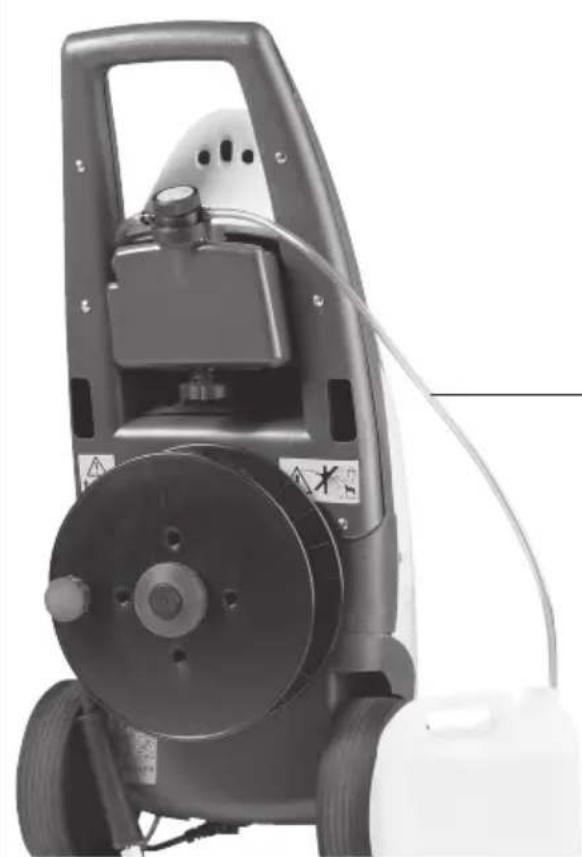
natural_image
Close-up of a black industrial water purifier with visible control panel and safety warning labels (no text or symbols on the device itself)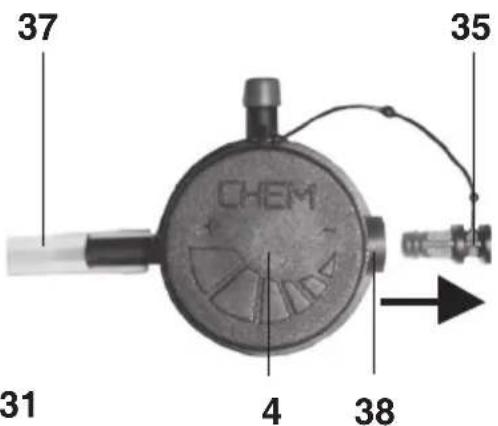
6 ARRESTO E MESSA A RIPOSO
Congratulations for choosing one of our products! We would like to remind you that we took the safety of the operator, the efficiency of its use and the protection of the environment into great consideration when designing and manufacturing this product.
In order to preserve its features over time, please read and follow these instructions carefully.
Particular attention must be awarded to the parts with the following symbol:
WARNING
as they contain important instructions regarding safety when using the high-pressure cleaner.
The Manufacturer is not liable for damage caused by:
- failure to comply with these instructions;
- use of the high-pressure cleaner not included in the list in the "DESIGNATED USE" section;
- failure to comply with current safety regulations and regulations for the prevention of accidents in the workplace when using the high-pressure cleaner;
- incorrect installation
- failure to carry out the anticipated maintenance;
- modifications or actions without prior authorisation by the Manufacturer;
- use of non-original or non-specific spare parts for this model of high-pressure cleaner;
• repairs which were not completed by a Skilled Technician.
1.1 THE ADDRESS OF THE MANUFACTURER
The address of the manufacturer is given in the EC declaration of conformity.
1.2 USE AND CONSERVATION OF THESE OPERATING AND MAINTENANCE MANUAL
The operating and maintenance instructions are an integral part of the high-pressure cleaner and they must be kept in a safe place for future reference so that they may be readily consulted in case of need. The operating and maintenance instructions contain important information for the safety of the operator and of any people near him and for the protection of the environment.
In case of deterioration or loss, a new copy should be requested from the dealer or from an authorised service centre.
If the high-pressure cleaner is passed on to a third party, please make sure these operating and maintenance instructions are also given to the new owner.
We take great care when drawing up our instructions. If you note any mistakes, please do inform the Manufacturer or an authorised service centre.
The Manufacturer reserves the right to modify, update and correct these instructions without notice. It is illegal to copy these instructions, even partially, without prior authorisation by the Manufacturer.
1.3 SYMBOLS AND TERMS
1.3.1 Symbols
The symbol:
WARNING
next to certain parts of the text, is to indicate that there is the firm possibility of injury to persons if the relative instructions and indications are not followed.
The symbol: CAUTION
next to certain parts of the text, is to indicate that there is the possibility of damaging the high-pressure cleaner if the relative instructions are not followed.
1.3.2 Terms
- Skilled Technician: a person, generally from the service centre, who has received appropriate training and is authorised to carry out special maintenance and repairs on the high-pressure cleaner. Any work on is electrical parts must be carried out by a Skilled Technician who is also a Qualified Eletrician, i.e. a person with professional training who is authorised to check, install and repair electrical equipment correctly and according to current regulations in the country where the high-pressure cleaner is installed.
- Total Stop: this stops operation of the high-pressure cleaner every time the control lever on the cleaner
gun is released. It does not operate in the range of pressures between 0÷20 bar/0÷290psi.
- By-pass: means the particular operating mode of the high-pressure cleaner that is achieved when the lever of the cleaner gun is released during normal operation. In this condition, the pressure gauge signals lack of pressure and the pumped water returns to the suction unit thanks to the pressure control valve. Due to the presence of the Total stop, (see previous description), this operating mode is only activated in the range of pressures between 0 ÷ 20 bar/0÷290 psi, or should the Total Stop fail to operate.
- Easy Start: this aids starting up the high-pressure cleaner by lowering the pressure for the first moments of its operation.
2 FEATURES AND TECHNICAL SPECIFICATIONS
| KA Classic - KA Excel | |||||
| 2800 M 30 | 00 M 3200 M | 4000 T 5000 T | |||
| ELECTRICAL CONNECTIONMains power supply 230 V / 1~ 50 Hz 400 V | / 3~ 50 Hz | ||||
| Absorbed power 2,6 kW 2,9 kW 2,9 kW 3,8 kW | 4,3 kW | ||||
| Fuse 16 A | |||||
| HYDRAULIC CONNECTIONMaximum inlet water temperature 50 °C / 122 °F | |||||
| Minimum inlet water temperature 5 °C / 41 °F | |||||
| Minimum inlet water flow | 700 l/h185 US gph | 900 l/h238 US gph | 800 l/h211 US gph | 900 l/h238 US gph | 900 l/h238 US gph |
| Maximum inlet water pressure 0,8 MPa / 8 bar | / 116 psi | ||||
| Maximum priming depth 1,5 m / 59 in | |||||
| PERFORMANCEWater flow | 540 l/h143 US gph | 720 l/h191 US gph | 600 l/h159 US gph | 720 l/h191 US gph | 720 l/h191 US gph |
| Maximum pressure | 14 MPa140 bar2031 psi | 13 MPa130 bar1885 psi | 15 MPa150 bar2176 psi | 17 MPa170 bar2466 psi | 20 MPa200 bar2901 psi |
| Recoil of cleaner gun | 25 N | 31 N | 29 N | 36 N | 39 N |
| Sound level | 88,2 dB (A) | ||||
| Operator arm vibrations | 2,30 m/s^2 | ||||
| WEIGHT AND DIMENSIONLenght x width x height(without pipe reel) | 46 x 41 x 94 cm / 18,1 x 16,1 x 37,0 in | ||||
| Lenght x width x height(with pipe reel) | 48 x 41 x 94 cm / 18,9 x 16,1 x 37,0 in | ||||
| Weight(without pipe reel) | 37 kg / 81,6 lb | ||||
| Weight(with pipe reel) | 43 kg / 94,8 lb | ||||
| Detergent tank | 4 l / 1,06 US gal | ||||
All features and technical specifications are only indications. The Manufacturer reserves the right to modify the appliance as it deems necessary.
2.1 IDENTIFICATION OF COMPONENTS
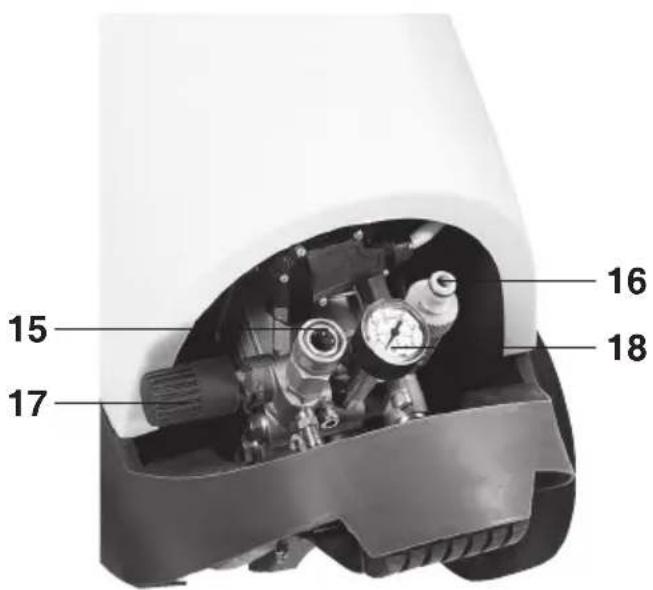
Please also refer to figures 1 to 4, which are located at the start of these operating and maintenance instructions.
-
Main switch
-
Housing for cleaner gun/lance pipe
-
Detergent tank cap
-
Detergent adjustment control
-
Detergent tank
-
Detergent tank ring
-
Pocket for accessories
-
"Read instructions before..." label
-
"Do not spray persons.." label
-
Pipe reel ring nut (KA Excel)
11 Pipe reel (KA Excel)
-
Pipe reel knob (KA Excel)
-
Identification label
-
Electric wire
-
Connection for water outlet
-
Quick connection for water inlet
-
Pressure adjustment control
-
Pressure gauge
-
Cleaner gun
-
Lance pipe KA 2800 M
-
Lance pipe
-
Nozzle head KA 2800 M
-
Nozzle head
-
Professional, fixed, fan-shaped spray nozzle
-
Nozzle cleaning pin
-
High pressure pipe
-
External detergent suction pipe
-
Safety stop on cleaner gun lever
-
Cleaner gun control lever
-
Quick coupling for high pressure pipe
-
External detergent suction cap
-
Coupling for external detergent suction pipe
-
Detergent suction pipe
-
Coupling for suction of detergent from external tank
-
Inlet water filter
-
Filter for suction pipe of external detergent

2.2 SAFETY DEVICES
This high-pressure cleaner is provided with the following safety devices:
a) Amperometric protector
This blocks the operation of the high-pressure cleaner in case of excessive consumption of electrical current.
In this case, proceed as follows:
- switch the main switch (1) to position '0' and remove the plug from the power outlet;
- press the lever (33) on the cleaner gun to eliminate any remaining pressure;
- wait 10 to 15 minutes until the high-pressure cleaner cools down;
- check that the instructions in the “Controls and connection to the mains electricity supply” section have been followed, particularly regarding any extension cord used;
- replace the electric plug in the power outlet and repeat the start-up procedure described in the "OPERATION" section.

WARNING
- If this safety device cuts in repeatedly, do not use the high-pressure cleaner until it has been checked by a Skilled Technician.
b) Pressure limit/adjustment valve
When this valve has been correctly set, the pumped fluid is able to return to the pump's suction unit, thus preventing the creation of dangerous levels of pressure when the cleaner gun is stopped or should pressure be set that is above permitted levels.
c) Safety stop on cleaner gun lever
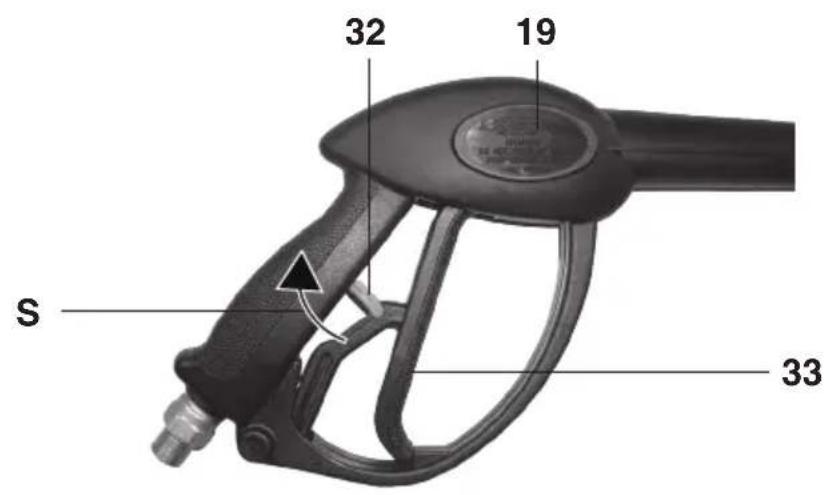
This safety device (32) shuts and blocks the lever on the cleaner gun to prevent the possibility of it being started by accident (also see Fig. 2)
2.3 DESIGNATED USE

• This high-pressure cleaner is to be used exclusively for:
- cleaning vehicles, machinery, buildings, tools etc with cold water, possibly with the addition of detergents as per the Manufacturer's instructions;
- distributing detergents as per the Manufacturer's instructions;
- removing lime scale and unblocking pipe work using the appropriate tools as per the Manufacturer's instructions;
-
water sanding objects using the appropriate tools as per the Manufacturer's instructions;
-
To protect the environment, vehicle engines and machinery with oil-pressure circuits must only be cleaned in areas with a suitable oil trap.
- The high-pressure cleaner must not be used to wash people, animals, energized electrical appliances, delicate objects or the high pressure cleaner itself.
-
The accessories (standard and optional) and the detergents used with the high pressure cleaner must be those endorsed by the Manufacturer.
-
The high pressure cleaner is not suitable for use in certain situations such as in corrosive or explosive atmospheres.
- Contact the Manufacturer's service centre before use on board vehicles, ships or airplanes, as there may be additional instructions for use.
Any other use is considered improper.
The Manufacturer is not liable for any damage caused by improper or incorrect use.
3 REMOVING THE APPLIANCE FROM ITS PACKING MATERIALS
WARNING
- Protective gloves and glasses must be worn when removing the appliance from the packing materials to prevent injury to the hands and eyes.
- The packing materials (plastic bags, staples etc.) must not be left in reach of children, as they are potentially dangerous.
- The packing materials must be disposed of according to current regulations in the country where the high-pressure cleaner is installed.
In particular, plastic bags and packaging must never be abandoned, as they are harmful to the environment.
• After removing the appliance from the packing materials, check that no parts are missing.
In case of doubt, do not use the high-pressure cleaner but contact an authorised service centre so that a Skilled Technician can check the appliance
3.1 IDENTIFICATION LABEL AND WARNING LABELS
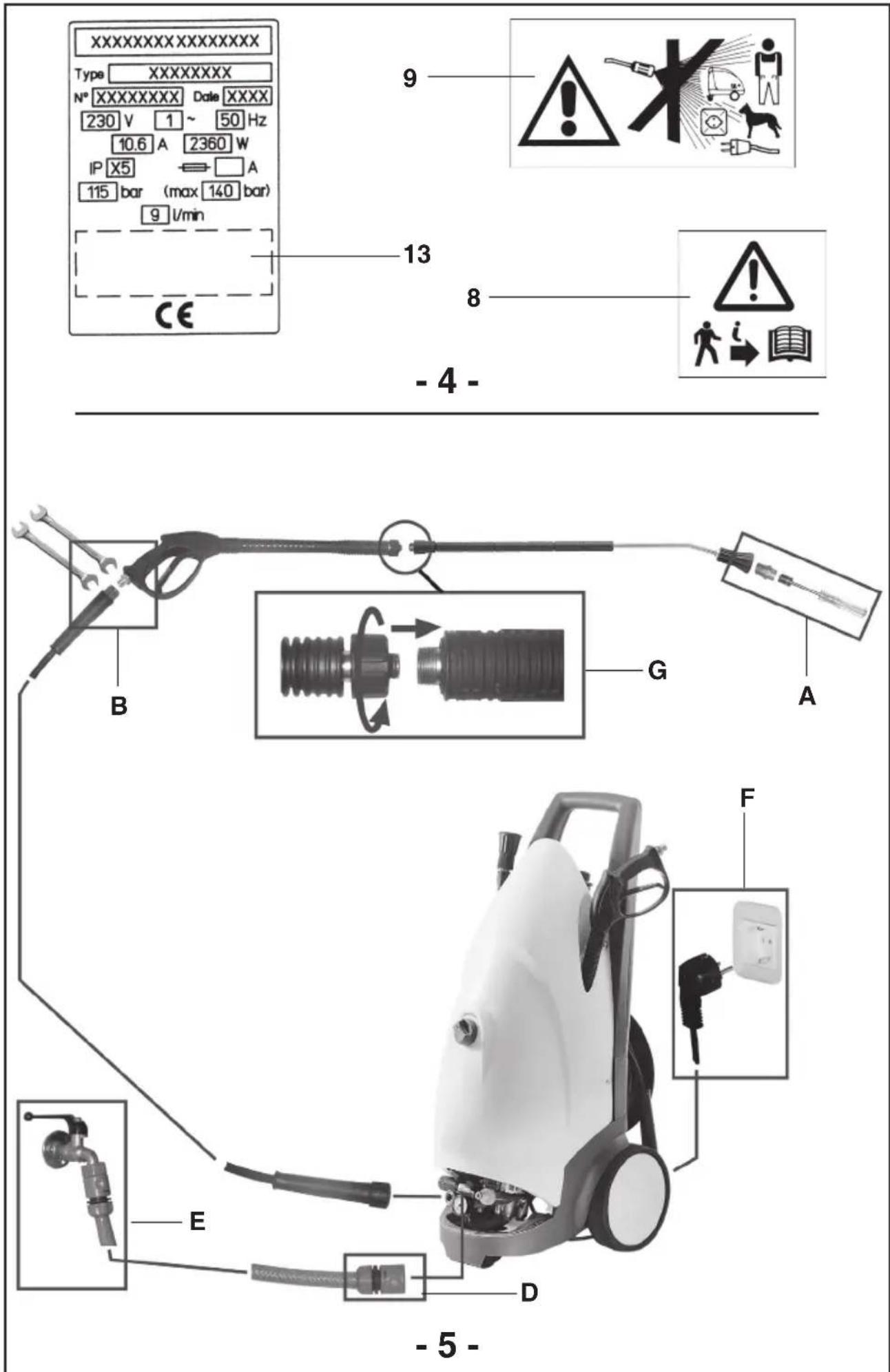
See Fig. 4 at the front of these operating and maintenance instructions.
The identification label (13) contains the serial number and the main technical specifications of the high-pressure cleaner.
The warning labels contain information regarding any further risks that may exist when using the high-pressure cleaner and their meaning is explained below.
- Warning label (8): indicates that the high-pressure cleaner must not be used unless the operating and maintenance instructions have been read carefully beforehand.
- Warning label (9): indicates that the high-pressure cleaner must not be used to wash people, animals, electrical appliances or the high pressure cleaner itself.
WARNING
• After removing the appliance from the packing materials, check that the identification label and the warning labels are present and are legible. If this is not the case, contact your dealer or an authorised service centre so they can be replaced.
- If the identification label and the warning labels deteriorate during use, contact your dealer or an authorised service centre so they can be replaced.
3.2 STANDARD ACCESSORIES
Check that the box of the product purchased contains the following parts:
• high-pressure cleaner;
• high-pressure delivery pipe;
- cleaner gun;
- lance pipe;
- bag of accessories containing:
- operating and maintenance instructions
- detergent suction pipe for external tank
- nozzle cleaning pin
- professional, fixed, fan-shaped spray nozzle
- nozzle removal key (KA 2800 M)
Should there be any problems, contact your dealer or an authorised service centre.
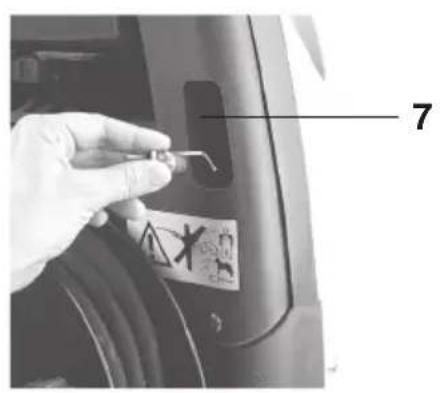
Note 1: small accessories may be inside the pockets (7).
3.3 OPTIONAL ACCESSORIES
The standard accessories for the high pressure cleaner can be integrated with the following vast range of accessories:
- Sandblasting lance: designed for smoothing down surfaces, eliminating rust, paint, deposits etc.
- Pipe-cleaning lance: designed for unblocking pipes and ducts.
- Underbody lance: designed to reach the most difficult areas of access.
- Rotating water jet brush: designed for cleaning delicate surfaces;
- Rotojet: designed to eliminate the toughest dirt;
- Foaming lance: designed for the most efficient distribution of detergent.

WARNING
- The operation of the high-pressure cleaner may be impaired if unsuitable accessories are used and they may even make it dangerous. Only use original accessories endorsed by the Manufacturer. Refer to the documents provided with the optional accessories for information regarding their general use, safety warnings, installation and maintenance.
4 INSTALLATION
See Fig. 5 at the front of these operating and maintenance instructions.
4.1 ASSEMBLING THE ACCESSORIES
- The KA 2800 M are complete with a variable, fan-shaped nozzle-head (23) with a factory-installed nozzle.
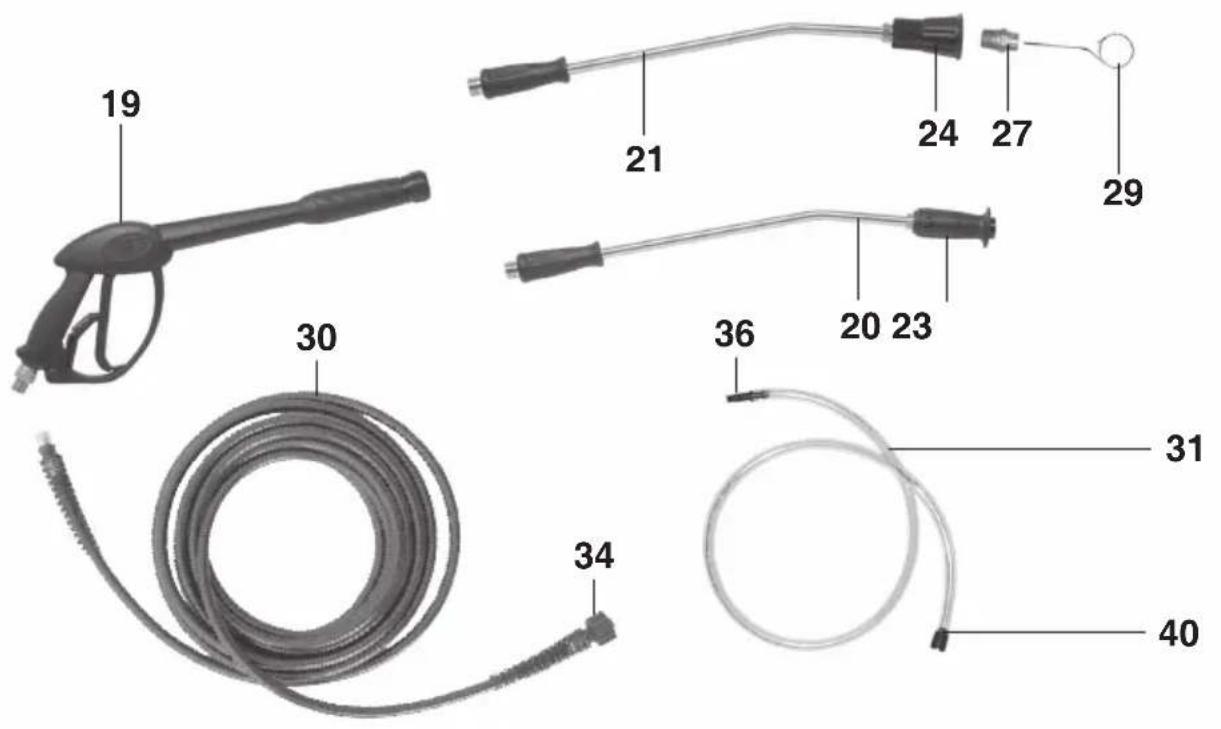
- For all other versions, fixed fan-shaped spray nozzle (27) must be assembled on the nozzle-head (24). Make sure it is secured tightly using a 14mm pipe key (not supplied). Operation A in fig. 5.
- Screw the end of the high-pressure pipe (30) (the end without the quick coupling) onto the thread of the cleaner gun (19) and tighten using two 22mm keys (not supplied). Operation B in fig. 5.
- For the KA EXCEL versions, provided with the standard pipe reel, (11), the coupling (34) for the high-pressure pipe (30) is connected to the coupling of the water outlet (15) in the factory.
4.2 CONTROLS AND CONNECTION TO THE MAINS WATER SUPPLY
CAUTION
- The water supply must be able to guarantee the adequate delivery of water flow to the high pressure cleaner; refer to the table of technical specifications.
- In case of doubt, contact a Skilled Technician.
- Do not supply the high-pressure cleaner with water at a temperature in excess of 50^ / 122^ or below 5^ / 41^ .
- The pressure of the water supply must not be in excess of 8 bar/116 psi.
- Do not operate the high pressure cleaner with a priming depth in excess of 1.5m / 4.9 ft.
- Do not operate the high pressure cleaner if it is not connected to a water supply.
- Do not supply the high pressure cleaner with salt water or water containing impurities. In this event, run the high pressure cleaner for a few minutes with clean water.

WARNING
- Follow current regulations for connection to the mains water supply in the country where the high-pressure cleaner is installed.
4.3 CONTROLS AND CONNECTION TO THE MAINS ELECTRICITY SUPPLY
WARNING
- A Skilled Technician must check that the electrical supply complies with the data indicated on the identification label on the high pressure cleaner (see Fig. 4). It is especially important that the supply voltage does not differ more than ± 5% from that indicated on the label.
- All connections to mains electricity must be carried out by a Qualified Eletrician according to IEC 60364-1 regulations or the equivalent standard in the country where the high pressure cleaner is to be used. It is especially important that the current outlet where the high pressure cleaner is connected is provided with an earth conductor and a suitable fuse (according to the size indicated on the identification label and in the table of technical specifications), and must be protected by a magneto-thermal differential circuit breaker, whose sensitivity is not in excess of 30mA .
- If the power supply cable is too short, an extension cord can be used provided it is not longer than 10m / 32.8ft , the section of the wires is at least 2.5mm^2 and the plug and the socket are waterproof. Contact a Qualified Eletrician so that all these requirements are followed.
The use of unsuitable extension cords can be dangerous.
5 OPERATION
WARNING
- The high pressure cleaner must be used with care and attention. It is your responsibility to make sure that any infrequent users have read these instructions and are acquainted with the operation of the high-pressure cleaner; otherwise do not allow others to use the high pressure cleaner. High-pressure cleaners must not be used by children or by unauthorised personnel.
- Comply with the safety warnings in the operating and maintenance instructions of any optional accessories to be used.
-
Do not use the high pressure cleaner if:
-
the power supply cable or other important parts such as the high pressure pipe, the safety devices, the cleaner gun and the lance are damaged;
- the high pressure cleaner has been tipped over or has been bumped;
- there are obvious leaks of water.
In these circumstances, the high-pressure cleaner should be tested by a Skilled Technician.
- It is especially important to pay great attention when the high pressure cleaner is used in areas where there are moving vehicles as these can crush or damage the power supply cable, the high pressure pipe, the cleaner gun etc.
- During operation, never leave the high-pressure cleaner unattended and make sure it is out of children's reach. Pay particular attention when using it in kindergartens, nursing homes and old people's homes, as unsupervised children, elderly people and disabled people may be present in such places.
- Before using the high-pressure cleaner, make sure it is in a dry place and that it is in a flat and stable position in order to avoid accidents and prevent it from falling over.
- Before moving the high-pressure cleaner, follow the instructions in the "Switching off" section.
- Before starting the high-pressure cleaner, put on clothing which guarantees adequate protection against the possibility of incorrect manoeuvres of the jet of pressurised water. Do not operate the high-pressure cleaner near people unless they are also wearing protective clothing.
- High-pressure jets of water can be dangerous if they are not used properly. Do not point the jet in the direction of people, animals, and energized electrical appliances or towards the high-pressure cleaner itself.
- Hold the cleaner gun firmly during use: when operating the lever (33), the operator is subjected to the backlash of the high pressure. The power of this recoil is indicated in the table of technical specifications (recoil is expressed in N, where 1 N = 0.1 kg).
- Do not point the jet towards oneself or other people in order to clean off clothing or footwear.
- Vehicle tyres must be cleaned at a distance of at least 50cm to safeguard them from being damaged by the high-pressure jet. The first evidence of damage to a tyre is a change in colour.
- Do not point the high-pressure jet towards materials, which contain asbestos or other harmful substances.
- Do not use the high-pressure cleaner in the rain.
- Pay particular attention to the instructions in the “Controls and connection to the mains electricity supply” section.
- Pay particular attention to the instructions in the "Use with detergents" section.
- When the high-pressure cleaner is not in use, do not leave its plug in the power outlet and disconnect it before any activity. More precisely, make sure that the mains switch (1) is in position '0', remove the plug from the power outlet, press the lever (33) on the cleaner gun to eliminate any remaining pressure and bring the safety catch in its locked position (32) (Fig. 2 – position S):
- before leaving the high power cleaner unattended, even for only a short time;
- before topping up the detergent;
-
after use;
-
In addition, wait until the high pressure cleaner has completely cooled down before cleaning or maintenance.
- During use, do not lock the lever (33) on the cleaner gun in the open position.
- Do not remove the plug from the power outlet by pulling on the power supply cable.
- Do not put any reducers or adaptors between the electric plug and the power outlet.
- Keep the power supply cable, any extension cords, the plugs and the outlets dry. Do not touch them with wet hands.
- Should the power supply cable be damaged, contact a Qualified Eletrician for its replacement.
- Do not cover the high pressure cleaner during operation and do not place it where there is inadequate ventilation.
- When the high pressure cleaner is used in enclosed spaces, make sure that there is adequate ventilation.
5.1 PRELIMINARY PROCEDURES
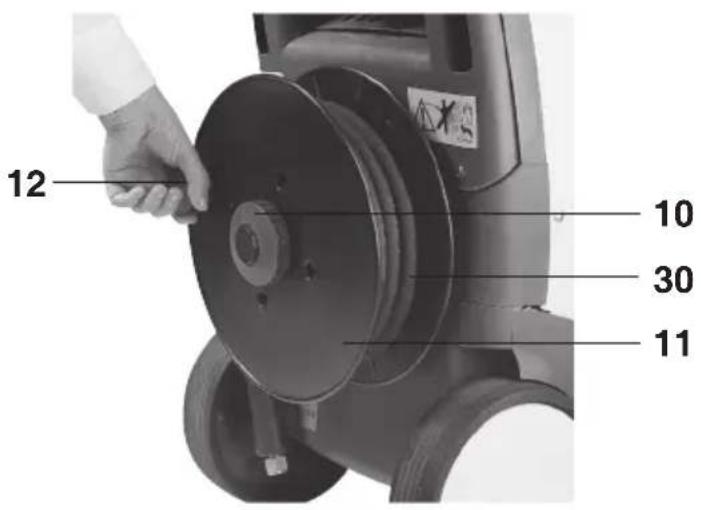
- Pipe reel (11): turn the ring nut (10) anti-clockwise to release the device; unroll the amount of pipe required by turning the reel anti-clockwise using the knob (12); turn the ring nut (10) clockwise to block the device.
- Attach a supply pipe to the water inlet's quick connection (16) using a normal garden connector. Operation D in Fig. 5.
- Open the tap to the water supply and make sure that there are no drips. Operation E in Fig. 5. Otherwise, prime using an appropriate tank.
- Make sure that the main switch (1) is in the off position (the '0' position) and put the plug into the electric current outlet. Operation F in Fig. 5.
- Turn the main switch (1) to position '1'.
- Press the cleaner gun's control lever (33) and wait for a continuous jet of water to be issued.
- Note 3: the Total Stop function is not operational in this condition because the operating pressure is less than 20 bar / 290 psi (also refer to the “Interrupting use when operating pressure is between 0÷20 bar/0÷290 psi” section).
- Turn the main switch (1) to position '0' and connect the lance pipe (21) to the cleaner gun (19). Operation G in Fig. 5.
5.2 STANDARD OPERATION (HIGH PRESSURE)
- Make sure that the nozzle head (23) or (24) is not in the position for supplying detergent (also see the “Use with detergents” section).
- Restart the high pressure cleaner by turning the main switch (1) to position '1' and check that the spray from the nozzle is uniform, without dripping.
- Note 4: during this restart phase, the high pressure cleaner will immediately stop operating after the initial peak, as the Total Stop device will take effect.
- Use the cleaner gun's lever (33) to start operation of the high pressure cleaner and thus start cleaning.
- Adjust the pressure, if necessary, using the pressure adjustment control (17). Turn this knob clockwise to increase pressure and anticlockwise to reduce pressure. The amount of pressure is shown on the pressure gauge (18)
5.3 USE WITH DETERGENTS
WARNING
- The high pressure cleaner was designed to be used with the detergents recommended by the Manufacturer. Use of other detergents or chemicals can affect the safety of the high pressure cleaner.
Never suck up liquids, which contain solvents, petrol, diluents, acetone and fuel oil, as these products are highly inflammable, explosive and toxic when nebulized. - Read the instructions and warnings on the label of the detergent to be used.
- Store detergents in a safe place out of children's reach.
- Should detergent come into contact with your eyes, wash immediately with water. Contact a doctor without delay and remember to take the container of detergent with you.
- If detergent is swallowed, do not provoke vomiting. Contact a doctor without delay and remember to take the container of detergent with you.
- When filling the tank with detergent, take care not to spill any detergent on the high pressure cleaner. If this should happen, wait at least 24 hours before using the high pressure cleaner so that any liquid, which may have entered the appliance, can evaporate.
The recommended detergents, are over 90% biodegradable.
For information on how to use the detergents, refer to the instructions in the table and on the label on the container of detergent.
- If using suction from the high-pressure cleaner's tank (5), unscrew the cap (3) and fill the tank taking care not to spill the liquid (maximum capacity 4L / 1.06 US gallons). Follow the recommendations regarding the doses indicated on the label on the container of detergent.
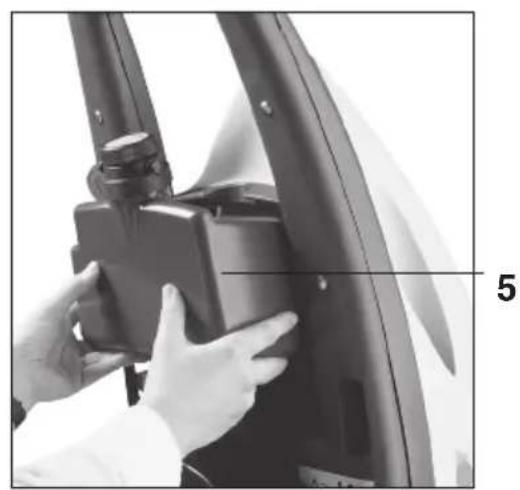
For more thorough cleaning, the detergent tank (5) can be removed from its housing as follows:
- Unscrew the ring nut (6) completely, remove the detergent suction pipe (37), press down on the detergent cap (3) and remove the tank (5) at the same time.
Follow the same procedure backwards to replace the tank.
CAUTION
- Make sure that the tank (5) is replaced in the correct position, especially regarding the detergent suction pipe (37).
All high-pressure cleaners can also take up detergents from an external tank. This is also possible if the tank (5) contains detergent as the suction from the internal tank is automatically interrupted (also refer to following section).
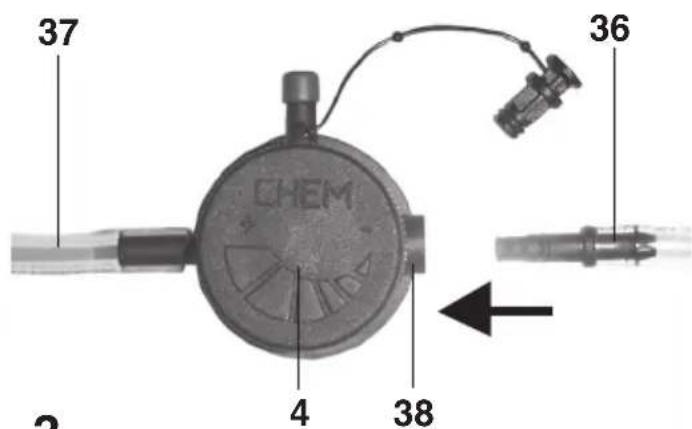
- If using suction from an external tank (also see Fig. 3), unscrew the cap (35) and insert the coupling (36) for the detergent suction pipe for an external tank (31) into the coupling (38). The external tank should already contain the chosen detergent. Again, follow the recommendations regarding the doses indicated on the label on the container of detergent.
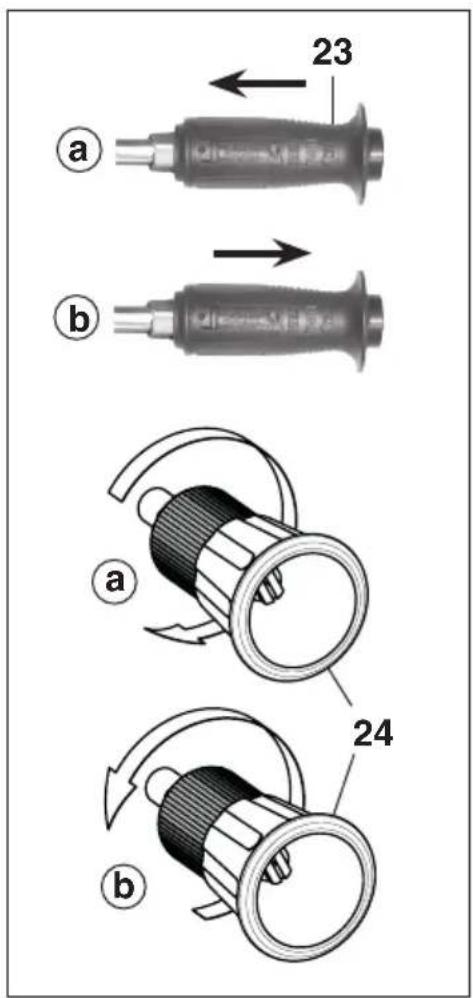
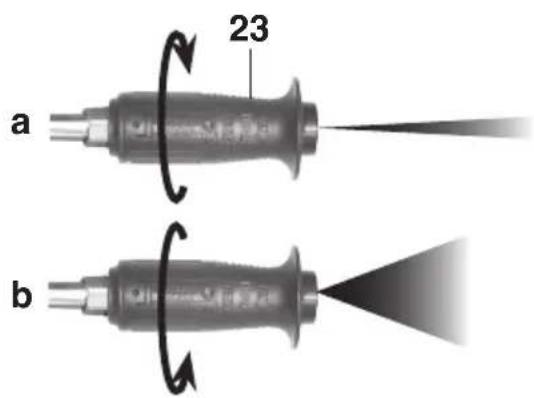
- Operate the nozzle head (23) or (24) as illustrated in Fig 3a and then operate the lever (33) on the cleaner gun and start the releasing the detergent.
- Turn the detergent adjustment control knob (4) to achieve the required amount of product.
- Operate the nozzle head (23) or (24) as illustrated in Fig 3b to restore high-pressure operation.
CAUTION
- After use of the high pressure cleaner with external tank, take care to replace the cap (35) correctly in the coupling (38) to safeguard the correct suction of detergent from the high-pressure cleaner's tank (5).
5.4 INTERRUPTING USE
5.4.1 Interrupting use when operating pressure is between 0÷20 bar/0÷290 psi
Release the lever (33) on the cleaner gun and the high-pressure cleaner will change from operational mode to bypass mode and remains in bypass mode until the lever (33) is pressed again.
CAUTION
- Do not leave the high-pressure cleaner in bypass mode for more than three minutes (with cleaner gun closed).
5.4.2 Interrupting use when operating pressure is above 20 bar/290 psi (Total Stop)
Release the lever (33) on the cleaner gun and the high-pressure cleaner will automatically stop.
The high-pressure cleaner starts operating normally again when the lever on the cleaner gun is pressed again.

WARNING
- It is important to remember that the high pressure cleaner is still operational when it is in Total Stop mode. Therefore, always put the main switch (1) in position “0”, remove the plug from the power outlet, press the lever (33) on the cleaner gun to eliminate any remaining pressure and lock the safety protection device (32) (Fig. 2 – position s), before leaving it unattended, even for a short time.
Note 5: during use with operating pressure in excess of 20 bar/290 psi (i.e. when the Total Stop device is operational) if switch (1) is put into position "0" for any reason (and lever (33) on the cleaner gun is not being operated to eliminate any remaining pressure) the next time the switch (1) is put into position "1", the high pressure cleaner will not begin to start up as it is already ready for normal operation. Press lever (33) on the cleaner gun to start operating the high-pressure cleaner.
6 SWITCHING OFF AND STORAGE
After cleaning, switch the high-pressure cleaner off and prepare it for storage.
6.1 SWITCHING OFF
- Close the tap for the water supply securely.
- Empty the water out of the high-pressure cleaner by pressing the lever (33) on the cleaner gun for a few minutes.
- Put the main switch (1) in position "0"
- Remove the plug from the power outlet.
- Press the lever (33) on the cleaner gun to eliminate any remaining pressure in the high-pressure pipe (30).
- Wait for the high pressure cleaner to cool down.
WARNING
- When the high-pressure cleaner is left to cool down, take care that:
- the high-pressure cleaner is not left unattended in the presence of unsupervised children, elderly or disabled people.
- the high-pressure cleaner is in a stable position and not at risk of falling over.
- the high-pressure cleaner is not in contact with inflammable materials, or in their immediate vicinity.
6.2 STORAGE
- Wind up the high-pressure pipe (30) carefully and avoid bending it.
• Wind up the electric power supply cable (14). - Put the high-pressure cleaner in a clean and dry place making sure that the electric power supply cable and the high-pressure pipe are not damaged.
CAUTION
- The high-pressure cleaner is not frost proof.
In order to prevent the formation of ice inside the high-pressure cleaner in cold areas, it is possible to make the high pressure cleaner take up a motor vehicle grade anti freeze before starting the “Switch off” procedures. Contact a Skilled Technician before attempting this as the pumped liquid could damage the seals in the high-pressure pump.
If it is not possible to protect the high pressure cleaner in cold areas as described above, it must be brought into a warm room for the time required to melt any ice which may have formed inside it before attempting to start it up again.
If these instructions are not followed, the high pressure cleaner may be seriously damaged.
7 CLEANING AND MAINTENANCE
WARNING
- Only start cleaning and maintenance once the instructions in the “Switching off” section have been completed.
It is particularly important to always disconnect the electricity supply.
- To safeguard the safety of the high pressure cleaner, only use the original spare parts supplied by the Manufacturer or those endorsed by him.
- The rubber pipes, the coupling and the high-pressure lances are important for safety: only use those endorsed by the Manufacturer.
7.1 ROUTINE MAINTENANCE
Follow the instructions in the “Switching off” section and abide by the recommendations in the table below.
| INTERVAL FOR MAINTENANCE ACTION | |
| Each time used • Check the supply cable, high-pressure pipe, couplings, cleaner gun, lance pipe.Should any of these parts appear to be damaged, do not use the high pressure cleaner and contact a Skilled Technician. | |
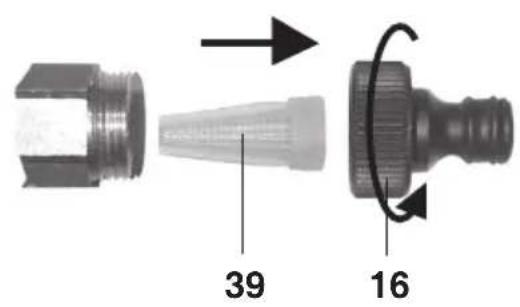
| Weekly • Clean the water inlet filter (39).Unscrew the water inlet coupling (16) and remove the filter (also see fig. 1).Usually, it is sufficient to pass the filter under running water or in a jet of compressed air to clean it. In more difficult cases, use a lime scale remover or replace the filter.Contact an authorised service centre for the purchase of a new filter. | |
| Monthly • Clean the detergent suction filters.A filter is found inside the tank (5) and is accessible after the cap (3) has been removed.Another filter (40) is supplied with the detergent suction pipe from external tank (31).Usually it is sufficient to pass the filters under running water or in a jet of compressed air to clean them. In more difficult cases, use a lime scale remover or replace the filters.Contact an authorised service centre for the purchase of new filters.• Clean the nozzle.It is generally sufficient to insert the pin (29) supplied into the nozzle's hole to clean it.If this does not result in any improvement, replace the nozzle. Contact an authorised service centre for the purchase of a new nozzle.The professional, fixed, fan-shaped spray nozzle used on the nozzle heads (24) can be replaced using a 14 mm pipe key (not supplied). | |
CAUTION
- During use, the high pressure cleaner should not be too noisy and large amounts of water or oil should not drip from underneath it.
In this event, a Skilled Technician should test the appliance.
- Only Skilled Technicians are authorised to carry out special maintenance.
Follow the instructions in the table below for special maintenance.
| INTERVAL FOR MAINTENANCE ACTION | |
| Every 200 hours Check the pump's oil | I-pressure circuitCheck the pump is secure. |
| Every 500 hours Replace the pump oil | Check the pump suction/delivery valvesCheck the pump screws are secureCheck the pump adjustment valveCheck the safety devices |
CAUTION
- The data in the table are indications.
8 DISMANTLING AND DISPOSAL
Only trained personnel are allowed to dismantle the high pressure cleaner in accordance with the current regulations in the country where it is installed.
In particular, the symbol on the identification plate (13) indicates the product must not be disposed of together with normal household waste.
For further information, contact your local authority's waste disposal service or your local retailer.

WARNING
- Before disposing of the high pressure cleaner, make sure it is no longer possible to operate it, by cutting the power supply cable for example. Make sure all its parts are inoffensive, as they could prove to dangerous to children playing.
9 PROBLEMS, CAUSES AND SOLUTIONS

- Before undertaking any action, follow the instructions in the “Switching off” section. If it is not possible to restore correct operation of the high pressure cleaner using the information in the table below, contact a Skilled Technician.
| PROBLEM CAUSE SOLUTION | ||
| The high-pressure cleaner does not start when switch (1) is put into position “1”. Note the information in Note 5 in the “Interrupting use when operating pressure is above 20 bar/290 psi (Total Stop)” section. | A safety device in the system where the high pressure cleaner is connected has cut in (fuse, differential circuit breaker, etc).The power supply cable is not inserted correctly. | Reset the protection device.If it cuts in again, do not use the high pressure cleaner and contact a Skilled Technician.Take the plug out of the socket and replace it correctly. |
| The high pressure cleaner vibrates a lot and is noisy | The water inlet filter (39) is dirty.The water supply is insufficient or priming depth is excessive | Follow instructions in the “Routine Maintenance” section.Check that the tap is fully open and that the mains water supply or the priming depth conform with the instructions in the “Features and Technical data” section |
| The high pressure cleaner does not reach maximum pressure. | The adjustment valve is set for a pressure which is lower than maximum.The nozzle head (23) or (24) is in the position for low pressure (fig. 3 - position A).The nozzle is worn. | Turn the control knob clockwise (17).Follow instructions in Fig 3 Position B.Replace the nozzle according to instructions in the “Routine Maintenance” section |
| Poor suction of detergent. | The detergent adjustment control knob (4) is not fully open.The nozzle head (23) or (24) is not in the position for low pressure (fig. 3 - position B).Detergent suction filter is blocked.After use with an external detergent tank, the cap (3) was not replaced.The detergent used is too viscose. | Turn the detergent adjustment control further anticlockwise.Follow instructions in Fig 3 Position A.Follow instructions in the “Routine Maintenance” section.Replace the cap correctly.Use a detergent recommended by the Manufacturer and follow instructions on the label re its dilution. |
| Nowatercomesoutofthenozzle.No water.Suction depth is excessive.Blocked water nozzle. | Check that the mains water tap is fully open or that the suction pipe can prime.Check the priming depth conforms to instructions in the “Features and Technical Specifications” section.Clean and/or replace the nozzle as per instructions in the “Routine Maintenance” section. | |
| The high-pressure cleaner stops during use. | A safety device in the system where the high pressure cleaner is connected has cut in (fuse, differential circuit breaker, etc).The ammeter protection device has cut in. | Reset the protection device.If it cuts in again, do not use the high pressure cleaner and contact a Skilled Technician.Follow instructions in the “Safety Devices” section. |
| If main switch (1) is turned, the motor hums but does not start up. | The electrical system and/or extension cord are not suitable. | Follow instructions in the “Controls and connection to the mains electricity supply” section. |

1 INFORMATIONS GENERALES
5.3 FONCTIONNEMENT AVEC DETERGENT
ATTENTION
6 ARRET ET MISE AU REPOS
9 PROBLEMES, CAUSES ET SOLUTIONS

'TENTION
□.□ V□□□□□□□□□ E C□□□□□ C□ A R□□ H□□□□□□□
ADVERTÊNCIA
3.1 IDENTIFICATIEPLAATJE EN WAARSCHUWINGSTEKENS
3.3 OPTIONELE HULPSTUKKEN
5.3 WERKING MET HET REINIGINGSPRODUCT
ATTENTIE
1610 0759 00 - 11/2017 - Rev. 04
- IT • IDROPULITRICI ELETTRCHE AD ACQUA FREDDA
- ARRESTO E MESSA A RIPOSO
- WARNING
- The Manufacturer is not liable for damage caused by:
- THE ADDRESS OF THE MANUFACTURER
- USE AND CONSERVATION OF THESE OPERATING AND MAINTENANCE MANUAL
- SYMBOLS AND TERMS
- Symbols
- The symbol: CAUTION
- Terms
- IDENTIFICATION OF COMPONENTS
- SAFETY DEVICES
- a) Amperometric protector
- b) Pressure limit/adjustment valve
- c) Safety stop on cleaner gun lever
- DESIGNATED USE
- REMOVING THE APPLIANCE FROM ITS PACKING MATERIALS
- IDENTIFICATION LABEL AND WARNING LABELS
- STANDARD ACCESSORIES
- OPTIONAL ACCESSORIES
- INSTALLATION
- ASSEMBLING THE ACCESSORIES
- CONTROLS AND CONNECTION TO THE MAINS WATER SUPPLY
- CAUTION
- CONTROLS AND CONNECTION TO THE MAINS ELECTRICITY SUPPLY
- OPERATION
- PRELIMINARY PROCEDURES
- STANDARD OPERATION (HIGH PRESSURE)
- USE WITH DETERGENTS
- INTERRUPTING USE
- Interrupting use when operating pressure is between 0÷20 bar/0÷290 psi
- Interrupting use when operating pressure is above 20 bar/290 psi (Total Stop)
- SWITCHING OFF AND STORAGE
- SWITCHING OFF
- STORAGE
- CLEANING AND MAINTENANCE
- ROUTINE MAINTENANCE
- DISMANTLING AND DISPOSAL
- PROBLEMS, CAUSES AND SOLUTIONS
- INFORMATIONS GENERALES
- FONCTIONNEMENT AVEC DETERGENT
- ATTENTION
- ARRET ET MISE AU REPOS
- PROBLEMES, CAUSES ET SOLUTIONS
- 'TENTION
- □.□ V□□□□□□□□□ E C□□□□□ C□ A R□□ H□□□□□□□
- ADVERTÊNCIA
- IDENTIFICATIEPLAATJE EN WAARSCHUWINGSTEKENS
- OPTIONELE HULPSTUKKEN
- WERKING MET HET REINIGINGSPRODUCT
- ATTENTIE
Brand : Comet
Model : KA 3200 Excel
Category : Pressure washer