
Premium - Water filter AARKE - Free user manual and instructions
Find the device manual for free Premium AARKE in PDF.


| Product Type | Soda maker / carbonator |
| Brand | Aarke |
| Model | Premium |
| Dimensions (Carbonator) | Height 414 mm, Width 153 mm, Depth 258 mm |
| Weight (Carbonator) | Approximately 1450 g |
| Water Bottle Dimensions | Height 265 mm, Diameter 85.5 mm |
| Water Bottle Weight | 209 g |
| Water Bottle Capacity | 812 ml (to filling line) |
| Material | Polished stainless steel (also available in lacquered finish) |
| Power Source | Manual operation (no electricity) |
| Gas Cylinder Compatibility | Standard CO2 cylinders approved for carbonators (cylinder not included) |
| Carbonation Control | Adjustable by repeating carbonation cycles or partial lever lift |
| Water Bottle Material | Plastic (max temperature 40°C) |
| Cleaning (Stainless Steel) | Microfiber cloth with water or mild soap; no abrasive cleaners |
| Cleaning (Lacquered) | Soft cloth/sponge with water or mild soap; no abrasive cleaners |
| Dishwasher Safety | Water bottle not dishwasher safe; hand wash only |
| Warranty | 2 years (or as per local law) for workmanship/defects |
| Safety Features | Pressure release on lever; use only upright; avoid heat sources |
| Recommended Use | Carbonating plain cold water only; not for other beverages |
| Maintenance | Empty spill tray; replace water bottle after expiry date |
Frequently Asked Questions - Premium AARKE
User questions about Premium AARKE
0 question about this device. Answer the ones you know or ask your own.
Ask a new question about this device
Download the instructions for your Water filter in PDF format for free! Find your manual Premium - AARKE and take your electronic device back in hand. On this page are published all the documents necessary for the use of your device. Premium by AARKE.
USER MANUAL Premium AARKE
natural_image
Modern stainless steel water leveler with dual lever and base (no visible text or symbols)INSTRUCTION MANUAL / INSTRUKTIONSBOK
ENGLISH 3-27
SVENSKA 28-53

Congratulations to your new Aarke Carbonator.
A few minutes spent on reading this book will enable you to get the very best out of this excellent soda maker. Carbonating water at home is convenient, affordable and environmentally friendly. The other advantage with a carbonator over bottled mineral water is that you can choose your own level of carbonation. You will soon get to know your carbonator and learn how you should operate it to get the perfect level of carbonation. Some people like a real carbonation bite and some want a milder effervescent taste.
The Aarke Carbonator is carefully crafted in the finest materials, designed and tested for best possible quality and safety. However, products that include gas and high pressures should always be handled with care. It is, therefore, important that the product is used as intended. Please read through the safety section of this book carefully before using it.
Welcome to Aarke!
INCLUDED IN THE BOX

natural_image
Line drawing of a modern vertical stand with two cups and a base, no text or symbols presentCarbonator

Water bottle

natural_image
Simple black square with a thin border on top (no text or symbols)This book

GETTING STARTED
HOW TO OPERATE YOUR CARBONATOR
1
GETTING STARTED
ATTACHING THE GAS CYLINDER
ATTACHING CYLINDER
Remove the spill tray grid and then carefully lay the carbonator down on the side with the lever upwards.

natural_image
Technical line drawing of a mechanical device with cylindrical components and a perforated base plate (no text or symbols)Unscrew the plastic sealing from the cylinder top. Carefully insert the gas cylinder through the hole at the bottom. Don't drop the cylinder into the hole. When you feel that it reaches the bottom, begin screwing the cylinder clockwise until it is fastened. Don't screw too hard since this might break the threads holding the gas cylinder in place.

DETACHING CYLINDER
When you need to replace the gas cylinder, lay the carbonator down on the side with the lever pointing up and unscrew it counterclockwise and then carefully pull it out of the compartment.
2
GETTING STARTED
THE CARBONATION PROCESS

1. FILL THE WATER BOTTLE
Rinse the water bottle with luke warm water before you use it for the first time.
Fill the water bottle with cold, clean water up to the marked filling line. If you fill too much you will get a lot of water in the spill tray during carbonation.

natural_image
Simple line drawing of a laboratory apparatus with a rotating container and upward arrow (no text or symbols)2. ATTACH THE WATER BOTTLE
Screw the water bottle into the water bottle socket.
Screw counterclockwise if viewed from above.
Don't screw extremely hard - just make sure the water bottle sits properly.

natural_image
Line drawing of a laboratory apparatus with a vertical dashed line and a horizontal base (no text or symbols)3. CORRECTLY ATTACHED BOTTLE
Make sure the water bottle is attached correctly, in complete vertical position.

4. CARBONATE
Pull the lever downwards until you hear a buzzing sound.

5. VENTILATE 6. MORE CARBONATION
Release the lever back to horizontal position. The remaining pressure in the water bottle will be released with a puff sound.

To add more carbonation, repeat the carbonation cycle a few times before unscrewing the water bottle.

GETTING STARTED
DEGREE OF CARBONATION
With the Aarke Carbonator you can easily learn how to adjust the degree of carbonation, or, how much bubbles you want.
The level of carbonation depends on many factors such as the temperature of the water and the amount of gas in the gas cylinder.
We encourage you to experiment with the level of carbonation to find your own preference. Some people want a real carbonation bite and some want a milder effervescent (less bubbly) taste.
HOW WOULD YOU LIKE YOUR SODA WATER?
You will add more carbonation to the water by repeating the carbonating process.
The process will consume less gas if you lift the lever half-ways (enough to quiet the buzzing sound but before relieving the pressure from the bottle) between the carbonation cycles.

4
GETTING STARTED
FLAVORING THE WATER

natural_image
Simple line drawing of a lemon slice (no text or symbols)Essences, syrups, fruits and infusions. There are virtually endless possibilities to make carbonated water even more refreshing and inspiring. Below is a quick and easy recipe for classic lemonade.
CLASSIC LEMONADE
2dl sugar (or other sweetener such as agave syrup or cane sugar)
2dl water
2dl fresh lemon juice
Zest from 1/2 lemon
Put the water and the sugar into a pan and heat the mixture while stirring until the sugar is completely dissolved.
Let the syrup cool a bit before pouring it into a suitable glass container with a lid.
Add the lemon juice and the zest.
Mix 1 part syrup with about 3 parts of cool, carbonated water. First, add the flavouring substance into a glass or pitcher, then gently add the carbonated water. Serve with lots of ice and a lemon slice.
The lemonade syrup can be stored in the fridge for a couple of weeks.
MAINTENANCE
HOW TO TAKE CARE OF YOUR CARBONATOR
1
MAINTENANCE
KEEPING YOUR CARBONATOR BEAUTIFUL AND CLEAN
POLISHED VERSION
This carbonator is made of polished stainless steel. Stainless steel gets its lustre from the chrome and its stainless quality from the nickel. Adhering to the maintenance tips will ensure that you enjoy (the look of) your Aarke Carbonator for a long time.
To clean your carbonator we recommend using a micro fibre cloth and water. If needed you could use some mild soap. Do not use strong detergents or cleanser with abrasive substance.
LACQUERED VERSION
The lacquered Aarke Carbonators are made of polished stainless steel that have been industrially painted in various colours and finishes.
To clean your glossy lacquered Aarke Carbonator we recommend using a micro fibre cloth and water. If needed you could use some mild soap.
To clean you matte lacquered Aarke Carbonator we recommend using a soft cloth or sponge and water. If needed you could use some mild soap.
Never use strong detergents or cleanser with abrasive substance.
2
MAINTENANCE
EMPTYING THE SPILL TRAY
Water accumulated in the spill tray is simply removed with a dish-cloth.

WHY IS THERE WATER IN THE SPILL TRAY?
Water that flushes through the machine during the carbonating process ends up in the spill tray. This is often a result of too much water in the water bottle. Make sure the water is not filled above the filling line.
Letting the lever up more gently when the carbonation is finished, is another way of preventing water from coming out into the tray.
3
MAINTENANCE
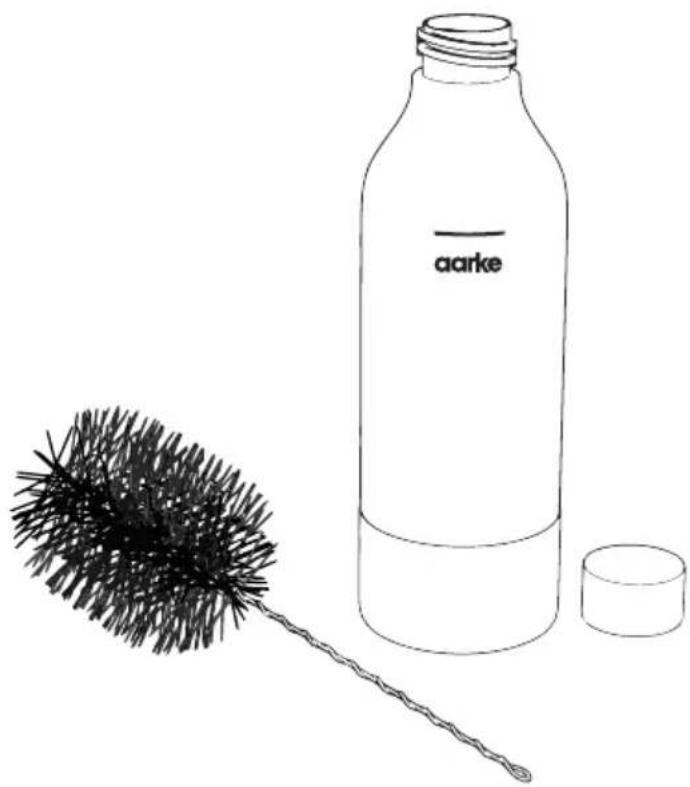
RINSING THE WATER BOTTLE
natural_image
Line drawing of a Darke water bottle, a brush holder, and a small container (no text or symbols)To clean the Aarke water bottle use clean lukewarm water with a mild detergent. If using a dishwasher brush, make sure the brush is intended to be used for cleaning plastic bottles and do not leave any scratches.
Do not use solvents, strong detergents or cleanser with abrasive substances.

Never wash the Aarke water bottles in a dishwasher. The Aarke water bottles can withstand a maximum temperature of 40 degrees Celsius.

SAFETY GUIDELINES
THINGS YOU SHOULD NOT DO WITH YOUR CARBONATOR

SAFETY GUIDELINES
DO NOT CABONATE ANY LIQUIDS OTHER THAN PLAIN WATER
When carbonating, a small amount of liquid could bubble up through the valves. If the water contains sugar or other compounds the valves could start malfunction and the product could potentially be dangerous to use. Never add fruit slices, ice and flavours in the water bottle. Use a pitcher or mix it directly in your glass. Rinse the water bottle carefully before filling it with water.

Don't put fruits, vegetables or herbs in the water bottle before carbonating.

Don't put flavours or syrup into the water bottle before carbonating.

natural_image
Simple line drawing of a bottle with no text or symbolsDon't carbonate wine! We recommend buying champagne.

natural_image
Simple line drawing of a rectangular container with a straw inserted (no text or symbols)Don't carbonate juice or milk. (Even if it is tempting)

natural_image
Three overlapping squares with dots, no text or symbols presentDon't carbonate with ice in the water bottle!

natural_image
Line drawing of a plastic bottle with cap and side handles (no text or symbols)Don't give new life to old flat soda.

SAFETY GUIDELINES
NEVER CLEAN THE WATER BOTTLE IN THE DISHWASHER
The water bottle is designed to withstand pressures up to double the working pressure of the carbonator. However, this ability is quickly destroyed if the bottle is exposed to heat above 40 degrees Celsius. Most dishwashers operate at very high temperatures so therefore never put the bottle in the dishwasher.

natural_image
Symbolic diagram with a black 'X' over a grid of circles and dashed lines, enclosed in a square frame (no text or labels)
SAFETY GUIDELINES
KEEP THE CARBONATOR AWAY FROM POTENTIAL SOURCES OF HEAT
Due to the laws of physics, the pressure in the gas cylinder depends on the temperature. The Aarke Carbonator is optimized for using the gas cylinder at room temperature. If the cylinder gets too hot, it could be dangerous to use the machine.

natural_image
Simple line drawing of a grid with a thermometer on the right (no text or symbols)Don't place the carbonator in a sunny window.

natural_image
Simple line drawing of a heat exchanger with wavy lines indicating temperature or flow (no text or symbols)Don't place the carbonator close to a hot radiator.

natural_image
Simple line drawing of a flame with no text or symbolsDon't place the carbonator close to an open flame.

natural_image
Simple line drawing of a sun and palm tree (no text or symbols)Don't use the carbonator in extreme hot conditions.

SAFETY GUIDELINES
DO NOT TRANSPORT THE CARBONATOR WITH THE GAS CYLINDER ATTACHED
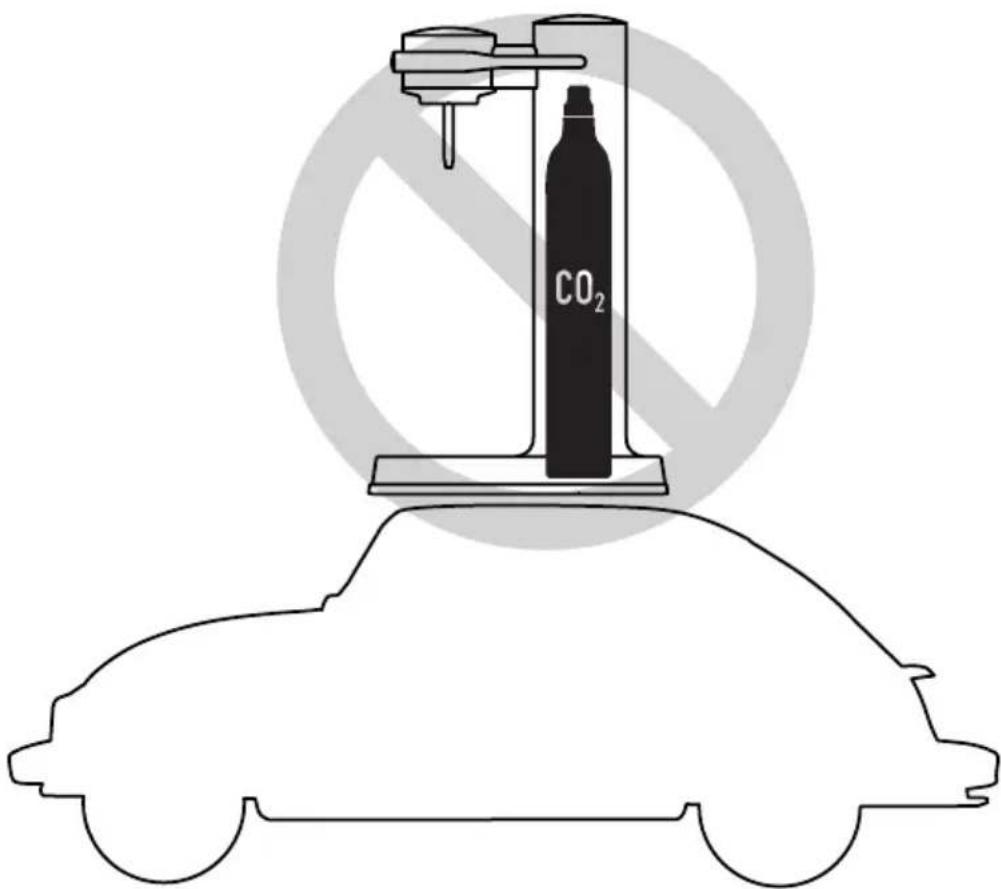
Always unscrew the gas cylinder during transport.

SAFETY GUIDELINESSAFETY GUIDELINES
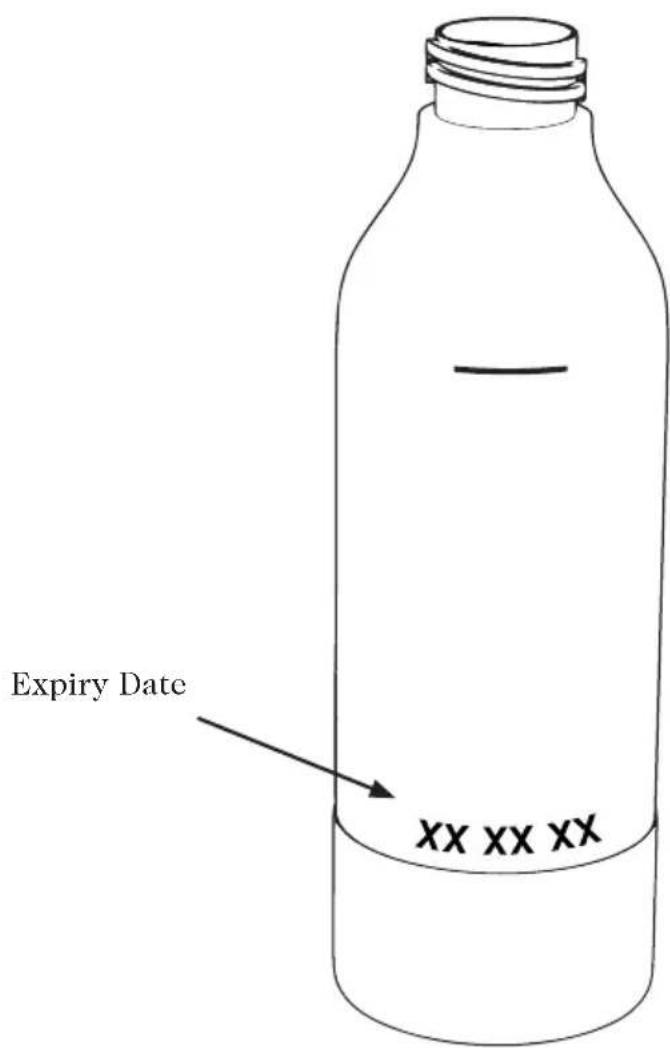
DO NOT USE THE WATER BOTTLE AFTER THE EXPIRY DATE
After the bottle has expired, the plastic may have weakened a little bit and for safety reasons the water bottle should be replaced with a new one.

SAFETY GUIDELINES
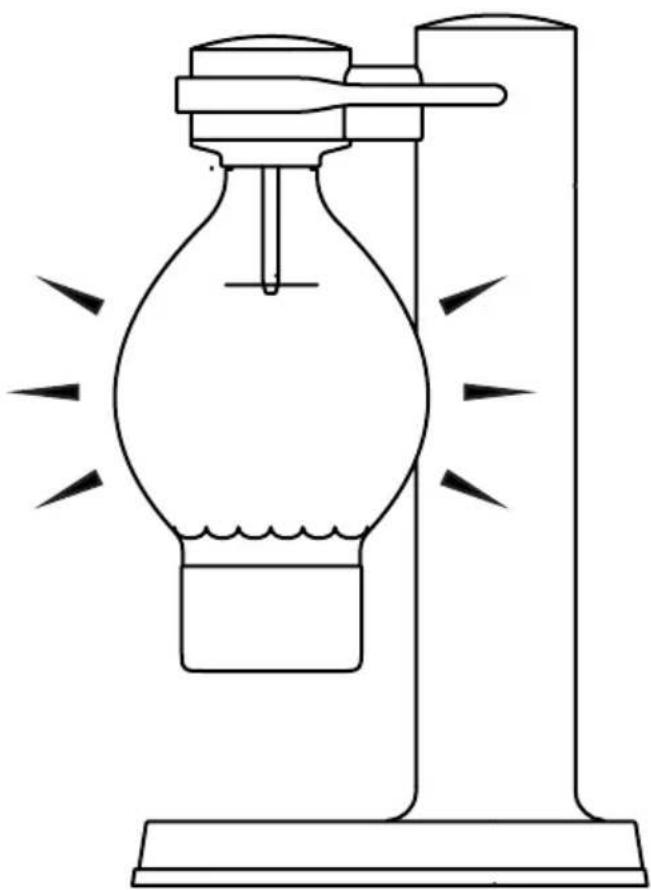
NEVER INJECT GAS INTO AN EMPTY WATER BOTTLE
Using an empty water bottle may lead to a higher pressure in the water bottle with safety risks as a result.
natural_image
Simple line drawing of a laboratory distillation setup with a round-bottom flask and heated by a vertical tube (no text or labels)
SAFETY GUIDELINES
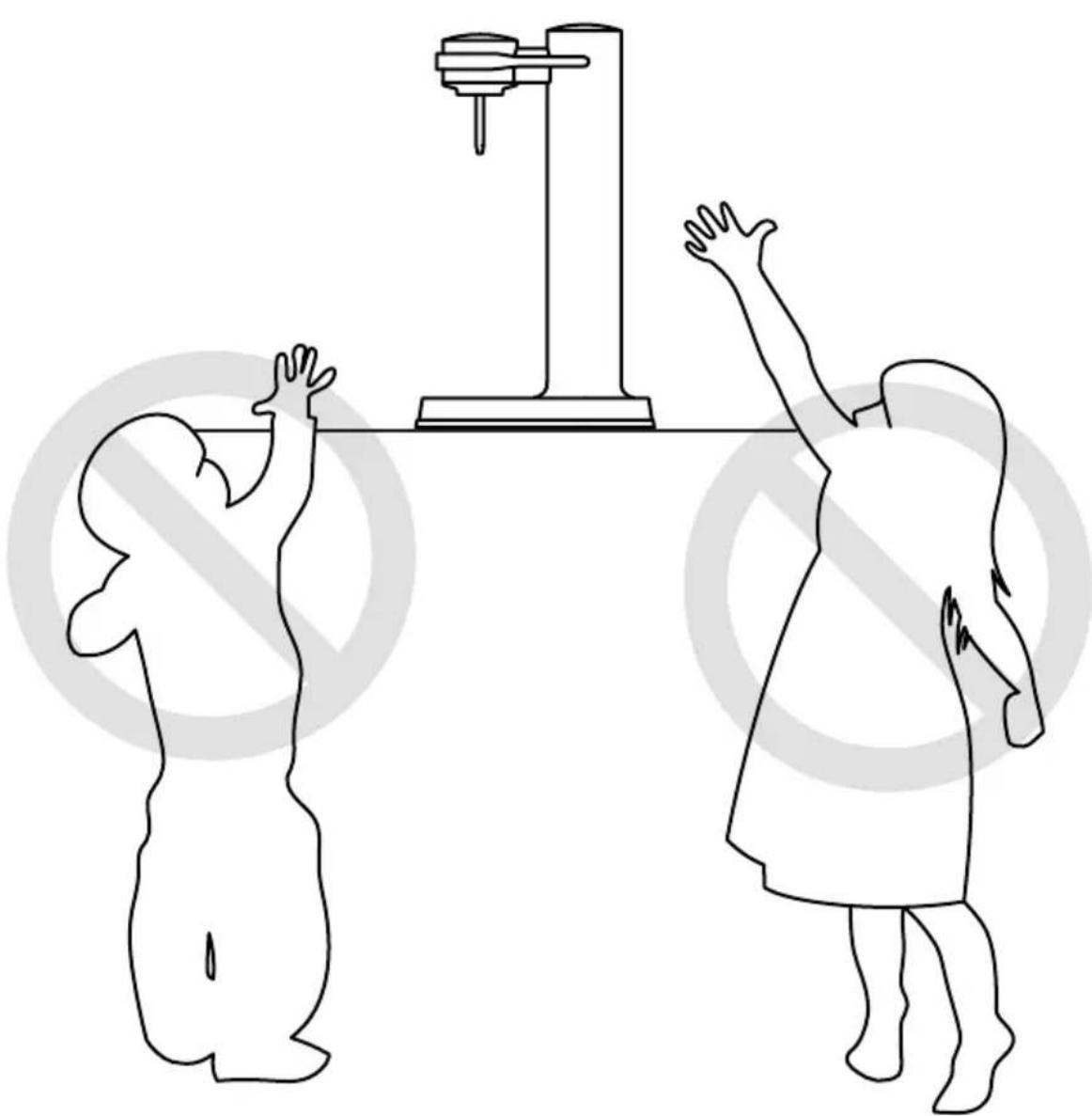
KEEP THE CARBONATOR AWAY FROM CHILDREN
Children are way too creative to use this product.
natural_image
Simple line drawing of two figures reaching toward a water level with a stopper (no text or symbols)
SAFETY GUIDELINES
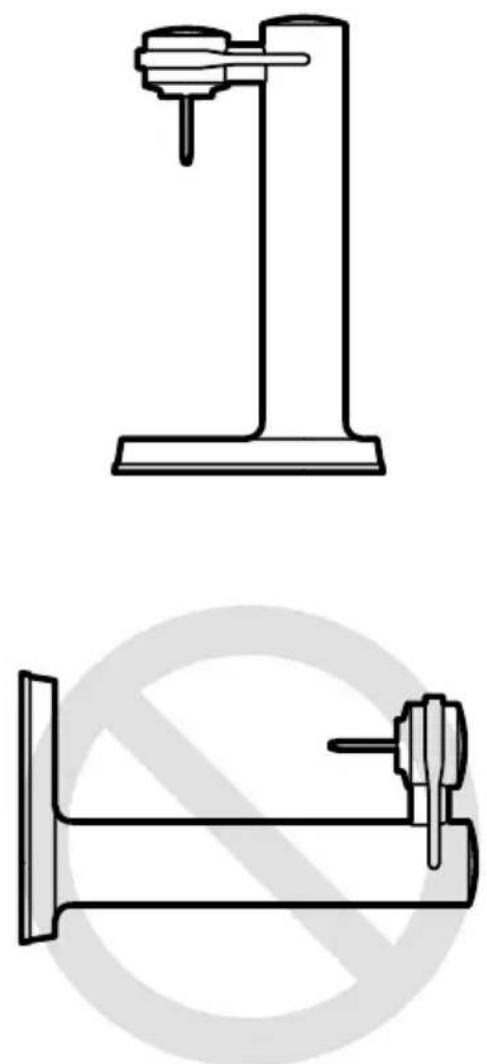
ALWAYS USE YOUR CABONATOR IN AN UPRIGHT POSITION
If used in other ways than standing in an upright position, dangerous levels of CO_2 could accumulate in the water bottle during carbonation.
natural_image
Technical line drawings of a mechanical device with no visible text or symbolsWARRANTY & RECYCLING

WARRANTY
The Aarke Carbonator is designed to meet and exceed your expectations in terms of quality and safety. Great care has been taken to ensure that it was delivered to you in a perfect working condition. However, if your carbonator malfunctions within 2 (two) years (or according to specific country laws) from date of purchase, and we determine the problem is due to faulty workmanship or materials, Aarke will repair or replace the product free of charge.
This warranty is invalid if product is damaged due to:
- An accident taking place after purchase.
- Abuse and misuse according to this book.
- Modification, or repair made by anyone except an authorized Aarke Service Centre.
- Damages caused by the use of water bottles other than those provided by Aarke.
- Damages caused by the use of faulty gas cylinder.

RECYCLING
The Aarke Carbonator is designed to last many years. However, when disposing the product all parts can be recycled. Therefore, it must be returned to the place of purchase or to a proper recycling centre.
TROUBLE SHOOTING
| PROBLEM | POSSIBLE CAUSE REMEDY | |
| The amount of gas in the water gradually drops. | The gas cylinder is running low. | Replace the Gas cylinder. |
| The gas cylinder is too cold. | Wait until the cylinder warms up to room temperature. | |
| Water is spraying out in to the spill tray. | The water bottle is overfull. | Do not fill the bottle above the marked filling line. |
| There is no or very little gas coming down into the water when the lever is pulled. | There is no gas cylinder attached. | Attach a gas cylinder. |
| The gas cylinder is not attached correctly. | Screw out and attach the gas cylinder again properly. | |
| The amount of CO2in the water is very low but the gas consumption is high. | The seal washer in the cylinder attaching point holder is leaking or missing. | Change the washer.A new washer can be ordered from Aarke customer service.Please go to aarke.com to find contact details and get more info about how to switch washer. |
TECHNICAL SPECIFICATIONS

natural_image
Simple line drawing of a laboratory apparatus with a vertical column and a central rod (no text or symbols)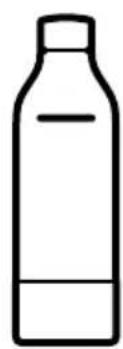
natural_image
Simple line drawing of a bottle with no text or symbolsCARBONATOR WATER BOTTLE
Height ..... 414 mm
Width ..... 153 mm
Depth ..... 258 mm
Weight .....≈1450 g
Height ..... 265 mm
Diameter..... 85,5 mm
Weight ..... 209 g
Volume.....812 ml
(to filling line)

∅ 60 mm
425 g
Compatible with standard gas cylinders approved for use with carbonators from all major brands worldwide. Other gas cylinders might seem to work but could damage the machine or cause safety risk.
CYLINDER NOT INCLUDED IN THIS BOX

natural_image
Line drawing of a cylindrical water leveler with a base and stand (no text or symbols)Kolsyremaskin
Vattenflaska

natural_image
Simple black square with a thin border on top (no text or symbols)Den här boken
PRODUKTENS KOMPONENTER
SVENSKA
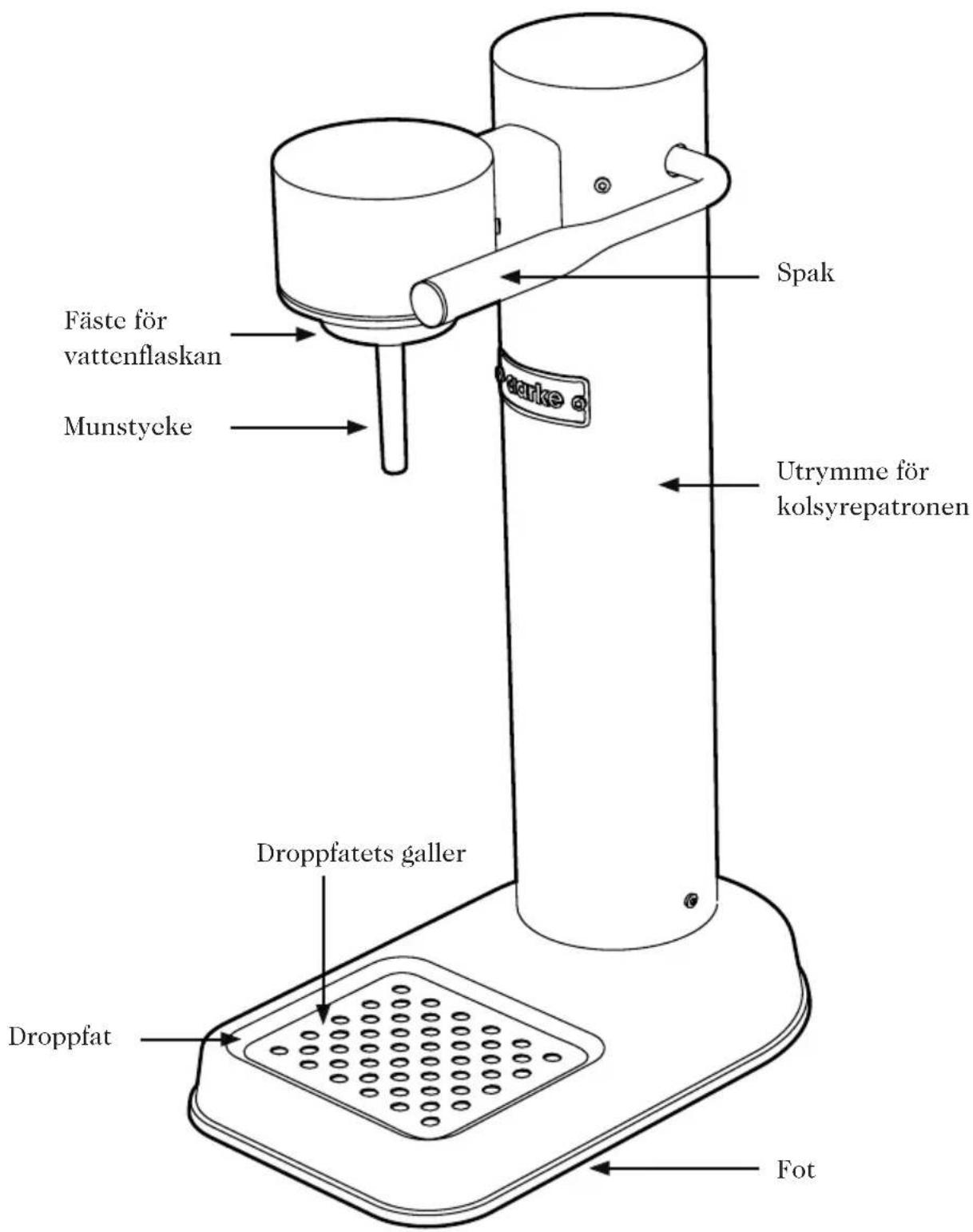
natural_image
Technical line drawing of a mechanical device with cylindrical components and a perforated base plate (no text or symbols)TA UR PATRONEN
natural_image
Simple line drawing of a laboratory apparatus with a rotating vial and upward arrow (no text or symbols)2. SÄTT I VATTENFLASKAN
natural_image
Line drawing of a laboratory apparatus with a vertical dashed line indicating measurement or setup (no text or symbols present)3. FÄST FLASKAN KORREKT
4. KOLSYRA VATTNET

5. SLÄPP UT TRYCKET 6. TILLFÖRA MER KOLSYRA
KOMMA IGÅNGKOMMA IGÅNG
SMAKSÄTTA VATTNETKOLSYREMÄNGD I VATTNI

natural_image
Simple line drawing of a lemon slice (no text or symbols)2dl nypressad citronjuice
VARFÖR HAMNAR DET VATTEN I DROPPFATET?
natural_image
Line drawing of a Darke bottle, a brush holder, and a small container (no text or symbols)natural_image
Symbolic diagram with a black 'X' over a grid of circles and dashed lines, no readable text or labelsSÄKERHETSFÖRESKRIFTER
SAKER DU INTE SKA GÖRA MED DIN KOLSYREMASKIN

SÄKERHETSFÖRESKRIFTER
SVENSKA
KOLSYRA ALDRIG NÅGON ANNAN VÄTSKA ÄN RENT VATTEN
natural_image
Simple line drawing of a rectangular container with a straw inserted (no text or symbols)natural_image
Three overlapping rounded squares with small dots inside, no text or symbols presentnatural_image
Line drawing of a plastic bottle with cap and side handles (no text or symbols)natural_image
Symbolic diagram with a black 'X' over a grid of circles and dashed lines, enclosed in a square frame (no text or labels)
SÄKERHETSFÖRESKRIFTER
HÅLL DIN KOLSYREMASKIN BORTA FRÅN VÄRMEKÄLLOR
SVENSKA
natural_image
Simple line drawing of a window and thermometer (no text or symbols)natural_image
Pure diagram of a heat exchanger with wavy lines indicating temperature or flow (no text or symbols)natural_image
Simple line drawing of a flame with no text or symbolsnatural_image
Simple line drawing of a sun and palm tree (no text or symbols)natural_image
Simple line drawing of a laboratory distillation setup with a round-bottom flask and heated tube (no text or labels)
SÄKERHETSFÖRESKRIFTER
SVENSKA
PLACERA KOLSYREMASKINEN
UTOM RÄCKHÅLL FÖR BARN
natural_image
Simple line drawing of two figures reaching toward a vertical platform with a stopper, no text or symbols present
SÄKERHETSFÖRESKRIFTER
ANVÄND ENBART KOLSYREMASKINEN I UPPRÄTT LÄGE
natural_image
Simple line drawing of a laboratory apparatus with a vertical column and a horizontal rod (no text or symbols)
natural_image
Pure mechanical diagram of a lever mechanism without any text or symbolsGARANTI & ÅTERVINNING
SVENSKA

GARANTI
natural_image
Simple line drawing of a laboratory apparatus with a vertical column and a horizontal rod (no text or symbols)
natural_image
Simple line drawing of a bottle with no text or symbolsKOLSYREMASKIN VATTENFLASKA
Höjd......414 mm
Bredd ..... 153 mm
Djup......258 mm
Vikt.....≈1450 g
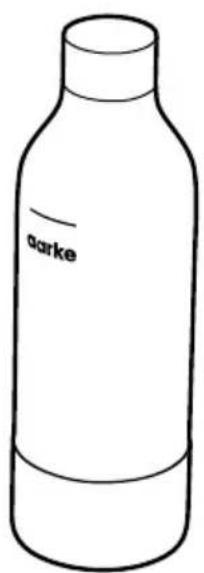
Höjd......265 mm
Diameter..... 85,5 mm
Vikt 209 g
Volym.....812 ml
(upp till maxindikeringen)

∅ 60 mm
425 g


- INCLUDED IN THE BOX
- GETTING STARTED
- HOW TO OPERATE YOUR CARBONATOR
- 1
- ATTACHING THE GAS CYLINDER
- ATTACHING CYLINDER
- DETACHING CYLINDER
- 2
- THE CARBONATION PROCESS
- FILL THE WATER BOTTLE
- ATTACH THE WATER BOTTLE
- CORRECTLY ATTACHED BOTTLE
- CARBONATE
- VENTILATE 6. MORE CARBONATION
- DEGREE OF CARBONATION
- HOW WOULD YOU LIKE YOUR SODA WATER?
- 4
- FLAVORING THE WATER
- CLASSIC LEMONADE
- MAINTENANCE
- HOW TO TAKE CARE OF YOUR CARBONATOR
- KEEPING YOUR CARBONATOR BEAUTIFUL AND CLEAN
- POLISHED VERSION
- LACQUERED VERSION
- EMPTYING THE SPILL TRAY
- WHY IS THERE WATER IN THE SPILL TRAY?
- 3
- RINSING THE WATER BOTTLE
- SAFETY GUIDELINES
- DO NOT CABONATE ANY LIQUIDS OTHER THAN PLAIN WATER
- NEVER CLEAN THE WATER BOTTLE IN THE DISHWASHER
- KEEP THE CARBONATOR AWAY FROM POTENTIAL SOURCES OF HEAT
- DO NOT TRANSPORT THE CARBONATOR WITH THE GAS CYLINDER ATTACHED
- SAFETY GUIDELINESSAFETY GUIDELINES
- DO NOT USE THE WATER BOTTLE AFTER THE EXPIRY DATE
- NEVER INJECT GAS INTO AN EMPTY WATER BOTTLE
- KEEP THE CARBONATOR AWAY FROM CHILDREN
- ALWAYS USE YOUR CABONATOR IN AN UPRIGHT POSITION
- WARRANTY & RECYCLING
- TROUBLE SHOOTING
- TECHNICAL SPECIFICATIONS
- CARBONATOR WATER BOTTLE
- PRODUKTENS KOMPONENTER
- TA UR PATRONEN
- SÄTT I VATTENFLASKAN
- FÄST FLASKAN KORREKT
- KOLSYRA VATTNET
- SLÄPP UT TRYCKET 6. TILLFÖRA MER KOLSYRA
- KOMMA IGÅNGKOMMA IGÅNG
- SMAKSÄTTA VATTNETKOLSYREMÄNGD I VATTNI
- VARFÖR HAMNAR DET VATTEN I DROPPFATET?
- SÄKERHETSFÖRESKRIFTER
- KOLSYRA ALDRIG NÅGON ANNAN VÄTSKA ÄN RENT VATTEN
- HÅLL DIN KOLSYREMASKIN BORTA FRÅN VÄRMEKÄLLOR
- PLACERA KOLSYREMASKINEN
- UTOM RÄCKHÅLL FÖR BARN
- ANVÄND ENBART KOLSYREMASKINEN I UPPRÄTT LÄGE
- GARANTI & ÅTERVINNING
- KOLSYREMASKIN VATTENFLASKA
Brand : AARKE
Model : Premium
Category : Water filter