
WSE901BX - Range hood Witt - Free user manual and instructions
Find the device manual for free WSE901BX Witt in PDF.


| Brand | Witt |
| Model | WSE901BX |
| Product Type | Range Hood (Kitchen Extractor Hood) |
| Width | 90 cm |
| Depth | 43 cm |
| Height | 147.5 cm (including chimney) |
| Supply Voltage | AC 230V, 50Hz |
| Power Consumption | 202 W (max) |
| Lighting | 2 × 3W LED lamps |
| Motor | 1 external motor |
| Number of Fan Speeds | 10 (slider control) |
| Max Airflow | 900 m³/h |
| Noise Level | 49 dBA |
| Outlet Diameter | 150 mm |
| Operating Modes | Extractor (duct to outside) or Recirculation (with carbon filter) |
| Grease Filter | 1 metal mesh filter, clean every 2 months |
| Carbon Filter | Optional, replace every 2 months in recirculation mode |
| Control Panel | Touch control: I/O, slider speed, timer, lights |
| Timer Function | Auto switch-off up to 15 minutes |
| Minimum Installation Height | 550 mm for electric cooktop, 650 mm for gas cooktop |
| Warranty | 2 years (manufacturing and material defects) |
| Color | Stainless steel with black glass |
| Safety Class | Class II (double insulated) |
Frequently Asked Questions - WSE901BX Witt
User questions about WSE901BX Witt
0 question about this device. Answer the ones you know or ask your own.
Ask a new question about this device
Download the instructions for your Range hood in PDF format for free! Find your manual WSE901BX - Witt and take your electronic device back in hand. On this page are published all the documents necessary for the use of your device. WSE901BX by Witt.
USER MANUAL WSE901BX Witt
User manual Hood (p. 75 – 88)
WSE901BX
Indholdsfortegnelse
natural_image
Technical line drawing showing a 3D box assembly with an upward arrow indicating vertical displacement (no text or symbols)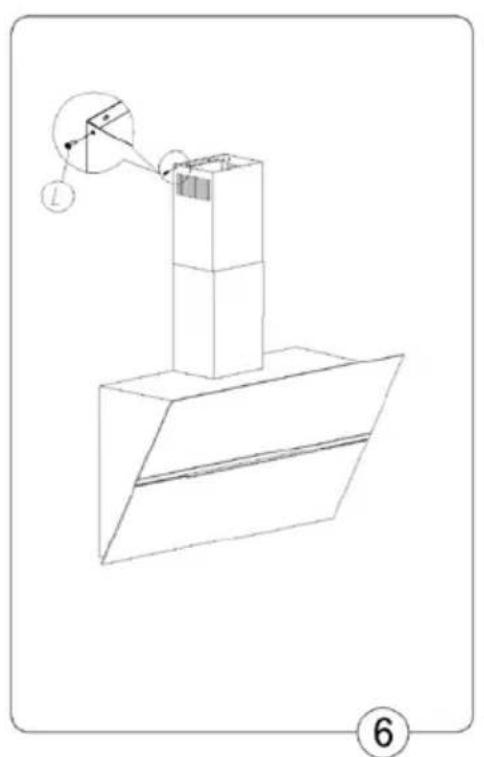
natural_image
Technical line drawing of a mechanical assembly with a base and top component, no visible text or symbols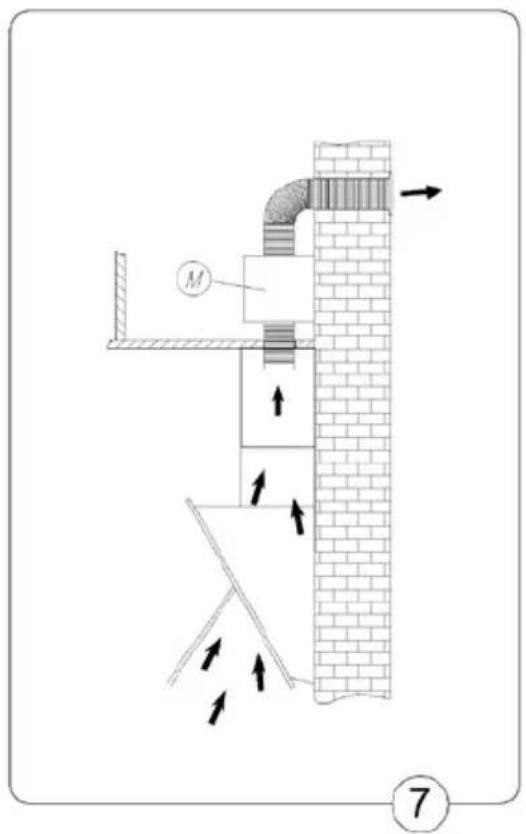
natural_image
Simple line drawing of a mechanical component with a handle and coiled cable (no text or symbols)Timerfunktion
natural_image
Technical line drawing showing a cabinet and its 3D model with an upward arrow, no text or symbols present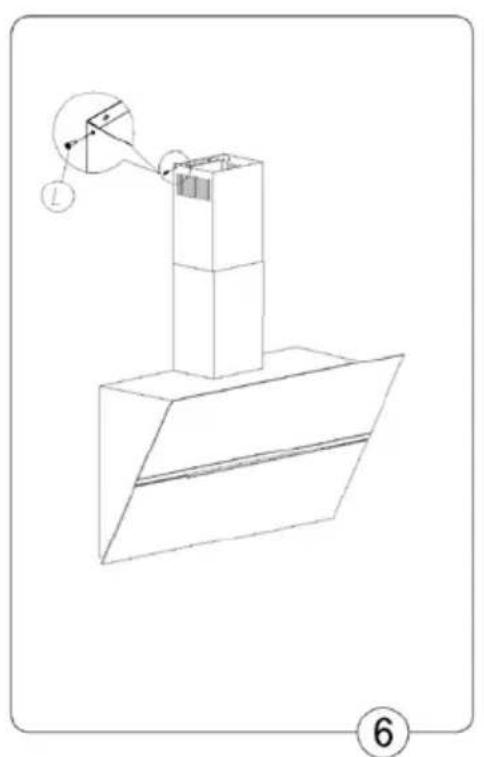
natural_image
Technical line drawing of a mechanical assembly with a base and top component, no visible text or symbols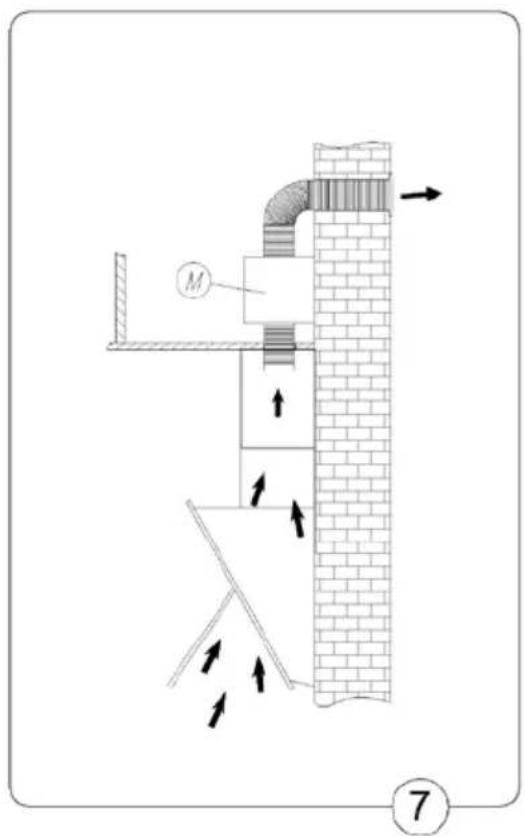
natural_image
Simple line drawing of a mechanical assembly with a handle and coiled components (no text or symbols)Timerfunksjon
natural_image
Technical line drawing showing a 3D box assembly with an upward arrow indicating vertical displacement (no text or symbols)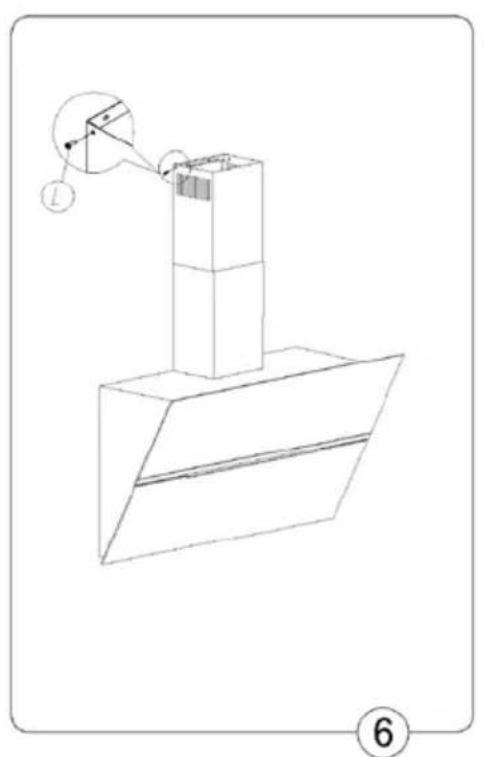
natural_image
Technical line drawing of a mechanical assembly with a base and top component, no visible text or symbols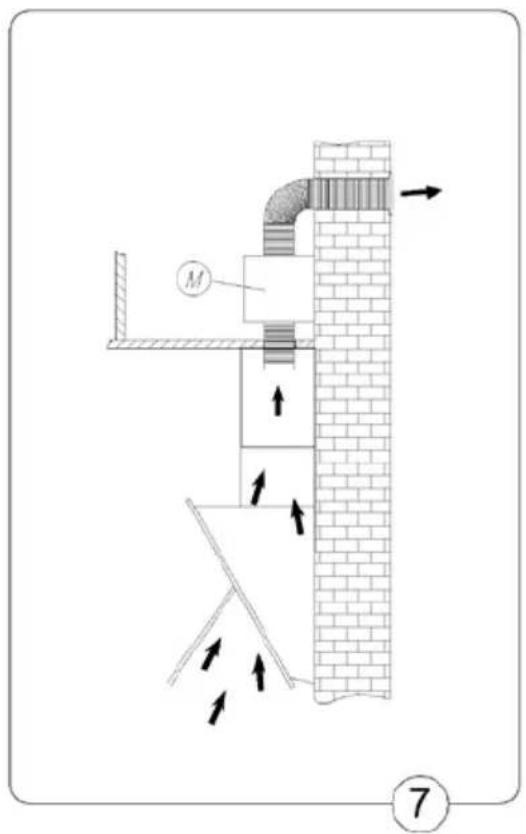
natural_image
Line drawing of a mechanical assembly with a tool inserted, showing wires and components (no text or symbols)Timerfunktion
natural_image
Technical line drawing showing a cabinet and its 3D model with an upward arrow, no text or symbols present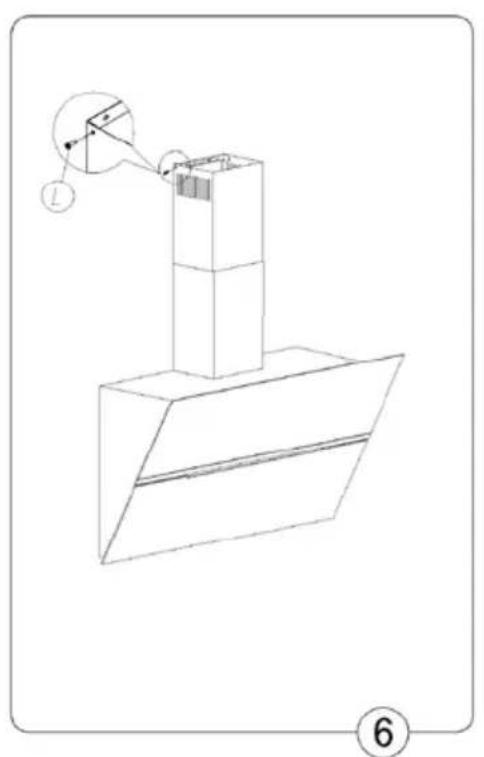
natural_image
Technical line drawing of a mechanical assembly with a base and top component, no visible text or symbols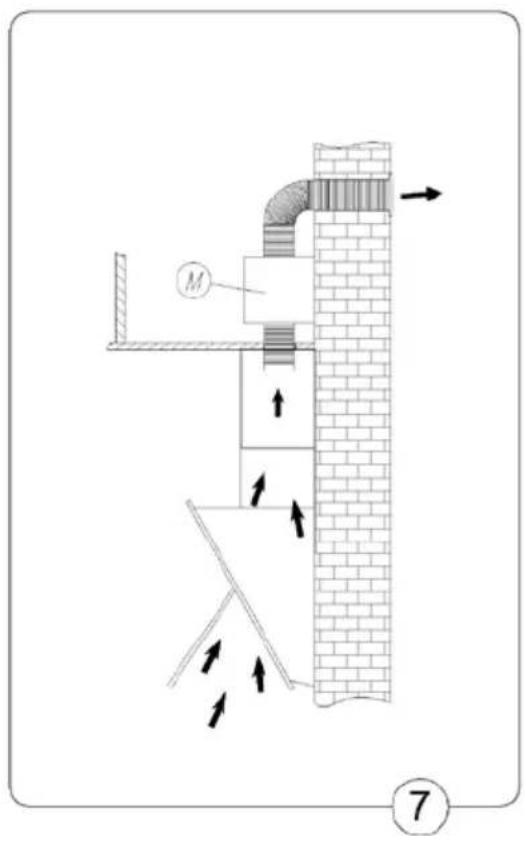
natural_image
Simple line drawing of a mechanical or electrical component with wires and a knob, no text or symbols present.LED-lamppua.
Ajastustoiminto
| CONTENTS | ||
| I Characteristics | ||
| II Components | ||
| III Technical data | ||
| IV Operating conditions | ||
| V Installation | ||
| 1. Installation of the wall hanger | ||
| 2. Installation of the hood | ||
| 3. Connecting to the power network and operation check | ||
| 4. Setting the operation mode of the kitchen extractor hood | ||
| 4.1. Setting the air extractor mode of operation of the hood | ||
| 4.2 Fan speeds | ||
| VI Operation and maintenance | ||
| 1. Operational safety | ||
| 2. Operation | ||
| 2.1. Control panel | ||
| 2.2. Program function | ||
| 3. Maintenance | ||
| 3.1. Metal grease filters | ||
| 3.2. Carbon cassette filter | ||
| 3.3. Lighting | ||
| 3.4. Cleaning | ||
I Characteristics
WSE WSE 901 BX kitchen extractor hood was designed to remove kitchen fumes. It requires installation of a conduit discharging used air to the outside. The conduit (usually a pipe ∅150 mm) shall not be longer than 4-5 m.
The kitchen hood is an electrical appliance manufactured according to class II of shock protection.
It has its own lighting and an exhaust fan which can be set to one of three rotational speeds.
The hood was designed for permanent installation on a vertical wall over a gas or electric cooker.
II Components
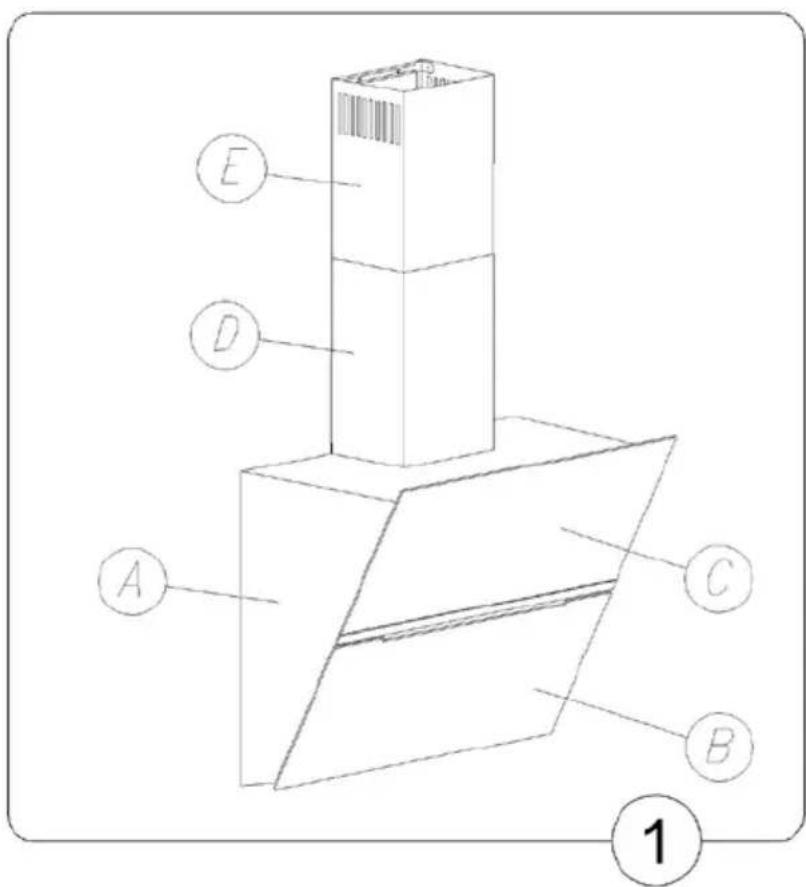
The hood consists of the following elements (Fig. 1):
- Hood body [A] with two glasses [B, C] equipped with lights,
- Lower chimney [D]
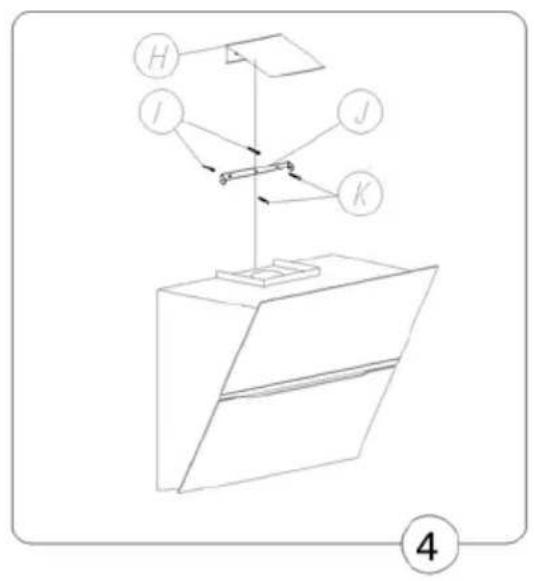
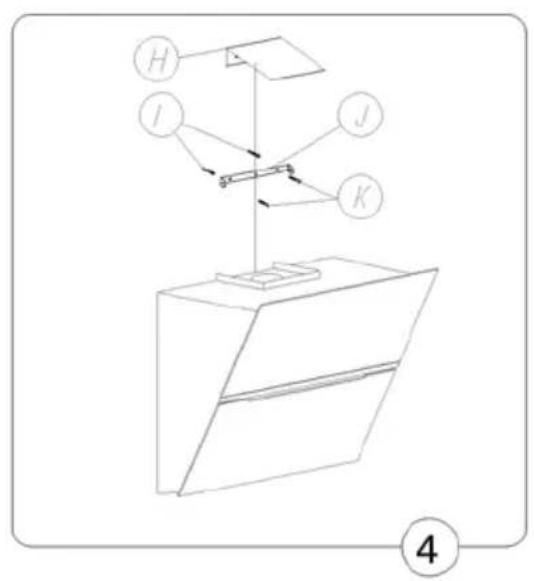
- Upper chimney with wall hanger [E]
- Box with external motor
- Set of mounting plugs.
| III Technical data | |
| Characteristics | Hood typeWSE 901 BX |
| Supply voltage | AC 230V 50Hz |
| Motor | 1 |
| Lighting | 2x3W LED |
| Number of grease filters | 1 |
| Fan speeds | 10 |
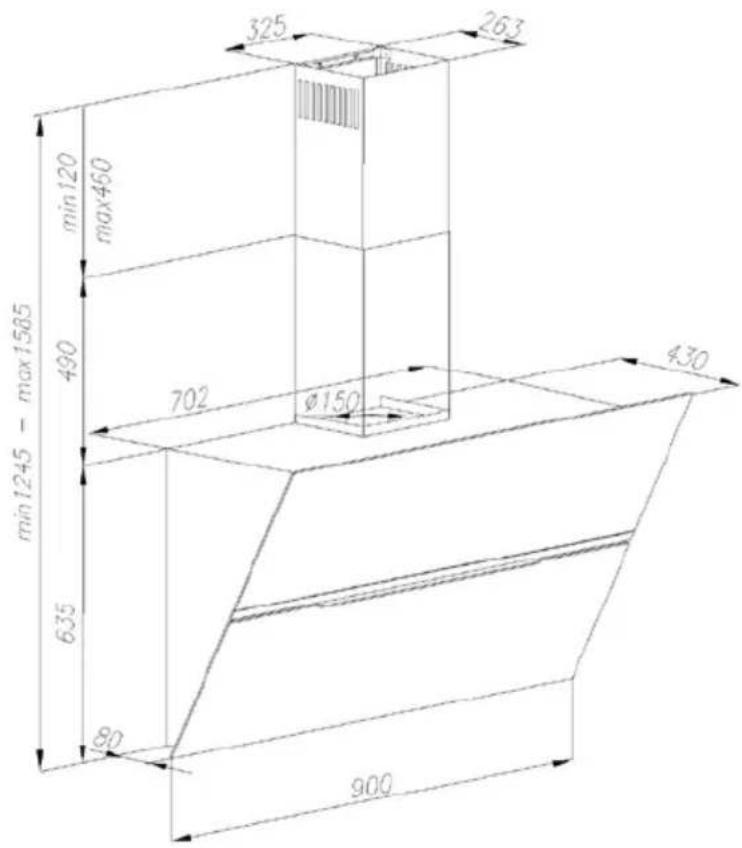
| Width [cm] | 90 |
| Depth [cm] | 43 |
| Height [cm] | 147,5 |
| Outlet [ø mm] | 150 |
| Capacity [m ^3 /h] | Max. 900 |
| Power consumption [W] | 202 |
| Noise level [dBA] | 49 |
| Operational mode | Extractor or absorber |
| Colour | INOX stainless steel, black glass |
IV Operating conditions
- The kitchen hood was designed for removal of kitchen fumes to the outside. It should be connected to an appropriate ventilation duct (do not connect the hood to any chimney, smoke or flue-gas ducts which are in use).
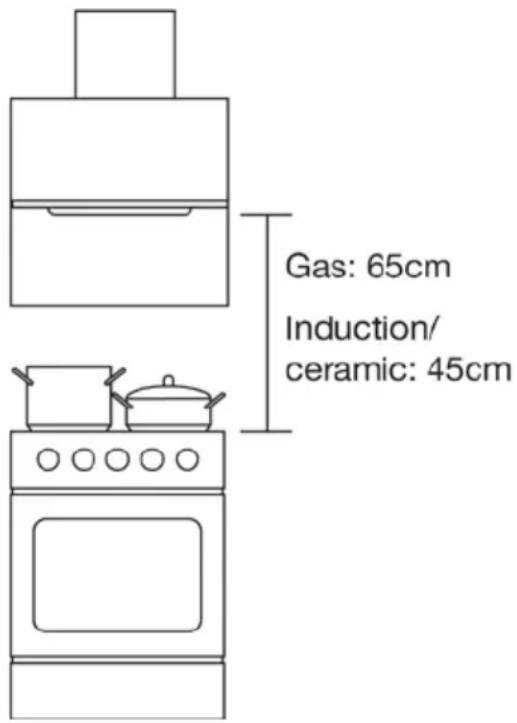
- The device shall be installed at the distance of at least 550 mm above the working top of an electric cooker and 650 mm - of a gas cooker.
- Do not leave open flame under the hood. When removing pots from the burners set the flame to its minimum level.
- Any food cooked in fat shall be constantly monitored, since overheated fat can ignite very easily.
-
The grease filter of your kitchen hood should be cleaned at least every 2 months, because a filter soaked with grease becomes easily flammable.
-
Pull the plug of the power cord from a wall socket before any cleaning, filter replacement or repair operation.
- If any other non-electric devices are used in the same room as the hood (e.g. liquid fuel ovens, flow-through or volumetric water heaters), it is necessary to provide appropriate ventilation (air supply). Safe operation is possible when during simultaneous operation of the hood and combustion devices dependent on air supply the negative pressure of not more than 0.004 milibar is maintained at the location of these devices inside the room (this point does not apply when the hood is used as an odour absorber).
- When connecting to 220V power supply network use an electric socket in working order
V Installation
To install the hood proceed as follows:
- Mark on the wall minimum distance between hood and plate
- Mark drilling holes with hood on the wall
- Drill mounting holes and put mounting screws inside
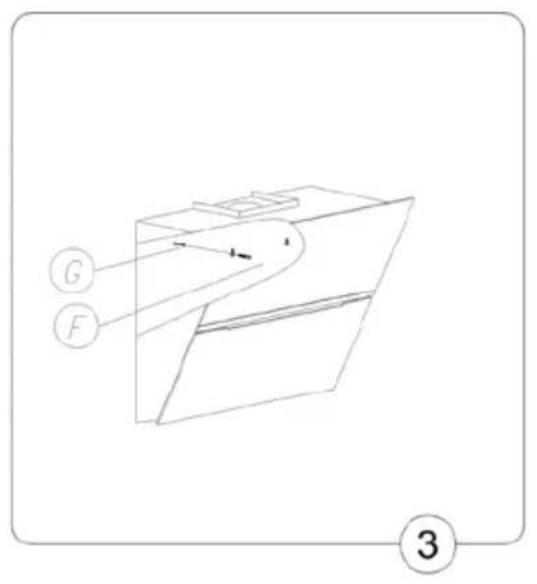
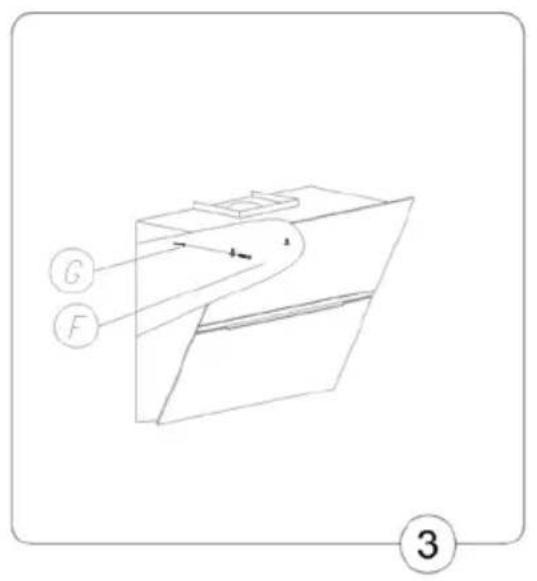
- Hang hood body
- Mount vent pipe.
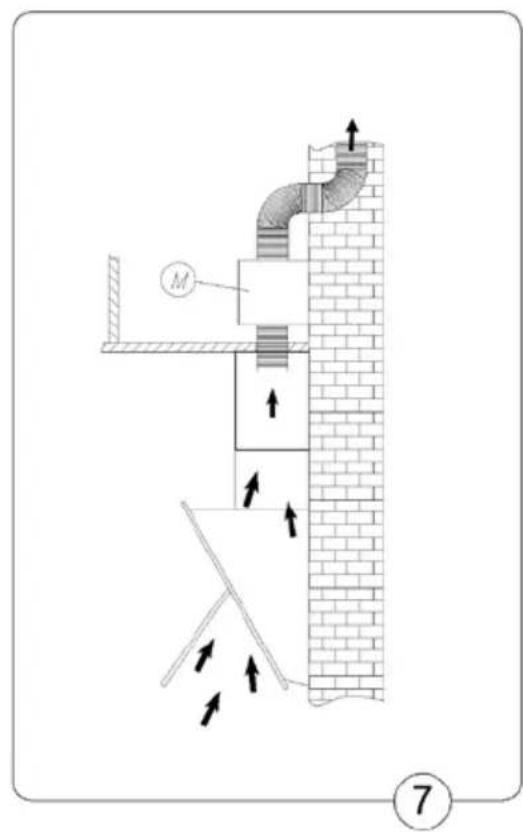
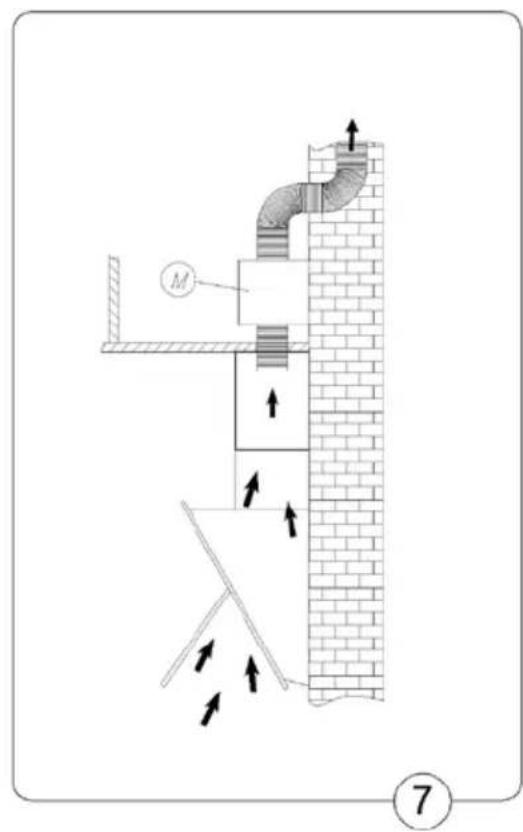
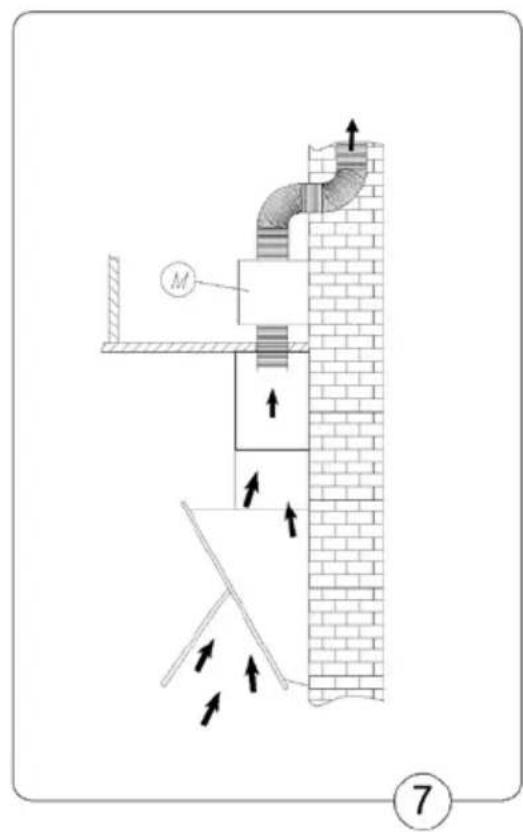
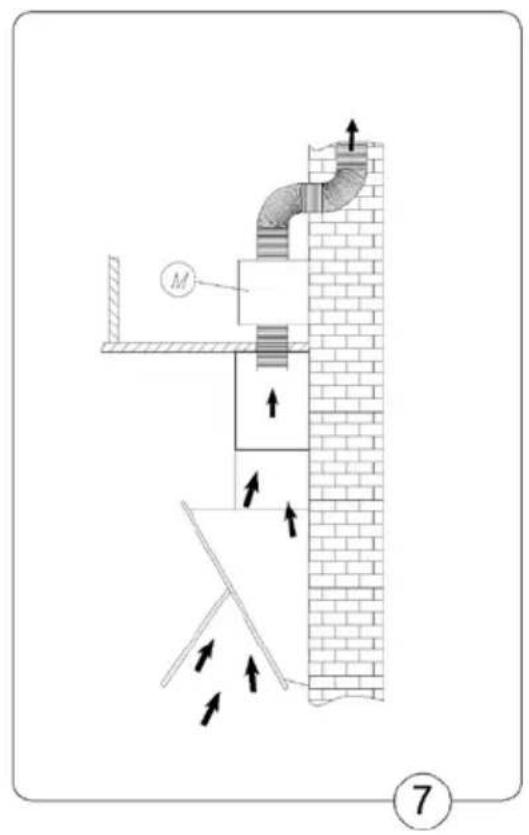
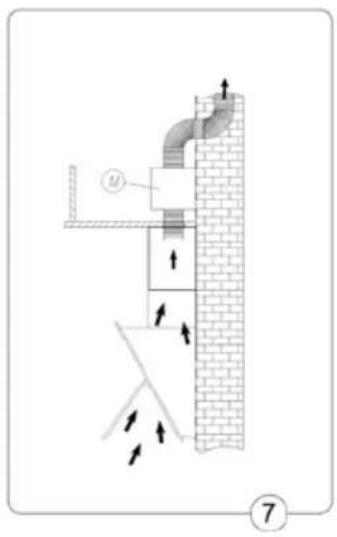
- Place the box with motor [M] when you have decided (for example in the attic, above the hood)
- Connect hood to the box with motor ∅ 150 ventilation air duct R.
- Connect the motor power cable and power cable together.
- Connect motor box to the vent.
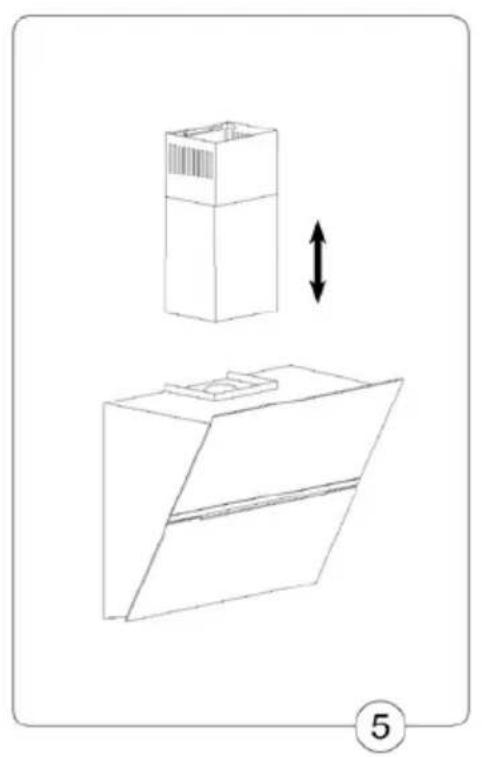
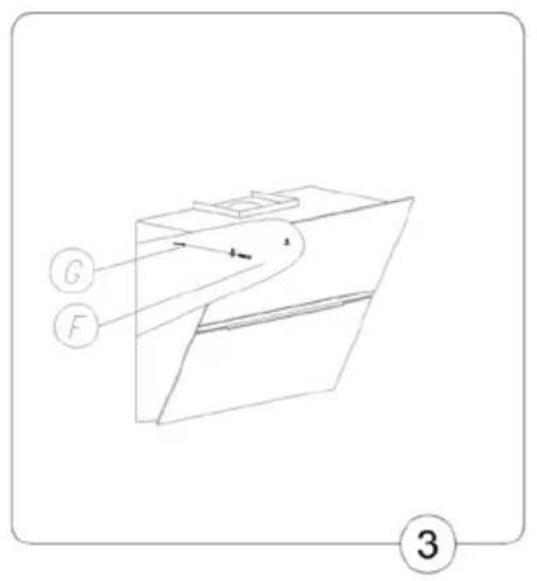
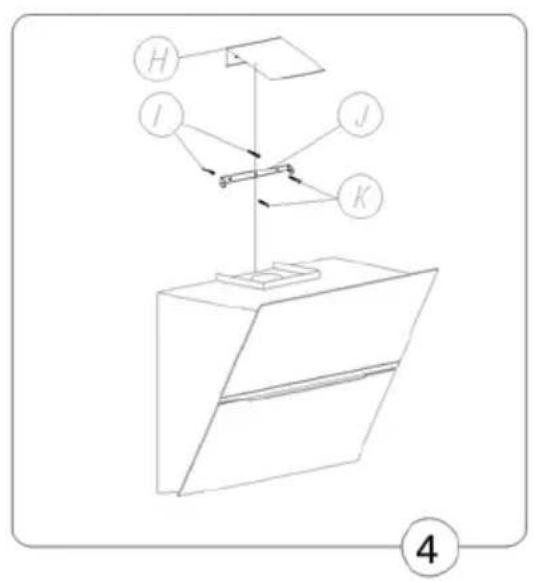
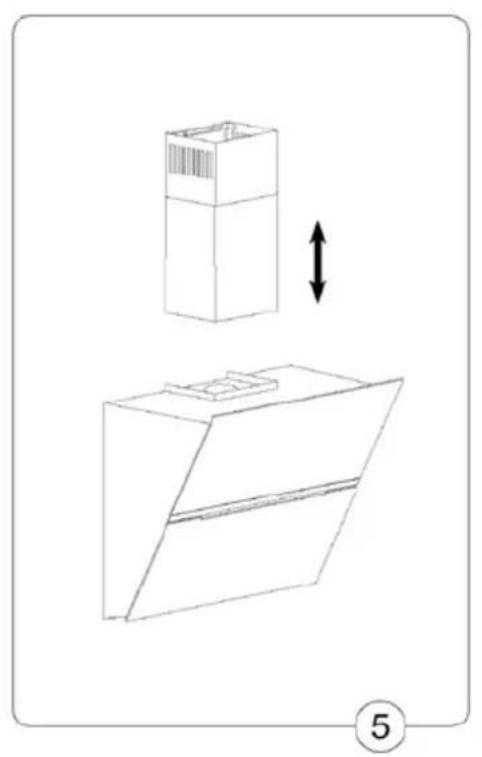
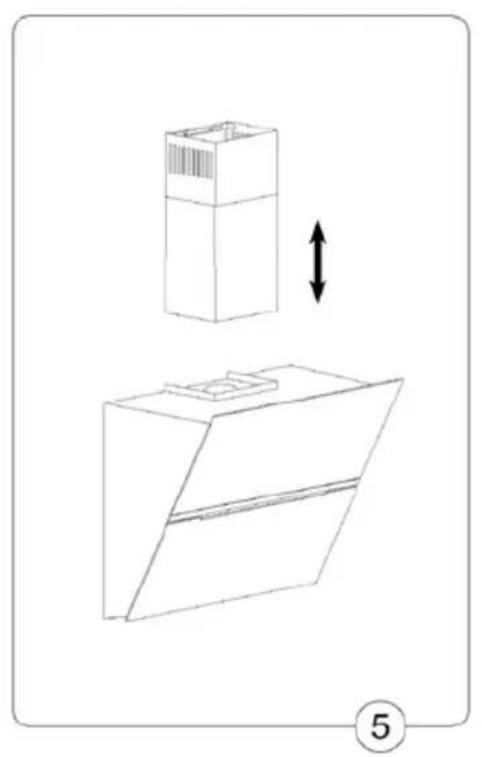
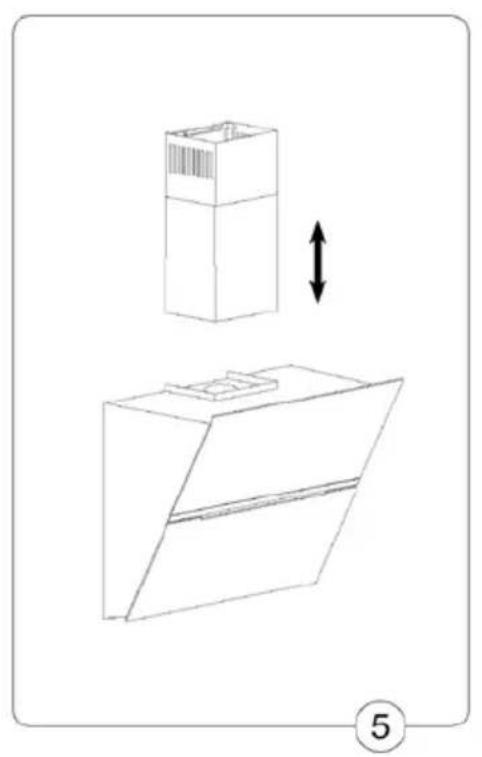
- Slide chimneys
- Mark the appropriate height of chimney section.
- Secure both chimneys parts.
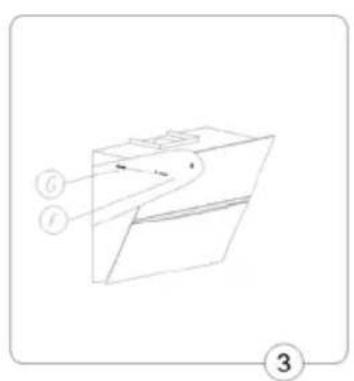
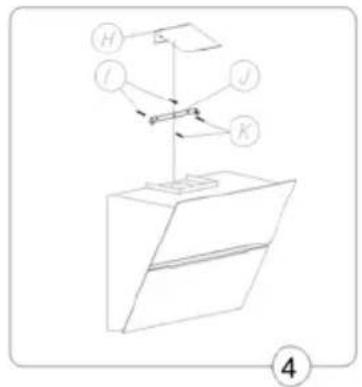
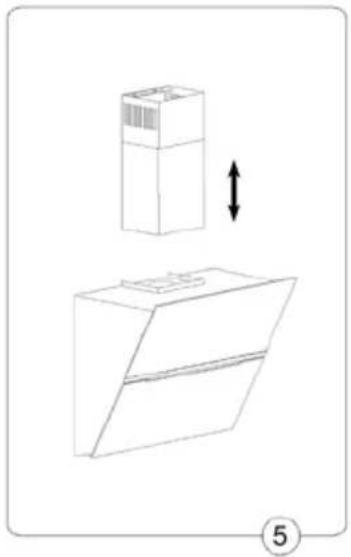
natural_image
Line drawing of a refrigerator with an upward arrow indicating rotation (no text or symbols)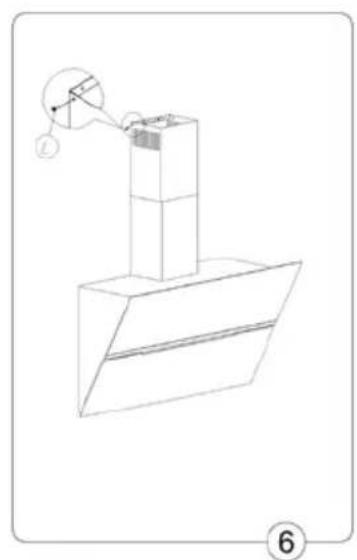
natural_image
Technical line drawing of a mechanical component with a base and top assembly, no visible text or symbols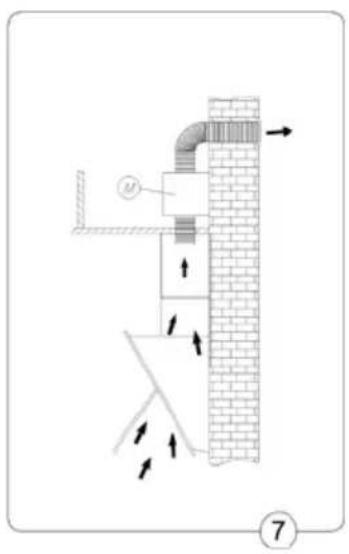
3. Connecting to the power network and operation check
After connecting the device to the power supply network (in accordance with the requirements defined above) it is necessary to check the lighting of the hood and whether its motor works correctly.
The wall socket shall be accessible for disconnecting the plug after the hood is installed.
4. Setting the operation mode of the kitchen extractor hood
4.1 Setting the air extractor mode of operation of the hood
The hood can be connected to the opening discharging air to the outside by means of a rigid or flexible conduit of 150 mm diameter, and appropriate clamps for conduits which should be purchased in a shop selling installation materials.
A qualified installer should be commissioned to make the connection.
4.2 Fan speeds
The lowest and medium speeds should be used under normal conditions and with low concentration of fumes. The top speed should be used in case of high concentration of kitchen fumes, e.g. during frying or grilling.
VI Operation and maintenance
1. Operational safety
All safety instructions included in this manual shall be observed without exception!
Grease filters should be cleaned and replaced according to manufacturer's instructions, or more frequently in periods of intensive use (more than 4 hours a day).
If a gas cooker is used it is forbidden to leave uncovered flame. When removing pots from gas burners set the flame to its minimum level.
Always make sure that flame does not extend outside the pot. Such a situation causes undesired energy losses and dangerous heat build-ups.
The hood should not be used for other purposes than those for which it was designed.
2. Operation
2.1 Control panel
Hood can be controlled by a touch control panel:
I/O-on/off
Slider – slide your finger to select motor speed
T - timer
- dot indicating that the good is in the switch-off mode
L - lights on/off button

2.2. Program function
Timer function: WSE 901BX kitchen hood is equipped with the option of programming automatic switch-off of to maximum delay of 15 minutes. Timer" is activated by tapping „T" button during operation of the hood with the required fan speed. The dot above the T will appear indicating that the device is in the switch-off time programming mode.
TIMER function can be cancelled by pressing T button again during counting of the time.
TIMER function has to be actuated within 20 seconds, otherwise the hood will return automatically to normal operation.
The microprocessor system may get deleted or crash during momentary voltage drops in the network, and stop responding to commands from the keyboard. In such case the hood has to be disconnected from and then connected again to the power network in order to reset the system.
3. Maintenance
Regular maintenance and cleaning of the device will guarantee its good and fault-less operation, and extend its life. Attention should be paid to replacing grease filters according to manufacturer's instructions.
3.1 Metal grease filters
- Cleaning.
Grease filters should be cleaned every two months during normal operation of the hood, in a dishwasher or manually, using mild detergent or liquid soap.
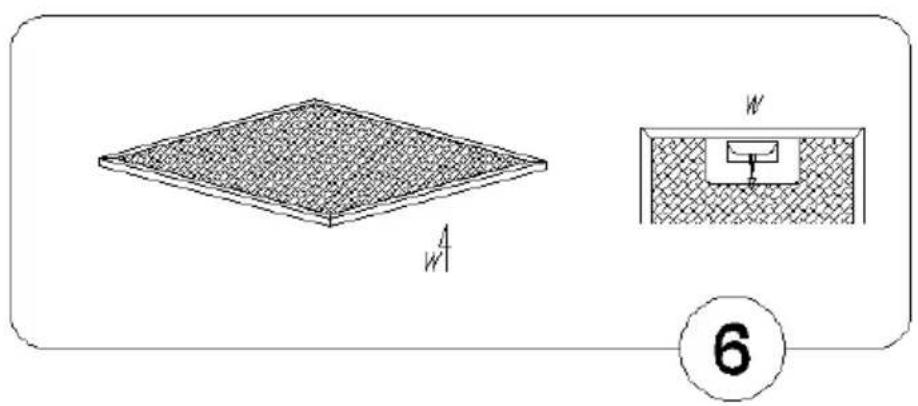
- Replacement (Fig. 6).
To dismantle the filter proceed as follows:
a) remove the bottom cover by releasing the lock catch,
b) remove the metal grease filter
natural_image
Technical diagram showing a 3D grid-patterned panel and its cross-section with a basketball net, labeled with 'W' and number '6' (no text or symbols on the panels themselves)3.2 Carbon cassette filter
-
This filter is used only in the re-circulation mode. The filter contains active carbon that absorbs the ventilated odors. After a while the active carbon is saturated, and loses its absorption ability. The filter can't be washed or otherwise cleaned. Under normal use, the carbon filter should be replaced every 2 months. In case of more frequent frying or deepfrying, shorten the interval.
-
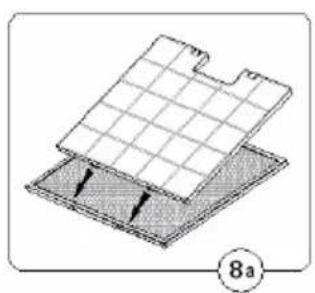
Installation
a) open the filter casing
b) remove the metal filter and remove the carbon filter from it.
c) mount a new carbon filter on the metal one, and put the set back.
d) close the filter casing.
natural_image
Diagram of a grid-patterned panel or panel structure with a circular label '8a' at the bottom (no text or symbols on the diagram itself)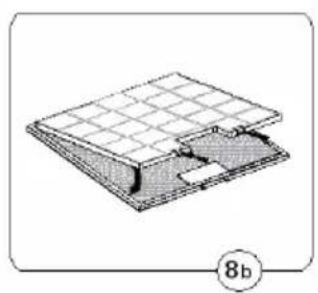
natural_image
Diagram of a solar panel installation with grid pattern and 8b label (no text or symbols on the diagram itself)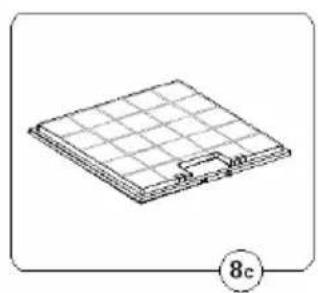
natural_image
Simple line drawing of a grid-patterned rectangular object with a small protrusion and a circled number 8c (no text or symbols on the object itself)3.3. Lighting
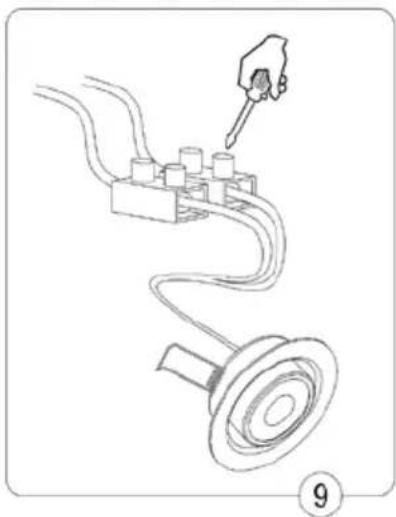
The lighting system consists of five LED lamps of 3 W power each. To replace a light proceed as present on the picture below:
natural_image
Line drawing of a mechanical assembly with a hand pin inserted, no text or symbols presentNote: Make sure that you do not touch the LED with your fingers!
3.4. Cleaning
The following shall be avoided during normal cleaning of the hood:
- wet cloth or sponge and water jet,
• solvents or alcohols which might dull lacquered surfaces, - caustic agents, particularly in regard to cleaning stainless steel elements,
- hard, rough cloth
It is recommended to us moist cloth and neutral cleaning agents.
Guarantee
A two year guarantee on manufacture and material defects is granted on your new appliance valid from the documented purchase date. The guarantee includes materials, salary and transport. When contacting service please state the appliance model and serial number.
The guarantee does not cover:
- Defects and damages which are not caused by manufacture and material defects.
• If original spare parts have not been used.
• If the instructions in the manual have not been carried out.
• If the installation has not been carried out according to this manual.
• If unauthorized personnel has carried out installation or repair word.
Transport damages
A transport damage observed when the dealer delivers the appliance at the customer is solely a matter between the customer and the dealer. If the customer has carried out the transport alone the manufacture / supplier cannot be held responsible for transport damages. All transport damages must be reported no later than 24 hours after delivery otherwise all claims will be rejected.
Unnecessary service visits
If a service technician is called out to a defect and the customer could have corrected the defect without help e.g. by following the instructions within this manual or by changing a fuse the customer will be charged all service costs – even under guarantee.
Commercial purchase
Commercial purchases are any purchase of appliances not used in a domestic household but instead are used for commercial purposes e.g. in a restaurant, café etc. or used to rent out or used for any other purpose including several users. In case of commercial purchase no guarantee is granted on this appliance since this is only meant for domestic household use.
Service
For service and spare parts in England and Ireland please call below-mentioned number and you will be directed accordingly or send us an email.
Witt UK & Ireland Ltd.
(44) 148 351 6633 / info@witt.dk
- Indholdsfortegnelse
- Timerfunktion
- Timerfunksjon
- LED-lamppua.
- Ajastustoiminto
- I Characteristics
- II Components
- IV Operating conditions
- V Installation
- To install the hood proceed as follows:
- Connecting to the power network and operation check
- Setting the operation mode of the kitchen extractor hood
- Setting the air extractor mode of operation of the hood
- Fan speeds
- VI Operation and maintenance
- Operational safety
- Operation
- Control panel
- Program function
- Maintenance
- Metal grease filters
- Carbon cassette filter
- Lighting
- Cleaning
- Guarantee
- The guarantee does not cover:
- Transport damages
- Unnecessary service visits
- Commercial purchase
- Service
Brand : Witt
Model : WSE901BX
Category : Range hood