000-705 - Hand Tools Meec Tools - Free user manual and instructions
Find the device manual for free 000-705 Meec Tools in PDF.


| Product Type | Impact Wrench |
| Brand | Meec Tools |
| Model | 000-705 |
| Rated Voltage | 18 VDC |
| No-Load Speed | 0-2200 rpm |
| Stroke Rate | 0-3300 strokes/min |
| Max Torque | 250 Nm |
| Drive | 1/2" |
| Sound Pressure Level | 72.26 dB(A) (K=3 dB) |
| Sound Power Level | 83.26 dB(A) (K=3 dB) |
| Vibration Level | 3.661 m/s² (K=1.5 m/s²) |
| Weight | 1.2 kg |
| Power Source | Cordless (Battery) |
| Battery Charger | Use only supplied charger |
| Intended Use | Tightening and loosening screw joints (private use) |
| Safety Features | Variable speed trigger, LED work light, direction selector |
| Maintenance | Clean with damp cloth, brush vents, store in dry place |
| Warranty | Refer to manufacturer's warranty policy |
Frequently Asked Questions - 000-705 Meec Tools
User questions about 000-705 Meec Tools
0 question about this device. Answer the ones you know or ask your own.
Ask a new question about this device
Download the instructions for your Hand Tools in PDF format for free! Find your manual 000-705 - Meec Tools and take your electronic device back in hand. On this page are published all the documents necessary for the use of your device. 000-705 by Meec Tools.
USER MANUAL 000-705 Meec Tools
natural_image
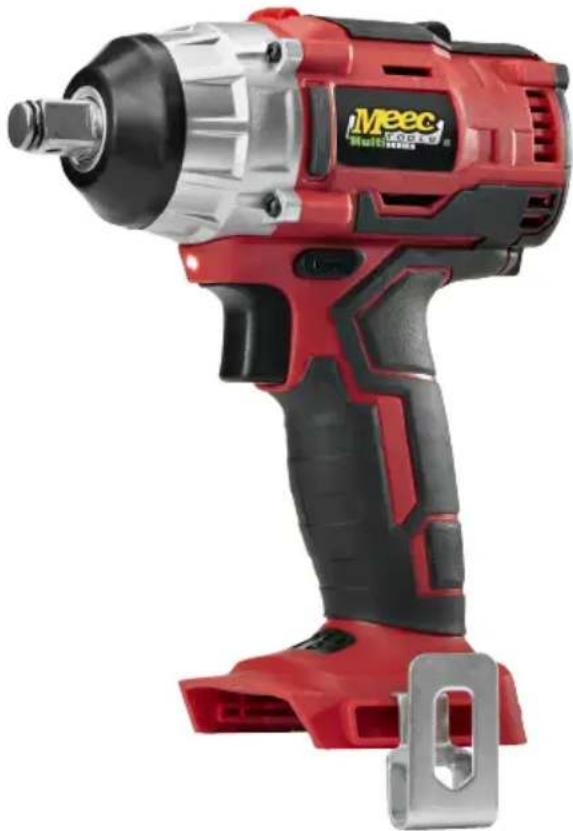
Red and black Meec-branded electric drill put tool (no visible text or symbols)SE Bruksanvisning för mutterdragare
NO Bruksanvisning for muttertrekker
PL Instrukcja obsługi klucza udarowego
EN Operating instructions for impact wrench
SE - Bruksanvisning i original
EN - Operating instructions (Translation of the original instructions)
Jula reserves the right to make changes. In the event of problems, please contact our service department.
www.jula.com
Tillverkare/ Produsent / Produenci/ Manufacturer
Jula AB, Box 363, 532 24 SKARA
Importör/ Importør/ Importer/ Importer
Care for the environment!
Must not be discarded with household waste! This product contains electrical or electronic components that should be recycled. Leave the product for recycling at the designated station e.g. the local authority's recycling station.
SVENSKA....5
SÄKERHETSANVISNINGAR....5
TEKNISKA DATA 11
BESKRIVNING 12
HANDHAVANDE 12
UNDERHÅLL 14
NORSK 15
SIKKERHETSANVISNINGER 15
TEKNISKE DATA 21
BESKRIVELSE....22
BRUK....22
VEDLIKEHOLD 24
POLSKI 25
ZASADY BEZPIECZEŃSTWA 25
DANE TECHNICZNE 32
OPIS 33
OBSŁUGA 33
KONSERWACJA 35
ENGLISH 36
SAFETY INSTRUCTIONS 36
TECHNICAL DATA....42
DESCRIPTION 43
USE 43
MAINTENANCE 45
SÄKERHETSANVISNINGAR
Read the operating instructions carefully before use!
Save them for future reference.
General safety instructions for power tools
- Warning: Read all the instructions and safety instructions carefully before use. Failure to follow all the instructions and safety instructions can result in the risk of electric shock, fire and/or serious personal injury.
- Save the safety and user instructions for future use.
- The term "power tool" in all the warnings below refers to mains-powered (corded) or battery-powered (cordless) power tool.
Work area
- Keep the work area clean and well lit. Dark and cluttered work areas increase the risk of accidents and injuries.
- Do not use power tools in explosive environments, such as in the vicinity of flammable liquids, gases or dust. Power tools produce sparks that can ignite dust and fumes.
- Keep children and onlookers at a safe distance when using power tools. You can easily lose control of the tool if you are distracted.
Electrical safety
- The mains plug on the power tool must match the mains outlet.
Never modify the plug in any way. Never use an adapter with earthed power tools. Unmodified plugs and matching outlets reduce the risk of electric shock. - Avoid body contact with earthed surfaces such as pipes, radiators, cookers and refrigerators. There is an increased risk of electric shock if your body is earthed.
- Do not expose power tools to rain or moisture. There is a greater risk of electric shock if water gets into a power tool.
- Never use the power cord to carry or pull the tool, or to pull out the plug from the mains socket. Keep the power cord away from heat, oil, sharp edges and moving parts. Damaged or tangled power cords increase the risk of electric shock.
- If using the tool outdoors, only use an extension cord approved for outdoor use. If you use an extension cable intended for outdoor use you reduce the risk of electric shock.
- If it is absolutely necessary to use power tools in damp conditions, use a mains connection protected by an RDC. Using an RCD reduces the risk of electric shock.
Personal safety
- Stay alert. Pay attention to what you are doing, and use your common sense when working with power tools. Never use power tools if you are tired or under the influence of drugs, alcohol or medication. A moment of inattention when using a power tool can result in serious personal injury.
- Use personal safety equipment. Wear safety glasses. Depending on the type of power tool and how it is used, safety equipment such as dust masks, non-slip safety shoes, safety helmets and ear protection reduce the risk of personal injury.
- Avoid accidental starting. Make sure the power tool is in the OFF position before plugging in the cord and/or battery or lifting/carrying the tool. Carrying a power tool with your finger on the switch, or connecting a tool to the mains supply when the switch is in the ON position, increases the risk of accidents and injuries.
- Remove Allen keys/spanners etc. before starting the tool. Allen keys, or the like, left in a rotating part of a power tool can cause personal injury.
- Do not overreach. Always maintain a firm footing and good balance. This will ensure you have better control over the tool in unexpected situations.
- Wear suitable clothing. Do not wear loose-fitting clothing or jewellery. Keep your hair, clothing and gloves away from moving parts. Loose-fitting clothing, jewellery and long hair can get caught in moving parts.
- If dust extraction and dust collection equipment is available, this should be connected and used correctly. The use of such devices can reduce the risk of dust-related problems.
Use and care
- Do not force the power tool. Use the correct power tool for the planned work. The tool does the job better and safer when used at the rate for which it was designed.
- Do not use the tool if it cannot be switched on and off with the power switch. Power tools that cannot be controlled with the power switch are dangerous and must be repaired.
-
Unplug the power cord and/or remove the battery before making any adjustments, changing accessories or putting the power tool away. These safety precautions reduce the risk of accidentally starting the tool.
-
Store power tools out of the reach of children when not in use. Never allow children, or anyone who is unfamiliar with the power tool and these instructions, to use the tool. Power tools are dangerous if used by inexperienced persons.
- Keep the power tool properly maintained. Check that moving parts are properly adjusted and do not jam, and that no parts are incorrectly fitted or damaged. Check for other factors that could affect functionality. If the power tool is damaged, it must be repaired before being used again. Many accidents are caused by poorly maintained power tools.
- Keep cutting tools sharp and clean. Properly maintained cutting tools with sharp cutting edges are less likely to jam and are easier to control.
- Use power tools, accessories, and bits etc. in accordance with these instructions, with due consideration to the actual working conditions and the work that is to be done. It can be dangerous to use power tools for purposes other than those they are intended to be used for.
Additional instructions for cordless power tools
- Only use a battery charger recommended by the manufacturer. Using a battery charger intended for a different type of battery can result in a fire risk.
- Only use power tools with the specified batteries. The use of other batteries can cause personal injury or the risk of fire.
- When the battery is not in use keep it away from other metal objects such as paper-clips, coins, keys, nails, screws and other small metal objects that can short circuit the terminals. Short circuiting the battery terminals can cause burns or a fire.
Service
The power tool must only be serviced by qualified service personnel using identical spare parts. This will ensure that the tool remains safe to use.
Special safety instructions for screwdrivers
Hold the power tool by the insulated grips when working in areas where the tool or parts of the screw joint may come into contact with concealed electrical cables or its own power cord. Contact with a live cable will cause the metal parts on the tool to also become live – risk of electric shock.
Important safety instructions for the battery and battery charger
- Carefully read all the instructions and warnings on the charger and battery, and in this section on using the battery, before using the charger.
- Inspect the charger regularly, especially for damage to its casing and power cord. If damaged, the charger must be returned to the dealer or an authorised workshop for repair before using it again.
- If the charger has been subjected to knocks or blows, or been otherwise damaged, it must not be used until it has been checked and repaired by an electrician.
- Never insert a cracked or damaged battery in the battery charger – risk of electric shock.
- Do not dismantle the charger. Hand it to an authorised electrician or service centre if it needs repairing. Tampering or incorrect assembly can result in the risk of fire or electric shock.
- Do not use the charger in explosive or flammable environments, for example, in the vicinity of flammable liquids, gases or dust.
- The charger is intended for domestic use and must be powered from a household mains socket. Never attempt to use the charger with other voltages.
- Charge the battery in a well ventilated area. When charging the battery can emit gas.
- The charger is intended for indoor use and must not be used outdoors.
- Do not expose the charger to water or any other liquid – risk of electric shock and /or material damage.
- The charger must never be used in any other way than the one intended and should never be used for charging batteries of other types than those supplied with the charger - risk of fire and life threatening electric shock.
- Never attempt to charge the battery with any other charger than the one supplied with the tool. The charger and the battery or batteries supplied with the tool must always be included with it.
- The charger may only be used for charging batteries, not for the direct power supply of electric appliances and tools.
- Never try to charge non-rechargeable batteries. Attempting to charge non-rechargeable batteries can be dangerous.
- Do not place objects on the charger or cover the charger – risk of overheating. Do not place the charger near sources of heat.
-
Route the power cord to prevent it being walked on, damaged or present a tripping hazard - risk of personal injury and damage to property.
-
Unplug the charger from the power outlet after each use. To allow the charger to be constantly connected to the mains can be dangerous.
- Unplug the power cord before cleaning the charger – risk of electric shock.
- Never use the power cord to carry or pull the power tool, or to pull out the plug from the mains.
- Do not use an extension cord unless absolutely necessary. Unsuitable extension cords can cause a fire and/or electric shock.
Safety instructions for batteries
- Do not attempt to remove, open or dismantle the battery.
- Never expose the battery to heat and never incinerate the battery, not even if it is damaged and can no longer be charged. Batteries can explode if burned. Do not store the battery in direct sunlight.
- Do not short-circuit the battery. When the battery is not in use keep it away from other metal objects such as paper-clips, coins, keys, nails, screws and other small metal objects that can short circuit the terminals.
- Do not remove the batteries or battery cells from the original packaging until immediately prior to use.
- Do not expose the battery to impact or shocks.
- Exercise care if fluid leaks from the battery - do not allow the fluid to come in contact with skin or eyes. If the battery fluid comes in contact with skin or eyes, rinse immediately with plenty of water and seek medical attention.
- Never attempt to charge the tool's battery with any other charger than the one supplied with the tool.
- Check the polarity markings positive (+) and negative (-) and never connect the battery to the charger or tool with the wrong polarity.
- Only the supplied batteries may be used in the tool. Batteries from another manufacturer or with another capacity, size or design must not be used.
- Batteries and battery cells must be stored out of the reach of children.
- Seek immediate medical attention if you accidentally swallowing a battery or battery cell.
- When replacing the batteries, be sure that you get exactly the right type.
- Batteries and battery cells must be stored in a clean and dry environment.
- Wipe clean contaminated battery terminals with a clean, dry cloth.
- Charge the battery before use, according to the battery manufacturer's instructions or the instructions in the tool's operating manual.
- Batteries to be unused for any length of time should be taken out of the charger - they must not be stored vertically on the charger.
- After a long period of storage, batteries may need to complete several charging and discharging cycles before it reaches full capacity.
- Batteries have their best performance when used at normal room temperature (20 ± 5 °C).
- Save the battery's operating instructions and other battery documentation for future use.
- Batteries and battery cells may only be used for their intended purpose.
- If the tool shall remain unused for any length of time the battery should be removed from the tool.
- Spent batteries must be disposed of in accordance with applicable regulations.
Remaining risks
Even if appropriate safety regulations are adhered to and safety devices are used, it is not possible to eliminate all risks. The following potential risks are related to the design and functionality of the tool:
- Damage to lungs if dust filter mask is not used
• Hearing impairment if ear protection is not used
- Vibration injuries if the tool is used for long periods, or is not used or maintained properly.
- Personal injury or damage to segregate caused by thrown parts.
WARNING: The tool produces an electromagnetic field when in use. This field can in some circumstances affect active or passive medical implants. If you have a medical implant you should consult your doctor and/or the manufacturer of the medical implant before using the tool to reduce the risk of serious and/or fatal personal injury.
IMPORTANT:
- Wear safety gloves. Protective gloves reduce the vibration stress on the hands and fingers.
- Ensure all tool accessories are undamaged and sharp. Blunt or damaged tool accessories cause excessive vibration.
- Keep the tool properly maintained. Keep the tool in good condition through regular maintenance and cleaning. A well-maintained tool vibrates less.
- Keep your hands warm and take sufficient breaks from work. Regular breaks in work reduce the vibration stress and gives better flow of blood in the hands and fingers.
- Hold the tool firmly, but avoid clutching too tightly. Do not force the tool.
Symbol

Read the operating instructions before use.
TECHNICAL DATA
| Rated voltage 18 VDC | |
| Speed 0–2200 rpm | |
| Stroke 0–3300 strokes/min | |
| Torque 250 Nm | |
| Drive | 1/2" |
| Sound pressure level, LpA 72.26 dB(A), K=3 dB | |
| Sound power level, LwA 83.26 dB(A), K=3 dB | |
| Vibration 3.661 m/s2, K=1.5 m/s2 | |
| Weight 1.2 kg | |
Always wear ear protection!
The declared vibration value, which has been measured by a standardised test method, can be used to compare different tools with each other and for a preliminary assessment of exposure.
WARNING: The actual vibration level when using power tools may differ from the specified maximum value, depending on how the tool is used. It is therefore necessary to determine which safety precautions are required to protect the user, based on an estimate of exposure in actual operating conditions (taking into account all stages of the work cycle, e.g. the time when the tool is switched off and when it is idling, in addition to the start-up time).
DESCRIPTION
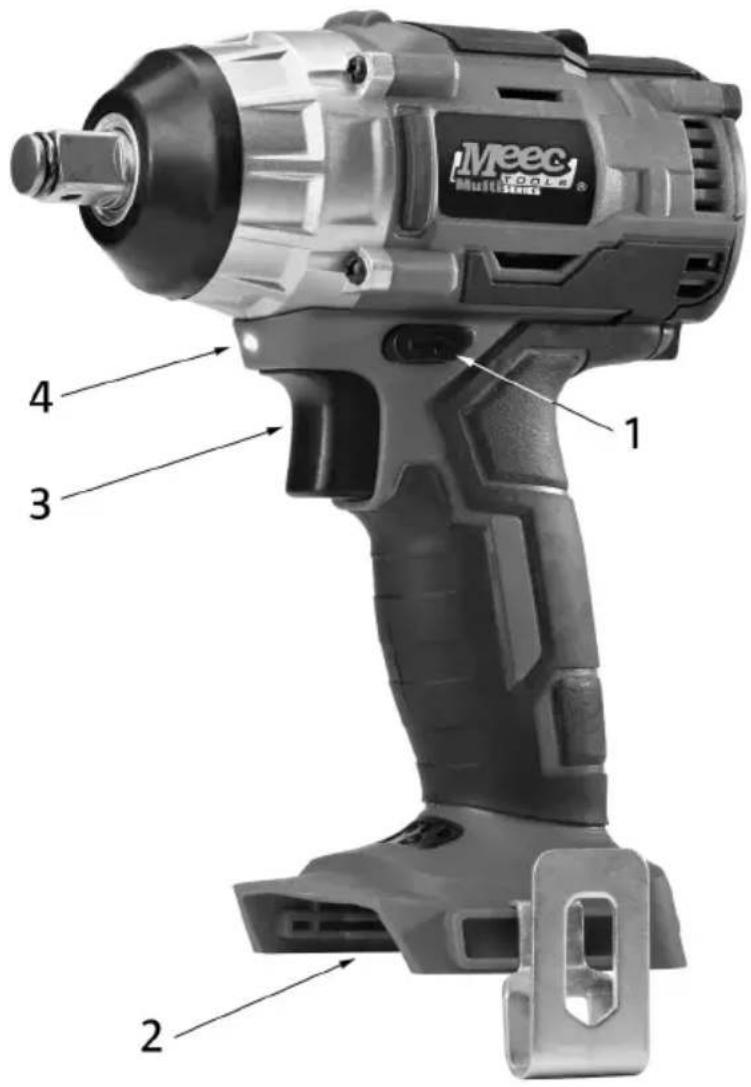
-
Direction selector
-
Power switch
-
Battery compartment
-
LED
USE
Intended use
The impact wrench is designed for tightening and loosening the screw joints. The impact wrench is only intended for private use and for the specified area of application. All other use is prohibited.
Non-intended use
The impact wrench is not intended for professional use. The impact wrench must not be used together with other accessories than those specified by the manufacturer. The impact wrench must not be modified or used in other ways than the stated intended use.
Assembly and replacing the tool's accessories.
WARNING: Use only supplied or accessories specified by the manufacturer. Tool accessories can be very sharp and can be in use become very hot - risk of personal injury. Wear safety gloves when handling tool accessories and bits.
- Place the tool on a stable surface, for example a work bench.
- Align the tool accessory on the drive and press it into place until it locks.
- Check that the tool accessory is properly positioned on the drive.
Switching On/Off
- Press the power switch to start the tool.
- Release the power switch to stop the tool.
- The tool features a variable speed. Press the power button longer to increase the speed, release slightly to reduce the speed.
Use
- Hold the tool firmly and put the right socket on the anvil. Fit the socket on the nut and hold the tool firmly pressed against the nut, so that the socket does not slip. Press the power switch to start screwing.
- When the nut does not initially resist the tightening the impact wrench works like a normal screwdriver. When the nut starts to become tight and resist the percussion function comes into play automatically.
- The tightening torque varies according to a wide range of different factors. For this reason, check the torque with a torque wrench after tightening.
- The final torque achieved after a few seconds of tightening varies according to the type of nut, dimension and combination of materials. It therefore takes a little practice and experience to judge the correct tightening time for a specific torque.
Charging the battery
The battery must be charged before using for the first time. At this first-time charging, the battery should be fully charged. Otherwise, the battery will not reach its full capacity.
IMPORTANT: Only use the supplied charger to charge the battery.
-
Connect the battery to the charger and then connect the charger to the mains supply. Charging takes place automatically.
-
Unplug the charger from the mains supply before removing the battery from the charger.
MAINTENANCE
Cleaning and correct maintenance of the tool is important for both safety and for the service life of the tool.
NOTE: Switch off the tool and disconnect it from the power supply (remove the battery/unplug the power cord) before cleaning and maintenance - risk of electrical shock and accidental starting.
- Wipe the tool with a cloth moistened with water and a few drops of soap or detergent. Brush clean hard to reach areas with a brush. NOTE: Do not use cleaning agents that contain solvents or abrasive or corrosive additives - risk of damaging tool surfaces.
- Clear the tool vents and the accessory mount after each use of with brush and cloth.
- Stubborn contamination in areas hard to access can be removed with compressed air.
• Always check after each use that any accessories are free from damage. - Remove the accessory from the tool's drive after each use and clean the drive.
IMPORTANT: The tool has no internal parts that the user can service or repair. Never try to repair the tool yourself. Take to an authorised service centre
Transport and storage
- Clean the tool as instructed and allow it to dry.
- If the tool shall remain unused for any length of time, it should be stored in the original packaging.
- Store the tool in a dry place, well ventilated and out of the reach of children.
• Always shut off the tool before transport.
• Always carry the tool using the purpose-designed handle. - Ensure that the tool is not at risk of tipping over or exposed to vibration and shocks during transport, especially if the tool will be transported by car or other vehicle.
CE
EC DECLARATION OF CONFORMITY
EG FÖRSÄKRAN OM ÖVERENSSTÄMMELSE
EF SAMSVARSERKLÆRING
DEKLARACJA ZGODNOŚCI WE

Jula AB, Box 363, SE-532 24 SKARA, SWEDEN
Machinery Directive 2006/42/EC
EN 60745-1:2009+A11, EN 60745-2-2:2010
Electromagnetic Compatibility Directive 2004/108/EC
EN 55014-1:2006+A1+A2, EN 55014-2:1997+A1+A2
RoHS Directive 2011/65/EU
IEC 62321-4:2013, IEC 62321-5:2013, EN 62321:2009
This product was CE marked in year -15
Name and address of the person authorised to compile the technical file:
- Care for the environment!
- SVENSKA....5
- SÄKERHETSANVISNINGAR....5
- TEKNISKA DATA 11
- BESKRIVNING 12
- HANDHAVANDE 12
- UNDERHÅLL 14
- NORSK 15
- SIKKERHETSANVISNINGER 15
- TEKNISKE DATA 21
- BESKRIVELSE....22
- BRUK....22
- VEDLIKEHOLD 24
- POLSKI 25
- ZASADY BEZPIECZEŃSTWA 25
- DANE TECHNICZNE 32
- OPIS 33
- OBSŁUGA 33
- KONSERWACJA 35
- ENGLISH 36
- SAFETY INSTRUCTIONS 36
- TECHNICAL DATA....42
- DESCRIPTION 43
- USE 43
- MAINTENANCE 45
- SÄKERHETSANVISNINGAR
- Read the operating instructions carefully before use!
- General safety instructions for power tools
- Work area
- Electrical safety
- Personal safety
- Use and care
- Additional instructions for cordless power tools
- Service
- Special safety instructions for screwdrivers
- Important safety instructions for the battery and battery charger
- Safety instructions for batteries
- Remaining risks
- IMPORTANT:
- Symbol
- Always wear ear protection!
- DESCRIPTION
- USE
- Intended use
- Non-intended use
- Assembly and replacing the tool's accessories.
- Switching On/Off
- Charging the battery
- MAINTENANCE
- Transport and storage
- CE
- EC DECLARATION OF CONFORMITY
- EG FÖRSÄKRAN OM ÖVERENSSTÄMMELSE
- EF SAMSVARSERKLÆRING
- DEKLARACJA ZGODNOŚCI WE
Brand : Meec Tools
Model : 000-705
Category : Hand Tools