
EX-P600 - Digital Camera CASIO - Free user manual and instructions
Find the device manual for free EX-P600 CASIO in PDF.


User questions about EX-P600 CASIO
0 question about this device. Answer the ones you know or ask your own.
Ask a new question about this device
Download the instructions for your Digital Camera in PDF format for free! Find your manual EX-P600 - CASIO and take your electronic device back in hand. On this page are published all the documents necessary for the use of your device. EX-P600 by CASIO.
USER MANUAL EX-P600 CASIO
Thank you for purchasing this CASIO Product.
- Before using it, be sure to read the precautions contained in this User's Guide.
- Keep the User's Guide in a safe place for future reference.
- For the most up-to-date information about this product, visit the official Exilim Website at http://www.exilim.com/.
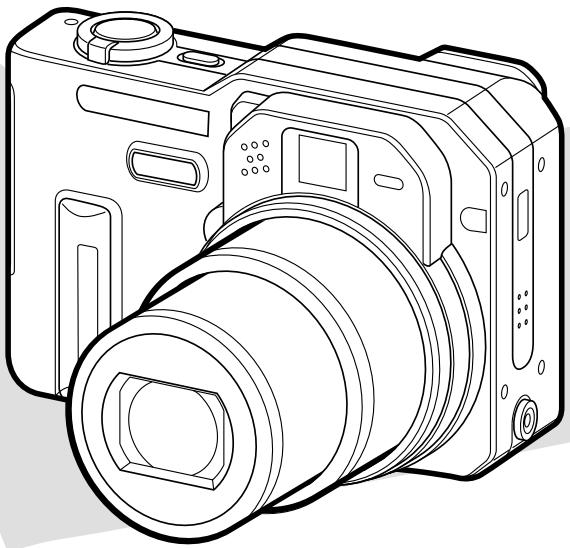
Unpacking
Check to make sure that all of the items shown below are included with your camera. If something is missing, contact your dealer as soon as possible.
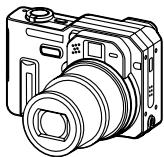
Camera
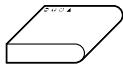
Rechargeable lithium ion battery (NP-40)
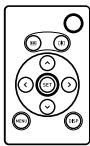
Card Remote Controller

Lithium battery (CR2025)
- For card remote controller.
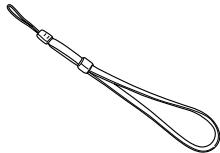
Strap
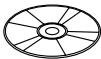
CD-ROM (CASIO Digital Camera Software)
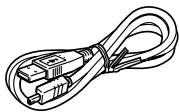
USB Cable
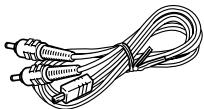
AV Cable
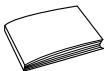
Basic Reference
- Note that the shape of the charger unit depends on the area where you purchased the camera.
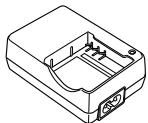
Rapid Charger Unit (BC-30L) (Inlet Type)
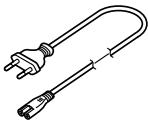
* The shape of the AC power cord plug varies according to country or geographic area.
AC power cord *
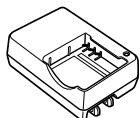
Rapid Charger Unit (BC-30L) (Plug-in Type)
Contents
2 INTRODUCTION
Unpacking 2
Features 10
Precautions 13
General Precautions 13
Test for proper operation before using the camera! 15
Data Error Precautions 15
Operating conditions 15
Condensation 16
Lens and Phase Differential Sensor 16
Other 16
17 QUICK START GUIDE
First, charge the battery! 17
To configure display language and clock settings..... 19
To record an image 20
To view a recorded image 20
To delete an image 21
22 GETTING READY
About This Manual 22
General Guide 23
Camera 23
Monitor Screen Contents 26
REC mode 26
PLAYmode 30
Changing the Contents of the Monitor Screen 31
Indicator Lamps 33
Attaching the Strap 34
Power Requirements 34
Using the Rapid Charger Unit 34
To load the battery 38
To remove the battery 39
Power Supply Precautions 42
Using AC Power 45
Turning the Camera On and Off 47
Configuring Power Saving Settings 47
Using the On-screen Menus 48
Configuring Display Language and Clock Settings... 51
To configure display language and clock settings 52
54 BASIC IMAGE RECORDING
Recording an Image 54
Aiming the Camera 54
Recording an Image 55
Recording Precautions 57
About Auto Focus 58
About the REC Mode Monitor Screen 58
Previewing the Last Image Recorded 59
Deleting an Image on the Preview Screen 59
Orientation Sensor 60
Using the Optical Viewfinder 61
Using Zoom 62
Optical Zoom 62
Digital Zoom 63
Using the Flash 64
Flash Unit Status 66
Changing the Flash Intensity Setting 66
Flash Precautions 67
Using the Self-timer 68
Specifying Image Size and Quality 70
To specify the image size 70
To specify image quality 71
OTHER RECORDING FUNCTIONS
Selecting the Focus Mode 73
Using Auto Focus 74
Using the Macro Mode 76
Using the Infinity Mode 77
Using Manual Focus 77
Using Pan Focus 78
Using Focus Lock 79
Exposure Compensation (EV Shift) 80
Adjusting White Balance 81
Adjusting White Balance Manually 83
Specifying the Exposure Mode 84
Using Aperture Priority AE 84
Using Shutter Speed Priority AE 85
Setting Exposure Settings Manually 87
Using Manual Assist On-screen Guidance 88
Exposure Mode Recording Precautions 89
Using Auto Exposure Lock (AE Lock) 89
Using a Continuous Shutter Mode 91
Using the Normal Speed Continuous Shutter Mode 91
Using the High Speed Continuous Shutter Mode 92
25-shot Stop Action Images (Using the Multi Continuous Shutter Mode) 93
Continuous Shutter Precautions 94
INTRODUCTION
Using Auto Bracketing 95
Using Auto Bracketing with Exposure Selected as the Variable (AE Bracketing) 96
Using Auto Bracketing with White Balance as the Variable (WB Bracketing) 97
Using Auto Bracketing with the Focus Distance as the Variable (Focus Bracketing) 98
Using Auto Bracketing with Non-configurable Variables (Multi Bracketing) 99
Auto Bracketing Precautions 100
Previewing Images Recorded with High Speed
Continuous Shutter or Auto Bracketing 100
Deleting an Image on the Preview Screen 102
Using the BESTSHOT Mode 103
Creating Your Own BESTSHOT Setup 104
Combining Shots of Two People into a Single Image
(Coupling Shot) 107
Recording a Subject onto an Existing Background
Image (Pre-shot) 109
Using the Movie Mode 111
Recording Audio 113
Adding Audio to a Snapshot 113
Recording Your Voice 114
REC Mode Camera Settings 116
117
Selecting the Auto Focus (AF) Mode 118
Selecting the Metering Mode 119
Using the Filter Function 120
121
Specifying Color Saturation 121
Specifying Contrast 122
Turning the On-screen Grid On and Off 122
Turning Image Review On and Off 123
Assigning Functions to the [A] and [B] Keys 123
124
Resetting the Camera 126
Using the Shortcut Menu 127
Using the Card Remote Controller for Recording ... 128
Loading the Battery 128
Before Using the Card Remote Controller for Recording 129
Using the Card Remote Controller 130
Using an External Flash 132
External Flash Unit Requirements 132
Attaching an External Flash Unit 133
Using a Conversion Lens or Filter 135
Installing a Conversion Lens or Close-up Lens 136
Installing a Filter 137
138 PLAYBACK
BasicPlaybackOperation 138
Playing an Audio Snapshot 139
Zooming the Display Image 140
Resizing an Image 141
Cropping an Image 142
Checking the Focus of a Recorded Image 144
Playing a Movie 145
Displaying the 9-image View 146
Selecting a Specific Image in the 9-image View 147
Displaying the Calendar Screen 147
Playing a Slide Show 148
To specify the slideshow images 150
To specify the slideshow time 151
To set the slideshow interval 151
Rotating the Display Image 152
Using Image Roulette 153
Adding Audio to a Snapshot 154
To re-record audio 155
Playing Back a Voice Recording File 156
Displaying Camera Images on a TV Screen 157
Selecting the Video Input System 158
159 DELETING FILES
Deleting a Single File 159
Deleting All Files 160
161 FILE MANAGEMENT
Folders 161
Memory Folders and Files 161
Protecting Files 162
To protect a single file 162
To protect all files in memory 163
Using the FAVORITE Folder 163
To copy a file to the FAVORITE folder 163
To display a file in the FAVORITE folder 165
To delete a file from the FAVORITE folder 166
To delete all files from the FAVORITE folder 167
168 OTHER SETTINGS
Configuring Sound Settings 168
To configure sound settings 168
To set the volume level 169
Specifying an Image for the Startup Screen 169
INTRODUCTION
Configuring Power Down Image Settings 170
Specifying the File Name Serial Number Generation Method 172
Using the Alarm 173
To set an alarm 173
Stopping the Alarm 174
Setting the Clock 174
To select your Home Time zone 174
To set the current time and date 175
Changing the Date Format 176
Using World Time 176
To display the World Time screen 176
To configure World Time settings 177
To configure summer time (DST) settings 178
Changing the Display Language 179
Changing the USB Port Protocol 179
Formatting Built-in Memory 180
182 USING A MEMORY CARD
Using a Memory Card 183
To insert a memory card into the camera 183
To remove a memory card from the camera 184
Formatting a Memory Card 184
Memory Card Precautions 185
Copying Files 186
To copy all the files in built-in memory to a memory card 186
To copy a file from a memory card to built-in memory 187
188 PRINTING IMAGES
DPOF 189
To configure print settings for a single image 190
To configure print settings for all images 191
Using PictBridge or USB DIRECT-PRINT 192
To print a single image 192
To print a group of images 194
Printing Precautions 196
PRINT Image Matching II 196
Exif Print 197
198 VIEWING IMAGES ON A COMPUTER
Using the Camera with a Windows Computer 198
USB Connection Precautions 203
Using the Camera with a Macintosh Computer 204
USB Connection Precautions 207
Operations You Can Perform from Your Computer .... 207
INTRODUCTION
Using a Memory Card to Transfer Images to a
Computer 208
Memory Data 209
DCF Protocol 209
Memory Directory Structure 209
Image Files Supported by the Camera 211
Built-in Memory and Memory Card Precautions 212
213 USING THE CAMERA WITH A COMPUTER
Using the Album Feature 213
Creating an album 213
Selecting an Album Layout 215
ConfiguringDetailedAlbumSettings 215
Viewing Album Files 218
Saving an Album 220
To delete an album 221
Installing the Software from the CD-ROM 221
About the bundled CD-ROM (CASIO Digital Camera Software) 221
Computer System Requirements 223
Installing Software from the CD-ROM
in Windows 224
Getting Started 225
Selecting a Language 225
Viewing the Contents of the "Read me" File 225
Installing an Application 226
Viewing User Documentation (PDF Files) 226
User Registration 227
Exiting the Menu Application 227
Installing Software from the CD-ROM
on a Macintosh 227
Installing Software 227
Viewing User Documentation (PDF Files) 228
230 APPENDIX
Menu Reference 230
Indicator Lamp Reference 233
REC mode 233
PLAYmode 234
Rapid Charger Unit 235
Troubleshooting Guide 236
Display Messages 241
Specifications 242
IMPORTANT!
- The contents of this manual are subject to change without notice.
Note that the example screens and product illustrations shown in this User's Guide may differ somewhat by the screens and configuration of the actual camera. - CASIO COMPUTER CO., LTD. assumes no responsibility for any damage or loss resulting from the use of this manual.
- CASIO COMPUTER CO., LTD. assumes no responsibility for any loss or claims by third parties which may arise through the use of the EX-P600.
- CASIO COMPUTER CO., LTD. shall not be held liable for any damages or losses suffered by you or any third party due to the use of Photo Loader and/or Photohands.
- CASIO COMPUTER CO., LTD. assumes no responsibility for any damage or loss caused by deletion of data as a result of malfunction, repairs, or battery replacement. Be sure to back up all important data on other media to protect against its loss.
- The SD logo is a registered trademark.
- Windows, Internet Explorer, and DirectX are registered trademarks of Microsoft Corporation.
-
Macintosh is a registered trademark of Apple Computer, Inc.
-
MultiMediaCard is a trademark of Infineon Technologies AG of Germany, and licensed to the MultiMediaCard Association (MMCA).
- Acrobat and Acrobat Reader are trademarks of Adobe Systems Incorporated.
- The USB driver (mass storage) uses Phoenix Technologies Ltd. software.
- Compatibility Software Copyright © 1997 Phoenix Technologies Ltd., All Rights Reserved.
- Other company, product and service names used herein may also be trademarks or service marks of others.
- Photo Loader and Photohands are the property of CASIO COMPUTER CO., LTD. Except as stipulated above, all copyrights and other related rights to these applications revert to CASIO COMPUTER CO., LTD.
Copyright Restrictions
Except for the purposes of your own personal enjoyment, unauthorized copying of snapshot files, movie files, and audio files violates copyright laws and international contracts.
Distribution to third parties of such files over the Internet without permission of the copyright holder, whether for profit or for free, violates copyright laws and international contracts.
Features
- 6 million effective pixels
CCD provides 6.37 million total pixels of very high-resolution that produces crisp, clear, prints and display images.
2.0-inch TFT color LCD monitor screen
- Long battery life
The camera's low-power design combines with a large-capacity battery to provide more recording and playback between charges.
16X seamless zoom (page 62)
4X optical zoom, 4X digital zoom
9.2MB Flash memory
Images can be recorded without using a memory card.
High-speed, high-precision Auto Focus
A phase differential sensor combines with contrast Auto Focus for faster focusing.
- Three continuous shutter modes (page 91)
In addition to normal continuous shutter operation that can continually record shots as long as memory is available, you can also use high-speed continuous
shutter and stop-action continuous shutter, which records a series of shots in a single image.
- Four auto bracketing modes (page 95)
Configurable variables can be set up to record multiple versions of an image altering the exposure, white balance, or focus distance setting. Non-configurable variables create multiple versions of the same image using various filters and other settings.
- Ex Finder view (page 29)
The Ex Finder view provides you with a wealth of information on the monitor screen as you compose your images.
- Ex Menu (page 127)
Short-cut menu access to four frequently-used settings.
- Multi Auto Focus (page 75)
When "Multi" is selected for the Auto Focus area, the camera takes simultaneous meter readings at seven different points and automatically selects the best one.
This makes it possible to avoid erroneous focusing on the background, and ensure proper focus for a wide range of image types.
- Movable Auto Focus (AF) Area (page 75)
You can move the focus area to the location you want.
- Support for SD memory cards and MMC (MultiMedia Cards) for memory expansion (page 182)
INTRODUCTION
- Manual Assist (page 88)
Follow the on-screen guidance when configuring manual exposure settings.
AE Lock (page 89)
A simple operation locks exposure on a particular subject, helping to ensure that the image is focused the way you want.
- BESTSHOT (page 103)
Simply select the sample scene that matches the type of image you are trying to record and the camera performs troublesome setups automatically for beautiful pictures every time.
- Coupling Shot and Pre-shot (pages 107, 109)
Coupling Shot lets you combine two subjects into a single image, while Pre-shot lets you add a subject to a previously recorded background image. This means you can create images that include you and your friend, even if you are the only two people around.
- Triple Self-timer mode (page 68)
The self-timer can be set up to repeat three times, automatically.
Real-time RGB histogram (page 32)
An on-screen histogram lets you adjust exposure as you view the effect on overall image brightness, which makes shooting under difficult lighting conditions easier than ever before.
World Time (page 176)
A simple operation sets the current time for your current location. You can select from among 162 cities in 32 time zones.
- Alarm (page 173)
A built-in alarm helps to keep you on time for important events, and even can be used in place of an alarm clock. You can also have a specific image appear, or a movie or audio file to play when the alarm time is reached.
- Album Function (page 213)
HTML files are generated automatically to create an album of recorded images. Album contents can be viewed and printed using a standard Web browser. Images can also be incorporated into Web pages quickly and easily.
Calendar screen (page 147)
A simple operation displays a full-month calendar on the camera's monitor screen. Each day of the full-month calendar shows a thumbnail of the first image recorded for that date, which helps to make searching for a particular image quicker and easier.
-
Snapshot + Audio Mode (page 113)
Adds audio to a snapshot. -
Movie + Audio Mode (page 111)
INTRODUCTION
Voice Recording (page 114) Quick and easy recording of voice input.
- After Recording (page 154)
Adds audio to images after they are recorded.
- Selectable Sound Settings (page 168)
You can configure different sounds to play whenever you turn on the camera, press the shutter button half-way or all the way, or perform a key operation.
- Card remote controller (page 128)
- External flash connectability (page 132)
- Conversion lens/close-up lens support (page 135) Conversion lens enhances telephoto and wide angle shots, while the close-up lens enhances macro shots.
- DCF Data Storage
- DCF (Design rule for Camera File system) data storage protocol provides image inter-compatibility between the digital camera and printers.
- Digital Print Order Format (DPOF) (page 189) Images can be printed easily in the sequence you want using a DPOF compatible printer. DPOF can also be used when specifying images and quantities for printing by professional print services.
- PRINT Image Matching II Compatible (page 196) Images include PRINT Image Matching II data (mode setting and other camera setup information). A printer that supports PRINT Image Matching II reads this data and adjusts the printed image accordingly, so your images come out just the way you intended when you recorded them.
- USB DIRECT-PRINT support (page 192) Your camera supports USB DIRECT-PRINT, which was developed by Seiko Epson Corporation. When connected directly to a printer that supports USB DIRECT-PRINT, you can select images to print and start the print operation directly from the camera.
- PictBridge support (page 192) Your camera supports the PictBridge standard of the Camera and Imaging Products Association (CIPA). You can connect the camera directly to a printer that supports PictBridge, and perform image selection and printing using the camera monitor screen and controls.
- Transfer images to a computer simply by connecting the camera with a USB cable (page 198).
- Connect the camera to a TV with the AV cable and use the TV screen for image recording and viewing (page 157).
INTRODUCTION
- Bundled with Photo Loader and Photohands (page 222) Your camera comes bundled with Photo Loader, the popular application that automatically loads images from your camera to your PC. It also comes with Photohands, and application that makes image retouching quick and easy.
Precautions
General Precautions
Be sure to observe the following important precautions whenever using the EX-P600.
All references in this manual to "this camera" and "the camera" refer to the CASIO EX-P600 Digital Camera.
- Never try to take pictures or use the built-in display while operating a motor vehicle or while walking. Doing so creates the danger of serious accident.
- Never try to open the case of the camera or attempt your own repairs. High-voltage internal components create the risk of electric shock when exposed. Always leave maintenance and repair work up to a CASIO authorized service center.
- Never look at the sun or any other bright light through the camera's viewfinder. Doing so can damage your eyesight.
- Keep the small parts and accessories of this camera out of the reach of small children. If swallowed accidentally, contact your physician immediately.
- Never fire the flash in the direction of a person operating a motor vehicle. Doing so can interfere with the driver's vision and create the danger of accident.
INTRODUCTION
- Never fire the flash while it is too close to the subject's eyes. Intense light from the flash can cause eye damage if it is fired too close to the eyes. This is especially true with young children. When using the flash, the camera should be at least one meter (3.3') from the eyes of the subject.
- Keep the camera away from water and other liquids, and never let it get wet. Moisture creates the danger of fire and electric shock. Never use the camera outdoors in the rain or snow, at the seashore or beach, in the bathroom, etc.
- Should foreign matter or water ever get into the camera, immediately turn it off. Next, remove the camera's battery and/or unplug the AC adaptor power cord from the power outlet, and contact your dealer or nearest CASIO authorized service center. Using the camera under these conditions creates the danger of fire and electric shock.
-
Should you ever notice smoke or a strange odor coming out of the camera, immediately turn it off. Next, taking care you do not burn your fingers, remove the camera's battery and/or unplug the AC adaptor power cord from the power outlet, and contact your dealer or nearest CASIO authorized service center. Using the camera under these conditions creates the danger of fire and electric shock. After making sure there is no more smoke coming from the camera, take it to your nearest CASIO authorized service center for repair. Never attempt your own maintenance.
-
Never use the AC adaptor to power any other device besides this camera. Never use any other AC adaptor besides the one that comes with this camera.
- Never cover the AC adaptor with a quilt, blanket, or other cover while it is in use, and do not use it near a heater.
- At least once a year, unplug the AC adaptor power cord from the power outlet and clean the area around the prongs of the plug. Dust build up around the prongs can create the danger of fire.
- If the camera's case should ever become cracked due to dropping it or otherwise subjecting it to rough treatment, immediately turn it off. Next, remove the camera's battery and/or unplug the AC adaptor power cord from the power outlet, and contact your dealer or nearest CASIO authorized service center.
- Never use the camera inside of an aircraft or in any other areas where its use is prohibited. Doing so can result in an accident.
- Physical damage and malfunction of this camera can cause the data stored in its memory to be deleted. Be sure to always keep backup copies of data by transferring them to personal computer memory.
- Never open the battery compartment cover, disconnect the AC adaptor from the camera, or unplug the AC adaptor from the wall socket while recording images. Doing so will not only make storage of the current image impossible, it can also corrupt other image data already stored in file memory.
Test for proper operation before using the camera!
- Before using the camera to record important images, make sure you first record a number of test images and check the results to ensure that the camera is configured correctly and operating properly (page 20).
Data Error Precautions
-
Your digital camera is manufactured using precision digital components. Any of the following creates the risk of corruption of data in file memory.
-
Removing the battery or memory card while the camera is performing a record or memory access operation
- Removing the battery or memory card while the operation lamp is still flashing after you turn off the camera
- Disconnecting the USB cable while a data communication operation is being performed
Low battery power - Other abnormal operations
Any of the above conditions can cause an error message to appear on the monitor screen (page 241). Follow the instructions provided by the message to eliminate the cause of the error.
Operating conditions
- This camera is designed for use in temperatures ranging from 0^ to 40^ ( 32^ to 104^ ).
- Do not use or keep the camera in the following areas.
In areas subject to direct sunlight
In areas subject to high humidity or dust
Near air conditioners, heaters, or other areas subject to temperature extremes
— Inside of a closed vehicle, especially one parked in the sun
In areas subject to strong vibration
Condensation
- When you bring the camera indoors on a cold day or otherwise expose it to a sudden change of temperature, there is the possibility that condensation can form on the exterior or on interior components. Condensation can cause malfunction of the camera, so you should avoid exposing it to conditions that might cause condensation.
- To keep condensation from forming, place the camera into a plastic bag before moving it into a location that is much warmer or colder than your current location. Leave it in the plastic bag until the air inside the bag has a chance to reach the same temperature as the new location. If condensation does form, remove the battery from the camera and leave the battery compartment cover open for a few hours.
Lens and Phase Differential Sensor
- Never apply too much force when cleaning the surface of the lens and phase differential sensor. Doing so can scratch the lens and phase differential sensor surface and cause malfunction.
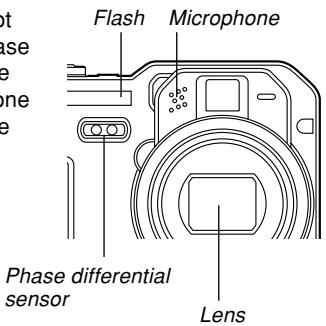
- Fingersprints, dust, or any other soiling of the lens and phase differential sensor can interfere with proper image recording. Never touch the lens and phase differential sensor with your fingers. You can remove dust particles from the lens and phase differential sensor surface by using a lens blower to blow them off. Next, wipe the surface of the lens and phase differential sensor with a soft lens cloth.
- When aiming the camera, make sure that your finger does not block the phase differential sensor.
Other
- The camera may become slightly warm during use. This does not indicate malfunction.
- If the exterior of the camera needs cleaning, wipe it with a soft, dry cloth.
First, charge the battery!
-
Charge the rechargeable lithium ion battery (NP-40) that comes with the camera (page 35).
-
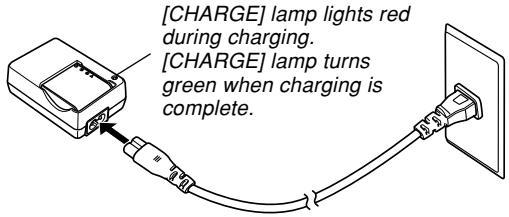
Note that the shape of the charger unit depends on the area where you purchased the camera.
It takes about two hours to achieve a full charge.
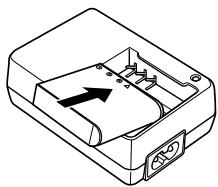
1
2
Inlet Type
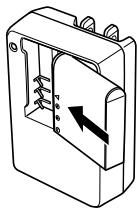
1
2
Plug-in Type
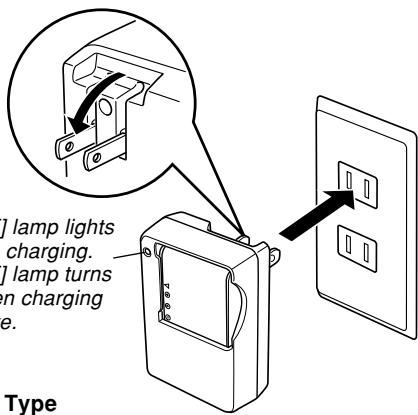
[CHARGE] lamp lights red during charging. [CHARGE] lamp turns green when charging is complete.
2. Load the battery (page 38).
1

3
2
To configure display language and clock settings
- Be sure to configure the following settings before using the camera to record images. (See page 51 for details.)
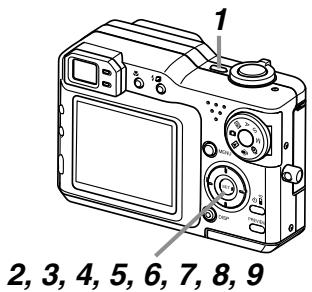
- Press the power button to turn on the camera.
- Press [▲] to select the language you want.
- Press [SET] to register the language setting.
- Use [], [], [] , and [] to select the geographical area you want, and then press [SET].
- Use [] and [] to select the city you want, and then press [SET].
- Use [] and [] to select the summer time (DST) setting you want, and then press [SET].
- Use [] and [] to select the date format setting you want, and then press [SET].
- Set the date and the time.
- Press [SET] to register the clock settings and exit the setting screen.
To record an image
Green operation lamp
(See page 54 for details.)
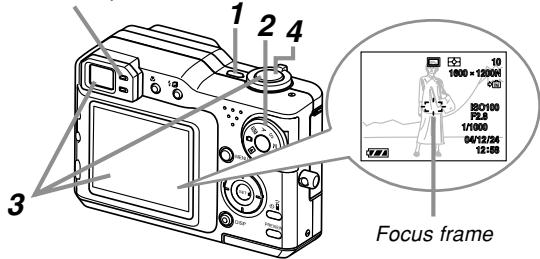
- Press the power button to turn on the camera.
- Align the mode dial with (Snapshot Mode).
-
Point the camera at the subject, use the monitor screen or viewfinder to compose the image, and then press the shutter button half way.
-
When proper focus is achieved, the focus frame turns green and the green operation lamp lights.
- Holding the camera still, gently press the shutter button.
To view a recorded image
(See page 138 for details.)
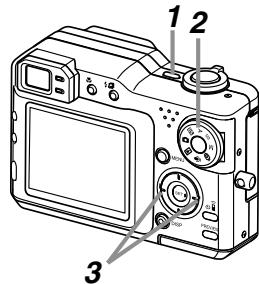
- Press the power button to turn on the camera.
- Align the mode dial with (PLAY Mode).
- Use [<] and [> ] to scroll through the images.
To delete an image
(See page 159 for details.)
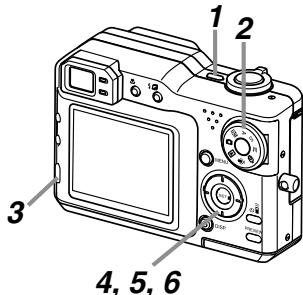
- Press the power button to turn on the camera.
- Align the mode dial with (PLAY Mode).
- Press [EX Ⅲ].
- Use [] and [] to display the image you want to delete.
-
Use [] and [] to select "Delete".
-
To exit the image delete operation without deleting anything, select "Cancel".
-
Press [SET] to delete the image.
GETTING READY
This section contains information about things you need to know about and do before trying to use the camera.
About This Manual
This section contains information about the conventions used in this manual.
Terminology
The following table defines the terminology used in this manual.
| This term as used in this manual: | Means this: |
| “this camera” or “the camera” | The CASIO EX-P600 Digital Camera |
| “file memory” | The location where the camera is currently storing images you record (page 55) |
| “battery” | The NP-40 Rechargeable Lithium Ion Battery |
| “charger unit” | The CASIO BC-30L rapid Charger Unit |
■ Button Operations
Button operations are indicated by the button name inside of brackets ([ ]).
■ On-screen Text
On-screen text is always enclosed by double quotation marks ("").
File Memory
The term "file memory" in this manual is a general term that refers to the location where your camera is currently storing the images you record. File memory can be any one of the following three locations.
The camera's built-in Flash memory
An SD memory card loaded in the camera
- A MultiMediaCard loaded in the camera
For more information about how the camera stores images, see page 161.
General Guide
The following illustrations show the names of each component, button, and switch on the camera.
Camera
Front
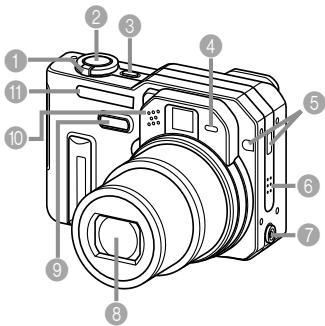
1 Zoom controller
2 Shutter button
3 Power button
Self-timer lamp
Remote control signal receiver
6 Speaker
External flash sync terminal
8 Lens
9 Phase differential sensor
Microphone
1 Flash
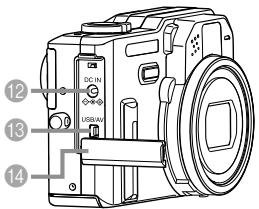
DC IN
USB/AV
14 Terminal panel cover
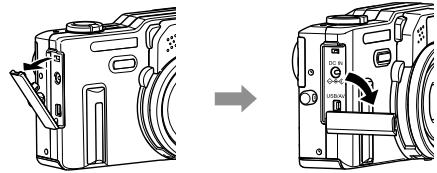
Open Terminal Panel Cover
Back
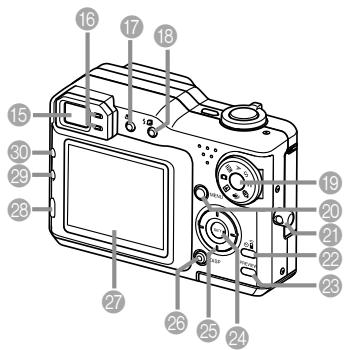
Viewfinder
16 Operation lamp
17 y button
18 [ ] (Flash / Calendar) button
19 Mode dial
:PLAYMode
: Snapshot Mode
ES : BESTSHOT Mode
A : Aperture Priority AE Mode
S : Shutter Speed Priority AE Mode
M : Manual Exposure Mode
: Movie Mode
Voice Recording Mode
[MENU] button
Strap ring
O
button
[PREVIEW] button
[SET] button
[△][V][A][B]
[DISP] button
Monitor Screen
[EX] (EX/Delete) button
AE-L button
[BKT] (Continuous Shutter/Auto Bracketing) button
REC Mode
Bottom
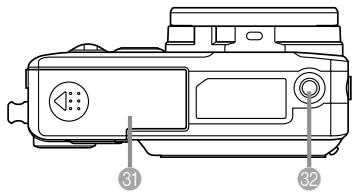
Battery compartment cover
32 Tripod screw hole
- Use this hole when attaching to a tripod.
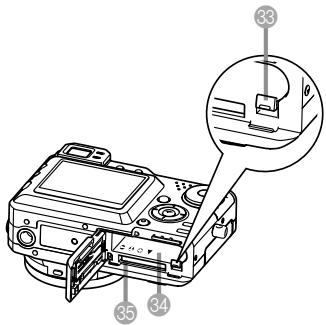
Stopper
34 Battery compartment
Memory card slot
Monitor Screen Contents
The monitor screen uses various indicators and icons to keep you informed of the camera's status.
- Note that the example screens in this chapter are for illustrative purposes only. They do not exactly match the screen contents actually produced on the camera.
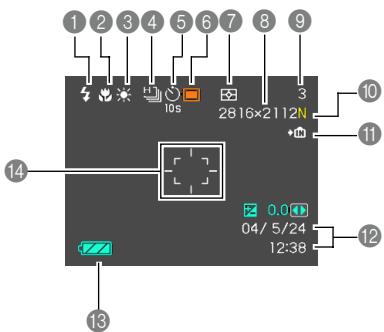
REC mode
Flash mode indicator
None (Auto)

(Flash Off)

(Flash On)

(Red Eye Reduction)
- If the camera detects that flash is required while auto flash is selected, the flash on indicator will appear when the shutter button is pressed half way.
Focus mode indicator
None (Auto Focus)

(Macro)

(Pan Focus)

(Infinity)

(Manual Focus)
- (Pan Focus) appears in the Movie Mode only.
3 White balance indicator
None (Auto)

(Daylight)

(Cloudy)

(Shade)

(Tungsten)

(Fluorescent 1)

(Fluorescent 2)

(Flash)

Manual)
4 Continuous shutter/auto bracketing mode

(Single Shot)

(High Speed Continuous)

(Normal Speed
Continuous)

(Multi Continuous)

(AE Bracketing)

(WB Bracketing)

(Focus Bracketing)

(Multi Bracketing)
Self-timer/Remote controller mode
None
(1 Shot)

(10-second Self-timer)

(2-second Self-timer)

(Triple Self-timer)

(Remote controller)

(Remote controller and 2-second Self-timer)
Recording mode

(Snapshot)

(BESTSHOT)

(Aperture Priority AE)

(Shutter Speed Priority AE)

(Manual Exposure)

(Movie)

(Voice Record)
GETTING READY
Metering mode indicator

(Multi)

(Center Weighted)

(Spot)
8 Image size
2816 × 2112 pixels
2816× 1872 (3:2) pixels
2048×1536pixels
1600 × 1200 pixels
1280 × 960 pixels
640 × 480 pixels
Movie Recording: recording time
Memory Capacity
(Remaining number of storable images)
Movie Recording: Remaining
recording time
10 Image quality
F:FINE
N:NORMAL
E: ECONOMY
T:TIFF
Memory indicator

(Built-in memory in use)
(Memory card in use)
12 Date/time
13 Battery level indicator
14 Focus frame
- Focused: Green
- Unfocused: Red
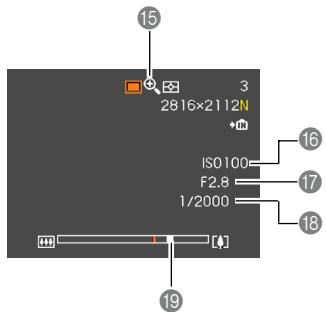
Digital zoom indicator
ISO sensitivity
17 Aperture value
18 Shutter speed value
- An out of range aperture or shutter speed causes the corresponding monitor screen value to turn amber.
9 Zoom indicator
- Left side indicates optical zoom.
- Right side indicates digital zoom.
GETTING READY
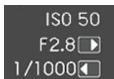
Exposure Panel
The exposure panel is an area in the lower right corner of the REC mode monitor screen that shows various adjustable parameters. You can also use the exposure panel to adjust exposure settings.
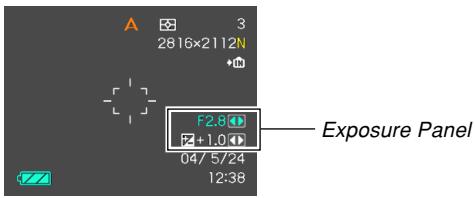
- The following explains the items that appear on the exposure panel. Note that the current recording mode determines which items appear.
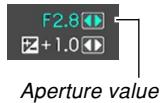
1 Aperture value
Use this item to adjust the aperture.
Applicable Modes: A Mode (aperture priority AE), M Mode (manual exposure)
2.Shutter speed
Use this item to adjust the shutter speed.
Applicable Modes: S Mode (shutter priority AE), M Mode (manual exposure)
EV shift (exposure compensation value) Use this item to adjust the exposure compensation (EV shift) value.
- Applicable Mode: Snapshot Mode, BESTSHOT Mode, A Mode (aperture priority AE), S Mode (shutter speed priority AE)
4 Manual Focus (MF) setting
Use this item for adjust focus manually.
Applicable Mode: Manual Mode
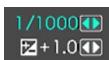
Shutter speed
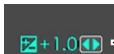
EV shift
FOCUS
MF setting
Ex Finder View
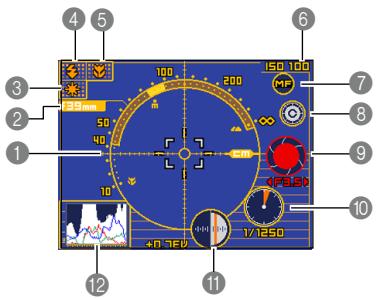
Focus distance scale
- This scale indicates the focus distance range. Note that this scale is not intended for precision measurement. It is provided as a general guide only.
- The focus distance scale may not appear when any one of the following conditions exists.
- When "Contrast" is selected as the Auto Focus (AF) mode (page 118)
- When "Hybrid" is selected as the Auto Focus (AF) mode (page 118) and Macro "✔️" is selected as the focus mode (page 73)
- Conditions that are so dark or so bright that distance measurement is impossible
- When "Free" is selected as the Auto Focus Area (AF Area) mode (page 75)
Focal distance
White balance indicator
4 Flash mode indicator
Focus mode indicator
ISO sensitivity
7 Manual focus icon
- This icon is displayed only when "MF (Manual Focus)" is selected as the focus mode.
- If you use [] and [] to move the cursor to “MF” and then press [] or [] , the Ex Finder view will disappear and the manual focus indicator (page 77) will appear.
Color change icon
- You can use [] and [] to move the cursor to “ ” and then press [] or [] to change the color of the Ex Finder view.
Aperture value
10 Shutter speed
- The shutter speed and aperture values on the monitor screen will turn amber when you press the shutter button half way if the image is over-exposed or under-exposed.
EV shift (exposure compensation value)
12 Histogram (page 32)
PLAY mode
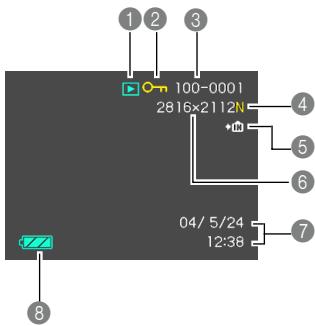
PLAY mode file type

Snapshot

Movie

Audio Snapshot

Voice Recording
2 Image protection indicator
3 Folder number/File number
4 Quality
F:FINE
N:NORMAL
E: ECONOMY
T:TIFF
5 IN
Built-in memory selected for data storage.
Memory card selected for data storage.
6 Image size
2816 × 2112 pixels
2816× 1872 (3:2) pixels
2048×1536pixels
1600 × 1200 pixels
1280 × 960 pixels
640× 480 pixels
Movie Playback: Elapsed play time
Date and time
8 Battery capacity
IMPORTANT!
- Some information may not display properly if you display an image that was recorded using a different digital camera model.
Changing the Contents of the Monitor Screen
Each press of the [DISP] button cycles the contents of the monitor screen as shown below.
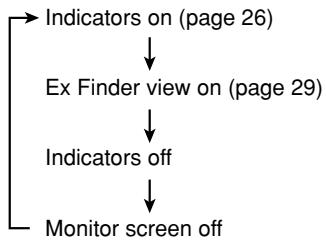
IMPORTANT!
- The Ex Finder view cannot be displayed in the Movie mode. In this case, a histogram is displayed in addition to normal display indicators.
- The Ex Finder view cannot be displayed in the following modes: PLAY, Coupling Shot, Pre-shot.
- You cannot turn off the monitor screen in the following modes: PLAY, BESTSHOT, Movie (standby).
- Pressing [DISP] will not change monitor screen contents during movie recording or during standby or recording of an audio snapshot.
- The only display options that appear when you press [DISP] in the Coupling Shot or Voice Recording mode are "Indicators on" and "Monitor screen off".
■ Histogram
The histogram lets you check exposure conditions as you record images. You can also display the histogram of a recorded image in the PLAY mode.
-
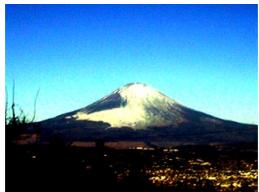
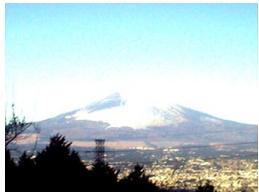
A histogram is a graph that represents the lightness of an image in terms of the number of pixels. The vertical axis indicates the number of pixels, while the horizontal axis indicates lightness. You can use the histogram to determine whether an image includes the shadowing (left side), mid tones (center), and highlighting (right) required to bring out sufficient image detail. If the histogram appears too lopsided for some reason, you can use EV shift (exposure compensation) to move it left or right in order to achieve better balance. Optimum exposure can be achieved by correcting exposure so the graph is as close to the center as possible.
-
When the histogram is too far to the left, it means that there are too many dark pixels. This type of histogram results when the overall image is dark. A histogram that is too far to the left may result in "black out" of the dark areas of an image.
- When the histogram is too far to the right, it means that there are too many light pixels. This type of histogram results when the overall image is light. A histogram that is too far to the right may result in "white out" of the light areas of an image.
- A centered histogram indicates that there is good distribution of light pixels and dark pixels. This type of histogram results when the overall image is at optimal lightness.



IMPORTANT!
- Note that the above histograms are shown for illustrative purposes only. You may not be able to achieve exactly the same shapes for particular subjects.
- A centered histogram does not necessarily guarantee optimum exposure. The recorded image may be over-exposed or under-exposed, even though its histogram is centered.
- You may not be able to achieve an optimum histogram configuration due to the limitations of EV shift.
- Use of the flash as well as certain shooting conditions can cause the histogram to indicate exposure that is different from the actual exposure of the image when it was recorded.
Indicator Lamps
You can find out the operational status of the camera at a glance by checking the color of the indicator lamps, and whether a lamp is lit or flashing. For details, see "Indicator Lamp Reference" on page 233.
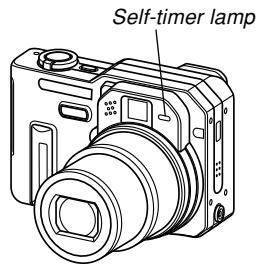
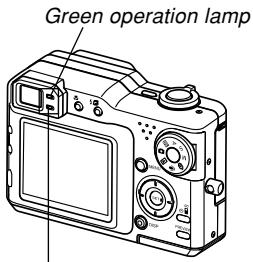
Red operation lamp
Attaching the Strap
Attach the strap to the strap ring as shown in the illustration.
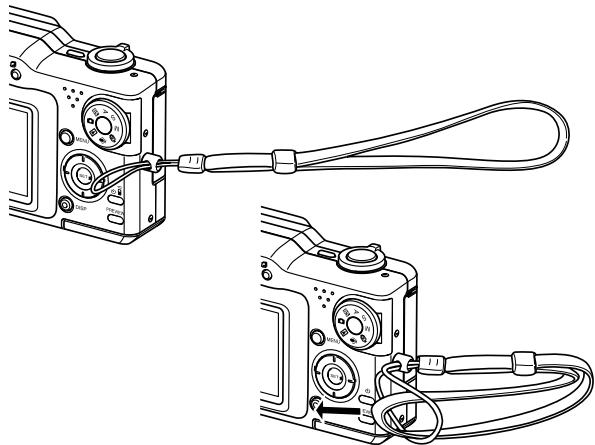
IMPORTANT!
- To avoid dropping the camera while operating it, be sure to wear the strap around your wrist. Use the buckle to ensure that the strap is fastened snugly your wrist.
- The supplied strap is intended for use with this camera only. Do not use it for any other purpose.
- Never swing the camera around by the strap.
Power Requirements
Your camera can operate on either battery power or AC power.
- Battery
One NP-40 rechargeable lithium ion battery
The battery is not charged when you purchase the camera. You need to charge the battery before using the camera for the first time (page 35).
Household AC Power
AC Adaptor: AD-C40 (Option)
Using the Rapid Charger Unit
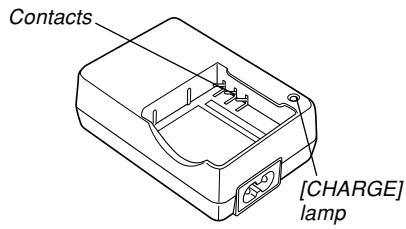
Rapid Charger Unit General Guide
GETTING READY
- Attaching the Battery to the Rapid Charger Unit
Making sure that the positive and negative contacts are aligned correctly, affix the battery to the charger unit. Note that the battery will not charge properly if it is not positioned correctly on the charger unit.
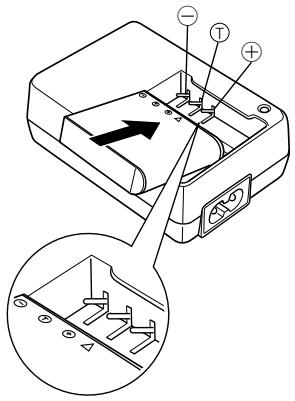
To charge the battery
- Correctly positioning the positive and negative terminals of the battery, attach the battery to the charger unit.
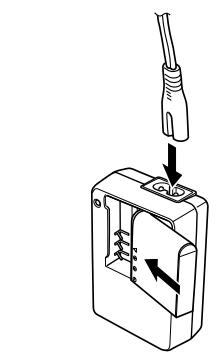
Inlet Type
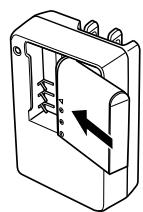
Plug-in Type
2. Plug the charger unit into a household power outlet.
- This will cause the [CHARGE] lamp to turn red.
- Charging will take about two hours.
- Note that the shape of the charger unit depends on the area where you purchased the camera.
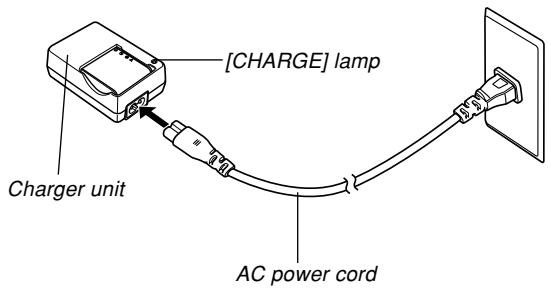
NOTE
- The bundled charger unit is designed for operation with any power supply in the range of 100V to 240V AC. Note, however, that the shape of the AC power cord plug varies according to country or geographic area. If you plan to use the charger unit in a geographic area where the power receptacle shape is different from that in your area, replace the AC power cord with one of the other ones that comes with the camera, or purchase a commercially available AC power cord that is compatible with the power outlets in that area.
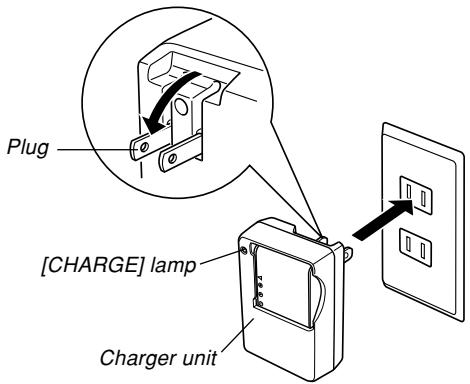
NOTE
- The bundled charger unit is designed for operation on power ranging from 100V AC to 240V AC. Note, however, that the shape of the power plug varies according to country or geographic area. When traveling abroad, it is up to you to find out if the shape of the charger unit power plug is compatible with local power outlets and to purchase any required adapters.
3. The [CHARGE] lamp turns green when charging is complete.
4. After charging is complete, unplug the charger unit from the power outlet, and remove the battery from it.
- Always unplug the charger unit from the power outlet and remove the battery whenever you are not using it for charging.
IMPORTANT!
-
If the battery or charger unit is very hot or cold when you start charging or if it becomes hot during charging, the charger unit will enter a standby state, which is indicated when its [CHARGE] lamp is lit amber. Charging will resume when the temperature returns to the allowable charging temperature range, which is indicated when the [CHARGE] lamp turns red.
-
Charging battery while it is still warm immediately after removing it from the camera can result in only partial charging. Give battery time to cool before charging it.
- Battery discharges slightly even when it is left without loading it into the camera. Because of this, it is recommended that you charge battery immediately before you need to use it.
- The rechargeable battery used with this camera is specifically designed for use with digital cameras. If you want to try to use it to power another type of device, you should first check the user documentation that comes with the device to see if it is compatible.
- Though the actual service life of the rechargeable battery depends on the environment under which it is used, you can expect to be able to recharge it about 500 times before it needs replacement.
- Charging the camera's battery may cause interference with TV and radio reception. If this happens, plug the charger into an outlet that is further away from the TV or radio.
- Dirty charger contacts and/or battery terminals can make proper charging impossible. Be sure to wipe contacts and terminals occasionally with a dry cloth to keep them clean.
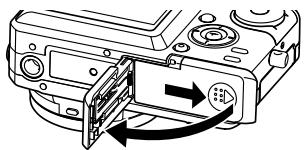
To load the battery
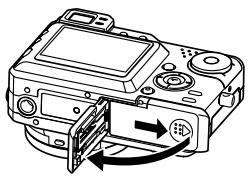
- While pressing the battery compartment cover on the bottom of the camera, slide the cover in the direction indicated by the arrow, and then swing it open.
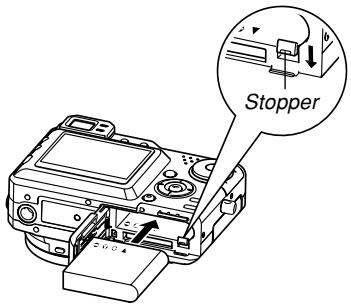
- While pulling the stopper in the direction indicated by the arrow in the illustration, align the (-) mark on the battery with the (-) mark on the camera and slide the battery into the camera.
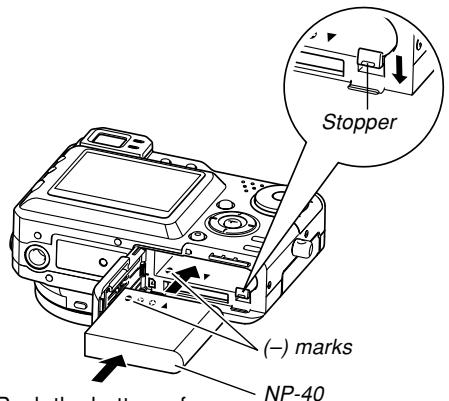
- Push the bottom of the battery, and make sure that the stopper securely locks the battery in place.
GETTING READY
- Swing the battery compartment cover closed, and then slide it in the direction indicated by the arrow.
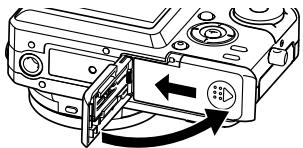
IMPORTANT!
- Use only the special NP-40 rechargeable lithium ion battery to power this camera. Use of any other type of battery is not supported.
To remove the battery
- Open the battery compartment cover.
-
Pull the stopper in the direction indicated by the arrow.
-
This will cause the battery to come part way out of the slot.
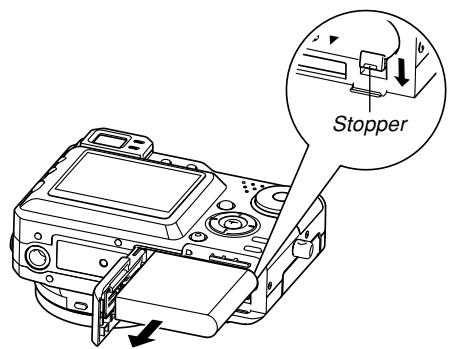
- Release the stopper and pull the battery from the camera.
Take care so you do not drop the battery.
If the camera works normally
- Continue using the camera until the current charge is used up, and then charge the battery.
If the camera does not work normally
This can mean there is a problem with how the battery is loaded.
- Remove the battery from the camera and check the battery contacts for dirt. If the contacts are dirty, wipe them clean with a dry cloth.
Battery Life Guidelines
The battery life guideline values given below indicate the amount of time under the conditions defined below the table, until power automatically turns off due to battery failure. They do not guarantee that the battery will provide the amount of service indicated. Low temperatures and continued use reduce battery life.
| Operation | Approximate Battery Life |
| Number of Shots (CIPA)*1(Operating Time) | 260 shots (130 minutes) |
| Number of Shots, Continuous Recording*2(Operating Time) | 600 shots (150 minutes) |
| Continuous Playback*3(Continuous Snapshot Recording) | 300 minutes |
| Continuous Voice Recording*4 | 260 minutes |
GETTING READY
Supported Battery: NP-40 (Rated Capacitance: 1230mAh)
Storage Medium: SD Memory Card
*1 Number of Shots (CIPA)
CIPA Standard
- Temperature: 23^ C( 73^ F)
Monitor Screen: On
- Zoom operation between full wide to full telephoto every 30 seconds, during which two images are recorded, one image with flash; power turned off and back on every time 10 images are recorded.
*2 Continuous Recording Conditions
- Temperature: 23^ C( 73^ F)
Monitor screen: On - Flash: Off
- Image recorded approximately every 15 seconds
*3 Continuous Playback Conditions
- Temperature: 23^ C( 73^ F)
- Scroll one image about every 10 seconds
*4 Voice recording times are based on continuous recording.
- The above values are based on a new battery starting from a full charge. Repeated charging shortens battery life.
- Battery life is greatly affected by how much you use flash, zoom and other functions, and how long you leave power turned on.
Tip to Make the Battery Last Longer
- If you do not need the flash while recording, select (flash off) for the flash mode. See page 64 for more information.
- You can also conserve battery power by using the [DISP] button to turn off the monitor screen.
GETTING READY
Low Battery Indicator
The following shows how the battery capacity indicator on the monitor screen changes as battery power is used. The indicator means that remaining battery power is low. Note that you will not be able to record images while the battery indicator is Charge the battery immediately whenever either of these indicators appears.
| Battery Level | High | ←→ | Low |
| Indicator | → | → | → |
Power Supply Precautions
Note the following precautions when handling or using the battery and the charger unit.
■ Battery Handling Precautions
SAFETY PRECAUTIONS
Be sure to read the following Safety Precautions before trying to use the battery for the first time. Keep these safety precautions and all operating instructions on hand for future reference.
NOTES
- The term "battery" in this manual refers to the CASIO NP-40 Rechargeable Lithium Ion Battery.
- Use only the rapid charger unit (BC-30L) to charge the special NP-40 rechargeable lithium ion battery. Never use any other charging device.
GETTING READY
-
Failure to observe any of the following precautions while using the battery creates the risk of overheating, fire, and explosion.
-
Never try to use the battery to power any other device other than this camera.
- Never use or leave the battery near open flame.
- Never place the battery in a microwave oven, throw it into fire, or otherwise expose it to intense heat.
- Make sure the battery is oriented correctly when you load it into the camera or attach it to the charger unit.
- Never carry or store the battery together with items that can conduct electricity (necklaces, pencil lead, etc.)
- Never try to take the battery apart, modify it in any way, or expose it to strong impact.
- Do not immerse the battery in fresh water or salt water.
-
Do not use or leave the battery under direct sunlight, in an automobile parked in the sun, or in any other area subject to high temperatures.
-
Should you ever notice leakage, strange odor, heat generation, discoloration, deformation, or any other abnormal condition while using, charging, or storing a battery, immediately remove it from the camera or charger unit and keep it away from open flame.
- If the battery does not achieve full charge after the normal charging time has passed, stop charging. Continued charging creates the risk of overheating, fire, and explosion.
- Battery fluid can damage your eyes. Should battery fluid get into your eyes accidentally, immediately rinse them with clean tap water and then consult a physician.
- If the battery is to be used by young children, make sure that a responsible adult makes them aware of the precautions and proper handling instructions and make sure that they handle the battery correctly.
- Should fluid from the battery accidentally get onto clothing or your skin, immediately rinse it off with clean tap water. Prolonged contact with battery fluid can cause skin irritation.
GETTING READY
PRECAUTIONS DURING USE
- Charge the battery in a location where the temperature is in the range of 5^ to 35^ (41°F to 95°F). Charging outside this temperature range can cause charging to take longer than normal or even cause charging to fail.
- Very limited operation following a full charge indicates that the battery has reached the end of its service life. Replace the battery with a new one.
- Never wipe the battery with thinner, benzene, alcohol, or other volatile agents or chemically treated rags. Doing so can cause deformation of the battery and lead to malfunction.
- This charger unit is intended to be correctly orientated in a vertical or floor mount position.
BATTERY STORAGE PRECAUTIONS
- Make sure you remove the battery when you do not plan to use the camera for a long time. A battery left in the camera discharges very small amounts of power even when power is turned off, which can lead to a dead battery or the need for longer charging before the next use.
- Store the battery in a cool, dry place (20^ (68^) or lower).
USING THE BATTERY
- When transporting a battery, keep it either loaded in the camera or stored in its case.
GETTING READY
Charger Unit Precautions
- Never plug the charger unit into an outlet whose voltage rating is different from that marked on the charger unit. Doing so creates the risk of fire, malfunction, and electric shock.
- Never plug in or unplug the charger unit while your hands are wet. Doing so creates the risk of electric shock.
- Do not plug the charger unit into an outlet or extension cord that is shared by other devices. Doing so creates the risk of fire, malfunction, and electric shock.
- The charger unit becomes slightly warm during charging. This is normal and does not indicate malfunction.
- Unplug the charger unit from the power outlet whenever you are not using it.
Using AC Power
You need to purchase the optionally available AC adaptor (AD-C40) in order to be able to power the camera using AC power.
- Connect the AC power cord to the AC adaptor.
- Open the camera's terminal panel cover and connect the AC adaptor to the port marked [DC IN].
3. Plug the AC power cord into an electrical outlet.
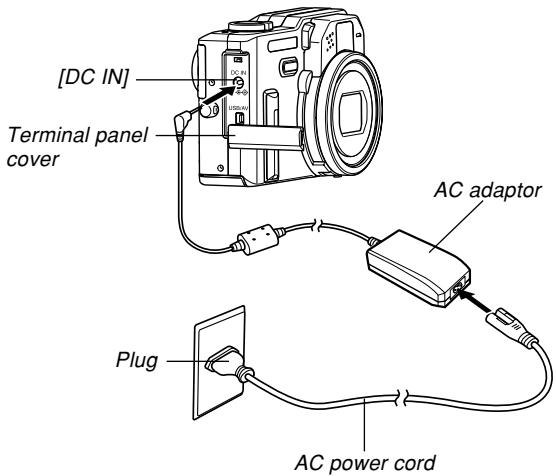
NOTE
- The AC adaptor can be used with any power source rated from 100V to 240V AC. If you plan to use the AC adaptor in another country, it is up to you to purchase the applicable AC power cord that matches the configuration of power receptacles in that country.
AC Adaptor Precautions
- Be sure to turn off power before connecting or disconnecting the AC adaptor.
- Always turn camera power off before disconnecting the AC adaptor, even if the camera has a battery installed. If you don't, the camera will turn off automatically when you disconnect the AC adaptor. You also run the risk of damaging the camera whenever you disconnect the AC adaptor without first turning power off.
- The AC adaptor may become warm to touch after extended periods of use. This is normal and is not cause for alarm.
After using the camera, turn it off and unplug the AC adaptor from the AC outlet. - The camera automatically switches over to AC adaptor powered operation whenever the AC adaptor is plugged into the camera.
- Always use the AC adaptor to power the camera whenever it is connected to a computer.
- Never place a blanket or any other cover on the AC adaptor. Doing so creates the risk of fire.
GETTING READY
Turning the Camera On and Off
Press the power button to turn the camera on and off.
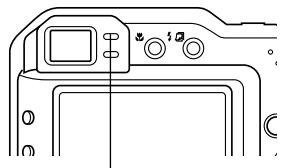
Pressing the power button to turn on the camera causes the green operation lamp to flash. Press the power button again to turn off the camera.
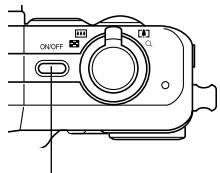
Power button
Green operation lamp
IMPORTANT!
- If camera power is turned off by the Auto Power Off feature, press the power button to turn it back on again.
- Turning on camera power while the mode dial is set to REC mode causes the lens to extend from the camera. Make sure there is nothing in front of the camera that can be hit by the lens when you turn on the camera.
Configuring Power Saving Settings
You can configure the settings described below to conserve battery power.
Sleep
: Automatically turns off the monitor screen if no operation is performed for a specified amount of time in the REC mode.
Performing any button operation causes the monitor screen to turn back on.
Auto Power Off: Turns off power if you do not perform any operation for a specified amount of time.
- Turn on the camera.
- Press [MENU].
- Use [] and [] to select the "Set Up" tab.
- Use [▲] and [▼] to select the feature whose setting you want to configure, and then press [▶].
GETTING READY
See page 48 for information about how to use menus.
| To configure this feature: | Select this setting: |
| Sleep | Sleep |
| Auto Power Off | Auto Power Off |
-
Use [] and [] to change the currently selected setting, and then press [SET].
-
Available Sleep settings are: "30 sec", "1 min", "2 min", and "Off".
- Available Auto Power Off settings are: "2 min" and "5 min".
Note that the Sleep feature does not operate in the PLAY mode. - Pressing any button while the camera is in the Sleep state immediately turns the monitor screen back on.
- The Auto Power Off and Sleep features are disabled in the following cases.
While the camera is connected to computer or TV via its USB/AV port
While a slideshow is in progress
While playing back a voice recording file
While playing back a movie
Using the On-screen Menus
Pressing [MENU] displays menus on the monitor screen that you can use to perform various operations. The menu that appears depends on whether you are in the REC mode or the PLAY mode. The following shows an example menu procedure in the REC mode.
-
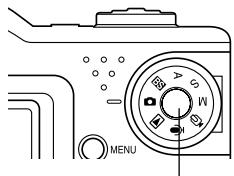
Turn on the camera, and then align the mode dial with .
-
If you want to enter the PLAY mode instead, you would align the mode dial with .
Mode dial
2. Press [MENU].
![CASIO EX-P600 - Press [MENU]. - 1](/content/2025/01/86577/images/204f2749632bc58d4f4f6103becf40cbdb2b87225f4cff8d0b7b321780401ff9.jpg)
![CASIO EX-P600 - Press [MENU]. - 2](/content/2025/01/86577/images/b3b457ec8446210e4f304d3e2152478027a7e7d717c637171019cc80c9ec0947.jpg)
Settings
Selection cursor (indicates the currently selected item)
- Menu Screen Operations
| When you want to do this: | Do this: |
| Move between tabs | Press [▲] and [▶]. |
| Move from the tab to the settings | Press [▼]. |
| Move from the settings to the tab | Press [▲]. |
| Move between the settings | Press [▲] and [▼]. |
| Display the options available for a setting | Press [▶] or press [SET]. |
| Select an option | Press [▲] and [▼]. |
| Register an option selection and exit the menu screen | Press [SET]. |
| Register an option selection and return to the menu screen | Press [▲]. |
| Exit the menu screen | Press [MENU]. |
GETTING READY
- Press [<] or [▶] to select the tab you want, and then press [SET] to move the selection cursor from the tab to the settings.
- Use [▲] and [▼] to select the feature whose setting you want to configure, and then press [▶].
Instead of pressing [▶], you could also press [SET].
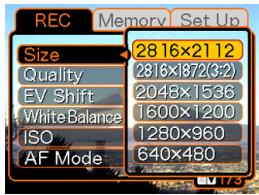
Example: To select the "Size" item.
-
Use [] and [] to change the currently selected setting.
-
Perform one of the following operations to apply the setting you configured.
| To do this: | Perform this key operation: |
| Apply the setting and exit the menu screen. | Press [SET]. |
| Apply the setting and return to feature selection in step 4. | Press [▲]. |
| Apply the setting and return to tab selection in step 3. | 1. Press [▲]. 2. Use [▲] to move back up to tab selection. |
- See "Menu Reference" on page 230 for more information about menus.
Configuring Display Language and Clock Settings
Be sure to configure the following settings before using the camera to record images.
- Display language
Home city - Date Style
- Date and time
Note that the current date and time settings are used by the camera to generate the date and time that are stored along with image data, etc.
IMPORTANT!
- Recording images without configuring the clock settings causes incorrect time information to be registered. Be sure to configure the clock settings before using the camera.
- The camera's clock settings are cleared whenever power is totally cut off. This can happen if the battery goes dead while the camera is not being supplied power by AC adaptor. The clock setting screen will appear automatically the next time you turn on power after the settings are cleared. Set the date and time before using the camera.
- The current date and time settings will be cleared if the battery remains dead without being charged for about two days.
To configure display language and clock settings
- Press the power button to turn on the camera.
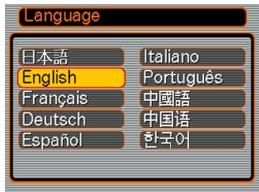
- Use [], [], [] , and [] to select the language you want, and then press [SET].
日本語 :Japanese
English : English
Français : French
Deutsch : German
Espanol : Spanish
Italiano : Italian
Portugues : Portuguese
中国语 : Chinese (Simplified)
Korean
- Use [▲], [▼], [◁], and [▷] to select the geographical area where you live, and then press [SET].
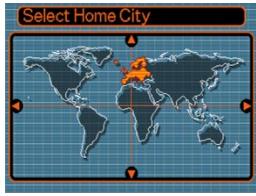
- Use [▲] and [▼] to select the name of the city where you live, and then press [SET].
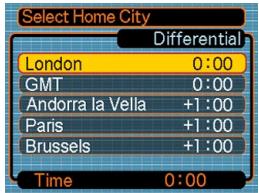
- Use [] and [] to select the summer time (DST) setting you want, and then press [SET].
| When you want to do this: | Select this setting: |
| Keep time using summer time (Daylight Saving Time) | On |
| Keep time using standard time | Off |
GETTING READY
- Use [▲] and [▼] to change the date format setting, and then press [SET].
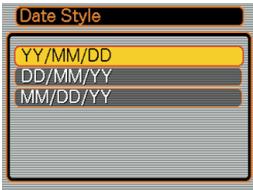
Example: December 24, 2004
| To display the date like this: | Select this format: |
| 04/12/24 | YY/MM/DD |
| 24/12/04 | DD/MM/YY |
| 12/24/04 | MM/DD/YY |
- Set the current date and the time.
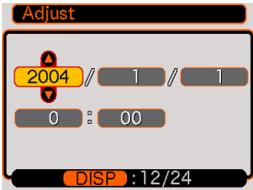
| To do this: | Do this: |
| Change the setting at the current cursor location | Press [▲] and [▼]. |
| Move the cursor between settings | Press [←] and [►]. |
| Toggle between 12-hour and 24-hour timekeeping | Press [DISP]. |
- Press [SET] to register the settings and exit the setting screen.
BASIC IMAGE RECORDING
This section describes the basic procedure for recording an image.
Recording an Image
Aiming the Camera
Use both hands to hold the camera still when shooting an image. Holding the camera with one hand increases the chance of movement, which can blur your images.
Horizontal
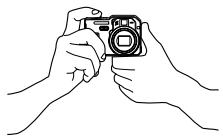
Hold the camera still in both hands, with your arms firmly against your sides.
Vertical
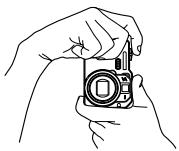
When holding the camera vertically, make sure that the flash is above the lens. Hold the camera still with both hands.
IMPORTANT!
- Make sure your fingers or the strap does not block the flash, microphone or lens.
- When aiming the camera, take particular care to ensure that your finger is not blocking the phase differential sensor.
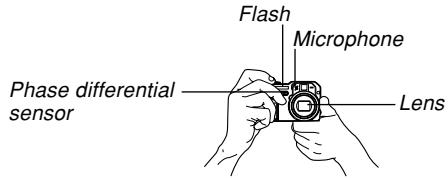
NOTE
- Your image will be blurred if you move the camera when pressing the shutter button. Press the shutter button carefully, taking care that there is no camera movement. This is especially important when available lighting is low, which slows down the shutter speed.
Recording an Image
Your camera automatically adjusts shutter speed and aperture values in accordance with the brightness of the subject. Images you record are stored in the camera's built-in memory, or to a memory card if you have one loaded in the camera.
- When an optionally available SD memory card or MultiMediaCard (MMC) is loaded in the camera, images are stored on the card (page 182).
1. Press the power button to turn on the camera.
- This causes an image or a message to appear on the monitor screen.
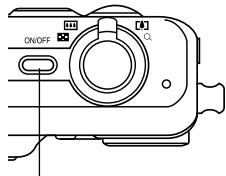
Power button
2. Align the mode dial with (Snapshot Mode).
- This enters the Snapshot mode for image recording.
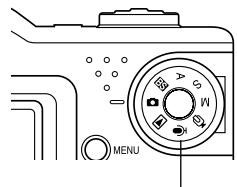
Mode dial
3. Compose the image on the monitor screen so the main subject is within the focus frame.
- The focusing range of the camera in the Auto Focus mode is approximately 40cm (1.3 feet) to infinity () (page 74).
- You can compose images using either the monitor screen or the optical viewfinder (page 61).
- When using the optical viewfinder to compose images, you can use the [DISP] button to turn off the monitor screen and conserve battery power.
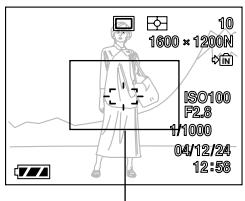
Focus frame
4. Press the shutter button half way to focus the image.
- When you press the shutter button half way, the camera's Auto Focus feature automatically focuses the image, and displays the shutter speed and aperture values. The ISO sensitivity value also appears on the display at this time.
- You can tell whether the image is focused by observing the focus frame and the green operation lamp.
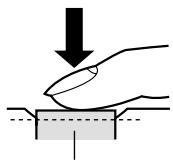
Shutter button
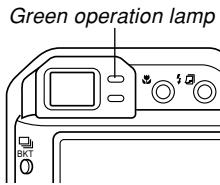
Operation Lamp and Focus Frame Operation
| When you see this: | It means this: |
| Green focus frame Green operation lamp | The image is in focus. |
| Red focus frame Flashing green operation lamp | The image is not in focus. |
- Make sure you are not blocking the lens, phase differential sensor, the flash, or the microphone with your fingers while recording an image.
5. After making sure that the image is focused properly, press the shutter button the rest of the way down to record.
- The number of images that can be stored in memory depends on the image size and image quality setting you are using (page 70).
- Press the shutter button gently to avoid camera movement.
Shutter button
Recording Precautions
- Never open the battery compartment cover while the green operation lamp is flashing. Doing so not only causes the current image to be lost, it can also corrupt images already stored in file memory and even lead to malfunction of the camera.
- Never remove the memory card while an image is being recorded to the memory card.
- Fluorescent lighting actually flickers at a frequency that cannot be detected by the human eye. When using the camera indoors under such lighting, you may experience some brightness or color problems with recorded images.
- When "Auto" is selected for the ISO sensitivity setting (page 117), the camera automatically adjusts its sensitivity in accordance with the brightness of the subject. This can cause some static noise to appear in images of relatively dark subjects.
- When recording a dimly lit subject while "Auto" is selected for the ISO sensitivity setting (page 117), the camera increases sensitivity and uses a slower shutter speed. Because of this, you need to guard against camera movement if you have flash turned off (page 64).
- If unwanted light is shining on the lens, shade the lens with your hand when recording the image.
About Auto Focus
- Auto Focus tends not to work well if the camera is moved during recording, or when recording the types of subjects listed below.
Solid color walls or objects with little contrast
— Strongly backlit objects
Polished metal or other brightly reflective objects
— Venetian blinds or other horizontally repeating patterns
- Multiple images that are varying distances from the camera
- Subjects in poorly lit areas
— Moving subjects
- Note that a green operation lamp and focus frame do not necessarily guarantee that an image is in focus.
- If Auto Focus does not produce the results you want for some reason, try using focus lock (page 79) or manual focus (page 77).
About the REC Mode Monitor Screen
- The image shown on the monitor screen in the REC mode is a simplified image for composing purposes. The actual image is recorded in accordance with the image quality setting currently selected on your camera. The image saved in file memory has much better resolution and detail than the REC mode monitor screen image.
- Certain levels of subject brightness can cause the response of the REC mode monitor screen to slow down, which causes some static noise in the monitor screen image.
Previewing the Last Image Recorded
Use the following procedure to preview the last image recorded, without leaving the current REC mode.
1. Press [PREVIEW] to display the last image recorded.
- Pressing [PREVIEW] again returns to the REC mode screen.
- No preview image will appear if you press [PREVIEW] after changing the mode dial setting, or immediately after you turn on the camera.
- Image preview cannot be used in the Movie Mode. The preview image is cleared automatically whenever the REC mode is changed.
![CASIO EX-P600 - Press [PREVIEW] to display the last image recorded. - 1](/content/2025/01/86577/images/38952ecc86834dbccdfd4f4e782fd27ab5be3e22a550f8ea497eb46247784723.jpg)
[PREVIEW]
Deleting an Image on the Preview Screen
You can use the preview screen to delete the last image you recorded.
IMPORTANT!
Note that the image delete operation cannot be undone. Make sure you really do not need an image before you delete it.
- In the REC mode, press [PREVIEW] to display the last image you recorded.
- Press [EX 匝].
-
In response to the confirmation message that appears, use [▲] and [▼] to select "Delete".
-
Select "Cancel" to cancel the delete operation without deleting anything.
- Press [SET].
- This deletes the image and returns to the REC mode screen.
Orientation Sensor
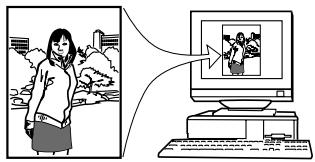
The camera has an orientation sensor that detects whether the camera is being held horizontally (its normal orientation) or vertically when you record an image. Information about camera orientation is recorded along with the image data so the image can be displayed properly. When you transfer images to a computer using the bundled Photo Loader application (page 222), Photo Loader also detects the orientation of each image and displays it accordingly.
IMPORTANT!
To ensure proper operation of the orientation sensor, note the following points.
- Keep the camera still during recording. Moving the camera while recording can cause miss-operation of the orientation sensor.
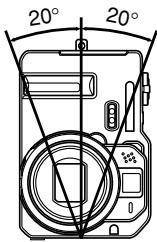
- When recording an image using portrait (vertical) orientation, make sure the camera is standing straight up, 90 degrees from horizontal. A sensor error may occur if the camera is angled more than about 20 degrees from vertical.
- When positioning the camera vertically, keep the flash above the lens.
BASIC IMAGE RECORDING
- Miss-operation of the orientation sensor can also occur if the camera is angled towards the front or back. A sensor error may occur if the camera is angled more than about 60 degrees towards the front or back.
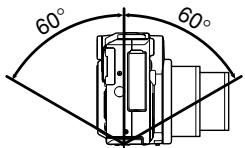
Note that the orientation sensor does not operate in the Movie mode.
Using the Optical Viewfinder
You can conserve battery power by turning off the camera's monitor screen (page 31) and using the optical viewfinder to compose images.
IMPORTANT!
- The frame that is visible inside of the viewfinder indicates the image recorded at a distance of about one meter (3.3'). When the subject is closer than one meter, the recorded image will be different from what you see inside the viewfinder frame.
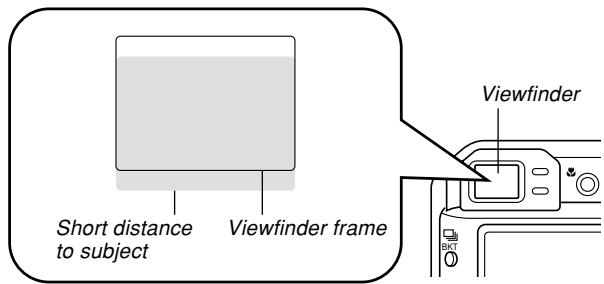
- Since the monitor screen shows exactly what will be recorded, always use it for composing your images in the Macro and Manual Focus modes.
Using Zoom
Your camera is equipped with two types of zoom: optical zoom and digital zoom.
Optical Zoom
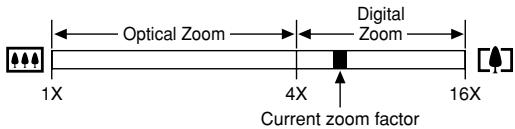
The range of the optical zoom factor is shown below.
Optical Zoom Factor Range: 1X to 4X
- In the REC mode, shift the zoom controller to change the zoom factor.
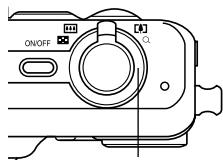
Zoom controller
| To do this: | Shift this side of the zoom controller: |
| Zoom out | Wide Angle |
| Zoom in | Telephoto |
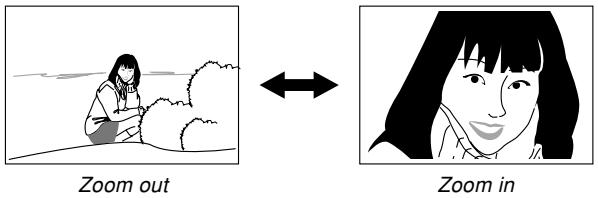
- Compose the image, and then press the shutter button.
NOTES
- The optical zoom factor also affects the lens aperture.
- Use of a tripod is recommended to protect against hand movement when using the telephoto setting (zoom in).
Digital Zoom
Digital zoom is activated after you reach the maximum optical zoom factor (4X). It enlarges the part of the image at the center of the image screen. The range of the digital zoom factor is shown below.
Digital Zoom Factor Range: 4X to 16X
(in combination with optical zoom)
- In the REC mode, press [MENU].
- Use [] and [] to select the "REC" tab.
- Use [] and [] to select "Digital Zoom", and then press [] .
-
Use [] and [] to select "On", and then press [SET].
-
Selecting "Off" disables digital zoom.
-
Slide the zoom controller towards [A] (Telephoto)/Q to change the zoom factor.
-
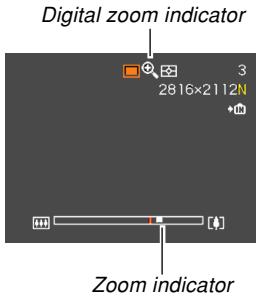
When zoom reaches maximum optical zoom, it stops momentarily. Keep the zoom controller pressed to the [A] (Telephoto)/O side and zoom will switch over to digital zoom automatically.
- Switching to digital zoom causes the zoom indicator to appear on the monitor screen. The zoom indicator shows the current approximate zoom factor.
- Compose the image, and then press the shutter button.
IMPORTANT!
- Digital zoom is disabled whenever the monitor screen is turned off (page 31).
- Using digital zoom can cause degradation of the recorded image.
Using the Flash
Perform the following steps to select the flash mode you want to use.
- In the REC mode, press [MENU].
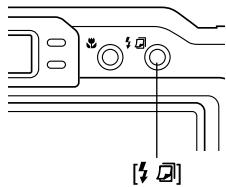
- Press [4] to select the flash mode.
Each press of [4] cycles through the flash mode settings shown below on the monitor screen.
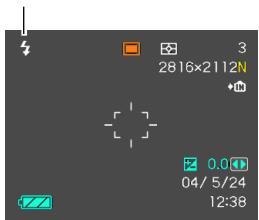
Flash mode indicator
BASIC IMAGE RECORDING
| To do this: | Select this setting: |
| Have the flash fire automatically when required (Auto Flash) | None |
| Turn off the flash (Flash Off) | |
| Always fire the flash (Flash On) | |
| Fire a pre-flash followed by image recording with flash, reducing the chance of red-eye in the image (Red-eye reduction)In this case, the flash fires automatically when required |
3. Record the image.
IMPORTANT!
- Image recording may not be performed if you press the shutter button while the red operation lamp is flashing.
About Red-eye Reduction
Using the flash to record at night or in a dimly lit room can cause red spots inside the eyes of people who are in the image. This is caused when the light from the flash reflects off of the retina of the eye. When red-eye reduction is selected as the flash mode, the camera performs two preflash operations, one designed to cause the irises in the eyes of any people in the image to close, and one for the Auto Focus operation. This is followed by another flash operation for actual recording of the image.
IMPORTANT!
Note the following important points when using redeye reduction.
- Red-eye reduction does not work unless the people in the image are looking directly at the camera during the pre-flash. Before pressing the shutter button, call out to the subjects so they all look at the camera while the pre-flash operation is performed.
- Red-eye reduction may not work very well if the subjects are located far away from the camera.
Flash Unit Status
You can find out the current flash unit status by pressing the shutter button half way and checking the monitor screen and red operation lamp.
The indicator is also shown on the monitor screen when the flash unit is ready to fire.
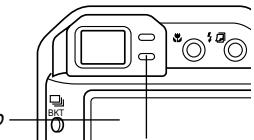
Red operation lamp*
- Red operation lamp
| When the red operation lamp is this: | It means this: |
| Flashing | Flash unit is charging |
| Lit | Flash unit is ready to fire |
Changing the Flash Intensity Setting
Perform the following steps to change the flash intensity setting.
- In the REC mode, press [MENU].
- Use [] and [] to select the "REC" tab.
- Use [] and [] to select "Flash Intensity", and then press [] .
- Use [] and [] to select the setting you want, and then press [SET].
| To do this: | Select this setting: |
| Fire the flash with strong intensity | Strong |
| Fire the flash with normal intensity | Normal |
| Fire the flash with weak intensity | Weak |
NOTE
- Flash intensity may not change if the subject is too far or too close to the camera.
Flash Precautions
Take care that your fingers do not block the flash when you hold the camera. Covering the flash with your finger can greatly reduce its effectiveness.
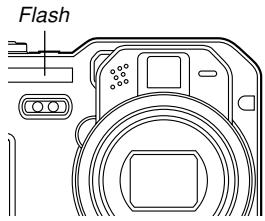
- You may not be able to achieve the desired results using a flash if the subject is too close or too far away.
- The flash takes anywhere from a few seconds to as long as 10 seconds to attain full charge after being fired. The actual time required depends on the battery level, temperature, and other conditions.
- The flash does not fire in the Movie mode. This is indicated by (Flash Off) on the monitor screen.
- The flash unit may not be able to charge when battery power is low. Low battery power is indicated by (Flash Off) on the monitor screen, and when the flash fails to fire properly resulting in poor image exposure. When these symptoms occur, charge the camera's battery as soon as possible.
-
When the red-eye reduction mode (O) is selected, flash intensity is adjusted automatically in accordance with the exposure. The flash may not fire at all when the subject is brightly lit.
-
Using flash in combination with another light source (daylight, fluorescent light, etc.) can result in abnormal image colors.
Using the Self-timer
The self-timer lets you select either a 2-second or 10-second delay of the shutter release after you press the shutter button. A Triple Self-timer feature lets you perform three consecutive self-timer operations to record three images.
1. In the REC mode, use [] to cycle through the available self-timer modes.
Each press of [O] cycles through the timer settings on the monitor screen in the sequence shown below.
![CASIO EX-P600 - In the REC mode, use [] to cycle through the available self-timer modes. - 1](/content/2025/01/86577/images/99093d131e6465f6d78446d278d8c2055f57c06bf90154786b03e1bd8a9b340b.jpg)
| To do this: | Select this setting: |
| Disable the self-timer | No icon displayed |
| Specify a 10-second self-timer | 106 |
| Specify a 2-second self-timer | 25 |
| Specify Triple Self-timer | X3 |
| Self-timer off for remote controller operation (page 129) | |
| 2-second self-timer for remote controller operation (page 129) | 25 |
-
With the Triple Self-timer, the camera records a series of three images in the sequence described below.
-
The camera performs a 10-second countdown and then records the first image.
- The camera prepares to record the next image. The amount of time required for preparation depends on the camera's current "Size" and "Quality" settings, the type of memory (built-in or card) you are using for image storage, and whether or not the flash is charging.
BASIC IMAGE RECORDING
- After preparation is complete, the indicator "1sec" appears on the monitor screen, and another image is recorded one second later.
- Steps 2 and 3 are repeated once more to record the third image.
2. Record the image.
- When you press the shutter button, the self-timer lamp flashes and the shutter releases after the self-timer reaches the end of its countdown.
- You can interrupt an ongoing self-timer countdown by pressing the shutter button while the self-timer lamp is flashing.
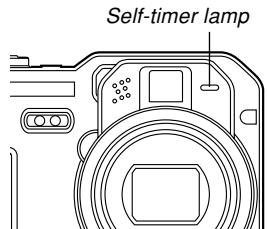
NOTES
- The "2 sec" self-timer setting is best when shooting with a slow shutter speed, because it helps to avoid blurring of images due to hand movement.
- The following functions are not available for use in combination with the Triple Self-timer. BULB (pages 85, 87), Continuous Shutter (page 91), Auto Bracketing (page 95), Coupling Shot (page 107), Pre-shot (page 109)
Specifying Image Size and Quality
You can specify the image size and image quality to suit the type of image you are recording.
To specify the image size
"Image size" is the size of the image, expressed as the number of vertical and horizontal pixels. A "pixel" is one of the many tiny dots that make up the image. More pixels provide finer detail when an image is printed, but a higher pixel count also causes the image's file size of to be larger. You can select an image size to suit your needs for greater detail or smaller file size.
- In the REC mode, press [MENU].
- Use [] and [] to select the "REC" tab.
- Use [] and [] to select "Size", and then press [] .
4. Use [] and [] to select the setting you want, and then press [SET].
2816x2112 : 2816x2112pixels
2816 x 1872 (3:2) : 2816 x 1872 (3:2) pixels
2048 x 1536 : 2048 x 1536 pixels
1600x1200 : 1600x1200 pixels
1280x960 : 1280x 960 pixels
640x 480 : 640x 480 pixels
NOTES
- The following are guidelines for selecting the image size.
| When you want to do this:* | Use this setting:* | |
| Print the image on paper up to 358 x 268mm (14.1 x 10.6 inches) | 2816 x 2112 | Larger ↓ Smaller |
| Print the image on paper up to 358 x 238mm (14.1 x 9.4 inches) | 2816 x 1872 (3:2) | |
| Print the image on paper up to 260 x 195mm (10.2 x 7.7 inches) | 2048 x 1536 | |
| Print the image on paper up to 203 x 152mm (8 x 6 inches) | 1600 x 1200 | |
| Print the image on paper up to 163 x 122mm (6.4 x 4.8 inches) | 1280 x 960 | |
| Print the image on paper up to 81 x 61mm (3.2 x 2.4 inches), or attach the image to e-mail | 640 x 480 | |
- The sizes indicated by the settings are rough approximates only.
BASIC IMAGE RECORDING
- The above paper sizes are all approximate values when printing at a resolution of 200 dpi (dots per inch). Use a larger setting when you want to print at a higher resolution or when you plan to produce a larger size print.
- Selecting the "2816 x 1872 (3:2)" image size records images with a 3:2 (vertical : horizontal) aspect ratio, which is optimal for printing on paper with an aspect ratio of 3:2.
To specify image quality
Compressing an image before storage can cause a deterioration of its quality. The more an image is compressed, the greater the loss of quality. The image quality setting specifies the compression ratio used when an image is stored in memory. You can select an image quality setting to suit your needs for higher quality or smaller file size.
- In the REC mode, press [MENU].
- Use [] and [] to select the "REC" tab.
- Use [] and [] to select "Quality", and then press [] .
- Use [] and [] to select the setting you want, and then press [SET].
| To get this: | Select this setting: |
| Very high quality, but large file size | Fine |
| Normal quality | Normal |
| Small file size, but low quality | Economy |
| Image recording without compression | TIFF |
NOTE
- The following are guidelines for selecting image quality.
| To get this: | Select this setting: | |
| Image recording without compression | TIFF | Higher Quality |
| High image quality and memory capacity | Fine | |
| Normal image quality and memory capacity | Normal | |
| Low image quality and memory capacity | Economy | Lower Quality |
IMPORTANT!
- Actual file size depends on the type of image you record. This means that the remaining image capacity noted on the monitor screen may not be exactly accurate (pages 26, 243).
- It takes longer to store a TIFF (uncompressed) image than a JPEG (compressed) image.
- When you record a TIFF image, a JPEG format FINE version of the same image is also stored. The FINE version is the one that appears on the camera's monitor screen when you display the image in the PLAY mode.
- A TIFF image cannot be resized (page 141), cropped (page 142), or copied (page 186). All of these operations must be performed on JPEG images.
- You cannot transfer a TIFF image to a computer using the bundled Photo Loader application (page 222). Use the procedure under "Viewing Images on a Computer" (page 198) instead.
OTHER RECORDING FUNCTIONS
This section describes other powerful features and functions that are available for recording.
Selecting the Focus Mode
You can select one of five different focus modes: Auto Focus, Macro, Infinity, Manual, and Pan Focus.
IMPORTANT!
- Pan Focus can be used in the Movie Mode only. You cannot use Pan Focus in any other REC mode.
1. In the REC mode, press [%].
Each press of [ ] cycles thorough the focus mode settings in the sequence shown below.
![CASIO EX-P600 - In the REC mode, press [%]. - 1](/content/2025/01/86577/images/e92e2e193b2a8e9c2a0273d4a462ad1fe43a016deec92a6dca8fdb7ff8b636d2.jpg)
![CASIO EX-P600 - In the REC mode, press [%]. - 2](/content/2025/01/86577/images/d4c130e65fa6709824e2256a10bea2e0e13c07dd62513702739adb21b69a8084.jpg)
Focus mode indicator
| To set up the camera to do this: | Select this setting: |
| Focus automatically (Auto Focus) | None |
| Perform close-up focus (Macro) | ↓ |
| Fix the focal distance (Pan Focus) | PF* |
| Perform infinity focus (Infinity) | ∞ |
| Focus manually (Manual Focus) | MF |
- The PF (Pan Focus) setting is available in the Movie Mode only.
OTHER RECORDING FUNCTIONS
Using Auto Focus
As its name suggests, Auto Focus focuses the image automatically. The automatic focus operation starts when you press the shutter button down half way. The following is the Auto Focus range.
Range: Approximately 40cm to (1.3' to )
- Keep pressing [u] until there is no focus mode indicator on the display.
-
Compose the image so the main subject is within the focus frame, and then press the shutter button half way.
-
You can tell whether the image is focused by observing the focus frame and the green operation lamp.
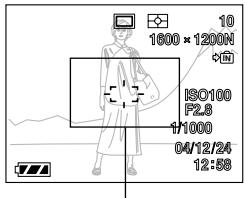
Focus frame
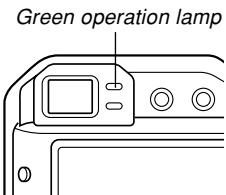
| When you see this: | It means this: |
| Green focus frame Green operation lamp | The image is focused. |
| Red focus frame Flashing green operation lamp | The image is not in focus. |
- Press the shutter button the rest of the way to record the image.
NOTES
- When "Hybrid" is selected as the Auto Focus mode (page 118), pressing the shutter button all the way without pausing at the half-way point will perform high-speed Auto Focus using the phase differential sensor only. Note, however, that high-speed Auto Focus is somewhat less reliable than the Auto Focus operation performed when you press the shutter button half way and pause.
- Except when you specifically need very fast focusing and response, it is recommended that you normally press the shutter button half way and wait for the Auto Focus operation to complete before pressing the shutter button the rest of the way down to record.
OTHER RECORDING FUNCTIONS
■ Specifying the Auto Focus Area
You can use the following procedure to change the Auto Focus area used in the Auto Focus Mode and the Macro Mode. Note that the configuration of the focus frame changes in accordance with the Auto Focus area you select.
- In the REC mode, press [MENU].
- On the "REC" tab, select "AF Area", and then press [▶].
- Use [] and [] to select the Auto Focus area you want, and then press [SET].
| For this type of Auto Focus area: | Select this: |
| Very limited range in the center of the screen ·This setting works well with focus lock (page 79). | Spot |
| Automatic selection of the focus area where the subject closest to the camera is located ·With this setting, a wide focus frame, which contains seven focus points, appears on the monitor screen first. When you press the shutter button half way, the camera automatically selects the focus point where the subject closest to the camera is located, and a focus frame appears at that point. ·This setting works well for group photos. | Multi |
| Select of the focus point using the [▲], [▼], [▲], and [▼] keys. Then press [SET] to display the focus frame at that point. | Free |
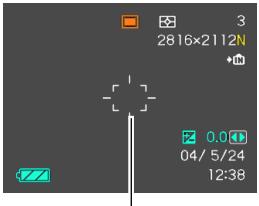
- Spot
Focus frame
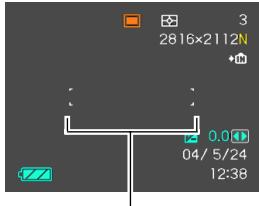
Multi
Focus frame
Free
Focus point
→ [SET]
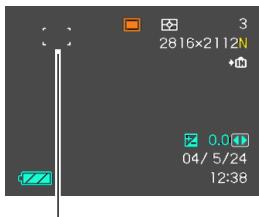
Focus frame
Using the Macro Mode
The Macro mode lets you focus automatically on close up subjects. The automatic focus operation starts when you press the shutter button down half way. The following is the focus range in the Macro mode.
Range: Approximately 10cm to 50cm (3.9" to 19.7") at wide angle Approximately 40cm to 50cm (15.6" to 19.7") at telephoto
- Keep pressing [ ] until the focus mode indicator shows " 念
-
Record the image.
-
The focus and image recording operations are identical to those in the Auto Focus mode.
- You can tell whether the image is focused by observing the focus frame and the green operation lamp. The indications of the focus frame and green operation lamp are the same as those in the Auto Focus mode.
OTHER RECORDING FUNCTIONS
Using the Infinity Mode
The Infinity mode fixes focus at infinity () . Use this mode when recording scenery and other faraway images.
- Keep pressing [%] until the focus mode indicator shows "∞".
- Record the image.
Using Manual Focus
With the Manual Focus mode, you can adjust the focus of an image manually. The following shows focus ranges in the Macro mode for two optical zoom factors.
| Optical Zoom Factor | Approximate Focus Range |
| 1X | 10cm (3.9") to infinity (∞) |
| 4X | 40cm (15.7") to infinity (∞) |
-
Keep pressing [y] until the focus mode indicator shows "MF".
-
At this point, a boundary also appears on the display, indicating the part of the image that will be used for manual focus.
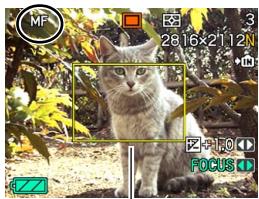
Boundary
OTHER RECORDING FUNCTIONS
- While watching the image on the monitor screen, use [<] and [▶] to focus.
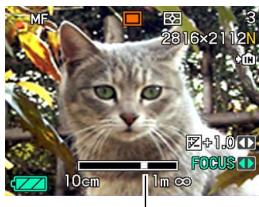
Manual focus position
| To do this: | Do this: |
| Focus in on the subject | Press [▲]. |
| Focus out on the subject | Press [▶]. |
-
Pressing [▲] or [▶] causes the area inside of the boundary displayed in step 1 to fill the monitor screen momentarily to aid in focus. The normal image reappears a short while later.
-
Press the shutter button to record the image.
IMPORTANT!
- In the Manual Focus mode, the [] and [] keys adjust focus, even if you used key customization to assign other functions to them (page 123).
Using Pan Focus
You can use Pan Focus in the Movie Mode (page 111) to fix focus at a preset distance, so Auto Focus is not performed during movie recording.
-
Enter the Movie Mode (page 111).
-
This automatically selects Pan Focus as the focus mode, which is indicated by "PF" appearing on the monitor screen.
-
If another focus mode is selected in the Movie Mode, use [ ] to display the "PF" (Pan Focus) indicator.
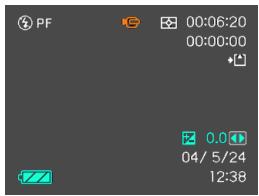
- Press the shutter button to record a movie.
IMPORTANT!
- Pan Focus can be used in the Movie Mode only. You cannot use Pan Focus in any other REC mode.
Using Focus Lock
Focus lock is a technique you can use to focus on a subject that is not located within the focus frame when you record an image. You can use focus lock in the Auto Focus mode and the Macro mode ().
-
Using the monitor screen, compose the image so the main subject is within the focus frame, and then press the shutter button half way.
-
Keeping the shutter button half way down, re-compose the image as you like.
-
This locks the focus on the subject that is currently within the focus frame.
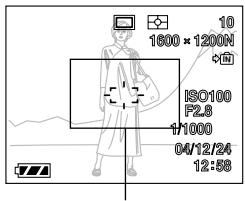
Focus frame
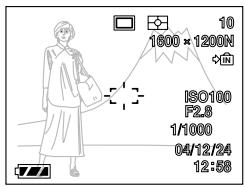
- When the image is composed the way you want, press the shutter button the rest of the way to record it.
NOTE
- Locking the focus also locks the exposure.
Exposure Compensation (EV Shift)
Exposure compensation lets you change the exposure setting (EV value) manually to adjust for the lighting of your subject. This feature helps to achieve better results when recording a backlit subject, a strongly lit subject indoors, or a subject that is against a dark background.
EV Shift Range: -2.0EV to +2.0EV
Steps: 1/3EV
- In the REC mode, press [MENU].
- Select the "REC" tab, select "EV Shift", and then press [▶].
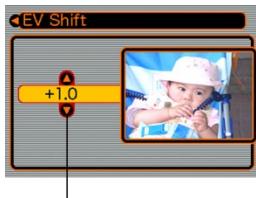
Exposure compensation value
-
Use [▲] and [▼] to change the exposure compensation value, and then press [SET].
-
Pressing [SET] registers the displayed value.
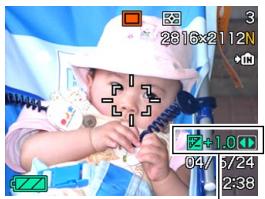
EV value
Up : Increases the EV value. A higher EV value is best used for light-colored subjects and backlight subjects.
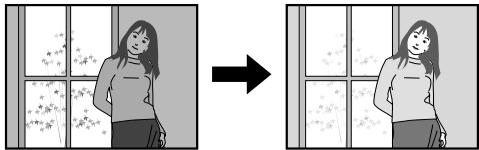
Down: Decreases the EV value. A lower EV value is best for dark-color subjects and for shooting outdoors on a clear day.
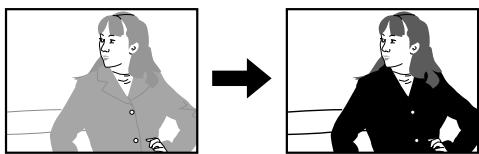
OTHER RECORDING FUNCTIONS
- To cancel EV Shift, adjust the value until it becomes 0.0.
4. Record the image.
IMPORTANT!
- When shooting under very dark or very bright conditions, you may not be able to obtain satisfactory results even after performing exposure compensation.
NOTES
- Performing an EV shift operation causes the metering mode to switch automatically to center weighted metering. Returning the EV shift value to 0.0 causes the metering mode to change back to multi-pattern metering (page 119).
- You can use key customization (page 123) to configure the camera to perform exposure compensation whenever you press [<] or [▶] while in the REC mode.
Adjusting White Balance
The wavelengths of the light produced by various light sources (daylight, light bulb, etc.) can affect the color of a subject when it is recorded. White balance lets you make adjustments to compensate for different lighting types, so the colors of an image appear more natural.
- In the REC mode, press [MENU].
- Select the "REC" tab, select "White Balance", and then press [▶].
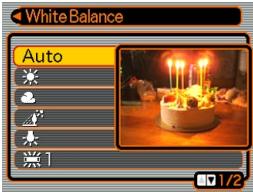
3. Use [] and [] to select the setting you want, and then press [SET].
| When shooting under these conditions: | Select this setting: |
| Normal conditions | Auto |
| Outdoor daylight on a clear day | |
| Outdoor daylight on an overcast or rainy day, in the shade of a tree, etc. | |
| In the shade of a building or any other area where the color temperature is high | |
| Under incandescent lighting | |
| Under white fluorescent light (suppresses color fogging) | |
| Under daylight white or daylight fluorescent light (suppresses color fogging) | |
| Flash | |
| Difficult lighting that requires manual control (See “Adjusting White Balance Manually”). | Manual |
NOTES
- When "Auto" is selected for the white balance setting, the camera reads the color of the subject and automatically corrects the color balance. Certain subject colors and lighting conditions can cause problems for the camera as it tries to read the color. If this happens, use one of the other fixed white balance settings in accordance with your current lighting conditions.
- Selecting "Manual" changes white balance to the settings achieved the last time a manual white balance operation was performed.
- You can use key customization (page 123) to configure the camera so the white balance setting changes whenever you press [▲] or [▶] while in the REC mode.
Adjusting White Balance Manually
Certain complex light sources or other environmental conditions can make it impossible to obtain good results when "Auto" or one of the fixed light source settings is selected for white balance. Manual white balance lets you configure the camera for a particular light source and other conditions.
Note that you must perform manual white balance under the same conditions you will be shooting under. You must also have a white piece of paper or other similar object on hand in order to perform manual white balance.
- In the REC mode, press [MENU].
- Select the "REC" tab, select "White Balance", and then press [▶].
-
Use [▲] and [▼] to select "Manual".
-
This causes the object you last used to adjust manual white balance to appear on the monitor screen.
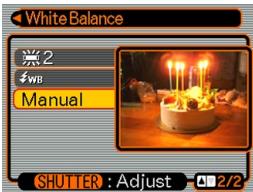
- Point the camera at a white paper or similar object under the lighting conditions for which you want to set the white balance, and then press the shutter button.
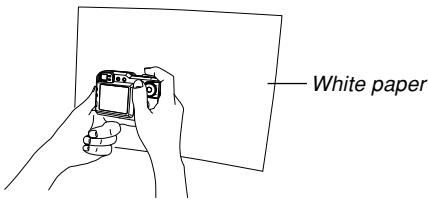
- This starts the white balance adjustment procedure. The message "Complete" appears on the monitor screen after white balance adjustment is complete.
- Dim lighting or pointing the camera at a dark colored object while performing manual white balance adjustment can cause the procedure to take a long time to complete.
5. Press [SET].
- This registers the white balance settings and returns to the REC mode.
Specifying the Exposure Mode
You can use the mode dial to select the exposure mode, which controls the aperture and shutter speed settings used during image recording.
A Mode : Aperture Priority AE
S Mode : Shutter Speed Priority AE
M Mode: Manual Exposure
Using Aperture Priority AE
When A Mode (aperture priority AE) is selected as the exposure mode, the camera adjusts the shutter speed automatically in accordance with a fixed aperture value specified by you. A wider aperture (a lower aperture value) provides a shallow depth of field, while a small aperture (a higher aperture value) provides a greater depth of field.
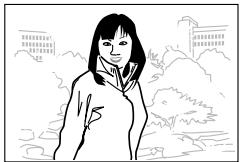
Wide Aperture

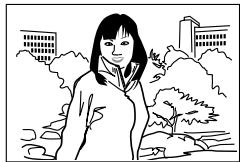
Small Aperture
Available Aperture Settings
| Aperture value* | Wide ←→ Small |
| F2.8, 3.2, 3.5, 4.0, 4.5, 5.0, 5.6, 6.3, 7.1, 8.0 | |
| Depth of Field | Shallow ←→ Deep |
- The above values are full wide angle optical zoom. Aperture values are different at other optical zoom settings.
1. Align the mode dial with "A" (Aperture Priority).
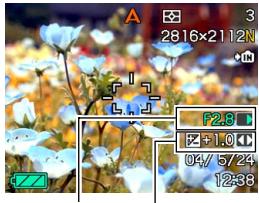
Aperture value EV shift
2. Use [▲] and [▼] to select “F *.”, and then use [▲] and [▶] to change the aperture value setting.
- You could also use [] and [] to select "EV Shift" here, and then use [] and [] to specify an exposure compensation value (page 80).
- If you are using manual focus, you can also use [] and [] to select "FOCUS" (manual focus adjustment), and then use [] and [] to focus manually.
OTHER RECORDING FUNCTIONS
3. Press the shutter button half way.
- This causes the camera to configure shutter speed automatically in accordance with the aperture value you selected. Then it focuses the image.
-
The shutter speed and aperture values on the monitor screen will turn amber when you press the shutter button half way if the image is over-exposed or under-exposed.
-
When the image is focused, press the shutter button all the way down to record.
Using Shutter Speed Priority AE
When S Mode (shutter speed priority AE) is selected as the exposure mode, the camera adjusts the aperture automatically in accordance with a fixed shutter speed specified by you. You should specify a shutter speed in accordance with how much your subject is moving.
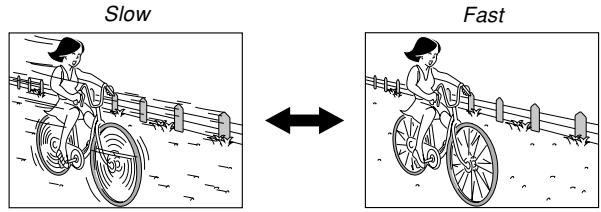
- Shutter Speed Setting Range
| Shutter speed | Slow → Fast |
| BULB, 60 seconds → 1/2000 second | |
| Movement | Blurred → Stopped |
- Align the mode dial with "S" (Shutter Speed Priority).
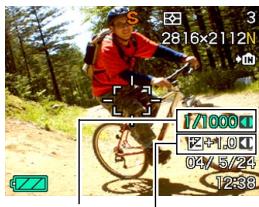
Shutter speed EV shift
-
Use [] and [] to select “1/**”, and then use [] and [] to change the shutter speed setting.
-
You could also use [] and [] to select "EV Shift" here, and then use [] and [] to specify an exposure compensation value (page 80).
-
If you are using manual focus, you can also use [] and [] to select "FOCUS" (manual focus adjustment), and then use [] and [] to focus manually.
-
Press the shutter button half way.
-
This causes the camera to configure the aperture value automatically in accordance with the shutter speed you selected. Then it focuses the image.
-
The shutter speed and aperture values on the monitor screen will turn amber when you press the shutter button half way if the image is over-exposed or under-exposed.
-
When the image is focused, press the shutter button all the way down to record.
OTHER RECORDING FUNCTIONS
Setting Exposure Settings Manually
In the M mode (manual exposure), you can adjust shutter speed and aperture manually.
Available Aperture Settings
| Aperture value* | Wide ←→ Small |
| F2.8, 3.2, 3.5, 4.0, 4.5, 5.0, 5.6, 6.3, 7.1, 8.0 | |
| Depth of Field | Shallow ←→ Deep |
-
The above values are full wide angle optical zoom. Aperture values are different at other optical zoom settings.
-
Shutter Speed Setting Range
| Shutter speed | Slow → Fast |
| BULB, 60 seconds → 1/2000 second | |
| Movement | Blurred → Stopped |
- Align the mode dial with "M" (Manual).
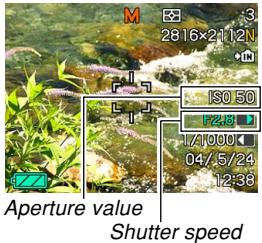
- Use [▲] and [▼] to select “F *.”, and then use [▲] and [▶] to change the aperture value setting.
-
Use [] and [] to select “1/**”, and then use [] and [] to change the shutter speed setting.
-
If you are using manual focus, you can also use [] and [] to select "FOCUS" (manual focus adjustment), and then use [] and [] to focus manually.
-
Press the shutter button half way.
- This causes the camera to adjust focus automatically.
- When the image is focused, press the shutter button all the way down to record.
Using Manual Assist On-screen Guidance
Pressing [SET] while in the A mode (aperture priority AE), S mode (shutter speed priority AE), or M mode (manual exposure) causes on-screen guidance and exposure indicators (aperture and shutter speed) to appear on the display.
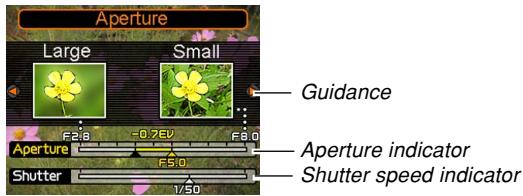
- In the A mode, you can use [<] and [> ] to change the aperture value setting. Pressing a button causes the on-screen guidance to disappear from the display.
- In the S mode, you can use [<] and [▶] to change the shutter speed setting. Pressing a button causes the on-screen guidance to disappear from the display.
- In the M mode, you can use [] and [] to switch on-screen guidance between the aperture value and shutter speed settings. After displaying the screen you want, you can use [] and [] to change the setting.
- If on-screen guidance disappears from the monitor screen, you can display it again by pressing [DISP].
IMPORTANT!
- The shutter speed displayed in the A mode and the aperture value displayed in the S mode are rough approximations only. Because of this, these settings may be slightly different from the settings that appear when you press the shutter button half way (which are more precise).
Exposure Mode Recording Precautions
- You may not be able to achieve the brightness you want when recording an image that is very dark or very bright. If this happens, use the M mode (manual exposure) to adjust the aperture or shutter speed manually.
- You can select the "BULB" setting in the S mode (shutter speed priority AE) or M mode (manual exposure).
- With the "BULB" setting, exposure continues as long as you keep the shutter button depressed, for up to 60 seconds.
- Note that when you are using the "BULB" setting, the record operation with the card remote controller is different from the record operation on the camera.
- Using slow shutter speeds can cause digital noise to appear in the image. Because of this, the camera automatically performs a noise reduction process whenever the shutter speed is one second or slower. The slower the shutter speed, the greater the possibility that noise will be generated in an image. If you notice digital noise in your images at very slow shutter speeds, try using a shutter speed setting that is faster than four seconds. Also note that the noise reduction process can cause it to take longer (about double the shutter speed setting or more) to record each image.
- At shutter speeds slower than 1/8 second, the brightness of recorded image may not be the same as the brightness of the image that appears on the monitor screen.
Using Auto Exposure Lock (AE Lock)
The AE Lock feature lets you lock auto exposure at a particular setting. This feature is separate from the AE lock effect you can achieve by pressing the shutter button half way in any exposure mode besides the M mode (manual exposure). You can use AE Lock in the following instances.
- To set up exposure on a subject that is different from the subject selected by Auto Focus
-
To setup exposure prior to using the flash for recording
-
In the REC mode, point the camera at the subject on which you want exposure to be performed.
2. Press [AE-L].
- This fixes the exposure settings (aperture and shutter speed), and displays "AE-L" on the monitor screen.
- The AE Lock is released by pressing [AE-L] again or by changing to another mode.
![CASIO EX-P600 - Press [AE-L]. - 1](/content/2025/01/86577/images/f9be709f6ae8b87c529386f93b2437f387596affc86d0c4037eb246fd79d486b.jpg)
![CASIO EX-P600 - Press [AE-L]. - 2](/content/2025/01/86577/images/f718f3db54a84b2ed1cf0632e6e44f4c2bac09ce2731f6f6741a80d4f3272d6f.jpg)
3. Record the image.
- AE Lock is released automatically when the image is recorded.
IMPORTANT!
- If AE Lock is already in effect, you can re-execute it by pressing [AE-L] once to release AE Lock, and then pressing [AE-L] again to perform a new AE Lock operation.
- Continuous shutter recording is always performed with AE Lock.
- AE Lock can be used before starting movie recording or while movie recording is in progress (page 111).
- Proper Auto Focus may not be possible if you try to use AE Lock to record an image in which there is a very large variation in brightness.
- You can also perform AE Lock by holding down [AE-L], instead to performing the procedure described above.
Using a Continuous Shutter Mode
You can configure the camera to record only a single snapshot each time the shutter button is pressed, or to keep recording as long as the shutter button remains depressed. You can select from among three different continuous shutter modes.
- Normal speed continuous shutter mode
- This mode records images as long as you keep the shutter button depressed.
- High speed continuous shutter mode
- This mode records up to 6 consecutive images, at a speed of about three images per second, as long as you keep the shutter button depressed. This mode records faster than the normal speed continuous shutter mode.
- Multi continuous shutter mode
- Pressing the shutter button once records 25 consecutive stop-action frames at high speed and combines them into a single image.
Using the Normal Speed Continuous Shutter Mode
The normal speed continuous shutter mode records images as long as you keep the shutter button depressed.
- Recording Speed: Depends on image size and image quality settings.
-
Number of Shots: Maximum number of shots possible (based on remaining memory capacity)
-
In the REC mode, press [BKT].
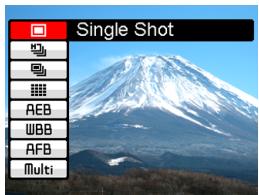
-
Use [▲] and [▼] to select “且”,and then press [SET].
-
This causes " " to appear on the monitor screen.
-
Press the shutter button to record.
-
Recording continues as long as you keep the shutter button depressed. Release the shutter button to stop recording.
NOTE
- You can also select a continuous shutter mode by holding down [BKT], selecting the mode you want with [▲] and [▼], and then releasing [BKT].
Using the High Speed Continuous Shutter Mode
The high speed continuous shutter mode provides higher speed recording than the normal speed coutinous shutter mode.
-
Recording Speed: Three images per second (The interval between shots is longer when shooting at slow shutter speeds)
Maximum Number of Shots: 6 -
In the REC mode, press [BKT].
-
Use [▲] and [▼] to select “”,and then press [SET].
-
This causes "M" to appear on the monitor screen.
-
Press the shutter button to record.
-
Recording continues as long as you keep the shutter button depressed. Release the shutter button to stop recording.
OTHER RECORDING FUNCTIONS
IMPORTANT!
- Nothing is displayed on the monitor screen while recording is in progress.
25-shot Stop Action Images (Using the Multi Continuous Shutter Mode)
The multi continuous shutter mode records 25 stop-action shots at high speed and combines them into a single image.
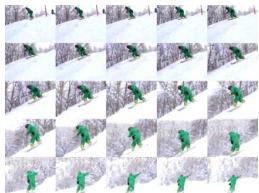
- In the REC mode, press [BKT].
-
Use [] and [] to select “ ”, and then press [SET].
-
This causes "..." to appear on the monitor screen.
-
Press the shutter button once to record.
After 25 shots are recorded, they are combined into a single image, which is stored in memory.
IMPORTANT!
- Note with the above procedure, you do not need to keep the shutter button depressed.
- The size of the 25-shot images is 1600 × 1200 pixels.
Continuous Shutter Precautions
Continuous shutter cannot be used when any one of the following conditions exists.
- When TIFF is selected for the image resolution (page 71)
- When "BULB" is selected for the shutter speed (pages 85, 87)
- When recording with the BESTSHOT night scene or fireworks scene (page 103) (multi continuous shutter mode only)
-
When using Coupling Shot or Pre-shot (pages 107, 109)
-
The flash is disabled while a continuous shutter mode is being used.
- You cannot use the self-timer in combination with a normal speed continuous shutter mode. Also, you cannot use the high speed continuous shutter mode or multi continuous shutter mode in combination with the Triple Self-timer (page 68).
- The slowest possible shutter speed setting when using the multi continuous shutter mode is 1/15 second.
- Starting a continuous shutter operation causes the exposure and focus settings to be fixed at the levels for the first image. The same settings are applied to all subsequent images.
- A continuous shutter operation may stop part way through if memory capacity runs low.
- Using a slow shutter speed setting causes a longer interval between images.
Using Auto Bracketing
Auto bracketing lets you select a single particular setting as a variable, and then record a series of images, each of which uses a different setting for the variable you selected. You can then select the image(s) you want to keep. There are two types of auto bracketing variables: configurable and non-configurable.
- Configurable Auto Bracketing Variables
There are three configurable auto bracketing variables.
- Exposure
- White Balance
Focus distance
With these configurable variables, you can specify how the setting of the variable changes, and whether three or five images should be recorded when the shutter button is pressed.
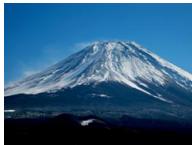
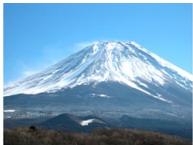
Three images using exposure as a variable
Non-configurable Auto Bracketing Variables
There are six non-configurable auto bracketing variables.
- Filter 1
Filter 2 - Portrait
- Sharpness
- Saturation
- Contrast
The shift range of a non-configurable variable and the number of images recorded are fixed, and cannot be changed by you.
Using Auto Bracketing with Exposure Selected as the Variable (AE Bracketing)
With AE bracketing, you can specify recording of three images or five images each of which is recorded with a different Auto Exposure setting. You can also specify the range of change for the exposure value (shift range).
- You can specify the shift range you want for AE bracketing.
- In the REC mode, press [BKT].
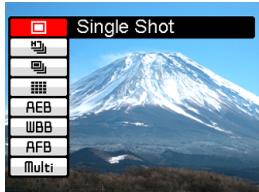
- Use [▲] and [▼] to select "AEB", and then press [▶].
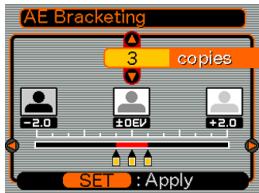
-
Use [] and [] to specify the number of images you want to record.
-
You can specify either three images or five images.
-
Use [] and [] to specify the shift range.
-
When the settings are the way you want, press [SET].
-
This causes the "AEB" indicator to appear on the monitor screen.
-
Press the shutter button to record.
-
Pressing the shutter button once records the number of images you specified.
NOTE
- You can also select an auto bracketing mode by holding down [BKT], selecting the mode you want with [▲] and [▼], and then releasing [BKT].
Using Auto Bracketing with White Balance as the Variable (WB Bracketing)
With WB bracketing, you can specify recording of three images or five images, each of which is recorded with a different white balance setting. As the white balance setting changes, the image takes on a more reddish or bluish tinge. You can also specify the range of change for the white balance setting (shift range).
-
You can specify the shift range you want for WB bracketing.
-
In the REC mode, press [BKT].
- Use [] and [] to select "WBB", and then press [▶].
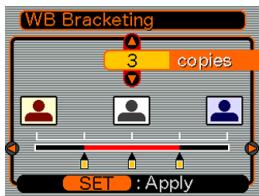
-
Use [] and [] to specify the number of images you want to record.
-
You can specify either three images or five images.
-
Use [] and [] to specify the shift range.
-
When the settings are the way you want, press [SET].
-
This causes the "WBB" indicator to appear on the monitor screen.
-
Press the shutter button to record.
-
Pressing the shutter button once records the number of images you specified.
Using Auto Bracketing with the Focus Distance as the Variable (Focus Bracketing)
With Focus bracketing, you can specify recording of three images or five images, each of which is recorded using a different focus distance setting. You can also specify the range of change for the focus distance (shift range).
-
You can specify the shift range you want for focus bracketing
-
In the REC mode, press [BKT].
-
Use [▲] and [▼] to select “AFB”, and then press [▶].
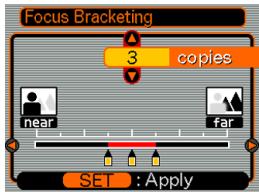
-
Use [] and [] to specify the number of images you want to record.
-
You can specify either three images or five images.
-
Use [] and [] to specify the shift range.
-
When the settings are the way you want, press [SET].
-
This causes the "AFB" indicator to appear on the monitor screen.
-
Press the shutter button to record.
-
Pressing the shutter button once records the number of images you specified.
Using Auto Bracketing with Non-configurable Variables (Multi Bracketing)
There are six non-configurable auto bracketing variables.
- Filter 1 (five images)
- Filter 2 (five images)
- Portrait (three images)
- Sharpness (three images)
- Saturation (three images)
- Contrast (three images)
The shift range of a non-configurable variable and the number of images recorded are fixed, and cannot be changed by you.
To use auto bracketing with a non-configurable variable
- In the REC mode, press [BKT].
- Use [] and [] to select "Multi", and then press [▶].
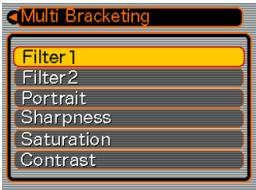
-
Use [] and [] to select the non-configurable variable you want, and then press [SET].
-
This causes the "MB" indicator to appear on the monitor screen.
-
Press the shutter button to record.
-
Pressing the shutter button once records the image. After that, the image data is processed internally to create other versions of the same image in accordance with the selected auto bracketing function.
NOTES
- Selecting "Filter 1" records images with the monochrome, sepia, red, and purple filters.
- Selecting "Filter 2" records images with the green, blue, yellow, and pink filters.
- Selecting "Portrait" records a normal image, followed by an image with soft focus and enhanced flesh tones.
IMPORTANT!
Note that you can use only one non-configurable variable at a time. You cannot use them in combination with each other.
Auto Bracketing Precautions
- Auto bracketing cannot be used when any one of the following conditions exists.
- When TIFF is selected for the image resolution (page 71)
- When "BULB" is selected for the shutter speed (pages 85, 87)
During Coupling Shot or Pre-shot recording (pages 107, 109) - The flash is disabled while auto bracketing is being used.
- The Triple Self-timer (page 68) cannot be used together with auto bracketing.
- An auto bracketing operation may stop part way through if memory capacity or battery power runs low.
- Certain menu settings may be ignored when you use Auto Bracketing for recording.
Previewing Images Recorded with High Speed Continuous Shutter or Auto Bracketing
You can use the following procedure to preview images after you record them with high speed continuous shutter or auto bracketing, without switching to the PLAY mode (page 138).
1. After recording the images, press [PREVIEW].
- This displays a preview screen of the images you just recorded with high speed continuous shutter or auto bracketing.
- Press [PREVIEW] again to clear the preview screen.
![CASIO EX-P600 - After recording the images, press [PREVIEW]. - 1](/content/2025/01/86577/images/2cd8b9706ec65f1df0871d955d4a521fae4040abdd9e4a3bf4f8837a542f67ed.jpg)
![CASIO EX-P600 - After recording the images, press [PREVIEW]. - 2](/content/2025/01/86577/images/8651d9da94ab1e8015cbd7dbf646b31e8cf0cf5cb66fb6588cebb1b9a69f4e8c.jpg)
Images recorded using the high-speed continuous shutter mode
OTHER RECORDING FUNCTIONS
-
Use [], [], [] , and [] to move the selection boundary to the image you want to view, and then press [SET] to display the selected image.
-
This displays the image with an indicator (like “#”) that shows the recording method used, along with a value indicating the image number in the series.
-
Use [] and [] to scroll between images.
IMPORTANT!
- Pressing [PREVIEW] after a normal speed, multi continuous shutter mode, or single-image operation displays the last image recorded only.
-
Pressing [PREVIEW] does not display preview images if any of the following conditions existed immediately before recording of images using the high speed continuous shutter mode or auto bracketing.
-
Immediately after turning on camera power
- Immediately after changing the mode dial setting
- Immediately after recording a new image without high speed continuous shutter or auto bracketing.
- The selection screen does not appear following a high speed continuous shutter mode operation that records only one image.
OTHER RECORDING FUNCTIONS
Deleting an Image on the Preview Screen
You can use the preview screen to delete images recorded with the high-speed continuous shutter mode or auto bracketing.
IMPORTANT!
-
Note that image deletion cannot be undone. Once you delete an image, it is gone. Make sure you really do not need an image anymore before you delete it.
-
After recording the images, press [PREVIEW] to display the preview screen.
- Press [EX 血].
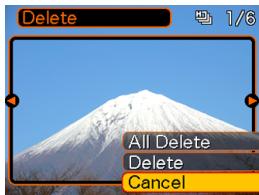
- Use [] and [] to select the delete operation you want.
| To do this: | Select this option: |
| Delete all of the images of the last high-speed continuous shutter or auto bracketing operation | All Delete |
| Delete only the displayed image | Delete |
| Cancel the delete operation | Cancel |
- After the setting is the way you want, press [SET].
IMPORTANT!
- The "All Delete" option is not available when there is only one image.
Using the BESTSHOT Mode
Selecting one of the 25 BESTSHOT scenes automatically sets up the camera for recording a similar type of image.
Example Sample Scene
- Portrait
Night Scene
- Scenery
Night Scene Portrait
-
Align the mode dial with ES.
-
This enters the BESTSHOT mode and displays a sample scene.
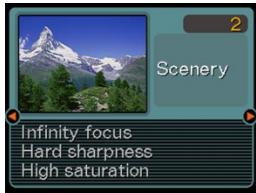
- Use [] and [] to select the sample scene you want, and then press [SET].
- Record the image.
IMPORTANT!
- Sample scene number 4 is Coupling Shot scene (page 107). Sample scene number 5 is a Pre-shot scene (page 109).
- BESTSHOT scenes were not recorded using this camera. They are provided as samples only.
- Images recorded using a BESTSHOT scene may not produce the results you expected due to shooting conditions and other factors.
- After selecting a BESTSHOT scene, you can change to a different one by pressing [SET] and then using [▲] and [▶] to scroll through available scenes. When the one you want is displayed, press [SET].
OTHER RECORDING FUNCTIONS
- You can change the camera settings that are made when you select a BESTSHOT scene. Note, however, that the BESTSHOT settings revert to their defaults when you select another BESTSHOT scene, change the recording mode, or turn off the camera.
- Noise reduction processing is performed automatically when you are recording a night scene, fireworks, or other image that requires slow shutter speeds. Because of this, it takes longer to record images at lower shutter speeds. Make sure that you do not perform any camera button operations until the image recording operation is complete.
NOTE
- Operation guidance and the currently selected BESTSHOT scene appear on the display for about two seconds if the camera is in the BESTSHOT mode when you turn it on.
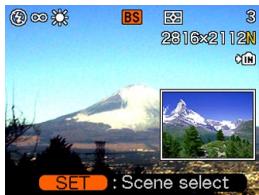
Creating Your Own BESTSHOT Setup
You can use the procedure below to save the setup of an image you recorded for later recall when you need it again. Recalling a setup you save automatically sets up the camera accordingly.
1. Align the mode dial with ES.
- This enters the BESTSHOT mode and displays a sample scene.
2. Use [<] and [▶] to display "Register User Scene".
![CASIO EX-P600 - Use [<] and [▶] to display "Register User Scene". - 1](/content/2025/01/86577/images/4805eb7ba01672b21b6adcb020d719eb8d8c1f81fa3f2ac66a402b1b447c8466.jpg)
3. Press [SET].
- Use [<] and [▶] to display the image whose setup you want to register as a BESTSHOT scene.
![CASIO EX-P600 - Press [SET]. - 1](/content/2025/01/86577/images/aef4c0276df3bf8e421a96ee967f835cd12b3bd90a178c31cff895d6a5bf7fac.jpg)
-
Use [] and [] to select "Save", and then press [SET].
-
This registers the setup.
- Now you can use the procedure on page 103 to select your user setup for recording.
![CASIO EX-P600 - Press [SET]. - 2](/content/2025/01/86577/images/0009bf89e6223bdf8f289849a7b80bdfbc5014a5a31e2873124d746ecd9fcb15.jpg)
IMPORTANT!
- BESTSHOT user setups are located in the camera's built-in memory after the built-in sample scenes.
- When a BESTSHOT user setup is recalled, the monitor screen in step 2 of the procedure on page 103 displays the text "Recall User Scene".
Note that formatting the built-in memory (page 180) deletes all BESTSHOT user setups.
NOTES
- The following are the settings that are included in a BESTSHOT Mode user setup: focus mode, EV shift value, filter, metering mode, white balance mode, flash intensity, sharpness, saturation, contrast, flash mode, ISO sensitivity, and aperture and shutter speed.
- Note that images recorded with this camera only can be used to create a BESTSHOT user setup.
- You can have up to 999 BESTSHOT user setups in the camera's built-in memory at one time.
- You can check the current setup of a scene by displaying the various setting menus.
- When you register a BESTSHOT user setup, it is automatically assigned a file name using the format "UP600nnn.JPE" (n=0 to 9).
To delete a BESTSHOT user setup
-
Align the mode dial with ES.
-
This enters the BESTSHOT mode and displays a sample scene.
-
Use [<] and [> ] to display the user setup you want to delete.
-
Press [EX] to delete the user setup.
-
You can also delete a user setup by using your computer to delete its file in the "SCENE" folder in the camera's built-in memory (page 210).
Combining Shots of Two People into a Single Image (Coupling Shot)
The Coupling Shot mode lets you record images of two people and combine them into a single image. This makes it possible for you to include yourself in group images, even when there is no one else around to record the image for you. Coupling Shot is available in the BESTSHOT mode (page 103).
- First Image
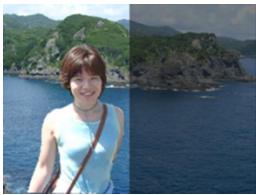
This is the part of the image that does not include the person who is recording the first image.
Second Image
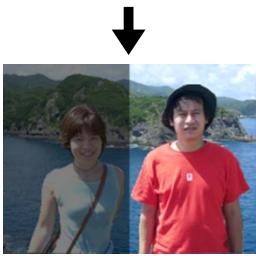
Making sure that the background of the image is aligned correctly, record the image of the person who recorded the first image.

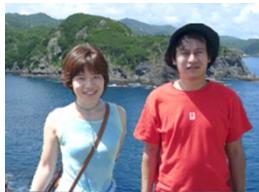
Combined Images
-
Align the mode dial with ES.
-
Use [<] and [▶] to select "Coupling Shot", and then press [SET].
-
Align the focus frame on the monitor screen with the subject you want on the left side of the image.
While "Coupling Shot" is selected, the "AF Area" (page 75) setting automatically becomes "Spot".
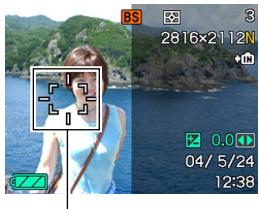
Focus frame
OTHER RECORDING FUNCTIONS
4. Press the shutter button to record the left side of the image.
- The focus, exposure, white balance, zoom, and flash settings are fixed for this type of image.
5. Next, align the focus frame with the subject you want in the right side of the image, taking care to align the actual background with the semi-transparent image of the background of the first image, which is shown on the monitor screen.
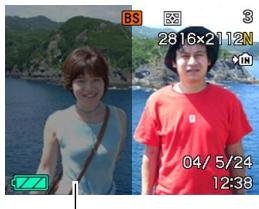
Semi-transparent image
- Pressing [MENU] any time after step 3 of the above procedure cancels the first image and returns to step 3.
6. When everything is aligned correctly, record the right side of the image.
IMPORTANT!
- Coupling Shot temporarily uses file memory to store data. You may get an error during Coupling Shot recording if there is not enough file memory available to store the required data. If this happens, delete images you no longer need and try again.
Recording a Subject onto an Existing Background Image (Pre-shot)
Pre-shot helps you get the background you want, even if you need to ask someone else to record the image for you. Basically, Pre-shot is a two-step process.
- You compose the background you want and press the shutter button, which causes a semi-transparent image of the background to remain on the monitor screen.
-
Ask someone else to record a shot of you against your original background, telling them to compose the image by using the semi-transparent monitor screen image as a guide.
-
The camera stores the image produced by step 2 only.
- Depending on how the image is actually composed in step 2, its background may not be exactly the same as the one you composed in step 1.
Note that Pre-shot is available in the BESTSHOT mode only (page 103).
- Freeze the background on the monitor screen.
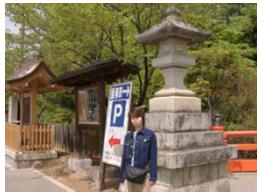

- Record the image, using the background on the monitor screen as a guide.
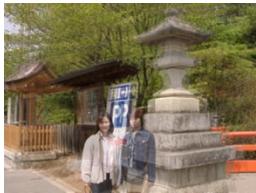
This records the image.
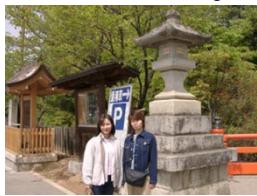
OTHER RECORDING FUNCTIONS
- Align the mode dial with ES.
- Use [<] and [> to select "Pre-shot", and then press [SET].
-
Freeze the background on the monitor screen.
-
Though a semi-transparent image of the background appears on the monitor screen in step 4, the background image is not saved in memory at this time.
-
The focus, exposure, white balance, zoom, and flash settings are fixed for this type of image.
-
Next, align the focus frame with the subject, composing the subject with the semi-transparent background shown on the monitor screen.
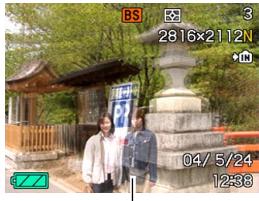
Semi-transparent image
-
Pressing [MENU] any time after step 3 of the above procedure cancels the background image and returns to step 3.
-
When everything is aligned correctly, record the image.
-
This records the image composed on the monitor screen in step 4. The reference background image is not recorded.
Using the Movie Mode
You can record movies with audio. A single movie can be as long as available memory capacity allows.
- File Format: AVI
AVI format conforms to the Motion JPEG format promoted by the Open DML Group.
-
Image Size: 320 × 240 pixels
-
Movie File Size: Approximately 300KB/second.
Maximum Movie Length
One Movie:
As long as available memory capacity allows
Total Movie Time:
30 seconds with built-in memory; 200 seconds with
64MB SD memory card
1. Align the mode dial with
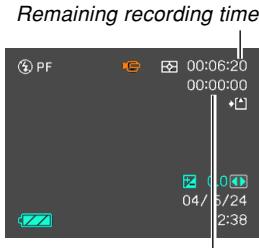
Recording time
2. Point the camera at the subject and then press the shutter button.
- Movie recording continues as long as remaining memory capacity allows, or until you stop it by pressing the shutter button again.
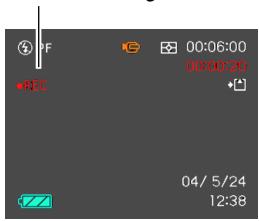
Movie recording indicator
- The remaining recording time and recording time values count down on the monitor screen as you record.
- Starting a movie record operation causes optical zoom to be disabled. Only digital zoom is available while a movie record operation is in progress. If you want to use optical zoom to record a movie, perform the zoom operation before starting the record operation.
- The focus mode automatically changes to Pan Focus (page 78) when you enter the Movie mode, regardless of the mode memory's (page 124) Focus setting. You can, however, change to another focus mode before starting a recording.
OTHER RECORDING FUNCTIONS
3. When movie recording is complete, the movie file is stored in file memory.
IMPORTANT!
- The flash does not fire in the Movie mode.
- This camera also records audio. Note the following points when recording a movie.
Take care that you do not block the microphone with your fingers.
Good recording results are not possible when the camera is too far from the subject.
- Operating camera buttons during recording can cause button noise to be included in the audio.
— Movie audio is recorded in monaural.
The camera automatically switches to the Pan Focus (PF) (page 78) whenever you enter the Movie Mode.
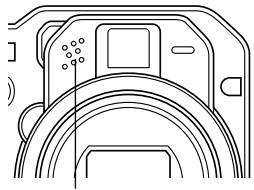
Microphone
The camera focuses automatically whenever you have Auto Focus (page 74) or Macro (s) selected as the focus mode. Note that the confirmation tone that sounds during the Auto Focus operation will be recorded in the audio. If you do not want confirmation tones in your audio, keep Pan Focus (PF) as the focus mode, or select Manual Focus (MF) and manually focus the image before starting your recording.
- Auto Focus is not performed in the case of the Pan Focus (PF), Manual Focus (MF) and Infinity () focus modes, and so no confirmation tone sounds. In the case of the Manual Focus mode, you cannot adjust focus settings while recording is in progress. Be sure to make all adjustments before beginning the record operation.
Certain types of memory cards take longer to record data, which can cause movie frames to be dropped. and flash on the monitor screen during recording to let you know when a frame has been dropped.
Recording Audio
Adding Audio to a Snapshot
You can add audio to a snapshot after you record it.
- Image Format: JPEG
JPEG is an image format that provides efficient data compression.
The file extension of a JPEG file is“.JPG”.
- Audio Format: WAVE/ADPCM recording format
This is the Windows standard format for audio recording.
The file extension of a WAVE/ADPCM file is“.WAV”.
- Recording Time:
Up to about 30 seconds per image
Audio File Size:
Approximately 120KB (30-second recording of approximately 4KB per second)
- In the REC mode, press [MENU].
- Select the "REC" tab, select "Audio Snap", and then press [▶].
-
Use [] and [] to select "On" and then press [SET].
-
This enters the Audio Snapshot Mode and display a indicator.
-
Selecting "Off" enters the Normal Snapshot Mode (no audio).
-
Press the shutter button to record the image.
After the image is recorded, the camera enters audio recording standby, with the image you just recorded on the monitor screen.
- You can cancel audio recording standby by pressing [MENU].
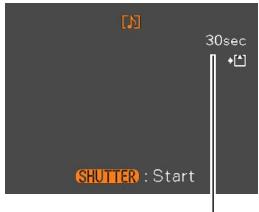
Remaining recording time
5. Press the shutter button to start audio recording.
- The green operation lamp flashes as recording is performed.
- Even if you have the monitor screen turned off (page 31), the monitor screen turns on while you are adding audio to a snapshot.
6. Recording stops after about 30 seconds or when you press the shutter button.
IMPORTANT!
- The Audio Snapshot Mode is unavailable during image recording using any of the following: Triple Self-timer, Continuous shutter, Auto bracketing, Coupling Shot.
Recording Your Voice
The Voice Recording Mode provides quick and easy recording of your voice.
- Audio Format: WAVE/ADPCM recording format This is the Windows standard format for audio recording. The file extension of a WAVE/ADPCM file is“.WAV”.
- Recording Time: Approximately 40 minutes with built-in memory
- Audio File Size: Approximately 120KB (30-second recording of approximately 4KB per second)
1. Align the mode dial with
- This enters the Voice Recording Mode and display a indicator.
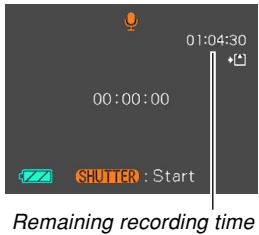
2. Press the shutter button to start voice recording.
- The remaining recording time value counts down on the monitor screen and the green operation lamp flashes as recording is performed.
- Pressing [DISP] during voice recording turns off the monitor screen.
- You can insert index marks while recording by pressing [SET]. See page 156 for information about jumping to an index mark during playback.
3. Recording stops when you press the shutter button, when memory becomes full, or when the battery goes dead.
Audio Recording Precautions
- Keep the microphone on the front of the camera pointed at the subject.
Take care that you do not block the microphone with your fingers.
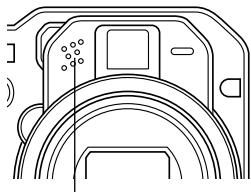
Microphone
- Good recording results are not possible when the camera is too far from the subject.
- Pressing the power button or rotating the mode dial stops recording and stores any audio recorded up to that point.
- You can also perform "after-recording" to add audio to a snapshot after recording it, and also change the audio recorded for an image. See page 154 for more information.
REC Mode Camera Settings
The following are the settings you can make before recording an image using a REC mode.
- ISO sensitivity
- Auto Focus Mode (AF Mode)
- Metering
Color filtering - Sharpness
- Saturation
- Contrast
- Grid on/off
- Image Review on/off
L/R key setting
Power on default settings - Resetting the camera
NOTE
- You can also configure the settings listed below. See the referenced pages for more information.
Size (page 70)
Quality (page 71)
- White Balance (page 83)
— AF Area (page 75)
Audio Snap (page 113)
— Flash Intensity (page 66)
Digital Zoom (page 63)
OTHER RECORDING FUNCTIONS
Specifying ISO Sensitivity
You can change the ISO sensitivity setting for better images in places where lighting is dim or when you are using faster shutter speeds.
- ISO sensitivity is expressed in terms of values that originally indicated the sensitivity to light for photographic film. A larger value indicates higher sensitivity, which is better for recording when available lighting is dim.
- In the REC mode, press [MENU].
- Select the "REC" tab, select "ISO", and then press [▶].
- Use [] and [] to select the setting you want and then press [SET].
| To get this: | Select this setting: |
| Automatic sensitivity selection | Auto |
| Conforms to ISO 50 | ISO 50 |
| Conforms to ISO 100 | ISO 100 |
| Conforms to ISO 200 | ISO 200 |
| Conforms to ISO 400 | ISO 400 |
IMPORTANT!
- Under certain conditions, a high shutter speed in combination with a high ISO sensitivity setting can cause digital noise to appear inside of an image. For clean, good-quality images, use the lowest ISO sensitivity setting possible.
- Using a high ISO sensitivity setting along with the flash to shoot a nearby subject may result in improper illumination of the subject.
NOTE
- You can use key customization (page 123) to configure the camera so the ISO sensitivity setting changes whenever you press [▲] and [▶] while in the REC mode.
OTHER RECORDING FUNCTIONS
Selecting the Auto Focus (AF) Mode
Use the following procedure to change the AF mode.
- In the REC mode, press [MENU].
- Select the "REC" tab, select "AF Mode", and then press [▶].
- Use [] and [] to select the setting you want, and then press [SET].
| To perform this type of Auto Focus: | Select this AF mode: |
| Combination of phase difference and contrast focus* Normally, you should use this mode. | Hybrid |
| At normal distance, high-speed continual focus | Continuous |
| Contrast focus to protect against loss of Auto Focus because the phase differential sensor is blocked | Contrast |
IMPORTANT!
- Use of Continuous AF performs focus non-stop, so battery power runs down faster than with Hybrid AF.
- Be sure to use Contrast AF whenever you have a telephoto conversion, wide angle conversion, or close-up lens installed (page 135). Note that Contrast AF is slower to focus than Hybrid AF.
OTHER RECORDING FUNCTIONS
Selecting the Metering Mode
Use the following procedure to specify multi (multi pattern) metering, spot metering, or center weighted metering as the metering mode.
- In the REC mode, press [MENU].
- Select the "REC" tab, select "Metering", and then press [▶].
- Use [] and [] to select the setting you want, and then press [SET].
Multi (Multi pattern):
Multi (Multi pattern) metering divides the image into sections and measures the light in each section for a balanced exposure reading. The camera automatically determines shooting conditions according to the measured lighting pattern, and makes exposure settings accordingly. This type of metering provides error-free exposure settings for a wide range of shooting conditions.
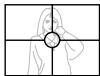
Center Weighted:
Center weighted metering measures light concentrating on the center of the focus area. Use this metering method when you want to exert some control over exposure, without leaving settings totally up to the camera.
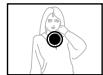
Spot:
Spot metering takes readings at a very small area. Use this metering method when you want exposure to be set according to the brightness of a particular subject, without it being affected by surrounding conditions.
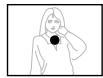
IMPORTANT!
- When "Multi" is selected as the metering mode, certain procedures cause the metering mode setting to change automatically as described below.
- Changing the exposure compensation setting (page 80) to a value other than 0.0 changes the metering mode setting to "Center Weighted." The metering mode changes back to "Multi" when you return the exposure compensation setting to 0.0.
- Selecting manual exposure (page 87) changes the metering mode setting to "Center Weighted." The metering mode changes back to "Multi" when you select an exposure mode other than manual.
Using the Filter Function
The camera's filter function lets you alter the tint of an image when you record it.
- In the REC mode, press [MENU].
- Select the "REC" tab, select "Filter", and then press [▶].
- Use [] and [] to select the setting you want, and then press [SET].
Available filter settings are: Off, B/W, Sepia, Red, Green, Blue, Yellow, Pink, Purple
IMPORTANT!
- Using the camera's filter feature produces the same effect as attaching a color filter to the lens.
OTHER RECORDING FUNCTIONS
Specifying Outline Sharpness
Use the following procedure to control the sharpness of image outlines.
- In the REC mode, press [MENU].
- Select the "REC" tab, select "Sharpness", and then press [▶].
- Use [] and [] to select the setting you want, and then press [SET].
| To get this: | Select this setting: |
| High sharpness | Hard |
| Normal sharpness | Normal |
| Low sharpness | Soft |
Specifying Color Saturation
Use the following procedure to control the intensity of the image you are recording.
- In the REC mode, press [MENU].
- Select the "REC" tab, select "Saturation", and then press [▶].
- Use [] and [] to select the setting you want, and then press [SET].
| To get this: | Select this setting: |
| High color saturation (intensity) | High |
| Normal color saturation (intensity) | Normal |
| Low color saturation (intensity) | Low |
Specifying Contrast
Use this procedure to adjust the relative difference between the light areas and dark areas of the image you are recording.
- In the REC mode, press [MENU].
- Select the "REC" tab, select "Contrast", and then press [▶].
- Use [] and [] to select the setting you want, and then press [SET].
| To get this: | Select this setting: |
| High contrast | High |
| Normal contrast | Normal |
| Low contrast | Low |
Turning the On-screen Grid On and Off
You can display gridlines on the monitor screen to help you compose images and ensure that the camera is straight when recording.
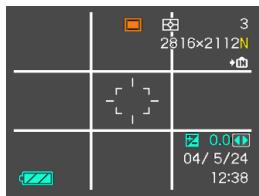
- In the REC mode, press [MENU].
- Select the "REC" tab, select "Grid", and then press [▶].
- Use [] and [] to select the setting you want, and then press [SET].
| To do this: | Select this setting: |
| Display the grid | On |
| Hide the grid | Off |
Turning Image Review On and Off
Image review displays an image on the monitor screen as soon as you record it. Use the following procedure to turn image review on and off.
- In the REC mode, press [MENU].
- Select the "REC" tab, select "Review", and then press [▶].
- Use [] and [] to select the setting you want, and then press [SET].
| To do this: | Select this setting: |
| Display images on the monitor screen for about one second immediately after they are recorded | On |
| Do not display images immediately after they are recorded | Off |
Assigning Functions to the [<] and [>]: Keys
A "key customization" feature lets you configure the [▲] and [▶] keys so they change camera settings whenever they are pressed in the REC mode. After you configure the [▲] and [▶] keys, you can change the setting assigned to them without going through the menu screen.
- In the REC mode, press [MENU].
- Select the "REC" tab, select "L/R Key", and then press [▶].
- Use [] and [] to select the setting you want, and then press [SET].
OTHER RECORDING FUNCTIONS
| When you want to assign this function to [▲] and [▶] keys: | Select this: |
| EV shift ·[▲] decreases compensation, [▶] increases compensation (page 80). | EV Shift |
| White balance setting ·[▲] and [▶] cycle through white balance settings (page 81). | White Balance |
| ISO sensitivity ·[▲] and [▶] cycle through ISO sensitivity settings (page 117). | ISO |
| Metering mode ·[▲] and [▶] cycle through metering modes (page 119). | Metering |
| AF Area ·[▲] and [▶] cycle through AF areas (page 75). | AF Area |
| No function assigned | Off |
NOTE
- The initial default setting is "EV Shift".
Specifying Power On Default Settings
The camera's "mode memory" feature lets you specify the power on default settings individually for the flash mode, focus mode, white balance mode, ISO sensitivity, AF Area, Metering, Cont./BKT, Flash Intensity, digital zoom mode, manual focus position and zoom position. Turning on mode memory for a mode tells the camera to remember the status of that mode when you turn off the camera, and restore it the next time you turn the camera back on. When mode memory is turned off, the camera automatically restores the initial factory default setting for the applicable mode.
The following table shows what happens when you turn mode memory on or off for each mode.
OTHER RECORDING FUNCTIONS
| Function | On | Off |
| Flash | Setting when camera is turned off | Auto |
| Focus*1 | Auto | |
| White Balance | Auto | |
| ISO | Auto | |
| AF Area | Spot | |
| Metering | Multi | |
| Cont./BKT | 1 Shot | |
| Flash Intensity | Normal | |
| Digital Zoom | On | |
| MF Position | Last Auto Focus position that was in effect before you switched to manual focus | |
| Zoom Position*2 | Wide Angle |
1 Focus mode setting is not remembered for the Movie Mode. Mode automatically returns to PF (Pan Focus).
2 Only the optical zoom position is remembered.
- In the REC mode, press [MENU].
- Use [] and [] to select the "Memory" tab.
- Use [] and [] to select the item you want to change, and then press [] .
- Use [] and [] to select the setting you want, and then press [SET].
| To do this: | Select this setting: |
| Turn on mode memory so settings are restored at power on | On |
| Turn off mode memory so settings are initialized at power on | Off |
IMPORTANT!
- If you change the BESTSHOT mode sample scene selection or if you turn off the camera while it is in the BESTSHOT mode, the camera's setup (except for "Zoom Position") will be configured according to the BESTSHOT sample scene settings when you turn it back on again. This is true, regardless of mode memory on/off settings.
- If you turn the camera off while in the Movie mode, the flash will be turned off when you turn the camera back on again, regardless of mode memory on/off setting.
Resetting the Camera
Use the following procedure to reset all of the camera's settings to their initial defaults as shown under "Menu Reference" on page 230.
- In the REC mode or the PLAY mode, press [MENU].
- Select the "Set Up" tab, select "Reset", and then press [▶].
-
Use [] and [] to select "Reset", and then press [SET].
-
To cancel the procedure without resetting, select "Cancel" and press [SET].
Using the Shortcut Menu
Pressing [EX] displays a shortcut menu that you can use to configure white balance, ISO sensitivity, metering, and AF area settings.
- In the REC mode, press [EX].
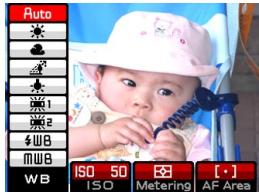
- Use [] and [] to select the item you want, and then use [] and [] to scroll through the available settings.
-
After configuring the settings you want, press [SET] to exit the shortcut menu.
-
Refer to the following pages for details about each of the settings.
Adjusting the White Balance (page 81)
— Specifying ISO Sensitivity (page 117)
- Specifying the Metering Mode (page 119)
- Specifying the Auto Focus Area (page 75)
NOTE
- You can also configure a setting by holding down [EX 10], selecting the item you want with [▲] and [▲], and then changing the setting with [▲] and [▼]. The setting is applied when you release [EX 10].
Using the Card Remote Controller for Recording
You can use the card remote controller that comes with the camera when recording. By mounting the camera on a tripod and using the remote shutter release, you can eliminate the chance of blurred images due to accidental hand movement.
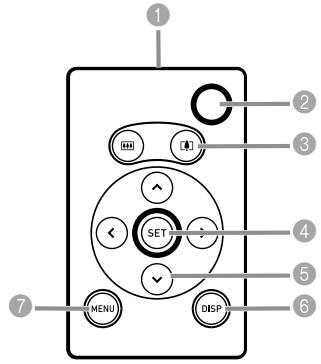
Signal emitter
Shutter button
3 Zoom button
SET button
Control buttons
DISP button
7 MENU button
Loading the Battery
You need to load a lithium battery (CR2025) into the card remote controller before you can use it to control the camera.
- While pressing point A in the direction indicated by the arrow, pull the battery holder from the remote controller.
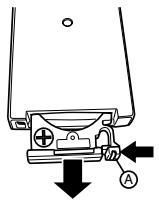
OTHER RECORDING FUNCTIONS
- Wipe the surfaces of the battery with a soft, dry cloth, and then place it onto the battery holder so its positive side is facing upwards (so you can see it).
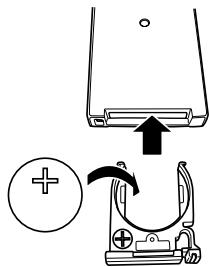
- Slide the battery holder back into the remote controller.
IMPORTANT!
- Take care to ensure that the battery is not accidentally swallowed when it is removed from the remote controller. Particular care is required where young children are present.
- Keep button battery out of the reach of small children. If swallowed accidentally, contact your physician immediately.
Before Using the Card Remote Controller for Recording
Be sure to perform the following steps before using the card remote controller for recording.
-
In the REC mode, use [O] to select the card remote controller mode you want to use.
-
Enabling the card remote controller for recording causes either "or" to appear on the monitor screen.
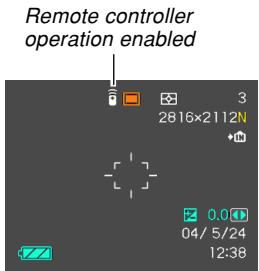

: Pressing the remote controller's shutter button immediately releases the shutter.

: Pressing the remote controller's shutter button releases the shutter about two seconds later (same as the 2-second self-timer).
IMPORTANT!
- The "..." setting is useful when you want to be part of the image you are recording. The delay gives you time to look at the camera after operating the remote controller.
- The remote controller can be used in the PLAY mode and the Voice Recording Mode, regardless of the Triple Self-timer setting.
Using the Card Remote Controller
Point the signal emitter on the remote controller at the camera's signal receiver (front or side), and perform the operation you want.
Card remote controller button operations are identical to those of the corresponding camera buttons.
- The range of the card remote controller is normally about five meters on a straight line between the signal emitter and front camera signal receiver, and about one meter from an angle to the right of the front of the camera.
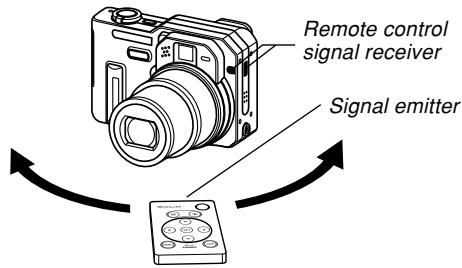
IMPORTANT!
- Any one of the following conditions can reduce the range for remote controller operations.
- When the card remote controller signal emitter is at an angle to the camera's signal receiver
- When the camera is exposed to bright light
- When the card remote controller battery is low
- Unlike the camera's shutter button, you cannot press the remote controller shutter button half way.
Pressing the remote controller shutter button causes the camera to perform an auto focus operation and then record the image. - When performing a high speed or normal speed continuous shutter mode operation with the card remoter controller, keep the shutter button of the card remote controller depressed.
- A continuous shutter or auto bracketing record operation may be interrupted part way through if remote control signal reception is interfered with or if the card remote controller battery goes low.
-
When using the card remote controller for "BULB" recording (pages 85, 87), press the card remote controller shutter button once to start exposure, and a second time to stop exposure. This is different from the operation using the camera's shutter button, which you must keep depressed as long as you want exposure to be performed. Note that card remote controller shutter button operations are different from camera shutter button operations.
-
Installing a conversion lens on the camera can cause the signal receiver on the front of the camera to become blocked. Point the card remote controller at the signal receiver on the side of the camera in this case (page 135).
Using an External Flash
Use of a commercially available flash unit makes it possible to obtain a higher level of brightness (guide number) than you get when using the built-in flash alone. An external flash also makes it possible to extend the effective range of flash photography.
- The guide number of the internal flash is 8 (ISO 100/m).
External Flash Unit Requirements
Any external flash unit you use with this camera must satisfy the following requirements.
Variable flash intensity (AUTO)
- Flash Duration: Less than 1/1000 sec.
- Coverage Angle: Coverage of 33mm equivalent 35mm focal length lens (without wide conversion lens)
IMPORTANT!
- Some flash performance may be lost when using a ring flash or other type of unit with a long flash time.
- The aperture value and ISO sensitivity available with some flash units may not match the values supported by your camera. In such a case, make adjustments in the aperture setting of the external flash and the camera until proper brightness is achieved.
Attaching an External Flash Unit
IMPORTANT!
- Always make sure that the external flash unit is turned off before attaching it to or detaching it from the camera. Leaving the flash unit on can cause it to fire unexpectedly.
1. Attach the flash unit's sync cable to the camera's external flash sync terminal.
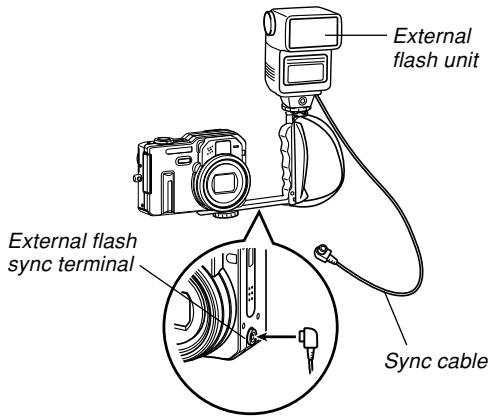
- When attaching an external flash unit to the camera, you should also purchase and install a gripped bracket that can be secured to the camera's tripod hole.
2. Turn on camera power and make the required camera settings.
- Exposure Mode: M (Manual Exposure) Mode
- Shutter Speed: Around 1/60 (Actual setting should be in accordance with aperture setting.)
- For maximum brightness of areas that are not reached by flash illumination, use the camera's maximum aperture opening (F2.8).
- White Balance: (Daylight)
- Flash Mode: (Off)
OTHER RECORDING FUNCTIONS
3. Turn on the external flash unit, and set it up for the camera's aperture (F) value (page 84) and sensitivity (ISO 50 equivalent) value.
- Depending on shooting conditions, proper exposure may not be obtained even if you properly set the auto aperture (F) value and ISO sensitivity of the flash unit to match those of the camera. If this happens, adjust the auto aperture (F) value, ISO sensitivity, or other settings of the flash unit. Also try adjusting the aperture of the camera.
IMPORTANT!
- The external flash connected to the external flash sync terminal always fires. To record an image without using external flash, disconnect the sync cable from the terminal or turn off external flash unit power.
-
After recording an image, check it on the monitor screen. If it is not what you expected, use the controls on the external flash unit to adjust flash intensity, and adjust the aperture and ISO sensitivity settings on the camera. Note that you cannot control external flash unit intensity using camera settings.
-
Close up images often tend to be overexposed. If you are having overexposure problems, try adjusting the aperture and ISO sensitivity settings of the external flash unit and the camera. You can also try using the camera's built in flash to correct for overexposure.
Note that the camera's built in flash fires whenever its Flash Mode setting is something other than Off). - Camera aperture (F) values are based on the widest optical zoom (1X). Using telephoto can cause slight lens darkness. Adjust the aperture and ISO sensitivity settings of the external flash unit and the camera as required when using optical zoom.
- When using a zoom flash, a coverage angle for a focal distance of 33mm or less for the flash unit is recommended.
Using a Conversion Lens or Filter
Installing the optionally available Conversion Lens Adaptors (LU-60A) on the camera makes it possible to use a recommended conversion lens or close-up lens, or a commercially available filter for recording.
-
Telephoto
-
The Conversion Lens Adaptors (LU-60A) includes a TELE CONVERTER ADAPTOR and a WIDE CONVERTER ADAPTOR.
- The Canon Inc. conversion lenses and close-up lenses described below are recommended for use with this camera.
Focal Distance: 1.5X the focal distance of the camera The distance from the surface of the Tele Converter to the subject can be in the range of one meter to infinity (at full zoom).
Canon Tele Converter TC-DC58
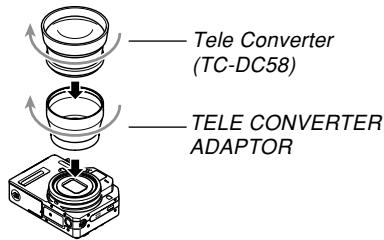
Wide Angle
Focal Distance: 0.7X the focal distance of the camera Canon Wide Converter WC-DC58N
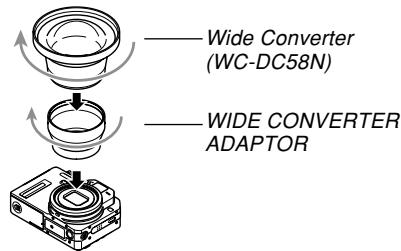
Macro
In the Macro Mode, the allowable distance from the close up lens surface to the subject is 6 cm (2.4") to 25.1 cm (9.9") (when zoom is set to maximum wide angle). Canon Close-up Lens 250D (58mm)
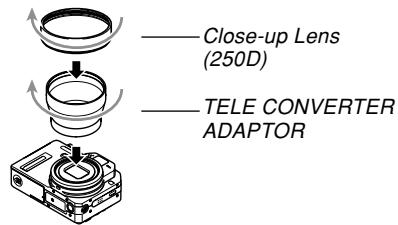
Installing a Conversion Lens or Close-up Lens
A conversion lens provides your camera with telephoto or wide angle capabilities. A close-up lens enables macro photography.
- Turn off the camera, and then remove the lens ring installed on its lens.
- Install either the TELE CONVERTER ADAPTOR or WIDE CONVERTER ADAPTOR on the camera.
- Install a conversion lens or close-up lens on the camera.
IMPORTANT!
- Installing a conversion lens or close-up lens can cause blackening around the edges of the image, which can interfere with proper operation of the camera's phase differential sensor. Before recording an image, be sure to select "Contrast" for the Auto Focus mode. See "Selecting the Auto Focus (AF) Mode" on page 118 for more information.
Conversion Lens and Close-up Lens Precautions
- Be sure to install the TELE CONVERTER ADAPTOR or WIDE CONVERTER ADAPTOR before installing a conversion lens or close-up lens.
- Carefully read the user documentation that comes with the conversion lenses and close-up lens for information about how to use them properly.
- Be sure to use the monitor screen to compose images while a conversion lens or close-up lens is installed on the camera. Do not use the viewfinder, because its image is not changed by the lens you are using. Also, there will be darkening around the edges of the image within the viewfinder.
- Installing a conversion lens or close-up lens can interfere with proper operation of the camera's built-in flash. When using a conversion lens or close-up lens, select Off) for the flash mode or use an external flash (page 132).
- When using a telephoto conversion lens, select Auto Focus as the focus mode (page 74).
- Using optical zoom to select wide angle while a telephoto conversion lens is installed can cause blackening around the edges of the image. Set optical zoom to telephoto (page 62).
- Use of a tripod is recommended to avoid camera movement during recording with a telephoto conversion lens.
- When using a wide angle conversion lens, select Auto Focus or Macro (A) as the focus mode (page 76).
OTHER RECORDING FUNCTIONS
- The wide angle conversion lens may cause distortion of an image.
- When using a close-up lens, be sure to set the focus mode to (Macro mode, page 76). Proper focus of a close-up image is not possible with any other focus mode.
Optical Zoom Precautions
- Optical zoom cannot be performed while a wide angle conversion lens is installed. This is to prevent damage to the wide angle conversion lens by contact with the camera lens as it extends.
IMPORTANT!
- Be sure to reinstall the lens ring on the camera lens when you are not using a conversion lens. Optical zoom is disabled while the lens ring is not installed properly, even if the camera does not have the wide angle conversion lens installed.
Installing a Filter
This camera supports use of commercially available 58mm filters.
IMPORTANT!
- Be sure to install the TELE CONVERTER ADAPTOR before installing a filter. If you attach a filter directly to the lens without the TELE CONVERTER ADAPTOR, the convex surface of the lens will come into contact with the filter and damage it.
- Carefully read the user documentation that comes with filters for information about how to use them properly.
- Keep the following points in mind when purchasing a filter.
Use of a filter can cause blackening around the edges of images.
Use of a filter may interfere with proper operation of Auto Focus and flash.
-
Filters may not deliver the same results as those obtained with a film camera.
-
Do not use multiple filters.
- Use of commercially available lens hood may cause blackening around the edges of images.
PLAYBACK
You can use the camera's built-in monitor screen to view images after you record them.
BasicPlaybackOperation
Use the following procedure to scroll through files stored in the camera's memory.
-
Press the power button to turn on the camera.
-
This causes an image or a message to appear on the monitor screen.
-
Align the mode dial with (PLAY Mode).
-
This enters the PLAY Mode.
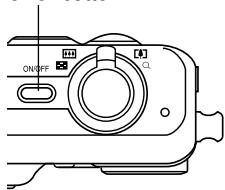
Power button
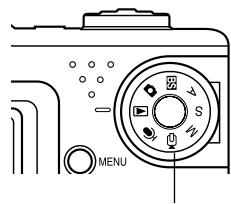
Mode dial
- Use [▶] (forward) or [←] (back) to scroll through files on the monitor screen.
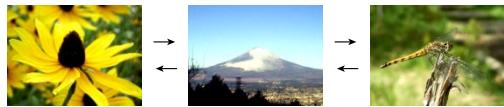
NOTES
- Holding down [▲] or [▶] scrolls images at high speed.
- In order to allow for faster playback image scrolling, the image that initially appears on the monitor screen is a preview image, which is of somewhat lower quality than the actual display image. The actual display image appears a short while after the preview image. This does not apply to images copied from another digital camera.
Playing an Audio Snapshot
Perform the steps below to display an audio snapshot (indicated by a indicator) and play its audio.
1. In the PLAY mode, use [<] and [> ] until the image you want is displayed.
2. Press [SET].
- This plays back the audio that accompanies the displayed image.
- You can perform the following operations while audio is playing.
![CASIO EX-P600 - Press [SET]. - 1](/content/2025/01/86577/images/153232c3e984230bd9f8f3628c1217a1fcbda3d99836fc9ca5feaa3d4edc8d62.jpg)
| To do this: | Do this: |
| Fast forward or fast reverse the audio | Hold down [▲] or [►]. |
| Pause and unpause audio playback | Press [SET]. |
| Adjust audio volume | Press [▲] or [▼]. |
| Cancel playback | Press [MENU]. |
IMPORTANT!
- Audio volume can be adjusted only when playback is being performed or is paused.
Zooming the Display Image
Perform the following procedure to zoom the image currently on the monitor screen up to eight times its normal size.
- In the PLAY mode, use [▲] and [▶] to display the image you want.
-
Shift the zoom controller towards to enlarge the image.
-
This displays an indicator that shows the current zoom factor.
- You can toggle between the zoomed image and normal image by pressing [DISP].
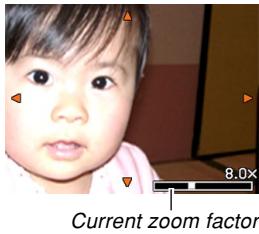
- Use [], [], [] , and [] to shift the image up, down, left, or right.
- Press [MENU] to return the image to its original size.
IMPORTANT!
- You cannot enlarge a movie image.
- Depending on the original size of the recorded image, you may not be able to zoom a display image the full eight times its normal size.
Resizing an Image
You can use the following procedure to change a snapshot image to one of the three sizes.
1600 x 1200-pixel UXGA size
1280 x 960-pixel SXGA size
640 x 480-pixel VGA size
VGA is the optimum image size for attachment to e-mail messages or incorporation into Web pages.
- In the PLAY mode, press [MENU].
- Select the "PLAY" tab, select "Resize", and then press [▶].
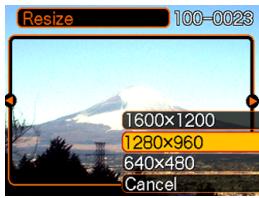
-
Use [] and [] to scroll through images and display the one you want to resize.
-
Use [] and [] to select the setting you want, and then press [SET].
| To do this: | Select this: |
| Resize to 1600 x 1200 pixels (UXGA) | 1600 x 1200 |
| Resize to 1280 x 960 pixels (SXGA) | 1280 x 960 |
| Resize to 640 x 480 pixels (VGA) | 640 x 480 |
| Cancel the resizing operation | Cancel |
IMPORTANT!
- Resizing an image creates a new file that contains the image in the size you select. The file with the original image also remains in memory.
- Images smaller than 640 × 480 pixels cannot be resized.
- An image recorded using the 2816 x 1872 (3:2) pixel size cannot be resized.
Note that you can resize snapshots recorded with this camera only. - If the message "This function is not supported for this file." appears, it means that the current image cannot be resized.
- The resize operation cannot be performed if there is not enough memory to store the resized image.
- When you display a resized image on the camera's monitor screen, the date and time indicates when the image was originally recorded, not when the image was resized.
Cropping an Image
Use the following procedure when you want to crop a portion of an enlarged image and use the remaining part of the image as an e-mail attachment, Web page image, etc.
- In the PLAY mode, use [<] and [> to scroll through images and display the one you want to crop.
- Press [MENU].
-
Select the "PLAY" tab, select "Trimming", and then press [▶].
-
This causes a cropping boundary to appear.
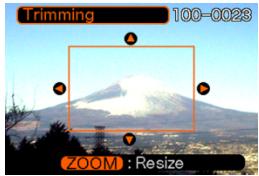
-
Use the zoom controller to make the cropping boundary larger or smaller.
-
The size of the cropping boundary depends on the size of the image on the display.
PLAYBACK
- Use [], [], [], and [] to move the cropping boundary up, down, left, or right until the area of the image you want to extract is within the boundary.
-
Press [SET] to extract the part of the image enclosed in the cropping boundary.
-
If you want to cancel the procedure at any point, press [MENU].
IMPORTANT!
- Cropping an image creates a new file that contains the cropped image. The file with the original image also remains in memory.
- The smaller the image, the more limited is the size of the cropping boundary.
- You cannot resize the cropping boundary for an image that is 640 × 480 pixels.
- An image recorded using the 2816 x 1872 (3:2) pixel size cannot be cropped.
- Movie and voice recording file images cannot be cropped.
- An image recorded using another camera model cannot be cropped.
- If the message "This function is not supported for this file." appears, it means that the current image cannot be cropped.
- The cropping operation cannot be performed if there is not enough memory to store the cropped image.
- When you display a trimmed image on the camera's monitor screen, the date and time indicates when the image was originally recorded, not when the image was trimmed.
Checking the Focus of a Recorded Image
You can use the following procedure to enlarge a recorded image to check its focus.
- In the PLAY mode, use [<] and [▶] to display the image whose focus you want to check.
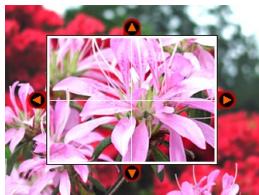
-
Press [PREVIEW].
-
This enlarges the image, and displays it with the point that was focused upon in the center of the monitor screen.
- Use [], [], [], and [] to scroll the image on the monitor screen.
- To return the image to its normal size, press [PREVIEW].
IMPORTANT!
- You can use the above procedure to check the focus of snapshots and audio snapshots only.
- You cannot check the focus of images recorded by any other camera model.
Playing a Movie
Use the following procedure to play back a movie that was recorded in the movie mode.
- In the PLAY mode, press [▲] and [▶] to scroll through images until the movie you want to play is displayed.
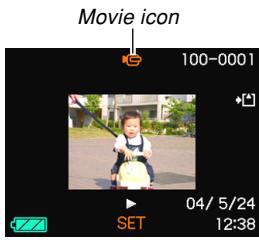
-
Press [SET].
-
This start playback of the movie.
- You can perform the following operations while a movie is playing.
| To do this: | Do this: |
| Fast forward or fast reverse the movie | Hold down [▲] or [►]. |
| Pause and unpause movie playback | Press [SET]. |
| Skip forward or back one frame while paused | Press [▲] or [►]. |
| Cancel playback | Press [MENU]. |
| Adjust audio volume | Press [▲] or [▼]. |
IMPORTANT!
- You cannot repeat play a movie. To play a movie more than once, repeat the steps of the above procedure.
- Audio volume can be adjusted only when playback is being performed or is paused.
Displaying the 9-image View
The following procedure displays nine images on the monitor screen at the same time.
-
In the PLAY mode, shift the zoom controller towards .
-
This displays the 9-image screen with the image that was on the monitor screen in step 2 in the center, with a selection boundary around it.
- is displayed in the 9-image screen to indicate voice recording file images (page 156).
-
When there are nine or fewer images, they are displayed in order with Image 1 in the upper left corner, with the selection boundary around it.
-
Use [], [], [] , and [] to move the selection boundary to the image you want. Pressing [] while the selection boundary is in the right column or [] while it is in the left column scrolls to the next full screen of nine images.
Example: When there are 20 images in memory, and Image 1 is displayed first
| 17 | 18 | 19 |
| 20 | 1 | 2 |
| 3 | 4 | 5 |
| 6 | 7 | 8 |
| 9 | 10 | 11 |
| 12 | 13 | 14 |
- Pressing any button besides [], [], [] , or [] displays the full-size version of the image where the selection boundary is located.
Selecting a Specific Image in the 9-image View
- Display the 9-image view.
- Use [▲], [▼], [▲], and [▶] to move the selection boundary up, down, left, or right until it is located at the image you want to view.
-
Pressing any button besides [], [], [] , or [] displays the selected image.
-
This displays the full-size version of the image you selected.
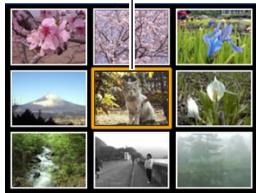
Selection boundary
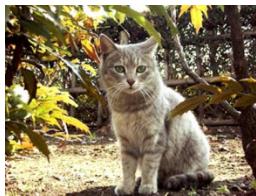
Displaying the Calendar Screen
Use the following procedure to display a 1-month calendar. While the calendar is on the display, you can select a date, which displays the first image recorded on that date. This helps to make it easy to find the images you want.
-
In the PLAY mode, press [4].
-
You can also display the calendar screen by pressing [MENU] in the PLAY mode, selecting "Calendar" on the "PLAY" tab, and then pressing [▶].
-
Use [], [], [], and [] to move the date selection cursor.
-
Use the procedure under "Changing the Date Format" on page 176 to specify the date format.
- The image displayed on the calendar for each date is the first image that was recorded on that date.
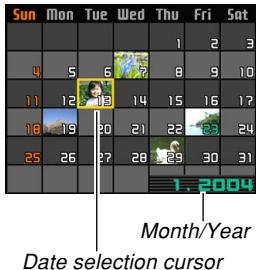
PLAYBACK
- Pressing [▲] while the date selection cursor is located anywhere in the top line of the calendar causes the previous month to appear.
- Pressing [▼] while the date selection cursor is located anywhere in the bottom line of the calendar causes the next month to appear.
- To exit the calendar screen, press [MENU] or [DISP].
- is displayed in the calendar screen to indicate voice recording file images (page 156).
- appears in place of the image when the date contains data that cannot be displayed by this camera.
3. To view the large version of a date's image, move the date selection cursor to the date and then press [SET].
- This displays the first image that was recorded on the selected date.
Playing a Slide Show
Slide Show automatically plays back images in sequence at a fixed interval.
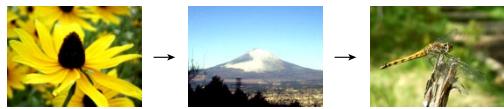
- In the PLAY mode, press [MENU].
- Select the "PLAY" tab, select "Slideshow", and then press [▶].
3. Configure the slideshow settings.
See the pages indicated below for more information.
| For information about configuring this setting: | Go here: |
| Images | “To specify the slideshow images” on page 150 |
| Time | “To specify the slideshow time” on page 151 |
| Interval | “To set the slideshow interval” on page 151 |
| Cancel | To exit the slideshow setting screen and cancel the slideshow, use [▲] and [▼] to select “Cancel” and then press [SET]. |
- Use [] and [] to select "Start", and then press [SET].
This starts the slide show.
-
To stop Slide Show, press [SET].
-
The slideshow will also stop automatically after the amount of time you specified for "Time" elapses.
IMPORTANT!
- Note that all buttons are disabled while an image change is in progress. Wait until an image is stopped on the monitor screen before performing a button operation, or hold down the button until the image stops.
- When the slideshow comes to a movie file, it plays the movie once and advances to the next file.
- When the slideshow comes to a movie or voice recording file, it plays the audio once and then advances to the next file.
- While audio is playing, you can use [▲] and [▼] to adjust the volume level.
- Images copied from another digital camera or a computer may take longer time to appear than the slideshow interval time you specify.
To specify the slideshow images
- Use [] and [] to select "Images", and then press [] .
- Use [] and [] to select the setting you want, and then press [SET].
| To do this: | Select this setting: |
| Include all files in file memory in the slideshow | All images |
| Display a single file | One Image |
| Include all files in the FAVORITE folder (page 163) in the slideshow | Favorites |
-
Use [] and [] to select "Start", and then press [SET].
-
This starts the slideshow.
- The audio of audio snapshot and voice recording files is also played back.
Selecting a Particular Image for a Slideshow
When you select "One image" as the slideshow type, the slide show displays only one image, without changing it.
- Select "One image", and then press [▶].
- Use [<] and [> ] to scroll through the images until the one you want to use is on the monitor screen.
-
Press [SET] to register your selection and return to the menu screen.
-
Pressing [MENU] instead of [SET] returns to the menu screen without registering the setting.
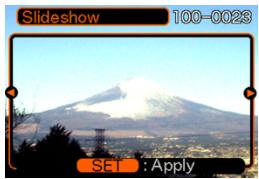
To specify the slideshow time
- Use [] and [] to select "Time".
-
Use [] and [] to specify the time setting you want, and then press [SET].
-
You can specify a time in the range of 1 to 60 minutes.
-
Use [] and [] to select "Start", and then press [SET].
- This starts the slideshow.
To set the slideshow interval
- Use [] and [] to select "Interval".
-
Use [] and [] to specify the interval setting you want, and then press [SET].
-
You can specify "MAX", or a value in the range of 1 to 30 seconds as the interval.
-
When "MAX" is selected for the interval, only the first frame of movie files is played.
-
Use [] and [] to select "Start", and then press [SET].
This starts the slideshow.
Rotating the Display Image
Use the following procedure to rotate the image 90 degrees and register the rotation information along with the image. After you do this, the image is always displayed in its rotated orientation.
- In the PLAY mode, press [MENU].
- Select the "PLAY" tab, select "Rotation", and then press [▶].
- Use [<] and [> to scroll through images until the one you want to rotate is on the monitor screen.
- Use [▲] and [▼] to select "Rotate", and then press [SET].
Each press of [SET] rotates the image 90 degrees.
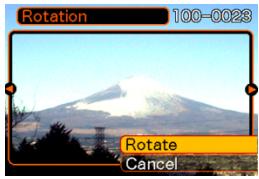
- After you are finished configuring settings, press [MENU] to exit the setting screen.
IMPORTANT!
- You cannot rotate an image that is protected. To rotate such an image, first unprotect it.
- You may not be able to rotate a digital image that was recorded with another type of digital camera.
- You cannot rotate movie or voice record images.
Using Image Roulette
Image Roulette cycles images like a slot machine on the display, before stopping at one of them. When you start an Image Roulette operation, images scroll randomly on the screen. At first, images scroll at high speed. Then the scrolling gradually slows down until a single image is stopped on the screen. The image that finally appears is random, and subject to no rules or system.
-
While the camera is turned off, hold down [4] as you press the power button to turn it on.
-
Keep [▲] held down until images appear on the monitor screen.
-
This starts the Image Roulette operation, scrolling images on the display, finally stopping at one.
-
Press [<] or [▶] to restart the Image Roulette operation.
- To turn off Image Roulette, align the mode dial to enter the REC mode or press the power button to turn off the camera.
IMPORTANT!
- Image Roulette does not play movie files or display voice recording images.
- Image Roulette is disabled when there is only one snapshot image available.
- Note that Image Roulette works only with images recorded with this camera. Image Roulette may not operate properly when other types of images are in memory.
- If you do not start another Image Roulette operation for about one minute after the final image appears, the camera enters its normal PLAY mode.
Adding Audio to a Snapshot
The "after-recording" feature lets you add audio to snapshots after they are recorded. You can also re-record an audio image (one with a icon on it).
- Audio Format: WAVE/ADPCM recording format
This is the Windows standard format for audio recording.
The file extension of a WAVE/ADPCM file is“.WAV”. - Recording Time: Up to about 30 seconds per image
-
Audio File Size: Approximately 120KB (30-second recording of approximately 4KB per second)
-
In the PLAY mode, use [<] and [▶] to scroll through snapshots until the one to which you want to add audio is displayed.
- Press [MENU].
- Select the "PLAY" tab, select "Dubbing", and then press [▶].
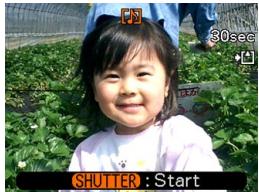
- Press the shutter button to start audio recording.
- Recording stops after about 30 seconds or when you press the shutter button.
To re-record audio
- In the PLAY mode, use [<] and [▶] to scroll through snapshots until the one whose audio you want to re-record is displayed.
- Select the "PLAY" tab, select "Dubbing", and then press [▶].
-
Use [] and [] to select "Delete", and then press [SET].
-
If you merely want to delete the audio with rerecording, press [MENU] here to complete the procedure.
-
Press the shutter button to start audio recording.
-
Recording stops after about 30 seconds or when you press the shutter button.
-
This deletes the previous recording and replaces it with a new one.
IMPORTANT!
- Keep the microphone on the front of the camera pointed at the subject.
Take care that you do not block the microphone with your fingers. - Good recording results are not possible when the camera is too far from the subject.
- Operating camera buttons during recording can cause button noise to be included in the audio.
- The (Audio) icon appears on the monitor screen after audio recording is complete.
- You will not be able to record audio when remaining memory capacity is low.
-
The following types of audio recording are not supported.
-
Adding audio to a movie image
- Adding audio to a protected snapshot (page 162)
- Audio that is re-recorded or deleted cannot be recovered. Make sure you no longer need audio before re-recording or deleting it.
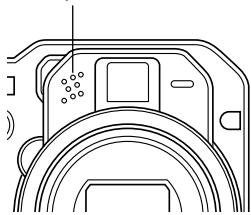
Microphone
Playing Back a Voice Recording File
Perform the following steps to play back a voice recording file.
- In the PLAY mode, use [▲] and [▶] to display the voice file (a file with on it) you want to play.
-
Press [SET].
-
This starts playback of the voice recording file through the camera's speaker.
- You can perform the following operations while audio is playing.
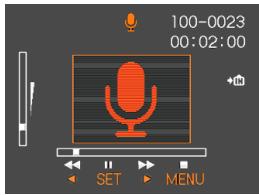
| To do this: | Do this: |
| Fast forward or fast reverse the audio | Hold down [▲] or [►]. |
| Pause and unpause audio playback | Press [SET]. |
| Adjust audio volume | Press [▲] or [▼]. |
| Cancel playback | Press [MENU]. |
IMPORTANT!
- Audio volume can be adjusted only when playback is being performed or is paused.
- If your recording has index marks (page 114) inside it, you can jump to the index mark before or after the current playback location by pausing playback and then pressing [←] or [▶]. Next, press [SET] to resume playback from the index mark position.
Displaying Camera Images on a TV Screen
You can display recorded images on a TV screen and even use a TV screen to compose images before you record them. To display camera images on a TV, you need a television equipped with a video input terminal, and the AV cable that comes with the camera.
1. Connect one end the AV cable that comes with the camera to the camera's [USB/AV] port, and the other end to the video input terminal of the TV.
- Connect the yellow plug of the AV cable to the video input (yellow) terminal of the TV, and the white plug to the TV's audio input (white) terminal.
Note that the audio output is monaural.
![CASIO EX-P600 - Connect one end the AV cable that comes with the camera to the camera's [USB/AV] port, and the other end to the video input terminal of the TV. - 1](/content/2025/01/86577/images/b0cba93fc63144442ab6174c58f218b79660de5a5f2d5a6c6590bb2c03e3553b.jpg)
- Turn on the TV and select its video input mode.
- Now when you perform normal image playback and recording operations on the camera, the applicable image appears on the TV screen.
IMPORTANT!
- All icons and indicators that appear on the monitor screen also appear on the TV screen.
- The camera's monitor screen will go blank during video output.
Selecting the Video Input System
You can select either NTSC or PAL for the video output system to match the system of the TV you are using.
- In the REC mode or PLAY mode, press [MENU].
- Select the "Set Up" tab, select "Video Out", and then press [▶].
- Use [] and [] to select the setting you want, and then press [SET].
| If you are using a TV designed for use in this area: | Select this setting: |
| U.S., Japan, and other areas that use the NTSC system | NTSC |
| Europe and other areas that use the PAL system | PAL |
DELETING FILES
You can delete a single file, or you can delete all files currently in memory.
IMPORTANT!
Note that file deletion cannot be undone. Once you delete a file, it is gone. Make sure you really do not need a file anymore before you delete it. Especially when deleting all files, make sure you check all the files you have stored before proceeding.
- A protected file cannot be deleted. To delete a protected file, unprotect it first (page 162).
- Delete cannot be performed when all the files in memory are protected (page 163).
- Deleting an audio snapshot deletes both the image file and the audio file attached to it.
Deleting a Single File
Perform the following steps when you want to delete a single file.
- In the PLAY mode, press [EX Ⅲ].
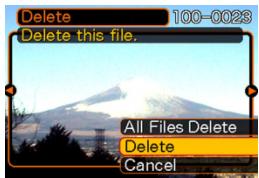
- Use [<] and [> ] to scroll through files and display the one you want to delete.
-
Use [] and [] to select "Delete".
-
To exit the file delete operation without deleting anything, select "Cancel".
- Press [SET] to delete the file.
- Repeat steps 2 through 4 to delete other files, if you want.
- Press [MENU] to exit the menu screen.
DELETING FILES
IMPORTANT!
- If a file cannot be deleted for some reason, the message "This function is not supported for this file." appears when you try to delete it.
Deleting All Files
The following procedure deletes all unprotected files currently in memory.
- In the PLAY mode, press [EX 田].
- Use [] and [] to select "All Files Delete", and then press [SET].
-
Use [] and [] to select "Yes".
-
To exit the file delete operation without deleting anything, select "No".
-
Press [SET] to delete all the files.
- The message "There are no files." appears on the screen after all of the files are deleted.
FILE MANAGEMENT
The file management capabilities of the camera make it easy to keep track of images. You can protect files against deletion and store the files you want in the camera's built-in memory.
Folders
Your camera automatically creates a directory of image storage folders in its built-in Flash memory or on the memory card.
Memory Folders and Files
An image you record is automatically stored in a folder, whose name is a serial number. You can have up to 900 folders in memory at the same time. Folder names are generated as shown below.
Example: Name of the 100th folder.
100CASIO
Serial number (3 digits)
Each folder can hold files numbered up to 9,999.
Trying to store the 10,000th file in a folder causes the next serially numbered folder to be created. Folder names are generated as shown below.
Example: Name of the 26th file
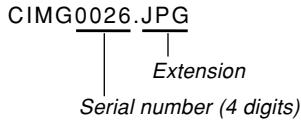
- The actual number of files you will be able to store on a memory card depends on the image size and quality, capacity of the card, etc.
- For details about the directory structure, see "Memory Directory Structure" on page 209.
Protecting Files
Once you protect a file it cannot be deleted (page 159). You can protect files individually or you can protect all files in memory with a single operation.
To protect a single file
- In the PLAY mode, press [MENU].
- Select the "PLAY" tab, select "Protect", and then press [▶].
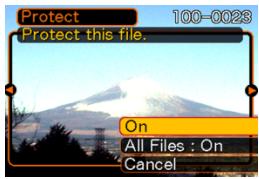
-
Use [] and [] to scroll through files and display the one you want to protect.
-
Use [] and [] to select "On", and then press [SET].
-
A file that is protected is indicated by the mark.
- To unprotect a file, select "Off" in step 4, and then press [SET].
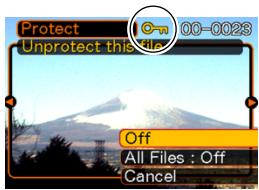
- Press [MENU] to exit the menu screen.
To protect all files in memory
- In the PLAY mode, press [MENU].
- Select the "PLAY" tab, select "Protect", and then press [▶].
-
Use [] and [] to select "All Files: On", and then press [SET].
-
To unprotect all files, press [SET] in step 3 so the setting shows "All Files : Off".
-
Press [MENU] to exit the menu screen.
Using the FAVORITE Folder
You can copy scenery shots, photos of your family, or other special images from a file storage folder (page 209) to the FAVORITE folder in built-in memory (page 209). Images in the FAVORITE folder are not displayed during normal playback, so it helps to keep your personal image private as you carry them around. FAVORITE folder images are not deleted when you change memory cards, so you can always keep them on hand.
To copy a file to the FAVORITE folder
- In the PLAY mode, press [MENU].
- Select the "PLAY" tab, select " Favorites", and then press [▶].
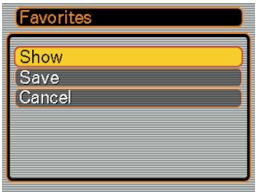
FILE MANAGEMENT
-
Use [] and [] to select "Save", and then press [SET].
-
This displays the names of the files in built-in memory or on the loaded memory card.
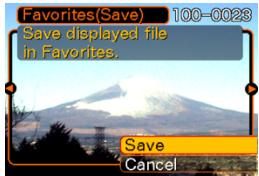
- Use [<] and [> ] to select the file you want to copy to the FAVORITE folder.
- Use [] and [] to select "Save", and then press [SET].
This copies the displayed file to the FAVORITE folder.
- After copying all of the files you want, use [▲] and [▼] to select "Cancel", and then press [SET] to exit.
NOTES
- Copying an image file with the above procedure creates a 320 × 240 -pixel QVGA-size image in the FAVORITE folder.
- A file copied into the FAVORITE folder is automatically assigned a file name that is a serial number. Though the serial number starts from 0001 and can go as high as 9999, the actual upper end of the range depends on built-in memory capacity. Remember that the maximum number of images that can be stored in built-in memory depends on the size of each image and other factors.
IMPORTANT!
Note that an image that has been copied to the FAVORITE folder and then resized cannot be returned to its original size.
- Files in the FAVORITE folder cannot be copied to a memory card.
To display a file in the FAVORITE folder
- In the PLAY mode, press [MENU].
- Select the "PLAY" tab, select "Favorites", and then press [▶].
-
Use [] and [] to select "Show", and then press [SET].
-
If the FAVORITE folder is empty, the message "No Favorites file!" appears.
-
Use [▶] (forward) and [←] (back) to scroll through the files in the FAVORITE folder.
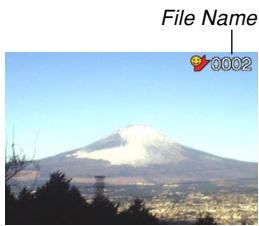
- After you are finished viewing files, press [MENU] twice to exit.
NOTE
- Holding down [▲] or [▶] scrolls images at high speed.
IMPORTANT!
Note that a FAVORITE folder is created in the camera's built-in memory only. No FAVORITE folder is created on a memory card when you use one. If you want to view the contents of the FAVORITE folder on your computer screen, you need to remove the memory card from the camera (if you are using one) before connecting the USB cable and starting data communication (pages 198, 204).
To delete a file from the FAVORITE folder
- In the PLAY mode, press [MENU].
- Select the "PLAY" tab, select "Favorites", and then press [▶].
- Use [] and [] to select "Show", and then press [SET].
- Press [EX Ⅲ].
- Use [<] and [> to select the file you want to delete from the FAVORITE folder.
-
Use [] and [] to select "Delete", and then press [SET].
-
To exit the file delete operation without deleting anything, select "Cancel".
-
After deleting all of the files you want, use [▲] and [▼] to select "Cancel", and then press [SET] to exit.
IMPORTANT!
- You cannot use the delete operations on page 159 to delete images from the FAVORITE folder. Performing the memory format operation (page 180), however, does delete FAVORITE folder files.
To delete all files from the FAVORITE folder
- In the PLAY mode, press [MENU].
- Select the "PLAY" tab, select "Favorites", and then press [▶].
- Use [] and [] to select "Show", and then press [SET].
- Press [EX Ⅲ].
- Use [] and [] to select "All Files Delete", and then press [SET].
IMPORTANT!
- You cannot use the delete operations on page 159 to delete images from the FAVORITE folder. Performing the memory format operation (page 180), however, does delete FAVORITE folder files.
OTHER SETTINGS
Configuring Sound Settings
You can configure different sounds to play whenever you turn on the camera, press the shutter button half-way or all the way, or perform a key operation.
To configure sound settings
- In the REC mode or the PLAY mode, press [MENU].
- Select the "Set Up" tab, select "Sounds", and then press [▶].
- Use [▲] and [▼] to select the sound whose setting you want to configure, and then press [▶].
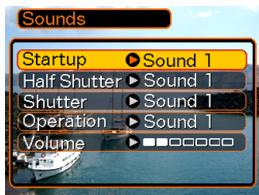
- Use [] and [] to change the setting, and then press [SET].
| To do this: | Select this setting: |
| Select a built-in sound | Sound 1 through Sound 5 |
| Turn off the sound | Off |
NOTE
- The default sound setting for all operations is "Sound 1".
To set the volume level
- In the REC mode or the PLAY mode, press [MENU].
- Select the "Set Up" tab, select "Sounds", and then press [▶].
- Use [] and [] to select "Volume".
-
Use [] and [] to specify the volume setting you want, and then press [SET].
-
You can set the volume in the range of 0 (no sound) to 7 (loudest).
NOTE
- The initial default volume setting is 3.
Specifying an Image for the Startup Screen
You can specify an image you recorded as the startup screen image, which causes it to appear on the monitor screen for about two seconds whenever you turn on the camera in the REC mode.
- In the REC mode or the PLAY mode, press [MENU].
- Select the "Set Up" tab, select "Startup", and then press [▶].
- Use [<] and [> ] to display the image you want to use as the startup image.
- Use [] and [] to change the setting, and then press [SET].
| To do this: | Select this setting: |
| Use the currently displayed image as the startup screen image | On |
| Disable the startup screen | Off |
IMPORTANT!
- You can select any one of the following types of image as the startup image.
The camera's built-in startup image
A snapshot you recorded with the camera
— An audio snapshot you recorded with the camera
- The snapshot image that you select as the startup image is stored in a special memory location called "startup image memory". Only one image can be stored in startup image memory at one time.
Selecting a new startup image overwrites anything that is already stored in startup image memory.
Because of this, if you want to return to a previous startup image, you need to have a separate copy of that image in the camera's standard image memory.
- The startup image is deleted by the format operation (page 180).
- If you store an audio snapshot to startup image memory, the image's audio is not played when the image is displayed at startup.
Configuring Power Down Image Settings
With the Power Down Image feature, you can configure the camera so a specific image stored in camera image memory appears whenever you turn off power. You can specify a snapshot or a movie as the power down image.
To configure power down image settings
- Use the USB cable to connect the camera to your computer (page 198).
-
Move the image data that you want to use for the power down image to the top (root) directory of the camera's built-in Flash memory.
-
The file name extension will not be displayed if your computer is configured to hide file name extensions. Example: CIMG0001
- If there is a memory card loaded in the camera, be sure to copy the image to built-in memory before removing the memory card from the camera.
OTHER SETTINGS
3. Change the name of the file to one of the following.
Snapshot Image: ENDING.JPG
Movie Image: ENDING.AVI
- Input the following file name only (without file name extension) if your computer is configured to hide file name extensions.
File Name: ENDING
- Your camera is now configured to display a power down image. The power down image will appear any time you press the power button to turn off the camera. The power down image appears regardless of whether or not your camera has a memory card loaded in it.
IMPORTANT!
- Only a snapshot (JPEG) or movie (AVI) file can be used as the power down image.
- Note that the Power Down Image feature works only with images recorded with this camera. The Power Down Image feature may not operate properly when another type of image is specified as the power down image.
- Formatting the camera's Flash memory deletes the power down image (page180).
- When both a still image and a movie are present for the power down image, only the movie is used.
- Note that a power down image display operation cannot be interrupted once it starts. Because of this, you should select a relatively short movie when using a movie file as the power down image.
To cancel Power Down Image settings
- Use the USB cable to connect the camera to your computer (page 198).
- Change the name of the current power down image from ENDING.JPG or ENDING.AVI to something else, or delete the current power down image from Flash memory.
Specifying the File Name Serial Number Generation Method
Use the following procedure to specify the method for generating the serial number used for file names (page 161).
- In the REC mode or the PLAY mode, press [MENU].
- Select the "Set Up" tab, select "File No.", and then press [▶].
- Use [] and [] to change the setting, and then press [SET].
| To do this for a newly saved file: | Select this setting: |
| Store the last file number used and increment it, regardless of whether files are deleted or whether the memory card is replaced with a new one | Continue |
| Find the highest file number in the current folder and increment it | Reset |
Using the Alarm
You can configure up to three alarms that cause the camera to beep and display a specified image at the time you specify. Specifying a movie or an audio snapshot plays back the image and the audio at the assigned time. Specifying a voice recording file plays the audio.
To set an alarm
- In the PLAY mode, press [MENU].
- Select the "PLAY" tab, select "Alarm", and then press [▶].
- Use [] and [] to select the alarm whose setting you want to configure, and then press [▶].
-
Use [] and [] to select the setting you want to change, and then use [] and [] to change the selected setting.
-
You can set an alarm time and configure the alarm to sound either once or at the same time everyday. You can also turn the alarm on or off.
-
Press [DISP].
-
You could press [SET] in place of [DISP] if you want to configure the alarm without an image.
-
Use [<] and [▶] to select the scene you want to appear at the alarm time, and then press [SET].
-
After all the settings are the way you want, press [SET].
-
You can configure up to three alarms, named "Alarm 1", "Alarm 2", and "Alarm 3".
OTHER SETTINGS
Stopping the Alarm
When an alarm time is reached while the camera is turned off, the alarm will sound for about one minute (or until you stop it), and then the camera will turn on. To stop the alarm after it starts to sound, press any button.
IMPORTANT!
- Note that the alarm does not sound if the alarm time is reached when any one of the following conditions exists.
While the camera is turned on
While a USB data communication operation is in progress
Setting the Clock
Use the procedures in this section to select a Home Time zone, and to change its date and time settings.
IMPORTANT!
- Make sure you select your Home Time zone (the zone where you are currently located) before changing the time and date settings. Otherwise, the time and date setting will change automatically when you select another time zone.
To select your Home Time zone
- In the REC mode or the PLAY mode, press [MENU].
-
Select the "Set Up" tab, select "World Time", and then press [▶].
-
This displays the current World Time zone.
-
Use [] and [] to select "Home", and then press [] .
OTHER SETTINGS
- Use [] and [] to select "City", and then press [] .
- Use [▲], [▼], [▲], and [▶] to select the geographical area that contains location you want to select as your Home Time zone, and then press [SET].
- Use [▲] and [▼] to select the city you want, and then press [SET].
- After selecting the city you want, press [SET] to register its zone as your Home Time zone.
To set the current time and date
- In the REC mode or the PLAY mode, press [MENU].
- Select the "Set Up" tab, select "Adjust", and then press [▶].
- Set the current date and the time.
| To do this: | Do this: |
| Change the setting at the current cursor location | Press [▲] or [▼]. |
| Move the cursor between settings | Press [←] or [▶]. |
| Toggle between 12-hour and 24-hour timekeeping | Press [DISP]. |
- When all the settings are the way you want, press [SET] to register them and exit the setting screen.
Changing the Date Format
You can select from among three different formats for display of the date.
- In the REC mode or the PLAY mode, press [MENU].
- Select the "Set Up" tab, select "Date Style", and then press [▶].
- Use [] and [] to change the setting, and then press [SET].
Example: December 24, 2004
| To display the date like this: | Select this format: |
| 04/12/24 | YY/MM/DD |
| 24/12/04 | DD/MM/YY |
| 12/24/04 | MM/DD/YY |
Using World Time
You can use the World Time screen to view a time zone that is different from the home time zone when you go on a trip, etc. World Time can display the time in one of 162 cities in 32 time zones.
To display the World Time screen
- In the REC mode or the PLAY mode, press [MENU].
- Select the "Set Up" tab, select "World Time", and then press [▶].
This displays the current World Time zone.
- Use [] and [] to select "World".
| To do this: | Select this: |
| Display the time in your home time zone | Home |
| Display the time in a different time zone | World |
- Press [SET] to exit the setting screen.
To configure World Time settings
- In the REC mode or the PLAY mode, press [MENU].
- Select the "Set Up" tab, select "World Time", and then press [▶].
This displays the current World Time zone.
- Use [] and [] to select "World", and then press [] .
- Use [▲] and [▼] to select "City", and then press [▶].
- Use [], [], [] , and [] to select the geographical area you want, and then press [SET].
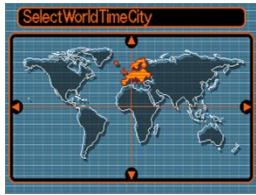
-
Use [▲] and [▼] to select the city you want, and then press [SET].
-
This displays the current time in the city you select.
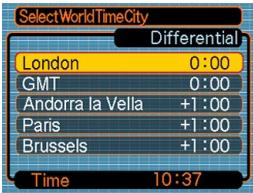
- When the setting is the way you want, press [SET] to apply it and exit the setting screen.
To configure summer time (DST) settings
- In the REC mode or the PLAY mode, press [MENU].
-
Select the "Set Up" tab, select "World Time", and then press [▶].
-
This displays the current World Time Settings.
-
Use [] and [] to select "World", and then press [] .
-
If you want to configure Home Time settings, select "Home" instead.
-
Use [] and [] to select "DST", and then press [] .
- Use [] and [] to select the summer time (DST) setting you want.
| To do this: | Select this: |
| Advance the current time setting by one hour | On |
| Display the current time as-is | Off |
- After the setting is the way you want, press [SET].
- This displays the current time in accordance with your setting.
- Press [SET] again to exit the setting screen.
Changing the Display Language
You can use the following procedure to select one of ten language as the display language.
- In the REC mode or the PLAY mode, press [MENU].
- Select the "Set Up" tab, select "Language", and then press [▶].
- Use [], [], [], and [] to change the setting, and then press [SET].
日本語 :Japanese
English : English
Français : French
Deutsch : German
Espanol : Spanish
Italiano : Italian
Portugues: Portuguese
中国语 : Chinese (Simplified)
Korean
Changing the USB Port Protocol
You can use the procedure below to change the communication protocol of the camera's USB port when connecting to a computer, printer, or other external device. Select the protocol that suits the device to which you are connecting.
- In the REC mode or the PLAY mode, press [MENU].
- Select the "Set Up" tab, select "USB", and then press [▶].
- Use [] and [] to select the setting you want, and then press [SET].
| When connecting to this type of device: | Select this setting: |
| Computer or USB DIRECT-PRINT-compatible printer (page 192) | Mass Storage (USB DIRECT-PRINT) |
| PictBridge-compatible printer (page 192) | PTP (PictBridge)* |
- "PTP" stands for "Picture Transfer Protocol".
OTHER SETTINGS
- PTP (PictBridge) simplifies the transfer of image data to the connected device.
- Mass Storage (USB DIRECT-PRINT) causes the camera to see the computer as an external storage device. Use this setting for normal transfer of images from the camera to a computer (using the bundled Photo Loader application).
Formatting Built-in Memory
Formatting built-in memory deletes any data stored in it.
IMPORTANT!
- Note that data deleted by a format operation cannot be recovered. Check to make sure you do not need any of the data in memory before you format it.
- Formatting built-in memory deletes all files, including files in the FAVORITE folder (page 163), protected files (page 162), and BESTSHOT user setups (page 104).
-
The startup screen image (page 169) and the power down image (page 170) are deleted by formatting memory.
-
Check to make sure there is no memory card loaded in the camera.
-
If there is a memory card loaded in the camera, remove it (page 184).
-
In the REC mode or the PLAY mode, press [MENU].
- Select the "Set Up" tab, select "Format", and then press [▶].
OTHER SETTINGS
4. Use [] and [] to select "Format", and then press [SET].
- To exit the format operation without formatting, select "Cancel".
USING A MEMORY CARD
You can expand the storage capabilities of your camera by using a commercially available memory card (SD memory card or MultiMediaCard). You can also copy files from built-in flash memory to a memory card and from a memory card to flash memory.

- Normally, files are stored in built-in flash memory. When you insert a memory card, however, the camera automatically stores files to the card.
Note that you cannot save files to built-in memory while a memory card is installed in the camera.
IMPORTANT!
- Use only an SD memory card or a MultiMediaCard with this camera. Proper operation is not guaranteed when any other type of card is used.
- See the instructions that come with the memory card for information about how to use it.
- Certain types of cards can slow down processing speeds.
- SD memory cards have a write protect switch, which you can use to protect against accidental deletion of image data. Note, however, if you write protect an SD memory card, you must remove write protection whenever you want to record to it, format it, or delete any of its files.
- Electrostatic charge, electrical noise, and other phenomena can cause data to become corrupted or even lost. Always make sure that you always back up important data on other media (CD-R, CD-RW, MO disc, computer hard disk, etc.)
Using a Memory Card
IMPORTANT!
- Make sure you turn off the camera before inserting or removing a memory card.
- Be sure to orient the card correctly when inserting it. Never try to force a memory card into the slot when you feel resistance.
To insert a memory card into the camera
- While pressing the battery compartment cover on the bottom of the camera, slide the cover in the direction indicated by the arrow, and then swing it open.
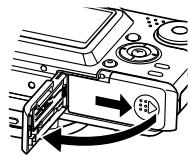
- Positioning the memory card so its front is facing in the same direction as the camera's monitor screen, carefully slide it into the card slot.
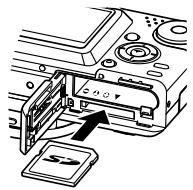
Front
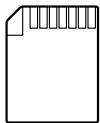
Back
- Swing the battery compartment cover closed, and then slide it in the direction indicated by the arrow.
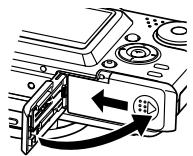
To remove a memory card from the camera
- Press the memory card into the camera and then release it. This will cause the card to come part way out of the camera.
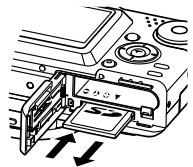
2. Pull the memory card out of the slot.
IMPORTANT!
- Never insert any other object besides a memory card into the camera's card slot. Doing so creates the risk of damage to the camera and card.
- Should water or any foreign object ever get into the card slot, immediately turn off the camera, remove the battery, and contact your dealer or nearest CASIO authorized service center.
- Never remove a card from the camera while the green operation lamp is flashing. Doing so can cause the file save operation to fail, and even damage the memory card.
Formatting a Memory Card
Formatting a memory card deletes any data already stored on it.
IMPORTANT!
- Be sure to use the camera to format a memory card. Formatting a memory card on a computer and then using it in the camera can slow down data processing by the camera. In the case of an SD card, formatting on a computer can result in non-conformity with the SD format, causing problems with compatibility, operation, etc.
- Note that data deleted by a memory card format operation cannot be recovered. Check to make sure you do not need any of the data on the memory card before you format it.
-
Formatting a memory card that contains files deletes all the files, even those that are protected (page 162).
-
Load the memory card into the camera.
- Turn on the camera. Next, enter the REC mode or PLAY mode and press [MENU].
- Select the "Set Up" tab, select "Format", and then press [▶].
-
Use [] and [] to select "Format", and then press [SET].
-
To exit the format operation without formatting, select "Cancel".
Memory Card Precautions
- If a memory card starts to behave abnormally, you can restore normal operation by reformatting it. However, we recommend that you always take along more than one memory card whenever using the camera far away from the home or office.
- We recommend that you format a memory card before using it for the first time after purchasing it, or whenever the card you are using seems to be the cause of abnormal images.
- Before starting a format operation, check to make sure that the battery is fully charged. Power interruption during the format operation can result in improper formatting, and even damage the memory card and make it unusable.
Copying Files
Use the procedures below to copy files between built-in memory and a memory card.
IMPORTANT!
- Only snapshot, movie files, audio snapshot, and voice recording files recorded with this camera can be copied. Other files cannot be copied.
- Files in the FAVORITE folder cannot be copied.
- Copying an audio snapshot copies both the image file and the audio file.
To copy all the files in built-in memory to a memory card
- Load the memory card into the camera.
-
Turn on the camera. Next, enter the PLAY mode and press [MENU].
-
Select the "PLAY" tab, select "Copy", and then press [▶].
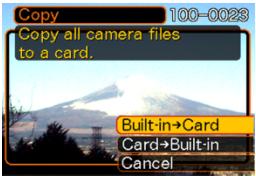
-
Use [] and [] to select "Built-in → Card", and then press [SET].
-
This starts the copy operation and displays the message "Busy.... Please wait...".
- After the copy operation is complete, the monitor screen shows the last file in the folder.
To copy a file from a memory card to built-in memory
With this procedure you can copy one file at a time.
- Perform steps 1 through 3 of the procedure under "To copy all the files in built-in memory to a memory card".
- Use [] and [] to select "Card Built-in", and then press [SET].
- Use [<] and [> to select the file you want to copy.
-
Use [] and [] to select "Copy", and then press [SET].
-
This starts the copy operation and displays the message "Busy.... Please wait...".
- The file reappears on the monitor screen after the copy operation is complete.
-
Repeat steps 3 through 4 to copy other images, if you want.
-
Press [MENU] to exit the copy operation.
NOTE
- Files are copied to the folder in built-in memory whose name has the largest number.
PRINTING IMAGES
A digital camera provides you with a variety of different ways to print the images it records. The three main printing methods are described below. Use the method that best suits your needs.
Professional Print Service
The camera's DPOF feature lets you specify which images you want to print and how many copies of each you want. Then, simply take the memory card to a professional print service where they will print your images in accordance with your specifications. For more information, see "DPOF" (page 189).
■ Printing Directly on a Printer Equipped with a Card Slot, or a Printer that Supports USB DIRECT-PRINT or PictBridge
The camera's DPOF feature lets you specify which images you want to print and how many copies of each you want. Then you can plug the memory card into a printer equipped with a card slot, or connect the camera to a PictBridge or USB DIRECT-PRINT printer for printing. For more information, see "DPOF" (page 189) and "Using PictBridge or USB DIRECT-PRINT" (page 192).
■ Printing with a Computer
Windows Users
The camera comes bundled with Photo Loader and Photohands applications (page 222), which can be installed on a Windows computer for image transfer, management, and printing. For more information, see "Viewing Images on a Computer" (page 198) and "Installing the Software from the CD-ROM" (page 221).
IMPORTANT!
- Refer to the pages referenced above for information about how to connect the camera to a computer. Image management procedures are provided in the following pages of this section.
PRINTING IMAGES
Macintosh Users
The camera comes bundled with Photo Loader for the Macintosh, which can be installed for image transfer and management, but not for printing. Use commercially available software for printing with a Macintosh. For more information, see "Viewing Images on a Computer" (page 198) and "Installing the Software from the CD-ROM" (page 221).
IMPORTANT!
- Refer to the pages referenced above for information about how to connect the camera to a computer. Image management procedures are provided in the following pages of this section.
DPOF
The letters "DPOF" stand for "Digital Print Order Format", which is a format for recording on a memory card or other medium which digital camera images should be printed and how many copies of the image should be printed. Then you can print on a DPOF-compatible printer or at a professional print service in accordance with the file name and number of copies settings recorded on the card.

DPOF
With this camera, you can select images by viewing them on the monitor screen without needing to remember the file name, its location in memory, etc.
DPOF Settings
File Name, number of copies, date
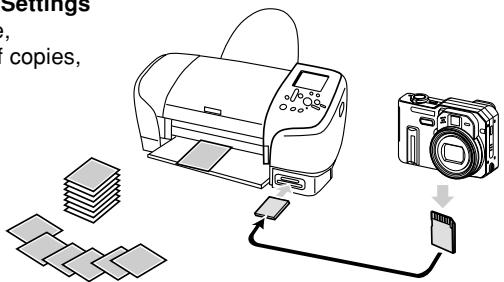
To configure print settings for a single image
- In the PLAY mode, press [MENU].
- Select the "PLAY" tab, select "DPOF", and then press [▶].
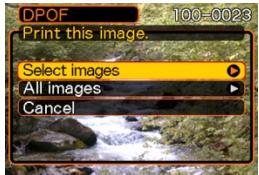
- Use [] and [] to select "Select images", and then press [] .
- Use [<] and [▶] to display the image you want.
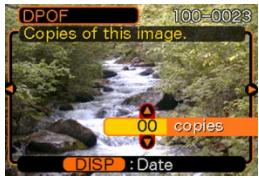
-
Use [] and [] to specify the number of copies.
-
You can specify up to 99 for the number of copies. Specify 00 if you do not want to have the image printed.
-
To turn on date stamping for the prints, press [DISP] so is displayed.
indicates that date stamping is turned on.
- To turn off date stamping for the prints, press [DISP] so 2 is not displayed.
- Repeat steps 4 through 6 if you want to configure other images for printing.
- After all the settings are the way you want, press [SET] to apply them.
To configure print settings for all images
- In the PLAY mode, press [MENU].
- Select the "PLAY" tab, select "DPOF", and then press [▶].
- Use [] and [] to select "All images", and then press [] .
-
Use [▲] and [▼] to specify the number of copies.
-
You can specify up to 99 for the number of copies. Specify 00 if you do not want to have the image printed.
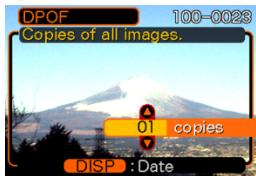
- To turn on date stamping for the prints, press [DISP] so is displayed.
indicates that date stamping is turned on.
- To turn off date stamping for the prints, press [DISP] so is not displayed.
- After all the settings are the way you want, press [SET] to apply them.
IMPORTANT!
- If you take a memory card to a professional print service, be sure to tell them that it includes DPOF settings for the images to be printed and the number of copies. If you don't, they may print all images on the card, including the ones you do not want printed.
- Note that some professional print services do not support DPOF printing. Check with your service before ordering prints.
- Some printers may have settings that disable date stamp and/or DPOF printing. See the user documentation that comes with your printer for details about how to enable these features.
Using PictBridge or USB DIRECT-PRINT
You can connect the camera directly to a printer that supports PictBridge or USB DIRECT-PRINT, and perform image selection and printing using the camera monitor screen and controls. DPOF support (page 189) also lets you specify which images you want to print and how many copies of each should be printed.
- PictBridge is a standard established by the Camera and Imaging Products Association (CIPA).
- USB DIRECT-PRINT is a standard proposed by Seiko Epson Corporation.

PictBridge

IMPORTANT!
- Use of the optional AC adaptor (AD-C40) is recommended when printing with PictBridge or USB DIRECT-PRINT.
To print a single image
- In the REC mode or the PLAY mode, press [MENU].
- Select the "Set Up" tab, select "USB", and then press [▶].
- Use [] and [] to select the setting you want, and then press [SET].
| When connecting to this type of device: | Select this setting: |
| Computer or USB DIRECT-PRINT-compatible printer | Mass Storage (USB DIRECT-PRINT) |
| PictBridge-compatible printer | PTP (PictBridge) |
- Mass Storage (USB DIRECT-PRINT) causes the camera to see the computer as an external storage device. Use this setting for normal transfer of images from the camera to a computer (using the bundled Photo Loader application).
- PTP (PictBridge) simplifies the transfer of image data to the connected device.
4. Connect the optionally available AC adaptor to the camera.
- If you are using battery to power the camera, check to make sure that the battery power level is high enough to support the operation you are about to perform.
Note that the camera does not draw any power over the USB cable.
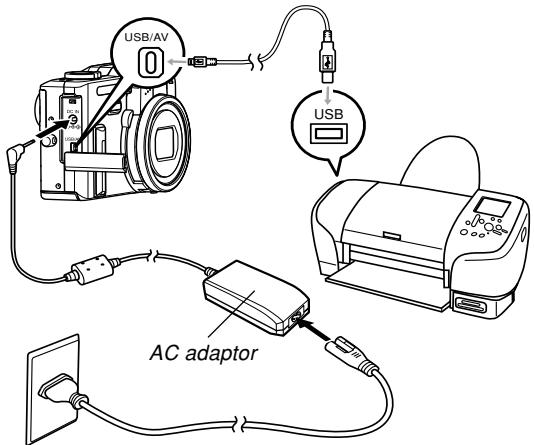
- Use the USB cable that comes with the camera to connect the camera to a printer.
- Load paper for printing the images into the printer.
- Turn on the printer.
This displays the print menu on the camera's monitor screen.
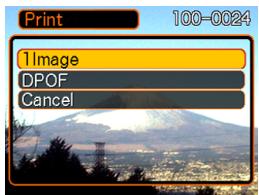
-
On the print menu, use [▲] and [▼] to select "1 Image", and then press [SET].
-
You can use [<] and [>] to select the image you want to print.
- You can toggle date stamping of the image on and off by pressing [DISP]. The icon indicates that date stamping is turned on.
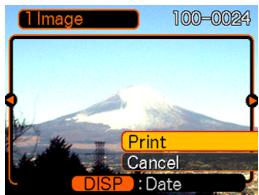
9. On the camera's monitor screen, use [▲] and [▼] to select "Print", and then press [SET].
- This starts printing and displays the message "Busy.... Please wait..." on the monitor screen. The message will disappear after a short while, even though printing is still being performed. Pressing any of the camera's buttons while printing is in progress will cause the message to reappear.
- The print menu will appear when printing is complete.
- To print again, repeat the above from step 8.
10. The camera will turn off automatically when printing is complete. After this happens, disconnect the USB cable from the camera.
To print a group of images
- Use the DPOF procedure on page 189 to specify the images in file memory that you want to print.
- Perform steps 1 through 7 of the procedure under "To print a single image" on page 192.
- On the print menu, use [] and [] to select "DPOF", and then press [SET].
4. On the camera's monitor screen, use [▲] and [▼] to select "Print", and then press [SET].
- This starts printing and displays the message "Busy.... Please wait..." on the monitor screen. The message will disappear after a short while, even though printing is still being performed. Pressing any of the camera's buttons while printing is in progress will cause the message to reappear.
- The print menu will appear when printing is complete.
- This automatically starts printing of the images you specified with the DPOF procedure.
- To print again, repeat the above from step 3.
-
A message appears on the monitor screen, followed by the DPOF setting screen (page 190), if there are no DPOF settings currently configured on the camera to control the printing operation. If this happens, configure the required DPOF settings and then perform step 6 of the above procedure again.
-
The camera will turn off automatically when printing is complete. After this happens, disconnect the USB cable from the camera.
Printing Precautions
- See the documentation that comes with your printer for information about print quality and paper settings.
- Contact your printer manufacturer for information about models that support PictBridge and USB DIRECT-PRINT, upgrades, etc.
- Never disconnect the USB cable, or perform any camera operation while printing is in progress. Doing so causes a printer error.
PRINT Image Matching II
Images include PRINT Image Matching II data (mode setting and other camera setup information). A printer that supports PRINT Image Matching II reads this data and adjusts the printed image accordingly, so your images come out just the way you intended when you recorded them.
- Seiko Epson Corporation holds the copyright for PRINT Image Matching and PRINT Image Matching II.

Exif Print
Exif Print is an internationally supported, open standard file format that makes it possible to capture and display vibrant digital images with accurate colors. With Exif 2.2, files include a wide range of shooting condition information that can be interpreted by an Exif Print printer to produce better-looking prints.
IMPORTANT!
- Information about the availability of Exif Print compatible printer models can be obtained from each printer manufacturer.

VIEWING IMAGES ON A COMPUTER
After using the USB cable to establish a USB connection between the camera and your computer, you can use your computer to view images in file memory and copy images to your computer's hard disk or other storage media. In order to do this, you first need to install the USB driver located on the CD-ROM that comes bundled with the camera onto your computer.
Note that the procedure you need to perform depends on whether you are using computer running under Windows (see below) or a Macintosh (see page 204).
Using the Camera with a Windows Computer
The following are the general steps for viewing and copying files from a computer running under Windows. You can find details about each operation in the procedures that follow below. Note that you should also refer to the documentation that comes with your computer for other information about USB connections, etc.
-
If you are running Windows 98, Me, or 2000, install the USB driver onto your computer.
-
You need to perform this step only once, the first time you connect to your computer.
- If you are running Windows XP, you do not need to install the USB driver.

- Use the USB cable to establish a connection between the camera and computer.

- View and copy the images you want.
IMPORTANT!
- If you want to transfer files from the camera's built-in memory to a computer, make sure there is no memory card loaded in the camera before you connect the USB cable.
- If battery goes low while you are not using the AC adaptor, data communication may stop and the camera may shut down. Use of the special AC adaptor is recommended to power the camera during data communication.
Do not try to establish a connection between the camera and computer before installing the USB driver onto the computer. If you do, the computer will not be able to recognize the camera.
- USB driver installation is required in the case of Windows 98, Me, and 2000. Do not connect the camera to a computer running one of the above operating systems without installing the USB driver first.
-
USB driver installation is not required in the case of Windows XP.
-
What you should do first depends on whether your computer is running under Windows 98/ Me/2000 or Windows XP.
Windows 98/Me/2000 Users
- Start from step 2 to install the USB driver.
Note that the example installation presented here uses Windows 98.
Windows XP Users
-
Installation of the USB driver is not required, so jump directly to step 6.
-
Set the bundled CD-ROM (CASIO Digital Camera Software) into the CD-ROM drive of your computer.
- On the menu screen that appears, click "English".
-
Click [USB driver] and then [Install].
-
This starts installation.
-
The following steps show installation under the English version of Windows.
-
On the screen that appears after installation is complete, select the "Yes, I want to restart my computer now." check box and then click [Finish] to restart your computer.
-
Connect the optional AC adaptor to the [DC IN] connector of the camera, and then plug it in to a household power outlet.
-
If you are using battery to power the camera, check to make sure that the battery power level is high enough to support the operation you are about to perform.
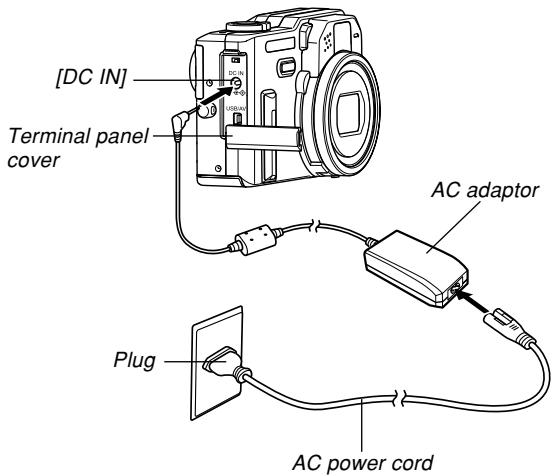
7. Turn on the camera.
-
It makes no difference whether the camera is in the REC mode or PLAY mode.
-
Select the "Set Up" tab, select "USB", and then press [▶].
- Use [] and [] to select "Mass Storage (USB DIRECT-PRINT)", and then press [SET].
- Connect the USB cable that comes bundled with the camera to the camera's [USB/AV] port and your computer's USB port.
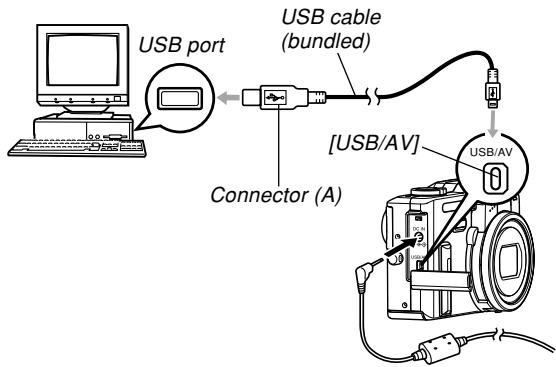
- This will cause the "New Hardware..." dialog box to appear on the computer screen as the computer automatically detects the camera's file memory. After you install the USB driver, "New Hardware..." dialog box will no longer appear when you perform the above steps to establish a USB connection.
- The camera's green operation lamp lights (page 233).
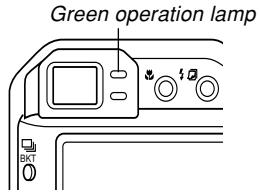
- At this point, some operating systems will display a "Removable Disk" dialog box. If your operating system does, close the dialog box.
- Take care when connecting the USB cable to the camera or your computer. USB ports and cable plugs are shaped for proper positioning.
- Plug the USB cable plugs into the ports securely, as far as they will go. Proper operation is not possible if connections are not correct.
VIEWING IMAGES ON A COMPUTER
-
On your computer, double-click "My Computer".
-
If you are running Windows XP, click [Start] and then [My Computer].
-
Double-click "Removable Disk".
-
Your computer sees the camera's file memory as a removable disk.
-
Double-click the "Dcim" folder.
- Double-click the folder that contains the image you want.
-
Double-click the file that contains the image you want to view.
-
For information about file names, see "Memory Directory Structure" on page 209.
-
Depending on your operating system, perform one of the following procedures to save the files, if you want.
Windows 98, 2000, Me
- In the camera's file memory (Removable Disk), right-click the "Dcim" folder.
- On the shortcut menu that appears, click [Copy].
- Double click [My Documents] to open it.
-
On the My Documents [Edit] menu, click [Paste].
-
This copies the "Dcim" folder (which contains the image files) to your "My Documents" folder.
Windows XP
- In the camera's file memory (Removable Disk), right-click the "Dcim" folder.
- On the shortcut menu that appears, click [Copy].
- Click [Start] and then [My Documents].
- On the My Documents [Edit] menu, click [Paste].
- This copies the "Dcim" folder (which contains the image files) to your "My Documents" folder.
IMPORTANT!
- Never use your computer to edit, delete, move, or rename images stored in file memory. Doing so can cause problems with the image management data used by the camera, which may make it impossible to display images on the camera or it may cause a large error in the number of images value displayed by the camera. Always copy images to your computer memory before performing any edit, delete, move, or rename operation.
17. Depending on the version of Windows you are running, use one of the following procedures to terminate the USB connection.
Windows Me/98/XP Users
- Press the camera's power button. After making sure that the camera's green operation lamp is not lit, disconnect the camera from the computer.
Windows 2000 Users
- Click card services in the task tray on your computer screen, and disable the drive number assigned to the camera. Next, disconnect the USB cable from the camera, and then turn off the camera.
USB Connection Precautions
- Do not leave the same image displayed on your computer screen for a long time. Doing so can cause the image to "burn in" on the screen.
- Never disconnect the USB cable, or perform any camera operation while data communication is in progress. Doing so can cause data to become corrupted.
Using the Camera with a Macintosh Computer
The following are the general steps for viewing and copying files from a Macintosh.
You can find details about each operation in the procedures that follow below. Note that you should also refer to the documentation that comes with your Macintosh for other information about USB connections, etc.
IMPORTANT!
-
This camera does not support operation with a computer running Mac OS 8.6 or lower, or Mac OS X 10.0. If you have a Macintosh running Mac OS 9 or OS X (10.1, 10.2 or higher), use the standard USB driver that comes with your OS.
-
Use the USB cable to establish a connection between the camera and your Macintosh.
- View and copy the images you want.
IMPORTANT!
- Low battery power can cause the camera to power down suddenly during data communication. Use the optional AC adaptor is recommended to power the camera during data communication with a computer.
-
If you want to transfer files from the camera's built-in memory to a computer, make sure there is no memory card loaded in the camera before you connect the USB cable.
-
Connect the optional AC adaptor to the [DC IN] connector of the camera, and then plug it in to a household power outlet.
-
If you are using battery to power the camera, check to make sure that the battery power level is high enough to support the operation you are about to perform.
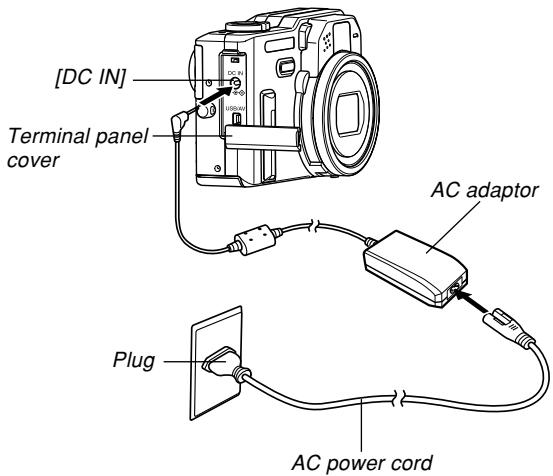
-
Turn on the camera.
-
It makes no difference whether the camera is in the REC mode or PLAY mode.
- Select the "Set Up" tab, select "USB", and then press [▶].
- Use [▲] and [▼] to select "Mass Storage (USB DIRECT-PRINT)", and then press [SET].
- Connect the USB cable that comes bundled with the camera to the camera's [USB/AV] port and your computer's USB port.
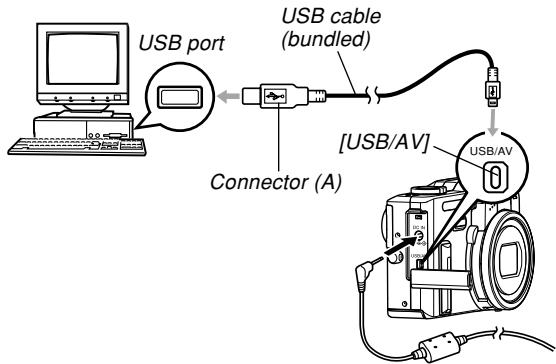
VIEWING IMAGES ON A COMPUTER
- Take care when connecting the USB cable to the camera or your computer. USB ports and cable plugs are shaped for proper positioning.
- Plug the USB cable plugs into the ports securely, as far as they will go. Proper operation is not possible if connections are not correct.
6. Your Macintosh will see the camera's file memory as a drive.
- The appearance of the drive icon depends on the Mac OS version you are using.
- After installing the USB driver, your Macintosh will see the camera's file memory as a drive whenever you establish a USB connection between them.
7. Double-click the drive icon for the camera's file memory, the "DCIM" folder, and then the folder that contains the image you want.
8. Double-click the file that contains the image you want to view.
- For information about file names, see "Memory Directory Structure" on page 209.
9. To copy all the files in file memory to your Macintosh hard disk, drag the "DCIM" folder to the folder to which you want to copy it.
IMPORTANT!
- Never use your computer to edit, delete, move, or rename images stored in file memory. Doing so can cause problems with the image management data used by the camera, which may make it impossible to display images on the camera or it may cause a large error in the number of images value displayed by the camera. Always copy images to your computer memory before performing any edit, delete, move, or rename operation.
10. To terminate the USB connection, drag the drive icon that represents the camera toTrash. Next, disconnect the USB cable from the camera, and then turn off the camera.
USB Connection Precautions
- Do not leave the same image displayed on your computer screen for a long time. Doing so can cause the image to "burn in" on the screen.
- Never disconnect the USB cable, or perform any camera operation while data communication is in progress. Doing so can cause data to become corrupted.
Operations You Can Perform from Your Computer
The following are the operations you can perform while there is a USB connection between your camera and computer. See the referenced pages for more information about each operation.
View images in album format .. See "Using the Album Feature" on page 213.
- Print images in album format
.... See "Using the Album Feature" on page 213.
- Automatically transfer images to your computer and manage images
- See "Installing the Software from the CD-ROM" on page 221 for information about installing Photo Loader.
- Retouch images
.... See "Installing the Software from the CD-ROM" on page 221 for information about installing Photohands.
Using a Memory Card to Transfer Images to a Computer
The procedures in this section describe how to transfer images from the camera to your computer using a memory card.
Using a Computer with a Built-in SD Memory Card Slot Insert the SD memory card directly into the slot.
Using a Computer with a Built-in PC Card Slot
Use a commercially available PC card adapter (for an SD memory card/MMC). For full details, see the user documentation that comes with the PC card adapter and your computer.
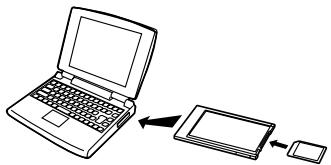
Using a Commercially Available SD Memory Card Reader/Writer
See the user documentation that comes with the SD memory card reader/writer for details about how to use it.
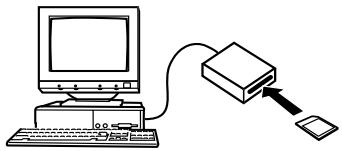
Using a Commercially Available PC Card Reader/Writer and PC Card Adapter (for SD Memory Cards and MMCs)
See the user documentation that comes with the PC card reader/writer and PC card adapter (for an SD memory card/ MMC) for details about how to use them.
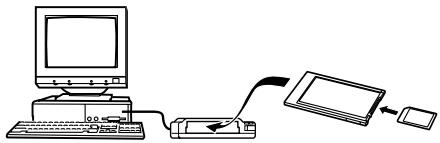
Memory Data
Images recorded with this camera and other data are stored in memory using DCF (Design rule for Camera File System) protocol. DCF protocol is designed to make it easier to exchange image and other data between digital cameras and other devices.
DCF Protocol
DCF devices (digital cameras, printers, etc.) can exchange images with each other. DCF protocol defines camera format for image file data and the directory structure for file memory, so images can be viewed using another manufacturer's DCF camera or printed on a DCF printer.
Memory Directory Structure
■ Directory Structure
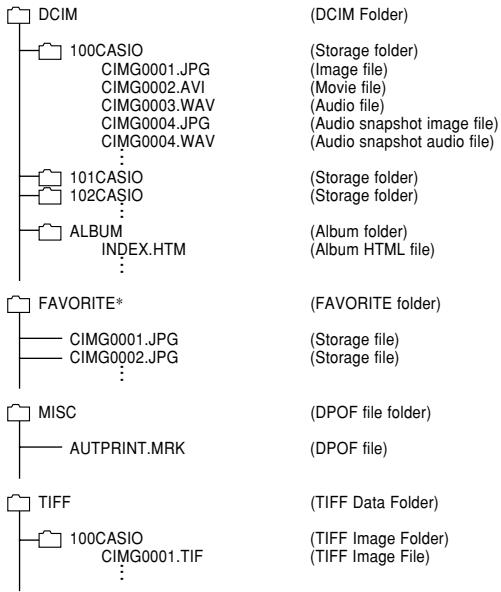
VIEWING IMAGES ON A COMPUTER
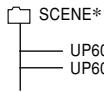
(BESTSHOT folder)
(User setup file)
(User setup file)
- These folders are created in built-in memory only.
Folder and File Contents
- DCIM folder
Folder that stores all of the digital camera files
- Storage folder
Folder for storing files created by the digital camera
- Image file
File that contains an image recorded with the digital camera (File Name Extension: JPG)
- Movie file
File that contains a movie recorded with the digital camera (File Name Extension: AVI)
Audio file
File that contains an audio recording (File Name Extension: WAV).
Audio snapshot image file
File that contains the image part of an audio snapshot (File Name Extension: JPG).
Audio snapshot audio file
File that contains the audio part of an audio snapshot (File Name Extension: WAV).
- Album folder
Folder that contains files used by the album function
- Album HTML file
File used by the album function
(File Name Extension: HTM)
VIEWING IMAGES ON A COMPUTER
- FAVORITE folder Folder that contains Favorites image files (Image Size: 320 x 240 pixels)
- DPOF file folder Folder that contains DPOF files
- TIFF Data Folder
- Folder that contains All TIFF format image related files
TIFF Image Folder Folder that contains TIFF format image files
TIFF Image File File that contains a TIFF format image (File Name Extension: TIF). - BESTSHOT folder (Built-in memory only)
Folder that contains BESTSHOT user setup files. - User setup files (Built-in memory only)
Files that contain BESTSHOT user setups
Image Files Supported by the Camera
- Image files recorded with this camera
- DCF protocol image files
Certain DCF functions may not be supported. When displaying an image recorded on another camera model, it may take a long time for the image to appear on the display.
Built-in Memory and Memory Card Precautions
- Note that the folder named "DCIM" is the parent (top) folder of all the files in memory. When transferring memory contents to a hard disk, CD-R, MO disk, or other external storage, treat all the contents inside a DCIM folder as a set and always keep them together. You can change the name of the DCIM folder on your computer. Changing the name to a date is a good way to keep track of multiple DCIM folders. However, if you even want to copy the folders back to the camera's file memory, be sure you change the name of the DCIM folder back to "DCIM" first. The camera does not recognize any folder name other than DCIM.
USING THE CAMERA WITH A COMPUTER
The album feature of the camera creates files that make it possible for you to view images on your computer in a photo album layout. You can also use the applications contained on the CD-ROM that comes bundled with the camera to automate image transfer and to retouch images.
Using the Album Feature
The album feature creates an HTML photo album layout that displays your images. You can use the HTML layout to post your images on a Web page, or for printing the images.
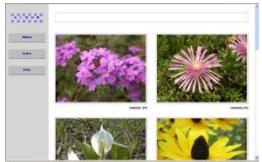
Album
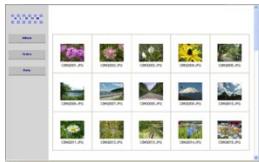
Index
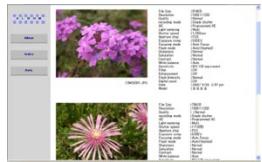
Info
- You can use the Web browser shown below to view or print the contents of an album. Note that to view a movie on a computer running Windows 2000 or 98, you need to install DirectX.
Microsoft Internet Explorer Ver 5.5 or later
Creating an album

IMPORTANT!

- Remember that creating an "ALBUM" folder (page 209) causes different size versions of each image to be created in memory. If there is an "ALBUM" folder in image memory when you specify printing of all images by a professional print service or on a printer, you may end up with unwanted multiple prints of the same image. To avoid this problem, use the procedure under "To delete an album" on page 221 to delete the ALBUM folder.
1. In the PLAY mode, press [MENU].
- Select the "PLAY" tab, select "Create Album", and then press [▶].
![CASIO EX-P600 - In the PLAY mode, press [MENU]. - 1](/content/2025/01/86577/images/abae0694329af43d6c5abe5c8b46b0121083431f5ba8652cc7143da0308dbe1f.jpg)
Sample layout
3. Use [] and [] to select "Create", and then press [SET].
- This starts creation of the album, and causes the message "Busy.... Please wait...". to appear on the monitor screen.
- The PLAY mode screen reappears after creation of the album is complete.
- Creating an album causes a file folder named "ALBUM", which contains a file named "INDEX.HTM" plus other files to be created in camera memory or on the memory card.
IMPORTANT!
- Never open the battery compartment cover or remove the memory card from the camera while an album is being created. Doing so not only runs the risk of certain album files being skipped, it can also result in image data and other data in memory being corrupted.
- If memory becomes full while an album is being created, the message "Memory Full" appears on the monitor screen and album creation is terminated.
- Album creation will not be performed properly if the battery goes dead while album creation is in progress.
- You can also configure the camera to create albums automatically (page 217). However, performing the above procedure creates an album regardless of whether automatic album creation is turned on or off.
- Images in the "ALBUM" folder (page 209) cannot be viewed on the camera's monitor screen.
Selecting an Album Layout
You can select from among 10 different display layouts for an album.
- In the PLAY mode, press [MENU].
- Select the "PLAY" tab, select "Create Album", and then press [▶].
- Use [] and [] to select "Layout".
-
Use [] and [] to select the layout you want.
-
Changing the layout causes the layout sample on the right side of the screen to change.
IMPORTANT!
- The sample layout shows the arrangement of items and the background color. It does not show whether the layout uses a list view or detailed view, or the current Image Type setting.
Configuring Detailed Album Settings
- In the PLAY mode, press [MENU].
- Select the "PLAY" tab, select "Create Album", and then press [▶].
- Use [] and [] to select "Set Up", and then press [] .
-
Use [▲] and [▼] to select the item whose setting you want to change, and then press [▶].
-
Details about each of the settings are provided in the following sections.
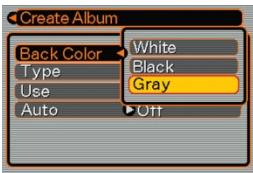
- Use [] and [] to change the setting, and then press [SET].
USING THE CAMERA WITH A COMPUTER
Background Color
You can specify white, black, or gray as the color of the album background using the procedure under "Configuring Detailed Album Settings".
■ Album Type
There are two album types: "Normal" and "Index/Info".
"Normal" Type : This type of album displays images in accordance with the currently selected layout.
"Index/Info" Type: In addition to the normal album screen, this type of album also includes thumbnails of images and detailed information about each image.
Image Use
This setting lets you select from among three different image uses, as described below. Select the image use that best suits the way you plan to use the image.
| For this purpose: | Select this setting: |
| Smaller images for album browsing, Website thumbnails, or archiving on a CD-R or other media, with the full-size image displayed when a thumbnail is clicked ·This setting can be used for browsing with the thumbnails. Clicking a thumbnail displays a larger version for viewing or printing. | View |
| Small image files only for album browsing, or uploading to a Website, etc. ·This option displays only the small-file images (located in the camera's “ALBUM” folder). Smaller files upload to the Internet faster. ·You cannot enlarge images by clicking a thumbnail or play movies while this image is selected. | WEB |
| Printing (high resolution) ·High-resolution images take longer to display on your computer screen. ·You cannot enlarge images by clicking a thumbnail or play movies while this image is selected. |
USING THE CAMERA WITH A COMPUTER
Auto Album Creation On/Off
This setting controls whether an album is created automatically whenever you turn off the camera.
| To do this: | Select this option: |
| Turn on auto album creation | On |
| Turn off auto album creation | Off |
- When auto album creation is turned on, an album is created automatically in built-in memory or on the memory card whenever you turn off the camera.
IMPORTANT!
- When you turn off the camera while auto album creation is turned on, the monitor screen turns off, but the green operation lamp continues to flash for a few seconds to indicate that the album creation process is being performed. Never open the battery compartment cover or remove the memory card while the green operation lamp is flashing.
NOTE
- Depending on the number of images in memory, it can take quite a bit of time to complete auto album creation when you turn off the camera. If you do not plan to use the album feature, we suggest that you keep auto album creation turned off, which shortens the amount of time the camera takes to power down completely.
Viewing Album Files
You can view and print album files using your computer's Web browser application.
- Use your computer to access the data in built-in memory or on the memory card, or access a memory card with your computer (pages 198, 208).
- Open the built-in memory "ALBUM" folder or the memory card "ALBUM" folder, which is located inside the folder named "DCIM".
-
Use your computer's Web browser to open the file named "INDEX.HTM".
-
This displays a list of folders in built-in memory or on the memory card.
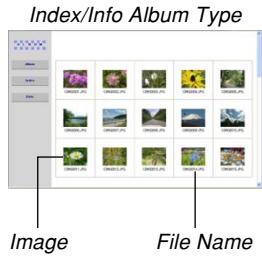
- If you created the album after selecting "Index/Info" as the album type under "Configuring Detailed Album Settings" on page 215, you can click one of the following display options.
Album : Displays an album created by the camera.
Index : Displays a list of images stored in a folder.
Info : Displays information about each image.
- If "View" is selected for "Use" (page 216), you can double-click an image on your computer screen to display the full-size version.
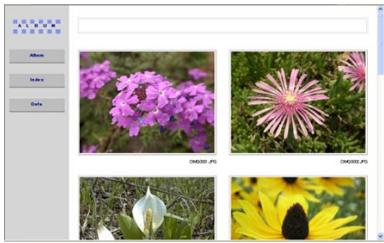
Album
USING THE CAMERA WITH A COMPUTER
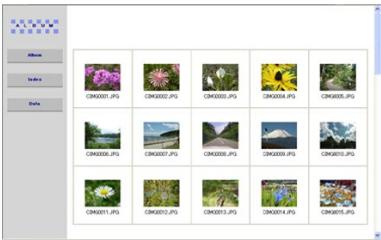
Index
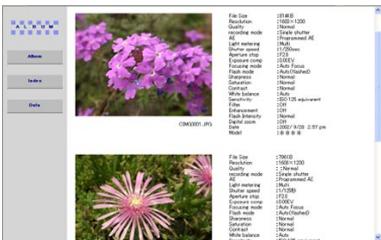
Info
- The following describes the information that appears on the Info Screen.
| This Info Screen item: | Shows this: |
| File Size | Image file size |
| Resolution | Resolution |
| Quality | Quality |
| Recording mode | Recording mode |
| AE | Exposure mode |
| Drive mode | Drive mode |
| Light metering | Metering mode |
| Shutter speed | Shutter speed |
| Aperture stop | Aperture stop |
| Exposure comp | EV shift |
| Focusing mode | Focusing mode |
| AF Area | Auto Focus area |
| Flash mode | Flash mode |
| Sharpness | Sharpness |
| Saturation | Saturation |
| Contrast | Contrast |
| White balance | White balance |
| Sensitivity | Sensitivity |
| Filter | Filter setting |
| Enhancement | Enhancement setting |
| Flash intensity | Flash intensity |
USING THE CAMERA WITH A COMPUTER
| This Info Screen item: | Shows this: |
| Digital zoom | Digital zoom setting |
| World | Location |
| Date | Recording date and time |
| Model | Camera model name |
NOTES
- When printing an album page, you should set up your Web browser as described below.
- Select the browser frame where the images are located.
Set margins to the lowest possible values.
Set the background color to a printable color. - See the user documentation that came with your Web browser application for details about printing and configuring settings for printing.
-
Album contents (titles, comments, etc.) cannot be edited on the camera. Use a commercially available HTML file editor to edit album contents.
-
After you are finished viewing the album, exit your Web browser application.
Saving an Album
- To save an album, copy the "DCIM" folder from camera memory or the memory card to your computer's hard disk, a CD-R, an MO disk, or some other storage medium. Note that copying only the "ALBUM" folder, does not copy image data and other necessary files.
- After copying the "DCIM" folder, do not change or delete any of the files inside of it. Adding new images or deleting existing images may lead to abnormal album display.
- If you plan to use a memory card again after saving its album, first delete all of its files or format it before loading it into the camera.
- When you have "WEB" selected for the "Use" setting, the album shows only the smaller image files stored in the "ALBUM" folder. Such images can be uploaded to the Internet more quickly.
To delete an album
- In the PLAY mode, press [MENU].
- Select the "PLAY" tab, select "Create Album", and then press [▶].
-
Use [] and [] to select "Delete", and then press [SET].
-
This deletes the album and returns to the PLAY mode screen.
Installing the Software from the CD-ROM
Your digital camera comes bundled with useful applications for using it in combination with a computer. Install the applications you need on your computer.
About the bundled CD-ROM (CASIO Digital Camera Software)
The CD-ROM (CASIO Digital Camera Software) that comes bundled with the camera contains the applications described below. Installation of these applications is optional, and you should install only the ones you want to use.
USB Driver for Mass Storage (for Windows)
This is the software that makes it possible for the camera to "talk" to your personal computer over a USB connection. If you are using Windows XP, do not install the USB driver from the CD-ROM. With these operating systems, you will be able to perform USB communication simply by connecting the camera to your computer with the USB cable.
Photo Loader (for Windows/Macintosh)
This application automatically transfers image, audio snapshot, and voice recording WAV files from the camera to your computer. Photo Loader automatically stores transferred files in folders named using the current date (year, month, day) and generates HTML files that make it possible to view images using a web browser. Photo Loader (Windows version only) also includes a feature that simplifies the task of attaching images to e-mail.
- See the user documentation file (PDF) on the bundled "CASIO Digital Camera Software" CD-ROM for details about using Photo Loader.
Photohands (for Windows)
Photohands includes retouching tools for adjusting image color, contrast, and brightness, for resizing images, for changing image orientation, and for cropping images. You can also use Photohands for printing images and for adding a date stamp to printed images.
- See the user documentation file (PDF) on the bundled "CASIO Digital Camera Software" CD-ROM for details about using Photohands.
DirectX (for Windows)
This software provides an extended tool set including a codec that allows Windows 98 and 2000 to handle movie files recorded using a digital camera. You do not need to install DirectX if you are running Windows XP or Me.
Acrobat Reader (for Windows)
This is an application that lets you read PDF files. Use it to read the user documentation for the camera, Photo Loader, and Photohands, all of which is included on the bundled CD-ROM.
- See the user documentation files (PDF) on the bundled CD-ROM for details about using Photo Loader and Photohands. See "Viewing User Documentation (PDF files)" on page 226 (Windows) and page 228 (Macintosh) of this manual for more information.
Computer System Requirements
Computer system requirements depend on each of the applications, as described below.
Windows
| USB Driver*1 | Photo Loader | Photohands | |
| OS | XP*2/2000/Me/98 | XP/2000/Me/98 | XP/2000/Me/98 |
| CPU | 486 or higher(Pentium recommended) | 486 or higher(Pentium recommended) | Pentium or higher |
| Memory | - | At least 16MB | At least 64MB |
| HD | - | At least 7MB | At least 10MB |
1 In the case of Windows 2000, you install a data file that enables use of the operating system's standard USB driver. You do not install a special USB driver. Proper operation is not guaranteed on a computer that has been upgraded from Windows 95 or 3.1 to Windows Me or 98, or from Windows 95 or NT to Windows 2000.
2 With Windows XP, use the USB driver that comes with the operating system. You do not need to install the USB driver that comes with the camera.
Macintosh
| Photo Loader | |
| OS | 9 |
| CPU | Power PC |
| Memory | At least 32MB |
| HD | At least 3MB |
- USB connection is supported on a Macintosh running OS 9, 10.1, or 10.2. Operation is supported using the standard USB driver that comes with the operating system, so all you need to do is connect the camera to your Macintosh using the USB cable.
IMPORTANT!
- For details about Windows minimum system requirements, see the "Readme" file on the CD-ROM (CASIO Digital Camera Software) that comes bundled with the camera.
- For details about Macintosh minimum system requirements, use a Web browser application to read the contents of the "readme" file on the CD-ROM (CASIO Digital Camera Software) that comes bundled with the camera.
- The software on the CD-ROM (CASIO Digital Camera Software) that comes bundled with the camera does not support operation under Mac OS X (10.0).
Installing Software from the CD-ROM in Windows
Use the procedures in this section to install the software from the bundled CD-ROM (CASIO Digital Camera Software) to your computer.
NOTE
- If you already have one of the bundled applications installed on your computer, check its version. If the bundled version is newer than the one you have, you should install the newer version.
The CD-ROM (CASIO Digital Camera Software) includes the software and user documentation for various languages. Check the CD-ROM menu screen to see if applications and user documentation are available for a particular language.
Getting Started
Start up your computer and insert the CD-ROM into its CD-ROM drive. This will automatically launch the menu application, which displays a menu screen on your computer.
- The menu application may not start up automatically on some computers. If this happens, navigate to the CD-ROM and double-click "menu.exe" to launch the menu application.
Selecting a Language
First select a language. Note that some software is not available in all languages.
- On the menu screen, click the tab for the language you want.
Viewing the Contents of the "Read me" File
You should always read the "Read me" file for any application before installing it. The "Read me" file contains information you need to know when installing the application.
- Click the "Read me" button for the application you are going to install.
IMPORTANT!
- Before upgrading or reinstalling Photo Loader, or before installing it onto another computer, be sure to read the "Read me" file for information about retaining existing libraries.
Installing an Application
- Click the "Install" button for the application you want to install.
- Follow the instructions that appear on your computer screen.
IMPORTANT!
- Be sure to follow the instructions carefully and completely. If you make a mistake when installing Photo Loader, you may not be able to browse your existing library information and HTML files that are created automatically by Photo Loader. In some cases, image files may be lost.
- When using an operating system other than Windows XP, never connect the camera to your computer without installing the USB driver from the CD-ROM first.
Viewing User Documentation (PDF Files)
- In the "Manual" area, click the name of the manual you want to read.
IMPORTANT!
- You need to have Adobe Acrobat Reader installed on your computer to read user documentation files. If you do not already have Adobe Acrobat Reader installed, you can install it from the bundled CD-ROM.
User Registration
You can perform user registration over the Internet. To do so, of course, you need to be able to connect to the Internet with your computer.
1. Click the "Register" button.
- This starts up your Web browser and accesses the user registration website. Follow the instructions that appear on your computer screen to register.
2. After registering, terminate your connection to the Internet.
Exiting the Menu Application
- On the menu screen, click "Exit" to exit the menu.
Installing Software from the CD-ROM on a Macintosh
Use the procedures in this section to install the software from the bundled CD-ROM (CASIO Digital Camera Software) to your computer.
Installing Software
Use the following procedures to install the software.
To install Photo Loader
- Open the folder named "Photo Loader".
- Open the folder named "English", and then open the file named "Important".
- Open the folder named "Installer", and then open the file named "README".
- Follow the instructions in the "readme" file to install Photo Loader.
IMPORTANT!
- If you are upgrading to the new version of Photo Loader from a previous version and you want to use library management data and HTML files created using the old version of Photo Loader, be sure to read the "Important" file in the "Photo Loader" folder. Follow the instructions in the file to use your existing library management files. Failure to follow this procedure correctly can result in loss or corruption of your existing files.
Viewing User Documentation (PDF Files)
To perform the following procedures, you must have Acrobat Reader installed on your Macintosh. You can download the latest version of Adobe Acrobat Reader by visiting the Adobe Systems website.
To view the camera user's guide
- On the CD-ROM, open the "Manual" folder.
- Open the "Digital Camera" folder, and then open the folder for the language whose user's guide you want to view.
-
Open the file named "camera_xx.pdf".
-
"xx" is the language code.
To read the Photo Loader user's guide
- On the CD-ROM, open the "Manual" folder.
- Open the "Photo Loader" folder and then open the "English" folder.
- Open "PhotoLoader_english".
To register as a user
Internet registration only is supported. Visit the following CASIO website to register:
http://world.casio.com/qv/register/
APPENDIX
Menu Reference
The following shows lists of menus that appear in the REC mode and PLAY mode, and their settings.
- The settings that are underlined in the following table are initial defaults.
REC mode
REC tab menu
| Size | 2816 x 2112 / 2816 x 1872 (3:2) / 2048 x 1536 / 1600 x 1200 / 1280 x 960 / 640 x 480 |
| Quality | Fine / Normal / Economy / TIFF |
| EV Shift | -2.0 / -1.7 / -1.3 / -1.0 / -0.7 / -0.3 / 0.0 / +0.3 / +0.7 / +1.0 / +1.3 / +1.7 / +2.0 |
| White Balance | Auto / Daylight / Cloudy / (Shade) / (Tungsten) / (Fluorescent 1) / (Fluorescent 2) / (Flash) / Manual |
| ISO | Auto / ISO 50 / ISO 100/ ISO 200 / ISO 400 |
| AF Mode | Hybrid / Continuous / Contrast |
| AF Area | Spot / Multi / Free |
| Metering | Multi / Center weighted / Spot |
| Audio Snap | On / Off |
| Filter | Off / B/W / Sepia / Red / Green / Blue / Yellow / Pink / Purple |
| Sharpness | Hard / Normal / Soft |
| Saturation | High / Normal / Low |
| Contrast | High / Normal / Low |
| Flash Intensity | Strong / Normal / Weak |
| Grid | On / Off |
| Digital Zoom | On / Off |
| Review | On / Off |
| L/R Key | EV shift / White Balance / ISO / Metering / AF Area / Off |
Memory tab menu
| Flash | On / Off |
| Focus | On / Off |
| White Balance | On / Off |
| ISO | On / Off |
| AF Area | On / Off |
| Metering | On / Off |
| Cont. / BKT | On / Off |
| Flash Intensity | On / Off |
| Digital Zoom | On / Off |
| MF Position | On / Off |
| Zoom Position | On / Off |
Set Up tab menu
| Sounds | Startup / Half Shutter /Shutter / Operation / Volume |
| Startup | On (Selectable image) / Off |
| File No. | Continue / Reset |
| World Time | Home / World |
| Home Time setup (city, DST, etc.) | |
| World Time setup (city, DST, etc.) | |
| Date Style | YY/MM/DD / DD/MM/YY / MM/DD/YY |
| Adjust | Time setting |
| Language | 日本語 / English / Français / Deutsch /spano / Italiano / Português /中国市场 / 韓国어 |
| Sleep | 30 sec / 1 min / 2 min / Off |
| Auto Power Off | 2 min / 5 min |
| USB | Mass Storage (USB DIRECT- PRINT) / PTP (PictBridge) |
| Video Out | NTSC / PAL |
| Format | Format / Cancel |
| Reset | Reset / Cancel |
PLAY mode
- PLAY tab menu
| Slideshow | Start / Images / Time / Interval / Cancel |
| Calendar | - |
| Favorite | Show / Save / Cancel |
| DPOF | Select images / All images / Cancel |
| Protect | On / All Files : On / Cancel |
| Rotation | Rotate / Cancel |
| Resize | 1600 x 1200 / 1280 x 960 / 640 x 480 / Cancel |
| Trimming | - |
| Create Album | Create / Delete / Layout / Set Up / Cancel |
| Dubbing | - |
| Alarm | Alarm setups |
| Copy | Built-in → Card / Card → Built-in / Cancel |
Set Up tab menu
| Sounds | Startup / Half Shutter /Shutter / Operation / Volume |
| Startup | On (Selectable image) / Off |
| File No. | Continue / Reset |
| World Time | Home / World |
| Home Time setup (city, DST, etc.) | |
| World Time setup (city, DST, etc.) | |
| Date Style | YY/MM/DD / DD/MM/YY / MM/DD/YY |
| Adjust | Time setting |
| Language | 日本語 / English / Français / Deutsch /spano / Italiano / Português /中国市场 / 韓国어 |
| Sleep | 30 sec / 1 min / 2 min / Off |
| Auto Power Off | 2 min / 5 min |
| USB | Mass Storage (USB DIRECT- PRINT) / PTP (PictBridge) |
| Video Out | NTSC / PAL |
| Format | Format / Cancel |
| Reset | Reset / Cancel |
Indicator Lamp Reference
The camera has three indicator lamps: a green operation lamp, a red operation lamp, and a self-timer lamp. These lamps light and flash to indicate the current operational status of the camera.
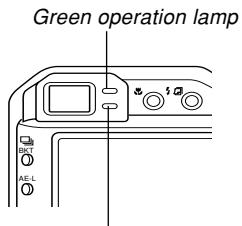
Red operation lamp
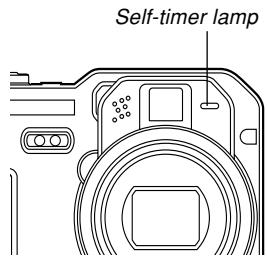
* There are three lamp flash patterns. Pattern 1 flashes once per second, Pattern 2 flashes twice per second, and Pattern 3 flashes four times per second. The table below explains what each flash pattern indicates.
REC mode
| Operation Lamp | Self-timeramp | Meaning | |
| Green | Red | Red | |
| Lit | Operational (Power on, recording enabled) | ||
| Pattern 3 | Flash is charging. | ||
| Lit | Flash charging is complete. | ||
| Lit | Auto Focus operation was successful. | ||
| Pattern 3 | Cannot Auto Focus. | ||
| Lit | Monitor screen is off. | ||
| Pattern 2 | Storing image | ||
| Pattern 1 | Storing movie / performing noise reduction | ||
| Pattern 1 | Self-timer countdown(10 to 3 seconds) | ||
| Pattern 2 | Self-timer countdown(3 to 0 seconds) | ||
| Pattern 1 | Cannot charge flash. | ||
| Pattern 2 | Memory card problem / Memory card is unformatted. / BESTSHOT setup cannot be registered. | ||
| Lit | Memory card is locked. / Cannot create folder. / Memory is full. / Write error | ||
APPENDIX
| Operation Lamp | Self-timer Lamp | Meaning | |
| Green | Red | Red | |
| Pattern 3 | Low battery alert | ||
| Pattern 3 | Formatting card | ||
| Pattern 3 | Powering down | ||
IMPORTANT!
- When you are using a memory card, never remove the card from the camera while the green operation lamp is flashing. Doing so will cause recorded images to be lost.
PLAY mode
| Operation Lamp | Self-timer Lamp | Meaning | |
| Green | Red | Red | |
| Lit | Operational (Power on, recording enabled) | ||
| Pattern 3 | One of the following operations is being performed: delete, DPOF, image protect, copy, album creation, format, power down | ||
| Pattern 2 | Memory card problem / Memory card is unformatted. | ||
| Lit | Memory card is locked. / Cannot create folder. / Memory is full. | ||
| Pattern 3 | Low battery alert | ||
APPENDIX
Rapid Charger Unit
The rapid charger unit has a [CHARGE] lamp that lights or flashes in accordance with the charger unit operation that is being performed.
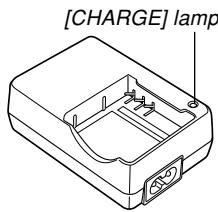
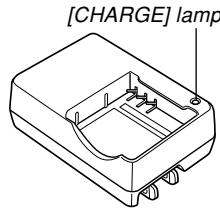
| [CHARGE] Lamp | Meaning | |
| Color | Status | |
| Red | Lit | Charging |
| Green | Lit | Charging complete |
| Red | Flashing | Charger unit or battery abnormality |
| Amber | Lit | Charge standby state (Ambient temperature is too high or too low.) |
Troubleshooting Guide
| Symptom | Possible Cause | Action | |
| Power Supply | Power does not turn on. | 1) The battery is not oriented correctly. 2) The battery is dead. | 1) Orient the battery correctly (page 38). 2) Charge the battery (page 35). If the battery goes dead soon after being charged, it means the battery has reached the end of its life and needs to be replaced. Purchase a separately available NP-40 rechargeable lithium ion battery. |
| Camera suddenly powers down. | 1) Auto Power Off activated (page 47). 2) The battery is dead. | 1) Turn power back on. 2) Charge the battery (page 35). | |
| Image Recording | Image is not recorded when the shutter button is pressed. | 1) The camera is in the PLAY mode. 2) Flash unit is being charged. 3) Memory is full. | 1) Use the mode dial to select the REC mode (page 24). 2) Wait until the flash unit finishes charging. 3) Transfer files you want to keep to your computer and then delete files from image memory, or use a different memory card. |
APPENDIX
| Symptom | Possible Cause | Action | |
| Image Recording | Auto Focus does not focus properly | 1) The lens is dirty. 2) The phase differential sensor is dirty. 3) You are blocking the phase differential sensor with your finger. 4) The subject is not located in the center of the focus frame when you compose the image. 5) The subject you are shooting is a type that is not compatible with Auto Focus operation (page 58). 6) You are moving the camera. 7) An Auto Focus mode other than “Contrast” is selected while a conversion lens is installed on the camera (page 118). | 1) Clean the lens. 2) Clean the phase differential sensor. 3) Move your finger so it does not block the phase differential sensor. 4) Make sure the subject is centered in the focus frame when composing the image. 5) Use manual focus (page 77). 6) Mount the camera on a tripod. 7) Change the Auto Focus mode setting to “Contrast” (page 118). |
| The subject is out of focus in the recorded image. | The image is not focused properly. | When composing the image, make sure the subject on which you want to focus is located inside the focus frame. | |
| The flash does not fire. | 1) (flash off) is selected as the flash mode. 2) The battery is dead. 3) The camera is in the Movie mode. 4) A scene that selects (flash off) as the flash mode is selected in the BESTSHOT Mode. | 1) Select a different flash mode (page 64). 2) Charge the battery (page 35). 3) Select a different REC mode. 4) Select a different flash mode (page 64) or BESTSHOT scene (page 103). |
APPENDIX
| Symptom | Possible Cause | Action | |
| Image Recording | Camera powers down during self-timer countdown. | The battery is dead. | Charge the battery (page 35). |
| Monitor screen image is out of focus. | 1) You are using the Manual Focus Mode and have not focused the image. 2) You are trying to use the Macro Mode ( ) when shooting a scenery or portrait shot. 3) You are trying to use Auto Focus or the Infinity Mode (∞) when shooting a close-up shot. | 1) Focus the image (page 78). 2) Use Auto Focus for scenery and portrait shots. 3) Use the Macro Mode ( ) for close-ups. | |
| Recorded images are not saved in memory. | 1) Camera powers down before the save operation is complete. 2) Removing the memory card before the save operation is complete. | 1) When the battery indicator shows ( ), charge the battery as soon as possible (page 35). 2) Do not remove the memory card before the save operation is complete. | |
| The images produced by an auto bracketing operation look the same. | 1) The subject you are recording is a type for which the different settings do not produce much of a difference in appearance. 2) The image is drastically under-exposed or over-exposed. | 1) Shoot a different subject. 2) Adjust the exposure. |
APPENDIX
| Symptom | Possible Cause | Action | |
| Playback | Color of the playback image is different from the image on the monitor screen during recording. | Sunlight or light from another source is shining directly into the lens during recording. | Position the camera so sunlight does not shine directly into the lens. |
| Images are not displayed. | A memory card with non-DCF images recorded with another camera is loaded in the camera. | This camera cannot display non-DCF images recorded onto a memory card using another digital camera. | |
| Other | All buttons and switches are disabled. | Circuit problem caused by electrostatic charge, impact, etc. while the camera was connected to another device. | Remove the battery from the camera, reinsert it, and then try again. |
| Monitor screen is off. | 1) USB communication is in progress. 2) The monitor screen is turned off (in the REC mode). 3) The camera is connected to a TV for image output. | 1) After confirming that the computer is not accessing camera memory, disconnect the USB cable. 2) Press [DISP] to turn on the monitor screen. 3) Unplug the AV cable. | |
| Cannot transfer files over a USB connection. | 1) USB cable is not connected securely. 2) USB driver is not installed. 3) Camera is turned off. | 1) Check all connections. 2) Install the USB driver on your computer (page 198). 3) Turn on the camera. |
APPENDIX
If you have problems installing the USB driver...
You may not be able to install the USB driver properly if you use the USB cable to connect the camera to a computer running Windows 98 before installing the USB driver from the bundled CD-ROM (CASIO Digital Camera Software), or if you have another type of driver installed. This will make it impossible for the computer to recognize the digital camera when it is connected. If this happens, you will need to re-install the camera's USB driver. For information about how to re-install the USB driver, see the USB driver's "Read me" file on "CASIO Digital Camera Software" CD-ROM that comes bundled with the camera.
Display Messages
| Alarm setting complete. | This message appears after you change the alarm setting. |
| Battery is low. | The battery is dead. |
| Can not find the file. | The camera cannot find the image specified by the slideshow "Images" setting. Specify another image (page 150). |
| Cannot register any more files. | • You are attempting to register a BESTSHOT setup when the "SCENE" folder already contains 999 setups. • You are attempting to register a FAVORITE file when the "FAVORITE" folder already contains 9999 files. |
| Card ERROR | Some problem occurred with the memory card. Turn off the camera, and remove and then reinsert the memory card. If the same message appears, format the memory card (page 184). |
| IMPORTANT! Formatting the memory card deletes all files on the memory card. Before formatting, try transferring recoverable files to a computer or some other storage device. | |
| File could not be saved because battery is low. | The battery is dead, so the recorded image could not be saved. |
| Folder cannot be created. | This message appears when you try to record an image while there are 9,999 files stored in the 999th folder. If you want to record more files, delete files you no longer need (page 159). |
| LENS ERROR | If the lens comes into contact with some obstacle while it is extending, this message appears, the lens retracts, and the camera turns off. Take action to remove the obstacle, and try turning on power again. |
| Memory Full | Memory is full. If you want to record more files, delete files you no longer need (page 159). |
| No Favorites file! | There is no FAVORITE file. |
| Printing Error | One of the following problems occurred during printing. • Printer power off • Out of paper • Out of ink • Printer internal error |
| Record Error | Image compression could not be performed during image data storage for some reason. Record the image again. |
| SYSTEM ERROR | Your camera system is corrupted. Contact your retailer or a CASIO service center. |
| The card is locked. | The LOCK switch of the SD memory card is locked. You cannot store images to or delete images from a memory card that is locked. |
| There are no files. | There are no files in built-in memory or on the memory card. |
| There are no printing images. | There are no DPOF settings specifying images and the number of copies of each for printing. |
| Set up DPOF. | Configure the required DPOF settings (page 189). |
| There is no file to register. | You are trying to save an invalid file as a BESTSHOT user setup, or as an original startup image. |
| This card is not formatted. | The memory card is not formatted. Format the memory card (page 184). |
| This file cannot be played. | The image file or audio file is corrupted, or is a type that cannot be displayed by this camera. |
| This function cannot be used. | You attempted to copy files from built-in memory to a memory card while there is no memory card loaded in the camera (page 183). |
| This function is not supported for this file. | The function you are trying to perform is not supported for the file on which you are trying to perform it. |
Specifications
Product Digital Camera
Model EX-P600
Camera Functions
Image Files Format
Snapshots JPEG (Exif Ver.2.2); DCF (Design rule for Camera File system) 1.0 standard; DPOF compliant
Movies AVI (Motion JPEG)
Audio . WAV
Recording Media 9.2MB built-in Flash memory SD Memory Card MultimediaCard
Image Size
| Snapshots | 2816 x 2112 | pixels |
| 2816 x 1872 | (3:2) pixels | |
| 2048 x 1536 | pixels | |
| 1600 x 1200 | pixels | |
| 1280 x 960 | pixels | |
| 640 x 480 | pixels | |
| Movies | 320 x 240 | pixels |
APPENDIX
Approximate Memory Capacity and File sizes:
- Snapshots
| File Size (pixels) | Quality | Approximate Image File Size | Built-in flash memory 9.2MB | SD Memory Card* 64MB |
| 2816 x 2112 | Fine | 3.0MB | 2 shots | 19 shots |
| Normal | 2.4MB | 3 shots | 24 shots | |
| Economy | 1.6MB | 5 shots | 36 shots | |
| TIFF | 17.0MB | 0 shots | 3 shots | |
| 2816 x 1872 (3:2) | Fine | 2.7MB | 3 shots | 22 shots |
| Normal | 2.1MB | 4 shots | 28 shots | |
| Economy | 1.4MB | 6 shots | 41 shots | |
| TIFF | 15.1MB | 0 shots | 3 shots | |
| 2048 x 1536 | Fine | 1.64MB | 5 shots | 34 shots |
| Normal | 1.23MB | 6 shots | 45 shots | |
| Economy | 630KB | 13 shots | 88 shots | |
| TIFF | 9.0MB | 0 shots | 5 shots | |
| 1600 x 1200 (UXGA) | Fine | 1.05MB | 7 shots | 53 shots |
| Normal | 710KB | 11 shots | 79 shots | |
| Economy | 370KB | 23 shots | 154 shots | |
| TIFF | 5.5MB | 1 shots | 9 shots | |
| 1280 x 960 (SXGA) | Fine | 680KB | 12 shots | 82 shots |
| Normal | 460KB | 18 shots | 126 shots | |
| Economy | 250KB | 33 shots | 221 shots | |
| TIFF | 3.5MB | 2 shots | 14 shots | |
| 640 x 480 (VGA) | Fine | 190KB | 44 shots | 294 shots |
| Normal | 140KB | 57 shots | 386 shots | |
| Economy | 90KB | 92 shots | 618 shots | |
| TIFF | 900KB | 8 shots | 55 shots |
- Movies (320 x 240 pixels)
| Data Size | 300KB/second max. |
| Recording Time | Total Movie Time: 30 seconds maximum (built-in memory) 200 seconds maximum (SD 64MB memory card)* |
- Based on Matsushita Electric Industrial Co., Ltd. products. Capacity depends on card manufacturer.
- To determine the number of images that can be stored on a memory card of a different capacity, multiply the capacities in the table by the appropriate value.
Delete ............ Single-file, all files (with protection)
Effective Pixels 6.0 million
Imaging Element. 1/1.8-inch square pixel color CCD (Total pixels: 6.37 million)
Lens/Focal Distance
Lenses Six lenses in five groups, including an aspherical lens F2.8 (W) to 4 (T); f = 7.1 W to 28.4mm (T) (equivalent to approximately 33 (W) to 132 (T) for 35mm film)
Zoom 4X optical zoom; 4X digital zoom (16X in combination with optical zoom)
Focusing Combination phase differential sensor and contrast Auto Focus (AF Mode (AF Area: Spot, Multi, or Free), Macro Mode), Infinity Mode; Manual Focus; focus lock
APPENDIX
Approximate Focus Range (from lens surface)
Normal 40cm to (1.3' to )
Macro Approximately 10cm to 50cm
(3.9" to 19.7") at wide angle
Approximately 40cm to 50cm
(15.6" to 19.7") at telephoto
Exposure Control
Light Metering .... Multi-pattern by CCD
Exposure . Program AE, Aperture priority AE, Shutter speed priority AE, Manual exposure
Exposure Compensation.....-2EV to +2EV (1/3EV units)
Shutter CCD electronic shutter; mechanical shutter, Snapshot Mode, Aperture Priority AE Mode, BESTSHOT Mode : 1/8 to 1/2000 second Shutter Speed Priority AE Mode, Manual Exposure Mode : BULB, 60 to 1/2000 second
- Shutter speed is different for the following BESTSHOT scenes.
Night Scene: 4 to 1/2000 second
Fireworks: BULB, 60 to 1/2000 second
Aperture F2.8, 3.2, 3.5, 4.0, 4.5, 5.0, 5.6, 6.3, 7.1, 8.0
- Using optical zoom causes the aperture to change.
An aperture setting from F2.8 to 5.6 is possible in the Snapshot Mode
White Balance Automatic, fixed (7 modes), manual switching
Self-timer 10 seconds, 2 seconds, Triple Self-timer, Remote controller, Remote controller and 2-second Self-timer
Built-in Flash
Flash Modes.....AUTO, ON, OFF, Red eye reduction
Flash Range Wide Angle Optical Zoom: 0.2 to 2.9 meters (0.66' to 9.5')
Telephoto Optical Zoom: 0.4 to 2.0
meters (1.3' to 6.6')
(ISO Sensitivity: "Auto")
Recording Functions ....... Snapshot with audio; Macro; self-timer;
Aperture priority AE; Shutter speed priority AE; Manual exposure;
BESTSHOT; Continuous shutter; Auto
Bracketing; Movie with audio; voice recording
- Audio recording is monaural.
Audio Recording Time
Audio Snapshot............Approximately 30 seconds maximum per image
Voice Recording............ Approximately 40 minutes with built-in memory
After Recording ............ Approximately 30 seconds maximum per image
APPENDIX
Monitor Screen 2.0-inch TFT color LCD 115,200 pixels (480 x 240)
Viewfinder .Monitor screen and optical viewfinder
Timekeeping Functions ....... Built-in digital quartz clock
Date and Time ....... Recorded with image data
Auto Calendar ....... To 2049
World Time ....... City; Date; Time; Summer time; 162 cities in 32 time zones
Input/Output Terminals .... AC adaptor connector (DC IN); USB / AV port (Special mini port, NTSC/ PAL); External flash sync terminal
Microphone Monaural
Speaker. Monaural
Power Requirements
Power Requirements .... Rechargeable lithium ion battery (NP-40) x 1 AC adaptor (AD-C40)
Approximate Battery Life:
The values below indicate the amount of time under the conditions defined below, until power automatically turns off due to battery failure. They do not guarantee that you will be able to achieve this level of operation. Low temperatures shorten battery life.
| Operation | Approximate Battery Life |
| Number of Shots (CIPA)*1(Operating Time) | 260 shots (130 minutes) |
| Number of Shots, Continuous Recording*2(Operating Time) | 600 shots (150 minutes) |
| Continuous Playback*3(Continuous Snapshot Recording) | 300 minutes |
| Continuous Voice Recording*4 | 260 minutes |
Supported Battery: NP-40 (Rated Capacitance: 1230mAh)
Storage Medium: SD Memory Card
*1 Number of Shots (CIPA)
CIPA Standard
- Temperature: 23^ C( 73^ F)
Monitor Screen: On
- Zoom operation between full wide to full telephoto every 30 seconds, during which two images are recorded, one image with flash; power turned off and back on every time 10 images are recorded.
APPENDIX
*2 Continuous Recording Conditions
Temperature: 23^ (73^)
Monitor screen: On
- Flash: Off
- Image recorded approximately every 15 seconds
*3 Continuous Playback Conditions
Temperature: 23^ (73^)
- Scroll one image about every 10 seconds
*4 Voice recording times are based on continuous recording.
Power Consumption .DC 4.5V Approximately 5.5W
Dimensions 97.5(W) x 67.5(H) x 45.1(D) mm
(3.8^ (W)× 2.7^ (H)× 1.8^ (D))
(excluding projections; 26.1mm (1.0") at thinnest part)
Weight Approximately 225 g (7.9 oz)
(excluding battery and accessories)
Bundled Accessories. Rechargeable lithium ion battery (NP-
40); Rapid charger unit (BC-30L); Card
Remote Controller; lithium battery
(CR2025); AC power cord; USB cable;
AV cable; Strap; CD-ROM; Basic
Reference
Rechargeable Lithium Ion Battery (NP-40)
Rated Voltage 3.7 V
Rated Capacitance 1230 mAh
Operating Temperature
Range 0°C to 40°C (32°F to 104°F)
Dimensions 38.5(W) x 38.0(H) x 9.3(D) mm
(1.5^ (W)× 1.5^ (H)× 0.37^ (D))
Weight Approximately 34 g (1.20 oz)
■ Special battery charger unit (BC-30L) : Inlet Type
Power Requirement 100 to 240V AC, 0.13A, 50/60Hz
Output DC 4.2V, 900 mA
Charging Temperature .... 5^ to 35^ (41^ to 95^)
Chargeable Battery type... Rechargeable lithium ion battery (NP-40)
Full Charge Times Approximately 2 hours
Dimensions 80 (W) x 55 (H) x 30 (D) mm
(3.1^ (W)× 2.2^ (H)× 1.2^ (D))
(excluding projections)
Weight Approximately 60 g (2.1 oz)
APPENDIX
Special battery charger unit (BC-30L) : Plug-in Type
Power Requirement 100 to 240V AC, 0.13A, 50/60Hz
Output DC 4.2V, 900 mA
Charging Temperature .... 5^ to 35^ (41^ to 95^)
Chargeable Battery type... Rechargeable lithium ion battery (NP-40)
Full Charge Times Approximately 2 hours
Dimensions 80 (W) x 55 (H) x 25 (D) mm
(3.1^ (W)× 2.2^ (H)× 0.98^ (D))
(excluding projections)
Weight Approximately 63 g (2.2 oz)
Power Supply
- Use only the special NP-40 rechargeable lithium ion battery to power this camera. Use of any other type of battery is not supported.
- This camera does not have a separate battery for the clock. The date and time settings of the camera are cleared whenever power is totally cut off (from both the battery and AC adaptor). Be sure to reconfigure these settings after power is interrupted (page 51).
LCD Panel
The LCD panel is a product of the latest LCD manufacturing technology that provides a pixel yield of 99.99% . This means that less than 0.01% of the total pixels are defective (they do not turn on or always remain turned on).
Lens
- You may sometimes notice some distortion in certain types of images, such as a slight bend in lines that should be straight. This is due to the characteristics of lens, and does not indicate malfunction of the camera.