VRA640XS - Cooker INDESIT - Free user manual and instructions
Find the device manual for free VRA640XS INDESIT in PDF.



User questions about VRA640XS INDESIT
0 question about this device. Answer the ones you know or ask your own.
Ask a new question about this device
Download the instructions for your Cooker in PDF format for free! Find your manual VRA640XS - INDESIT and take your electronic device back in hand. On this page are published all the documents necessary for the use of your device. VRA640XS by INDESIT.
USER MANUAL VRA640XS INDESIT
Operating Instructions HOB
Contents
Operating Instructions,1
WARNING,2
Description of the appliance-Control Panel,7
Installation, 11
Start-up and use,14
Precautions and tips,17
Care and maintenance,18
Technical description of the models, 18
FR
Français
Mode d'emploi
TABLE DE CUISSON
Sommaire
Mode d'emploi,1
ATTENTION,2
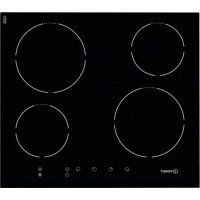
Description of the appliance Control panel
The control panel described in this manual is only a representative example: it may not exactly match the panelon your appliance.
1 INCREASE POWER button switches on the hotplate and controls the power (see Start-up and use).
2 REDUCE POWER button controls the power and switches off the hotplate (see Start-up and use).
3 COOKING ZONE SELECTOR indicator shows a particular cooking zone has been selected and therefore various adjustments are possible.
4 COOKING ZONE SELECTOR button is used to select the desired cooking zone.
5 POWER indicator provides a visual display for the current heat level.
6 ON/OFF button switches the appliance on and off.
7 ON/OFF indicator light shows whether the appliance is on or off.
8 CONTROL PANEL LOCK button prevents accidental changes to the hob settings (see Start-up and use).
9 CONTROL PANEL LOCK indicator light shows the control panel has been locked (see Start-up and use).
! This product complies with the requirements of the latest European Directive on the limitation of power consumption of the standby mode.
If no operations are carried out for a period of 2 minutes, after the residual heat indicator lights turn off and the fan stops (if present), the appliance automatically switches to the .off mode..
The appliance resumes the operating mode once the ON/OFF button is pressed.
FR
! Before operating your new appliance please read this instruction booklet carefully. It contains important information concerning the safe operation, installation and maintenance of the appliance.
! Please keep these operating instructions for future reference. Pass them on to any new owners of the appliance.
Positioning
! Keep all packaging material out of the reach of children. It may present a choking or suffocation hazard (see Precautions and tips).
! The appliance must be installed by a qualified professional in accordance with the instructions provided. Incorrect installation may cause harm to people and animals or may damage property.
Built-in appliance
Use a suitable cabinet to ensure that the appliance functions properly.
- The supporting surface must be heat-resistant up to a temperature of approximately 100^ .
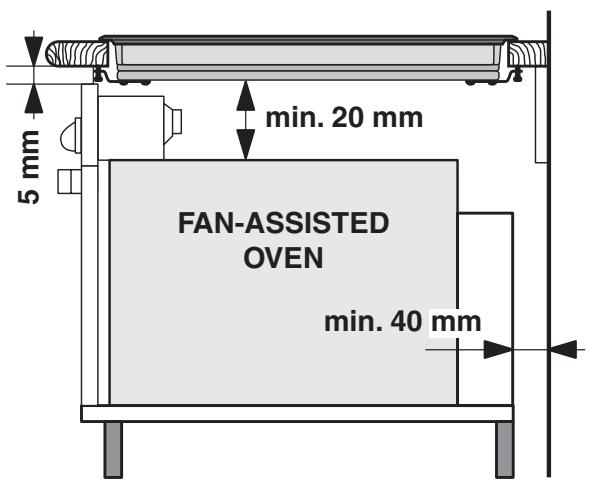
- If the appliance is to be installed above an oven, the oven must be equipped with a forced ventilation cooling system.
- Avoid installing the hob above a dishwasher: if this cannot be avoided, place a waterproof separation device between the two appliances.
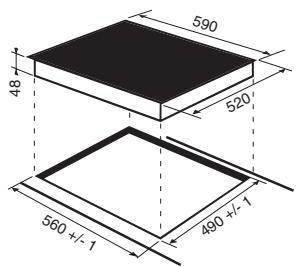
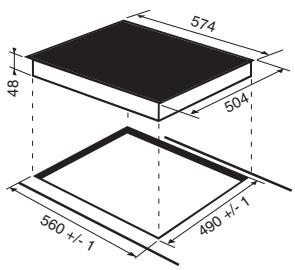
- Depending on the hob you want to install, the cabinet must have the following dimensions (see figure):
Ventilation
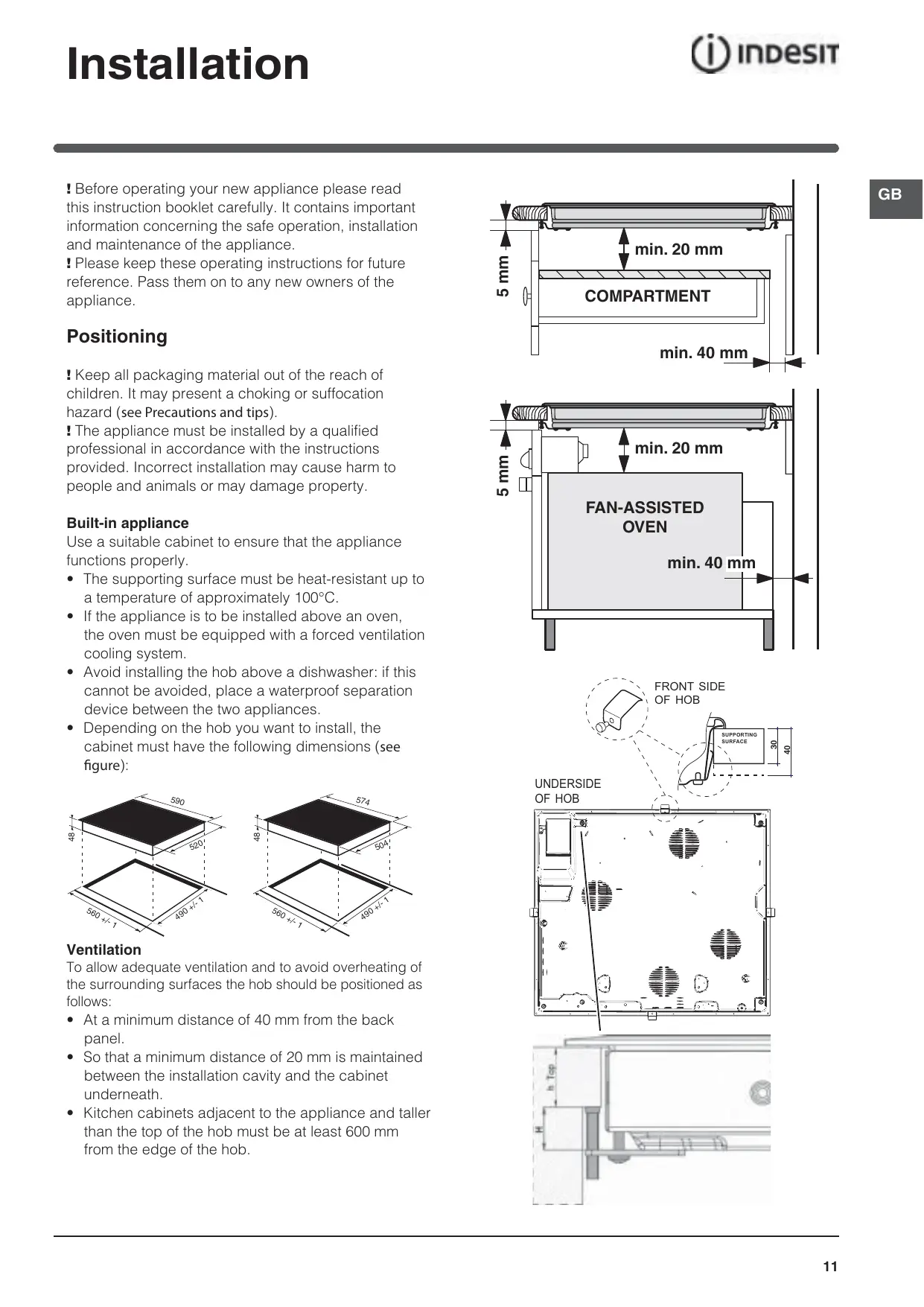
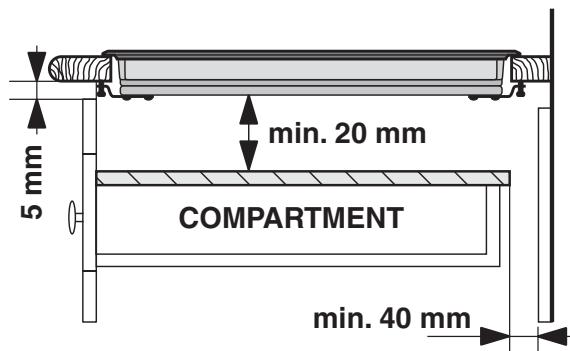
To allow adequate ventilation and to avoid overheating of the surrounding surfaces the hob should be positioned as follows:
- At a minimum distance of 40mm from the back panel.
- So that a minimum distance of 20 ~mm is maintained between the installation cavity and the cabinet underneath.
- Kitchen cabinets adjacent to the appliance and taller than the top of the hob must be at least 600 ~mm from the edge of the hob.
Fixing
The appliance must be installed on a perfectly level supporting surface.
Any deformities caused by improper fixing could affect the features and operation of the hob.
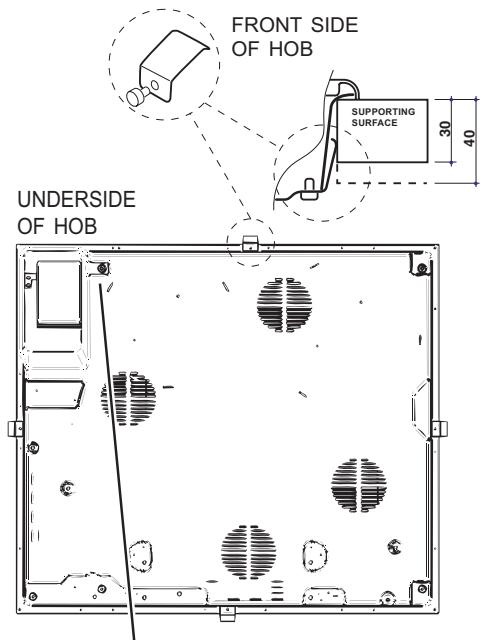
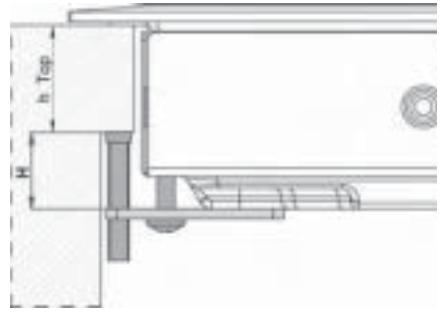
The thickness of the supporting surface should be taken into account when choosing the length of the screws for the fixing hooks:
- 30 mm thick: 17.5 mm screws
- 40 mm thick: 7.5 mm screws
Fix the hob as follows:
- Use short flat-bottomed screws to fix the 4 alignment springs in the holes provided at the central point of each side of the hob.
- Place the hob in the cavity, make sure it is in a central position and push down on the whole perimeter until the hob is stuck to the supporting surface.
- For hobs with raised sides: After inserting the hob into its cavity, insert the 4 fixing hooks (each has its own pin) into the lower edges of the hob, using the long pointed screws to fix them in place, until the glass is stuck to the supporting surface.
! The screws for the alignment springs must remain accessible.
! In order to adhere to safety standards, the appliance must not come into contact with electrical parts once it has been installed.
! All parts which ensure the safe operation of the appliance must not be removable without the aid of a tool.
Electrical connection
! The electrical connection for the hob and for any built-in oven must be carried out separately, both for safety purposes and to make extracting the oven easier.
Terminal board
On the lower part of the appliance there is a
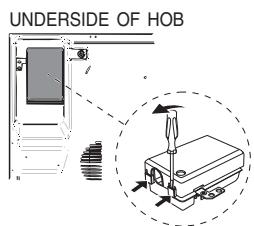
connection box for the different types of electricity supply (the picture is only an indication and is not an exact representation of the purchased model).
Single-phase connection
The hob is equipped with a pre-connected electricity supply cable, which is designed for single-phase
connection. Connect the wires in accordance with the instructions given in the following table and diagrams:
| Voltage and mains frequency | Electrical cable | Wire connection |
| 230-240V 1+N ~ 220-240V 1+N ~ 50/60 Hz | : yellow/green N: the two blue wires together L: brown and black together |
Other types of connection
If the mains supply corresponds with one of the following:
Voltage and mains frequency
- 400V - 2+N ~ 50/60 Hz
- 220-240V 3 ~ 50/60 Hz
- 230-240V 3 ~ 50/60 Hz
- 400V - 2+2N ~ 50/60 Hz
Separate the wires and connect them in accordance with the instructions given in the following table and diagrams:
| Voltage and mains frequency | Electrical cable | Wire connection |
| 400V - 2+N ~ 50/60 Hz 230-240V 3 ~ 220-240V 3 ~ 50/60 Hz | N: yellow/green; N: the two blue wires together L1: black L2: brown | : yellow/green; N1: blue N2: blue L1: black L2: brown |
| 400V - 2+2N ~ 50/60 Hz | : yellow/green; N1: blue N2: blue L1: black L2: brown |
If the mains supply corresponds with one of the following:
Voltage and mains frequency
- 400V 3 - N ~ 50/60 Hz
proceed as follows:
! The cable provided is not suitable for the following types of installation.
- Use a suitable supply cable, H05RR-F or higher, with the right dimensions (cable cross section: 25 mm).
- To open the terminal board, use a screwdriver as a lever under the side tabs of the cover (see Terminal board picture).
- Loosen the cable clamp screw and the terminal board screws in accordance with the type of connection required and position the connection supports as shown in the following table and diagrams.
- Position the wires in accordance with the information given in the following table and diagrams and connect the appliance by tightening all the screws for the springs as much as possible.
| Voltage and mains frequency | Electrical connections | Terminal board |
| 400V 3-N ~ 50/60 Hz | 1234567890 | Three-phase 400 |
- Secure the power supply cable by fastening the cable clamp screw, then put the cover back on.
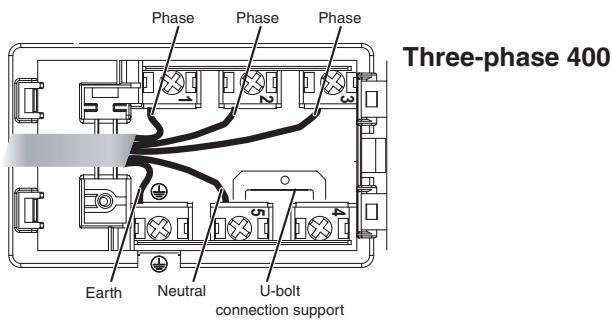
Connecting the electricity supply cable to the mains
If the appliance is being connected directly to the electricity mains an omnipolar switch must be installed with a minimum opening of 3mm between contacts.
! The installer must ensure that the correct electrical connection has been made and that it is fully compliant with safety regulations.
Before connecting the appliance to the power supply, make sure that:
- The appliance is earthed and the plug is compliant with the law.
- The socket can withstand the maximum power of the appliance, which is indicated on the data plate located on the appliance itself.
- The voltage falls within the range of values indicated on the data plate.
- The socket is compatible with the plug of the appliance. If the socket is incompatible with the plug, ask an authorised technician to replace it. Do not use extension cords or multiple sockets.
! Once the appliance has been installed, the power supply cable and the electrical socket must be easily accessible.
! The cable must not be bent or compressed.
! The cable must be checked regularly and replaced by authorised technicians only.
! The manufacturer declines any liability should these safety measures not be observed.
! Do not remove or replace the power supply cable for any reason. Its removal or replacement will void the warranty and the CE marking. INDESIT does not assume liability for accidents or damage arising from replacement/removal of the original power supply cable. Replacement can only be accepted when carried out by personnel authorised by INDESIT and using an original spare part.
Extendable cooking zones
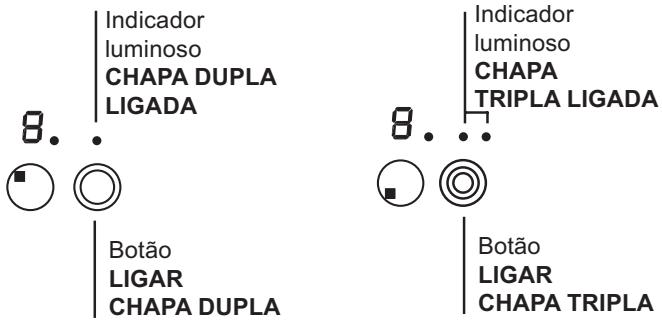
Certain models are fitted with extendable cooking zones. These may be circular and may vary in their extensibility (they may be double or triple hotplates). A list of controls is given below (these controls are only present in models with the extendable cooking zone option).
Circular extendable hotplate
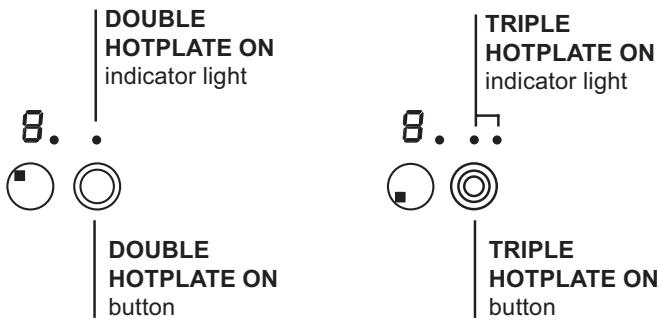
- DOUBLE HOTPLATE ON button switches on the double hotplate (see Start-up and use).
- DOUBLE HOTPLATE ON indicator light shows the double hotplate has been switched on.
- TRIPLE HOTPLATE ON button switches on the triple hotplate (see Start-up and use).
- TRIPLE HOTPLATE ON indicator light shows the triple hotplate has been switched on.
! The glue applied on the gaskets leaves traces of grease on the glass. Before using the appliance, we recommend you remove these with a special non-abrasive cleaning product. During the first few hours of use there may be a smell of rubber which will disappear very quickly.
! A few seconds after the hob is connected to the electricity supply, a buzzer will sound. The hob may now be switched on.
! If the - or + button is pressed for an extended period of time, the display scrolls quickly though the power levels and timer minutes.
Switching on the hob
To switch the hob on, press and hold the ① button for approximately one second.
Switching on the cooking zones
Each cooking zone is controlled using a selector button
and a power adjustment device consisting of a
double - and + button.
- To begin operating a cooking zone, press the corresponding control button and set the desired
power level (between 0 and 9) using the buttons
and +.
Power function
The power function for the cooking zones may be used to shorten heating-up times. Activate and set the power
level for the desired cooking zone as described in the previous paragraph. Press and hold the selector
button corresponding to the desired cooking zone for at least 2 seconds. The display, the power level indicator, will alternately show the letter “P” and the power level set previously until the desired power level has been reached. Once this level has been reached, the display will revert to showing the set power level. To deactivate this function, press and hold – for at least 2 seconds - the selector button corresponding to
the cooking zone on which the function has been activated; alternatively, select a different power level
using the buttons - and +.
Switching off the cooking zones
To switch off a cooking zone, select it using the corresponding selector button and:
- Press the button: the power of the cooking zone will progressively decrease until it is switched off.
Heating elements
Two types of heating element may be installed, depending on the appliance model: halogen and radiant elements.
Halogen elements emit heat via radiation from the halogen lamps they contain.
They have similar properties to gas burners: they are easy to control and reach set temperatures quickly, allowing you to see the power level instantly.
Radiant elements consist of a series of coils which allow heat to be distributed evenly at the base of the cookware, so that all slow-flame cooking may be performed successfully, for example stews, sauces or reheated dishes.
Control panel lock
When the hob is switched on, it is possible to lock the oven controls in order to avoid accidental changes being made to the settings (by children, during
cleaning, etc.). Press the button to lock the control panel: the indicator light above the button will switch on.
To use any of the controls (e.g. to stop cooking), you must switch off this function. Press the button for a few moments, the indicator light will switch off and the lock function will be removed.
Switching off the hob
Press the ① button to switch the appliance off. If the control panel lock has been activated, the controls will continue to be locked even after the hob is switched on again. In order to switch the hob on again, you must first remove the lock function.
Practical advice on using the appliance
To obtain the best results from your hob:
- Use pans with a thick, flat base in order to fully utilise the cooking zone.
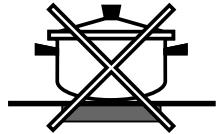
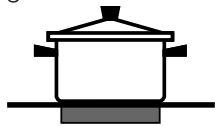
- Always use pans with a diameter which is large enough to cover the hotplate fully, in order to use all the available heat.
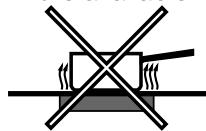
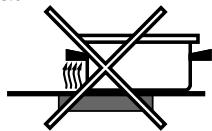
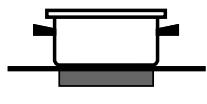
- Make sure that the base of the cookware is always clean and dry, in order to fully utilise and extend the life of both the cooking zones and the cookware.
- Avoid using the same cookware which has been used on gas burners: the heat concentration on gas burners may distort the base of the pan, causing it not to adhere correctly.
Safety devices
Pan sensor
Each cooking zone is equipped with a pan sensor device. The hotplate only emits heat when a pan with suitable measurements for the cooking zone is placed on it. If the indicator light is flashing, it may indicate:
- An incompatible pan
- A pan whose diameter is too small
- The pan has been removed from the hotplate.
Residual heat indicators
Each cooking zone is equipped with a residual heat indicator. This indicator signals which cooking zones are still at a high temperature. If the power display
shows H, the cooking zone is still hot. It is possible, for example, to keep a dish warm or melt butter or chocolate. As the cooking zone cools, the power display will show H. The display switches off when the cooking zone has cooled sufficiently.
Overheating protection
If the electronic elements overheat, the hob switches off automatically and F appears on the display, followed by a flashing number. When the temperature has reached a suitable level, this message disappears and the hob may be used again.
Safety switch
The appliance has a safety switch which automatically switches the cooking zones off after they have been in operation for a certain amount of time at a particular power level. When the safety switch has been triggered, the display shows "0".
For example: the right rear hotplate is set to 5 and will switch off after 5 hours of continuous operation, while the front left hotplate is set to 2 and will switch off after 8 hours.
| Power level | Maximum operating time in hours |
| 1 | 9 |
| 2 | 8 |
| 3 | 7 |
| 4 | 6 |
| 5 | 5 |
| 6 | 4 |
| 7 | 3 |
| 8 | 2 |
| 9 | 1 |
Buzzer
This can also indicate several irregularities:
- An object (a pan, cutlery, etc.) has been placed on the control panel for more than 10 seconds.
- Something has been spilt on the control panel.
- A button has been pressed for too long. All of the above situations may cause the buzzer to sound. Remove the cause of the malfunction to stop the buzzer. If the cause of the problem is not removed, the buzzer will keep sounding and the hob will switch off.
Practical cooking advice
| Very high-flame cooking | 98 | Pressure cooking Pressure cooker Grilling | Frying Boiling |
| High-flame cooking | 107 | Crêpes | Cooking on a high flame and browning (roasts, steaks, escalopes, fish fillets, fried eggs) |
| Medium-flame cooking | 116 | Fast thickening (liquid juices) Boiling water (pasta, rice, vegetables) Milk | |
| 125 | Slow thickening (dense juices) | ||
| 134 | Bain-marie cooking | Pressure cooking after whistle | |
| Low-flame cooking | 142 | Low-flame cooking (stews) | Reheating dishes |
| Very low-flame cooking | 151 | Chocolate sauce | Keeping food hot |
! This appliance has been designed and manufactured in compliance with international safety standards. The following warnings are provided for safety reasons and must be read carefully.

This appliance conforms to the following European Economic Community directives:
- 2006/95/EEC dated 12/12/06 (Low Voltage) and subsequent amendments;
- 2004/108/EEC dated 15/12/04 (Electromagnetic Compatibility) and subsequent amendments;
- 93/68/EEC dated 22/07/93 and subsequent amendments.
- 1275/2008 stand-by/off mode.
General safety
! Make sure that the air inlet behind the fan grille is never obstructed. The built-in hob should, in fact, be provided with suitable ventilation for the cooling of the electronic components used in the appliance.
- The appliance was designed for domestic use inside the home and is not intended for commercial or industrial use.
- The appliance must not be installed outdoors, even in covered areas. It is extremely dangerous to leave the appliance exposed to rain and storms.
- Do not touch the appliance when barefoot or with wet or damp hands and feet.
- The appliance must be used by adults only for the preparation of food, in accordance with the instructions outlined in this booklet. Any other use of the appliance (e.g. for heating the room) constitutes improper use and is dangerous. The manufacturer may not be held liable for any damage resulting from improper, incorrect and unreasonable use of the appliance.
- The glass ceramic hob is resistant to mechanical shocks, but it may crack (or even break) if hit with a sharp object such as a tool. If this happens, disconnect the appliance from the electricity mains immediately and contact a Service Centre.
- Ensure that power supply cables of other electrical appliances do not come into contact with the hot parts of the hob.
-
Remember that the cooking zones remain relatively hot for at least thirty minutes after they have been switched off. An indicator light provides a warning when residual heat is present (see Start-up and use).
-
Keep any object which could melt away from the hob, for example plastic and aluminium objects, or products with a high sugar content. Be especially careful when using plastic film and aluminium foil or packaging: if placed on surfaces which are still hot, they may cause serious damage to the hob.
- Always make sure that pan handles are turned towards the centre of the hob in order to avoid accidental burns.
- When unplugging the appliance, always pull the plug from the mains socket; do not pull on the cable.
- Never perform any cleaning or maintenance work without having disconnected the appliance from the electricity mains.
- The appliance should not be operated by people (including children) with reduced physical, sensory or mental capacities, by inexperienced individuals or by anyone who is not familiar with the product. These individuals should, at the very least, be supervised by someone who assumes responsibility for their safety or receive preliminary instructions relating to the operation of the appliance.
- Do not look at the halogen lamps in the cooking zones for long if they are present.
- Do not let children play with the appliance.
- Do not place metal objects (knives, spoons, pan lids, etc.) on the hob as they may become hot.
- The appliance is not intended to be operated by means of an external timer or separate remote-control system.

Disposal
- When disposing of packaging material: observe local legislation so that the packaging may be reused.
- The European Directive 2002/96/EC relating to Waste Electrical and Electronic Equipment (WEEE) states that household appliances should not be disposed of using the normal solid urban waste cycle. Exhausted appliances should be collected separately in order to optimise the cost of re-using and recycling the materials inside the machine, while preventing potential damage to the atmosphere and to public health. The crossed-out dustbin is marked on all products to remind the owner of their obligations regarding separated waste collection.
For further information relating to the correct disposal of exhausted household appliances, owners may contact the public service provided or their local dealer.
Care and maintenance
Switching the appliance off
Disconnect your appliance from the electricity supply before carrying out any work on it.
Cleaning the appliance
! Do not use abrasive or corrosive detergents (for example, products in spray cans for cleaning barbecues and ovens), stain removers, anti-rust products, powder detergents or sponges with abrasive surfaces: these may scratch the surface beyond repair.
! Never use steam cleaners or pressure cleaners on the appliance.
- It is usually sufficient simply to wash the hob using a damp sponge and dry it with absorbent kitchen towel.
- If the hob is particularly dirty, rub it with a special glass ceramic cleaning product, then rinse well and dry thoroughly.
- To remove more stubborn dirt, use a suitable scraper. Remove spills as soon as possible, without waiting for the appliance to cool, to avoid residues forming crusty deposits. You can achieve excellent results by using a rust-proof steel wire sponge - specifically designed for glass ceramic surfaces - soaked in soapy water.
- If any plastic or sugary substances are accidentally melted on the hob, remove them immediately with the scraper, while the surface is still hot.
- Once it is clean, the hob may be treated with a special protective maintenance product: the invisible film left by this product protects the surface from drips during cooking. This maintenance task should be carried out
while the appliance is warm (not hot) or cold.
- Always remember to rinse the appliance well with clean water and dry it thoroughly: residues can become encrusted during subsequent cooking processes.
Stainless steel frame (only in models with outer frame) Stainless steel can be marked by hard water which has been left on the surface for a long time, or by cleaning products containing phosphorus.
After cleaning, it is advisable to rinse the surface well and dry it thoroughly. If water is spilt on the surface, dry it quickly and thoroughly.
! Some hobs have an aluminium frame which is similar to stainless steel. Do not use any cleaning or degreasing products which are not suitable for use with aluminium.
Disassembling the hob
If it is necessary to disassemble the hob:
- Loosen the screws fixing the alignment springs on each side.
- Loosen the screws holding the fixing hooks in each corner.
- Take the hob out of its installation cavity.
! Do not attempt to repair the appliance yourself. If the appliance breaks down, contact a Service Centre.
Technical description of the models
This table provides a model-by-model list of the energy absorption values, type of heating elements and diameters of each cooking zone.
Key:
H = single hilight
HD = double hilight
HT = triple hilight
AD = double halogen
| Hobs | VRA 640 X S VRA 640 C S | VRA 641 D B S VRA 641 D X S | ||
| Cooking zone | Power (W) | Diameter (mm) | Power (W) | Diameter (mm) |
| Back Left | HD 2300 | 210 | HT 2200/1000 | 210/140 |
| Back Right | H 1400 | 160 | H 1400 | 160 |
| Front Left | H 1200 | 145 | H 1200 | 145 |
| Front Right | H 1800 | 180 | H 1800 | 180 |
| Total power | 6700 | 6600 | ||
H = hilight individual
Chapa extensivel circular
Acender as zonas de cozedura
Desligar as zonas de cozedura
Dpyrne Tnbl coeHHeHn
Ecnn 3JneKtpoPBOOka COOTBETCTBye T OndHou n3 cJeNyUxnx XapaKTepnCTnK:
Tinoboe Hanpajekhe n uactota cetu
- 400B - 2+N ~ 50/60 Γu
220-240B3\~50/60T
230-240B 3 ~ 50/60 Hz - 400B - 2+2N ~ 50/60 Γu
Pa3dienTe npoBOaI nIOcOeINHITe npoBOHnIKB COOTBeTCTBnC Ta6NIuCeN IN pRbEdeHHbIM HNXeCXemam;
Kpyrna paacwnpraoucaerBapouhna 30Ha
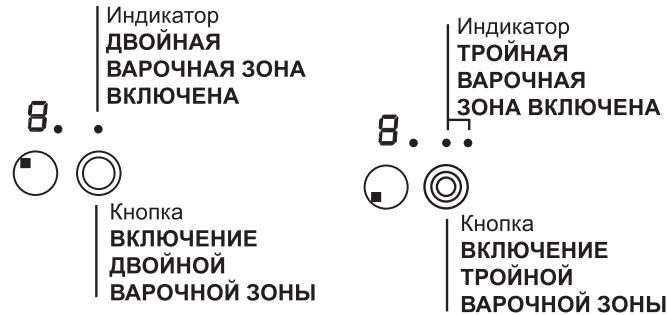
- Khonka BKJIIOUOHEHNE DBOHN BAOPOHON 3OHbl cnyknt dIЯ BKJIIOUHEnI yBOHN KOHΦOpKN (cM. BKnIOUeHue u 3Kcnnyamaua).
- INДИКaTOp IБОИHЯ BAPOчHЯ 3OHA BKJIIOUChEHa: nOKa3bIbAeT, YTO IбОИнЯ BapOчHЯ 3OHa BKJIIOUChEHa.
- Khonka BKJIIOUOHEHNE TPOINHOI BAPOOHON 3OHbl cnyknt dIЯ BKJIIOUeHn TPOINHOI KOHΦOpKN (cM. BkJIIOUeHue u 3KcIIpyamaucu).
- INДикatop TPOHAR BAPOUHAR 3OHA BKJIQUEHA: nOKa3bIbAeT, YTO TPOHAR BAPOUHAR 3OHa BKJIQUeHa.
!Ha cTeKJIaHHoN NOBepxHocTn BapOuHOn NaHeI N MOryT 6bITb BnHbI CaIbHbIe CNeDbI OT KNeI, HaNecEHHO Ha npokJaKn IpeE nauJIoM 3KcPiNyatauIN3dEInr CJeDyET ydaIHT bCneDbI KNeI pRn NOMOuIN CneUaJIbHoro Hea6pa3INBHorO MOIOeRo cpeCTBa. B nepBbIe Yacbl pa60Tb Bbl MoKeTe NoCyBCTBOBaTb 3aNaX JxKeHOn pe3INbI, KOToPbI 6bICTpo IpponaJaET.
!Yepe3 HeckoKo CkyHnI NocIe NODcoEINHeHnBapOCHon NaHEnn K CETn 3JeKTPoNITaHn BKNIOuHaETcKOPOTKn 3ByKOBoN cInHaJI. ToJIbKO NocJIe 3TOrO MOxHO BKJIOUHTb BApOCHyIO NaHeJIb.
!PnДПNTeHOM HaxKaTHN Ha KHOKN + npOxCxOHT 6bICTpa CMeHa yPoBHeN MOUHOCTN MInHyT TaMepa.
BkJIoueHne BapOuHo nAheJI
BknHnTe BapOHyTo nAHeNb, HaxKaB KhoNky ① npImepHo Ha OndHy cekyHny.
BkJIoueHne BapOHyX 3OH
Kajda 30Ha BapouHoi naneBkIIOuYaETc npi NOMOUI KHOJKN I nperyJyTOpa MOUHOCTN,
COCTOJIeIIOI3 IBOHON KHOKNI -I
ДяВКЛЮЧЕнЯ OДHONИЗ ВAPОЧБIX 3OH HAnKMITE COOTBETCTBYUOу KHOПКУ И HAcTpОпТЕ HUxKHyIO MOUIHOCTb Пи ПOMOUIK HONOK - +.
BbIKIIOUeHne BapOuHBIX 3OH
Дя OTКЛIOHENЯ BAPOCHON 3OHbI Bbl6epnte ee npnOMOUI COOTBETCTBYIOUe KNOHKN n 3aTEM:
HaxMMTe KHOKNK:MOUHOCbBapOCHON3OHbI NOCTeNEHHO NOHN3NTcB NPTOTb DO BByIKNHOeyHn.
Функця power
Дя уckopener HapeBa BapouHbIX 30H MOxHo nCNoIb3OBAt yHKuHIO power. BkJIuOHte n Hactponte
MOUHOCb HUxHON BApOuHON 30HbI ,Kak ONiCaHO B npEdbNyue m naparpafe. HaxMnte n depxnte HaxaTOn He MeHee 2 cekynd KhoNky Bbl6opa HuxHON BapOuHON 30HbI .Ha dinCnlee nonepemehno 6ydet NOKa3bIBaTbcra INDnKaTOp MOUHcTn,6yKBa «P» I pahee 3aDaHHoe 3NaYeHne yPoBnRA MOUHcTn B TeueHne BCEr BOpeMeHN, HeoBXoDMOro dIra DOCTNXeHn 3aDaHHoro yPoBnRA MOUHcTn. Po DOCTNXeHn 3aDaHHoro yPoBnRA MOUHcTn Ha dinCnJIee
ONTb 6yET NOKa3bIbTaBc8 3aHaHHbIn yPoBeHb MOUHOCTN.ДЯ OTMeHbI 3TON ΦyHKcHn HaxMMte IN DePKeNTe HaxaToH He MeHee 2 CeKHyKnKy Bbl6opa BapOCHOn 30HbI,ДЯ KOTOpON 6bJIbA BKJIuOyeHaФyHKcHn I,ИЛи JVE 3aDaANTe dpyrOu yPoBeHb MoUHOCTn npN
HOMOUI KHOIOK -+
HarpeBaTeJbHbIe 3JIeMeHTbl
Iopraok demoHTaxa Bapouho nHaHeJi
PnHneOeXoDmOCTn DEmOHtnpOBaTb BApOChyI NaHeJIb:
- CHIMITE UpybI, KpeIaue c6OKOB ueHTpOBOHbI npyKInbI;
- ocla6bTe upynbKpeNexHbIX KpOKOB nO yrJAm;
- BbIbTe BapOHyIO NaHeJIb I3 HIIJN.
!He pekomeHnyetcO tKpbIbAtb BHyTpEHnE KOMJIeKtYIOUne IJN IONbTKI CAMOCToRteBHO BByINOHHTpeMOHT.B cIyue HeNCnpaBHOCTu Obaaantecb B LHeTp TEXHnueCKOrO o6CnykBaHnI.
TexHHueckoe onncahne MoJeNei
B 3tix Ta6nuaq dx nkaKdoM moeJIn yka3bIbaOTc 3HaueHn IORIOUeHn 3NeKTPO3Heprn, TIN HArpeBaTeNbHO 3JeMeHTa IN DaAMetp KaKdo BapOCHON 3OHbl.
| l i aee āaī -i UO l ài Āaé | VRA 640 X S VRA 640 C S | VRA 641 D B S VRA 641 D X S | ||
| Aaī -i uà cí fù | l iúfūn ou (Ao) | Aea i āo (i i) | l iúfūn ou (Ao) | Aea i āo (i i) |
| Çaí yy eaaay | HD 2300 | 210 | HT 2200/1000 | 210/140 |
| Çaí yy i òaay | H 1400 | 160 | H 1400 | 160 |
| l òaáí yy eaaay | H 1200 | 145 | H 1200 | 145 |
| l òaáí yy i òaay | HD 1800 | 180 | H 1800 | 180 |
| l áuay i iúfūn ou | 6700 | 6600 | ||
YcIOBHeIe 06O3HaueHnra:
H = odinnapna Bapouhna 30ha "hilight"
HD = Довоная варочая за "hilight"
HT = trponha Bapouhna 3oha "hilight"
AD = ranoreHHaJ DBOHna
PACNOPTHA TABJNUKA