
YT-8273 - Welding machine Yato - Free user manual and instructions
Find the device manual for free YT-8273 Yato in PDF.


| Product Type | Soldering Iron |
| Model | YT-8273 |
| Brand | Yato |
| Power Supply Voltage | ~230 V |
| Power Supply Frequency | 50 Hz |
| Rated Power | 80 W |
| Heating Time | 2 min |
| Working Temperature of Tip | 450 °C |
| Maximum Temperature of Tip | 520 °C |
| Tip Dimensions | 6.8 × 64 mm |
| Tip Durability | >60 h |
| Weight | 0.11 kg |
| Electric Insulation Class | I |
| Protection Rating | IP20 |
| Included Accessories | None (soldering iron only) |
| Safety Features | Non-flammable base required, cool on stand, tip replacement only when off |
| Intended Use | Soft soldering of metals with tin/lead binders |
| Maintenance | Clean body and vents with dry cloth or air jet (max 0.3 MPa) |
| Compliance | CE, PLGB |
| Disposal | Do not dispose with household waste; recycle responsibly |
Frequently Asked Questions - YT-8273 Yato
User questions about YT-8273 Yato
0 question about this device. Answer the ones you know or ask your own.
Ask a new question about this device
Download the instructions for your Welding machine in PDF format for free! Find your manual YT-8273 - Yato and take your electronic device back in hand. On this page are published all the documents necessary for the use of your device. YT-8273 by Yato.
USER MANUAL YT-8273 Yato
natural_image
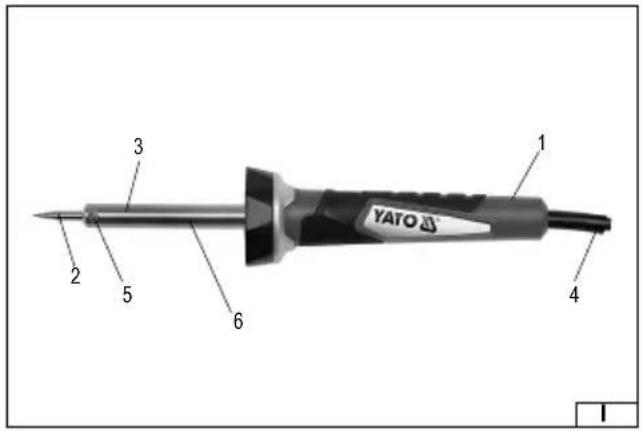
Close-up of a YATO soldering iron with a black and white body, no visible text or symbols on the tool itself.CE
PLGB
Read the operating instruction
Wear protective goggles
Correct disposal of this product: This marking shown on the product and its literature indicates this kind of product mustn't be disposed with household wastes at the end of its working life in order to prevent possible harm to the environment or human health. Therefore the customers is invited to supply to the correct disposal, differentiating this product from other types of refusals and recycle it in responsible way, in order to re - use this components. The customer therefore is invited to contact the local supplier office for the relative information to the differentiated collection and the recycling of this type of product.
UMWELTSCHUTZ
The soldering tool has been designed for the purpose of soldering metals with tin and lead binders for soft soldering. A correct, reliable and safe functioning of the tool depends upon appropriate operation, and therefore:
Before work with the tool, read the complete instruction and keep it.
The supplier will not be held responsible for any damage and injuries which occur as a result of inappropriate applications of the tool, failure to observe safety regulations and the recommendations specified in these instructions. Improper application of the tool will also cause cancellation of any guarantee rights due to incompliance with the sales contract.
EQUIPMENT
The soldering tool is provided complete and has no additional accessories.
TECHNICAL DATA
| Parameter Unit of measurement Value | ||||
| Catalogue number YT-8271 YT-8272 YT-8273 | ||||
| Power supply mains voltage [V] ~230 | ||||
| Power supply mains frequency [Hz] 50 | ||||
| Rated power [W] 30 60 80 | ||||
| Heating time [min] 3 2,5 2 | ||||
| Working temperature of the soldering tip | [°C] | 350 | 430 | 450 |
| Maximum temperature of the soldering tip | [°C] | 400 | 500 | 520 |
| Dimensions of the soldering tip | [mm] | 3,8 × 70 | 6 × 78 | 6,8 × 64 |
| Durability of the soldering tip [h] | >60 | |||
| Mass | [kg] | 0,07 | 0,09 | 0,11 |
| Electric insulation class | I | |||
| Protection rating | IP20 | |||
GENERAL SAFETY CONDITIONS
NOTE! Get acquainted with all the instructions below. Failure to observe them may lead to an electric shock, fire or injuries. The notion of electric tool used in the instructions applies to all the tools which are powered with electric current, both wire tools and wireless ones.
OBSERVE THE FOLLOWING INSTRUCTIONS
Place of work
The place of work must be properly illuminated and clean. Disorder and poor illumination may be a cause of accidents. Do not work with electric tools in explosive environments, or those which contain inflammable liquids, gases or vapours. Electric tools generate sparks, which may cause a fire in case of contact with inflammable gases or vapours. Do not allow children and outsiders to the place of work. A lack of concentration may result in a loss of control over the tool.
Electric safety
The plug of the power supply cable must fit the mains socket. Do not modify the plug. Do not use any adapters whatsoever in order to adapt the plug to the socket. Unmodified plug which fits the socket reduces the risk of an electric shock. Avoid contact with grounded surfaces, such as pipes, heaters and refrigerators. Grounding of the body increases the risk of an electric shock. Do not expose electric tools to precipitation or humidity. Water and humidity which gets into the electric tool increases the risk of an electric shock. Do not overload the power supply cable. Do not use the power supply cable in order to carry the tool or to connect and disconnect the plug from the mains socket. Avoid contact of the power supply cable with heat, oils, sharp tools and moving elements. Damage to the power supply cable increases the risk of an electric shock. In case work is realised outside closed areas, it is necessary to use extension cords designed for applications outside closed areas. Using a correct extension cord permits to reduce the risk of an electric shock.
Personal safety
Commence work in good physical and psychological conditions. Pay attention to what you do. Do not work if you are tired or under effects of medicines or alcohol. Even a moment's inattention during work may lead to serious injuries. Always use individual means of protection. Always wear goggles. Using individual means of protection, such as dust-masks, protective shoes, helmets and hearing protections permits to reduce the risk of serious injuries. Avoid accidental activation of the
tool. Make sure the switch is in the OFF position, before you connect the tool to the mains. Holding the tool with a finger on the switch or connecting an electric tool when the switch is in the ON position may lead to serious injuries. Before you turn an electric tool on remove all the spanners and other tools, which have been used for adjustments. A spanner left on rotating elements of the tool may lead to serious injuries. Keep your balance. Maintain an appropriate position. It will permit to control the electric tool in case of unpredicted situations during its operation. Use protective clothes. Do not wear loose clothes or jewellery. Keep your hair, clothes and gloves away from moving elements of the electric tool. Loose clothes, jewellery or long hair may get caught on moving elements of the tool. Use dust extractors or dust containers, if the tool is equipped with any. Make sure they are properly connected. Using of dust extractors permits to reduce the risk of serious injuries.
Operation of the electric tool
Do not overload the electric tool. Use a proper tool for the given purpose. A correct selection of the tool for the given work will result in a more efficient and safer work. Do not use the electric tool if the switch is not functioning properly. A tool which may not be controlled by means of a switch is dangerous and must be repaired. Disconnect the plug from the mains socket before any adjustment, replacement of accessories or storage of the tool. It will permit to avoid accidental activation of the electric tool. Store the tool away from children. Do not allow untrained persons to operate the tool. An electric tool may be dangerous in hands of an untrained person. Make sure the tool is properly maintained. Check the tool in order to detect any unfitting or loose moving elements. Check whether the elements of the tool are not damaged. In case any damaged elements of the tool are detected, they must be repaired before the electric tool is operated. Many accidents are caused by improper maintenance of tools. Cutting tools must be sharp and clean. Properly maintained cutting tools are easier to control during work. Use electric tools and accessories in accordance with the aforementioned instructions. Use the tool in accordance with its purpose, taking into account the kind and conditions of work. Should the tool be used for other applications than the ones it has been designed for, the risk of a dangerous situation increases.
Repairs
The tool may be repaired only by authorised service centres, which must use solely original spare parts. It will guarantee a proper level of safety of operation of the electric tool.
SAFETY USE INSTRUCTIONS
The soldering tool may be connected solely to the 230V/50Hz mains. In order to avoid fire and burns, always use special non-flammable bases under the soldering tool. Once the soldering tool has been heated, it must be held solely by the handle. Touching of the soldering tip or other metal elements of a hot soldering tool may cause burns. Do not permit any contact of the power supply cable with hot metal elements since this might result in an electric shock. If the cable is damaged, the soldering tool must be disconnected from the power supply mains. It is prohibited to work with a soldering tool with a damaged power supply cable. A damaged cable must be replaced by an authorised service centre. Do not repair damaged electric cables of the tool. After work, the tool must be placed on the base to cool. This is the only acceptable manner of cooling the tool. Do not cool the soldering tool placing it in water, since this may cause an electric shock. The soldering tip of the soldering tool must be replaced solely when the power supply if off. The plug of the power supply cable must be disconnected from the mains. Before you proceed to replace the soldering tip, make sure the soldering tool has cooled. The soldering tip must be inserted until you feel resistance. Fasten the soldering tip in the fixture securely. Do not heat the soldering tool if a soldering tip is not installed. A lack of a soldering tip during heating may cause a premature wear of the heating element of the soldering tool. Before you proceed to heating, make sure the soldering tip is securely fastened to the soldering tool. Maintain the heating element and the soldering tip of the soldering tool clean. It is prohibited to touch electric cables insulation with a hot soldering tip. It is prohibited to use the soldering tool in high humidity conditions and in an explosive atmosphere containing gases and explosives or caustic dusts. Do not solder live element!
PREPARATION FOR WORK AND USING OF THE TOOL
Before work is commenced, make sure the body the cable with a plug and the extension cords are not damaged. If necessary, the tool must be cleaned and the ventilating holes cleared. If any damage is detected, it is prohibited to continue working! Note! All the actions related to replacement or cleaning elements of the soldering tool must be realised when the power supply of the tool is off, so before you proceed to these actions: Disconnect the plug of the power supply cable of the tool from the mains socket! Soldering must be realised by an adult acquainted with the industrial safety regulations related to soldering. Before the tool is used, make sure the parameters of the power supply mains correspond to the data presented in the rating plate. Before soldering, clean thoroughly the metal elements to be soldered as well as the soldering tip of the soldering tool. In case the soldering tip is burnt, replace it with a new one. Before soldering, clean the surface to be soldered of any foreign matter, particularly grease. Do not ever grind the soldering tip with abrasive paper, since it would damage the soldering tip coating.
Replacement of soldering tip
A used, narrow or dirty soldering tip must be replaced.
Loosen the screw at the soldering tip, and then remove it and replace with a new one. Make sure the soldering tip touches the heating element, and then tighten screw.
Replacement of the heating element
Replacement of the heating element is complex and it requires adequate knowledge and authorisation. The heating element must be replaced by qualifies personnel in an authorised service centre.
Guidelines and recommendations regarding soldering
Select a soldering tool, whose power corresponds to the kind of work to be realised. Power 30 W: soldering of elements on integrated circuit boards, soldering of small electronic elements. Power 60 - 80 W: Soldering of electronic and electric elements (e.g. switches and contacts). Make sure the soldering tip is clean and properly fixed in the soldering tool. Place the soldering tool on the base, and then connect it to the mains. Wait until the soldering tip has reached a required temperature. Commence soldering using flux and filler metal (soldering tin). The soldering tip must only touch the places that are meant to be soldered. The filler metal should flow off the soldering tip to the weld, when it reaches an adequate temperature. Once the task has been finished and when the tool is not operated, it must be placed on the base.
MAINTENANCE AND INSPECTIONS
NOTE! Before any adjustment, technical service or maintenance, the plug of the tool must be removed from the mains socket. Once work has concluded, the body, ventilating holes, switches, additional handle and protections must be cleaned, for example with an air jet (whose pressure must not exceed 0.3 MPa), brush or a dry cloth, without any chemicals or cleaning liquids. The tool and the handles must be cleaned with a dry, clean cloth.
CHARAKTERISTIK DES WERKZEUGES
- PLGB
- UMWELTSCHUTZ
- EQUIPMENT
- TECHNICAL DATA
- GENERAL SAFETY CONDITIONS
- Place of work
- Electric safety
- Personal safety
- Operation of the electric tool
- Repairs
- SAFETY USE INSTRUCTIONS
- PREPARATION FOR WORK AND USING OF THE TOOL
- Replacement of soldering tip
- MAINTENANCE AND INSPECTIONS
- CHARAKTERISTIK DES WERKZEUGES
Brand : Yato
Model : YT-8273
Category : Welding machine