
MO 20MW - Microwave GORENJE - Free user manual and instructions
Find the device manual for free MO 20MW GORENJE in PDF.


| Product type | Microwave oven |
| Brand | Gorenje |
| Model | MO 20MW |
| Capacity | 20 L |
| Microwave power | 700 W |
| Power consumption | 1050 W |
| Voltage | 230 V / 50 Hz |
| Dimensions (W x D x H) | 45 x 35 x 25 cm |
| Weight | 11 kg |
| Turntable | Yes, 25 cm diameter |
| Timer | Up to 99 minutes |
| Defrost function | Yes, by weight |
| Power levels | 6 levels |
| Door type | Side opening with handle |
| Interior light | Yes |
| Child lock | Yes |
| Cleaning | Wipe interior with damp cloth |
| Spare parts availability | Glass turntable, roller ring, fuse |
Frequently Asked Questions - MO 20MW GORENJE
User questions about MO 20MW GORENJE
0 question about this device. Answer the ones you know or ask your own.
Ask a new question about this device
Download the instructions for your Microwave in PDF format for free! Find your manual MO 20MW - GORENJE and take your electronic device back in hand. On this page are published all the documents necessary for the use of your device. MO 20MW by GORENJE.
USER MANUAL MO 20MW GORENJE
| Navodila za uporabo | SI |
| Upute za uporabu | BIH HR |
| Uputstvo za upotrebu | BIH SRB MNE |
| Упатства за употреба | MK |
| Instruction manual | GB |
| Használati útmutató | H |
| Manual de utilizare | RO |
| Інцтрукція з експлуатації | UA |
| Instrukcja obsługi | PL |
| Инструкции за употреба | BG |
| Инструкция по эксплуатации | RUS |
| Návod na použití | CZ |
| Istruzioni d’uso | I |
Before operating this oven, please read these instructions completely.
SPECIFICATIONS
Power consumption: 230 V ~ 50 Hz, 1200W
Output: 700W
Operating Frequency: 2450 MHz
Outside Dimensions: 452 mm (L) x 262 mm (H) x 335 mm (W)
Oven Cavity Dimensions: 315 mm (L) x 198 mm (H) x 297 mm (W)
Oven Capacity: 20 litres
Uncrated Weight: Approx. 10.5 kg
Noise level: Lc < 58 dB(A)
This appliance is marked according to the European directive 2002/96/EC on Waste Electrical and Electronic Equipment (WEEE). This guideline is the frame of a European-wide validity of return and recycling on Waste Electrical and Electronic Equipment.
BEFORE YOU CALL FOR SERVICE
- If the oven will not perform at all, the display does not appear or the display disappeared:
a) Check to ensure that the oven is plugged in securely. If it is not, remove the plug from the outlet, wait 10 seconds and plug it in again securely.
b) Check the premises for a blown circuit fuse or a tripped main circuit breaker. If these seem to be operating properly, test the outlet with another appliance.
- If the microwave power will not function:
a) Check to see whether the timer is set.
b) Check to make sure that the door is securely closed to engage the safety interlocks. Otherwise, the microwave energy will not flow into the oven.
IF NONE OF THE ABOVE RECTIFY THE SITUATION, THEN CONTACT THE NEAREST AUTHORIZED SERVICE AGENT.
RADIO INTERFERENCE
Microwave oven may cause interference to your radio, TV, or similar equipment. When interference occurs, it may be eliminated or reduced by the following procedures.
a) Clean the door and sealing surface of the oven. b) Place the radio, TV, etc. as far away from your microwave oven as possible. c) Use a properly installed antenna for your radio, TV, etc. to get a strong signal reception.
INSTALLATION
- Make sure all the packing materials are removed from the inside of the door.
- Inspect the oven after unpacking for any visual damage such as:
- Misaligned Door
- Damaged Door
- Dents or Holes in Door Window and Screen
- Dents in Cavity
- If any of the above are visible, DO NOT use the oven.
- This Microwave Oven weighs 10.5 kg and must be placed on a horizontal surface strong enough to support this weight.
- The oven must be placed away from high temperature and steam.
- DO NOT place anything on top of the oven.
- Keep the oven at least 8 cm away from both sidewalls and 10 cm away from rear wall to ensure the correct ventilation.
- DO NOT remove the turn-table drive shaft.
- As with any appliance, close supervision is necessary when used by children.
WARNING - THIS APPLIANCE MUST BE EARTHED.
The plug socket should be within easy reach of the power cord. This oven requires 1.2 KVA for its input, consultation with service engineer is suggested when installing the oven.
CAUTION: This oven is protected internally by a 250V 10 Amp Fuse.
IMPORTANT - The wires in this mains lead are colored in accordance with the following code:
Green-and-yellow Earth
Blue Neutral
Brown Live
As the colors of the wires in the mains leads of the appliance may not correspond with the colored markings identifying the terminals in your plug, proceed as follows:
The wire which is colored green-and-yellow must be connected to the terminal in the plug which is marked with the letter E or by the earth symbol colored green or green-and-yellow.
The wire which is colored blue must be connected to the terminal which is marked with the letter N or colored black. The wire which is colored brown must be connected to the terminal which is marked with the letter L or colored red.
IMPORTANT INSTRUCTIONS
WARNING - To reduce the risk of burns, electric shock, fire, injury to persons or excessive microwave energy:
- Read all instructions before using microwave oven.
- Some products such as whole eggs and sealed containers - (for example, closed glass jars and sealed baby bottles with teat) - may explode and should not be heated in microwave oven. Refer to cookbook for more details.
- Use this microwave oven only for its intended use as described in this manual.
- This appliance is not intended for use by persons (including children) with reduced physical, sensory or mental capabilities, or lack of experience and knowledge, unless they have been given supervision or instruction concerning use of the appliance by a person responsible for their safety.
Children should be supervised to ensure that they do not play with the appliance.
- Do not operate this microwave oven if it is not working properly or if it has been damaged or dropped.
- To reduce the risk of fire in the oven cavity:
a) Do not overcook food. Carefully attend the microwave oven if paper, plastic, or other combustible materials are placed inside the oven to facilitate cooking.
b) Remove wire twist-ties from bags before placing the bag in the oven.
c) If materials inside the oven should ignite, keep the oven door closed, turn the oven off at the wall switch, or shut off power at the fuse or circuit breaker panel.
SAFETY INSTRUCTIONS FOR GENERAL USE
Listed below are, as with all appliances, certain rules to follow and safeguards to assure top performance from this oven:
- Always have the glass tray, roller arms, coupling, and roller track in place when operating the oven.
- Do not use the oven for any reason other than food preparation, such as for drying clothes, paper, or any other non-food items, or for sterilizing purposes.
- Do not operate the oven when empty. This could damage the oven.
- Do not use the oven cavity for any type of storage, such as papers, cookbooks, etc.
- Do not use the oven for home canning. Microwave ovens are not designed to permit proper canning.
Improperly canned food may spoil and be dangerous to consume.
- Do not cook eggs in the shell, as they will burst.
Occasionally a poached egg may burst during cooking. Be sure to cook covered and let stand one minute after cooking before removing the cover.
- Do not cook any food surrounded by a membrane, such as egg yolks, potatoes, chicken livers, etc., without first being pierced several times with a fork.
- Do not insert any object into the openings on the outer case.
- Do not at any time remove parts from the oven such as the feet, coupling, screws, etc.
- Do not cook food directly on the glass tray. Place food in/on proper cooking utensil before placing in the oven.
IMPORTANT - COOKWARE NOT TO USE IN YOUR MICROWAVE OVEN
- Do not use metal pans or dishes with metal handles.
- Do not use anything with metal trim.
- Do not use paper covered wire twist-ties on plastic bags.
- Do not use melamine dishes as they contain a material which will absorb microwave energy. This may cause the dishes to crack or char and will slow down the cooking speed.
- Do not use Centura Tableware. The glaze is not suitable for microwave use. Corelle Living ware closed handle cups should not be used.
- Do not cook in a container with a restricted opening, such as a pop bottle or salad oil bottle, as they may explode if heated in a microwave oven.
- Do not use conventional meat or candy thermometers. There are thermometers available specifically for microwave cooking. These may be used.
- Microwave utensils should be used only in accordance with manufacturer's instructions.
- Do not attempt to deep-fry foods in this oven.
- Please remember that a microwave oven only heats the liquid in a container rather than the container itself. Therefore, even though the lid of a container is not hot to the touch when removed from the oven, please remember that the food/liquid inside will be releasing the same amount of steam and/or spitting when the lid is removed as in conventional cooking.
- Always test the temperature of cooked food yourself especially if you are heating or cooking food/liquid for babies. It is advisable never to consume food/liquid straight from the oven but allow it to stand for a few minutes and stir food/liquid to distribute heat evenly.
- Food containing a mixture of fat and water, e.g. stock, should stand for 30-60 seconds in the oven after it has been turned off. This is to allow the mixture to settle and to prevent bubbling when a spoon is placed in the food/liquid or a stock cube is added.
- When preparing/cooking food/liquid and remember that there are certain foods, e.g. Christmas puddings, jam and mincemeat, which heat up very quickly. When heating or cooking foods with a high fat or sugar content do not use plastic containers.
- Cooking utensil may become hot because of heat transferred from the heated food. This is especially true if plastic wrap has been covering the top and handles of the utensil. Potholders may be needed to handle the utensil.
CONTROL PANEL

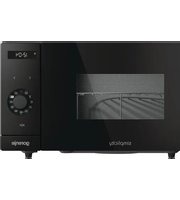
1 - Door Safety lock system 2 - Oven window 3 - Roller Ring 4 - Glass Tray 5 - Control Panel
CONTROL PANEL

1 - Timer 0-30 Minutes 2 - Power Select Control
QUICK LOOK UP GUIDE
- Place the food in the oven. Select the power level by rotating the Cooking Power Control knob.
- Select the cooking time by rotating the Timer knob.
If you want to defrost some food
- Turn the cooking power control knob to "*".
- Turn the timer knob to select the appropriate time.
Microwaves are high-frequency electromagnetic waves; the energy released enables food to be cooked or reheated without changing either the form or the color.
You can use your microwave oven to:
- Defrost
- Instant reheat
- Cook
Cooking Principle
- The microwaves generated by the magnetron are distributed uniformly as the food rotates on the turntable. The food is thus cooked evenly.
- The microwaves are absorbed by the food up to a depth of about 1 inch (2.5 cm). Cooking then continues as the heat is dissipated within the food.
- Cooking times vary according to the receptacle used and the properties of the food.
- Quantity and density.
- Water Content
- Initial temperature (refrigerated or not)
As the centre of the food is cooked by heat dissipation, cooking continues even when you have taken the food out of the oven. Standing times specified in recipes and in this booklet must therefore be respected to ensure:
- Even cooking of the food right to the centre
- The same temperature throughout the food
- Even cooking of the food right to the centre - The same temperature throughout the food
- First place a bowl of water on the turntable.
- Set the power level to high by turning Cooking Power Control knob.
- Set the time to 4-5 minutes by turning the Timer knob. The oven must be plugged into an appropriate wall socket. The turntable must be in position in the oven. If a power level other than the maximum is used, the water takes longer to boil.
WHAT TO DO IF YOU ARE IN DOUBT OR IF YOU HAVE A PROBLEM
If you experience any of the problems listed below, please try the solutions offered.
- This is normal:
Condensation in the oven. Air flow around the door and outer casing. Light reflected around the door and outer casing. Steam escaping from around the door or vents.
- The oven does not start when you turn the timer knob
Is the door completely closed? The food is not cooked at all. Have you set the timer correctly?
Is the door closed?
Have you overloaded the electric circuit and caused a fuse to blow or a circuit breaker to be triggered?
- The food is either overcooked or under-cooked. Was the appropriate cooking time set for the food? Was an appropriate power level chosen?
- Sparking and crackling occur inside the oven (arcing). Have you used a dish with metal trimmings? Have you left a fork or other metal utensil inside the oven? Is aluminium foil too close to the inside walls?
- The oven causes interference with radios or televisions. Slight interference may be observed on televisions or radios when the oven is operating. This is normal, and to solve the problem, install the oven away from televisions, radios and aerials.
| POWER LEVELS | |
| High | 100% |
| Medium High | 85% |
| Medium | 66% |
| Medium Low | 48% |
| Low | 17% |
| Defrost | 40% |
COOKING/REHEATING
The following procedure explains how to cook or reheat food. ALWAYS check your cooking settings before leaving the oven unattended.
First place the food in the centre of the turntable. Close the door.
- Set the power level to high by turning Cooking Power Control knob. (Maximum power: 700 Watt)
- Set the time by turning the Timer knob. Result: The oven light comes on and the turntable starts rotating.
You can change the power level during cooking by turning the cooking power control knob.
STOPPING THE COOKING
- To stop temporarily: Open the door. Result: Cooking stops. To resume cooking, close the door.
- To stop completely: Turn the Timer knob to "0".
ADJUSTING THE COOKING TIME
- Adjust the remaining cooking time by rotating the Timer knob.
MANUAL DEFROSTING OF FOOD
The defrost feature enables you to defrost meat, poultry, and fish. First, place the frozen food in the center of the turntable and close the door.
- Turn the Cooking Power Control knob to defrost.
- Turn the Timer knob to select the appropriate time. Result: Defrosting begins.
| COOK-WARE | MICROWAVE SAFE | COMMENTS |
| Aluminium Foil | Safe with care, see comments | Can be used in small quantities to protect area's of food against over cooking. Arcing can occur if too much foil is used or if foil is to close to oven walls |
| Browning Plate | Yes | Do not preheat for more than 8 minutes |
| China and Earthenware | Yes | Usually suitable unless decorated with a metal trim |
| Disposable Polyester and cardboard dishes | Yes | Some frozen foods are packed in these containers |
| Fast Food Packaging Polystyrene Cups Paper bags/Newspaper Recycled paper or metal trims | Yes NO NO | Can be used to warm food, but overheating may cause the polystyrene to melt May catch fire May cause arcing |
| Glassware Oven to table ware Fine Glassware Glass Jars | Yes Yes Yes | Can be used unless decorated with metal trim Delicate glass may crack if heated suddenly Must remove the lid, suitable for warming only |
| Metal dishes Freezer Bag Ties | NO NO | May cause arcing or fire May cause arcing or fire |
| Paper Plates, Cups, Napkins, Kitchen paper Recycled paper | Safe with care, see comments NO | For short cooking times and warming. Also to be used to absorb excess moisture May cause arcing |
| Plastic Containers Cling Film Freezer Bags | Yes Yes Safe with care, see comments | Heat resistant plastic the most suitable. Other plastics may warp or discolour. DO NOT USE MELAMINE. Can be used to retain moisture, should not touch the food, and care should be taken when removing. Only if boilable or oven proof, should not be airtight always prick bag with a fork. |
| Wax or Grease PROOF Paper | Yes | Can be used to prevent spattering and to retain moisture. |
The following parts of your microwave oven should be cleaned regularly to prevent grease and food particles from building up:
- Inside and outside surfaces
- Door and door seals
- Turntable and roller rings
Always ensure that the door seals are clean and the door closes properly.
- Clean the outside surfaces with a soft cloth and warm soapy water.
- Remove any splashes or stains on the inside surfaces and roller ring with a soapy cloth, rinse and dry.
- To loosen hardened food particles and remove smells, place a cup of diluted lemon juice on the turntable and heat for ten minutes at maximum power.
- Wash the dishwasher-safe glass turntable whenever necessary.
DO NOT SPILL WATER IN THE VENTS. NEVER USE ANY ABRASIVE PRODUCTS OR CHEMICAL SOLVENTS. TAKE PARTICULAR CARE WHEN CLEANING DOOR SEALS TO ENSURE THAT NO PARTICLES ACCUMULATE, PREVENTING THE DOOR FROM CLOSING PROPERLY.
Environment
Do not throw away the appliance with the normal household waste at the end of its life, but hand it in at an official collection point for recycling. By doing this, you help to preserve the environment.
Guarantee & service
If you need information or if you have a problem, please contact the Gorenje Customer Care Centre in your country (you find its phone number in the worldwide guarantee leaflet). If there is no Customer Care Centre in your country, go to your local Gorenje dealer or contact the Service department of Gorenje domestic appliances.
For personal use only!
Additional recommendations for cooking with microwave and useful advice can be found on the web site:
http://microwave.gorenje.com
gorenje
WISHES YOU A LOT OF PLEASURE WHILE USING YOUR APPLIANCE
GENERAL SAFETY INSTRUCTIONS FOR YOUR SAFETY
Noise level (Lc IEC)....< 58 dB (A)

- SPECIFICATIONS
- BEFORE YOU CALL FOR SERVICE
- RADIO INTERFERENCE
- INSTALLATION
- WARNING - THIS APPLIANCE MUST BE EARTHED
- GREEN-AND-YELLOW EARTH
- BLUE NEUTRAL
- BROWN LIVE
- IMPORTANT INSTRUCTIONS
- SAFETY INSTRUCTIONS FOR GENERAL USE
- IMPORTANT - COOKWARE NOT TO USE IN YOUR MICROWAVE OVEN
- CONTROL PANEL
- QUICK LOOK UP GUIDE
- IF YOU WANT TO DEFROST SOME FOOD
- COOKING PRINCIPLE
- WHAT TO DO IF YOU ARE IN DOUBT OR IF YOU HAVE A PROBLEM
- COOKING/REHEATING
- STOPPING THE COOKING
- ADJUSTING THE COOKING TIME
- MANUAL DEFROSTING OF FOOD
- ENVIRONMENT
- GUARANTEE & SERVICE
- GORENJE
- GENERAL SAFETY INSTRUCTIONS FOR YOUR SAFETY
Brand : GORENJE
Model : MO 20MW
Category : Microwave