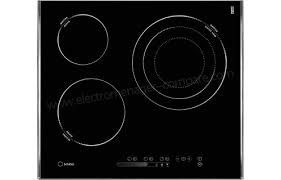
USER MANUAL TIS 633 T L S SCHOLTES
Operating Instructions
HOB
Contents
Operating Instructions,1
WARNING,2
Description of the appliance-Control Panel,6
Installation, 11
Start-up and use,13
Precautions and tips,17
Care and maintenance, 18
Technical description of the models,18
FR
François
WARNING: The appliance and its accessible parts become hot during use.
- Care should be taken to avoid touching heating elements.
- Children less than 8 years of age shall be kept away unless continuously supervised.
- This appliance can be used by children aged from 8 years and above and persons with reduced physical, sensory or mental capabilities or lack of experience and knowledge if they have been given supervision or instruction concerning use of the appliance in a safe way and understand the hazards involved. Children shall not play with the appliance. Cleaning and user maintenance shall not be made by children without supervision.
WARNING: Unattended cooking on a hob with fat or oil can be dangerous and may result in fire
- NEVER try to extinguish a fire with water, but switch off the appliance and then cover flame e.g. with a lid or a fire blanket.
WARNING: Danger of fire: do not store items on the cooking surfaces.
WARNING: If the surface in glassceramic is cracked, switch off the appliance to avoid the possibility of electric shock.
- Never use steam cleaners or pressure cleaners on the appliance.
- The appliance is not intended to be operated by means of an external timer or separate remote control system.
- Do not place metal objects (knives, spoons, pan lids, etc.) on the hob as they may become hot.
- After use, switch off the hob element by its control and do not rely on the pan detector.
FR
Français
ATTENTION!
- ATTENTION : cet apparéil ainsi que ses parties accessibles deviennent très chauds pendant leur fonctionnement.
- Il faut faire attention de ne pas toucher les éléments chauffants.
- Ne laisser s'approcher les enfants de moins de 8 ans à moins qu'ils ne soient sous surveillance constante.
- Leprésent appareliel peut être utilisé par des enfants de plus de 8 ans et par des personnes représentant des capacités physiques, sensorielles ou mentalles réduites ou n'ayant pas l'expérience ou les connaissances nécessaires, à condition qu'ils soient sous bonne surveillance ou qu'ils aient reçu les instructions nécessaires pour une'utilisation de l'articile en toute sécurité et à condition qu'ils se rendent compte des dangers encourus. Les enfants ne doivent pas jouer avec l'articile. Les opérations de nettoyage et d'entretien ne doivent pas être effectuees par des enfants non surveillés.
- ATTENTION : laisser un-scripte de cuisson contenant de l'huile ou de la graisse sur le foyer est dangereux et risque d'entrainer un incendie
- Il nè faut JAMAIS essayer d'eteindre une flamme ou un incendie avec de l'eau ! Il faut eteindre l'appareil et couvrir la flamme avec un couvercle, par exemple, ou avec une couverture anti-feu.
- ATTENTION : risque d'incendie : ne pas laisser d'objets sur les surfaces de cuisson.
- ATTENTION: si la surface vitrocéramique est fêlée, éteindre l'appareil afin d'éviter tout risque d'électrocution.
- Ne jamais nettoyer l'appareil avec des nettoyeurs vapeur ou haute pression.
- Cet apparéil ne peut pas être allumé au moyen d'un temporisateur extérieur ou d'un système de commande à distance séparé.
- Ne pas poser d'objets metalliques (couteaux, cuillères, couvercles, etc.) sur la table car ils risquent devenir brûlants.
-
Àprous utilise, éteindre la table de cuisson à l'aide de son dispositif de commande et ne pas se fier uniquement à son détecteur de casserole.
-
ATENCION: Este aparato y sus partes accesibles se calientan mucho durante el uso.
- Por lo tanto, es importante evaporar tocar los elementos calentadores.
- Mantenga alejados a los niños menos de 8 años si no soncontinuamente vigilados.
- El presente aparato pueda ser realizado por niños mayores de 8 años y por personas con capacities físicas, sensoriales o mentales disminuidas o sin experiencia ni conocimientos, si se encontrartran bajo una adecuada vigilancia o si han sido instruidos sobre el uso del aparato de todo seguro y comprenden lospeligos relacionados con el本身就是. Los niños no deben hacer para el aparato. Las operaciones de limpieza y de mantenerimiento no deben ser realizadas por niños sin vigilancia.
- ATENCLION: Dejar un quemador con grasas o aceites sin vigilancia pueda ser peligioso y provocar un incendio.
- NUNCA intente apagar una llama/ incendio con agua, se debe apagar el aparato y cubrir la llama, por ejempo, con una tapa o con una manta ignífuga.
- ATENCION: Riesgo de incendio: no deje objetos sobre las superficies de cocción.
- ATENCLION: Si la superficie de vitroceramica está agrietada, apague el aparato para evaporar SACUDidas electricas.
- No utilise nunca limpiadores a vapor o de alta presión para la limpieza del aparato.
- El aparato no se debeponer en functionamento atramés de un temporizador externo o de un sistemas de mando a distancia.
- No coloque objetos metálicos (cuchillos, cucharas, cubiertos, etc.) sobre la placà de coccción porqueSEOSEOSEOSEOSEOSEOSEOSEOSEOSEOSEOSEOSEOSEOSEOSEOSEOSEOSEOSEOSEOSEOSEOSEOSEOSEOSEOSEOSEOSEOSEOSEOSEOSEOSEOSEOSEOSEOSEOSEOSEOSEOSEOSEOSEOSEOSEOSEOSEOSEOSEOSEOSEOSEOSEOSEOSEOSEOSEOSEOSEOSEOSEOSEOSEOSEOSEOSEOSEOSEOSEOSEOSEOSEOSEOSEOSEOSEOSEOSEOSEOSEOSEOSEOSEOSEOSEOSEOSEOSEOSEOSEOSEOSEOSEOSEOSEOSEOSEOSEO SEOE
-
Después del uso apague la placado coccción realizando su mando y noonga en cuenta el detector de ollas.
-
ATENÇÃO: Este aparecido e as suas partes acesseis aquecem muito durante a UTILização.
- É preciso ter atençao e evaporar tocar os elementos que aquecem.
- Manter afastadas as 'criancies com menos de 8 anos, caso não esteejam a ser vigiadas.
- O presente aparélhô pode ser realizado por crianças com mais de 8 anos e por pessoas com capacidades físicas, sensoriais ou mentalais reduzidas ou com pouca experiência e conheçimentos, caso sejam adequamente vigiadas ou caso tenham recebido instruções em relação ao uso do aparélhô de forma segura e tenham conheçimento dos perigos associados. As crianças não devem brincar com o aparélhô. As operações de limpeza e manutenção não devem ser effectuadas por crianças sem vigilância.
- ATENÇAÇO: Deixar um fogão com gordura e oleo sem vigilência pode ser perigoso e provocar um incêndio.
- NUNCA tente apagar as chamas com agua. E necessário desligar o aparelho e cobrir as chamas com uma tampa ou com uma manta ignífuga.
- ATENÇA O: Risco de incência: não deixe objects sobre as superfícies de cozedura.
- ATENÇAO: Se a superficie vitrocérâmica estiver rachada, désigne o aparelho para evitar a possibíidade de Choques electricos.
- Nunca utilize equipamento de limpeza a vapor ou de alta pressão para limpar o aparelho.
- O aparecido não é destinado a ser colocado em funçãoamento por meio de um temporizador externo ou por umsystema de commando à distência separado.
- NãoAPOIEobjectosmetálicos (facas, colheres, tampas, etc.) sobre o plano porque pode fazer quentes.
- Depois do uso, deslgue o plano de cozedura atraves do seu disposicao de commando e não confie no detector de panelas.
Description of the appliance Control panel
The control panel described in this manual is only a representative example: it may not exactly match the panelon your appliance.
- "SLIDER" ZONE - switches the hotplate on/off or adjusts its power level (see Start-up and use).
2 COOKING ZONE indicator represents the corresponding cooking zone.
3 POWER indicator provides a visual display for the current heat level.
4 ON/OFF button switches the appliance on and off.
5 ON/OFF indicator light shows whether the appliance is on or off.
6 PROGRAMME TIMER button controls the cooking programme times (see Start-up and use).
7 PROGRAMME TIMER display shows which programme has been selected (see Start-up and use).
8 COOKING ZONE PROGRAMMED indicator lights show which cooking zones are being used during a cooking programme (see Start-up and use).
9 CONTROL PANEL LOCK button prevents accidental changes to the hob settings (see Start-up and use).
10 CONTROL PANEL LOCK indicator light shows the control panel has been locked (see Start-up and use).
11 BOOSTER button activates the booster function - 3000 W - of the cooking zone (see Start-up and use).
12 BOOSTER indicator light shows that the booster function has been activated.
13 TIMER indicator light shows that the timer has been activated
14 MAX BUTTON - switches the cooking zone on at its maximum power level 16 (see Start-up and use).
15 MED BUTTON - switches the cooking zone on at its medium power level 8 (see Start-up and use).
16 MIN BUTTON - switches the cooking zone on at its minimum power level 1 (see Start-up and use).
17 INCREASE TIME* button increases the cooking duration while the timer is running or while a set programme is underway (see Start-up and use).
18 DECREASE TIME* button decreases the cooking duration while the timer is running or while a set programme is underway (see Start-up and use).
! This product complies with the requirements of the atest European Directive on the limitation of power consumption of the standby mode. If no operations are carried out for a period of 2 minutes, after the residual heat indicator lights turn off and the fan stops (if present), the appliance automatically switches to the .off mode.. The appliance resumes the operating mode once the ON/OFF button is pressed.
* Only available in certain models.
FR
4 KhoNka ON/OFF (BKJI./BbIKJ.) cnyknt dIy BKJIIOHeHn I BBIKJIIOHeHn n3JeJIy.
5 INHnKaTOp ON/OFF (BKJ./BbIKJ)IOKa3bIbAET COCTOHNHe N3dJIIN, BKJIIOUeHO JIN BbIKJIIOUeHO.
6 KhoNka TANMEP PPOPGAMMPOBAHNA* cnyknt dna HacTroPOnKn npoDoJnxTeJIbHOCTn npriroTOBJeHnra (CM. BKnIOeHue u 3Kcnpnyamaua).
7ДиспгEN TANMEPA ПОPGPAMMIOBAHNA*: poka3bIbaeТ ра3ЛИЧье HabTPOKN nporpaMMIOBAHNA (cM.Вкнчehue u экрлуamaцura).
8 INHnKaTOpbI 3APoPramMPOBAHHbIE BAPOUHbIE 3OHbl*: noka3bIBaHT BapOuHbI 30HbI nocJe 3anycka nporpamMPOBaHnra (cm. BkNoeHue u 3Kcnnyamaua).
9 KhoNka BLOKIOBKA YNPABLEHIN cIyXnT dJIa 3aIITbI ynpabLeHIN BapOCHn nAHeJN OT cIyuaHbIX n3MHeHIn (cM. BKnIOeHue u 3KcNpyamaucu).
10INHdNkaTOp YNPABLHeHn 3A6JLOKnPOBAHbI noka3bIbaeT,чTO ynpabLeHn 3a6JIOKnPOBaHbI (CM. BkIouehue u 3KcPnyamauia).
11 KhoNka BOOSTER* cIyKNT dIЯ BkJIIOueHnI yOJINHTeJIbHOrO 3JIeKTPoPITaHnI - 3000 Bt - INdYkuINHOHoi KOHΦOpKn (cM. BkJIIOueHue u 3KcNpyamaua).
12 INHnKaTOp BOOSTER* noka3bIbaeT, YTO fynKcna BOJIbToO6abOuHOrO yCTpoNCTBa BkNIOUyeHa.
13INnKaTOp TANMEP* noka3bBaet, YTO TaNMeP BkJIuOHeN
14KHONKA MAKC -ДЯВКЛЮЧЕНВарочн 30ны МамсмальHom уровHe моцноCTn 16 (cM. Включени n эКСПЛУТацnia).
15 KHOPIKA CPEI. -ДЯ ВКПЮЧЕНИ BAPОHо 3Oны Na cpeД hem ypoBHe moUHOCtN 8 (cM. BkPJOUeHne n 3KcPJIpyatauia).
16KHONKA MNH.-ДЯВКЛЮЧЕНЯ BAPOUHÖN 3Oны Ha MHNIMaJIbHOM yPOBHe MOUHOCTe 1 (cM. BKJIQUCHENE i 3KcPJIyatauNA).
17KhoNka YBENEHNE BPEMEHN* cnyknt nIy yBeJIuHnRApeHn B npOceCse paObI TaMepa IIN npOrpAMMbI (cM. BKnIOUeHue u 3KcnIpyamaucu)
18KhoPiKa UMEHbUeHne BPEMeHN* CnyxNt dIy UmeHbUeHnBpeMeHn B npOceCpe paObTb TaMepa IIN npOrpAmMbI (cM. BKnIOueHue u 3KcnPyamaucu).
!ДанhoeиздениOTBeuaETTre6OBaHnMHOBOI EbponeckoДиpeKTINBbI NOOrpaHnueHnIO 3Hepronotpe6JIeHnB pexime3Heproc6epeKeHnI.
EcnB TeueHne 2-x MNHyT He npOn3BOoNTcra HnKaKnx DeiCTBn IocJIe BbIKIooHnRAHdNKaTOPOB OCTaTOOHOro TEnJa N BeHTNJrToPA (ecn OHn npNCyTCTByOT), n3deJIne aBTOMaTHueCKn NepeXoJNT B pexIM «BbIKJ.»
Bo3Bpar n3dieny B pa6oyn pexim npou3BOUntc KhoNko BKJ./BbIKJ.
* IMeETcT TOJIbKO B HeKOTOpbIX MoJeJIAx.
! Before operating your new appliance please read this instruction booklet carefully. It contains important information concerning the safe operation, installation and maintenance of the appliance.
! Please keep these operating instructions for future reference. Pass them on to any new owners of the appliance.
Positioning
! Keep all packaging material out of the reach of children. It may present a choking or suffocation hazard (see Precautions and tips).
! The appliance must be installed by a qualified professional in accordance with the instructions provided. Incorrect installation may cause harm to people and animals or may damage property.
Built-in appliance
Use a suitable cabinet to ensure that the appliance functions properly.
- The supporting surface must be heat-resistant up to a temperature of approximately 100°C .
- If the appliance is to be installed above an oven, the oven must be equipped with a forced ventilation cooling system.
- Avoid installing the hob above a dishwasher: if this cannot be avoided, place a waterproof separation device between the two appliances.
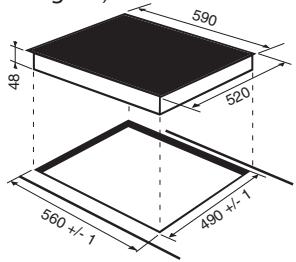
- Depending on the hob you want to install, the cabinet must have the following dimensions (see figure):
Ventilation
To allow adequate ventilation and to avoid overheating of the surrounding surfaces the hob should be positioned as follows:
- At a minimum distance of 40 mm from the back panel or any other vertical surfaces.
- So that a minimum distance of 20 mm is maintained between the installation cavity and the cabinet underneath.
- Kitchen cabinets adjacent to the appliance and taller than the top of the hob must be at least 600mm from the edge of the hob.



Fixing
The appliance must be installed on a perfectly level supporting surface.
Any deformities caused by improper fixing could affect the features and operation of the hob.
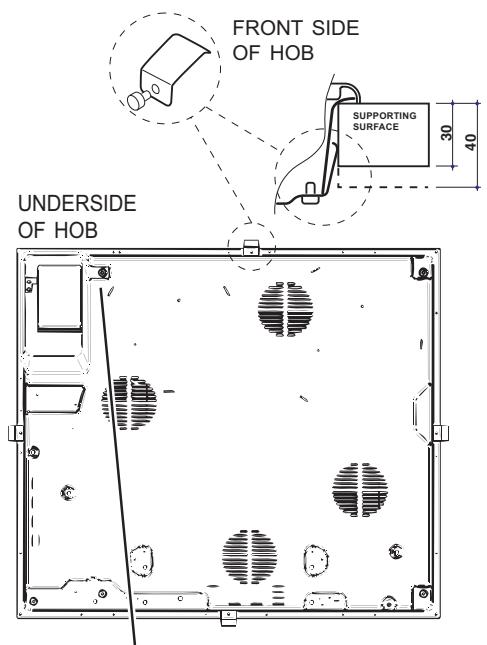
The thickness of the supporting surface should be taken into account when choosing the length of the screws for the fixing hooks:
- 30 mm thick: 23 mm screws
- 40 mm thick: 13 mm screws
Fix the hob as follows:
- Use short flat-bottomed screws to fix the 4 alignment springs in the holes provided at the central point of each side of the hob.
- Place the hob in the cavity, make sure it is in a central position and push down on the whole perimeter until the hob is stuck to the supporting surface.
- For hobs with raised sides: After inserting the hob into its cavity, insert the 4 fixing hooks (each has its own pin) into the lower edges of the hob, using the long pointed screws to fix them in place, until the glass is stuck to the supporting surface.
! The screws for the alignment springs must remain accessible.
! In order to adhere to safety standards, the appliance must not come into contact with electrical parts once it has been installed.
! All parts which ensure the safe operation of the appliance must not be removable without the aid of a tool.
Electrical connection
! The electrical connection for the hob and for any built-in oven must be carried out separately, both for safety purposes and to make extracting the oven easier.
Single-phase connection
The hob is equipped with a pre-connected electricity supply cable, which is designed for single-phase connection. Connect the wires in accordance with the instructions given in the following table and diagrams:
| Voltage and mains frequency | Electrical cable | Wire connection |
| 220-240V 1+N ~ 50 Hz | N L | 1 : yellow/green
N: the two blue wires together
L: brown and black together |
Other types of connection
If the mains supply corresponds with one of the following:
Voltage and mains frequency
-
400V - 2+N ~ 50 Hz
-
220-240V 3 ~ 50 Hz
- 400V 3 - N ~ 50 Hz
- 400V - 2+2N ~ 50 Hz
Separate the wires and connect them in accordance with the instructions given in the following table and diagrams:
| Voltage and mains frequency | Electrical cable | Wire connection |
| 400V - 2+N ~ 50 Hz | N L1 L2 | 1: yellow/green;
N: the two blue wires together
L1: black
L2: brown |
| 220-240V 3 ~ 50 Hz |
| 400V 3-N ~ 50 Hz |
| 400V - 2+2N ~ 50 Hz | N1 N2 L1 L2 | 1: yellow/green;
N1: blue
N2: blue
L1: black
L2: brown |
Connecting the electricity supply cable to the mains If the appliance is being connected directly to the electricity mains an omnipolar switch must be installed with a minimum opening of 3mm between contacts.
! The installer must ensure that the correct electrical connection has been made and that it is fully compliant with safety regulations.
Before connecting the appliance to the power supply, make sure that:
- The appliance is earthed and the plug is compliant with the law.
- The socket can withstand the maximum power of the appliance, which is indicated on the data plate located on the appliance itself.
- The voltage falls within the range of values indicated on the data plate.
- The socket is compatible with the plug of the appliance. If the socket is incompatible with the plug, ask an authorised technician to replace it. Do not use extension cords or multiple sockets.
! Once the appliance has been installed, the power supply cable and the electrical socket must be easily accessible.
! The cable must not be bent or compressed.
! The cable must be checked regularly and replaced by authorised technicians only.
! The manufacturer declines any liability should these safety measures not be observed.
! Do not remove or replace the power supply cable for any reason. Its removal or replacement will void the warranty and the CE marking. INDESIT does not assume liability for accidents or damage arising from replacement/removal of the original power supply cable. Replacement can only be accepted when carried out by personnel authorised by INDESIT and using an original spare part.
! The glue applied on the gaskets leaves traces of grease on the glass. Before using the appliance, we recommend you remove these with a special non-abrasive cleaning product. During the first few hours of use there may be a smell of rubber which will disappear very quickly.
! A few seconds after the hob is connected to the electricity supply, a buzzer will sound. The hob may now be switched on.
Types of noise during normal hob operation:
- Buzz: due to the vibration of the metallic parts that make up the induction element and the pot; it is generated by the electromagnetic field required for heating and increases as the power of the induction element increases.
- Soft whistle: heard when the pot placed on the heating zone is empty; the noise disappears once food or water is placed into the pot.
- Crackle: produced by the vibration of materials on the bottom of the pot due to the flow of parasitic currents caused by electromagnetic fields (induction); can be more or less intense depending on the material making up the bottom of the pot, and decreases as the pot dimensions increase.
- Loud whistle: heard when two induction elements of the same group function simultaneously at maximum power and/or when the booster function is set on the larger element while the other is auto-adjusted. Noise is reduced by decreasing the power level of the auto-adjusted induction element; pot bottom layers made of different kinds of materials are among the main causes of this noise.
- Fan noise: a fan is necessary to ensure the hob functions correctly and to safeguard the electronic unit from possible overheating. The fan functions at maximum power when the large induction element is at maximum power or when the booster function is on; in all other cases, it works at average power depending on the temperature detected. Furthermore, the fan may continue to work even after switching the hob off, if the temperature detected is high.
The types of noise listed above are due to induction technology and are not necessarily operational faults.
Switching on the hob
To switch the hob on, press and hold the button for approximately one second.
- Only available in certain models.
Switching on the cooking zones
To operate a cooking zone, select the button corresponding to the desired zone and set the required power level by pressing down on the slider and moving it towards the right to increase the power level, or towards the left to decrease the power level.
The min/med/max buttons can also be pressed directly to select the pre-set power levels: min (1) / med (8) / max (16), and to switch off the plate (see below).
MIN/MED/MAX functions
Press the MED button to switch on the cooking zone at medium power level 8.
Press the MIN button to switch on the cooking zone at minimum power level 1.
Press the MAX button to switch on the cooking zone at maximum power level 16.
Booster function*
The booster function for some of the cooking zones may be used to shorten heating-up times. It may be activated
by pressing the button. The indicator light directly above the button will illuminate. This function boosts the power to 2000 W or 3000 W, depending on the size of the corresponding cooking zone.
It stops automatically after 4 minutes. While the booster for one of the cooking zones is active, the corresponding front or rear cooking zone will operate at a reduced power level (e.g. if the booster for the rear left-hand hotplate has been activated, the power level of the front left-hand hotplate will be reduced).
For further information, please refer to the Technical description of the models.
Switching off the cooking zones
To switch off the hotplate, select the button corresponding to the desired zone, moving the slider towards the left to return to level 0, or press the Off button on the slider control directly.
! The first time the slider is pressed, a short beep will sound to acknowledge the touch. If - and only if - the power level is adjusted, another short beep will sound when the slider is released.
! The hotplate selection LEDs light up for the power adjustment period (10 seconds), during which the slider (or min/med/max buttons)* can influence the selected hotplate.
Programming the cooking duration
! If the → and + buttons are pressed for an extended period of time, the timer scrolls quickly through the minute values in the corresponding direction.
! All the cooking zones may be programmed simultaneously, for a duration between 1 and 99 minutes.
- Select the cooking zone using the corresponding selector button.
- Adjust the power level of the cooking zone.
- Press the programming button. The indicator light corresponding to the selected zone will start flashing.
- Set the cooking duration using the - and + buttons.
- Confirm by pressing the button or automatic selection occurs after 10 seconds.
The timer begins counting down immediately. A buzzer sounds for approximately 1 minute and the cooking zone switches off when the set programme has finished.
Repeat the above procedure for each hotplate you wish to programme.

Using multiple programmes and the display
If one or more hotplates are programmed, the display will show the data for the hotplate with the least time remaining, and the light corresponding to the position of the hotplate will flash. The lights corresponding to the other hotplates programmed will be switched on.
To visualise the time remaining for the other programmed
hotplates, press the button repeatedly: the time remaining for each hotplate will be shown sequentially in a clockwise order, starting from the front left hotplate.
Changing the programme
- Press the button repeatedly until the duration you wish to change is shown.
- Use the buttons to set the new duration.
- Confirm by pressing the button.
To cancel a programme, follow the above instructions.
At step 2, press the button: the duration decreases
progressively until it reaches 0 and switches off. The programme resets and the display exits programming mode.
Timer
The hob must be switched on.
The timer can be used to set a duration up to 99 minutes.
- Press the programming button until the timer
indicator light is illuminated
- Set the desired duration using the 12 and + buttons.
- Confirm by pressing the button.
The timer begins counting down immediately. When the time has elapsed, a buzzer will sound (for one minute).
Control panel lock
When the hob is switched on, it is possible to lock the oven controls in order to avoid accidental changes being made to the settings (by children, during cleaning, etc.). Press
the button to lock the control panel: the indicator light above the button will switch on.
To use any of the controls (e.g. to stop cooking), you
must switch off this function. Press the button for a few moments, the indicator light will switch off and the lock function will be removed.
Switching off the hob
Press the button ① to switch off the appliance - do not rely solely on the pan sensor.
If the control panel lock has been activated, the controls will continue to be locked even after the hob is switched on again. In order to switch the hob on again, you must first remove the lock function.
"Demo" mode
It is possible to set the hob to a demonstration mode where all the controls work normally but the heating elements do not switch on. To activate the "demo" mode the hob must be switched on, with all the hotplates switched off.
- Press and hold the + and - buttons simultaneously for 6 seconds. When the 6 seconds have elapsed, the ON/OFF and CONTROLS LOCKED indicator
lights will flash for one second. Release the + and
To exit this mode, follow the procedure described above. The display will show the text DE and OF and the hob will be switched off. When it is next switched on, the hob will function normally.
Practical advice on using the appliance
! Use cookware made from materials which are compatible with the induction principle (ferromagnetic material). We especially recommend pans made from: cast iron, coated steel or special stainless steel adapted for induction. Use a magnet to test the compatibility of the cookware.
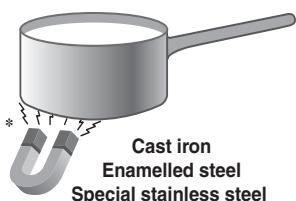
SUITABLE
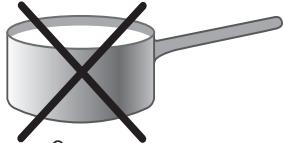
UNsuitABLE
Aluminium, Glass, Earthenware, Ceramic, non magnetic Stainless steel
In addition, to obtain the best results from your hob:
- Use pans with a thick, flat base in order to fully utilise the cooking zone.


- Always use pans with a diameter which is large enough to cover the hotplate fully, in order to use all the available heat.
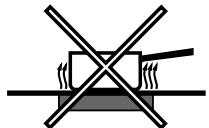


- Make sure that the base of the cookware is always clean and dry, in order to fully utilise and extend the life of both the cooking zones and the cookware.
- Avoid using the same cookware which has been used on gas burners: the heat concentration on gas burners may distort the base of the pan, causing it not to adhere correctly.
Safety devices
Pan sensor
Each cooking zone is equipped with a pan sensor device. The hotplate only emits heat when a pan with suitable measurements for the cooking zone is placed on it. If the power level indicator display flashes, this may be because:
Overheating protection
If the electronic elements overheat, the hob switches off
automatically and F appears on the display, followed by a flashing number. When the temperature has reached a suitable level, this message disappears and the hob may be used again.
Safety switch
The appliance has a safety switch which automatically switches the cooking zones off after they have been in operation for a certain amount of time at a particular power level. When the safety switch has been triggered, the display shows "0".
For example: the rear right-hand hotplate is set to 5 and will switch off after 7 and a half hours of continuous operation, while the front left-hand hotplate is set to 2 and will switch off after 9 and a half hours.
| Power level | Maximum operating time in hours |
| 1 | 10 |
| 2 | 9,5 |
| 3 | 9 |
| 4 | 8,5 |
| 5 | 7,5 |
| 6 | 7 |
| 7 | 6,5 |
| 8 | 6 |
| 9 | 5,5 |
| 10 | 5 |
| 11 | 4 |
| 12 | 3,5 |
| 13 | 3 |
| 14 | 2,5 |
| 15 | 2 |
| 16 | 1 |
Buzzer
This can also indicate several irregularities:
- An object (a pan, cutlery, etc.) has been placed on the control panel for more than 10 seconds.
- Something has been spilt on the control panel.
- A button has been pressed for too long. All of the above situations may cause the buzzer to sound. Remove the cause of the malfunction to stop the buzzer. If the cause of the problem is not removed, the buzzer will keep sounding and the hob will switch off.
Practical cooking advice
| Very high-flame cooking | 32 | Pressure cooking
Pressure cooker | Frying |
| Grilling | Boiling |
| High-flame
cooking | 32 | Crépes | Cooking on a high flame and browning
(roasts, steaks, escalopes, fish fillets, fried eggs) |
| Medium-flame cooking | 9 | Fast thickening (liquid juices)
Boiling water (pasta, rice, vegetables)
Milk | |
| 8 | Slow thickening (dense juices) | |
| 7 | Bain-marie cooking | Pressure cooking after whistle |
| Low-flame
cooking | 6 | Low-flame cooking (stews) | Reheating dishes |
| Very
low-flame
cooking | - | Chocolate sauce | Keeping food hot |
! This appliance has been designed and manufactured in compliance with international safety standards. The following warnings are provided for safety reasons and must be read carefully.
This appliance conforms to the following European Economic Community directives:
- 2006/95/EEC dated 12/12/06 (Low Voltage) and subsequent amendments;
- 2004/108/EEC dated 15/12/04 (Electromagnetic Compatibility) and subsequent amendments;
- 93/68/EEC dated 22/07/93 and subsequent amendments.
- 1275/2008 stand-by/off mode.
General safety
! Make sure that the air inlet behind the fan grille is never obstructed. The built-in hob should, in fact, be provided with suitable ventilation for the cooling of the electronic components used in the appliance.
! We advise against the installation of an induction hob above an under-the-counter refrigerator (heat) or above a washing machine (vibrations). In fact, there would be insufficient space for the ventilation of electronic components.
- The appliance was designed for domestic use inside the home and is not intended for commercial or industrial use.
- The appliance must not be installed outdoors, even in covered areas. It is extremely dangerous to leave the appliance exposed to rain and storms.
- Do not touch the appliance when barefoot or with wet or damp hands and feet.
- The appliance must be used by adults only for the preparation of food, in accordance with the instructions provided in this booklet. Do not use the hob as a worktop or chopping board.
- The glass ceramic hob is resistant to mechanical shocks, but it may crack (or even break) if hit with a sharp object such as a tool. If this happens, disconnect the appliance from the electricity mains immediately and contact a Service Centre.
- Ensure that power supply cables of other electrical appliances do not come into contact with the hot parts of the hob.
- Remember that the cooking zones remain relatively hot for at least thirty minutes after they have been switched off. An indicator light provides a warning when residual heat is present (see Start-up and use).
- Keep any object which could melt away from the hob, for example plastic and aluminium objects, or products with a high sugar content. Be especially careful when using plastic film and aluminium foil or packaging: if placed on surfaces which are still hot, they may cause serious damage to the hob.
- Always make sure that pan handles are turned towards the centre of the hob in order to avoid accidental burns.
- When unplugging the appliance, always pull the plug from the mains socket; do not pull on the cable.
- Never perform any cleaning or maintenance work without having disconnected the appliance from the electricity mains.
- The appliance should not be operated by people (including children) with reduced physical, sensory or mental capacities, by inexperienced individuals or by anyone who is not familiar with the product. These individuals should, at the very least, be supervised by someone who assumes responsibility for their safety or receive preliminary instructions relating to the operation of the appliance.
- For the attention of wearers of pacemakers or other active implants:
The hob complies with all current standards on electromagnetic interference.
Your induction hob is therefore perfectly in keeping with legal requirements (89/336/CEE directives). It is designed not to create interference on any other electrical apparatus being used on condition that the apparatus in question also complies with this legislation.
Your induction hob generates short-range magnetic fields.
To avoid any interference between your induction hob and a pacemaker, the latter must be designed to comply with relevant regulations.
In this respect, we can only guarantee our own product conformity. Please consult the pacemaker manufacturer or your doctor concerning its conformity or any possible incompatibility.
- Do not let children play with the appliance.
- Do not place metal objects (knives, spoons, pan lids, etc.) on the hob as they may become hot..
- The appliance is not intended to be operated by means of an external timer or separate remote-control system.

Disposal
- When disposing of packaging material: observe local legislation so that the packaging may be reused.
- The European Directive 2002/96/EC relating to Waste Electrical and Electronic Equipment (WEEE) states that household appliances should not be disposed of using the normal solid urban waste cycle. Exhausted appliances should be collected separately in order to optimise the cost of re-using and recycling the materials inside the machine, while preventing potential damage to the atmosphere and to public health. The crossed-out dustbin is marked on all products to remind the owner of their obligations regarding separated waste collection. For further information relating to the correct disposal of exhausted household appliances, owners may contact the public service provided or their local dealer.
Care and maintenance
GB
Switching the appliance off
Disconnect your appliance from the electricity supply before carrying out any work on it.
Cleaning the appliance
! Do not use abrasive or corrosive detergents (for example, products in spray cans for cleaning barbecues and ovens), stain removers, anti-rust products, powder detergents or sponges with abrasive surfaces: these may scratch the surface beyond repair.
! Never use steam cleaners or pressure cleaners on the appliance.
- It is usually sufficient simply to wash the hob using a damp sponge and dry it with absorbent kitchen towel.
- If the hob is particularly dirty, rub it with a special glass ceramic cleaning product, then rinse well and dry thoroughly.
- To remove more stubborn dirt, use the scraper provided. Remove spills as soon as possible, without waiting for the appliance to cool, to avoid residues forming crusty deposits. You can obtain excellent results by using a rust-proof steel wire sponge - specifically designed for glass ceramic surfaces - soaked in soapy water.
The scraper provided is sharp: be careful when using it.
- If any plastic or sugary substances are accidentally melted on the hob, remove them immediately with the scraper, while the surface is still hot.
- Once it is clean, the hob may be treated with a special protective maintenance product: the invisible film left by this product protects the surface from drips during cooking. This maintenance task should be carried out while the appliance is warm (not hot) or cold.
- Always remember to rinse the appliance well with clean water and dry it thoroughly: residues can become encrusted during subsequent cooking processes.
Stainless steel frame (only in models with outer frame)
Stainless steel can be marked by hard water which has been left on the surface for a long time, or by cleaning products containing phosphorus.
After cleaning, it is advisable to rinse the surface well and dry it thoroughly. If water is spilt on the surface, dry it quickly and thoroughly.
! Some hobs have an aluminium frame which is similar to stainless steel. Do not use any cleaning or degreasing products which are not suitable for use with aluminium.
Disassembling the hob
If it is necessary to disassemble the hob:
- Loosen the screws fixing the alignment springs on each side.
- Loosen the screws holding the fixing hooks in each corner.
- Take the hob out of its installation cavity.
! Do not attempt to repair the appliance yourself. If the appliance breaks down, contact a Service Centre.
Technical description of the models
The induction system is the quickest existing way of cooking. Unlike traditional hotplates where the cooking zone heats up, with the induction system heat is generated directly inside pans which have ferromagnetic bases.
Key:
I = single induction cooking zone
B = booster: the power of the cooking zone may be boosted to 3000 W
* = the maximum power level is limited while the booster is activated for the relevant rear cooking zone (see Start-up and use).
| Hobs | TIS 633 T L S |
| Cooking zone | Power (W) |
| Back Left | 1 1400 – B 2000* – 600 se Front. Left* |
| Back Right | 1 3000 – B 4000 |
| Front Left | 1 2200 – B 3000* – 1600 se Back. Left* |
| Total power | 7600 |
Detection de recipient
Acender as zonas de cozedura
Desligar as zonas de cozedura
IporpaMMnpoBaHne IpoIoJXHTeJIbHOCTN npiroTOBJIeHnA
!IINTeHoe HaxaTne KHOJOK + nno3BOJAre 6bICTpo CMeHrMbMHyTb TaMepa.
3BykoBaCnHaJIaIaIaIaIaIaIaIaIaIaIaIaIaIaIaIaIaIaIaIaIaIaIaIaIaIaIaIaIaIaIaIaIaIaIaIaIaIaIaIaIaIaIaIaIaIaIaIaIaIaIa
HekotopbIe HEnCpapBHOCTN TAKMe KaK:
Kakoi-JinboIpeImeT (nocya, cToIOBbIn npi6Op n.T.D.) HaxoJntcB 30He ynpaBHeHm 6oJIee 10 cekyHd.
- yTKeKa XnDkoCTn Ha 3OHy ynpaBJIeHIN;
ПИДПITeJIbHOM HaKaTnHa KhoNkIy MOKET BKNIOUHTbc3ByKOBOu CInHaJI. YcTpahnte PpUChHy HeNCnPabHOCTnДЯrTaSeHnA 3ByKOBOu CInHaIN3aCm. EcJnPpUHaHeNCnPabHOCTn He6yJeT yCTpaHeHa, 3ByKOBOu CInHaJI He racNTcA, I BapOchna NaHeJI BbIKJIHOuaTeC.
IpaKTHueckne COBeTbI NO pRnroTOBJIeHIO 6JIUD