
IAN 290723 - Board game Playtive - Free user manual and instructions
Find the device manual for free IAN 290723 Playtive in PDF.


| Product Type | Children's Activity Toy |
| Brand | Playtive |
| Model | IAN 290723 |
| Dimensions | Approx. 30 x 20 x 10 cm |
| Weight | Approx. 0.5 kg |
| Power Source | 2 x AA batteries (not included) |
| Recommended Age | 3+ years |
| Material | Plastic |
| Color | Multicolor |
| Main Functions | Interactive play, sound effects, motorized movement |
| Assembly Required | Yes, simple assembly with included tools |
| Cleaning | Wipe with a damp cloth, do not immerse in water |
| Safety Warnings | Contains small parts, choking hazard, use under adult supervision |
| Spare Parts | Contact Playtive customer service |
| Repairability | Limited, replace batteries and accessible parts |
Frequently Asked Questions - IAN 290723 Playtive
User questions about IAN 290723 Playtive
0 question about this device. Answer the ones you know or ask your own.
Ask a new question about this device
Download the instructions for your Board game in PDF format for free! Find your manual IAN 290723 - Playtive and take your electronic device back in hand. On this page are published all the documents necessary for the use of your device. IAN 290723 by Playtive.
USER MANUAL IAN 290723 Playtive
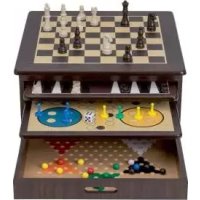
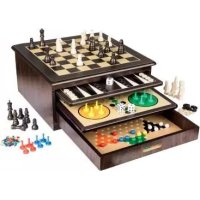
10-IN-1 GAME COMPENDIUM
GB CY
10-IN-1 GAME COMPENDIUM
Instructions for use
RO
COLECTIE DE JOCURI 10 ÎN 1
Safety instructions 4
Chess 4-6
Draughts 6
Backgammon 6-8
(Peg) Solitaire 8
Noughts and crosses 8-9
Mancala 9
Chinese chequers 9-10
Snakes and ladders 10
Ludo 10-11
Pass out 11
Storage, cleaning 11
Disposal 11
Notes on the guarantee and service handling 11
RO
With your purchase you have decided on a high-quality product. Get to know the product before you start to use it.
Carefully read the following instructions for use.
Use the product only as described and only for the given areas of application. Keep these instructions safe. When passing the product on to a third party, always make sure that the documentation is included.
Scope of delivery
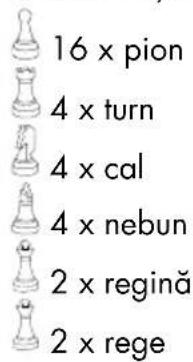
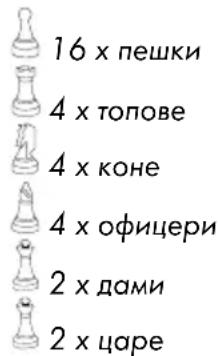
32 x Playing pieces
60 x Marbles
16 x Play figures
32 x Chess pieces
48 x Mancala pieces
2 x Dice
1 x Doubling cube
1 x Rules for the following games: chess, draughts, backgammon, mancala, noughts and crosses, Chinese chequers, snakes and ladders, ludo, (peg) solitaire, pass out
1 x Instructions for use
Correct use
This product is designed for 1-6 players aged 5 and above and for private use only.
Symbols used

Date of manufacture (month/year): 2017

Safety instructions
- Caution! Not suitable for children under 36 months. Choking hazard - contains small parts.
- Caution! Neither the packaging and mounting materials nor the 'SUPER DRY' pouch are a constituent part of the toy and they must be removed in all cases before the article is given to children to play with.
• Children may play with this article only under adult supervision.
Chess
Strategic board game for 2 players
Equipment
Board
16 pieces dark/16 pieces light
Objective of the game
The aim of the game is to beat the opposing king - to checkmate him.
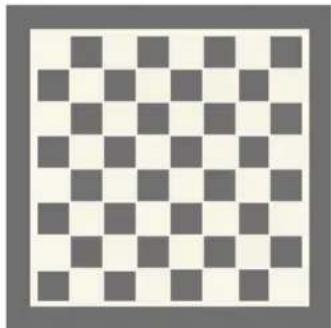

Set up positions

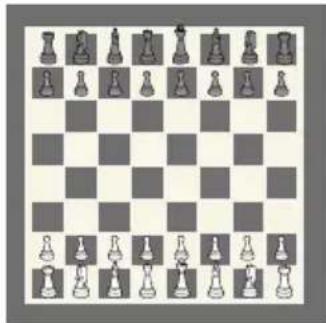
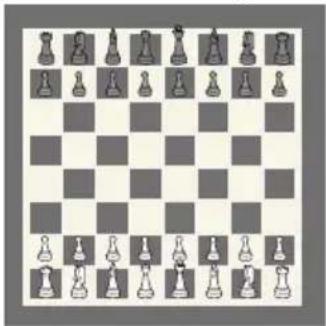
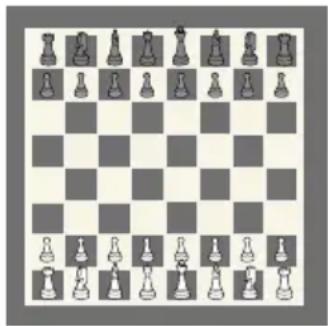
Each player has 8 pawns, two castles, two knights, two bishops, one queen, and one king.
- Place the chess pieces in their starting positions (see illustration).
Note: The board is placed between the players in such a way that the left white castle is on a black square. - The player with the white pieces starts. Only one piece may be moved on each turn.
Note: The 'castling' move is an exception (see 'Castling'). - Move the chess pieces according to their movement rules. If one player moves his or her piece onto a square that is occupied by an opposition piece then this is captured.
- The piece is removed from the board.
Moving the chess pieces
Castle

The castle can only be moved horizontally or vertically. It is not possible to jump over other pieces.
Bishop

The bishop moves diagonally across the board and cannot jump over other pieces.
Queen

The queen is the piece with the greatest freedom of movement. It can be moved horizontally, vertically and diagonally. However it cannot jump over other pieces either.
King

The king can be moved one square in any direction as long as the landing square is not occupied or threatened by an opposition piece.
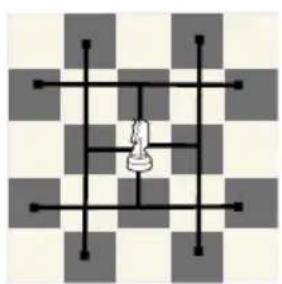
Knight

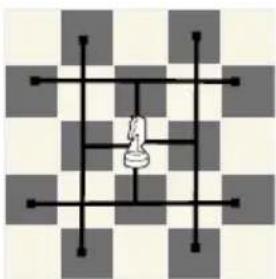
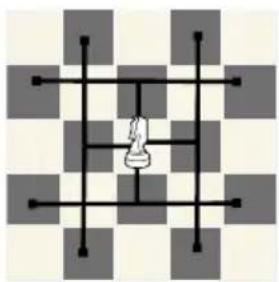
The knight moves two squares vertically or horizontally and one square to the left or right. The knight is the only figure that can jump over other pieces (occupied squares).
Pawn
The pawn can only ever move one square straight forwards.
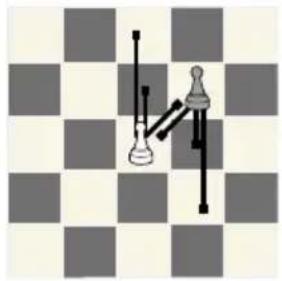
Note: This is different if you are taking an opposition piece with a pawn. If a square diagonally to the left or right is occupied by an opposition piece then the pawn can take this piece diagonally.
The pawn can also make the following special moves:
Double move
When a pawn is moved for the first time it can be moved forwards two spaces. Neither of the squares may be occupied.
En passant capture
This move is only permitted immediately following a double move.
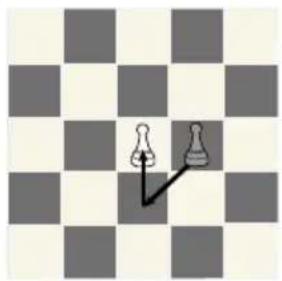
If a player has carried out a double move directly next to an opposition pawn then he or she can move the pawn horizontally behind the pawn that has been moved two squares and thus capture it 'en passant'.
Promotion on a pawn
If a player succeeds in moving a pawn all the way to the opponent's side (into the opponent's first row) then he or she may replace the pawn with a (further) knight, bishop, castle or a further queen, independent of whether this piece has already been captured in the course of the game.
Castling
- Castling is the only move in chess in which two pieces may be moved at the same time.
- In this move the king moves from its initial position two squares to the right or left and the castle is moved over the king to the neighbouring square.
Prerequisites for castling:
- Neither the king nor the castle may have been moved previously.
- No pieces can be standing between the king and the castle.
- The king may not be under threat of capture before castling and may not jump over or land on a square that is under threat of capture.
Check
- If a player threatens the opposing player then he or she announces check.
- The threatened king must be freed from the situation by capturing a piece or moving out of the situation. If this is not possible because the king could only move onto squares that are also threatened then there is a checkmate. The game has been lost.
- If a player is not threatened with capture but is unable to make any more moves we speak of a stalemate and the game ends in a draw.
The history of chess goes back many centuries. Today chess is considered the most popular board game in Europe. There are many variations, tips, and strategies. There is a lot of specialist literature on the subject of chess.
Draughts
Strategic board game for 2 players
Equipment
Board
12 Playing pieces dark/12 playing pieces light


Objective of the game
The objective of the game is to limit the opponent's ability to move, i.e. to either take or block all the opponent's pieces.
Preparation for the game
- The players distribute their pieces on the dark squares of the first three rows.
- The game is played only on the black squares.
- The player with the dark pieces starts.
Rules of the game
- Pieces are only moved diagonally forwards one square to the left or right. Opposing pieces need to be jumped over where possible and these are then captured after the end of the move. There is an obligation to capture!
- If a piece reaches the opposite back line then it can be crowned to become a queen. In order to do this another piece is placed on top.
- A queen can move forwards or backwards by as many squares as desired. It must capture several opposition pieces if this is possible.
- According to the rules common in Germany the queen must be placed on the square behind the last captured piece after capturing it.
- If there are several possible pieces that could be captured then the player can choose which piece to move.
- If a player is no longer able to move then he or she has lost. If neither player is able to win then the game ends in a draw.
Special rules, strategies, and tips can be found in specialist literature.
Backgammon
Tactical/dice games for 2 persons
Equipment
Board
15 Playing pieces dark/15 playing pieces light
2 Dice
1 Doubling cube
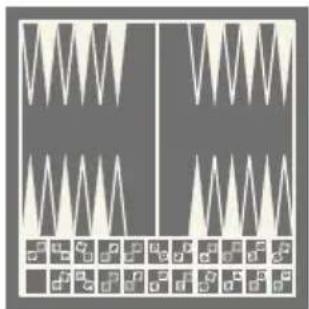

Objective of the game
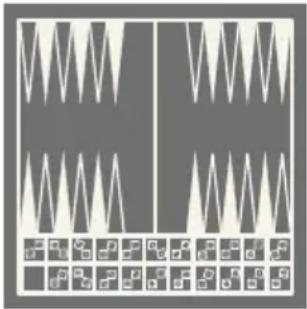
The objective of the game is to be the first player to bring his or her pieces home (2) and then throw dice to take them out (3) (see illustration). The first player who succeeds in doing this wins the game. Captured pieces are placed on the central line of the board, or bar (1). The pieces must be moved in the direction of play and there are certain rules.

Preparation for the game
Place the pieces in the starting formation (see illustration).

- White plays from top right anti-clockwise to bottom right to its home (and then out).
- Black plays clockwise from bottom right to top right to its home (and then out).
Rules of the game
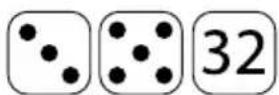
- First throw the dice to decide who starts. Each player throws one die. The player with the higher number starts.
- From now on the two dice are always thrown together.
- The player can now decide whether he or she moves the number thrown on the dice using one or two pieces.
- It is not permitted to move onto fields where more than one of the opponent's pieces are located.
- If the player uses both of the numbers thrown then it is not permitted to simply add the numbers but rather each numbers must be placed separately and the intermediate stop must be on a permitted field.
- It principle it can be said that both moves must be made for both the numbers thrown. However if only one of the numbers can be moved then the higher number must be used.
- If a player throws a double (the same number on both dice), then the result is doubled or the player may move by this number four times - as possible with one, two, three or four pieces.
- If a piece ends up on a field with only one opposing piece then this is captured and placed on the bar.
- The player who has one or several pieces on the bar must bring these back into the game before moving his or her other pieces. Pieces from the bar are brought into the game through the opponent's home - according to the numbers rolled on the dice to fields 1-6.
Prime
• One possibility to make the game more difficult for your opponent is to form a prime.
- Several consecutive points are occupied with at least two pieces each in order to block them for the opponent.
- If 6 points in a row are occupied then we speak of a full prime, a completely insurmountable blockade.
- If all the pieces are at the home positions the players can bear off. If a piece is captured then this needs to be brought back into the game and through to home before the player can continue throwing dice to take pieces out.
- The player can bear off over the last field. If the dice numbers are not sufficient to bear off then the pieces are simply moved by the relevant number.
- If the move is further than the piece furthest away then the piece can be removed.
• The player who is first to bear off wins the game.
Doubling cube
The doubling cube is used when playing for stakes.
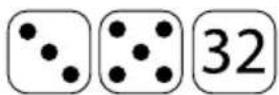
- At the beginning of the game the doubling cube is placed next to the board with the number 64 facing upwards.
• Each player can propose doubling during the game. The doubling must be announced before throwing the dice. - The player who first proposes doubling turns the cube to the number 2.
• The opponent must either accept or give up. - If the opponent has accepted the doubling the stake is doubled and then he or she has the right to announce the next doubling.
- At the next doubling the cube is turned to the number 4 and the stake is multiplied by four.
For strategies, tips, and special rules please consult the extensive specialist literature.
(Peg) Solitaire
Combination game for one player
Equipment
Board, playing area 1 (①)
32 Playing pieces
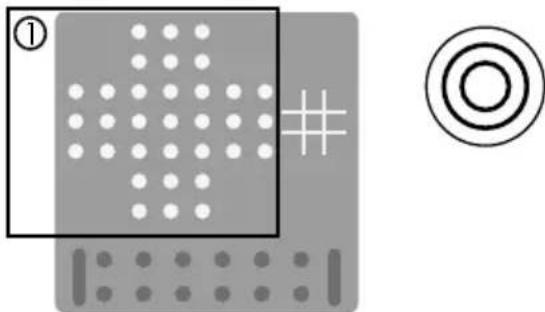
Objective of the game
The objective of the game is to be left with only one piece in the central field.
Preparation for the game
Lay the playing pieces on all the white fields except in the middle.
Rules of the game
- Now jump with one piece – horizontally or vertically – over another piece onto the free space directly behind it. - The piece that has been jumped over is removed from the game. Continue in this way and try to have only one piece left at the end, exactly at the centre.
Noughts and crosses
Combination game for 2 persons
Equipment
Board, playing area 2 (②) Playing pieces dark/playing pieces light

Objective of the game
The objective of the game is to lay three pieces of your own colour in a line horizontally, vertically or diagonally.
Rules of the game
- Players take turns to place one playing piece in one of the 9 fields. - If one player succeeds in laying three of his or her own pieces in a row then he or she wins.
- If neither of the players is able to form a line then the game ends in a draw.
Mancala
Game for 2 persons
Equipment
Board, playing area 3 (③)
48 Mancala pieces
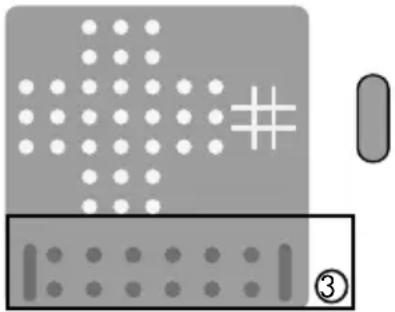
Objective of the game
The player who has the most playing pieces at the finish (Kalaha) (1) wins.
Preparation for the game
4 playing pieces are placed in each depression.
![graph LR A["Player A"] --> B["Player B"] B --> C["1"] style A fill:#f9f,stroke:#333 style B fill:#ccf,stroke:#333 style C fill:#cfc,stroke:#333](/content/2026/05/831721/images/a5ffc6d2fb5a6d0de0ee306e31f13df2ad82ad67d05a659c27afd60eab85dd3b.jpg)
Rules of the game
- Player A starts. He or she empties a depression and distributes the pieces anti-clockwise in the four following depressions.
- If the opponent's depression where the last playing piece lands contains more than 3 playing pieces then the move is finished. It is now player B's turn.
Note: Only one playing piece may be placed in a depression and no depression can be missed out.
- If the last playing piece is placed in an opponent's depression and if there are then 2 or 3 playing pieces in the depression then one victory point is gained. The depression can be emptied and the playing pieces laid into your own Kalaha (1).
Note: If the opponent's depression into which the last but one of a player's pieces is placed also contains 2 or 3 playing pieces then this depression can also be emptied. This continues as long as an opponent's depression is reached that has fewer than 2 or more than 3 playing pieces.
- If the last piece is placed in a depression in which there are fewer than 2 or more than 3 playing pieces then the move is finished and it's the opponent's turn.
Note: If it is possible to capture all the opponent's playing pieces during a move then this may not be executed.
- The game is over when all the depressions of one player are empty and the opponent cannot make a move to fill the depressions again.
- The game is also over if a player has more than 24 playing pieces in his or her Kalaha. This player then wins.
There are numerous variations of this game. You can find further variations in specialist literature.
Chinese chequers
Strategic board game for 2-6 persons
Equipment
Board
10 marbles of one colour for each player

Objective of the game
The objective of the game is to move your 10 marbles fastest to the opposite corner.
Preparation for the game
- The players choose their colour and place their marbles in the point of the star that is facing them.
-
If there are two players then the two opposite starting fields are set up.
-
If there are three players each player takes one starting field – the opposite field of the same colour stay free.
- If there are four or six players each player gets a starting field opposite an opponent.
- If there are five players then the game is asymmetrical with one player opposite an empty field while all others are opposite an opposing colour.
Rules of the game
• The youngest player begins.
- Only one marble may be moved on each move.
- Marbles can be moved in all directions by one field.
- You can jump over your own and opposing marbles if the field behind them is free.
- There is no limit to the number of marbles that can be jumped over in one move and it is also permitted to change direction.
- Once a marble reaches the opposite point on the star then it can no longer leave it and can only be moved within it.
- The first player who has moved all his or her marbles into the finishing area wins.
Snakes and ladders
Game for 2-4 persons
Equipment
Board
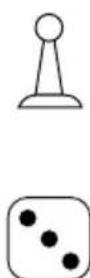
1 Playing figure per player
1 Die

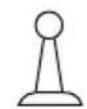

Objective of the game
The object of the game is to be the fastest to move your figure onto the finishing field (100).
Rules of the game
• The game is played with one die. Turns pass in a clockwise direction.
- The youngest player starts by throwing the die and moves his or her figure forwards by the number on the die.
- If you move onto a ladder field you can climb onto the field where the ladder ends. If you land on the head of a snake you have to move your figure down to the end of the snake's tail.
• The player who is first to move his or her figure into the finishing field (100) wins.
Ludo
Game for 2-4 players
Equipment
Board
4 Playing figures per player
1 Die

Objective of the game
The objective of the game is to be the first player to get his or her figures to the finish (ladder) (1).
Preparation for the game

• The figures are placed in your own corner (yard) (3).
- Turns move in a clockwise direction. The player who throws the highest number begins.
- If a player throws a six he or she may take a figure from his or her yard (3) and place it at the start (2). Then he or she throws the die again and moves the figure in accordance with the number on the die.
- If a player moves his or her figure to a square where an opponent's figure is standing then this is captured and must be placed back in the corresponding player's yard (3).
Note: Figures that are standing on the starting squares (2) may not be captured. If a player lands on a starting square where an opponent's figure is standing then both figures remain on this square until they are able to move on.
- It is only possible to land on the finishing square on the ladder (1) if the correct number is thrown.
- The first player to get all his or her figures in the ladder (1) wins the game.
Pass out
Game for 2 players
Equipment
Board
15 Playing pieces dark/15 playing pieces light 2 Dice


Objective of the game
The objective of the game is to place as many of your own playing pieces on the fields with the dice combinations.
Rules of the game
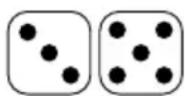
- Black begins with both dice.
- If the numbers thrown – individually or combined – corresponds to the combination of numbers on the target squares then a piece can be placed there.
- No square can be occupied by two pieces.
- The player who is able to lay down the most pieces has won.
Storage, cleaning
Always store the product in clean and dry condition at room temperature.
Only wipe clean with a dry cleaning cloth. IMPORTANT! Never clean the product with aggressive cleaning agents.
Disposal
Dispose of the article and the packaging materials in accordance with current local regulations. Packaging materials such as foil bags are not suitable to be given to children. Keep the packaging materials out of the reach of children.
Notes on the guarantee and service handling
The product was produced with great care and under constant supervision. You receive a three-year warranty for this product from the date of purchase. Please retain your receipt.
The warranty applies only to material and workmanship and does not apply to misuse or improper handling. Your statutory rights, especially the warranty rights, are not affected by this warranty.
With regard to complaints, please contact the following service hotline or contact us by e-mail. Our service employees will advise as to the subsequent procedure as quickly as possible. We will be personally available to discuss the situation with you.
Any repairs under the warranty, statutory guarantees or through goodwill do not extend the warranty period. This also applies to replaced and repaired parts. Repairs after the warranty are subject to a charge.
IAN: 290723
GB Service Great Britain Tel.: 0871 5000 720 (£ 0.10/Min.) E-Mail: deltasport@lidl.co.uk
CY Service Cyprus Tel.: 8009 4409 E-Mail: deltasport@lidl.com.cy

Srdačno vam čestitamo!

Osnovno slaganje
Svaki igrač ima po 8 pješaka, dvije kule, dva skakača, dva lovca, jednu damu i kralja.
Top se može kretati isključivo horizontalno ili vertikalno. Druge figure ne može preskakati.
Lovac

Lovac se kreće dijago- nalno po ploči, druge figure ne može preskakati.
Dama

Dama je figura s najvećom slobodom kretanja. Ona se može kretati horizontalno, vertikalno i dijagonalno. Međutim, niti ona ne može preskakati druge figure.
Krali


Skakač se kreće dva polja vertikalno ili horizontalno i jedno polje udesno ili ulijevo.
Skakač je jedina figura koja može preskakati druge figure (zauzeta polja).
Pješak
Ako neki igrač izvede dvostruki potez direktno pored protivničkog pješaka, ovaj može provući vlastitog pješaka ukoso iza pješaka koji je igrao dvostruki potez i tako ga tući „en passant“.
Zamjena pješaka

Cilj igre
Cilj igre je oduzeti protivniku mogućnost poteza, dakle potući ili blokirati sve protivničke žetone za igru.
Priprema igre

Cilj igre

Cilj igre
Cilj igre je da vam na kraju preostane samo jedan žeton u srednjem polju.
Priprema igre
Cilj igre
Cilj igre je poredati tri žetona u vlastitoj boji horizontalno, vertikalno ili dijagonalno u jedan red.
Pravila igre
- Postavlja se naizmjence po jedan žeton u neko od 9 polja.
- Pođe li igraču za rukom da postavi tri vlastita žetona u jedan red, pobijedio je.
- Ako nijedan od igrača nije u mogućnosti složiti jedan red, partija završava neodlučeno.
Mancala
Igra za 2 osobe
Pribor
Cilj igre
Pobjeđuje igrač koji na kraju ima većinu žetona u cilju (kalaha) (1).
Priprema igre
U svaku udubinu se slažu po 4 žetona za igru.

Pravila igre
- Započinje igrač A. On isprazni jednu od svojih udubina i raspoređuje žetone suprotno smjeru kazaljke na satu na četiri sljedeće udubine.
- Ako se u udubini protivnika, u kojoj završi posljednji žeton, nalaze više od 3 žetona, potez je završen. Igrač B je na redu.
Cilj igre
Cilj igre
Cilj igre je sa svojom figurom najbrže dostići ciljno polje (100).
Pravila igre
Cilj igre
Cilj igre je prvi dovesti svoje figure na cilj (stepenice) (1).
Priprema igre


Cilj igre
Cilj igre je po mogućnosti postaviti čim više vlastitih žetona na polja s kombinacijama kocke.
Pravila igre
- Crni započinje igru s obje kocke.
- Ako broj bodova dobivenih na kocki - pojedinačno ili kombinirano - odgovara oslikanoj kombinaciji bodova na ciljanim poljima, onda se ondje može postaviti jedan žeton.
- Na polja se ne smiju nalaziti dva žetona.
- Pobijedio je igrač koji je uspio postaviti najviše svojih žetona.
Structura inițială

Obiectivul jocului

Obiectivul jocului

Obiectivul jocului
Obiectivul jocului
Obiectivul jocului
Obiectivul jocului
Obiectivul jocului
Obiectivul jocului


Obiectivul jocului
Начална позиция

Указание

Цел на играта

Цел на играта

Цел на играта
Цел на играта
Цел на играта
Цел на играта
Цел на играта
Цел на играта
Цел на играта





Hinweis: Eine

Ziel des Spiels


Ziel des Spiels

Ziel des Spiels
Ziel des Spiels
Ziel des Spiels
Ziel des Spiels
Ziel des Spiels
Ziel des Spiels


Ziel des Spiels

- 10-IN-1 GAME COMPENDIUM
- COLECTIE DE JOCURI 10 ÎN 1
- RO
- CAREFULLY READ THE FOLLOWING INSTRUCTIONS FOR USE
- SCOPE OF DELIVERY
- CORRECT USE
- SYMBOLS USED
- SAFETY INSTRUCTIONS
- CHESS
- EQUIPMENT
- OBJECTIVE OF THE GAME
- MOVING THE CHESS PIECES
- PAWN
- DOUBLE MOVE
- EN PASSANT CAPTURE
- PROMOTION ON A PAWN
- CASTLING
- PREREQUISITES FOR CASTLING
- CHECK
- DRAUGHTS
- PREPARATION FOR THE GAME
- RULES OF THE GAME
- BACKGAMMON
- PRIME
- DOUBLING CUBE
- (PEG) SOLITAIRE
- NOUGHTS AND CROSSES
- MANCALA
- CHINESE CHEQUERS
- SNAKES AND LADDERS
- LUDO
- PASS OUT
- STORAGE, CLEANING
- DISPOSAL
- NOTES ON THE GUARANTEE AND SERVICE HANDLING
- OSNOVNO SLAGANJE
- PJEŠAK
- ZAMJENA PJEŠAKA
- CILJ IGRE
- PRIPREMA IGRE
- PRAVILA IGRE
- PRIBOR
- OBIECTIVUL JOCULUI
- УКАЗАНИЕ
- ЦЕЛ НА ИГРАТА
- HINWEIS: EINE
- ZIEL DES SPIELS
Brand : Playtive
Model : IAN 290723
Category : Board game