
DW300 - Saw DEWALT - Free user manual and instructions
Find the device manual for free DW300 DEWALT in PDF.


| Product Type | Circular Saw |
| Brand | DeWALT |
| Model | DW300 |
| Dimensions (L x W x H) | Approx. 400 x 300 x 250 mm |
| Weight | 5.5 kg (12.1 lbs) |
| Power Source | Corded electric, 120V / 240V |
| Motor Power | 1500 W |
| Blade Diameter | 184 mm (7-1/4 in) |
| No Load Speed | 5500 RPM |
| Cutting Depth at 90° | 64 mm (2-1/2 in) |
| Cutting Depth at 45° | 45 mm (1-3/4 in) |
| Bevel Capacity | 0° – 50° |
| Dust Extraction Port | Integrated dust port for vacuum attachment |
| Safety Features | Blade guard, electric brake, lock-off switch |
| Maintenance | Regular cleaning, brush inspection, blade replacement |
| Spare Parts & Repairability | Available from authorized service centers |
| Warranty | 3 years limited warranty |
| Manual Availability | Free PDF download at notice-facile.com |
Frequently Asked Questions - DW300 DEWALT
User questions about DW300 DEWALT
0 question about this device. Answer the ones you know or ask your own.
Ask a new question about this device
Download the instructions for your Saw in PDF format for free! Find your manual DW300 - DEWALT and take your electronic device back in hand. On this page are published all the documents necessary for the use of your device. DW300 by DEWALT.
USER MANUAL DW300 DEWALT
Definitions: Safety Guidelines
The definitions below describe the level of severity for each signal word. Please read the manual and pay attention to these symbols.
▲DANGER: Indicates an imminently hazardous situation which, if not avoided, will result in death or serious injury. ▲WARNING: Indicates a potentially hazardous situation which, if not avoided, could result in death or serious injury. ▲CAUTION: Indicates a potentially hazardous situation which, if not avoided, may result in minor or moderate injury. NOTICE: indicates a practice not related to personal injury which, if not avoided, may result in property damage.

WARNING: To reduce the risk of injury, read the instruction manual.
General Power Tool Safety Warnings

WARNING! Read all safety warnings and all instructions Failure to follow the warnings and instructions may result in electric shock, fire and/or serious injury.
SAVE ALL WARNINGS AND INSTRUCTIONS FOR FUTURE REFERENCE
The term "power tool" in the warnings refers to your mains-operated (corded) power tool or battery-operated (cordless) power tool.
1) WORK AREA SAFETY
a) Keep work area clean and well lit. Cluttered or dark areas invite accidents.
b) Do not operate power tools in explosive atmospheres, such as in the presence of flammable liquids, gases or dust. Power tools create sparks which may ignite the dust or fumes.
c) Keep children and bystanders away while operating a power tool. Distractions can cause you to lose control.
2) ELECTRICAL SAFETY
a) Power tool plugs must match the outlet. Never modify the plug in any way. Do not use any adapter plugs with earthed (grounded) power tools. Unmodified plugs and matching outlets will reduce risk of electric shock.
b) Avoid body contact with earthed or grounded surfaces such as pipes, radiators, ranges and refrigerators. There is an increased risk of electric shock if your body is earthed or grounded.
c) Do not expose power tools to rain or wet conditions. Water entering a power tool will increase the risk of electric shock.
d) Do not abuse the cord. Never use the cord for carrying, pulling or unplugging the power tool. Keep cord away from heat, oil, sharp edges or moving parts. Damaged or entangled cords increase the risk of electric shock.
e) When operating a power tool outdoors, use an extension cord suitable for outdoor use. Use of a cord suitable for outdoor use reduces the risk of electric shock.
f) If operating a power tool in a damp location is unavoidable, use a residual current device (RCD) protected supply. Use of an RCD reduces the risk of electric shock.
3) PERSONAL SAFETY
a) Stay alert, watch what you are doing and use common sense when operating a power tool. Do not use a power tool while you are tired or under the influence of drugs, alcohol or medication. A moment of inattention while operating power tools may result in serious personal injury.
b) Use personal protective equipment. Always wear eye protection. Protective equipment such as dust mask, non-
skid safety shoes, hard hat, or hearing protection used for appropriate conditions will reduce personal injuries.
c) Prevent unintentional starting. Ensure the switch is in the off position before connecting to power source and/or battery pack, picking up or carrying the tool. Carrying power tools with your finger on the switch or energising power tools that have the switch on invites accidents.
d) Remove any adjusting key or wrench before turning the power tool on. A wrench or a key left attached to a rotating part of the power tool may result in personal injury.
e) Do not overreach. Keep proper footing and balance at all times. This enables better control of the power tool in unexpected situations.
f) Dress properly. Do not wear loose clothing or jewellery. Keep your hair, clothing and gloves away from moving parts. Loose clothes, jewellery or long hair can be caught in moving parts.
g) If devices are provided for the connection of dust extraction and collection facilities, ensure these are connected and properly used. Use of dust collection can reduce dust-related hazards.
4) POWER TOOL USE AND CARE
a) Do not force the power tool. Use the correct power tool for your application. The correct power tool will do the job better and safer at the rate for which it was designed.
b) Do not use the power tool if the switch does not turn it on and off. Any power tool that cannot be controlled with the switch is dangerous and must be repaired.
c) Disconnect the plug from the power source and/or the battery pack from the power tool before making any adjustments, changing accessories, or storing power tools. Such preventive safety measures reduce the risk of starting the power tool accidentally.
d) Store idle power tools out of the reach of children and do not allow persons unfamiliar with the power tool or these instructions to operate the power tool. Power tools are dangerous in the hands of untrained users.
e) Maintain power tools. Check for misalignment or binding of moving parts, breakage of parts and any other condition that may affect the power tool's operation. If damaged, have the power tool repaired before use. Many accidents are caused by poorly maintained power tools.
f) Keep cutting tools sharp and clean. Properly maintained cutting tools with sharp cutting edges are less likely to bind and are easier to control.
g) Use the power tool, accessories and tool bits etc., in accordance with these instructions taking into account the working conditions and the work to be performed. Use of the power tool for operations different from those intended could result in a hazardous situation.
5) SERVICE
a) Have your power tool serviced by a qualified repair person using only identical replacement parts. This will ensure that the safety of the power tool is maintained.
SPECIFIC SAFETY RULES
Safety Warnings for Jig Saws
- Hold power tools by insulated gripping surfaces when performing an operation where the cutting tool may contact hidden wiring or its own cord. Contact with a "live" wire will make exposed metal parts of the tool "live" and shock the operator.
-
Use clamps or another practical way to secure and support the work piece to a stable platform. Holding the work by hand or against your body leaves it unstable and may lead to loss of control.
-
Keep hands away from cutting area. Never reach underneath the material for any reason. Hold front of saw by grasping the contoured gripping area. Do not insert fingers or thumb into the vicinity of the reciprocating blade and blade clamp. Do not stabilize the saw by gripping the shoe.
- Keep blades sharp. Dull blades may cause the saw to swerve or stall under pressure.
- When cutting pipe or conduit ensure that they are free from water, electrical wiring, etc.
- Allow the motor to come to a complete stop before withdrawing the blade from the kerf (the slot created by cutting). A moving blade may impact the workpiece causing a broken blade, workpiece damage or loss of control and possible personal injury.
- Never hold work in your hand, lap or against parts of your body when sawing. The saw may slip and the blade could contact the body causing injury.
- Keep handles dry, clean, free from oil and grease. This will enable better control of the tool.
- Clean out your tool often, especially after heavy use. Dust and grit containing metal particles often accumulate on interior surfaces and could create an electric shock hazard.
- Do not operate this tool for long periods of time. Vibration caused by the operating action of this tool may cause permanent injury to fingers, hands, and arms. Use gloves to provide extra cushion, take frequent rest periods, and limit daily time of use.
- Avoid prolonged contact with dust from power sanding, sawing, grinding, drilling, and other construction activities. Wear protective clothing and wash exposed areas with soap and water. Allowing dust to get into your mouth, eyes, or lay on the skin may promote absorption of harmful chemicals.
⚠ WARNING: Wear appropriate hearing protection during use. Under some conditions and duration of use, noise from this product may contribute to hearing loss.
- An extension cord must have adequate wire size (AWG or American Wire Gauge) for safety. The smaller the gauge number of the wire, the greater the capacity of the cable, that is 16 gauge has more capacity than 18 gauge. An undersized cord will cause a drop in line voltage resulting in loss of power and overheating. When using more than one extension to make up the total length, be sure each individual extension contains at least the minimum wire size. The following table shows the correct size to use depending on cord length and nameplate ampere rating. If in doubt, use the next heavier gauge. The smaller the gauge number, the heavier the cord.
| Voltage (Volts) | Total length of cord in meters (m) | |||
| 120 - 127V 0 - 7 | 7 - 15 | 15 - 30 | 30 - 50 | |
| 220 - 240V | 0 - 15 | 15 - 30 | 30 - 60 | 60 - 100 |
| Rated Ampere range | Minimal cross-sectional area of the cord in meters ( mm^2 ) | |||
| 0 - 6A | 1.0 | 1.5 | 1.5 | 2.5 |
| 6 - 10A | 1.0 | 1.5 | 2.5 | 4.0 |
| 10 - 12A | 1.5 | 1.5 | 2.5 | 4.0 |
| 12 - 16A | 2.5 | 4.0 | Not Recommended | |
▲WARNING: Always use eye protection. All users and bystanders must wear eye protection that conforms to ANSI Z87.1. ▲WARNING: Always wear proper personal hearing protection that conforms to ANSI S12.6 (S3.19) during use. Under some conditions and duration of use, noise from this product may contribute to hearing loss.
⚠ WARNING: Some dust created by power sanding, sawing, grinding, drilling, and other construction activities contains chemicals known to cause cancer, birth defects or other reproductive harm. Some examples of these chemicals are:
- lead from lead-based paints,
- crystalline silica from bricks and cement and other masonry products, and
• arsenic and chromium from chemically-treated lumber (CCA).
Your risk from these exposures varies, depending on how often you do this type of work. To reduce your exposure to these chemicals: work in a well ventilated area, and work with approved safety equipment, such as those dust masks that are specially designed to filter out microscopic particles.
- Avoid prolonged contact with dust from power sanding, sawing, grinding, drilling, and other construction activities. Wear protective clothing and wash exposed areas with soap and water. Allowing dust to get into your mouth, eyes, or lay on the skin may promote absorption of harmful chemicals.
WARNING: Use of this tool can generate and/or disburse dust, which may cause serious and permanent respiratory or other injury. Always use NIOSH/OSHA approved respiratory protection appropriate for the dust exposure. Direct particles away from face and body.
▲WARNING: Wear appropriate hearing protection during use. Under some conditions and duration of use, noise from this product may contribute to hearing loss.
- The label on your tool may include the following symbols. The symbols and their definitions are as follows:
V.....volts A.....amperes
Hz...... hertz W...... watts
min......minutes \~ ......alternating current
- - - - direct current n_0 - - - - - - - - - - - - - - - - - - - - - - - - - - - - - - - - - - - - - - - - - - - - - - - - - -
Class I Construction (grounded) earthing terminal
☐......Class II Construction ▲......safety alert symbol (double insulated)
BPM.....beats per minute
sfpm.....surface feet
per minute (sfpm)
.../min....revolutions or
reciprocation
per minute
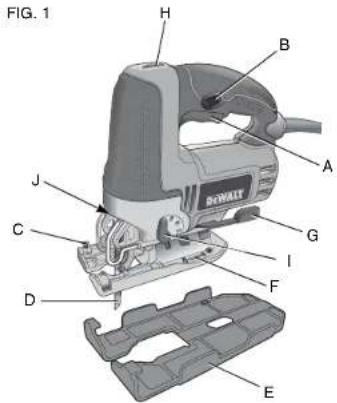
DESCRIPTION (FIG. 1)
WARNING: Never modify the power tool or any part of it. Damage or personal injury could result.
A. Trigger switch G. Shoe beveling lever
B. Lock-on button H. Speed control wheel
C. Saw blade locking lever I. Cutting action lever
D. Saw blade J. LED Light
E. Shoe sleeve
F. Shoe
INTENDED USE
This jig saw is designed for professional sawing applications.
DO NOT use under wet conditions or in presence of flammable liquids or gases.
This jig saw is a professional power tools. DO NOT let children come into contact with the tool. Supervision is required when inexperienced operators use this tool.
ASSEMBLY AND ADJUSTMENTS
⚠ WARNING: Prior to assembly and adjustment, ALWAYS unplug tool.
OPERATION
⚠ WARNING: Always observe the safety instructions and applicable regulations. FIG. 2
Blade Installation (Fig. 2)
- Push the saw blade locking lever (C) upward.
- With teeth facing forward, insert the shank of the saw blade into the blade holder as far as it will go.
safety instructions and applicable FIG. 2
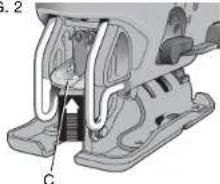
- Release the lever.
- Check to ensure blade is secure before cutting.
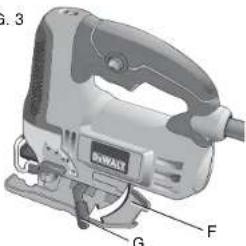
Adjusting the Shoe for Bevel Cuts (Fig. 3)
WARNING: Never use the tool when the shoe is loose or removed. The shoe plate can be set to a left or right bevel angle of up to 45°.
TO SET THE BEVEL ANGLE
- Pull the shoe beveling lever (G) out and away from the saw to unlock the shoe (F) as shown in Figure 3.
- Slide the shoe forward to release it from the 0° positive stop position.
- The shoe can be beveled to the left or to the right and has detents at 15°, 30° and 45°.
- Set the shoe to the desired bevel angle. Use a protractor to verify angle accuracy.
- Push the shoe beveling lever back towards the saw to lock the shoe.
TO RESET THE SHOE FOR STRAIGHT CUTS
- Pull the shoe beveling lever (G) out and away from the saw to unlock the shoe (F) as shown in Figure 3.
- Rotate shoe to an angle of approximately 0^ and then pull shoe backwards to engage the 0^ positive stop.
- Push the shoe beveling lever back towards the saw to lock the shoe.
Switching On and Off
To switch the tool on, squeeze the trigger switch (A).
For continuous operation, squeeze the trigger switch then depress the lock-on button (B). Once lock-on button is depressed, release the trigger switch.
To switch the tool off, release the trigger switch. To switch the tool off, when in continuous operation, squeeze the trigger and the lock will disengage.
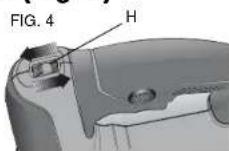
Variable Speed Control (Fig. 4)
A speed control wheel (H) is located on the top of the saw. The speed increases as the wheel is turned from a low speed setting of 1 to a high speed setting of 7.
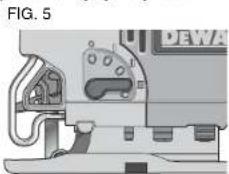
Cutting Action – Orbital or Straight (Fig. 5)
WARNING: Check that the tool is not locked ON before connecting it to a power supply. If the trigger switch is locked on when the tool is connected to the power supply, it will start immediately. Damage to your tool or personal injury may result.
This jig saw is equipped with four cutting actions, three orbital and one straight. Orbital action has a more aggressive blade motion and is designed for cutting in soft materials like wood or plastic. Orbital action provides a faster cut, but with a less smooth cut across the material. In orbital
natural_image
Mechanical assembly diagram showing a component with no visible text or symbolsaction, the blade moves forward during the cutting stroke in addition to the up and down motion.
NOTE: Metal or hardwoods should never be cut in orbital action.
TO ADJUST THE CUTTING ACTION
- Move the cutting action lever (I) between the four cutting positions: 0, 1, 2, and 3.
- Position 0 is straight cutting.
- Positions 1, 2, and 3 are orbital cutting.
The aggressiveness of the cut increases as the lever is adjusted from one to three, with three being the most aggressive cut.
LED Light
The jig saw is equipped with a light which projects on the cutting path.
The light will come on when the trigger switch is depressed and will go off when the trigger switch is released.
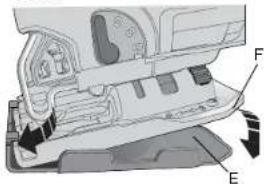
Removable Shoe Sleeve (Fig. 6)
The non-marring shoe sleeve (E) should be used when cutting surfaces that scratch easily, such as laminate, veneer, or paint. It can also be used to protect the shoe surface during transportation and storage.
To attach shoe sleeve, place the front of the shoe (F) into the front of the shoe sleeve (E) and lower the jig saw as shown in Figure 6. The shoe sleeve will click securely onto the rear of the shoe.
To remove shoe sleeve, grasp the sleeve from the bottom at the two rear tabs and pull down and away from the shoe.
FIG. 6
Hints for Optimum Use
SAWING LAMINATES
As the saw blade cuts on the upward stroke, splintering may occur on the surface closest to the shoe plate.
- Use a fine-tooth saw blade.
- Saw from the back surface of the workpiece.
- To minimize splintering, clamp a piece of scrap wood or hardboard to both sides of the workpiece and saw through this sandwich.
SAWING METAL
- Be aware that sawing metal takes much more time than sawing wood.
- Use a saw blade suitable for sawing metal.
- When cutting thin metal, clamp a piece of scrap wood to the back surface of the workpiece and cut through this sandwich.
- Spread a film of oil along the intended line of cut for easier operation and longer blade life. For cutting aluminum, kerosene is preferred.
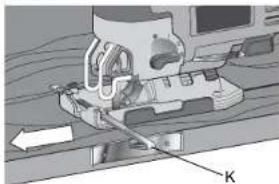
Rip/Circle Cutting (Fig. 7, 8)
Ripping and circle cutting without a pencil line are easily done with the rip fence / circle guide (not included; available at extra cost).
Using the screw supplied with the accessory guide, position as shown in Figure 7 and thread the screw into the shoe to clamp the fence securely.
FIG. 7
natural_image
Mechanical assembly diagram showing a motor with attached components and a labeled component 'K' (no text or symbols beyond label)When ripping, position as shown in Figure 7 and slide the rip fence under the screw from either side of the saw. Set the cross bar (J) at desired distance from blade and tighten screw. For ripping, the cross bar should be down and against the straight edge of the workpiece as shown.
When circle cutting, adjust rip fence so that distance from blade to hole in fence
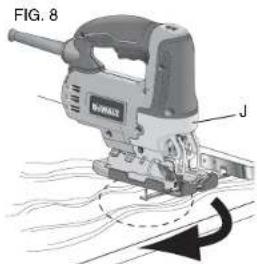
arm (K) is at the desired radius and tighten screw. Place saw so that hole in fence arm is over center of circle to be cut (drill hole for blade or cut inward from edge of material to get blade into position). When saw is properly positioned, drive a small nail through hole in fence arm. Using rip fence as a pivot arm, begin cutting circle. For circle cutting, the cross bar should be up, as shown in Figure 8.
MAINTENANCE
Your DEWALT power tool has been designed to operate over a long period of time with a minimum of maintenance. Continuous satisfactory operation depends upon proper tool care and regular cleaning.
WARNING: To reduce the risk of injury, turn unit off and disconnect tool from power source before installing and removing accessories, before making any adjustments or removing/installing attachments or accessories.
Lubrication
Your power tool requires no additional lubrication.
Cleaning
WARNING: Blow dirt and dust out of the main housing with dry air as often as dirt is seen collecting in and around the air vents. Wear approved eye protection and approved dust mask when performing this procedure.
WARNING: Never use solvents or other harsh chemicals for cleaning the non-metallic parts of the tool. These chemicals may weaken the materials used in these parts. Use a cloth dampened only with water and mild soap. Never let any liquid get inside the tool; never immerse any part of the tool into a liquid.
Accessories
WARNING: Since accessories, other than those offered by DEWALT, have not been tested with this product, use of such accessories with this tool could be hazardous. To reduce the risk of injury, only DEWALT, recommended accessories should be used with this product.
Recommended accessories for use with your tool are available at extra cost from your local dealer or authorized service center.
SPECIFICATIONS DW300-B3
| Volts | 120V | ~ |
| Watts | 500W | |
| Hertz | 50-60 | Hz |
| RPM | 0-3200/min |
TROUBLESHOOTING
Problem Possible Cause Possible Solution
- Unit will not start. - Cord not plugged in.
- Circuit fuse is blown.
- Plug tool into a working outlet.
- Replace circuit fuse. (If the product repeatedly causes the circuit fuse to blow, discontinue use immediately and have it serviced at a DEWALT service center or authorized servicer.)
- Circuit breaker is tripped. - Reset circuit breaker. (If the product repeatedly causes the circuit breaker to trip, discontinue use immediately and have it serviced at a DeWALT service center or authorized servicer.)
- Cord or switch is damaged. • Have cord or switch replaced at a DEWALT Center or authorized servicer.
natural_image
Mechanical component diagram showing a bracket with labeled parts (no text or symbols present)natural_image
Mechanical assembly diagram showing a tool interacting with a mechanical component (no visible text or symbols)natural_image
Mechanical assembly diagram showing a motor or gear mechanism with labeled component K (no text or symbols present)BOSQUES DE CIDROS, ACCESO RADIATAS NO. 42
IMPORTED BY/IMPORTADO POR:
BLACK & DECKER DO BRASIL LTDA.
ROD. BR 050, S/N° - KM 167
DIST. INDUSTRIAL II
UBERABA - MG - CEP: 38064-750
CNPJ: 53.296.273/0001-91
INSC. EST.: 701.948.711.00-98
S.A.C.: 0800-703-4644
MAQUINAS Y HERRAMIENTAS BLACK & DECKER CHILE S.A.
AVDA. EDUARDO FREI M. #6001 EDIFICIO 67
CONCHALI-SANTIAGO
CHILE
HECHO EN BRASIL
FABRICADO NO BRASIL
MADE IN BRAZIL
DEWALT Industrial Tool Co., 701 East Joppa Road, Baltimore, MD 21286
(AUG10) Part No. 90563638 DW300 Copyright @ 2010 DEWALT
The following are trademarks for one or more DEWALT power tools: the yellow and black color scheme; the "D" shaped air intake grill; the array of pyramids on the handgrip; the kit box configuration; and the array of lozenge-shaped humps on the surface of the tool.