Mein erster Spieleschatz - Board game HABA - Free user manual and instructions
Find the device manual for free Mein erster Spieleschatz HABA in PDF.


| Product type | Board game |
| Brand | HABA |
| Model | Mein erster Spieleschatz |
| Recommended age | Ages 3 and up |
| Number of players | 1 to 6 players |
| Game contents | 3 horses, 3 cows, 3 pigs, 3 sheep, 2 red apples, 2 plums, 2 eggs, 2 portions of cheese, 2 lettuce leaves, 2 carrots, 1 farmer, 1 die, 1 multicolored die, 6 stars, 1 moon, 32 memory cards, 4 shopping lists, 3 farm boards, 2 game boards (double-sided) |
| Main functions | 10 varied games: In the Barn, Farm Work, Let's Go Shopping, Ready, Set, Meadow!, In the Meadow and in the Barn, Moo Moo, The Farm Quartet, Sleepyhead, A Day at the Market, The Farm Race |
| Materials | Cardboard, wood |
| Care and cleaning | Clean with a dry or slightly damp cloth. Do not use abrasive products. |
| Safety | Contains small parts. Not suitable for children under 3 years. Use under adult supervision. |
| Spare parts and repairability | Parts available on request from the manufacturer. Repairable by the manufacturer. |
Frequently Asked Questions - Mein erster Spieleschatz HABA
User questions about Mein erster Spieleschatz HABA
0 question about this device. Answer the ones you know or ask your own.
Ask a new question about this device
Download the instructions for your Board game in PDF format for free! Find your manual Mein erster Spieleschatz - HABA and take your electronic device back in hand. On this page are published all the documents necessary for the use of your device. Mein erster Spieleschatz by HABA.
USER MANUAL Mein erster Spieleschatz HABA
My first Treasury of Games · Mon premier trésor de jeux · Mijn eerste spelletjesdoos Mi primer tesoro de juegos · Il mio primo tesoretto di giochi

32 Spielkarten
Vorderseite:
Rückseite:

Rückseite:
Wiese


A great big HABA game collection

Illustrations: Roger De Klerk
Editorial staff: Markus Nikisch, Johannes Zirm

Game ideas – contents
page
- Farmer's Parcheesi 22
For 2 - 4 player age 3+
- The Eager Farmer 24
For 1 - 6 players age 3+
- Lets Go Shopping 25
For 2 - 4 players age 3+
- To the Fields, Ready, Steady, Go! 26
For 2 - 6 players age 3+
- Pasture and Stable
For 2 - 6 players age 3+
- Mao Mao 28
For 2 - 5 players age 4+
- Happy Families on the Farm 30
For 3 - 6 players age 4+
- Sleepy Spoons 31
For 3 - 6 players age 4+
- A Day at the Market 32
For 2 - 4 players age 5+
- Race around the Farm 33
For 2 - 4 players age 5+
Contents
3 horses, 3 cows, 3 pigs, 3 sheep, 2 red apples, 2 plums, 2 eggs, 2 wedges of cheese, 2 salad leaves, 2 carrots, 1 farmer, 1 die with dots, 1 color die, 6 stars, 1 moon, game instruction

HSIÓNÉ
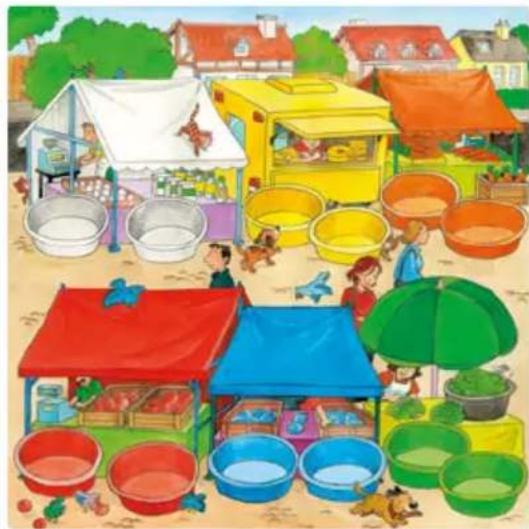
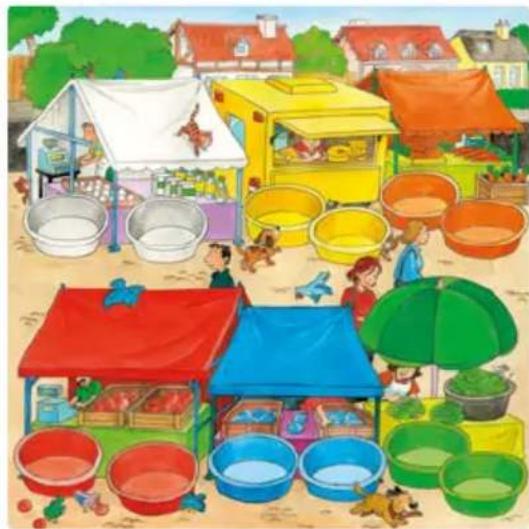
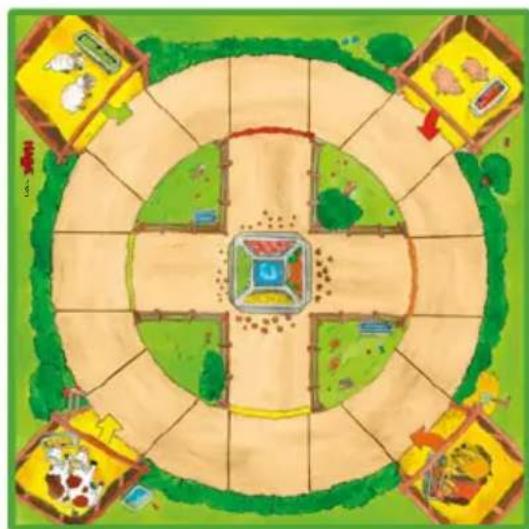
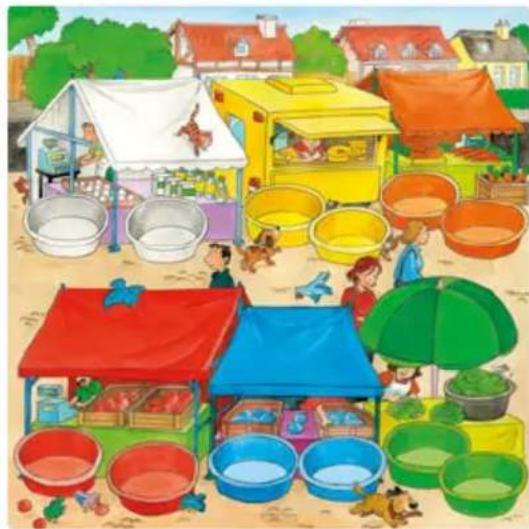
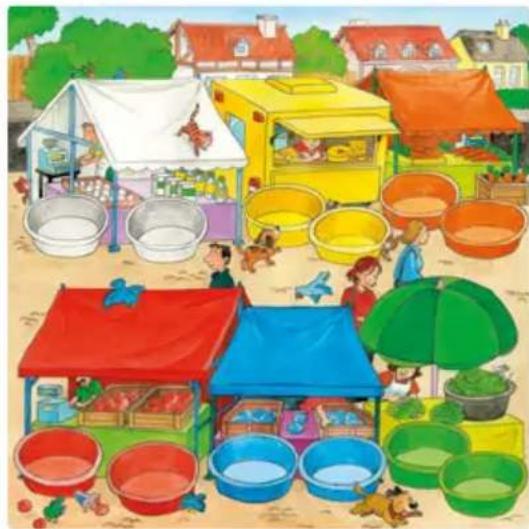
Game board "farm" and "market"
Front: farm Back: market
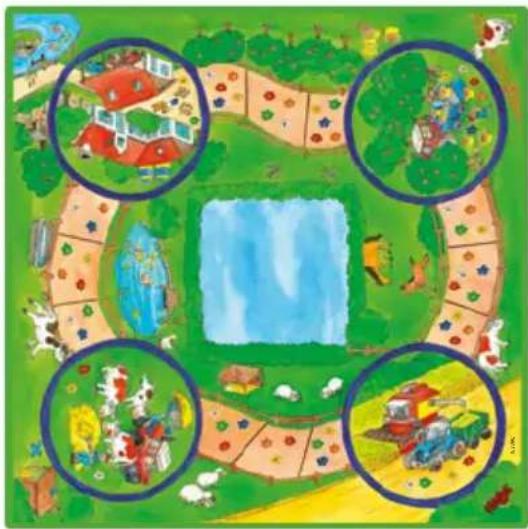

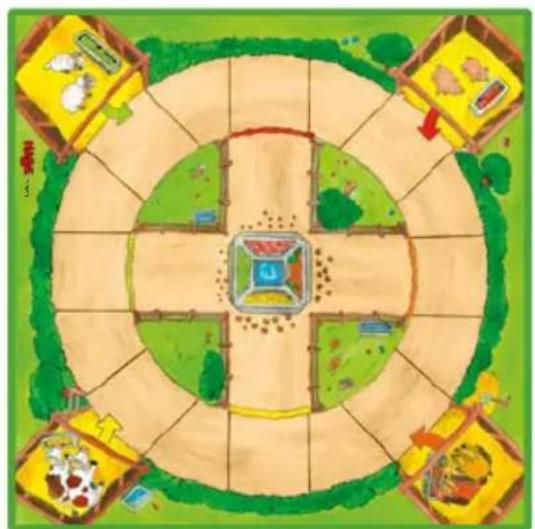
Game board "pasture" and "parcheesi"
Front: pasture Back: parcheesi


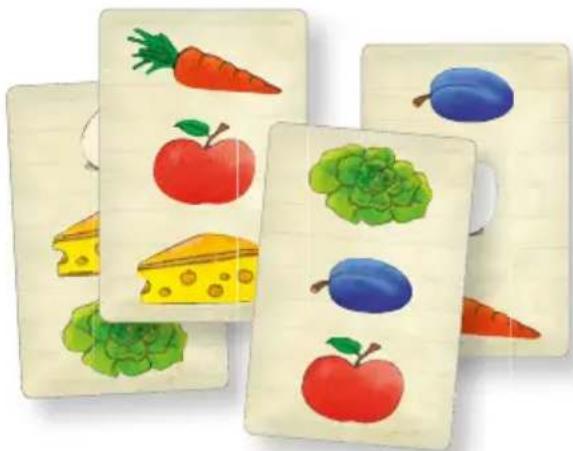
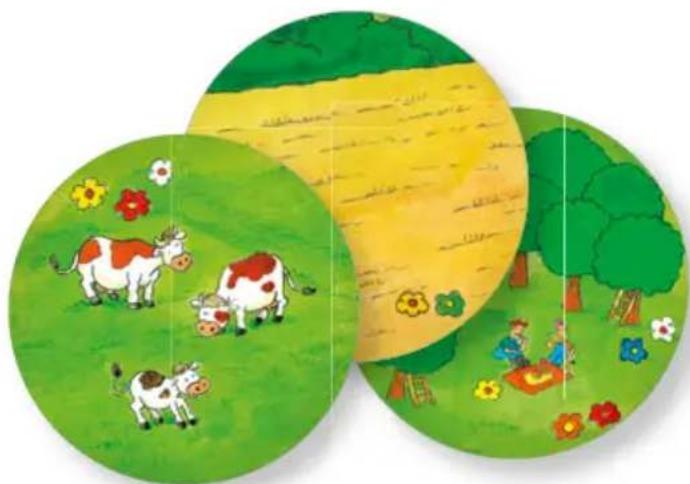
Deck of 32 playing cards
Front:

Back:

ENGLISH

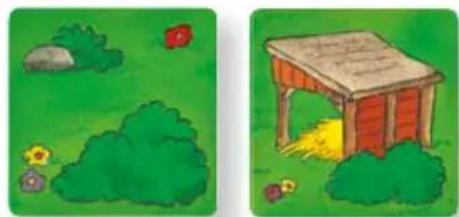
32 memory cards with "pasture" and "stable" on the backside
Front:

Back:
pasture
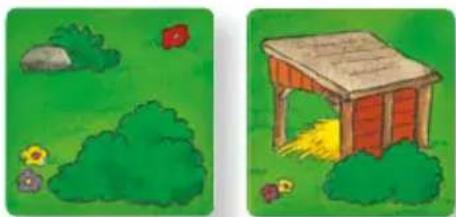
4 shopping lists 3 cardboard "farm" disks

1. Farmer's Parcheesi
The child friendly version of the classic game, for 2 - 4 players age 3+ .
Game material
Game board "Farmer's Parcheesi", 3 sheep, 3 horses, 3 pigs, 3 cows, die with dots
Preparation of the Game
Place the game board in the center of the table. Each player gets three animals of the same kind and places them in their corresponding stables. Get the die ready.
How to Play
Play in a clockwise direction. Whoever has fed an animal most recently may start. If you cannot agree, the youngest player starts.
Try to make your animals move around the yard and reach their specific feeding place. You can recognize which feeding place you have to bring your animals to by identifying the different foods. Horses like carrots, the cows eat hay, the sheep want to eat green leaves and the pigs fancy some red apples.
When it's your turn, roll the die.
On the die appears:
- 3 dots
What luck! You have the option to either, get one of your animals out of the stable and place it on the square next to it, or you can choose to move one of your animals that is already out grazing three squares ahead in a clockwise direction.
- 1 or 2 dots
You can move an animal that is already out grazing the corresponding number of squares ahead.
Then it's the turn of the next player to roll the die.
Important hints:
- If none of your animals are out grazing yet, you must first get an animal out of the stable. This can only be accomplished by rolling three dots. When it's your turn you can roll the die up to three times.
- If one or more of your animals are already on the move, you are allowed to roll the die only once and then move an animal the corresponding number of squares.
- When moving an animal all the squares are counted, even the occupied ones.
- Various animals may occupy one square.
- You always have to move an animal, as many squares as there are dots on the die.
- The target square has to be reached with the exact number of dots. If this is not possible, your animal has to remain where it is.
End of the Game
The game ends as soon as a player has moved his three animals to their corresponding feeding place thus winning the game.
Variation
If you reach a square with an animal of another player on it, you can send his animal home. This animal then has to start all over again.
2. The Eager Farmer
A co-operative, color die game for 1 - 6 players age 3+.
Game material
Game board "farm", 3 cardboard "farm" disks, 6 stars, moon, farmer, color die
Preparation of the Game
Place the game board in the center of the table and put the farmer on the farmhouse. Get the stars, the three cardboard disks, the moon and the color die ready.
How to Play
Play in a clockwise direction. Whoever has picked fruit most recently may start. If you cannot agree the youngest player starts. Together you help the farmer with his daily work: feeding animals, picking fruit and harvesting the crop. When it's your turn, roll the die. Now look and see where the farmer is standing
Moving clockwise, is there a flower of the same color as on the die on the next square?
- Yes?
Well done! You may move the farmer to the next square. - No?
What a pity! The farmer is tired and has to stay where he is. Time passes. Place a star on the sky in the center of the game board.
Then it's the turn of the next player to roll the die.
Important hints:
- The big round squares in the corners of the game board count as normal squares and can be entered only with the corresponding color on the die.
- Look carefully! Some flowers grow somewhat hidden.
- When you leave a corner square place the corresponding cardboard disk on it. This task is accomplished!
- When there are no stars left, place the moon in the sky.
End of the game
The game ends as soon as all the tasks have been accomplished and the farmer has reached his house before the moon has risen. The eager helpers have won together. If the moon rises before the farmer has reached his house, unfortunately you have not accomplished all the tasks and lose together. Have another go as a new day brings new luck.
3. Let's Go Shopping
A first, color die, shopping game, for 2 - 4 players age 3+ .
Game Material
Game board “market”, 4 shopping lists, 2 red apples, 2 plums, 2 eggs, 2 wedges of cheese, 2 leaves of salad, 2 carrots, color die
Preparation of the Game
Place the game board in the center of the table. Distribute the food items according to their color in the baskets in front of the booths. Each player takes a shopping list. Get the color die ready.
How to Play
Play in a clockwise direction. Whoever has been to a market most recently may start. If you cannot agree, the youngest player starts and tries to be the first to finish purchasing all the items on his shopping list.
When it's your turn, roll the die.
Does the die show the color of an item on your shopping list?
- Yes?
If you have not already collected it you take the item from the game board and place it on your shopping list. If you have already collected this item, you are not allowed to take anything.
- No?
Pity. You cannot take any item.
Then it's the turn of the next player.
End of the Game
The game ends as soon as a player has collected all the items on his shopping list thus winning the game.
4. To the Pasture, Ready, Steady, Go!
An exciting die game, requiring good memory skills for 2 - 6 players age 3+ .
Game Material
Game board "pasture", 16 memory cards with "pasture" on the backside, farmer, die with dots
Preparation of the Game
Place the game board in the center of the table. Distribute the 16 cards on the pasture and place the farmer on any square. Get the die ready.
How to Play
Play in a clockwise direction. Whoever is fastest at saying “green grass” quickly three times in a row, may start. If you cannot agree, the youngest player starts and tries to find as many animals as possible on the pasture.
When it's your turn, roll the die. Then move the farmer as many squares in a clockwise direction as the die shows dots.
When the farmer reaches a square with the picture of an animal, you have to try to find the same animal on the pasture. Turn over a memory card.
Does the card show the same animal?
- Yes?
Found! Take the card.
- No?
All players should try and remember the animal. Then the card is turned over again.
Then it's the turn of the next player.
Important hints:
- If the farmer reaches a corner square where no animal is pictured, you are allowed to have a secret look at any memory card.
- If the farmer reaches a square showing an animal that has already been found you are allowed to move the farmer on to the next square showing an animal that has not yet been found.
End of the Game
The game ends as soon as no memory cards are left on the pasture. The player with the highest pile of cards wins the game.
5. Pasture and Stable
A classic memory game for 2 - 6 players age 3+.
Game Material
16 memory cards with "pasture" on the backside, 16 memory cards with a "stable" on the backside
Preparation of the Game
Shuffle the cards and distribute them randomly in the center of the table making sure that no cards overlap.
How to Play
Play in a clockwise direction. Whoever is the first to name a farm animal may start. Turn over 2 cards: one pasture and one stable card.
Are the motifs identical (for example 2 horses)?
- Yes?
Found! Take the pair, and immediately turn over two more cards.
- No?
All players try to remember the motifs. Then the cards are turned over again.
It's the turn of the next player.
End of the Game
As soon as all the pairs have been collected, the player with the highest pile of cards wins the game.
Variation
The game gets easier if some pairs of animals are removed from the game.
6. Mao Mao
A classic game of cards for 2 - 5 players age 4+.
Game Material
Deck of cards (32 cards)
Preparation of the Game
Shuffle the cards. Each player receives five cards and holds them privately in his hand without allowing the others to see them. The remaining cards are placed face down in the center of the table. Draw the card from the top of the pile and place it face up next to the pile.
How to Play
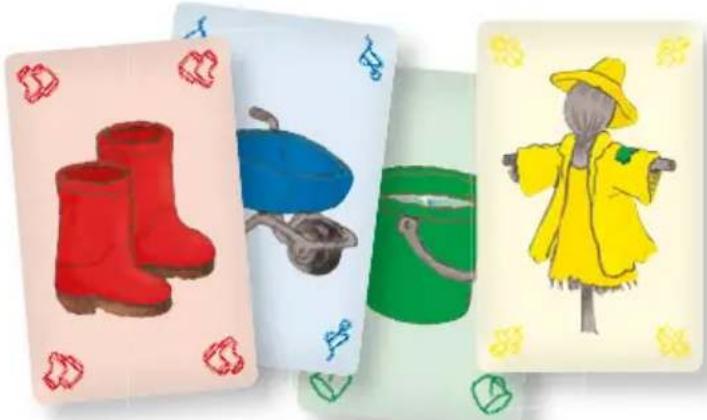
Play in a clockwise direction. Whoever has been wearing rubber boots most recently may start. If you cannot agree the youngest player starts and tries to place one of his cards on top of the card faceup in the center.
Important:
The card you deposit has either to be the same color (yellow, blue, red or green) or the same motif (eg. rubber boots) as the card face up on top of the card(s) in the center. If you don't have a matching card you have to draw one from the pile. However you are not allowed to place this card in this turn even if it matches. Once the pile of face down cards has been used up, the cards from the pile of cards facing up, except for the one on the top, are shuffled and then placed face down in a pile.
Then it's the turn of the next player.
Some cards have a special meaning:
- The bucket
When placing this card you can call for a color. The next card to be placed must be of that color. - The wheelbarrow
You are immediately allowed to place a second card on this one. If you don't have a matching card you have to draw one from the pile. - The pitch fork
The next player has to draw two cards from the pile. - The scarecrow
The next player has to skip his turn. It's then the turn of the next but one player.
As soon a player is left with only one card in his hand he yells "Moo!". If he forgets to do so, as a punishment he has to draw two cards from the pile.
End of the Game
Whoever can place his last card yells, "Moo! Moo!" and wins the game.
Hint:
The game gets easier if some or all the special meanings are ignored. You can also think of more special cards if you want to. How about changing the order of play, if a tractor is placed or imitating a cow with a milk-churn card?
7. Happy Families On the Farm
A classic game of cards for 3 - 6 players, age 4+.
Game Material
Deck of cards (32 cards)
Preparation of the Game
Shuffle the cards and deal them all out to the players. Some players may end up with more cards than others. Then all the players look at their cards and check to see if they have four cards with the same motif (for example 4 pitch forks). This is called a happy family. Whoever has a happy family places it face up in front of him. If a player happens to have more than one happy family right at the beginning, the cards are all returned, newly shuffled and dealt again.
How to Play
Play in a clockwise direction. Whoever has tidied up his room most recently may start. If you cannot agree, the youngest player starts and asks any of the other players for any motif (for example: "Do you have a tractor?").
Does the player have the corresponding card?
- Yes?
If he does, then he has to hand over this card. However he only has to hand over one card, even if he has more than one of the motifs requested.
The asking player receives the card and can immediately ask for another motif, either from the same player he asked before or from any other player. - No?
He does not have to hand over any card. It is his turn now to ask any other player for a motif.
As soon as a player has collected a happy family he can place it in front of him.
End of the Game
As soon as all the happy families are placed on the table the game ends. The player with the most happy families wins the game
8. Sleepy Spoons
A variation on the classic game of cards for 3 - 6 alert players, age 4+.
Game Material
Deck of cards (32 cards), 6 stars, farmer, 1 moon
Preparation of the Game
Shuffle all the cards. Each player gets five cards (6 cards if there are three players) and takes them in his hand. Get the stars, the farmer and the moon ready.
How to Play
Play in a clockwise direction. Whoever has got up the earliest today may start. If you cannot agree the youngest player starts and takes the farmer. He is the conductor for this round.
The conductor gives the command "Change cards!". All players pass one card face down to their left hand neighbor who takes the card into his hand.
The passing on of cards is repeated until one player has three cards with identical motifs in his hand (for example three buckets). He immediately places all his cards face up in front of him. Then he touches the tip of his nose with one finger. Whoever notices that a player has done this, also then immediately places his cards in front of him and touches the tip of his nose.
The last player left with cards in his hand and not in time to place his finger on the tip of his nose is the sleepyhead in this round and receives a star. If there are no stars left, he gets the moon.
A new round starts. The cards are shuffled and dealt. The farmer is passed on to the next player, in a clockwise direction, who becomes the new conductor.
End of the Game
As soon as the moon has been handed out, the game ends. The player with the fewest wooden fi gures wins the game. In case of a draw there are various winners.
Hint:
If there are doubts about who was the last to place his cards, the conductor decides.
9. A Day on the Market
A color die game requiring first tactical reflections for 2 - 4 players age 5+.
Game Material
Game board "market", 4 shopping lists, 2 red apples, 2 plums, 2 eggs, 2 wedges of cheese, 2 lettuce leaves, 2 carrots, 1 color die
Preparation of the Game
Place the game board in the center of the table. Distribute the food items corresponding to their color in the baskets in front of the booths. Place the shopping lists next to the game board so that everyone can see them. Get the color die ready.
How to Play
Play in a clockwise direction. Whoever can name three items that can be purchased at the market may start. If you cannot agree, the youngest player starts and tries to satisfy as many shopping wishes as possible.
When it's your turn, roll the die.
Are there still shopping items of the color shown on the die left on the game board?
- Yes?
Take the corresponding item from the game board and place it on a shopping list showing this item. As soon as a shopping list is complete, you can take it. It's the turn of the next player.
- No?
Pity. You cannot take any food item, and it's the turn of the next player.
End of the Game
The game ends as soon as all the shopping lists are distributed. The player with the most shopping lists wins the game. In case of a draw there are various winners.
10. Race Around the Farm
An exciting color die race for 2 - 4 players age 5+.
Game material
Game board "farm", 1 sheep, 1 horse, 1 pig, 1 cow, farmer, color die
Preparation of the Game
Place the game board in the center of the table. Each player takes a different animal and places it on the farmhouse. Get the farmer and the color die ready.
How to Play
Play in a clockwise direction. Whoever has seen a rabbit or a hedgehog most recently may start. If you cannot agree, the youngest player starts.
When it's your turn, place the farmer on the same square as where your animal is and roll the die. (At the beginning of the game that is the starting place of the animals, the farmhouse).
Is there, on the next square in a clockwise direction, a flower of the same color as shown on the die?
- Yes?
Lucky you! You are allowed to move your farmer to the next square.
Then roll the die again or fi nish your turn.
If you want to finish your turn move your animal to the square with the farmer and pass the farmer on to the next player. It's now his turn to roll the die.
- No?
Pity! Your animal stays where it is. Pass the farmer on to the next player.
It's now his turn to roll the die.
Important hints:
- You can roll the die as many times as you like and move the farmer. But it's only when you voluntarily renounce carrying on that you can move your animal to the square the farmer has reached.
- If you roll a color where there is no flower shown on the next square, your turn is immediately over and your animal stays where it is.
- The big squares count as normal squares and can only be entered once you have rolled the matching color.
- Look carefully! Some flowers grow somewhat hidden.
End of the Game
The game ends as soon as a player has moved his animal back to the farmhouse thus winning the game.
The illustrator


Roger De Klerk, was born in 1956 near Antwerpen. He has always enjoyed expressing his fantasies in detailed drawings. While studying at a Belgian art college and later on when working as a comic illustrator he discovered that what he liked most was illustrating games and books. Roger de Klerk is married and has two sons. He works as a freelance illustrator in Antwerpen and likes to cross Flanders on his mountain bike.
32 cartes de jeu
pré
1. A l'étable !
Illustraties: Roger De Klerk


32 speelkaarten
Voorkant:

Achterkant:

Achterkant:
weide

NEDERLANDS


Ilustraciones: Roger De Klerk

32 cartas
Parte delantera Parte trasera


pradera


ESPAÑOL

Tabellone „Pascolo“ e „Contadin, non t'arrabbiare!"

32 carte da gioco

32 carte memory con lato inferiore „Pascolo“ e „Stalla“
pascolo


ITALIANO

Inventive Playthings for Inquisitive Minds
Baby & Kleinkind
Infant Toys
Jouets premier âge
Baby & kleuter
Bebé y niño pequeño
Geschenke
Gifts
Cadeaux
Geschenken
Regalos
Regali

Kinderschmuck
Children's jewelry
Bijoux d'enfants
Kindersieraden
Joyería infantil
Kinderzimmer
Children's room
Chambre d'enfant
Kinderkamers
Children learn about the world ugh play. HABA makes it easy for
them with games and toys which arouse curiosity, with imaginative furniture, delightful accessories, jewelry, gifts and much more. HABA encourages big ideas for our diminutive explorers.


- 32 SPIELKARTEN
- A GREAT BIG HABA GAME COLLECTION
- GAME IDEAS – CONTENTS
- CONTENTS
- GAME BOARD "FARM" AND "MARKET
- GAME BOARD "PASTURE" AND "PARCHEESI
- DECK OF 32 PLAYING CARDS
- 32 MEMORY CARDS WITH "PASTURE" AND "STABLE" ON THE BACKSIDE
- 4 SHOPPING LISTS 3 CARDBOARD "FARM" DISKS
- FARMER'S PARCHEESI
- GAME MATERIAL
- PREPARATION OF THE GAME
- HOW TO PLAY
- ON THE DIE APPEARS
- IMPORTANT HINTS
- END OF THE GAME
- VARIATION
- THE EAGER FARMER
- MOVING CLOCKWISE, IS THERE A FLOWER OF THE SAME COLOR AS ON THE DIE ON THE NEXT SQUARE
- LET'S GO SHOPPING
- DOES THE DIE SHOW THE COLOR OF AN ITEM ON YOUR SHOPPING LIST
- YES
- NO
- TO THE PASTURE, READY, STEADY, GO
- DOES THE CARD SHOW THE SAME ANIMAL
- PASTURE AND STABLE
- ARE THE MOTIFS IDENTICAL (FOR EXAMPLE 2 HORSES)
- MAO MAO
- IMPORTANT
- SOME CARDS HAVE A SPECIAL MEANING
- HINT
- HAPPY FAMILIES ON THE FARM
- DOES THE PLAYER HAVE THE CORRESPONDING CARD
- SLEEPY SPOONS
- A DAY ON THE MARKET
- ARE THERE STILL SHOPPING ITEMS OF THE COLOR SHOWN ON THE DIE LEFT ON THE GAME BOARD
- RACE AROUND THE FARM
- THE ILLUSTRATOR
- 32 CARTES DE JEU
- A L'ÉTABLE
- 32 SPEELKAARTEN
- 32 CARTAS
- TABELLONE „PASCOLO“ E „CONTADIN, NON T'ARRABBIARE
- 32 CARTE DA GIOCO
- 32 CARTE MEMORY CON LATO INFERIORE „PASCOLO“ E „STALLA
Brand : HABA
Model : Mein erster Spieleschatz
Category : Board game