DEH-P4200UB - Car stereo PIONEER - Free user manual and instructions
Find the device manual for free DEH-P4200UB PIONEER in PDF.


User questions about DEH-P4200UB PIONEER
0 question about this device. Answer the ones you know or ask your own.
Ask a new question about this device
Download the instructions for your Car stereo in PDF format for free! Find your manual DEH-P4200UB - PIONEER and take your electronic device back in hand. On this page are published all the documents necessary for the use of your device. DEH-P4200UB by PIONEER.
USER MANUAL DEH-P4200UB PIONEER
Thank you for purchasing this PIONEER product.
To ensure proper use, please read through this manual before using this product. It is especially important that you read and observe W R A N NINGs and CA UTI ONs in this manual. Please keep the manual in a safe and accessible place for future reference.
01 Before You Start
Information to User 4
For Canadian model 4
About this unit 4
After-sales service for Pioneer products 4
In case of trouble 5
Visit our website 5
Demo mode 5
Reverse mode 5
Resetting the microprocessor 5
02 Operating this unit
Head unit 6
Remote control 6
Basic Operations 6
Use and care of the remote control 7
Menu operations identical for function settings/audio adjustments/initial settings/ lists 8
Tuner 8
- Basic Operations 8
- Storing and recalling stations 8
- Switching the display 9
- Function settings 9
CD/CD-R/CD-RW and USB storage devices 9
- Basic Operations 9
-Displaying text information 10 - Selecting and playing files/tracks from the name list 10
- Advanced operations using special buttons 11
- Function settings 11
iPod 11
- Basic Operations 11
-Displaying text information 12 - Browsing for a song 12
-
Advanced operations using special buttons 12
-
Function settings 13
Audio Adjustments 14
Initial Settings 15
Other Functions 17
Using the AUX source 17
- Turning the clock display on or off 17
- Switching the display indication and button illumination 18
Using different entertainment displays 18
03 Available accessories
Bluetooth Audio 19
- Basic Operations 19
- Function settings 19
Bluetooth Telephone 20
- Basic Operations 20
- Setting up for hands-free phoning 21
- Making a phone call 21
- Taking a phone call 22
- Function and operation 22
-Using the phone book 24
-Using the call history 25
HD RadioTMtuner 25
- Basic Operations 26
- Storing and recalling stations 26
- Switching the display 26
-UsingiTunes tagging 26 - Advanced operations using special buttons 26
- Function settings 27
XMtuner 27
- Basic Operations 27
- Storing and recalling broadcast stations 27
- Advanced operations using special buttons 28
- Function and operation 28
- Selecting a channel in the channel category 28
-Displaying the Radio ID 28
SIRIUSSatelliteRadio tuner 28
- Listening to SIRIUS Satellite Radio 29
- Storing and recalling broadcast stations 29
- Advanced operations using special buttons 30
- Function and operation 30
- Selecting a channel in the channel category 31
-Using Instant Replay function 31
Additional Information
Troubleshooting 32
Error messages 32
Handling guideline 34
Compressed audio compatibility (disc, USB) 35
iPod compatibility 36
Sequence of audio files 36
Copyright and trademark 37
Specifications 38
This device complies with part 15 of the FCC Rules. Operation is subject to the following two conditions:
(1) This device may not cause harmful interference, and (2) this device must accept any interference received, including interference that may cause undesired operation.
Information to User
Alteration or modifications carried out without appropriate authorization may invalidate the user's right to operate the equipment.

For Canadian model
This Class B digital apparatus complies with Canadian ICES-003.

About this unit
The tuner frequencies on this unit are allocated for use in North America. Use in other areas may result in poor reception.
- In this manual, iPod and iPhone will be referred to as iPod.

WARNING
Handling the cord on this product or cords associated with accessories sold with the product will expose you to chemicals listed on proposition 65 known to the State of California and other governmental entities to cause cancer and birth defect or other reproductive harm. Wash hands after handling.
CAUTION: USE OF CONTROL OR ADJUSTMENT OR PERFORMANCE OF PROCEDURES OTHER THAN THOSE SPECIFIED HEREIN MAY RESULT IN HAZARDOUS RADIATION EXPOSURE.
CAUTION: THE USE OF OPTICAL INSTRUMENTS WITH THIS PRODUCT WILL INCREASE EYE HAZARD.

CAUTION
- Do not allow this unit to come into contact with liquids. Electrical shock could result. Also, damage to this unit, smoke, and overheating could result from contact with liquids.
Always keep the volume low enough to hear outside sounds.
- Avoid exposure to moisture.
- If the battery is disconnected or discharged, any preset memory will be erased.

Important (Serial number)
The serial number is located on the bottom of this unit. For your own security and convenience, be sure to record this number on the enclosed warranty card.
After-sales service for Pioneer products
Please contact the dealer or distributor from where you purchased this unit for after-sales service (including warranty conditions) or any other information. In case the necessary information is not available, please contact the companies listed below:
Please do not ship your unit to the companies at the addresses listed below for repair without advance contact.
U.S.A.
Pioneer Electronics (USA) Inc.
CUSTOMER SUPPORT DIVISION
P.O. Box 1760
Long Beach, CA 90801-1760
800-421-1404
CANADA
Pioneer Electronics of Canada, Inc.
CUSTOMER SATISFACTION DEPARTMENT
300 Allstate Parkway
Markham, Ontario L3R 0P2
1-877-283-5901
905-479-4411
For warranty information please see the Limited Warranty sheet included with this unit.
In case of trouble
Should this unit fail to operate properly, please contact your dealer or nearest authorized PIONEER Service Station.
Visit our website
http://www.pioneerelectronics.com
- Learn about product updates (such as firmware updates) for your product.
- Register your product to receive notices about product updates and to safeguard purchase details in our files in the event of loss or theft.
- Access owner's manuals, spare parts information, service information, and much more.
Demo mode

Important
-
Failure to connect the red lead (ACC) of this unit to a terminal coupled with ignition switch on/off operations may lead to battery drain.
-
Remember that if the feature demo continues operating when the car engine is turned off, it may drain battery power.
The demo automatically starts when the ignition switch is set to ACC or ON while the unit is turned off. Turning off the unit does not cancel demo mode. To cancel the demo mode, press DISP/SCRL. Press DISP/SCRL again to start. Operating the demo while the ignition switch is set to ACC may drain battery power.
Reverse mode
If you do not perform an operation within about 30 seconds, screen indications start to reverse, and then continue reversing every 10 seconds. Pressing button BAND/ESC when power to this unit is turned off while the ignition switch is set to ACC or ON cancels the reverse mode. Press button BAND/ESC again to start the reverse mode.
Resetting the microprocessor
The microprocessor must be reset under the following conditions:
- Prior to using this unit for the first time after installation
- If the unit fails to operate properly
- When strange or incorrect messages appear on the display
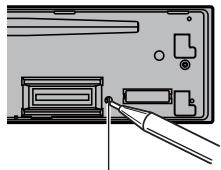
RESET button
1 Remove the front panel.
2 Press RESET with a pen tip or other pointed instrument.
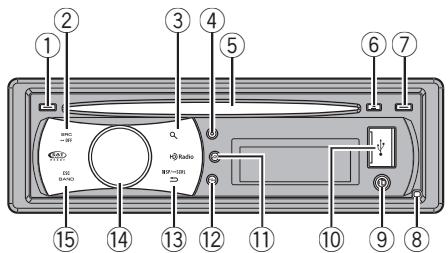
Head unit
| Part | Part | ||
| ① | S.Rtrv/SAT MODE | ⑨ | AUX input jack (3.5 mm stereo jack) |
| ② | SRC/OFF | ⑩ | USB port |
| ③ | Q(list) | ⑪ | Xy/x/iPod |
| ④ | ●/TAG | ⑫ | ←/LOC |
| ⑤ | Disc loading slot | ⑬ | DISP/→/SCRL |
| ⑥ | ▲(eject) | ⑭ | MULTI-CONTROL (M.C.) |
| ⑦ | CLK/DISP OFF | ⑮ | BAND/ESC |
| ⑧ | Detach button | ||

CAUTION
Use an optional Pioneer USB cable (CD-U50E) to connect the USB audio player/USB memory to the USB port. Since the USB audio player/USB memory is projected forward from the unit, it is dangerous to connect directly.
Do not use the unauthorized product.
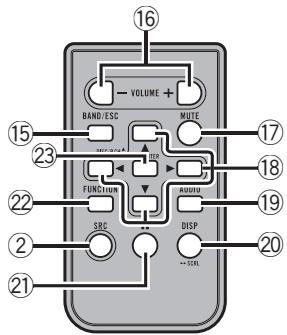
Remote control
| Part | Operation | |
| 16 | VOLUME | Press to increase or decrease volume. |
| 17 | MUTE | Press to mute. Press again to un-mute. |
| 18 | ▲/▼/▲ | Press to perform manual seek tuning, fast forward, reverse and track search controls. Also used for controlling functions. |
| 19 | AUDIO | Press to select an audio function. |
| 20 | DISP/SCRL | Press to select different displays. Press and hold to scroll through the text information. |
| 21 | II | Press to pause or resume. |
| 22 | FUNCTION | Press to select functions. Press and hold to recall the initial setting menu when the sources are off. |
| 23 | LIST/ENTER | Press to display the disc title, track title, folder, or file list depending on the source. While in the operating menu, press to control functions. |

Basic Operations

Important
- Handle gently when removing or attaching the front panel.
Operating this unit
- Avoid subjecting the front panel to excessive shock.
- Keep the front panel out of direct sunlight and high temperatures.
- Remove any cables and devices attached to this unit before detaching the front panel to avoid damage to the device or vehicle interior.
Removing the front panel to protect your unit from theft
Press the detach button to release the front panel.
2 Grab the front panel and remove.
Always keep the detached front panel in the protection device such as protection case.
Re-attaching the front panel
1 Slide the front panel to the left until it clicks. Front panel and the head unit are connected on the left side. Make sure that the front panel has been properly connected to the head unit.
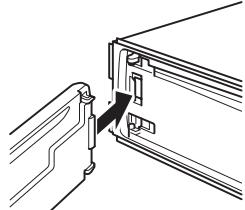
Press the right side of the front panel until it is firmly seated. If you can't attach the front panel to the head unit successfully, try again. However, forcing the front panel into place may result in damage.
Turning the unit on
Press SRC/OFF to turn the unit on.
Turning the unit off
1 Press SRC/OFF and hold until the unit turns off.
Selecting a source
Press SRC/OFF to cycle between: XM (XM tuner)—SIRIUS (SIRIUS tuner)—HD Radio (HD radio tuner)—TUNER (tuner)—CD (CD player)—USB (USB storage device)/iPod (iPod connected using USB input)—EXT (external unit 1)—EXT (external unit 2)—AUX1 (AUX1)—AUX2 (AUX2)—BT Audio (BT audio)—TEL (BT telephone)
Adjusting the volume
Turn M.C. to adjust volume.

Notes
- When this unit's blue/white lead is connected to the vehicle's auto-antenna relay control terminal, the vehicle's antenna extends when this unit's source is turned on. To retract the antenna, turn the source off.
If the HD Radio tuner is connected to this unit, tuner source is skipped.
Use and care of the remote control
Using the remote control
1 Point the remote control in the direction of the front panel to operate. When using for the first time, pull out the film protruding from the tray.
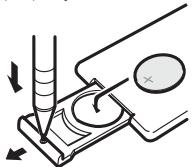
Replacing the battery
1 Slide the tray out on the back of the remote control.
2 Insert the battery with the plus (+) and minus (-) poles aligned properly.

WARNING
- Keep the battery out of the reach of children. Should the battery be swallowed, consult a doctor immediately.
- Batteries (battery pack or batteries installed) must not be exposed to excessive heat such as sunshine, fire or the like.

CAUTION
Use one CR2025 (3V) lithium battery.
- Remove the battery if the remote control is not used for a month or longer.
- There is a danger of explosion if the battery is incorrectly replaced. Replace only with the same or equivalent type.
- Do not handle the battery with metallic tools.
Operating this unit
- Do not store the battery with metallic objects.
- If the battery leaks, wipe the remote control completely clean and install a new battery.
- When disposing of used batteries, comply with governmental regulations or environmental public institutions' rules that apply in your country/area.
- "Perchlorate Material - special handling may apply.
See www.dtsc.ca.gov/hazardouswaste/ perchlorate. (Applicable to California, U.S.A.)

Important
- Do not store the remote control in high temperatures or direct sunlight.
- The remote control may not function properly in direct sunlight.
- Do not let the remote control fall onto the floor, where it may become jammed under the brake or accelerator pedal.
Menu operations identical for function settings/album adjustments/initial settings/lists
Returning to the previous display Returning to the previous list/category (the folder/ca- tegory one level higher)
PressDISP/SCRL.
Returning to the main menu
Returning to the top tier of list/category
Press and hold DISP/SCRL.
Returning to the ordinary display
Canceling the initial setting menu
Press BAND/ESC.
Returning to the ordinary display from the list/category
1 Press BAND/ESC.

Tuner
Basic Operations
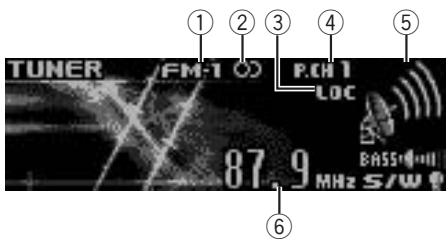
① Band indicator
② (stereo) indicator
③ LOC indicator Appears when local seek tuning is on.
(4) Preset number indicator
⑤ Signal level indicator
⑥ Frequency indicator
Selecting a band
Press BAND/ESC until the desired band (FM-1, FM-2, FM-3 for FM or AM) is displayed.
Manual tuning (step by step)
Push M.C. left or right.
Seeking
Push and hold M.C. left or right. You can cancel seek tuning by pushing M.C. left or right.
While pushing and holding M.C. left or right, you can skip stations. Seek tuning starts as soon as you release M.C.
Storing and recalling stations
You can easily store up to six stations for each band as presets.
1 Press (list).
Preset screen is displayed.
2 Use M.C. to store the selected frequency in memory.
Turn to change the preset number. Press and hold to store.
3 Use M.C. to select the desired station.
Turn to change the station. Press to select.
Operating this unit
- You can also change the station by pushing M.C. up or down.
To return to the ordinary display, press BAND/ ESC or (list).
Switching the display
Desired information can be displayed while tag information has been broadcasting.
Selecting the desired text information
PressDISP/SCRL
Frequency or program service name—song title and artist name
Function settings
1 Press M.C. to display the main menu.
2 Turn M.C. to change the menu option and press to select FUNCTION.
3 Turn M.C. to select the function.
After selecting, perform the following procedures to set the function.
BSM (best stations memory)
BSM (best stations memory) automatically stores the six strongest stations in the order of their signal strength.
Press M.C. to turn BSM on.
To cancel, press M.C. again.
Local (local seek tuning)
Local seek tuning lets you tune in only those radio stations with sufficiently strong signals for good reception.
Press M.C. to turn local on.
To cancel, press M.C. again.
Push M.C. left or right to select the desired setting.
FM: Level 1—Level 2—Level 3—Level 4
AM: Level 1—Level 2
Larger setting number is higher level. The highest level setting allows reception of only the strongest stations, while lower settings let you receive progressively weaker stations.

CD/CD-R/CD-RW and USB storage devices
Basic Operations
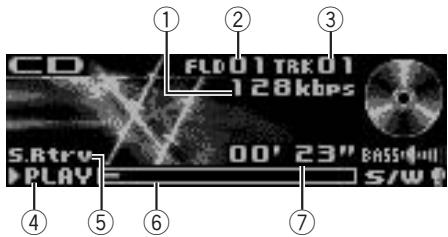
① Bit rate/sampling frequency indicator Shows the bit rate or sampling frequency of the current track (file) when the compressed audio is playing.
- When playing back VBR (variable bit rate)-recorded WMA files, the average bit rate value is displayed.
- When playing back VBR (variable bit rate)-recorded MP3 files, VBR is displayed instead of bit rate value.
- When playing back VBR (variable bit rate)-recorded AAC files, the average bit rate value is displayed. However, depending on the software used to decode AAC files, VBR may be displayed.
② Folder number indicator Shows the folder number currently playing when the compressed audio is playing.
③ Track number indicator
④ PLAY/PAUSE indicator
⑤ S.Rtrv indicator Appears when Sound Retriever function is on.
⑥ Song time (progress bar)
⑦ Play time indicator
Playing a CD/CD-R/CD-RW
1 Insert the disc, label side up, into the disc loading slot.
- If a disc has already been inserted, press SRC/OFF to select the built-in CD player.
Ejecting a CD/CD-R/RD-RW
Press (eject).
Operating this unit
| Playing songs on a USB storage device 1 Open the USB connector cover and plug in the USB storage device using a USB cable. |
| Stop playing a USB storage device • You may disconnect the USB storage device at anytime. |
| Selecting a folder 1 Push M.C. up or down. |
| Selecting a track 1 Push M.C. left or right. |
| Fast forwarding or reversing 1 Push and hold M.C. left or right. |
| Returning to root folder 1 Press and hold BAND/ESC. |
| Switching between compressed audio and CD-DA 1 Press BAND/ESC. |

Notes
- When playing compressed audio, there is no sound during fast forward or reverse.
- USB portable audio players that can be charged via USB will be recharged when plugged in and the ignition switch is set to ACC or ON.
- Disconnect USB storage device from unit when not in use.
- If plug and play is on and a USB storage device is present, depending on the type of device, the source may switch to USB automatically when you turn on the engine. Please change plug and play setting as necessary. Refer to USB plug&play (plug and play) on page 15.
Displaying text information
Selecting the desired text information
PressDISP/SCRL.
CD TEXT discs: Play time: disc artist name and : track title: disc artist name and : disc title: disc title and : track title: track artist name and : track title: track title and play time: : track title, : track artist name and : disc title
WMA/MP3/AAC/WAV: track title and play time: track title and artist name: track title and album title: file name and folder name: play time: artist name and album title: track title, artist name and album title
Scrolling the text information to the left
Press and hold DISP/SCRL.

Notes
- Incompatible text stored with the audio file may not be displayed or may be displayed incorrectly.
Depending on the version of iTunes used to write MP3 files onto a disc, comment information may be incorrectly displayed. - When Windows Media Player 11 is used to encode the WAV files, text information can be displayed.
Selecting and playing files/ tracks from the name list
1 Press (list) to switch to the file/track name list mode.
2 Use M.C. to select the desired file name (or folder name).
| Changing file or folder name 1 Turn M.C. |
| Playing 1 When a file or track is selected, press M.C. |
| Seeing a list of files (or folders) in the selected folder 1 When a folder is selected, press M.C. |
| Playing a song in the selected folder 1 When a folder is selected, press and hold M.C. |
Operating this unit

Note
Track title list will display the list of track titles on a CD TEXT disc.
Advanced operations using special buttons
Selecting a repeat play range
1 Press /LOC to cycle between the following:
CD/CD-R/CD-RW
DISC - Repeat all tracks
- TRACK - Repeat the current track
FOLDER - Repeat the current folder
USB audio player/USB memory
- TRACK - Repeat the current file
FOLDER - Repeat the current folder
ALL-Repeat all files
Enhancing compressed audio and restoring rich sound (sound retriever)
Press S.Rtrv/SAT MODE to cycle between: OFF (off)—1—2
1 is effective for low compression rates, and 2 is effective for high compression rates.
Function settings
1 Press M.C. to display the main menu.
2 Turn M.C. to change the menu option and press to select FUNCTION.
3 Turn M.C. to select the function.
After selecting, perform the following procedures to set the function.
Play mode (repeat play)
Press M.C. to select a repeat play range. For details, refer to Selecting a repeat play range on this page.
Random mode (random play)
1 Press M.C. to turn random play on or off.
Pause (pause)
Press M.C. to pause or resume.
Sound Retriever (sound retriever)
Automatically enhances compressed audio and restores rich sound.
Press M.C. to select the desired setting. For details, refer to Enhancing compressed audio and restoring rich sound (sound retriever) on this page.

iPod
Basic Operations
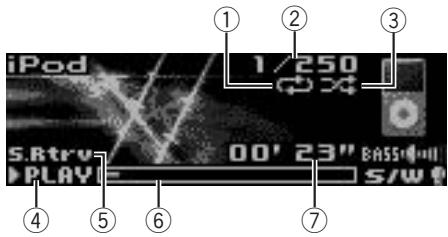
① Repeat indicator
② Song number indicator
③ Shuffle indicator
④ PLAY/PAUSEindicator
⑤ S.Rtrv indicator Appears when Sound Retriever function is on.
⑥ Song time (progress bar)
⑦ Play time indicator
Playing songs on iPod
1 Open the USB connector cover and plug in an iPod using the iPod Dock Connector to USB Cable.
Selecting a track (chapter)
Push M.C. left or right.
Fast forwarding or reversing
Push and hold M.C. left or right.

Notes
- The iPod's battery will be charged if the ignition switch is set to ACC or ON, while connected.
Operating this unit
While the iPod is connected to this unit, the iPod cannot be turned on or off unless the control mode is set to iPod.
- Disconnect headphones from the iPod before connecting to this unit.
- The iPod will turn off about two minutes after the ignition switch is set to OFF.
Displaying text information
Selecting the desired text information
1 Press DISP/SCRL.
Play time: artist name and : song title
: artist name and : album title: album title and : song title: : song title and play
time: : song title, : artist name and :
album title
Scrolling the text information to the left
1 Press and hold DISP/SCRL.

Note
Incompatible text saved on the iPod will not be displayed by the unit.
Browsing for a song
1 Press (list) to switch to the top menu of the list search.
2 Use M.C. to select a category/song.
Changing the name of song or category
1 Turn M.C.
Playlists (playlists)—Artists (artists)—Albums (albums)—Songs (songs)—Podcasts (podcasts)—Genres (genres)—Composers (composers)—Audiobooks (audiobooks)
Playing
1 When a song is selected, press M.C.
Seeing a list of songs in the selected category
When a category is selected, press M.C.
Playing a song in the selected category
When a category is selected, press and hold M.C.
Searching by alphabet in the list
When a list for the selected category is displayed, press LIST to switch to alphabet search mode.
2 Turn M.C. to select a letter.
3 Press M.C. to display the alphabetical list.
If alphabet search is aborted, NOT FOUND is displayed.

Note
Depending on the number of files in the iPod, there may be a delay when displaying a list.
Advanced operations using special buttons
Selecting a repeat play range
1 Press /LOC to cycle between the following:
- ONE - Repeat the current song
- ALL - Repeat all songs in the selected list
Playing all songs in a random order (shuffle all)
Press × 2 / IPod to turn shuffle all on.
Playing songs related to the currently playing song You can play songs from the following lists.
—Album list of currently playing artist
Song list of currently playing album
—Album list of currently playing genre
Press and hold M.C. to switch to the link play mode.
2 Turn M.C. to change the mode; press to select.
- Artist - Plays an album of currently playing artist.
- Album - Plays a song of currently playing album.
Genre - Plays an album of currently playing genre.
The selected song/album will be played after the currently playing song.
- The selected song/album may be cancelled if you operate functions other than link search (e.g. fast forward and reverse).
If no related albums/songs are found, Not found is displayed.
Depending on the song selected to play, the end of the currently playing song and the beginning of the selected song/album may be cut off.
Operating this unit
Operating this unit's iPod function from your iPod This function is not compatible with the following iPod models.
- iPod nano 1st generation
- iPod 5th generation
This unit's iPod function allows you to conduct operations from your iPod and listen to it using your car's speakers.
Press / and hold to switch the control mode.
- iPod - This unit's iPod function can be operated from the connected iPod.
- AUDIO - This unit's iPod function can be operated from this unit.
Enhancing compressed audio and restoring rich sound (sound retriever)
Refer to Enhancing compressed audio and restoring rich sound (sound retriever) on page 11.
Function settings
1 Press M.C. to display the main menu.
2 Turn M.C. to change the menu option and press to select FUNCTION.
3 Turn M.C. to select the function.
After selecting, perform the following procedures to set the function.
Play mode (repeat play)
Refer to Play mode (repeat play) on page 11. However the repeat range is different from CD/ USB storage device. Refer to Selecting a repeat play range on the previous page.
Shuffle mode (shuffle)
Press M.C. to select your favorite setting.
- Shuffle Songs - Play back songs in the selected list in random order.
Shuffle Albums - Play back songs from a randomly selected album in order.
- Shuffle OFF - Cancel random play.
Shuffle all (shuffle all)
Press M.C. to turn shuffle all on.
To turn off, set Shuffle mode in the FUNCTION menu to off.
Link play (link play)
1 Turn M.C. to change the mode; press to select. For details about the settings, refer to Playing songs related to the currently playing song on the previous page.
Control mode (control mode)
Press M.C. to select your favorite setting. For details about the settings, refer to Operating this unit's iPod function from your iPod on this page.
PAUSE (pause)
Refer to Pause (pause) on page 11.
Audiobooks (audiobook speed)
The playback speed of audiobook can be changed.
Press M.C. to select your favorite setting.
- Faster - Playback faster than normal speed
Normal -Playback in normal speed - Slower - Playback slower than normal speed
Sound Retriever (sound retriever)
Refer to Sound Retriever (sound retriever) on page 11.

Notes
- Switching the control mode to iPod pauses song playback. Operate the iPod to resume playback.
- The following functions are still accessible from the unit even if the control mode is set to iPod.
Volume
Fast forward/reverse
Track up/down
— Pausing
Switching the text information
-
When the control mode is set to iPod, operations are limited as follows:
-
Only Control mode (control mode), PAUSE (pause) and Sound Retriever (sound retriever) functions are available.
Browse function cannot be operated from this unit.
Audio Adjustments
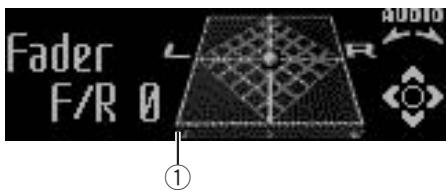
① Audio display
Shows the audio adjustment status.
1 Press M.C. to display the main menu.
2 Turn M.C. to change the menu option and press to select AUDIO.
3 Turn M.C. to select the audio function.
After selecting, perform the following procedures to set the audio function.
Fader/Balance (fader/balance adjustment)
Push M.C. up or down to adjust front/rear speaker balance.
F15 to R15 is displayed as the front/rear speaker balance moves from front to rear.
- F/R 0 is the proper setting when only two speakers are used.
- When the rear output setting is Rear SP:S/W, you cannot adjust front/rear speaker balance. Refer to S/W control (rear output and subwoofer setting) on page 16.
Push M.C. left or right to adjust left/right speaker balance.
L15 to R15 is displayed as the left/right speaker balance moves from left to right.
Powerful (equalizer recall)
Push M.C. left or right to select an equalizer curve.
Powerful—Natural—Vocal—Custom1—Custom2—Flat—S.Bass
- When Flat is selected no adjustments are made to the sound.
100 Hz (equalizer adjustment)
You can adjust the currently selected equalizer curve setting as desired. Adjusted equalizer curve settings are memorized in Custom1 or Custom2.
- A separate Custom1 curve can be created for each source. If you make adjustments when a curve other than Custom2 is selected, the equalizer curve settings will be memorized in Custom1.
- A Custom2 curve can be created common to all sources. If you make adjustments when the Custom2 curve is selected, the Custom2 curve will be updated.
1 Recall the equalizer curve you want to adjust.
Push M.C. left or right to select the equalizer band to adjust. 100Hz-315Hz-1.25kHz-3.15kHz-8kHz
Push M.C. up or down to adjust the equalizer curve. +6 to -6 is displayed as the equalizer curve is increased or decreased.
LOUD (loudness)
Loudness compensates for deficiencies in the low- and high-frequency ranges at low volume.
Press M.C. to turn loudness on or off.
Push M.C. left or right to select the desired setting.
Low (low)-Mid (mid)-High (high)-OFF (off)
Sub W.1 (subwoofer on/off setting)
This unit is equipped with a subwoofer output which can be turned on or off.
1 Press M.C. to turn subwoofer output on or off.
Push M.C. left or right to select the phase of subwoofer output.
Push M.C. left to select reverse phase and Reverse appears in the display. Push M.C. right to select normal phase and Normal appears in the display.
Sub W.2 (subwoofer adjustment)
When the subwoofer output is on, you can adjust the cut-off frequency and the output level of the subwoofer.
Only frequencies lower than those in the selected range are outputted from the subwoofer.
Push M.C. left or right to select cut-off frequency. 50Hz—63Hz—80Hz—100Hz—125Hz
Push M.C. up or down to adjust the output level of the subwoofer. Each time M.C. is pushed up or down, subwoofer level increases or decreases. +6 to -24 is displayed as the level is increased or decreased.
Bass (bass boost)
Operating this unit
Push M.C. up or down to select a desired level. 0 to +6 is displayed as the level is increased or decreased.
HPF (high pass filter adjustment)
When you do not want low sounds from the subwoofer output frequency range to play from the front or rear speakers, turn on the HPF (high pass filter). Only frequencies higher than those in the selected range are output from the front or rear speakers.
Press M.C. to turn high pass filter on or off.
Push M.C. left or right to select cut-off frequency. 50Hz—63Hz—80Hz—100Hz—125Hz
SLA (source level adjustment)
SLA (Source level adjustment) lets you adjust the volume level of each source to prevent radical changes in volume when switching between sources.
- Settings are based on the FM volume level, which remains unchanged.
- Before adjusting source levels, compare the FM volume level with the level of the source you wish to adjust.
- The AM volume level can also be adjusted with source level adjustments.
Push M.C. up or down to adjust the source volume.
Adjustment range: +4 to -4

Note
When selecting FM as the source, you cannot switch to SLA.
Initial Settings
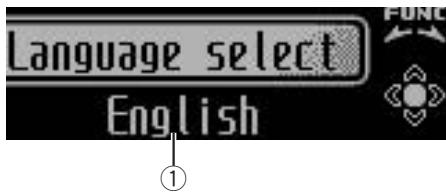
① Function display
- Shows the function status.
1 Press SRC/OFF and hold until the unit turns off.
2 Press M.C. and hold until the initial setting menu appears in the display.
3 Turn M.C. to select the initial setting.
After selecting, perform the following procedures to set the initial setting.
Language select (multi language)
For your convenience, this unit equips multiple language display. You can select the language best suited to your first language.
1 Press M.C. to select the language.
Calendar (setting the date)
Push M.C. left or right to select the segment of the calendar display you wish to set. Year—Day—Month
Push M.C. up or down to set the date.
Clock (setting the clock)
Push M.C. left or right to select the segment of the clock display you wish to set. Hour—Minute
2 Push M.C. up or down to put a clock right.
- You can match the clock to a time signal by pressing M.C.
If 00 to 29, the minutes are rounded down. (e.g., 10:18 becomes 10:00.)
If 30 to 59, the minutes are rounded up. (e.g., 10:36 becomes 11:00.)
EngineTime alert (elapsed time display setting)
This setting allows you to measure the length of time that elapses from when the machine is turned on and display the amount of elapsed time per set period. Also, you will hear alarm.
Press M.C. to select your favorite setting.
OFF—15Minutes—30Minutes
USB plug&play (plug and play)
Operating this unit
This setting allows you to switch your source to USB/ iPod automatically.
Press M.C. to turn the plug and play on or off.
- ON - When USB storage device/iPod is connected, the source is automatically switched to USB/iPod. If you disconnect your USB storage device/iPod, this unit's source is turned off.
- OFF - When USB storage device/iPod is connected, the source is not switched to USB/iPod automatically. Please change the source to USB/iPod manually.
Warning tone (warning tone setting)
If the front panel is not detached from the head unit within four seconds of turning off the ignition, a warning tone sounds. You can turn off the warning tone.
1 Press M.C. to turn the warning tone on or off.
AUX1/AUX2 (auxiliary input setting)
Activate this setting when using auxiliary device connected to this unit.
Press M.C. to turn auxiliary setting on or off.
Dimmer (dimmer setting)
To prevent the display from being too bright at night, the display is automatically dimmed when the car's headlights are turned on. You can turn the dimmer on or off.
Press M.C. to turn dimmer on or off.
Brightness (display brightness setting)
Push M.C. left or right to adjust the brightness level.
0 to 15 is displayed as the level is increased or decreased.
- When dimmer is functioning, the brightness level can be adjusted 0 to 10.
S/W control (rear output and subwoofer setting)
This unit's rear output (rear speaker leads output and RCA rear output) can be used for full-range speaker
(Rear SP:F.Range) or subwoofer (Rear SP:S/W) connection. If you switch the rear output setting to Rear
SP:S/W, you can connect a rear speaker lead directly to a subwoofer without using an auxiliary amp.
Press M.C. to switch the rear output setting.
- When no subwoofer is connected to the rear output, select Rear SP:F.Range (full-range speaker).
-
When a subwoofer is connected to the rear output, select Rear SP:S/W (subwoofer).
-
Even if you change this setting, there is no output unless you turn the subwoofer output on (refer to Sub W.1 (subwoofer on/off setting) on page 14).
If you change this setting, subwoofer output in the audio menu will return to the factory settings. - Both rear speaker lead outputs and RCA rear output are switched simultaneously in this setting.
Demonstration (demo display setting)
1 Press M.C. tp turn the demo display on or off.
- You can also turn on or off feature demo by pressing DISP while this unit is turned off. For more details, refer to Demo mode on page 5.
Reverse mode (reverse mode setting)
1 Press M.C. to turn the reverse mode on or off.
- You can also turn on or off reverse mode by pressing BAND while this unit is turned off. For more details, refer to Reverse mode on page 5.
Ever-Scroll (scroll mode setting)
When Ever Scroll is set to ON, recorded text information scrolls continuously in the display. Set to OFF if you prefer the information to scroll just once.
1 Press M.C. to turn the ever scroll on or off.
BT AUDIO (Bluetooth audio activation)
You need to activate the BT Audio source in order to use a Bluetooth audio player.
- You can only operate this function when Bluetooth adapter (e.g. CD-BTB200) is connected to this unit.
Press M.C. to turn the BT Audio source on or off.
Pin code input (PIN code input)
Operating this unit
To connect your cellular phone to this unit via Bluetooth wireless technology, you need to enter PIN code on your phone to verify the connection. The default code is 0000, but you can change this in this function.
With some Bluetooth audio players, you may be required to enter the Bluetooth audio player PIN code in advance to set this unit for a connection.
- You can only operate this function when Bluetooth adapter (e.g. CD-BTB200) is connected to this unit.
Push M.C. up or down to select a number.
Push M.C. left or right to move the cursor to the previous or next position.
3 After inputting PIN code (up to 16 digits), press M.C.
PIN code can be stored in memory.
- When you press M.C. again on the same display, the PIN code you entered is stored in this unit.
- Pushing M.C. right in the confirmation display returns you to the PIN code input display, and you can change the PIN code.
BT Version info. (Bluetooth version display)
You can display the system versions of this unit and of Bluetooth module.
-
You can only operate this function when Bluetooth adapter (e.g. CD-BTB200) is connected to this unit.
Push M.C. left or right to display the information. -
Push M.C. left to switch to the version of the Bluetooth module of this unit.
- Pushing M.C. right to switch to the system version of this unit.

Other Functions
Using the AUX source
Up to two auxiliary devices such as VCR or portable devices (sold separately) can be connected to this unit. When connected, auxiliary devices are automatically read as AUX sources and assigned to AUX1 or AUX2. The relationship between AUX1 and AUX2 sources is explained below.
About AUX1 and AUX2
There are two methods to connect auxiliary devices to this unit.
AUX1 source:
When connecting auxiliary device using a stereo mini plug cable
- Insert the stereo mini plug into the AUX input jack.
For more details, refer to the installation manual.
This auxiliary device is automatically set to AUX1.
AUX2 source:
When connecting auxiliary device using an IP-BUS-RCA Interconnector (sold separately)
- Use an IP-BUS-RCA Interconnector such as the CD-RB20/CD-RB10 (sold separately) to connect this unit to auxiliary device featuring RCA output.
For more details, refer to the IP-BUS-RCA Interconnector owner's manual.
This auxiliary device is automatically set to AUX2.
- You can only make this type of connection if the auxiliary device has RCA outputs.
Selecting AUX as the source
- Press SRC/OFF to select AUX as the source.
- AUX cannot be selected unless the auxiliary setting is turned on. For more details, refer to AUX1/AUX2 (auxiliary input setting) on the previous page.
Turning the clock display on or off
- Press CLK/DISP OFF to select the desired setting.
Clock off—clock display— elapsed time display
Switching the display indication and button illumination
Display indication and button illumination can be switched on or off.
- Press and hold CLK/DISP OFF.
Pressing and holding CLK/DISP OFF switches the display indication and button illumination on or off.
Even if the display indication is turned off, operation can be conducted. If operation is conducted while the display indication is off, display will light up for a few seconds and then turn off again.
Using different entertainment displays
You can enjoy entertainment displays while listening to each sound source.
1 Press M.C. to display the main menu.
2 Turn M.C. to change the menu option and press to select ENTERTAINMENT.
3 Turn M.C. to change the display.
Background visual—genre—background picture 1—background picture 2—background picture 3—background picture 4—simple display—movie screen 1—movie screen 2—calendar
Genre display changes depending on the genre of music.
This unit supports the genre information stored by iTunes. If MP3/WMA/AAC/WAV music files with genre information are used, background visual 2 can be displayed.
Genre display may not operate correctly depending on the application used to encode audio files.
Bluetooth Audio
If you connect a Bluetooth adapter (e.g. CD-BTB200) to this unit, you can control Bluetooth audio players via Bluetooth wireless technology.
- In some countries, CD-BTB200 is not sold on the market.

Important
Depending on the Bluetooth audio player connected to this unit, the operations available with this unit are limited to the following two levels:
A2DP profile (Advanced Audio Distribution Profile): Only playing back songs on your audio player is possible.
AVRCP profile (Audio/Video Remote Control Profile): Playing back, pausing, selecting songs, etc., are possible.
- Operations may vary depending on the kind of a Bluetooth audio player.
Refer to the instruction manual that came with your Bluetooth audio player as well as this manual while operating your player on this unit.
Information about songs (e.g. the elapsed playing time, song title, song index, etc.) cannot be displayed on this unit. - While you are listening to songs on your Bluetooth audio player, refrain from using on your cellular phone as much as possible. If you use your cellular phone, the signal from your cellular phone may cause noise on the song playback.
- When you are talking on a cellular phone connected to this unit via Bluetooth wireless technology, song playback from your Bluetooth audio player connected to this unit is muted.
- Even if you are listening to a song on your Bluetooth audio player and you switch to another source, song playback continues.
Basic Operations
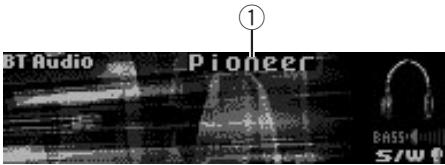
① Device name Shows the device name of the connected Bluetooth audio player (or Bluetooth adapter).
Selecting a track
Push M.C. left or right.
Fast forwarding or reversing
Push and hold M.C. left or right.

Notes
- For details concerning operation, refer to the Bluetooth adapter's operation manual.
- Even though your audio player does not contain a Bluetooth module, you can still control it from this unit via Bluetooth wireless technology. To control your audio player using this unit, connect a product featuring Bluetooth wireless technology (available on the market) to your audio player and connect the Bluetooth adapter (e.g. CD-BTB200) to this unit.
Function settings
1 Press M.C. to display the main menu.
2 Turn M.C. to change the menu option and press to select FUNCTION.
3 Turn M.C. to select the function.
After selecting, perform the following procedures to set the function.
Connection open (Bluetooth audio player connection)
- This function cannot be operated when a Bluetooth audio player has already been connected.
1 Press M.C. to open the connection.
Always waiting is displayed. This unit is now on standby for connection from Bluetooth audio player.
- If your Bluetooth audio player is set ready for Bluetooth wireless connection, connection to this unit is automatically established.
- If your player requires a PIN code to establish a connection, look for the code on the player or in its accompanying documentation. Refer to Pin code input (PIN code input) on page 16.
Disconnect audio (Bluetooth audio player disconnection)
- This function cannot be operated when a Bluetooth audio player is not connected.
Press M.C. to disconnect the Bluetooth audio player.
Connected is displayed. The Bluetooth audio player is now disconnected from this unit.
Play (song playback)
- This function cannot be operated when a Bluetooth audio player is not connected.
- This function cannot be operated when a Bluetooth audio player is connected via A2DP.
1 Press M.C. to start playback.
Stop (stop playback)
- This function cannot be operated when a Bluetooth audio player is not connected.
- This function cannot be operated when a Bluetooth audio player is connected via A2DP.
Press M.C. to stop the playback.
Pause (pause)
- This function cannot be operated when a Bluetooth audio player is not connected.
- This function cannot be operated when a Bluetooth audio player is connected via A2DP.
Refer to Pause (pause) on page 11.
Device info. (BD (Bluetooth device) address display)
Push M.C. left or right to display the information.
- Push M.C. right to display the device name.
- Push M.C. left to display the BD address.

Bluetooth Telephone
If you use a Bluetooth adapter (e.g. CD-BTB200), you can connect a cellular phone fea-turing Bluetooth wireless technology to this unit for hands-free, wireless calls, even while driving.
- In some countries, CD-BTB200 is not sold on the market.
Basic Operations
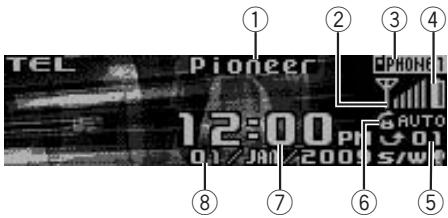
① Device name
Shows the device name of the cellular phone.
② Signal level indicator
Shows the signal strength of cellular phone.
- The level shown on the indicator may differ from the actual signal level.
③ User number indicator
Shows the registration number of the cellular phone.
④ Battery strength indicator
Shows the battery strength of cellular phone.
- The level shown on the indicator may differ from the actual battery strength.
- If the battery strength is not available, nothing is displayed in the battery strength indicator area.
⑤ Incoming call notice indication
Shows when an incoming call has been received and not checked yet.
- Incoming call notice is not displayed for calls made when your cellular phone is disconnected from this unit.
⑥ Automatic answering/Automatic rejecting indicator
Shows AUTO when the automatic answering function is on (for more details, refer to
Auto answer (automatic answering) on page 24).
Shows REFUSE when the automatic rejecting function is on (for more details, refer to Refuse calls (automatic rejecting) on page 24).
⑦ Clock display
Shows the time (if connected with a phone).
⑧ Calendar display
Shows the day, month and year (if connected with a phone).

Important
- Since this unit is on standby to connect with your cellular phone via Bluetooth wireless technology, using this unit without running the engine can result in battery drainage.
- Advanced operations that require your attention such as dialing numbers on the monitor, using phone book, etc., are prohibited while you are driving. When you need to use these advanced operations, stop your vehicle in a safe place.

Notes
- The equalizer curve for the phone source is fixed.
- When selecting the phone source, you can only operate Fader/Balance (balance adjustment) in the audio menu.
Setting up for hands-free phoning
Before you can use the hands-free phoning function you must set up the unit for use with your cellular phone. This entails establishing a Bluetooth wireless connection between this unit and your phone, registering your phone with this unit, and adjusting the volume level.
1 Connection
For detailed instructions on connecting your phone to this unit via Bluetooth wireless technology, see following section. Function and operation on the next page.
To make best use of the technology, we recommend you register the phone to this unit.
2 Registration
To register your temporarily connected phone, refer to Set phone (registering a connected cellular phone) on page 23.
Volume adjustment
Adjust the earpiece volume on your cellular phone for comfort. When adjusted, the volume level is recorded in this unit as the default setting.
- Caller's voice volume and ring volume may vary depending on the type of cellular phone.
- If the difference between the ring volume and caller's voice volume is big, overall volume level may become unstable.
- Before disconnecting the cellular phone from this unit, make sure to adjust the volume to a proper level. If the volume is muted (zero level) on your cellular phone, the volume level of your cellular phone remains muted even after the cellular phone is disconnected.
Making a phone call
Voice recognition
Press BAND/ESC and hold until Voice dial appears in the display.
Voice dial appears in the display. When Voice dial ON is displayed, voice recognition function is now ready.
- If your cellular phone does not feature voice recognition function, No voice dial appears in the display and operation is not possible.
2 Pronounce the name of your contact.
Taking a phone call
Answering or rejecting an incoming call
Answering an incoming call
1 When a call comes in, press M.C.
- You can also perform this operation by pushing M.C. up.
End a call
Push M.C. down.
Rejecting an incoming call
1 When a call comes in, push M.C. down.

Notes
If private mode is selected on the cellular phone, hands-free phoning may not be performed.
- The estimated call time appears in the display (this may differ slightly from the actual call time).
Operating a call waiting
Answering a call waiting
When a call comes in, press M.C.
- You can also perform this operation by pushing M.C. up.
End all calls
Push M.C. down.
Switch between callers on hold
Press M.C.
- You can also perform this operation by pushing M.C. up.
Rejecting call waiting
Push M.C. down.

Notes
- Pushing M.C. down ends all calls including calls waiting on line.
To end the call, both you and your caller need to hang up the phone.
Function and operation
1 Press M.C. to display the main menu.
2 Turn M.C. to change the menu option and press to select FUNCTION.
3 Turn M.C. to select the function.
After selecting, perform the following procedures to set the function.
Search & Connect (searching for available cellular phone)
- This function cannot be operated when the cellular phone is connected.
Press M.C. to search for available cellular phones. While searching, Searching flashes. When available cellular phones featuring Bluetooth wireless technology are found, device name or Name not found (if names cannot be obtained) is displayed. - If this unit fails to find any available cellular phones, Not found is displayed.
Push M.C. up or down to select a device name you want to connect.
Press M.C. to connect the selected cellular phone.
While connecting, Connecting flashes. To complete the connection, check the device name (Pioneer BT Unit) and enter the link code on your cellular phone. If the connection is established, Connected is displayed.
PIN code is set to 0000 as the default. You can change this code. Refer to Pin code input (PIN code input) on page 1
Connection open (connecting from cellular phone)
- This function cannot be operated when the cellular phone is connected.
1 Press M.C. to open the connection.
Disconnect phone (disconnecting a cellular phone)
- This function cannot be operated when the cellular phone is not connected.
Press M.C. to disconnect a cellular phone from this unit. After disconnection is completed, Disconnecte is displayed.
Connect phone (connecting a registered cellular phone)
- This function cannot be operated when the cellular phone is connected.
Push M.C. up or down to select a pairing assignment.
P1 (user phone 1)—P2 (user phone 2)—P3 (user phone 3)—G1 (guest phone 1)—G2 (guest phone 2)
- If the assignment is empty, No data is displayed and operation is not possible.
Press M.C. to connect the selected cellular phone.
While connecting, Connecting is displayed. After the connection is completed, Connected is displayed.
Set phone (registering a connected cellular phone)
- This function cannot be operated when the cellular phone is not connected or already connected and registered.
Push M.C. up or down to select a pairing assignment.
P1 (user phone 1)—P2 (user phone 2)—P3 (user phone 3)—G1 (guest phone 1)—G2 (guest phone 2)
- As you select each assignment, you can see whether or not a phone is already registered. If the assignment is empty, No data is displayed. If the assignment is already taken, the device name appears. To replace an assignment with a new phone, first delete the current assignment. Refer to Delete phone (deleting a registered cellular phone).
Press M.C. to register the currently connected phone.
When registration is completed, RegCompleted is displayed.
If the registration fails, Reg.ErrOR is displayed. In this case, return to step 1 and try again.
Delete phone (deleting a registered cellular phone)
Push M.C. up or down to select a pairing assignment.
P1 (user phone 1)—P2 (user phone 2)—P3 (user phone 3)—G1 (guest phone 1)—G2 (guest phone 2)
- If the assignment is empty, No data is displayed and operation is not possible.
2 Push M.C. right to select Delete YES.
Delete YES is displayed. Deleting phone is now on standby.
3 Press M.C. to delete the phone.
After the phone is deleted, Deleted is displayed.
PH.B.Transform (transferring entries to the phone book)
The Phone Book can hold a total of 500 entries. 300 from User 1, 150 from User 2, and 50 from User 3.
Press M.C. to enter the phone book transfer standby mode.
Transfer YES appears in the display.
Press M.C. to show the confirmation display.
Transfer - / - appears in the display.
3 Use the cellular phone to perform phone book transfer.
Perform phone book transfer using the cellular phone. For detailed instructions, refer to the instruction manual that came with your cellular phone.
- The display indicates how many entries have been transferred and the total number to be transferred.
4 Data transferred is displayed and phone book transfer is completed.
PH.B.Name view (changing the phone book display order)
- This function cannot be operated when the cellular phone is not connected or not registered.
- This function cannot be operated when the registered guest phone is used.
This function cannot be operated when a Bluetooth telephone is connected via HSP (head set profile).
Press M.C. to change the name view order. Inverted is displayed and the name view order is changed.
Pressing M.C. repeatedly changes the name view order between first and last name.
Clear memory (clearing memory)
Available accessories
- This function cannot be operated when the cellular phone is not connected or not registered.
-
This function cannot be operated when a Bluetooth telephone is connected via HSP (head set profile).
Push M.C. up or down to select an item. Phone book (phone book)—Missed calls (missed call history)—Dialled calls (dialed call history)—Received calls (received call history)—Dial preset (preset phone numbers)—All clear (delete all memory) -
If you want to clear all the Phone Book, dialled/received/missed call history list and preset phone number, select All clear.
- If guest phone is connected to this unit via Bluetooth wireless technology, Phone book cannot be selected.
Push M.C. right to determine the item that you want to delete from this unit.
Clear memory YES is displayed. Clearing memory is now on standby.
If you do not want to clear the memory that you have selected, push M.C. left. The display reverts to normal.
Press M.C. to clear the memory.
Cleared is displayed and data on the selected item is cleared from this unit's memory.
Number dial (making a call by entering phone number)
- This function cannot be operated when the cellular phone is not connected.
- This function cannot be operated when a Bluetooth telephone is connected via HSP (head set profile).
- Be sure to park your vehicle and apply the parking brake when performing this operation.
Push M.C.up or down to select a number.
Push M.C. left or right to move the cursor to the previous or next position. Up to 24 digits can be entered.
3 When you finish entering the number, press M.C.
4 Press M.C. to make a call.
5 To end the call, push M.C. down.
Refuse calls (automatic rejecting)
- This function cannot be operated when a Bluetooth telephone is connected via HSP (head set profile).
Press M.C. to turn automatic call rejection on or off.
Auto answer (automatic answering)
Press M.C. to turn automatic answering on or off.
Ring tone (ring tone select)
1 Press M.C. to turn the ring tone on or off.
Auto connect (automatic connection to a phone)
1 Press M.C. to turn automatic connection on or off. If your cellular phone is ready for Bluetooth wireless connection, connection to this unit is automatically established.
Echo cancel (echo cancel and noise reduction)
Press M.C. to turn echo canceling on or off.
Device info. (BD (Bluetooth device) address display)
Refer to Device info. (BD (Bluetooth device) address display) on page 20.
Using the phone book

Important
Be sure to park your vehicle and apply the parking brake when performing this operation.
After finding the number you want to call in the phone book, you can select the entry and make the call.
1 Press (list) to display the Phone Book.
Phone book—Missed call—Dialled call—Received call
2 Push M.C. left or right to select the first letter of the name you are looking for.
3 Press M.C. to display entries.
The display shows the first three Phone Book entries starting with that letter (e.g. "Ben", "Brian" and "Burt" when "B" is selected).
4 Push M.C. up or down to select a Phone Book entry you want to call.
5 Push M.C. right to display the detailed list of the selected entry.
The phone number, name and genre (if assigned) of entries are displayed in the detailed list.
If several phone numbers are included in an entry, select one by turning M.C.
If you want to go back and select another entry, push M.C. left.
6 Use M.C. to control the following functions.
Perform the following procedures to set the function.
Calling a number in the phone book
Press M.C. to make a call.
2 To end the call, push M.C. down.
Editing phone numbers
You can edit the numbers of Phone Book entries. Each phone number can be up to 24 digits long.
Press and hold M.C. to display the number input screen.
Push M.C. left or right to move the cursor to the number you want to change.
Push M.C. up or down to change numbers.
4 Press M.C. to store the new number.
Clearing a phone book entry
Press and hold M.C. to display the number input screen.
Turn M.C. to switch to the clear memory screen. Edit number (number input screen)—Clear memory (clear memory screen)
Push M.C. right to show a confirmation display. Clear memory YES is displayed.
- If you do not want to clear the memory that you have selected, push M.C. left. The display reverts to normal.
4 Press M.C. to delete the Phone Book entry. Cleared is displayed.
The Phone Book entry is deleted. The display returns to Phone Book entry list.
Using the call history

Important
Be sure to park your vehicle and apply the parking brake when performing this operation.
The 12 most recent calls made (dialled), received and missed, are stored in the call history. You can browse the call history and call numbers from it.
1 Press (list) to display the list.
Phone book—Missed call—Dialled call—Received call
If no phone numbers are stored in the selected list, No data is displayed.
2 Turn M.C. to select a phone number.
Turning M.C. to change the phone numbers stored in the list.
If the phone number is already in the phone book, the corresponding name is displayed.
- You can also change the phone number by pushing M.C. up or down.
3 Push M.C. right to display the detailed list.
Name and phone number are displayed in the detailed list.
If the number is already in the Phone Book then the name is also displayed.
- Turning M.C. switches to the previous or next phone number displayed in the detailed list.
4 Press M.C. to make a call.
For an international call, press and hold M.C. to add + to the phone number.
5 To end the call, push M.C. down.
HD Radio™ tuner
You can use this unit to control an HD Radio tuner (e.g. GEX-P20HD), which is sold separately.
For details concerning operation, refer to the HD Radio tuner's operation manual.
Basic Operations
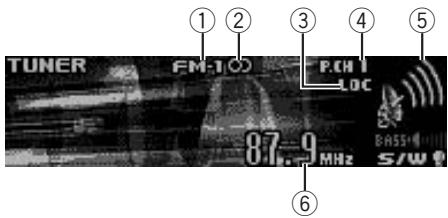
① Band indicator
② OD (stereo) indicator
Appears when the selected frequency is being broadcast in stereo.
③ LOCindicator
Appears when local seek tuning is on.
(4) Preset number indicator
⑤ Signal level indicator
Shows the radio wave strength.
⑥ Frequency indicator
Selecting a band
Press BAND/ESC until the desired band (FM-1, FM-2, FM-3 for FM or AM) is displayed.
Manual tuning (step by step)
Push M.C. left or right.
Seeking
Push and hold M.C. left or right. You can cancel seek tuning by pushing M.C. left or right.
While pushing and holding M.C. left or right, you can skip stations. Seek tuning starts as soon as you release M.C.
Storing and recalling stations
The operation is the same as that of the tuner. (Refer to Storing and recalling stations on page 8.)
Switching the display
Desired information can be displayed while tag information has been broadcasting.
Selecting the desired text information
PressDISP/SCRL.
Broadcast frequency/station name—broadcast frequency/artist name—broadcast frequency/song title—broadcast frequency/program type
Scrolling the text information to the left
Press and hold DISP/SCRL.
Using iTunes tagging
This function can be operated with the following iPod models.
- iPod 5th generation
- iPod nano 3rd generation
- iPod nano 4th generation
— iPod classic - iPod classic 120GB
— iPod touch - iPod touch 2nd generation
iPhone
iPhone 3G
However, tag information can be stored in this unit even while the other iPod models are used. It is possible to save the song's information (tag) from broadcasting station to your iPod. The songs will show up in a playlist called "Tagged playlist" in iTunes the next time you sync your iPod. Then you can directly buy the songs you want from iTunes Music Store.
Storing the tag information to this unit
Tune in the broadcast station.
Press and hold M.C. if TAG is indicated in the display while desired song is broadcasting.
While storing the tag data on this unit, TAG flashes.
Storing the tagged information to your iPod
1 Connect the iPod to this unit and transfer this unit's tag information to the iPod.
Advanced operations using special buttons
Storing the tag information to this unit
Press /TAG.
Function settings
1 Press M.C. to display the main menu.
2 Turn M.C. to change the menu option and press to select FUNCTION.
3 Turn M.C. to select the function.
After selecting, perform the following procedures to set the function.
BSM (best stations memory)
Refer to BSM (best stations memory) on page 9.
Local (local seek tuning)
Refer to Local (local seek tuning) on page 9.
Seek mode (seek mode)
Seek tuning setting can be changed between digital station seek (Seek HD) and analog station seek (Seek ALL) depending on the reception status.
Press M.C. to select your favorite setting.
Seek ALL—Seek HD
Blending (reception mode)
If a digital broadcast reception condition gets poor, this unit automatically switches to the analog broadcast of the same frequency level. If this function is set to on, the tuner switches between digital broadcast and analog broadcast automatically. If this function is off, reception will be conducted within an analog broadcast.
Press M.C. to turn this function on or off.

XM tuner
You can use this unit to control an XM satellite digital tuner (GEX-P920XM), which is sold separately.
For details concerning operation, refer to the XM tuner's operation manuals. This section provides information on XM operations with this unit which differs from that described in the XM tuner's operation manual.
- With this unit, you can operate two additional functions: XM channel direct selection and preset channel list.
Basic Operations
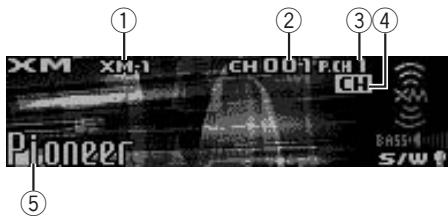
① XM band indicator
② XM channel number indicator
③ XM preset number indicator
④ XM channel select setting indicator Shows what channel select setting has been selected. CH is displayed when Channel number is selected, and CAT is displayed when Category is selected.
⑤ XM text information
Shows the text information of broadcast channel.
Select an XM band.
1 Press BAND/ESC.
- Band can be selected from XM-1, XM-2 or XM-3.
Select a channel.
Push M.C. left or right.
If you push and hold M.C. left or right, you can increase or decrease channel number continuously.
- You can also perform tuning from a desired channel category. (Refer to Selecting a channel in the channel category on the next page.)
Switching the XM display
1 Press and hold DISP/SCRL.
Storing and recalling broadcast stations
You can easily store up to six stations for each band as presets.
- Six stations for each band can be stored in memory.
1 Press (list).
Preset screen is displayed.
Available accessories
2 Use M.C. to store the selected station in memory.
Turn to change the preset number. Press and hold to store.
3 Use M.C. to select the desired station.
Turn to change the station; press to select.
- You can also change the station by pushing
M.C. up or down.
Advanced operations using special buttons
Selecting the XM channel select mode
Press S.Rtrv/SAT MODE to cycle between: Channel number (channel number select setting)—Category (channel category select setting)
Function and operation
1 Press M.C. to display the main menu.
2 Use M.C. to select FUNCTION.
The function selection menu is displayed.
Turn to change the menu option. Press to select.
3 Turn M.C. to select the function.
After selecting, perform the following procedures to set the function.
Channel mode (channel select mode setting)
You have two methods for selecting a channel: by number and by category. When selecting by number, channels in any category can be selected. Select by category to narrow your search down to only channels in a particular category.
1 Press M.C. to change the channel select mode. Channel number (channel number select setting)—Category (channel category select setting)
Selecting a channel in the channel category
1 Switch the channel select settings to Category.
Refer to Selecting the XM channel select mode on this page or Channel mode (channel select mode setting) on this page.
2 Push M.C. up or down to select the desired channel category.
3 Push M.C. left or right to select the desired channel in the selected channel category.
Displaying the Radio ID
1 Select the channel select settings to Channel number.
Refer to Selecting the XM channel select mode on this page or Channel mode (channel select mode setting) on this page.
2 Push M.C. left or right to select RADIO ID.
If you select another channel, display of the ID code is canceled.
- Display of the ID code repeats displaying RADIO ID and the ID code one after the other.
SIRIUS Satellite Radio tuner
You can use this unit to control a SIRIUS Satellite Radio tuner, which is sold separately. When the SIRIUS tuner is used together with this unit, some operations differ slightly from those described in the SIRIUS operation manual. This manual provides information on these points. For all other information on using the SIRIUS tuner, please refer to the SIRIUS operation manual.
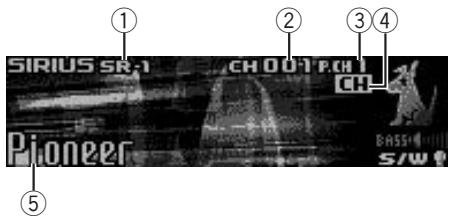
Listening to SIRIUS Satellite Radio
① SIRIUS band indicator
② SIRIUS channel number indicator
③ SIRIUS preset number indicator
④ SIRIUS channel select setting indicator Shows what channel select setting has been selected. CH is displayed when Channel number is selected, and CAT is displayed when Category is selected. I.R is displayed during the Instant Replay mode.
⑤ SIRIUS channel name
Shows the channel name of broadcast channel.
Select a SIRIUS band.
1 Press BAND/ESC.
Band can be selected from SR-1, SR-2 or SR3.
Select a channel.
Push M.C. left or right.
If you push and hold M.C. left or right, you can increase or decrease channel number continuously.
- You can also perform tuning from a desired channel category. (Refer to Selecting a channel in the channel category on page 31.)
Switching the SIRIUS display
Press and hold DISP/SCRL.
Play time—Channel number—Channel name—Category name—Artist name—Song title/program title—Composer name
- Play time is displayed during the Instant Replay mode. Refer to Using Instant Replay function on page 31.
- Play time display indicates the time inverted from the live broadcast. Play time is displayed in negative number.
Displaying the Radio ID
1 Push M.C. left or right to select CH 000.
- To select CH 000, set the channel select setting to Channel number. About the channel select setting, refer to Selecting the SIRIUS channel select mode on the next page.

Note
It may take a few seconds before you can hear anything while this unit acquires and processes the satellite signal when you change the source to SIRIUS tuner or select a channel.
Storing and recalling broadcast stations
You can easily store up to six stations for each band as presets.
- Six stations for each band can be stored in memory.
1 Press /LIST.
Preset screen is displayed.
2 Use M.C. to store the selected station in memory.
Turn to change the preset number. Press and hold to store.
The SIRIUS preset number you have selected will flash and then remain lit. The selected station has been stored in memory.
3 Use M.C. to select the desired station.
Turn to change the station; press to select.
- You can also change the station by pushing M.C. up or down.
Available accessories
Advanced operations using special buttons
Selecting the SIRIUS channel select mode
Press S.Rtrv/SAT MODE repeatedly to select the desired channel select setting.
Channel number (channel number select setting) Category channel category select setting
Function and operation
1 Press M.C. to display the main menu.
2 Use M.C. to select FUNCTION.
The function selection menu is displayed.
Turn to change the menu option. Press to select.
3 Turn M.C. to select the function.
After selecting, perform the following procedures to set the function.
Channel mode (channel select mode setting)
You have two methods for selecting a channel: by number and by category. When selecting by number, channels in any category can be selected. Select by category to narrow your search down to only channels in a particular category.
1 Press M.C. to change the channel select mode. Channel number (channel number select setting)—Category (channel category select setting)
Game alert (game alert setting)
This system can alert you when games involving your favorite teams are about to start. To use this function you need in advance to set up a game alert for the teams.
To use this function, Pioneer SIRIUS bus interface (e.g. CD-SB10) is required.
To use this function, SIRIUS plug-and-play unit with Game Alert Function is required.
- For details, refer to SIRIUS plug-and-play unit's manuals.
- You can also operate this function when SIR-PNR2 is connected to this unit.
- The Game Alert function is on at the default setting.
- Once you made team selections, you need to turn the Game Alert function on.
1 Press M.C. to turn the Game Alert on or off.
- When a game of the selected team is about to start (or is currently playing) on a different station, Game alert info is displayed. Press and hold M.C. to switch to that station, and you can listen to that game.
Team setting (team setting)
Push M.C. left or right to select a desired league.
Push M.C. up or down to select a desired team.
Press M.C. to store the selected team in memory. The game alert function will start on that team.
4 Repeat these steps for selecting other teams. Up to 12 teams can be selected.
- When you have already made 12 team selections, FULL is displayed and additional team selection is not possible. In this case, first delete the team selection and then try again.
Game info (game information)
If games of your selected teams are currently playing, you can display information of the games and tune to the broadcast channel.
You can display information of the games while enjoying the sound from currently tuning station. You can also tune to the broadcast channel when you wish to.
Push M.C. up or down to select a game.
Game score will be updated automatically.
Press M.C. to switch to that station to listen to the game.
If you have not made any team selections, NOT SET is displayed.
- When games involving your favorite teams are not currently playing, NO GAME is displayed.
Pause (pause)
During the Instant Replay mode, you can select
Pause (pause). Refer to Using Instant Replay function on this page.
Refer to Pause (pause) on page 11.
Selecting a channel in the channel category
1 Select the channel select settings to Category.
Refer to Selecting the SIRUS channel select mode on the previous page.
2 Push M.C. up or down to select the desired channel category.
3 Push M.C. left or right to select the desired channel in the selected channel category.
Using Instant Replay function
Following functions can be operated during the Instant Replay mode.
To use this function, Pioneer SIRIUS bus interface (e.g. CD-SB10) is required.
- To use this function, SIRIUS plug-and-play unit with Instant Replay Function is required.
- For details, refer to SIRIUS plug-and-play unit's manuals.
Performing the Instant Replay mode
1 When SIRIUS tuner is selected as the source, press and hold S.Rtrv/SAT MODE.
- When BAND/ESC is pressed, instant replay mode is canceled.
- When another source is selected, instant replay mode is canceled.
Select a track
Push M.C. left or right.
Fast forward or reverse
Push and hold M.C. left or right for about one second and release.

Additional Information
Troubleshooting
Error messages
| Symptom | Cause | Action (See) |
| The display automatically returns to the ordinary display. | You did not perform any operation within about 30 seconds. | Perform operation again. |
| The repeat play range changes unexpectedly. | Depending on the repeat play range, the selected range may change when selecting another folder or track, or when fast for warding/reversing. | Select the repeat play range again. |
| A subfolder is not played back. | Sub folders cannot be played when FOLDER (folder repeat) is selected. | Select another repeat play range. |
| NO XXXX appears when a display is changed (e.g., NO TITLE). | No text information embedded | Switch the display or play another track/file. |
| The display is illuminated when the unit is turned off. | Demo mode is on. | Press DISP/SCRL to cancel demo mode. |
| The unit is mal-functioning. There is interference. | You are using a device, such as a cell phone, that transmits electromagnetic waves near the unit. | Move electrical devices that may be causing the interference away from the unit. |

When you contact your dealer or your nearest Pioneer Service Center, be sure to note the error message.
Built-in CD Player
| Message | Cause | Action |
| ERROR-11, 12, 17, 30 | Dirty disc | Clean disc. |
| Scratched disc | Replace disc. | |
| ERROR-10, 11, 12, 15, 17, 30, A0 | Electrical or mechanical | Turn the ignition switch OFF and back ON, or switch to a different source, then back to the CD player. |
| ERROR-15 | The inserted disc is blank | Replace disc. |
| ERROR-22, 23 | Unsupported CD format | Replace disc. |
| FORMAT READ | There is some-times a delay be-tween the start of playback and when you start to hear any sound | Wait until the mes-sage disappears and you hear sound. |
| NO AUDIO | The inserted disc does not contain any playable files | Replace disc. |
| SKIPPED | The inserted disc contains DRM protected WMA files | Replace disc. |
| PROTECT | All the files on the inserted disc are embedded with DRM | Replace disc. |
USB storage device
| Message | Cause | Action |
| NO DEVICE | When plug and play is off, no USB storage device is connected. | • Turn the plug and play on. • Connect a compatible USB storage device. |
| FORMAT READ | There is some times a delay between the start of playback and when you start to hear any sound | Wait until the message disappears and you hear sound. |
Additional Information
| NO AUDIO | No songs | Transfer the audio files to the USB storage device and connect. |
| The connected USB storage device has security enabled | Follow the USB storage device instructions to dis-able the security. | |
| SKIPPED | The connected USB storage device contains WMA files embedded with Windows Media DRM 9/10 | Play an audio file not embedded with Windows Media DRM 9/10. |
| PROTECT | All the files in the USB storage device are embedded with Windows Media DRM 9/10 | Transfer audio files not embedded with Windows Media DRM 9/10 to the USB storage device and connect. |
| CHECK USB | The USB connec- tor or USB cable has short-circuited. | Check that the USB connector or USB cable is not caught in some-thing or damaged. |
| The connected USB storage de- vice consumes more than 500 mA (maximum allowable cur-rent). | Disconnect the USB storage de- vice and do not use it. Turn the ignition switch to OFF, then to ACC or ON and then connect only com- pliant USB storage devices. | |
| NOT COMPA-TIBLE | Not compatible USB device | Disconnect your device and replace it with a compati-ble USB storage device. |
| ERROR-19 | Communication failure | Perform one of the following oper- tions.-Turn the ignition switch OFF and back ON.-Disconnect the USB storage de- vice.-Change to a dif- ferent source. Then, return to the USB source. |
| ERROR-23 | USB storage device is not for-matted with FAT12, FAT16 or FAT32 | USB storage device should be for-matted with FAT12, FAT16 or FAT32. |
iPod
| Message | Cause | Action |
| NO DEVICE | When plug and play is off, no USB storage device or iPod is connected. | Turn the plug and play on. Connect a compatible iPod. |
| FORMAT READ | There is some-times a delay between the start of playback and when you start to hear any sound | Wait until the message disappears and you hear sound. |
| ERROR-19 | Communication failure | Disconnect the cable from iPod. Once iPod's main menu is displayed, reconnect cable. Reset the iPod. |
| iPod failure | Disconnect the cable from iPod. Once iPod's main menu is displayed, reconnect cable. Reset the iPod. | |
| ERROR-16 | Old iPod firmware versions | Update the iPod version. |
| iPod failure | Disconnect the cable from iPod. Once iPod's main menu is displayed, reconnect cable. Reset the iPod. | |
| N/A USB | Not compatible iPod | Disconnect your device and replace it with a compatible iPod. |
Additional Information
| CHECK USB | iPod operates correctly but does not charge | Check if the con- nection cable for iPod shorted out (e.g., not caught in metal objects). After checking, turn the ignition switch OFF and back ON or discon- nect the iPod and reconnect. |
| STOP | No songs | Transfer songs to iPod. |
| No songs in the current list | Select a list that contains songs. |

Handling guideline Discs and player
Use only discs featuring either of following two logos.


Use 12-cm disc. Do not use 8-cm disc or an adapter for 8-cm disc.
Use only conventional, fully circular discs. Do not use shaped discs.


Do not insert anything other than a CD into the CD loading slot.
Do not use cracked, chipped, warped, or otherwise damaged discs as they may damage the player.
Unfinalized CD-R/CD-RW disc playback is not possible.
Do not touch the recorded surface of the discs.
Store discs in their cases when not in use.
Avoid leaving discs in excessively hot environments including under direct sunlight.
Do not attach labels, write on or apply chemicals to the surface of the discs.
To clean a CD, wipe the disc with a soft cloth outward from the center.
Condensation may temporarily impair the player's performance. Leave it to adjust to the warmer temperature for about one hour. Also, wipe any damp discs with a soft cloth.
Playback of discs may not be possible because of disc characteristics, disc format, recorded application, playback environment, storage conditions, and so on.
Road shocks may interrupt disc playback.
Read the precautions for discs before using them.
USB storage device
Address any questions you have about your USB storage device to the manufacturer of the device.
Connections via a USB hub are not supported.
Do not connect anything other than a USB storage device.
Do not leave the USB storage device in any place with high temperatures.
Firmly secure the USB storage device when driving. Do not let the USB storage device fall onto the floor, where it may become jammed under the brake or accelerator pedal.
Depending on the USB storage device, the following problems may occur.
Operations may vary.
This unit may not recognize the storage device.
The file may not be played back properly.
The device may generate noise in the radio.
iPod
Do not leave the iPod in direct sunlight for extended amounts of time. Extended exposure to direct sunlight can result in iPod malfunction due to the resulting high temperature.
Do not leave the iPod in any place with high temperatures.
To ensure proper operation, connect the dock connector cable from the iPod directly to this unit.
Additional Information
Firmly secure the iPod when driving. Do not let the iPod fall onto the floor, where it may become jammed under the brake or accelerator pedal.
For details, refer to the iPod's manuals.
About iPod settings
- When an iPod is connected, this unit changes the EQ (equalizer) setting of the iPod to off in order to optimize the acoustics. When you disconnect the iPod, the EQ returns to the original setting.
- You cannot set Repeat to off on the iPod when using this unit. Repeat is automatically changed to All when connecting the iPod to this unit.
DualDiscs
DualDiscs are two-sided discs that have a recordable CD for audio on one side and a recordable DVD for video on the other.
Since the CD side of DualDiscs is not physically compatible with the general CD standard, it may not be possible to play the CD side with this unit.
Frequent loading and ejecting of a DualDisc may result in scratches on the disc. Serious scratches can lead to playback problems on this unit. In some cases, a DualDisc may become stuck in the disc loading slot and will not eject. To prevent this, we recommend you refrain from using DualDisc with this unit.
Please refer to the information from the disc manufacturer for more detailed information about DualDiscs.

Compressed audio compatibility (disc, USB)
WMA
File extension: .wma
Bit rate: 48 kbps to 320 kbps (CBR), 48 kbps to 384 kbps (VBR)
Sampling frequency: 32kHz 44.1 kHz,48 kHz
Windows Media Audio Professional, Lossless, Voice/ DRM Stream/Stream with video: No
MP3
File extension: .mp3
Bit rate: 8 kbps to 320 kbps
Sampling frequency: 8 kHz to 48 kHz (32 kHz, 44.1 kHz, 48 kHz for emphasis)
Compatible ID3 tag version: 1.0, 1.1, 2.2, 2.3, 2.4 (ID3 tag Version 2.x is given priority over Version 1.x.)
M3u playlist: No
MP3i (MP3 interactive), mp3 PRO: No
WAV
File extension: .wav
Quantization bits: 8 and 16 (LPCM), 4 (MS ADPCM)
Sampling frequency: 16 kHz to 48 kHz (LPCM), 22.05 kHz and 44.1 kHz (MS ADPCM)
AAC
Compatible format: AAC encoded by iTunes
File extension:.m4a
Sampling frequency: 11.025 kHz to 48 kHz
Transmission rate: 16 kbps to 320 kbps, VBR
Apple Lossless: No
AAC file bought on the iTunes Store (.m4p file extension): No
Supplemental information
Only the first 32 characters can be displayed as a file name (including the file extension) or a folder name.
This unit may not operate correctly depending on the application used to encode WMA files.
There may be a slight delay when starting playback of audio files embedded with image data.
Disc
Playable folder hierarchy: up to eight tiers (A practical hierarchy is less than two tiers.)
Playable folders: up to 99
Playable files: up to 999
File system: ISO 9660 Level 1 and 2, Romeo, Joliet
Multi-session playback: Yes
Additional Information
| Packet write data transfer: No |
| Regardless of the length of blank section between the songs of the original recording, compressed audio discs play with a short pause between songs. |
| USB storage device |
| Playable folder hierarchy: up to eight tiers (A practical hierarchy is less than two tiers.) |
| Playable folders: up to 1500 |
| Playable files: up to 15000 |
| Playback of copyright protected files: No |
| Partitioned USB storage device: Only the first playable partition can be played. |
| There may be a slight delay when starting playback of audio files on a USB storage device with numerous folder hierarchies. |

CAUTION
Pioneer accepts no responsibility for data lost on the USB storage device even if that data is lost while using this unit.
iPod compatibility
This unit supports only the following iPod models. Supported iPod software versions are shown below. Older versions may not be supported.
- iPod nano 4th generation (software version 1.0.3)
- iPod nano 3rd generation (software version 1.1.3)
- iPod nano 2nd generation (software version 1.1.3)
- iPod nano 1st generation (software version 1.3.1)
- iPod touch 2nd generation (software version 3.0)
- iPod touch 1st generation (software version 3.0)
- iPod classic 120GB (software version 2.0.1)
- iPod classic (software version 1.1.2)
- iPod 5th generation (software version 1.3)
iPhone 3GS (software version 3.0)
iPhone 3G (software version 3.0)
iPhone (software version 3.0)
Depending on the generation or version of the iPod, some functions can not be operated.
Operations may vary depending on the software version of iPod.
When using an iPod, iPod Dock Connector to USB Cable is required.
Pioneer CD-IU50 interface cable is also available. For details, consult your dealer.
About the file/format compatibility, refer to iPod manuals.
Audio Book, Podcast: Yes

CAUTION
Pioneer accepts no responsibility for data lost on the iPod even if that data is lost while using this unit.
Sequence of audio files
The user cannot assign folder numbers and specify playback sequences with this unit.
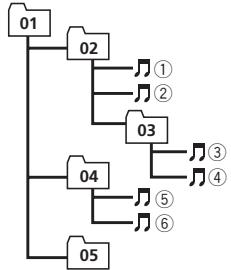
Example of a hierarchy
Level 1
Level 2
Level 3
Level 4
: Folder
Compressed audio file
01 to 05: Folder number
① to ⑥: Playback sequence
Disc
Folder selection sequence or other operation may differ depending on the encoding or writing software.
USB storage device
Playback sequence is the same as recorded sequence in the USB storage device.
To specify the playback sequence, the following method is recommended.
1 Create the file name including numbers that specify the playback sequence (e.g., 001xxx.mp3 and 099yyy.mp3).
Put those files into a folder.
Additional Information
Save the folder containing files on the USB storage device.
However, depending on the system environment, you cannot specify the playback sequence.
For USB portable audio players, the sequence is different and depends on the player.
Copyright and trademark
iTunes
Apple and iTunes are trademarks of Apple Inc., registered in the U.S. and other countries.
MP3
Supply of this product only conveys a license for private, non-commercial use and does not convey a license nor imply any right to use this product in any commercial (i.e. revenue-generating) real time broadcasting (terrestrial, satellite, cable and/or any other media), broadcasting/Streaming via internet, intranets and/or other networks or in other electronic content distribution systems, such as pay-audio or audio-on-demand applications. An independent license for such use is required. For details, please visit
http://www.mp3licensing.com.
WMA

Windows Media and the Windows logo are trademarks or registered trademarks of Microsoft Corporation in the United States and/or other countries.
This product includes technology owned by Microsoft Corporation and cannot be used or distributed without a license from Microsoft Licensing, Inc.
iPod

Made for iPod
iPod is a trademark of Apple Inc., registered in the U.S. and other countries.
"Made for iPod" means that an electronic accessory has been designed to connect specifically to iPod and has been certified by the developer to meet Apple performance standards.
Apple is not responsible for the operation of this device or its compliance with safety and regulatory standards.
iPhone

Works with
iPhone
iPhone is a trademark of Apple Inc.
"Works with iPhone" means that an electronic accessory has been designed to connect specifically to iPhone and has been certified by the developer to meet Apple performance standards.
Apple is not responsible for the operation of this device or its compliance with safety and regulatory standards.
SAT Radio

Additional Information
The SAT RADIO READY mark indicates that the Satellite Radio Tuner for Pioneer (i.e., XM tuner and Sirius satellite tuner which are sold separately) can be controlled by this unit. Please inquire to your dealer or nearest authorized Pioneer service station regarding the satellite radio tuner that can be connected to this unit. For satellite radio tuner operation, please refer to the satellite radio tuner owner's manual.
- The system will use direct satellite-to-receiver broadcasting technology to provide listeners in their cars and at home with crystal-clear sound seamlessly from coast to coast. Satellite radio will create and package over 100 channels of digital-quality music, news, sports, talk and children's programming.
- "SAT Radio", the SAT Radio logo and all related marks are trademarks of Sirius Satellite Radio Inc., and XM Satellite Radio Inc.
HD Radio Technology
- HD Radio™ Technology Manufactured Under License From iBiquity Digital Corp. U.S. and Foreign Patents. HD Radio™ and the HD and HD Radio logos are proprietary trademarks of iBiquity Digital Corp.
Specifications
General
Power source 14.4 V DC (10.8 V to 15.1 V allowable)
Grounding system Negative type
Maximum current consumption 10.0 A
Dimensions (W× H× D) DIN
Chassis 178 mm × 50 mm × 165 mm
(7 in. × 2 in. × 6 - 3 / 8 in.)
Nose 188 mm × 58 mm × 17 mm
(7-3/8 in. × 2-1/4 in. × 5/8 in.)
D
Chassis 178 mm × 50 mm × 165 mm
(7 in. × 2 in. × 6-3/8 in.)
Nose 170 mm × 46 mm × 17 mm
(6-3/4 in. × 1-3/4 in. × 5/8 in.)
Weight 1.3 kg (2.9 lbs)
Audio
Maximum power output ....50 W x 4 50W× 2 / 4 +70W× 1 / 2 (for subwoofer)
Continuous power output ... 22W× 4 (50 Hz to 15 000 Hz, 5 % THD, 4 Ω load, both channels driven)
Load impedance 4Ω to 8Ω × 4
4Ω to 8Ω × 2 + 2Ω × 1
Preout maximum output level 4.0 V
Equalizer (5-Band Graphic Equalizer): Frequency 100/315/1.25k/3.15k/8k Hz Gain ±12 dB
HPF: Frequency .50/63/80/100/125 Hz Slope .-12 dB/oct
Subwoofer (mono): Frequency 50/63/80/100/125 Hz
Slope . 18 dB/oc
Gain +6 dB to -24 dB
Phase Normal/Reverse
Bass boost: Gain +12 dB to 0 dB
CD player
System Compact disc audio system
Usable discs Compact disc
Signal-to-noise ratio 94 dB (1 kHz) (IHF-A network)
Number of channels 2 (stereo)
MP3 decoding format ...... MPEG-1 & 2 Audio Layer 3
WMA decoding format.......Ver.7,7.1,8,9,10,11 (2ch audio) (Windows Media Player)
AAC decoding format ...... MPEG-4 AAC (iTunes encoded only).(.m4a) (Ver. 8.2 and earlier)
WAV signal format ......... Linear PCM & MS ADPCM
USB
USB standard specification USB 2.0 full speed
Maximum current supply .... 500 mA
USB Class .MSC (Mass Storage Class)
File system .FAT12,FAT16,FAT32
MP3 decoding format ...... MPEG-1 & 2 Audio Layer 3
WMA decoding format ......... Ver. 7, 7.1, 8, 9, 10, 11 (2ch audio)
(Windows Media Player)
Additional Information
AAC decoding format ...... MPEG-4 AAC (iTunes encoded only) .m4a) (Ver. 8.2 and earlier)
WAV signal format ......... Linear PCM & MS ADPCM (Non-compressed)
FM tuner
Frequency range 87.9 MHz to 107.9 MHz
Usable sensitivity 9 dBf (0.8 μV/75 Ω, mono, S/N: 30 dB)
Signal-to-noise ratio 72 dB (IHF-A network)
AMtuner
Frequency range 530 kHz to 1710 kHz
Usable sensitivity 25 V (S/N: 20 dB)
Signal-to-noise ratio 62 dB (IHF-A network)
CEA2006 Specifications

Power output 14 W RMS × 4 Channels (4 and ≤ 1% THD+N) S/N ratio 91 dBA (reference: 1 W into 4)

Note
Specifications and the design are subject to modifications without notice.
Pioneer Electronics (USA) Inc.
CUSTOMER SUPPORT DIVISION
P.O.Box 1760
Long Beach, CA 90801-1760
800-421-1404
CANADA
300 Allstate Parkway
Markham, Ontario L3R 0P2
1-877-283-5901
905-479-4411
http://www.pioneerelectronics.com
USB plug&play (Plug-and-Play).
Bass (accentuation des graves)
OFF—15Minutes—30Minutes
USB plug&play (Plug-and-Play)
BT AUDIO (activation audio Bluetooth)
Consummation maximale ... 10,0 A
Dimensions (L× H× P) DIN
Chassis 178 mm × 50 mm × 165 mm
Panneau avant..... 188mm× 58mm× 17mm
D
Chassis 178 mm × 50 mm × 165 mm
Panneau avant ....170 mm × 46 mm × 17 mm
Poids 1,3 kg
Audio
Specification standard USB
Ver. 7, 7.1, 8, 9, 10, 11 (2 ca
naux audio)
(Windows Media Player)
Pioneer Electronics (USA) Inc.
CUSTOMER SUPPORT DIVISION
P.O.Box 1760
Long Beach, CA 90801-1760
800-421-1404
CANADA
Pioneer Electronics of Canada, Inc.
CUSTOMER SATISFACTION DEPARTMENT
300 Allstate Parkway
Markham, Ontario L3R 0P2
1-877-283-5901
905-479-4411
http://www.pioneerelectronics.com
OFF—15Minutes—30Minutes
USB plug&play (plug and play)
Este ajuste permite partager la fuente a USB/iPod automatically.
1 Pulse M.C. para activar o desactivar "plug and play".
- Aúnque el indicator de display está apagado,SEO,SEO,SEO,SEO,SEO,SEO,SEO,SEO,SEO,SEO,SEO,SEO,SEO,SEO,SEO,SEO,SEO,SEO,SEO,SEO,SEO,SEO,SEO,SEO,SEO,SEO,SEO,SEO,SEO,SEO,SEO,SEO,SEO,SEO,SEO,SEO,SEO,SEO,SEO,SEO,SEO,SEO,SEO,SEO,SEO,SEO,SEO,SEO,SEO,SEO, SEO, SEO, SEO, SEO, SEO, SEO, SEO, SEO, SEO, SEO, SEO, SEO, SEO, SEO, SEO, SEO, SEO, SEO, SEO, SEO, SEO, SEO, SEO, SEO, SEO, SEO, SEO, SEO, SEO, SEO, SEO, SEO, SEO, SEO, SEO, SEO, SEO, SEO, SEO, SEO, SEO, SEO, SEO
Clear memory (borrado de la memoria)
Register your product at
http://www.pioneerelectronics.com
See "Visit our website" page
4-1, MEGURO 1-CHOME, MEGURO-KU
PIONEER ELECTRONICS (USA) INC.
P.O. Box 1540, Long Beach, California 90801-1540, U.S.A.
TEL: (800) 421-1404
PIONEER EUROPE NV
Haven 1087, Keetberglaan 1, B-9120 Melsele, Belgium/Belgique
TEL: (0) 3/570.05.11
PIONEER ELECTRONICS ASIACENTRE PTE. LTD.
253 Alexandra Road, #04-01, Singapore 159936
TEL: 65-6472-7555
PIONEER ELECTRONICS AUSTRALIA PTY. LTD.
178-184 Boundary Road, Braeside, Victoria 3195, Australia
TEL: (03) 9586-6300
PIONEER ELECTRONICS OF CANADA, INC.
300 Allstate Parkway, Markham, Ontario L3R 0P2, Canada
TEL: 1-877-283-5901
TEL: 905-479-4411
PIONEER ELECTRONICS DE MEXICO, S.A. de C.V.
Blvd.Manuel Avila Camacho 138 10 piso
Col.Lomas de Chapultepec, Mexico, D.F. 11000
TEL: 55-9178-4270
先锋股份有限公司
總公司:台北市中山北路二段44號13樓
電話:(02)2521-3588
先鋒電子(香港)有限公司
香港九龍尖沙嘴海港域世界商業中心
9樓901-6室
電話:(0852) 2848-6488
Published by Pioneer Corporation.
Copyright © 2009 by Pioneer Corporation.
All rights reserved.