SSMK 500 A1 - Food Processor SILVERCREST - Free user manual and instructions
Find the device manual for free SSMK 500 A1 SILVERCREST in PDF.


| Product type | Food processor (blender) |
| Brand | SilverCrest |
| Model | SSMK 500 A1 |
| Rated power | 500 W |
| Rated voltage | 220-240 V ~, 50-60 Hz |
| Total bowl capacity | 2.1 liters |
| Useful capacity | 1.5 liters |
| Bowl material | Glass |
| Speeds | 2 speeds (1 and 2) + pulse function (P) |
| Intermittent operating time | 3 minutes |
| Protection class | II (double insulation) |
| Main functions | Blend, puree, stir, crush ice |
| Included accessories | Motor unit, blender jug, lid, measuring cap, user manual |
| Cleaning | Bowl, lid and measuring cap are dishwasher safe; motor unit wipe with damp cloth |
| Safety | Extremely sharp blades; do not immerse motor unit; automatic stop if bowl is removed |
| Warranty | 3 years |
| After-sales service France | 0800 919270, kompernass@lidl.fr |
| Reference (IAN) | 500273_2504 |
Frequently Asked Questions - SSMK 500 A1 SILVERCREST
User questions about SSMK 500 A1 SILVERCREST
0 question about this device. Answer the ones you know or ask your own.
Ask a new question about this device
Download the instructions for your Food Processor in PDF format for free! Find your manual SSMK 500 A1 - SILVERCREST and take your electronic device back in hand. On this page are published all the documents necessary for the use of your device. SSMK 500 A1 by SILVERCREST.
USER MANUAL SSMK 500 A1 SILVERCREST
natural_image
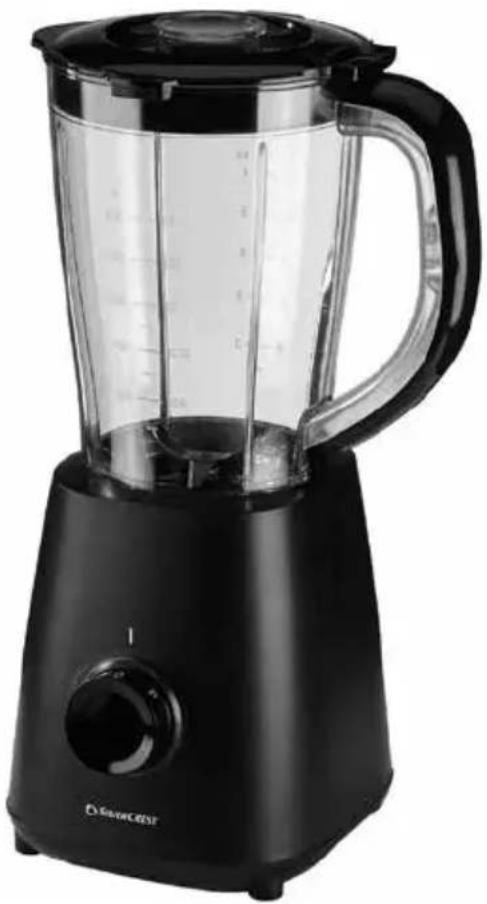
Black and white photo of a modern kitchen blender with handle and control knob (no visible text or symbols)JUG BLENDER / STANDMIXER / BLENDER SSMK 500 A1
GB IE NI MT
JUG BLENDER
Operating instructions
FR BE CH
BLENDER
Mode d'emploi
IT CH MT
FRULLATORE
Before reading, unfold the page containing the illustrations and familiarise yourself with all functions of the device.
DE AT BE CH
English Operating instructions Page 1
| Deutsch | Bedienungsanleitung | Seite | 13 |
| Français Mode d'emploi Page 25 | |||
| Nederlands | Gebruiksaanwijzing | Pagina | 39 |
| Italiano Istruzioni per l'uso Pagina 51 | |||
| Español Instrucciones de uso Página 63 | |||
| Português | Manual de instruções | Página 75 | |
Contents
- Introduction 2
- Intended use 2
- Package contents 2
- Description of the appliance 2
- Technical data 2
- Warnings and symbols used 3
- Safety instructions 4
- Unpacking 6
- Setting up 6
-
Use 6
10.1. Filling and fitting the blender 6
10.2. Selecting the speed setting 7
10.3. Filling during operation 8
10.4. Removing the blender 8 -
Useful tips 8
-
Cleaning 9
12.1. Cleaning the blender 9
12.2. Cleaning the motor block 10
-
Storage 10
-
Disposal 10
-
Kompernass Handels GmbH warranty 10
15.1. Service 11
15.2. Importer 11
1. Introduction
Congratulations on the purchase of your new appliance.
You have selected a high-quality product. These operating instructions are a part of this product. They contain important information on safety, usage and disposal. Before using the product, familiarise yourself with all operating and safety instructions. Use the product only as described and only for the specified areas of application. In addition, pass these documents on, together with the product, to any future owner.
2. Intended use
This appliance is intended exclusively for ...
- mixing, puréeing and stirring foods as well as crushing ice cubes,
■ use exclusively in normal domestic amounts and only for private use in a domestic environment in dry rooms.
This appliance is not intended for ...
■ chopping herbs, onions, meat and hard food components such as nuts, pits, large seeds or stalks,
■ making nut puree,
■ the processing of materials that are not foodstuffs,
■ commercial or industrial use,
■ for use in damp environments or outdoors,
■ processing hot/boiling liquids.
Use only the accessories and spare parts that are specified for this appliance. Other parts may not be adequately suitable or safe!
3. Package contents
After unpacking, check to ensure all items are available. The package contains:
- Motor block, with power cable and plug
- Blender
• Lid - Measuring cap
- Operating instructions
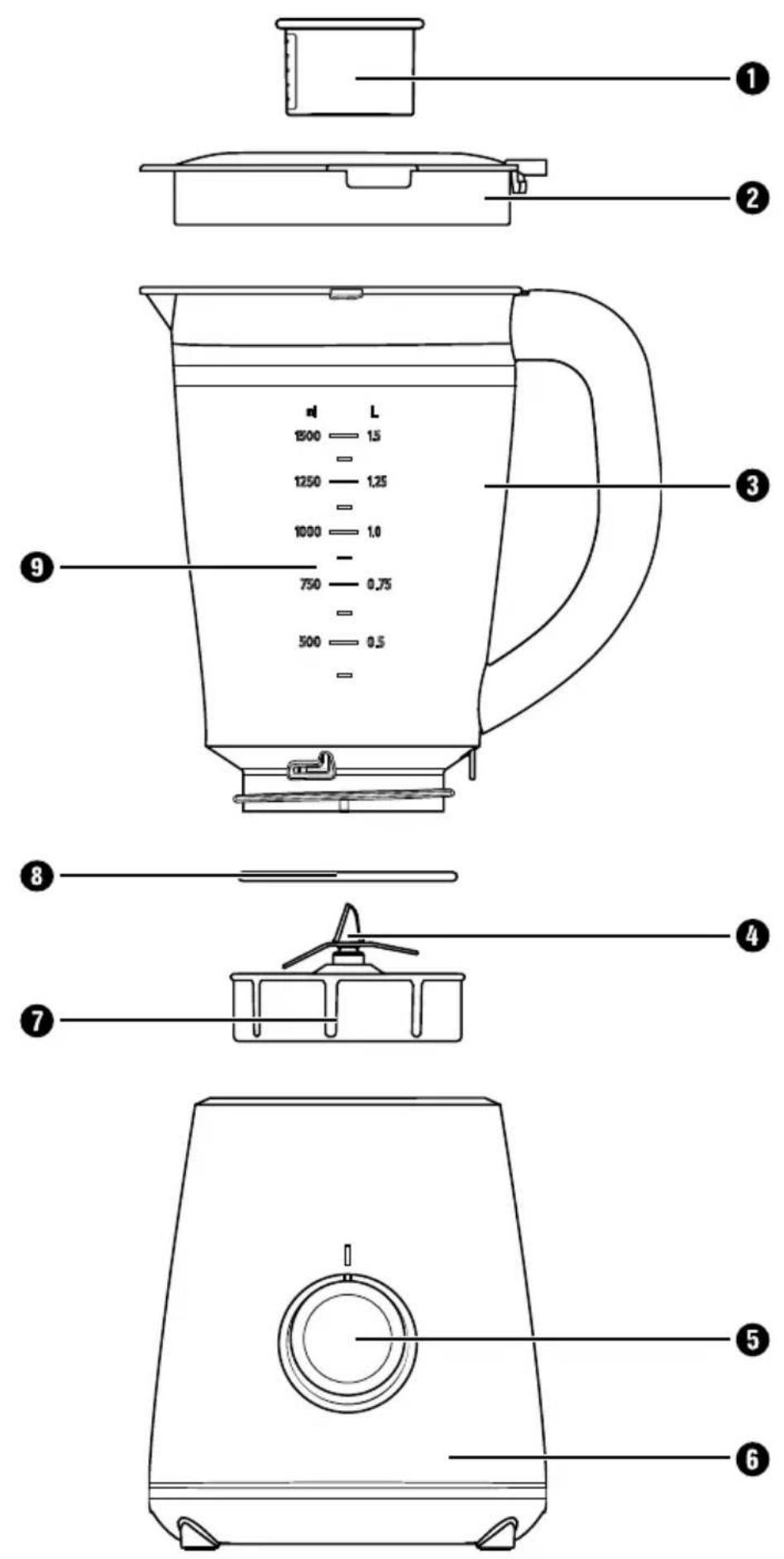
4. Description of the appliance
① Measuring cap
② Lid
③ Blender
4 Cutting blades
5 Switch
6 Motor block
8 Sealing ring
9 Scale
⑦ Cutting blade attachment
5. Technical data
| Nominal voltage | 220 - 240 V ~ ,50 - 60 Hz |
| Nominal power consumption | 500 W |
| Power consumption in off mode | < 0.5 W |
| Storage capacity approx. | 2.1 litres |
| Useful volume 1.5 litres | |
| Protection Class | II / ☐ |
| CO time 3 minutes |
The CO time (continuous operation time) is the amount of time an appliance can be operated without the motor overheating and becoming damaged. When the specified CO time has been reached, the appliance must be switched off until the motor has cooled down to room temperature.
6. Warnings and symbols used
The following warnings and symbols are used in these operating instructions, on the packaging and on the appliance (where applicable):
 | DANGER! A warning with this symbol and the signal word "DANGER" indicates an imminently hazardous situation that will result in death or serious injury if not avoided. |
 | WARNING! A warning with this symbol and the signal word "WARNING" indicates a potentially hazardous situation that could result in death or serious injury if not avoided. |
 | CAUTION! A warning with this symbol and the signal word "CAUTION" indicates a potentially hazardous situation that could result in a minor or moderate injury if not avoided. |
 | ATTENTION! A warning with this symbol and the signal word "ATTENTION" indicates a potential situation that could result in property damage if not avoided. |
 | Note: A note identifies additional information that facilitates the use of the appliance. |
 | Read the instructions. |
| AC current/voltage | |
 | Protection class II: Protection by double or reinforced insulation. |
 | Do not immerse in water! |
 | Dishwasher-proof. |
 | All of the parts of this appliance that come into contact with food are food-safe. |
 | This product satisfies the requirements of the applicable European and national regulations. |
 | Do not dispose of electrical appliances in the household waste! |
  | Dispose of the packaging in an environmentally-responsible manner. |
  | The packaging is made of recyclable materials. Observe the labelling on the packaging material when sorting for disposal: The material is labelled with abbreviations (a) and numbers (b) with the following meanings: 1-7: plastics, 20-22: paper and cardboard, 80-98: composites. |
   | The packaging contains paper and/or cardboard components.The packaging contains plastic and/or metal components. |
  | |
  | |
  | FR: The product, its packaging and the operating instructions are recyclable. They are subject to an extended manufacturer responsibility and will be collected separately. |
7. Safety instructions
⚠️ DANGER! ELECTRIC SHOCK!
■ Ensure that the appliance, the power cable and the power plug are never immersed in water or other liquids.
■ Use the appliance only in dry rooms; never use it outdoors or in damp environments.
■ Ensure that the power cable never becomes wet or damp during operation. Route the power cable in such a way that it cannot become trapped or damaged in any way.
■ To avoid potential risks, if the appliance power cable is damaged, it must be replaced by the manufacturer, its customer service or by a qualified technician.
■ Always remove the plug from the power socket after use. Switching off the appliance is not sufficient because the appliance receives power as long as the power plug is connected to the socket.
- Check to ensure that the appliance is in a serviceable condition before use. The appliance may not be used if it shows signs of damage, especially to the motor block or the blender attachment.
■ Remove the plug from the socket immediately if you notice unexpected smells or noises coming from the appliance while it is in use or if there is an evident malfunction.
⚠ WARNING! RISK OF INJURY!
■ NEVER insert your hand or fingers into the blender, especially when it is in use. The cutting blades are extremely sharp!
■ DO NOT remove the lid when the appliance is in operation.
■ To ensure you can react immediately in the event of danger, never leave the appliance running unattended.
■ Do not insert cutlery items or mixing tools into the blender while the appliance is in use. There is a considerable risk of injury if these come into contact with the swiftly rotating cutting blades!
■ Children should be supervised to ensure that they do not play with the appliance.
■ Never use the appliance for purposes other than those described in these instructions.
■ Risk of injury if appliance is misused.
■ The appliance should always be disconnected from the mains when not supervised and before assembly, disassembly or cleaning.
■ This appliance is not to be used by children.
■ The appliance and its mains cable must be kept away from children.
■ This appliance can be used by persons with reduced physical, sensory or mental capabilities or lack of experience and knowledge if they have been given supervision or instruction concerning safe use of the appliance, and if they are aware of the potential risks.
■ Do not allow children to play with the appliance.
■ Be careful when handling the appliance. The cutting blades are extremely sharp!
■ Take care when emptying the blender! The cutting blades are extremely sharp!
■ Take care when cleaning the appliance! The cutting blades are extremely sharp!
■ Switch the appliance off and disconnect the plug from the power supply before changing accessories or getting hold of parts that move during operation.
■ Always make sure that the blender is switched off before removing the jug from the motor block!
■ Use the blender only with the supplied motor block!
■ Only operate the blender when the lid or the safety device is in the operating position as specified in the instructions.
■ Never reach into the container with your hand while it is on the stand.
■ Always use an appropriate tool, e.g. a spatula, to push food down.
CAUTION! MATERIAL DAMAGE!
■ Do not use the appliance in direct sunlight or near any heatgeneratingappliances.
■ NEVER fill the blender with boiling liquids or other foods! Allow these to cool to a lukewarm temperature.
■ NEVER operate the appliance when it is empty, i.e. without ingredients in the blender attachment.
8. Unpacking
■ Remove all packaging materials or protective films from the appliance. Retain the packaging, so that you can store the appliance safely or send it by post, e.g. if it needs to be repaired.
■ Before using the appliance, check that it is free of damage; check also that the power cable and plug as well as all accessories and appliance parts are undamaged.
■ Clean all components carefully before using the appliance for the first time (see 12. Cleaning).
9. Setting up
Once all components have been cleaned as described in the section 12. Cleaning:
■ Position the appliance so that, ...
—the power plug is immediately accessible, so that it can be quickly withdrawn in the event of danger,
—that it is stable and not liable to slip, and so that the sucker feet can attach firmly and the appliance cannot tip over due to vibration,
—that the mains cable is not in the working area and thus does not present a risk of being inadvertently snagged and tipping the appliance over.
10. Use
WARNING!
The motor switches off automatically as soon as the blender ③ is removed from the motor block ⑥. In such cases it may be easy to forget that the machine is still switched on. The motor will then start unexpectedly as soon as the blender ③ is fitted. Therefore:
-Do not plug in the appliance until the blender ③ is filled, closed and fitted on the appliance.
—Before fitting, always ensure that the appliance is switched off or the plug has been removed.
- Switch the appliance off first, pull the plug out and wait until the motor has come to a standstill before removing the blender ③ or opening the lid ②.
10.1. Filling and fitting the blender
1) Turn the blender ③ anticlockwise until the blender handle is located above the position ▶. Remove the blender ③ straight upwards from the motor block ⑥.
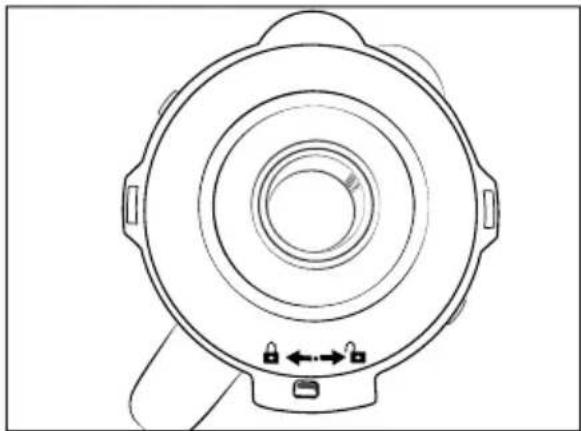
2) Remove the lid ② by turning it anticlockwise towards position 📋 (see Fig. 1) until you can pull it upwards.
natural_image
Technical line drawing of a mechanical component with concentric rings and a handle (no text or symbols)Fig. 1
3) Add the ingredients to the blender ③.
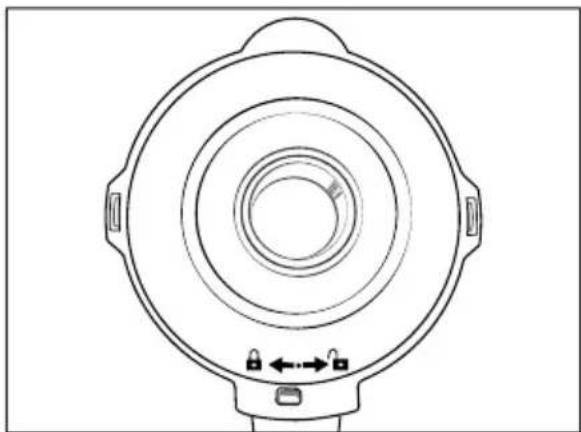
4) Press the lid ② firmly down onto the blender ③. Close the lid ② by turning it clockwise to position 🔒 until it audibly engages (see Fig. 2).
natural_image
Technical line drawing of a circular mechanical component with mounting flanges and central bore (no text or symbols)Fig. 2
5) Ensure that the pouring spout on the blender ③ is closed.
6) Press the measuring cap ① into the lid as far as the stop.
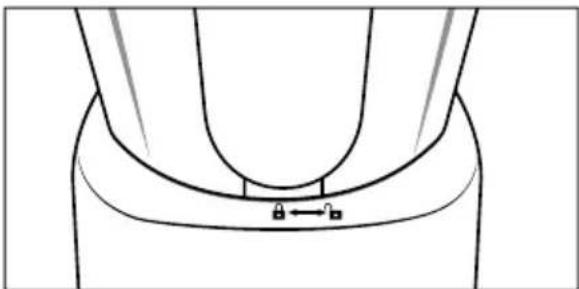
7) Place the filled and closed blender ③ on the motor unit ⑥. To do this, use the recesses on the motor block ⑥ and make sure that the handle of the blender ③ is pointing to the 🔔 symbol. Turn the blender ③ clockwise to towards the position (see Fig. 3) until it audibly engages. The motor cannot start until the blender ③ is fitted flush to the motor block.
natural_image
Pure technical line drawing of a mechanical component with no text or symbolsFig. 3
10.2. Selecting the speed setting
Once the blender ③ is filled and sitting completely closed on the motor block ⑥, you can switch on the appliance.
Set the switch ⑤ to ...
Level 1
For mixing liquids and blending viscous foods
Level 2
For mixing porridge or shakes and for puree-ing medium-solid foods
For short, powerful pulse operation, e.g. for crushing ice cubes or cleaning. To prevent overloading the motor, the switch ⑤ will not click into place in this setting. Therefore, hold the speed switch ⑤ in this position only for short periods.
(i) Note
▶ Fill the blender ③ with a maximum of 10-12 ice cubes with a maximum edge length of 2.5 cm. Otherwise, the appliance will not crush the ice cubes optimally.
▶ When mixing liquids (level 1), we recommend a processing time of max. 60 seconds at a time.
10.3. Filling during operation
WARNING!
▶ If you want to add a little extra while the appliance is running, use only the measuring cap ① provided for this purpose. Do not open the lid ②.
▶ Never insert cutlery items or mixing tools into the blender ③ when the appliance is in use. There is a considerable risk of injury if these come into contact with the very fast rotating cutting blades ④!
To add food while the appliance is running:
1) Remove the measuring cap ① from the lid ②.
2) Add the ingredients.
3) Press the measuring cap ① back into the lid.
10.4. Removing the blender
Once you have finished processing the food:
1) Always start by setting switch ⑤ to the off position ("0") and pulling out the mains plug.
2) Wait until the motor has come to a complete standstill before lifting the blender ③ off the motor block ⑥. To do this, turn the blender ③ anticlockwise until the handle of the blender is above the position ⚙️. Remove the blender ③ straight upwards from the motor block ⑥.
11. Useful tips
To achieve the best results when puréeing firm ingredients, add small amounts one after the other into the blender ③ rather than a single large portion.
■ When processing firm ingredients, cut them into small pieces (2 - 3 cm).
■ Add at least 50 ml of liquid when pureeing fruit or vegetables.
■ Add thicker ingredients (such as yoghurt) into the blender ③ first. If any of ingredients are not picked up during mixing, remove the blender ③ from the motor block ⑥, remove the lid ② and stir the ingredients with a suitable implement, such as a spoon. Replace the blender ③ back on the motor block ⑥ with the lid ② closed and continue mixing.
■ When mixing liquid ingredients, start off with a small amount of liquid. Gradually add more liquids to the mixture through the measuring cap.
■ The appliance can be stabilised by placing your hand on top of the closed blender during operation.
For stirring solid or very thick liquid foods, it can be useful to use level P to prevent the cutting blades 4 from blocking.
i Note
▶ Do not use the appliance to grind crystals of cooking salt, refined sugar or white sugar. For example, to make powdered sugar.
12. Cleaning
DANGER!
Before starting to clean the blender and its components:
▶ Ensure that the motor is switched off and the power plug removed from the socket.

Do not immerse the motor block ⑥ in water or other liquids. This could result in you receiving a fatal electric shock and cause damage to the appliance.
▶ Never open the housing of the appliance. Otherwise, there is a risk of a fatal electric shock.
WARNING!
▶ Never insert your hand or fingers into the blender ③, especially while it is in use. The cutting blades ④ are extremely sharp!
CAUTION!
▶ Do not use solvents or abrasive cleaners on the plastic surfaces, they could be damaged by them.
12.1. Cleaning the blender
■ To prevent injuring yourself on the cutting blades ④, clean the blender ③ only with a long-handled washing-up brush.
- Clean the measuring cap ① and the lid ② in mild soap solution.
i Note

You can also clean the lid ②, the measuring cap ① and the blender ③ with the cutting blade ④ in your dishwasher.
If possible, place all the parts in the upper basket of the dishwasher and make sure that they are not jammed in place.
If you clean the appliance directly after use, you can usually achieve sufficiently hygienic cleaning results by using the following alternatives:
Fill the blender ③ with 500 ml of water and add a couple of drops of mild washing up liquid. Close the lid ② and fit the blender
③ onto the motor block ⑥. Insert the mains plug into the socket and activate the pulse function a few times so that the cutting blades ④ plough through the water at maximum speed. Afterwards, rinse the blender
③ with plenty of clean water to remove any washing up liquid residues.
To make it easier to remove stubborn food remains, you can remove the cutting blade attachment ⑦ from the blender ③:
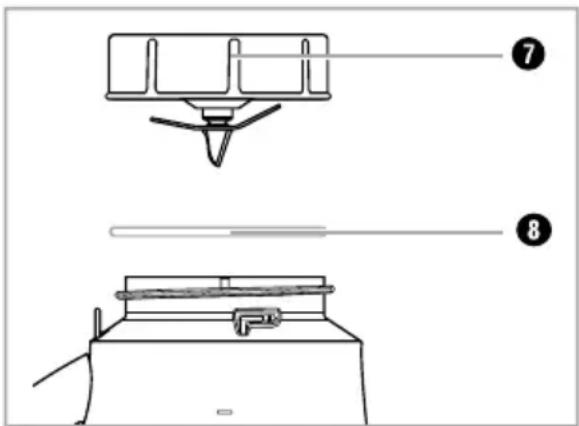
Fig. 4
1) Remove the blender ③ from the motor block ⑥. For better stability, remove the lid ② by turning it anticlockwise towards the position 📋 (see Fig. 1) until you can pull it off upwards.
2) Turn the appliance upside down and turn the cutting blade attachment ⑦ anticlockwise so that it can be detached from the blender ③.
WARNING!
▶ Handle the cutting blades ④ with care. They are very sharp.
3) Clean both parts thoroughly in a mild soap solution.
i Note
If necessary, you can remove the sealing ring ⑧ from the cutting blade attachment ⑦. Pull the sealing ring ⑧ out of the cutting blade attachment ⑦ and clean it in a mild soap solution. Then rinse off the sealing ring ⑧ in fresh water.

You can also clean the blender ③ and cutting blade attachment ⑦ in the dishwasher.
4) Dry all parts thoroughly before reassembling them.
5) Place the cutting blade attachment ⑦ back on the blender jug ③ and turn it clockwise to tighten. Make sure the sealing ring ⑧ is inserted correctly.
12.2. Cleaning the motor block
1) Clean the surfaces with a damp cloth. If necessary, apply a mild washing-up liquid to the cloth. Afterwards, wipe off with a cloth moistened only with water to ensure that no detergent remains on the appliance. Then dry the surfaces thoroughly.
2) When cleaning, always check that the contact switch in the fitting for the blender ③ is not blocked by soiling residues. If you cannot dislodge any blockages with the corner of a piece of paper, make contact with Customer Services. Do not use any hard objects, these could damage the contact switch.
3) Remove any possible residues on the underside of the motor block ⓑ with a dry cloth or a stiff-bristled brush only. Ensure that nothing can get in through the ventilation openings of the appliance.
13. Storage
1) If you do not intend to use the blender for an extended period, clean it thoroughly (see chapter 12. Cleaning).
2) Store the blender in a cool and dry location.
14. Disposal

The symbol of the crossed-out wheelie bin means that this appliance may not be disposed of in regular household waste at the end of its service
life. The appliance must be deposited at an established collection point, recycling centre or disposal company.
Please erase all personal data before returning an appliance.
The packaging is made from environmentally friendly material which can be disposed of at your local recycling plant.
Dispose of the packaging in an environmentally friendly manner.
15.KompernassHandels GmbHwarranty
Dear Customer,
This appliance has a 3-year warranty valid from the date of purchase. If this product has any faults, you, the buyer, have certain statutory rights. Your statutory rights are not restricted in any way by the warranty described below.
Warranty conditions
The warranty period starts on the date of purchase. Please keep your receipt in a safe place. This will be required as proof of purchase.
If any material or manufacturing fault occurs within three years of the date of purchase of the product, we will either repair or replace the product for you or refund the purchase price (at our discretion). This warranty service requires that you present the defective appliance and the proof of purchase (receipt) within the three-year warranty period, along with a brief written description of the fault and of when it occurred.
If the defect is covered by the warranty, your product will either be repaired or replaced by us. The repair or replacement of a product does not signify the beginning of a new warranty period.
Warranty period and statutory claims for defects
The warranty period is not prolonged by repairs effected under the warranty. This also applies to replaced and repaired components. Any damage and defects present at the time of purchase must be reported immediately after unpacking. Repairs carried out after expiry of the warranty period shall be subject to a fee.
Scope of the warranty
This appliance has been manufactured in accordance with strict quality guidelines and inspected meticulously prior to delivery.
The warranty covers material faults or production faults. The warranty does not extend to product parts subject to normal wear and tear or to fragile parts which could be considered as consumable parts such as switches or parts made of glass.
The warranty does not apply if the product has been damaged, improperly used or improperly maintained. The directions in the operating instructions for the product regarding proper use of the product are to be strictly followed. Uses and actions that are discouraged in the operating instructions or which are warned against must be avoided.
This product is intended solely for private use and not for commercial purposes. The warranty shall be deemed void in cases of misuse or improper handling, use of force and modifications / repairs which have not been carried out by one of our authorised Service centres.
Warranty claim procedure
To ensure quick processing of your case, please observe the following instructions:
■ Please have the till receipt and the item number (IAN) 500273_2504 available as proof of purchase.
- You will find the item number on the type plate on the product, an engraving on the product, on the front page of the operating instructions (below left) or on the sticker on the rear or bottom of the product.
If functional or other defects occur, please contact the service department listed either by telephone or by e-mail.
- You can return a defective product to us free of charge to the service address that will be provided to you. Ensure that you enclose the proof of purchase (till receipt) and information about what the defect is and when it occurred.

You can download these instructions along with many other manuals, product videos and installation software at www.lidl-service.com.
This QR code will take you directly to the Lidl service page (www.lidl-service.com) where you can open your operating instructions by entering the item number (IAN) 500273_2504.
15.1. Service
GB Service Great Britain
Tel.: 0800 404 7657
E-Mail: kompernass@lidl.co.uk
IE ServiceIreland
Tel.: 1800 101010
E-Mail: kompernass@lidl.ie
MT ServiceMalta
Tel.: 80062230
E-Mail: kompernass@lidl.com.mt
IAN 500273_2504
15.2. Importer
Please note that the following address is not the service address. Please use the service address provided in the operating instructions.
KOMPERNASS HANDELS GMBH
BURGSTRASSE 21
44867 BOCHUM
GERMANY
www.kompernass.com
Inhaltsverzeichnis
1. Einleitung 14
natural_image
Top-down line drawing of a mechanical component with concentric rings and a handle (no text or symbols)Abb.1
natural_image
Technical line drawing of a circular mechanical component with mounting holes and a central hub (no text or symbols)Abb.2
natural_image
Pure technical line drawing of a mechanical component with no text or symbolsAbb.3
Abb. 4
KOMPERNASS HANDELS GMBH
BURGSTRASSE 21
44867 BOCHUM
DEUTSCHLAND
www.kompernass.com
Sommaire
natural_image
Technical line drawing of a mechanical component with concentric rings and mounting features (no text or symbols)Fig. 1
natural_image
Technical line drawing of a circular mechanical component with concentric rings and mounting features (no text or symbols)Fig. 2
natural_image
Pure technical line drawing of a mechanical component with no text or symbolsFig. 3
Fig. 4
KOMPERNASS HANDELS GMBH
BURGSTRASSE 21
44867 BOCHUM
ALLEMAGNE
www.kompernass.com
Inhoudsopgave
1. Inleiding 40
⚠ WAARSCHUWING! LETSELGEVAAR!
natural_image
Technical line drawing of a mechanical component with concentric rings and adjustment knobs (no text or symbols)Afb. 1
natural_image
Technical line drawing of a circular mechanical component with mounting flanges and central bore (no text or symbols)Afb. 2
natural_image
Simple line drawing of a mechanical component with a central lock and directional arrow (no text or symbols)Afb. 3
Afb. 4
KOMPERNASS HANDELS GMBH
BURGSTRASSE 21
44867 BOCHUM
DUITSLAND
www.kompernass.com
Indice
natural_image
Technical line drawing of a mechanical component with concentric rings and a handle (no text or symbols)Fig. 1
natural_image
Technical line drawing of a circular mechanical component with concentric rings and mounting features (no text or symbols)Fig. 2
natural_image
Pure technical line drawing of a mechanical component with no text or symbolsFig. 3
Fig. 4
KOMPERNASS HANDELS GMBH
BURGSTRASSE 21
44867 BOCHUM
GERMANIA
www.kompernass.com
Índice
natural_image
Technical line drawing of a mechanical component with concentric rings and mounting features (no text or symbols)Fig. 1
natural_image
Technical line drawing of a circular mechanical component with mounting flanges and central hub (no text or symbols)Fig. 2
natural_image
Pure technical line drawing of a mechanical component with no text or symbolsFig. 3
Fig. 4
KOMPERNASS HANDELS GMBH
BURGSTRASSE 21
44867 BOCHUM
ALEMANIA
www.kompernass.com
Índice
natural_image
Technical line drawing of a mechanical component with concentric rings and mounting features (no text or symbols)Fig. 1
3) Insira os ingredientes no copo misturador ③.
natural_image
Technical line drawing of a circular mechanical component with concentric rings and mounting features (no text or symbols)Fig. 2
natural_image
Pure technical diagram of a mechanical component with no text, numbers, or symbolsFig. 3
Fig. 4
KOMPERNASS HANDELS GMBH
BURGSTRASSE 21
44867 BOCHUM
ALEMANHA
www.kompernass.com
KOMPERNASS HANDELS GMBH
BURGSTRASSE 21
44867 BOCHUM
GERMANY
www.kompernass.com
Last Information Update · Stand der Informationen · Version des informations
Stand van de informatie · Versione delle informazioni · Estado de las informaciones

- JUG BLENDER / STANDMIXER / BLENDER SSMK 500 A1
- JUG BLENDER
- BLENDER
- FRULLATORE
- DE AT BE CH
- Contents
- Introduction
- Intended use
- Package contents
- Description of the appliance
- Technical data
- Warnings and symbols used
- Safety instructions
- ⚠️ DANGER! ELECTRIC SHOCK!
- ⚠ WARNING! RISK OF INJURY!
- CAUTION! MATERIAL DAMAGE!
- Unpacking
- Setting up
- Use
- WARNING!
- Filling and fitting the blender
- Selecting the speed setting
- Level 1
- Level 2
- Note
- Filling during operation
- Removing the blender
- Useful tips
- i Note
- Cleaning
- DANGER!
- CAUTION!
- Cleaning the blender
- Cleaning the motor block
- Storage
- Disposal
- 15.KompernassHandels GmbHwarranty
- Warranty conditions
- Warranty period and statutory claims for defects
- Scope of the warranty
- Warranty claim procedure
- Service
- Importer
- Inhaltsverzeichnis
- Einleitung 14
- Sommaire
- Inhoudsopgave
- Inleiding 40
- ⚠ WAARSCHUWING! LETSELGEVAAR!
- Indice
- Índice
Brand : SILVERCREST
Model : SSMK 500 A1
Category : Food Processor