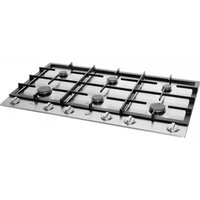
HL6011A - Cooker Atag - Free user manual and instructions
Find the device manual for free HL6011A Atag in PDF.


User questions about HL6011A Atag
0 question about this device. Answer the ones you know or ask your own.
Ask a new question about this device
Download the instructions for your Cooker in PDF format for free! Find your manual HL6011A - Atag and take your electronic device back in hand. On this page are published all the documents necessary for the use of your device. HL6011A by Atag.
USER MANUAL HL6011A Atag
instructions for use
ceramic hob
7000000001
ATAG
your ceramic hob description
your ceramic hob foreword
This manual describes how you can make the best use possible of your ceramic hob. You can find information in it about the controls and background information about how the appliance works. You will also find cooking tables and maintenance tips.
The safety instructions that are important during the installation are included in the installation guide, which is supplied separately and is meant for the installer.
Please keep this manual carefully, since any subsequent user will also find it very useful.
We wish you much pleasure with your ceramic hob!
your ceramic hob introduction
your ceramic hob contents
This Atag ceramic hob has been designed for the real lover of cooking. The generous separation of the cooking zones makes for ease of cooking.
The cooking zones can be controlled accurately thanks to their controls with 12 settings.
The ceramic hob is fitted with a residual-heat indicator for optimum safety.
| safety |
| what you should pay attention to 4 - 5 |
| operation |
| switching on 6 |
| cooking information |
| cooking settings 7 |
| maintenance |
| cleaning 8 |
| faults |
| what should I do if... 9 |
| environmental aspects |
| disposal of packaging and appliance 10 |
safety
what you should pay attention to
safety
what you should pay attention to
when installing the appliance
This appliance should only be connected up by registered installer.
Never open the casing of the appliance.
during use
This appliance has been designed for domestic use. You should only use it for cooking food.
Grease and oil are flammable when over-heated. Stay near the cooker when preparing dishes.
Watch out with young children; the appliance is hot during and after use.
The appliance is hot both during and after use. Bear this in mind if young children come anywhere near the appliance.
Never leave an empty pan on a cooking zone that is switched on. Do not allow the pan to boil dry, either. Although the hob is protected against overheating, the pan will get very hot, which may damage it.
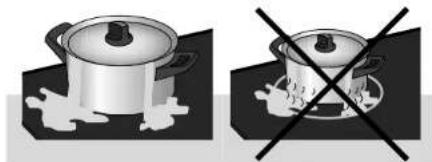
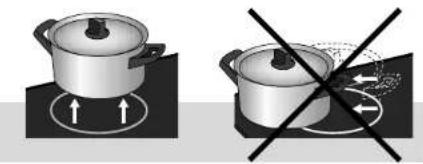
Do not use pans that are smaller than the cooking zone. This will prevent food remains ending up on the red-hot cooking zone. Burnt-on food remains are difficult to remove.
Do not use pans that are smaller than the cooking zone.
Always put a lid on the pan when cooking, to prevent energy loss.
Pans that have already been used for cooking on a gas hob are no longer suitable for use on a ceramic hob.
Damage arising from the use of unsuitable pans or from boiling dry is excluded from the guarantee.
The ceramic cooking surface is very strong but not unbreakable. It may be cracked if, for example, a spice jar or pointed object falls on it.
Do not use the appliance if there are any cracks or splits in it. Switch the appliance off immediately. Take the plug out of the socket and phone the service department.
Do not use aluminium foil, such as the trays from ready-made meals, for cooking food in. If aluminium foil melts on the cooking surface, it cannot be removed.
Grains of sand may cause scratches that cannot be removed. Only put pans with a clean and dry base on the cooking surface. This prevents lime stains or other stains that are difficult to remove.
Always pick pans up to move them. Do not use the hob as a worktop.
Cords to electrical appliances - e.g. a mixer - may accidentally touch the cooking zones.
operation switching on
cooking information cooking settings
introduction
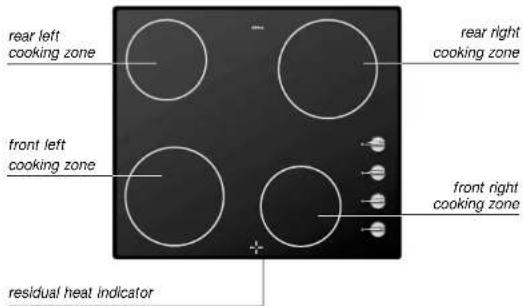
The ceramic glass hob is resistant to all temperature shocks. Neither the heat or the cold will damage the hob. On the glass work surface the 4 cooking zones are indicated by a circle. The base of the pan should correspond with this circle.
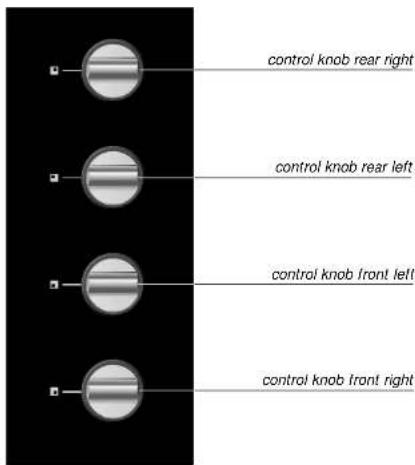
You may turn the switch either to the left or the right. The switch has 12 settings, you can also select any setting in between. The ceramic hob is fitted with a residual-heat indicator.
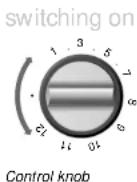
1 Put a pan on a cooking zone.
2 Turn the control knobs to the required setting.
The various cooking settings can be found in the table on the following page.
residual-heat indicator

The indicator shows that the cooking zone is still hot, and goes out as soon as the glass top reaches a safe temperature. Residual heat is indicated with a light on the glass top.
The cooking zone can be switched off 5-10 minutes before the food is cooked. If the food is in a covered pan, it will continue to simmer on the residual heat.
settings 1 - 4
- making stock
stewing cooking pears
stewing meat - cooking food through
- braising vegetables
settings 4-7
- cooking large quantities through
defrosting firm vegetables (French beans, for example)
setting 8
- frying thick pancakes
- frying thick pieces of meat covered in breadcrumbs
- frying thin pieces of meat
- frying thick pieces of meat
- fry fat out of cubes of bacon
- frying raw potatoes
- frying French toast
- frying fish covered in breadcrumbs
- frying thin pieces meat covered in breadcrumbs
- frying omelettes
settings 9-12
- searing meat
- frying flatfish, thin steaks or fillets
- frying cooked potatoes
- cooking smooth, thickened soups and sauces
- frying omelettes
- frying steak (medium, pink)
- deep frying (depending on the temperature and the quantity)
setting 12
- bringing to the boil quickly
- shrinking down leaf vegetables
- blanching vegetables
heating oil, fat and butter - frying steak (rare, red)
- getting pressure cooker up to pressure
- cooking smooth, thickened blanc mange and custard
maintenance
cleaning
daily cleaning
Clean the glass top after each use. You can use a mild cleaning agent for this - for example, washing-up liquid.
stubborn stains
water marks; lime stains; traces of metal.
Stubbarn stains can also be removed with a mild cleaning agent - for example, washing-up liquid. Remove water marks and lime stains with vinegar.
Traces of metals (due to sliding pans) can be difficult to remove. Remove traces of metals with a proprietary cleaning agent.
Remains of food that has boiled over are best removed with a glass scraper. Melted plastic and sugar can also be removed with a glass scraper.
never use
You should never use scouring agents. These cause scratches in which lime deposits and dirt can accumulate.
Never use sharp objects such as steel wool and scourers.
faults what should I do if...
If the appliance does not work properly, this does not always mean that it is defective. Try to deal with the problem yourself first. Phone the service department if the advice given below does not help.
| fault | cause | solution |
| Cooking zones do not get hot. | Plug is not in socket. | Put the plug into the socket. |
| Fuse(s) in the meter cupboard defective. | Check the meter cupboard. | |
| Metal-like marks on the ceramic hob. | Incorrect cleaning material used. | Remove with a cleaning material like Stahlfix. |
| Scratches on the ceramic hob. | Sliding pans across the hob is the usual cause. | Do not slide pans across the ceramic hob. Any scratches that have been made by sliding pans around cannot be removed. |
environmental aspects
disposal of packaging and appliance
The appliance's packaging is recyclable. The following may be used:
cardboard;
polyethylene film (PE);
CFC-free polystyrene (PS rigid foam).
Dispose of these materials responsibly and in accordance with government regulations.
The government can also provide information about the responsible disposal of discarded domestic appliances.