
IVM 40/24-2 M ACD - Vacuum Cleaner Kärcher - Free user manual and instructions
Find the device manual for free IVM 40/24-2 M ACD Kärcher in PDF.
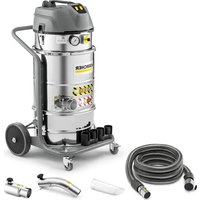


| Product type | Wet and dry vacuum cleaner class M |
| Brand | Kärcher |
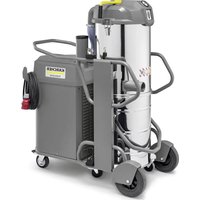
| Model | IVM 40/24-2 M ACD |
| Dimensions (L × W × H) | 645 × 655 × 1150 mm |
| Operating weight | 35.7 kg |
| Tank volume | 40 L |
| Mains voltage | 220-240 V, 1~, 50-60 Hz |
| Nominal power | 2100 W |
| Max power | 2300 W |
| Protection type | IPX4 |
| Protection class | I (with Class II elements) |
| Max vacuum | 19.0 kPa |
| Max volumetric flow rate (DN50, L=3 m) | 250 m³/h |
| Max volumetric flow rate (DN40, L=3 m) | 205 m³/h |
| Effective filtration area | 1.5 m² |
| Suction hose connection | DN40/DN50 |
| Mains cable length | 10 m |
| Filter type | Bag filter, class M |
| Filter reference | 9.990-222.0 |
| Sound pressure level | 77 dB(A) |
| Hand-arm vibrations | < 2.5 m/s² |
| Usage | Professional and industrial |
| Main functions | Dry and wet vacuuming of class M dusts (dry, flammable, health hazardous) |
| Maintenance | Filter cleaning by flap, emptying container, annual inspection by manufacturer |
| Safety | Parking brake, equipotential bonding, emergency stop in case of leak |
| Supplied accessories | Suction hose, sealing plug, recycling bag |
| Warranty | According to country's commercial conditions |
Frequently Asked Questions - IVM 40/24-2 M ACD Kärcher
User questions about IVM 40/24-2 M ACD Kärcher
0 question about this device. Answer the ones you know or ask your own.
Ask a new question about this device
Download the instructions for your Vacuum Cleaner in PDF format for free! Find your manual IVM 40/24-2 M ACD - Kärcher and take your electronic device back in hand. On this page are published all the documents necessary for the use of your device. IVM 40/24-2 M ACD by Kärcher.
USER MANUAL IVM 40/24-2 M ACD Kärcher
Polish 171
Hungarian 183
Czech 194
Slovak 205
Slovenian 217
Romanian 228
Croatian 239
Serbian 250
Greek 261
Russian 274
Ukrainian 288
Kazakh 301
Bulgarian 313
Chinese 326
Arabic 335





Contents
73550 Waldstetten (Germany)
Tel.: +49 7171 94888-0
Fax: +49 7171 94888-528
T. Wahl
Managing Director
A. Haag
Director R&D
Waldstetten, 24/11/01
73550 Waldstetten (Germany)
Tel.: +49 7171 94888-0
Fax: +49 7171 94888-528
Contents
General instructions .... 15
Safety information 16
Intended use 17
Environmental protection 17
Accessories and spare parts.... 18
Scope of delivery.... 18
Device description.... 18
Symbols on the device.... 18
Initial startup.... 19
Operation 19
Transport.... 22
Storage....22
Care and maintenance.... 23
Troubleshooting guide.... 24
Disposal 25
Warranty.... 25
Technical data.... 25
EU Declaration of Conformity...... 26
General instructions


Read these original instructions before using your device
For the first time, adhere to the instructions contained therein and store them for later reference or subsequent owners.
- Be sure to read the safety instructions no. 5.956-249.0 prior to the initial start-up.
- If the operating instructions and safety instructions are not observed, the device can be damaged and dangers could arise for users and other persons.
- Notify the dealer immediately in the case of shipping damage.
Hazard levels
⚠️ DANGER
- Indication of an imminent threat of danger that will lead to severe injuries or even death.
- Indication of an imminent threat of danger that will lead to severe injuries or even death.
⚠ WARNING
- Indication of a potentially dangerous situation that may lead to severe injuries or even death.
△CAUTION
- Indication of a potentially dangerous situation that may lead to minor injuries.
ATTENTION
- Indication of a potentially dangerous situation that may lead to damage to property.
General safety instructions
⚠️ DANGER ● Only trained personnel are permitted to use the device and the substances for which it is to be used, including the safe procedure for disposing of the vacuumed material. ● An air exchange rate L must be present in the room when the exhaust gas is returned into the room. To remain within the required limit values, the volume flow of returned air must be no greater than 50% of the fresh air volume (room volume VR × air exchange rate LW ). Without special ventilation measures, the following applies: LW=1h-1 . ● This device contains dust that is harmful to your health. Emptying and maintenance, including removal of the dust bag, may only be performed by technical specialists wearing suitable personal protective equipment.
- Do not operate the device without the complete filtration system. Observe the applicable safety instructions for the materials being vacuumed. The simultaneous collection of different combustible dusts in the collection container can lead to fires or explosion.
⚠ WARNING • You must not set up or operate the device in areas where there is a risk of dust or gas explosion. A dust explosive atmosphere inside the device is only
allowed in front of the filter. Gas explosive atmospheres are prohibited inside the device. ● The device is not suitable for the suctioning or vacuuming of flammable liquids (flammable, easily flammable, highly flammable according to Dangerous Substances Directive 67/548/EEC) (flash point below 55 °C) and mixtures of flammable dusts and liquids. ● The device is not suitable for the vacuuming of dusts with extremely low minimum ignition energy (ME <1 mJ), e.g. toner, mesh, aluminium powder, lead acid suitable. ● The device is not suitable for sucking up ignition sources and dusts with a glow temperature ≤ 190 °C. ● Every time before use, check whether the equipotential bonding conductors (earthing conductors) are connected. ● The device must not be used or stored outdoors in wet conditions. ● Apply the parking brake at the steering roller to ensure a secure footing for the device. The device may move uncontrollably if the parking brake is open.
⚠️ CAUTION ● In case of longer breaks in operation and after use, switch off the device at the power switches and unplug the mains plug.
ATTENTION • Only use the device indoors. • Risk of crushing! Wear gloves when removing or installing the suction head, filter inlay or collection container.
- Risk of damage! Never vacuum without a filter or with a damaged filter. • Wear safety shoes when operating the device. • Only move the device at walking speed, and to move down a decline, have two workers steady the device as necessary. • Be careful to ensure that there is no dust spillage when replacing accessories. • Surface temperatures can rise to 135°C during normal operation. • Avoid kinking the suction hose unit. • Carry out a regular visual inspection of the hoses.
Electrical connection
The device may only be connected to an electrical connection which has been set up by a qualified electrician as per IEC 60364.
For connected loads see Technical data and type plate.
⚠️DANGER
Danger of electric shock
Danger of death
Avoid damaging the power cables by driving over them or otherwise crushing them, or by jerking them.
Protect the cables from heat, oil and sharp edges.
Check the mains connection of the device for damage every time before operation.
Do not operate the device using a damaged cable. Have any damaged cables replaced by a qualified electrician.
Behaviour in the event of an emergency
⚠️DANGER
Risk of injury and damage in the event of a short-circuit or other electrical faults
Danger of electric shock, danger of burns Switch off the device and unplug the mains plug.
Behaviour in case of filter breakage / leakage:
- Switch off the unit immediately. The unit may not be operated without the fresh water filter.
- Replace the filter.
Intended use
The device is intended for:
- Wet and dry cleaning of floor and wall surfaces
- Vacuuming of dry, flammable, deposited dusts hazardous to health; dust class M according to EN 60335-2-69
- Vacuuming of non-explosive substances
- Vacuuming of flammable dusts of all dust explosion classes (excluding dusts with a minimum ignition energy ME < 1 mJ) • Vacuuming of dusts and coarse dirt
- Vacuuming of flammable dusts from a zone 22 if the device is installed outside of potentially explosive areas • Vacuuming moist and liquid substances
- Commercial use, e.g. in hotels, schools, hospitals, factories, shops, offices, and rental companies
- Industrial use, e.g. in storage and production areas
A corresponding Ex device must be used if there is a classified Ex zone at the device installation location.
The device's correct function is only guaranteed when using suction hose nominal widths of DN40 and DN50.
Any other use constitutes improper use. The device is not suitable for:
- Vacuuming of ignition sources and dusts with a glow temperature ≤ 190 °C
- Vacuuming aluminium and magnesium dusts
- Vacuuming of flammable liquids (flammable, easily flammable, highly flammable according to Dangerous Substances Directive 67/548/EEC) (flash point below 55 °C) and mixtures of flammable dusts and liquids
- Vacuuming of magnesium dust or powder
- Vacuuming of mixtures of flammable liquids and flammable dust
- Vacuuming of smouldering or hot particles where this could otherwise result in a fire or an explosion
Environmental protection

The packing materials can be recycled. Please dispose of packaging in accordance with the environmental regulations.

Electrical and electronic devices contain valuable, recyclable materials and often components such as batteries, rechargeable batteries or oil, which - if handled or disposed of incorrectly - can pose a potential danger to human health and the environment. However, these components are required for the correct operation of the device. Devices marked by this symbol are not allowed to be disposed of together with the household rubbish.
Notes on the content materials (REACH)
Current information on content materials can be found at: www.kaercher.de/REACH
Accessories and spare parts
⚠️DANGER
Risk of explosion when used with non-permitted accessories
Only use accessories permitted by the manufacturer and with the Ex label for type 22 usage.
Only use original accessories and original spare parts. They ensure that the appliance will run safely and fault-free.
Information on accessories and spare parts can be found at www.kaercher.com.
Note
No accessories are included in the scope of delivery. The accessories must be ordered separately depending on the application.
Scope of delivery
Check the contents for completeness when unpacking. In the event of shipping damage, please notify your dealer.
Device description
For the figures, please refer to the graphics page
Illustration A
① Steering roller with parking brake ② Dirt receptacle ③ Sealing plug ④ Pressure gauge ⑤ Filter dedusting ⑥ Spacer lock ⑦ Suction turbine power switch ⑧ Suction head ⑨ Filter ⑩ Sealing ring ⑪ Filter hold-down device ⑫ Type plate ⑬ Cable clips ⑭ Carrying handle ⑮ Mains cable ⑯ Spacer ⑰ Bow handle of the dirt receptacle ⑱ Push handle ⑲ Suction head lock
20 Filter ring 21 Suction hose port 22 Chassis
Symbols on the device

The device is suitable for vacuuming dusts up to dust class M.
⚠ WARNING
Damage to the skin, lungs and eyes
Expulsion of fine dust during emptying and maintenance work and disposal
Wear the prescribed personal protective gear when performing during emptying and maintenance work, including disposal of the dust bag.
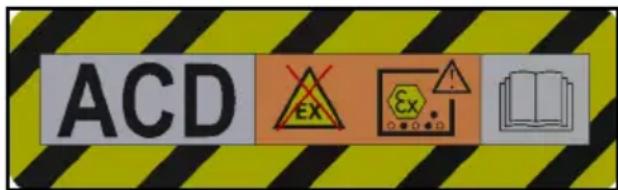
The device is suitable for vacuuming flammable dusts, installation outside zone 22.
WARNING: This device must not be placed in any zone 22. If a zone 22 is present, an EX-device must be used.
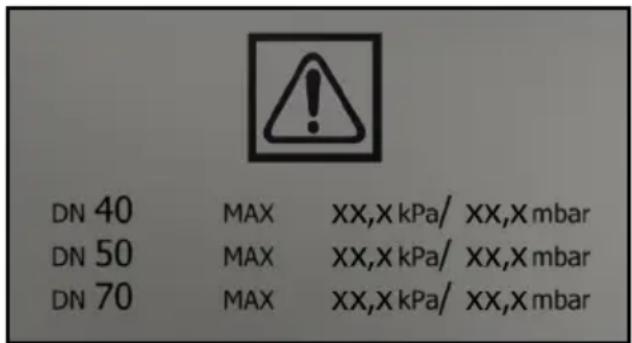
The maximum vacuum value in relation to the hose cross-section is specified on the label. The actual value can be read on the pressure gauge. For the values applicable to this device, see chapter Reading the minimum volumetric flow. If this value is not reached, the filter must be cleaned (see chapter Dedusting the filter) or replaced (see chapter Replacing the filter). The various different hose cross-sections allow ad-
aptation to the various different connection cross-sections of the accessories.

Dust bag
(Order no. 9.989-606.0)

filter
(Order no. 9.990-222.0)
Initial startup
⚠ WARNING
Potential equalisation line not connected correctly
Electric shock
Every time before use, check whether the equipotential bonding conductor (earthing conductors) are connected.
⚠ WARNING
Danger from dust that is harmful to your health
Respiratory sicknesses through inhalation of dust.
Do not vacuum without correctly installed filter elements, otherwise a danger to health from increased fine dust emission is present.
ATTENTION
Missing filter element
Damage to the suction motor
Do not vacuum without a filter element.
ATTENTION
Exceeding the grid impedance
Electrical shock in the event of a short-circuit
The maximum permissible mains grid impedance at the electrical connection point (see Technical data) must not be exceeded.
Contact your electricity supplier in the case of any uncertainties regarding the mains grid impedance at your electrical connection point.
- Bring the device into the working position.
- Secure the device with the parking brakes.
- Insert the suction hose into the suction connection.
- Check the filling level in the dirt receptacle (see chapter Check the dirt receptacle filling level).
- Empty the dirt receptacle if necessary (see chapter Emptying the dirt receptacle).
- Fit the dust bag before dry vacuuming (see chapter Fitting the dust bag).
- Fit the desired accessory (not included in the scope of delivery) onto the suction hose.
Check the dirt receptacle filling level
Note
The dirt receptacle must be emptied when it has filled up to approximately 3 cm below the upper edge.
The device does not switch off automatically when the maximum filling level is exceeded.
- Check the dirt receptacle filling level regularly.
Operation
The device is suitable for vacuuming fine dust up to dust class M.
⚠ WARNING
Danger from dust that is harmful to your health
Respiratory sicknesses through inhalation of dust.
Do not vacuum without correctly installed filter elements, otherwise a danger to health from increased fine dust emission is present.
ATTENTION
Risk of damage to the suction motor.
Never remove the filter element when vacuuming.
Dry vacuuming
Note
All types of dust up to dust class M can be vacuumed with this device. The use of a dust collection bag is required by law.
Note
The device is an industrial vacuum cleaner for vacuuming dry, flammable dusts.
Switching from wet to dry vacuuming
ATTENTION
Switching from wet to dry vacuuming
Risk of damage to the filter
Do not vacuum dry dust with a wet filter element because this clogs the filter and can make it unusable.
- Allow the wet filter to dry completely or replace it with a dry filter before using the device for dry vacuuming.
- Replace the filter if necessary.
Fitting the dust bag
- Secure the device with the parking brakes.
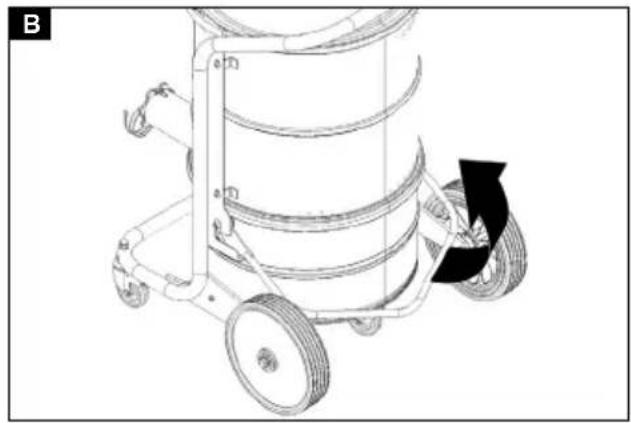
Illustration B
- Pull the bow handle up.
The dirt receptacle is unlocked and lowered.
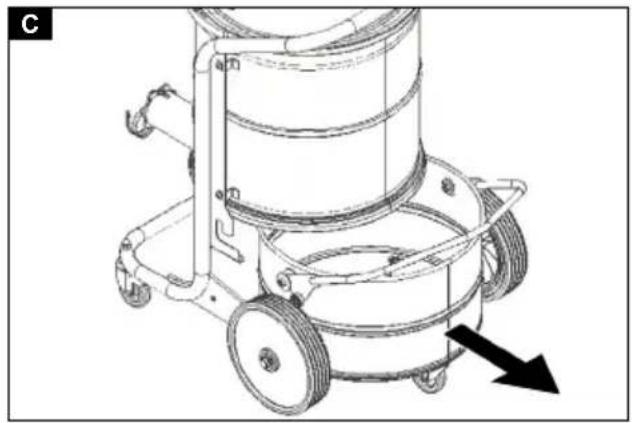
Illustration C
- Pull the dirt receptacle out of the device by the bow handle.
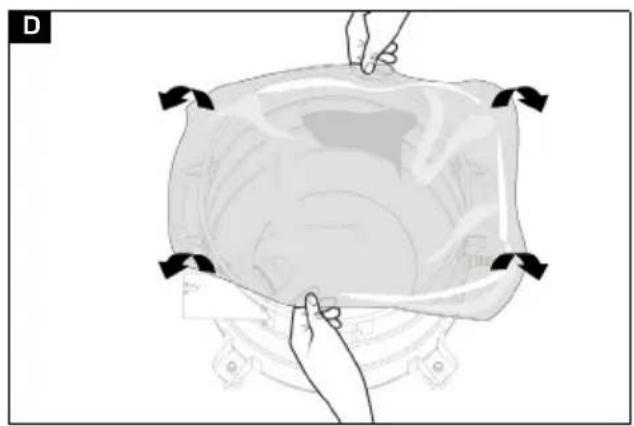
Illustration D
- Fit the dust bag in the dirt receptacle and carefully position it against the container wall and the container floor.
- Fold the edge of the dust bag over the edge of the dirt receptacle to the outside.
⚠ WARNING
Improper handling when locking the dirt receptacle
Risk of crushing
Under no circumstances should you hold your hands between the dirt receptacle and filter ring or allow them to come close to the lifting mechanism while locking it.
Lock the dirt receptacle by operating the bow handle with both hands.
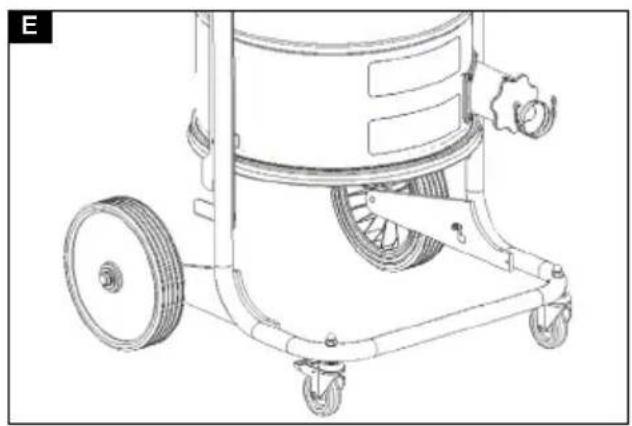
Illustration E
ATTENTION
Static charge of the dirt receptacle
Ignition of dusts
Make sure that the grounding on the chassis is in contact with the dirt receptacle.
- Fit the dirt receptacle and lock it with the bow handle.
Wet vacuum cleaning
⚠️ DANGER
Danger from dust that is harmful to your health
Respiratory sicknesses through inhalation of dust.
No dusts harmful to health may be vacuumed when performing wet vacuum cleaning.
ATTENTION
Risk of damage if the dirt receptacle overflows
The dirt receptacle can fill within a few seconds and overflow when vacuuming large amounts of liquids.
Continuously monitor the filling level.
- Remove the dust bag before wet vacuum cleaning (see chapter Removing the dust bag).
Removing the dust bag
⚠️DANGER
Danger from dust that is harmful to your health
Respiratory sicknesses through inhalation of dust.
Accumulated dust must be transported in dust-proof containers. Do not transfer the contents. The dust bag may only be disposed of by qualified staff.
- Secure the device with the parking brakes.
- Remove the suction hose if necessary.
- Close the suction connection on the filter ring (see chapter Closing the suction connection).
Illustration B
- Pull the bow handle up.
The dirt receptacle is unlocked and lowered.
Illustration C
- Pull the dirt receptacle out of the device by the bow handle.
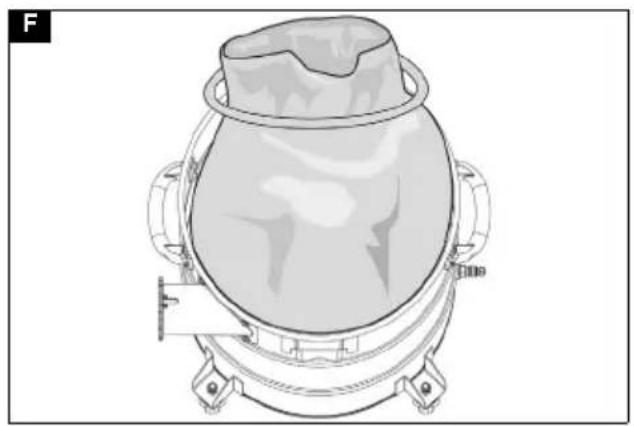
Illustration F
- Turn up the dust bag.
- Seal the dust bag tightly with the cable tie.
- Remove the dust bag.
- Dispose of the dust bag in accordance with statutory regulations.
⚠ WARNING
Improper handling when locking the dirt receptacle
Risk of crushing
Under no circumstances should you hold your hands between the dirt receptacle and filter ring or allow them to come close to the lifting mechanism while locking it.
Lock the dirt receptacle by operating the bow handle with both hands.
Illustration E
ATTENTION
Static charge of the dirt receptacle
Ignition of dusts
Make sure that the grounding on the chassis is in contact with the dirt receptacle.
- Fit the dirt receptacle and lock it with the bow handle.
Ending wet vacuum cleaning
⚠ WARNING
Improper disposal of waste water
Environmental pollution
Observe the local waste water treatment regulations.
- Dry the filter.
- Clean the dirt receptacle with a moist cloth and dry it off.
Switching on the device
- Plug the mains plug into the socket.
- Switch on the device via the suction turbine power switches.
Note
Always switch the suction turbines on and off one after the other. For the correct function of the pressure gauge for monitoring the minimum volume flow, all suction turbines must be switched on.
- Start the vacuuming process.
Reading the minimum volumetric flow
A pressure gauge showing the vacuum inside the device is mounted on the front of the device. The filter must be cleaned when the maximum vacuum (see table) is reached (see chapter Dedusting the filter). This value depends on the device performance and the suction hose used. If the vacuum is not significantly reduced by dedusting, the filter must be replaced (see chapter Replacing the filter).
ATTENTION
Exceeding the maximum vacuum
Suction loss
If the specified value is exceeded, the air speed in the suction hose drops below 20 m/s. Clean or replace the filter.
| Nominal width of the suction hose | Maximum vacuum |
| DN40 13.15 kPa | (131.5 mbar) |
| DN50 10.0 kPa (100 mbar) | |
| DN70 --- |
Dedusting the filter
The filter must be cleaned if the pressure gauge shows the maximum vacuum (see chapter Reading the minimum volumetric flow).
Illustration G
- Close the inlet opening or the suction hose during the suction process.
- Pull the flap of the filter dedusting system 3-4 times and hold it open for 1-2 seconds each time.
Switching off the device
- Switch off the device via the suction turbine power switches.
- Pull out the mains plug.
Each time after use
Closing the suction connection
⚠ WARNING
Risk of injury
Damage to the skin, lungs and eyes through fine dust
The suction connection must be closed using the sealing plug after removing the suction hose.
Illustration H
- Insert the sealing plug precisely into the suction connection.
- Push the sealing plug in all the way to the end stop.
Emptying the dirt receptacle
The dirt receptacle must be emptied as required and after each use and cleaned inside and out by vacuuming and wiping with a damp cloth.
A vacuum cleaner with the same or better classification must be used for vacuuming the device.
The inlet opening or the suction hose are closed.
- Switch on the device via the suction turbine power switches.
- Dedust the filter (see chapter Dedusting the filter).
- Switch off the device via the suction turbine power switches.
- Secure the device with the parking brakes.
Illustration B
- Pull the bow handle up. The dirt receptacle is unlocked and lowered.
Illustration C
- Pull the dirt receptacle out of the device by the bow handle.
- Empty the dirt receptacle. To do this, remove the dust bag if necessary (see chapter Removing the dust bag).
⚠ WARNING
Improper handling when locking the dirt receptacle
Risk of crushing
Under no circumstances should you hold your hands between the dirt receptacle and filter ring or allow them to come close to the lifting mechanism while locking it.
Lock the dirt receptacle by operating the bow handle with both hands.
Illustration E
ATTENTION
Static charge of the dirt receptacle
Ignition of dusts
Make sure that the grounding on the chassis is in contact with the dirt receptacle.
- Fit the dirt receptacle and lock it with the bow handle.
- If necessary, check the electrostatic grounding.
Cleaning the device
⚠ WARNING
Improper disposal of waste water
Environmental pollution
Observe the local waste water treatment regulations.
- Vacuum the inside and outside of the device and clean with a moist cloth. A vacuum cleaner with the same or better classification must be used for vacuuming the device.
- If necessary, rinse the accessories (not included in the scope of delivery) with water and dry them.
Storing the device
- Wind the mains cable onto the cable holders.
- Store the device in a dry room and secure it against unauthorised use.
Transport
△CAUTION
Failure to observe the weight
Risk of injury and damage
Be aware of the weight of the device during transportation.
- Close the suction connection for dust-free transport (see chapter Closing the suction connection).
- Release the parking brakes and push the device by the push handle.
- Grasp the device by the chassis and the push handle for loading.
- Secure the device against slipping and tipping over when transporting in vehicles.
Storage
△CAUTION
Failure to observe the weight
Risk of injury and damage
Be aware of the weight of the device during storage.
The dirt receptacle is emptied.
- Store the device indoors only.
Care and maintenance
⚠️DANGER
Inadvertently starting up device, touching live components
Risk of injury, electric shock
Switch off the device before performing any work on the device.
Remove the mains plug.
⚠️ DANGER
Danger from dust that is harmful to your health
Respiratory sicknesses through inhalation of dust.
Wear a breathing protection mask of class P2 or higher and disposable clothing when performing maintenance work (e.g., filter change).
⚠ WARNING
Danger from dust that is harmful to your health
Respiratory sicknesses through inhalation of dust.
Safety devices providing hazard protection must be checked for correct safety-related functionality at least annually by the manufacturer or an appropriately instructed person, e.g., absence of leaks, filter damage, functionality of the monitoring devices.
ATTENTION
Care agents containing silicone
These can attach plastic components.
Do not use care agents containing silicone for cleaning.
Dust extraction machines are safety devices for the prevention or elimination of hazards according to the DGUV regulation:
- For servicing performed by the user, the device must be disassembled, cleaned and maintained only to the degree that this is possible without presenting a danger to the maintenance personnel and other persons. Suitable precautionary measures include detoxification before disassembly. Make provisions for local forced ventilation at the location where the device is to be disassembled, for cleaning the maintenance surface and
to ensure adequate protection for the personnel.
- The exterior of the device should be detoxified by vacuuming and wiped clean, or treated with sealant before being removed from the hazardous area. All device parts must be regarded as contaminated when they are taken from the hazardous area. Suitable measures must be taken to prevent distribution of the dust.
- All contaminated objects resulting from maintenance and repair work that cannot be satisfactorily cleaned must be correctly disposed of. Such objects must be disposed of in sealed bags in accordance with the applicable regulations for the disposal of this type of waste.
- The suction hose ports are to be closed using the sealing plugs during transport and maintenance of the device.
- Note that you can carry out simple maintenance and care work yourself.
- Clean the surface of the device and the interior of the container regularly with a moist cloth.
- Carry out a regular visual inspection for clogging of the hoses.
Inspection and maintenance work
Have the device regularly inspected according to the respective national accident prevention regulations. Maintenance work as specified by the manufacturer must be performed by a technically qualified person at the specified regular intervals and in accordance with the applicable regulations and safety requirements. Work on electrical components may only be performed by a qualified electrician. Please contact a KÄRCHER branch office if you have any questions.
Replacing the filter
△CAUTION
Emission of dust when changing the filter
Damage to the skin, lungs and eyes through emitted dust.
Wear the prescribed protective clothing when changing the filter.
Change the filter in a suitable maintenance area.
Dispose of the filter in accordance with the statutory regulations.
- Secure the device with the parking brakes.
- Switch off the device at the power switches.
- Pull out the mains plug.
- Unlock and remove the suction head.
- Unlock and remove the spacer.
- Remove the contaminated filter.
- Immediately after removing the contaminated filter from the device, place it in a bag and seal the bag tightly.
- Dispose of the contaminated filter according to legal requirements.
- Check the sealing ring for damage.
- Remove any dirt deposits from the clean air side.
- Fit the new filter in reverse order. Make sure that the filter hold-down device is centred in the filter pockets.
- Fit and lock the spacer.
- Fit and lock the suction head.
Replace dust bag
- Secure the device with the parking brakes.
Illustration B
- Pull the bow handle up. The dirt receptacle is unlocked and lowered.
Illustration C
- Pull the dirt receptacle out of the device by the bow handle.
Illustration F
- Turn up the dust bag.
- Seal the dust bag tightly with the cable tie.
- Remove the dust bag.
- Dispose of the dust bag in accordance with statutory regulations.
Illustration D
- Insert the new dust bag in the dirt receptacle and carefully place it against the container wall and the container floor.
- Fold the edge of the dust bag over the edge of the dirt receptacle to the outside.
⚠ WARNING
Improper handling when locking the dirt receptacle
Risk of crushing
Under no circumstances should you hold your hands between the dirt receptacle and filter ring or allow them to come close to the lifting mechanism while locking it.
Lock the dirt receptacle by operating the bow handle with both hands.
Illustration E
ATTENTION
Static charge of the dirt receptacle Ignition of dusts
Make sure that the grounding on the chassis is in contact with the dirt receptacle.
- Fit the dirt receptacle and lock it with the bow handle.
Troubleshooting guide
⚠️DANGER
Unintentional start-up of the device / electric shock
Unintentional start-up of the suction motor can cause injuries. Voltage present on electrical parts can cause an electric shock. Switch off the device and unplug the mains plug before performing any work on the device.
Have all checks and work on electrical parts performed by a qualified technician.
Note
The device must be switched off immediately in the event of a malfunction. The malfunction must be eliminated before switching the device on again.
If the malfunction cannot be corrected, the device must be checked by the Customer Service department.
Suction turbine does not start up
- Check the socket and the power supply fuse.
- Check the mains cable and the mains plug of the device.
- Switch the device on.
Suction power decreases
- Remove the blockages from the suction nozzle, the suction pipe or the suction hose.
- Replace the filled dust bag (see chapter Replace dust bag).
- Check that the suction head and the dirt receptacle are correctly seated.
- Dedust the filter (see chapter Dedusting the filter).
- Check the seating of the filter and correct if necessary.
- Replace the filter (see chapter Replacing the filter).
Escaping dust when vacuuming
- Check the seating of the filter and correct if necessary.
- Dedust the filter (see chapter Dedusting the filter).
- Replace the filter (see chapter Replacing the filter).
Disposal
At the end of its service life, the device is to be disposed of in accordance with statutory regulations.
Warranty
The warranty conditions issued by our relevant sales company apply in all countries. We shall remedy possible malfunctions on your appliance within the warranty period free of cost, provided that a material or manufacturing flaw is the cause. In a warranty case, please contact your dealer (with the purchase receipt) or the next authorised customer service site.
(See overleaf for the address)
Further warranty information (if available) can be found in the service area of your local Kärcher website under "Downloads".
Technical data
| Electrical connection | |
| Mains voltage V 220-240 | |
| Phase ~ 1 | |
| Power frequency Hz 50-60 | |
| Nominal power W 2100 | |
| Maximum power W 2300 | |
| Protection type IPX4 | |
| Protection class I* | |
| Maximum permissible mains grid impedance | Ω 0.224+j0 .140 |
Dimensions and weights
| Typical operating weight | kg | 35,7 |
| Length x width x height mm | 645 x | |
| 655 x | ||
| 1150 | ||
| Effective filter area | m2 | 1,5 |
Ambient conditions
| Storage temperature | °C | -10-40 |
Device performance data
| Container capacity | I | 40 |
| Vacuum (max.) | kPa | 19,0 |
| Max. volume flow with suc- m3/h tion hose DN50, L=3 m | 250 | |
| Max. volume flow with suc- m3/h tion hose DN40, L=3 m | 205 | |
| Max. volume flow with suc- m3/h tion hose DN50, L=5 m | 230 | |
| Max. volume flow with suc- m3/h 190tion hose DN40, L=5 m |
| Suction hose connection | DN70 |
| Nominal width of the suction hose | DN40/50 |
| Filter order number | 9.990-222.0 |
Determined values in acc. with EN 60335-2-69
| Hand-arm vibration value | m/s2 | <2,5 |
| K uncertainty | m/s2 | 1 |
| Sound pressure level LpA | dB(A) | 77 |
| Uncertainty KpA | dB(A) | 2 |
Mains cable
| Type H07RN- | |
| F 3G1.5 mm 2 | |
| Part number 6.650- | 035.0 |
Cable length m 10
* with elements of protection class II arrangement
Subject to technical changes without notice.
EU Declaration of Conformity
We hereby declare that the product named below complies with the relevant provisions of the directives and regulations listed. This declaration is invalidated by any changes made to the product that are not approved by us.
Product: Dry vacuum cleaner
Product: Wet/dry vacuum cleaner
Type: 9.990-xxx
Directives and Regulations
2006/42/EC (+2009/127/EC)
2014/30/EU
2011/65/EU
Harmonised standards used
EN 60335-1
EN 60335-2-69
EN 55014-1: 2017 + A11: 2020
EN 55014-2: 2015
EN IEC 61000-3-2: 2019
EN 61000-3-11: 2000
EN 62233: 2008
EN IEC 63000: 2018
Non-harmonised standards used
IEC 60335-1
IEC 60335-2-69
Name and address
Documentation supervisor:
A. Haag
Kärcher Industrial Vacuuming GmbH
73550 Waldstetten (Germany)
Tel.: +49 7171 94888-0
Fax: +49 7171 94888-528
T. Wahl
Managing Director
A. Haag
Director R&D
Waldstetten, 24/11/01
The signatories act on behalf of and with the authority of the Executive Board.
73550 Waldstetten (Germany)
Ph.: +49 7171 94888-0
Fax: +49 7171 94888-528
T. Wahl
Managing Director
A. Haag
Director R&D
Waldstetten, 01/11/24
73550 Waldstetten (Germany)
Tel.: +49 7171 94888-0
Fax: +49 7171 94888-528
T. Wahl
Managing Director
A. Haag
Director R&D
Waldstetten, 01/11/24
73550 Waldstetten (Germany)
Tel.: +49 7171 94888-0
Fax: +49 7171 94888-528
2006/42/EC (+2009/127/EC)
2014/30/EU
2011/65/EU
2006/42/EC (+2009/127/EC)
2014/30/EU
2011/65/EU
T. Wahl Managing Director
A. Haag Director R&D
Waldstetten, 24/11/01
73550 Waldstetten (Germany)
Tel.: +49 7171 94888-0
Fax: +49 7171 94888-528
T. Wahl
Managing Director
A. Haag
Director R&D
Waldstetten, 24/11/01
73550 Waldstetten (Germany)
Tel.: +49 7171 94888-0
Fax: +49 7171 94888-528
Table of contents
General notes 86
Safety information 86
2006/42/EC (+2009/127/EC)
2014/30/EU
2011/65/EU
73550 Waldstetten (Germany)
Tel.: +49 7171 94888-0
Fax: +49 7171 94888-528
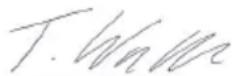
T. Wahl
Managing Director
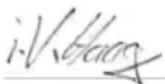
A. Haag
Director R&D
Waldstetten, 24/11/01
73550 Waldstetten (Germany)
Tel.: +49 7171 94888-0
Fax: +49 7171 94888-528
T. Wahl Managing Director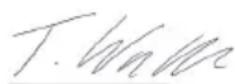
A. Haag Director R&D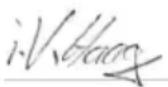
73550 Waldstetten (Germany)
Tel.: +49 7171 94888-0
Fax: +49 7171 94888-528
Contents
73550 Waldstetten (Germany)
73550 Waldstetten (Germany)
Dust emission during suction
2006/42/EC (+2009/127/EC)
2014/30/EU
2011/65/EU
Harmonised standards applied
EN 60335-1
EN 60335-2-69
EN 55014-1: 2017 + A11: 2020
EN 55014-2: 2015
EN IEC 61000-3-2: 2019
EN 61000-3-11: 2000
EN 62233: 2008
EN IEC 63000: 2018
73550 Waldstetten (Germany)
Tel.: +49 7171 94888-0
Fax: +49 7171 94888-528
T. Wahl
Managing Director

A. Haag
Director R&D
Waldstetten, 24/11/01
73550 Waldstetten (Germany)
Tel.: +49 7171 94888-0
Fax: +49 7171 94888-528
Contents
2006/42/EC (+2009/127/EC)
2014/30/EU
2011/65/EU
73550 Waldstetten (Germany)
Tel.: +49 7171 94888-0
Fax: +49 7171 94888-528
T. Wahl
Managing Director
A. Haag
Director R&D
Waldstetten, 24/11/01
73550 Waldstetten (Germany)
Tel.: +49 7171 94888-0
Fax: +49 7171 94888-528
Table of Contents
General instructions 138
Safety instructions 139
Intended use.... 140
2006/42/EÜ (+2009/127/EÜ)
2014/30/EL
2011/65/EL
73550 Waldstetten (Germany)
Tel: +49 7171 94888-0
Fax: +49 7171 94888-528
T. Wahl
Managing Director
A. Haag
Director R&D
Waldstetten, 24/11/01
73550 Waldstetten (Germany)
Tel: +49 7171 94888-0
Fax: +49 7171 94888-528
Contents
T. Wahl Managing Director
A. Haag Director R&D
2006/42/EC (+2009/127/EC)
2014/30/EU
2011/65/EU
T. Wahl Managing Director
A. Haag Director R&D
Waldstetten, 24/11/01
2006/42/ES (+2009/127/ES)
2014/30/EU
2011/65/EU
73550 Waldstetten (Germany)
Tel.: +49 7171 94888-0
Fax: +49 7171 94888-528
T. Wahl Managing Director
A. Haag Director R&D
73550 Waldstetten (Germany)
Tel.: +49 7171 94888-0
Fax: +49 7171 94888-528
Table of Contents
General instructions.... 217
Safety instructions 217
Intended use.... 218
2006/42/EC (+2009/127/EC)
2014/30/EU
2011/65/EU
2006/42/EC (+2009/127/EC)
2014/30/EU
2011/65/EU
73550 Waldstetten (Germany)
Tel.: +49 7171 94888-0
Fax: +49 7171 94888-528
T. Wahl
Managing Director
A. Haag
Director R&D
73550 Waldstetten (Germany)
Tel.: +49 7171 94888-0
Fax: +49 7171 94888-528
Contents
General notes.... 250
Safety notes.... 250
Intended use.... 252
The device is suitable for vacuuming combustible dust, setting outside zone 22.
WARNING: This device must not be placed in zone 22. If zone 22 exists, an Ex device must be used.
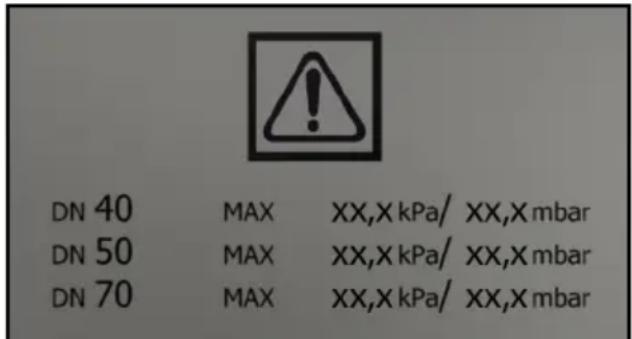
The label specifies values for max. negative pressure in relation to the used cross-section of the suction hose. The current value can be read on the manometer. For values applicable to this device, see chapter Reading the minimum volume flow. If the value is not met, the filter must be cleaned (see chapter Cleaning the filter) or replaced (see chapter Replacing the filter). Different cross-sections of the suction hose allow adaptation to different connection cross-sections of accessory parts.

Disposal bag
(Catalog no. 9.989-606.0)
Filter
(Catalog no. 9.990-222.0)
Commissioning
⚠WARNING
T. Wahl
Managing Director
A. Haag
Director R&D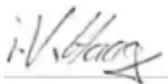
Waldstetten, 24/11/01
The signatories act on behalf of and with the authorization of the management.
Kärcher Industrial Vacuuming GmbH
73550 Waldstetten (Germany)
Tel.: +49 7171 94888-0
Fax: +49 7171 94888-528
T. Wahl Managing Director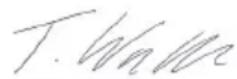
A. Haag Director R&D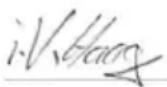
Waldstetten, 24/11/01
73550 Waldstetten (Germany)
Tel.: +49 7171 94888-0
Fax: +49 7171 94888-528
Contents
General notes 274
T. Wahl Managing Director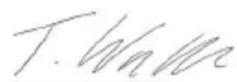
A. Haag Director R&D
T. Wahl Managing Director
A. Haag Director R&D
T. Wahl Managing Director
A. Haag Director R&D
Waldstetten, /11/01
Find: www.kaercher.com/REACH
Accessories and spare parts
Danger
Unauthorized accessories may cause explosion hazard
T. Wahl Managing Director
A. Haag Director R&D
Waldstetten, 24/11/01
http://www.kaercher.com/dealersearch



- CONTENTS
- GENERAL INSTRUCTIONS
- HAZARD LEVELS
- ⚠️ DANGER
- INDICATION OF AN IMMINENT THREAT OF DANGER THAT WILL LEAD TO SEVERE INJURIES OR EVEN DEATH
- ⚠ WARNING
- △CAUTION
- ATTENTION
- GENERAL SAFETY INSTRUCTIONS
- ELECTRICAL CONNECTION
- ⚠️DANGER
- DANGER OF ELECTRIC SHOCK
- BEHAVIOUR IN THE EVENT OF AN EMERGENCY
- RISK OF INJURY AND DAMAGE IN THE EVENT OF A SHORT-CIRCUIT OR OTHER ELECTRICAL FAULTS
- BEHAVIOUR IN CASE OF FILTER BREAKAGE / LEAKAGE
- INTENDED USE
- ENVIRONMENTAL PROTECTION
- NOTES ON THE CONTENT MATERIALS (REACH)
- ACCESSORIES AND SPARE PARTS
- RISK OF EXPLOSION WHEN USED WITH NON-PERMITTED ACCESSORIES
- NOTE
- SCOPE OF DELIVERY
- DEVICE DESCRIPTION
- ILLUSTRATION A
- SYMBOLS ON THE DEVICE
- DAMAGE TO THE SKIN, LUNGS AND EYES
- INITIAL STARTUP
- POTENTIAL EQUALISATION LINE NOT CONNECTED CORRECTLY
- DANGER FROM DUST THAT IS HARMFUL TO YOUR HEALTH
- MISSING FILTER ELEMENT
- EXCEEDING THE GRID IMPEDANCE
- CHECK THE DIRT RECEPTACLE FILLING LEVEL
- OPERATION
- DRY VACUUMING
- SWITCHING FROM WET TO DRY VACUUMING
- FITTING THE DUST BAG
- ILLUSTRATION B
- ILLUSTRATION C
- ILLUSTRATION D
- IMPROPER HANDLING WHEN LOCKING THE DIRT RECEPTACLE
- ILLUSTRATION E
- STATIC CHARGE OF THE DIRT RECEPTACLE
- WET VACUUM CLEANING
- RISK OF DAMAGE IF THE DIRT RECEPTACLE OVERFLOWS
- REMOVING THE DUST BAG
- ILLUSTRATION F
- ENDING WET VACUUM CLEANING
- IMPROPER DISPOSAL OF WASTE WATER
- SWITCHING ON THE DEVICE
- READING THE MINIMUM VOLUMETRIC FLOW
- EXCEEDING THE MAXIMUM VACUUM
- DEDUSTING THE FILTER
- ILLUSTRATION G
- SWITCHING OFF THE DEVICE
- EACH TIME AFTER USE
- CLOSING THE SUCTION CONNECTION
- RISK OF INJURY
- ILLUSTRATION H
- EMPTYING THE DIRT RECEPTACLE
- CLEANING THE DEVICE
- STORING THE DEVICE
- TRANSPORT
- FAILURE TO OBSERVE THE WEIGHT
- STORAGE
- CARE AND MAINTENANCE
- INSPECTION AND MAINTENANCE WORK
- REPLACING THE FILTER
- EMISSION OF DUST WHEN CHANGING THE FILTER
- REPLACE DUST BAG
- STATIC CHARGE OF THE DIRT RECEPTACLE IGNITION OF DUSTS
- TROUBLESHOOTING GUIDE
- UNINTENTIONAL START-UP OF THE DEVICE / ELECTRIC SHOCK
- SUCTION TURBINE DOES NOT START UP
- SUCTION POWER DECREASES
- ESCAPING DUST WHEN VACUUMING
- DISPOSAL
- WARRANTY
- CABLE LENGTH M
- EU DECLARATION OF CONFORMITY
- DIRECTIVES AND REGULATIONS
- HARMONISED STANDARDS USED
- NON-HARMONISED STANDARDS USED
- NAME AND ADDRESS
- TABLE OF CONTENTS
- DUST EMISSION DURING SUCTION
- HARMONISED STANDARDS APPLIED
- COMMISSIONING
- ⚠WARNING
- DANGER
Brand : Kärcher
Model : IVM 40/24-2 M ACD
Category : Vacuum Cleaner