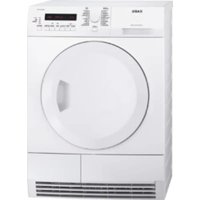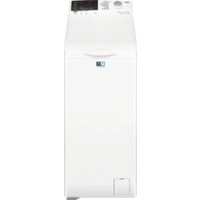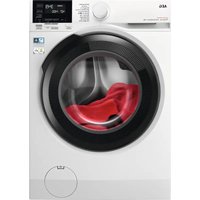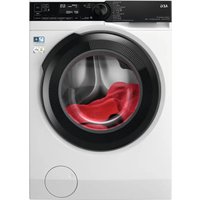
L6FE8444GM - Washing machine AEG - Free user manual and instructions
Find the device manual for free L6FE8444GM AEG in PDF.


User questions about L6FE8444GM AEG
0 question about this device. Answer the ones you know or ask your own.
Ask a new question about this device
Download the instructions for your Washing machine in PDF format for free! Find your manual L6FE8444GM - AEG and take your electronic device back in hand. On this page are published all the documents necessary for the use of your device. L6FE8444GM by AEG.
USER MANUAL L6FE8444GM AEG
natural_image
Simple line drawing of a washing machine with no text or symbolsCONTENTS
- SAFETY INFORMATION......3
- SAFETY INSTRUCTIONS......5
- PRODUCT DESCRIPTION....6
- TECHNICAL DATA....7
- INSTALLATION....8
- ACCESSORIES....12
- CONTROL PANEL....12
- DIAL AND BUTTONS.... 14
- PROGRAMMES 16
- SETTINGS....20
- BEFORE FIRST USE....20
- DAILY USE.... 20
- HINTS AND TIPS....25
- CARE AND CLEANING....27
- TROUBLESHOOTING....32
- CONSUMPTION VALUES....34
- QUICK GUIDE......35
- ENVIRONMENTAL CONCERNS......37
FOR PERFECT RESULTS
Thank you for choosing this AEG product. We have created it to give you impeccable performance for many years, with innovative technologies that help make life simpler – features you might not find on ordinary appliances. Please spend a few minutes reading to get the very best from it.
Visit our website to:

Get usage advice, brochures, trouble shooter, service and repair information: www.aeg.com/support

Register your product for better service: www.registeraeg.com

Buy Accessories, Consumables and Original spare parts for your appliance: www.aeg.com/shop
CUSTOMER CARE AND SERVICE
Always use original spare parts.
When contacting our Authorised Service Centre, ensure that you have the following data available: Model, PNC, Serial Number.
The information can be found on the rating plate.
⚠ Warning / Caution-Safety information
i General information and tips
Environmental information
Subject to change without notice.
1. ⚠ SAFETY INFORMATION
Before the installation and use of the appliance, carefully read the supplied instructions. The manufacturer is not responsible for any injuries or damage that are the result of incorrect installation or usage. Always keep the instructions in a safe and accessible location for future reference.
1.1 Children and vulnerable people safety
- This appliance can be used by children aged from 8 years and above and persons with reduced physical, sensory or mental capabilities or lack of experience and knowledge if they have been given supervision or instruction concerning the use of the appliance in a safe way and understand the hazards involved.
- Children between 3 and 8 years of age and persons with very extensive and complex disabilities shall be kept away from the appliance unless continuously supervised.
- Children of less than 3 years of age should be kept away from the appliance unless continuously supervised.
- Children should be supervised to ensure that they do not play with the appliance.
- Keep all packaging away from children and dispose of it appropriately.
- Keep detergents away from children.
- Keep children and pets away from the appliance when the door is open.
- If the appliance has a child safety device, it should be activated.
- Children shall not carry out cleaning and user maintenance of the appliance without supervision.
1.2 General Safety
- This appliance is for washing domestic-type, machine-washable laundry only.
- This appliance is designed for single household domestic use in an indoor environment.
- This appliance may be used in, offices, hotel guest rooms, bed & breakfast guest rooms, farm guest houses and other similar accommodation where such use does not exceed (average) domestic usage levels.
- Do not change the specification of this appliance.
- The appliance maximum load is 8 kg. Do not exceed the maximum load of each programme (refer to the “Programmes” chapter).
- The operating water pressure at the water entry point from the outlet connection must be between 0.5 bar (0.05 MPa) and 8 bar (0.8 MPa).
- The ventilation opening in the base must not be covered by a carpet, mat, or any floor covering.
- The appliance must be connected to the water mains using the new supplied hose sets, or other new hose sets supplied by the Authorised Service Centre.
- Old hose sets must not be reused.
- If the mains power supply cable is damaged, it must be replaced by the manufacturer, its Authorised Service Centre or similarly qualified persons to avoid an electrical hazard.
- Before any maintenance operation, deactivate the appliance and disconnect the mains plug from the socket.
- Do not use high pressure water sprays and/or steam to clean the appliance.
- Clean the appliance with a moist cloth. Use only neutral detergents. Do not use abrasive products, abrasive cleaning pads, solvents or metal objects.
- If a tumble dryer is stacked on the top of the washing machine, make sure to use the correct stacking kit approved by AEG (see more details in chapter "Accessories - Stacking kit").
2. SAFETY INSTRUCTIONS
2.1 Installation

The installation must comply with relevant national regulations.
- Remove all the packaging and the transit bolts including rubber bush with plastic spacer.
- Keep the transit bolts in a safe place. If the appliance is to be moved in the future they must be reattached to lock the drum to prevent an internal damage.
• Always take care when moving the appliance as it is heavy. Always use safety gloves and enclosed footwear. - Follow the installation instructions supplied with the appliance.
- Do not install or use a damaged appliance.
- Do not install or use the appliance where the temperature can be less than 0^ or where it is exposed to the weather.
- The floor area on which the appliance is to be installed must be flat, stable, heat resistant and clean.
• Make sure that there is air circulation between the appliance and the floor. - When the appliance is in its permanent position, check if it is levelled correctly with the aid of a spirit level. If it is not, adjust the feet accordingly.
- Do not install the appliance directly above a floor drain.
- Do not spray water on the appliance and do not expose it to excessive humidity.
- Do not install the appliance where the appliance door cannot be fully opened.
- Do not put a closed container to collect possible water leakage under the appliance. Contact the Authorised Service Centre to ensure which accessories can be used.
2.2 Electrical connection

WARNING!
Risk of fire and electrical shock.
- WARNING: This appliance is designed to be installed / connected to a grounding connection in the building.
• Always use a correctly installed shockproof socket. - Make sure that the parameters on the rating plate are compatible with the electrical ratings of the mains power supply.
- Do not use multi-plug adapters and extension cables.
- Make sure not to cause damage to the mains plug and to the mains cable. Should the mains cable need to be replaced, this must be carried out by our Authorised Service Centre.
- Connect the mains plug to the mains socket only at the end of the installation. Make sure that there is access to the mains plug after the installation.
- Do not touch the mains cable or the mains plug with wet hands.
- Do not pull the mains cable to disconnect the appliance. Always pull the mains plug.
2.3 Water connection
- The inlet water shall not exceed 25^ .
- Do not cause damage to the water hoses.
- Before connection to new pipes, pipes not used for a long time, where repair work has been carried out or new devices fitted (water meters, etc.), let the water flow until it is clean and clear.
- Ensure that there are no visible water leaks during and after the first use of the appliance.
-
Do not use an extension hose if the inlet hose is too short. Contact the Authorised Service Centre for the replacement of the inlet hose.
-
When unpacking the appliance, It is possible to see water flowing from the drain hose. This is due to the testing of the appliance with the use of water in the factory.
- You can extend the drain hose to maximum 400 cm. Contact the Authorised Service Centre for the other drain hose and the extension.
- Make sure that there is access to the tap after the installation.
2.4 Use

WARNING!
Risk of injury, electrical shock, fire, burns or damage to the appliance.
- Follow the safety instructions on the detergent packaging.
- Do not put flammable products or items that are wet with flammable products in, near or on the appliance.
- Do not wash fabrics which are heavily soiled with oil, grease or other greasy substances. It can damage rubber parts of the washing machine. Prewash such fabrics by hand before loading them into the washing machine.
- Do not touch the glass door while a programme operates. The glass can get hot.
- Make sure that all metal objects are removed from the laundry.
2.5 Service
• To repair the appliance contact the Authorised Service Centre. Use original spare parts only.
3. PRODUCT DESCRIPTION
3.1 Special features
Your new washing machine meets all modern requirements for an effective treatment of laundry with low water, energy and detergent consumption and respectful of fabric care.
• The ProSense technology adjusts automatically the programme duration to the laundry in the drum to achieve
- Please note that self-repair or non-professional repair can have safety consequences and might void the guarantee.
- Concerning the lamp(s) inside this product and spare part lamps sold separately: These lamps are intended to withstand extreme physical conditions in household appliances, such as temperature, vibration, humidity, or are intended to signal information about the operational status of the appliance. They are not intended to be used in other applications and are not suitable for household room illumination.
2.6 Disposal

WARNING!
Risk of injury or suffocation.
- Disconnect the appliance from the mains electrical and water supplies.
- Cut off the mains electrical cable close to the appliance and dispose of it.
- Remove the door catch to prevent children or pets from becoming trapped in the drum.
- Dispose of the appliance in accordance with local requirements for the disposal of Waste Electrical and Electronic Equipment (WEEE).
perfect washing results in the minimum possible time.
- Thanks to the Soft Plus option, the fabric softener is uniformly spread out in the laundry and deeply penetrates the fabric fibres favouring a perfect softness.
3.2 Fixing plate kit
If you install the appliance on a plinth that is not an accessory supplied by AEG, secure the appliance in the fixing plates.
Read carefully the instructions supplied with the accessory.
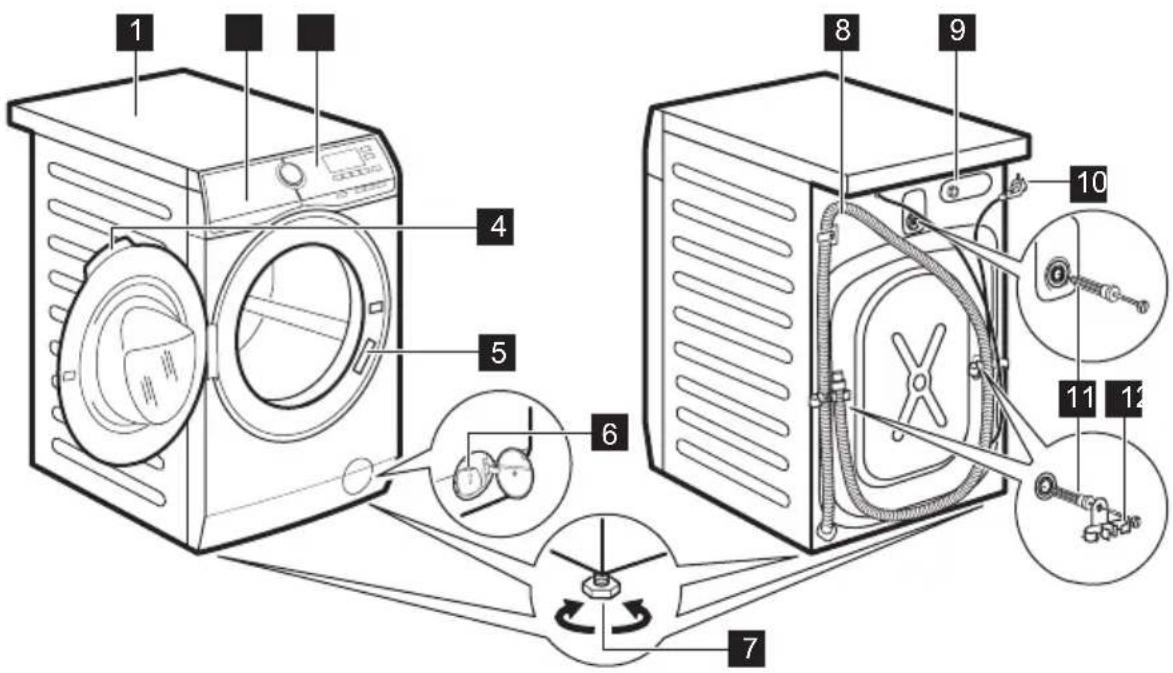
3.3 Appliance overview
text_image
Diagram of a washing machine with numbered parts and internal components, including front and side views with labeled parts.1 Worktop
2 Detergent dispenser
3 Control panel
4 Door handle
5 Rating plate
6 Drain pump filter
7 Feet for levelling the appliance
8 Drain hose
9 Inlet hose connection
10 Mains cable
11 Transit bolts
12 Hose support
4. TECHNICAL DATA
1) Connect the water inlet hose to a water tap with a 3/4" thread.
| Dimension Width/ Height/ Depth/ Total depth | 600 mm/ 850 mm/ 571 mm/ 600 mm |
| Electrical connection Voltage | 230 V |
| Overall power | 2000 W |
| Fuse | 10 A |
| Frequency | 50 Hz |
| Level of protection against ingress of solid particles and moisture ensured by the protective cover, except where the low voltage equipment has no protection against moisture | IPX4 |
| Water supply pressure Minimum Maximum | 0.5 bar (0.05 MPa)8 bar (0.8 MPa) |
| Water supply 1) | Cold water |
| Maximum Load Cotton 8 kg | |
| Energy Efficiency Class A | |
| Spin Speed Maximum 1400 rpm |
5. INSTALLATION

WARNING!
Refer to Safety chapters.
5.1 Unpacking
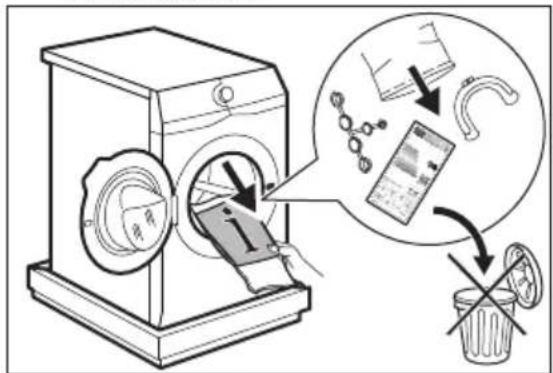
- Open the door. Remove all the items from the drum.
text_image
Diagram illustrating a washing machine operation with labeled parts and a magnified view showing cleaning steps.
Accessories delivered with the appliance may vary depending on the model.
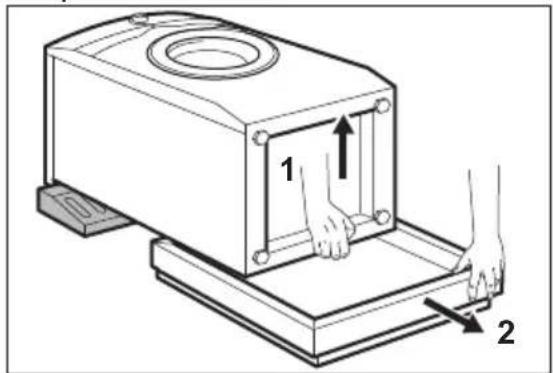
- Put the packaging element on the floor behind the appliance and carefully put it down onto its rear side. Remove the polystyrene protection from the bottom.
text_image
Technical diagram showing a device with labeled parts and directional arrows indicating movement or force
CAUTION!
Do not lay washing machine on its front.
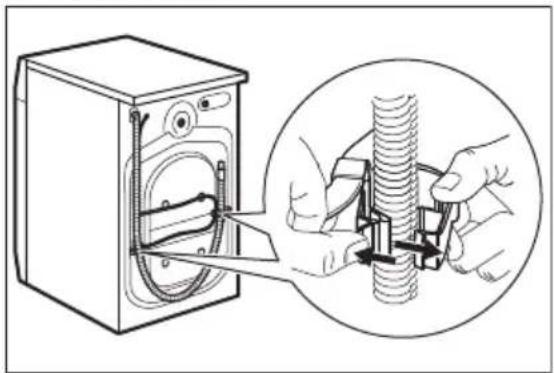
- Put the appliance back into an upright position. Remove the power supply cable and the drain hose from the hose holders.
natural_image
Illustration of a washing machine with a magnified inset showing hands adjusting a spring (no text or symbols present)
WARNING!
It is possible to see water flowing from the drain hose. This is because the washing machine has been tested at the factory.
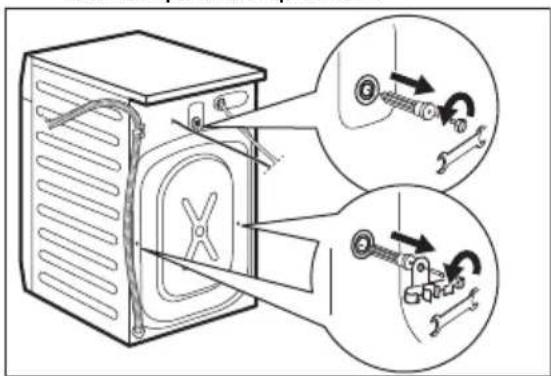
- Remove the three bolts by using the key supplied with the appliance. Pull out the plastic spacers.
text_image
Diagram illustrating the installation of a washing machine with two views showing tool path changes and assembly instructions.
We recommend that you keep the packaging and the transit bolts for any transport of the appliance.
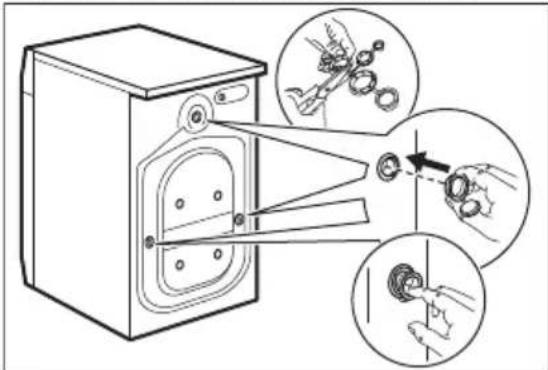
- Put the plastic caps, that you find in the user manual bag, in the holes.
text_image
Diagram illustrating the process of inserting a component into a washing machine, with magnified insets showing tool positioning and adjustment.5.2 Positioning and levelling
- Install the appliance on a flat hard floor.

Make sure that carpets do not stop the air circulation below the appliance.
Make sure that the appliance does not touch the wall or other units.
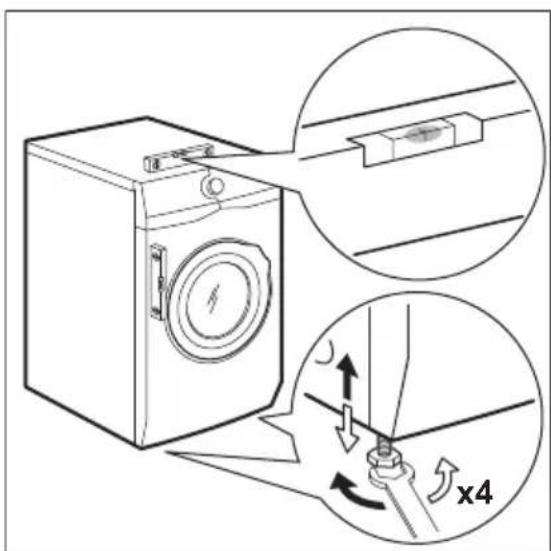
- Loosen or tighten the feet to adjust the level.

WARNING!
Do not put cardboard, wood or equivalent materials below the appliance feet to adjust the level.
text_image
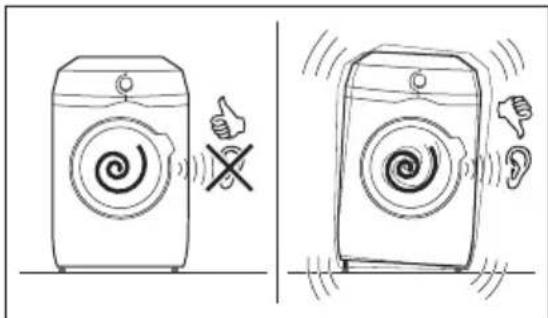
Diagram showing a washing machine with attached components and a magnified view of the switch mechanism, labeled 'x4'The appliance must be level and stable.

A correct adjustment of the appliance level prevents the vibration, noise and the movement of the appliance when in operation.

When the appliance is installed on a plinth or a tumble dryer is stacked on the washing machine, use the accessories described in chapter 'Accessories'. Read carefully the instructions supplied with the appliance and with the accessory.
text_image
Illustration showing two washing machines with sound waves and a 'X' symbol, one emitting noise and the other listening to a speaker.5.3 The inlet hose
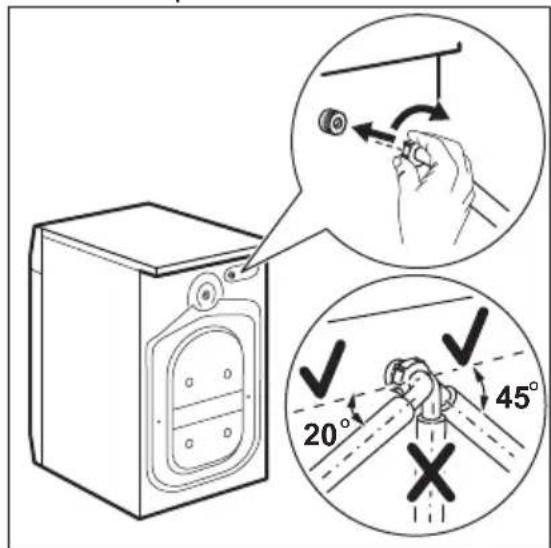
- Connect the water inlet hose to the back of the appliance.
- Position it toward left or right depending on the position of the water tap.
text_image
Diagram illustrating washing machine operation with angle annotations and hand gesture instructions
Make sure that the inlet hose is not in vertical position.
- If necessary, loose the ring nut to set it in the correct position.
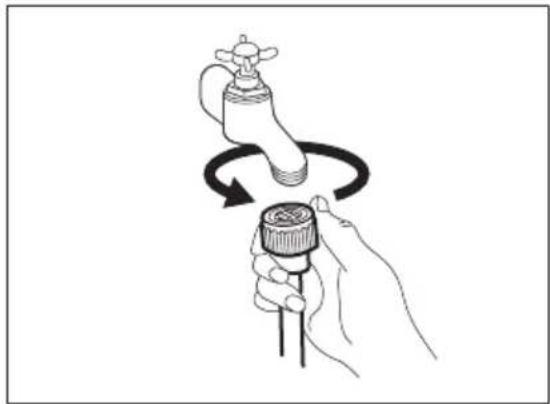
- Connect the water inlet hose to the cold water tap with 3/4" thread.
natural_image
Illustration of a hand holding a faucet with a valve, showing the process of rotation around it (no text or symbols present)
WARNING!
The inlet water shall not exceed 25 °C.

CAUTION!
Make sure that there are no leaks from the couplings.

Do not use an extension hose if the inlet hose is too short. Contact the service centre for the replacement of the inlet hose.
5.4 Water drainage
The drain hose should be positioned at a height of not less than 60 cm and not more than 100 cm from the floor.

You can extend the drain hose to maximum 400 cm. Contact the authorized service centre for the other drain hose and the extension.
It is possible to connect the drain hose in different ways:
- Make a U shape with the drain hose and put it around the plastic hose guide.
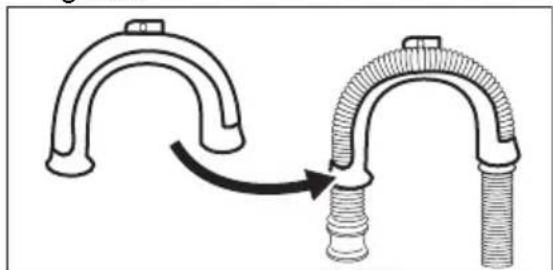
natural_image
Diagram showing two curved pipe fittings with a central connector, connected by an arrow indicating transformation (no text or symbols present)- On the edge of a sink - Fasten the guide to the water tap or to the wall.

Make sure that the plastic guide cannot move when the appliance drains.
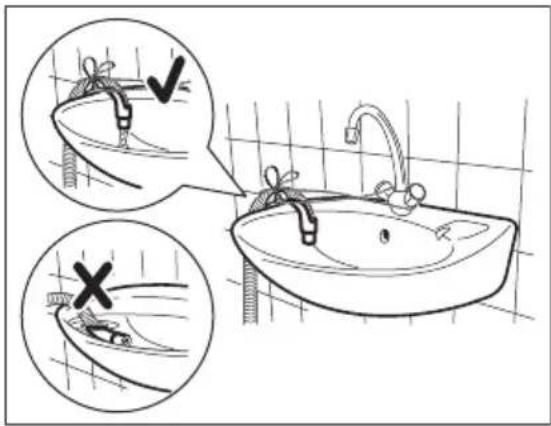
text_image
Diagram illustrating bathroom sink behavior with check and dissection instructions, showing water level inspection and cleaning steps.
Make sure that the drain hose end is not immersed in the water. There may be a return of dirty water into the appliance.
- To a stand pipe with vent-hole - Insert the drain hose directly into a drain pipe. Refer to the illustration.
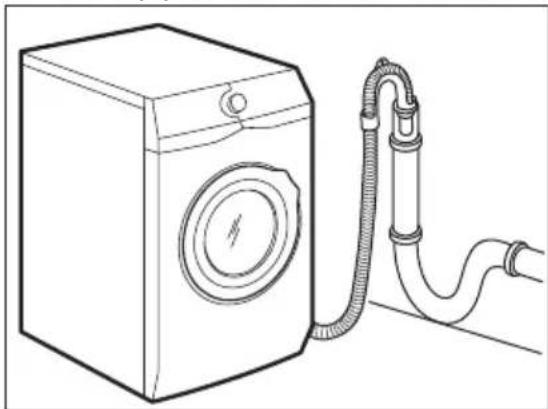
natural_image
Line drawing of a washing machine connected to a hose, no text or symbols present
The end of the drain hose must always be ventilated, i.e. the inner diameter of the drain pipe (min. 38 mm - min. 1.5") must be larger than the external diameter of the drain hose.
- If the end of the drain hose looks like this (see the picture), you can push it directly into the stand pipe.
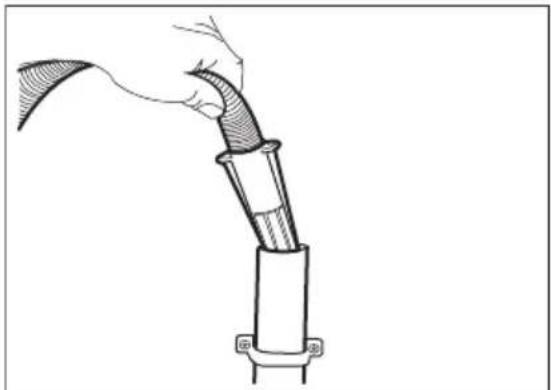
natural_image
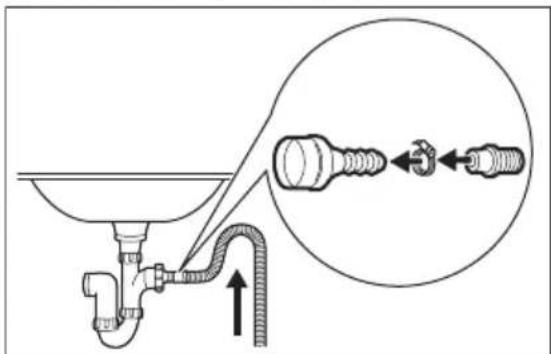
Diagram of a hand holding a bent tube inserted into a cylindrical device (no text or symbols present)- Without the plastic hose guide, to a sink spigot - Put the drain hose in the spigot and tighten it with a clamp. Refer to the illustration.
text_image
Diagram illustrating a plumbing sink with pipe connection and valve insertion, showing fluid flow direction
Make sure that the drain hose makes a loop to prevent particles going into the appliance from the sink.
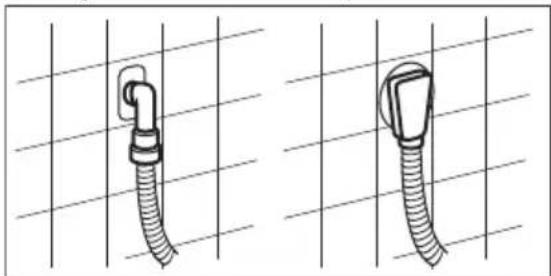
- Position the hose directly to a built-in drain pipe in the room wall and tighten it with a clamp.
natural_image
Two handbags with coiled tubing, shown against a grid background (no text or symbols)5.5 Electrical connection
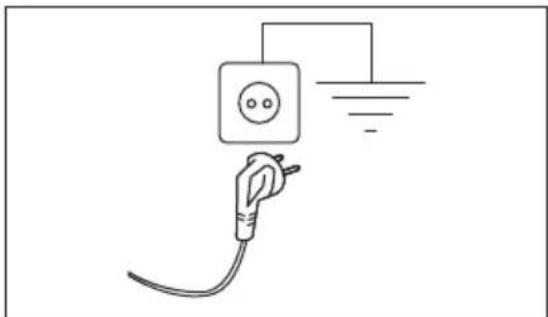
At the end of installation you can connect the mains plug to the mains socket.
The rating plate on the inner edge of the appliance door and the 'Technical Data' chapter indicate the necessary electrical ratings. Make sure that they are compatible with the mains power supply.
Check that your domestic electrical installation can take the maximum load required, also taking into account any other appliances in use.
Connect the appliance to an earthed socket.
natural_image
Simple line drawing of an electrical plug with a power outlet and ground connection (no text or symbols)The power supply cable must be easily accessible after installing the appliance.
For any electrical work required to install this appliance, contact our Authorised Service Centre.
The manufacturer does not accept any responsibility for damage or injury through failure to comply with the above safety precaution.
6. ACCESSORIES
6.1 Available in www.aeg.com/shop or from authorised dealer

Only appropriate accessories approved by AEG ensure the safety standards of the appliance. If unapproved parts are used, any claims will be invalidated.
6.2 Stacking kit

natural_image
Line drawing of a two-tiered washing machine with front-mounted dish and side-mounted tray, accompanied by icons for laundry (no text or symbols)The tumble dryer can be stacked on the top of the washing machine only by using the correct stacking kit manufactured and approved by AEG.

Verify the compatible stacking kit by checking the depth of your appliances.
The stacking kit can be used only with the appliances specified in the leaflet provided with the accessory.
Read carefully the instructions supplied with the appliance and with the accessory.

WARNING!
Do not put the tumble dryer under the washing machine.
7. CONTROL PANEL
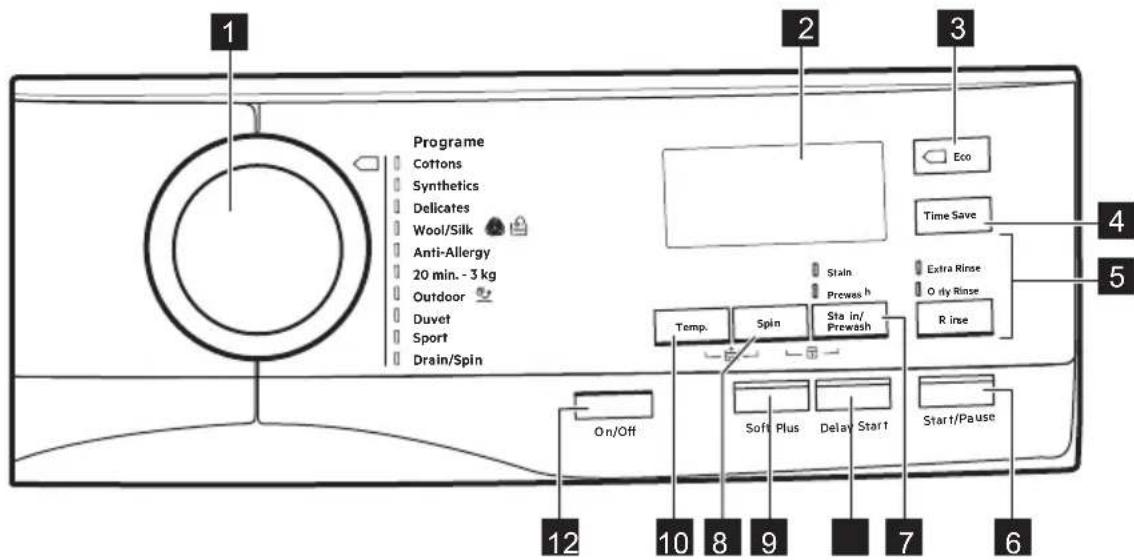
7.1 Control panel description
text_image
1 Programe Cottons Synthetics Delicates Wool/Silk Anti-Allergy 20 min. - 3 kg Outdoor Duvet Sport Drain/Spin 2 2 3 Eco Time Save 4 5 Stain Prewash h Extra Rinse O lty Rinse R rinse Temp. Spin Sta in/ Prewash On/Off Soft Plus Delay Start Start/Pause 12 10 8 9 7 61 Programme dial
2 Display
3 Eco touch button
4 Time Save touch button
5 Rinse touch button
- Extra Rinse option
• Skipping wash phase Only Rinse
6 Start/Pause touch button
7 Stain/Prewash touch button
- Stain option
- Prewash option
8 Delay Start touch button
9 Soft Plus touch button
10 Spin reduction touch button
11 Temp. touch button
12 On/Off push button
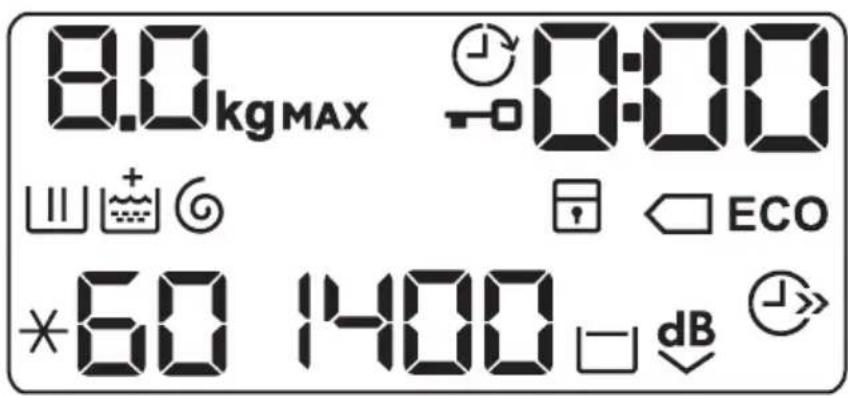
7.2 Display
text_image
8.0 kg MAX 0:00 ECO *60 1400 dB| 8.0kg | Maximum load indicator. The indicator flashes during the laundry load estimation. |
| -0 | Door locked indicator. |
| Delay start indicator. | |
| 0:00 | The digital indicator can show:Programme duration (e.g.)240Delay time (e.g. 30° 24Cycle end ( 0 ).Warning code ( ).E20 |
| Washing phase indicator. It flashes during prewash and wash phase. | |
| Rinsing phase indicator. It flashes during rinse phase. | |
| The Extra Rinse option. The indicator appears above the when a extra rinse is set . | |
| Spinning and draining phase indicator. It flashes during spin and drain phase. | |
| [88CY] | Child safety lock indicator. |
 | Energy saving indicators. The indicator appears by selecting a programme for cotton at 40 °C or 60 °C. |
 | Temperature indicator. The indicator appears when a cold wash is set. |
 | Spin speed indicator. |
 | No spin speed indicator. Spin phase is off. |
 | Rinse hold indicator. |
 | Extra silent indicator. |
 | Time saving indicator. |
8. DIAL AND BUTTONS
8.1 On/Off
Pressing this button for a few seconds allows to activate or deactivate the appliance. Two different tunes sound while switching the appliance on or off.
As the Stand-by function automatically deactivates the appliance to decrease the energy consumption in a few cases, you may need to activate the appliance again.
For more details, refer to Stand-by paragraph in Daily Use chapter.
8.2 Introduction

The options/functions are not selectable with all washing programmes. Check the compatibility between options/functions and washing programmes in the "Programme Chart". An option/function can exclude another one, in this case the appliance doesn't allow you to set the incompatible options/functions together.
8.3 Temp.
When you select a washing programme, the appliance automatically proposes a default temperature.
Touch this button repeatedly until the desired temperature value appears on the display.
When the display shows the indicators
* and -, the appliance does not heat the water.
8.4 Spin
When you set a programme, the appliance automatically sets the maximum spin speed allowed.
Touch repeatedly this button to:
- Decrease the spin speed.

The display shows only the spin speeds available for the set programme.
- Activate the Rinse Hold option.
The final spin is not performed. The water of the last rinse is not drained out to prevent the fabrics from creasing. The washing programme ends with water in the drum.
The display shows the indicator □ The door stays locked and the drum
turns regularly to reduce creasing.
You must drain the water to unlock the door.
If you touch the Start/Pause button, the appliance performs the spinning phase and drains the water.

The appliance empties the water out automatically after 18 hours approximately.
- Activate the Extra Silent option.
The intermediate and the final spinning phases are suppressed and the programme ends with water in the drum. This helps to reduce creasing.
The display shows the indicator dB
The door stays locked. The drum turns regularly to reduce creasing.
You must drain the water to unlock the door.
As the programme is very quiet, it is suitable for use at night time when cheaper electricity tariffs are available. In some programmes the rinses are performed with more water. If you touch the Start/Pause button, the appliance performs the only draining phase.

The appliance empties the water out automatically after 18 hours approximately.
8.5 Stain/Prewash
Press this button repeatedly to activate one of the two options.
The relevant indicator goes on in the display.
- Stain
Select this option to add an anti-stain phase to a programme in order to treat heavily soiled or stained laundry with stain remover.
Pour the stain remover into
compartment ☐. The stain remover will be added in the appropriate phase of the washing programme.

This option is not available with a temperature lower than 40^ C.
- Prewash
Use this option to add a pre-wash phase at 30 °C before the washing phase.
This option is recommended for heavily soiled laundry, especially if containing sand, dust, mud and other solid particles.

The options can increase the programme duration.
8.6 Rinse
With this button you can select one of the following options:
- Extra Rinse option
This option adds a few rinses according to the selected washing programme.
Use this option for persons allergic to detergent residues and in areas where the water is soft.

This option increases slightly the programme duration.
- Skipping wash phase - Only Rinse option
The appliance performs only the rinsing phase, the spinning and the draining phases of the selected programme.
The corresponding indicator above the touch button illuminates.
8.7 Eco

The Eco option reduces the energy consumption maintaining good washing results.
Set this option for slightly or normally soiled items washed at 30^ C or higher temperatures.
Water and energy consumption may depend on different causes, such as water pressure, its hardness and temperature, ambient temperature, type and quantity of laundry, the set options, spin speed and voltage fluctuations in the electricity network. The display
shows the indicator ECO
8.8 Time Save
With this option you can decrease the programme duration.
- If your laundry is normally or lightly soiled, it may be advisable to shorten the washing programme. Touch this button once to decrease the duration.
- In case of smaller load, touch this button twice to set an extra quick programme.
The display shows the indicator ↩.
8.9 Soft Plus
Set the Soft Plus option to ensure perfect distribution of the fabric softener and improves the fabric softness.

This option increases slightly the programme duration.
8.10 Delay Start
With this option you can delay the start of a programme in a more convenient time.
Touch the button repeatedly to set the required delay. The time increases by steps of 30 minutes up to 90' and from 2 hours up to 20 h.
After touching the Start/Pause button, the display shows the indicator ⏻ and the selected delay time and the appliance begins the countdown.
8.11 Start/Pause
Touch the Start/Pause button to start, pause the appliance or interrupt a running programme.
9. PROGRAMMES
9.1 Programme Chart
Washing programmes
| Programme Programme description | |
| Washing programmes | |
| Cottons | White cotton and coloured cotton. Normal, heavy and light soil.Cottons Energy Saving Programme.This programme at 60 °C with a load of 8 is the reference programme for energy label data, measured according to EN 60456. |
| Synthetics | Synthetic items or mixed fabric items. Normal soil. |
| Delicates | Delicate fabrics such as acrylics, viscose and mixed fabrics requiring gentler washing. Normal soil. |
| Wool/Silk | Machine washable wool, hand washable wool and other fabrics with «hand washing» care symbol1). |
| Anti-Allergy | White cotton items. This programme removes micro-organisms thanks to a washing phase with the temperature maintained above 60°C for several minutes. This helps remove germs, bacteria, micro-organism and particles. An additional rinsing phase ensures a proper removal of detergent residues and pollens/allergenic items. In this way the wash is more effective. |
| Programme Programme description | |||
| 20 min. - 3 kg | Cotton and synthetic items lightly soiled or once worn. | ||
| Outdoor | Do not use fabric softener and make sure that there is no softener residue in the detergent dispenser. Outdoor clothing, technical, sport fabrics, waterproof and breathable jackets, shell jackets with a removable fleece or inner insulation. The recommended laundry load is 2 kg. This programme can also be used as water-repellent restoring cycle, specifically tailored for treating clothes with a hydrophobic coating. To perform the water-repellent restoring cycle, proceed as follows:Pour the washing detergent in the compartmentPour a special water-repellent restorer for fabric in the drawer compartment for fabric softenerReduce the laundry load to 1 kg.To further improve the water-repellent restoring action, dry the laundry in a tumble dryer by setting the Outdoor drying programme (if available and if the garment care label permits tumble drying). | ||
| Duvet | Single synthetic blanket, padded clothes, duvets, down jackets and similar items. | ||
| Sport | Synthetic and delicate items | ||
| Drain/Spin | To spin the laundry and to drain the water in the drum. All fabrics, except woollens and delicate fabrics. | ||
| 1) During this cycle the drum rotates slowly to ensure a gentle wash. It can seem that the drum doesn't rotate or doesn't rotate properly, but this is normal for this programme. | |||
| Programme temperature, maximum spin speed and maximum load | |||
| Programme Default temperature Temperature range | Reference spin speed Spin speed range | Maximum load | |
| Washing programmes | |||
| Cottons | 40 °C95 °C - Cold | 1400 rpm1400 rpm - 400 rpm | 8 kg |
| Synthetics | 40 °C60 °C - Cold | 1200 rpm1200 rpm - 400 rpm | 3 kg |
| Programme Default temperature | Temperature range | Reference spin speed Spin speed range | Maximum load |
| Delicates | 30 °C | 1200 rpm | 3 kg |
| 40 °C - Cold | 1200 rpm - 400 rpm | ||
| Wool/Silk | 40 °C | 1200 rpm | 1,5 kg |
| 40 °C - Cold | 1200 rpm - 400 rpm | ||
| Anti-Allergy | 60 °C | 1400 rpm | 8 kg |
| 1400 rpm - 400 rpm | |||
| 20 min. - 3 kg | 30 °C | 1200 rpm | 3 kg |
| 40 °C - 30 °C | 1200 rpm - 400 rpm | ||
| Outdoor | 30 °C | 1200 rpm | 2 kg^1) |
| 40 °C - Cold | 1200 rpm - 400 rpm | 1 kg^2) | |
| Duvet | 40 °C | 800 rpm | 3 kg |
| 60 °C - Cold | 800 rpm - 400 rpm | ||
| Sport | 30 °C | 1200 rpm | 3 kg |
| 40 °C - Cold | 1200 rpm - 400 rpm | ||
| Drain/Spin ^3) | 1400 rpm | 8 kg | |
| 1400 rpm - - - | |||
1) Washing programme.
2) Washing programme and waterproofing phase.
3) Set the spin speed. Make sure it is suitable for the type of fabric being washed. If you set the No Spin option then only the drain phase is available.
1) This option is not available with temperature lower than 40 °C.
2) This option is not available with a temperature lower than 30 °C.
3) If you set the shortest duration, we recommend that you decrease the load size. It is possible to fully load the appliance, however the washing results can be less satisfactory.
Programme options compatibility
| Programme | Cottons | Synthetics | Delicates | Wool/Silk | Anti-Allergy | 20 min. - 3 kg | Outdoor | Duvet | Sport | Drain/Spin |
| Options | ||||||||||
| Spin | ||||||||||
| --- | ||||||||||
| dB | ■ ■ ■ | |||||||||
| Stain 1) | ■ ■ ■ | |||||||||
| Prewash | ||||||||||
| Extra Rinse | ■ ■ ■ ■ ■ ■ ■ | |||||||||
| ■ ■ ■ ■ ■ ■ ■ ■ | ||||||||||
| 2) | ■ ■ ■ ■ | |||||||||
| Time Save 3) | ■ ■ ■ | |||||||||
| Delay Start | ||||||||||
| Soft Plus ■ ■ ■ ■ ■ |
9.2 Woolmark Wool Care - Blue

text_image
WOOL HAND WASH SAFEThe wool wash cycle of this machine has been approved by The Woolmark Company for the washing of wool garments labelled as «hand wash» provided that the products are washed according to the instructions on the garment label and those issued by the manufacturer of this washing machine. M1511 The Woolmark symbol is a Certification mark in many countries.
10. SETTINGS
10.1 Acoustic signals
To deactivate the acoustic signals when the programme is completed touch the Stain/Prewash and the Delay Start buttons simultaneously for about 3 seconds.

The acoustic signals, they continue operate when the appliance has a malfunction.
10.2 Child Lock
With this option you can prevent children from playing with the control panel.
- To activate/deactivate this option, touch the Spin and the Stain/Prewash buttons simultaneously until the indicator ⏻ comes on/goes off on the display.
You can activate this option:
- Make sure that all transit bolts have been removed from the appliance.
- Make sure that the electrical power is available and the water tap is open.
- Pour a small quantity of detergent
into the compartment marked
12. DAILY USE

WARNING!
Refer to Safety chapters.
12.1 Activating the appliance
- Connect the mains plug to the mains socket.
- Open the water tap.
- Press the On/Off button for a few seconds to activate the appliance.
A short tune sounds (if activated). The programme dial is automatically set on Cotton programme.
The display shows the maximum load, the default temperature, the maximum spin speed, the indicators of the phases
• After you touch the Start/Pause button: all the buttons and the programme dial are deactivated (except On/Off button).
- Before you touch the Start/Pause button: the appliance cannot start.
The appliance keeps the selection of this option after you switch it off.
10.3 Permanent Extra Rinse

With this option you can permanently have an extra rinse when you set a new programme.
- To activate/deactivate this option touch the Temp. button and the Spin button simultaneously until relevant indicator comes on/goes off.
The display shows + above the

- Set and start a programme for cotton at the highest temperature without any laundry in the drum.
This removes all possible dirt from the drum and the tub.
making up the programme and the cycle duration.
12.2 Loading the laundry
- Open the appliance door.
- Shake the items before you put them in the appliance.
- Put the laundry in the drum, one item at a time.
Make sure not to put too much laundry in the drum. - Close the door firmly.
text_image
Medical warning illustration showing a mouse inside a catheter with a warning symbol and a cross mark.
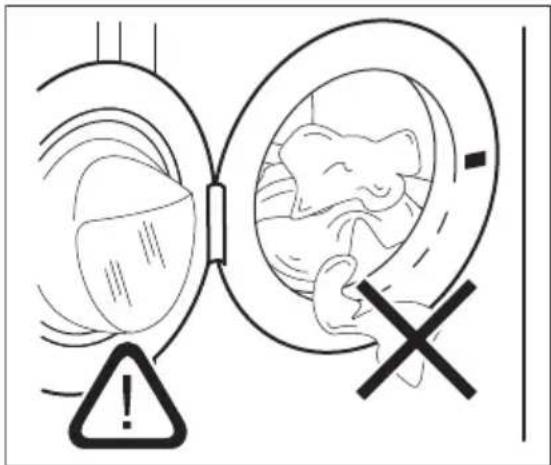
CAUTION!
Make sure that no laundry stays between the seal and the door. There is a risk of water leakage or damage to the laundry.

CAUTION!
Washing heavily oiled, greasy stains could cause damage rubber parts of the washing machine.
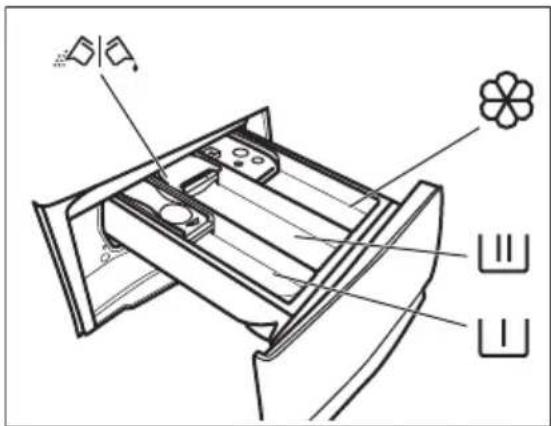
12.3 Filling the detergent and additives
text_image
Technical diagram of a device handle with labeled parts and symbols
Compartment for prewash phase, soak programme or stain remover.

Compartment for washing phase.

Compartment for liquid additives (fabric conditioner, starch).

Maximum level for quantity of liquid additives.

Flap for powder or liquid detergent.

Always follow the instructions that you find on the packaging of the detergent products, but we recommend that you do not exceed the maximum indicated level (MAX) is quantity will however guarantee the best washing results.

After a washing cycle, if necessary, remove any detergent residue from the detergent dispenser.
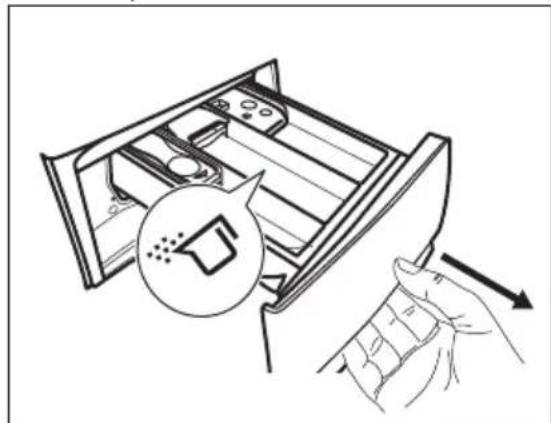
12.4 Check the position of the detergent flap
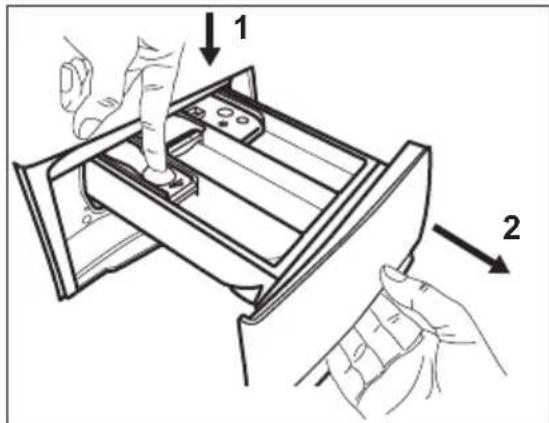
- Pull out the detergent dispenser until it stops.
natural_image
Illustration of a hand inserting a device into a drawer with a magnified inset showing a speaker icon (no text or symbols)-
Press the lever down to remove the dispenser.
-
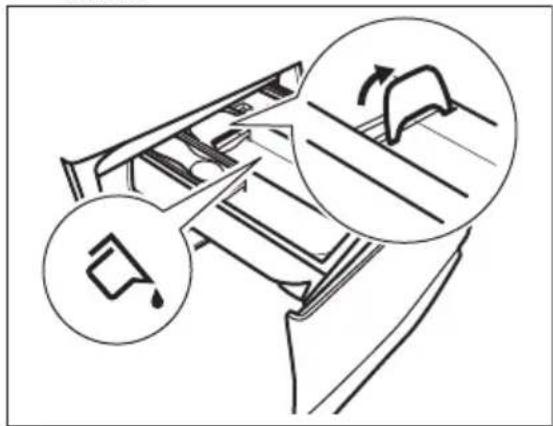
To use powder detergent, turn the flap up.
text_image
Technical diagram showing hand operating a device with labeled components and directional arrows- To use liquid detergent, turn the flap down.
natural_image
Diagram of a mechanical component with arrows indicating motion or flow, showing internal structure and movement (no text or symbols)With the flap in the position DOWN:
- Do not use gelatinous or thick liquid detergents.
- Do not exceed to liquid detergent dose indicated on the flap.
- Do not set the prewash phase.
-
Do not set the delay start function.
-
Measure out the detergent and the fabric conditioner.
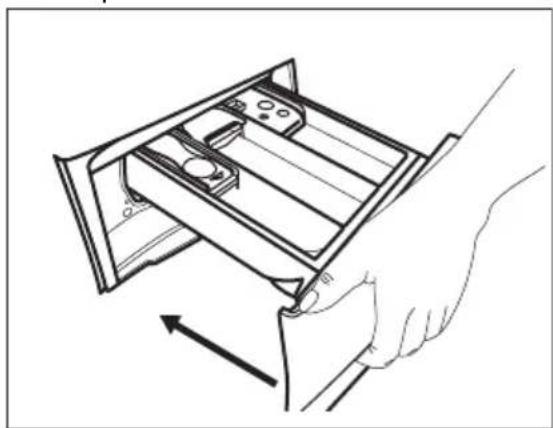
- Carefully close the detergent dispenser.
natural_image
Line drawing of a hand inserting a device into a rack (no text or symbols)Make sure that the flap does not cause a blockage when you close the drawer.
12.5 Setting a programme
- Turn the programme dial to select the desired washing programme. The related programme indicator comes on.
The indicator of the Start/Pause button flashes.
The display shows the maximum declared load for the programme, the default temperature, the maximum spin speed, the washing phase indicators (when available) and an indicative programme duration.
- To change the temperature and/or the spin speed, touch the related buttons.
- If desired, set one or more options by touching the related buttons. The related indicators come on in the display and the given information changes accordingly.

In case a selection is not possible, no indicator comes on and an acoustic signal sounds.
12.6 Starting a programme with the delay start
- Touch the Delay Start button repeatedly until the display shows the desired delay time. The indicator ⏻ comes on.
- Touch the Start/Pause button.
The appliance starts the countdown of the delay start.
When the countdown is completed, the programme starts.

The PROSENSE adapts starts at the end of the countdown.
Cancelling the delay start after the countdown has started
To cancel the delay start:
- Touch the Start/Pause button to pause the appliance. The related indicator flashes.
-
Touch the Delay Start button repeatedly until the display shows ☐
-
Touch the Start/Pause button again to start the programme immediately.
Changing the delay start after the countdown has started
To change the delay start:
- Touch the Start/Pause button to pause the appliance. The related indicator flashes.
- Touch the Delay Start button repeatedly until the display shows the desired delay time.
- Touch the Start/Pause button again to start the new countdown.
12.7 Starting a programme
Touch the Start/Pause button to start the programme.
The related indicator stops flashing and stays on.
The programme starts, the door is locked. The display shows the indicator


The drain pump can operate shortly before the appliance fills water.
12.8 The ProSense System load detection
After touching the Start/Pause button:
-
The ProSense System starts the laundry load detection to calculate the real programme duration. The indicator kg and the time dots flash.
-
After about 15 minutes the display shows the new programme duration:
the indicator kg goes off and the time dots: stops flashing.
The appliance adjusts automatically the programme duration to the load to achieve perfect washing results in the minimum possible time. The programme duration could increase or decrease.

The ProSense System detection is carried out with complete washing programmes only (no skipping phase selected).

The ProSense System is not available with all programmes such as :Wool/Silk, Rinse, SpinDrain, and programmes with short cycles.
12.9 Programme phase indicators
When the programme starts the indicator of the running phase flashes and the other phase indicators are steady on.
E.g. the washing or pre wash phase is
running:

When the phase ends the relevant indicator stops flashing and is steady on. The next phase indicator starts flashing.
E.g. the rinse phase is running:
12.10 Interrupting a programme and changing the options
When the programme is running, you can change only some options:
- Touch the button Start/Pause.
The related indicator flashes. - Change the options. The given information in the display changes accordingly.
- Touch the button Start/Pause again. The washing programme continues.
12.11 Cancelling a running programme
-
Press the button On/Off to cancel the programme and to deactivate the appliance.
-
Press the button On/Off again to activate the appliance.
Now, you can set a new washing programme.

If the ProSense phase is already carried out and the water filling is already started, the new programme starts without repeating the ProSense phase. The water and the detergent are not drained out in order to avoid waste.
12.12 Opening the door - Adding garments
While a programme or the delay start operates, the appliance door is locked.

If the temperature and level of the water in the drum are too high and/or the drum still rotates you cannot open the door.
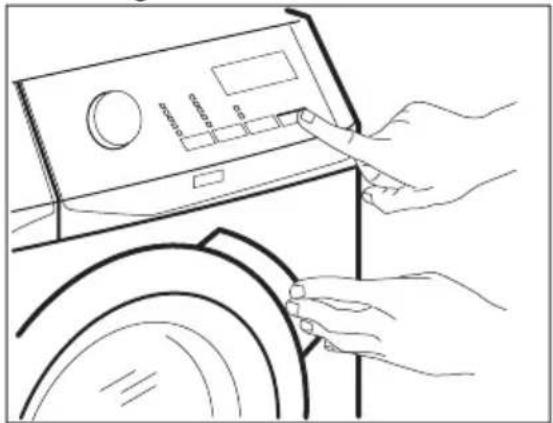
- Touch the Start/Pause button. In the display the related door lock indicator goes off.
natural_image
Line drawing of a hand pressing down on a washing machine (no text or symbols)-
Open the appliance door. If necessary, add or remove the items.
-
Close the door and touch the Start/Pause button.
The programme or the delay start continues.
- The door can be opened when the programme is complete, or set spinning or draining programme/option and then press Start/Pause button.
12.13 End of the programme
When the programme has finished, the appliance stops automatically. The
acoustic signals operate (if they are active).
In the display all washing phase indicators become steady and the time area shows ☐
The indicator of the Start/Pause button goes off.
The door unlocks and the indicator goes off.
- Press the On/Off button to deactivate the appliance.
After five minutes from the end of the programme, the energy saving function automatically deactivates the appliance.

When you activate the appliance again, the display show the end of the last selected programme. Turn the programme dial to set a new cycle.
- Remove the laundry from the appliance.
- Make sure that the drum is empty.
- Keep the door and the detergent dispenser slightly ajar to prevent mildew and odours.
- Close the water tap.
12.14 Draining water out after end of cycle
If you have chosen a programme or an option that does not empty out the water of the last rinse, the programme is completed, but:
- The display shows the indicator ☐, the option indicator ☐ or dB and the door locked indicator: The indicator of the running phase 📋 flashes.
• The drum still turns at regular intervals to prevent the creases in the laundry.
• The door stays locked. -
You must drain the water to open the door:
-
If necessary, touch the Spin button to decrease the spin speed proposed by the appliance.
-
Touch the Start/Pause button:
-
If you have set, the appliance drains the water and spins.
- If you have set, the appliance only drains the water.
The option indicator or goes out, while the indicator Ⓤ flashes and then goes off.
- When the programme is completed and the door locked indicator →0 goes off, you can open the door.
- Press the On/Off button a few seconds to deactivate the appliance.

In any case, the appliance empties the water out automatically after approximately 18 hours.
12.15 Stand-by option
The Stand-by function automatically deactivates the appliance to decrease the energy consumption when:
13. HINTS AND TIPS

WARNING!
Refer to Safety chapters.
13.1 The laundry load
- Divide the laundry into: white, coloured, synthetics, delicates and wool.
- Follow the washing instructions on the laundry care labels.
- Do not wash white and coloured items together.
- Some coloured items can discolour with the first wash. We recommend that you wash them separately for the first couple of times.
- Turn multilayered fabrics, wool and items with printed illustrations inside out.
• Pre-treat stubborn stains. - Wash stubborn stains with a special detergent.
- Be careful with curtains. Remove the hooks and put the curtains in a washing bag or pillowcase.
-
A very small load can cause balance problems with the spin phase leading to excessive vibration. If this occurs:
-
You do not use the appliance for 5 minutes before you touch the Start/Pause button. Press the button On/Off to activate the appliance again.
• After 5 minutes from the end of the washing programme Press the On/Off button to activate the appliance again. The display shows the end of the last set programme. Turn the programme dial to set a new cycle.

If you set a programme or an option that ends with water in the drum, the Stand-by function doesn't deactivate the appliance to remind you to drain the water.
a. interrupt the programme and open the door (refer to "Daily Use" chapter);
b. manually redistribute the load so that the items are spaced evenly around the tub;
c. press the Start/Pause button.
The spin phase continues.
- Avoid washing garments full of long animal hair or poor quality garments releasing lots of fluff that could block the drain circuit and therefore requiring the Service assistance.
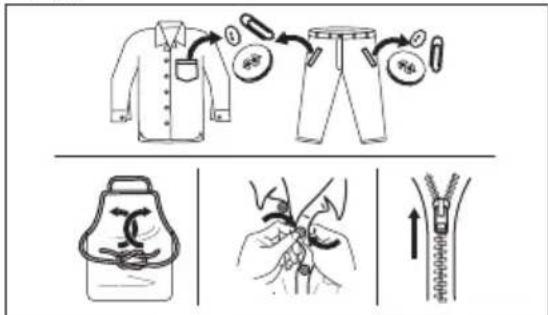
- Button up pillowcases, close zippers, hooks and poppers. Tie up belts, cords, shoelaces, ribbons and any other loose elements.
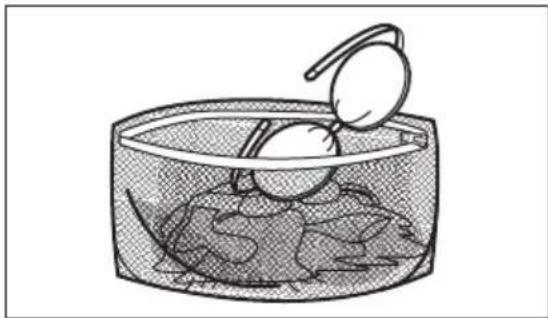
- Do not wash laundry without hems or with cuts. Use a washing bag to wash small and/or delicate items (e.g. underwired bras, belts, tights, shoelaces, ribbons, etc.).
natural_image
Illustration of a bowl containing fish and a spoon, no text or symbols present• Empty pockets and unfold the items.
text_image
Diagram illustrating garment styling techniques with labeled steps: cutting, stretching, and fastening.13.2 Stubborn stains
For some stains, water and detergent is not sufficient.
We recommend that you pre-treat these stains before you put the items in the appliance.
Special stain removers are available. Use the special stain remover that is applicable to the type of stain and fabric.
13.3 Detergent type and quantity
The choice of detergent and use of correct quantities not only affects your wash performance, but also helps to avoid waste and protect the environment:
- Use only detergents and other treatments specially made for washing machines. First, follow these generic rules:
- powder detergents for all types of fabric, excluding delicate. Prefer powder detergents containing bleach for whites and laundry sanitization,
- liquid detergents, preferably for low temperature wash programmes (60 °C max) for all types of fabric, or special ones for woollens only.
• The choice and quantity of detergent will depend on: type of fabric
(delicates, woollens, cottons, etc), the colour of clothes, size of the load, degree of soiling, wash temperature and hardness of the water used.
- Follow the instructions that you find on packaging of the detergents or other treatments without exceeding the indicated maximum level (MAX)
- Do not mix different types of detergents.
- Use less detergent if: - you are washing a small load, - the laundry is lightly soiled, - there is large amounts of foam during washing.
- When using detergent tabs or pods, always put them inside the drum, not in the detergent dispenser.
Insufficient detergent may cause:
• unsatisfactory washing results,
• the wash load to turn grey,
- greasy clothes,
- mould in the appliance.
Excessive detergent may cause:
- sudsing,
- reduced washing effect,
- inadequate rinsing,
• a greater impact for the environment.
13.4 Ecological hints
To save water, energy and to help protect the environment, we recommend that you follow these tips:
- Normally soiled laundry may be washed without prewash in order to save detergent, water and time (the environment is protected too!).
- Loading the appliance to the maximum capacity indicated for each programmes helps to reduce energy and water consumption.
- With adequate pre-treatment, stains and limited soiling can be removed; the laundry can then be washed at a lower temperature.
• To use the correct quantity of detergent, refer to the quantity suggested by the detergent producer and check the water hardness of you domestic system. Refer to 'Water hardness'. - Set the maximum possible spin speed for the selected washing programme before drying your
laundry in a tumble dryer. This will save energy during drying!
13.5 Water hardness
If the water hardness in your area is high or moderate, we recommend that you additive for water softening. In areas where the water hardness is soft it is not necessary to use him.
14. CARE AND CLEANING

WARNING!
Refer to Safety chapters.
14.1 Periodic cleaning schedule
Periodic cleaning helps to extend the life of your appliance.
After each cycle, keep the door and the detergent dispenser slightly ajar to get air circulation and dry the humidity inside the appliance: this will prevent mildew and odours.
If the appliance is not used for a long time: close the water tap and unplug the appliance.
Indicative periodic cleaning schedule:
| Descaling Twice a year | |
| Maintenance wash Once a month | |
| Clean door seal Every two months | |
| Clean drum Every two months | |
| Clean detergent dis-Every two months penser | |
| Clean drain pump Twice a year filter | |
| Clean the inlet hose Twice a year and the valve filter |
The following paragraphs explain how you should clean each part.
To find out the water hardness in your area, contact your local water authority.
Use the correct quantity of additive for water softening. Follow the instructions that you find on the packaging of the product.
14.2 Removing foreign objects

Make sure that pockets are empty and all loose elements are tied up before running your cycle. Refer to 'The laundry load' in 'Hints and tips'.
Remove any foreign objects (such as metal clip, buttons, coins, etc) that you may find in the door seal, the filters and the drum. Refer to 'Door seal with double lip trap', 'Cleaning the drum', 'Cleaning the drain pump' and 'Cleaning the inlet hose and the valve filter' paragraphs. If necessary, please contact the Authorised Service Centre.
Remove any foreign objects (such as metal clip, buttons, coins, etc) that you may find in the door seal, the inlet hose filter and the drum. Refer to 'Door seal with double lip trap', 'Cleaning the drum' and 'Cleaning the inlet hose and the valve filter' paragraphs. If necessary, please contact the Authorised Service Centre.
14.3 External cleaning
Clean the appliance with mild soap and warm water only. Fully dry all the surfaces. Do not use a scouring pads or any scratching material.

CAUTION!
Do not use alcohol, solvents or chemical products.

CAUTION!
Do not clean the metal surfaces with chlorine-based detergent.
14.4 Descaling

If the water hardness in your area is high or moderate, we recommend that you use a water descaling product for washing machines.
Regularly examine the drum to check any limescale.
The regular detergents already contain water softening agents, but we recommend to run a cycle with empty drum and a descaling product occasionally.

Always follow the instructions that you find on the packaging of the product.
14.5 Maintenance wash
With the low temperature programmes it is possible that some detergent stays in the drum. Perform a maintenance wash regularly. To do this:
- Remove all laundry from the drum.
- Select the cotton programme with the highest temperature or use if is available programme Machine Clean. Add a small quantity of powder detergent into empty drum, in order to rinse out any left residues.
14.6 Door seal
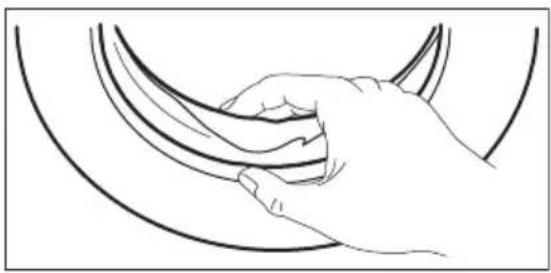
This appliance is designed with a self cleaning draining system, allowing light fluff fibers that fall off the clothes to be drained out with the water. Regularly examine the seal. Coins, buttons, other small items can be recovered at the end of the cycle.
natural_image
Line drawing of a hand holding a curved cable or wire (no text or symbols)Clean it when needed, using ammonia cream cleanser agent without scratching the seal surface.

Always obey the instructions that you find on the packaging of the product.
14.7 Cleaning the drum
Regularly examine the drum to prevent rust particles.
For a complete cleaning:
- Clean the drum with special products for stainless steel.

Always follow the instructions that you find on the packaging of the product.
- Run a short cotton programme at high temperature or use if is available programme Machine Clean. Add a small quantity of powder detergent into empty drum, in order to rinse out any left residues.
14.8 Cleaning the detergent dispenser
To prevent possible deposits of dried detergent or clotted fabric softener and/or formation of mould in the detergent dispenser drawer, once in a while carry out the following cleaning procedure:
- Open the drawer. Press the catch downwards as indicated in the picture and pull it out.
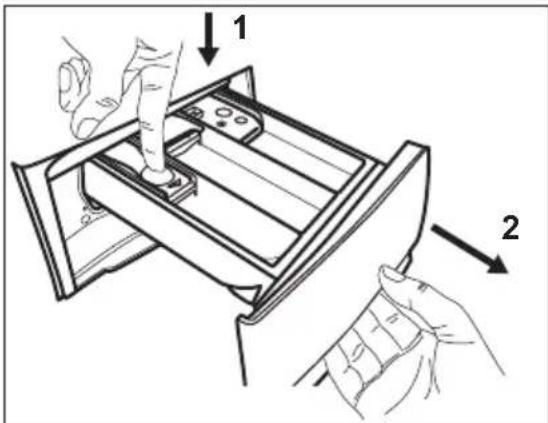
text_image
Diagram showing hand positioning of a device with labeled parts and directional arrows- Remove the top part of the additive compartment to aid cleaning and flush it out under running warm water, to remove any traces of accumulated detergent. After cleaning, put the top part back into position.
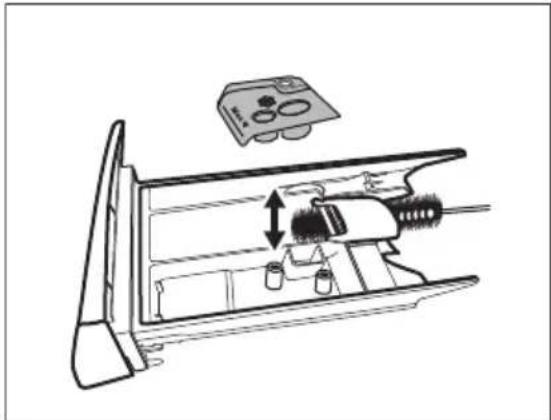
natural_image
Diagram of a refrigerator interior showing internal components and a control panel (no text or symbols)- Make sure that all detergent residue is removed from the upper and lower part of the recess. Use a small brush to clean the recess.
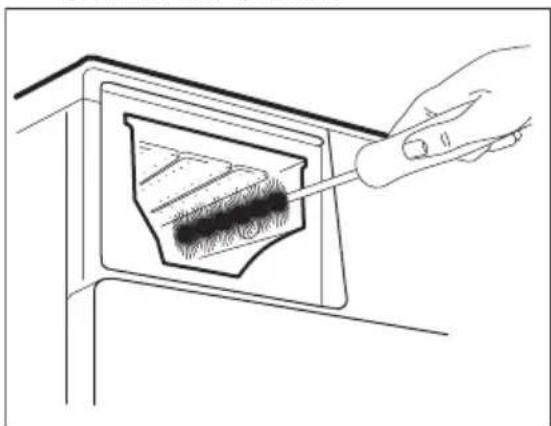
natural_image
Line drawing of a hand using a tool to clean or store items inside a window frame (no text or symbols)- Insert the detergent drawer into the guide rails and close it. Run the rinsing programme without any clothes in the drum.
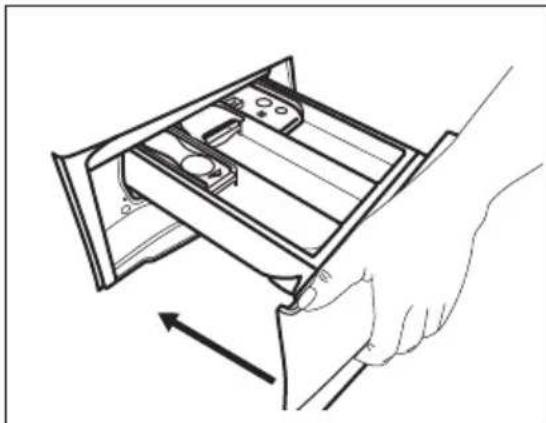
natural_image
Line drawing of a hand holding a device with an arrow indicating motion or force (no text or symbols present)14.9 Cleaning the drain pump

WARNING!
Disconnect the mains plug from the mains socket.

Regularly check the drain pump filter and make sure that it is clean.
Clean the drain pump if:
• The appliance does not drain the water.
• The drum does not turn.
• The appliance makes an unusual noise because of the blockage of the drain pump.
• The display shows the alarm code E20.

WARNING!
- Do not remove the filter while the appliance operates.
- Do not clean the pump if the water in the appliance is hot. Wait until the water cools down
Proceed as follows to clean the pump:
- Open the pump cover.
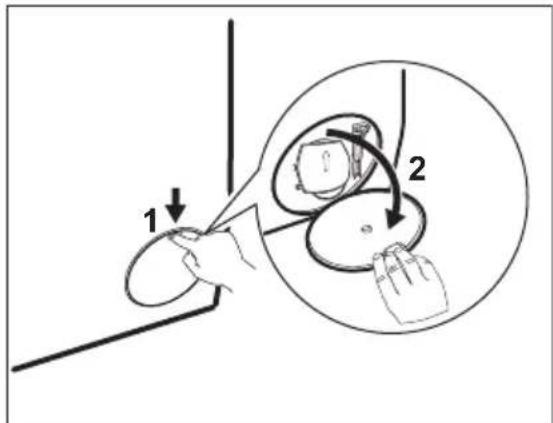
text_image
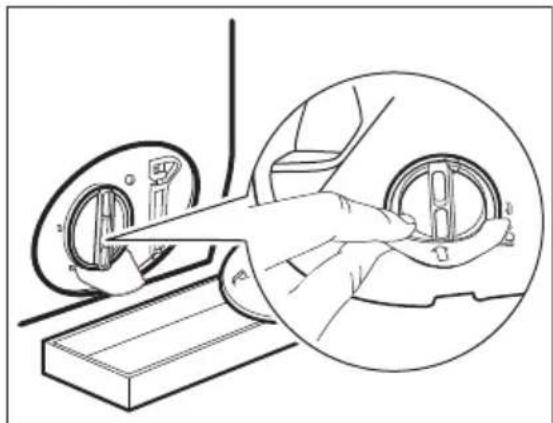
1 2- Place a suitable bowl below the drain pump access to collect the water that flows out.
- Open the chute downwards. Always keep a rag nearby to dry up any water spillages when removing the filter.
natural_image
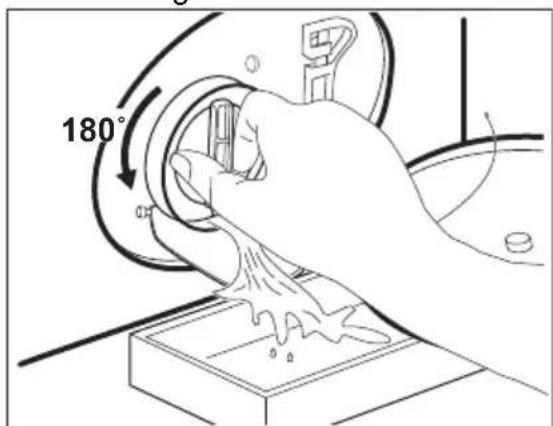
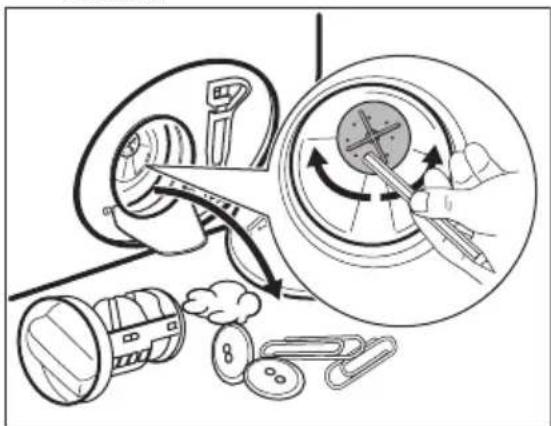
Illustration of a hand using a tool to adjust or install a mechanical component, with no visible text or symbols.- Turn the filter 180 degrees in anti-clockwise direction to open it, without removing. Let the water flow out.
text_image
180°- When the bowl is full of water, turn the filter back and empty the container.
- Repeat the steps 4 and 5 until the water stops to flow out.
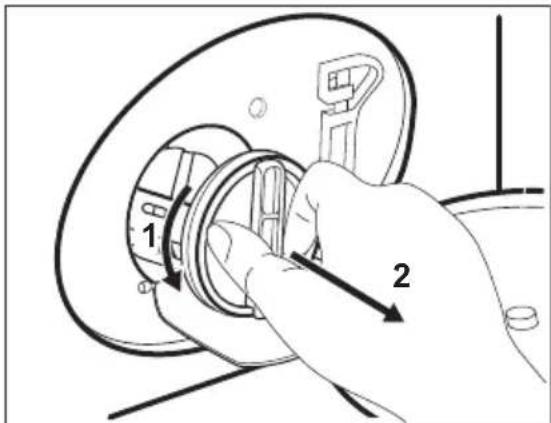
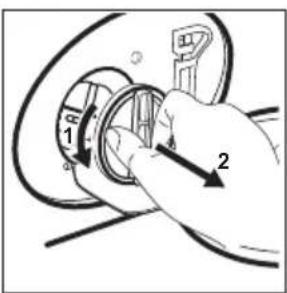
- Turn the filter anti-clockwise to remove it.
text_image
1 2- If it is necessary, remove fluff and objects from the filter recess.
- Make sure that the impeller of the pump can rotate. If it does not rotate, contact the Authorised Service Centre.
text_image
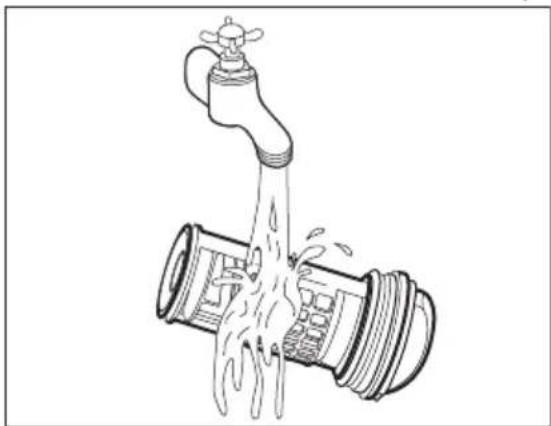
Diagram illustrating mechanical assembly steps with labeled components and directional arrows indicating motion- Clean the filter under the water tap.
natural_image
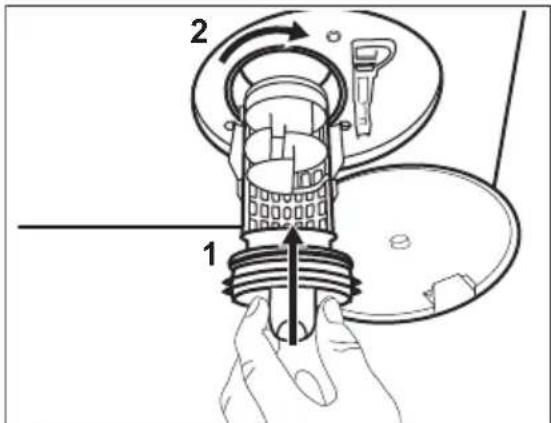
Illustration of a faucet releasing water into a pipe (no text or symbols)- Put the filter back into the special guides by turning it clockwise. Make sure that you tighten the filter correctly to prevent leakages.
text_image
Diagram showing a mechanical assembly with labeled parts and directional arrows indicating motion or force- Close the pump cover.
natural_image
Illustration of a hand using a tool to adjust a mechanical component, showing rotational arrows and a magnified view (no text or symbols)- Clean the valve filter on the back of the appliance with a toothbrush.
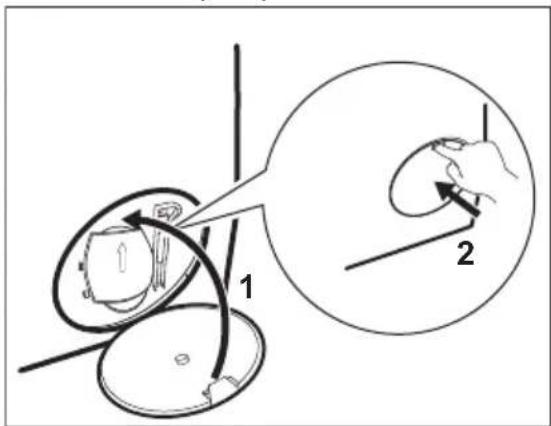
text_image
Diagram illustrating a hand operating a device with labeled parts and directional arrows, including parts numbered 1 and 2.14.10 Cleaning the inlet hose and the valve filter
It is recommended to clean both the filters of the inlet hose and valve occasionally to remove any deposit, collected over the time:
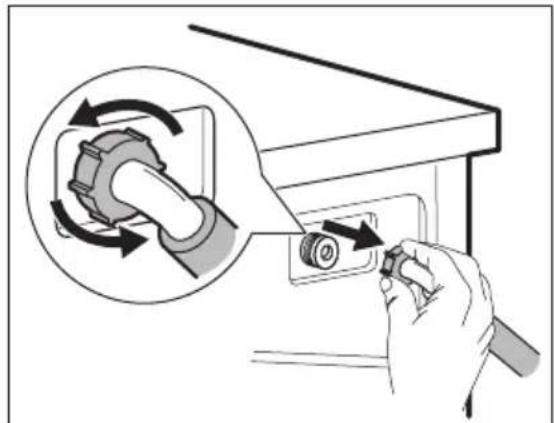
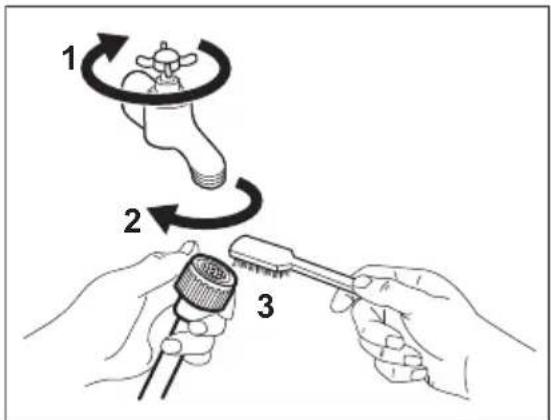
- Remove the inlet hose from the tap and clean the filter.
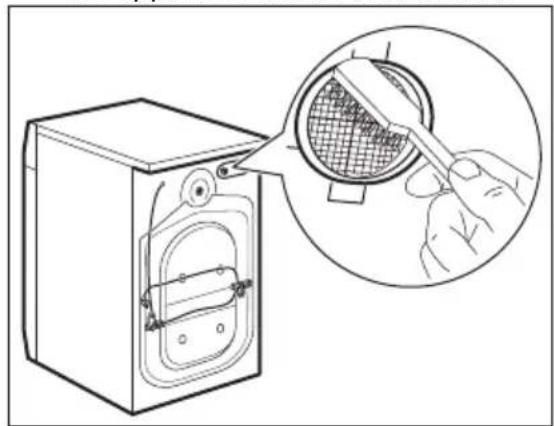
natural_image
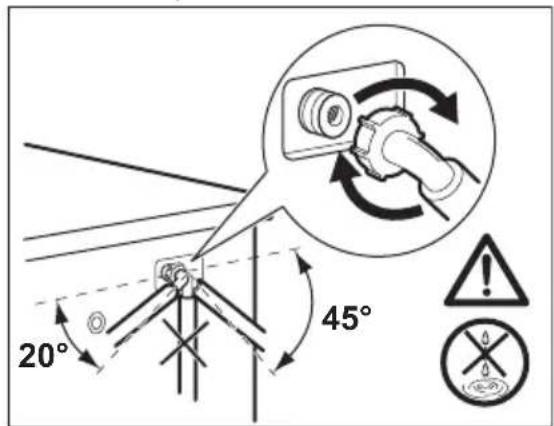
Line drawing of a washing machine with a magnified inset showing a hand using a tool to filter or clean material (no text or symbols present)- When you reconnect the hose to the back of the appliance, turn it left or right (not in vertical position) depending on the position of your water tap.
text_image
1 2 3- Remove the inlet hose from the appliance by loosening the ring nut.
text_image
20° 45°14.11 Emergency drain
If the appliance cannot drain the water, carry out the same procedure, described in 'Cleaning the drain filter' paragraph. If necessary, clean the pump.
14.12 Frost precautions
If the appliance is installed in an area where the temperature can reach the
values around 0^ C or drop below, remove the remaining water from the inlet hose and the drain pump.
- Disconnect the mains plug from the mains socket.
- Close the water tap.
- Put the two ends of the inlet hose in a container and let the water flow out of the hose.
-
Empty the drain pump. Refer to the emergency drain procedure.
-
When the drain pump is empty, install the inlet hose again.

WARNING!
Make sure that the temperature is higher than 0 °C before you use the appliance again. The manufacturer is not responsible for damages caused by low temperatures.
15. TROUBLESHOOTING

WARNING!
Refer to Safety chapters.
15.1 Alarm Codes and Possible failures
The appliance does not start or it stops during operation. First try to find a solution to the problem (refer to the tables).

WARNING!
Deactivate the appliance before carrying out any check.
With some problems, the display shows an alarm code and the Start/Pause button may flash continuously:
| Problem Possible solution | |
| E10The appliance does not fill with water properly. | Make sure that the water tap is open.Make sure that the pressure of the water supply is not too low.For this information, contact your local water authority.Make sure that the water tap is not clogged.Make sure that the inlet hose has no kinks, damages or bends.Make sure that the connection of the water inlet hose is correct. |
| E20The appliance does not drain the water. | Make sure that the sink spigot is not clogged.Make sure that the drain hose has no kinks or bends.Make sure that the drain filter is not clogged. Clean the filter, if necessary. Refer to "Care and cleaning".Make sure that the connection of the drain hose is correct.Set the drain programme if you set a programme without drain phase.Set the drain programme if you set an option which ends with water in the tub. |
| E40The appliance door is open or not closed correctly. | Make sure that the door is properly closed. |
| E91No communication between electronic elements of the appliance. | The programme was not finished properly or the appliance stopped too early. Switch the appliance off and on again.If the alarm code appears again, contact the Authorised Service Centre. |
| EHOThe mains supply is unstable. | Wait until mains supply is stable. |
If the display shows other alarm codes, deactivate and activate the appliance. If the problem continues, contact the Authorised Service Centre.
In case of different problem with the washing machine check the table below for possible solutions.
| Problem Possible solution | |
| The programme does not start. | Make sure that the mains plug is connected to the mains socket.Make sure that the appliance door is closed.Make sure that there is no damaged fuse in the fuse box.Make sure that the Start/Pause has been touched.If the delay start is set, cancel the setting or wait for the end of countdown.Deactivate the Child Lock function if it is on.Check the position of the knob on the selected programme. |
| The appliance fills with water and drains immediately. | Make sure that the drain hose is in the correct position. The hose may be positioned too low. Refer to "Installation instruction". |
| The spin phase does not operate or the washing cycle lasts longer than usual. | Set the spin programme.Make sure that the drain filter is not clogged. Clean the filter, if necessary. Refer to "Care and cleaning".Adjust manually the items in the tub and start the spin phase again. This problem may be caused by balance problems. |
| There is water on the floor. | Make sure that the couplings of the water hoses are tight and there is not water leakages.Make sure that the water inlet hose and the drain hose have no damages.Make sure you use the correct detergent and the correct quantity of it. |
| You cannot open the appliance door. | Make sure that a washing programme that ends with water in tub, has not been selected.Make sure that the washing programme is finished.Set the drain or the spin programme if there is water in the drum.Make sure that the appliance receives electrical power.This problem may be caused by a failure of the appliance.Contact the Authorised Service Centre. |
| The appliance makes an unusual noise and vibrates. | Make sure the levelling of the appliance is correct. Refer to "Installation instruction".Make sure that the packaging and/or the transit bolts are removed. Refer to "Installation instruction".Add more laundry in the drum. The load may be too small. |
| The programme duration increases or decreases during programme execution. | The ProSense System is able to adjust the programme duration according to the type and the laundry load size. Refer to "The ProSense System load detection" in "Daily Use" chapter. |
| The washing results are not satisfactory. | Increase the detergent quantity or use a different detergent.Use special products to remove the stubborn stains before you wash the laundry.Make sure that you set the correct temperature.Decrease the laundry load. |
| Too much foam in the drum during the washing cycle. | Reduce the quantity of detergent. |
| After the washing cycle, there are some detergent residues in the dispenser drawer. | Make sure that the flap is in the correct position (UP for powder detergent - DOWN for liquid detergent).Make sure you have used the detergent dispenser according the indications given in this user manual. |
After the check, activate the appliance. The programme continues
from the point of interruption.
If the problem occurs again, contact the Authorised Service Centre.
The necessary data for the service centre are on the rating plate.
16. CONSUMPTION VALUES

Stated values are obtained in laboratory conditions with relevant standards. Different causes can change the data: the quantity and type of laundry and ambient temperature. Water pressure, the supply voltage and the temperature of inlet water may also affect the washing programme duration.

Technical specifications may be changed without prior notice to improve the quality of product.

During the washing programme, the Prosense function can vary the wash duration and the consumption values. For more details see 'The Prosense function' paragraph in 'Daily Use' chapter.
| Programmes Load | (kg) | Energy consumption (kWh) | Water consumption (litre) | Approximate pro-gramme duration (minutes) |
| Cottons60°C | 8 1,40 70 210 | |||
| Cotton Eco60°C1) | 8 0,81 52 275 | |||
| Cottons40°C | 8 1,20 69 205 | |||
| Synthetics40°C | 3 0,60 56 140 | |||
| Delicates40°C | 3 0,55 59 95 | |||
| Wool/Silk30°C | 1,5 0,45 62 75 | |||
1) Cottons Energy Saving Programme. This programme at 60 °C with a load of 8 is the reference programme for energy label data, measured according to EN 60456.
17. QUICK GUIDE
17.1 Daily use
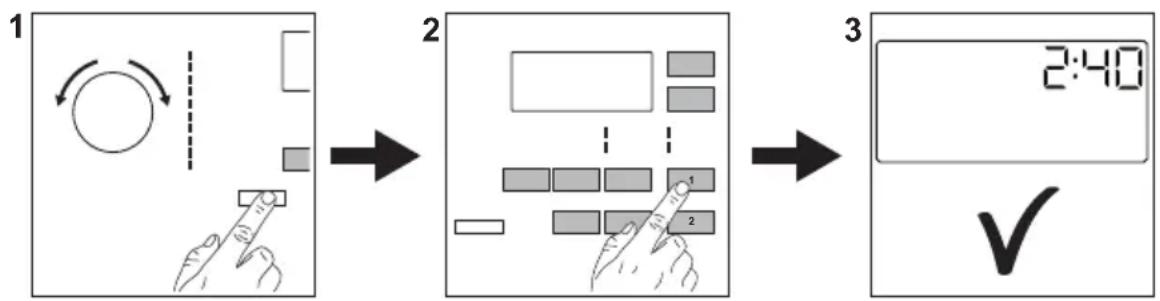
flowchart
graph LR
    A["1: Rotation Circle"] --> B["2: Navigation with Hand Click"]
    B --> C["3: Display Time: 2:40"]
Connect the mains plug to the mains socket.
Open the water tap.
Load the laundry.
Pour the detergent and other treatment in the proper compartment of the detergent dispenser.
-
Push the On/Off button to turn the appliance on. Turn the programme dial to set the desired programme.
-
Set the desired options (1) by means of the corresponding touch buttons. To start the programme, touch the Start/Pause (2) button.
Push the On/Off button to turn the appliance off.
- The appliance starts. At the end of the programme, remove the laundry.
17.2 Cleaning the drain pump filter
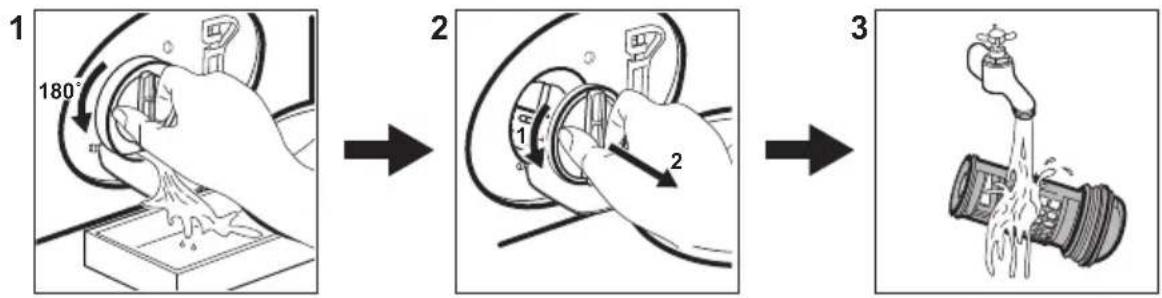
flowchart
graph LR
    A["Step 1: Hand cooling water pump with 180° angle"] --> B["Step 2: Valve shift to pump with valve position"]
    B --> C["Step 3: Water tap pouring from pipe into tank"]
Clean the filter regularly and, especially, if the alarm code appears on the display.
17.3 Programmes
| Programmes Load Product description | ||
| Cottons | 8 kg White cotton and coloured cotton. | |
| Synthetics | 3 kg Synthetic items or mixed fabric items. | |
| Delicates | 3 kg | Delicate fabrics such as acrylics, viscose, polyester items. |
  | 1,5 kg | Machine washable wool, hand washable wool and delicates. |
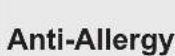 | 8 kg | White cotton items. This programme helps to remove germs and bacteria. |
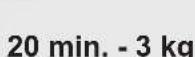 | 3 kg | Cotton and synthetic lightly soiled items or once worn items. |
 | 2 kg 1) 1 kg 2) | Modern outdoor sporting garments. |
| Duvet | 3 kg | Synthetic or feather and down filled blankets, padded clothes, duvets. |
| Sport | 3 kg Sportswear. | |
text_image
1 2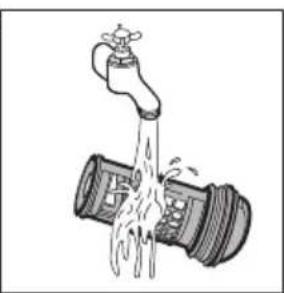
natural_image
Illustration of a faucet with water flowing out, no text or symbols present| Programmes Load Product description | ||
| Drain/Spin | 8 kg | All fabrics, except woollens and very delicate fabrics. Programme for spinning and draining the water. |
1) Washing programme.
2) Washing programme and waterproofing phase.
18. ENVIRONMENTAL CONCERNS
Recycle materials with the symbol 🌐 Put the packaging in relevant containers to recycle it. Help protect the environment and human health by recycling waste of electrical and electronic appliances. Do not dispose of
appliances marked with the symbol 📄 with the household waste. Return the product to your local recycling facility or contact your municipal office.
TABLE DES MATIÈRES
- INFORMATIONS DE SÉCURITÉ.... 39
- CONSIGNES DE SÉCURITÉ.... 41
- DESCRIPTION DE L'APPAREIL.... 43
- CARACTÉRISTIQUES TECHNIQUES....44
- INSTALLATION....44
- ACCESSOIRES....48
- BANDEAU DE COMMANDE.... 49
- MANETTES ET TOUCHES....51
- PROGRAMMES 53
- RÉGLAGES.... 57
- AVANT LA PREMIÈRE UTILISATION....57
- UTILISATION QUOTIDIENNE....58
- CONSEILS....63
- ENTRETIEN ET NETTOYAGE....65
- DÉPANNAGE....70
- VALEURS DE CONSOMMATION....73
- GUIDE DE DÉMARRAGE RAPIDE....74
- EN MATIÈRE DE PROTECTION DE L'ENVIRONNEMENT.... 76
POUR DES RÉSULTATS PARFAITS
text_image
Diagram of a washing machine with numbered parts and internal components, including front and side views.text_image
Diagram illustrating a washing machine operation with labeled parts and a recycling bin, accompanied by explanatory text.
text_image
Technical diagram showing a device with labeled parts and directional arrows indicating movement or force
ATTENTION!
natural_image
Illustration of a washing machine with a magnified inset showing hands adjusting a spring (no text or symbols present)
AVERTISSEMENT!
text_image
Diagram illustrating the installation of a washing machine with two views showing screw and nut assembly.
text_image
Diagram illustrating a washing machine operation with three circular insets showing different hand positions and tool tips.text_image
Diagram showing a washing machine with labeled parts and a magnified view of the component being inserted into a bracket.text_image
Illustration comparing two types of sound purifiers: one with a 'spiral' icon and the other with a 'earhole' symbol, both showing noise effects.text_image
Diagram showing a washing machine with hand operating a screw, accompanied by two views of the angle measurement (20° and 45°) with checkmark indicators.natural_image
Illustration of a hand holding a faucet with a valve, illustrating the process of rotation (no text or symbols)AVERTISSEMENT!
natural_image
Diagram showing two curved pipe fittings with a central connector, connected by an arrow indicating transformation (no text or symbols present)text_image
Diagram illustrating bathroom sink behavior with check and cross icons indicating inspection or repair actionsnatural_image
Line drawing of a washing machine connected to a hose (no text or symbols)natural_image
Diagram of a hand holding a bent tube inserted into a cylindrical device (no text or symbols present)text_image
Diagram illustrating a plumbing system with pipe connection and valve placement, showing fluid flow from a sink to a valve.natural_image
Two identical line drawings of a flexible hose with a loop, placed on grid paper (no text or symbols)natural_image
Simple line drawing of an electric plug connected to a power outlet (no text or symbols)natural_image
Line drawing of a two-tier washing machine with front-mounted dish and side-mounted sink, accompanied by bathroom fixtures (no text or symbols)text_image
WOOL HAND WASH SAFEtext_image
Medical warning diagram showing a catheter with an exclamation mark and a cross symbol, likely indicating a medical or diagnostic hazard.
ATTENTION!
text_image
Technical diagram of a mechanical device with labeled components and symbols
natural_image
Illustration of a hand holding a device into a drawer with a magnified inset showing a speaker icon (no text or symbols)text_image
Diagram showing two hands operating a device with labeled parts and directional arrows indicating movement or assembly.natural_image
Diagram showing a mechanical component with circular annotations highlighting features, no readable text or symbols present.natural_image
Line drawing of a hand holding a device with an arrow indicating motion or force (no text or symbols present)text_image
Line drawing showing hand pressing down on a washing machine control panel with labeled buttons and dialsnatural_image
Illustration of a bowl containing fish and a spoon, no text or symbols presenttext_image
Diagram illustrating garment styling and sewing process with labeled steps: cutting, stitching, and fastening.13.2 Taches tenaces
natural_image
Line drawing of a hand gripping a curved object (no text or symbols)text_image
Technical diagram showing two hands operating a mechanical device with labeled components and directional arrowsnatural_image
Diagram of a refrigerator interior showing internal components and a control panel (no text or symbols)natural_image
Line drawing of a hand using a tool to insert or install a component, no text or symbols presentnatural_image
Line drawing of a hand holding a device with an arrow indicating motion (no text or symbols)14.9 Nettoyage de la pompe de vidange

AVERTISSEMENT!
natural_image
Illustration of a hand operating a mechanical component with circular components (no text or symbols)text_image
Diagram illustrating mechanical assembly steps with labeled components and directional arrows indicating motionnatural_image
Line drawing of a faucet with water flowing out, showing fluid and pipe flow (no text or symbols)text_image
Diagram showing a mechanical assembly with labeled parts and directional arrows indicating motion or movement.text_image
Diagram illustrating a hand operating a device with labeled parts and directional arrows, including parts numbered 1 and 2.natural_image
Illustration of a hand using a tool to adjust a mechanical component, showing rotational arrows and a magnified view (no text or symbols)natural_image
Line drawing of a washing machine with a magnified inset showing a hand using a tool to clean or filter the mesh (no text or symbols present)flowchart
graph LR
    A["1: Hand with circular arrow, vertical dashed line"] --> B["2: Navigation with hand icons and buttons"]
    B --> C["3: Display with 2:40 timer and checkmark"]
natural_image
Five circular icons representing shopping and e-commerce concepts (no text or symbols)
CE