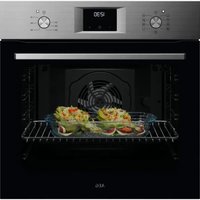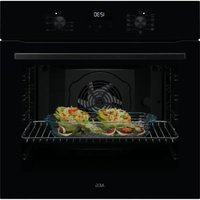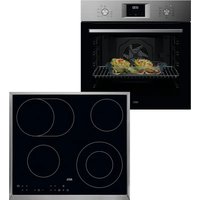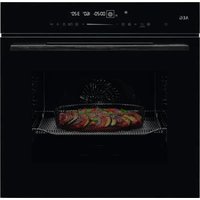
BGB211011M - Oven AEG - Free user manual and instructions
Find the device manual for free BGB211011M AEG in PDF.


User questions about BGB211011M AEG
0 question about this device. Answer the ones you know or ask your own.
Ask a new question about this device
Download the instructions for your Oven in PDF format for free! Find your manual BGB211011M - AEG and take your electronic device back in hand. On this page are published all the documents necessary for the use of your device. BGB211011M by AEG.
USER MANUAL BGB211011M AEG
natural_image
Simple line drawing of a kitchen oven (no text or symbols)CONTENTS
- SAFETY INFORMATION......2
- SAFETY INSTRUCTIONS......4
- PRODUCT DESCRIPTION....7
- BEFORE FIRST USE....7
- DAILY USE....8
- CLOCK FUNCTIONS....9
- USING THE ACCESSORIES....9
- ADDITIONAL FUNCTIONS.... 11
- HINTS AND TIPS....11
- CARE AND CLEANING.... 16
- TROUBLESHOOTING....18
- INSTALLATION....20
- TECHNICAL DATA....24
FOR PERFECT RESULTS
Thank you for choosing this AEG product. We have created it to give you impeccable performance for many years, with innovative technologies that help make life simpler features you might not find on ordinary appliances. Please spend a few minutes reading to get the very best from it.
Visit our website for:

Get usage advice, brochures, trouble shooter, service information:
www.aeg.com/webselfservice

Register your product for better service:
www.registeraeg.com

Buy Accessories, Consumables and Original spare parts for your appliance:
www.aeg.com/shop
CUSTOMER CARE AND SERVICE
Always use original spare parts.
When contacting our Authorised Service Centre, ensure that you have the following data available: Model, PNC, Serial Number.
The information can be found on the rating plate.
⚠ Warning / Caution-Safety information
i General information and tips
Environmental information
Subject to change without notice.
1. ⚠️ SAFETY INFORMATION
Before the installation and use of the appliance, carefully read the supplied instructions. The
manufacturer is not responsible for any injuries or damages that are the result of incorrect installation or usage. Always keep the instructions in a safe and accessible location for future reference.
1.1 Children and vulnerable people safety
- This appliance can be used by children aged from 8 years and above and persons with reduced physical, sensory or mental capabilities or lack of experience and knowledge if they have been given supervision or instruction concerning the use of the appliance in a safe way and understand the hazards involved.
• Children between 3 and 8 years of age and persons with very extensive and complex disabilities shall be kept away from the appliance unless continuously supervised.
• Children of less than 3 years of age should be kept away from the appliance unless continuously supervised. - Do not let children play with the appliance.
- Keep all packaging away from children and dispose of it appropriately.
- Keep children and pets away from the appliance when it operates or when it cools down. Accessible parts may become hot during use.
- If the appliance has a child safety device, it should be activated.
• Children shall not carry out cleaning and user maintenance of the appliance without supervision.
1.2 General Safety
- Only a qualified person must install this appliance and replace the cable.
-
WARNING: The appliance and its accessible parts become hot during use. Care should be taken to avoid touching heating elements.
• Always use oven gloves to remove or put in accessories or ovenware. -
Before carrying out any maintenance, disconnect the appliance from the power supply.
- Ensure that the appliance is switched off before replacing the lamp to avoid the possibility of electric shock.
- Do not use a steam cleaner to clean the appliance.
- Do not use harsh abrasive cleaners or sharp metal scrapers to clean the glass door since they can scratch the surface, which may result in shattering of the glass.
- If the mains power supply cable is damaged, it must be replaced by the manufacturer, its Authorised Service Centre or similarly qualified persons to avoid an electrical hazard.
- To remove the shelf supports first pull the front of the shelf support and then the rear end away from the side walls. Install the shelf supports in the opposite sequence.
2. SAFETY INSTRUCTIONS
This appliance is suitable for the following markets: AE
2.1 Installation

WARNING!
Only a qualified person must install this appliance.
- Remove all the packaging.
- Do not install or use a damaged appliance.
- Follow the installation instructions supplied with the appliance.
• Always take care when moving the appliance as it is heavy. Always use safety gloves and enclosed footwear. - Do not pull the appliance by the handle.
- Keep the minimum distance from other appliances and units.
• Install the appliance in a safe and suitable place that meets installation requirements. - Do not operate the appliance without the cavity bottom cover. It is a functional safety component.
- The appliance is equipped with an electric cooling system. It must be operated with the electric power supply.
2.2 Electrical connection

WARNING!
Risk of fire and electric shock.
- All electrical connections should be made by a qualified electrician.
- The appliance must be earthed.
- Make sure that the parameters on the rating plate are compatible with the electrical ratings of the mains power supply.
• Always use a correctly installed shockproof socket. - Do not use multi-plug adapters and extension cables.
-
Make sure not to cause damage to the mains plug and to the mains cable. Should the mains cable need to be replaced, this must be carried out by our Authorised Service Centre.
-
Do not let mains cables touch or come near the appliance door, especially when the door is hot.
- The shock protection of live and insulated parts must be fastened in such a way that it cannot be removed without tools.
- Connect the mains plug to the mains socket only at the end of the installation. Make sure that there is access to the mains plug after the installation.
- If the mains socket is loose, do not connect the mains plug.
- Do not pull the mains cable to disconnect the appliance. Always pull the mains plug.
- Use only correct isolation devices: line protecting cut-outs, fuses (screw type fuses removed from the holder), earth leakage trips and contactors.
- The electrical installation must have an isolation device which lets you disconnect the appliance from the mains at all poles. The isolation device must have a contact opening width of minimum 3 mm.
- This appliance complies with the E.E.C. Directives.
- All gas connections must be made by a qualified person.
- Before installation, make sure that the local distribution conditions (nature of the gas and gas pressure) and the adjustment of the appliance are compatible.
- Make sure that there is air circulation around the appliance.
- The information about the gas supply is on the rating plate.
- This appliance is not connected to a device, which evacuates the products of combustion. Make sure to connect the appliance according to current installation regulations. Pay attention to requirements regarding adequate ventilation.
2.3 Gas connection
2.4 Use

WARNING!
Risk of injury, burns and electric shock or explosion.
- This appliance is for household use only.
- Do not change the specification of this appliance.
- Make sure that the ventilation openings are not blocked.
- Do not let the appliance stay unattended during operation.
- Deactivate the appliance after each use.
- Be careful when you open the appliance door while the appliance is in operation. Hot air can release.
- Do not operate the appliance with wet hands or when it has contact with water.
- Do not apply pressure on the open door.
- Do not use the appliance as a work surface or as a storage surface.
- Open the appliance door carefully. The use of ingredients with alcohol can cause a mixture of alcohol and air.
- Do not let sparks or open flames to come in contact with the appliance when you open the door.
- Do not put flammable products or items that are wet with flammable products in, near or on the appliance.

WARNING!
Risk of damage to the appliance.
- To prevent damage or discoloration to the enamel:
– do not put ovenware or other objects in the appliance directly on the bottom.
– do not put aluminium foil directly on the bottom of cavity of the appliance.
- do not put water directly into the hot appliance.
– do not keep moist dishes and food in the appliance after you finish the cooking.
– be careful when you remove or install the accessories.
- Discoloration of the enamel or stainless steel has no effect on the performance of the appliance.
- Use a deep pan for moist cakes. Fruit juices cause stains that can be permanent.
- This appliance is for cooking purposes only. It must not be used for
other purposes, for example room heating.
• Always cook with the oven door closed.
- If the appliance is installed behind a furniture panel (e.g. a door) make sure the door is never closed when the appliance is in operation. Heat and moisture can build up behind a closed furniture panel and cause subsequent damage to the appliance, the housing unit or the floor. Do not close the furniture panel until the appliance has cooled down completely after use.
2.5 Care and cleaning

WARNING!
Risk of injury, fire, or damage to the appliance.
- Before maintenance, deactivate the appliance and disconnect the mains plug from the mains socket.
- Make sure the appliance is cold. There is the risk that the glass panels can break.
- Replace immediately the door glass panels when they are damaged. Contact the Authorised Service Centre.
- Be careful when you remove the door from the appliance. The door is heavy!
- Clean regularly the appliance to prevent the deterioration of the surface material.
-
Clean the appliance with a moist soft cloth. Only use neutral detergents. Do not use any abrasive products, abrasive cleaning pads, solvents or metal objects.
-
If you use an oven spray, follow the safety instruction on it's packaging.
- Do not clean the catalytic enamel (if applicable) with any kind of detergent.
2.6 Internal lighting

WARNING!
Risk of electric shock.
- The type of light bulb or halogen lamp used for this appliance is for household appliances only. Do not use it for house lighting.
- Before replacing the lamp, disconnect the appliance from the power supply.
- Only use lamps with the same specifications.
2.7 Service
• To repair the appliance contact an Authorised Service Centre.
- Use original spare parts only.
2.8 Disposal

WARNING!
Risk of injury or suffocation.
- Contact your municipal authority for information on how to discard the appliance correctly.
- Disconnect the appliance from the mains supply.
- Cut off the mains electrical cable close to the appliance and dispose of it.
- Flat the external gas pipes.
3. PRODUCT DESCRIPTION
3.1 General overview
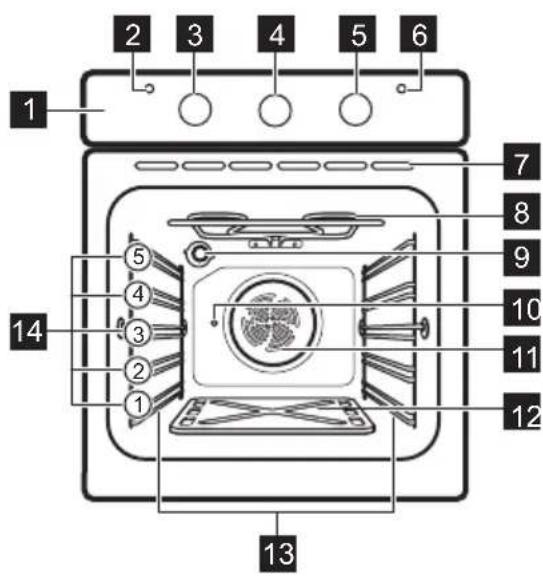
text_image
1 2 3 4 5 6 7 8 9 10 11 12 13 14 ① ② ③ ④ ⑤ ⑦3.2 Accessories
- Wire shelf
For cookware, cake tins, roasts.
• Aluminium baking tray
For cakes and biscuits. - Grill- / Roasting pan
4. BEFORE FIRST USE

WARNING!
Refer to Safety chapters.
4.1 Oven cavity bottom plate
When you buy the oven, at first the oven cavity bottom plate is together with the accessories. Before you use the oven for the first time, put the bottom plate with the hole on its front part in the burner area, as shown in "Product description" chapter.
4.2 Initial Cleaning
Remove all accessories and removable shelf supports from the oven.
1 Control panel
2 Grill indicator
3 Knob for the heating functions
4 Knob for the Minute Minder
5 Knob for the gas control
6 Power indicator
7 Air vents for the cooling fan
8 Heating element
9 Lamp
10 Turnspit hole
11 Fan
12 Oven cavity bottom plate
13 Shelf support, removable
14 Shelf positions
To bake and roast or as pan to collect fat.
- Turnspit
For roasting larger joints of meat and poultry.

Refer to "Care and cleaning" chapter.
Clean the oven and the accessories before first use.
Put the accessories and the removable shelf supports back to their initial position.
4.3 Preheating
Preheat the empty oven before first use.
- Set the function .Set the maximum temperature.
- Let the oven operate for 1 hour.
- Set the function ☐. Set the maximum temperature.
-
Let the oven operate for 15 minutes.
-
Turn off the oven and let it cool down.
Accessories can become hotter than usual. The oven can emit an odour and
5. DAILY USE

WARNING!
Refer to Safety chapters.
5.1 Ignition of oven gas burner

Oven safety device:
The gas oven has a thermocouple. It stops the gas flow if the flame goes out.
- Press the knob for the gas control and turn it to ☆.
- Keep the knob for the gas control pushed for 15 seconds or less to let the thermocouple warm up. Do not release the knob until the flame ignites, otherwise the gas flow is interrupted.
Do not keep the knob for the gas control pushed for more than 15 seconds. If the oven burner does not ignite after 15 seconds, release the knob for the gas control, turn it into off position, open the oven door. Wait minimum 1 minute, close the oven door and try to ignite the oven burner again.
5.2 After igniting the oven gas burner
- Release the knob for the gas control.
- Turn the knob for the gas control to set the temperature.
Control the flame through the holes in the cavity bottom plate.
5.3 Knob for the gas control
Symbol Function

The oven burner is off.
Off position
smoke. Make sure that the airflow in the room is sufficient.
| Symbol Function | |
| 150 °C - 250 °C | Range of temperature adjustment. |
5.4 Oven functions
| Oven function | Application |
 | The oven is off. |
| Off position | |
 | To turn on the lamp without a cooking function. |
| Light | |
| [DS6H] | To grill meat, including kebabs and smaller pieces of meat. |
| Grilling + Turnspit | To roast larger pieces of meat on the turnspit. |
 | To adjust the temperature for the electric grill in the cavity centre, from a minimum of about 50 °C to a maximum of about 200 °C. |
| Range of Temperature Adjustment | |
 | To bake and to dry food. You can use the fan in combination with the gas oven burner. To defrost food (vegetables and fruit). The defrosting time depends on the amount and size of the frozen food. |
| Fan Cooking /Defrost |

You cannot use the gas oven and the function Grill + Turnspit at the same time.
5.5 Using the fan

The gas burner heats up the air inside the oven. The fan moves the hot air to keep the equal temperature.
- Light the oven gas burner.
- After ignition, turn the knob for the oven functions to 📋
5.6 Using the grill
- Turn the knob for the oven functions clockwise to and set the maximum temperature.
6. CLOCK FUNCTIONS
6.1 Minute Minder
Use it to set a countdown time for an oven function.

This function has no effect on the operation of the appliance.
7. USING THE ACCESSORIES

WARNING!
Refer to Safety chapters.
7.1 Using the turnspit

WARNING!
Be careful when you use the turnspit. The forks and the spit are sharp. There is a risk of injury.

WARNING!
Use oven gloves when you remove the turnspit. The turnspit and the grill are hot. There is a risk of burns.
- Adjust the grill and the deep pan runner position to fit in different portions of food. Refer to "Hints and Tips" chapter, Grilling.
5.7 Grill indicator
The grill indicator turns on when the grill cooking function is selected. It turns off when the oven reaches the correct temperature. It then cycles on and off to show the temperature changes.
Turn the knob for the timer as far as it goes, then turn it to necessary time period.
After the time period is completed, an acoustic signal sounds.
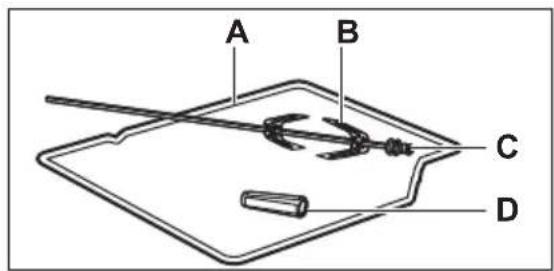
text_image
A B C DA. Turnspit frame
B. Forks
C. Spit
D. Handle
- Put the turnspit handle into the spit.
- Put the deep pan on the lowest shelf position.
- Put the spit frame on the third shelf position from the bottom.
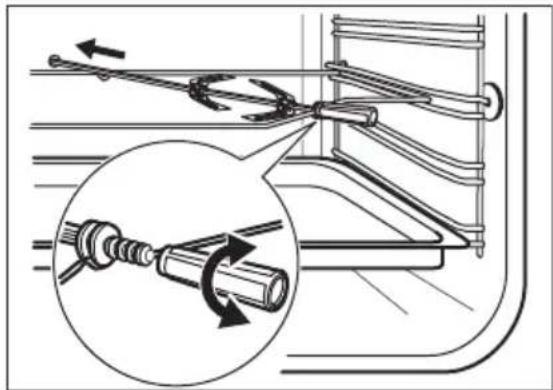
natural_image
Technical diagram of a mechanical assembly with a magnified inset showing internal components (no text or labels)- Install the first fork on the spit, then put the meat on the turnspit and install the second fork.
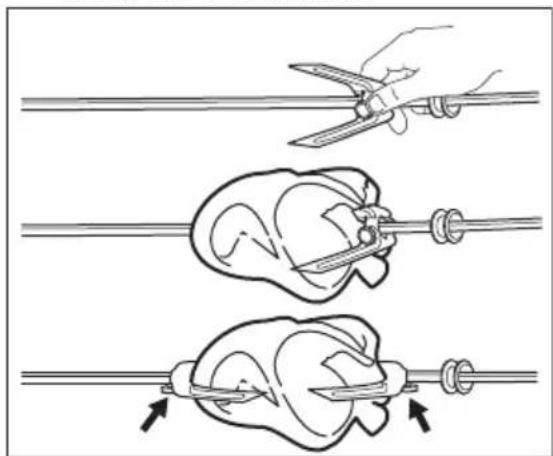
natural_image
Illustration of three stages of a bird rat being lifted using scissors, showing body and tail positioning (no text or symbols)- Use the screws to tighten the forks.
- Put the tip of the spit into the turnspit hole.
- Lay the back side of the spit on the turnspit frame.
Refer to "Product description" chapter.
- Remove the turnspit handle.
- Select a function with the turnspit position. The turnspit rotates.
- Set the necessary temperature. Refer to the cooking tables.
7.2 Inserting the accessories
Wire shelf:
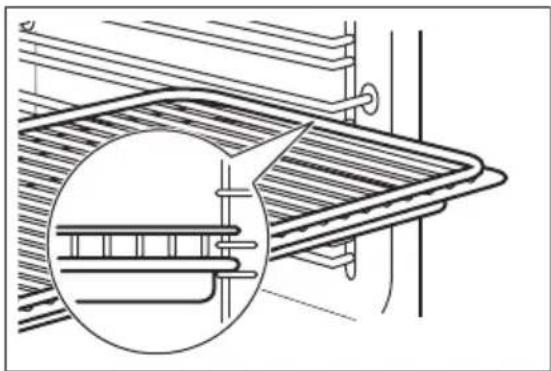
Push the shelf between the guide bars of the shelf support and make sure that the feet point down.
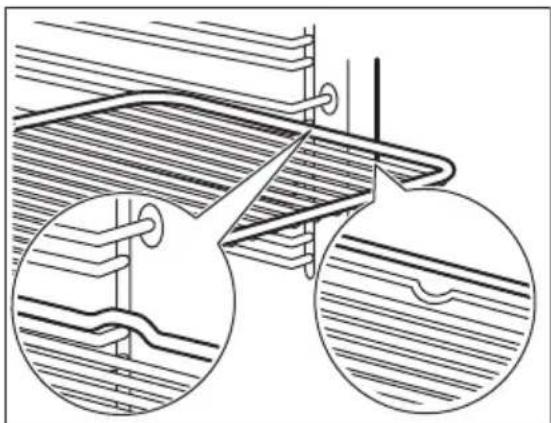
natural_image
Technical line drawing of a mechanical assembly with two circular insets showing internal components (no text or symbols)Baking tray/ Deep pan:
Push the baking tray / deep pan between the guide bars of the shelf support.
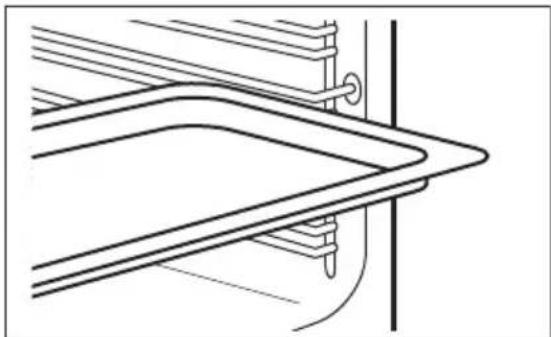
natural_image
Pure technical line drawing of a mechanical component or bracket (no text or symbols)Wire shelf and baking tray / deep pan together:
Push the baking tray / deep pan between the guide bars of the shelf support and the wire shelf on the guide bars above.
natural_image
Technical line drawing of a mechanical assembly with a magnified inset showing internal components (no text or symbols)
Small indentation at the top increase safety. The indentations are also anti-tip devices. The high rim around the shelf prevents cookware from slipping of the shelf.
8. ADDITIONAL FUNCTIONS
8.1 Cooling fan
When the oven operates, the cooling fan turns on automatically to keep the
9. HINTS AND TIPS

WARNING!
Refer to Safety chapters.

The temperature and baking times in the tables are guidelines only. They depend on the recipes and the quality and quantity of the ingredients used.
9.1 Cooking recommendations
The oven has five shelf positions.
Count the shelf positions from the bottom of the oven floor.
Your oven may bake or roast differently to the oven you had before. The below tables provide you with the standard settings for temperature, cooking time and shelf position.
If you cannot find the settings for a special recipe, look for the similar one.
The oven has a special system which circulates the air and constantly recycles the steam. With this system you can cook in a steamy environment and keep the food soft inside and crusty outside. It decreases the cooking time and energy consumption.
Baking cakes
Do not open the oven door before 3/4 of the set cooking time is up.
Grilling
Put the food close to the top heating element for faster cooking and further away for more gentle cooking.
Place most types of food on the wire shelf in the grill-/roasting pan to enable maximum circulation of air and to lift the food out of the fats and juices.
surfaces of the oven cool. If you turn off the oven, the cooling fan can continue to operate until the oven cools down.
If you prefer, you may place food such as fish, liver and kidneys directly on the grill-/roasting pan.
To minimise splashing, you should dry food before grilling. Apply a little oil or melted butter on lean meats and fish to keep them moist during cooking.
You can place accompaniments such as tomatoes and mushrooms underneath the grid when grilling meats.
You should turn over the food during cooking, as you require.
Cooking meat and fish
Use a deep pan for very fatty food to prevent the oven from stains that can be permanent.
Leave the meat for approximately 15 minutes before carving so that the juice does not seep out.
To prevent too much smoke in the oven during roasting, add some water into the deep pan. To prevent the smoke condensation, add water each time after it dries up.
Cooking times
Cooking times depend on the type of food, its consistency, and volume.
Initially, monitor the performance when you cook. Find the best settings (heat setting, cooking time, etc.) for your cookware, recipes and quantities when you use this appliance.
9.2 Baking and roasting table
Cakes
Preheat the empty oven for 10 minutes before cooking.
Use the cake mould if no other cookware specified below.
Use the third shelf position.
Use the function: Fan Cooking.
| Food Temper- | ature (°C) | Time (min) |
| Whisked recipes 160 45 - 60 | ||
| Shortbread dough 160 20 - 30 | ||
| Buttermilk cheese- cake, on a wire shelf | 160 70 - 80 | |
| Apple pie, 20 cm cake mould on a wire shelf | 160 80 - 100 | |
| Strudel, baking tray | min. 60 - 80 | |
| Jam tart 165 30 - 40 | ||
| Sponge cake 160 50 - 60 | ||
| Christmas cake / Rich fruit cake, 20 cm cake mould | min. 90 - 120 | |
| Plum cake, bread tin | 160 50 - 60 | |
| Small cakes - one level, baking tray | min. - 160 | 25 - 35 |
| Biscuits/ Pastry strips - one level, baking tray | min. 30 - 35 | |
| Buns, baking tray 180 15 - 20 | ||
| Eclairs, baking tray 170 25 - 35 | ||
| Plate tarts, 20 cm cake mould | 170 45 - 70 | |
| Rich fruit cake, 24 cm cake mould | min. 110 - 120 | |
| Victoria sandwich, 20 cm cake mould | 160 50 - 60 | |
Bread and pizza
Preheat the empty oven for 10 minutes before cooking.
Use the third shelf position.
Use the function: Fan Cooking.
| Food Tem- | pera-ture(°C) | Time(min) | Comments |
| White bread | 190 60 - 70 1 - 2 | pieces, 0,5 kg per piece | |
| Rye bread | 180 30 - 45 In a bread | tin | |
| Bread rolls | 230 - 250 | 10 - 20 6 | - 8 rolls in a baking tray |
| Pizza 190 10 - 20 In a baking | tray or a deep pan | ||
| Scones 190 10 - 20 In a baking | tray | ||
Flans
Preheat the empty oven for 10 minutes before cooking.
Use the cake mould.
Use the fourth shelf position.
Use the function: Fan Cooking.
| Food Temperature (°C) | Time (min) |
| Pasta flan 180 45 - 50 | |
| Vegetable flan 175 45 - 60 | |
| Quiches 180 50 - 60 |
Fish
Preheat the empty oven for 10 minutes before cooking.
Use the third shelf position.
Use the function: Fan Cooking.
| Food Temperature (°C) | Time (min) | Comments |
| Trout / Sea bream | 175 40 - 55 | 3 - 4 fish |
| Tuna fish / Salmon | 175 35 - 60 4 - 6 fil-lets |
9.3 Gas oven cooking
Meat & Poultry
Preheat the empty oven for 10 minutes before cooking.
Use the wire shelf.
Put a deep pan on the second shelf position.
Use the third shelf position.
| Food Temperature (°C) | Time (min) |
| Bone-in beef, 1.0 kg | min. 40 - 50 |
| Boneless beef, 1.0 kg | 190 50 |
| Lamb, 1.0 kg min. | 40 - 50 |
| Pork, 1.0 kg 180 - 190 | 75 - 85 |
| Chicken / Rabbit, 1.2 kg | 220 - 230 75 - 85 |
| Duck, 1.0 kg 190 | 80 - 90 |
| English roast beef - rare | 220 44 - 50 |
| English roast beef - medium | 220 51 - 55 |
| English roast beef - well done | 220 56 - 60 |
Turkey
Preheat the empty oven for 10 minutes before cooking.
Use the deep pan.
Use the second shelf position.
| Food Temper- | Time (min) | |
| ature(°C) | ||
| Turkey, 4.5 - 5.5 kg | 160 210 - 240 | |
Pastry
Preheat the empty oven for 10 minutes before cooking.
Use the aluminium baking tray if no other cookware specified below.
Use the fourth shelf position.
| Food Temper- | ature (°C) | Time (min) |
| Fruit tart in a 26 cm round cake mould on the wire shelf | 165 40 - 50 | |
| Fruit pie in a 26 cm round cake mould on the wire shelf | min. 40 - 50 | |
| Sausage rolls 180 20 - 30 | ||
| Choux pastry 190 25 - 30 | ||
| Vol au vent 170 15 - 20 | ||
| Jam tart in a 30 cm round cake mould on the wire shelf | 165 40 - 50 | |
Pudding
Preheat the empty oven for 10 minutes before cooking.
Use 9 ceramic ramekins.
Pour 2 cm of water into the deep pan.
Use the third shelf position.
| Food | Temperature (°C) | Time (min) |
| Egg Custard in a bain-marie | min. 60 - 75 | |
Cakes
Preheat the empty oven for 10 minutes before cooking.
Use the aluminium baking tray if no other cookware specified below.
Use the fourth shelf position.
| Food Temperature (°C) | Time (min) | |
| Rich fruit cake in a 20 cm cake mould on the wire shelf | min. 150 - | 170 |
| Rich fruit cake in a 20 cm cake mould on the wire shelf | min. 150 | |
| Madeira cake in a 20 cm cake mould on the wire shelf | min. 105 - | 120 |
| Small cakes min. - 170 35 - 50 | ||
| Ginger bread min. 35 - 45 | ||
Bread
Preheat the empty oven for 10 minutes before cooking.
Use the aluminium baking tray.
Use the fourth shelf position.
| Food Temperature (°C) | Time (min) |
| Bread loaves, 0.5 kg | 180 - 190 40 - 50 |
| Bread loaves, 1.0 kg | 180 - 190 50 - 60 |
| Rolls and buns | 180 - 190 15 - 20 |
9.4 Grilling
Preheat the empty oven for 3 minutes before cooking.
Use the fourth shelf position.
Maximum temperature is the default value for all types of food.
| Food Pieces | es | Time (min) |
| 1st side 2nd side | ||
| Fillet steaks, 0.8 kg | 4 12 - 15 12 - 14 | |
| Beef steaks, 0.6 kg | 4 10 - 12 6 - 8 | |
| Sausages 8 12 - 15 10 - 12 | ||
| Pork chops, 0.6 kg | 4 12 - 16 12 - 14 | |
| Chicken (cut in 2), 1.0 kg | 2 30 - 35 25 - 30 | |
| Kebabs 4 10 - 15 10 - 12 | ||
| Chicken breast, 0.4 kg | 4 12 - 15 12 - 14 | |
| Hamburger, 0.6 kg | 6 13 - 15 12 - 14 | |
| Fish fillet, 0.4 kg | 4 12 - 14 10 - 12 | |
| Toasted sandwiches | 4 - 6 5 - 7 - | |
| Toast 4 - 6 2 - 4 2 - 3 | ||
9.5 Turnspit
Preheat the empty oven for 3 minutes before cooking.
Use the third shelf position.
| Food | Temperature (°C) | Time (min) |
| Poultry, 1.0 - 1.2 kg | max. 75 - 85 | |
| Roasts, 0.8 - 1.0 kg | max. 75 - 85 | |
9.6 Defrost
| Food Quantity(kg) | Defrosting time (min) | Further defrost-ing time (min) | Comments |
| Chicken 1.0 100 - 140 20 - 30 Place chicken on an up- | turned saucer placed on a large plate. Turn half-way through. | ||
| Meat 1.0 100 - 140 20 - 30 Turn halfway through. | |||
| 0.5 90 - 120 | |||
| Trout 0.15 25 - 35 10 - 15 - | |||
| Strawberries 0.3 30 - 40 10 - 20 - | |||
| Butter 0.25 30 - 40 10 - 15 - | |||
| Cream 2 x 0.2 80 - 100 10 - 15 Cream can also be whip- | ped when still slightly fro-zen in places. | ||
| Gateau 1.4 60 60 - | |||
9.7 Information for test institutes
Tests according to IEC 60350-1.
| Food | Function | Accessories | Shelf position | Temperature (°C) | Time (min) | Comments |
| Small cake | Fan Cooking | Aluminized baking tray | 4 160 - 170 | 25 - 35 | Put 20 small cakes per one baking tray.Preheat the oven for 10 minutes. | |
| Apple pie | Fan Cooking | Wire shelf | 4 160 | 80 - 100 | Use 2 tins (20 cm diameter), diagonally shifted.Preheat the oven for 10 minutes. | |
| Sponge cake | Fan Cooking | Wire shelf | 4 160 - 170 | 45 - 55 | Use a cake mould (26 cm diameter).Preheat the oven for 10 minutes. |
| Food Function Acces- | sories | Shelf position | Tempera-ture (°C) | Time (min) Comments | |
| Short bread | Fan Cooking Alumi-nized baking tray | 4 150 - 160 | 30 - 40 Preheat the oven for 10 minutes. | ||
| Toast 4 - 6 pieces | Grilling Wire shelf | 4 max. 2 - 3 minutesfirst side; 2 - 3 minutes sec-ond side | Preheat the oven for 3 minutes. | ||
| Beef bur-ger 6 pieces, 0.6 kg | Grilling Wire shelf and dripping pan | 4 max. 20 - 30 Put the wire shelf | on the fourth level and the dripping pan on the third level of the oven.Turn the food half-way through the cooking time.Preheat the oven for 3 minutes. | ||
10. CARE AND CLEANING

WARNING!
Refer to Safety chapters.
10.1 Notes on cleaning
Clean the front of the oven with a soft cloth with warm water and a mild cleaning agent.
To clean metal surfaces, use a dedicated cleaning agent.
Clean the oven interior after each use. Fat accumulation or other food remains may result in a fire. The risk is higher for the grill pan.
Clean all accessories after each use and let them dry. Use a soft cloth with warm water and a cleaning agent. Do not clean the accessories in the dishwasher.
Clean stubborn dirt with a special oven cleaner.
If you have nonstick accessories, do not clean them using aggressive agents, sharp-edged objects or a dishwasher. It
can cause damage to the nonstick coating.
Moisture can condense in the oven or on the door glass panels. To decrease the condensation, operate the oven for 10 minutes before cooking. Clean the moisture from the cavity after each use.
10.2 Stainless steel or aluminium ovens
Clean the oven door with a damp cloth or sponge only. Dry it with a soft cloth.
Do not use steel wool, acids or abrasive materials as they can damage the oven surface. Clean the oven control panel with the same precautions.
10.3 Cleaning the door gasket
Regularly do a check of the door gasket. The door gasket is around the frame of the oven cavity. Do not use the oven if the door gasket is damaged. Contact an Authorised Service Centre.
To clean the door gasket, refer to the general information about cleaning.
10.4 Removing the shelf supports
To clean the oven, remove the shelf supports.

CAUTION!
Be careful when you remove the shelf supports.
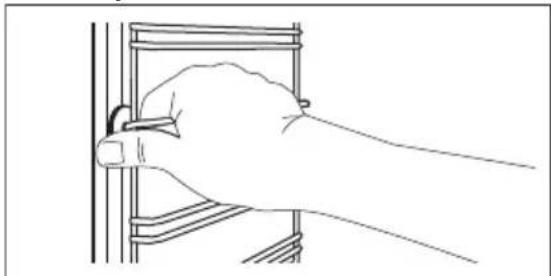
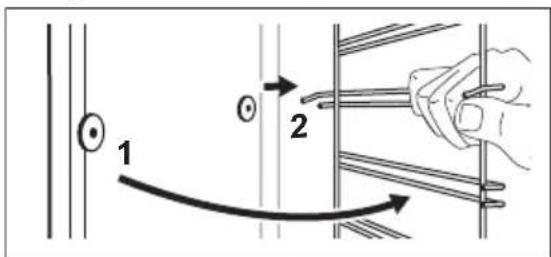
- Pull the front of the shelf support away from the side wall.
natural_image
Line drawing of a hand holding a tool near a vertical panel (no text or symbols)- Pull the rear end of the shelf support away from the side wall and remove it.
text_image
1 2Install the removed accessories in the opposite sequence.
10.5 Removing and installing door
The oven door has two glass panels. You can remove the oven door and the internal glass panel to clean it. Read the whole "Removing and installing door" instruction before you remove the glass panels.

The oven door may close if you try to remove the internal glass panel before you remove the oven door.

CAUTION!
Do not use the oven without the internal glass panel.
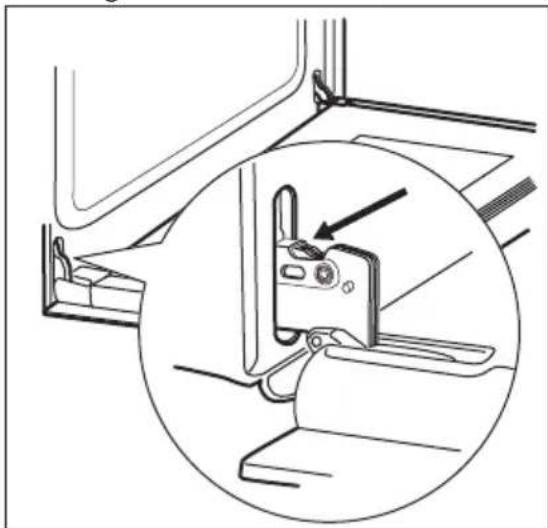
- Open the door fully and hold both hinges.
natural_image
Technical diagram of a mechanical assembly with an inset showing a close-up of a component (no text or symbols present)- Lift and turn the levers fully on both hinges.
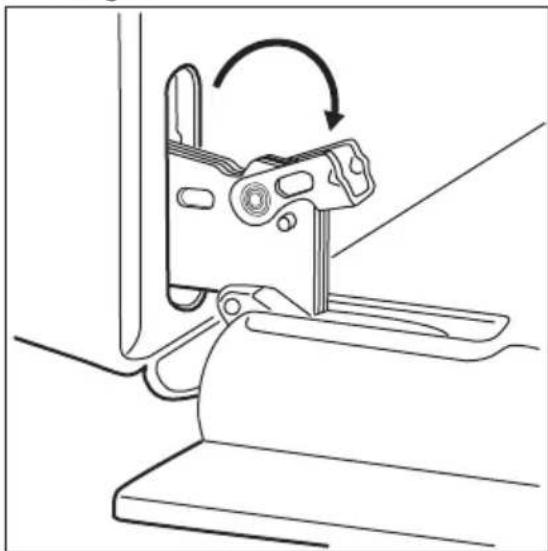
natural_image
Line drawing of a mechanical clamp or bracket assembly with an arrow indicating rotation (no text or symbols)- Close the oven door halfway to the first opening position. Then lift and pull forward and remove the door from its seat.
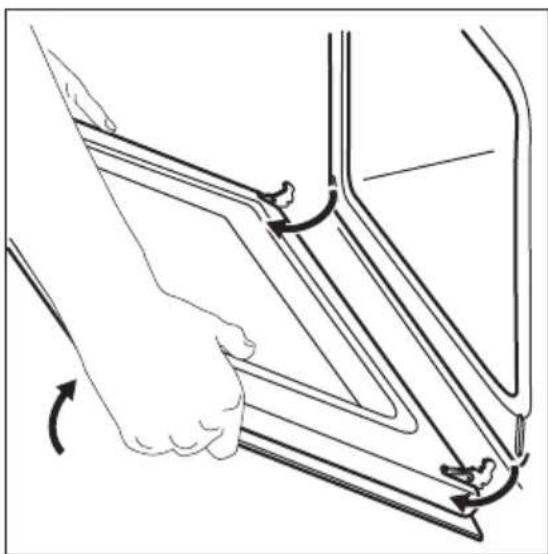
natural_image
Line drawing of a hand holding a rectangular object with curved arrows indicating rotation (no text or symbols)- Put the door on a soft cloth on a stable surface.
- Hold the door trim (B) on the top edge of the door at the two sides and push inwards to release the clip seal.
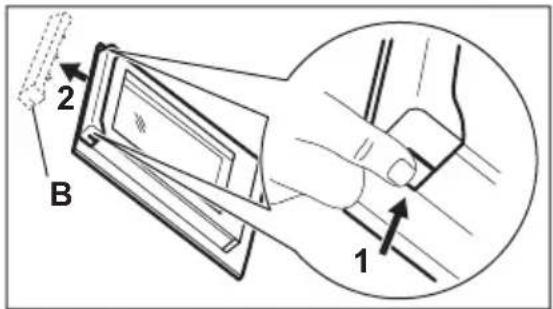
text_image
2 B 1- Pull the door trim to the front to remove it.
- Hold the door glass panel by its top edge and carefully pull it out. Make sure the glass slides out of the supports completely.
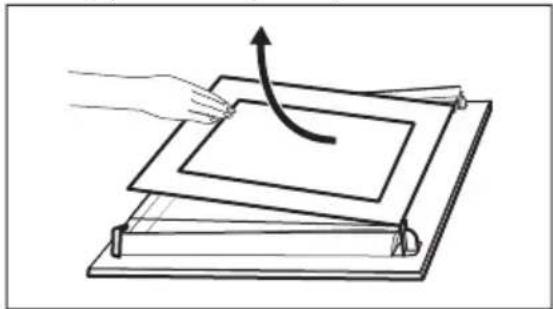
natural_image
Diagram of a hand pressing a curved arrow on a layered platform (no text or symbols)- Clean the glass panels with water and soap. Dry the glass panels carefully. Do not clean the glass panels in the dishwasher.
When the cleaning is completed, install the glass panel and the oven door.
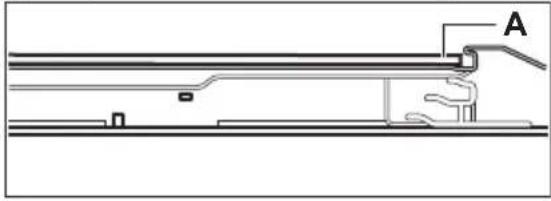
The screen-printing zone must face the inner side of the door. Make sure that
after the installation the surface of the glass panel frame on the screen-printing zones is not rough when you touch it.
When installed correctly the door trim clicks.
Make sure that you install the internal glass panel in the seats correctly.
natural_image
Technical line drawing of a mechanical assembly with labeled component A (no text or symbols present)10.6 Replacing the lamp

WARNING!
Risk of electric shock. The lamp can be hot.
- Turn off the oven.
Wait until the oven is cooled down. - Disconnect the oven from the mains.
- Put a cloth on the bottom of the cavity.

CAUTION!
Always hold the halogen lamp with a cloth to prevent grease residue from burning on the lamp.
The back lamp
- Turn the lamp glass cover to remove it.
- Clean the glass cover.
- Replace the lamp with a suitable 300 °C heat-resistant lamp.
- Install the glass cover.
11. TROUBLESHOOTING

WARNING!
Refer to Safety chapters.
11.1 What to do if...
Problem Possible cause Remedy
The oven does not heat up. The oven is off. Turn on the oven.
| Problem Possible cause Remedy | ||
| The oven does not heat up. The fuse is blown. Make sure that the fuse is the cause of the malfunction. If the fuse problem recurs, contact a qualified electrician. | ||
| The oven does not work. The automatic ignition does not work. | Light the burner with a long match. Hold the flame near the hole in the bottom of the oven cavity. At the same time push the knob for the gas control and turn it counterclockwise to the maximum temperature. When the flame lights, keep the knob for the gas control pushed for 15 seconds or less to warm up the thermocouple. Otherwise the gas flow is interrupted. | |
| The lamp does not work. The lamp is broken. Replace the lamp. | ||
| Steam and condensation settle on the food and in the oven cavity. | A dish was left in the oven for too long. | Food should not be left in the oven for longer than 15-20 minutes after cooking. |
| The flame extinguishes immediately after ignition. | The thermocouple is not heated up. | After the flame lights, keep the knob for the gas control pushed for 15 seconds or less. |
| The turnspit does not rotate. | The turnspit is not correctly installed into the turnspit hole. | Refer to "Using the accessories" chapter, Using the turnspit. |
11.2 Service data
If you cannot find a solution to the problem yourself, contact your dealer or an Authorised Service Centre.
The necessary data for the service centre is on the rating plate. The rating plate is
on the front frame of the oven cavity. Do not remove the rating plate from the oven cavity.
| We recommend that you write the data here: |
| Model (MOD.) .... |
| Product number (PNC) .... |
| Serial number (S.N.) .... |
12. INSTALLATION

WARNING!
Refer to Safety chapters.
12.1 Gas connection

WARNING!
Before the gas connection, disconnect the mains plug from the mains socket or deactivate the fuse in the fuse box. Close the primary valve of the gas supply.
The gas supply ramp is on the rear side of the appliance.

WARNING!
Do not use rubber flexible pipes!
Do not fully put the oven into the built-in cabinet (approximately 30 cm).
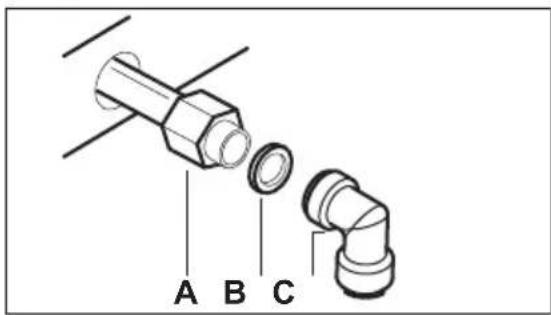
Connection with a flexible metallic pipe or a rigid metallic pipe:
text_image
A B CA. Gas supply ramp, end of shaft with ramp
B. Washer
C. Elbow
Put the supplied gasket between the pipe and the gas supply ramp. Turn the pipe to the 1/2" gas supply ramp.
- Use a 22 mm spanner to tighten the nuts. Keep the gas supply ramp in the correct position. Do not apply force to the gas supply circuit.

WARNING!
Do not use a flame to check for leaks!
- Fully move the oven into the built-in cabinet.

WARNING!
Do not squeeze the gas supply ramp and the pipe when you move the oven into the built-in cabinet.
- Seal the connection correctly. Use a leak detection to control it.
12.2 Adjustment to different types of gas

Only a qualified technician is authorized to handle adjustment of different types of gas.

The oven is set for natural gas, you can change it to liquid gas, with the correct injectors. The gas rate is adjusted to suit.

WARNING!
Before you replace the injectors, make sure that the gas knobs are in the Off position. Let the oven cool down. There is a risk of injury.
12.3 Oven injector replacement
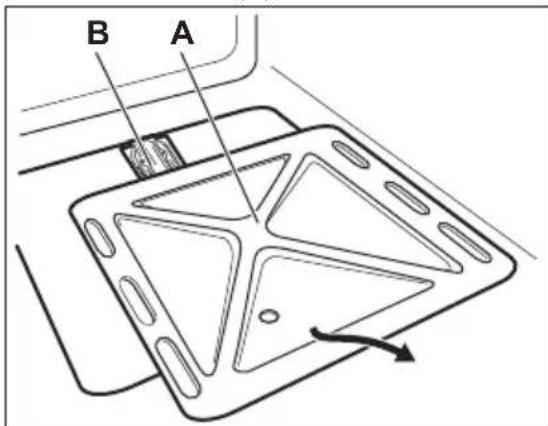
- Remove the bottom plate of the oven cavity (A) to get access to the oven burner (B).
text_image
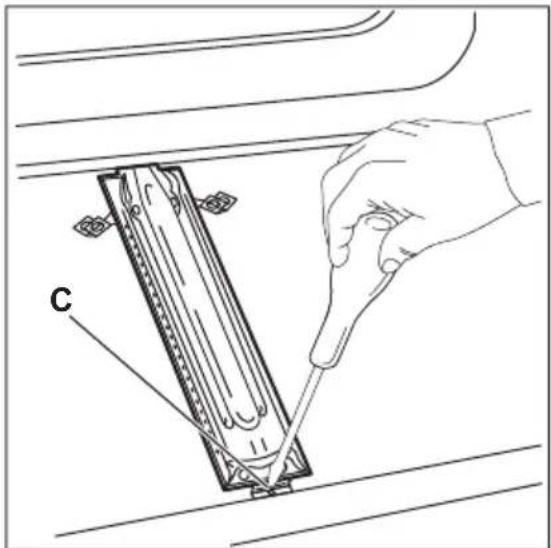
B A- Release the screw (C), which keeps the burner in position.
text_image
C- Carefully move the burner off the injector support (D).
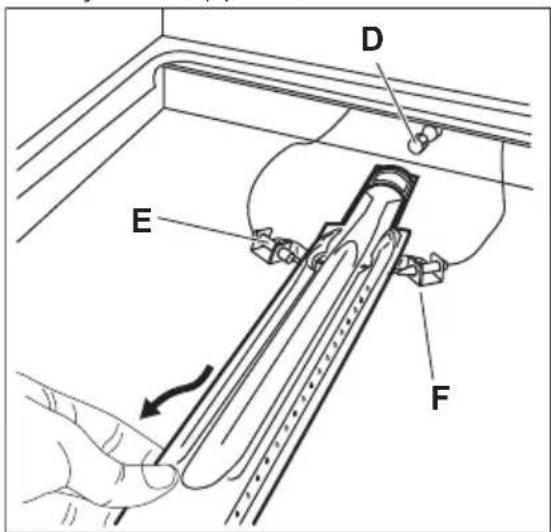
text_image
D E F-
Slowly move it to the left side. Do not apply force to the wire of the spark plug connector (F) and to the thermocouple conductor (E).
-
Release the burner injector (D) with a 7 mm socket spanner and replace it with a different one, which is necessary for the type of gas you use. Refer to "Technical data" chapter.
-
Assemble the burner in a reverse sequence.
Replace the gas type sticker near the gas supply ramp with the one related to the new gas type.
The gas oven burner does not need any primary gas regulation.

Make sure that the gas supply pressure of the appliance is in line with the recommended values.

If the supply gas pressure is changeable or different than the necessary pressure, you must fit an applicable pressure adjuster on the gas supply pipe.
12.4 Minimum level adjustment of the oven burner
- Disconnect the appliance from the electricity.
- Turn the knob for the gas control to the minimum position and remove it.
- Adjust the adjustment screw (A) with a thin-bladed screwdriver.
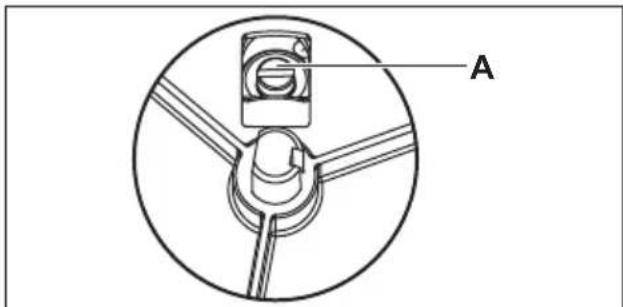
text_image
A| Change of the type of gas | Adjustment of the adjustment screw |
| From natural gas to liquid gas | Fully tighten the adjustment screw in. |
| From liquid gas to natural gas | Release the adjustment screw approximately 1/3 of a turn. |
- Attach the knob for the gas control.
- Connect the appliance to the electricity.

WARNING!
Only put the mains plug into the mains socket when all parts are back into their initial position. There is a risk of injury.
-
Light the gas oven burner. Refer to "Daily use" chapter.
-
Set the knob for the gas control to the maximum position and let the oven heat for at least 10 minutes.
- Turn the knob for the gas control from the maximum to the minimum position.
Control the flame. If the flame goes out, do the procedure again. There must be a small regular flame on the oven burner crown.
The manufacturer objects liability if you do not obey to this safety measures.
12.5 Building In
Only set up the appliance in a kitchen or in a kitchen-dining room. Do not set up the appliance in a bathroom or a bedroom.
You can install the appliance "built-in" or "built-under". The dimensions of the built-in cabinet must agree with the related illustrations.
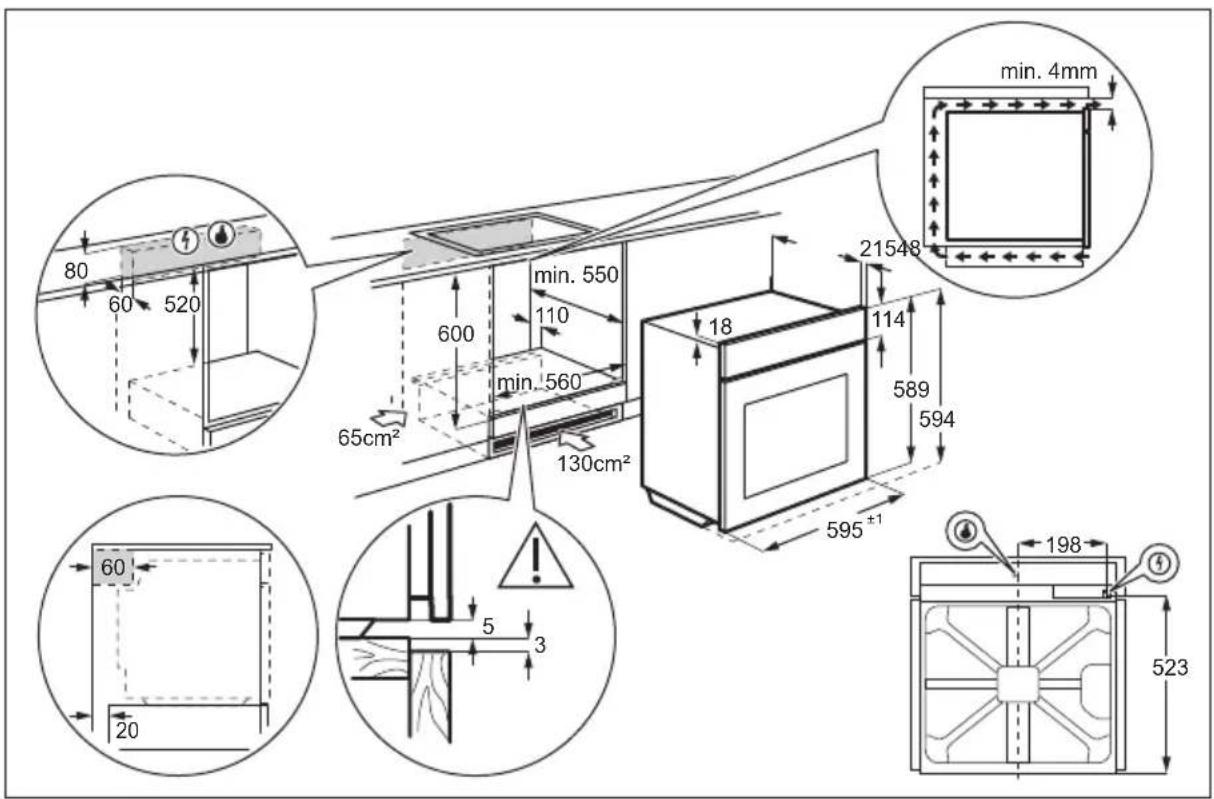
text_image
80 60 520 min. 550 600 110 min. 560 65cm² 130cm² 18 21548 114 589 594 595⁺¹ 60 20 5 3 min. 4mm 198 523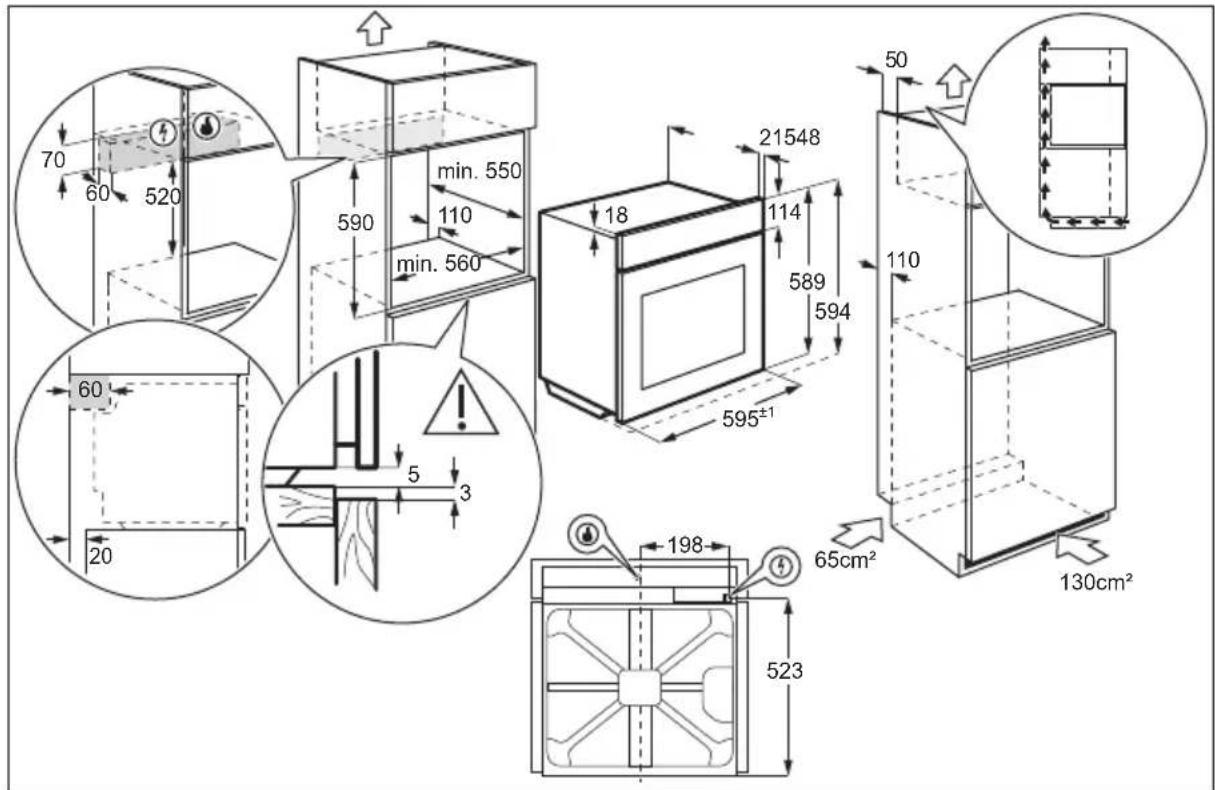
text_image
70 60 520 min. 550 590 110 min. 560 18 21548 114 589 594 595±1 50 110 60 20 5 3 198 65cm² 130cm² 523There must be a clearance of minimum 4 mm between the top surface of the appliance and the inner top of the cabinet.
When you install the appliance "built-under" (below a hob), install the hob before the oven unit.
The materials must be resistant to a temperature increase of minimum 60 °C above the ambient temperature.
There must be a continuous air supply around the oven in order to not have the oven become too hot.
For correct operation, the oven cabinet must have a minimum opening of 130 cm ^2 in the front or on the sides (a minimum of 65 cm ^2 for each side). The manufacturer recommends a 130 cm ^2 opening in the front for a brick cabinet and a 65 cm ^2 opening for each side for a wooden cabinet.
When you install a hob above the oven, make different electrical connections for the hob and for the oven.
Only make connections with correct cables for the power supplied.
Make sure that after the installation there is easy access to the appliance if repairs or maintenance are necessary.
12.6 Securing the appliance to the cabinet
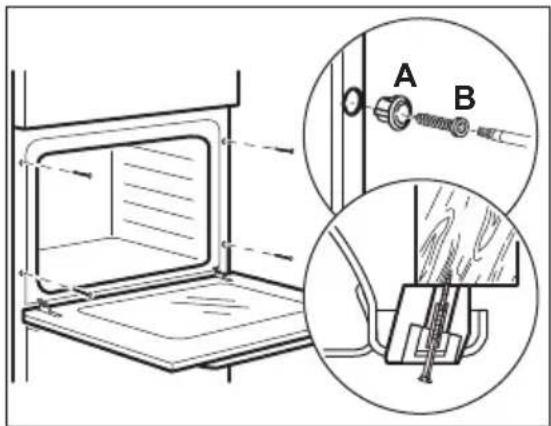
text_image
Technical diagram showing a door opening with labeled parts A and B, including a magnified inset of the component being inserted.12.7 Electrical installation
The manufacturer is not responsible if you do not follow the safety precautions from the Safety chapters.
This appliance is supplied only with a main cable.
12.8 Cable
Cable types applicable for installation or replacement:
H05 V2V2-F (T90), H05 BB-F
For the section of the cable refer to the total power on the rating plate. You can also refer to the table:
| Total power (W) Section of the cable (mm2) |
| maximum 1380 3 x 0.75 |
| Total power (W) Section of the cable (mm2) |
| maximum 2300 3 x 1 |
| maximum 3680 3 x 1.5 |
The earth cord (green / yellow cable) must be 2 cm longer than phase and neutral cables (blue and brown cables).
13. TECHNICAL DATA
13.1 Technical data
| TOTAL POWER: Electric: 1.77 kW |
| Gas original: G20 (2H) 20 mbar = 2.6 kW |
| Gas replacement: G30/G31 30/30 mbar = 196 g/hG30/G31 30/30 mbar = 2.7 kW |
| Electric supply: 220 - 240 V ~ 50 - 60 Hz |
| Appliance category: II2H3B/P |
| Gas connection: G 1/2" |
| Appliance class: 3 |
13.2 Gas oven burner
| Gas type NOMINAL | GAS POW-ER (kW) | NOMINAL GAS FLOW (g/h) | Reduced gas power (kW) | BY-PASS NEEDLE (1/100 mm) | INJECTOR MARK (1/100 mm) |
| G20 (2H) 20 mbar 2.6 - 0.7 Reg. | 112 | ||||
| G30/G31 30/30 mbar | 2.7 196 0.7 43 80 | ||||
14. ENVIRONMENTAL CONCERNS
Recycle materials with the symbol. Put the packaging in relevant containers to recycle it. Help protect the environment and human health by
recycling waste of electrical and electronic appliances. Do not dispose of appliances marked with the symbol 📄 with the household waste. Return the
product to your local recycling facility or contact your municipal office.
TABLE DES MATIÈRES
- INFORMATION SUR LA SÉCURITÉ.... 26
- CONSIGNES DE SÉCURITÉ....28
- DESCRIPTION DE L'APPAREIL....31
- AVANT LA PREMIÈRE UTILISATION.... 32
- UTILISATION QUOTIDIENNE....32
- FONCTIONS DE L'HORLOGE.... 34
- UTILISATION DES ACCESSOIRES....34
- FONCTIONS SUPPLÉMENTAIRES.... 35
- CONSEILS.... 35
- ENTRETIEN ET NETTOYAGE.... 42
- DÉPANNAGE....45
- INSTALLATION....46
- CARACTÉRISTIQUES TECHNIQUES....50
POUR DES RÉSULTATS PARFAITS
www.aeg.com/webselfservice

natural_image
Technical diagram showing mechanical assembly with a magnified inset of a component being inserted (no text or symbols present)natural_image
Illustration of three steps to tie a bird's seat using a tool, with arrows indicating movement (no text or symbols)natural_image
Technical line drawing of a structural component with two circular inset views showing internal details (no text or symbols)natural_image
Pure technical line drawing of a mechanical component or bracket (no text or symbols)natural_image
Technical line drawing of a structural component with an inset magnified detail (no text or symbols)i