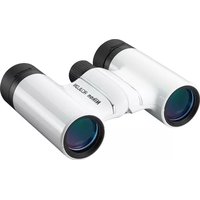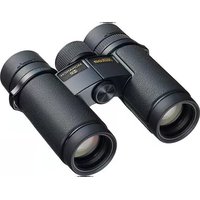
Monarch HG 10x30 - Binoculars NIKON - Free user manual and instructions
Find the device manual for free Monarch HG 10x30 NIKON in PDF.


| Product type | Roof prism binoculars with central focus |
| Brand | Nikon |
| Model | Monarch HG 10x30 |
| Magnification | 10x |
| Effective objective diameter | 30 mm |
| Angular field of view (real) | 6.9° |
| Angular field of view (apparent) | 62.2° |
| Field of view at 1,000 m | 121 m |
| Exit pupil | 3.0 mm |
| Relative brightness | 9.0 |
| Eye relief | 15.2 mm |
| Minimum focus distance | 2 m |
| Length | 119 mm |
| Width | 126 mm |
| Thickness | 47 mm |
| Weight | 450 g |
| Interpupillary distance adjustment | 56-74 mm |
| Waterproof | Up to 5 m for 10 minutes, nitrogen filled |
| Power supply | None (optical binoculars) |
| Main functions | Terrestrial and astronomical observation, central focus, diopter adjustment, retractable eyecups |
| Maintenance and cleaning | Clean lenses with an aerosol from a minimum distance of 30 cm; wipe any moisture before handling |
| Safety | Do not use underwater; do not expose to high-pressure water |
| Spare parts and accessories included | Eyepiece caps (x1), objective lens caps (x2), rubber objective rings (x2), case, strap |
| General information | User manual available for download; design and specifications subject to change |
Frequently Asked Questions - Monarch HG 10x30 NIKON
User questions about Monarch HG 10x30 NIKON
0 question about this device. Answer the ones you know or ask your own.
Ask a new question about this device
Download the instructions for your Binoculars in PDF format for free! Find your manual Monarch HG 10x30 - NIKON and take your electronic device back in hand. On this page are published all the documents necessary for the use of your device. Monarch HG 10x30 by NIKON.
USER MANUAL Monarch HG 10x30 NIKON
natural_image
Line drawing of two binoculars (no text or symbols)Eyecups
For directions in which to turn the eyecups, please refer to the image on page 3.
- For eyeglass wearers, use fully retracted. To accurately adjust your view, you can also use either of the two click stops before reaching the fully retracted position.
- For non-eyeglass wearers, use fully extended. To accurately adjust your eye position, you can also use either of the two click stops before reaching the fully extended position.
Diopter and diopter lock mechanism
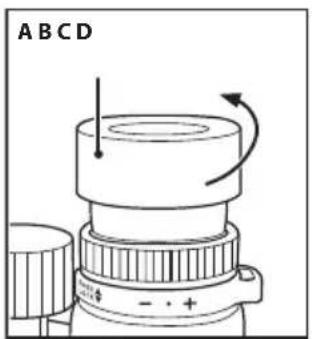
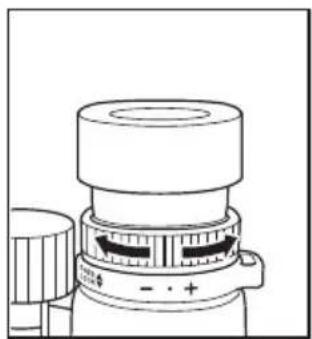
- When using 8×30/10×30, rotate the eyecup as illustrated in (A) to extend it. When using 8×42/10×42, proceed to "2."
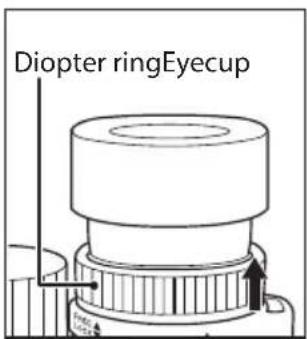
- Pull up the diopter ring as illustrated in (B) to unlock it. Adjust the diopter by rotating it clockwise or counterclockwise (C).
- After adjusting the diopter on the right side, pull down the diopter ring as illustrated in (D) to lock it.
natural_image
Technical line drawing of a mechanical component with no visible text or symbols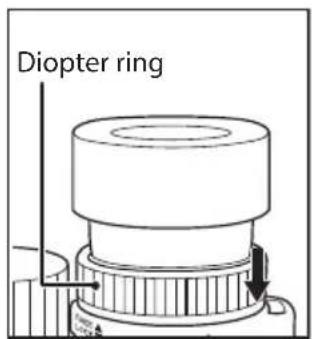
Neckstrap and caps during observation
Neck Strap
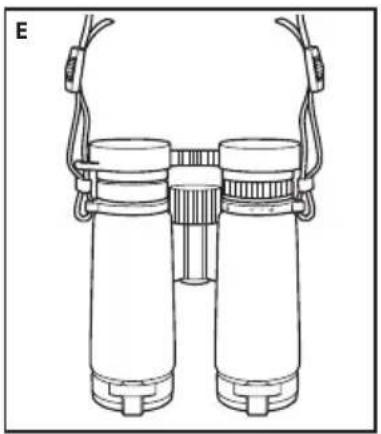
Attach the neckstrap as illustrated in (E), paying special attention to avoid twisting the strap.
natural_image
Line drawing of two binoculars with straps and lenses (no text or symbols)Flipdown objective lens caps
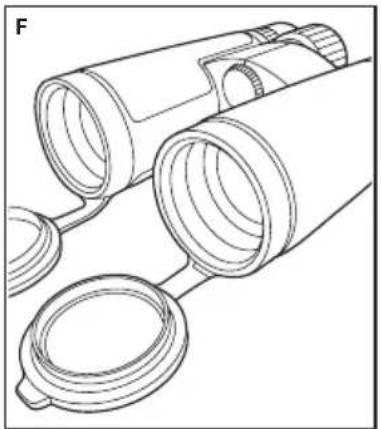
Attach the objective lens caps as illustrated in (F), making sure the cap part hinges open downward from the binocular tube when folded open. (correctly attached when supplied).
natural_image
Line drawing of binoculars with a lid, no text or symbols presentEyepiece cap
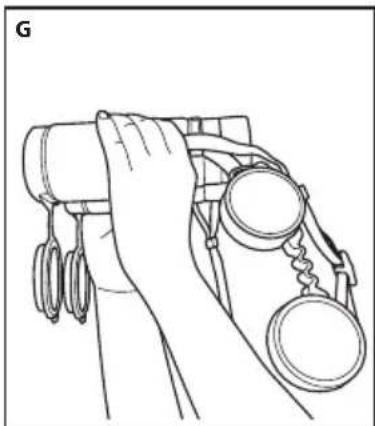
Remove the eyepiece cap from the eyepieces, then allow the cap to hang from the left neckstrap as illustrated in (G).
natural_image
Line drawing of a hand holding a cylindrical device with attached circular components (no text or symbols)Objective rubber ring
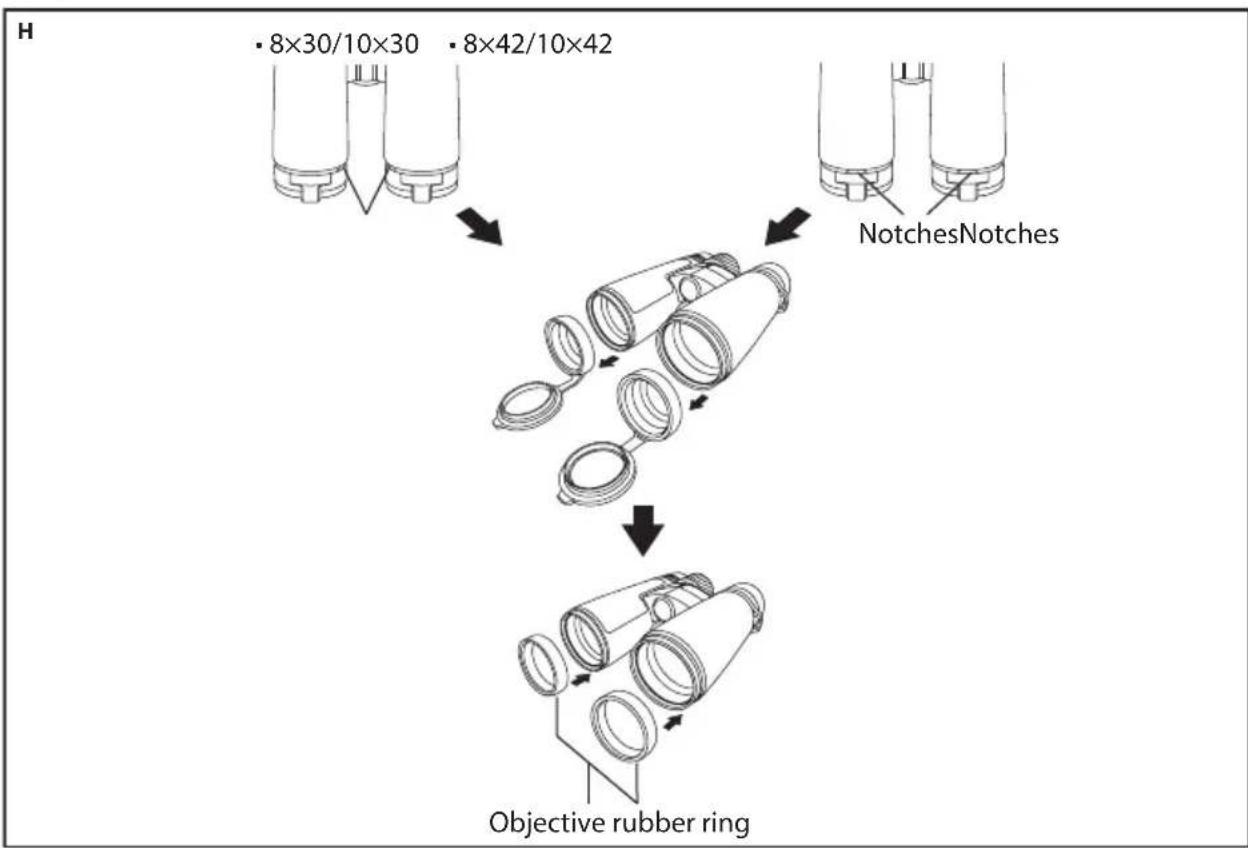
You can insert your fingers into the notches to remove the objective lens caps, and attach the objective rubber rings as replacement parts (H).
If you store the binoculars in the case with the objective rubber rings attached, dirt or dust may adhere to the objective lens.
flowchart
graph TD
    A["• 8×30/10×30 • 8×42/10×42"] --> B["Object with circular parts"]
    B --> C["Objective rubber ring"]
    D["Notches Notches"] --> C
Specifications
| Type: Dach prism central focusing type | ||||
| Model | 8×30 10×30 | 8×42 10×42 | ||
| Magnification (×) | 8 10 8 10 | |||
| Effective diameter of objective lens (mm) | 30 30 42 42 | |||
| Angular field of view (real) (°) | 8.3 6.9 8.3 | 6.9 | ||
| Angular field of view (apparent) (°)* | 60.3 62.2 60.3 62.2 | |||
| Field of view at 1,000m/yd. (m/ft) | 145/435 121/362 145/435 121/362 | |||
| Exit pupil (mm) | 3.8 3.0 5.3 | 4.2 | ||
| Brightness | 14.4 9.0 28.1 | 17.6 | ||
| Eye relief (mm) | 16.2 15.2 17.8 | 17.0 | ||
| Close focusing distance (m/ft) | 2/6.6 2/6.6 | 2/6.6 2/6.6 | ||
| Length (mm/in.) | 119/4.7 119/4.7 | 145/5.7 145/5.7 | ||
| Width (mm/in.) | 126/5.0 126/5.0 | 131/5.2 131/5.2 | ||
| Depth (mm/in.) | 47/1.9 47/1.9 | 56/2.2 56/2.2 | ||
| Weight (g/oz.) | 450/15.9 450/15.9 | 665/23.5 680/24.0 | ||
| Interpupillary distance adjustment (mm/in.) | 56-742.2-2.9 | 56-742.2-2.9 | 56-742.2-2.9 | 56-742.2-2.9 |
| Structure | Waterproof (up to 5 m (16.4 ft) for 10 minutes) and nitrogen gas filled | |||
* The number calculated by the formula [ ' = × ] : Apparent field of view: 2' , Magnification: , Real field of view: 2
About waterproof and defogging:
- All models shown are waterproof, and will suffer no damage to the optical system if submerged or dropped in water to a maximum depth of 5m (16.4 ft) for up to 10 minutes.
• Can be used in conditions of high humidity, dust and rain without risk of damage. - Nitrogen-filled design makes them resistant to condensation and mold.
Observe the following when using these products:
- The binoculars cannot be used underwater. Also, do not subject it to strong water pressure such as from running water.
- Any moisture should be wiped off before adjusting movable parts of these products to prevent damage and for safety reasons.
To keep your binoculars in excellent condition, regular servicing by authorized dealer is recommended.
Cleaning lens
When cleaning the binoculars' objective lenses using an aerosol-type dust cleaner, make sure to hold the can upright at least 30 cm (11.8 in.) from the lens surface while moving the can to avoid focusing the vaporized liquid gas on one point.
• Specifications and design are subject to change without notice.
- No part of the manual may be reproduced, transmitted, transcribed, stored in a retrieval system, or translated into any language in any form, by any means, without Nikon's prior written permission.
Notice for customers in the State of California
WARNING:

This product contains chemicals including Lead which is known to the State of California to cause cancer and birth defects or other reproductive harm. For more information go to www.P65Warnings.ca.gov.
Nomenclatura
Ojeras
natural_image
Technical line drawing of a mechanical component with no visible text or symbols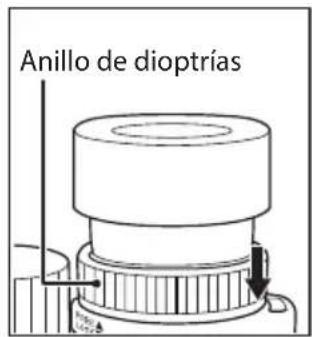
natural_image
Line drawing of binoculars with no text or symbolsnatural_image
Line drawing of two cylindrical binoculars with a separate cover and ring, no text or symbols presentnatural_image
Line drawing of a hand holding a cylindrical device with attached circular components (no text or symbols)
©Eilletons
natural_image
Technical line drawing of a mechanical component with no visible text or symbols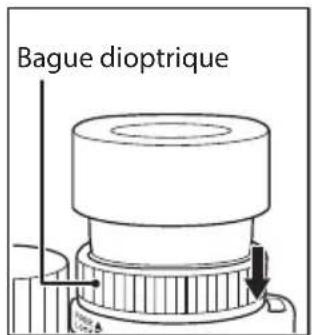
natural_image
Line drawing of binoculars with no text or symbolsnatural_image
Line drawing of binoculars with a strap, shown in two different angles (no text or symbols)Capuchon d'oculaire
natural_image
Line drawing of a hand holding a cylindrical device with multiple circular components attached (no text or symbols)Oculares
natural_image
Technical line drawing of a mechanical component with no visible text or symbols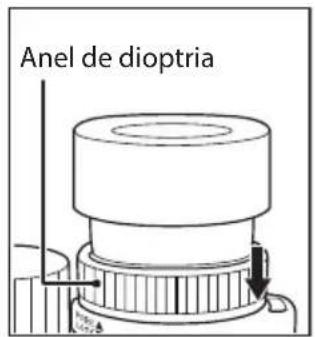
natural_image
Line drawing of binoculars with no text or symbolsnatural_image
Line drawing of binoculars with a strap, shown in two different angles (no text or symbols)Tampas das oculares
natural_image
Line drawing of a hand holding a cylindrical device with attached circular components (no text or symbols)
Anel de borracha das objetivas
Printed in China, 877C_1_1803