
TBM250Vario - Drill SCHEPPACH - Free user manual and instructions
Find the device manual for free TBM250Vario SCHEPPACH in PDF.


| Brand | Scheppach |
| Model | TBM250Vario |
| Product type | Bench drill press |
| Power supply | 230-240 V ~ 50 Hz |
| Power (S1 / S2 10 min) | 370 W / 600 W |
| No-load speed | 450 – 2580 min⁻¹ |
| Protection class | I |
| Protection rating | IPX0 |
| Weight | 26 kg |
| Drill chuck | B16 (1,5 mm – 13 mm) |
| Drilling stroke | 60 mm |
| Drilling table dimensions | 198 x 194 mm |
| Base dimensions | 334 x 206 mm |
| Sound power level | 86 dB (K=3 dB) |
| Sound pressure level | 73 dB (K=3 dB) |
| Main functions | Drilling, milling, centered drilling; laser guide; variable speed; depth stop; table tilt up to 45° |
| Maintenance and cleaning | Clean after each use with a dry cloth; do not immerse; no special maintenance required |
| Safety | On/Off switch; restart protection; detailed safety instructions; mandatory wearing of goggles and hearing protection |
| Spare parts and repairability | Wear parts: drive belt; repairs by a specialist; original spare parts recommended |
| General information | Legal warranty; intended use: metal, wood, plastic, tile; not suitable for professional use |
Frequently Asked Questions - TBM250Vario SCHEPPACH
User questions about TBM250Vario SCHEPPACH
0 question about this device. Answer the ones you know or ask your own.
Ask a new question about this device
Download the instructions for your Drill in PDF format for free! Find your manual TBM250Vario - SCHEPPACH and take your electronic device back in hand. On this page are published all the documents necessary for the use of your device. TBM250Vario by SCHEPPACH.
USER MANUAL TBM250Vario SCHEPPACH
natural_image
Line drawing of a drill press machine with no visible text or symbols
Made in P.R.C.
TBM250Vario
GB Bench drill | Translation of the original operating instructions .... 20
2
natural_image
Technical line drawing of an industrial machine with no visible text or symbols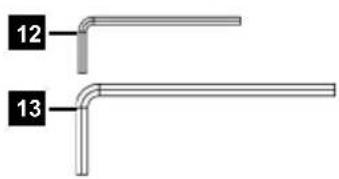

natural_image
Diagram of a mechanical component with circular top and two vertical slots, labeled with number 6 (no text or symbols on the diagram itself)
natural_image
Simple line drawing of a vertical cylindrical object with a labeled top point (no text or symbols on the object itself)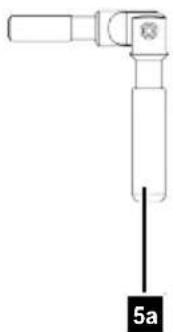
natural_image
Simple line drawing of a mechanical or robotic arm with a labeled section '5a' (no text or symbols on the object itself)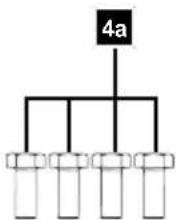
natural_image
Pure mechanical component diagram without any text, numbers, or symbols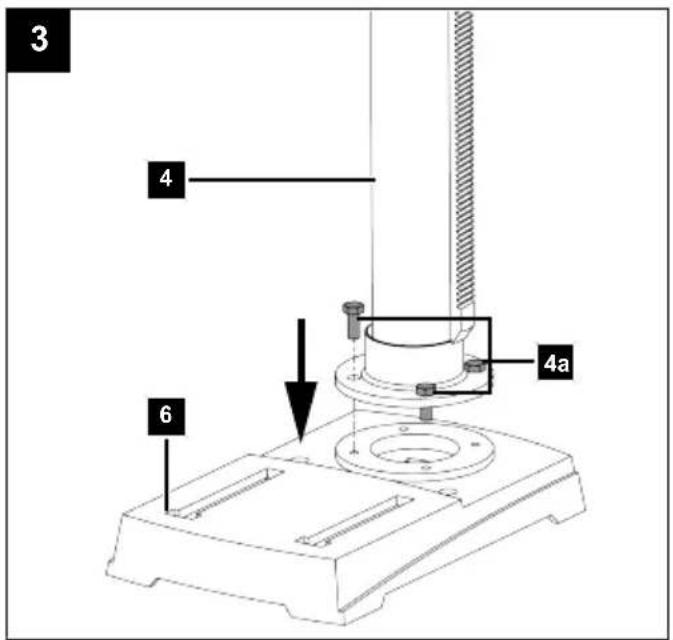

Inhaltsverzeichnis
Günzburger Straße 69
D-89335 Ichenhausen
Verehrter Kunde
• Innensechskantschlüssel 3 mm (12)
• 2x Gabelschlüssel SW 14 mm*
• 2x Gabelschlüssel SW 17 mm*
• Gabelschlüssel SW 18 mm*
13 Transport (Abb. 1)
Günzburger Straße 69
D-89335 Ichenhausen
Division Manager Product Center

Head of Project Management
Garantiebedingungen
Revisionsdatum 26.11.2021
https://www.scheppach.com/de/service
1 Introduction ...... 20
2 Product description (Fig. 1-18).... 21
3 Scope of delivery (Fig. 2) 21
4 Proper use.... 21
5 Safety instructions.... 22
6 Technical data.... 23
7 Unpacking 24
8 Assembly....24
9 Before commissioning.... 25
10 Operation 26
11 Working instructions.... 27
12 Cleaning and maintenance 27
13 Transport (Fig. 1) 28
14 Storage.... 28
15 Electrical connection 28
16 Repair and ordering spare parts 28
17 Troubleshooting 29
18 Disposal and recycling 29
19 EU Declaration of Conformity.... 30
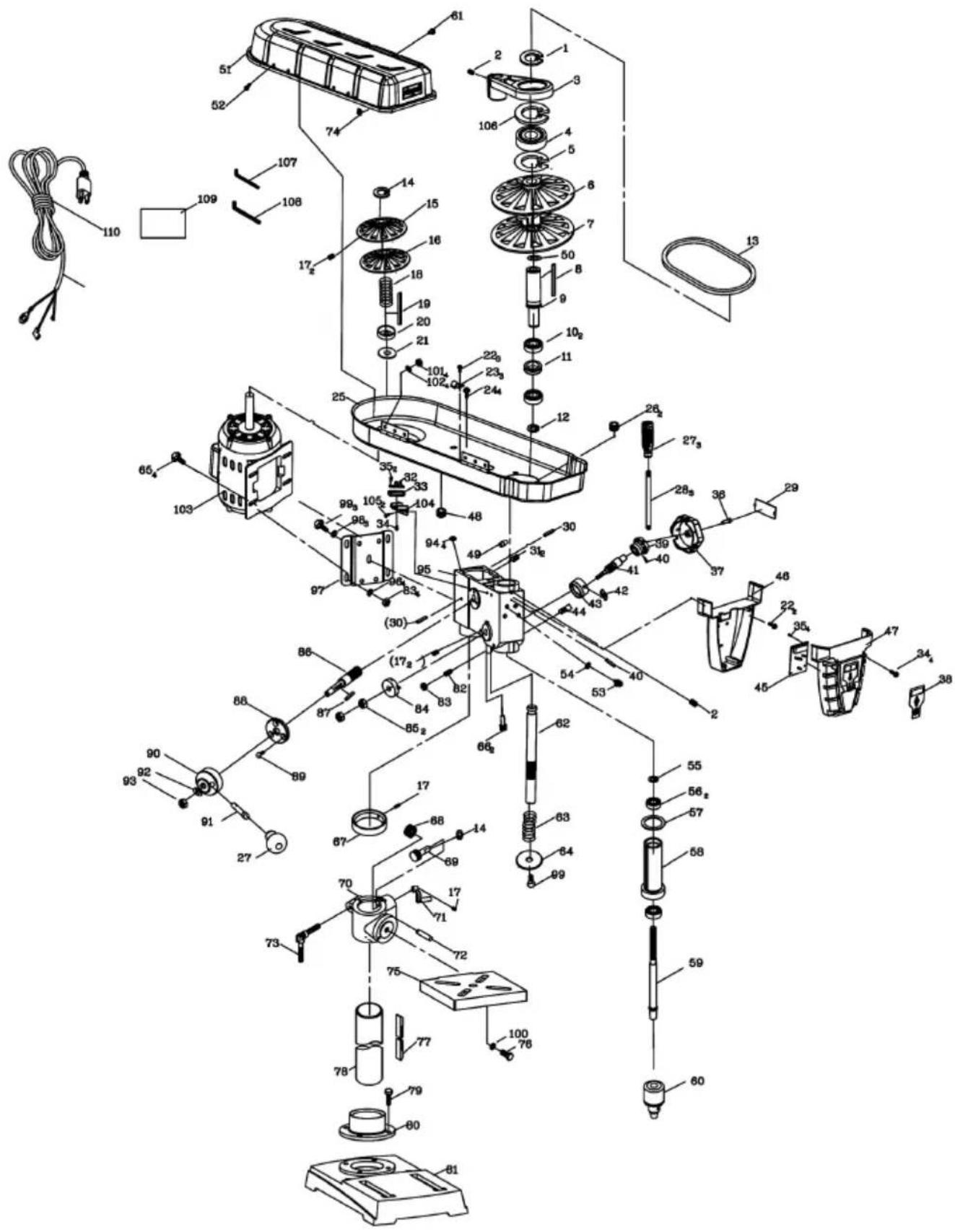
20 Exploded view.... 297
Explanation of the symbols on the product
Symbols are used in this manual to draw your attention to potential hazards. The safety symbols and the accompanying explanations must be fully understood. The warnings themselves will not rectify a hazard and cannot replace proper accident prevention measures.
 | Before commissioning, read and observe the operating manual and safety instructions! |
 | Attention! Failure to observe the safety signs and warning information affixed to the product and failure to observe the safety and operating manual can result in serious injury or even death. |
 | Wear safety goggles. |
 | Wear hearing protection. |
 | Wear a hair net! |
 | Do not wear gloves during operation! |
 | Attention! Keep your hands away from rotating tools. |
 | The motor becomes very hot during operation, do not touch! |
 | Only carry out maintenance, conversion, adjustment and cleaning work when the product is switched off and the mains plug is disconnected! |
 | Attention! Laser beam |
 | Drill diameter |
 | Maximum tool attachment shaft diameter |
 | The product complies with the applicable European directives. |
 | The product complies with the applicable Serbian directives. |
1 Introduction
Manufacturer:
Scheppach GmbH
Günzburger Straße 69
D-89335 Ichenhausen
Dear Customer
We hope your new product brings you much enjoyment and success.
Note:
In accordance with the applicable product liability laws, the manufacturer of this product assumes no liability for damage to the product or caused by the product arising from:
- Improper handling
• Non-compliance with the operating manual
• Repairs carried out by third parties, unauthorised specialists
• Installing and replacing non-original spare parts - Improper use
- Failures of the electrical system in the event of the electrical regulations and VDE provisions 0100, DIN 57113 / VDE0113 not being observed.
Note:
The operating manual is part of this product.
It includes important instructions for the safe, proper and economic operation of the product, for avoiding danger, for minimising repair costs and downtimes and for increasing the reliability and extending the service life of the product. In addition to the safety instructions in this operating manual, you must also observe the regulations applicable to the operation of the product in your country.
Familiarise yourself with all operating and safety instructions before using the product. Only operate the product as described and for the specified areas of application. Keep the operating manual in a good place and hand over all documents when passing the product on to third parties.
2 Product description (Fig. 1-18)
- Gearing cover
- Engine unit
2a. Clamping screws - Handle
3a. Hand spindle guide
3b. Scale ring
3c. Locking screw - Column tube
4a. Hexagon screw (M8x20 mm)
4b. Stop ring
4c. Grub screw
4d. Toothed rack
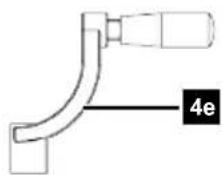
4e. Crank
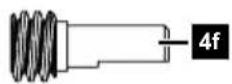
4f. Crank mounting - Drilling table
5a. Locking screw
5b. Locking screw (inclination) - Floor plate
- Chuck
7a. Drill spindle - On/off switch (drive)
8a. On/off switch (laser)
8b. Speed indicator - Adjusting lever (speed)
- Spring cap
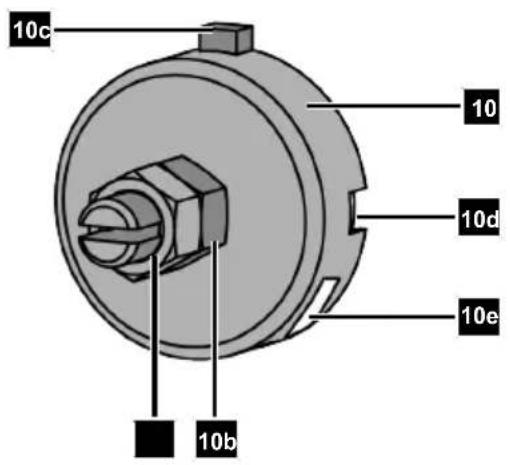
10a. Lock nut M10
10b. M10 nut
10c. Hub
10d. Notch
10e. Groove - Laser lens
11a. Grub screw - Allen key, 3 mm
- Allen key, 4 mm
3 Scope of delivery (Fig. 2)
Item Quantity Designation
-
1 x Engine unit
-
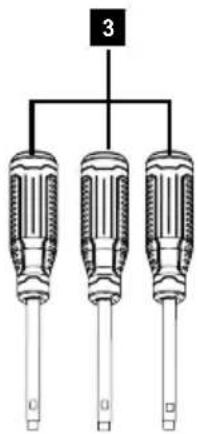
3 x Handle
-
1 x Column tube
4a. 4 x Hexagon screw (M8x20 mm)
4e. 1 x Crank
4f. 1 x Crank mounting
- 1 x Drilling table
5a. 1 x Locking screw
-
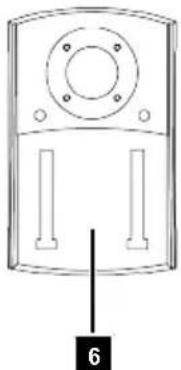
1 x Floor plate
-
1 x Chuck
-
1 x Adjusting lever (speed)
-
1 x Allen key, 3 mm
- 1 x Allen key, 4 mm
1 x Bench drill
1 x Operating manual
4 Proper use
The bench drill is designed for drilling in metal, wood, plastic and tiles. Shank drill bits from 1.5 mm to 13 mm drill diameter can be used.
The product may only be used in the intended manner. Any use beyond this is improper. The user, not the manufacturer, is responsible for damages or injuries of any type resulting from this.
An element of the intended use is also the observance of the safety instructions, as well as the assembly instructions and operating information in the operating manual.
Persons who operate and maintain the product must be familiar with the manual and must be informed about potential dangers.
The liability of the manufacturer and resulting damages are excluded in the event of modifications of the product.
The product may only be operated with original parts and original accessories from the manufacturer.
The safety, operating and maintenance specifications of the manufacturer, as well as the dimensions specified in the technical data, must be observed.
Please note that our products were not designed with the intention of use for commercial or industrial purposes. We assume no guarantee if the product is used in commercial or industrial applications, or for equivalent work.
Explanation of the signal words in the operating manual

DANGER
Signal word to indicate an imminently hazardous situation which, if not avoided, will result in death or serious injury.

WARNING
Signal word to indicate a potentially hazardous situation which, if not avoided, could result in death or serious injury.

CAUTION
Signal word to indicate a potentially hazardous situation which, if not avoided, could result in minor or moderate injury.
ATTENTION
Signal word to indicate a potentially hazardous situation which, if not avoided, could result in product or property damage.
5 Safety instructions
General power tool safety warnings
WARNING
Read all safety warnings, instructions, illustrations and specifications provided with this power tool.
Failure to follow all instructions listed below may result in electric shock, fire and/or serious injury.
Save all warnings and instructions for future reference.
The term "power tool" in the warnings refers to your mains-operated (corded) power tool or battery-operated (cordless) power tool.
1) Work area safety
a) Keep your work area clean and well-lit. Cluttered or dark areas invite accidents.
b) Do not operate power tools in explosive atmospheres, such as in the presence of flammable liquids, gases or dust. Power tools create sparks which may ignite the dust or fumes.
c) Keep children and bystanders away while operating a power tool. Distractions can cause you to lose control.
2) Electrical safety
a) Power tool plugs must match the outlet. Never modify the plug in any way. Do not use any adapter plugs with earthed (grounded) power tools. Unmodified plugs and matching outlets will reduce risk of electric shock.
b) Avoid body contact with earthed or grounded surfaces, such as pipes, radiators, ranges and refrigerators. There is an increased risk of electric shock if your body is earthed or grounded.
c) Do not expose power tools to rain or wet conditions. Water entering a power tool will increase the risk of electric shock.
d) Do not abuse the cord. Never use the cord for carrying, pulling or unplugging the power tool. Keep cord away from heat, oil, sharp edges or moving parts. Damaged or entangled cords increase the risk of electric shock.
e) When operating a power tool outdoors, use an extension cord suitable for outdoor use. Use of a cord suitable for outdoor use reduces the risk of electric shock.
f) If operating a power tool in a damp location is unavoidable, use a residual current device (RCD) protected supply. Use of an RCD reduces the risk of electric shock.
3) Personal safety
a) Stay alert, watch what you are doing and use common sense when operating a power tool. Do not use a power tool while you are tired or under the influence of drugs, alcohol or medication. A moment of inattention while operating power tools may result in serious personal injury.
b) Use personal protective equipment. Always wear eye protection. Protective equipment such as a dust mask, non-skid safety shoes, hard hat or hearing protection used for appropriate conditions will reduce personal injuries.
c) Prevent unintentional starting. Ensure the switch is in the off-position before connecting to power source and/or battery pack, picking up or carrying the tool. Carrying power tools with your finger on the switch or energising power tools that have the switch on invites accidents.
d) Remove any adjusting key or wrench before turning the power tool on. A wrench or a key left attached to a rotating part of the power tool may result in personal injury.
e) Do not overreach. Keep proper footing and balance at all times. This enables better control of the power tool in unexpected situations.
f) Dress properly. Do not wear loose clothing or jewellery. Keep your hair and clothing away from moving parts. Loose clothes, jewellery or long hair can be caught in moving parts.
g) If devices are provided for the connection of dust extraction and collection facilities, ensure these are connected and properly used. Use of dust collection can reduce dust-related hazards.
h) Do not let familiarity gained from frequent use of tools allow you to become complacent and ignore tool safety principles. A careless action can cause severe injury within a fraction of a second.
4) Power tool use and care
a) Do not force the power tool. Use the correct power tool for your application. The correct power tool will do the job better and safer at the rate for which it was designed.
b) Do not use the power tool if the switch does not turn it on and off. Any power tool that cannot be controlled with the switch is dangerous and must be repaired.
c) Disconnect the plug from the power source and/or remove the battery pack, if detachable, from the power tool before making any adjustments, changing accessories, or storing power tools. Such precautionary measures reduce the risk of starting the power tool accidentally.
d) Store idle power tools out of the reach of children and do not allow persons unfamiliar with the power tool or these instructions to operate the power tool. Power tools are dangerous in the hands of untrained users.
e) Maintain power tools and accessories. Check for misalignment or binding of moving parts, breakage of parts and any other condition that may affect the power tool's operation. If damaged, have the power tool repaired before use. Many accidents are caused by poorly maintained power tools.
f) Keep cutting tools sharp and clean. Properly maintained cutting tools with sharp cutting edges are less likely to bind and are easier to control.
g) Use the power tool, accessories and tool bits etc. in accordance with these instructions, taking into account the working conditions and the work to be performed. Use of the power tool for operations different from those intended could result in a hazardous situation.
h) Keep handles and grasping surfaces dry, clean and free from oil and grease. Slippery handles and grasping surfaces do not allow for safe handling and control of the tool in unexpected situations.
5) Service
a) Have your power tool serviced by a qualified repair person using only identical replacement parts. This will ensure that the safety of the power tool is maintained.
Safety instructions for transportable drills
a) The drill must be secured. An incorrectly secured drill can move or topple and this can result in injuries.
b) The workpiece must be clamped or fastened to the workpiece support. Do not drill into workpieces that are too small to be securely clamped. Holding the workpiece by hand can lead to injuries.
c) Do not wear gloves. Gloves can be caught by rotating parts or drilling debris and thus cause injuries.
d) Keep your hands away from the drilling area whilst the electrical tool is running. Contact with rotating parts or drilling debris can cause injuries.
e) The drill must be turning before it makes contact with the workpiece. Otherwise, the drill bit can catch in the workpiece and this can result in an unexpected movement of the workpiece and cause injuries.
f) If the drill becomes jammed, stop pressing downwards and switch the electrical tool off. Investigate and rectify the cause of the jamming. Jamming can result in an unexpected movement of the workpiece and can result in serious injuries.
g) Avoid long pieces of drill swarf by interrupting the downward pressure at regular intervals. Sharp metal swarf can become tangled and lead to injuries.
h) Never remove drilling debris from the drilling area whilst the electrical tool is running. To remove swarf, move the drill away from the workpiece, switch off the electrical tool and wait until the drill has come to a standstill. Use an aid such as a brush or a hook to remove the swarf. Contact with rotating parts or drilling debris can cause injuries.
i) The permissible rotational speed for drill bits with a rated speed must be at least as high as the highest speed cited on the electrical tool. Accessories which rotate faster than the maximum permissible rate can break and throw pieces into the air.
Residual risks
The product has been built according to state-of-the-art and the recognised technical safety rules. However, individual residual risks can arise during operation.
• Health hazard due to electrical power, with the use of improper electrical connection cables.
• Furthermore, despite all precautions having been met, some non-obvious residual risks may still remain.
- Residual risks can be minimised if the "Safety Instructions" and the "Intended Use" together with the operating manual as a whole are observed.
- Prevent the product being unintentionally started up.
- Keep your hands away from the working area when the product is in operation.
- Comply with the stipulated maintenance and safety instructions in the operating manual.
WARNING
This power tool generates an electromagnetic field during operation. This field can impair active or passive medical implants under certain circumstances. In order to prevent the risk of serious or deadly injuries, we recommend that persons with medical implants consult with their physician and the manufacturer of the medical implant prior to operating the power tool.
6 Technical data
| Rated voltage | 230-240 V~/50 Hz |
| Rated power consumption | 370W (S1*) |
| 600 W (S2* 10min) | |
| Rated idle speed n_0 spindlemotor | 450–2580 min ^-1 1490 min ^-1 |
| Protection class | I |
| Protection category | IPX0 |
| Weight | 26 kg |
| Chuck | B16 (1.5 mm – 13 mm) |
| Drill stroke | 60 mm |
| Floor plate | 334x206 mm |
| Drilling table | 198x194 mm |
Subject to technical changes!
*Operating mode S1 (continuous operation)
The product can be operated continuously with the specified power.
*Operating mode S2 (short-term operation)
The product may only be operated at the specified power for a brief time (10 min.).
Noise and vibration
WARNING
Noise can have serious effects on your health. If the machine noise exceeds 85 dB, please wear suitable hearing protection for you and persons in the vicinity.
The noise and vibration values have been determined in accordance with EN 62841-1.
Noise data
| Sound pressure level L_pA | 73 dB |
| Measurement uncertainty K_pA | 3 dB |
| Sound power level L_wA | 86 dB |
| Measurement uncertainty K_wA | 3 dB |
The specified noise emission values have been measured in accordance with a standardised test procedure and can be used to compare one power tool with another.
The specified device emissions values can also be used for an initial estimation of the load.
WARNING
The noise emission values can vary from the specified values during the actual use of the power tool, depending on the type and the manner in which the electric tool is used, and in particular the type of workpiece being processed.
Try to keep the stress as low as possible. For example: Limit working time. In doing so, all parts of the operating cycle must be taken into account (such as times in which the power tool is switched off or times in which it is switched on, but is not running under a load).
7 Unpacking
WARNING
The product and the packaging material are not children's toys!
Do not let children play with plastic bags, films or small parts! There is a danger of choking or suffocating!
- Open the packaging and carefully remove the product.
- Remove the packaging material, as well as the packaging and transport safety devices (if present).
- Check whether the scope of delivery is complete.
- Check the product and accessory parts for transport damage. Immediately report any damage to the transport company that delivered the Product. Later claims will not be recognised.
- If possible, keep the packaging until the expiry of the warranty period.
- Familiarise yourself with the product by means of the operating manual before using for the first time.
- With accessories as well as wearing parts and replacement parts use only original parts. Spare parts can be obtained from your specialist dealer.
- When ordering please provide our article number as well as type and year of manufacture for the product.
8 Assembly
WARNING
Danger of injury!
Do not insert the mains plug into the socket until you are ready to use the product.
WARNING
Tool attachments may be sharp and become hot during use. Always wear protective gloves when handling the tool attachments.
Some parts of the delivery come disassembled. For quick and easy assembly, read and follow the instructions below.
Tool required:
- Allen key, 3 mm (12)
- Allen key, 4 mm (13)
- Open-ended spanner, size 13 mm*
• Phillips screwdriver* - Plastic hammer*
* = may not be included in the scope of delivery!
Clean the following parts with a clean and dry cloth:
- Column tube (4)
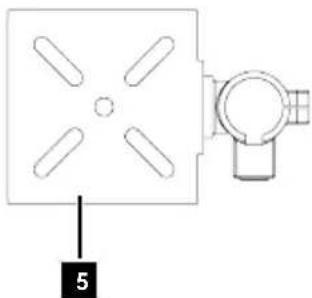
- Drilling table (5)
- Floor plate (6)
- Chuck (7)
8.1 Fitting the column tube (4) (Fig. 3)
- Place the column tube (4) on the floor plate (6).
- Use the four M8x20 mm hexagonal screws (4a) to fit the column tube (4) to the floor plate (6). Use an open-ended spanner size 13.
Do not tighten the hexagonal screws too tight, as the thread could otherwise break in the floor plate (6).
8.2 Fitting the drilling table (5) (Fig. 4)
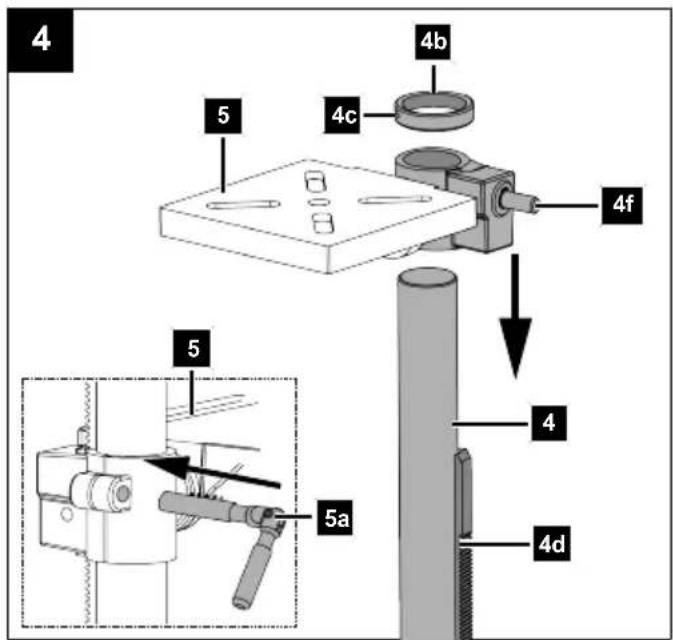
- Remove the stop ring (4b) from the column tube (4) by undoing the grub screw (4c). Use a 3 mm Allen key (14).
- Place the drilling table (5) onto the column tube (4) and the rack (4d).
- Push the drilling table (5) into a lower position and use the locking screw (5a) to secure it.
- Place the stop ring (4b) again onto the column tube (4) and tighten the grub screw (4c). Use a 3 mm Allen key (14).
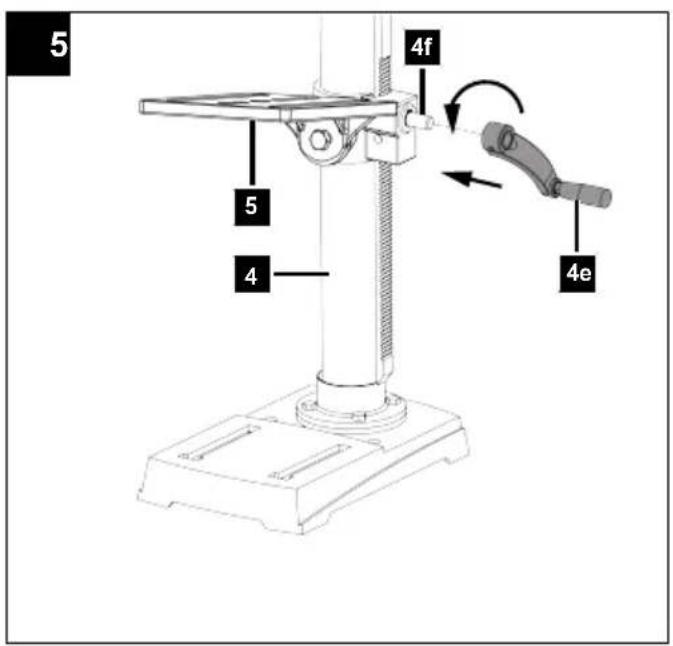
8.3 Mounting the crank mounting (4f) and crank (4e) (Fig. 5)
- Screw the crank mounting (4f) onto the thread of the height adjustment in a clockwise direction. Use a Phillips screwdriver.
- Place the crank (4e) onto the crank mounting (4f) and secure it with the grub screw. Use a 3 mm Allen key (12).
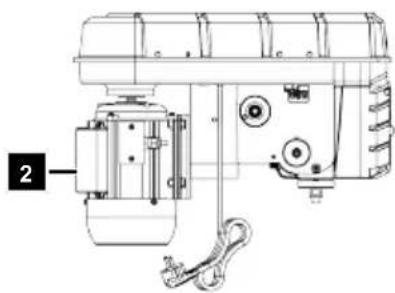
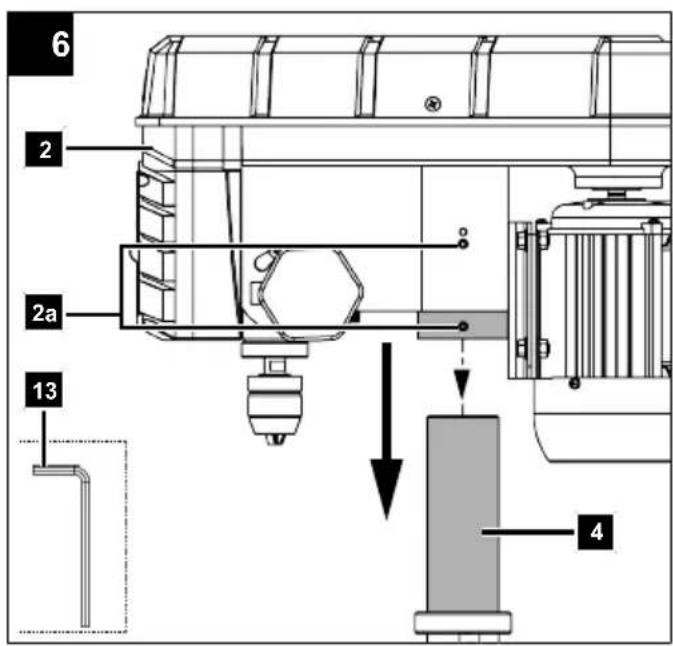
8.4 Fitting the motor unit (2) (Fig. 6)
- Attach the motor unit (2) to the column tube (4).
- Use the two clamping screws (2a) to secure the motor unit (2) to the side. Use a 4 mm Allen key (13).
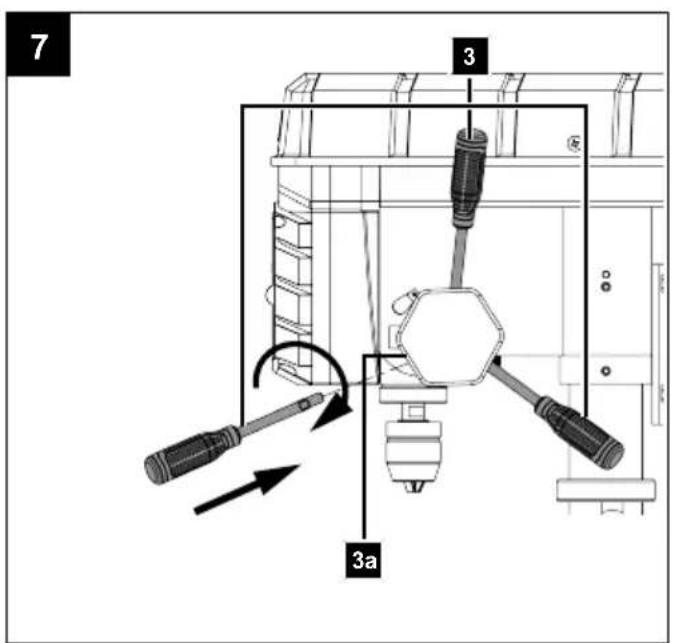
8.5 Mounting the handles (3) (Fig. 7)
- Screw the handles (3) into the mounting holes of the hand spindle guide (3a) and tighten them hand-tight.
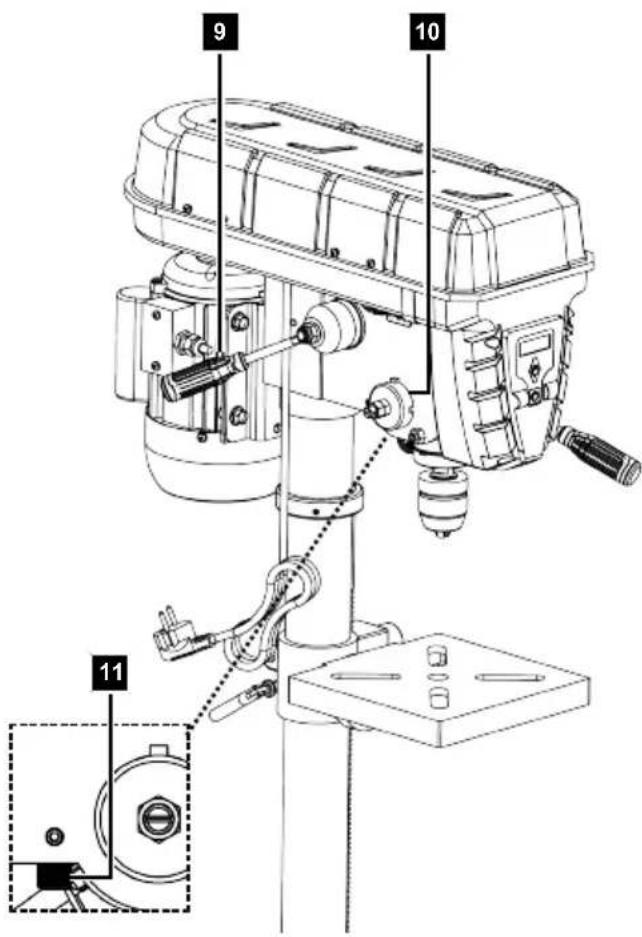
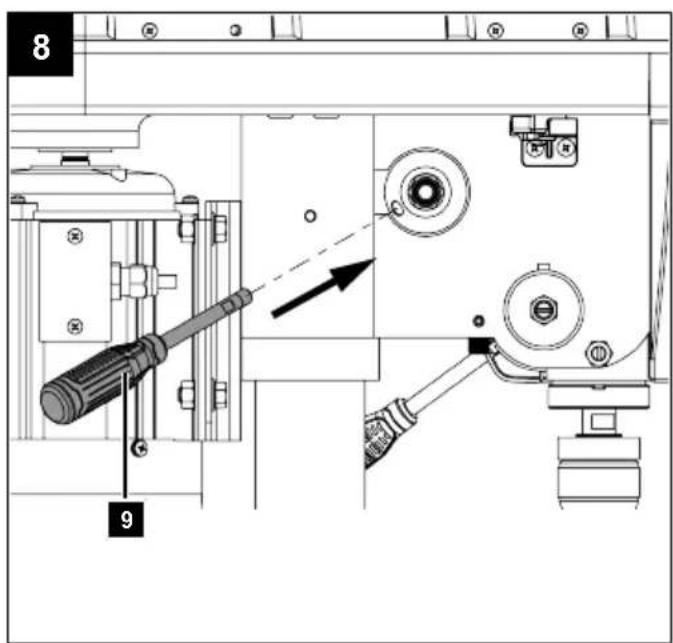
8.6 Fit adjusting lever (9) (Fig. 8)
- Screw the adjusting lever (9) clockwise into the mounting hole and tighten them hand-tight.
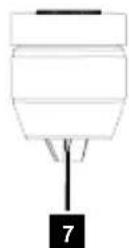
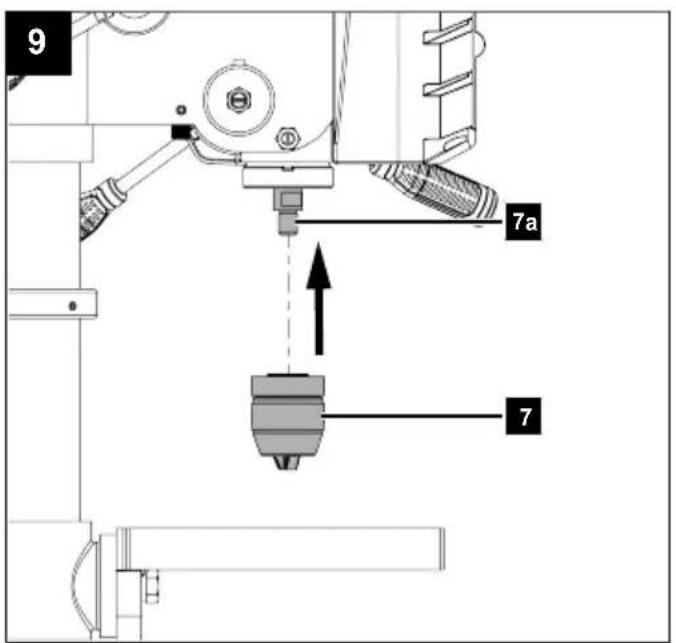
8.7 Attaching the chuck (7) (Fig. 9)
- Attach the chuck (7) in the cone on the drill spindle (7a).
- Tap the chuck tip gently to secure the chuck (7). Use a plastic hammer to do this.
9 Before commissioning

WARNING
Always remove the mains plug before carrying out adjustments on the product.
Tool required:
- Allen key, 3 mm (12)
- 2x open-ended spanner, size 14 mm*
- 2x open-ended spanner, size 17 mm*
- Open-ended spanner AF 18 mm*
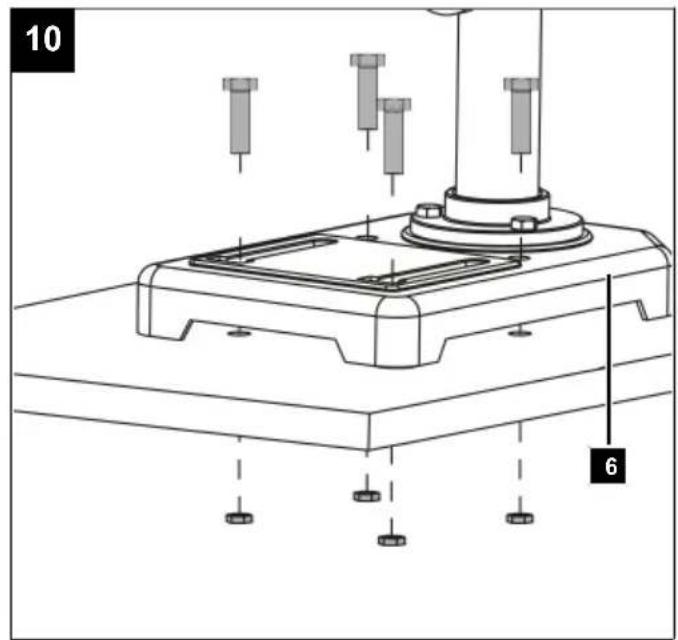
9.1 Use as a stationary machine (Fig. 10)
The product must be mounted on a workbench for continuous use.
- The product must be securely installed, i.e. bolted down on a workbench or fixed machine stand.
-
There are fastening holes in the floor plate (6) for this purpose.
-
Mark the drill holes.
-
Place the product as it will be installed later.
- Mark the positions of the holes to be drilled on the workbench.
These are given by the mounting holes in the floor plate (6).
- Drill the holes (at least 11 mm diameter) through the workbench.
- Place the product over the drilled holes congruent with the fastening holes in the floor plate (6) and insert the screws* (M10) with a suitable length through the holes from above.
- Screw the nuts* onto the screws* (M10) from below.
- Use two 17mm open-ended spanners to tighten the nuts*.
* = not included in the scope of delivery!
9.2 Adjusting the drilling table (5) (Fig. 11, 12)
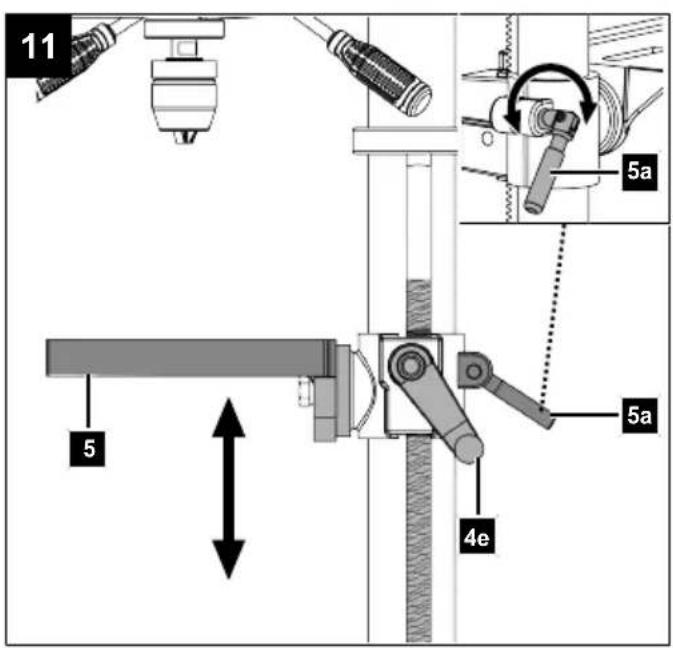
9.2.1 Setting the drilling table height (Fig. 11)
- Loosen the locking screw (5a).
- Adjust the drilling table (5) to the required height using the crank (4e).
- Re-secure the locking screw (5a).
Note:
The laser may need to be readjusted. See 9.7.
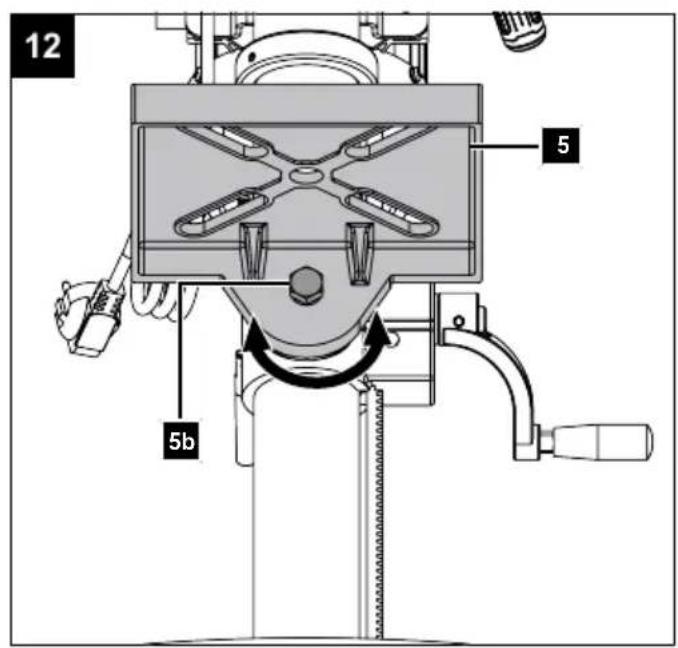
9.2.2 Inclining the drilling table (5) (Fig. 12)
You can also adjust the inclination of the drilling table (5).
- To do this, loosen the locking screw (5b) under the drill table (5). Use an open-end spanner size 18.
- Incline the drilling table (5) as required up to max. 45^ to the right or left.
- Secure the locking screw (5b) again. Use an open-end spanner size 18.
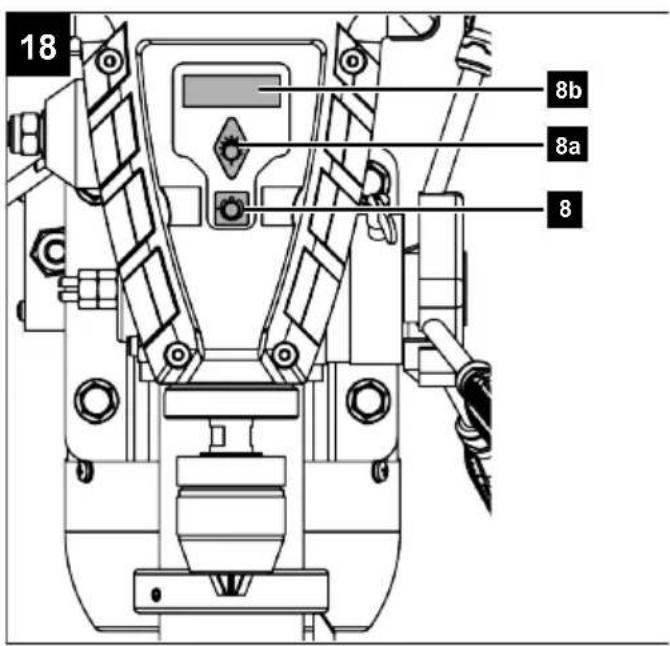
9.3 Switching the laser on/off (Fig. 18)
Switching on
- Insert the mains plug into a properly fused mains socket.
- Press the on/off switch (8a) to switch the laser on.
Switching off
- Press the on/off switch (8a) again to switch the laser off.
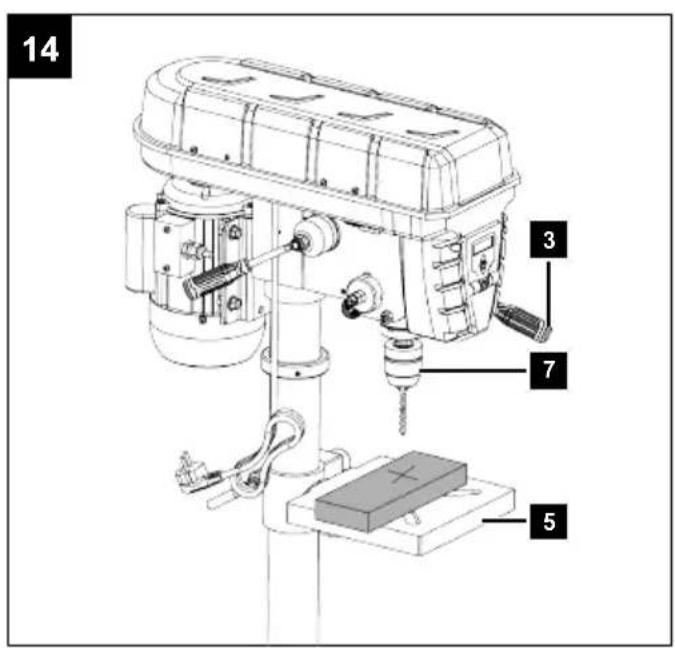
9.4 Aligning the workpiece (Fig. 14, 18)
- Switch the laser on as described in 9.3.
- The intersection of the two laser lines shows you the centre point of the drill. Adjust the position of the intersection if required, as described under 9.7.
- Align your marking on the workpiece with the laser cross.
9.5 Securing the workpiece
- Ensure that the workpiece is securely fastened.
- Do not work with workpieces that are to small to be clamped in place.
- Only machine workpieces that can be clamped securely between the clamping jaws. The workpiece must not be too large, small or soft. Otherwise, it cannot be clamped securely.
- Use additional workpiece supports, if required for workpiece stability.
- Secure the workpiece. Use clamping devices/bench vice to hold the workpiece in place. In this manner, it is held more securely than with your hand.
9.6 Inserting/removing the tool attachment (Fig. 14)

WARNING
Tool attachments may be sharp and become hot during use. Always wear protective gloves when handling the tool attachments.

CAUTION
Keep your hands away from the tool attachment when the product is in operation.
Check that the tool attachment is fitted securely.
Tool attachments that are not fitted correctly or securely may come loose during operation and injure you.
-
Turn the chuck (7) until the chuck opening is large enough to insert the tool attachment*.
-
Insert the tool attachment* into the chuck (7) as far as possible.
- Turn the chuck (7) clockwise to insert the tool attachment*.
- To take out the tool attachment* again, untwist the chuck (7) and remove the tool attachment*.
* = may not be included in the scope of delivery!
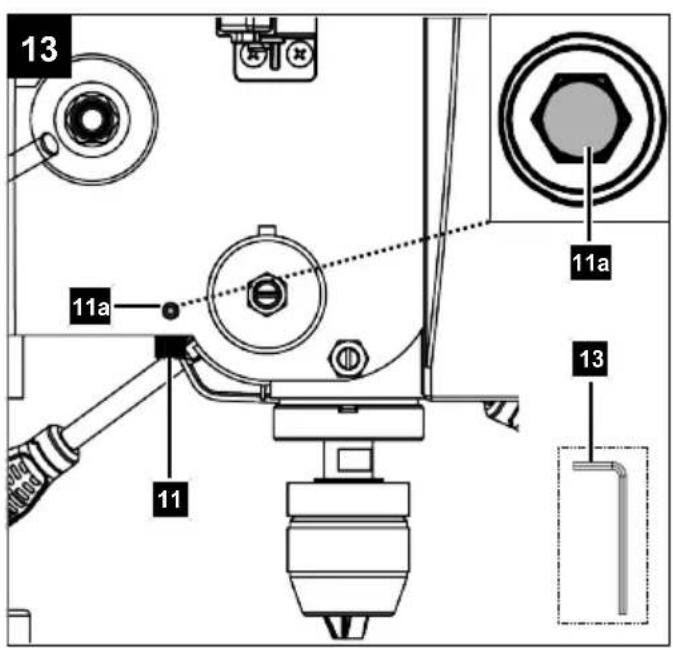
9.7 Checking/setting the laser (Fig. 13, 14, 18)
Checking the laser:
- Tension a tool attachment with a small diameter into the chuck (7) as described in 9.6.
- Place a workpiece on the drilling table (5) underneath the tool attachment.
- Switch the laser on as described in 9.3.
- Lower the tool attachment onto the workpiece using the handles (3).
- The intersection of the laser cross should be exactly at the tip of the tool attachment.
Adjusting the laser:
- Loosen the grub screw (11a). Use a 3 mm Allen key (12).
- Turn the laser lens (11) to adjust the line of the laser.
- Retighten the grub screw (11a). Use a 3 mm Allen key (12).
- Repeat the process on the other side.
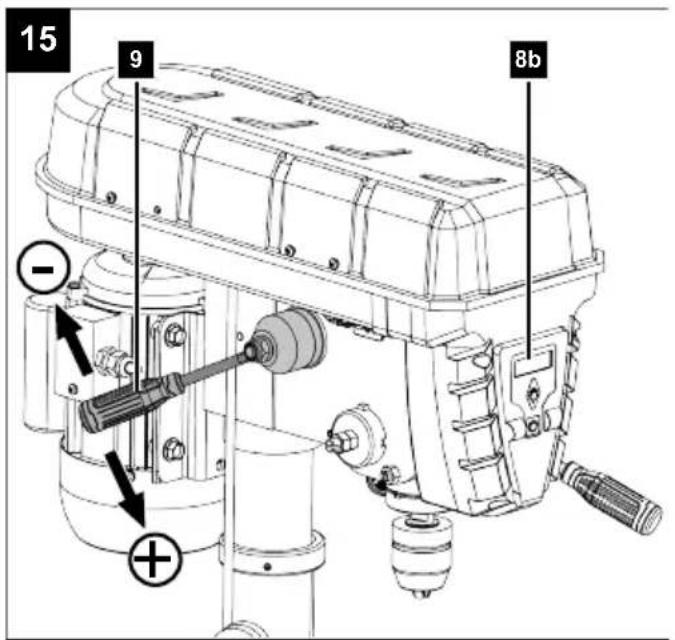
9.8 Setting the speed (Fig. 15)
WARNING
Danger of crushing!
Pay attention to your fingers!
ATTENTION
The speed may only be adjusted when the motor is running.
Note:
The speed of the product can be read on the display.
- Switch the drive on as described in 10.1.
- Move the adjusting lever (9) in the desired direction to increase or decrease the speed. You can read the current speed on the speed indicator (8b).
9.9 Adjusting the drilling depth (Fig. 16)
- Place the required tool attachment into the chuck (7) as described in 9.6.
- Open the locking screw (3c).
- Lower the drill spindle (7a) using the handles (3) until the tool attachment is on the workpiece and hold it in this position.
- Set the desired reference point on the scale ring (3b).
- Tighten the locking screw (3c).
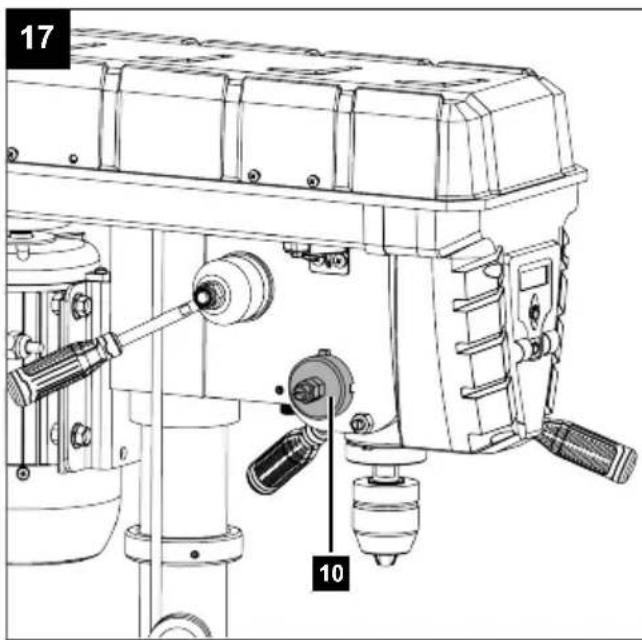
9.10 Adjusting the spindle return spring (Fig. 9, 17)
- For more working space, lower the drill table as described under9.2.1
- Insert a slotted screwdriver into the front lower groove (10e) and keep this in position.
- Remove the M10 counternut (10a). Use a 16 mm open-ended spanner.
- Loosen the M10 nut (10b) and pull the spring cap (10) outwards until the notch is released from the hub (10c). Note that the spring is pretensioned.
- Carefully turn the spring cap (10) anti-clockwise until the notch (10d) is aligned with that of the hub (10c) and can be pressed in. Use a slotted screwdriver.
-
Check the spring tension by lowering the drill spindle (7a) to the lowest position using the handles (3). Hold the spring cap (10) in position while doing so. If necessary, adjust the spring tension using the spring cap (10).
-
Clockwise - reduces the spring tension.
-
Anti-clockwise - increases the spring tension.
-
Once you have reached the desired spring tension, retighten the M10 nut (10b).
-
Lock the M10 nut (10b) with the M10 lock nut (10a). Use two size 14 open-end spanners.
10 Operation
ATTENTION
Always make sure the product is fully assembled before commissioning!
WARNING
Danger of injury!
The on/off switch and the safety switch must not be locked!
- Do not work with the product if the switch is damaged.
- Ensure that the product is in working order before each use.
WARNING
Danger of injury!
Do not insert the mains plug into the socket until you are ready to use the product.
WARNING
Tool attachments may be sharp and become hot during use. Always wear protective gloves when handling the tool attachments.
Notes:
- Prior to commissioning, all covers and safety devices must be mounted correctly. Damaged or illegible stickers must be replaced.
- Before connecting of the product, make certain that the data on the type plate matches with the mains power data.
- Remember that when the starter mechanism with motorised products is commissioned, the cutting tool also starts operating.
- Never operate the product with defective Protective devices or without safety devices.
- Before switching on, make sure that the product does not touch any objects.
- Check the material to be processed for foreign objects such as nails, screws etc. and remove them.
- Make sure that the surface to be treated is dust-free and dry.
• After switching on, wait until the product has reached its maximum speed. Only then should you start working.
10.1 Switching the product on/off (Fig. 18)
Switching on
- Insert the mains plug into a properly fused mains socket.
- Press the on/off switch (8) to switch the product on.
Switching off
- Press the on/off switch (8) again to switch the product off.
- Wait until the product has come to a standstill.
11 Working instructions
ATTENTION
The feed and the spindle speed are decisive for the attachment tool's service life!
- The cutting speed is determined by the drill spindle speed and the diameter of the attachment tool.
- In principle, the greater the attachment tool diameter, the lower the speed should be.
- The stronger the workpiece, the higher the cutting pressure must be.
- Pulling the attachment tool back repeatedly ensures that the chips can be removed easier.
- Chip removal is made more difficult in deeper holes in particular. Reduce the feed and the speed here.
- In order to prevent excessive wear to the attachment tool cutting edge, first pre-drill holes with a diameter of more than 8.0 mm using an attachment tool with a smaller diameter.
- Do not allow the drill to rattle on the workpiece, as this will most likely lead to a significant increase in vibration levels.
- The workpiece must be clamped or fastened to the workpiece support. Do not drill into workpieces that are too small to be securely clamped. Holding the workpiece by hand can lead to injuries.
11.1 Drilling (Fig. 9, 14)
- Use a punch* or a sharp nail* to mark the location to be drilled on the workpiece.
- Secure the workpiece to be machined on the drilling table (5). (See 9.5).
- Insert a tool attachment into the chuck (7) (see 9.6).
- Use the handles (3) to lower the drill spindle (7a) and centre the tool attachment over the point to be drilled on the workpiece. Proceed as described under 9.4.
- Switch on the product (see 10.1).
- Use the handles (3) to lower the drill spindle (7a).
- Drill into the workpiece with an appropriate feed and to the required depth.
- Select the correct lubricant based on the workpiece and drill bit materials, as well as the type of hole.
- Ensure any required chip breaking on the way to the required drilling depth.
- Use the handles (3) to guide the drill spindle (7a) back to the starting position slowly.
* = may not be included in the scope of delivery!
11.2 Countersinking and centre drilling
You can also use this product for countersinking or centre drilling.
Note that countersinking must be performed at the lowest speed while a high speed is required for centre drilling.
11.3 Machining wood
Note:
Note that suitable dust extraction must be used when machining wood, as wood dust can be harmful to health. Wear a suitable dust protection mask when performing work that generates dust.
12 Cleaning and maintenance

WARNING
Have maintenance and repair tasks that are not described in this operating manual, carried out by a specialist workshop. Use only original spare parts.

WARNING
Improper maintenance or cleaning work can cause injuries!

WARNING
The product may start unexpectedly and cause injuries and burns during cleaning, repair and maintenance work.
- Switch the product off.
– Pull out the mains plug. - Allow the product to cool.
- Remove the tool attachment.
12.1 Cleaning
- Keep protective devices, air vents and the motor housing as free of dust and dirt as possible. Rub the product clean with a clean cloth* or blow it off with compressed air* at low pressure. We recommend that you clean the product directly after every use.
- Never immerse the product in water or other liquids for cleaning.
• Always keep the product clean, dry and free from oil or grease. Remove dust after each use and before storage. - Do not use chemical, alkaline, abrasive or other aggressive cleaning agents or disinfectants to clean the product, as these may damage the surfaces.
- Do not clean the tool attachment while it is still in operation.
- Check the bench vice and the clamping jaws. They must be clean, free of chips and other residues.
12.2 Maintenance
The product is maintenance-free.
13 Transport (Fig. 1)
- To transport the product, disconnect the it from the power supply and set it up in the new position you want to use it in.
- The product must be secured against tipping and slipping during transport in vehicles in order to prevent damage and injuries.
- Protect the product from impacts, shocks and severe vibrations, e.g. during vehicular transport.
- Do not transport the product by the motor unit.
Note:
Carry the product together with a second person if possible.
- Reach under the floor place (6) with one hand and use the other hand to stabilise the product on the transmission cover (1).
14 Storage
Store the product and its accessories in a dark, dry and frost-free place that is inaccessible to children.
The optimum storage temperature is between 5°C and 30°C.
Store the product in its original packaging.
Cover the product to protect it from dust or moisture. Store the operating manual with the product.
15 Electrical connection
The electrical motor installed is connected and ready for operation. The connection complies with the applicable VDE and DIN provisions. The customer's mains connection as well as the extension cable used must also comply with these regulations.
15.1 Damaged electrical connection cables
The insulation on electrical connection cables is often damaged.
This may have the following causes:
- Pressure points, where connection cables are passed through windows or doors,
- Kinks where the connection cable has been improperly fastened or routed,
- Places where the connection cables have been cut due to being driven over,
• Insulation damage due to being ripped out of the wall socket, - Cracks due to the insulation ageing.
Such damaged electrical connection cables must not be used and are life-threatening due to the insulation damage.
Check the electrical connection cables for damage regularly. Ensure that the connection cables are disconnected from electrical power when checking for damage.
Electrical connection cables must comply with the applicable VDE and DIN provisions. Only use connection cables of the same designation.
The printing of the type designation on the connection cable is mandatory.
Safety information for replacing damaged or defective mains connection cables
Connection type Y
If it is necessary to replace the mains connection cable, this must be done by the manufacturer or their representative to avoid safety hazards.
15.2 AC motor
Connections and repair work on the electrical equipment may only be carried out by electricians.
• The mains voltage must be 230 V\~.
- Extension cables up to 25 m long must have a cross-section of 1.5 mm ^2 .
16 Repair and ordering spare parts
After repairs or maintenance, make sure that all safety-related parts are installed and are in perfect condition. All parts which may cause injury must be kept where they are inaccessible to children or others.
ATTENTION
According to the German Product Liability Act, no liability is accepted for damage caused by improper repairs or by not using original spare parts.
Such work should be performed by a customer service centre or an authorised specialists. The same applies to accessory parts.
Spare parts and accessories can be obtained from our Service Centre. To do this, scan the QR code on the front page.
Connections and repairs
Connections and repair work on the electrical equipment may only be carried out by electricians.
16.1 Ordering spare parts
Please provide the following information when ordering spare parts:
- Model designation
- Item number
- Type plate data
16.2 Service information
With this product, it is necessary to note that the following parts are subject to natural or usage-related wear, or that the following parts are required as consumables.
Wearing parts: Drive belt*
* = may not be included in the scope of delivery!
17 Troubleshooting
The following table shows fault symptoms and describes remedial measures in the event of your product failing to work properly. If you cannot localise and rectify the problem with this, please contact your service workshop.
| Fault Possible cause Remedy | ||
| The spindle moves into its starting position too quickly or too slowly. | Spindle return spring is incorrectly adjusted. | Set the spindle return spring. |
| The chuck always comes loose from the spindle despite continued fastening. | Dirt, grease or oil on the spindle or on the inside of the chuck. | Use a household detergent to clean the surface of the spindle and chuck. |
| High noise level during operation. | The spindle is too dry. Test the spindle. | |
| The pulley on the spindle is loose. | Check that the nuts on the pulley are tight and re-tighten if necessary. | |
| The pulley on the motor is loose. | Tighten the set screw on the motor pulley | |
| The drill bit wears out Incorrect speed. | Change the speed. | |
| No chips come out of the hole. | Move the drill bit out of the hole regularly in order to pull the chips out. | |
| The drill bit is blunt. | Sharpen the drill bit. | |
| Insufficient downward pressure. | Increase the downward pressure. | |
| The drill bit slips or the hole is not round. | Hard places in the wood or the length and angle of the drill bit is different. | Sharpen the drill bit. |
| The drill bit is bent. | Replace the drill bit. | |
| The drill bit gets stuck in the workpiece. | The workpiece and drill bit are twisted or the downward pressure is too great. | Put a base underneath the workpiece or secure it. |
| Insufficient V-belt tension. | Check the V-belt tension and adjust it if necessary. | |
| The drill bit drifts and vibrates excessively. | The drill bit is bent. | Use a straight drill bit. |
| The spindle bearing is worn excessively. | Have the spindle bearing replaced. | |
| The drill is not centred in the chuck. | Check the centring. | |
| The chuck is not fastened correctly. | Fasten the chuck correctly. | |
18 Disposal and recycling
Notes for packaging


The packaging materials are recyclable. Please dispose of packaging in an environmentally friendly manner.
Notes on the electrical and electronic equipment act [ElektroG]
![SCHEPPACH TBM250Vario - Notes on the electrical and electronic equipment act [ElektroG] - 1](/content/2026/04/739661/images/1c1d5ec8924f76a9f6f70818ae9dc03c2463251a8a1121995f86df82348bfcd0.jpg)
Waste electrical and electronic equipment does not belong in household waste, but must be collected and disposed of separately!
- Used batteries or rechargeable batteries that are not installed permanently in the old appliance must be removed non-destructively before disposal! Their disposal is regulated by the battery act.
- Owners or users of electrical and electronic devices are legally obliged to return them after use.
- The end user is responsible for deleting their personal data from the old device being disposed of!
- The symbol of the crossed-out dustbin means that waste electrical and electronic equipment must not be disposed of with household waste.
- Waste electrical and electronic equipment can be handed in free of charge at the following places:
– Public disposal or collection points (e.g. municipal works yards)
- Points of sale of electrical appliances (stationary and online), provided that dealers are obliged to take them back or offer to do so voluntarily.
- Up to three waste electrical devices per type of device, with an edge length of no more than 25 centimetres, can be returned free of charge to the manufacturer without prior purchase of a new device from the manufacturer or taken to another authorised collection point in your vicinity.
– Further supplementary take-back conditions of the manufacturers and distributors can be obtained from the respective customer service.
- If the manufacturer delivers a new electrical appliance to a private household, the manufacturer can arrange for the free collection of the old electrical appliance upon request from the end user. Please contact the manufacturer's customer service for this.
• These statements only apply to devices installed and sold in the countries of the European Union and which are subject to the European Directive 2012/19/EU. In countries outside the European Union, different regulations may apply to the disposal of waste electrical and electronic equipment.
19 EU Declaration of Conformity
Translation of the original Declaration of Conformity
Manufacturer:
Scheppach GmbH
Günzburger Straße 69
D-89335 Ichenhausen
We declare under our sole responsibility that the product described here complies with the applicable directives and standards.
Brand: SCHEPPACH
Art. designation: Bench drill TBM250 Vario
Item No. 5906834901
EU directives:
2014/30/EU, 2006/42/EC, 2011/65/EU*,
* The object of the declaration described above fulfils the regulations of the directive 2011/65/EU of the European Parliament and Council from 8th June 2011, on the restriction of the use of certain hazardous substances in electrical and electronic equipment.
Applied standards:
EN 62841-1:2015/A11:2022;
EN ISO 12100:2010;
EN IEC 55014-1:2021;
EN IEC 55014-2:2021;
EN IEC 61000-3-2:2019/A1:2021;
EN 61000-3-3:2013/A2:2021
Documentation authorised representative:
Ann-Katrin Bloching
Günzburger Str. 69
D-89335 Ichenhausen
Division Manager Product Center

Head of Project Management
Sommaire
Günzburger Straße 69
D-89335 Ichenhausen
Cher client,
13 Transport (fig. 1)
Günzburger Straße 69
D-89335 Ichenhausen
2014/30/UE, 2006/42/UE, 2011/65/EU*,
Division Manager Product Center
Andreas Pecher
Head of Project Management
Indice
Günzburger Straße 69
D-89335 Ichenhausen, Germania
Egregio cliente,
Controllo del laser:
Günzburger Straße 69
D-89335 Ichenhausen
Division Manager Product Center

Head of Project Management
Inhoudsopgave
Günzburger Straße 69
D-89335 Ichenhausen
Geachte klant,
13 Transport (afb. 1)
Günzburger Straße 69
D-89335 Ichenhausen
Division Manager Product Center

Head of Project Management
Índice
Günzburger Straße 69
Günzburger Straße 69
D-89335 Ichenhausen
Division Manager Product Center
Andreas Pecher
Head of Project Management
Índice
Günzburger Straße 69
8.5 Montar as pegas (3) (Fig. 7)
Günzburger Straße 69
D-89335 Ichenhausen
Division Manager Product Center

Head of Project Management
Obsah
Günzburger Straße 69
D-89335 Ichenhausen
Vážený zákazníku,
Günzburger Straße 69
D-89335 Ichenhausen
Division Manager Product Center

Andreas Pecher
Head of Project Management
Obsah
Günzburger Straße 69
D-89335 Ichenhausen
Vážený zákazník,
Günzburger Straße 69
D-89335 Ichenhausen
Division Manager Product Center

Andreas Pecher
Head of Project Management
Tartalomjegyzék
Günzburger Straße 69
D-89335 Ichenhausen
Tisztelt Ügyfelünk!
Günzburger Straße 69
D-89335 Ichenhausen
Division Manager Product Center
Andreas Pecher
Head of Project Management
Spis treści
Günzburger Straße 69
D-89335 Ichenhausen
Szanowny Kliencie
13 Transport (rys. 1)
Günzburger Straße 69
D-89335 Ichenhausen
Division Manager Product Center
Andreas Pecher
Head of Project Management
Popis sadržaja
1 Uvod.... 137
2 Opis proizvoda (sl. 1-18).... 138
3 Opseg isporuke (sl. 2).... 138
4 Namjenska uporaba.... 138
5 Sigurnosne napomene.... 138
6 Tehnički podatci 140
7 Raspakiravanje 141
8 Montaža 141
9 Prije stavljanja u pogon.... 142
10 Rukovanje 143
11 Napomene za rad.... 144
12 Čišćenje i održavanje.... 144
13 Transport (sl. 1).... 145
14 Skladištenje.... 145
15 Priključivanje na električnu mrežu.... 145
16 Popravak i naručivanje rezervnih dijelova...... 145
17 Otklanjanje neispravnosti.... 146
18 Zbrinjavanje i recikliranje.... 146
19 EU izjava o sukladnosti.... 147
20 Povećani crtež.... 297
Günzburger Straße 69
D-89335 Ichenhausen
Poštovani kupče
Želimo vam mnogo zadovoljstva i uspjeha prilikom rada s novim proizvodom.
Napomena:
Prema važećem njemačkom Zakonu o odgovornosti za proizvode, proizvođač ovog proizvoda ne odgovara za štete koje nastanu na ovom proizvodu ili koje ovaj proizvod uzrokuje u slučaju:
- neispravnog rukovanja
- nepridržavanja priručnika za uporabu
- popravaka koje obave drugi, neovlašteni stručnjaci
- montaže i zamjene neoriginalnih rezervnih dijelova
- nenamjenske uporabe
- kvarova električnog sustava zbog nepridržavanja propisa i odredaba o električnoj energiji VDE 0100, DIN 57113 / VDE0113.
13 Transport (sl. 1)
Günzburger Straße 69
D-89335 Ichenhausen
Division Manager Product Center

Andreas Pecher
Head of Project Management
Kazalo
Günzburger Straße 69
D-89335 Ichenhausen
Spoštovani kupec,
13 Transport (sl. 1)
Günzburger Straße 69
D-89335 Ichenhausen
Division Manager Product Center

Andreas Pecher
Head of Project Management
Sisukord
Günzburger Straße 69
D-89335 Ichenhausen
Austatud klient!
8.1 Sambatoru (4) monteerimine (joon. 3)
8.4 Mootorimooduli (2) monteerimine (joon. 6)
Günzburger Straße 69
D-89335 Ichenhausen
Division Manager Product Center

Andreas Pecher
Head of Project Management
Turinys
Günzburger Straße 69
D-89335 Ichenhausen
Gerbiamas kliente,
Günzburger Straße 69
D-89335 Ichenhausen
2014/30/ES, 2006/42/EB, 2011/65/ES*,
Division Manager Product Center

Andreas Pecher
Head of Project Management
Satura rādītājs
Günzburger Straße 69
Günzburger Straße 69
D-89335 Ichenhausen
Division Manager Product Center

Head of Project Management
Günzburger Straße 69
D-89335 Ichenhausen
Bästa Kund!
Günzburger Straße 69
Division Manager Product Center

Andreas Pecher
Head of Project Management
Sisällysluettelo
Günzburger Straße 69
D-89335 Ichenhausen
Arvoisa asiakas
Günzburger Straße 69
D-89335 Ichenhausen
Division Manager Product Center
Andreas Pecher
Head of Project Management
Indholdsfortegnelse
Günzburger Straße 69
D-89335 Ichenhausen, Tyskland
Kære kunde
13 Transport (fig. 1)
Günzburger Straße 69
D-89335 Ichenhausen, Tyskland
Division Manager Product Center

Head of Project Management
Innholdsfortegnelse
Günzburger Straße 69
D-89335 Ichenhausen
Kjære kunde
9.9 Stille inn boredybden (fig. 16)
13 Transport (fig. 1)
Günzburger Straße 69
D-89335 Ichenhausen
Division Manager Product Center

Head of Project Management
Съдържание
Günzburger Straße 69
D-89335 Ichenhausen, Германия
Уважаеми клиенти,
Günzburger Straße 69
D-89335 Ichenhausen
Division Manager Product Center

Andreas Pecher
Head of Project Management
Günzburger Straße 69
D-89335 Ichenhausen
Αξιότιμε πελάτη
Günzburger Straße 69
D-89335 Ichenhausen
EN IEC 55014-2:2021,
EN IEC 61000-3-2:2019/A1:2021,
EN 61000-3-3:2013/A2:2021
Division Manager Product Center

Andreas Pecher
Head of Project Management
Cuprins
Günzburger Straße 69
D-89335 Ichenhausen
Stimate client
13 Transport (fig. 1)
Günzburger Straße 69
D-89335 Ichenhausen
Division Manager Product Center
Andreas Pecher
Head of Project Management
Sadržaj
1 Uvod....275
2 Opis proizvoda (sl. 1-18).... 276
3 Opseg isporuke (sl. 2).... 276
4 Namenska upotreba.... 276
5 Sigurnosne napomene.... 277
6 Tehnički podaci 278
7 Raspakivanje....279
8 Montaža 279
9 Pre stavljanja u pogon.... 280
10 Rukovanje 282
11 Radna uputstva.... 282
12 Čišćenje i održavanje.... 283
13 Transport (sl. 1)....283
14 Skladištenje.... 283
15 Električni priključak.... 283
16 Popravka i naručivanje rezervnih delova ..... 284
17 Pomoć za otklanjanje smetnji.... 284
18 Odlaganje na otpad i reciklaža.... 285
19 EU izjava o usaglašenosti.... 285
20 Znak eksplozije 297
Günzburger Straße 69
D-89335 Ichenhausen
Poštovani kupče
13 Transport (sl. 1)
- Da biste transportovali proizvod, odvojite ga sa električne mreže i postavite ga na predviđeno mesto.
-
Da biste sprečili oštećenja i povrede, proizvod morate osigurati od prevrtanja i klizanja tokom transporta u vozilu.
-
Zaštitite proizvod od udaraca, udara i jakih vibracija, npr. pri transportu u vozilima.
- Ne transportujte proizvod na jedinici motora.
Napomena:
Günzburger Straße 69
D-89335 Ichenhausen
Division Manager Product Center

Andreas Pecher
Head of Project Management
İçindekiler
Günzburger Straße 69
D-89335 Ichenhausen
İthalatçı:
11.1 Delme (Res. 9, 14)
Günzburger Straße 69
D-89335 Ichenhausen
Division Manager Product Center

Head of Project Management
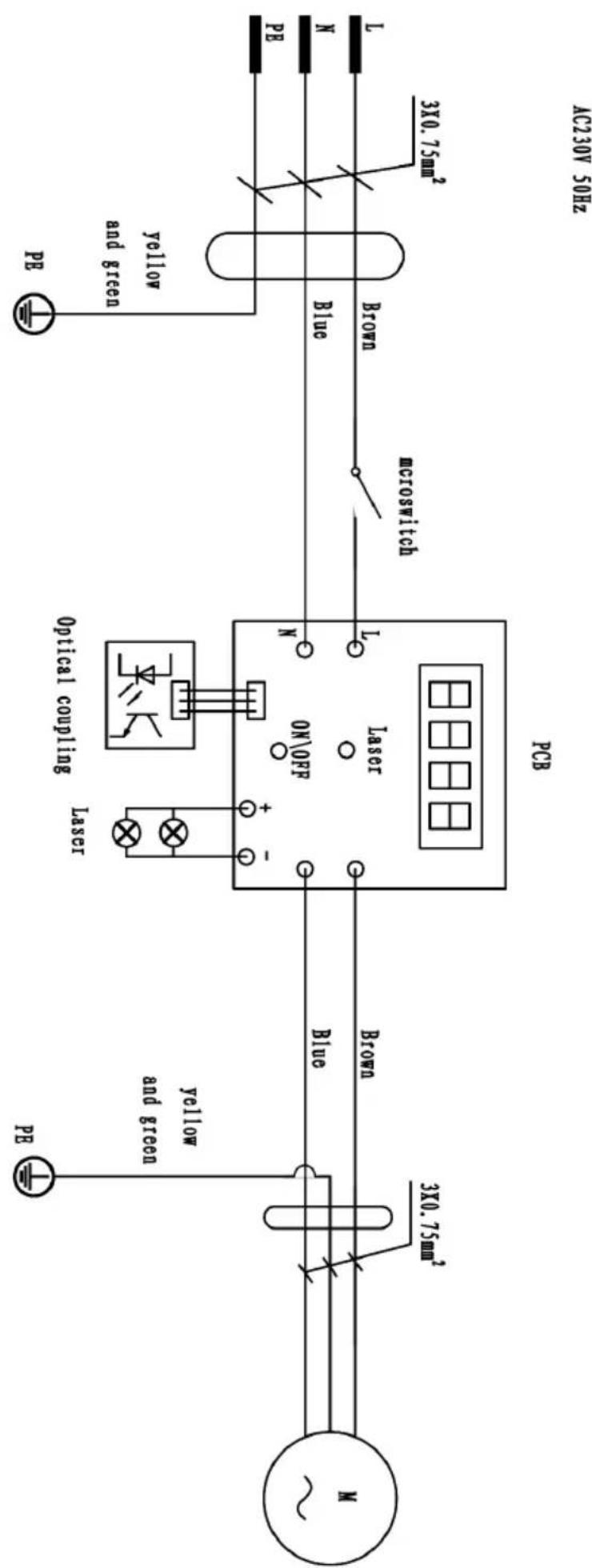
flowchart
graph LR
    A["AC230V 50Hz"] --> B["PCB"]
    B --> C["Laser"]
    C --> D["Optical coupling"]
    D --> E["Yellow and Green"]
    E --> F["pB"]
    B --> G["Microswitch"]
    G --> H["Brown"]
    H --> I["Blue"]
    B --> J["Blue"]
    B --> K["Brown"]
    K --> L["3X0.75mm²"]
    B --> M["3X0.75mm²"]
    N["~M"] --> O["Switch"]
    P["pB"] --> Q["Power Supply"]
    R["pB"] --> S["Power Supply"]
    T["pB"] --> U["Power Supply"]
Garantie DE
Obvious defects must be reported within 8 days after receipt of the goods, otherwise the purchaser loses all claims due to such defects. We guarantee our machines, if handled correctly, for the duration of the statutory warranty period from handover in such a way that we will replace free of charge any machine part that demonstrably becomes unusable within this period as a result of material or manufacturing defects. For parts that we do not manufacture ourselves, we only provide a warranty to the extent that we are entitled to warranty claims against the upstream suppliers. The purchaser shall bear the costs of fitting the new parts. Claims for conversion and reduction and other claims for damages are excluded.
Garantie FR



- TBM250Vario
- Inhaltsverzeichnis
- Verehrter Kunde
- Transport (Abb. 1)
- Garantiebedingungen
- Explanation of the symbols on the product
- Introduction
- Manufacturer:
- Dear Customer
- Note:
- Product description (Fig. 1-18)
- Scope of delivery (Fig. 2)
- Item Quantity Designation
- Proper use
- Explanation of the signal words in the operating manual
- DANGER
- WARNING
- CAUTION
- ATTENTION
- Safety instructions
- 1) Work area safety
- 2) Electrical safety
- 3) Personal safety
- 4) Power tool use and care
- 5) Service
- Safety instructions for transportable drills
- Residual risks
- Unpacking
- Assembly
- Fitting the column tube (4) (Fig. 3)
- Fitting the drilling table (5) (Fig. 4)
- Mounting the crank mounting (4f) and crank (4e) (Fig. 5)
- Fitting the motor unit (2) (Fig. 6)
- Mounting the handles (3) (Fig. 7)
- Fit adjusting lever (9) (Fig. 8)
- Attaching the chuck (7) (Fig. 9)
- Before commissioning
- Use as a stationary machine (Fig. 10)
- Adjusting the drilling table (5) (Fig. 11, 12)
- Setting the drilling table height (Fig. 11)
- Inclining the drilling table (5) (Fig. 12)
- Switching the laser on/off (Fig. 18)
- Switching on
- Switching off
- Aligning the workpiece (Fig. 14, 18)
- Securing the workpiece
- Inserting/removing the tool attachment (Fig. 14)
- Check that the tool attachment is fitted securely.
- Checking/setting the laser (Fig. 13, 14, 18)
- Checking the laser:
- Adjusting the laser:
- Setting the speed (Fig. 15)
- Adjusting the drilling depth (Fig. 16)
- Adjusting the spindle return spring (Fig. 9, 17)
- Operation
- Danger of injury!
- Notes:
- Switching the product on/off (Fig. 18)
- Working instructions
- Drilling (Fig. 9, 14)
- Countersinking and centre drilling
- Machining wood
- Cleaning and maintenance
- Cleaning
- Maintenance
- Transport (Fig. 1)
- Storage
- Electrical connection
- Damaged electrical connection cables
- Safety information for replacing damaged or defective mains connection cables
- Connection type Y
- AC motor
- Repair and ordering spare parts
- Connections and repairs
- Ordering spare parts
- Service information
- Troubleshooting
- Disposal and recycling
- Notes for packaging
- Notes on the electrical and electronic equipment act [ElektroG]
- EU Declaration of Conformity
- Translation of the original Declaration of Conformity
- EU directives:
- Applied standards:
- Documentation authorised representative:
- Sommaire
- Cher client,
- Indice
- Egregio cliente,
- Controllo del laser:
- Inhoudsopgave
- Geachte klant,
- Transport (afb. 1)
- Índice
- Montar as pegas (3) (Fig. 7)
- Obsah
- Vážený zákazníku,
- Vážený zákazník,
- Tartalomjegyzék
- Tisztelt Ügyfelünk!
- Spis treści
- Szanowny Kliencie
- Transport (rys. 1)
- Popis sadržaja
- Poštovani kupče
- Napomena:
- Transport (sl. 1)
- Kazalo
- Spoštovani kupec,
- Sisukord
- Austatud klient!
- Sambatoru (4) monteerimine (joon. 3)
- Mootorimooduli (2) monteerimine (joon. 6)
- Turinys
- Gerbiamas kliente,
- Satura rādītājs
- Bästa Kund!
- Sisällysluettelo
- Arvoisa asiakas
- Indholdsfortegnelse
- Kære kunde
- Innholdsfortegnelse
- Kjære kunde
- Stille inn boredybden (fig. 16)
- Съдържание
- Уважаеми клиенти,
- Αξιότιμε πελάτη
- Cuprins
- Stimate client
- Sadržaj
- İçindekiler
- Delme (Res. 9, 14)
- Garantie DE
- Garantie FR
Brand : SCHEPPACH
Model : TBM250Vario
Category : Drill