
BLV3000E - Blower SCHEPPACH - Free user manual and instructions
Find the device manual for free BLV3000E SCHEPPACH in PDF.


| Product type | Electric leaf blower / vacuum |
| Brand | Scheppach |
| Model | BLV3000E |
| Rated power | 3000 W |
| Voltage / Frequency | 230-240 V ~ 50 Hz |
| Motor speed | 8000 - 14000 min⁻¹ (variable) |
| Max. air speed | 70 m/s |
| Max. air flow | 720 m³/h |
| Mulching ratio | 10:1 |
| Collector bag volume | 40 litres |
| Weight (with accessories) | 3.2 kg |
| Protection class | II (double insulation) |
| Protection rating | IPX0 (non-waterproof) |
| Sound pressure level | 85.8 dB (blower) / 91.8 dB (vacuum) |
| Guaranteed sound power level | 103.2 dB (blower) / 104.5 dB (vacuum) |
| Functions | Blowing, vacuuming, shredding |
| Wheels | Yes (2 wheels) |
| Transport strap | Yes (with carabiner) |
| Speed regulator | Yes, 6 positions |
| Safety | Overload protection, limit switch |
| Max. extension cord length | 50 m (section 2.5 mm²) |
| Wear parts | Collector bag, wheels |
| Maintenance | Clean regularly, empty the bag, avoid moisture |
| Warranty | Statutory (depending on country) |
Frequently Asked Questions - BLV3000E SCHEPPACH
User questions about BLV3000E SCHEPPACH
0 question about this device. Answer the ones you know or ask your own.
Ask a new question about this device
Download the instructions for your Blower in PDF format for free! Find your manual BLV3000E - SCHEPPACH and take your electronic device back in hand. On this page are published all the documents necessary for the use of your device. BLV3000E by SCHEPPACH.
USER MANUAL BLV3000E SCHEPPACH
natural_image
Technical line drawing of a mechanical device with gears and lever mechanism (no text or symbols)
BLV3000E
| DE | Elektro-Laubsauger /-bläserOriginalBetriebsanleitung | 4 |
| GB | Electric leaf vacuum/blowerTranslation of original instruction manual | 21 |
| FR | Aspirateur souffleur électriqueTraduction des instructions d'origine | 35 |
1
Günzburger Straße 69
D-89335 Ichenhausen
Verehrter Kunde,
Homepage: https://www.scheppach.com/de/service
Explanation of the symbols on the product
Symbols are used in this manual to draw your attention to potential hazards. The safety symbols and the accompanying explanations must be fully understood. The warnings themselves will not rectify a hazard and cannot replace proper accident prevention measures.
 | Attention! Failure to observe the safety signs and warning information affixed to the machine and failure to observe the safety and operating instructions can result in serious injury or even death. |
 | Before commissioning, read and observe the operating manual and safety instructions! |
 | Wear hearing protection. |
 | Wear a dust protection mask. When machining wood and other materials, harmful dust may be generated. Do not machine material containing asbestos! |
 | Wear safety goggles. Sparks created during work or fragments, chippings and dust ejected by the product can cause sight loss. |
 | Wear non-slip safety shoes. |
 | If you interrupt the work, switch off the machine and unplug the mains plug. |
 | Tie long hair back in a hair net. |
 | Do not expose the product to rain. |
 | Attention! Danger of injury due to objects being flung away!Keep other people away. |
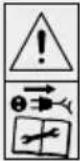 | Only carry out maintenance, modification, adjustment and cleaning work when the motor is switched off and the power is disconnected at the mains plug. |
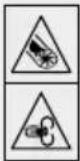 | Danger of injury! Never have your hands near the blades.Risk of injury due to rotating cutting roller! Keep hands and feet outside the openings when the product is running. |
 | Read the whole text of the operating instructions thoroughly before start up. |
 | Protection class II (double insulation) |
 | Use as a leaf vacuum. |
 | Use as a leaf blower. |
 | Max. air speed |
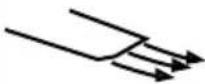 | Max. air volume |
 | Guaranteed sound power level |
 | The product complies with the applicable European directives. |
Table of contents: Page:
- Introduction....24
- Description of the product 24
- Scope of delivery 24
- Proper use 24
- Safety instructions 25
- Residual risks 28
- Technical data....28
- Unpacking 29
- Assembly 29
- Commissioning 30
- Operation 30
- Working instructions 31
- Electrical connection 32
- Cleaning....32
- Storage 32
- Maintenance 32
- Repair & ordering spare parts 33
- Disposal and recycling....33
- Troubleshooting 34
- Declaration of conformity .... 51
1. Introduction
Manufacturer:
Scheppach GmbH
Günzburger Straße 69
D-89335 Ichenhausen
Dear Customer,
We hope your new product brings you much enjoyment and success.
Note:
In accordance with the applicable product liability laws, the manufacturer of this product assumes no liability for damage to the product or caused by the product arising from:
- Improper handling
- Failure to comply with the operating manual
• Repairs carried out by third parties, unauthorised specialists
• Installing and replacing non-original spare parts - Improper use
- Failure of the electrical system in the event of the electrical regulations and VDE provisions 0100, DIN 57113 / VDE 0113 not being observed
Note:
The operating manual is part of this product. It includes important instructions for the safe, proper and economic operation of the product, for avoiding danger, for minimising repair costs and downtimes and for increasing the reliability and extending the service life of the product. In addition to the safety instructions in this operating manual, you must also observe the regulations applicable to the operation of the product in your country. Familiarise yourself with all operating and safety instructions before using the product. Only operate the product as described and for the specified areas of application. Keep the operating manual in a good place and hand over all documents when passing the product on to third parties.
2. Description of the product
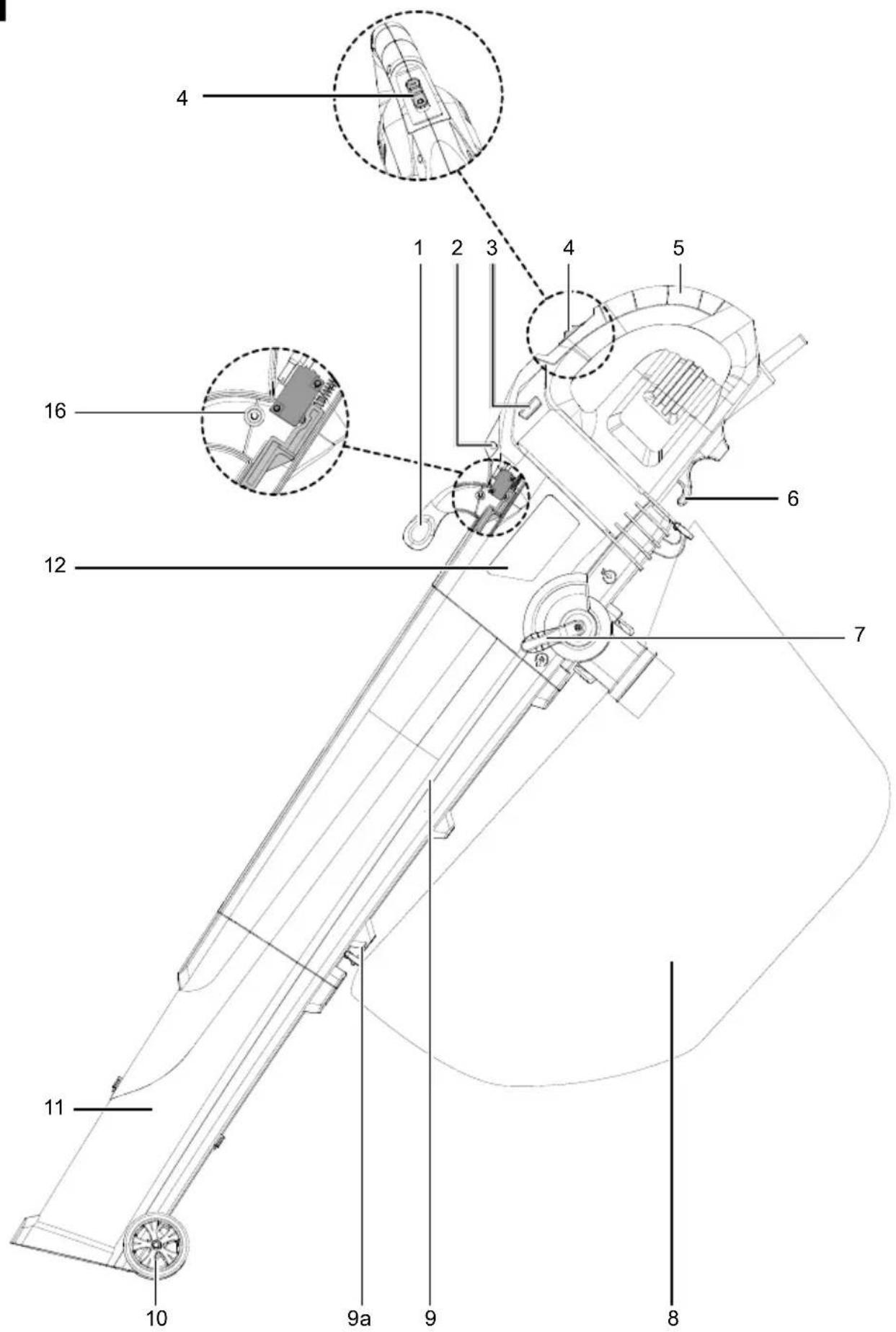
- Fronthandle
- Carrying strap attachment eye
- Speedcontrol
- On/off switch
- Rearhandle
- Cable strain relief
- Mode selector lever
- Collectionbag
8a. Rear collection bag
8b. Collection bag inlet with locking device
8c. Front collection bag
9. Medium blast/suction tube
9a Fronthooks
10. Wheels
11. Front blast/suction tube
12. Motorhousing
12a. Rearhooks
13. Carryingstrap
13a. Carabinerhook
14. Ejectionopening
15. Fastening screws (blow/suction pipe)
16. Limit switch
3. Scope of delivery
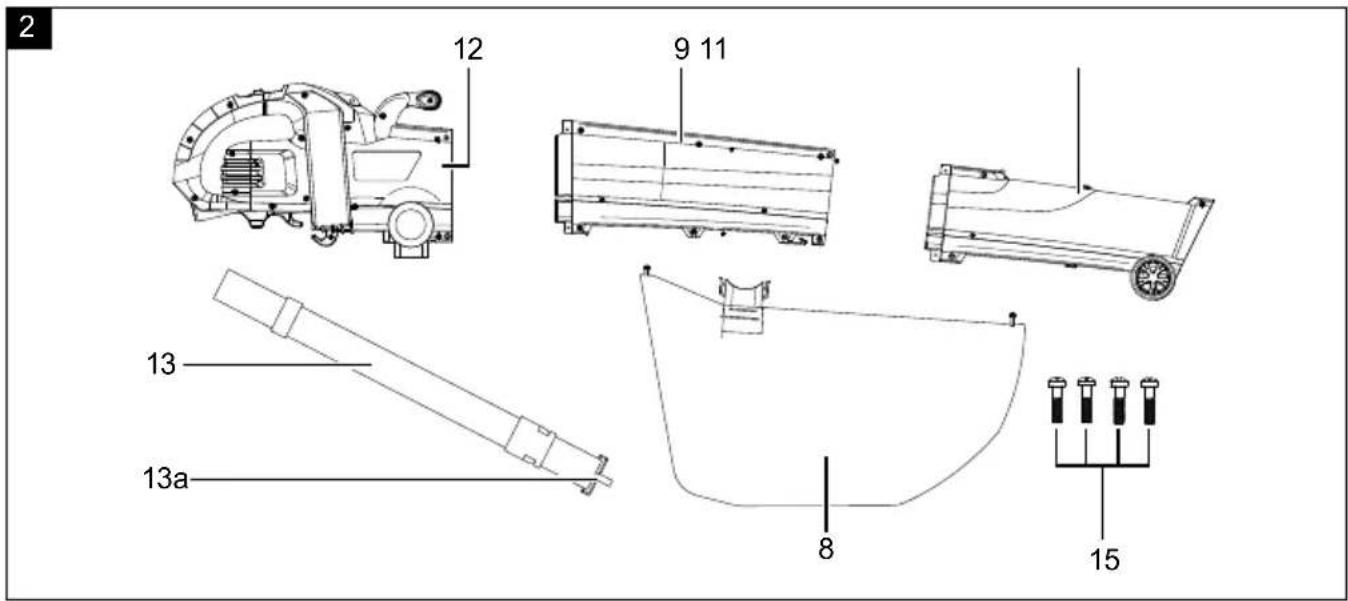
Item Quantity Designation
| 8 1x Collection bag | |
| 9 1x Medium blast/suction tube | |
| 10 | 1x Wheels |
| 11 | 1x Front blast/suction tube |
| 12 | 1x Motor housing |
| 13 | 1x Carrying strap |
| 15 | 4x Fixing screw M4x15 |
| 1x Operating manual | |
4. Proper use
Only use the electric leaf vacuum/blower for the following purposes:
- In blowing mode for collecting leaves or general garden waste such as prunings or for removing them from hard-to-reach places.
- In suction mode for vacuuming and shredding dry leaves and other light, loose and non-combustible garden waste.
- The product must not be used for collecting flammable or explosive products, hot embers, ashes, burning cigarettes and pieces of branches, sharp objects, metal objects, stones and other objects that could be dangerous for the operator. This can result in injuries and can damage the product.
The product may only be used in the intended manner. Any use beyond this is improper. The user/operator, not the manufacturer, is responsible for damages or injuries of any type resulting from this.
An element of the intended use is also the observance of the safety instructions, as well as the assembly instructions and operating information in the operating manual. Persons who operate and maintain the product must be familiar with the manual and must be informed about potential dangers.
The liability of the manufacturer and resulting damages are excluded in the event of modifications of the product. The product may only be operated with original parts and original accessories from the manufacturer.
The safety, operating and maintenance specifications of the manufacturer, as well as the dimensions specified in the technical data, must be observed.
Please note that our products were not designed with the intention of use for commercial or industrial purposes. We assume no guarantee if the product is used in commercial or industrial applications, or for equivalent work.
The product is intended for use by adults. Children under the age of 16 may only use the product when supervised.
The manufacturer is not liable for damage caused by improper use or incorrect operation.
Explanation of the signal words in the operating manual

DANGER
Signal word to indicate an imminently hazardous situation which, if not avoided, will result in death or serious injury!

CAUTION
Signal word to indicate a potentially hazardous situation which, if not avoided, could result in minor or moderate injury!
ATTENTION
Signal word to indicate a potentially hazardous situation which, if not avoided, could result in material damage to the product or property/possession!
5. Safety instructions
⚠ WARNING!
Read all safety information and instructions, illustrations and technical data provided with this product!
Failure to follow all instructions listed below may result in electric shock, fire and/or serious injury.
Save all warnings and instructions for future reference. The term “power tool” used in the safety instructions refers to mains-powered electrical tools (with a mains cable) and battery-powered electrical tools (without a mains cable).
General power tool safety warnings
⚠ WARNING!
This power tool generates an electromagnetic field during operation.
This field can impair active or passive medical implants under certain circumstances!
To reduce the risk of serious or fatal injury, we recommend that persons with medical implants consult their doctor and the manufacturer of the medical implant before operating the power tool!
5.1 Electrical safety
a) Power tool plugs must match the outlet. Never modify the plug in any way. Do not use any adapter plugs with earthed (grounded) power tools. Unmodified plugs and matching outlets will reduce risk of electric shock.
b) Avoid body contact with earthed or grounded surfaces, such as pipes, radiators, ranges and refrigerators. There is an increased risk of electric shock if your body is earthed or grounded.
c) Do not expose power tools to rain or wet conditions. Water entering a power tool will increase the risk of electric shock.
d) Do not abuse the cord. Never use the cord for carrying, pulling or unplugging the power tool. Keep cord away from heat, oil, sharp edges or moving parts. Damaged or entangled cords increase the risk of electric shock.
e) When operating a power tool outdoors, use an extension cord suitable for outdoor use. Use of a cord suitable for outdoor use reduces the risk of electric shock
f) If operating a power tool in a damp location is unavoidable, use a residual current device (RCD) protected supply. Use of an RCD reduces the risk of electric shock.
5.2 Personal safety
a) Stay alert, watch what you are doing and use common sense when operating a power tool. Do not use a power tool while you are tired or under the influence of drugs, alcohol or medication. A moment of carelessness when using electrical tools can result in serious injuries.
b) Wear personal protective equipment and always safety goggles. Wearing personal protective equipment, such as a dust mask, non-slip safety shoes, hard hat or hearing protection, depending on the type of protection, depending on the type and use of the power tool, reduces the risk of injury.
c) Prevent unintentional starting. Ensure the switch is in the off-position before connecting to power source and/or rechargeable battery, picking up or carrying the tool.
d) Carrying electric tools with your finger on the switch or connecting power tools to the power supply when they are already switched on invites accidents.
e) Remove any adjusting tools or spanners/keys before turning the power tool on. A wrench or a key left attached to a rotating part of the power tool may result in personal injury.
f) Avoid abnormal postures. Keep proper footing and balance at all times. This enables better control of the power tool in unexpected situations.
g) Wear suitable clothing. Do not wear loose clothing or jewellery. Keep your hair and clothing away from moving parts. Loose clothing, jewellery or long hair can be caught by moving parts.
h) If devices are provided for the connection of dust extraction and collection facilities, ensure these are connected and properly used. Use of dust extraction can reduce dust-related hazards.
i) Do not let familiarity gained from frequent use of tools allow you to become complacent and ignore tool safety principles. Careless behaviour can lead-to serious injuries within fractions of a second .
j) Do not work with the appliance in rain, thunderstorms and especially not when there is a risk of lightning.
k) Keep extension cords away from dangerous moving parts to avoid damage to the extension cable.
5.3 Work area safety
a) Keep your work area clean and well lit! Cluttered or dark areas invite accidents.
b) Do not work with the power tool in potentially explosive atmospheres containing flammable liquids, gases or dust! Power tools create sparks which may ignite the dust or fumes.
c) Keep children and other persons away when using the power tool! Distractions can cause you to lose control.
5.4 Power tool use and care
a) Do not overload the power tool! Use the appropriate power tool for your work! With the right power tool, you can work better and more safely in the specified power range!
b) Do not use a power tool if the switch is defective! Any power tool that cannot be controlled with the switch is dangerous and must be repaired.
c) Disconnect the plug from the socket and/or remove a removable battery before making device settings, changing insert tool parts or putting the power tool away! This precautionary measure prevents the power tool from starting unintentionally tool.
d) Keep unused power tools out of the reach of children! Do not allow anyone to use the power tool who is not familiar with it or has not read these instructions! Power tools are dangerous in the hands of untrained users.
e) Maintain power tools and tools with care! Check whether moving parts are working properly and are not jammed, whether parts are broken or damaged in such a way that the function of the power tool is impaired! Have damaged parts repaired before using the power tool! Many accidents are caused by poorly maintained power tools!
f) Keep cutting tools sharp and clean! Carefully maintained cutting tools with sharp cutting edges jam less and are easier to guide.
g) Use power tools, accessories, tools etc. in accordance with these instructions! Take into account the working conditions and the activity to be carried out! Use of the power tool for operations different from those intended could result in a hazardous situation.
h) Keep handles and grip surfaces dry, clean and free from oil and grease! Slippery handles and grasping surfaces do not allow for safe handling and control of the tool in unexpected situations.
5.5 Service
Only have your power tool repaired by qualified specialists and only with original spare parts! This ensures that safety of the electric tool is maintained.
5.6 Safety instructions for electric leaf vacuum/blowers
Instructions
a) Read through the operating instructions carefully. Familiarise yourself with the controls and proper operation of the machine.
b) Never allow children or persons who are not familiar with these instructions to use the machine. Local regulations may restrict the age of the user.
c) Note that the operator or user is responsible for accidents or hazards to other people or their property.
5.7 Preparation
a) Use ear protection and safety goggles! Wear them during the entire time the machine is in use.
b) Always wear sturdy shoes and long trousers when operating the machine! Do not operate the machine barefoot or with open sandals! Avoid wearing loose-fitting clothing or clothing with hanging strings or ties!
c) Do not wear any loose clothing or jewellery that could be pulled into the suction opening! Keep long hair away from the suction openings!
d) Operate the machine in a recommended position and only on firm, level surfaces.
e) Do not use the machine on a paved surface or gravel surface where ejected material could cause injuries.
f) Always carry out a visual inspection before use to check that the chopping unit, the chopping unit bolts and other fasteners are secured, that the housing is undamaged and that the protective devices and guards are in place. Replace worn or damaged components in sets to maintain balance. Replace damaged or illegible labelling.
g) Check the power supply and the extension cable for signs of damage or ageing before use. If a cable is damaged during use, the mains connection cable must be disconnected from the mains immediately! Do not touch the cable until it has been disconnected from the mains! Do not use the machine if the cable is damaged or tattered.
h) Never operate the machine when people, especially children, or animals are in the vicinity!
5.8 Operation
a) Before starting the machine, make sure that the feeder is empty.
b) Keep your face and body away from the feed opening.
c) Do not allow hands, other parts of the body or clothing to be in the feeder, in the discharge duct or near moving parts!
d) Be careful to be stable when standing and not to lose your balance. Avoid abnormal postures. When feeding material, never stand on a higher level than the level of the base of the machine.
e) Walk, do not run.
f) Do not stay in the ejection area when operating the machine.
g) Be extremely careful when feeding material into the machine that no pieces of metal, stones, bottles, cans or other foreign objects are introduced.
h) Switch off the power source immediately and wait until the machine has run down if the cutting mechanism hits a foreign object or if the machine starts to make unusual noises or vibrate!
Disconnect the machine from the mains and take the following steps before restarting and operating the machine:
- check for damage;
- replace or repair damaged parts;
- check for loose parts and tighten them.
i) Do not allow processed material to accumulate in the ejection zone as this may prevent proper ejection and cause reintroduction of the material via the feed opening.
j) Switch off the power sources and disconnect the machine from the mains if the machine becomes blocked before clearing it of debris.
k) Never operate the machine with defective safety devices or guards or without safety devices, for example the attached catcher bag!
I) Keep the energy sources clean of debris and other accumulations to prevent damage to them or a possible fire.
m) Do not transport the machine while the power source is running!
n) Stop the machine and remove the plug from the power socket. Ensure that all moving parts have come to a complete stop
- whenever you leave the machine unsupervised,
- before clearing a blockage or blocked ducts, - before checking, cleaning or other work on the machine
o) Do not tilt the machine while the energy source is active.
5.9 Maintenance and storage
a) When the machine is stopped for servicing, inspection, storage or for replacing accessories, switch off the power source, disconnect the machine from the mains and ensure that all moving parts have run out. Allow the machine to cool down before inspections, adjustments, etc. Maintain the machine with care and keep it clean.
b) Store the machine in a dry place and out of reach of children.
c) Always allow the machine to cool down before storing it.
d) When maintaining the chipper, be aware that although the energy source is switched off due to the interlocking function of the protective device, the chipper can still be moved.
e) Replace worn or damaged parts for safety reasons. Only use original spare parts and accessories.
f) Never attempt to bypass the interlocking function of the safety guard!
g) Switch off the machine before attaching or removing the bag.
h) The machine should be supplied via a residual current device (RCD) with a trigger current of no more than 30 mA.
6. Residual risks
The product has been built according to state-of-the-art and the recognised technical safety rules. However, individual residual risks can arise during operation.
• Health hazard due to electrical power, with the use of improper electrical connection cables.
• Furthermore, despite all precautions having been met, some non-obvious residual risks may still remain.
- Residual risks can be minimised if the "Safety Instructions" and the "Intended Use" together with the operating manual as a whole are observed.
- Avoid accidental starting of the product: the operating button may not be pressed when inserting the plug in a socket. Use the tool attachment that is recommended in this operating manual.
This is how to ensure that your product provides optimum performance.
- Keep your hands away from the working area when the product is in operation.
7. Technical data
Rated voltage U 230-240 V\~, 50 Hz
Rated power P 3000 W
Min. rotational speed 8000 rpm
Max. speed 14000 rpm
Max. air speed 70 m/s
Max. air flow 720 m³/h
Mulching ratio 10:1
Collection bag volume Approx. 40 l
Protection class II
Protection category IPX0
Weight (incl. accessories) 3.2 kg
Subject to technical changes!
Noise and vibration
⚠ WARNING!
Noise can have serious effects on your health! If the machine noise exceeds 85 dB, please wear suitable hearing protection!
Information on noise emission according to ISO 11094:1991; EN ISO 3744:2010
Noise data
Leaf blower
| Sound power level L_WA | 103.2 dB |
| Sound pressure level L_pA | 85.8 dB |
| Uncertainty K_wa/pA | 3.0 dB |
Leaf vacuum
| Sound power level L_WA | 104.5 dB |
| Sound pressure level L_pA | 91.8 dB |
| Uncertainty K_wa/pA | 3.0 dB |
Vibration value per EN 60335-1:2012
Leaf blower
| Vibration ah _handle | 4.410 m/s ^2 |
| Vibration ah front _handle | 1.805 m/s ^2 |
| Uncertainty K_h | 1.5 m/s ^2 |
Leaf vacuum
| Vibration ah _handle | 4.596 m/s ^2 |
| Vibration ah front _handle | 2.339 m/s ^2 |
| Uncertainty K _h | 1.5 m/s ^2 |
⚠ WARNING!
During prolonged work, the vibrations in the operator's hands can lead to circulatory disorders (white finger syndrome)!
Raynaud's syndrome is a vascular disease that causes the small blood vessels on the fingers and toes to cramp in spasms. The affected areas are no longer supplied with sufficient blood and therefore appear extremely pale. The frequent use of vibrating devices can cause nerve damage in people whose circulation is impaired (e.g. smokers, diabetics).
If you notice unusual adverse effects, stop working immediately and seek medical advice.
Observe the following information to reduce hazards:
- Keep your body and especially your hands warm in cold weather.
• Take regular breaks and move your hands to promote circulation. - Ensure as little vibration as possible at the device via regular maintenance and stable parts on the machine.
8. Unpacking
- Open the packaging and carefully remove the product.
- Remove the packaging material as well as the packaging and transport locks (if present).
- Check whether the scope of delivery is complete.
- Check the product and accessory parts for transport damage. In the event of complaints the carrier must be informed immediately. Later claims will not be recognised.
- If possible, keep the packaging until the expiry of the warranty period.
-
Familiarise yourself with the product by means of the operating manual before using for the first time.
-
With accessories as well as wearing parts and replacement parts use only original parts. Spare parts can be obtained from your specialist dealer.
- When ordering please provide our article number as well as type and year of manufacture for the product.
⚠ WARNING!
The product and the packaging material are not children's toys! Do not let children play with plastic bags, films or small parts! There is a danger of choking or suffocating!
9. Assembly
⚠ WARNING!
Only carry out maintenance, conversion, adjustment and cleaning work with the motor switched off and the mains plug disconnected!
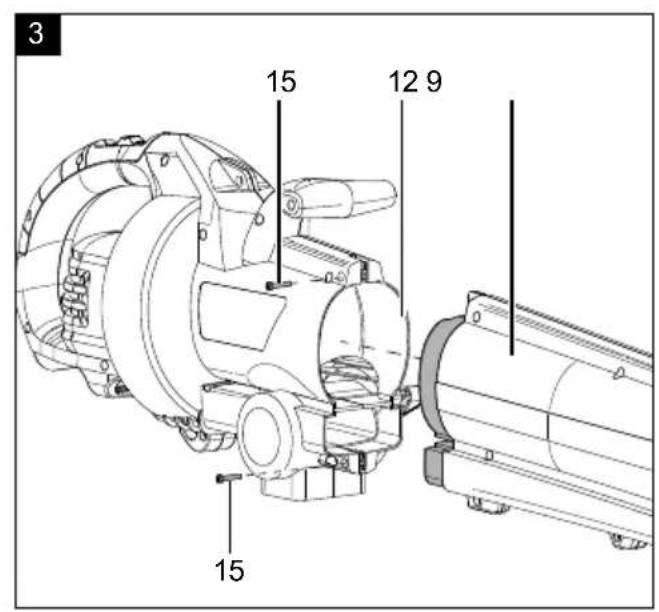
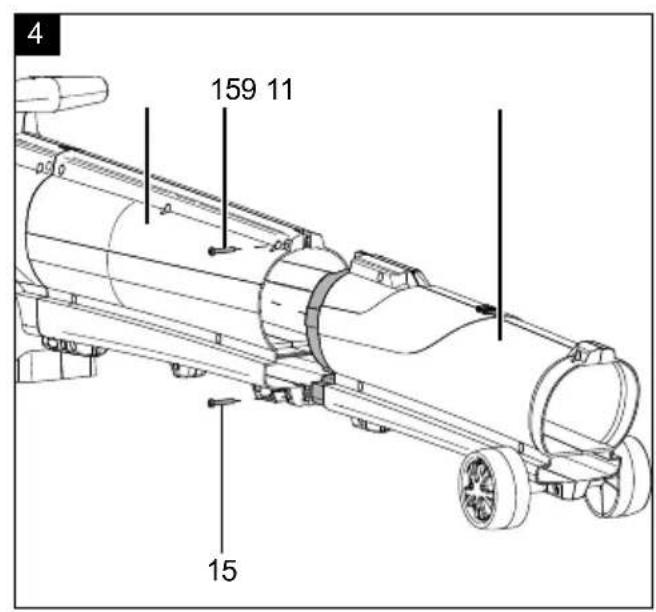
9.1 Fit theblow/suction pipe (9) + (11) (Fig. 3, 4)
- Insert the centre blow/suction pipe (9) into the motor housing (12).
- Secure the centre blow/suction pipe (9) with two of the fastening screws (blow/suction pipe) M4x15 (15). To do this, use a Phillips screwdriver (not included in the scope of delivery) included).
- Insert the front blast/suction tube (11) into the centre blast/suction tube (9).
- Secure the front blow/suction pipe (11) with two of the fastening screws (blow/suction pipe) M4x15 (15). To do this, use a Phillips screwdriver (not included in the scope of delivery).
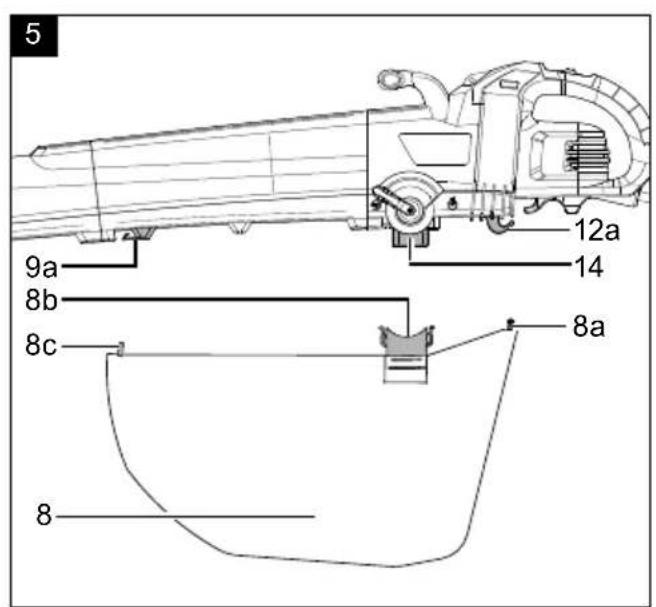
9.2 Fitting the collection bag (8) (Fig. 5)
The collection bag (8) is only required when operating as a leaf vacuum. Before starting work, check that the zip fastener of the collection bag (8) is properly closed.
- Place the Inlet collection bag with latch (8b) onto the ejection opening (14). Make sure that the collection bag inlet with locking device (8b) is properly engaged.
- Hang the collection bag eye at the rear (8a) in the hook at the rear (12a).
- Hook the front collection bag eye (8c) into the front hook (9a).
9.3 Dismantle the collection bag (8) (Fig. 5)
- Remove the front collection bag eye (8c) from the front hook (9a).
-
Actuate the two locking devices on the collection bag inlet (8b).
-
Pull the collection bag inlet with locking device (8b) off the ejection opening (14).
-
Remove the rear collection bag eye (8a) from the rear hook (12a).
9.4 Fitting the carrying strap (13) (Fig. 1, 2)
-
Open the carabiner hook (13a) of the carrying strap (13).
-
Clip the carabiner hook (13a) into the fastening eye of the carrying strap (2).
-
Adjust the length of the carrying strap (13) to suit.
Note!
Never wear the shoulder strap (13) diagonally across your shoulder and chest, but only on one shoulder! This allows you to quickly remove the product from the body in case of danger. Open the buckle to be able to open the catch (13) quickly in the event of an accident.
10. Commissioning
⚠ WARNING!
Always make sure the product is fully assembled before commissioning!
⚠ WARNING!
Make sure that the on/off switch (4) is in the "0" position!
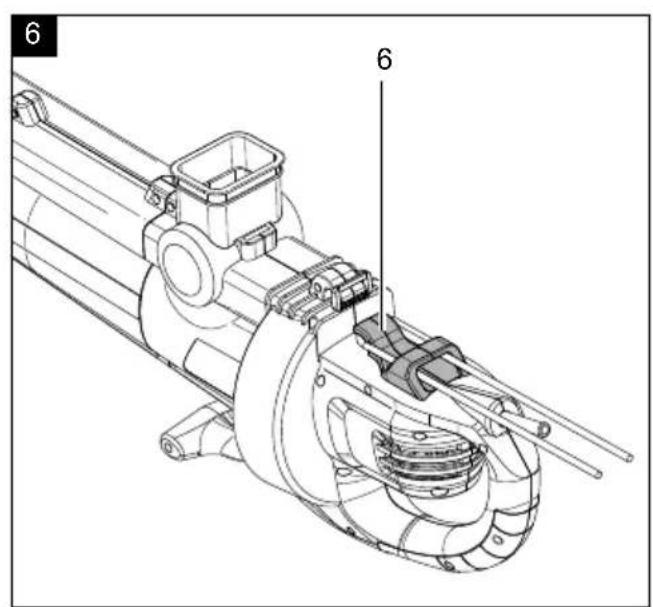
Cable strain relief (6) (Fig. 6)
You will need an extension cable (not included in the scope of delivery) for outdoor operation (max. 50 m, 2.5mm ^4 cross-section).
- Form a loop with the extension cable.
-
Pass the loop through the cable strain relief (6) and hang it in the hook of the cable strain relief (6).
-
Insert the mains plug into the corresponding end of the extension cable.
10.1 Select operating mode (Fig. 1)
The operating mode can be selected using the mode selector lever (7):

Use as a leaf vacuum.

Use as a leaf blower.
ATTENTION!
If you change the operating mode while the product is switched on, this can lead to injuries and damage to the product!
Note!
Due to the limit switch (16), the product can only be used with the blowpipe (9 + 11) fully assembled!
10.2 Starting up
- Connect the extension cable to a suitable energy source.
- When using as a leaf vacuum, make sure that the collection bag (8) is properly fitted.
- Move the on/off switch (4) to the "I" position.
10.3 Switching off
Move the on/off switch (4) to position "0".
11. Operation
Set the engine speed
The motor speed can be adjusted using the speed control (3). To do this, turn the speed control (3) and select the appropriate level. Levels 1-6 can be selected.
The engine speed should be adapted to the type of material to be removed:
- Use a low motor speed for light material on the lawn.
- Use a moderate motor speed to move grass and light leaves on asphalt or solid ground.
- Use a high speed for larger garden waste.
Leaf blower operation
△Risk of injury!
If you direct the airflow towards other people, animals or objects (e.g. windows), this can lead to injuries and damage!
- Direct the air flow away from you.
- Never direct the airflow at other people, animals or objects.
- Do not blow away hard objects such as stones or branches.
Note!
Always hold the product firmly with both hands while working! Hold both handles (front and rear) with a firm grip!
- Place your left hand on the front handle (1) and your right hand on the rear handle (5) handle (5).
- Hold the product a few centimetres above the ground and walk forward slowly, with a sweeping motion.
- Use the wheels (10) for ergonomic operation. These allow the product to be moved easily and effortlessly over the surface.
Operating the leaf vacuum
Note!
Always hold the product firmly with both hands while working! Hold both handles (front and rear) with a firm grip!
△RISK OF INJURY!
If the collection bag (8) is not secured during operation in suction mode, this can lead to injuries from flying parts!
During suction, the sucked-in leaves are shredded to reduce volume, blown through the ejection port and collected in the collection bag (8).
- Only use the leaf vacuum in suction mode with the collection bag (8) properly fitted.
- Make sure that the collection bag (8) is not damaged.
- Place your left hand on the front handle (1) and your right hand on the rear handle (5).
- The collection bag (8) should be on the right side of the operator.
- When used as a leaf vacuum, it is best to operate the product at medium/high speed.
- Do not vacuum up too many leaves at once, this can lead to clogging of the tube and the shredder. Do not vacuum hard or wet materials.
- Use the wheels (10) for ergonomic operation. These enables the product to be moved simply and easily over the surface.
11.1 Empty the collection bag (8)
The collection bag (8) also works like a filter, similar to an ordinary household vacuum cleaner. For this reason, it is best not to fill the collection bag (8) completely and remove bulky objects immediately.
- Switch off the motor and wait until the product comes to a complete stop.
- Open the zip fastener of the collection bag (8) and empty the collection bag (8) without detaching it from the discharge opening (14).
Note!
When using the leaf vacuum, do not collect damp grass or leaves, otherwise there is a risk of the rotor or collection bag (8) becoming blocked!
Note!
A collection bag (8) that is too full reduces the performance of the product and can cause the motor to overheat!
11.2 RemoveBLOCKAGE
△RISK OF INJURY!
If you remove blockages with your bare hands, you could injure yourself!
- Wear protective gloves.
-
Use suitable tools (e.g. a wooden stick).
-
Switch off the motor and wait until the product comes to a complete stop.
- Pull out the mains plug.
- Check the blow/suction pipe for blockages. Gently tap the pipe or use a wooden stick to loosen blockages. If necessary, tap the tube lightly on the ground to loosen the blockage.
- Check the ejection opening (14) for blockages. To do this, remove the collection bag (8) as described in 9.3. Remove the blockage with a wooden stick if necessary.
11.3 Overload protection
In the event of overloading, the motor switches itself off. Switch the product off and pull out the mains plug. Then check whether there is a blockage or jam and remove it. The product is only ready for use again after it has cooled down completely.
12. Working instructions
- Before switching on the product, make sure that it is not aimed at people or animals!
• Always hold the product firmly with both hands while working! Hold both handles (front and rear) with a firm grip! - The product may only be operated at reasonable times - not early in the morning or late in the evening when others may be disturbed! The times listed by the local authorities must be observed!
- Use rakes and brooms to loosen waste before blowing!
- Lightly moisten surfaces in dusty conditions!
13. Electrical connection
The electrical motor installed is connected and ready for operation. The connection complies with the applicable VDE and DIN provisions.
The customer's mains connection as well as the extension cable used must also comply with these regulations.
13.1 Damaged electrical connection cable
The insulation on electrical connection cables is often damaged.
This may have the following causes:
- Pressure points, where connection cables are passed through windows or doors.
- Kinks where the connection cable has been improperly fastened or routed.
- Interfaces by travelling over the connecting cable
- Insulation damage due to being ripped out of the wall outlet.
• Cracks due to the insulation ageing.
Such defective electrical connection cables must not be used and are life-threatening due to the insulation damage!
Check electrical connection cables regularly for damage! Make sure that the connecting cable is not connected to the mains when checking!
Electrical connection cables must comply with the relevant VDE and DIN regulations! Only use connection cables with the same labelling!
The type designation must be printed on the connection cable!
For single-phase AC motors, we recommend a fuse rating of C 16A or K 16A for products with a high starting current (from 3000 watts)!
Connection type X
If the mains connection cable of this product is damaged, it must be replaced with a special connection cable available from the manufacturer or its customer service centre!
14. Cleaning
⚠ WARNING!
Only carry out maintenance, conversion, adjustment and cleaning work with the motor switched off and the mains plug disconnected!
- Keep protective devices, air vents and the engine housing as free of dust and dirt as possible. Rub the product clean with a clean cloth or blow it off with compressed air at low pressure.
• We recommend that you clean the product directly after every use. - Clean the product at regular intervals using a damp cloth and a little soft soap. Do not use any cleaning products or solvents; they could attack the plastic parts of the product. Make sure that no water can penetrate the interior of the product. Water penetration increases the risk of an electric shock.
- Never immerse the product in water or other liquids for cleaning.
When used as a leaf vacuum:
- After finishing work, remove the collection bag (8), turn it upside down and clean it thoroughly and dry it if necessary. This prevents the development of mould and unpleasant odours.
- A heavily soiled collection bag (8) can be washed with soap and water and then dried.
- If the zip is difficult to operate, rub the zip teeth with a dry soap bar.
15. Storage
- Store the product and its accessories in a dark, dry and frost-free place that is inaccessible to children.
- The optimum storage temperature lies between 5 and 30^ .
- Store the product in its original packaging.
• Cover the product to protect it from dust or moisture. - Store the operating manual with the product.
16. Maintenance
⚠ WARNING!
Only carry out maintenance, conversion, adjustment and cleaning work with the motor switched off and the mains plug disconnected!
Replace the wheels (10)
- Hold one of the two wheels (10) and turn the other wheel (10) anticlockwise.
- Unscrew the wheels (10) completely.
- Unscrew the spare wheels.
- The replacement wheels are fitted in reverse order.
- Make sure that the wheels (10) run smoothly after assembly.
The interior of the product has no further internal parts that require maintenance.
17. Repair & ordering spare parts
After repairs or maintenance, make sure that all safety-related parts are installed and are in perfect condition. All parts which may cause injury must be kept where they are inaccessible to children or others.
ATTENTION!
In accordance with the Product Liability Act, no liability is accepted for damage caused by improper repairs or failure to use original spare parts!
Such work should be performed by a customer service centre or an authorised specialist. The same applies to accessories!
Spare parts and accessories can be obtained from our Service Centre. Scan the QR code on the front page!
17.1 Connections and repairs
Connections and repairs to the electrical equipment may only be carried out by a qualified electrician!
If you have any queries, please provide the following details:
• Type of current for the motor
• Machine data - type plate
- Motor data - type plate
17.2 Ordering spare parts
Please provide the following information when ordering spare parts:
- Model designation
- Item number
- Type plate data
17.3 Spare parts / accessories
Wheels (10) - Article no: 5911005001
Collection bag (8) - Article no: 5911005003
Operating mode selector lever (7) - Article no: 5911005005
17.4 Service information
Please note that the following parts of this product are subject to normal or natural wear and tear and that the following parts are required as consumables!
Wearing parts*: Collection bag (8), wheels (10)
* may not be included in the scope of delivery!
18. Disposal and recycling
Notes for packaging


The packaging materials are recyclable. Please dispose of packaging in an environmentally friendly manner.
Information on the Electrical and Electronic Equipment Act (ElektroG)
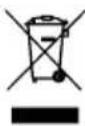
Waste electrical and electronic equipment does not belong in household waste, but must be collected and disposed of separately!
- Used batteries or rechargeable batteries that are not installed permanently in the old device must be removed non-destructively before disposal! Their disposal is regulated by the battery act.
- Owners or users of electrical and electronic devices are legally obliged to return them after use.
- The end user is responsible for deleting their personal data from the old device being disposed of!
- The symbol of the crossed-out dustbin means that waste electrical and electronic equipment must not be disposed of with household waste.
- Waste electrical and electronic equipment can be handed in free of charge at the following places:
- Public disposal or collection points (e.g. municipal works yards)
- Points of sale of electrical appliances (stationary and online), provided that dealers are obliged to take them back or offer to do so voluntarily.
- Up to three waste electrical devices per type of device, with an edge length of no more than 25 centimetres, can be returned free of charge to the manufacturer without prior purchase of a new device from the manufacturer or taken to another authorised collection point in your vicinity.
- Further supplementary take-back conditions of the manufacturers and distributors can be obtained from the respective customer service.
- If the manufacturer delivers a new electrical device to a private household, the manufacturer can arrange for the free collection of the old electrical device upon request from the end user. Please contact the manufacturer's customer service for this.
• These statements only apply to devices installed and sold in the countries of the European Union and which are subject to the European Directive 2012/19/EU.
In countries outside the European Union, different regulations may apply to the disposal of waste electrical and electronic equipment.
19. Troubleshooting
The following table shows fault symptoms and describes remedial measures in the event of your product failing to work properly. If you cannot localise and rectify the problem with this, please contact your service workshop.
| Fault Possible cause Remedy | ||
| Product does not start | No mains voltage | Check socket, cable, lead, plug and fuse, if necessary, have repaired by an authorised service centre. |
| Carbon brushes worn | Repair by an authorised service centre. | |
| On/off switch (4) defective | ||
| Motor defective | ||
| Product works with interruptions | Power cable damaged | Repair by an authorised service centre. Internal loose contact |
| On/off switch (4) defective | ||
| Low or lacking suction/blowing power | Collection bag (8) is full Empty | the collection bag (8). |
| Collection bag (8) is dirty Clean | the collection bag (8). | |
| Tube or shredder blocked with leaf Foreign body blocked | Remove any blockages as described under 11.5. | |
Günzburger Straße 69
D-89335 Ichenhausen
Cher client,
EU Declaration of Conformity
| X 2000/14/EG_2005/88/EG | |
| Noise: measured LWA= xx dB; guaranteed LVIA= xx dB | |
| Annex V | |
| Annex VI | |
| 2016/1628/EU | |
| Emission. No: |
Standard references:
EN 60335-1:2012+A11+A13+A1+A14+A2; EN 50636-2-100:2014; EN 62233:2008; EN 55014-1:2021;
EN 55014-2:2021; EN 61000-3-2:2019+A1; EN 61000-3-3:2013+A1+A2
This declaration of conformity is issued under the sole responsibility of the manufacturer.
The object of the declaration described above fulfils the regulations of the directive 2011/65/EU of the European Parliament and Council from 8th June 2011, on the restriction of the use of certain hazardous substances in electrical and electronic equipment.
Subject to change without notice
Documents registrar: Gabriel Baur
Günzburger Str. 69, D-89335 Ichenhausen
Garantie DE
Apparent defects must be notified within 8 days from the receipt of the goods. Otherwise, the buyer loses its rights of claim due to such defects are invalidated. We guarantee for our machines in case of proper treatment for the time of the statutory warranty period from delivery in such a way that we replace any machine part free of charge which provably becomes unusable due to faulty material or defects of fabrication within such period of time. With respect to parts not manufactured by us we only warrant insofar as we are entitled to warranty claims against the upstream suppliers. The costs for the installation of the new parts shall be borne by the buyer. The cancellation of sale or the reduction of purchase price as well as any other claims for damages shall be excluded.
Garantie FR



- BLV3000E
- Verehrter Kunde,
- Explanation of the symbols on the product
- Table of contents: Page:
- Introduction
- Manufacturer:
- Dear Customer,
- Note:
- Description of the product
- Scope of delivery
- Proper use
- DANGER
- CAUTION
- ATTENTION
- Safety instructions
- ⚠ WARNING!
- Electrical safety
- Personal safety
- Work area safety
- Power tool use and care
- Service
- Safety instructions for electric leaf vacuum/blowers
- Instructions
- Preparation
- Operation
- Maintenance and storage
- Residual risks
- Technical data
- Noise and vibration
- Noise data
- Vibration value per EN 60335-1:2012
- Unpacking
- Assembly
- Fitting the carrying strap (13) (Fig. 1, 2)
- Note!
- Commissioning
- Cable strain relief (6) (Fig. 6)
- Select operating mode (Fig. 1)
- ATTENTION!
- Starting up
- Switching off
- Operation
- Set the engine speed
- The engine speed should be adapted to the type of material to be removed:
- Leaf blower operation
- △Risk of injury!
- Operating the leaf vacuum
- Empty the collection bag (8)
- RemoveBLOCKAGE
- Overload protection
- Working instructions
- Electrical connection
- Damaged electrical connection cable
- Connection type X
- Cleaning
- When used as a leaf vacuum:
- Storage
- Maintenance
- Replace the wheels (10)
- Repair & ordering spare parts
- Connections and repairs
- Ordering spare parts
- Spare parts / accessories
- Service information
- Disposal and recycling
- Notes for packaging
- Information on the Electrical and Electronic Equipment Act (ElektroG)
- Troubleshooting
- Cher client,
- EU Declaration of Conformity
- Standard references:
- Garantie DE
- Garantie FR
Brand : SCHEPPACH
Model : BLV3000E
Category : Blower