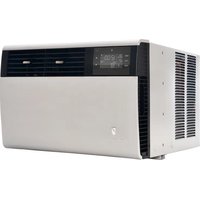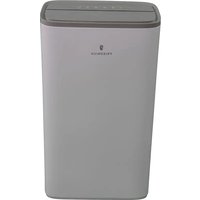
ZoneAire Premier ZHV16DA - Air Conditioning Friedrich - Free user manual and instructions
Find the device manual for free ZoneAire Premier ZHV16DA Friedrich in PDF.


User questions about ZoneAire Premier ZHV16DA Friedrich
0 question about this device. Answer the ones you know or ask your own.
Ask a new question about this device
Download the instructions for your Air Conditioning in PDF format for free! Find your manual ZoneAire Premier ZHV16DA - Friedrich and take your electronic device back in hand. On this page are published all the documents necessary for the use of your device. ZoneAire Premier ZHV16DA by Friedrich.
USER MANUAL ZoneAire Premier ZHV16DA Friedrich
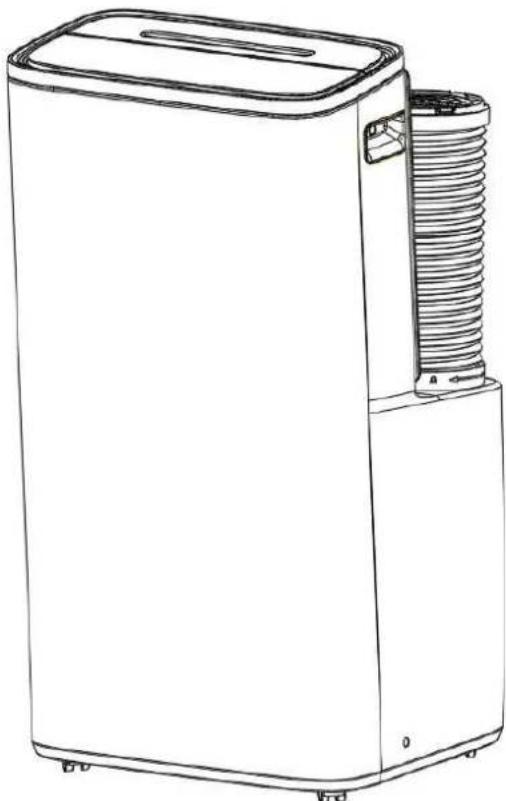
Portable Air-conditioner User's Manual(R32)
natural_image
Line drawing of a white industrial air conditioner unit with a coiled spring and ventilation cover (no text or symbols)For Model:
ZHV16DA Double Tube + Frequency Conversion + Heat Pump + WIFI
Please read this user's manual carefully to ensure proper use, maintenance and installation.
Friedrich Air Conditioning, A Rheem company
10001 Reunion Place, Ste. 500 | San Antonio, TX 78216
Technical Support 1-877-599-5665 | www.friedrich.com
Contents
- Safety Awareness....3
- Name of Parts ...... 15
- Accessories 16
- Appearance and Function of Control Panel....17
- Appearance and Function of Remote-Control....18
- Operation Introduction....19
- Installation Explanations....24
- Maintenance Explanations ...... 26
- Troubleshooting....27
1. Safety Awareness

text_image
ETL C LISTED USIntertek
VERY IMPORTANT!
Please do not install or use your portable air conditioner before you have carefully read this manual. Please keep this instruction manual for an eventual product warranty and for future reference.
Warning
Do not use means to accelerate the defrosting process or to clean, other than those recommended by the manufacturer.
The appliance shall be stored in a room without continuously operating ignition sources (for example: open flames, an operating gas appliance or an operating electric heater.
Do not pierce or burn.
Be aware the refrigerants may not contain an odor.
Appliance shall be installed, operated and stored in a room with a floor area of X ft2.
| MODEL | Sq. Ft. |
| 12000Btu/h DOE / 16,000Btu/h ASHRAE | 700 - 800 |
Servicing shall be performed only as recommended by the manufacturer.
The appliance shall be stored in a well-ventilated area where the room size corresponds to the room area as specified for operation.
All working procedure that affects safety means shall only be carried by competent persons.
Warning (for R32)

text_image
i A2LSpecific information regarding appliances with R32 refrigerant gas.
• Thoroughly read all the warnings.
- When defrosting and cleaning the appliance, do not use any tools other than those recommended by the manufacturing company.
- The appliance must be placed in an area without any continuous sources of ignition (for example: open flames, gas or electrical appliances in operation).
• Do not puncture and do not burn.
• This appliance contains Y g (see rating label back of unit) of R32 refrigerant gas.
- R32 is a refrigerant gas that complies with United States directives on the environment. Do not puncture any part of the refrigerant circuit.
- If the appliance is installed, operated or stored in an unventilated area, the room must be designed to prevent to the accumulation of refrigerant leaks resulting in a risk of fire or explosion due to ignition of the refrigerant caused by electric heaters, stoves, or other sources of ignition.
- The appliance must be stored in such a way as to prevent mechanical failure.
- Individuals who operate or work on the refrigerant circuit must have the appropriate certification issued by an accredited organization that ensures competence in handling refrigerants according to a specific evaluation recognized by associations in the industry.
- Repairs must be performed based on the recommendation from the manufacturing company. Maintenance and repairs that require the assistance of other qualified personnel must be performed under the supervision of an individual specified in the use of flammable refrigerants.
- Ducts connected to an appliance shall not contain a potential ignition source.
- WARNING – Risk of Fire. Flammable Refrigerant Used. To Be Repaired Only by Trained Service Personnel. Do Not Puncture Refrigerant Tubing.
- WARNING – Risk of Fire. Dispose Of Properly in Accordance with Federal Or Local Regulations.
Flammable Refrigerant Used.
- WARNING – Risk of Fire. Flammable Refrigerant Used. Consult Repair Manual/Owner's Guide Before Attempting to Service This Product. All Safety Precautions Must Be Followed.
- WARNING – Risk of Fire due to Flammable Refrigerant Used. Follow Handling Instructions
General Safety Instruction
Carefully in Compliance with National Regulations.
- The appliance is for indoor use only.
- Do not use the unit on a socket under repairs or not installed properly
-
Do not use the unit, follow these precautions:
A: Near to source of fire.
B: An area where oil is likely to splash.
C: An area exposed to direct sunlight.
D: An area where water is likely to splash.
E: Near a bath, a laundry, a shower or a swimming pool. -
Never insert your fingers and rods into the air outlet. Take special care to warn children of these dangers.
-
Keep the unit upward while transport and storage, for the compressor locates properly.
-
Before cleaning the air-conditioner, always turn off or disconnect the power supply.
-
When moving the air-conditioner, always turn off and disconnect the power supply, and move it slowly.
-
To avoid the possibility of fire disaster, the air-conditioner shall not be covered.
-
All the air-conditioner sockets must comply with the local electric safety requirements. If necessary, please check it for the requirements.
-
Children should be supervised to ensure that they do not play with the appliance.
-
If the supply cord is damaged, it must be replaced by the manufacturer, its service agent or similarly qualified persons to avoid a hazard.
-
This appliance can be used by children aged from 8 years and above and persons with reduced physical, sensory or mental capabilities or lack of experience and knowledge if they have been given supervision or instruction concerning use of the appliance in a safe way and understand the
hazards involved. Children shall not play with the appliance. Cleaning and user maintenance shall not be done by children without supervision.
- This appliance is not intended for use by persons (including children) with reduced physical, sensory or mental capabilities, or lack of experience and knowledge, unless they have been given supervision or instruction concerning use of the appliance by a person responsible for their safety.
- The appliance shall be installed in accordance with national wiring regulations.
- Details of type and rating of fuses: T, 250V AC, 30A.
- Recycling
This marking indicates that this product should not be disposed of with other household wastes throughout the EU. To prevent possible harm to the environment or human health from uncontrolled waste disposal, recycle it responsibly to promote the sustainable reuse of material resources. To return your used device, please use the return and collection systems or contact the retailer where the product was purchased. They can take this product for environmentally safe recycling.
- Contact an authorized service technician for repair or maintenance of this unit.
- Do not pull, deform. or modify the power supply cord or immerse it in water. Pulling or misuse of the power supply cord can result in damage to the unit and cause electrical shock.
- Compliance with national gas regulations shall be observed.
- Keep ventilation openings clear of obstruction.
- Any person who is involved with working on or breaking into a refrigerant circuit should hold a current valid certificate from an industry-accredited assessment authority, which authorizes their competence to handle refrigerants safely in accordance with an industry recognized assessment specification.
- Servicing shall only be performed as recommended by the equipment manufacturer.
Maintenance and repair requiring the assistance of other skilled personnel shall be carried out under the supervision of the person competent in the use of flammable refrigerants.
- Do not operate or stop the unit by inserting or pulling out the Die power plug, it may cause electric
shock or fire due to heat generation.
- Unplug the unit if strange sounds, smell, or smoke comes from it.
- Impedance declaration
These appliances can be connected only to a supply with system impedance no more than 0.367Ω. In case necessary, please consult your supply authority for system impedance information.
Notes:
— If any parts are damaged, please contact the dealer or a designated repair shop.
— In case of any damage, please turn off the air switch, disconnect the power supply, and contact the dealer or a designated repair shop.
— In any case, the power cord shall be firmly grounded.
— To avoid the possibility of danger, if the power cord is damaged, please turn off the air switch and disconnect the power supply. It must be replaced by the dealer or a designated repair shop.
INSTRUCTIONS FOR REPAIRING APPLIANCES CONTAINING R32
1 GENERAL INSTRUCTIONS
1.1 Checks to the area
Prior to beginning work on systems containing flammable refrigerants, safety checks are necessary to ensure that the risk of ignition is minimized. For repair to the refrigerating system, the following precautions shall be complied with prior to conducting work on the system.
1.2 Work procedure
Work shall be undertaken under a controlled procedure to minimize the risk of a flammable gas or vapor being present while the work is being performed.
1.3 General work area
All maintenance staff and others working in the local area shall be instructed on the nature of the work being carried out. Work in confined spaces shall be avoided. The area around the workspace shall be sectioned off. Ensure that the conditions within the area have been made safe by control of flammable material.
1.4 Checking for presence of refrigerant
The area shall be checked with an appropriate refrigerant detector prior to and during work, to ensure the technician is aware of potentially flammable atmospheres. Ensure that the leak detection equipment being used is suitable for use with flammable refrigerants, i.e. non-sparking, adequately sealed or intrinsically safe.
1.5 Presence of fire extinguisher
If any hot work is to be conducted on the refrigeration equipment or any associated parts,
propriate fire extinguishing equipment shall be available to hand. Have a dry powder or CO 2 fire extinguisher adjacent to the charging area.
1.6 No ignition sources
No person carrying out work in relation to a refrigeration system which involves exposing any pipe work that contains or has contained flammable refrigerant shall use any sources of ignition in such a manner that it may lead to the risk of fire or explosion. All possible ignition sources, including cigarette smoking, should be kept sufficiently far away from the site of installation, repairing, removing and disposal, during which flammable refrigerant can possibly be released to the surrounding space. Prior to work taking place, the area around the equipment is to be surveyed to make sure that there are no flammable hazards or ignition risks. “No Smoking” signs shall be
displayed.
1.7 Ventilated area
Ensure that the area is in the open or that it is adequately ventilated before breaking into the system or conducting any hot work. A degree of ventilation shall continue during the period that the work is carried out. The ventilation should safely disperse any released refrigerant and preferably expel it externally into the atmosphere.
1.8 Checks to the refrigeration equipment
Where electrical components are being changed, they shall be fit for the purpose and to the correct specification. At all times the manufacturer's maintenance and service guidelines shall be followed. If in doubt consult the manufacturer's technical department for assistance. The following checks shall be applied to installations using flammable refrigerants: the charge size is in accordance with the room size within which the refrigerant containing parts are installed; the ventilation machinery and outlets are operating adequately and are not obstructed; if an indirect refrigerating circuit is being used, the secondary circuit shall be checked for the presence of refrigerant; marking to the equipment continues to be visible and legible. Markings and signs that are illegible shall be corrected; refrigeration pipe or components are installed in a position where they are unlikely to be exposed to any substance which may corrode refrigerant containing components, unless the components are constructed of materials which are inherently resistant to being corroded or are suitably protected against being so corroded.
1.9 Checks to electrical devices
Repair and maintenance of electrical components shall include initial safety checks and component inspection procedures. If a fault exists that could compromise safety, then no electrical supply shall be connected to the circuit until it is satisfactorily dealt with. If the fault cannot be corrected immediately but it is necessary to continue operation, an adequate temporary solution shall be used. This shall be reported to the owner of the equipment, so all parties are advised.
Initial safety checks shall include that capacitors are discharged: this shall be done in a safe manner to avoid possibility of sparking; that there no live electrical components and wiring are exposed while charging, recovering or purging the system; that there is continuity of earth bonding.
Every working procedure for maintenance, service and repair operations that affects safety means shall only be carried out by competent persons according to Annex HH (competence of service personnel by training, this training is carried out by national training organizations that are accredited to teach the relevant national competency standards that may be set in legislation. The achieved competence should be documented by a certificate).
All the work men who are engaging in the refrigeration system should bear the valid certification
awarded by the authoritative organization and the qualification for dealing with the refrigeration system recognized by this industry. If it needs other technicians to maintain and repair the appliance, they should be supervised by the person who bears the qualification for using the flammable refrigerant.
2 REPAIRS TO SEALED COMPONENTS
Sealed electrical components shall be replaced.
3 REPAIRS TO INTRINSICALLY SAFE COMPONENTS
Intrinsically safe components must be replaced.
4 CABLING
Check that cabling will not be subject to wear, corrosion, excessive pressure, vibration, sharp edges or any other adverse environmental effects. The check shall also consider the effects of aging or continual vibration from sources such as compressors or fans.
5 DETECTIONS OF FLAMMABLE REFRIGERANTS
Under no circumstances shall potentially sources of ignition be used in the searching for or detection of refrigerant leaks. A halide torch (or any other detector using a naked flame) shall not be used.
6 LEAK DETECTION METHODS
The following leak detection methods are deemed acceptable for systems containing flammable refrigerants. Electronic leak detectors shall be used to detect flammable refrigerants, but the sensitivity may not be adequate or may need recalibration. (Detection equipment shall be calibrated in a refrigerant-free area.) Ensure that the detector is not a potential source of ignition and is suitable for the refrigerant used. Leak detection equipment shall be set at a
percentage of the LFL of the refrigerant and shall be calibrated to the refrigerant employed and the appropriate percentage of gas (25 % maximum) is confirmed.
Leak detection fluids are suitable for use with most refrigerants but the use of detergents containing chlorine shall be avoided as the chlorine may react with the refrigerant and corrode the copper pipework.
NOTE Examples of leak detection fluids are
- bubble method,
- fluorescent method agents.
If a leak is suspected, all naked flames shall be removed/extinguished. If a leakage of refrigerant is found which requires brazing, all of the refrigerants shall be recovered from the system, or isolated (by means of shut off valves) in a part of the system remote from the leak. Removal of refrigerant shall be according to 7 Removal and evacuation.
7 REMOVAL AND EVACUATION
When breaking into the refrigerant circuit to make repairs – or for any other purpose – conventional procedures shall be used. However, for flammable refrigerants it is important that best practice be followed, since flammability is a consideration. The following procedure shall be adhered to:
a) safely remove refrigerant following local and national regulations.
b) purge the circuit with inert gas.
c) evacuate (optional for A2L);
d) purge with inert gas (optional for A2L).
e) open the circuit by cutting or brazing.
The refrigerant charge shall be recovered into the correct recovery cylinders if venting is not allowed by local and national codes. For appliances containing flammable refrigerants, the system shall be purged with oxygen-free nitrogen to render the appliance safe for flammable refrigerants. This process might need to be repeated several times. Compressed air or oxygen shall not be used for purging refrigerant systems.
For appliances containing flammable refrigerants, refrigerants purging shall be achieved by breaking the vacuum in the system with oxygen-free nitrogen and continuing to fill until the working pressure is achieved, then venting to atmosphere, and finally pulling down to a vacuum (optional for A2L). This process shall be repeated until no refrigerant is within the system (optional for A2L). When the final oxygen-free nitrogen charge is used, the system shall be vented down to atmospheric pressure to enable work to take place.
Ensure that the outlet for the vacuum pump is not close to any ignition sources and there is ventilation available.
8 CHARGING PROCEDURES
In addition to conventional charging procedures, the following requirements shall be followed.
- Ensure that contamination of different refrigerants does not occur when using charging equipment. Hoses or lines shall be as short as possible to minimize the amount of refrigerant contained in them.
• Cylinders shall be kept upright. - Ensure that the refrigeration system is earthed prior to charging the system with refrigerant.
- Label the system when charging is complete (if not already).
- Extreme care shall be taken not to overfill the refrigeration system.
Prior to recharging the system, it shall be pressure tested with OFN. The system shall be leak tested on completion of charging but prior to commissioning. A follow up leak test shall be carried out prior to leaving the site.
9 DECOMMISSIONING
Before carrying out this procedure, it is essential that the technician is completely familiar with the equipment and all its details. It is recommended good practice that all refrigerants are recovered safely. Prior to the task being carried out, an oil and refrigerant sample shall be taken in case analysis is required prior to re-use of reclaimed refrigerant. It is essential that electrical power is available before the task commences.
a) Become familiar with the equipment and its operation.
b) Isolate the system electrically.
c) Before attempting the procedure ensure that: mechanical handling equipment is available, if required, for handling refrigerant cylinders; all personal protective equipment is available and being used correctly; the recovery process is supervised at all times by a competent person; recovery equipment and cylinders conform to the appropriate standards.
d) Pump down the refrigerant system, if possible.
e) If a vacuum is not possible, make a manifold so that refrigerant can be removed from various parts of the system.
f) Make sure that cylinder is situated on the scales before recovery takes place.
g) Start the recovery machine and operate in accordance with manufacturer's instructions.
h) Do not overfill cylinders. (No more than 80 % volume liquid charge).
i) Do not exceed the maximum working pressure of the cylinder, even temporarily.
j) When the cylinders have been filled correctly and the process completed, make sure that the cylinders and the equipment are removed from site promptly and all isolation valves on the equipment are closed off.
k) Recovered refrigerant shall not be charged into another refrigeration system unless it has been cleaned and checked.
10 LABELLING
Equipment shall be labelled stating that it has been de-commissioned and emptied of refrigerant. The label shall be dated and signed.
Ensure that there are labels on the equipment stating the equipment contains flammable refrigerant.
11 RECOVERY
When removing refrigerants from a system, either for servicing or decommissioning, it is recommended good practice that all refrigerants are removed safely. When transferring refrigerant into cylinders, ensure that only appropriate refrigerant recovery cylinders are employed. Ensure that the correct number of cylinders for holding the total system charge are available. All cylinders to be used are designated for the recovered refrigerant and labelled for that refrigerant (i.e. special cylinders for the recovery of refrigerant). Cylinders shall be complete with pressure relief valve and associated shut-off valves in good working order. Empty recovery cylinders are evacuated and, if possible, cooled before recovery occurs.
The recovery equipment shall be in good working order with a set of instructions concerning the equipment that is at hand and shall be suitable for the recovery of flammable refrigerants. In addition, a set of calibrated weighing scales shall be available and in good working order. Hoses
shall be complete with leak-free disconnect couplings and in good condition. Before using the recovery machine, check that it is in satisfactory working order, has been properly maintained and that any associated electrical components are sealed to prevent ignition in the event of a refrigerant release. Consult manufacturer if in doubt.
The recovered refrigerant shall be returned to the refrigerant supplier in the correct recovery cylinder, and the relevant Waste Transfer Note arranged. Do not mix refrigerants in recovery units and especially not in cylinders.
If compressors or compressor oils are to be removed, ensure that they have been evacuated to an acceptable level to make certain that flammable refrigerant does not remain within the lubricant. The evacuation process shall be carried out prior to returning the compressor to the suppliers. Only electric heating to the compressor body shall be employed to accelerate this process. When oil is drained from a system, it shall be carried out safely.
Competence of service personnel
General
Special training additional to usual refrigerating equipment repair procedures is required when equipment with flammable refrigerants is affected.
In many countries, this training is carried out by national training organizations that are accredited to teach the relevant national competency standards that may be set in legislation.
The achieved competence should be documented by a certificate.
Training
The training should include the substance of the following:
Information about the explosion potential of flammable refrigerants to show that flammables may be dangerous when handled without care.
Information about potential ignition sources, especially those that are not obvious, such as lighters, light switches, vacuum cleaners, electric heaters.
Information about the different safety concepts:
Unventilated – (see Clause GG.2) Safety of the appliance does not depend on ventilation of the housing. Switching off the appliance or opening of the housing has no significant effect on the safety. Nevertheless, it is possible that leaking refrigerant may accumulate inside the enclosure and flammable atmosphere will be released when the enclosure is opened.
Ventilated enclosure – (see Clause GG.4) Safety of the appliance depends on ventilation of the housing. Switching off the appliance or opening of the enclosure has a significant effect on the safety. Care should be taken to ensure sufficient ventilation before.
Ventilated room – (see Clause GG.5) Safety of the appliance depends on the ventilation of the room. Switching off the appliance or opening of the housing has no significant effect on the safety. The ventilation of the room shall not be switched off during repair procedures.
Information about the concept of sealed components and sealed enclosures according to IEC 60079-15:2010.
Information about the correct working procedures:
a) Commissioning
- Ensure that the floor area is sufficient for the refrigerant charge or that the ventilation duct is assembled in a correct manner.
- Connect the pipes and carry out a leak test before charging with refrigerant.
- Check safety equipment before putting into service.
b) Maintenance
- Portable equipment shall be repaired outside or in a workshop specially equipped for
servicing units with flammable refrigerants.
- Ensure sufficient ventilation at the repair place.
- Be aware that malfunction of the equipment may be caused by refrigerant loss and a refrigerant leak is possible.
- Discharge capacitors in a way that won't cause any spark. The standard procedure to short circuit the capacitor terminals usually creates sparks.
- Reassemble sealed enclosures accurately. If seals are worn, replace them.
- Check safety equipment before putting into service.
c) Repair
- Portable equipment shall be repaired outside or in a workshop specially equipped for servicing units with flammable refrigerants.
- Ensure sufficient ventilation at the repair place.
- Be aware that malfunction of the equipment may be caused by refrigerant loss and a refrigerant leak is possible.
- Discharge capacitors in a way that won't cause any spark.
- When brazing is required, the following procedures shall be carried out in the following order:
- Safely remove the refrigerant following local and national regulations. If the recovery is not required by national regulations, drain the refrigerant to the outside. Take care that the drained refrigerant will not cause any danger. In doubt, one person should guard the outlet. Take special care that drained refrigerant will not float back into the building.
- Purge the refrigerant circuit with oxygen free nitrogen;
- Evacuate the refrigerant circuit;
- Purge the refrigerant circuit with nitrogen for 5 min (not required for A2L refrigerants).
- Evacuate again (not required for A2L refrigerants).
- Remove parts to be replaced by cutting or brazing.
- Purge the braze point with nitrogen during the brazing procedure required for repair.
- Carry out a leak test before charging with refrigerant.
d) Decommissioning
- If the safety is affected when the equipment is put out of service, the refrigerant charge shall be removed before decommissioning.
- Ensure sufficient ventilation at the equipment location.
- Be aware that malfunction of the equipment may be caused by refrigerant loss and a refrigerant leak is possible.
- Discharge capacitors in a way that won't cause any spark.
- Remove the refrigerant. If the recovery is not required by national regulations, drain the refrigerant to the outside. Take care that the drained refrigerant will not cause any danger. In doubt, one person should guard the outlet. Take special care that drained refrigerant will not float back into the building.
• Evacuate the refrigerant circuit.
- Purge the refrigerant circuit with nitrogen for 5 min.
- Evacuate again.
- Fill with nitrogen up to atmospheric pressure.
- Put a label on the equipment that the refrigerant is removed.
- Ensure sufficient ventilation at the working place.
e) Disposal
- Remove the refrigerant. If the recovery is not required by national regulations, drain the refrigerant to the outside. Take care that the drained refrigerant will not cause any danger. In doubt, one person should guard the outlet. Take special care that drained refrigerant will not float back into the building.
- When flammable refrigerants are used,
a) Evacuate the refrigerant circuit.
b) Purge the refrigerant circuit with oxygen free nitrogen.
c) Evacuate again. (not required for A2L refrigerants)
d) Cut out the compressor and drain the oil.
• Evacuate the refrigerant circuit.
- Purge the refrigerant circuit with nitrogen for 5 min.
- Evacuate again.
- Cut out the compressor and drain the oil.
Transportation, marking and storage for units that employ flammable refrigerants Transport of equipment containing flammable refrigerants
Attention is drawn to the fact that additional transportation regulations may exist with respect to equipment containing flammable gas. The maximum number of pieces of equipment or the configuration of the equipment, permitted to be transported together will be determined by the applicable transport regulations.
Marking of equipment using signs
Signs for similar appliances used in a work area generally are addressed by local regulations and give the minimum requirements for the provision of safety and/or health signs for a work location.
All required signs are to be maintained and employers should ensure that employees receive suitable and sufficient instruction and training on the meaning of appropriate safety signs and the actions that need to be taken in connection with these signs.
The effectiveness of signs should not be diminished by too many signs being placed together. Any pictograms used should be as simple as possible and contain only essential details.
Disposal of equipment using flammable refrigerants
See national regulations.
Storage of equipment/appliances
The storage of equipment should be in accordance with the manufacturer's instructions.
Storage of packed (unsold) equipment
Storage package protection should be constructed such that mechanical damage to the equipment inside the package will not cause a leak of the refrigerant charge.
The maximum number of pieces of equipment permitted to be stored together will be determined by local regulations.
2. Name of Parts
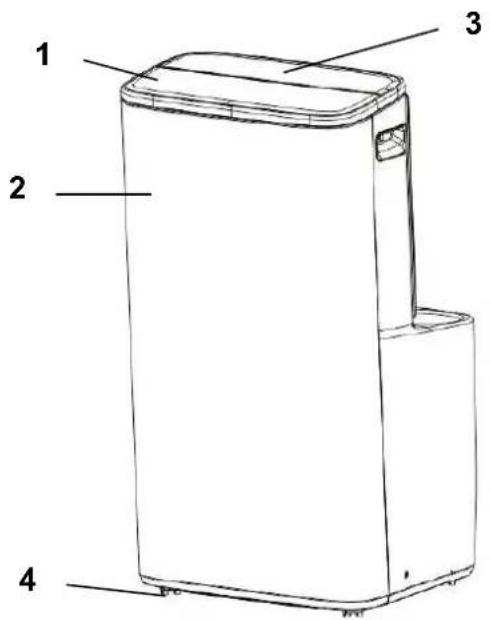
text_image
1 2 3 4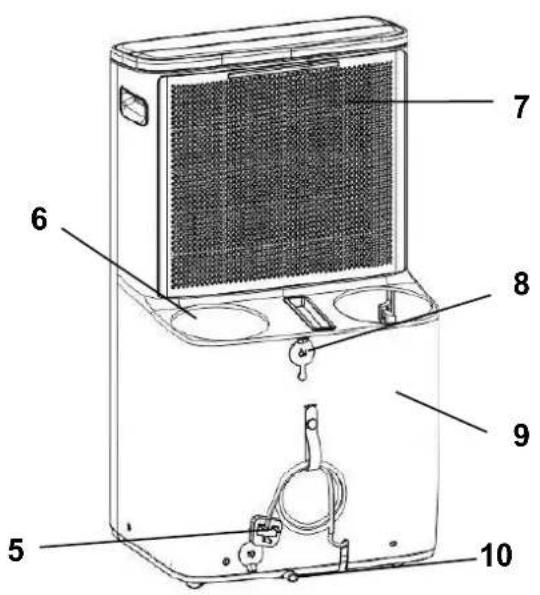
text_image
Technical diagram of a front-loading air purifier with numbered parts labeled 5 to 10Fig.1
| 1 | Louver | 6 | Air outlet |
| 2 | Front cover | 7 | Air inlet |
| 3 | Control panel | 8 | Drainage outlet plug |
| 4 | Castor | 9 | Rear cover |
| 5 | Power cord | 10 | Drainage outlet |
3. Accessories
| Part | Description | Quantity |
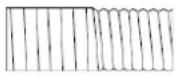 | Exhaust hose | 2 |
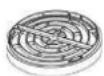
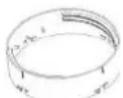
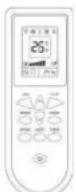
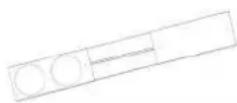
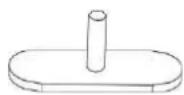
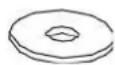
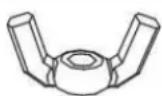

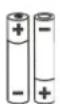
After unpacking, please check whether the above-mentioned accessories are included, and check their purposes in the installation introduction in this manual.
4. Appearance and Function of Control Panel
Cooling & Heating model
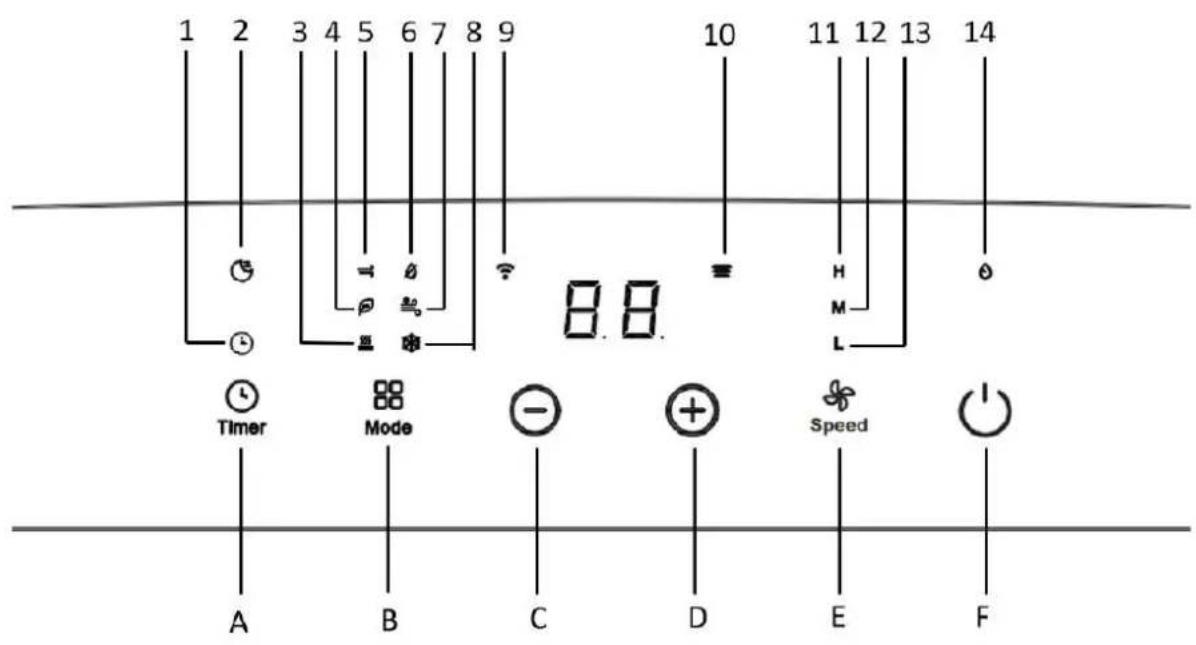
text_image
1 2 3 4 5 6 7 8 9 10 11 12 13 14 Timer Mode - + Speed F A B C D E F| A | Timer on/off | 5 | Fan mode |
| B | Operation mode | 6 | Dehumidifying mode |
| C | Timer/Temperature decreasing | 7 | Strong mode |
| D | Timer/Temperature increasing | 8 | Cooling mode |
| E | Fan speed | 9 | WIFI |
| F | Power on/off | 10 | Auto swing |
| 1 | Timing mode | 11 | High fan speed |
| 2 | Sleep mode | 12 | Medium fan speed |
| 3 | Heating mode | 13 | Low fan speed |
| 4 | ECO mode | 14 | Water full |
5. Appearance and Function of Remote Control
Remote Control
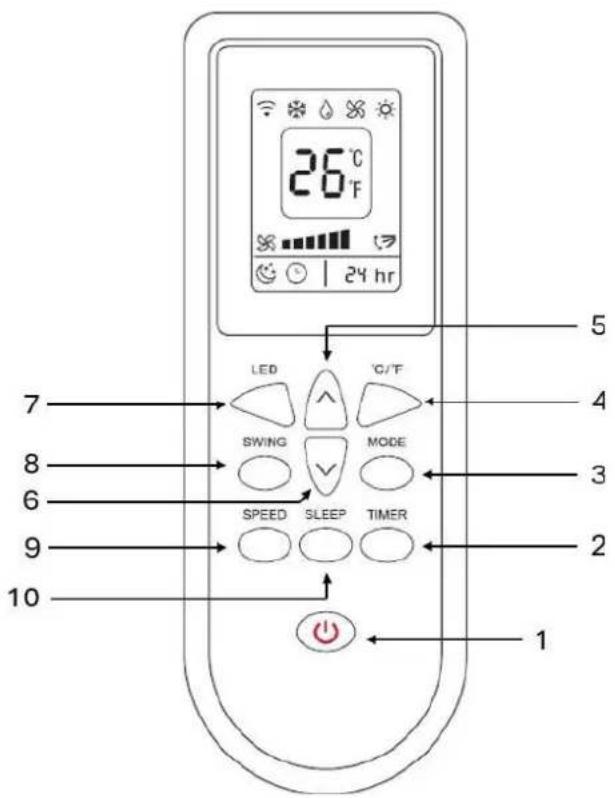
text_image
26°C 24 hr 7 LED SWING MODE SPEED SLEEP TIMER 1 5 4 3 2 10| 1 | Power on/off |
| 2 | Timer on/off |
| 3 | Operation MODE |
| 4 | °C/F selector |
| 5 | Temperature up |
| 6 | Temperature down |
| 7 | LED display |
| 8 | Swing Mode |
| 9 | Fan Speed |
| 10 | Sleep Mode |
Notes:
- Do not drop the remote control.
- Do not place the remote control in a location exposed to direct sunlight.
6. Operation Introduction
Before starting operations in this section:
1) Find a place where there is a power supply nearby.
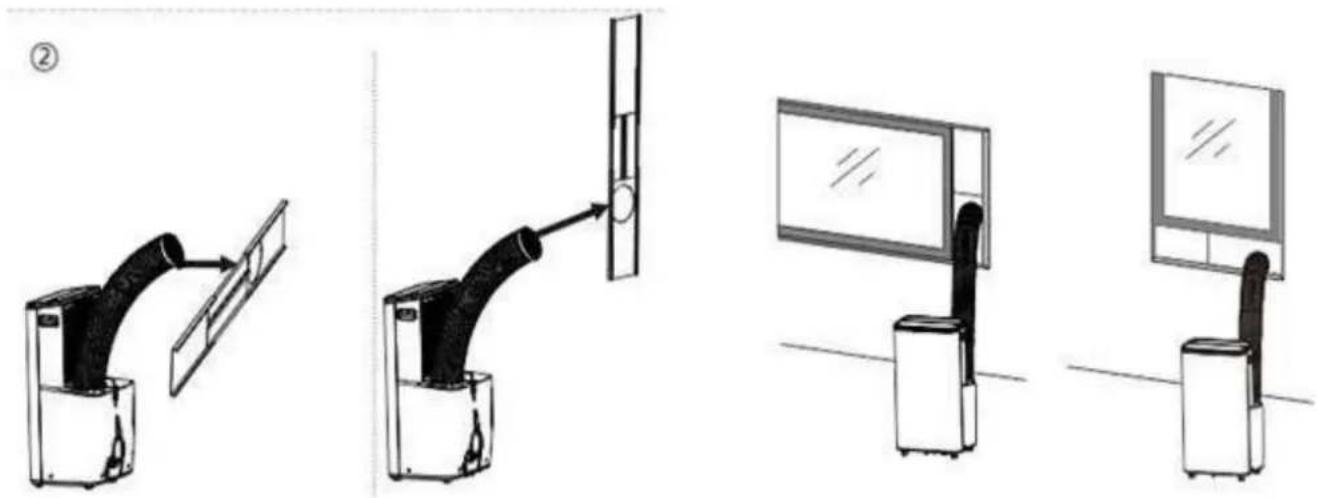
2) As shown in Fig.2 and Fig.2a, install the exhaust hose, and adjust the window position well.
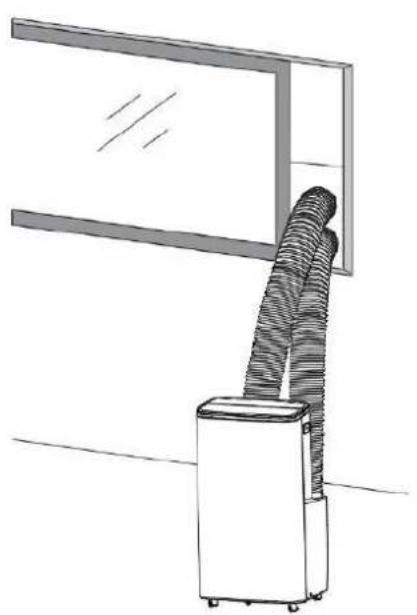
natural_image
Line drawing of a vertical cylindrical device mounted on a base, next to a window (no text or symbols)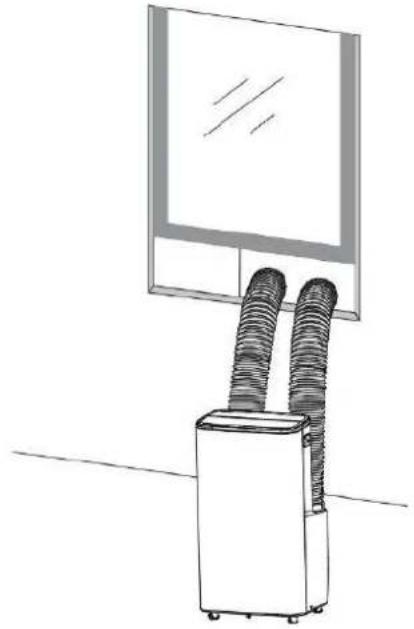
natural_image
Line drawing of an outdoor air conditioner unit with two coiled insulation tubes, mounted on a wall above (no text or symbols)Fig.2 Fig.2a
3) Insert the power cord into an grounded AC115V/60Hz socket; Press the POWER button to turn on the air-condition
6.1. Before using
Notice:
- Operation temperature range:
| Maximum cooling | Minimum cooling | |
| DB/WB(°F) | 89.6/109.4 64.4/6 | 4.4 |
| Maximum heating | Minimum heating | |
| DB/WB(°F) | 80.6/75.2 44.6/35.6 | |
Checkup whether the exhaust hose has been mounted properly.
Cautions for cooling and dehumidifying operations:
- When using functions on cooling and dehumidifying, keep an interval of at least 3 minutes between each ON/OFF.
- Power supply meets the requirements.
- The socket is for AC use.
- Do not share one socket with other appliances.
- Power supply is AC115V, 60Hz
6.2 Cooling operation
- Press the "Mode" button till the "Cool" icon appears.
- Press the “+” or “-” button to select a desired room temperature. (16°C-31°C/61°F-88°F)
- Press the "SPEED" button to select wind speed.
6.3 Dehumidifying operation
Press the "Mode" button till the "Dehumidify" icon appears.
- Automatically set the selected temperature to current room temperature minus 2°C. (16°C-31°C/61°F-88°F)
- Automatically set the fan motor to LOW wind speed.
6.4 Fan operation
- Press the "Mode" button till the "Fan" icon appears.
- Press the "SPEED" button to select wind speed.
6.5 Heating operation (this function is not available for a cold-single unit)
- Press the "Mode" button till the "Heat" icon appears.
- Press the “+” or “-” button to select a desired room temperature. (16°C-31°C/61°F-88°F)
- Press the "SPEED" button to select wind speed.
6.6 Timer operation
Timer ON setting:
- When the air-conditioner is OFF, press the "Timer" button and select a desired-ON time through the temperature and time setting buttons.
- "Preset ON Time" is displayed on the operation panel.
- ON time can be regulated at any time in 0-24 hours.
- Press the "Timer" button again to confirm, Timer indicator turns on.
- To deactivate the timer function, press "Timer" button until the timer indicator turns off.
Timer OFF setting
- When the air-conditioner is ON, press "Timer" button and select a desired OFF time through the temperature and time setting buttons.
- "Preset OFF Time" is displayed on the operation panel.
- OFF time can be regulated at any time in 0-24 hours.
- Press the "Timer" button again to confirm, Timer indicator turns on.
- To deactivate the timer function, press “Timer” button until the timer indicator turns off.
6.7 Auto SWING
After the machine turns on, pressing this key, the louver will swing continuously up and down; by pressing this button again the movement will stop, and the louver remains in that position.
6.8 SLEEP mode
- While in cooling mode, press the SLEEP key to set the temperature. It increases 1 °C after an hour and at most increases 2 °C/4°F after 2 hours.
- While in heating mode, press the SLEEP key to set the temperature. It decreases 1 °C after an hour and
at most decreases 2^ C/ 4^ F after 2 hours.
- Press the SLEEP key again to cancel the setting.
6.9 Water drainage
Water Full Alarm
The inner water tray inside the air-conditioner has one water level safety switch, it controls the water level. When the water level reaches an anticipated height, the water full indicator lamp lights up. When the water is full, please remove the rubber blockage at the bottom of unit, and all water will drain outside.
Continuous Drainage
- When you plan to leave this unit unused for a long time, please remove the rubber blockage from the drainage hole at the bottom of unit and connect a drain hose to the lower fixing clip. All the water in the water tank will drain outside.
- If the water pump is damaged, continuous drainage can be used, and under this condition, the water pump is not activated. The unit can also work well.
If the water pump is damaged, intermittent drainage can also be used. Under this condition, when the water full indicator lamp lights up, please connect a drain hose to the lower fixing clip, then all the water in the water tray will be drained outside. The unit can also work well.
6.10 WIFI function
- Long press the SPEED button for 5s, enter the WIFI factory set up mode;
- When the WIFI indicator flashing quickly, the unit is at the WIFI EZ mode, if flashing slowly, the unit is at the WIFI pairing APP mode;
- For Wi-Fi and Bluetooth combo devices, turn on Bluetooth and location and allow the app to access your location. The Bluetooth permission is required too. Wi-Fi and Bluetooth combo devices can be automatically discovered. Or choose "Portable Air Conditioner" in the application. Then tap on "Wi-Fi Mode" on the top right and select "Bluetooth";
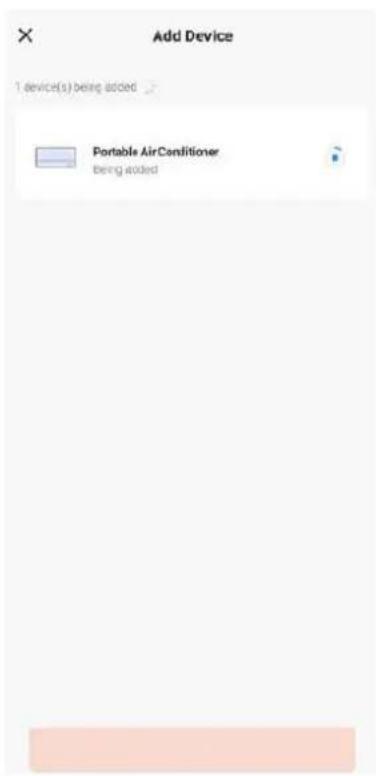
- Download and Login to ComfortPro APP; Portable Air Conditioner will be found automatically; a pop up page will appear as below.

text_image
ComfortPro MOBILE APP ComfortPro- If Portable Air Conditioner did not pop up automatically, click + in the upper right corner, and click Add
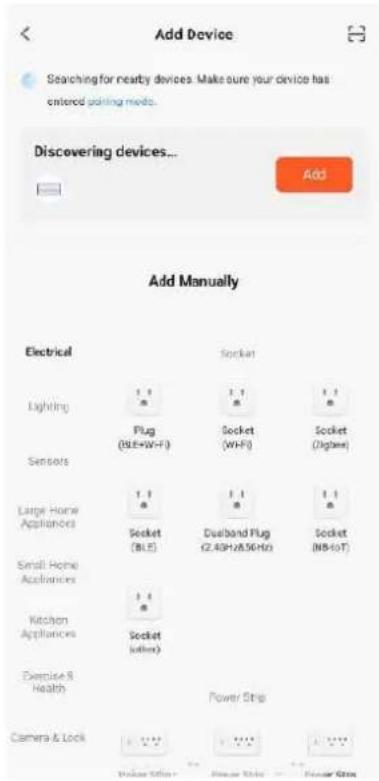
text_image
Add Device Searching for nearby devices. Make sure your device has entered joining mode. Discovering devices... Add Add Manually Electrical Socket Lighting Plug Socket Socket (SLE+W-F) Socket (WH-F) Socket (Digital) Sensors Large Home Appliances Socket Dualbond Plug Socket (BLE) 2.4GHz/2.5GHz (NB+0T) Small Home Appliances Kitchen Appliances Socket (other) Exercise & Health Power Strip Camera & Lock Power Strip Power Trim Power Trim Power Trim- Enter the WiFi password and click Start to start pairing. If pairing fails, please repeat previous steps.
text_image
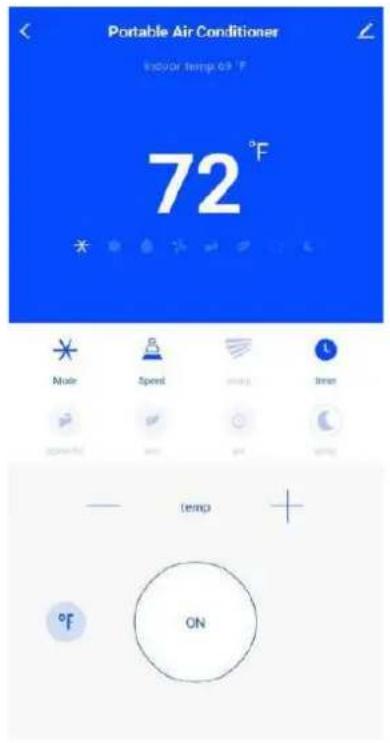
Add Device 1 device(s) being added Portable AirConditioner being added- User can select on the mobile APP
○ Click ✱ for Mode functions: Cold, Heating, Dry (dehumidification), Fan mode
○ Click ▲ for Speed levels: High, Medium, Low
○ Click ▷ for Swing mode
○ Click ● for Timer
○ Click for Powerful mode
○ Click for Eco mode
○ Click for UV mode
○ Click for Sleep mode
text_image
Portable Air Conditioner Indoor temp 69 °F 72 °F Mode Speed min Time temp ON6.11 Powerful Operation Mode
Press and hold the MODE button and the + button (combination button) for 5 seconds to turn this function on or off.
6.12 Economic (Energy Saving) Operation Mode
Press and hold the MODE button and the - button (combination button) for 5 seconds to turn this function on or off.
7. Installation Explanations
7.1 Installation Explanations:
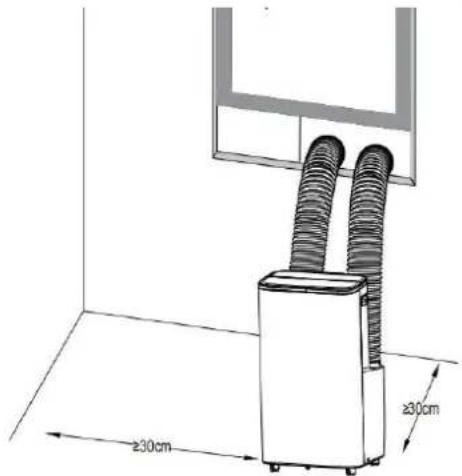
- A removal air-conditioner shall be installed in the flat and empty place all around. Don't block the air outlet, and the required distance around should be at least 30cm. (See Fig.3)
- Should not be installed in wet location, such as the laundry room.
- Should not be installed in dry cleaner.
- Socket wiring should be in accordance with the local electric safety requirements.
text_image
≥30cm ≥30cmFig.3
7.2 Introduction to Exhaust Hose Installation
Window Slider Kit Installation
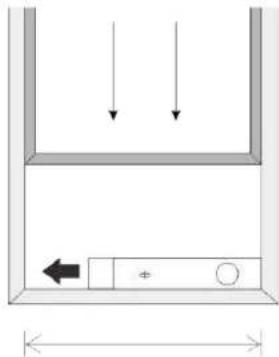
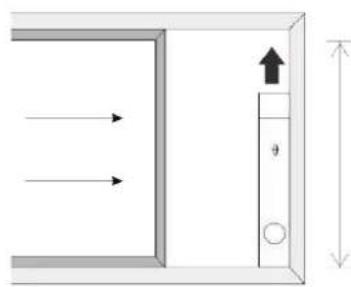
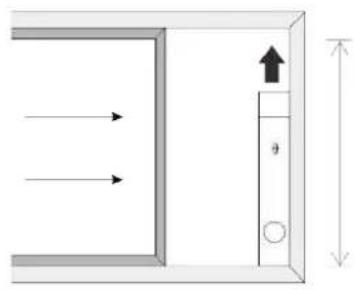
The installation manner of window slider kit is mostly in "horizontal" and "vertical". As shown Fig.4 and Fig.4a, check the min. and max. size of the window before the installation.
- Install the window kit on the window (Fig.4, Fig.4a).
- Adjust the length of the window slider kit according to the window width or height and fix it with the dowel.
- Insert the Window Connector hose to the hole of the Window Kit
①
natural_image
Simple diagram of a container with arrows indicating downward flow and a left-pointing arrow inside, no text or symbols present.Window width
Min: 40cm
Max: 120cm
Fig.4
natural_image
Diagram showing airflow direction and height measurement with arrows and a vertical bar (no text or symbols)Window height
Min: 40cm
Max: 120cm
Fig.4a
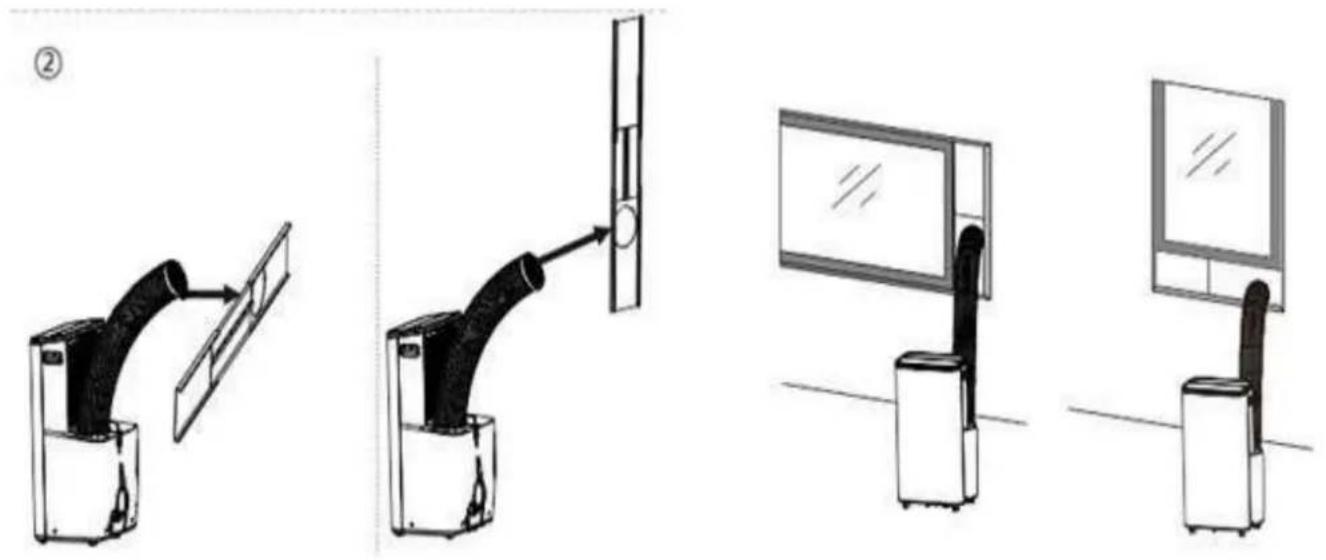
Fig.5
7.3 Drainpipe installation
(A) In dehumidification mode, connect the drainpipe to the upper drainage outlet on the rear side of the fuselage to drain water out of the machine.
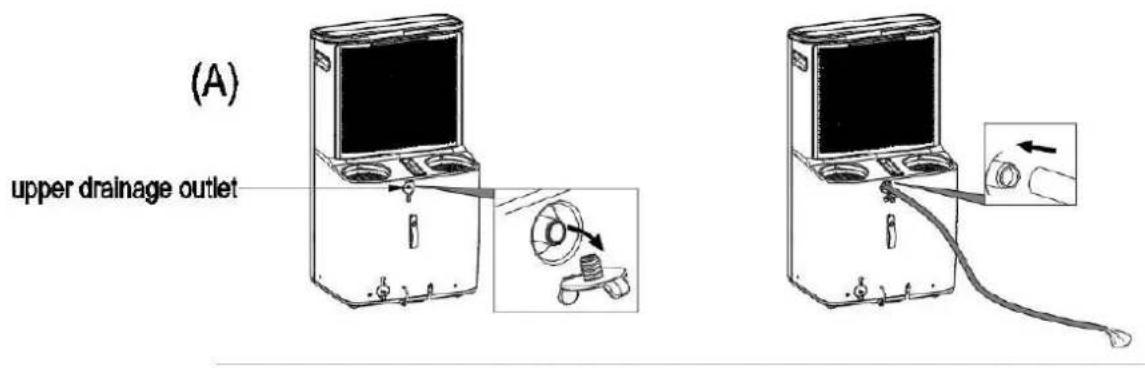
text_image
(A) upper drainage outletFig.6
(B) The inner water tray inside the air-conditioner has one water level safety switch, it controls water level. When the water level reaches an anticipated height, the water full indicator lamp lights up.
At this time, the drainpipe is connected to the lowest drainage outlet on the back of the fuselage, so that the water is discharged from the machine.
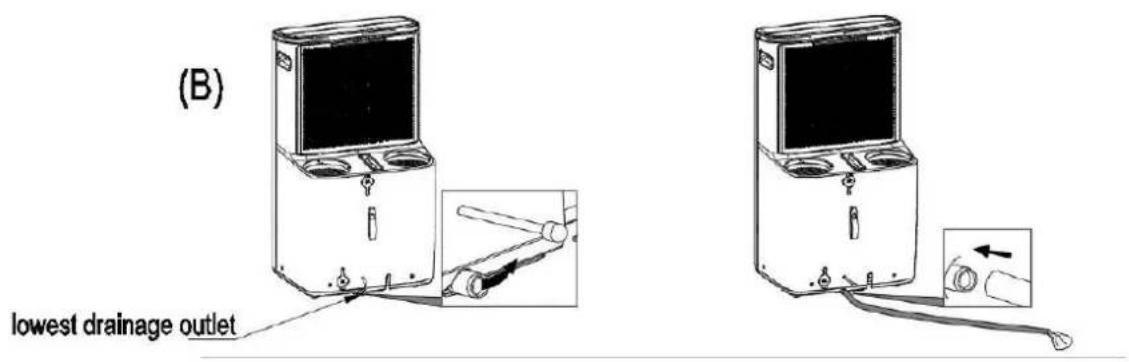
text_image
(B) lowest drainage outletFig.7
8. Maintenance Explanations
Declaration:
1) Before cleaning, be sure to disconnect the unit from any electric supply outlet.
2) Do not use gasoline or other chemicals to clean the unit.
3) Do not wash the unit directly.
4) If the conditioner is damaged, please contact the dealer or repair shop.
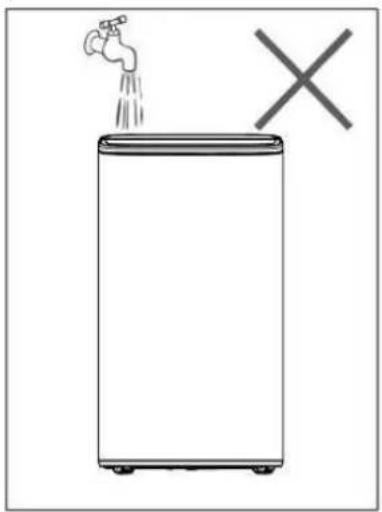
natural_image
Simple line drawing of a water dispenser with a faucet and a 'X' symbol (no text or labels)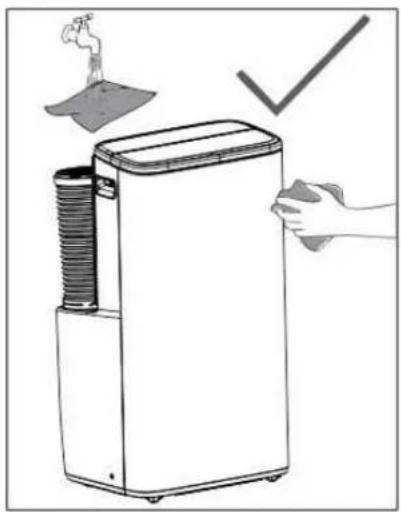
natural_image
Illustration of a portable air conditioner unit with a hand cleaning it, no text or symbols present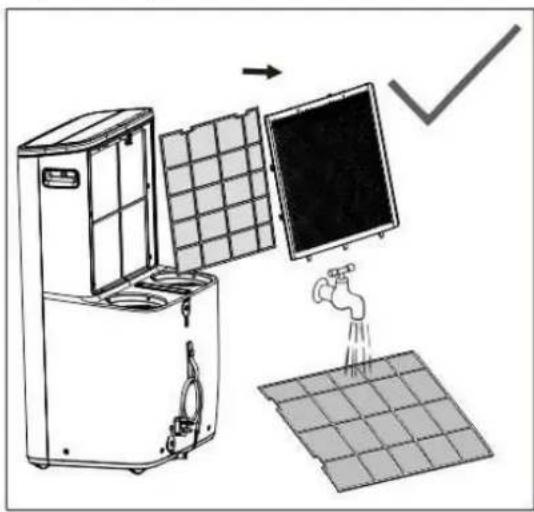
text_image
Diagram illustrating the installation of a solar panel system with water spray and cleaning componentsFig.9
8.1 Air Filter
- If the air filter becomes clogged with dust/dirt, the air filter should be cleaned once every two weeks.
- Dismounting
Open the air inlet grille and take off the air filter. - Cleaning
Clean the air filter with neural detergent in lukewarm (104°F) and dry it up in the shade. - Mounting
Putting the air filter into the inlet grille, replace the components as they were.
8.2 Clean the Air-conditioner Surface
First clean the surface with a neutral detergent and wet cloth, and then wipe it with a dry cloth.
9. Trouble Shooting
| Troubles | Possible Causes | Suggested Remedies |
| 1. Unit does not start when pressing on/off button | Water full indicator lamp blinks, and water tank is full. | Dump the water out of the water tank. |
| Room temperature is higher than the setting temperature. (Electric heating mode) | Reset the temperature | |
| Room temperature is lower than the setting temperature. (Cooling mode) | Reset the temperature | |
| 2. Not cool enough | The doors or windows are not closed. | Make sure all the windows and doors are closed. |
| There are heat sources inside the room. | Remove the heat sources if possible | |
| Exhaust air hose is not connected or blocked. | Connect or clean the exhaust air hose. | |
| Temperature setting is too high. | Reset the temperature | |
| Air inlet is blocked. | Clean the air inlet. | |
| 3. Noisy | The ground is not level or not flat enough | Place the unit on a flat, level ground if possible |
| The sound comes from the flowing of the refrigerant inside the air conditioner | It is normal. | |
| 4. E7 Code | Display board communication failure | Replace the display board or check whether the communication cable is falling off |
| 5. E1 Code | Internal coil overheat protection | Contact after-sales processing |
| 6. E2 Code | Outdoor ambient temperature is too low to protect when cooling | Contact after-sales processing |
| 7. E3 Code Outdoor ambient temperature is too high to protect when heating | Contact after-sales processing | |
| 8. E5 Code | 4 way valve reversing failure | Contact after-sales processing |
| 9. E6 Code | Fluorine deficiency fault | Contact after-sales processing |
| 10. A1 Code | Indoor unit EE failed | Contact after-sales processing |
| 11. A2 Code | Indoor fan motor failed | Contact after-sales processing |
| 12. A4 Code | Evaporator coil temperature sensor failed | Replace Evaporator coil temperature sensor |
| 13. A5 Code | Room ambient temperature sensor failed | Replace Room ambient temperature sensor |
| 14. A8 Code | Outdoor unit EE failed | Contact after-sales processing |
| 15. B1 Code | Internal and external unit communication faults - The power-on communication is faulty | Contact after-sales processing |
| 16. B2 Code Internal and external machine communication failure-communication failure during operation | Contact after-sales processing | |
| 17. B4 Code | Compressor start abnormal (phase missing, reverse) | Contact after-sales processing |
| 18. B5 Code | Compressor out of step failure | Contact after-sales processing |
| 19. B6 Code | IPM module faulty | Contact after-sales processing |
| 20. B7 Code Compressor housing top failure/protection | Contact after-sales processing | |
| 10. A1 Code | Indoor unit EE failed | Contact after-sales processing |
| 11. A2 Code | Indoor fan motor failed | Contact after-sales processing |
| 12. A4 Code | Evaporator coil temperature sensor failed | Replace Evaporator coil temperature sensor |
| 13. A5 Code | Room ambient temperature sensor failed | Replace Room ambient temperature sensor |
| 14. A8Code | Outdoor unit EE failed | Contact after-sales processing |
| 15. B1 Code Internal and external unit communication faults - The power-on communication is faulty | Contact after-sales processing | |
| 16. B2 Code Internal and external machine communication failure-communication failure during operation | Contact after-sales processing | |
| 17. B4 Code | Compressor start abnormal(phase missing, reverse) | Contact after-sales processing |
| 18. B5 Code | Compressor out of step failure | Contact after-sales processing |
| 19. B6 Code | IPM module faulty | Contact after-sales processing |
| 20. B7 Code | Compressor housing top failure/protection | Contact after-sales processing |
| 21. B8 Code | Exhaust gas temperature sensor failed | Replace Exhaust gas temperature sensor |
| 22. C2 Code | Condenser coil temperature sensor failed | Replace condenser coil temperature sensor |
| 23. C3 Code Outdoor ambient temperature sensor failed | Replace Outdoor ambient temperature sensor | |
| 24. C4 Code | Outdoor DC fan faulty | Contact after-sales processing |
| 25. C5 Code | Drive bus overvoltage protection | Contact after-sales processing |
| 26. C6 Code | Drive bus undervoltage protection | Contact after-sales processing |
| 27. C7 Code Drive phase current overcurrent fault | Contact after-sales processing | |
| 28. C8 Code Phase current sampling is abnormal | Contact after-sales processing | |
| 29. D2 Code Compressor phase current protection | Contact after-sales processing | |
| 30. D3 Code | Outdoor unit AC voltage is too high or too low protection | Contact after-sales processing |
| 31. D4 Code | Dc bus voltage is too high, too low protection | Contact after-sales processing |
| 32. D5 Code | IPM overtemperature protection | Contact after-sales processing |
| 33. D6 Code Exhaust temperature overheat protection | Contact after-sales processing | |
| 34. D7 Code | Inner disk anti-freeze protection | Contact after-sales processing |
| 35. D8 Code | The outer coil overheat protection | Contact after-sales processing |
| 36. FL Code | Water full protection | Dump the water out of the water tank |
Note: The real products may look different.
WIFI Description
| Item | Detailed description |
| Wireless technology: | WiFi (WLAN) |
| Wireless operating frequency | 2412MHz-2472MHz |
| BLE operating frequency | 2402MHz-2480MHz |
| Modulation type | 802.11b: DSSS 802.11g: OFDM 802.11n(20MHz): OFDM |
| Fixed frequency software | SecureCRT.exe |
| Antenna Gain 2.5dBi | |
| Type of antenna | PCB |
| Transmit power | ≤20dBm |
| Item | Detailed description |
| Wireless technology: | Bluetooth |
| Operating frequency | 2402-2480MHz |
| Modulation type | GFSK |
| Fixed frequency software | SecureCRT.exe |
| Antenna Gain | 2.5dBi |
| Type of antenna | PCB |
| Transmit power | ≤20dBm |

FRIEDRICH
Friedrich Air Conditioning Company
10001 Reunion Place, Suite 500
San Antonio, TX 78216
800.541.6645
www.friedrich.com
PORTABLE AIR CONDITIONERS & DEHUMIDIFIERS LIMITED WARRANTY
SAVE THIS CERTIFICATE. It gives you specific rights. You may also have other rights which may vary from state to state and province to province.
In the event that your Friedrich equipment needs servicing, please contact your nearest authorized service center. If you do not know the nearest service center, ask the company that installed your unit or contact Friedrich (see address and telephone number above). To obtain service and/or warranty parts replacement, you must notify an authorized FRIEDRICH Air Conditioning Co. service center, distributor, dealer, or contractor of any defect within the applicable warranty period.
When requesting service: the model, serial number, and proof of purchase of your equipment are required and must be readily available.
LIMITED WARRANTY – ALL PARTS & LABOR. FIRST YEAR (12 months). This warranty shall commence on the day of purchase. Any part that is found to be defective in factory-supplied material or workmanship will be replaced or exchanged at the discretion of Friedrich provided the equipment is delivered to a authorized service center.
These warranties apply only while the unit remains at the original site and only to units installed inside the continental United States, Alaska, Hawaii, Puerto Rico, Mexico and Canada. The warranty applies only if the unit is installed and operated in accordance with the printed instructions and in compliance with applicable local installation and building codes and good trade practices to the end-user purchaser. For international warranty information, contact the Friedrich Air Conditioning Company - International Division. This warranty is not applicable to units on which the model and serial numbers have been removed.
Any defective unit or part to be replaced must be made available to FRIEDRICH in exchange for the replacement part. Replacement units and/or replacement parts can be new or re-manufactured. Replacement parts shall be warranted for any unused portion of the original unit's warranty.
APPLICABILITY AND LIMITATIONS - Friedrich will not be responsible for and the user will pay for:
- Service calls to: A) Instruct on unit operation. B) Replace batteries, house fuses, or correct house wiring. C) Clean or replace air filters. D) Remove the unit from its installed location when not accessible for service required. E) Correct improper installations.
- Parts provided by anyone other than an authorized servicer.
- Damage caused by: A) Accident, abuse, negligence, misuse, riot, fire, flood or acts of God. B) Operating the unit where there is a corrosive atmosphere containing chlorine, fluorine, or any damaging chemicals (other than in a normal residential environment). C) Unauthorized alteration or repair of the unit, which in turn affects its stability or performance. D) Failing to provide proper maintenance and service. E) Using an incorrect power source. F) Faulty installation or application of the unit. G) Operation of the unit during construction.
- Cost to diagnose the system, removal of the system, freight charges, re-installation charges associated with the repair, or transportation to and from service agency
- Any additional labor cost for removing inaccessible units
Friedrich shall not be liable for any incidental, consequential, or special damages or expenses in connection with any use or failure of this unit. Friedrich has not made and does not make any representation or warranty of fitness for a particular use or purpose and there is no implied condition of fitness for a particular use or purpose. Friedrich makes no expressed warranties except as stated in this certification. Friedrich does not authorize any changes to this certificate or to create for Friedrich any other obligation or liability in connection with this unit. Any implied warranties shall last for one year after the original purchase date. Some states and provinces do not allow limitations on how long an implied warranty or condition lasts, so the above limitation or exclusions may not apply to you. The provisions of this warranty are in addition to and not a modification of or subtraction from the statutory warranties and other rights and remedies provided by law. The most up to date warranty certificates can be found on our website at www.friedrich.com.
Performance of Friedrich's Warranty obligation is limited to one of the following methods:
- A refund to the customer for the prorated value of the unit based upon the remaining warranty period of the unit as calculated by Friedrich Air Conditioning.
- Providing a replacement unit of equal or lesser value. The replacement unit will adopt the original unit's remaining warranty and shall be covered for the remaining duration as specified above.
Registration is strongly suggested. As described, the Limited Term Warranty coverage is available to owners who have not registered. To register, please visit www.friedrich.com and select "Product Registration" under our consumer menu selection. California, Florida, and Quebec, Canada residents are not required to register to receive full warranty coverage. Original proof of purchase is required to submit a warranty claim.
The method of fulfillment of the warranty obligation is at the sole discretion of Friedrich Air Conditioning. In case of any questions regarding the provisions of this warranty, the English version will govern.
natural_image
Line drawing of a portable air conditioner unit with a coiled heater and ventilation slots (no text or symbols)Para el modelo:
text_image
Technical diagram of a washing machine with numbered parts labeled 5 to 10Fig.1
natural_image
Line drawing of a vertical cylindrical device mounted on a white base, next to a window (no text or symbols)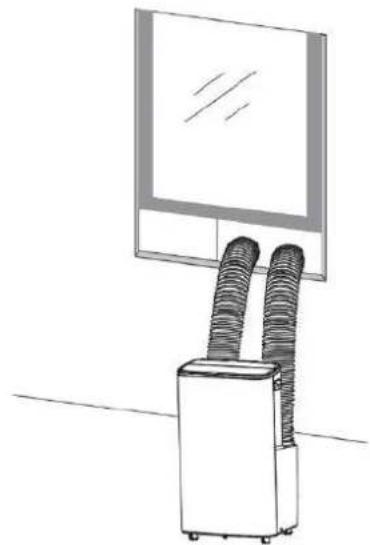
natural_image
Simple line drawing of an air conditioner unit with coiled tubing, mounted on a wall (no text or symbols)Fig.2 Fig.2a
text_image
Add Device Searching for nearby devices. Make sure your device has entered pinning mode. Discovering devices... Add Add Manually Electrical Socket Lighting Plug (BLE+WIFI) Socket (WHFI) Socket (Zigene) Sensors Large Home Appliances Socket (BLT) Dualband Plug (2.45H×50Hz) Socket (NMIuT) Small Home Appliances Kitchen Appliances Socket (other) Display & Health Power Strip Camera & Lock Power Strip Power Strip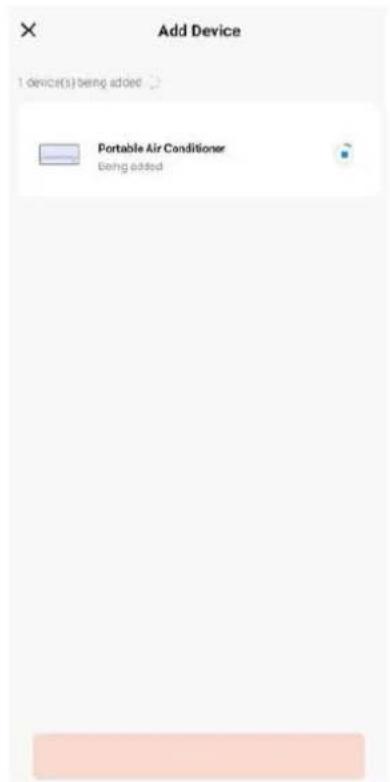
text_image
Add Device 1 device(s) being added Portable Air Conditioner Being addedtext_image
≥30cm ≥30cmFig.3
natural_image
Simple diagram showing a container with arrows indicating downward flow and a black arrow pointing left, no text or symbols present.Ancho de ventana
Min: 40 ~cm
Max: 120 ~cm
natural_image
Diagram showing airflow direction and height measurement with arrows and a vertical bar (no text or symbols)Altura de ventana
Min: 40 cm
Max: 120 cm
Fig.4 Fig.4a
text_image
Diagram showing three different setups for a device with labeled components and directional arrows indicating flow or movement.Fig.5
natural_image
Simple line drawing of a water dispenser with a faucet and a cross symbol (no text or labels)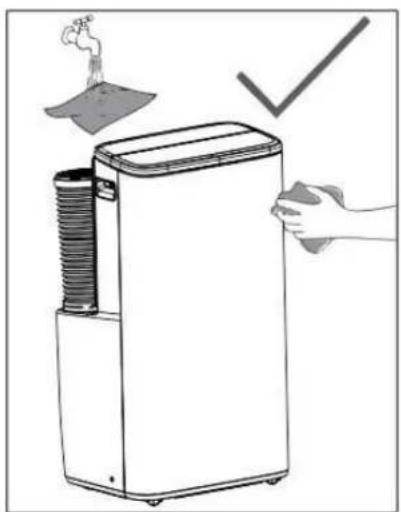
natural_image
Illustration of a portable air conditioner unit with a hand holding a cloth, no text or symbols present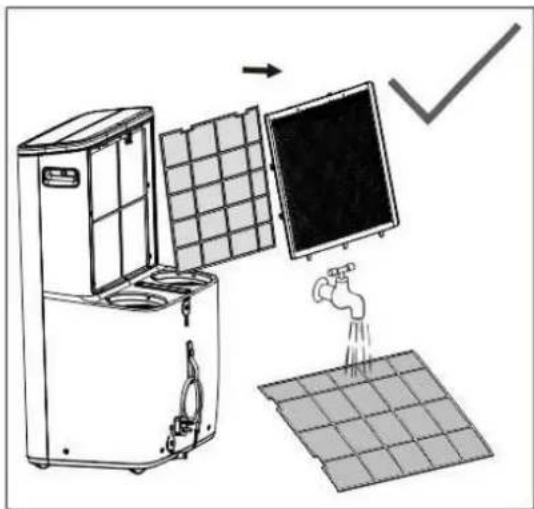
natural_image
Illustration of a solar-powered device with water spray and panel array (no text or symbols)Fig.9
8.1 Filtro de Aire
natural_image
Line drawing of a portable air conditioner unit with a coiled heater and top panel (no text or symbols)Modèle:
Friedrich Air Conditioning, A Rheem company
10001 Reunion Place, Ste. 500 | San Antonio, TX 78216
Soutien technique 1-877-599-5665 | www.friedrich.com
Table des matières
- eau savonneuse,
- colorants fluorescents.
text_image
Technical diagram of a front-loading air purifier with numbered parts labeled 5 to 10Fig.1
natural_image
Line drawing of a vertical cylindrical device emitting a bundle of wires, next to a window frame (no text or symbols)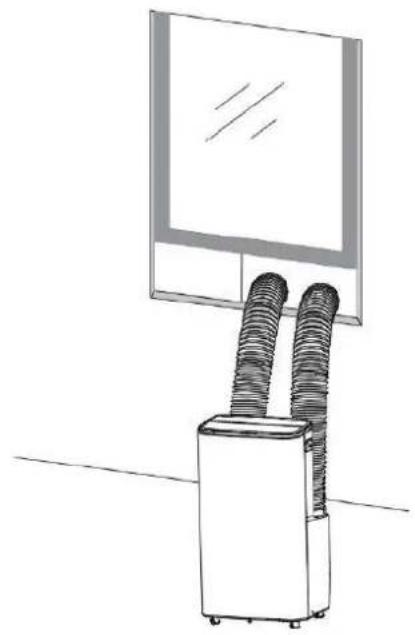
natural_image
Line drawing of an outdoor air conditioner unit with two coiled tubes, mounted on a wall above (no text or symbols)Figure 2 Figure 2a
text_image
Add Device Searching for nearly devices. Make sure your device has stored posting mode. Discovering devices... Add Add Manually Electrical Lighting Sensors Large Home Appliances Small Home Appliances Kitchen Appliances Exercise & Health Camers & Locks Socket Plug (BLE+0+F) Socket (M+0) Socket (Ziode) Socket (BLT) Doubond Plug (2.5mm/8.5mm) Socket (M+0+T) Socket (dlib+) Power Strip Power Strip Power Striptext_image
Add Device Device(s) being added Portable Air Conditioner Being addedtext_image
Portable Air Conditioner indoor temp 60 °F 72 °F * Main Seal Energy Heat temp ONnatural_image
Simple diagram of a container with arrows indicating downward flow and a control panel below (no text or symbols)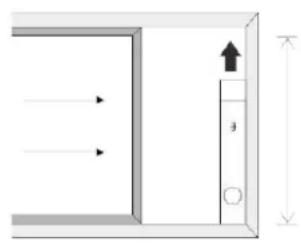
natural_image
Diagram showing airflow direction and height measurement with arrows and a vertical dimension (no text or symbols)text_image
(A) upper drainage outlet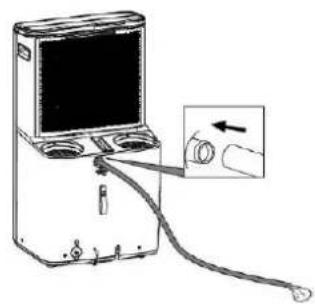
natural_image
Diagram of a portable electronic device with cable and ports, showing a hand holding a cable (no text or symbols present)Fig.6
text_image
(B) lowest drainage outlet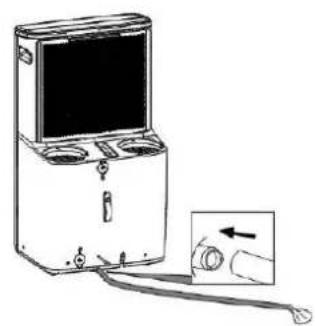
natural_image
Line drawing of a portable electronic device with a cable and a hand holding a circular button (no text or symbols)Fig.7
natural_image
Simple line drawing of a water dispenser with a faucet and a 'X' symbol (no text or labels)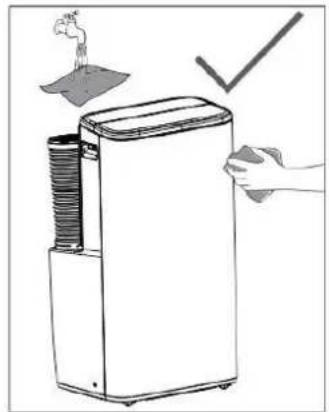
natural_image
Illustration of a portable air conditioner unit with a hand holding a tray and a checkmark indicating inspection (no text or symbols present)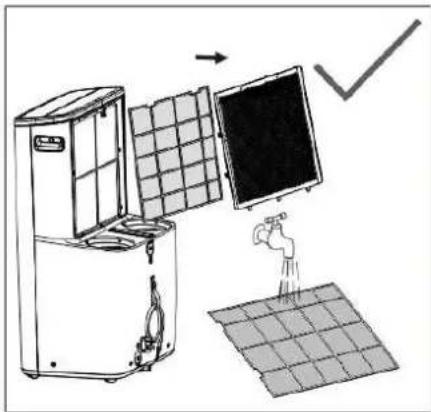
natural_image
Illustration of a solar panel installation with a water tap and grid base, no text or symbols presentFigure 9