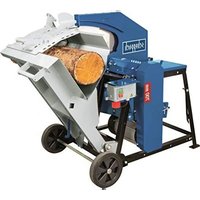
kw 7.0 - Log saw SCHEPPACH - Free user manual and instructions
Find the device manual for free kw 7.0 SCHEPPACH in PDF.


| Product type | Portable electric log saw |
| Brand | Scheppach |
| Model | KW 7.0 |
| Motor power (output) | 4.0 kW |
| Supply voltage | 400 V three-phase (380-420 V) |
| Frequency | 50 Hz |
| Nominal current | 16 A |
| Blade speed | 1400 rpm |
| Blade diameter | 700 mm |
| Blade bore | 30 mm |
| Cutting speed | 51 m/s |
| Net weight | 152 kg |
| Dimensions (L x W x H) | 1060 x 820 x 1150 mm |
| Maximum log length | 1 m |
| Maximum log diameter | 250 mm |
| Minimum log diameter | 60 mm |
| Maximum workpiece weight | 35 kg |
| Operating mode | S6 40% |
| Brake | Electronic, stop in less than 10 s |
| Drive type | Three-phase electric motor |
| Intended use | Outdoor, by one person, cross-cutting of firewood |
| Safety | On/off switch, blade guard, emergency stop (shaft version) |
| Routine maintenance | Regular cleaning, belt tension check, lubrication |
| Wear parts | Saw blade, tilt inserts |
| Warranty | Legal, defective parts |
Frequently Asked Questions - kw 7.0 SCHEPPACH
User questions about kw 7.0 SCHEPPACH
0 question about this device. Answer the ones you know or ask your own.
Ask a new question about this device
Download the instructions for your Log saw in PDF format for free! Find your manual kw 7.0 - SCHEPPACH and take your electronic device back in hand. On this page are published all the documents necessary for the use of your device. kw 7.0 by SCHEPPACH.
USER MANUAL kw 7.0 SCHEPPACH
natural_image
Mechanical device with black and white components, no visible text or symbols
kw 7.0
kwd 7.0
kwz 7.0
kw-ze 7.0
1905115902_0001
| DE | WippkreissägeOriginalbetriebsanleitung | 3 |
| GB | Rocking log sawTranslation of original instruction manual | 21 |
| FR | Scie à bûchesTraduction des instructions d'origine | 37 |
Inhaltsverzeichnis:
Günzburger Straße 69
D-89335 Ichenhausen
VEREHRTER KUNDE,
natural_image
Close-up of a mechanical lever mechanism with a downward arrow indicating force or direction (no text or symbols present)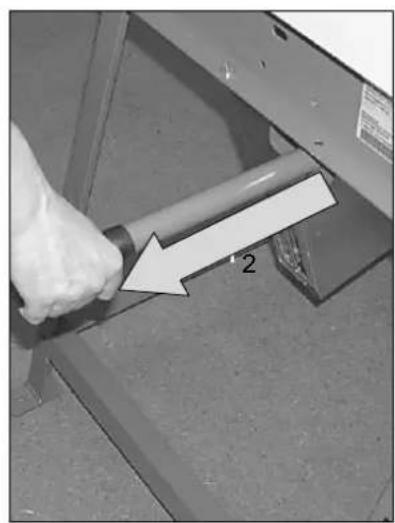
natural_image
Close-up of a hand holding a cylindrical object with an arrow pointing to it, no visible text or symbols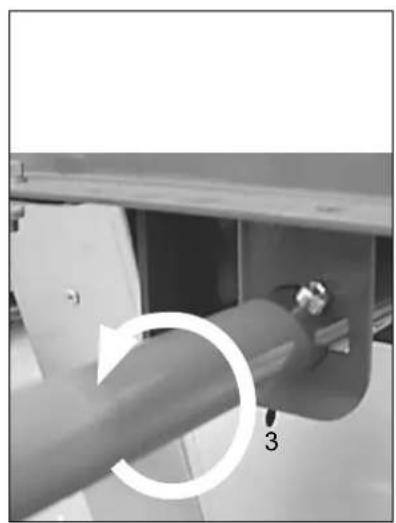
natural_image
Close-up of a mechanical component with a circular arrow and number 3, no visible text or symbolsnatural_image
Technical line drawing of a mechanical tool or connector assembly (no text or symbols)natural_image
Technical line drawing of a mechanical assembly with no visible text or symbolsnatural_image
Close-up of a mechanical assembly with a coiled spring and metal components (no visible text or symbols)natural_image
Mechanical assembly diagram showing a rotating component with labeled point A (no text or symbols beyond label)natural_image
Mechanical assembly diagram showing a frame with a labeled component 'A' (no text or symbols beyond label)Abb. 4
natural_image
Close-up of industrial machinery components with visible structural beams and a label (no readable text or symbols)natural_image
Technical line drawing of a mechanical assembly with no visible text or symbolsnatural_image
Technical line drawing of a mechanical assembly with a black arrow pointing to a component (no text or symbols present)natural_image
Close-up of a metallic fan or vent with a circular vent and radial blades, mounted on a base (no text or symbols visible)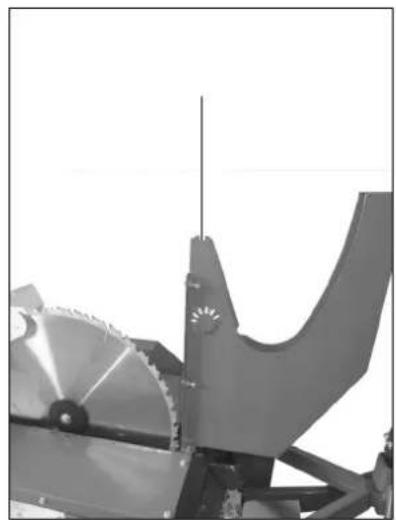
natural_image
Close-up of a mechanical component with a curved blade and flange, no visible text or symbolsnatural_image
Mechanical assembly diagram showing a bracket with mounting flanges and a labeled component (3), no readable text or symbols present.Abb. 5
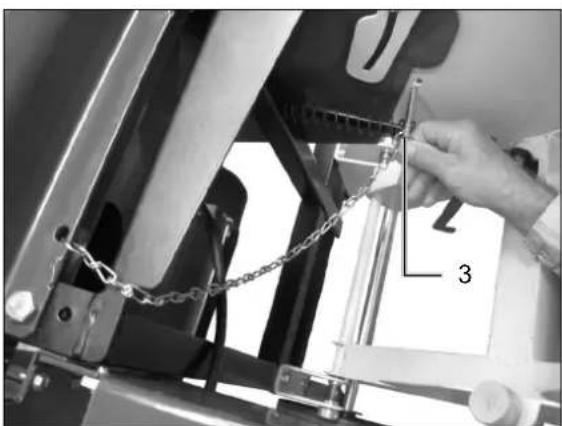
natural_image
Close-up of a mechanical assembly with chains and a hand adjusting a component (no visible text or symbols)natural_image
Close-up of a mechanical device with a metallic fan and control panel, labeled '4' (no readable text or symbols beyond label)Table of contents: Page:
- Introduction......22
- Proper use.... 22
- Safety instructions....23
- Operator training 25
- Technical data 26
- Scope of delivery....26
- Assembly......27
- Setup and calibration....27
- Transporting the machine....27
- Electrical connection 28
- Tractor attachment (kwz 7.0 and kw-ze 7.0)....29
- Commissioning....29
- How to use the safety cage 30
- Sawing operation....30
- Maintenance and service 32
- Saw blade replacement.... 34
- Storage....35
- Disposal and recycling 35
- Troubleshooting....36
- Declaration of conformity 59
1. Introduction
Manufacturer:
Scheppach GmbH
Günzburger Straße 69
D-89335 Ichenhausen
DEAR CUSTOMER
We hope your new product brings you much enjoyment and success.
NOTE:
In accordance with the applicable product liability laws, the manufacturer of this product assumes no liability for damage to the product or caused by the product arising from:
- Improper handling
- Failure to comply with the operating manual
• Repairs carried out by third parties, unauthorised specialists
• Installing and replacing non-original spare parts - Improper use
- Failures of the electrical system in the event of the electrical regulations and VDE provisions 0100, DIN 57113 / VDE0113 not being observed
Note:
Read the whole text of the operating manual before assembly and commissioning.
This operating manual should help to familiarise you with the machine and to use it for its intended purpose.
The operating manual includes important instructions for the safe, proper and economic operation of the machine, for avoiding danger, for minimising repair costs and downtimes and for increasing the reliability and extending the service life of the machine.
In addition to the safety instructions in these operating instructions, you must also observe the regulations applicable to the operation of the machine in your country.
Keep the operating instructions safely at the machine in a plastic sleeve, protected from dirt and moisture. They must be read and carefully observed by all operating personnel before starting the work. The machine may only be used by personnel who have been trained to use it and who have been instructed with respect to the associated hazards. The required minimum age must be observed.
In addition to the safety instructions in these operating instructions and the separate regulations of your country, the generally recognised technical rules relating to the operation of woodworking machines must also be observed.
We accept no liability for accidents or damage that occur due to a failure to observe this manual and the safety instructions.
2. Proper use
The firewood circular saw is designed exclusively with the offered tool for machining wood. The machine complies with the applicable EC machinery directive.
- The rocking log saw is designed as a one-man operating station and is only to be used outdoors.
- Only the operator may work or load the product.
- The rocking log saw is a transportable circular saw. It can only be used for cross-cutting firewood with feed rocker in accordance with the technical data.
- Transport is permitted using a transport device (kw 7.0 and kwd 7.0) or a tractor (kwz 7.0 and kzwe 7.0). Switch off the machine before transport and disconnect the mains plug or switch off the Cardan shaft drive and the motor and remove the ignition key.
- The saw is designed exclusively for cross-cutting firewood with a maximum length of 1 m.
- Do not use the saw to cut other materials.
- Regardless of the wood diameter, only one workpiece may be placed on the swivel frame.
- Observe all safety and danger notices on the machine and keep them complete and in legible condition.
- The working area and surroundings of the machine must be kept free of disruptive foreign bodies in order to prevent accidents.
- Basically, the timbers to be cut must be free of foreign bodies such as nails and screws.
- Only use the machine when in a technically faultless condition, appropriately and in compliance with the operating instructions and with full knowledge of safety and hazards. In particular, rectify malfunctions that could impair safety immediately (or commission rectification works accordingly).
- The safety, operating and maintenance specifications of the manufacturer, as well as the dimensions specified in the technical data, must be observed.
- The applicable accident prevention regulations and the other generally accepted safety rules must be complied with.
- The machine may only be used, maintained or repaired by persons who are familiar with it and have been informed of the dangers. The manufacturer shall not be liable for damage resulting from unauthorised changes to the machine.
- The machine may only be operated with original accessories and original tools from the manufacturer.
- Any use beyond this is improper use. The manufacturer is not responsible for the resulting damages; the user solely bears the risk.
- Only use saw blades that comply with the European standard DIN EN 847-1.
- Ensure adequate lighting.
- Make sure that the machine is stable on solid ground during assembly.
- The area around the machine must be free of trip hazards.
- The machine is equipped with an electronic brake, do not brake the machine by the saw blade.
- The maximum workpiece weight should be no more than 35 kg due to one-man operation and the ergonomic risks and must not exceed 50 kg in order to prevent overloading the swivel frame.
Please note that our products were not designed with the intention of use for commercial or industrial purposes. We assume no guarantee if the product is used in commercial or industrial applications, or for equivalent work.
3. Safety instructions
- We have marked points in the operating manual that impact your safety with this symbol: △
- Observe all of these notes before and while working with the saw.
- Store these safety instructions safely.
- Unused machines should be stored in a dry, locked place and out of reach of children.
- Keep tools sharp and clean in order to be able to work better and more safely.
- Pay attention to what you are doing. Remain sensible when working. Do not use the product when you are fatigued.
- Do not use any products on which the switch cannot be switched on and off.
- Warning! The use of other insertion tools and other accessories can entail a danger of injury.
- Warning: Before carrying out any of the maintenance work described in this manual, switch off the machine and disconnect the mains plug or switch off the Cardan shaft drive and the engine and remove the ignition key.
• Pass the safety instructions on to all persons who work on the machine. - Caution! There is a danger of injury to hands and fingers from the rotating saw blade.
- Do not expose the saw to rain and do not use the machine in a damp or wet environment.
- Ensure good lighting.
- Do not use in the vicinity of combustible fluids or gases.
- Wear suitable work clothing! Loose clothing or jewellery can be caught by the rotating saw blade.
- When working outdoors, anti-slip footwear is recommended.
- Tie long hair back in a hair net.
- Avoid abnormal posture.
-
The operating personnel must be at least 18 years of age. Trainees must be at least 16 years of age and may only work on the machine under supervision.
-
Keep children away from the machine with the engine running.
- Keep the workplace free of wood debris and parts lying around.
• Disorder in the work area can lead to accidents. - Do not allow other persons, especially children, to touch the product. Keep such persons away from the workplace.
- Personnel working on the machine must not be distracted.
- Observe the direction of rotation of the engine and saw blade. Only use saw blades whose maximum permissible speed is not less than the maximum spindle speed of the circular saw and the material to be cut.
- Under no circumstances should the saw blades be braked by pushing against the side after switching off the drive.
- Only install saw blades that are well sharpened, free of cracks and not deformed.
- Do not use circular saw blades made of high-speed steel (HSS steel).
- Only use saw blades recommended by the manufacturer and which comply with EN 847-1.
- Faulty saw blades must be replaced immediately.
- Do not use saw blades that do not correspond to the characteristics specified in this operating manual.
- Safety equipment on the machine must not be disassembled or made unusable.
- Replace worn table or swivel frame insert.
- Working position always to the side of the saw blade.
- Do not load the machine so much that it comes to a standstill.
- Make sure that cut-off pieces of wood are not caught by the sprocket of the saw blade and flung away.
- Never remove loose fragments, chips or jammed wood pieces from the running saw blade.
- For clearing faults or removing jammed pieces of wood, switch off the machine and disconnect the mains plug or switch off the Cardan shaft drive and the engine and remove the ignition key.
- If the sawing gap has increased due to wear, replace the swivel frame or table inlay. Switch off the machine and disconnect the mains plug or switch off the Cardan shaft drive and the motor and remove the ignition key.
- Only carry out modifications, adjustments, measurements and cleaning work with the engine switched off and the mains plug disconnected. When operating with a Cardan shaft, switch off the Cardan shaft and engine and remove the ignition key before making any changes, adjustments, measurements or cleaning.
-
Before switching on, make sure that keys and adjusting tools are removed.
-
When leaving the workplace, switch off the machine and disconnect the mains plug or switch off the Cardan shaft drive and the motor and remove the ignition key.
- All protective and safety equipment must be reassembled immediately after repair or when maintenance is completed.
- The safety, operating and maintenance information of the manufacturer, as well as the dimensions specified in the technical data, must be observed.
- The relevant accident prevention regulations and the other generally accepted safety rules must be observed.
- Make sure that you have secure footing and always maintain your balance.
- Check the product for potential damage!
- All components and protective devices must be carefully inspected to ensure that they are fault-free and function as intended prior to continued use of the machine.
- Check whether the moving parts function faultlessly and do not jam or whether parts are damaged. All parts must be correctly mounted and all conditions must be fulfilled to ensure fault-free operation of the product.
- Damaged protective devices and parts must be repaired properly or replaced by a recognised specialist workshop unless otherwise specified in the operating instructions.
- This product conforms to the applicable safety regulations. Repairs may only be performed by a specialist using original spare parts. Otherwise accidents could occur.
- Wear suitable personal protective equipment. This includes:
- Hearing protection to prevent the risk of developing hearing loss
- Respiratory protection to avoid the risk of inhaling damaging dust
- Wear gloves when handling saw blades and rough materials. Saw blades must be carried in a container whenever practical.
- The operator must be informed about the conditions that affect the noise levels (e.g. saw blades designed to reduce noise, care of saw blade and machine).
- Faults in the machine, including the guards and the saw blade, must be reported to the person responsible for safety as soon as they are discovered.
- When transporting the machine, use only the transport devices and never use the guards for handling and transport.
- All operators must be adequately trained in the use, setting and operation of the machine.
- Do not saw any material to be cut that contain foreign bodies such as wires, cables or cords.
-
Only use sharp saw blades.
-
Arrange the workpiece stack to be processed and the finished workpieces close to the normal workplace of the operator.
- Only use original, undamaged flanges as specified by the manufacturer and those that are suitable for the purpose.
- The machine must be on a horizontal, level floor during operation and the floor around the machine must be level, well maintained and free of waste such as chips and cut-off workpieces.
- Do not use the machine at locations with a high risk of fire.
Warning! This product generates an electromagnetic field during operation. This field can impair active or passive medical implants under certain circumstances. In order to prevent the risk of serious or deadly injuries, we recommend that persons with medical implants consult with their physician and the manufacturer of the medical implant prior to operating the product.
Residual risks
The machine has been built according to the state-of-the-art and the recognised technical safety requirements. However, individual residual risks can arise during operation.
- Danger of injury for fingers and hands due to the rotating saw blade with improper guiding of the workpiece.
- Risk to health from wood dust or wood chippings. The type of wood and degree of drying has an influence on the exposure to dust. Use a chip extraction system if necessary.
- Wearing personal protective equipment such as protective goggles and dust masks is mandatory.
- Risk to health due to noise. The permissible noise level is exceeded during operations. It is essential that personal protective equipment, such as hearing protection, is worn.
- Hazard due to electrical power, with the use of improper electrical connection cables.
• Furthermore, despite all precautions having been met, some non-obvious residual risks may still remain. - Residual risks can be minimised if the "Safety Instructions" and the "Intended Use" together with the operating manual as a whole are observed.
- Injuries due to defective saw blade. Check the integrity of the saw blade regularly and before each use.
- When using special accessories, the operating instructions enclosed with the special accessories must be observed and read carefully.
- The noise emission can be reduced by using a specific saw blade.
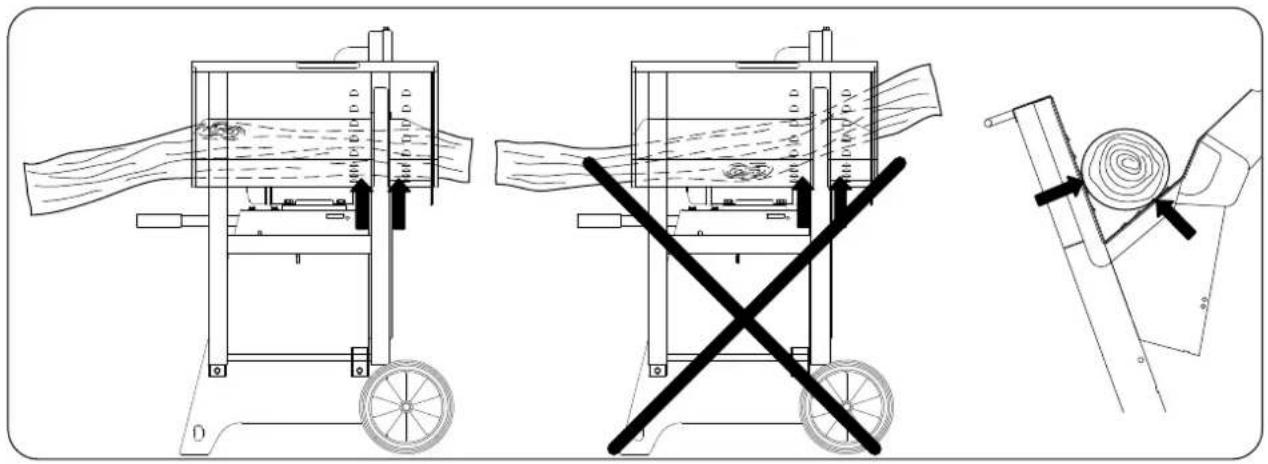
Attention: Danger of accidents!
The wood must always rest on both sides of the saw blade in the prism of the swivel frame. (see arrows)
 | Attention: Danger of accidents!Wear safety shoes. |  | Attention: Danger of accidents!Wear hearing protection.Wear safety goggles. |
 | Attention: Danger of accidents!Read the operating manual before commissioning. | 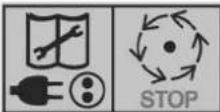 | Attention!Tool continues to run after power disconnected!Disconnect the machine from the power supply before carrying out any maintenance, cleaning or repair work!During Cardan shaft operation, switch off engine and remove the ignition key! |
4. Operator training
• Pass the safety instructions on to all persons who work on the machine.
- The operating personnel must be at least 18 years of age. Trainees must be at least 16 years of age and may only work on the machine under supervision.
- Personnel working on the machine must not be distracted.
- Keep children away from the mains-connected machine.
- Wear tight-fitting clothes. Remove jewellery, rings and watches.
- Ensure that all of the safety information and danger notices on the machine are in legible condition.
- Caution when working: Danger of injury for fingers and hands due to the rotating cutting tool.
- Regular breaks must be taken during operation.
- Safety shoes and protective clothing must be worn during operation.
5. Technical data
| kwd 7.0 kw 7.0 kwz 7.0 kw-ze 7.0 | ||||||
| Item number | 1905115906 | 1905115902 | 1905115903 | 1905115904 | 1905115905 | |
| Dimensions | ||||||
| Overall length | mm | 1060 | 1410 | 1500 | ||
| Overall width | mm | 820 | 900 | 900 | ||
| Overall height mm | 1150 | |||||
| Swivel frame support | mm | 735 | ||||
| Saw blade ø | mm | 700 x 30 x 4.5 x 3.5 Z42 | ||||
| Saw blade nut tightening torque | Nm | 90 | ||||
| Engine idle speed | rpm | 1400 | ||||
| Saw blade cutting speed | m/sec | 51 | 51 | 51 | 51 | |
| Weight | kg | 128 | 152 | 156 | 171 | 217 |
| Drive | ||||||
| Engine | V/Hz | 380 - 420 / 50 | 380 - 420 / 50 | 380 - 420 / 50 | Cardan shaft | 380 - 420 / 50 Cardan shaft |
| Rated input P1 | kW | 5.2 | 5.2 | 7.5 | - | 5.2 |
| Power output P2 | kW | 4.0 | 4.0 | 6.0 | - | 4.0 |
| Operating mode | S6 / 40% | S6 / 40% | S6 / 40% | - | S6 / 40% | |
| Nominal current | A | 16 | 16 | 16 | - | 16 |
| Cardan shaft speed | rpm | - | - | - | 460 | 460 |
| Operating data | ||||||
| Log cutting height | max. mm | 240 | 250 | |||
| min. mm | 60 | |||||
| Reversible cut | max. mm | 260 | ||||
| Firewood | max. mm | 370 x 250 | ||||
| Subject to technical changes! | ||||||
Noise data
Measurement of the noise levels was carried out in accordance with EN ISO 3744:2010.
| Sound power level in dB | kwd 7.0 | kw 7.0 | kwz 7.0 | kw-ze 7.0 |
| Idle L_WA / Machining L_WA | 102.9 / 105.9 | 102.9 / 105.9 | 107.1 / 102.6 | 107.1 / 102.6 |
| Sound pressure level at workstation in dB | ||||
| Idle L_LqAeq / Machining L_qAeq | 89.1 / 92.1 | 89.1 / 92.1 | 92.8 / 88.5 | 92.8 / 88.5 |
| Uncertainty K_wa/pA | 2 | 2 | 2 | 2 |
The stipulated values are emission values and so do not necessarily represent safe work station values. Although there is a correlation between emission levels and exposure levels, it is not possible to reliably determine whether additional precautionary measures will be required or not based on this. Factors that influence the exposure level present at any given time in the work area include the nature of the working area, other noise sources, e.g. the number of machines and neighbouring work processes. The permissible working values may vary from country to country. However, the information should enable the operator to evaluate the hazards and risks.
6. Scope of delivery
- Rocking log saw
- Allen key or open-end spanner
- Operating manual
General information
- Remove the packaging material, as well as the packaging and transport safety devices (if present).
- Check whether the scope of delivery is complete.
- Check the machine and accessory parts for transport damage. In the event of complaints the carrier and manufacturer must be informed immediately. Later claims will not be recognised.
- If possible, keep the packaging until the expiry of the warranty period.
⚠ WARNING
The product and the packaging material are not children's toys! Do not let children play with plastic bags, films or small parts! There is a danger of choking or suffocating!
- Familiarise yourself with the product by means of the operating manual before using for the first time.
- With accessories as well as wearing parts and replacement parts use only original spare parts. Spare parts can be obtained from your specialist dealer.
- When ordering please provide the article number as well as type and year of manufacture for the product.
7. Assembly
The machine is delivered fully assembled and ready for immediate use.
8. Setup and calibration
- Make sure that the machine is stable on solid ground during assembly.
• The workplace must be well lit. - The area around the machine must be free of trip hazards.
- For your safety in the workplace, fasten the saw to the floor with screws (8x80mm) or ground spikes/anchors (8x230mm) to prevent it tipping or sliding.
9. Transporting the machine
9.1 Transport with transport device (kw 7.0 and kwd 7.0)
natural_image
Close-up of a mechanical lever mechanism with a downward arrow indicating force or direction (no text or symbols present)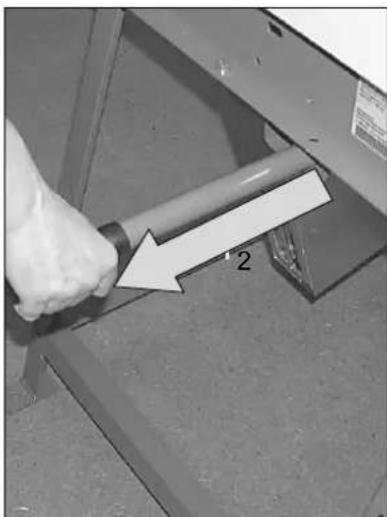
natural_image
Close-up of a hand holding a cylindrical object with an arrow pointing to it, against a plain background (no text or symbols visible)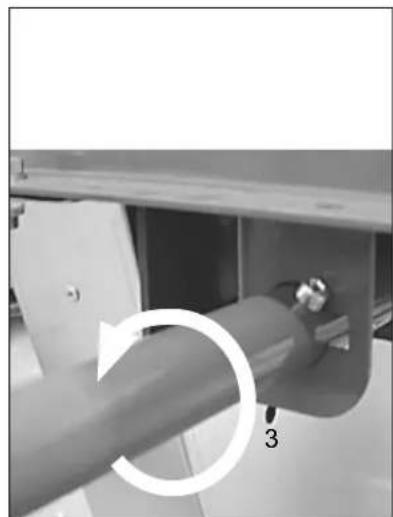
natural_image
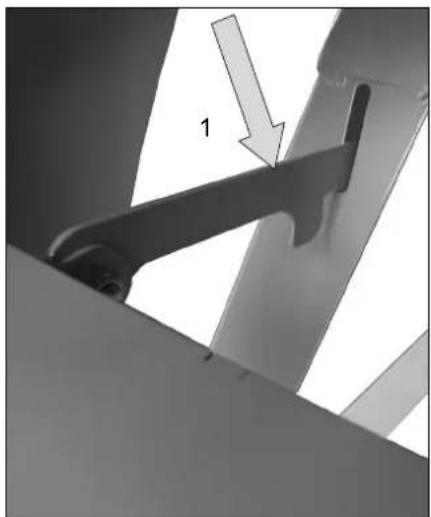
Close-up of a hand holding a cylindrical object with a numbered label '3' and an arrow indicating rotation (no text or symbols on the object itself)- To transport the rocking log saw, latch the swivel lock in position (1).
- Pull out the transport handle (2).
- Turn the transport handle (3) for a secure hold (locking mechanism through screw head in the transport handle).
9.2 Tractor transport (kwz 7.0 and kw-ze 7.0)
- Cardan shaft operation must be switched off when transporting the circular saw.
⚠️ Transport on public highways
Attention! When driving on public roads, it is necessary to observe the German road traffic act (StVZO) paragraph 53, 53b and 54 regarding attachments. If an attachment protrudes more than 1 m to the rear beyond the tail lights of a tractor vehicle, the end must be made readily recognisable with warning signs. If visibility conditions require it, additional tail lights and reflectors must also be fitted.
If an attachment protrudes more than 40 cm beyond the limiting lights or tail lights, the front and rear must be made readily recognisable with warning signs.
If visibility conditions require it, additional limiting lights, tail lights and reflectors are also necessary.
Attachments must be made safe with lighting equipment if the tractor unit is concealed by the attachment. It is necessary to ensure that front ballast is installed when transporting a machine with an agricultural tractor, if this is required according to the load table for the tractor. The transport speed must not exceed 6 km/h.
10. Electrical connection
The electrical motor installed is connected and ready for operation. The connection complies with the applicable VDE and DIN provisions. The customer's mains power connection as well as the extension lead used must also comply with these regulations and the local regulations.
Check the electrical connection cables for damage regularly. Ensure that the connection cables are disconnected from electrical power when checking for damage.
Electrical connection cables must comply with the applicable VDE and DIN provisions. Only use connection cables with the marking "H 07 RN".
The printing of the type designation on the cable is mandatory.
Damaged electrical connection cables
The insulation on electrical connection cables is often damaged.
Causes are:
- Pressure points, where connection cables are passed through windows or doors
- Kinks where the connection cables have been improperly fastened or routed
- Places where the connection cables have been cut due to being driven over
- Insulation damage due to being ripped out of the wall socket
- Cracks due to the insulation ageing
Such damaged electrical connection cables must not be used and are life-threatening due to insulation damage!
3-phase motor 400 V / 50 Hz
Mains voltage 400V / 50Hz
Mains power connection and extension leads must be 5-core = 3 P + N + SL. - (3/N/PE).
Extension cables must have a minimum cross section of 1.5 mm^2 ( ≤ 25m ).
Extension cables must have a minimum cross section of 2.5 mm^2 (> 25m) .
The mains power connection is protected with a 16A slow-blow fuse. The RCD circuit breaker must have a 30 mA trip rating.
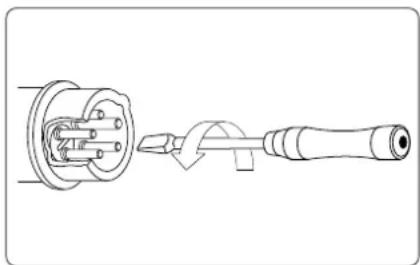
When connecting to the mains or in the event of the machine being moved to another location, the turning direction must be checked. It may be necessary to change the polarity.
Turn the pole changing device in the product connector.
Motor braking device
The brake brakes the drive motor of the sawing shaft within 10 s.
The electric braking is interrupted after max. 14 s. If the braking process takes longer than 10 s, the machine must no longer be operated because the brake is defective. It is essential to disconnect the machine from the power supply. Only a qualified electrician may be assigned with troubleshooting.
Operating mode / duty cycle
The electric motor is designed for operating mode S6 - 40 %.
S6 = Continuous operation with intermittent load
40% = based on 10 min. 4 min. load; 6 min. idle operation
If the engine is overloaded, it switches off automatically because a thermostat protects the motor from overloading. After a cool-down period (time varies) the motor can be switched back on again.
Electrical connection test
- Switch on the machine at the on-off switch; the sawing shaft starts up.
Attention!
Check direction of rotation
- The direction of rotation of 3-phase motors must be checked when they are connected for the first time or if they are relocated. If necessary the polarity must be changed with the phase inverter (Fig. A).
- When switching off, the sawing shaft is braked within 10 sec.
Change of direction of rotation
Fig. A
natural_image
Technical line drawing of a mechanical tool or connector assembly (no text or symbols)⚠️ Connections and repair work on the electrical equipment may only be carried out by electricians.
Please provide the following information in the event of any enquiries:
• Engine manufacturer; engine type
• Type of current for the motor
• Machine data - type plate
• Electrical control data
When returning the engine always send in the complete drive unit with electrical control. ⚠
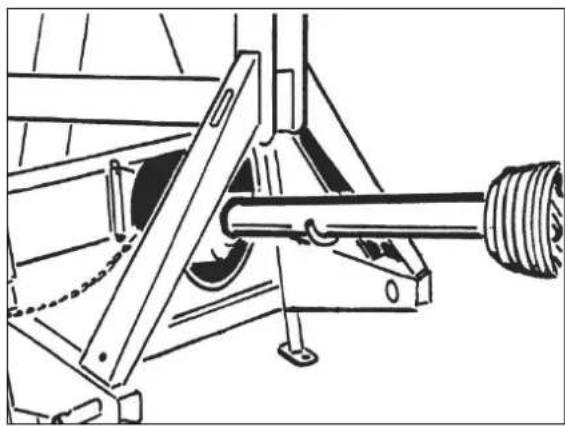
11. Tractor attachment (kwz 7.0 and kw-ze 7.0)
natural_image
Technical line drawing of a mechanical assembly with no visible text or symbolsImportant: The propshaft guard must be unlocked for assembly and pushed in the direction of the Cardan shaft-side connection.
We recommend the Cardan shaft W100, Art. no. 05018101.
- Remove the dust cover and attach it to the Cardan shaft protective cover.
- Lower the lower mounting arms to the support pins of the firewood saw and secure them with the locking pins.
- Position the upper mounting arm in the bracket and align it with the holes in the bracket. Insert the hanger pin to lock the upper mounting arm.
- The cardan shaft end of the gearbox has a diameter of 34.8 mm and a connection with 6 teeth (standard category 1 cardan).
- Slide the cardan drive shaft over the cardan shaft end on the gearbox and on the drive vehicle. Press in the spring pins located at both ends of the propeller shaft. Push the drive shaft further over the ends of the Cardan shaft until the spring pins spring out and engage in the teeth of the end of the Cardan shaft.
- Align the Cardan shaft: Viewed from above and from the side of the shaft, the Cardan shaft end on the firewood saw and the Cardan shaft end on the drive vehicle must be aligned parallel. The angles of the universal joints must be as small as possible.
- Secure the safety chain of the Cardan shaft drive to a fixed part of the machine and the driving vehicle to prevent the protective device from turning.
12. Commissioning
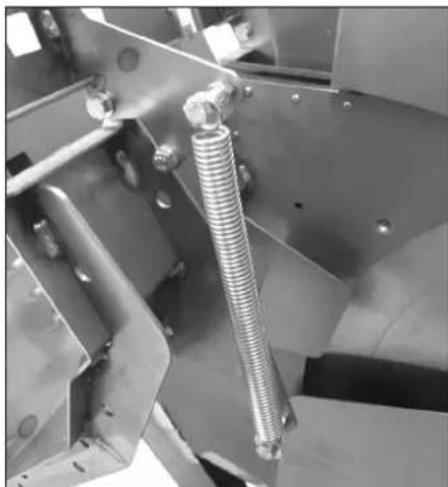
12.1 Before start-up
natural_image
Close-up of a mechanical assembly with a coiled spring and metal components (no visible text or symbols)- Remove the cable ties on the tension spring.
- Open the protective cover (1) (see illustration in chapter 13) and insert the tension springs.
12.2 Important notes on commissioning
- Observe the safety instructions before the commissioning.
- All safety devices and aids must be installed.
- Check the swivel frame. This must return to the starting position automatically. Check that the saw blade is properly seated and that the running direction is correct.
• Perform a functional test prior to commencing work.
• Perform a brake test prior to commencing work. - To start up the product, press the on/off switch: Switching on: Press the green button (I) Switching off: Press the red button (O)
- During Cardan shaft operation, start the tractor engine and the Cardan shaft drive.
-
The saw is designed exclusively for cross-cutting firewood with a maximum length of 1 metre.
• The smallest permissible wood diameter is 60 mm. -
The kw 7.0 / kwd 7.0 / kwz 7.0, kw-ze 7.0 offer you maximum safety thanks to a closed sawing area.
- With both hands on the handle, swivel the swivel frame towards the saw blade.
- Then bring the swivel frame into the starting position.
• The wood to be sawn must not be fixed by hand. - After the saw has come to a complete standstill, pull out the mains plug. When operating with a Cardan shaft, switch off the Cardan shaft and the engine, and remove the ignition key.
- Only carry out modifications, adjustments, measurements and cleaning work with the engine switched off or with the Cardan shaft drive and engine switched off. Wait for the rotating tool to stop and disconnect the mains plug or remove the ignition key.
13. How to use the safety cage
Fig. 1
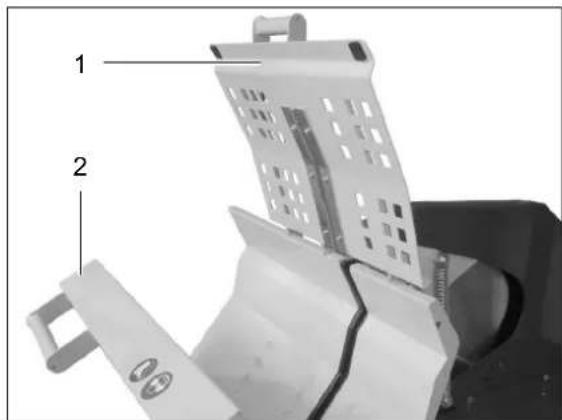
Fig. 2
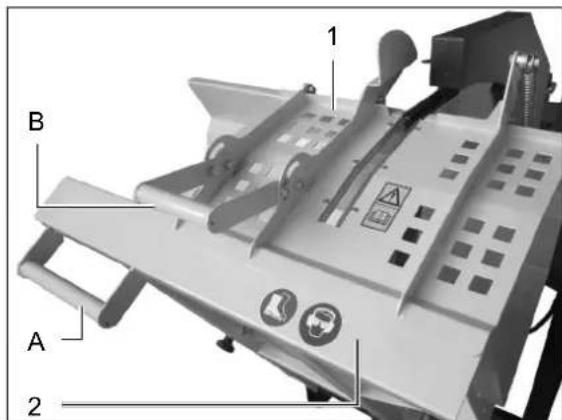
- Unfold the protective cover (1).
- Place in the material to be cut.
- Close the protective cover (1).
- Swivel the swivel frame (2) with the handles (A) and (B) towards the saw blade and cut through the material.
- Swivel the swivel frame (2) back and open the protective cover (1).
- Push the material to be cut in and close the protective cover (1) again.
14. Sawing operation
- After the machine has been switched on, wait until the saw blade has reached full speed.
- Put the wood in the swivel frame (2) and close the protective cover (1). (see picture in chap. 13)
- Hold the handles of the swivel frame (2) and protective cover (1) with both hands and guide them evenly to the saw blade.
-
Only apply enough pressure on the swivel frame (2) when sawing so that the speed of the saw blade does not drop.
-
Remove the sawn wood from the swivel frame (2) after it has returned to its original position and the saw blade is covered. Now place the next piece of wood on.
⚠ Attention!
- Do not leave the machine unattended during operation
- Switch the machine off and remove the mains plug when stopping work. When operating with a Cardan shaft, switch off the Cardan shaft and the engine, and remove the ignition key.
Working with the kw-ze 7.0
Fig.1
natural_image
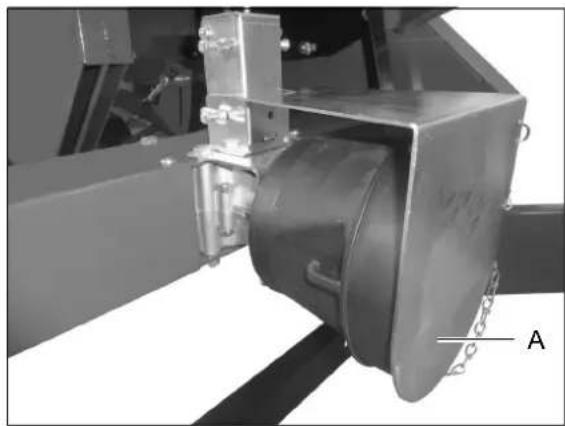
Mechanical assembly diagram showing a rotating component with labeled section A (no readable text or symbols)- During electrical operation, slide the protective cover (A) into the lowest position to activate electric operation. (Fig. 1)
Fig. 2
natural_image
Mechanical assembly diagram showing a fan-like structure with labeled component A (no text or symbols beyond label)-
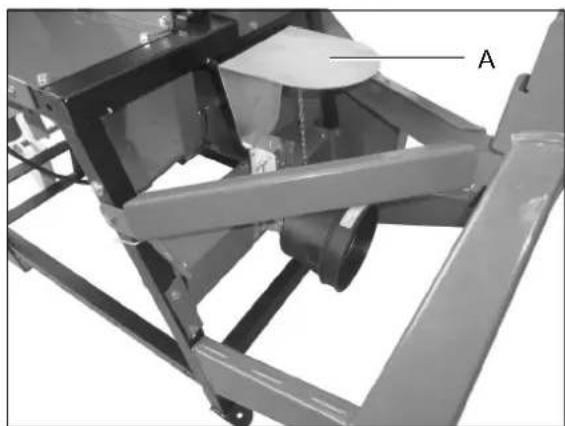
During Cardan shaft operation, lock the protective cover (A) in the top position.
-
Disconnect the mains cable. (Fig. 2)
⚠ Attention! Emergency stop only for Cardan shaft operation
Fig. 3
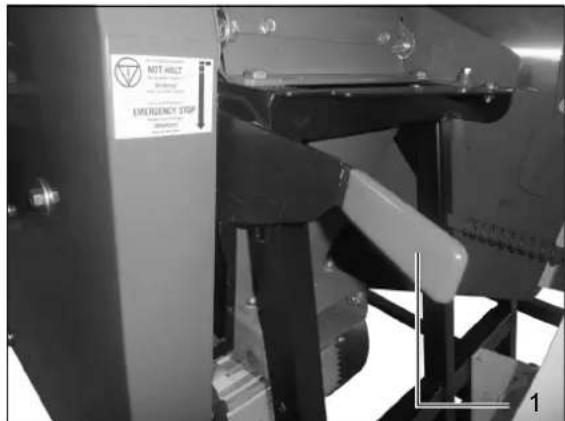
Fig. 4
natural_image
Close-up of industrial machinery components with visible safety labels (no readable text or symbols)-
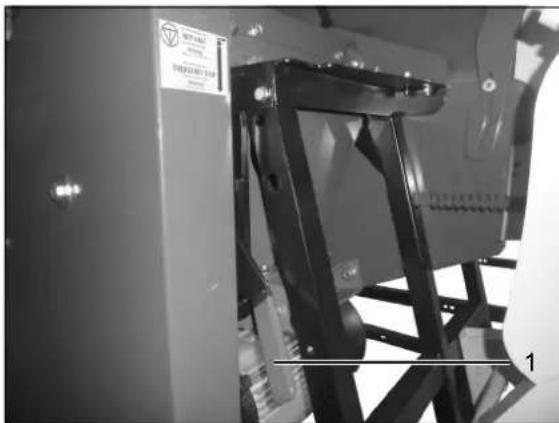
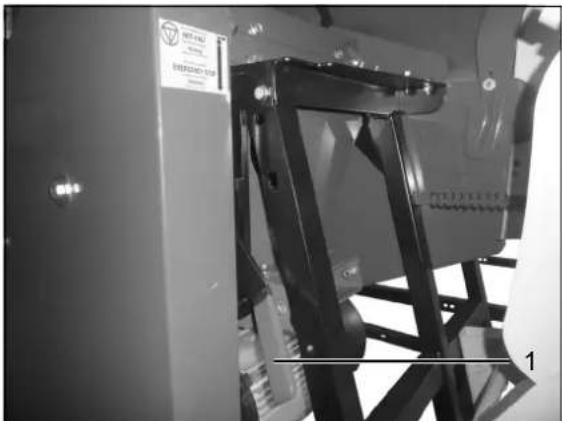
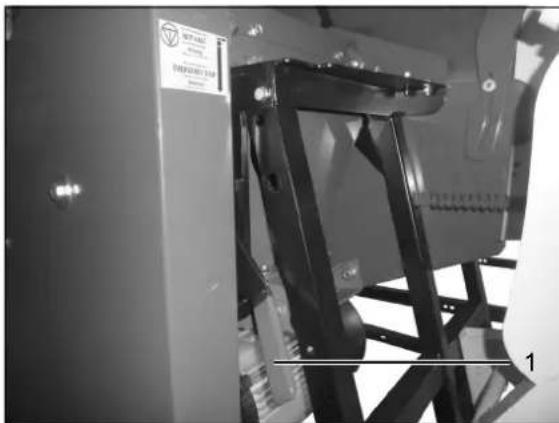
In case of danger, when operating with a Cardan shaft, release the emergency stop lever (1) slightly to the left and push it down. This stops the saw blade and the Cardan shaft runs on.
-
Switch off the Cardan shaft on the tractor immediately. Otherwise, the wear on the drive is very high.
Attention! Do not use the emergency stop to switch off the saw in normal operation. Otherwise, the wear on the drive is very high.
Work complete
- Switch off the drive on the On/Off switch or tractor.
- Wait until the saw blade has come to a complete stop.
- Pull out the mains plug or disconnect the ignition key.
- Observe the general maintenance information.
- Bring the swivel frame to the transport position and secure it with the swivel frame lock.
15. Maintenance and service
△ Only carry out maintenance, modification, adjustment and cleaning work when the engine is switched off and the mains plug is disconnected. When operating with a Cardan shaft, always switch off the Cardan shaft and the engine first and remove the ignition key before carrying out maintenance, modification, adjustment and cleaning work.
- Store the manual with the machine.
- Keep the machine clean.
- Wear safety goggles when cleaning.
- Attention! Danger of fire due to chips in the event the cleaning carried out is insufficient.
Before starting the maintenance or checks, clean the work area and have suitable tools at hand and in good condition.
The time intervals refer to normal conditions of use. If the machine is subject to heavy use, these times are reduced accordingly.
Clean the machine panels, covers and control levers with a soft, dry cloth or one that has been lightly dampened with a neutral cleaning agent.
Do not use solvents such as alcohol or petrol, as they can attack surfaces.
Keep oils and lubricating greases out of the reach of unauthorised personnel. Read the instructions on the containers carefully and follow them closely.
Avoid direct contact with the skin and rinse thoroughly after use.
Check the V-belt tension after the first hour of operation and every time before starting up. To do so, undo the T-screw on the motor bracket. Press the console down and retighten the tommy screw.
All ball bearings are lifetime lubricated. The circular saw blade is a wearing part. Check it every time before commissioning. Only a well-sharpened, correctly set saw blade delivers good cutting results. Occasional greasing of the saw blade is recommended.
If signs of wear appear in the swivel saw slit, the swivel parts must be replaced.
Additional maintenance work with Cardan shaft operation
Fig. 1
natural_image
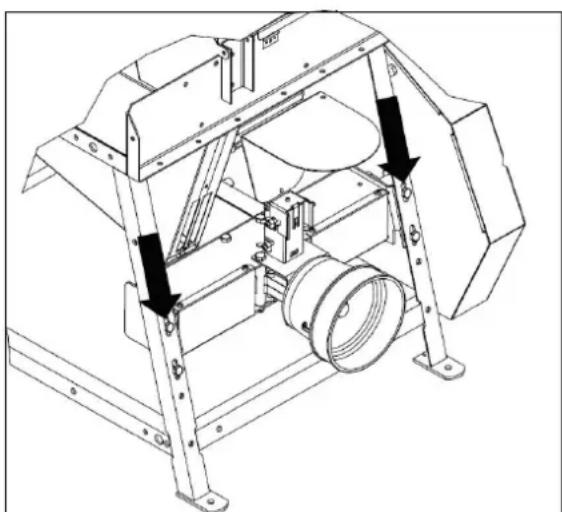
Technical line drawing of a mechanical assembly with no visible text or symbolsTightening the V-belt (Fig. 1)
- Loosen the hexagon bolts and push the gearbox down evenly. The gear unit must be adjusted parallel.
- Tighten the hexagon bolts firmly.
Fig. 2

natural_image
Technical line drawing of a mechanical assembly with a black arrow pointing to a component (no text or symbols present)Replacing the gear oil (Fig. 2)
Attention! If the product is operated without or with too little gear oil, this can lead to transmission damage.
Change the gearbox oil every year before the start of the season when the engine is warm and switched off. Use only SAE 30W transmission fluid. The capacity is 0.45 litres.
Attention! Spilled oil can pollute the environment permanently. The liquid is highly toxic and can quickly lead to water pollution. Use a funnel and catch the drained oil in a suitable container. Wipe up spilled oil carefully immediately and dispose of the cloth according to local regulations.
- Make sure that the machine is on a flat, paved surface.
- Place an oil drain pan under the angular gear oil filler plug (Fig. 2) and open it.
- Suck out the gear oil through the filler neck using an oil pump (with hose).
- Top up with fresh gear oil.
- Replace the oil filler plug on the angular gearbox (Fig. 2).
- Dispose of old oil as per local regulations.
⚠️ Check all safety devices after all maintenance or cleaning work.
Servicing
Switch off the engine or Cardan shaft and engine and let the engine cool down. Pull out the mains plug or disconnect the ignition key.
Check the general condition of the machine. Check for loose screws, misalignment or jamming of moving parts, part breakages and other conditions that could impair safe operation.
Remove all foreign objects and other materials that have collected on the saw blade and on the unit. Clean the machine after every use.
Then use a high-quality, low-viscosity machine oil to lubricate all moving parts.
△ Never use a high-pressure cleaner to clean your machine. Water can penetrate sealed areas of the machine and the transmission housing and cause damage to spindles, gear wheels, bearings or the engine. The use of high-pressure cleaners shortens the service life and reduces the ease of maintenance.
Experienced craftsmen can carry out small repairs on the machine themselves.
- Check the saw blade regularly. Use only saw blades that are well sharpened, free of cracks and not deformed. Only insert tools that comply with the European standard DIN EN 847-1.
- Replace worn swivel frame bearings immediately.
-
Check all safety devices after all maintenance or cleaning work.
-
Check that no tools or miscellaneous parts are on or in the machine before putting it back into operation.
- Remove any sawdust accumulations at the discharge.
Service information
With this product, it is necessary to note that the following parts are subject to natural or usage-related wear, or that the following parts are required as consumables.
Wearing parts*: Saw blade; rocker inserts * may not be included in the scope of delivery!
Spare parts and accessories can be obtained from our Service Centre. To do this, scan the QR code on the front page.
16. Saw blade replacement
Wait for the rotating saw blade to stop and let the mains plug cool down. Pull out the mains plug or disconnect the ignition key!
Observe the max. speed specified on the saw blade and select a saw blade suitable for your machine.
The saw blade can only be changed in the firewood cutting position and is carried out in the following steps:
natural_image
Close-up of a metallic mechanical component with a circular feature and mounting bracket (no visible text or symbols)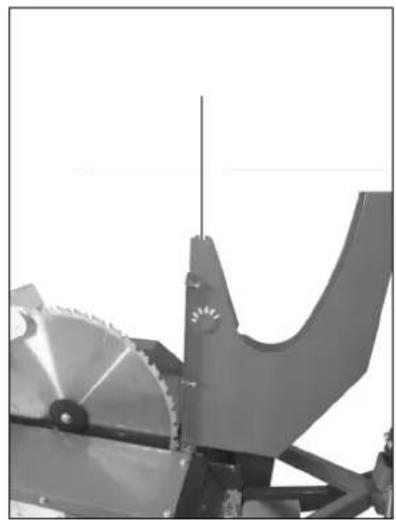
natural_image
Close-up of a mechanical component with a blade and gear mechanism (no visible text or symbols)- Loosen the hexagon bolts (1) on the left and right of the protective hood until the bolts turn freely. (Fig. 1 and 2)
- Fold the protective cover (2) upwards. (Fig. 3)
Fig. 4
natural_image
Mechanical assembly diagram showing a bracket with mounting holes and a labeled component (3), no readable text or symbols present.Fig. 5
natural_image
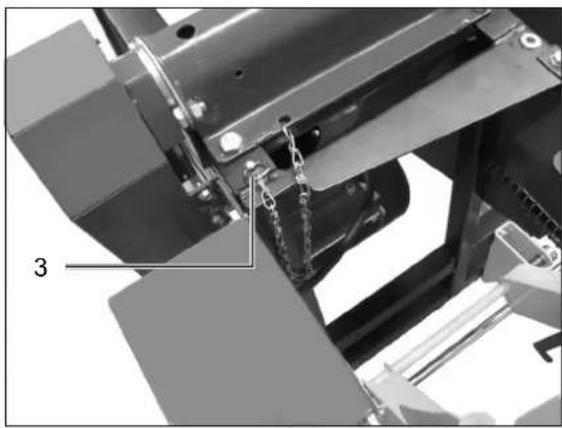
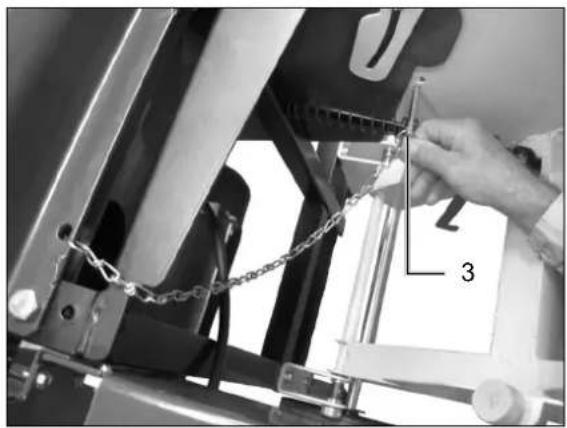
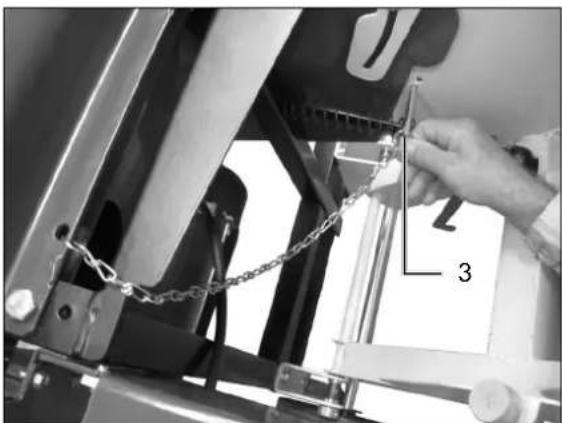
Close-up of a mechanical assembly with chains and a hand adjusting a component (no visible text or symbols)- To lock the saw blade, you need the locking pin (3), which is located in the frame (see Fig. 4). Insert the locking pin (3) through the corresponding opening on the saw blade guard (Fig. 5). To do this, insert the pin completely and straight into the hole. Use the corresponding hole (depending on the saw blade type) so that the pin is at the lowest point (bottom of the tooth).
Fig.6

natural_image
Close-up of a mechanical device with a metallic fan and control panel, labeled '4' (no readable text or symbols beyond label)- Loosen the saw blade with the supplied open-end spanner / Allen wrench (4). (Fig. 6)
- Remove saw blade flange and saw blade.
- Clean the clamping surfaces. The clamping surfaces must be free of dirt, grease, oil and water.
- Insert the new saw blade.
- Mount the saw blade flange again and tighten the clamp screw to 90 Nm. Use the open-ended spanner / Allen wrench (4) supplied. Do not extend the spanner with a tube or similar and do not tighten the screw by hitting the open-ended spanner with a hammer.
- Mount the saw blade flange again and tighten the clamp screw.
- Remove the locking pin (3).
- Lower the saw blade guard and screw it on.
Attention! When inserting the saw blade, make sure the running direction is correct!
17. Storage
- Store the product and its accessories in a dark, dry and frost-free place that is inaccessible to children.
- Store Product in the transport position.
- The optimum storage temperature lies between 5 and 30^ .
• Cover the product to protect it from dust or moisture. - Store the operating manual with the product.
18. Disposal and recycling
Notes for packaging


The packaging materials are recyclable. Please dispose of packaging in an environmentally friendly manner.
Notes on the electrical and electronic equipment act (ElektroG)
Waste electrical and electronic equipment does not belong in household waste, but must be collected and disposed of separately!
- Used batteries or rechargeable batteries that are not installed permanently in the old device must be removed non-destructively before disposal! Their disposal is regulated by the battery act.
- Owners or users of electrical and electronic devices are legally obliged to return them after use.
- The end user is responsible for deleting their personal data from the old device being disposed of!
- The symbol of the crossed-out dustbin means that waste electrical and electronic equipment must not be disposed of with household waste.
-
Waste electrical and electronic equipment can be handed in free of charge at the following places:
-
Public disposal or collection points (e.g. municipal works yards).
- Points of sale of electrical appliances (stationary and online), provided that dealers are obliged to take them back or offer to do so voluntarily.
- Up to three waste electrical devices per type of device, with an edge length of no more than 25 centimetres, can be returned free of charge to the manufacturer without prior purchase of a new device from the manufacturer or taken to another authorised collection point in your vicinity.
-
Further supplementary take-back conditions of the manufacturers and distributors can be obtained from the respective customer service.
-
If the manufacturer delivers a new electrical device to a private household, the manufacturer can arrange for the free collection of the old electrical device upon request from the end user. Please contact the manufacturer's customer service for this.
• These statements only apply to devices installed and sold in the countries of the European Union and which are subject to the European Directive 2012/19/EU. In countries outside the European Union, different regulations may apply to the disposal of waste electrical and electronic equipment.
You can find out how to dispose of the disused product from your local authority or city administration.
Fuels and oils
- Before disposing of the device, the fuel tank and the motor oil tank must be emptied!
- Fuel and engine oil do not belong in household waste or drains, but must be collected or disposed of separately!
- Empty oil and fuel tanks must be disposed of in an environmentally friendly manner.
19. Troubleshooting
| Fault Possible cause Remedy | ||
| The saw does not brake when switching the machine off | Brake system defective Have the brake | system checked and, if necessary, replaced by a specialist workshop. |
| Saw blade is loose after the motor is switched off | Fixing nut not tight enough Tighten the | fixing nut (Attention: Right-hand thread, 90 Nm) |
| Engine makes excessive noise or hums | Coils damaged, motor defective Arrange | for inspection of the engine by a specialist workshop. |
| Loud noise from the angular gear | No or insufficient oil in the gearbox Top | up oil |
| Gearbox defective Replace gearbox | ||
| Burnt areas on the cutting surface | Blunt saw blade Sharpen saw blade by | a specialist |
| Incorrect saw blade Replace saw blade | ||
| Engine does not start Mains fuse blown Check mains fuse | ||
| Saw blade turns in the wrong direction | Polarity reversed | Change direction of rotation with phase inverter |
| Incorrect connection | Have an electrician transpose the wall socket poles | |
| Motor not supplying power, switches itself off automatically | Overload due to blunt saw blade | Replace saw blade |
| Cross section of the extension cable insufficient | see “Electrical connection” | |
| Overload protection is activated Machine | Switch back on again after cool-down time | |
| Decreasing saw power at full speed | Belt loose | Retighten belt |
| Saw blade jammed. | For kw 7.0 and kwd 7.0: Switch off the machine, pull out the mains plug and release the blockage | |
| For kwz 7.0 and kw-ze 7.0: Switch off the Cardan shaft drive and the engine, remove the ignition key and release the blockage. | ||
Electrical maintenance work may only be carried out by a qualified electrician!
Table des matières: Page:
Günzburger Straße 69
D-89335 Ichenhausen
CHER CLIENT,
natural_image
Close-up of a mechanical lever mechanism with a labeled component '1' (no text or symbols beyond the label)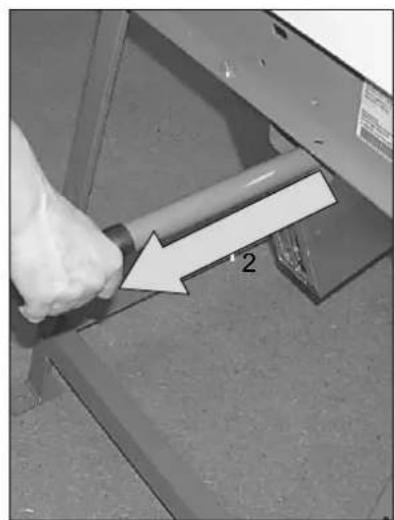
natural_image
Hand holding a cylindrical object with an arrow pointing to it, no visible text or symbols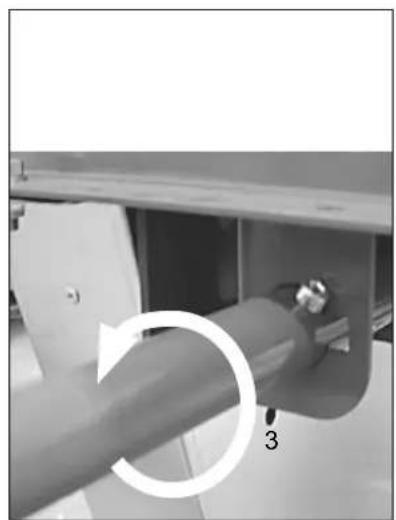
natural_image
Close-up of a mechanical component with a circular annotation labeled '3' pointing to a pipe or shaft (no readable text or symbols beyond the number)natural_image
Technical line drawing of a mechanical tool or connector assembly (no text or symbols)natural_image
Technical line drawing of a mechanical assembly with no visible text or symbolsnatural_image
Close-up of a mechanical assembly with a coiled spring and metal components (no visible text or symbols)natural_image
Mechanical assembly diagram showing a rotating component with labeled point A (no text or symbols beyond label)natural_image
Mechanical assembly diagram showing a frame with a labeled component 'A' (no text or symbols beyond label)Fig. 4
natural_image
Close-up of industrial machinery components with visible structural beams and a label (no readable text or symbols)natural_image
Technical line drawing of a mechanical assembly with no visible text or symbolsnatural_image
Technical line drawing of a mechanical assembly with no visible text or symbolsnatural_image
Close-up of a metallic fan or vent with a circular vent and radial blades, no visible text or symbols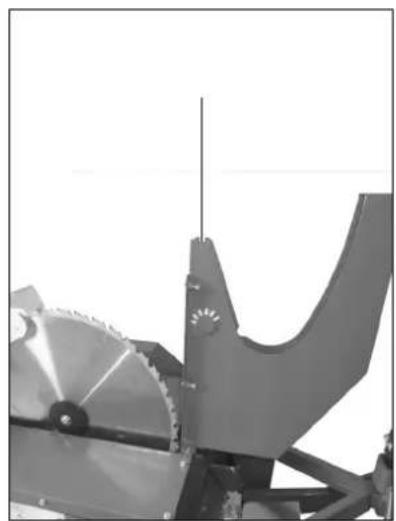
natural_image
Close-up of a mechanical component with a central vertical line and angular features (no visible text or symbols)natural_image
Mechanical assembly diagram showing a bracket with mounting flanges and a labeled component (3), no readable text or symbols present.Fig. 5
natural_image
Close-up of a mechanical assembly with chains and a hand adjusting a component (no visible text or symbols)natural_image
Close-up of a mechanical device with a fan-shaped component and a labeled section '4' (no readable text or symbols beyond the label)EU Declaration of Conformity
Standard references:
EN 55014-1:2006+A1:2009+A2:2011; EN 61000-3-2:2006+A1:2009+A2:2009; EN6100-3-3:2008 (teilweise);
EN 1870-6:2017; EN 60204-1:2006/A1:2009; EN 61140:2002/A1:2006; EN 60745-1/A11:2010; EN ISO 12100:2010
This declaration of conformity is issued under the sole responsibility of the manufacturer.
Subject to change without notice
Documents registrar: Simon Schunk
Günzburger Str. 69, D-89335 Ichenhausen
Garantie DE
Apparent defects must be notified within 8 days from the receipt of the goods. Otherwise, the buyer's rights of claim due to such defects are invalidated. We guarantee for our machines in case of proper treatment for the time of the statutory warranty period from delivery in such a way that we replace any machine part free of charge which provably becomes unusable due to faulty material
or defects of fabrication within such period of time. With respect to parts not manufactured by us, we only warrant insofar as we are entitled to warranty claims against the upstream suppliers. The costs for the installation of the new parts shall be borne by the buyer. The cancellation of sale or the reduction of purchase price as well as any other claims for damages shall be excluded.
Garantie FR
- Inhaltsverzeichnis:
- VEREHRTER KUNDE,
- Table of contents: Page:
- Introduction
- Manufacturer:
- Scheppach GmbH
- DEAR CUSTOMER
- NOTE:
- Proper use
- Safety instructions
- Residual risks
- Attention: Danger of accidents!
- Operator training
- Technical data
- Noise data
- Scope of delivery
- General information
- ⚠ WARNING
- Assembly
- Setup and calibration
- Transporting the machine
- Tractor transport (kwz 7.0 and kw-ze 7.0)
- ⚠️ Transport on public highways
- Electrical connection
- Damaged electrical connection cables
- 3-phase motor 400 V / 50 Hz
- Mains voltage 400V / 50Hz
- Motor braking device
- Operating mode / duty cycle
- Electrical connection test
- Attention!
- Check direction of rotation
- Change of direction of rotation
- Tractor attachment (kwz 7.0 and kw-ze 7.0)
- Commissioning
- Before start-up
- Important notes on commissioning
- How to use the safety cage
- Sawing operation
- ⚠ Attention!
- Working with the kw-ze 7.0
- ⚠ Attention! Emergency stop only for Cardan shaft operation
- Work complete
- Maintenance and service
- Tightening the V-belt (Fig. 1)
- Replacing the gear oil (Fig. 2)
- ⚠️ Check all safety devices after all maintenance or cleaning work.
- Servicing
- △ Never use a high-pressure cleaner to clean your machine. Water can penetrate sealed areas of the machine and the transmission housing and cause damage to spindles, gear wheels, bearings or the engine. The use of high-pressure cleaners shortens the service life and reduces the ease of maintenance.
- Service information
- Saw blade replacement
- Storage
- Disposal and recycling
- Notes for packaging
- Notes on the electrical and electronic equipment act (ElektroG)
- Fuels and oils
- Troubleshooting
- Table des matières: Page:
- CHER CLIENT,
- EU Declaration of Conformity
- Standard references:
- Garantie DE
- Garantie FR
Brand : SCHEPPACH
Model : kw 7.0
Category : Log saw