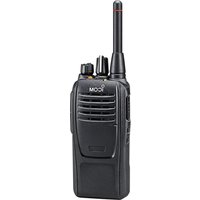
IC-F29SR2 - Radio transceiver ICOM - Free user manual and instructions
Find the device manual for free IC-F29SR2 ICOM in PDF.


| Product type | Portable PMR446 radio transceiver |
| Brand | ICOM |
| Model | IC-F29SR2 |
| Frequency range | 446.006250 to 446.19375 MHz |
| Transmitter output power | 0.5 W |
| Dimensions (W × H × D) | 52.2 × 186.1 × 30.3 mm (with BP-280 battery) |
| Weight | 270 g (with BP-280 battery) |
| Power supply | Li-Ion battery 7.2 V (models BP-278/279/280) |
| Battery life | Up to 33 hours (BP-280, TX:RX:Standby cycle 5:5:90, power save enabled) |
| Charger | BC-213 (desktop charger) or BC-214 (6-battery multi-charger); charging time 3.5 h for BP-280 |
| Number of channels | 16 channels divided into 2 zones (Zone 1 and Zone 2) |
| Main functions | Reception and transmission, call tone, customizable Smart-Ring ringer, squelch, power save |
| Waterproof rating | IP67 (dust and immersion) – with jack cap or optional headset HM-168LWP, HM-222HLWP, HS-94LWP or HS-95LWP |
| Operating temperature | -25 °C to +55 °C |
| Included accessories | Battery pack, belt clip, battery charger, AC adapter |
| Maintenance and cleaning | Clean with fresh water after exposure to seawater; do not use solvents (benzene, alcohol) |
| Safety instructions | Do not short-circuit the battery, use only Icom accessories, do not expose to temperatures >60 °C, turn off before connecting accessories |
| Spare parts and repairability | Battery packs (BP-278/279/280), chargers (BC-213/214), headsets, holders; contact an authorized Icom distributor |
| General information | Compliant with EU directives 2014/53/EU and 2011/65/EU; CE declaration available at www.icomjapan.com/support/ |
Frequently Asked Questions - IC-F29SR2 ICOM
User questions about IC-F29SR2 ICOM
0 question about this device. Answer the ones you know or ask your own.
Ask a new question about this device
Download the instructions for your Radio transceiver in PDF format for free! Find your manual IC-F29SR2 - ICOM and take your electronic device back in hand. On this page are published all the documents necessary for the use of your device. IC-F29SR2 by ICOM.
USER MANUAL IC-F29SR2 ICOM
Thank you for choosing this Icom product.
This product is designed and built with Icom's state of the art technology and craftsmanship.
With proper care, this product should provide you with years of trouble-free operation.
IMPORTANT
READ ALL INSTRUCTIONS carefully and completely before using the transceiver.
SAVE THIS INSTRUCTION MANUAL — This instruction manual contains important operating instructions for the IC-F29SR2 PMR446 TRANSCEIVER.
This transceiver includes some functions that are usable only when they are preset by your dealer. Ask your dealer for details.
For more information, download the IC-F29SR2 operating guide from the Icom web site.
(https://www.icomjapan.com/support/)
Icom and the Icom logo are registered trademarks of Icom Incorporated (Japan) in Japan, the United States, the United Kingdom, Germany, France, Spain, Russia, Australia, New Zealand, and/or other countries.
EXPLICIT DEFINITIONS
| WORD | DEFINITION |
| ⚠DANGER! | Personal death, serious injury or an explosion may occur. |
| ⚠WARNING! | Personal injury, fire hazard or electric shock may occur. |
| CAUTION | Equipment damage may occur. |
| NOTE | If disregarded, inconvenience only. No risk of personal injury, fire or electric shock. |
DISPOSAL
The crossed-out wheeled-bin symbol on your product, literature, or packaging reminds you that in the European Union, all electrical and electronic products, batteries, and accumulators (rechargeable batteries) must be taken to designated collection locations at the
end of their working life. Do not dispose of these products as unsorted municipal waste. Dispose of them according to the laws in your area.
RECOMMENDATION
CLEAN THE TRANSCEIVER THOROUGHLY WITH
FRESH WATER after exposure to saltwater, and dry it before operating. Otherwise, the transceiver's keys, switches and controllers may become unusable, due to salt crystallization, and/or the charging terminals of the battery pack may rust.
NOTE: If the transceiver's waterproof protection appears defective, carefully clean it with a soft, wet (fresh water) cloth, then, dry it before operating.
The transceiver may lose its waterproof protection if the case, jack cap, or connector cover is cracked or broken, or the transceiver has been dropped.
ABOUT CE AND DOC

Hereby, Icom Inc. declares that the versions of IC-F29SR2 which have the "CE" symbol on the product, comply with the essential requirements
of the Radio Equipment Directive, 2014/53/EU, and the restriction of the use of certain hazardous substances in electrical and electronic equipment Directive, 2011/65/EU.
The full text of the EU declaration of conformity is available at the following internet address:
https://www.icomjapan.com/support/
ABOUT UKCA DOC
To obtain the UKCA Declaration of Conformity, please contact Icom UK Limited by email at info@icomuk.co.uk or alternatively call + 44(0) 1227 741741.
SUPPLIED ACCESSORIES
Battery pack Belt clipBattery charger

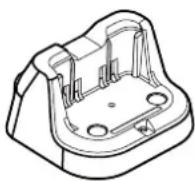
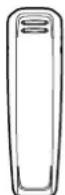
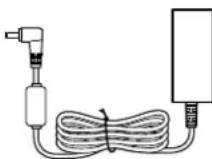
Power adapter ^* (for the battery charger)
*A different type is supplied, depending on the transceiver version.
PRECAUTIONS
⚠️ DANGER! NEVER short the terminals of the battery pack. Shorting may occur if the terminals touch metal objects such as a key, so be careful when placing the battery packs (or the transceiver) in bags, and so on. Carry them so that shorting cannot occur with metal objects. Shorting may damage not only the battery pack, but also the transceiver.
△ DANGER! NEVER use and charge Icom battery packs with non-Icom transceivers or non-Icom chargers. Only Icom battery packs are tested and approved for use with Icom transceivers or charged with Icom chargers. Using third-party or counterfeit battery packs or chargers may cause smoke, fire, or cause the battery to burst.
⚠ WARNING! NEVER hold the transceiver so that the antenna is very close to, or touching exposed parts of the body, especially the face or eyes, while transmitting. The transceiver will perform best if the microphone is 5 to 10 cm away from the lips and the transceiver is vertical.
⚠ WARNING! NEVER operate the transceiver with a headset or other audio accessories at high volume levels. If you experience a ringing in your ears, reduce the volume level or discontinue use.
⚠ WARNING! NEVER operate the transceiver while driving a vehicle. Safe driving requires your full attention—anything less may result in an accident.
CAUTION: DO NOT operate the transceiver unless the flexible antenna, battery pack and jack cover are securely attached. Confirm that the antenna and battery pack are dry before attaching. Exposing the inside of the transceiver to dust or water can cause serious damage to the transceiver.
CAUTION: DO NOT place or leave the transceiver in direct sunlight or in places with temperatures below -25^ or above +55^ .
CAUTION: DO NOT modify the transceiver. The specifications may change and then the transceiver may not comply with the requirements of required regulations. The transceiver warranty does not cover any problems caused by unauthorized modification.
CAUTION: DO NOT use harsh solvents such as Benzine or alcohol when cleaning, because they will damage the transceiver surfaces.
DO NOT operate the transceiver near unshielded electrical blasting caps or in an explosive atmosphere.
DO NOT push [PTT] when you do not actually intend to transmit.
NEVER place the transceiver in an insecure place to avoid inadvertent use by unauthorized persons.
BE CAREFUL! The transceiver meets IP67* requirements for dust-tight and waterproof protection. However, once the transceiver has been dropped, dust-tight and waterproof protection cannot be guaranteed because of possible damage to the transceiver's case or the waterproof seal.
* Only when the jack cover or the optional HM-168LWP, HM-222HLWP, HS-94LWP, or HS-95LWP is attached.
BE SURE to turn OFF the transceiver power before connecting the supplied or optional equipment.
Even when the transceiver power is OFF, a slight current still flows in the circuits. Remove the battery pack from the transceiver when not using it for a long periods of time. Otherwise, the installed battery pack will become exhausted, and will need to be recharged or replaced.
Icom is not responsible for the destruction, damage to, or performance of any Icom or non-Icom equipment, if the malfunction is because of:
- Force majeure, including, but not limited to, fires, earthquakes, storms, floods, lightning, other natural disasters, disturbances, riots, war, or radioactive contamination.
- The use of Icom transceivers with any equipment that is not manufactured or approved by Icom.
TABLE OF CONTENTS
IMPORTANT....1
EXPLICIT DEFINITIONS....1
DISPOSAL....1
RECOMMENDATION....2
ABOUT CE AND DOC....2
ABOUT UKCA DOC 2
SUPPLIED ACCESSORIES 2
PRECAUTIONS....3
1 PANEL DESCRIPTION....5
■ Turning ON the power....5
■ Front panel....5
2 BASIC OPERATION....6
■ Receiving and Transmitting....6
■ Call-Ring operation 6
■ Smart-Ring operation....6
3 BATTERY CHARGING....7-10
■ Caution....7
■ Battery chargers....9
4 OPTIONS....11
5 CHANNEL FREQUENCY LIST....12

1
PANEL DESCRIPTION
■Turning ON the power
NOTE: For optimum life and operation, the battery must be fully charged before using the transceiver for the first time.
Rotate [VOL] to turn ON the power.
■Front panel
![Antenna [VOL] [Top*] [Rotary Selector] [PTT] LED indicator Microphone [Upper]* [Lower]* Speaker-Microphone jack Speaker * Other functions can be assigned to these keys with the CS-F29SR2 programming software (purchase separately).](/content/2026/04/726827/images/9d4c3c052baf16d56cd2afd61cd1b431630d047aeaa75fa036beada1316dad10.jpg)
◇ About the Speaker microphone jack
The transceiver meets IP67 requirements for dust-tight and waterproof protection only when the jack cover or the optional HM-168LWP, HM-222HLWP, HS-94LWP, or HS-95LWP is attached.
◇ About the LED Indicator
- Lights red while transmitting.
- Lights green while receiving a signal.
- You should charge the battery when the indicator slowly blinks green.
- You must charge the battery when the indicator quickly blinks green.
◇ Factory default key assignment
| [Upper] | ● Push to make a Smart-Ring call. ● Hold down to make a Call-Ring call. 1 See the next page for more detail. |
| [Lower] | Hold down to release the C.Tone* mute. The mute is released even if the received signal does not include a matching C.Tone*. |
| [Top] | ● Push to alternately select Zone 1 or Zone 2. ● Hold down to turn the Channel Announce function ON or OFF. NOTE: The Zone number is announced when selecting a Zone, regardless of the Channel Announce setting. |
* CTCSS tone or DTCS code
BASIC OPERATION
2
■Receiving and Transmitting
Receiving
- Rotate [Rotary Selector] to select a channel.
- When receiving a call, rotate [VOL] to adjust the audio.
Transmitting
Wait until the channel is clear to avoid interference.
- While holding down [PTT], speak at your normal voice level.
- Release [PTT] to receive.
NOTE: To insure the readability of your signal:
- After pushing [PTT], pause briefly before you start speaking.
- Hold the microphone 5 to 10 cm from your mouth, and then speak at your normal voice level.
■Call-Ring operation
This function sends the preset ringer to your group members.
NOTE: To use this function, the operating channel and CTCSS tone must be the same on all of your group transceivers.
Hold down [Upper] for 1 second to send the preset ringer.
- The ringer sounds while holding down [Upper].
- The same ringer sounds from your group members' speaker.
■Smart-Ring operation
This function has an answer back call feature. You can confirm whether or not a call has reached your group members, even if the operators are temporarily away from their transceivers.
The called transceivers automatically send an answer back call to your transceiver.
NOTE: To use this function, the operating channel and CTCSS tone must be the same on all of your group transceivers.
- Push [Upper] to make a Smart-Ring call.
- When an answer back call is received, the transceiver sounds beeps and the LED indicator blinks orange.
- Turn OFF the transceiver to stop the beeps and the LED blinking.
-
When no answer back call is received, the transceiver sounds three short failure beeps.
-
Push [PTT] to answer the call and stop the beeps and blinking.
3
BATTERY CHARGING
Caution
NOTE: Misuse of Lithium-ion batteries may result in the following hazards: smoke, fire, or the battery may rupture. Misuse can also cause damage to the battery or degradation of battery performance.
◇ Battery caution
△ DANGER! NEVER strike or otherwise impact the battery pack. Do not use the pack if it has been severely impacted or dropped, or if it has been subjected to heavy pressure. Battery damage may not be visible on the outside of the case. Even if the surface of the pack does not show cracks or any other damage, the cells inside may rupture or catch fire.
⚠️ DANGER! NEVER leave the battery pack in areas with temperatures above +60°C. High temperature buildup in the battery cells, such as could occur near fires or stoves, inside a sun-heated vehicle, or in direct sunlight for long periods of time may cause the battery to rupture or catch fire. Excessive temperatures may also degrade pack's performance or shorten the battery cell's life.
⚠️ DANGER! NEVER expose the battery pack to rain, snow, salt water, or any other liquids. Do not charge or use a wet battery pack. If the pack gets wet, be sure to wipe it dry before using. The battery pack itself is not waterproof.
⚠️ DANGER! NEVER place battery packs near a fire. Fire or heat may cause them to rupture or explode. Dispose of used packs in accordance with local regulations.
⚠ DANGER! NEVER solder the battery cell's terminals, and NEVER modify the battery pack. This may cause heat generation, and the battery cells may burst, emit smoke, or catch fire.
⚠️ DANGER! NEVER use the battery pack with a transceiver for which it is not specified. Never use a pack with any other equipment, or for any purpose that is not specified in this instruction manual.
⚠️ DANGER! NEVER let fluid from inside the battery cells get in your eyes. If it does, blindness can result. Rinse your eyes with clean water, without rubbing them, and immediately go to a doctor.
⚠ WARNING! NEVER use the battery pack if it emits an abnormal odor, heats up, or is discolored or deformed. If any of these conditions occur, contact your lcom dealer or distributor.
⚠ WARNING! NEVER let fluid from inside the battery cells come in contact with your body. If it does, immediately wash with clean water.
⚠ WARNING! NEVER put the battery pack in a microwave oven, high-pressure container, or in an induction heating cooker. This could cause a fire, overheating, or cause the battery cells to rupture.
CAUTION: DO NOT use the battery pack out of the specified temperature range, for the transceiver -25^ to +55^ , and the battery itself -20^ to +60^ . Using the pack out of its specified temperature range will reduce it's performance and the battery cell's life. Please note that the specified temperature range of the pack may exceed that of the transceiver. In such cases, the transceiver may not work properly because it is out of its operating temperature range.
CAUTION: Shorter battery pack life could occur if the pack is left fully charged, completely discharged, or in an excessive temperature environment (above +50°C) for an extended period of time. If the battery pack must be left unused for a long time, it must be detached from the transceiver after discharging. You may use the battery until the remaining capacity is about half, then keep it safely in a cool dry place in the following temperature range:
-20^ to +50^ (within a month)
-20^ to +40^ (within three months)
-20^ to +20^ (within a year)
BE SURE to replace the battery pack with a new one approximately five years after manufacturing, even if it still holds a charge. The material inside the battery cells will become weak after a period of time, even with little use. The estimated number of times you can charge the pack is between 300 and 500. Even when the pack appears to be fully charged, the operating time of the transceiver may become short when:
- Approximately five years have passed since the pack was manufactured.
• The pack has been repeatedly charged.
◇ Charging caution
⚠ DANGER! NEVER charge the battery pack in areas with extremely high temperatures, such as near fires or stoves, inside a sun-heated vehicle, or in direct sunlight. In such environments, the safety/protection circuit in the pack will activate and stop the charging.
⚠ WARNING! NEVER charge the transceiver during a lightning storm. It may result in an electric shock, cause a fire or damage the transceiver. Always disconnect the power adapter before a storm.
⚠ WARNING! NEVER charge or leave the battery pack in the battery charger beyond the specified time for charging. If the pack is not completely charged by the specified time, stop charging and remove it from the battery charger. Continuing to charge the pack beyond the specified time limit may cause a fire, overheating, or the battery cells may rupture.
⚠ WARNING! NEVER insert the transceiver (with the battery pack attached) into the charger if it is wet or soiled. This could corrode the battery charger terminals or damage the charger. The charger is not waterproof.
CAUTION: DO NOT charge the battery outside of the specified temperature range: BC-213 (10°C to 40°C), BC-214 (15°C to 40°C). Icom recommends charging the battery at +20°C. The battery may heat up or rupture if charged out of the specified temperature range. Additionally, battery performance or battery life may be reduced.
CAUTION: DO NOT use the power adapter unless the power outlet is easily accessible and near the unit. Remove it from the AC power outlet when not in use.
3 BATTERY CHARGING
■Battery chargers
Attention to the swelled battery pack
The battery cells may deteriorate and swell due to their characteristics if used in an environment and conditions such as: frequently charged, recharged immediately after full charge, used or saved in a hot place, or charged by methods other than the instructions. If the battery pack swells, it has reached the end of its life due to deterioration. Replace it with a brand new one.
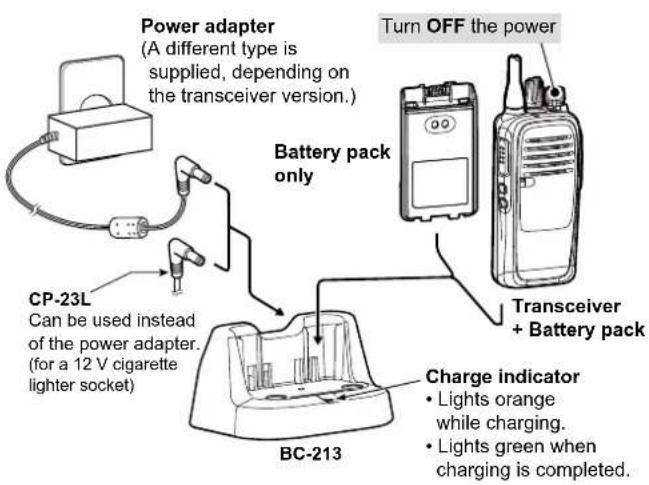
◇ Rapid charging with the supplied BC-213
The BC-213 DESKTOP CHARGER rapidly charges the Li-ion battery pack.
The BC-213 is used with the power adapter or the CP-23L CIGARETTE LIGHTER CABLE (purchase separately).
• Charging time of the BP-280
Approximately 3.5 hours
CAUTION: DO NOT continue to charge if the charge indicator lights orange and green alternately. This indicates a charging failure is occurring.
NOTE: Charge the battery within the specified temperature range of 10^ C to 40^ C. Otherwise, the charging time will be longer, but the battery will not reach a full charge. While charging, at the point where the temperature goes out of the specified range, charging will automatically stop.
BATTERY CHARGING
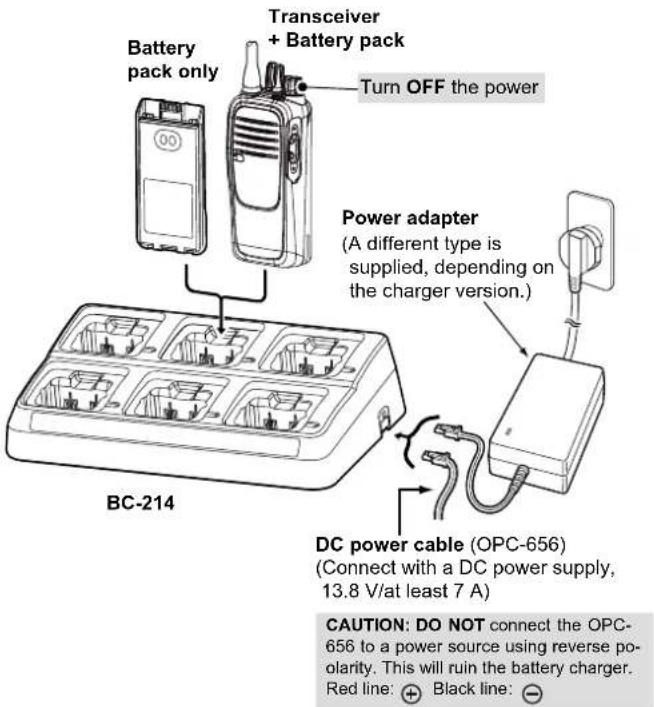
◇ Rapid charging with the BC-214
The BC-214 MULTI CHARGER can simultaneously charge up to 6 Li-ion battery packs.
The BC-214 is used with the BC-157S POWER ADAPTER or the OPC-656 DC POWER CABLE (purchase separately).
- Charging time of the BP-280
Approximately 3.5 hours
4 OPTIONS
◇ BATTERY PACKS
• BP-278/BP-279/BP-280 BATTERY PACK
| Battery pack | Voltage Capacity | Battery life* | |
| BP-278 | 7.2 V | 1130 mAh (minimum)1190 mAh (typical) | 16 hours |
| BP-279 | 1485 mAh (minimum)1570 mAh (typical) | 21 hours | |
| BP-280 | 2280 mAh (minimum)2400 mAh (typical) | 33 hours | |
* When the power save function is turned ON, and the operating periods are calculated when TX:RX:standby = 5:5:90.
◇ CHARGERS
- BC-213 DESKTOP CHARGER + BC-123S/BC-242 AC ADAPTER
• BC-214 MULTI CHARGER + BC-157S AC ADAPTER
◇ DC CABLES
- CP-23L CIGARETTE LIGHTER CABLE For BC-213.
•OPC-656 DC POWER CABLE For BC-214.
OTHERS
• MB-130 VEHICLE CHARGER BRACKET
• MB-133 BELT CLIP
• HM-158LA, HM-159LA, HM-168LWP, HM-222HLWP*
SPEAKER MICROPHONE
Adjust the microphone gain before use.
* High audio output is only usable with transceivers that support the function. (With a "U" mark on the serial number label)
• HM-153LA, HM-166LA EARPHONE MICROPHONE HS-94LWP, HS-95LWP, HS-97HEADSET
+VS-4LA PTT SWITCH CABLE /OPC-2004LA ADAPTER CABLE
HS-94LWP: Ear-hook type
HS-95LWP: Neck-arm type
HS-97: Throat microphone
VS-4LA: To connect headset and for PTT use
OPC-2004LA: To connect to headsets for VOX operation Adjust the both microphone and VOX gain before use.
Some options may not be available in some countries. Ask your dealer for details.
CHANNEL FREQUENCY LIST
5
| Channel | Zone 1 Zone 2 | |||
| Frequency (MHz) C | Tone* Frequency (MHz) C | Tone* | ||
| 1 | 446.006250 | 97.4 | 446.106250 | 97.4 |
| 2 | 446.018750 | 100.0 | 446.118750 | 100.0 |
| 3 | 446.031250 | 103.5 | 446.131250 | 103.5 |
| 4 | 446.043750 | 107.2 | 446.143750 | 107.2 |
| 5 | 446.056250 | 110.9 | 446.156250 | 110.9 |
| 6 | 446.068750 | 114.8 | 446.168750 | 114.8 |
| 7 | 446.081250 | 118.8 | 446.181250 | 118.8 |
| 8 | 446.093750 | 123.0 | 446.193750 | 123.0 |
| 9 | 446.006250 | 127.3 | 446.106250 | 127.3 |
| 10 | 446.018750 | 131.8 | 446.118750 | 131.8 |
| 11 | 446.031250 | 136.5 | 446.131250 | 136.5 |
| 12 | 446.043750 | 141.3 | 446.143750 | 141.3 |
| 13 | 446.056250 | 146.2 | 446.156250 | 146.2 |
| 14 | 446.068750 | 151.4 | 446.168750 | 151.4 |
| 15 | 446.081250 | 156.7 | 446.181250 | 156.7 |
| 16 | 446.093750 | 159.8 | 446.193750 | 159.8 |
NOTE: To communicate with the IC-F29SR, the CTCSS tone or DTCS code must be matched each other. Ask your dealer or authorized distributor for details.
* CTCSS tone or DTCS code can be programmed manually. Ask your dealer for details.
DEUTSCH
natural_image
Technical line drawings of three electronic device components: a front panel, a side view with internal casing, and a top-right view (no text or symbols)ACCESSOIRES FOURNIS ....38
PRÉCAUTIONS....39
1 DESCRIPTION DE LA FACE AVANT ....41
■ Mise en marche ....41
■ Face Avant....41
2 FONCTIONS DE BASE....42
4 ACCESSOIRES OPTIONNELS ....47
5 LISTE DE CANAUX ....48

1
DESCRIPTION DE LA FACE AVANT
■Mise en marche
◇ About the Speaker microphone jack
| Frequency coverage 446.0 | 06250 ~ 446.19375 MHz |
| Output power 0.5 W | |
| Dimensions(projections not included) | 52.2 (W) × 186.1 (H) × 30.3 (D) mm(with BP-280) |
| Weight (approximate) 270 g | (with BP-280) |
| SAR 10g Estimation 0.5 W/kg | |
TECHNISCHE DATEN
How the World Communicates
A7360H-2EU-5
Printed in Japan
© 2017–2024 Icom Inc. Mar. 2024

natural_image
Two-tone color block image with no text or symbols: light gray on top, black on bottom (no meaningful content)Icom Inc.
1-1-32 Kamiminami, Hirano-ku, Osaka 547-0003, Japan

- IMPORTANT
- DISPOSAL
- RECOMMENDATION
- CLEAN THE TRANSCEIVER THOROUGHLY WITH
- ABOUT CE AND DOC
- ABOUT UKCA DOC
- SUPPLIED ACCESSORIES
- PRECAUTIONS
- TABLE OF CONTENTS
- 1
- PANEL DESCRIPTION
- ■Turning ON the power
- ◇ About the Speaker microphone jack
- ◇ About the LED Indicator
- BASIC OPERATION
- 2
- ■Receiving and Transmitting
- Receiving
- Transmitting
- ■Call-Ring operation
- ■Smart-Ring operation
- 3
- BATTERY CHARGING
- Caution
- ◇ Battery caution
- ◇ Charging caution
- BATTERY CHARGING
- ■Battery chargers
- Attention to the swelled battery pack
- ◇ Rapid charging with the supplied BC-213
- • Charging time of the BP-280
- ◇ Rapid charging with the BC-214
- OPTIONS
- ◇ BATTERY PACKS
- ◇ CHARGERS
- ◇ DC CABLES
- OTHERS
- CHANNEL FREQUENCY LIST
- DEUTSCH
- DESCRIPTION DE LA FACE AVANT
- ■Mise en marche
Brand : ICOM
Model : IC-F29SR2
Category : Radio transceiver