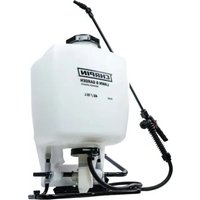
60100 - Agricultural sprayer Chapin - Free user manual and instructions
Find the device manual for free 60100 Chapin in PDF.


| Product Type | Agricultural Backpack Sprayer |
| Brand | Chapin |
| Model | 60100 |
| Tank Capacity | 15 liters (4 gallons) |
| Pump Type | Manual Piston Pump |
| Operating Pressure | 40 psi (2.76 bar) |
| Nozzle Flow Rate | 0.4 gal/min at 40 psi |
| Filtration System | 3-Stage Filtration (Strainer, Pressure Chamber, Shut-Off Valve) |
| Main Material | High Density Polyethylene |
| Approximate Weight (Empty) | 4.5 kg |
| Dimensions (L x W x H) | 38 cm x 25 cm x 55 cm |
| Power Source | Manual (Hand Pump) |
| Nozzle Type | Fan Nozzle (Adjustable) |
| Main Features | Continuous Spray with Lock, Safety Shut-Off, Lock-Off |
| Maintenance and Cleaning | Rinse with water after use, clean filters, lubricate O-rings, drain before freezing |
| Safety | Do not exceed 49°C, wear protective equipment, do not spray flammable or corrosive liquids |
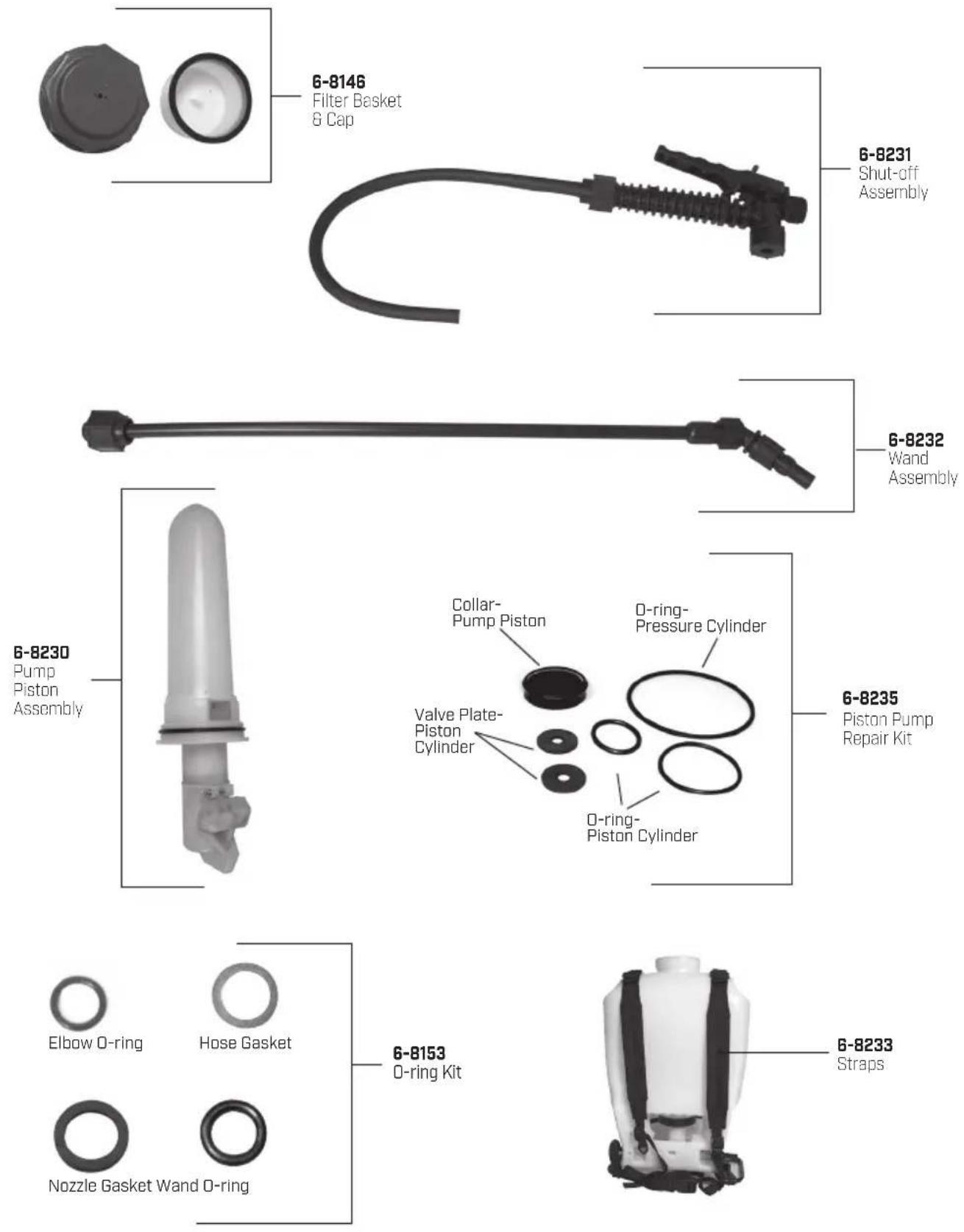
| Spare Parts and Repairability | Piston Pump Repair Kit (6-8235), O-Ring Kit (6-8153), Replacement Filter (6-8146), Shut-Off Assembly (6-8231), Tube Assembly (6-8232), Pump Piston Assembly (6-8230) |
| Warranty | 1 Year Limited (Online Registration Required) |
| Recommended Use | Gardening, Weeding, Foliar Feeding, Outdoor Cleaning |
Frequently Asked Questions - 60100 Chapin
User questions about 60100 Chapin
0 question about this device. Answer the ones you know or ask your own.
Ask a new question about this device
Download the instructions for your Agricultural sprayer in PDF format for free! Find your manual 60100 - Chapin and take your electronic device back in hand. On this page are published all the documents necessary for the use of your device. 60100 by Chapin.
USER MANUAL 60100 Chapin
See website for warranty detail
Chapin International, Inc
P.O. Box 549 700 Ellicott St.
Batavia, NY 14021-0549 U.S.A.
1-800-950-4458 www.chapinmfg.com
4G/15L
WARNING
Carefully Read These Instructions Before Use
016306R0921
WARNING
WARNING: IMPROPER USE OR FAILURE TO FOLLOW INSTRUCTIONS CAN RESULT IN EXPLOSIVE FAILURE CAUSING SERIOUS EYE OR OTHER INJURY.
For safe use of this product you must read and follow all instructions. Do not leave a pressurized sprayer in the hot sun. Heat can cause pressure build-up resulting in possible explosion. Do not store or leave solution in tank after use. Always wear goggles, gloves, long sleeve shirt, long pants and full foot protection when spraying. Never use any tool to remove pump if there is pressure in the pressure chamber. Never pressurize sprayer by any means other than the original pump. Do not attempt to modify this sprayer. Replace parts only with manufacturer's original parts.
Never spray flammable, caustic, acidic, chlorine, bleach or other corrosive solutions or heat, pressure, or gas producing chemicals. Always read and follow chemical manufacturer's instructions before use with this sprayer as some chemicals may be hazardous when used with this sprayer. SK 1158-1
CAUTION
- PRE-USE CHECK: Before each use check tightness of hose nut to be sure hose is securely attached to the shut-off assembly. Ensure hose is securely attached to the tank by tightening hose clamp if necessary. Ensure that all nozzle and wand connections are tight. Insure the large pump clamp is tight. Insure the 2 bolts used to attach the pump lever to the pump shaft are tight.
- Do Not exceed a tank solution temperature of 120°F / 49°C .
NOTE: The tank and hose may have residual water in it due to quality testing performed on the sprayer.
APPLICATIONS & USE FOR YOUR SPRAYER
Avoid using a sprayer for general cleaning purposes if plant protection or herbicide chemicals have already been used in the sprayer. If a sprayer has been used for plant protection or as an herbicide, clean the sprayer completely (see cleaning section) before using.
Plant Food: Use different spray patterns for optimum foliage feeding or for fungicide and pesticide application.
Herbicides: Reduce weeds and unwanted plants but avoid using the same sprayer for plant feeding or protection without thoroughly cleaning (see cleaning section) the sprayer first.
General Household Use: Apply detergents, cleaning solutions, warm water (do not exceed 120° F/49°C) or nontoxic household cleaning chemicals for carpets, floors, walls, glass, counter tops and ceilings. DO NOT use sprayer that has been used with herbicides, pesticides or other toxic chemicals for household applications.
General Outdoor Use: Use the sprayer for cleaning windows or with a detergent for general purpose cleaning.
SPRAYER COMPONENTS & USE INFORMATION
NOZZLE ASSEMBLY
Figure 1
Unscrew the nozzle cap (1) from the nozzle body (3) with retaining nut (2) fastened tightly to the elbow (5). Unscrew the retaining nut (2). Push the nozzle body (3) with the nozzle gasket (4) out of the retaining nut (2). To reinstall the nozzle, reverse the above instructions.
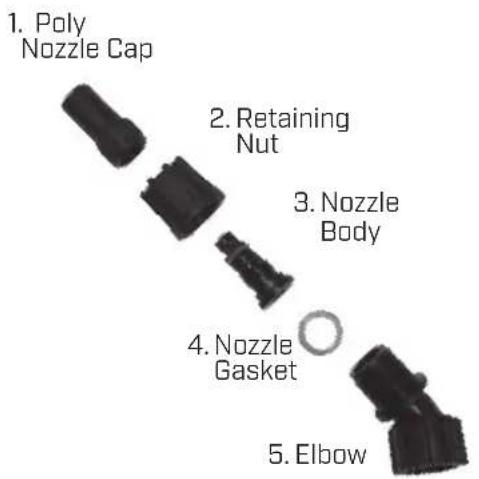
Figure 1
WAND ASSEMBLY
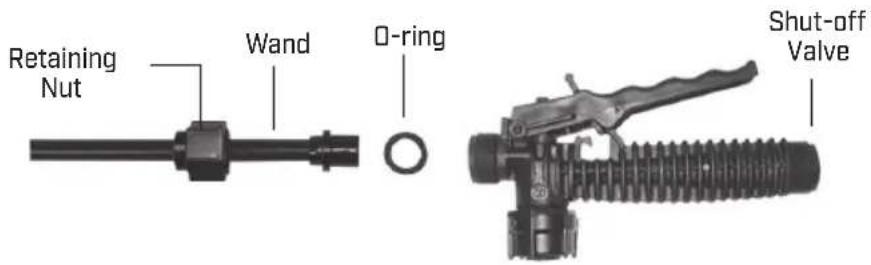
- Make sure the o-ring is installed on the end of the wand. Insert the wand into shut-off valve.
- Turn and tighten the retaining nut clock-wise onto the shut-off valve.
INSTALLING THE PUMP HANDLE
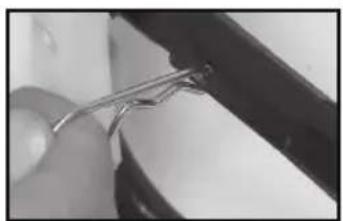
The pump handle can be mounted on either side of the pump shaft (A). To install the pump handle place the handle (C) over the shaft (A) aligning the pump handle hole and shaft hole. Push the straight side of the R-clip (B) through the aligned hole as shown in figure 1 thru 3.
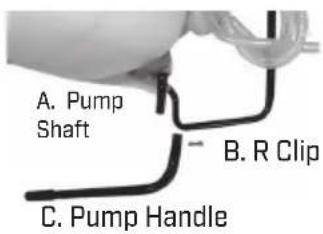
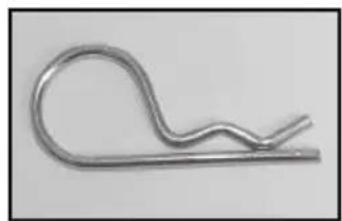
Figure 1 R Clip
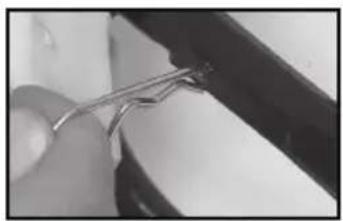
Figure 2 Line up holes
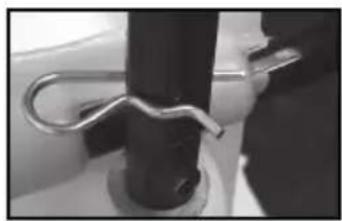
Figure 3 Slide clip through holes
INSTALLING THE SHOULDER STRAP
The top of the shoulder straps are attached to the tank. Attach the lower end of the straps by clipping the strap hooks to the metal frame between where the frame exits the tank and curves around.
3 STAGE FILTERING SYSTEM
This backpack sprayer is equipped with a 3 stage filtering system (see figure 1). Stage 1 is a filter basket incorporated into the tank opening where fluid is added. Stage 2 is a removable filter integrated into the pressure chamber. Stage 3 is a removable filter incorporated into the shut-off assembly. Periodic cleaning of these filters is recommended to insure consistent fluid flow through the sprayer. This will also reduce sprayer component wear.
Stage 2 filter cleaning requires removal of the entire pump assembly (see section “disassembling and repairing the pump assembly”). Once the pump assembly is removed the stage 2 filter can be removed for cleaning (see figure 2).
The stage 3 filter is a removable filter incorporated into the inlet side of the shut-off valve (see section “disassembling and repairing the shut-off valve”). Make sure pressure is released before detaching the hose from the shut-off. It is best to have no or minimal fluid in the pressure chamber before removing and reinstalling the stage 3 shut-off filter as fluid can leak from the hose.
It is best to have no or minimal fluid in the pressure cylinder before removing and reinstalling the stage 3 shut-off filter as fluid can leak from the hose.
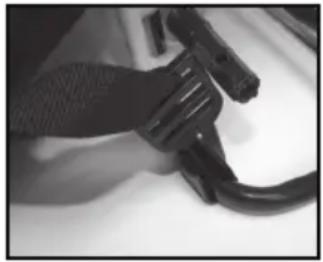
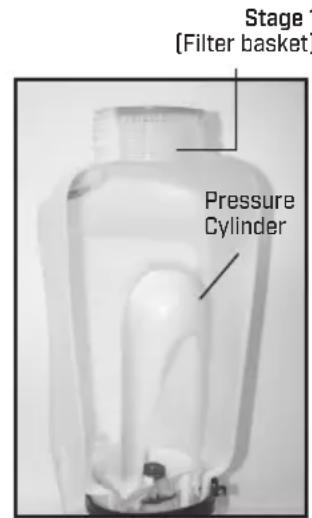
Figure 1
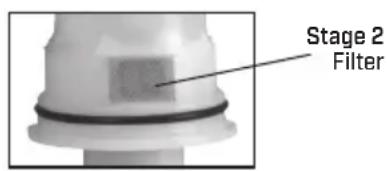
Figure 2
![Stage 3 [removable Shut-off filter]](/content/2026/04/726151/images/13efcd59d23f7ab252f4a166fb1851e4aa7d9f6306debf2b6c0441df0832f604.jpg)
FILLING THE SPRAYER
Make sure the filter basket is in place to keep debris from entering the tank.
Determine the amount of mixture needed for your application. Add the proper amount of water to the tank. Add the proper amount of chemical to the tank (check the chemical label for proper ratio of chemical). Stir mixture in tank with a clean utensil (like a paint stirrer). The tank will hold the 4-gallon (15.1L) capacity plus the chemical.
It is not necessary to completely fill the sprayer tank with each use. You can fill the tank with only the amount needed for each application.
Always follow the manufacturer's instructions included on their product label.
HELPFUL SPRAYING INFORMATION
Use RAPID pump strokes to prime the pump. You will know the pressure chamber is filling with liquid when you feel firm resistance from the pump. The air in the pressure chamber is compressed from repeated strokes. By pressing the hand lever on the shut-off, the valve opens. For safety lock-off feature (no-spraying), pull up on handle and move red locking mechanism into lock-off position as shown in fig.
- To disengage, pull up on handle and return red locking mechanism to neutral position as in fig. 3. For lock-on feature (continuous spraying), push down on handle and move red locking mechanism into lock-on position as shown in fig. 2. To disengage, push down on handle and return red locking mechanism to neutral position as shown in fig. 3.
LOCK-ON POSITION NEUTRAL POSITIONLOCK-OFF POSITION
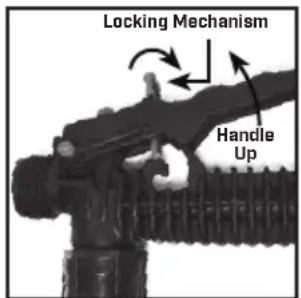
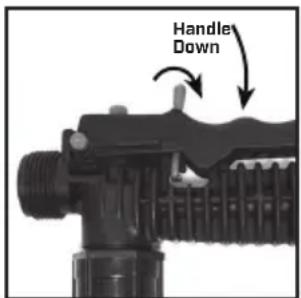
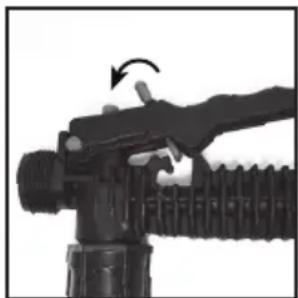
Figure 1 Figure 2 Figure 3
For easy pump action use the END of the pump handle. The amount of liquid delivered during spraying depends on the rate of pump stroke. The fan nozzle tip is rated at .4 gpm at 40psi. This is the nominal operating pressure of the sprayer.
Note: If you experience a rapid drop in pressure, drain the sprayer completely and pump the handle with an empty tank. The pressure chamber will fill with the required volume of air to repressurize. Perform this procedure from time to time as routine maintenance.
POWDER-BASED CHEMICALS
Powder-based chemicals (powder mixed with liquids to make the spraying agent) are usually abrasive and can cause wear. When you use a powder-based chemical in your sprayer, make sure it is thoroughly dissolved in the liquid solution. Thoroughly clean and flush the sprayer with water to extend the life of the sprayers parts.
CLEANING
1] Always empty the sprayer and clean the tank thoroughly after each use.
2) Pump the sprayer handle until all of the contents and air exit through the nozzle (minimum of 30 strokes).
3) Fill tank half way with water and pump the water out as explained in step 2 (repeat several times as necessary).
Other Cleaning Hints:
- Improper spray distribution usually means the nozzle is clogged, remove the nozzle and clean it.
- Soap can be added to the water to clean the tank.
- Do not use strong cleaning agents or abrasives.
- If you use a chemical agent to clean the tank follow the manufacturer's recommendations for the disposal of the waste water.
- Follow the chemical manufacturers instructions for clean up.
STORING / MAINTAINING YOUR SPRAYER
- The sprayer should be stored out of direct sunlight in a cool dry space.
- Before freezing weather make sure to drain all liquid in the tank, pump, pressure cylinder, hose, shut-off valve, wand and nozzle, to avoid liquid expansion and cracking in the sprayer components (See “Cleaning” section). Lock the shut-off valve in the “open” position.
- When service is required call your nearest dealer and always insist on original manufactured replacement parts.
- Inspect the hose, wand, pump, tank and shut-off valve for wear, damage or leaks on a regular basis and repair defects promptly.
Symptom Possible Reason Correction
| Difficulty actuating the pump lever and/or pump handle moves itself back up. | Upper valve plate sticks Clean or replace valve plate | |
| Piston cylinder outlet passage clogged Clean piston cylinder outlet passage | ||
| Little or no resistance during repeated pumping - no pressure. | Damaged/worn/dirty/upper and or lower valve plate | Clean or Replace Valve Plate |
| Damaged /worn upper o-ring on piston Replace O-ring | ||
| Piston Collar or piston cylinder assembly is worn Replace Collar or Piston cylinder assembly | ||
| Too much resistance after just a few pumping strokes but pressure only lasts briefly. | Not enough air cushion in the pressure chamber | Release pressure in pressure chamber.Remove the hose & drain pressure chamber. Reconnect the hose. |
| Upper valve plate damaged/worn/dirty Clean or replace upper valve plate | ||
| Upward pumping action is more difficult and/or pump handle moves itself backdown. | Vent hole is clogged Clear the vent hole in cap. | |
| Lower valve plate sticks Clean or replace the valve plate | ||
| Clogged filter Clean in tank filter | ||
| Piston cylinder intake clogged Clean piston cylinder intake | ||
| When the handle is pulled up it moves itself back down | Valve Plate sticking Clean or replace valve plate | |
| Leaks at Piston Cylinder Damaged | Worn/Dirty Collar | Clean or Replace Piston Collar |
| Damaged Piston Cylinder | Replace Piston Cylinder | |
| Damaged Piston | Replace Piston | |
| Shut-off leaks | Connections loose | Tighten connection. |
| Worn or damaged shut-off | Rebuild or replace the shut-off valve. | |
| Wand assembly leaks | Connections loose | Tighten connection. |
| Damaged or worn o-ring/gasket | Replace o-ring/gasket. | |
| Nozzle assembly leaks | Connections loose | Tighten connection. |
| Damaged or worn o-ring/gasket | Replace o-ring/gasket. | |
| Leak between pump assembly and tank | Pump clamp loose | Tighten clamp. |
| O-ring worn or damaged | Replace pressure chamber o-ring. | |
| Hose leaking at tank outlet | Hose clamp loose | Tighten clamp. |
| Hose leaking at shut-off Connection loose | Tighten retaining nut. | |
| Damaged or worn o-ring/gasket | Replace o-ring/gasket. | |
DISASSEMBLING AND REPAIRING THE PISTON PUMP
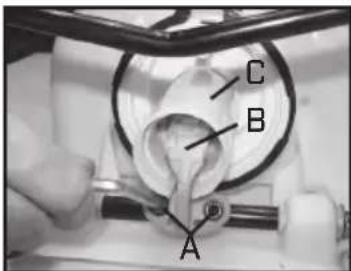
Figure 1
1) Remove the cotter pin and pump handle. With the pump facing towards you lay the unit on its back (Figure 1). Loosen the hose clamp and remove the sprayer hose. Caution: There could be residual liquid in the hose and pressure cylinder. Remove the nut and bolt from the protective cap and remove the cap (ref: figure 9). Rotate the pump shaft in order to reach two lever bolts[A]. Using an allen wrench, remove the lever bolts. Pull the piston assembly (B) out of the piston cylinder (C).
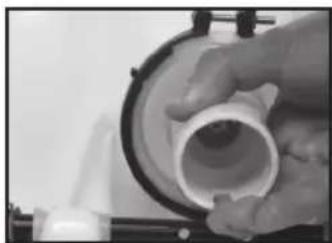
Figure 2
2) Remove the piston cylinder assembly by turning the piston cylinder counter-clockwise when viewing the sprayer from the bottom. Caution: The piston cylinder may have sharp edges.
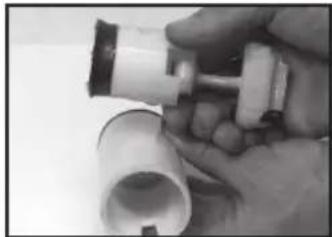
Figure 3
3) Check for vertical scratches on the inside of the piston cylinder and the piston. If one or both are scratched replace them.
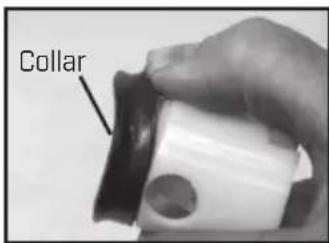
Figure 4
4) To replace the collar, push it off of the crown of the piston with your thumb. You will see form fitted slots to install the new collar on to the piston crown.
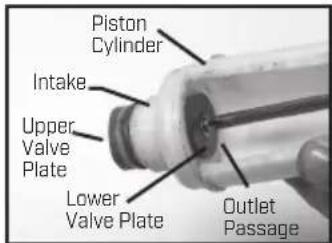
Figure 5
5) There are 2 valve plates on the piston cylinder, one on the inside of the cylinder and one on the outside top. The valve plates are held in place with a screw and washer and can be removed and replaced using a Phillipshead screw driver. The 2 o-rings can be removed and replaced as well. Insure that the o-rings are positioned in the o-ring grooves in the piston cylinder.
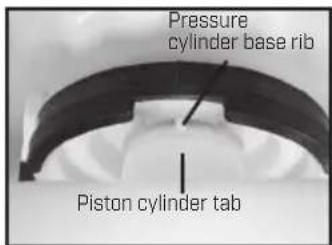
Figure 6
6) Grease the 2 D-rings on the piston cylinder (do not get any grease on the valve plate) and screw the piston assembly into the pressure cylinder base. Screw the piston cylinder clockwise until tight and the bottom D-ring is no longer visible. When properly placed, the tab on the piston cylinder will line up with the rib on the pressure cylinder base.
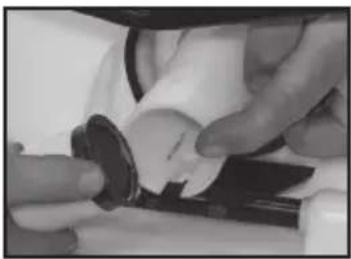
Figure 7
7) Apply Petroleum jelly to the inside of the piston cylinder wall and on the collar, and reinstall the piston assembly into the piston cylinder.
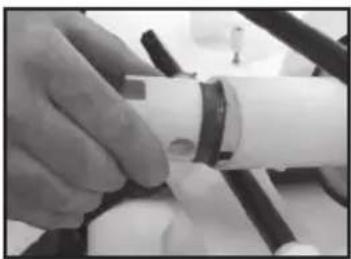
Figure 8
8) Insert the piston at an angle with the leading edge of the collar placed over the slot in the piston cylinder. Bolt the piston assembly to the pump shaft using the lever bolts.
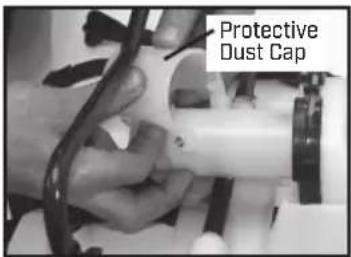
Figure 9
9] Replace the protective dust cap. Tighten the nut and bolt. Reinstall the pump handle. Replace the hose and firmly secure the hose clamp in place.
DISASSEMBLING AND REPAIRING THE PUMP ASSEMBLY
- Release the pressure from the sprayer and remove all liquid from both the pressure chamber and tank.
- Remove hose.
- Remove 2 bolts attaching the pivot lever to the pump shaft and remove piston assembly [fig. 2a & 2b].
- Remove the large clamp holding the pressure chamber and tank together (fig 1).
- Rock the pressure chamber back and forth and push down to free it from the tank [fig 1].
- Once freed the entire pump assembly can be removed by maneuvering it through the base frame (fig 3a & 3b).
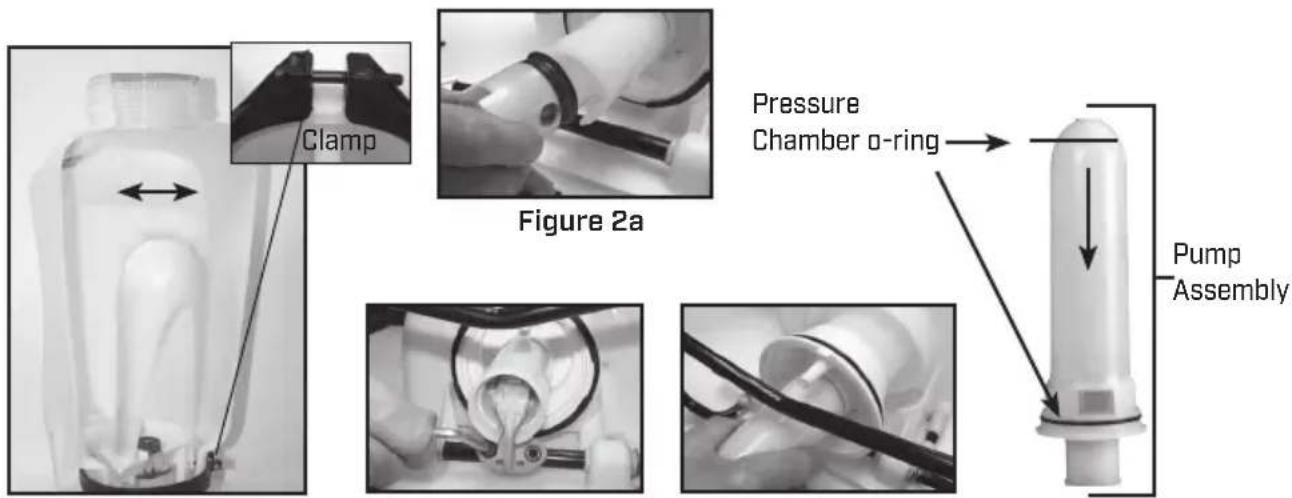
Figure 1
Figure 2b Figure 3a Figure 3b
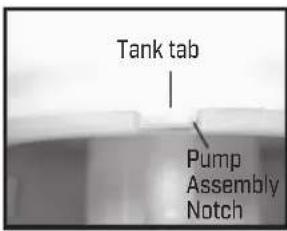
Figure 4
- The pressure chamber o-ring can also be replaced. DO NOT stretch the o-ring over the bottom flange. Assemble the o-ring over the top of the chamber. Apply petroleum jelly to the o-ring before reinstalling pump assembly into the tank [fig. 3b].
- Reassemble backwards from step 6 thru 2, performing each step in reverse. Note: there is a notch/tab combination in the pump assembly/tank to be used for alignment [fig. 4].
DISASSEMBLING AND REPAIRING THE SHUT OFF VALVE
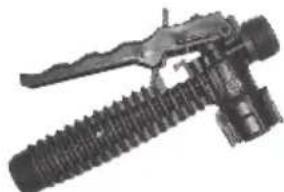
Figure 1
1) Assembled shut-off valve (Figure 1).
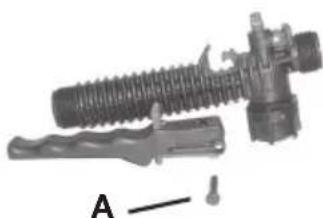
Figure 2
2) Remove the retaining pin (A) (Figure 2) place the notched end of the retaining pin on a hard surface and push down. Remove the retaining pin and slide the handle off the valve.
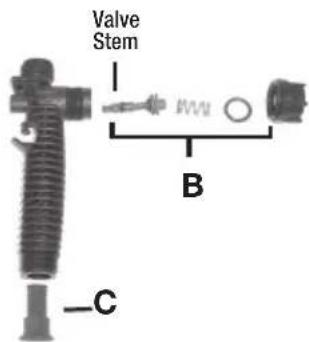
Figure 3
3] Remove the retaining nut [o-ring attached], spring, and valve stem (B) (Figure 3). Replace worn parts. Lubricate the O-rings and reassemble by reversing the steps above. Place the handle groove in the slotted area of the valve stem and make sure the locking clip is positioned in the neutral position [see "Helpful Spraying Information" section]. Insert the retaining pin. Push down on the handle a few times to distribute the lubricant evenly. Check filter (C) in end of shut-off valve for debris. Remove filter and flush with water to clean out.
REPLACEMENT PARTS ORDER INFORMATION
Congratulations!
You have just purchased a quality Chapin product.
Register Your Sprayer Online@ www.chapinmfg.com/warranty.asp
Chapin International, Inc
Figura 1 Figura 2 Figura 3
Figura 2
Figura 3
Figura 7
Figura 8
Figura 1
Figura 2
Figure 1 Goupille fendue
Étape 1
(panier-filtre)
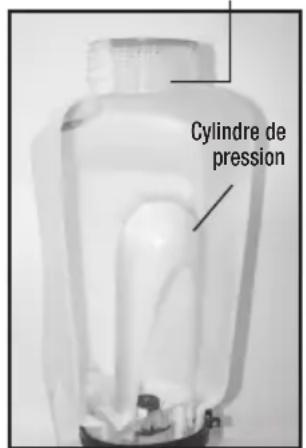
Figure 1
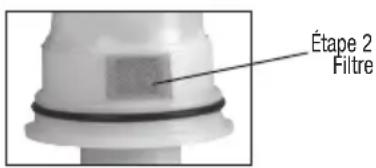
Figure 2
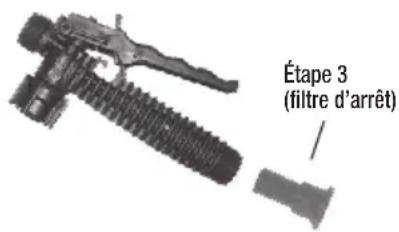
Figure 1 Figure 2 Figure 3
Figure 2
Figure 3
Figure 7
Figure 8
Figure 1
Figure 2b Figure 3a Figure 3b
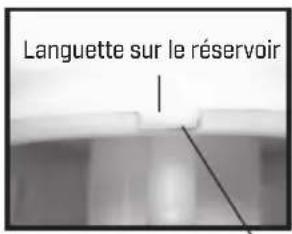
Figure 1
Figure 2
- WARNING
- WARNING: IMPROPER USE OR FAILURE TO FOLLOW INSTRUCTIONS CAN RESULT IN EXPLOSIVE FAILURE CAUSING SERIOUS EYE OR OTHER INJURY
- CAUTION
- APPLICATIONS & USE FOR YOUR SPRAYER
- SPRAYER COMPONENTS & USE INFORMATION
- NOZZLE ASSEMBLY
- WAND ASSEMBLY
- INSTALLING THE PUMP HANDLE
- INSTALLING THE SHOULDER STRAP
- 3 STAGE FILTERING SYSTEM
- FILLING THE SPRAYER
- HELPFUL SPRAYING INFORMATION
- POWDER-BASED CHEMICALS
- CLEANING
- OTHER CLEANING HINTS
- STORING / MAINTAINING YOUR SPRAYER
- DISASSEMBLING AND REPAIRING THE PISTON PUMP
- DISASSEMBLING AND REPAIRING THE PUMP ASSEMBLY
- DISASSEMBLING AND REPAIRING THE SHUT OFF VALVE
- CONGRATULATIONS
- CHAPIN INTERNATIONAL, INC
Brand : Chapin
Model : 60100
Category : Agricultural sprayer