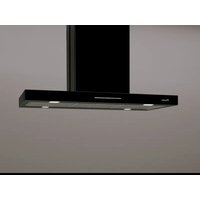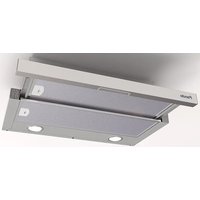
GR20 - Basket Pando - Free user manual and instructions
Find the device manual for free GR20 Pando in PDF.


| Product type | Built-in extractor hood |
| Brand | Pando |
| Model | GR20 |
| Dimensions (approx.) | Standard built-in (refer to installation template) |
| Weight (approx.) | 5 kg |
| Power supply | 220-240 V / 50 Hz |
| Motor power | Not specified |
| Number of speeds | 3 + 1 intensive |
| Lighting | LED (replacement by professional) |
| Filter type | Washable metal grease filter + activated carbon filter (optional) |
| Extraction mode | Extracting (external evacuation) or recirculating (charcoal filter) |
| Minimum distance from hob | 65 cm (gas), 50 cm (electric) |
| Exhaust duct diameter | 120 mm or 150 mm (depending on model) |
| Noise level | Variable depending on speed (not specified) |
| Installation | Built into a cabinet (professional recommended) |
| Grease filter maintenance | Wash every 2 months in dishwasher or by hand |
| Charcoal filter maintenance | Replace every 4 months (non-regenerable) |
| Exterior cleaning | Damp cloth with denatured alcohol or neutral detergent |
| Safety device | Automatic shut-off? Not specified |
| Manufacturer warranty | Standard (subject to terms in manual) |
| Repairability | Spare parts available via approved after-sales service |
Frequently Asked Questions - GR20 Pando
User questions about GR20 Pando
0 question about this device. Answer the ones you know or ask your own.
Ask a new question about this device
Download the instructions for your Basket in PDF format for free! Find your manual GR20 - Pando and take your electronic device back in hand. On this page are published all the documents necessary for the use of your device. GR20 by Pando.
USER MANUAL GR20 Pando
EN – User and installation Manual.
GR20
Pando
Quality Management System
UNE-EN ISO 9001:2015
ES19/86566

ES - Español
RECOGIDA DE LOS
ELECTRODOMÉSTICOS

text_image
COLLECTION OF APPLIANCESThe symbol on the product or its packaging indicates that this product cannot be disposed of like normal domestic waste. The product must be handed over at a collection point for recycling electrical and electronic equipment. If you ensure that this product is correctly disposed of, you will help to avoid the possible negative environmental and public health effects that could arise from incorrect disposal. For more detailed information about recycling this product, please contact your city authorities, the domestic waste service or the establishment where you purchased it. This electrical appliance is marked in compliance with European Directive 2012/19/EU on electrical and electronic appliance waste (WEEE).
EN - INTRODUCTION
Firstly, we would like to thank you for your confidence in our firm when you chose a Pando extractor hood.
This manual and its annexes are a guide for the correct installation, usage and maintenance of your new Extractor Hood.
To learn everything about your hood, we recommend you read these instructions carefully from beginning to end and keep them for future reference.
Before starting the installation process read with care this installation manual and the attached user's manual, There are also instructions for the correct installation of the product.
Installation should only be carried out by qualified professionals, professional installers or the official technical service. The manual or installation guide must be read with care before starting the installation process.
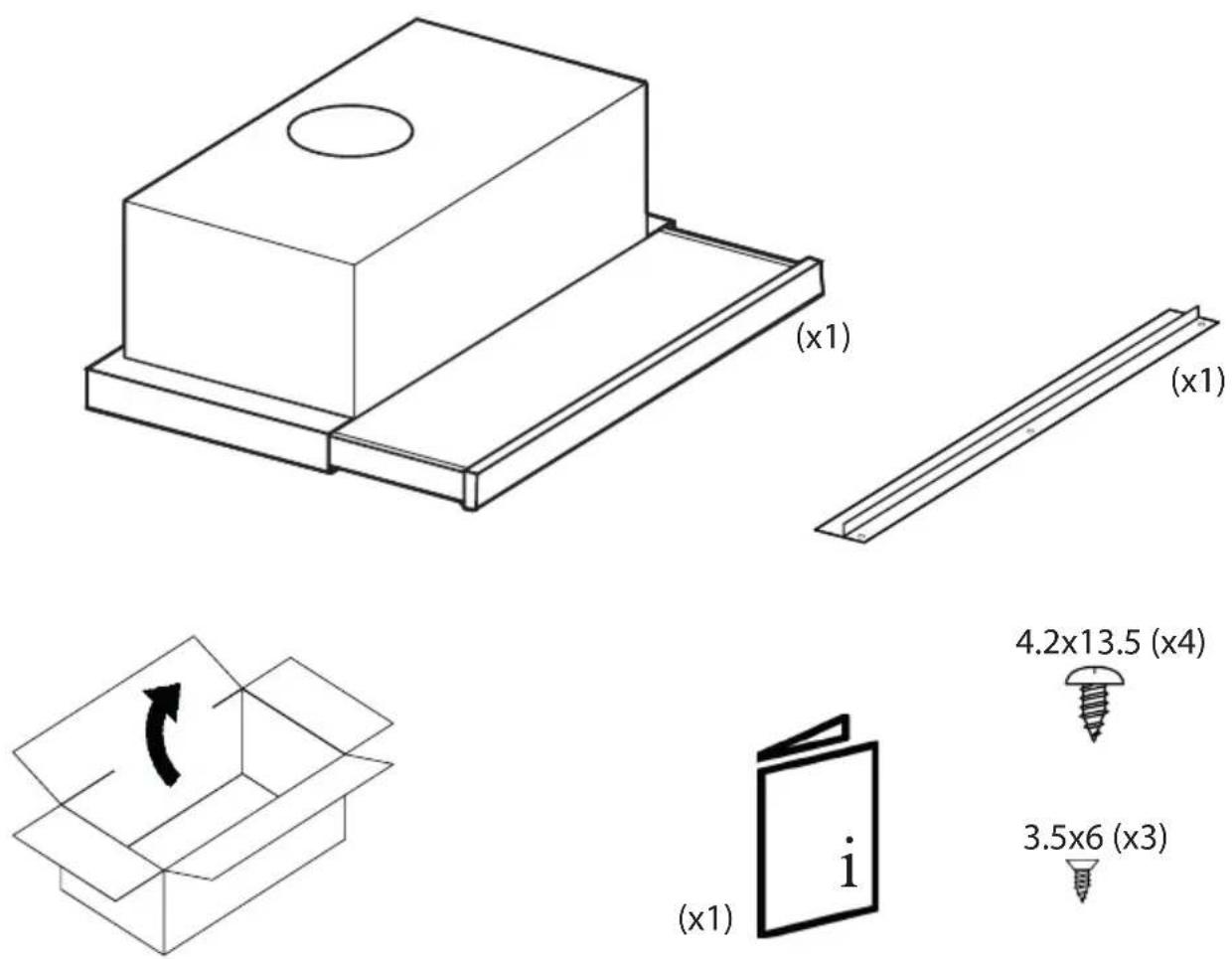
When opening the packaging, check that all the components are in perfect state and all the accessories are present. If this is not the case, contact the dealer and do not install. Once installed, any damage to the exterior such as scratches, dents, stains, etc. will not be covered by the guarantee.
The manufacturer will not be held liable for any possible inaccuracies due to printing or trans-cription errors in this manual. The manufacturer reserves the right to incorporate modifications considered useful or necessary into the products, which will not alter their essential functional and safety characteristics.
EN - RECOMMENDATIONS TO BEAR IN MIND BEFORE INSTALLATION
VERY IMPORTANT!
DO NOT REMOVE THE PROTECTIVE PLASTIC FROM THE HOOD UNTIL IT IS COMPLETELY INSTALLED, IF THIS PLASTIC IS NOT PRESENT IN AREAS THAT COULD HAVE A RISK OF DAMAGE DURING INSTALLATION, IT IS RECOMMENDED TO APPLY PROTECTIVE MATERIALS AGAINST IMPACT, SCRATCHES AND CONTACT WITH CORROSIVE AGENTS.
TAKE ESPECIAL CARE DURING THE INSTALLATION IF OTHER WORK IS ALSO IN PROGRESS, BECAUSE PAINT, SILICON, PLASTER AND OTHER MATERIALS COULD CONTAIN CORROSIVE CHEMICALS THAT MAY DAMAGE THE PRODUCT, IN THESE CASES IT IS RECOMMENDED TO ADEQUATELY PROTECT THE HOOD, BY FOR EXAMPLE, HERMETICALLY COVERING AREAS THAT COULD BE AFFECTED WITH PLASTIC.
THIS WILL AVOID DAMAGE TO THE OUTSIDE OF THE APPLIANCE, SOMETHING THAT WILL NOT BE COVERED BY THE GUARANTEE.
EN - SAFETY INSTRUCTIONS
- If the hood is to be used at the same time as gas fuelled or other fuelled appliances (not applicable to appliances exclusively designed to blow air into the room) the room must be properly ventilated.
- The exhausted air must not be led through a conduit that is used for exhausting fumes from other appliances using gas or other fuels (not applicable to devices destined exclusively to discharge the air inside the room).
-The minimum distance between the surface of the cooktop and the lower edge of the hood must be 65 cm if the the extractor hood is fitted over gas cooker. If the installation instructions of the gas cooker indicates a greater distance, this must be followed. - Regulations regarding air evacuation must be respected.
- If the hood does not have a power cable with a plug, or other means for disconnection from the mains, with a separation of all poles to ensure total disconnection under category III conditions of overvoltage, means for disconnection of the fixed installation must be incorporated in accordance with installation regulations.
EN - SAFETY INSTRUCTIONS
- Once the appliance has been delivered, within 24h, remove the packaging and check that it is in good state, visually inspecting the general state of the outside. If any anomaly or damage is observed, do not install and immediately inform the dealer or installer within 24h of reception.
- This hood has been designed for normal domestic use. It must not be used for industrial, professional, or any other use different from what it has been designed for.
- Pando will not be held liable for consequences or damages resulting from incorrect installation or misuse of the appliance.
- Do not try to alter any of the characteristics of this appliance, this could be dangerous and will automatically render the guarantee void.
- It must be possible and accessible for the user to disconnect the appliance from the mains after installation. The power plug should be easily accessible, if this is not the case, a switch for electrical disconnection, compliant with electrical installation regulations, must be fitted.
- Take special care when perforating walls or ceilings and ensure that there are no hidden electrical cables, pipes, metal beams, etc., as perforating them could cause great damage, short circuits or the transmission of noise and vibrations.
- IMPORTANT: Before connecting the appliance to the mains, make sure the current is first turned off (differential or circuit breaker on the general electrical panel of the house).
- Hood and conduit installation must comply with regulations on ventilation of closed spaces. More specifically, the exhausted air must not be led through a conduit that is used for exhausting fumes from other appliances using gas or other fuels (central heating installations, etc.).
- Negative pressure in the premises must not exceed 0.04 mbar. This will allow the hood to operate in optimum conditions. To achieve this, it is necessary to have a permanent entry of fresh air to avoid air stagnation, it is recommended to have a ventilation grille for this purpose. Doors and windows are not enough.
EN - SAFETY INSTRUCTIONS

- Attention! When the hood is in operation “in suction” at the same time as a heating system that depends on ambient air (gas, oil, coal boiler, chimney, etc.), take special care to avoid the hood absorbing air needed for combustion, this could cause dangerous accumulations of carbon monoxide in the premises or home, which could be deadly. If the extractor hood is installed together with a combustion appliance such as a boiler, chimney or local heating, the manufacturers of these appliances must be contacted to ensure optimum and risk-free operation.

- Electrical power supply must be stable and meet the electrical requirements of the appliance (see the nameplate of the appliance). If the power supply is unstable, with variations in voltage, current, surges and cuts, electrical storms, etc., the hood could malfunction and even be damaged, in which case repairs will not be covered by the guarantee. If any of these things happen, disconnect the hood and contact an electrician or your electrical company to solve the problem.
- To avoid hazards, it is forbidden to manipulate the appliance. If the power cable is damaged it must be replaced by the manufacturer through an authorised technical service. Any repairs that involve manipulating the appliance or its components must only be done by an authorised technical service.
- Improper and unauthorised handling of the hood, as well as modifying, cutting or perforating the body, structure, motor or wiring of the hood are expressly forbidden. In case of any of the above, the guarantee will be automatically void and the manufacturer will not be held liable for any possible harm or damages.
- The hood is an electrical appliance for fume extraction and must not be used as a support for objects or utensils.
- The LED lamps can not be manipulated by the user as there are risks of electric shock, handling, maintenance or replacement is a task reserved exclusively for official technical assistance service or authorized specialist installer.
- With the aim of constantly improving our products, we reserve the right to modify their functional characteristics or their appearance.
CONTENIDO / CONTEÚDO / CONTENU / CONTENT
HERRAMIENTAS NECESARIAS / FERRAMENTAS NECESSÀRIAS
LES OUTILS NÉCESSAIRES / TOOLS NEEDLE

natural_image
Three technical illustrations of screwdrivers, a flat screwdriver, and a rectangular electronic component with circular holes (no text or symbols)INSTALLACIÓN / INSTALAÇÃO / INSTALLATION / INSTALLATION
INSTALLACIÓN / INSTALAÇÃO / INSTALLATION / INSTALLATION
text_image
Exploded view diagram of a computer rack with numbered components and directional arrows indicating assembly stepsINSTALLACIÓN / INSTALAÇÃO / INSTALLATION / INSTALLATION

INSTALLACIÓN / INSTALAÇÃO / INSTALLATION / INSTALLATION

MANTENIMIENTO / MANUTENÇÃO / IMAINTENANCE / MAINTENANCE
FILTRO ALUMINIO
FILTRO ALUMÍNIO
FILTRE D'ALUMINIUM
ALUMINUM FILTER
text_image
Technical diagram illustrating the assembly of a server rack with labeled components and directional arrows indicating motion or assembly.MANTENIMIENTO / MANUTENÇÃO / IMAINTENANCE / MAINTENANCE
FILTROS DE CARBÒN ACTIVO (FCA)
FILTROS DE CARVÃO ATIVO (FCA)
ACTIVE CARBON FILTERS (FCA)
1
2
3
text_image
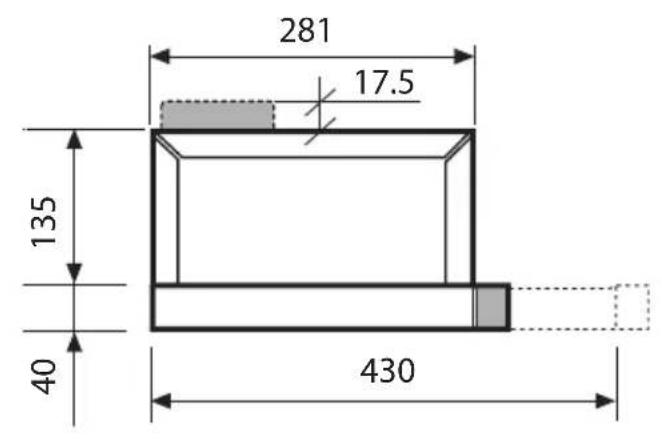
281 17.5 135 40 430
text_image
Ø120 69.6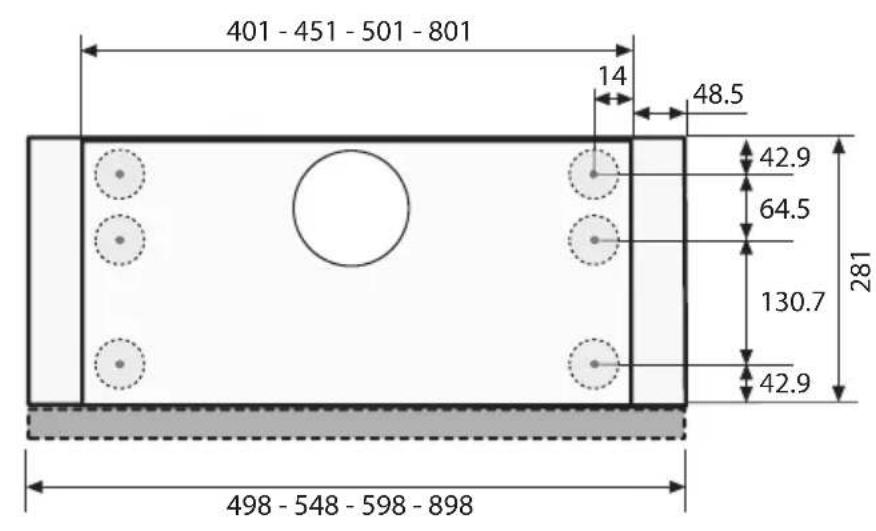
text_image
401 - 451 - 501 - 801 14 48.5 42.9 64.5 130.7 42.9 281 498 - 548 - 598 - 898
text_image
max 80 cmFig.1

natural_image
Technical line drawing of a mechanical housing or enclosure with two recessed components and vertical supports (no text or symbols)
text_image
Technical diagram showing a mechanical assembly with labeled parts L and P, including a hand holding a tool.Fig.2

text_image
A H 430
text_image
B H 430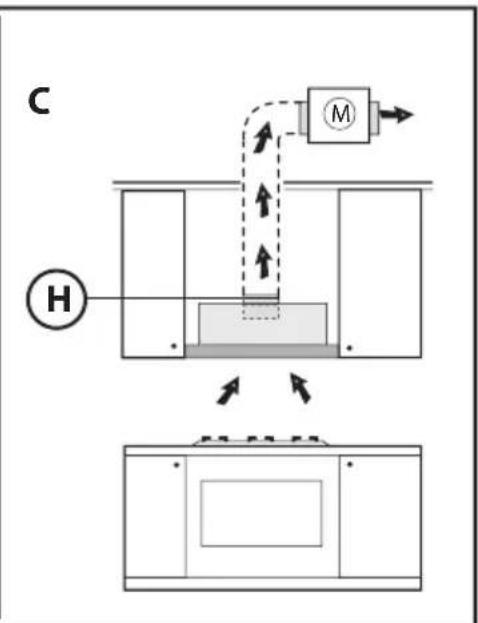
flowchart
graph TD
    A["H"] --> B["M"]
    B --> C["Output"]
    style A fill:#f9f,stroke:#333
    style B fill:#ccf,stroke:#333
    style C fill:#cfc,stroke:#333
Fig.3

text_image
Diagram illustrating airflow or mechanical change in a building interior, with labeled components and directional arrows.Fig.4

text_image
90° 90°F
ig.5
text_image
Technical diagram showing a mechanical assembly with labeled components and directional arrows indicating movement or assembly steps.Fig.6
ESPAÑOL

GENERALIDADES
Carefully read the following important information regarding installation safety and maintenance. Keep this information booklet accessible for further consultations. The appliance has been designed for use in the ducting version (air exhaust to the outside – Fig.3A), filtering version (air circulation on the inside – Fig.3B) or with external motor (Fig.3C).
SAFETY PRECAUTION
- Take care when the cooker hood is operating simultaneously with an open fireplace or burner that depend on the air in the environment and are supplied by other than electrical energy, as the cooker hood removes the air from the environment which a burner or fireplace need for combustion. The negative pressure in the environment must not exceed 4Pa (4x10⁻⁵ bar). Provide adequate ventilation in the environment for a safe operation of the cooker hood.
Follow the local laws applicable for external air evacuation.
Before connecting the model to the electricity network:
- Control the data plate (positioned inside the appliance) to ascertain that the voltage and power correspond to the network and the socket is suitable. If in doubt ask a qualified electrician.
-
If the power supply cable is damaged, it must be replaced with another cable or a special assembly, which may be obtained direct from the manufacturer or from the Technical Assistance Centre.
-
Warning!
In certain circumstances electrical appliances may be a danger hazard.
A) Do not check the status of the filters while the cooker hood is operating.
B) Do not touch bulbs or adjacent areas, during or straight after prolonged use of the lighting installation.
C) Flambè cooking is prohibited underneath the cooker hood.
D) Avoid free flame, as it is damaging for the filters and a fire hazard.
E) Constantly check food frying to avoid that the overheated oil may become a fire hazard.
F) Disconnect the electrical plug prior to any maintenance.
G) This appliance is not intended for use by young children or infirm persons without supervision.
H) Young children should be supervised to ensure they do not play with the appliance
I) There shall be adequate ventilation of the room when the rangehood is used at the same time as appliances burning gas or other fuels.
L) There is a risk of fire if cleaning is not carried out in accordance with the instructions.
This appliance conforms to the European Directive 2012/19/EU, Waste Electrical and Electronic Equipment (WEEE). By making sure that this appliance is disposed of in a suitable manner, the user is helping to prevent potential damage to the environment or to public health.

The symbol on the product or on the accompanying paperwork indicates that the appliance should not be
treated as domestic waste, but should be delivered to a suitable electric and electronic appliance recycling collection point. Follow local guidelines when disposing of waste. For more information on the treatment, re-use and recycling of this product, please contact your local authority, domestic waste collection service or the shop where the appliance was purchased.
INSTALLATION INSTRUCTIONS
- Assembly and electrical connections must be carried out by specialised personnel.
- Wear protective gloves before proceeding with installation.
• Electric Connection:
- The appliance has been manufactured as a class II, therefore no earth cable is necessary. The plug must be easily accessible after the installation of the appliance. If the appliance is equipped with power cord without plug, a suitably dimensioned omnipolar switch with 3 mm minimum opening between contacts must be fitted between the appliance and the electricity supply in compliance with the load and current regulations.
- The connection to the mains is carried out as follows:
BROWN = L line
BLUE = N neutral.
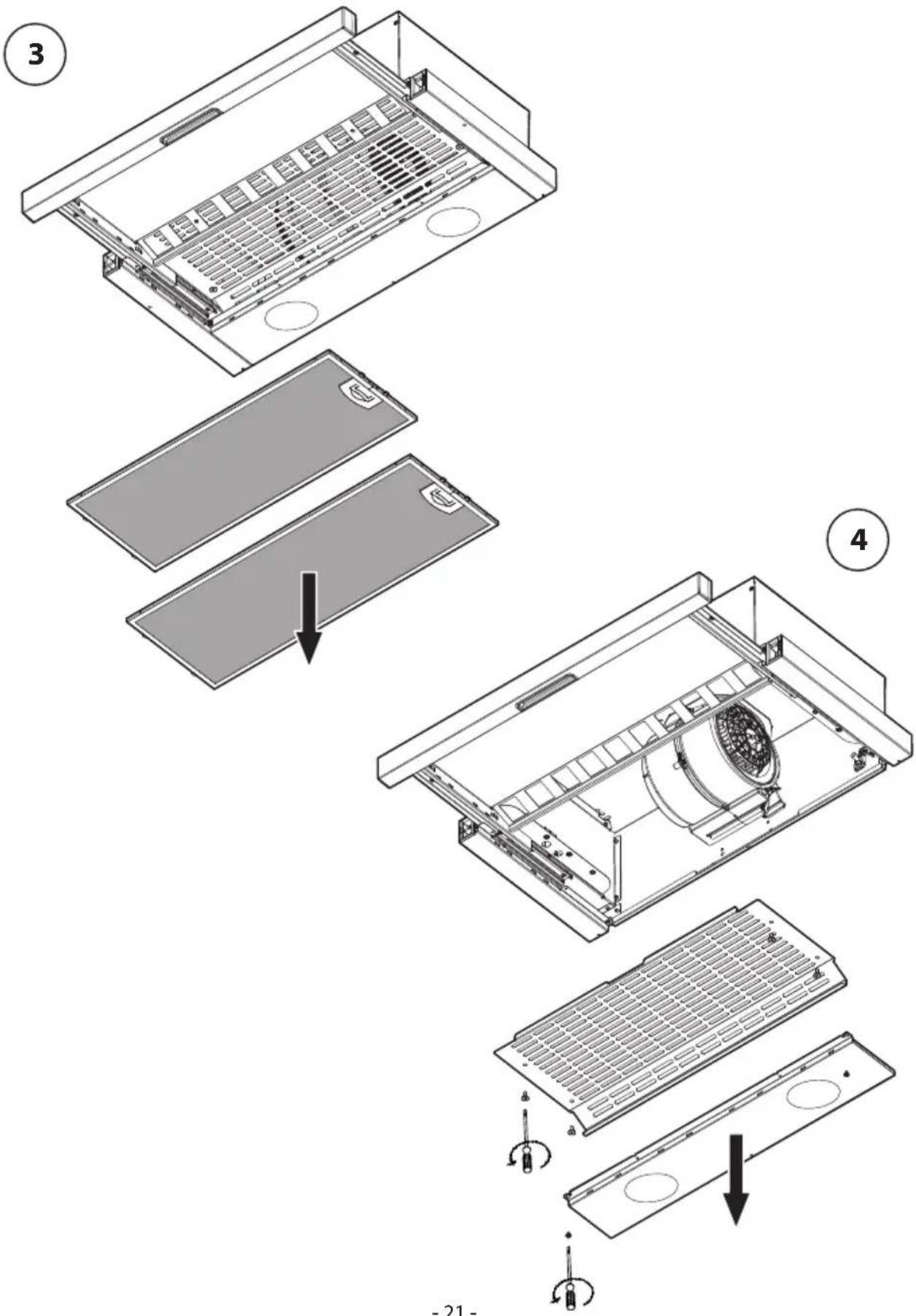
- The minimum distance between the support surfaces of the cooking pots on the cooker top and the lowest part of the cooker hood must be at least 65 cm. If a connection tube composed of two parts is used, the upper part must be placed outside the lower part. Do not connect the cooker hood exhaust to the same conductor used to circulate hot air or for evacuating fumes from other appliances generated by other than an electrical source. Before proceeding with the assembly operations, remove the anti-grease filter(s) (Fig.4) so that the unit is easier to handle.
- In the case of assembly of the appliance in the suction version prepare the hole for evacuation of the air.
• We recommend the use of an air exhaust tube which has the same diameter as the air exhaust outlet hole. If a pipe with a smaller diameter is used, the efficiency of the product may be reduced and its operation may become noisier. - If your appliance has been designed for use in habitations supplied with acentralised suction device perform the following operations:
- The switch controls opening and closure of a valve using a thermoelectical device. By placing the switch in the ON position, after a minute, the valve opens rotating 90° allowing suction of the stale air. By placing the switch in the OFF position, the valve closes after 100 seconds.
- Installation:
The following instruction should be followed to carry out the correct installation of the cooker hood.
- Mounting of the cooker hood on the lower side of the cupboard.
- Selection of the version (extraction Fig.3A or filtration Fig.3B).
• Fixing the hood to the lower part of the wall cabinet:
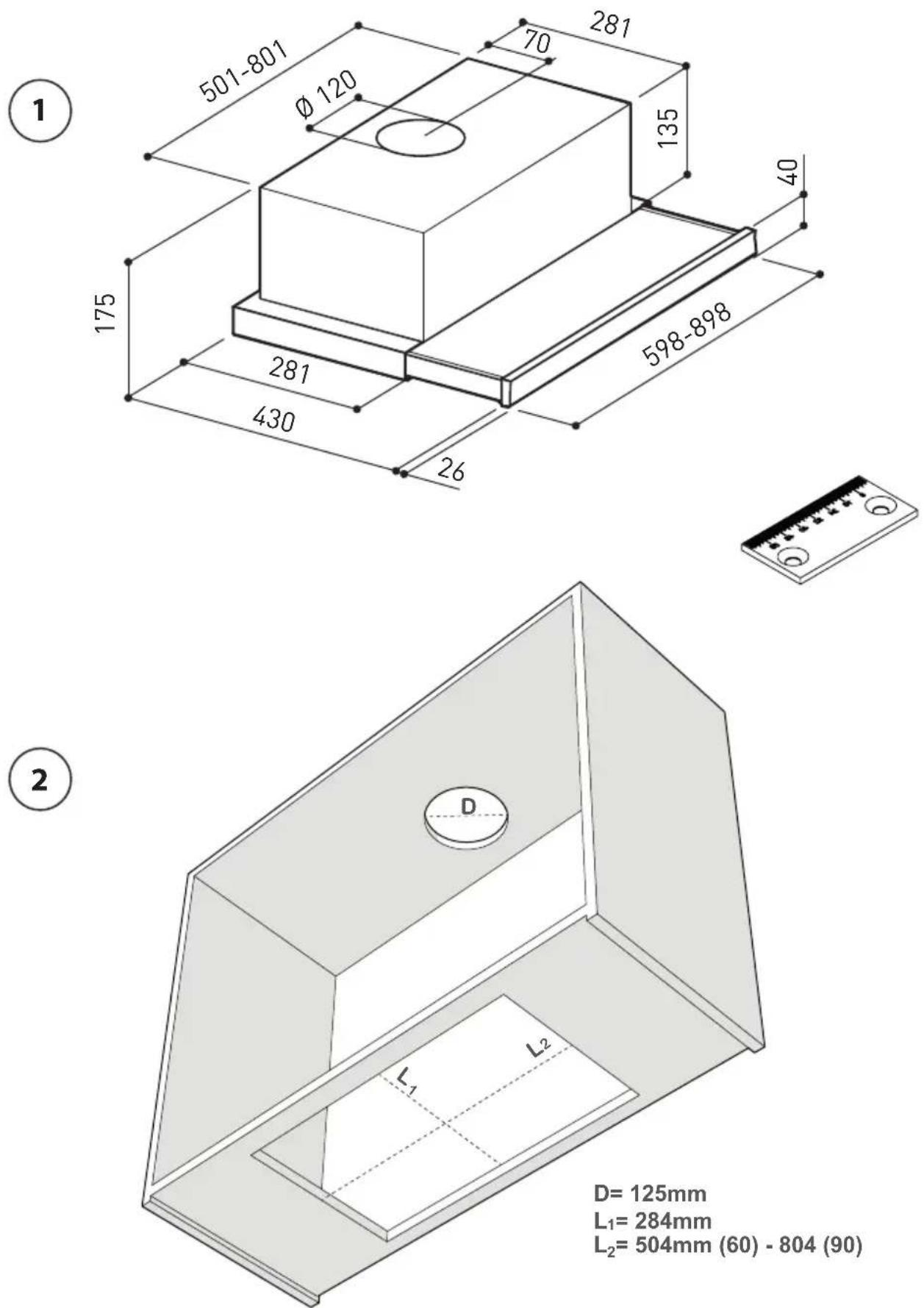
This type of appliance must be fitted inside a cabinet or inside another type of support structure. To fix it in place, use 4 screws which are suitable for the type of cabinet, making holes in accordance with the diagram shown in (Fig.1). To fit the appliance correctly, align the front panel of the cooker hood with the cabinet door and adjust spacer L using screws P (Fig.2), then ensure the appliance meets the cabinet at the rear.
• Extraction through an outside wall:
The appliance expels the fumes through an outside wall or a duct. It is necessary to buy a telescopic pipe in accordance with the standards in use (inflammable) and connect it to flange H (Fig.3A).
- Recirculation:
The To transform the cooker hood from the extraction version to the re circulating one ask your supplier for an activated carbon filter. The filter must be fitted to the extracting group cooker hood in the centre of the fan grille by twisting it by 90 degrees until it is gripped securely (Fig.5). For this operation remove the anti-grease filter(s) G (Fig.4). The clean air is returned into the room through a connecting tube passing inside the cupboard and connected to the ring H (Fig.3B).
USE AND MAINTENANCE
• We recommend that the cooker hood is switched on before any food is cooked. We also recommend that the appliance is left running for 15 minutes after the food is cooked, in order to thoroughly eliminate all contaminated air. The effective performance of the cooker hood depends on constant maintenance; the anti-grease filter and the active carbon filter both require special attention.
- The anti-grease filter is responsible retaining the grease particles suspended in the air, therefore it is subject to clogging with variable frequency according to the use of the appliance.
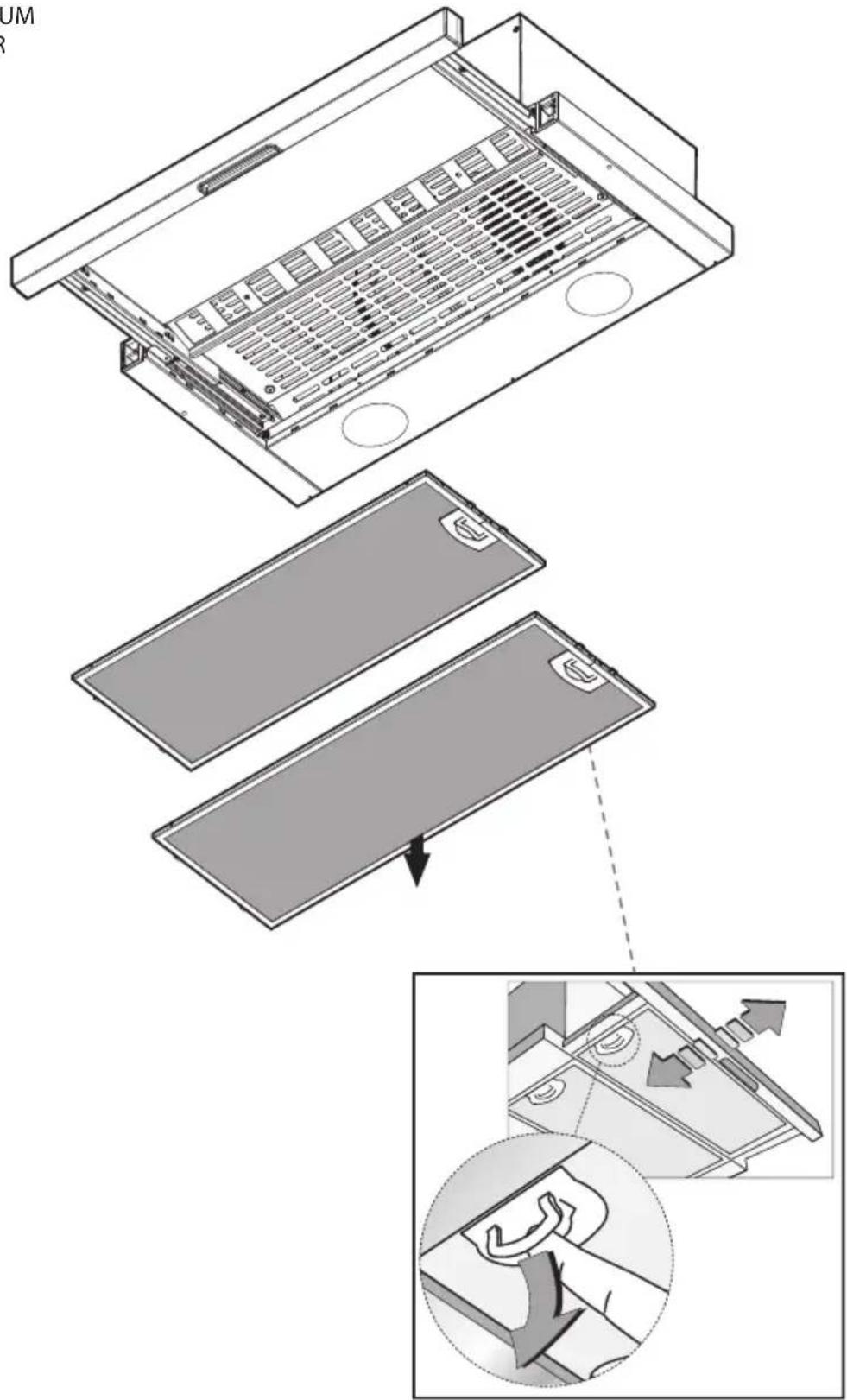
- To prevent the danger of possible fires, at least every 2 months one must wash the anti-grease filters by hand using non-abrasive neutral liquid detergents or in the dishwasher at low temperatures and on short cycles.
- After a few washes, colour alterations may occur. This does not give the right to claim their replacement.
- The active carbon filters are used to purify the air that is sent back into the room and its function is to mitigate the unpleasant odours produced by cooking.
- The non-regenerable active carbon filters must be replaced at least every 4 months. The saturation of the active charcoal depends on the more or less prolonged use of the appliance, on the type of kitchen and on the frequency with which anti-grease filter is cleaned.
- Before remounting the anti-grease filters and the regenerable active charcoal filters it is important that they are completely dry.
- Clean the hood frequently, both internally and externally, using a cloth dampened with denatured alcohol or neutral liquid detergents that are non abrasive.
- The lighting .system is designed for use during cooking and not for the prolonged general lighting of the room. The prolonged use of the lighting system significantly decreases the average duration of the bulbs.
- If the appliance is equipped with courtesy lights it is possible to use them for general room lighting for a prolonged amount of time.
- Attention: the non compliance with the hood cleaning warnings and with the replacement and cleaning of the filters entails risk of fires. One therefore recommends keeping to the suggested instructions.
- Lamps replacing:
Only use lamps of the same type and wattage installed on the device. If the appliance version is with LED lamps, the intervention of a specialised technician is necessary to replace them.
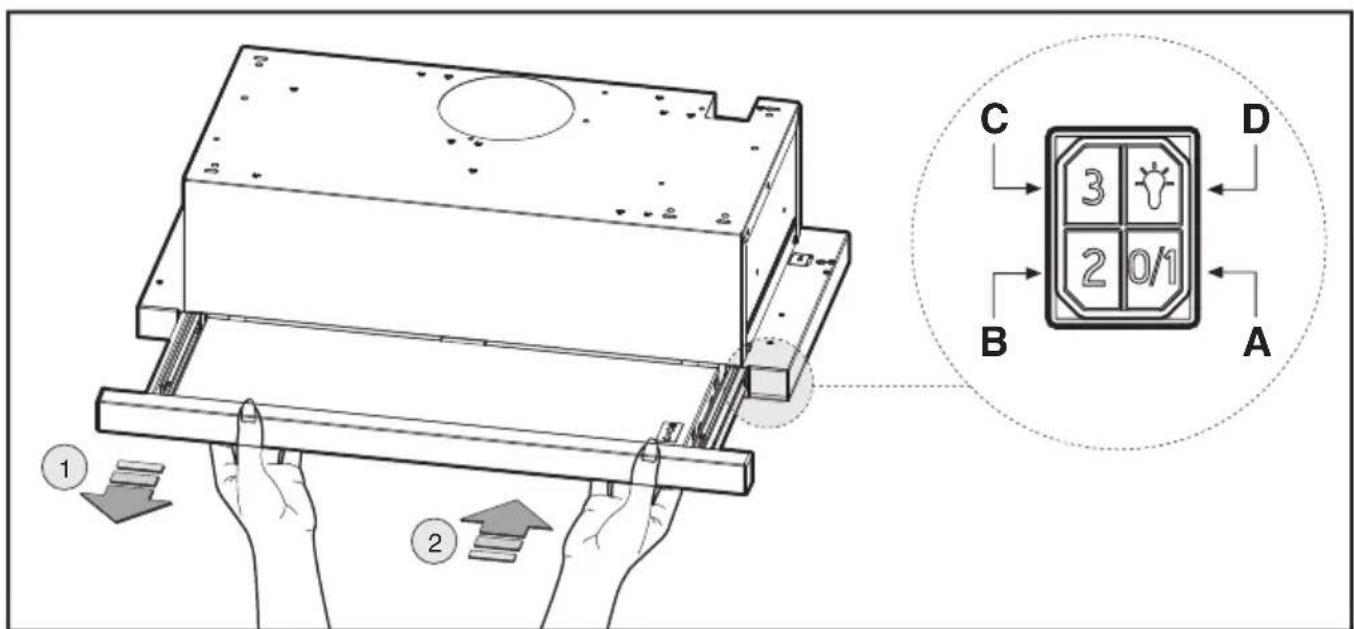
- Commands slider (Fig.6) the key symbols are explained below:
This hood is equipped with a microswitch.
If the telescopic trolley is closed with the speed set i.e. at 2 and the light are on, once it is reopened, the hood reactivates at the same working speed at which it was switched off.
A = FIRST SPEED Off/On Switch
B = SECOND SPEED Switch
C = THIRD SPEED Switch.
D = Light On/Off Switch
THE MANUFACTURER DECLINES ALL RESPONSIBILITY FOR EVENTUAL DAMAGES CAUSED BY BREACHING THE ABOVE WARNINGS.
GENERALIDADES
NOTAS/NOTAS/REMARQUES/NOTES:
NOTAS/NOTAS/REMARQUES/NOTES:
NOTAS/NOTAS/REMARQUES/NOTES:

text_image
INOX CLEAN LIMPIADOR, ABRILLANTADOR Y PROTECTOR DE ACERO INOXIDABLE PandoES
ESPRODUCTO EXCLUSIVO
LIMPIADOR,
ABRILLANTADOR Y
PROTECTOR DE ACERO INOXIDABLE
INOX PANDO, Referencia 1059.
PROPIEDADES:
Degreaser especially recommended for polishing stainless steel surfaces, with its complex formula based on paraffin it leaves an invisible film that acts as a protector and makes it shine.
APPLICATIONS:
Cleans, polishes and evens out stainless steel surfaces of extractor hoods and stainless steel kitchen furniture.
INOXPAN S.L.
Pol. Ind. El Cros
Quality Management System
UNE_EN ISO 9001:2015
ES19/86566