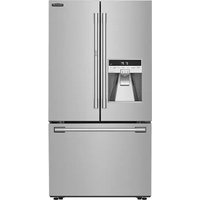
SKSCR2401P - Fridge SIGNATURE - Free user manual and instructions
Find the device manual for free SKSCR2401P SIGNATURE in PDF.


| Product Type | Built-in Refrigerator |
| Brand | SIGNATURE |
| Model | SKSCR2401P |
| Net Weight | 147 kg (324 lb) |
| Power Supply | 115 V, 60 Hz |
| Refrigerator Temperature Range | 1 °C to 8 °C (33 °F to 46 °F) |
| Default Temperature | 3 °C (37 °F) |
| Required Water Pressure | 20 to 120 psi (138 to 827 kPa) |
| Refrigerant | R600a (isobutane) |
| Water Dispenser | Internal |
| Interior Lighting | LED |
| Water Filter | LT1000P-S (ADQ74793506), replacement every 6 months |
| Air Filter | Recyclable every 6 months |
| Wi-Fi Connectivity | Yes, 2.4 GHz network |
| Smart Functions | LG ThinQ, Smart Grid, Smart Diagnosis |
| Sabbath Mode | Yes |
| Drawers | 2 fruit/vegetable drawers + snack tray |
| Adjustable Shelves | Yes |
| Door Bins | Removable |
| Defrost | Automatic |
| Recommended Cleaning | Monthly with mild detergent |
| Linear Compressor Warranty | 10 years |
| Sealed System Warranty | 7 years |
| Parts and Labor Warranty | 3 years |
Frequently Asked Questions - SKSCR2401P SIGNATURE
User questions about SKSCR2401P SIGNATURE
0 question about this device. Answer the ones you know or ask your own.
Ask a new question about this device
Download the instructions for your Fridge in PDF format for free! Find your manual SKSCR2401P - SIGNATURE and take your electronic device back in hand. On this page are published all the documents necessary for the use of your device. SKSCR2401P by SIGNATURE.
USER MANUAL SKSCR2401P SIGNATURE
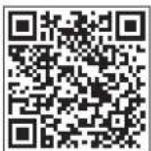
Scan to see the online manual.
SIGNATURE
KITCHEN SUITE
OWNER'S MANUAL
BUILT-IN REFRIGERATOR
Read this owner's manual thoroughly before operating the appliance and keep it handy for reference at all times.
ENGLISH
SKSCR3001P, SKSCR2401P
MFL70339815
Rev.08_062923
www.signaturekitchensuite.com
Copyright © 2019-2023 Signature Kitchen Suite. All Rights Reserved.
natural_image
Pure geometric diagram with intersecting lines and circles, no text or symbols present2
TABLE OF CONTENTS
3 IMPORTANT SAFETY INSTRUCTIONS
3 READ ALL INSTRUCTIONS BEFORE USE
3 W A R N I N G
5 C A U T I O N
7 PRODUCT OVERVIEW
7 Product Features
9 OPERATION
9 B e f o r e U s e
10 Control Panel
12 Sabbath Mode
12 Water Dispenser
12 Storing Food
14 Snack Pan
15 Drawers
16 Shelves
17 Door Bins
18 SMART FUNCTIONS
18 LG ThinQ Application
20 Smart Grid Function
21 Smart Diagnosis ™ Feature
23 MAINTENANCE
23 Cleaning
23 Air Filter
24 Water Filter
28 TROUBLESHOOTING
28 FAQs
29 Before Calling for Service
37 LIMITED WARRANTY
37 USA
39 Canada
natural_image
Pure geometric diagram with intersecting lines and circles, no text or symbols presentIMPORTANT SAFETY INSTRUCTIONS
READ ALL INSTRUCTIONS BEFORE USE
Safety Messages
Your safety and the safety of others are very important.
We have provided many important safety messages in this manual and on your appliance. Always read and follow all safety messages.

This is the safety alert symbol.
This symbol alerts you to potential hazards that can kill or injure you and others. All safety messages will follow the safety alert symbol and either the word WARNING or CAUTION.
These words mean:

WARNING
You may be killed or seriously injured if you do not follow instructions.

CAUTION
You may be injured or cause damage to the product if you do not follow instructions.
All safety messages will tell you what the potential hazard is, tell you how to reduce the chance of injury, and tell you what may happen if the instructions are not followed.
WARNING

WARNING
• To reduce the risk of explosion, fire, death, electric shock, scalding or injury to persons when using this product, follow basic precautions, including the following:
Installation
• To avoid a hazard due to instability of the appliance, it must be fixed in accordance with the instructions.
Operation
• This appliance is intended to be used in household and similar applications such as:
- staff kitchen areas in shops, offices and other working environments;
- farm houses and by clients in hotels, motels and other residential type environments;
- bed and breakfast type environments;
-
catering and similar non-retail applications.
-
This appliance is not intended for use by persons (including children) with reduced physical, sensory or mental capabilities, or lack of experience and knowledge, unless they have been given supervision or instruction concerning use of the appliance by a person responsible for their safety.
- This product is not to be used for special purposes such as the storage of medicine or test materials or for use on ships, etc.
- DO NOT allow children to climb, stand, or hang on the refrigerator doors or on the shelves in the refrigerator. They could damage the refrigerator and seriously injure themselves.
- Do not allow children to climb into the refrigerator. They could be trapped and suffocated.
• Children should be supervised to ensure that they do not play with the refrigerator.
natural_image
Pure geometric diagram with intersecting lines and circles, no text or symbols present4 IMPORTANT SAFETY INSTRUCTIONS
- Keep fingers out of pinch point areas; clearances between the doors and cabinets are necessarily small. Be careful closing doors when children are nearby.
- Do not use an adapter plug or plug the power plug into a multi-outlet extension cord.
- If the supply cord is damaged, it must be replaced by the manufacturer or its service agent or a similarly qualified person in order to avoid a hazard.
- Do not operate the refrigerator or touch the power cord with wet hands.
- Do not modify or extend the power cord.
- Do not use an uncertified power outlet. Do not plug the appliance into a damaged wall outlet.
- Do not put hands, feet or other objects into the air vents or bottom of the refrigerator. Doing so could result in personal injury or electric shock.
- In the event of a gas leak (propane/LPG), ensure the area is adequately ventilated and contact an authorized service center before resuming use. Do not touch the refrigerator or power button of the refrigerator.
- Turn off power to the appliance immediately and contact an authorized service center if there is a strange noise, odor, or smoke coming from the appliance.
- Do not use any fuse (such as copper, steel wire, etc.) other than a standard fuse.
- Do not place or use an electrical appliance inside the refrigerator, unless it is of a type recommended by the manufacturer.
- Do not put animals inside the appliance.
- Do not place heavy or fragile objects, liquid filled containers, combustible substances, or flammable objects (such as candles and lamps) on the appliance.
- If connected to a circuit protected by fuses, use time delay fuse.
- Keep ventilation openings, in the appliance enclosure or in the built-in structure, clear of obstruction.
- Do not use mechanical devices or other means to accelerate the defrosting process, other than those recommended by the manufacturer.
- Do not use electrical appliances inside the food storage compartments of the appliance, unless they are of a type recommended by the manufacturer.
- Do not store explosive substances such as aerosol cans with a flammable propellant in this appliance.
- Do not damage the refrigerant circuit.
- An individual properly grounded branch circuit or circuit breaker must be used in case of a required disconnect after installation.
• This appliance incorporates an earth connection for functional purposes.
- Fill with potable water only.
- If using a dispenser water tank, make sure to fill it with potable water only.
Maintenance
- Do not use a hair dryer to dry the inside of the refrigerator.
- Do not light a candle to remove odors in the refrigerator.
- In the event of a refrigerant leak, move flammable objects away from the refrigerator. Ensure the area is adequately ventilated and contact an authorized service center.
- Keep flammable materials and vapors, such as gasoline, away from the refrigerator.
- This appliance is not intended for use by persons (including children) with reduced physical, sensory or mental capabilities, or lack of experience and knowledge, unless they have been given supervision or instruction concerning use of the appliance by a person responsible for their safety.
- Turn off power before cleaning or repairing the refrigerator.
- The refrigerator compartment lights are interior LED lighting, and service should be performed by a qualified technician.
- Turn off power immediately in the event of a blackout or thunderstorm.
- Turn the power off if water or dust penetrates into the refrigerator. Call a service agent.
- Do not store, disassemble or repair the appliance yourself or allow unqualified personnel to do so.
- Do not damage the refrigerant circuit.
Disposal
- Risk of child entrapment. Junked or abandoned refrigerators are dangerous, even if they are sitting for only a few days. When disposing of the refrigerator, remove the packing materials from the door or take off the doors but leave the shelves in place so that children may not easily climb inside.
- If disposing of a refrigerator, make sure the refrigerant and insulation foam are removed for proper disposal by a qualified servicer. If you release the refrigerant or throw away the insulation foam, you may be fined or imprisoned in accordance with the relevant environmental law. Insulation foam contains flammable blowing gas.
- When discarding the appliance, remove the door gasket while leaving the shelves and bins in place, and keep children away from the appliance.
Grounding Instructions
- Improper connection of the equipment-grounding conductor can result in a risk of electric shock. Check with a qualified electrician or service personnel if you are in doubt whether the appliance is properly grounded. Do not modify the plug provided with the appliance; if it will not fit the outlet, have a proper outlet installed by a qualified electrician.
- Have a certified electrician check the wall outlet and wiring for proper grounding.
- An individual properly grounded branch circuit or circuit breaker must be used in case of requiring disconnect after installation.
Risk of Fire and Flammable Materials
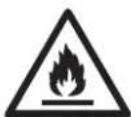
This appliance contains a small amount of isobutane refrigerant (R600a), which is combustible. When transporting and installing the appliance, care should be taken to ensure that no parts of the refrigerating circuit are damaged. Refrigerant squirting out of the pipes could ignite or cause an eye injury. If a leak is detected, avoid any naked flames or potential sources of ignition and air out the room in which the appliance is standing for several minutes.
In order to avoid the creation of a flammable gas air mixture if a leak in the refrigerating circuit occurs, the size of the room in which the appliance may be sited depends on the amount of refrigerant used. The room must be 10.8 square feet (1 square meter) in size for every 8g of R600a refrigerant inside the appliance. The amount of refrigerant in your particular appliance is shown on the identification plate inside the appliance. Never start up an appliance showing any signs of damage. If in doubt, consult your dealer.
CAUTION
CAUTION
- To reduce the risk of minor or moderate injury to persons, malfunction, or damage to the product or property when using this product, follow basic precautions, including the following:
Installation
- Do not install the refrigerator where there may be a danger of the unit falling.
- The refrigerator must be properly installed in accordance with the Installation Instructions.
6 IMPORTANT SAFETY INSTRUCTIONS
- This appliance does not require changes in installation or use based on altitude.
Operation
- Do not use aerosols near the refrigerator.
- This appliance is intended to be used only in domestic and similar applications.
- Do not strike or apply excessive force to any glass surface. Do not touch glass surfaces if they are cracked or broken.
- Do not overfill or pack items too tightly into door bins. Doing so may cause damage to the bin or personal injury if items are removed with excessive force.
- Do not overfill the appliance with food. Doing so may cause personal injury or property damage.
Maintenance
- Do not use strong detergents like wax or thinners for cleaning. Clean with a soft cloth.
- Remove foreign objects (such as dust and water) off the prongs of the power plug and contact areas. Do not use a wet or damp cloth when cleaning the plug.
- Do not spray water directly on the inside or outside of the appliance.
- Do not clean glass shelves or covers with warm water when they are cold. They may break if exposed to sudden temperature changes.
PRODUCT OVERVIEW
Product Features
The images in this guide may be different from the actual components and accessories, which are subject to change by the manufacturer without prior notice for product improvement purposes.
Interior

①Water Filter
Purifies water.
NOTE
- The filter should be replaced every 6 months. See the Replacing the Water Filter section in this manual for details.
②Control Panel
Sets the refrigerator temperature and the water filter condition.
③LED Interior Lighting
Lights up the inside of the refrigerator.
natural_image
Pure geometric diagram with intersecting lines and circular shapes, no text or symbols present8 PRODUCT OVERVIEW
④Adjustable Refrigerator Shelf
The refrigerator shelves are adjustable to meet individual storage needs.
⑤Internal Water Dispenser
Dispenses purified water.
⑥Snack Pan
Stores dairy snacks or other small items you want to keep especially cold.
⑦Drawer
Stores vegetables and fruits. The sliding drawers allow easy access and convenience of use.
- Use the upper compartment to store packaged foods and frequently-used foods.
- Use the lower compartments for larger foods and items stored for longer periods.
⑧ Movable Door Bin
Stores chilled food or drinks.
Product Specifications
The appearance and specifications listed in this manual may vary due to constant product improvements.
Electrical requirements: 115 V, 60 Hz
Min. / Max. water pressure: 20 - 120 psi (138 - 827 kPa)
| Model Description Net weight | |
| SKSCR3001P Built-in, Refrigerator 386 lb (175 kg) | |
| SKSCR2401P Built-in, Refrigerator 324 lb (147 kg) |
natural_image
Pure geometric lines and shapes without any text, numbers, or symbols
natural_image
Pure geometric diagram with intersecting lines and circles, no text or symbols presentOPERATION
Before Use
Checklist
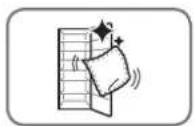
Clean the refrigerator.
Clean the refrigerator thoroughly and wipe off all dust that accumulated during shipping.

CAUTION
- Do not scratch the refrigerator with a sharp object or use a detergent that contains alcohol, a flammable liquid or an abrasive when removing any tape or adhesive from the refrigerator. Remove adhesive residue by wiping it off with your thumb or dish detergent.
- Do not peel off the model or serial number label or the technical information on the rear surface of the refrigerator.

Open refrigerator door to ventilate the interior.
The inside of the refrigerator may smell like plastic at first. Remove any adhesive tape from inside the refrigerator and open the refrigerator door for ventilation.
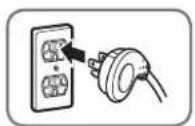
Connect the power supply.
Check if the power supply is connected before use.
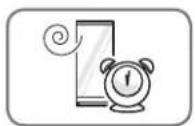
Wait for the refrigerator to cool.
Allow the refrigerator to run for at least two to three hours before putting food in it.

CAUTION
- Putting food in the refrigerator before it has cooled could cause the food to spoil, or a bad odor to remain inside the refrigerator.
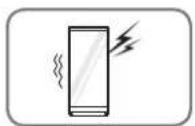
The refrigerator makes a loud noise after initial operation.
This is normal. The volume will decrease as the temperature decreases.
natural_image
Pure geometric diagram with intersecting lines and circular shapes, no text or symbols present10 OPERATION
Control Panel
Depending on the model, some of the following functions may not be available.
The actual control panel may differ from model to model.
Control Panel Features
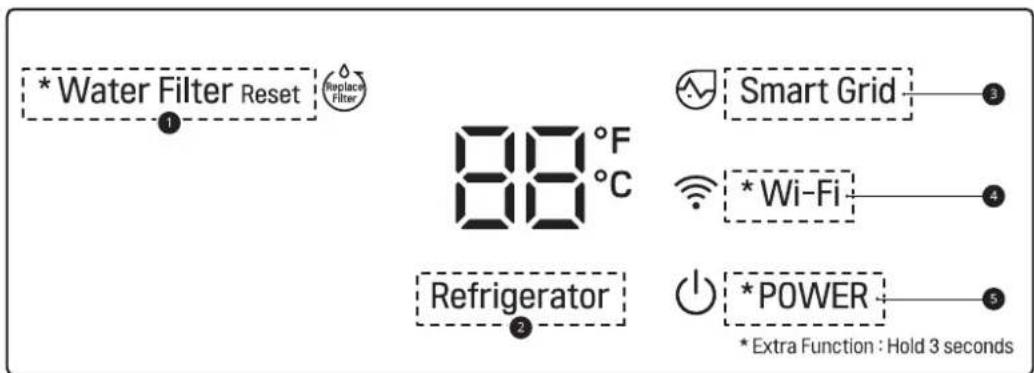
①Water Filter Reset
Replace the water filter when the ⚙️ icon turns on. After replacing the water filter, press and hold the Water Filter Reset button for three seconds to turn the icon light off. Replace the water filter approximately every six months.
②Refrigerator
Indicates the set temperature of the refrigerator compartment in Celsius (°C) or Fahrenheit (°F). The default refrigerator temperature is 37 °F (3 °C). Press the Refrigerator button repeatedly to select a new set temperature from 33 °F to 46 °F (1 °C to 8 °C).
NOTE
- To change the temperature mode from °F to °C (or vice versa) press the Refrigerator button first to wake the display. Press and hold the Refrigerator and Smart Grid buttons simultaneously for approximately five seconds until you hear a beep sound. The temperature indicator on the display window switches between Celsius and Fahrenheit.
- The displayed temperature is the target temperature, and not the actual temperature of the refrigerator. The actual refrigerator temperature depends on the food inside the refrigerator.
③Smart Grid
Press the Smart Grid button to turn the function On/Off. When the function is on, the icon illuminates. The function automatically turns on when the refrigerator is connected to the Wi-Fi network.
When the refrigerator is responding to a Demand Response (DR) message from the electric company, the Grid text illuminates.
④Wi-Fi
The Wi-Fi button, when used with the LG ThinQ app, allows the refrigerator to connect to a home Wi-Fi network. Refer to Smart Functions for information on the initial setup of the application.
The 📋 icon shows the status of the refrigerator's network connection. The icon illuminates when the refrigerator is connected to the Wi-Fi network.
Press and hold the Wi-Fi button for 3 seconds to connect to the network. The icon blinks while the connection is being made, then turns on once the connection is successfully made.
⑤POWER
The POWER button turns off all electrical power to the unit.
Press and hold the POWER button for 3 seconds to turn off the power. When the power is off, the ⏻ icon light is off. There is no need to turn off power at the circuit breaker or wall receptacle. Use this function for service or extended vacations.
NOTE
Display Mode (For Store Use Only)
- The Display Mode disables all cooling in the refrigerator to conserve energy while on display in a retail store. When activated, OF is displayed on the control panel and the display remains on for 20 seconds.
• To deactivate/activate:
- With the refrigerator door opened, press and hold the Refrigerator and Water Filter Reset buttons at the same time for five seconds. The control panel beeps and the temperature settings display to confirm that Display Mode is deactivated. Use the same procedure to activate Display Mode.
NOTE
- When the refrigerator is in the Power Saving Mode, the display remains off until a door is opened or a button is pressed. Once on, the display remains on for 20 seconds.
12 OPERATION
Sabbath Mode
This feature is only available on some models.
Using the Sabbath Mode
Sabbath mode is used on the Jewish Sabbath and Holidays.
- To turn Sabbath mode on, touch the display to activate it, then press and hold the Refrigerator and POWER buttons for 3 seconds until 5b appears in the display.
• To turn Sabbath mode off manually, press and hold the Refrigerator and POWER buttons for 3 seconds.
NOTE
- Sabbath mode automatically turns off after 96 hours.
- Once turned on, Sabbath mode is maintained even after a power outage.
- Selecting Sabbath mode automatically turns off the Light and Alarm functions.
- The dispenser is disabled in Sabbath Mode. This information is only available on models with the dispenser.
- The interior display stays on during Sabbath mode, but only 5b and the Refrigerator and POWER buttons are displayed.
- The refrigerator temperature is set to 37^ (3 °C) and cannot be changed until Sabbath mode is turned off.
- The Smart Grid function is automatically turned off in Sabbath mode. When Sabbath mode ends, the Smart Grid function must be activated again manually.
Water Dispenser

WARNING
- Connect to a potable water supply only.
Before Using the Water Dispenser

CAUTION
- Keep children away from the dispenser. Children may play with or damage the controls.
- If water dispenses unexpectedly, turn off the water supply and contact a SIGNATURE KITCHEN SUITE Customer Information Center.
• After installation, dispense 2.5 gallons of water (flush for approximately 5 minutes) to remove trapped air and contaminants from the system.
- Never use a glass that is exceptionally narrow or deep.
- Do not hang on to or place heavy objects on the refrigerator's dispenser.
NOTE
- The first water dispensed may include particles or odor from the water supply line or the water tank. This is also necessary if the refrigerator has not been used for a long time.
- Some dripping may occur after dispensing. Hold the cup beneath the dispenser for a few seconds after dispensing to catch all of the drops.
- Keep containers at an appropriate distance from the dispenser. A container with a very small opening should be held as close to the dispenser as possible to avoid spilling.
Using the Water Dispenser
Press the dispenser paddle ① with a glass or other container to dispense water.

natural_image
Diagram of a refrigerator interior showing the exterior and front views, with no text or symbols present.Storing Food
NOTE
- If you are leaving home for a short period, like a short vacation, the refrigerator should be left on.
- If you are leaving the refrigerator turned off for an extended period, remove all food and unplug the power cord. Clean the interior, and leave the doors open to prevent fungi from growing in the refrigerator.
- If doors are opened or closed too often, warm air may penetrate the refrigerator and raise its temperature. This can increase the running costs of the unit.
Food Storage Tips
Wrap or store food in the refrigerator in airtight and moisture-proof material unless otherwise noted. This prevents food odor and taste transfer throughout the refrigerator. For dated products, check date code to ensure freshness.

CAUTION
- Do not overfill or pack items too tightly into door bins. Doing so may cause damage to the bin or personal injury if items are removed with excessive force.
How to Store Food
- Butter or Margarine
- Keep opened butter in covered dish or closed compartment.
- Cheese
- Store in original wrapping until used. Once opened, rewrap tightly in plastic wrap or aluminum foil.
• Milk
- Wipe milk cartons. For coldest milk, place containers on an interior shelf.
• Eggs
- Store in original carton on interior shelf, not on door shelf.
- Fruit
- Do not wash or hull fruit until it is ready to be used. Sort and keep fruit in original container in a crisper, or store in completely closed paper bag on refrigerator shelf.
- Leafy Vegetables
- Remove store wrapping, trim or tear off bruised and discolored areas, wash in cold water, and drain. Place in plastic bag or plastic container and store in crisper.
• Vegetables with skins (carrots, peppers)
- Place in plastic bags or plastic container and store in crisper.
- Fish
- Eating fresh fish and shellfish the same day purchased is recommended.
- Leftovers
- Cover leftovers with plastic wrap or aluminum foil, or store in plastic containers with tight lids.
NOTE
- If you are leaving home for a short period, like a short vacation, the refrigerator should be left on.
- If you are leaving the refrigerator turned off for an extended period, remove all food and unplug the power cord. Clean the interior, and leave the door open to prevent fungi from growing in the refrigerator.
- Do not store food with high moisture content towards the top of the refrigerator. The moisture could come into direct contact with the cold air and freeze.
- Wash food before storing it in the refrigerator. Vegetables should be washed, and food packaging should be wiped down to prevent adjacent foods from being contaminated.
- If the refrigerator is kept in a hot and humid place, frequent opening of the door or storing a lot of vegetables in the refrigerator may cause condensation to form. Wipe off the condensation with a clean cloth or a paper towel.
- If the refrigerator door is opened or closed too often, warm air may penetrate the refrigerator and raise its temperature. This can increase the running costs of the unit.
Storing Frozen Food
Check a freezer guide or a reliable cookbook for further information about preparing food for freezing or food storage times.
Freezing
Your freezer will not quick-freeze a large quantity of food. Do not put more unfrozen food into the freezer than will freeze within 24 hours (no more than 2 to 3 pounds of food per cubic foot of freezer space). Leave enough space in the freezer for air to circulate around packages. Be careful to leave enough room at the front so the door can close tightly.
Storage times will vary according to the quality and type of food, the type of packaging or wrap used (how airtight and moisture-proof) and the storage temperature. Ice crystals inside a sealed package are normal. This simply means that moisture in the food and air inside the package have condensed, creating ice crystals.
14 OPERATION
NOTE
- Allow hot foods to cool at room temperature for 30 minutes, and then package and freeze. Cooling hot foods before freezing saves energy.
Packaging
Successful freezing depends on correct packaging. When you close and seal the package, it must not allow air or moisture in or out. If it does, you could have food odor and taste transfer throughout the refrigerator and could also dry out frozen food.
Packaging Recommendations
• Rigid plastic containers with tight-fitting lids
- Straight-sided canning/freezing jars
• Heavy-duty aluminum foil
- Plastic-coated paper
• Non-permeable plastic wraps
- Specified freezer-grade self-sealing plastic bags
Follow package or container instructions for proper freezing methods.
Do not use
- Bread wrappers
• Non-polyethylene plastic containers - Containers without tight lids
- Wax paper or wax-coated freezer wrap
• Thin, semi-permeable wrap
Snack Pan
Removing/Assembling the Snack Pan
The location of the snack pan is adjustable for your convenience.

CAUTION
• Make sure that Snack Pan is level from one side to the other. Failure to do so may result in the Snack Pan falling or spilled food.
- Do not clean the Snack Pan glass with warm water while it is cold. Snack Pan may break if exposed to sudden temperature changes or impact.
- Snack Pan is heavy. Use special care when removing it.
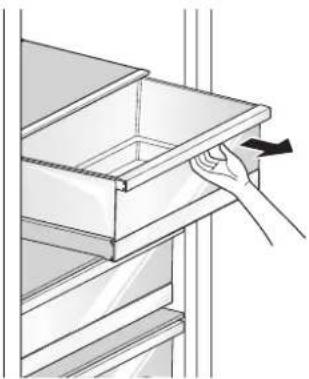
Removing the Drawer
1 Pull the drawer out until it stops. Empty all contents out of the drawer before removing it.
natural_image
Illustration of a hand placing a drawer into a multi-tiered cabinet (no text or symbols visible)2 Lift the empty drawer slightly to remove it from the support.

natural_image
Diagram of a mechanical assembly with layered components and an arrow indicating motion (no text or symbols)Detaching the Snack Pan
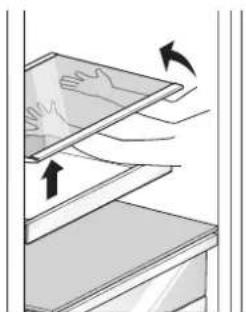
1 To detach, tilt up the front of the shelf and lift the shelf straight up.
2 Pull the Snack Pan out.
natural_image
Illustration of a person using a tool on a laptop, with arrows indicating motion (no text or symbols)
Assembling the Snack Pan
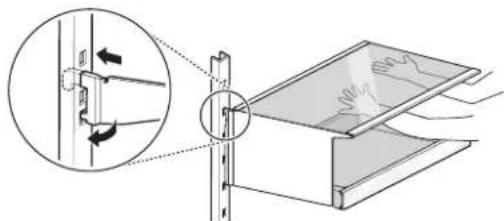
1 To assemble, tilt the front of the Snack Pan up and guide the shelf hooks into the slots at a desired height
2 Lower the front of the Snack Pan so that the hooks drop into the slots.
Assembling the Drawer
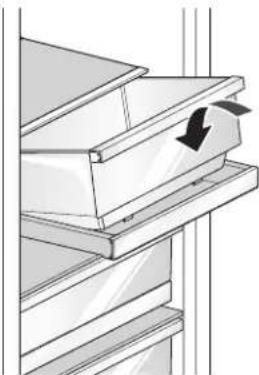
1 Pull out the drawer support until it stops. Angle the drawer into the space and set it on the support.
natural_image
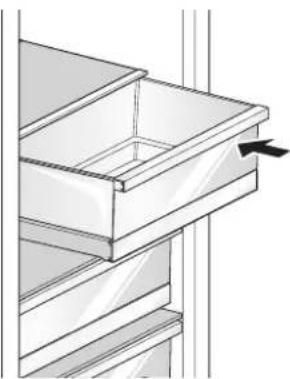
Diagram of a multi-level shelf with an arrow indicating direction (no text or symbols present)2 Slide the drawer back until it lowers into place on the support. Close the drawer.
natural_image
Illustration of a multi-level drawer or shelf with an arrow pointing to the interior (no text or symbols present)Drawers
Removing/Assembling Drawers

CAUTION
• The drawers are heavy. Always use two hands when removing or assembling the drawers to avoid product damage or personal injury. Always empty drawers before removing them.
• Always open the door completely before removing or assembling the drawers.
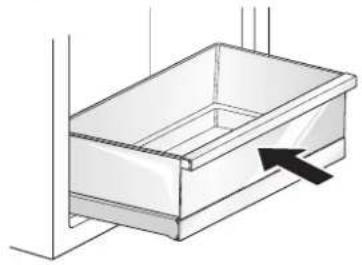
Removing Drawers
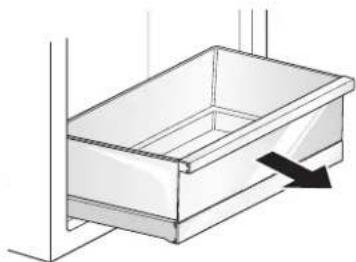
1 Pull the drawer out until it stops. Empty all contents out of the drawer before removing it.
natural_image
Simple line drawing of a rectangular drawer with a black arrow indicating direction (no text or symbols)2 Lift the empty drawer slightly to remove it from the support.
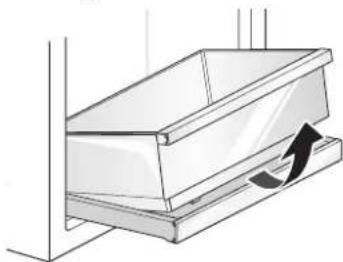
natural_image
Diagram of a mechanical component with an arrow indicating direction, no text or symbols presentAssembling Drawers
1 Pull out the drawer support until it stops. Angle the drawer into the space and set it on the support.
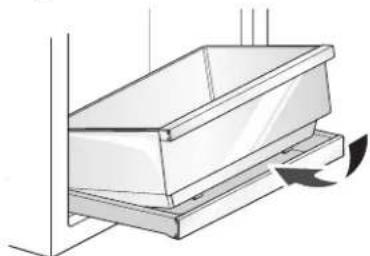
natural_image
Technical line drawing of a cabinet or shelf with an arrow indicating motion (no text or symbols)

16 OPERATION
2 Slide the drawer back until it lowers into place on the support. Close the drawer.
natural_image
Simple line drawing of a rectangular basin with a black arrow indicating direction (no text or symbols)Removing/Assembling the Drawer Support
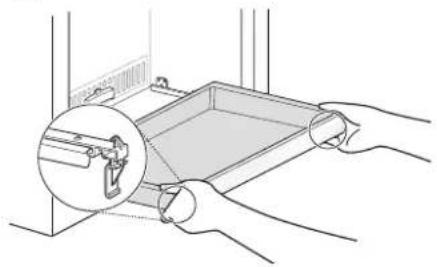
Removing the Drawer Support
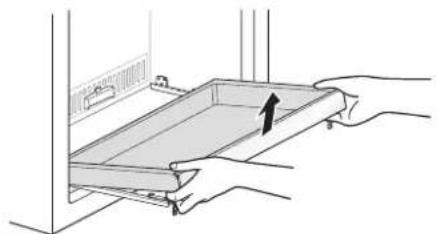
1 Press the levers on either side of the drawer support.
natural_image
Illustration of hands installing or adjusting a mechanical component inside a storage tray (no text or symbols visible)2 Keeping both levers pressed, lift the drawer support slightly and remove it from the rail system.
natural_image
Illustration of hands installing or adjusting a tray with an arrow indicating direction (no text or symbols present)Assembling the Drawer Support
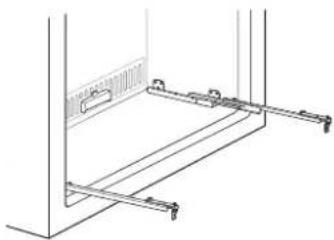
1 Pull both drawer rails out until they stop.
natural_image
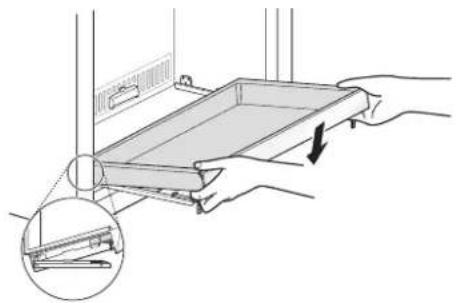
Technical line drawing of a metal frame assembly with mounting brackets (no text or symbols)2 Line up the bottom edges on the sides of the drawer support with the groove in each rail and then lower the support until it clicks into place.
natural_image
Illustration of a hand holding a tray with a device, showing a close-up of a device inside (no text or symbols present)Shelves
Detaching/Assembling the Shelf
The shelves in the refrigerator are adjustable to meet individual storage needs.
Adjusting the shelves to fit items of different heights will make finding the exact item you want easier.

CAUTION
• Make sure that shelves are level from one side to the other. Failure to do so may result in the shelf falling or spilled food.
- Do not clean glass shelves with warm water while they are cold. Shelves may break if exposed to sudden temperature changes or impact.
- Glass shelves are heavy. Use special care when removing them.
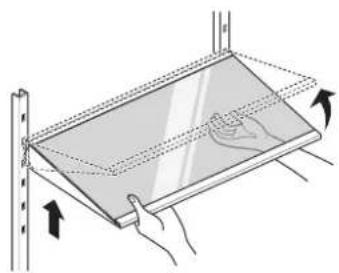
1 To detach, tilt up the front of the shelf and lift the shelf straight up.
2 Pull the shelf out.
natural_image
Diagram of a hand holding a transparent panel with arrows indicating force or movement, no text or symbols present
natural_image
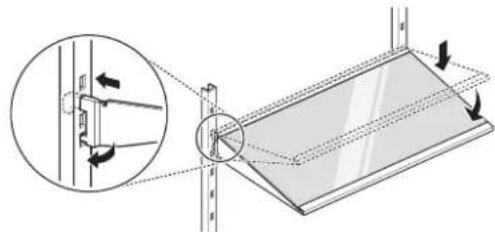
Pure geometric diagram with intersecting lines and shapes, no text or symbols present3 To assemble, tilt the front of the shelf up and guide the shelf hooks into the slots at a desired height.
4 Lower the front of the shelf so that the hooks drop into the slots.
natural_image
Diagram showing a mechanical assembly with an inset close-up of a bracket and a magnified view of the component (no text or symbols present)NOTE
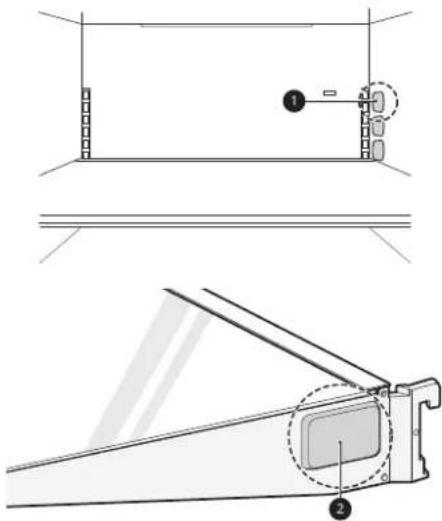
①Transmitter
②Receiver
- Foreign objects and dirt between the shelf and the inner cabinet wall could prevent the shelf light from turning on.
- The shelf light turns on when the door is opened.
- The shelf light turns off after seven minutes or when the door is closed.
Door Bins
Using Door Bins
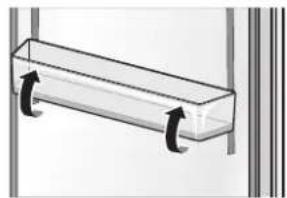
To adjust the bin position, hold the bottom of the bin at both ends and flip it up and down.
natural_image
Simple line drawing of a rectangular object with two curved arrows indicating rotation or movement (no text or symbols)Detaching/Assembling the Door Bins
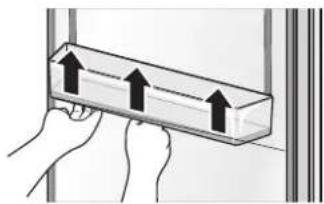
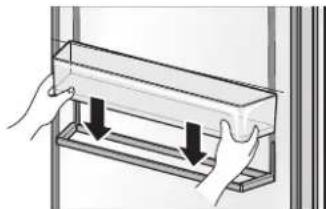
The door bins are removable for easy cleaning and adjustment.
1 To detach the door bins, hold the guide so that the bin can not move and tap the bottom of the bin 2 or 3 times.
natural_image
Illustration of hands holding a transparent rectangular object with three upward arrows, no text or symbols present2 To assemble the door bin, align both sides of the bin with the guides and push the bin down until it snaps into place.
natural_image
Illustration of hands installing or adjusting a rectangular object with downward arrows (no text or symbols)CAUTION
- Regularly detach and wash the storage bins and shelves; they can become easily contaminated by food.
- Do not apply excessive force while detaching or assembling the storage bins.
- Do not use the dishwasher to clean the storage bins and shelves.
18 SMART FUNCTIONS
SMART FUNCTIONS
LG ThinQ Application
This feature is only available on models with Wi-Fi.
The LG ThinQ application allows you to communicate with the appliance using a smartphone.
LG ThinQ Application Features
• Energy Monitoring
- This feature keeps track of the refrigerator's power consumption and the number of door openings.
- Push Messages
- If the door remains open for more than ten minutes, you will receive a push message. When Ice Plus is finished, you will receive a push message.
- Smart Diagnosis ^TM
- This function provides useful information for diagnosing and solving issues with the appliance based on the pattern of use.
- Settings
- Allows you to set various options on the refrigerator and in the application.
NOTE
- If you change your wireless router, Internet service provider, or password, delete the connected appliance from the LG ThinQ application and connect it again.
• This information is current at the time of publication. The application is subject to change for product improvement purposes without notice to users.
Installing LG ThinQ Application and Connecting an LG Appliance
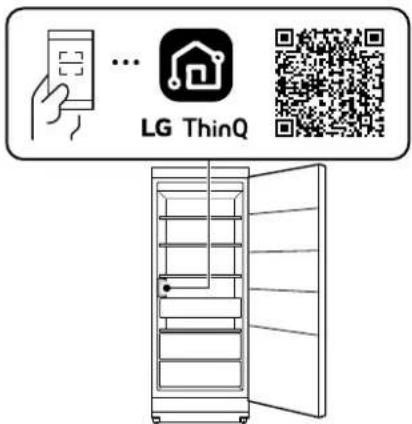
Models with QR Code
Scan the QR code attached to the product using the camera or a QR code reader application on your smartphone.
Models without QR Code
1 Search for and install the LG ThinQ application from the Google Play Store or Apple App Store on a smartphone.
2 Run the LG ThinQ application and sign in with your existing account or create an LG account to sign in.
3 Touch the add (+) button on the LG ThinQ application to connect your LG appliance. Follow the instructions in the application to complete the process.
NOTE
- To verify the Wi-Fi connection, check that the Wi-Fi indicator on the control panel is lit.
• The appliance supports 2.4 GHz Wi-Fi networks only. To check your network frequency, contact your Internet service provider or refer to your wireless router manual. - LG ThinQ is not responsible for any network connection problems or any faults, malfunctions, or errors caused by network connection.
• The surrounding wireless environment can make the wireless network service run slowly.
- If the distance between the appliance and the wireless router is too far, the signal becomes weak. It may take a long time to connect or fail to install the application.
- If the appliance is having trouble connecting to the Wi-Fi network, it may be too far from the router. Purchase a Wi-Fi repeater (range extender) to improve the Wi-Fi signal strength.
• The network connection may not work properly depending on the Internet service provider. - The Wi-Fi may not connect or the connection may be interrupted because of the home network environment.
- If the appliance cannot be connected due to problems with the wireless signal transmission, unplug the appliance and wait about a minute before trying again.
- If the firewall on your wireless router is enabled, disable the firewall or add an exception to it.
• The wireless network name (SSID) should be a combination of English letters and numbers. (Do not use special characters.) - Smartphone user interface (UI) may vary depending on the mobile operating system (OS) and the manufacturer.
- If the security protocol of the router is set to WEP, network setup may fail. Change the security protocol (WPA2 is recommended), and connect the product again.
• To disable the Wi-Fi function, press and hold the Wi-Fi button for 3 seconds. The Wi-Fi indicator will be turned off. - To reconnect the appliance or add another user, press and hold the Wi-Fi button for 3 seconds to temporarily turn it off. Run the LG ThinQ application and follow the instructions in the application to connect the appliance.
Wireless LAN Module Specifications
| Frequency Range | 2412 MHz ~ 2462 MHz |
| Output Power (Max) | < 30 dBm |
| Wireless Power Transfer Specifications | |
| Frequency 330 kHz | ~ 370 kHz |
| Rated voltage DC 12 V | |
| Delivered power Less than and equal to 3 W per shelf | |
| Wireless Power Transfer Specifications | |
| Transmission mode | Electromagnetic induction |
FCC Notice
The following notice covers the transmitter module contained in this product.
This equipment has been tested and found to comply with the limits for a Class B digital device, pursuant to Part 15 of the FCC Rules and also Part 18 of the FCC Rules. These limits are designed to provide reasonable protection against harmful interference in a residential installation. This equipment generates, uses, and can radiate radio frequency energy and, if not installed and used in accordance with the instructions, may cause harmful interference to radio communications. However, there is no guarantee that interference will not occur in a particular installation. If this equipment does cause harmful interference to radio or television reception, which can be determined by turning the equipment off and on, the user is encouraged to try to correct the interference by one or more of the following measures:
- Reorient or relocate the receiving antenna.
- Increase the separation between the equipment and the receiver.
- Connect the equipment into an outlet on a circuit different from that to which the receiver is connected.
- Consult the dealer or an experienced radio/TV technician for help.
This device complies with part 15 and part 18 of the FCC Rules. Operation is subject to the following two conditions:
(1) This device may not cause harmful interference and
(2) This device must accept any interference received, including interference that may cause undesired operation.
Any changes or modifications in construction of this device which are not expressly approved by the party responsible for compliance could void the user's authority to operate the equipment.
The manufacturer is not responsible for any radio or TV interference caused by unauthorized modification to this device. It is the responsibility of the user to correct such interference.

| Frequency Range | 2412 MHz ~ 2462 MHz |
| Output Power (Max) | < 30 dBm |
20 SMART FUNCTIONS
FCC RF Radiation Exposure Statement
This equipment complies with FCC radiation exposure limits set forth for an uncontrolled environment. This transmitter must not be co-located or operating in conjunction with any other antenna or transmitter.
This equipment should be installed and operated with a minimum distance of 20 cm (7.8 inches) between the antenna and your body. Users must follow the specific operating instructions for satisfying RF exposure compliance.
Industry Canada Statement
This device contains licence-exempt transmitter(s)/receiver(s) that comply with Innovation, Science and Economic Development Canada's licence-exempt RSS(s). Operation is subject to the following two conditions:
(1) This device may not cause interference.
(2) This device must accept any interference, including interference that may cause undesired operation of the device.
IC Radiation Exposure Statement
This equipment complies with IC radiation exposure limits set forth for an uncontrolled environment.
This equipment should be installed and operated with a minimum distance of 20 cm (7.8 inches) between the antenna and your body.
NOTE
• THE MANUFACTURER IS NOT RESPONSIBLE FOR ANY RADIO OR TV INTERFERENCE CAUSED BY UNAUTHORIZED MODIFICATIONS TO THIS EQUIPMENT. SUCH MODIFICATIONS COULD VOID THE USER'S AUTHORITY TO OPERATE THE EQUIPMENT.
Open Source Software Notice Information
To obtain the source code that is contained in this product, under GPL, LGPL, MPL, and other open source licenses that have the obligation to disclose source code, and to access all referred license terms, copyright notices and other relevant documents, please visit https://opensource.lge.com.
SIGNATURE KITCHEN SUITE will also provide open source code to you on CD-ROM for a charge covering the cost of performing such distribution (such as the cost of media, shipping, and handling) upon email request to opensource@lge.com.
This offer is valid to anyone in receipt of this information for a period of three years after our last shipment of this product.
Smart Grid Function
When the refrigerator operates in Smart Grid mode, the Smart Refrigerator function can control energy usage or delay the operation of some functions to save energy during peak usage periods.
- You can override the Smart Grid function at any time (using the Smart Grid button or application).
• To use the Smart Grid function, you need to register your appliance with your electric utility company, provided that your electric utility company supports the function. In other words, the Smart Grid function will not be available if your electric utility company does not support the function or does not have the capability to support the function.
Smart Grid Application Features
• Smart Saving_Demand Response
- You can lower energy usage based on Demand Response (DR) signals from the utility company. If the refrigerator is operating in Smart Saving mode according to the DR signal, you can see a pop up.
• Seasonal Energy Savings
- Lower energy usage based on time period.
Using the Smart Grid Function
This feature responds to notification events from your utility company to run high energy consuming tasks during off-peak periods when demand is lower. These notification events are known as Demand Response signals.
If the refrigerator receives a Demand Response signal from the utility company, the refrigerator will turn on the Grid LED on the refrigerator display and control its power consumption according to the signal. The refrigerator will respond to the signals received from the utility company as long as product performance is maintained.
If the refrigerator receives a Demand Response signal, the refrigerator will operate in Delay Appliance Load (DAL) or Temporary Appliance Load Reduction (TALR) mode.
Delay Appliance Load (DAL)
The refrigerator responds to a DAL signal by providing a moderate load reduction for the duration of the delay period.
This mode controls functions that consume a lot of energy such as adjusting the cooling system, running the defrost cycle, and making ice.
- When the refrigerator operates in DAL mode, the Grid LED is illuminated on the refrigerator display.
- DAL mode is automatically deactivated after the period stipulated by the DAL signal (max. 4 hours) or when you override the Smart Grid function.
Temporary Appliance Load Reduction (TALR)
The refrigerator responds to a TALR signal by aggressively reducing the load for a short time period, typically 10 minutes. This mode reduces energy consumption by stopping the compressor and controlling the functions that consume a lot of energy such as the defrost cycle and fan.
- When the refrigerator operates in TALR mode, the Grid LED is illuminated on the refrigerator display.
- TALR mode is automatically deactivated after the received duration (max. 10 minutes), or when you override the Smart Grid function. The mode is immediately deactivated and the refrigerator returns to its normal state if the door is opened or closed, or the dispenser is used.
Override Smart Grid Mode
To ignore the Demand Response signal from the utility company and override the Smart Grid function, push the Smart Grid button while the refrigerator is in Smart Grid mode.
When you override the Smart Grid function, the refrigerator ignores the Demand Response signal and is no longer controlled by the utility company until the next Demand Response signal is sent. You can also override the Smart Grid function using the smart phone app.
SIGNATURE KITCHEN SUITE Open API
You can manage Smart Grid features for the SIGNATURE KITCHEN SUITE Smart Refrigerator. Please check the detailed specifications on the notice page on signaturekitchensuite.com.
API List
- Demand Response
- Send demand response signal
• Power Saving - Set saving mode
- Get schedule of DR/Delay Defrost
- Energy Monitoring
- Get door open event
- Get energy consumption
- Delay Defrost Capability
- Insert a delay defrost schedule event
- Update a delay defrost schedule event
- Delete a delay defrost schedule event
- Get the delay defrost schedule
Smart Diagnosis™ Feature
This feature is only available on models with the ⏻ or ⏻ logo.
Use this feature to help you diagnose and solve problems with your appliance.
NOTE
- For reasons not attributable to LGE's negligence, the service may not operate due to external factors such as, but not limited to, Wi-Fi unavailability, Wi-Fi disconnection, local app store policy, or app unavailability.
• The feature may be subject to change without prior notice and may have a different form depending on where you are located.
Using LG ThinQ to Diagnose Issues
If you experience a problem with your Wi-Fi equipped appliance, it can transmit troubleshooting data to a smartphone using the LG ThinQ application.
- Launch the LG ThinQ application and select the Smart Diagnosis feature in the menu. Follow the instructions provided in the LG ThinQ application.

22 SMART FUNCTIONS
Using Audible Diagnosis to Diagnose Issues
Follow the instructions below to use the audible diagnosis method.
- Launch the LG ThinQ application and select the Smart Diagnosis feature in the menu. Follow the instructions for audible diagnosis provided in the LG ThinQ application.
1 Open the refrigerator door.
2 Hold the Lock button for three seconds.
- If the display has been locked for over five minutes, you must deactivate the lock and then reactivate it.
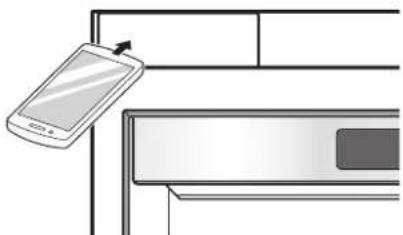
3 Hold the mouthpiece of your phone in front of the speaker that is located on the filter cover of the refrigerator.
natural_image
Illustration of a smartphone mounted on a wall-mounted device (no text or symbols visible)4 Press and hold the Refrigerator button for three seconds while continuing to hold your phone to the speaker.
5 After you hear three beeps, release the Refrigerator button.
6 Keep the phone in place until the tone transmission has finished. The display will count down the time. Once the countdown is over and the tones have stopped, the diagnosis will be displayed in the application.
NOTE
- For best results, do not move the phone while the tones are being transmitted.
MAINTENANCE
Cleaning

WARNING
- Use non-flammable cleaner. Failure to do so can result in fire, explosion, or death.

CAUTION
- Do not use an abrasive cloth or sponge when cleaning the interior and exterior of the appliance.
- Do not place your hand on the bottom surface of the appliance when opening and closing the doors.
General Cleaning Tips
• The refrigerator defrost automatically; however, clean both sections once a month to prevent odors.
- Wipe up spills immediately.
- Unplug the refrigerator or disconnect power before cleaning.
- Remove all removable parts, such as shelves.
- Use a clean sponge or soft cloth and a mild detergent in warm water. Do not use abrasive or harsh cleaners.
- Hand wash, rinse and dry all surfaces thoroughly.
- When cleaning the inside or outside of the appliance, do not wipe it with a rough brush, toothpaste, or flammable materials. Do not use cleaning agents containing flammable substances.
- Doing so may cause discoloration or damage to the appliance.
- Flammable substances: alcohol (ethanol, methanol, isopropyl alcohol, isobutyl alcohol, etc.), thinner, bleach, benzene, flammable liquids, abrasives, etc.
Inside Walls
To help remove odors, wash the inside of the refrigerator with a mixture of baking soda and warm water. Mix 2 tablespoons of baking soda to 1 quart of water (26 g soda to 1 liter water). Be sure the baking soda is completely dissolved so it does not scratch the surfaces of the refrigerator.
Door Liners and Gaskets
Use a clean sponge or soft cloth and a mild detergent in warm water. Do not use cleaning waxes, concentrated detergents, bleaches, or cleaners containing petroleum on plastic refrigerator parts.
Plastic Parts (Covers and Panels)
Use a clean sponge or soft cloth and a mild detergent in warm water. Do not use glass cleaners, abrasive cleansers, or flammable fluids. These can scratch or damage the material.
Air Filter
Recycling the Air Filter
Recycle the air filter approximately every 6 months.
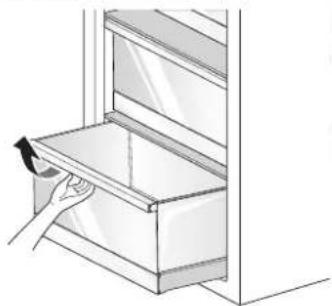
1 To remove the drawer, pull out the drawer to full extension, lift the front up, and pull straight out.
natural_image
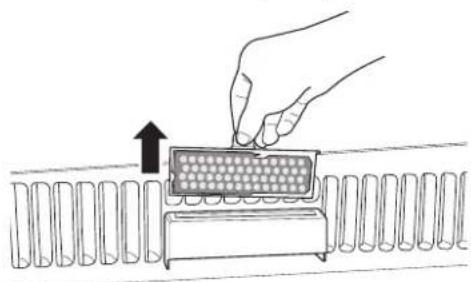
Illustration of a hand opening a cabinet drawer (no text or symbols visible)2 To remove the air filter, pull up the air filter.
natural_image
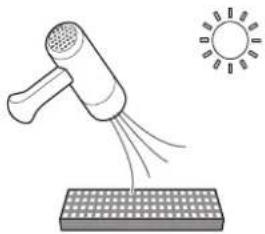
Illustration of a hand placing a grid object into a test tube with an upward arrow (no text or symbols)3 Dry the air filter with a hair dryer or let it air dry in the sun.
24 MAINTENANCE
natural_image
Illustration of a hairdryer emitting smoke from a grid base, with a sun symbol nearby (no text or symbols present)NOTE
• To increase deodorization performance, deodorant is made of natural palm wood material. So some powder may fall off. This powder is harmless to the human body and can be easily wiped off with a towel or cloth.
Water Filter
Before Replacing the Water Filter

WARNING
• To reduce the risk associated with choking, do not allow children under 3 years of age to have access to small parts during the installation of this product.
• To reduce the risk associated with the ingestion of contaminants, do not use with water that is microbiologically unsafe or of unknown quality without adequate disinfection before or after the system.
- Use of unauthorized water filters may result in product malfunction, water leakage or water quality issues, which will not be covered under the product warranty.
- Connect to a potable water supply only.

CAUTION
- Read and follow Use Instructions before installation and use of this system.
• Installation and use MUST comply with all state and local plumbing codes. - Do not install if water pressure exceeds 120 psi (827 kPa). If your water pressure exceeds 80 psi, you must install a pressure limiting valve. Contact a plumber if uncertain how to check your water pressure.
-
Do not install where water hammer conditions may occur. If water hammer conditions exist you must install a water hammer arrester. Contact a plumbing professional if you are uncertain how to check for this condition.
-
Do not install on hot water supply lines. The maximum operating water temperature of this filter system is 100 °F (37.8 °C).
- Protect filter from freezing. Drain filter when temperatures drop below 40 °F (4.4 °C).
- The disposable filter cartridge MUST be replaced every 6 months, at the rated capacity or if a noticeable reduction in flow rate occurs.
• To protect it from freezing, remove filter cartridge when temperatures are expected to drop below 33 °F. - Do not install systems in areas where ambient temperatures may go above 110 °F (43.3 °C).
- Where a backflow prevention device is installed on a water system, a device for controlling pressure due to thermal expansion must be installed.
- Ensure all tubing and fittings are secure and free from leaks.
Replacing the Water Filter
- Replace the water filter:
- Approximately every six months.
- When the icon turns on.
- When the water dispenser output decreases.
• To purchase a replacement water filter: - Visit your local dealer or distributor
- Find Parts & Accessories from Support section of signaturekitchensuite.com
- Call 1-855-790-6655 (USA) or 1-888-289-2802 (CANADA)
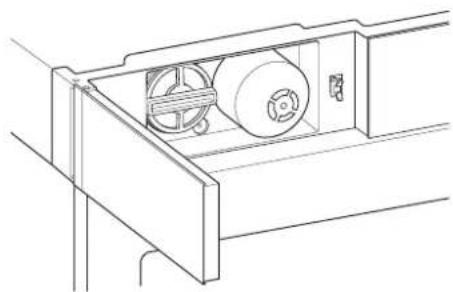
- Use replacement cartridge: LT1000P-S (ADQ74793506)
natural_image
Technical line drawing of a mechanical component with a circular housing and mounting bracket (no text or symbols)1 Remove the old water filter.
Push to open the water filter cover at the top of the refrigerator.
natural_image
Pure geometric diagram with intersecting lines and circles, no text or symbols present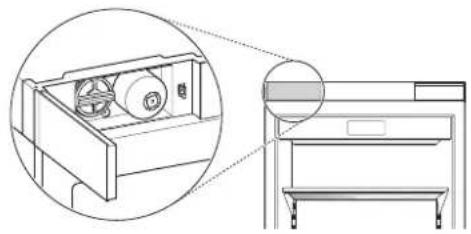
natural_image
Technical line drawing of a mechanical device with an inset showing internal components (no text or symbols)NOTE
- Replacing the water filter causes a small amount of water (around 1 oz. or 25 cc) to drain.
- Wrap a cloth around the front end of the water filter cover to collect any leaking water. Hold the water filter upright, once it is removed, to prevent any remaining water from spilling out of the water filter.
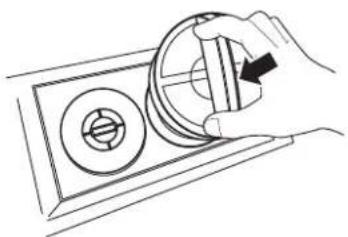
2 Put the cap ① on the water filter, then grasp and rotate it counterclockwise to remove the water filter from the filter head.

natural_image
Illustration showing two mechanical components: a device with a knob and a rotating wheel, and a hand holding a rotating wheel (no text or symbols present)3 Replace with a new water filter.
Take the new water filter out of its packing and remove the protective cover from the o-rings. Put the cap on the new water filter, then push it into the manifold hole until it stops.
natural_image
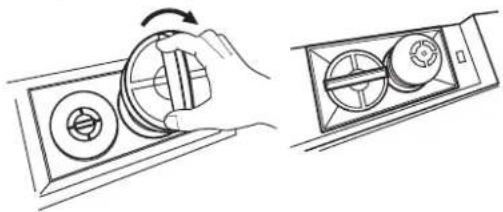
Line drawing of a hand holding a mechanical component with a circular feature and a rotating shaft (no text or symbols)4 Grasp and rotate cap clockwise until it stops. Replace the cap to the side of the water filter.
natural_image
Diagram showing a hand using a pulley to rotate or rotate a circular component, with no text or symbols present.5 After the water filter is replaced, dispense 2.5 gallons of water (flush for approximately 5 minutes) to remove trapped air and contaminants from the system.
NOTE
- Do not dispense the entire 2.5 gallon amount continuously. Press and release the dispenser pad for cycles of 30 seconds ON and 60 seconds OFF.
6 After changing the filter, press and hold the Water Filter Reset button for three seconds to reset the 🔊 icon light.
- For further assistance, call:
- 1-855-790-6655 (USA)
- 1-888-289-2802 (CANADA)
26 MAINTENANCE
Performance Data Sheet
Model: LT1000P-S
NSF System Trade Name Code: MDJ64844601
The concentration of the indicated substances in water entering the system was reduced to a concentration less than or equal to the permissible limit for water leaving the system as specified in NSF/ANSI Standard 42, Standard 53 and Standard 401.

System tested and certified by NSF International against NSF/ANSI Standard 42, Standard 53 and Standard 401 for the reduction of substances listed below.
| Substance Reduction | Average Influent Challenge | NSF Specified Challenge Concentration | Avg % Reduction | Average Product Water Concentration | Max Permissible Product Water Concentration | NSF Reduction Requirements |
| Chlorine Taste and Odor | 2.0 μg/L | 2.0 μg/L± 10% | >97.5% | 0.050 μg/L | N/A | ≥ 50.00% |
| Nominal Particulate Class I, , ≥ 0.5 to < 1.0 μm | 12,000,000 pts/mL | At least 10,000 particles/mL | 99.80% 24,000 | pts/ml N/A ≥ 85.00% | ||
| Asbestos 180 MFL | 10^7 to 10^8 MFL; fibers greater than 10 μg/Lin length | >99.00% < 1 M | MFL N/A ≥ 99.00% | |||
| Atrazine | 8.5 μg/L | 9.0 μg/L ± 10% | >94.10% | 0.500 μg/L | 3.0 μg/L | NA |
| Benzene | 15.0 μg/L | 15.0 μg/L ± 10% | >96.60% | 0.510 μg/L | 5.0 μg/L | NA |
| Carbofuran | 74.0 μg/L | 80.0 μg/L ± 10% | 98.30% | 1.258 μg/L | 40 μg/L | NA |
| Lindane | 1.9 μg/L | 2.0 μg/L ± 10% | >99.00% | 0.019 μg/L | 0.2 μg/L | NA |
| P-Dichlorobenzene | 230.0 μg/L | 225.0 μg/L ± 10% | >99.80% | 0.460 μg/L | 75.0 μg/L | NA |
| 2,4-D | 210.0 μg/L | 210.0 μg/L ± 10% | >99.90% | 0.210 μg/L | 70.0 μg/L | NA |
| Lead pH @6.5 | 140.0 μg/L | 150.0 μg/L ± 10% | 99.60% | 0.560 μg/L | 10.0 μg/L | NA |
| Lead pH @8.5 | 150.0 μg/L | 150.0 μg/L ± 10% | >99.70% | <0.500 μg/L | 10.0 μg/L | NA |
| Mercury @ pH6.5 | 5.9 μg/L | 6.0 μg/L ± 10% | 91.00% | 0.531 μg/L | 2.0 μg/L | NA |
| Mercury @ pH8.5 | 5.6 μg/L | 6.0 μg/L ± 10% | 92.5% | 0.420 μg/L | 2.0 μg/L | NA |
| Cyst* | 100,000 cysts/L | Minimum 50,000 cysts/L | >99.99% | 10 cysts/L | N/A | ≥ 99.95% |
| Atenolol | 240 ng/L | 200 ± 40% ng/L | >95.50% | 10.80 ng/L | 30 ng/L | NA |
| Carbamazepine | 1600 ng/L | 1400 ± 40% ng/L | 98.40% | 25.60 ng/L | 200 ng/L | NA |
| DEET | 1600 ng/L | 1400 ± 40% ng/L | 97.10% | 46.40 ng/L | 200 ng/L | NA |
| Trimethoprim | 170 ng/L | 140 ± 40% ng/L | >96.80% | 5.44 ng/L | 20 ng/L | NA |
| Linuron | 160 ng/L | 140 ± 40% ng/L | >96.60% | 5.44 ng/L | 20 ng/L | NA |
| Phenytoin | 200 ng/L | 200 ± 40% ng/L | >94.80% | 10.40 ng/L | 30 ng/L | NA |
| Ibuprofen | 400 ng/L | 400 ± 40% ng/L | >94.50% | 22.00 ng/L | 60 ng/L | NA |
| Naproxen | 140 ng/L | 140 ± 40% ng/L | >96.10% | 5.46 ng/L | 20 ng/L | NA |
| Estrone | 120 ng/L | 140 ± 40% ng/L | >96.10% | 4.68 ng/L | 20 ng/L | NA |
| Bisphenol A | 2000 ng/L | 2000 ± 40% ng/L | >98.90% | 22.00 ng/L | 300 ng/L | NA |
| Nonyl Phenol | 1600 ng/L | 1400 ± 40% ng/L | >97.10% | 46.40 ng/L | 200 ng/L | NA |
* Based on the use of Cryptosporidium parvum oocysts.
| Guidelines for Application / Water Supply Parameters | |
| Service Flow 0.5 gpm (1.9 lpm) | |
| Water Supply Community or Private Well - Potable Water | |
| Water Pressure 20 – 120 psi (138 – 827 kPa) | |
| Water Temperature 33 °F – 100 °F (0.6 °C – 37.8°C) | |
| Capacity 200 gallons (757 liters) |
It is essential that the manufacturer's recommended installation, maintenance and filter replacement requirements be carried out for the product to perform as advertised.
NOTE
- While the testing was performed under standard laboratory conditions, actual performance may vary.
For replacement filters, visit your local dealer or distributor or find a dealer on the signaturekitchensuite.com website.
For further assistance, contact the SIGNATURE KITCHEN SUITE Customer Information Center.
USA: 1-855-790-6655
Canada: 1-888-289-2802
Replacement Cartridge: LT1000P-S or ADQ74793506
NSF is a trademark of NSF International.
28 TROUBLESHOOTING
TROUBLESHOOTING
FAQs
Frequently Asked Questions
Q: What are the best temperature settings for my refrigerator?
A: The default setting for the refrigerator is 37° Fahrenheit (3° Celsius). Adjust these settings as necessary to keep food at desired temperatures. To switch the display from Fahrenheit to Celsius, press the Refrigerator button first to wake the display then press and hold the Refrigerator and Smart Grid buttons until you hear a beep and the settings in the display change.
Q: How do I set the refrigerator temperature?
A: Continually press the Refrigerator button on the control panel until the desired temperature appears. The numbers will cycle from highest to lowest and then return to the highest again with continuous pressing.
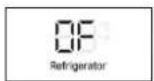
Q: My refrigerator is powered on and the controls are working, but it's not cooling and the display shows "OF" (see below). What is wrong?
A: The freezer is in Display Mode. The Display Mode disables all cooling to conserve energy while on display in a retail store. To restore normal operation, press Refrigerator button first to wake the display then press and hold the Refrigerator and Water Filter Reset buttons until you hear a beep and the temperature setting appears in the display. Use the same procedure to return the refrigerator to Display Mode, if desired.
natural_image
Pure geometric lines and shapes without any text, numbers, or symbolsBefore Calling for Service
Review this section before calling for service; doing so will save you both time and money.
Cooling
| Problem Possible | Cause & Solution |
| Refrigerator is not cooling or has no power. | The refrigerator control is set to OFF (some models).Turn the control ON. Refer to the Setting the Controls section for proper temperature settings. |
| Refrigerator is set to Display Mode.Display Mode allows the lights and control display to work normally while disabling cooling, to save energy while the refrigerator is on the showroom floor. See the FAQs section of this manual for instructions on how to disable Display Mode. | |
| Refrigerator is in the defrost cycle.During the defrost cycle, the temperature of each compartment may rise slightly. Wait 30 minutes and confirm the proper temperature has been restored once the defrost cycle has completed. | |
| Refrigerator was recently installed.It may take up to 24 hours for each compartment to reach the desired temperature. | |
| Refrigerator was recently relocated.If the refrigerator was stored for a long period of time or moved on its side, it is necessary for the refrigerator to stand upright for 24 hours before connecting it to power. | |
| Cooling system runs too much. | Refrigerator is replacing an older model.Modern refrigerators require more operating time but use less energy due to more efficient technology. |
| Refrigerator was recently plugged in or power restored.The refrigerator will take up to 24 hours to cool completely. | |
| The door is opened often or a large amount of food / hot food was added.Adding food and opening the door warms the refrigerator, requiring the compressor to run longer in order to cool the refrigerator back down. In order to conserve energy, try to get everything you need out of the refrigerator at once, keep food organized so it is easy to find, and close the door as soon as the food is removed. (Refer to the Food Storage Guide.) | |
| Doors are not closed completely.Firmly push the doors shut. If they will not shut all the way, see the "Doors will not close correctly or pop open" section in Troubleshooting. | |
| Refrigerator is installed in a hot location.The compressor will run longer under warm conditions. At normal room temperatures (70 °F or 21 °C) expect your compressor to run about 40 % to 80 % of the time. Under warmer conditions, expect it to run even more often. The refrigerator should not be operated above 110 °F (43 °C). | |
| Interior moisture buildup. | Doors are opened often or for long periods of time.When the doors are opened often or for long periods of time, warm, humid air enters the compartment. This raises the temperature and moisture level within the compartment. To lessen the effect, reduce the frequency and duration of door openings. |
| Doors are not closed correctly.See the "Doors will not close correctly or pop open" section. |
30 TROUBLESHOOTING
| Problem Possible | Cause & Solution |
| Interior moisture buildup. | Weather is humid.Humid weather allows additional moisture to enter the compartments when the doors are opened, leading to condensation or frost. Maintaining a reasonable level of humidity in the home will help to control the amount of moisture that can enter the compartments. |
| Defrost cycle recently completed.During the defrost cycle, the temperature of each compartment may rise slightly and condensation may form on the back wall. Wait 30 minutes and confirm that the proper temperature has been restored once the defrost cycle has finished. | |
| Food is not packaged correctly.Food stored uncovered or unwrapped, and damp containers can lead to moisture accumulation within each compartment. Wipe all containers dry and store food in sealed packaging to prevent condensation and frost. | |
| Food is freezing in the refrigerator compartment. | Food with high water content was placed near an air vent.Rearrange items with high water content away from air vents. |
| Refrigerator temperature control is set incorrectly.If the temperature is too cold, adjust the control one increment at a time and wait for the temperature to stabilize. Refer to the Control Panel section for more information. | |
| Refrigerator is installed in a cold location.When the refrigerator is operated in temperatures below 41 °F (5 °C), food can freeze in the refrigerator compartment. The refrigerator should not be operated in temperatures below 55 °F (13 °C). | |
| Refrigerator is too cold. | Incorrect temperature control settings.If the temperature is too cold, adjust the control one increment at a time and wait for the temperature to stabilize. Refer to the Control Panel for more information. |
| Refrigerator is too warm. | Refrigerator was recently installed.It may take up to 24 hours for each compartment to reach the desired temperature. |
| The air vents are blocked.Locate air vents by using your hand to sense airflow and move all packages that block vents and restrict airflow. Rearrange items to allow air to flow throughout the compartment. | |
| Doors are opened often or for long periods of time.When the doors are opened often or for long periods of time, warm, humid air enters the compartment. This raises the temperature and moisture level within the compartment. To lessen the effect, reduce the frequency and duration of door openings. | |
| Unit is installed in a hot location.The refrigerator should not be operated in temperatures above 110 °F (43 °C). | |
| A large amount of food or hot food was added to the refrigerator.Adding food warms the refrigerator requiring the cooling system to run. Allowing hot food to cool to room temperature before putting it in the refrigerator will reduce this effect. | |
| Doors are not closed correctly.See the "Doors will not close correctly or pop open" section in Troubleshooting. | |
| Temperature control is not set correctly.If the temperature is too warm, adjust the control one increment at a time and wait for the temperature to stabilize. | |
| Defrost cycle has recently completed.During the defrost cycle, the temperature of the refrigerator may rise slightly and condensation may form on the back wall. Wait 30 minutes and confirm the proper temperature has been restored once the defrost cycle has completed. |
Water
| Problem Possible | Cause & Solution |
| Water is dispensing slowly. | Water filter has been exhausted.• Replacing the water filter is recommended:- Approximately every six months.- When the water filter indicator turns on.- When the water dispenser output decreases.- When the ice cubes are smaller than normal. |
| Reverse osmosis filtration system is used.• Reverse osmosis filtration systems can reduce the water pressure below the minimum amount and result in icemaker issues. If the problem persists, it may be necessary to contact a plumber. | |
| Low house water supply pressure.• The water pressure must be between 20 and 120 psi on models without a water filter and between 40 and 120 psi on models with a water filter. If the problem persists, it may be necessary to contact a plumber. | |
| Water is not dispensing. | New installation or water line recently connected.• Dispense 2.5 gallons of water (flush for approximately 5 minutes) to remove trapped air and contaminants from the system. Do not dispense the entire 2.5 gallon amount continuously. Depress and release the dispenser pad for cycles of 30 seconds ON and 60 seconds OFF. |
| Refrigerator or freezer doors are not closed properly.• Water will not dispense if any of the refrigerator doors are left open. | |
| Water filter has been recently removed or replaced.• After the water filter is replaced, dispense 2.5 gallons of water (flush for approximately five minutes) to remove trapped air and contaminants from the system. Do not dispense the entire 2.5 gallon amount continuously. Depress and release the dispenser pad for cycles of 30 seconds ON and 60 seconds OFF. | |
| Tubing connecting refrigerator to house supply valve is kinked.• The tubing can kink when the refrigerator is moved during installation or cleaning, resulting in reduced water flow. Straighten or repair the water supply line and arrange it to prevent future kinks. | |
| The house water supply is not connected, the valve is not turned on fully, or the valve is clogged.• Connect the refrigerator to the water supply and turn the water shutoff valve fully open. If the problem persists, it may be necessary to contact a plumber. | |
| Dispensing warm water. | Refrigerator was recently installed.• Allow 24 hours after installation for the water storage tank to cool completely. |
| The water dispenser has been used recently and the storage tank was exhausted.• Depending on your specific model, the water storage capacity will range from approximately 20 to 30 oz. | |
| Dispenser has not been used for several hours.• If the dispenser has not been used for several hours, the first glass dispensed may be warm. Discard the first 10oz. | |
| Refrigerator is connected to the hot water supply.• Make sure that the refrigerator is connected to a cold water pipe.WARNING: Connecting the refrigerator to a hot water line may damage the icemaker. |
32 TROUBLESHOOTING
| Problem Possible Cause & Solution | |
| Water has bad taste or odor. | Water supply contains minerals such as sulfur.• A water filter may need to be installed to eliminate taste and odor problems. |
| Water filter has been exhausted.• Replacing the water filter is recommended:- Approximately every six months.- When the water filter indicator turns on.- When the water dispenser output decreases.- When the ice cubes are smaller than normal. | |
| Refrigerator was recently installed.• Dispense 2.5 gallons of water (flush for approximately 5 minutes) to remove trapped air and contaminants from the system. Do not dispense the entire 2.5 gallon amount continuously. Depress and release the dispenser pad for cycles of 30 seconds ON and 60 seconds OFF. | |
Ice
| Problem Possible | Cause & Solution |
| Icemaker is not making enough ice. | Demand exceeds ice production capacity.Refer to the Automatic Icemaker section for ice production capacity to check the amount of ice produced in a 24 hour period. |
| House water supply is not connected, valve is not turned on fully, or valve is clogged.Connect the refrigerator to a cold water supply with adequate pressure and turn the water shutoff valve fully open. If the problem persists, it may be necessary to contact a plumber. | |
| Water filter has been exhausted.Replacing the water filter is recommended:- Approximately every six months.- When the water filter indicator turns on.- When the water dispenser output decreases.- When the ice cubes are smaller than normal. | |
| Low house water supply pressure.The water pressure must be between 20 and 120 psi (138 and 827 kPa) on models without a water filter and between 40 and 120 psi (276 and 827 kPa) on models with a water filter. If the problem persists, it may be necessary to contact a plumber. | |
| Reverse osmosis filtration system is used.Reverse osmosis filtration systems can reduce the water pressure below the minimum amount and result in icemaker issues. | |
| Tubing connecting refrigerator to house supply valve is kinked.The tubing can kink when the refrigerator is moved during installation or cleaning resulting in reduced water flow. Straighten or repair the water supply line and arrange it to prevent future kinks. | |
| Doors are opened often or for long periods of time.If the doors of the unit are opened often, ambient air will warm the refrigerator which will prevent the unit from maintaining the set temperature. Lowering the refrigerator temperature can help, as well as not opening the doors as frequently. |
| Problem Possible | Cause & Solution |
| Icemaker is not making enough ice. | Doors are not closed completely.If the doors are not properly closed, ice production will be affected. See the "Doors will not close correctly or pop open" section in Parts & Features Troubleshooting for more information. |
| The temperature setting for the freezer is too warm.The recommended temperature for the freezer compartment for normal ice production is 0 °F (-18 °C). If the freezer temperature is warmer, ice production will be affected. | |
| Icemaker is not making ice | Refrigerator was recently installed or icemaker recently connected.It may take up to 24 hours for each compartment to reach the desired temperature and for the icemaker to begin making ice. |
| Icemaker is not turned on.Locate the icemaker ON/OFF and confirm that it is turned on. | |
| The ice detecting sensor is obstructed.Foreign substances or frost on the ice-detecting sensor can interrupt ice production. Make sure that the sensor area is clean at all times for proper operation. | |
| The refrigerator is not connected to a water supply or the supply shutoff valve is not turned on.Connect the refrigerator to the water supply and turn the water shutoff valve fully open. | |
| Icemaker shutoff (arm or sensor) obstructed.If your icemaker is equipped with an ice shutoff arm, make sure that the arm moves freely. If your icemaker is equipped with the electronic ice shutoff sensor, make sure that there is a clear path between the two sensors. | |
| Reverse osmosis water filtration system is connected to your cold water supply.Reverse osmosis filtration systems can reduce the water pressure below the minimum amount and result in icemaker issues. | |
| Ice has bad taste or odor. | Water supply contains minerals such as sulfur.A water filter may need to be installed to eliminate taste and odor problems. NOTE: In some cases, a filter may not help. It may not be possible to remove all minerals/odor/taste in all water supplies. |
| Icemaker was recently installed.Ice that has been stored for too long will shrink, become cloudy, and may develop a stale taste. Throw away old ice and make a new supply. | |
| The food has not been stored properly in either compartment.Rewrap the food. Odors may migrate to the ice if food is not wrapped properly. | |
| The interior of the refrigerator needs to be cleaned.See the Maintenance section for more information. | |
| The ice storage bin needs to be cleaned.Empty and wash the bin (discard old cubes). Make sure that the bin is completely dry before reinstalling it. | |
| Icemaker is making too much ice. | Icemaker shutoff (arm/ sensor) is obstructed.Empty the ice bin. If your icemaker is equipped with an ice shutoff arm, make sure that the arm moves freely. If your icemaker is equipped with the electronic ice shutoff sensor, make sure that there is a clear path between the two sensors. Reinstall the ice bin and wait 24 hours to confirm proper operation. |
| Ice is not dispensing. | Doors are not closed completely.Ice will not dispense if any of the refrigerator doors are left open. |
34 TROUBLESHOOTING
| Problem Possible Cause & Solution | |
| Ice is not dispensing. Infrequent use of the dispenser.Infrequent use of the ice dispenser will cause the cubes to stick together over time, which will prevent them from properly dispensing. Check the ice bin for ice cubes clumping/sticking together. If they are, break up the ice cubes to allow for proper operation. | |
Parts & Features
| Problem Possible | Cause & Solution |
| Doors will not close correctly or pop open. | Food packages are blocking the door open.• Rearrange food containers to clear the door and door shelves. |
| Ice bin, crisper cover, pans, shelves, door bins, or baskets are out of position.• Push bins all the way in and put crisper cover, pans, shelves and baskets into their correct positions. See the Operation section for more information. | |
| The doors were removed during product installation and not properly replaced.• Remove and replace the doors according to the installation instructions. | |
| Refrigerator is not leveled properly.• See Door Alignment in the installation instructions to level refrigerator. | |
| Doors are difficult to open. | The gaskets are dirty or sticky.• Clean the gaskets and the surfaces that they touch. Rub a thin coat of appliance polish or kitchen wax on the gaskets after cleaning. |
| Door was recently closed.• When you open the door, warmer air enters the refrigerator. As the warm air cools, it can create a vacuum. If the door is hard to open, wait one minute to allow the air pressure to equalize, then see if it opens more easily. | |
| Lights do not work. LED interior lighting failure. | |
| The interior of the refrigerator is covered with dust or soot. | The refrigerator is located near a fire source, such as a fireplace, chimney, or candle.• Make sure that the refrigerator is not located near a fire source, such as a fireplace, chimney or candle. |
Noises
| Problem Possible | Cause & Solution |
| Clicking | The defrost control will click when the automatic defrost cycle begins and ends. The thermostat control (or refrigerator control on some models) will also click when cycling on and off.· Normal Operation |
| Rattling | Rattling noises may come from the flow of refrigerant, the water line on the back of the unit, or items stored on top of or around the refrigerator.· Normal Operation |
| Refrigerator is not resting solidly on the floor.· Floor is weak or uneven or leveling legs need to be adjusted. See the Leveling and Door Alignment section in the installation instructions. | |
| Refrigerator with linear compressor was jarred while running.· Normal Operation | |
| Whooshing Evaporator | fan motor is circulating air through the refrigerator compartment.· Normal Operation |
| Air is being forced over the condenser by the condenser fan.· Normal Operation | |
| Gurgling Refrigerant flowing through the cooling system.· Normal Operation | |
| Popping Contraction and expansion of the inside walls due to changes in temperature.· Normal Operation | |
| Sizzling Water dripping on the defrost heater during a defrost cycle.· Normal Operation | |
| Vibrating If the side or back of the refrigerator is touching a cabinet or wall, some of the normal vibrations may make an audible sound.· To eliminate the noise, make sure that the sides and back cannot vibrate against any wall or cabinet. | |
| Dripping Water running into the drain pan during the defrost cycle.· Normal Operation | |
| Pulsating or high-pitched sound | Your refrigerator is designed to run more efficiently to keep your food items at the desired temperature. The high efficiency compressor may cause your new refrigerator to run longer than your old one, but it is still more energy efficient than previous models. While the refrigerator is running, it is normal to hear a pulsating or high-pitched sound.· Normal Operation |
ENGLISH
Wi-Fi
| Problem Possible Cause & Solution | |
| Trouble connecting appliance and smartphone to Wi-Fi network | The password for the Wi-Fi network was entered incorrectly. · Delete your home Wi-Fi network and begin the connection process again. |
| Mobile data for your smartphone is turned on. · Turn off the Mobile data on your smartphone before connecting the appliance. | |
36 TROUBLESHOOTING
| Problem Possible Cause & Solution | |
| Trouble connecting appliance and smartphone to Wi-Fi network | The wireless network name (SSID) is set incorrectly.The wireless network name (SSID) should be a combination of English letters and numbers. (Do not use special characters.) |
| The router frequency is not 2.4 GHz.Only a 2.4 GHz router frequency is supported. Set the wireless router to 2.4 GHz and connect the appliance to the wireless router. To check the router frequency, check with your Internet service provider or the router manufacturer. | |
| The appliance and the router are too far apart.If the appliance is too far from the router, the signal may be weak and the connection may not be configured correctly. Move the router closer to the appliance or purchase and install a Wi-Fi repeater. | |
| During Wi-Fi setup, the app is requesting a password to connect to the product (on certain phones).Locate the network name which starts with "LG" under Settings > Networks. Note the last part of the network name.If the network name looks like LGE_Appliance_XX-XX-XX, enter lge12345.If the network name looks like LGE_Appliance_XXXX, enter XXXX twice as your password. For example, If the network name appears as LGE_Appliance_8b92, then you would enter 8b928b92 as your password. In this instance, the password is case sensitive and the last 4 characters are unique to your appliance. | |
LIMITED WARRANTY
USA
TERMS AND CONDITIONS
Should your SIGNATURE KITCHEN SUITE Refrigerator ("Product") fail due to a defect in materials or workmanship under normal and proper use, during the warranty period set forth below, SIGNATURE KITCHEN SUITE will, at its option, repair or replace the Product. This limited warranty is valid only to the original retail purchaser of the Product ("You") and applies only when purchased lawfully and used within the United States including U.S. Territories.
| WARRANTY PERIOD | |||
| Refrigerator/Freezer | Sealed System (Condenser, Dryer, Connecting Tube and Evaporator) | Compressor | |
| Three (3) years from the date of original retail purchase | Five (5) years from the date of original retail purchase | Five (5) years from the date of original retail purchase | Linear / Inverter Compressor Only : Parts Only for years 6-10 from the date of original retail purchase (You will be charged for labor.) |
| Parts and Labor (internal/ functional parts only) | Parts and Labor Parts and | Labor | |
- Replacement Products and parts are warranted for the remaining portion of the original warranty period or ninety (90) days, whichever is greater.
- Replacement Products and parts may be new, reconditioned, refurbished, or otherwise factory remanufactured.
- Replaced Product or part(s) will be the property of SIGNATURE KITCHEN SUITE.
- Proof of original retail purchase specifying the Product model and date of purchase is required to obtain warranty service under this limited warranty.
EXCEPT TO THE EXTENT PROHIBITED BY APPLICABLE LAW, ANY IMPLIED WARRANTY OF MERCHANTABILITY OR FITNESS FOR A PARTICULAR PURPOSE ON THE PRODUCT IS LIMITED IN DURATION TO THE DURATION OF THE ABOVE LIMITED WARRANTY. UNDER NO CIRCUMSTANCES SHALL SIGNATURE KITCHEN SUITE OR ITS U.S. DISTRIBUTORS/DEALERS BE LIABLE FOR ANY INDIRECT, INCIDENTAL, CONSEQUENTIAL, SPECIAL, OR PUNITIVE DAMAGES, INCLUDING, WITHOUT LIMITATION, LOST GOODWILL, LOST REVENUES OR PROFITS, WORK STOPPAGE, IMPAIRMENT OF OTHER GOODS, COST OF REMOVAL AND REINSTALLATION OF THE PRODUCT, LOSS OF USE, OR ANY OTHER DAMAGES WHETHER BASED IN CONTRACT, TORT, OR OTHERWISE. SIGNATURE KITCHEN SUITE'S TOTAL LIABILITY, IF ANY, SHALL NOT EXCEED THE PURCHASE PRICE PAID BY YOU FOR THE PRODUCT.
SOME STATES DO NOT ALLOW THE EXCLUSION OR LIMITATION OF INCIDENTAL OR CONSEQUENTIAL DAMAGES OR LIMITATIONS ON HOW LONG AN IMPLIED WARRANTY LASTS, SO THE ABOVE EXCLUSIONS OR LIMITATIONS MAY NOT APPLY TO YOU. THIS LIMITED WARRANTY GIVES YOU SPECIFIC LEGAL RIGHTS AND YOU MAY ALSO HAVE OTHER RIGHTS THAT VARY FROM STATE TO STATE.
38 LIMITED WARRANTY
THIS LIMITED WARRANTY DOES NOT COVER:
- Service trips to deliver, pick up, or install, educate how to operate, correct wiring, or correct unauthorized repairs.
- Damage or failure of the Product to perform during power failures and interrupted or inadequate electrical service.
- Damage or failure of the Product caused by leaky or broken water pipes, frozen water pipes, restricted drain lines, inadequate or interrupted water supply or inadequate supply of air.
- Damage or failure of the Product resulting from operating the Product in a corrosive atmosphere or contrary to the Product owner's manual.
- Damage or failure of the Product caused by accidents, pests and vermin, lightning, wind, fire, floods, acts of nature, or any other causes beyond the control of SIGNATURE KITCHEN SUITE.
- Damage or failure of the Product caused by unauthorized modification or alteration, or if the Product is used for other than the intended purpose, or any water leakage where the Product was not properly installed.
- Damage or failure of the Product caused by incorrect electrical current, voltage, or plumbing codes.
- Damage or failure of the Product caused by transportation, storage, and/or handling, including scratches, dents, chips, and/or other damage to the finish of the Product, unless such damage is reported within one (1) week of delivery.
- Damage or failure of the Product resulting from misuse, abuse, improper installation, repair, or maintenance. Improper repair includes the use of parts not authorized by SIGNATURE KITCHEN SUITE. Improper installation or maintenance includes installation or maintenance contrary to the Product owner's manual.
- Damage or failure of the Product caused by the use of parts, components, accessories, consumable cleaning products, or any other products or services that were not authorized by SIGNATURE KITCHEN SUITE.
- Damage or missing items to any display or open box Product.
- Refurbished Product or any Product sold "As Is", "Where Is", "With all Faults", or similar disclaimer.
- Products with original serial numbers that have been removed, altered, or cannot be readily determined.
- Increases in utility costs and additional utility expenses.
- Any noises associated with normal operation.
- Products used for other than normal and proper household use (e.g., commercial or industrial use) or contrary to the Product owner's manual.
- Costs associated with removal and reinstallation of the Product for repairs, or the removal and reinstallation of the Product if it is installed in an inaccessible location or not installed in accordance with the Product Owner's manual.
- Accessories, removable components, or consumable parts (e.g. Shelves, door bins, drawers, water/air filters, racks, light bulbs, batteries, etc., as applicable), except for internal/functional parts covered under this limited warranty.
The cost of repair or replacement under these excluded circumstances shall be borne by You.
TO OBTAIN WARRANTY SERVICE AND ADDITIONAL INFORMATION
Call 1-855-790-6655 and select the appropriate option from the menu.
Or visit our website at http://www.signaturekitchensuite.com.
Or by mail: SIGNATURE KITCHEN SUITE Customer Service P.O. Box 240007 Huntsville, AL 35813 ATTN: CIC
Canada
TERMS AND CONDITIONS
Should your SIGNATURE KITCHEN SUITE Refrigerator ("Product") fail due to a defect in materials or workmanship under normal and proper use, during the warranty period set forth below, SIGNATURE KITCHEN SUITE will, at its option, repair, replace or pro rate the Product upon receipt of proof of the original retail purchase. This limited warranty is valid only to the original retail purchaser of the Product and applies only to a Product distributed, purchased from an authorized retailer and used within Canada, as determined at the sole discretion of SIGNATURE KITCHEN SUITE.
| WARRANTY PERIOD | |||
| Refrigerator | Sealed System (Condenser, Dryer, Connecting Tube and Evaporator) | Linear Compressor | |
| Three (3) years from the date of original retail purchase | Three (3) years from the date of original retail purchase | Seven (7) years from the date of original retail purchase | Ten (10) years from the date of original retail purchase |
| Parts and Labor (Internal / functional parts only) | Parts and Labor Parts Only | (Consumer will be charged for labor) | Parts Only (Consumer will be charged for labor) |
- Replacement products and parts are warranted for the remaining portion of the original warranty period or ninety (90) days, whichever is greater.
- Replacement products and parts may be new, reconditioned, refurbished, or otherwise factory remanufactured, all at the sole discretion of SIGNATURE KITCHEN SUITE.
- Proof of original retail purchase specifying the Product model and date of purchase is required to obtain warranty service under this Limited Warranty.
SIGNATURE KITCHEN SUITE'S SOLE LIABILITY IS LIMITED TO THE LIMITED WARRANTY SET OUT ABOVE. EXCEPT AS EXPRESSLY PROVIDED ABOVE, SIGNATURE KITCHEN SUITE MAKES NO, AND HEREBY DISCLAIMS, ALL OTHER WARRANTIES AND CONDITIONS RESPECTING THE PRODUCT, WHETHER EXPRESS OR IMPLIED, INCLUDING BUT NOT LIMITED TO, ANY IMPLIED WARRANTY OR CONDITION OF MERCHANTABILITY OR FITNESS FOR A PARTICULAR PURPOSE, AND NO REPRESENTATIONS SHALL BE BINDING ON SIGNATURE KITCHEN SUITE. SIGNATURE KITCHEN SUITE DOES NOT AUTHORIZE ANY PERSON TO CREATE OR ASSUME FOR IT ANY OTHER WARRANTY OBLIGATION OR LIABILITY IN CONNECTION WITH THE PRODUCT. TO THE EXTENT THAT ANY WARRANTY OR CONDITION IS IMPLIED BY LAW, IT IS LIMITED TO THE WARRANTY PERIOD SET OUT ABOVE. UNDER NO CIRCUMSTANCES SHALL SIGNATURE KITCHEN SUITE, THE MANUFACTURER OR DISTRIBUTOR OF THE PRODUCT, BE LIABLE FOR ANY INCIDENTAL, CONSEQUENTIAL, SPECIAL, DIRECT, INDIRECT, PUNITIVE OR EXEMPLARY DAMAGES, INCLUDING, WITHOUT LIMITATION, LOSS OF GOODWILL, LOST PROFITS, LOSS OF ANTICIPATED PROFITS, LOST REVENUE, LOSS OF USE, OR ANY OTHER DAMAGE, WHETHER ARISING DIRECTLY OR INDIRECTLY FROM ANY CONTRACTUAL BREACH, FUNDAMENTAL BREACH, TORT OR OTHERWISE, OR FROM ANY ACTS OR OMISSIONS. SIGNATURE KITCHEN SUITE'S TOTAL LIABILITY, IF ANY, SHALL NOT EXCEED THE PURCHASE PRICE PAID BY YOU FOR THE PRODUCT.
This Limited Warranty gives you specific legal rights. You may also have other rights that vary from province to province depending on applicable provincial laws. Any term of this Limited Warranty that negates or varies any implied condition or warranty under provincial law is severable where it conflicts with such provincial law without affecting the remainder of this warranty's terms.
THIS LIMITED WARRANTY DOES NOT COVER:
- Service trips to i) deliver, pick up, or install or; educate on how to operate the Product; ii) correct wiring or plumbing; or iii) correct unauthorized repairs or installations of the Product;
- Damage or failure of the Product to perform during power failures and interrupted or inadequate electrical service;
40 LIMITED WARRANTY
- Damage or failure caused by leaky or broken water pipes, frozen water pipes, restricted drain lines, inadequate or interrupted water supply or inadequate supply of air;
- Damage or failure resulting from operating the Product in a corrosive atmosphere or contrary to the instructions outlined in the Product's owner's manual;
- Damage or failure to the Product caused by accidents, pests and vermin, lightning, wind, fire, floods, acts of God, or any other causes beyond the control of SIGNATURE KITCHEN SUITEor the manufacturer;
- Damage or failure resulting from misuse, abuse, improper installation, repair, or maintenance of the Product. Improper repair includes use of parts not authorized or specified by SIGNATURE KITCHEN SUITE. Improper installation or maintenance includes installation or maintenance contrary to the Product's owner's manual;
- Damage or failure caused by unauthorized modification or alteration of the Product, or if used for other than the intended household purpose/use of the Product, or damage or failure resulting from any water leakage due to improper installation of the Product;
- Damage or failure caused by incorrect electrical current, voltage or plumbing codes;
- Damage or failure caused by use that is other than normal household use, including, without limitation, commercial or industrial use, including use in commercial offices or recreational facilities, or as otherwise outlined in the Product's owner's manual;
- Damage or failure caused by the use of any accessories, components or cleaning products, including, without limitation, water filters, that are not approved/authorized by SIGNATURE KITCHEN SUITE;
- Replacement of the water filter cartridge due to water pressure that is outside the specified operating range or due to excessive sediment in the water supply;
- Damage or failure caused by transportation and handling, including scratches, dents, chips and/or other damage to the finish of the Product, unless such damage results from defects in materials or workmanship and is reported to SIGNATURE KITCHEN SUITE within one (1) week of delivery of the Products;
- Damage or missing items to any display, open box, refurbished or discounted Product;
- Refurbished Product or any Product sold "As Is", "Where Is", "With all Faults", or any similar disclaimer;
- Products with original serial numbers that have been removed, altered or cannot be readily determined at the discretion of SIGNATURE KITCHEN SUITE;
- Increases in utility costs and additional utility expenses in any way associated with the Product;
- Any noises associated with normal operation of the Product;
- Replacement of light bulbs, filters, fuses or any other consumable parts;
- Replacement of any part that was not originally included with the Product;
- Costs associated with removal and/or reinstallation of the Product for repairs; and
- Racks, shelves, door bins, drawers, handle and accessories to the Product, except for internal/functional parts covered under this Limited Warranty.
All costs and expenses associated with the above excluded circumstances, listed under the heading. This Limited Warranty Does Not Cover, shall be borne by the consumer.
TO OBTAIN WARRANTY SERVICE AND ADDITIONAL INFORMATION, PLEASE CALL OR VISIT OUR WEBSITE:
- Call 1-888-289-2802 and select the appropriate option from the menu.
- Visit our website at http://www.signaturekitchensuite.com
- By mail: 20 Norelco Drive, North York, ON, M9L 2X6
6 P R E C A U C I Ó N
natural_image
Pure geometric diagram with intersecting lines and circles, no text or symbols presentnatural_image
Pure geometric diagram with intersecting lines and circles, no text or symbols present①Filtro de agua
Purifica el agua.
NOTA
natural_image
Pure geometric diagram with intersecting lines and circular shapes, no text or symbols presentnatural_image
Diagram of a refrigerator showing internal components and exterior view (no text or labels)Almacenando Alimentos
NOTA
natural_image
Illustration of a hand placing a drawer into a multi-level cabinet (no text or symbols)natural_image
Diagram of a mechanical assembly with a curved arrow indicating motion or force (no text or symbols present)natural_image
Illustration of a hand holding a tablet with arrows indicating motion or movement (no text or symbols)ESPAÑOL
natural_image
Diagram of a multi-tiered shelf with an arrow indicating direction (no text or symbols)natural_image
Pure geometric diagram with intersecting lines and circular shapes, no text or symbols present16 FUNCIONAMIENTO
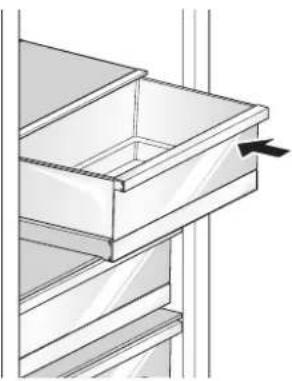
natural_image
Diagram of a multi-level cabinet or drawer with an arrow pointing to one panel (no text or symbols present)Cajones
natural_image
Simple line drawing of a rectangular container with a downward arrow indicating flow or movement (no text or symbols)natural_image
Diagram of a mechanical component with an arrow indicating force or motion, no text or symbols presentnatural_image
Technical line drawing of a mechanical component with a curved arrow indicating motion (no text or symbols)natural_image
Simple line drawing of a rectangular basin with an arrow indicating direction (no text or symbols)natural_image
Illustration of hands holding a tray with a magnified inset showing a mechanical component (no text or symbols)natural_image
Illustration of hands installing or removing a drawer into a cabinet (no text or symbols visible)natural_image
Technical line drawing of a cabinet or rack structure with metal brackets and a ventilation grille (no text or symbols)natural_image
Illustration of hands holding a tray with a ruler and a magnified inset showing a tool (no text or symbols)Estantes
natural_image
Diagram of a hand holding a rectangular panel with arrows indicating direction, no text or symbols presentNOTA
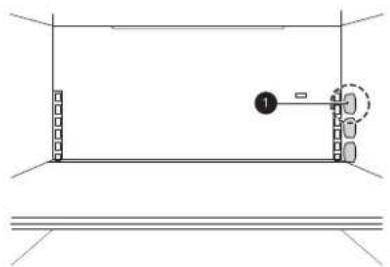
natural_image
Simple line drawing of a room with a numbered component and decorative elements (no text or symbols)
18 FUNCIONAMIENTO
NOTA
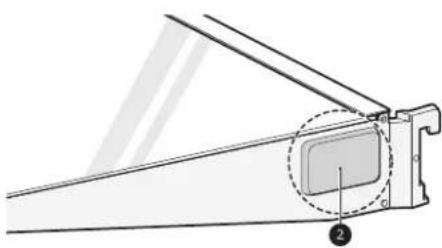
natural_image
Technical diagram of a mechanical component with a highlighted section and numbered label (no text or symbols present)①Transmisor
②Receptor
natural_image
Simple line drawing of a rectangular object with two curved arrows indicating rotation or movement (no text or symbols)natural_image
Illustration of hands holding a transparent rectangular object with three upward arrows, no text or symbols presentnatural_image
Illustration of two hands holding a transparent rectangular object with downward arrows, no text or symbols present
PRECAUCIÓN
natural_image
Pure geometric diagram with intersecting lines and circular shapes, no text or symbols presentnatural_image
Pure geometric diagram with intersecting lines and circular shapes, no text or symbols presentnatural_image
Diagram showing a smartphone mounted on a wall-mounted device (no text or symbols visible)natural_image
Illustration of a hand opening a cabinet drawer with a handle (no text or symbols)natural_image
Illustration of a hand pressing down on a grid device into a rack (no text or symbols)natural_image
Illustration of a hairdryer emitting exhaust smoke from a grid base, with a sun symbol nearby (no text or symbols present)NOTA
natural_image
Technical line drawing of a mechanical component with fan and housing (no text or symbols)natural_image
Technical line drawing of a mechanical device with an inset close-up showing internal components (no text or symbols)NOTA
natural_image
Illustration showing two mechanical components: a fan with a knob and a pulley device (no text or symbols)natural_image
Line drawing of a hand holding a mechanical component with a circular feature and a rotating shaft (no text or symbols)natural_image
Illustration showing a hand holding a circular component being placed on a panel, with no visible text or symbols.natural_image
Pure geometric diagram with intersecting lines and circles, no text or symbols presentCONSIGNES DE SÉCURITÉ IMPORTANTES
LISEZ TOUTES LES CONSIGNES AVANT L'UTILISATION
8 APERÇU DU PRODUIT
APERÇU DU PRODUIT
①Filtre à eau
Purifie l'eau.
REMARQUE
natural_image
Pure geometric diagram with intersecting lines and circular shapes, no text or symbols presentPanneau de commande
natural_image
Pure geometric lines and crosshair symbols without any text or labels
natural_image
Pure geometric diagram with intersecting lines and a circular pattern (no text or symbols)14 FONCTIONNEMENT
natural_image
Diagram of a refrigerator interior showing the exterior and front views, with no text or symbols present.natural_image
Illustration of a hand placing a tray into a multi-tiered drawer (no text or symbols)natural_image
Diagram of a mechanical or architectural component with layered shelves and an arrow indicating direction (no text or symbols)natural_image
Illustration of a hand holding a tablet with arrows indicating motion (no text or symbols)natural_image
Illustration of stacked shelves with a downward arrow indicating compression (no text or symbols)natural_image
Pure geometric lines and crosshair symbols without any text or labels
natural_image
Pure geometric diagram with intersecting lines and shapes, no text or symbols present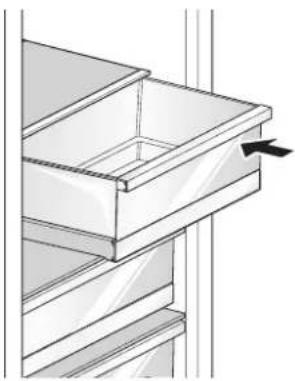
natural_image
Diagram of a multi-level drawer with an arrow indicating direction (no text or symbols present)Tiroirs
natural_image
Diagram of a rectangular container with a downward arrow indicating flow or movement (no text or symbols)natural_image
Diagram of a wooden shelf or rack with an arrow indicating upward motion (no text or symbols present)natural_image
Technical line drawing of a mechanical component with a curved arrow indicating motion (no text or symbols)natural_image
Simple line drawing of a rectangular basin with a black arrow pointing to the bottom portion (no text or symbols)natural_image
Illustration of hands holding a tray with a magnified inset showing a mechanical clamp (no text or symbols)natural_image
Illustration of hands installing or removing a drawer into a cabinet (no text or symbols visible)natural_image
Technical line drawing of a cabinet or shelf support structure with metal brackets and a ventilation grille (no text or symbols)natural_image
Illustration of hands holding a tray with a device, showing a close-up of a device inside (no text or symbols)Tablettes
natural_image
Diagram showing hands interacting with a rectangular panel or board, with arrows indicating movement or force direction (no text or symbols present)natural_image
Diagram showing a structural connection with an inset magnified view of a bracket and a close-up of the component (no text or symbols)REMARQUE
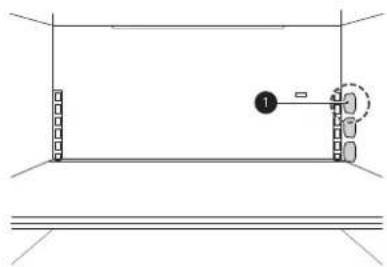
natural_image
Simple line drawing of a room with a numbered object and structural elements (no text or symbols)
natural_image
Pure geometric diagram with intersecting lines and circles, no text or symbols presentREMARQUE
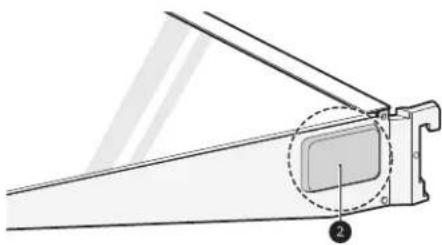
natural_image
Technical diagram of a mechanical component with a highlighted section and numbered label (no text or symbols present)①Émetteur
②Récepteur
natural_image
Simple line drawing of a rectangular object with two curved arrows indicating rotation or movement (no text or symbols)natural_image
Illustration of hands holding a transparent rectangular object with three upward arrows, no text or symbols presentnatural_image
Illustration of hands holding a transparent rectangular object with two downward arrows indicating force or movement (no text or symbols)
MISE EN GARDE
Application LG ThinQ
natural_image
Pure geometric diagram with intersecting lines and circles, no text or symbols presentREMARQUE
natural_image
Pure geometric diagram with intersecting lines and circles, no text or symbols presentnatural_image
Illustration of a smartphone mounted on a wall-mounted device (no text or symbols visible)natural_image
Illustration of a hand opening a cabinet drawer (no text or symbols visible)natural_image
Technical line drawing of a mechanical component with fan and housing (no text or symbols)natural_image
Technical line drawing of a mechanical device with an inset close-up showing internal components (no text or symbols)REMARQUE
natural_image
Illustration showing a hand holding a circular component next to a device with three circular parts, no text or symbols present.FRANÇAIS
natural_image
Line drawing of a hand holding a mechanical component with a circular feature and a rotating shaft (no text or symbols)natural_image
Illustration showing a hand holding a circular component being turned into a device (no text or symbols present)fr-ca_main.book.book Page 28 Thursday, June 29, 2023 11:22 AM
28 ENTRETIEN
fr-ca_main.book.book Page 43 Thursday, June 29, 2023 11:22 AM
fr-ca_main.book.book Page 48 Thursday, June 29, 2023 11:22 AM
Customer Information Center
For inquires or comments, call;
1-855-790-6655 USA, Consumer User
1-888-289-2802 CANADA, Consumer User
natural_image
Pure geometric diagram with intersecting lines and circular shapes, no text or symbols present