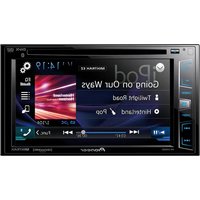
MVH-S21BT - Car stereo PIONEER - Free user manual and instructions
Find the device manual for free MVH-S21BT PIONEER in PDF.


User questions about MVH-S21BT PIONEER
0 question about this device. Answer the ones you know or ask your own.
Ask a new question about this device
Download the instructions for your Car stereo in PDF format for free! Find your manual MVH-S21BT - PIONEER and take your electronic device back in hand. On this page are published all the documents necessary for the use of your device. MVH-S21BT by PIONEER.
USER MANUAL MVH-S21BT PIONEER
Important (Serial number)
The serial number is located on the bottom of this unit. For your own security and convenience, be sure to record this number on the enclosed warranty card.

Connections/Installation 15
Additional Information 19
About this manual:
- In the following instructions, a USB memory or USB audio player are referred to as "USB device".
Getting Started
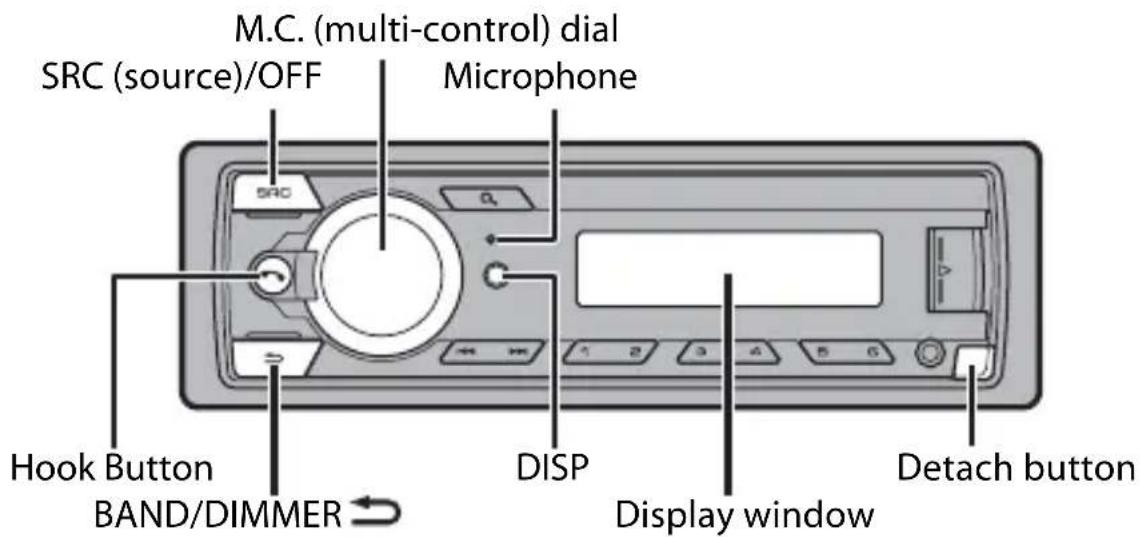
Basic operation
text_image
M.C. (multi-control) dial SRC (source)/OFF Microphone Hook Button BAND/DIMMER DISP Display window Detach buttonFrequently used operations
| Purpose Operation | |
| Turn on the power* Press SRC/OFF to turn on the power. Press and hold SRC/OFF to turn off the power. | |
| Adjust the volume Turn the M.C. dial. | |
| Select a source Press SRC/OFF repeatedly. | |
| Change the display information Press DISP repeatedly. | |
| Return to the previous display/list | Press BAND/DIMMER . |
| Return to the normal display from the menu | Press and hold BAND/DIMMER . |
| Answering/ending a call Press . | |
* When this unit's blue/white lead is connected to the vehicle's auto-antenna relay control terminal, the vehicle's antenna extends when this unit's source is turned on. To retract the antenna, turn the source off.
Display indication
| Indication Description | |
| Appears when a lower tier of the menu or folder exists. | |
| Indication Description | |
| [DAY] | Appears when the button is pressed. |
 | Appears when random/shuffle play is set (except when BT AUDIO and AOA). |
 | Appears when repeat play is set (except when BT AUDIO and AOA). |
 | Appears when a Bluetooth connection is made (page 9). |
Detaching the front panel
Detach the front panel to prevent theft. Remove any cables and devices attached to the front panel and turn off the unit before detaching it.
Detach Attach
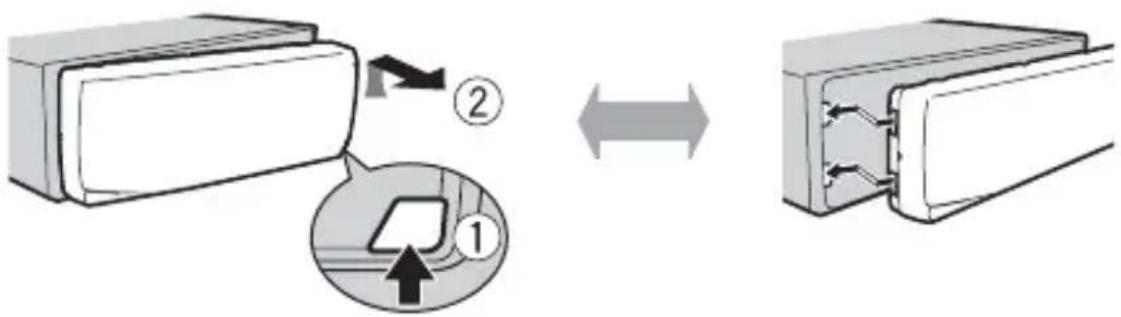
text_image
Diagram illustrating a mechanical or electrical component assembly with labeled parts and directional arrows indicating transformation.
Important
- Avoid subjecting the front panel to excessive shock.
- Keep the front panel out of direct sunlight and high temperatures.
• Always store the detached front panel in a protective case or bag.
Setup menu
When you turn the ignition switch to ON after installation, [SETUP:YES] appears in the display.
1 Press the M.C. dial.
The setup menu disappears after 30 seconds of no operation. If you prefer not to set at this time, turn the M.C. dial to select [NO], then press to confirm.
2 Turn the M.C. dial to select the options, then press to confirm.
To proceed to the next menu option, you need to confirm your selection.
| Menu Item Description | |
| CLOCK Set the clock. |
3[QUIT :YES] appears when all the settings have been made.
To return to the first item of the setup menu, turn the M.C. dial to select [QUIT :NO], then press to confirm.
4 Press the M.C. dial to confirm the settings.
NOTES
- You can cancel the menu setting by pressing SRC/OFF.
- These settings can be made at any time from the SYSTEM settings (page 14) and INITIAL settings (page 5).
Canceling the demonstration display (DEMO OFF)
1 Press the M.C. dial to display the main menu.
2 Turn the M.C. dial to select [SYSTEM], then press to confirm.
3 Turn the M.C. dial to select [DEMO OFF], then press to confirm.
4 Turn the M.C. dial to select [YES], then press to confirm.
INITIAL settings
1 Press and hold SRC/OFF until the unit turns off.
2 Press the M.C. dial to display the main menu.
3 Turn the M.C. dial to select [INITIAL], then press to confirm.
4 Turn the M.C. dial to select an option, then press to confirm.
NOTE
The options vary depending on the unit.
| Menu Item Description | |
| DIMMER Change the display brightness.[SYNC CLK],[MANUAL] | Select [SYNC CLK] to set the duration of activating dimmer.Select [MANUAL] to turn on/off dimmer by a press and hold of BAND/DIMMER button. |
| RESET Select [YES] to initialize the unit settings. The unit will be restarted automatically.[YES], [NO] | (Some of the settings may be retained even after resetting the unit.) |
Radio
The RDS (radio data system) function only works in areas that broadcast RDS signals for FM stations.
Best stations memory (BSM)
The six strongest stations are stored on the number buttons (1/∧ to 6/⇐).
1 After selecting the band, press the M.C. dial to display the main menu.
2 Turn the M.C. dial to select [FUNCTION], then press to confirm.
3 Turn the M.C. dial to select [BSM], then press to confirm.
To seek a station manually
1 After selecting the band, press / to select a station. Press and hold / then release to seek an available station. Scanning stops when the unit receives a station. To cancel seek tuning, press /
NOTE
[SEEK] needs to be set to [MAN] in the FUNCTION settings (page 13).
To store stations manually
1 While receiving the station you want to store, press and hold one of the number buttons (1/∧ to 6/⇐) until it stops flashing.
Receiving preset stations
1 Press SRC/OFF to select [RADIO].
2 Press BAND/DIMMER → to select the band from [F1], [F2], [F3] or [AM].
3 Press a number button (1/ ∧ to 6/ ⇌).
TIP
The /buttons can be also used to select a preset station when [SEEK] is set to [PCH] in the FUNCTION settings (page 13).
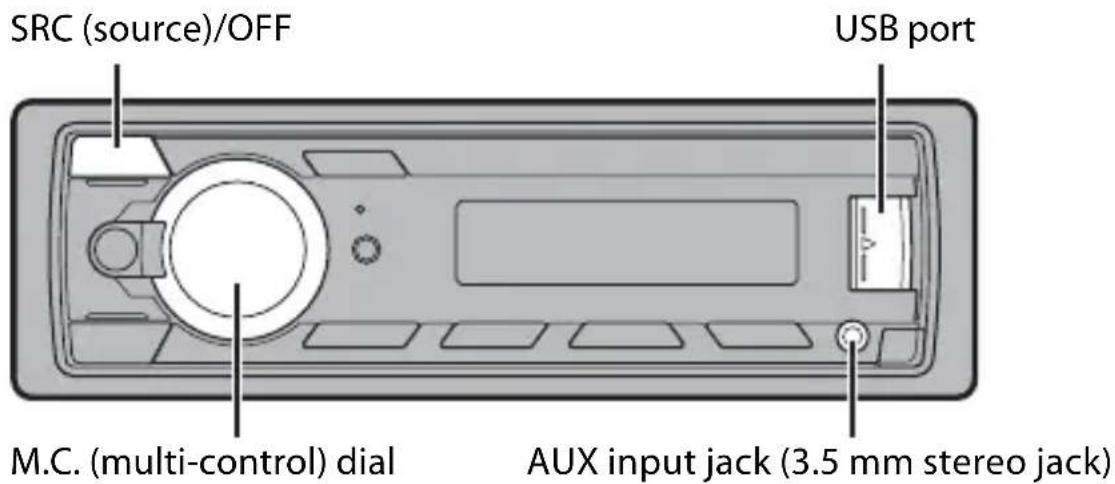
Playing back
Disconnect headphones from the device before connecting it to the unit.
text_image
SRC (source)/OFF USB port M.C. (multi-control) dial AUX input jack (3.5 mm stereo jack)USB devices (including Android)
1 Open the USB port cover.
2 Plug in the USB.
NOTE
To automatically switch to [USB] source when a USB device is connected to the unit, set [USB AUTO] to [ON] in the SYSTEM settings (page 14).

CAUTION
Use an optional Pioneer USB cable (CD-U50E) to connect the USB device as any device connected directly to the unit will protrude out from the unit, which could be dangerous.
Before removing the device, stop playback.
AOA connections
A device installed with Android OS 5.0 or later can be connected to the unit via AOA, using the cable supplied with the device.
Listening to music on Android
This function is compatible with devices that have Android OS 5.0 or later installed and also support AOA (Android Open Accessory) 2.0.
1 Press SRC/OFF to select [USB].
"ANDROID" is displayed after reading.
NOTE
Some Android devices connected via AOA 2.0 may not work properly or emit sounds due to their own software design, regardless of the OS version.
Basic operations
| Purpose Operation | |
| Select a track Press or . | |◀◀ ▶▶▶| |
| Fast forward or reverse Press and hold or . | |◀◀ ▶▶▶| |
| Pause/resume playback | Press 4/PAUSE. |
AUX
1 Insert the stereo mini plug into the AUX input jack.
2 Press SRC/OFF to select [AUX] as the source.
NOTE
If [AUX] is set to [OFF] in the SYSTEM settings, [AUX] cannot be selected as a source (page 14).
Operations
You can make various adjustments in the FUNCTION settings (page 12).
Note that the following operations do not work for an AUX device. To operate an AUX device, use the device itself.
| Purpose Operation | |
| Select a folder | Press 1/ ∧ or 2/ ∨ . |
| Select a track Press or . | |◀◀ ▶▶▶| |
| Fast forward or reverse Press and hold or . | |◀◀ ▶▶▶| |
| Search for a file from a list | 1 Press 🔒 to display the list.2 Turn the M.C. dial to select the desired file (folder) name, then press to confirm.3 Turn the M.C. dial to select the desired file, then press to confirm.Playback starts. |
| View a list of the files in the selected folder | Press the M.C. dial when a folder is selected. |
| Play a song in the selected folder | Press and hold the M.C. dial when a folder is selected. |
| Repeat play | Press 6/⇌ . |
| Random/shuffle play | Press 5/××. |
| Pause/resume playback | Press 4/PAUSE. |
Bluetooth
Bluetooth connection
1 Turn on the Bluetooth function of the device.
2Press to display the phone menu.
3 Turn the M.C. dial to select [BT SETUP], then press to confirm.
4 Turn the M.C. dial to select [ADD DEV], then press to confirm.
The unit starts to search for available devices.
- To cancel searching, press the M.C. dial.
- If the desired device is not in the list, select [RE-SRCH].
- If there is no device available, [NOT FND] appears in the display.
5 Turn the M.C. dial to select a device, then press to confirm.
Press and hold the M.C. dial to switch the displayed device information between the Bluetooth device address and device name.
6Select [Pioneer BT Unit] shown in the device display.
7 Make sure the same 6-digit number appears on this unit and the device, then select "Yes" on the device.
NOTES
- Depending on the device, the PIN code is required in step 7. In this case, input [0000].
- Only one single device can be paired/registered at any one time. The previously paired/registered device information is overwritten/deleted when a new device is paired/registered to this unit.
TIP
The Bluetooth connection can be also made by detecting the unit from the Bluetooth device. To do so, [VISBL] in the Bluetooth settings needs to be set to [ON]. For details on a Bluetooth device operations, refer to the operating instructions supplied with the Bluetooth device.
Bluetooth settings
| Menu Item Description | |
| BT CON Display the paired [ON], [OFF] | Bluetooth devices. “*” appears on the device name when the Bluetooth connection is established. |
| ADD DEV Register a new device. | |
| A CON Select [ON] to connect to a Bluetooth device automatically.[ON], [OFF] | |
| VISBL Select [ON] so that a Bluetooth device can detect the unit when the unit is connected via Bluetooth to another device. | |
| PIN CODE Change the PIN code.1 Press the M.C. dial to display the setting mode.2 Turn the M.C. dial to select a number.3 Press the M.C. dial to move the cursor to the next position.4 After inputting the PIN code, press and hold the M.C. dial. After inputting the PIN code, pressing the M.C. dial returns you to the PIN code input display, and you can change the PIN code. | |
| DEV. INFO Switch the device information on the display between the device name and Bluetooth device address. | |
Bluetooth telephone
First, make a Bluetooth connection with the Bluetooth telephone (page 9).

Important
- The Bluetooth microphone is built in the grill of the product.
- Speak toward the microphone when you make a call.
- Leaving the unit on standby to connect to your phone via Bluetooth while the engine is not running can drain the vehicle's battery.
- Be sure to park your vehicle in a safe place and apply the parking brake before operation.
To answer an incoming call
1 Press when a call is received.
Basic operations
| Purpose Operation | |
| End a call Press . | |
| Reject an incoming call Press and hold when a call is received. | |
| Switch between the current caller and a caller on hold | Press the M.C. dial. |
| Cancel a caller on hold Press and hold . | |
| Adjust the volume of the caller's voice (When private mode is on, this function is not available.) | Turn the M.C. dial during the call. |
| Turn the private mode on or off | Press BAND/ → during the call. |
Phone menu
| Menu Item Description | |
| ANSR Select [ON] to answer an incoming call automatically.[ON], [OFF] | wer an incoming call automatically. |
| RING Select [ON] if the ring tone does not come out from the car[ON], [OFF] | speakers. Depending on the connected phone, this function may not work. |
| BT SETUP You can adjust various settings for Bluetooth connections. For details on Bluetooth settings, see page 10. | |
* The contacts on your phone will normally be transferred automatically when the phone is connected. If they are not, use your phone to transfer the contacts.
Bluetooth audio

Important
- Depending on the Bluetooth audio player connected to this unit, the available operations will be limited to the following two levels:
- A2DP (Advanced Audio Distribution Profile) can only play back songs on your audio player.
- AVRCP (Audio/Video Remote Control Profile) can perform functions such as playback, pause, select song, etc.
- The sound of the Bluetooth audio player will be muted when the phone is in use.
- When the Bluetooth audio player is in use, you cannot connect to a Bluetooth telephone automatically.
- Depending on the type of Bluetooth audio player you have connected to this unit, operation and information displayed may vary based on availability and functionality.
1 Make a Bluetooth connection with the Bluetooth audio player.
2 Press SRC/OFF to select [BT-A] as the source.
3 Press 4/PLAY to start playback.
Basic operations
You can make various adjustments in the FUNCTION settings (page 12).
| Purpose Operation | |
| Fast forward or reverse Press and hold or . | |◀◀ ▶▶▶| |
| Select a track Press or . | |◀◀ ▶▶▶| |
| Repeat play* Press 6/ . | ↔ |
| Random play* Press 5/ . | ×× |
| Pause/resume playback | Press 4/PAUSE. |
| Search for a file from a list | 1 Press 🔒 to display a list.2 Turn the M.C. dial to select the desired folder name, then press to confirm.3 Turn the M.C. dial to select the desired file, then press to confirm.Playback starts. |
* Depending on the connected device, these operations may not be available.
Settings
You can adjust various settings in the main menu.
1 Press the M.C. dial to display the main menu.
2 Turn the M.C. dial to select one of the categories below, then press to confirm.
• FUNCTION settings (page 12)
• AUDIO settings (page 13)
• SYSTEM settings (page 14)
3 Turn the M.C. dial to select the options, then press to confirm.
FUNCTION settings
The menu items vary according to the source.
| Menu Item | Description |
| BSM RADIO | Store the six strongest stations on the number buttons (1/ ∧ to 6/ ⇌) automatically. |
| Menu Item Description | |
| LOCAL RADIOFM: [OFF], [LV1], [LV2], [LV3], [LV4]AM: [OFF], [LV1], [LV2] | Restrict the tuning station according to the signal strength. |
| SEEK RADIO[MAN], [PCH] Assign or buttons to seek the stationsone by one (manual tuning) or select a station from the preset channels. | |
| PLAY BT AUDIO | Start playback. |
| STOP BT AUDIO | Stop playback. |
| AUDIO settings | |
| Menu Item Description | |
| FADER*1 | Adjust the front and rear speaker balance. |
| BALANCE | Adjust the left and right speaker balance. |
| BASS&TRE[FLAT], [CUSTOM], [EQ1], [EQ2], [EQ3]Select Bass or Treble and level to customize sound.Tone control: [BASS], [TREBLE]Equalizer level: [+6] to [-6] | Select the bass & treble setting. |
| LOUD[ON], [OFF] Compensate for clear sound at low volume. | |
| SLA[+2] to [-1] Adjust the volume level for each source except RADIO. | |
SYSTEM settings
You can also access to these menus by pressing and holding the center of M.C. dial when the unit is turned off.
| Menu Item Description | |
| CLOCKSet the clock (page 4). | |
| 12/24[12H], [24H] Select the time notation. | |
| AUX[ON], [OFF] Set to [ON] when using an auxiliary device connected to the unit. | |
| BT-A[ON], [OFF] Set the Bluetooth signal on/off. | |
| BT CLEAR[YES], [NO] Clear the Bluetooth device data (device information, PIN code) stored in the unit.[CLEARED] appears when data is successfully deleted. | |
| BT VERDisplays the system version of the unit and the Bluetooth module. | |
| USB A[ON], [OFF] Select [ON] to automatically switch to [USB] source when a USB device/Android is connected to the unit.Select [OFF] when a USB device/Android is being connected to the unit just for charging. | |
| SCRL[YES], [ONE], [NO] Select the auto text scroll setting for text information from a compressed audio file.[ONE] is to scroll text information only once. |
Connections/Installation
Connections

WARNING
- Use speakers over 50 W (output value) and between 4 Ω to 8 Ω (impedance value). Do not use 1 Ω to 3 Ω speakers for this unit.
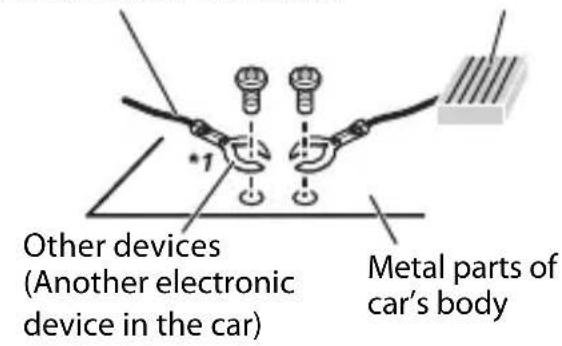
- The black cable is ground. When installing this unit or power amp (sold separately), make sure to connect the ground wire first. Ensure that the ground wire is properly connected to metal parts of the car's body. The ground wire of the power amp and the one of this unit or any other device must be connected to the car separately with different screws. If the screw for the ground wire loosens or falls out, it could result in fire, generation of smoke or malfunction.
Ground wire POWER AMP
text_image
Other devices (Another electronic device in the car) Metal parts of car's body*1 Not supplied for this unit

Important
- When installing this unit in a vehicle without an ACC (accessory) position on the ignition switch, failure to connect the red cable to the terminal that detects operation of the ignition key may result in battery drain.


ACC position No ACC position
- Use of this unit in conditions other than the following could result in fire or malfunction.
– Vehicles with a 12-volt battery and negative grounding. - When speaker output is used by 4 channels, use speakers over 50 ~W (maximum input power) and between 4 to 8 (impedance value). Do not use 1 to 3 speakers for this unit.
- When rear speaker output is used by 2 of subwoofer, use speakers over 70 W (maximum input power). * Please refer to connection for a connection method.
• To prevent a short-circuit, overheating or malfunction, be sure to follow the directions below. - Disconnect the negative terminal of the battery before installation.
- Secure the wiring with cable clamps or adhesive tape. Wrap adhesive tape around wiring that comes into contact with metal parts to protect the wiring.
- Place all cables away from moving parts, such as the shift lever and seat rails.
- Place all cables away from hot places, such as near the heater outlet.
- Do not connect the yellow cable to the battery by passing it through the hole to the engine compartment.
- Cover any disconnected cable connectors with insulating tape.
-Do not shorten any cables. -
Never cut the insulation of the power cable of this unit in order to share the power with other devices. The current capacity of the cable is limited.
-
Use a fuse of the rating prescribed.
- Never wire the negative speaker cable directly to ground.
– Never band together negative cables of multiple speakers.
- When this unit is on, control signals are sent through the blue/white cable.
Connect this cable to the system remote control of an external power amp or the vehicle's auto-antenna relay control terminal (max. 300mA 12 V DC). If the vehicle is equipped with a glass antenna, connect it to the antenna booster power supply terminal.
- Never connect the blue/white cable to the power terminal of an external power amp. Also, never connect it to the power terminal of the auto antenna. Doing so may result in battery drain or a malfunction.
- The black cable is ground. Ground cables for this unit and other equipment (especially, high-current products such as power amps) must be wired separately. If they are not, an accidental detachment may result in a fire or malfunction.
• The graphical symbol placed on the product means direct current.
This unit
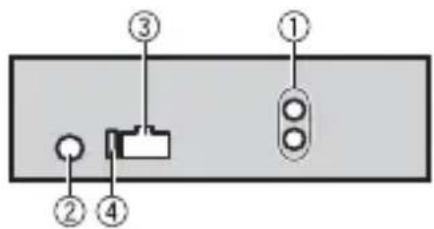
text_image
Diagram showing four labeled components or connectors on a gray rectangular background, with numbered annotations ① to ④.① Rear output
② Antenna input
③ Power cord input
④ Fuse (10 A)
Power cord
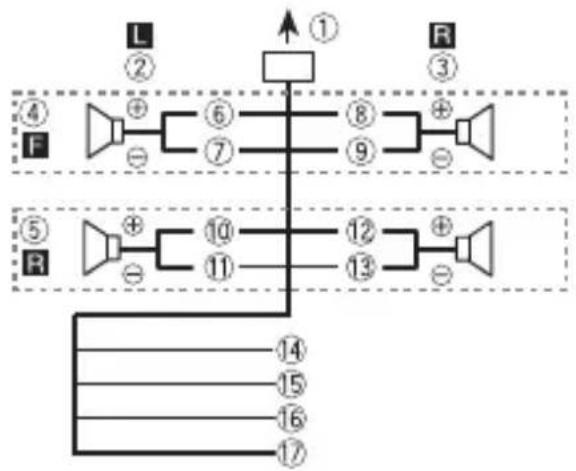
flowchart
graph TD
    subgraph Left_Circuit
        L["①"] --> F["④"]
        F --> A["+"]
        A --> ⑥[⑥]
        ⑥ --> ⑦[⑦]
        ⑦ --> ⑧[⑧]
        ⑧ --> ⑨[⑨]
        ⑨ --> R["③"]
    end
    subgraph Right_Circuit
        R["⑤"] --> R1["④"]
        R1 --> ⑩[⑩]
        ⑩ --> ⑪[⑪]
        ⑪ --> ⑫[⑫]
        ⑫ --> ⑬[⑬]
        ⑬ --> ⑭[⑭]
        ⑭ --> ⑮[⑮]
        ⑮ --> ⑯[⑯]
        ⑯ --> R2["⑤"]
    end
    L -->|L| F
    R -->|R| R1
    style Left_Circuit fill:#f9f,stroke:#333
    style Right_Circuit fill:#bbf,stroke:#333
① To power cord input
② Left
③ Right
④ Front speaker
⑤ Rear speaker
⑥ White
⑦ White/black
⑧ Gray
⑨ Gray/black
10 Green
⑪ Green/black
⑫ Violet
⑬ Violet/black
⑭ Black (chassis ground)
Connect to a clean, paint-free metal location.
15 Yellow
Connect to the constant 12 V supply terminal.
16 Red
Connect to terminal controlled by the ignition switch (12 V DC).
⑰ Blue/white
Connect to the system control terminal of the power amp or auto-antenna relay control terminal (max. 300 mA 12 V DC).
Power amp (sold separately)
Perform these connections when using the optional amplifier.
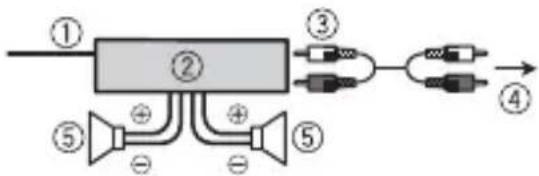
flowchart
graph LR
    ① --> ②
    ② --> ③
    ③ --> ④
    ⑤ --> ④
    ⑤ --> ④
    ② --> ⑤
    ② --> ⑤
    ② --> ⑤
    ② --> ⑤
    ② --> ⑤
    ② --> ⑤
    ② --> ⑤
① System remote control
Connect to blue/white cable.
② Power amp (sold separately)
③ Connect with RCA cables (sold separately)
④ To rear output
⑤ Rear speaker
Installation
Important
- Check all connections and systems before final installation.
- Do not use unauthorized parts as this may cause malfunctions.
- Consult your dealer if installation requires drilling of holes or other modifications to the vehicle.
- Do not install this unit where: - it may interfere with operation of the vehicle. - it may cause injury to a passenger as a result of a sudden stop.
- Optimum performance is obtained when the unit is installed at an angle of less than 60^ .
- When installing, to ensure proper heat dispersal when using this unit, make sure you leave ample space behind the rear panel and wrap any loose cables so they are not blocking the vents.
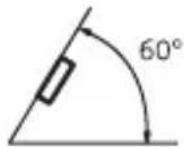
Leave ample space
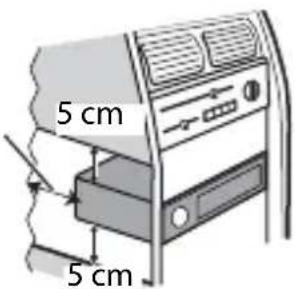
text_image
5 cm 5 cmDIN mount installation
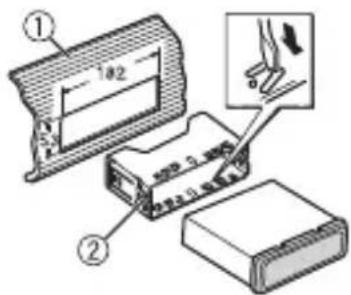
1 Insert the supplied mounting sleeve into the dashboard.
2 Secure the mounting sleeve by using a screwdriver to bend the metal tabs (90°) into place.
text_image
Diagram showing two labeled components of an electronic device with a magnified inset view highlighting a component.① Dashboard
② Mounting sleeve
• Make sure that the unit is installed securely in place. An unstable installation may cause skipping or other malfunctions.
When not using the supplied mounting sleeve
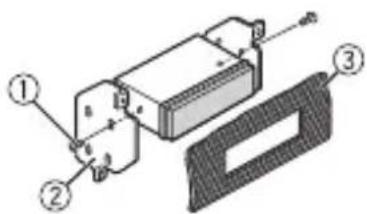
1 Line up the holes on the mounting bracket with the holes on the sides of the unit to attach the bracket.
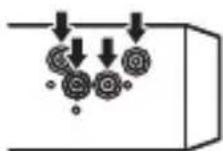
2 Screw in one screw on each side to hold the unit in place.
text_image
Technical diagram of a mechanical assembly with numbered components① Tapping screw (φ5 mm × 9 mm)
② Mounting bracket
③ Dashboard or console
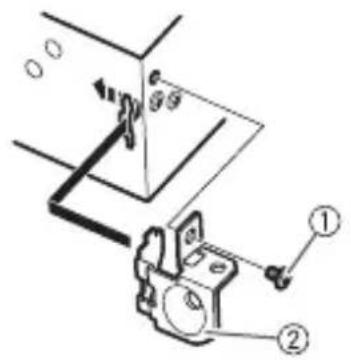
Using the included bracket
Check to make sure that the included bracket matches your particular model of
vehicle and then attach it to the unit as shown below.
text_image
Technical diagram showing mechanical assembly with labeled parts ① and ②, likely from an engineering or manufacturing context.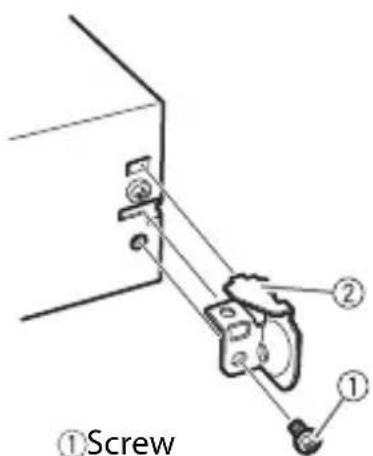
text_image
①Screw①Screw
②Bracket
Removing the unit (installed with the supplied mounting sleeve)
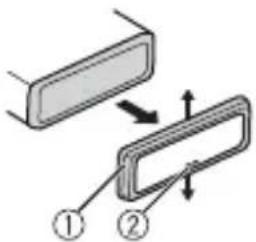
1 Remove the trim ring.
text_image
Diagram showing two labeled components (① and ②) with directional arrows indicating movement or force, likely illustrating a mechanical or electrical assembly.① Trim ring
② Notched tab
- Releasing the front panel allows easier access to the trim ring.
- When reattaching the trim ring, point the side with the notched tab down.
2 Insert the supplied extraction keys into both sides of the unit until they click into place.
3 Pull the unit out of the dashboard.
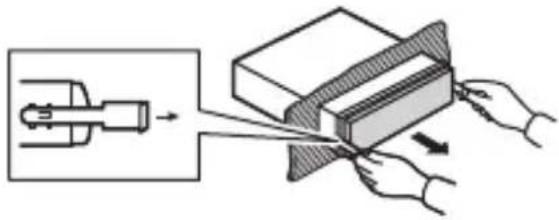
natural_image
Diagram showing a mechanical device being cut with force lines, no text or symbols presentTo secure the front panel
The front panel can be secured with the supplied screw.
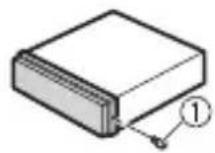
① Screw
Additional Information
Troubleshooting
The display automatically returns to the normal display.
→No operations have been made for about 30 seconds. -Perform an operation.
The repeat play range changes unexpectedly.
→Depending on the repeat play range, the selected range may change when another folder or track is being selected or during fast forwarding/reversing. –Select the repeat play range again.
A subfolder is not played back.
→Subfolders cannot be played when [FLD] (folder repeat) is selected. –Select another repeat play range.
The sound is intermittent.
→You are using a device, such as a cellular phone, that may cause audible interference. -Move electrical devices that may be causing the interference away from the unit.
The sound from the Bluetooth audio source is not played back.
→There is a call in progress on a Bluetooth-connected cellular phone. - The sound will be played back when the call is terminated. →A Bluetooth-connected cellular phone is currently being operated. - Stop using the cellular phone. →The connection between the unit and the cellular phone is not established correctly after a call made by a Bluetooth-connected cellular phone.
- Make a Bluetooth connection between the unit and the cellular phone again.
Error messages
Common
AMP ERR
→This unit fails to operate or the speaker connection is incorrect. →The protective circuit is activated. - Check the speaker connection. - Turn the ignition switch OFF and back to ON again. If the message remains, contact your dealer or an authorized Pioneer Service Station for assistance.
NO XXXX (NO TITLE, for example)
→There is no embedded text information. - Switch the display or play another track/file.
USB device
READING
→Sometimes there is a delay between the start of playback and when you start to hear any sound. –Wait until the message disappears and you hear sound.
NO AUDIO
→There are no songs. - Transfer the audio files to the USB device and connect. →The connected USB device has security enabled. -Follow the USB device instructions to disable the security.
SKIPPED
→The connected USB device contains DRM protected files.
–The protected files are skipped.
PROTECT
→All the files on the connected USB device are embedded with DRM.
-Replace the USB device.
N/A USB
→The connected USB device is not supported by this unit.
- Disconnect your device and replace it with a compatible USB device.
HUB ERR
→The USB device connected via a USB hub is not supported by this unit.
- Connect the USB device directly to this unit using a USB cable.
CHEK USB
→The USB connector or USB cable has short-circuited.
- Check that the USB connector or USB cable is not caught in something or damaged.
→The connected USB device consumes more than maximum allowable current.
- Disconnect the USB device and do not use it. Turn the ignition switch OFF and back to ACC or ON. Connect only compliant USB devices.
ERROR-19
→Communication failed.
-Perform one of the following operations, then return to the USB source.
- Turn the ignition switch OFF and back to ON.
- Disconnect the USB device.
- Change to a different source.
ERROR-23
→USB device was not formatted properly.
-Format the USB device with FAT12, FAT16 or FAT32.
STOP
→There are no songs in the current list.
-Select a list that contains songs.
Bluetooth device
ERROR-10
→The power failed for the Bluetooth module of the unit.
–Turn the ignition switch OFF and back to ACC or ON.
Handling guidelines
USB storage device
- Connections via USB hubs are not supported.
- Firmly secure the USB storage device before driving. Do not let the USB storage device fall onto the floor, where it may become jammed under the brake or accelerator pedal.
- Depending on the USB storage device, the following problems may occur.
-Operations may vary. - The storage device may not be recognized.
– Files may not be played back properly. - The device may cause audible interference when you are listening to the radio.
Compressed audio compatibility
- Only the first 32 characters can be displayed as a file name (including the file extension) or a folder name.
-
The unit may not work properly depending on the application used to encode WMA files.
-
There may be a slight delay at the start of the playback of audio files embedded with image data, or audio files stored on a USB device with numerous folder hierarchies.
- Russian text to be displayed on this unit should be encoded in one of the following character sets:
- Unicode (UTF-8, UTF-16)
- A character set other than Unicode that is used in a Windows environment and is set to Russian in the multi-language setting

CAUTION
- Pioneer cannot guarantee compatibility with all USB mass storage devices, and assumes no responsibility for any loss of data on media players, smartphones, or other devices while using this product.
- Do not leave a USB storage device in any place that is subject to high temperatures.
WMA files
| File extension .wma | |
| Bit rate 48 kbps to 320 | kbps(CBR), 48 kbps to 384kbps (VBR) |
| Sampling frequency 32 | kHz, 44.1 kHz, 48kHz |
| Windows MediaTMAudio Professional,Lossless, Voice/DRMStream/Stream with video | Not compatible |
MP3 files
| File extension .mp3 | |
| Bit rate 8 kbps to 320 kbps(CBR), VBR | |
| Sampling frequency 16 kHz to 48 kHz (32 kHz, 44.1 kHz, 48 kHz for emphasis) | |
| Compatible ID3 tag version | 2.2, 2.3, 2.4 |
| M3u playlist Not compatible | |
| MP3i (MP3 interactive), mp3 PRO | Not compatible |
WAV files
| File extension .wav | |
| Quantization bits 8 and | 16 (LPCM) |
| Sampling frequency 16 | kHz to 48 kHz (LPCM) |
FLAC files
- FLAC files may not be playable, depending on the encoder.
| File extension.flac | |
| Sampling frequency 8/ | 1.025/12/16/22.05/24/32/44.1/48 kHz |
| Quantization bit rate 16 | bit |
| Channel mode 1/2 ch |
USB device
- There may be a slight delay when starting playback of audio files on a USB storage device with numerous folder hierarchies.
| Playable folder hierarchy | Up to eight tiers (A practical hierarchy is less than two tiers.) |
| Playable folders Up to 500 | |
| Playable files Up to 1500 | |
| Playback of copyright-protected files | Not compatible |
| Partitioned USB device | Only the first partition can be played. |
Sequence of audio files
The user cannot assign folder numbers and specify playback sequences with this unit.
Sequence of audio file depends on the connected device.
Note that the hidden files in a USB device cannot be played back.
Example of a hierarchy
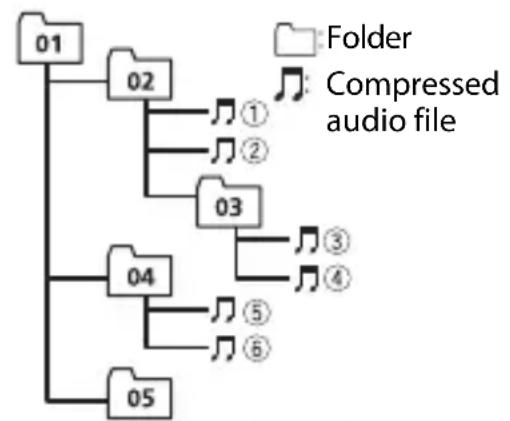
flowchart
graph TD
    A["01"] --> B["02"]
    B --> C["1"]
    B --> D["2"]
    B --> E["3"]
    E --> F["4"]
    B --> G["03"]
    G --> H["5"]
    G --> I["6"]
    G --> J["04"]
    J --> K["5"]
    J --> L["6"]
    style A fill:#f9f,stroke:#333
    style B fill:#ccf,stroke:#333
    style C fill:#cfc,stroke:#333
    style D fill:#fcc,stroke:#333
    style E fill:#cff,stroke:#333
    style F fill:#ffc,stroke:#333
    style G fill:#cfc,stroke:#333
    style H fill:#fcc,stroke:#333
    style I fill:#cff,stroke:#333
    style J fill:#ffc,stroke:#333
    style K fill:#fcc,stroke:#333
Level 1 Level 2 Level 3 Level 4
01 to 05: Folder number
① to :Playback sequence
Copyright and trademark
Bluetooth
The Bluetooth ^® word mark and logos are registered trademarks owned by Bluetooth SIG, Inc. and any use of such marks by PIONEER CORPORATION is under license. Other trademarks and trade names are those of their respective owners.
WMA
Windows Media is either a registered trademark or trademark of Microsoft Corporation in the United States and/or other countries.
This product includes technology owned by Microsoft Corporation and cannot be used or distributed without a license from Microsoft Licensing, Inc.
FLAC
Copyright © 2000-2009 Josh Coalson Copyright © 2011-2013 Xiph.Org Foundation
Redistribution and use in source and binary forms, with or without modification, are permitted provided that the following conditions are met:
-Redistributions of source code must retain the above copyright notice, this list of conditions and the following disclaimer.
- Redistributions in binary form must reproduce the above copyright notice, this list of conditions and the following disclaimer in the documentation and/or other materials provided with the distribution.
-Neither the name of the Xiph.org Foundation nor the names of its contributors may be used to endorse or promote products derived from this software without specific prior written permission.
THIS SOFTWARE IS PROVIDED BY THE COPYRIGHT HOLDERS AND
CONTRIBUTORS "AS IS" AND ANY EXPRESS OR IMPLIED WARRANTIES, INCLUDING, BUT NOT LIMITED TO, THE IMPLIED
WARRANTIES OF MERCHANTABILITY AND FITNESS FOR A PARTICULAR PURPOSE ARE DISCLAIMED. IN NO EVENT SHALL THE FOUNDATION OR CONTRIBUTORS BE
LIABLE FOR ANY DIRECT, INDIRECT, INCIDENTAL, SPECIAL, EXEMPLARY, OR CONSEQUENTIAL DAMAGES (INCLUDING, BUT NOT LIMITED TO, PROCUREMENT OF SUBSTITUTE GOODS OR SERVICES; LOSS OF USE, DATA, OR PROFITS; OR BUSINESS INTERRUPTION) HOWEVER CAUSED AND ON ANY THEORY OF LIABILITY, WHETHER IN CONTRACT, STRICT LIABILITY, OR TORT (INCLUDING NEGLIGENCE OR OTHERWISE) ARISING IN ANY WAY OUT OF THE USE OF THIS SOFTWARE, EVEN IF ADVISED OF THE POSSIBILITY OF SUCH DAMAGE.
Android™
Android is a trademark of Google Inc.
Specifications
General
Power source:
14.4 V DC (10.8 V to 15.1 V allowable)
Grounding system: Negative type
Maximum current consumption: 10.0 A
Dimensions (W × H × D): DIN
Chassis: 178 mm × 50 mm × 97 mm (7
in. × 2 in. × 3-7/8 in.)
Nose: 188 mm × 58 mm × 17 mm
(7-3/8 in. × 2-1/4 in. × 5/8 in.) D
Chassis: 178 mm × 50 mm × 97 mm (7
in. × 2 in. × 3-7/8 in.)
Nose: 170 mm × 46 mm × 17 mm
(6-3/4 in. × 1-3/4 in. × 5/8 in.)
Weight: 0.5 kg (1.1 lbs)
Audio
Maximum power output:
50 W × 4 ch/4 Ω
Continuous power output:
22 W × 4 (50 Hz to 15 000 Hz, 5 %
THD, 4 Ω load, both channels driven)
Load impedance:
4 Ω (4 Ω to 8 Ω allowable)
Preout maximum output level: 2.0 V
Loudness contour:
+8 dB (100 Hz), -1 dB (10 kHz) (volume: 28)
Tone control (bass and treble)
Frequency: 100 Hz (bass) /10 kHz (treble)
Equalization range:±12 dB (±2 dB step)
USB
USB standard specification: USB 2.0 full speed
Maximum current supply: 500 mA
USB Protocol:
MSC (Mass Storage Class)
AOA (Android Open Accessory) 2.0
File system: FAT12, FAT16, FAT32
MP3 decoding format:
MPEG-1 & 2 Audio Layer 3
WMA decoding format:
Ver. 7, 7.1, 8, 9 (2 ch audio) (Windows Media Player)
FLAC decoding format:
v1.2.1 (Free Lossless Audio Codec)
WAV signal format:
Linear PCM
FM tuner
Frequency range:
87.9 MHz to 107.9 MHz
Usable sensitivity:
6 dBf (1.0 μV/75 Ω, mono, S/N: 30 dB)
Signal-to-noise ratio: 72 dB (IEC-A network)
AM tuner
Frequency range: 530 kHz to 1 710 kHz
Usable sensitivity: 25 μV (S/N: 20 dB)
Signal-to-noise ratio:
58 dB (IEC-A network)
Bluetooth
Version: Bluetooth 3.0 + EDR certified
Output power:
+4 dBm Maximum (Power class 2)
Frequency band(s):
2 400 MHz to 2 483.5 MHz
Bluetooth profiles:
GAP (Generic Access Profile)
SDAP (Service Discovery Application
Profile)
HFP (Hands Free Profile) 1.6
A2DP (Advanced Audio Distribution
Profile)
AVRCP (Audio/Video Remote Control
Profile) 1.5
SPP (Serial Port Profile) 1.2
CEA2006 Specifications

text_image
Amplifier Power Standard CEA CEA-2006 CompliantPower output: 14 W RMS × 4 Channels (4 Ω and ≈ % THD+N)
S/N ratio: 77 dBA (reference: 1 W into 4 Ω)
NOTE
Specifications and the design are subject to modifications without notice.
Table des matières
Pour commencer .... 3
Radio....6
USB/AUX....7
Bluetooth 9
Réglages.... 13
Réglages FUNCTION 13
Réglages AUDIO 14
Réglages SYSTEM.... 15
Connexions/Installation.... 17
text_image
Diagram illustrating a mechanical or electrical component assembly with labeled parts and directional arrows
Important
text_image
SRC (source)/OFF Port USBConnexions/Installation
Connexions

ATTENTION
natural_image
Diagram of two hands holding three bolts with a ruler above, no text or symbols presenttext_image
Diagram showing four labeled components or connectors on a rectangular panel, with numbered annotations ① to ④.text_image
Diagram showing a device assembly with labeled parts and a magnified view of the componenttext_image
Technical diagram of a mechanical assembly with numbered componentstext_image
Technical diagram showing mechanical assembly with labeled parts ① and ②, likely from an engineering or manufacturing context.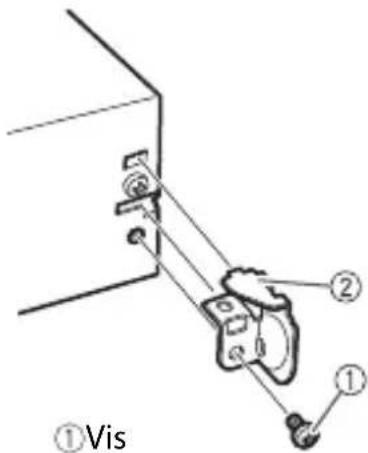
text_image
①Vis ② ①①Vis
②Support
text_image
Diagram showing two labeled components (① and ②) with directional arrows indicating movement or force, likely illustrating a mechanical or electrical assembly.natural_image
Diagram showing a mechanical component being processed into a block, with hands adjusting the part (no text or symbols present)→Échec de communication.
text_image
Amplifier Power Standard CEA-2006 Complianttext_image
Diagram illustrating a mechanical or electrical component assembly with labeled parts and directional arrows indicating transformation.
Importante
natural_image
Diagram of two hands holding screws and a tool with a ruler, no text or symbols presenttext_image
Diagram showing four labeled components or parts on a rectangular panel, with numbered annotations ① to ④.text_image
Diagram showing two labeled components of an electronic device with a magnified inset view highlighting a component.① Tablero
② Manguito de montaje
text_image
Technical diagram of a mechanical assembly with numbered componentstext_image
Technical diagram showing mechanical assembly with labeled parts ① and ②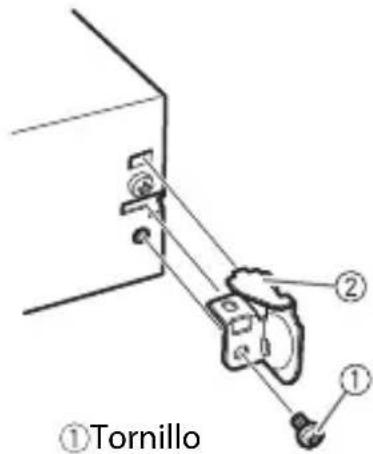
text_image
①Tornillo ② ①①Tornillo
②Soporte
text_image
Diagram showing two labeled components (① and ②) with directional arrows indicating movement or force, likely illustrating a mechanical or electrical assembly.natural_image
Diagram showing a mechanical device being processed into a block, with hands operating the process (no text or symbols present)Copyright © 2000-2009 Josh Coalson
Copyright © 2011-2013 Xiph.Org
Foundation
AOA (Android Open Accessory) 2.0
(Windows Media Player)
text_image
Amplifier Power Standards CEA CEA-2006 CompliantSalida de potencia: 14 W RMS × 4 canales (4 Ω y ≧ % THD+N)
Register your product at
http://www.pioneerelectronics.com
in Canada
au Canada
en Canadá
http://www.pioneerelectronics.ca
— Learn about product updates (such as firmware updates) for your product.
— Register your product to receive notices about product updates and to safeguard purchase details in our files in the event of loss or theft.
— Access owner's manuals, spare parts information, service information, and much more.
— Informez-vous sur les mises à jour disponibles pour votre produit (telles que les mises à jour du firmware).
— Enregistrez votre produit afin de recevoir des notifications concernant les mises à jour du produit, ainsi que pour sauvegarder les détails de votre achat dans nos fichiers en cas de perte ou de vol.
— Accédez aux modes d'emploi, aux informations relatives aux pièces de rechange et à l'entretien, et à beaucoup d'autres informations.
— Infórmese de las últimas actualizaciones (por ejemplo, actualizaciones de firmware) para su producto.
— Registre su producto para recibir información sobre actualizaciones del producto y para mantener la seguridad de los detalles de su compra en nuestros archivos en caso de pérdida o robo.
— Acceso a manuales de instrucciones, información sobre piezas de recambio y mucho más.
PIONEER CORPORATION
28-8, Honkomagome 2-chome, Bunkyo-ku, Tokyo 113-0021, Japan
PIONEER ELECTRONICS (USA) INC.
P.O. Box 1540, Long Beach, California 90801-1540, U.S.A. TEL: (800) 421-1404
PIONEER EUROPE NV
Haven 1087, Keetberglaan 1, B-9120 Melsele, Belgium/Belgique TEL: (0) 3/570.05.11
PIONEER ELECTRONICS ASIACENTRE PTE. LTD.
2 Jalan Kilang Barat, #07-01, Singapore 159346 TEL: 65-6378-7888
PIONEER ELECTRONICS AUSTRALIA PTY. LTD.
5 Arco Lane, Heatherton, Victoria, 3202 Australia TEL: (03) 9586-6300
PIONEER ELECTRONICS DE MÉXICO S.A. DE C.V.
Blvd. Manuel Ávila Camacho 138, 10 piso Col.Lomas de Chapultepec, México, D.F. 11000 Tel: 52-55-9178-4270, Fax: 52-55-5202-3714