DMH-100BT - Car stereo PIONEER - Free user manual and instructions
Find the device manual for free DMH-100BT PIONEER in PDF.


User questions about DMH-100BT PIONEER
0 question about this device. Answer the ones you know or ask your own.
Ask a new question about this device
Download the instructions for your Car stereo in PDF format for free! Find your manual DMH-100BT - PIONEER and take your electronic device back in hand. On this page are published all the documents necessary for the use of your device. DMH-100BT by PIONEER.
USER MANUAL DMH-100BT PIONEER
Important (Serial number)
The serial number is located on the bottom of this unit. For your own security and convenience, be sure to record this number on the enclosed warranty card.
Thank you for buying this Pioneer product. Please read through these instructions so you will know how to operate your model properly. After you have finished reading the instructions, keep this document in a safe place for future reference.
Important
The screens shown in the examples may differ from actual screens, which may be changed without notice for performance and function improvements.
■ Precaution......4
Information to User ....4 Important safety Information ....5 Parking brake interlock ....5 When using a display connected to V OUT ....5 To avoid battery exhaustion....5 Rear view camera ....5 Handling the USB connector ....6 Failure to operate ....6 Visit our website ....6 Protecting the LCD panel and screen....6 Notes on internal memory ....6 About this manual ....6
■ Basic operation......7
Checking part names and functions....7 Remote control....7 On first-time startup....7 How to use the screens....8 Supported AV source....9 Selecting a source....9 Using the touch panel....9
■ Registration and connection of Bluetooth device ....10
Displaying the "Bluetooth" screen....10
Registering your Bluetooth devices....10
Connecting a registered Bluetooth device manually....10
Switching visibility....10
Entering the PIN code for Bluetooth wireless connection....10
Displaying the device information....10
Clearing the Bluetooth memory....10
Updating Bluetooth software....11
Displaying the Bluetooth software version....11
■ Hands-free phoning......11
Displaying the Phone menu screen....11 Making a phone call....11 Receiving a phone call....12 Changing the phone settings....12 Notes for hands-free phoning....12
■ Setup for iPod......13
iPod compatibility....13 Information on the connections and functions....13
■ Radio ....14
Starting procedure....14 Storing the strongest broadcast frequencies....14 Tuning into strong frequencies....14
■ Compressed audio files....15
Starting procedure....15 Selecting files from the file name list....15 Switching the media file type....15
■ Compressed video files....16
Starting procedure....16 Selecting files from the file name list....16
■ Still image files ....17 Starting procedure....17 Selecting files from the file name list....17 Switching the media file type....17 Setting the slideshow interval....17
■ iPod ....18 Connecting your iPod....18 Starting procedure....19 Selecting song or video sources from the playlist screen....19
■ Bluetooth audio player....19 Starting procedure....19 Selecting files from the file name list....19
■ AUX source ....20 Starting procedure ....20 Setting the video signal ....20
■ System settings....20 Displaying the "System" setting screen....20 Activating the Bluetooth audio source....20 Setting the ever scroll....20 Setting the rear view camera....20 Setting the camera for Rear View mode....21 Selecting the system language....21 Setting the beep sound....21 Adjusting the response positions of the touch panel (touch panel calibration)....21 Setting the dimmer....21 Adjusting the picture....22
■ Audio adjustments ....23 Displaying the "Audio" setting screen ....23 Using fader/balance adjustment....23 Using balance adjustment....23 Adjusting source levels ....23 Adjusting loudness....23 Using the subwoofer output....23 Adjusting the subwoofer settings....23 Switching the rear speaker output....23 Switching the RCA rear output....23 Boosting the bass ....24 Setting the high pass filter....24 Using the equalizer....24
■ Theme menu ....24 Selecting the theme color....24
- Favorite menu....25 Creating a shortcut....25 Selecting a shortcut....25 Removing a shortcut....25 - Common operations....25 Setting the time and date....25 Changing the wide screen mode....25
■ Other functions....26 Resetting various settings/Restoring this product to the default settings....26
■ Connection....26 Precautions....26 Precautions before connecting the system....26 Before installing this product....26 To prevent damage....26 Notice for the blue/white lead....27 This product....27 Power cord....27 Speaker leads....28 Power amp (sold separately)....28 iPod / iPhone....29 iPod / iPhone with Lightning connector....29 iPod / iPhone with 30-pin connector....29 Camera....29 External video component and the display....30
■ Installation ....30 Precautions before installation ....30 Before installing ....30 Installation notes ....30 Installation using the screw holes on the side of this product ....31 Installing the microphone ....31 Mounting on the sun visor ....31 Installation on the steering column ....31 Adjusting the microphone angle ....32
Appendix....32 Troubleshooting....32 Error messages....32 Detailed information for playable media....33 Copyright and trademark notice....34
Contents
Bluetooth 35
WMA 35
AAC 35
Detailed information regarding connected iPod
devices....35
Using app-based connected content....35
Notice regarding video viewing 35
Notice regarding MP3 file usage 36
Using the LCD screen correctly....36
Specifications....36
Precaution
Information to User
MODEL NO.: MVH-AV290BT
Contains FCC ID: AJDK083
Contains/Contient IC : 775E-K083
This device complies with Part 15 of FCC Rules and Industry Canada licence-exempt RSS standard(s). Operation is subject to the following two conditions: (1) this device may not cause interference, and (2) this device must accept any interference, including interference that may cause undesired operation of this device.
● The Bluetooth antenna cannot be removed (or replaced) by user.
This equipment complies with FCC/IC radiation exposure limits set forth for an uncontrolled environment and meets the FCC radio frequency (RF) Exposure Guidelines and RSS-102 of the IC radio frequency (RF) Exposure rules. This equipment has very low levels of RF energy that it deemed to comply without maximum permissive exposure evaluation (MPB). But it is desirable that it should be installed and operated keeping the radiator at least 20 cm or more away from person's body (excluding extremities: hands, wrists, feet and ankles).
This device complies with Part 15 of the FCC Rules. Operation is subject to the following two conditions: (1) this device may not cause harmful interference, and (2) this device must accept any interference received, including interference that may cause undesired operation.
- Alteration or modifications carried out without appropriate authorization may invalidate the user's right to operate the equipment.
NOTE: This equipment has been tested and found to comply with the limits for a Class B digital device, pursuant to Part. 15 of the FCC Rules. These limits are designed to provide reasonable protection against harmful interference in a residential installation. This equipment generates, uses and can radiate radio frequency energy and, if not installed and used in accordance with the instructions, may cause harmful interference to radio communications. However, there is no guarantee that interference will not occur in a particular installation. If this equipment does cause harmful interference to radio or television reception, which can be determined by turning the equipment off and on, the user is encouraged to try to correct the interference by one or more of the following measures:
● Reorient or relocate the receiving antenna.
- Increase the separation between the equipment and receiver.
- Connect the equipment into an outlet on a circuit different from that to which the receiver is connected.
- Consult the dealer or an experienced radio/TV technician for help.
The Safety of Your Ears is in Your Hands
Get the most out of your equipment by playing it at a safe level—a level that lets the sound come through clearly without annoying blaring or distortion and, most importantly, without affecting your sensitive hearing. Sound can be deceiving. Over time, your hearing "comfort level" adapts to higher volumes of sound, so what sounds "normal" can actually be loud and harmful to your hearing. Guard against this by setting your equipment at a safe level BEFORE your hearing adapts.
ESTABLISH A SAFE LEVEL:
- Set your volume control at a low setting.
- Slowly increase the sound until you can hear it comfortably and clearly, without distortion.
- Once you have established a comfortable sound level, set the dial and leave it there.
BE SURE TO OBSERVE THE FOLLOWING GUIDELINES:
- Do not turn up the volume so high that you can't hear what's around you.
- Use caution or temporarily discontinue use in potentially hazardous situations.
- Do not use headphones while operating a motorized vehicle; the use of headphones may create a traffic hazard and is illegal in many areas.
Precaution
Important safety information
⚠ WARNING
- Do not attempt to install or service this product by yourself. Installation or servicing of this product by persons without training and experience in electronic equipment and automotive accessories may be dangerous and could expose you to the risk of electric shock, injury or other hazards.
- Do not allow this product to come into contact with liquids. Electrical shock could result. Also, damage to the product smoke, and overheating could result from contact with liquids.
- If liquid or foreign matter should get inside this product, park your vehicle in a safe place, turn the ignition switch off (ACC OFF) immediately and consult your dealer or the nearest authorized Pioneer Service Station. Do not use this product in this condition because doing so may result in a fire, electric shock, or other failure.
- If you notice smoke, a strange noise or odor from this product, or any other abnormal signs on the LCD screen, turn off the power immediately and consult your dealer or the nearest authorized Pioneer Service Station. Using this product in this condition may result in permanent damage to the system.
- Do not disassemble or modify this product, as there are high-voltage components inside which may cause an electric shock. Be sure to consult your dealer or the nearest authorized Pioneer Service Station for internal inspection, adjustments or repairs.
Before using this product, be sure to read and fully understand the following safety information:
- Do not operate this product, any applications, or the rear view camera opt on (if purchased) if doing so will divert your attention in any way from the safe operation of your vehicle. Always observe safe driving rules and follow all existing traffic regulations. If you experience difficulty in operating this product or reading the display, park your vehicle in a safe location and apply the parking brake before making the necessary adjustments.
● Never set the volume of this product so high that you cannot hear outside traffic and emergency vehicles. - To promote safety, certain functions are disabled unless the vehicle is slopped and/or the parking brake is applied.
- Keep this manual fancy as a reference for operating procedures and safety information.
- Do not install this product where it may (i) obstruct the driver's vision, (ii) impair the performance of any of the vehicle's operating systems or safety features, including air
bags or hazard lamp buttons or (iii) impair the driver's ability to safely operate the vehicle.
- Please remember to fasten your seat belt at all times while operating your vehicle. If you are ever in an accident, your injuries can be considerably more severe if your seat belt is not properly buckled.
● Never use headphones while driving.
CAUTION
This product is evaluated in moderate and tropical climate condition under the Audio, video and similar electronic apparatus - Safety requirements. IEC 60065.
Parking brake interlock
Certain functions (such as viewing of video image and certain touch panel key operations) offered by this product could be dangerous (possibly resulting in serious injury or death) and/or unlawful if used while driving. To prevent such functions from being used while the vehicle is in motion, there is an interlock system that senses when the parking brake is set and when the vehicle is moving. If you attempt to use the functions described above while driving, they will become disabled until you stop the vehicle in a safe place, and (1) apply the parking brake, (2) release the parking brake, and then (3) apply the parking brake again. Please keep the brake pedal pushed down before releasing the parking brake.
To ensure safe driving
WARNING
LIGHT GREEN LEAD AT POWER CONNECTOR IS DESIGNED TO DETECT PARKED STATUS AND MUST BE CONNECTED TO THE POWER SUPPLY SIDE OF THE PARKING BRAKE SWITCH. IMPROPER CONNECTION OR USE OF THIS LEAD MAY VIOLATE APPLICABLE LAW AND MAY RESULT IN SERIOUS INJURY OR DAMAGE.
- Do not take any steps to tamper with or disable the parking brake interlock system which is in place for your protection. Tampering with or disabling the parking brake interlock system could result in serious injury or death.
- To avoid the risk of damage and injury and the potential violation of applicable laws, this product is not for use with a video image that is visible to the driver.
- In some countries the viewing of video image on a display inside a vehicle even by persons other than the driver may be illegal. Where such regulations apply, they must be obeyed.
If you attempt to watch video image while driving, the warning "Viewing of front seat video source while driving is strictly prohibited," will appear on the screen. To watch video image on this display, stop the vehicle in a safe place and apply the parking brake. Please keep the brake pedal pushed down before releasing the parking brake.
When using a display connected to V OUT
The video output terminal (V OUT) is for connection of a display to enable passengers in the rear seats to watch video images.
WARNING
NEVER install the rear display in a location that enables the driver to watch video images while driving.
To avoid battery exhaustion
Be sure to run the vehicle engine while using this product. Using this product without running the engine can drain the battery.
WARNING
Do not install this product in a vehicle that does not have an ACC wire or circuitry available.
Rear view camera
With an optional rear view camera, you are able to use this product as an aid to keep an eye on trailers, or backing into a light parking spot.
Precaution
WARNING
• SCREEN IMAGE MAY APPEAR REVERSED.
- USE INPUT ONLY FOR REVERSE OR MIRROR IMAGE REAR VIEW CAMERA. OTHER USE MAY RESULT IN INJURY OR DAMAGE.
CAUTION
The rear view mode is to use this product as an aid to keep an eye on the trailers, or while backing up. Do not use this function for entertainment purposes.
Handling the USB connector
CAUTION
- To prevent data loss and damage to the storage device, never remove it from this product while data is being transferred.
- Pioneer cannot guarantee compatibility with all USB mass storage devices and assumes no responsibility for any loss of data on media players, iPhone, smartphone, or other devices while using this product.
Failure to operate
After-sales service for Pioneer products
Please contact the dealer or distributor from which you purchased the product for after-sales service (including warranty conditions) or any other information. In case the necessary information is not available, please contact the companies listed below.
Please do not ship your product to the companies at the addresses listed below for repair without making advance contact.
USA&CANADA
Pioneer Electronics (USA) Inc. CUSTOMER SUPPORT DIVISION
P.O. Box 1760 Long Beach, CA 90801-1760
800-421-1404
For warranty information, please see the Limited Warranty sheet included with your product.
Visit our website
Visit us at the following site:
http://www.pioneerelectronics.com
http://www.pioneerelectronics.ca
1 Register your product.
2 Receive updates on the latest products and technologies.
3. Download owner's manuals, order product catalogs, research new products, and much more.
4 Receive notices of software upgrades and software updates.
Protecting the LCD panel and screen
- Do not expose the LCD screen to direct sunlight when this product is not used. This may result in LCD screen malfunction due to the resulting high temperatures.
- When using a cellular phone, keep the antenna of the cellular phone away from the LCD screen to prevent disruption of the video in the form of spots, colored stripes, etc.
● To protect the LCD screen from damage, be sure to touch the touch panel keys only with your finger and do so gently.
Notes on internal memory
Before removing the vehicle battery
- Some of the settings and recorded contents will not be reset.
Data subject to erasure
The information is erased by disconnecting the yellow lead from the battery (or removing the battery itself).
- Some of the settings and recorded contents will not be reset.
Resetting the microprocessor
CAUTION
Pressing the RESET button resets settings and recorded contents to the factory settings.
- Do not perform this operation when a device is connected to this product.
- Some of the settings and recorded contents will not be reset.
The microprocessor must be reset under the following conditions: - Prior to using this product for the first time after installation.
-
If this product fails to operate properly.
-
If there appears to be problems with the operation of the system.
- If your vehicle position is shown on the map with a significant positioning error.
1 Turn the ignition switch OFF.
2 Press the RESET button with a pen tip or other pointed implement.
- Checking part names and functions on page 7 Settings and recorded contents are reset to the factory settings.
About this manual
This manual uses diagrams of actual screens to describe operations. However, the screens on some units may not match those shown in this manual depending on the model used.
Meanings of Symbols Used in This Manual
| 000BT | This indicates model name that are supported the described operations. |
| (7734) | This indicates to touch an appropriate soft key on the touch screen. |
| (8637) | This indicates to touch and hold an appropriate soft key on the touch screen. |
| (9447) | This indicates that there is a reference or supplementary for the key or screen. |
Basic operation
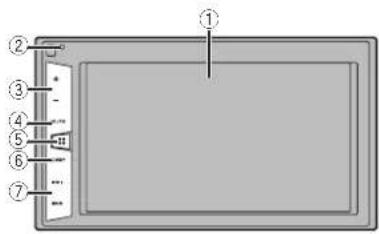
Checking part names and functions
text_image
Diagram of a device with numbered components and labeled parts, likely illustrating a physical or engineering setup.| 1 LCD screen | ||
| 2 RESET button | Resetting the microprocessor on page 6 | |
| 3 Volume (+/-) button | ||
| 4 MUTE button | Press to switch the mute setting to on or off. | |
| 5 button | Press to switch the display between the top menu screen and the current source screen. | |
| 6 DISP button | Press to turn the display on or off. | |
| 7 Track (|◀◀▶▶) button | Performs manual seek tuning, fast forwards, reverse and track search controls. Press to answer or end a call. | |
Remote control
The remote control CD-R33 is sold separately. For details concerning operations, see the remote control manual.
Plugging and unplugging a USB storage device
This product may not achieve optimum performance with some USB storage devices.
- Connection via a USB hub is not possible.
- A USB cable is required for connection.
1 Pull out the plug from the USB port of the USB cable.
2 Plug a USB storage device into the USB cable.
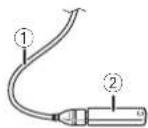
① USB cable
② USB storage device
☐ Check that no data is being accessed before pulling out the USB storage device.
On first-time startup
1 Start the engine to boot up the system.
After a short pause, the splash screen comes on for a few seconds.
The "Select Program Language" screen appears.
From the second time on, the screen shown will differ depending on the previous conditions.
2 Touch the language that you want to use on screen.
3 Touch →.
The top menu screen appears.
Basic operation
How to use the screens
text_image
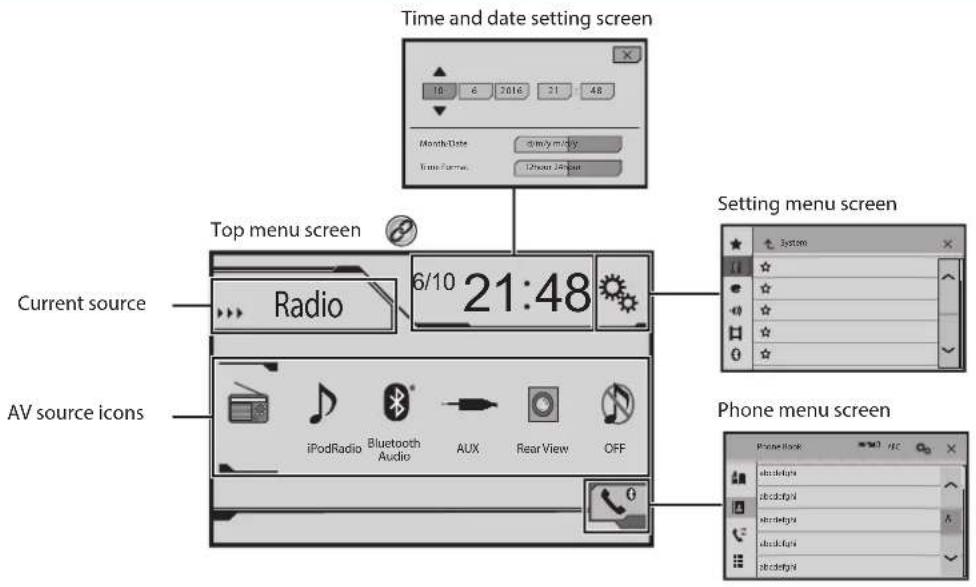
Time and date setting screen 10 6 2016 21 48 Month Date: empty mice Time Frame: 12 Hour 24 Hour Top menu screen 6/10 21:48 Current source Radio AV source icons iPodRadio Bluetooth Audio AUX Rear View OFF Setting menu screen System Phone menu screen
By pressing the ■ button on any screen you can display the Top menu screen.
Basic operation
Supported AV source
You can play or use the following sources with this product.
Radio
• ROM (compressed audio files)
The following sources can be played back or used by connecting an auxiliary device.
USB
Pod
- Bluetooth audio
• AUX
Selecting a source
Source on the Top menu screen
1 Press : : .
2 Touch the source icon you want to select.
☐ When you select "OFF", the AV source is turned off.
Source on the source list
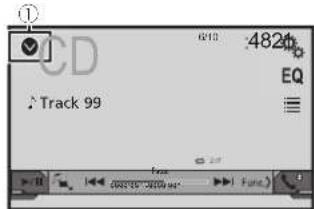
1 Display the source list.
text_image
CD Track 99 4824h EQ 0:13 0:13 0:13 0:13 0:13 0:13 0:13 0:13 0:13 0:13 0:13 0:13 0:13 0:13 0:13 0:13 0:13 0:13 0:13 0:13 0:15 0:15 0:15 0:15 0:15 0:15 0:15 0:15 0:15 0:15 0:15 0:15 0:15 0:15 0:15 0:15 0:15 0:15 0:15 0:15 0:16 0:16 0:16 0:16 0:16 0:16 0:16 0:16 0:16 0:16 0:16 0:16 0:16 0:16 0:16 0:16 0:16 0:16 0:16 0:16 0:17 0:17 0:17 0:17 0:17 0:17 0:17 0:17 0:17 0:17 0:17 0:17 0:17 0:17 0:17 0:17 0:17 0:17 0:17 0:17 0:18 0:18 0:18 0:18 0:18 0:18 0:18 0:18 0:18 0:18 0:18 0:18 0:18 0:18 0:18 0:18 0:18 0:18 0:18 0:18 0:19 0:19 0:19 0:19 0:19 0:19 0:19 0:19 0:19 0:19 0:20① Displays the source list.
2 Touch the source key you want to select.
☐ When you select "OFF", the AV source is turned off.
Using the touch panel
You can operate this product by touching the keys on the screen directly with your fingers.
To protect the LCD screen from damage, be sure to touch the screen only with your finger gently.
Using the common touch panel keys
• :Turns to the previous screen.
- X: Closes the screen.
Operating list screens
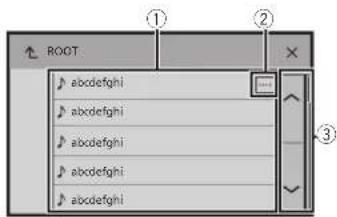
text_image
ROOT ① ② ③① Touching an item on the list allows you to narrow down the options and proceed to the next operation.
② Appears when all characters are not displayed on the display area.
If you touch the key, the rest are scrolled for display.
③ Appears when items cannot be displayed on a single page. Touch ▲ or ▼ view any hidden items.
Operating the time bar
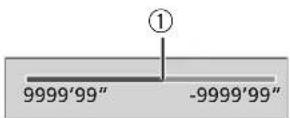
① You can change the playback point by dragging the key.
This function is not available when the Bluetooth Audio is selected as the AV source.
Switching the operation panel
1 : Switches the operation panel of AV sources.
This key is not available on all sources.
Registration and connection of Bluetooth device
Displaying the "Bluetooth" screen
1 Press
2 Touch, and then 0
The "Bluetooth" screen appears.
Registering your Bluetooth devices
If three devices are already paired, "Memory Full" is displayed. Delete a paired device first.
- Deleting a registered device on page 10
1 Activate the Bluetooth wireless technology on your devices.
2 Display the "Bluetooth" screen.
- Displaying the "Bluetooth" screen on page 10
3 Touch [Connection].
4 Touch Q.
The system searches for Bluetooth devices waiting for a connection and displays them in the list if a device is found.
5 Touch the Bluetooth device name you want to register.
☐ If your device supports SSP (Secure Simple Pairing), a six-digit number appears on the display of this product. Touch |Yes to pair the device.
Once the connection is established, the device name is displayed. Touch the device name to disconnect. After the device is successfully registered, a Bluetooth connection is established from the system.
☐ The Bluetooth connection can be also made by detecting this product from the Bluetooth device. Before registration, make sure that "Visibility" in the "Bluetooth" menu is set to "On". For details on a Bluetooth device operations, refer to the operating instructions supplied with the Bluetooth device.
Switching visibility on page 10
Connecting to a Bluetooth device automatically
This function connects the last connected Bluetooth device to this product automatically as soon as the two devices are less than a few meters apart.
1 Display the "Bluetooth" screen.
- Displaying the "Bluetooth" screen on page 10
2 Touch [Auto Connect] to switch "On" (default) or "Off".
Deleting a registered device
CAUTION
Never turn this product off while the paired Bluetooth device is being deleted.
1 Display the "Bluetooth" screen.
- Displaying the "Bluetooth" screen on page 10
2 Touch [Connection].
3 Touch
Connecting a registered Bluetooth device manually
Connect the Bluetooth device manually in the following cases:
- Two or more Bluetooth devices are registered, and you want to manually select the device to be used.
- You want to reconnect a disconnected Bluetooth device.
- Connect on cannot be established automatically for some reason.
1 Activate the Bluetooth wireless technology on your devices.
2 Display the "Bluetooth" screen.
- Displaying the "Bluetooth" screen on page 10
3 Touch [Connection].
4 Touch the name of the device that you want to connect.
Switching visibility
This function sets whether or not to make this product visible to the other device.
1 Display the "Bluetooth" screen.
- Displaying the "Bluetooth" screen on page 10
2 Touch [Visibility] to switch "On" (default) or "Off".
Entering the PIN code for Bluetooth wireless connection
To connect your Bluetooth device to this product, you need to enter a PIN code. You can change the PIN code with this function.
1 Display the "Bluetooth" screen.
- Displaying the "Bluetooth" screen on page 10
2 Touch [PIN Code Input].
3 Touch [0] to [9] to input the pin code (up to 8 -digits).
4 Touch
☐ The default PIN code is "0000".
Displaying the device information
1 Display the "Bluetooth" screen.
- Displaying the "Bluetooth" screen on page 10
2 Touch [Device Information].
The device name and address of the Bluetooth device and this product are displayed.
Clearing the Bluetooth memory
☐ This setting is available only when you stop your vehicle in a safe place and apply the parking brake.
CAUTION
Never turn this product off while the Bluetooth memory is being cleared.
1 Display the "Bluetooth" screen.
- Displaying the "Bluetooth" screen on page 10
Registration and connection of Bluetooth device
2 Touch [Bluetooth Memory Clear].
3 Touch [Clear].
The confirmat on screen appears
Updating Bluetooth software
This function is used to update this product with the latest Bluetooth software. For details on Bluetooth software and updating, refer to our website.
☐ The source is turned off and the Bluetooth connection is disconnected before the process starts.
☐ This setting is available only when you stop your vehicle in a safe place and apply the parking brake.
☐ You need to store the version up file to the USB storage device in advance.
CAUTION
Never turn this product off and never disconnect the phone while the software is being updated.
1 Connect the USB storage device stored the version update file to this unit.
- Plugging and unplugging a USB storage device on page 7
2 Display the "Bluetooth" screen.
- Displaying the "Bluetooth" screen on page 10
3 Touch [BT Software Update].
4 Touch [Start].
Follow the on-screen instructions to finish updating the Bluetooth software.
Displaying the Bluetooth software version
If this product fails to operate properly, you may need to consult your dealer for repair.
In such cases, perform the following procedure to check the software version on this unit.
1 Display the "Bluetooth" screen.
- Displaying the "Bluetooth" screen on page 10
2 Touch [BT Version Info].
The version of this product's Bluetooth module appears.
Hands-free phoning
Bluetooth telephone connected indicator
The device number of the connected device is displayed.
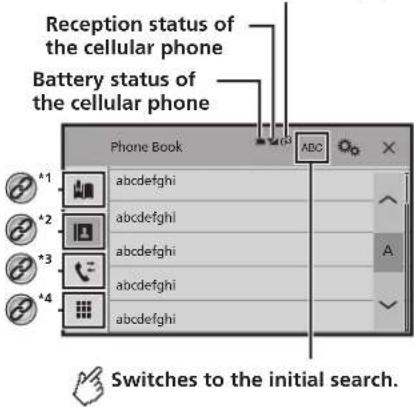
text_image
Reception status of the cellular phone Battery status of the cellular phone Phone Book *1 abcdefghi *2 abcdefghi *3 abcdefghi *4 abcdefghi Switches to the initial search.*1 Displays the preset dial screen.
Using the preset dial lists on page 17
*7 Switches to the phone book list.
Calling a number in the phone book on page 1
*2 Switches to the missed, received and dialed call lists.
Dialing from the history on page 12
*4 Switches the mode to enter the phone number directly.
Direct dialing on page 1
CAUTION
For your safety, avoid talking on the phone as much as possible while driving. To use this function you need to connect your cellular phone to this product via Bluetooth in advance.
Registration and connection of Bluetooth device on page 10
Displaying the Phone menu screen
1 Press ■.
2 Touch
The Phone menu screen appears.
Making a phone call
You can make a phone call in many different ways.
Direct dialing
1 Display the "Phone menu" screen.
- Displaying the Phone menu screen on page 11
2 Touch
3 Touch the number keys to enter the phone number.
4 Touch ☑ to make a call.
5 Touch to end the call.
☐ You may hear a noise when you hang up the phone.
Calling a number in the phone book
The contacts on your phone will be automatically transferred to this product.
- "Visibility" of the "Bluetooth" screen should be on.
Switching visibility on page 10
1 Display the "Phone menu" screen.
- Displaying the Phone menu screen on page 11
2 Touch
3 Touch the desired name on the list.
4 Touch the phone number you want to dial.
The dial screen appears and dialing starts.
5 Touch to end the call.
Hands-free phoning
Dialing from the history
1 Display the "Phone menu" screen.
- Displaying the Phone menu screen on page 11
2 Touch
3 Touch the item to switch the history list.
The following items are available:
Received call list
Dialed call list
Missed call list
4 Touch the desired entry on the list to make a call.
The dial screen appears and dialing starts.
5 Touch to end the call.
Using the preset dial lists
Registering a phone number
You can easily store up to six phone numbers per device as presets.
1 Display the "Phone menu" screen.
- Displaying the Phone menu screen on page 11
2 Touch or
On the "Phone Book" screen, touch the desired name.
3 Touch
Dialing from the preset dial list
1 Display the "Phone menu" screen.
- Displaying the Phone menu screen on page 11
2 Touch
3 Touch the desired item you want to dial.
The dial screen appears and dialing starts.
Receiving a phone call
1 Touch 📄 to answer the call.
■ If you touch ☐ while getting a call waiting, you can switch to the talking person.
■ Touch 📞 to reject the call.
2 Touch to end the call.
Changing the phone settings
Answering a call automatically
1 Display the "Bluetooth" screen.
- Displaying the "Bluetooth" screen on page 10
2 Touch [Auto Answer] to switch "On" or "Off" (default).
Switching the ring tone
You can select whether or not to use this product's ring tone.
1 Display the "Bluetooth" screen.
- Displaying the "Bluetooth" screen on page 10
2 Touch [Ring Tone] to switch "On" (default) or "Off".
Inverting names in the phone book
1 Display the "Bluetooth" screen.
- Displaying the "Bluetooth" screen on page 10
2 Touch [Invert Name].
Setting the private mode
During a conversation, you can switch to private mode (talk directly on your cellular phone).
1 Touch 📄 or to turn private mode on or off.
Adjusting the other party's listening volume
This product can be adjusted to the other party's listening volume.
1 Touch 📄 to switch between the three volume levels.
☐ Settings can be stored for each device.
Notes for hands-free phoning
General notes
- Connection to all cellular phones featuring Bluetooth wire less technology is not guaranteed.
- The line-of-sight distance between this product and your cellular phone must be 10 meters or less when sending and receiving voice and data via Bluetooth technology.
- With some cellular phones, the ring sound may not be output from the speakers.
- If private mode is selected on the cellular phone, hands-free phoning may be disabled.
Registration and connection
- Cellular phone operations vary depending on the type of cellular phone. Refer to the instruction manual that came with your cellular phone for detailed instructions.
- When phone book transfer does not work, disconnect your phone and then perform pairing again from your phone to this product.
Making and receiving calls
- You may hear a noise in the following situations:
— When you answer the phone using the button on the phone.
— When the person on the other end of the line hangs up the phone.
- If the person on the other end of the line cannot hear the conversal on due to an echo, decrease the volume level for hands-free phoning.
- With some cellular phones, even after you press the accept button on the cellular phone when a call comes in, hands-free phoring may not be performed.
- The registered name will appear if the phone number is already registered in the phone book. When one phone number is registered under different names, only the phone number will be displayed.
Hands-free phoning
The received call and the dialed number histories
- You cannot make a call to the entry of an unknown user (no phone number) in the received call history.
- If calls are made by operating your cellular phone, no history data will be recorded in this product.
Phone book transfers
- If there are more than 1 000 phone book entries on your cellular phone, not all entries may download completely.
● Depending on the phone, this product may not display the phone book correctly. - If the phone book in the phone contains image data, the phone book may not be transferred correctly.
● Depending on the cellular phone, phone book transfer may not be available.
Setup for iPod
When using an iPod with this product, configure the settings of this product according to the device to be connected.
iPod compatibility
This product supports only the following iPod models and iPod software versions. Others may not work correctly.
- iPhone 4, 4s, 5, 5c, 5s, 6, 6 Plus, 6s, 6s Plus: iOS 7.0 or later. - iPhone 3GS: iOS 6.0.1
- iPod touch (4th, 5th generation): iOS 6.0.1
- iPod touch (3rd generation): iOS 5.1.1
- iPod touch (2nd generation); iOS 4.2.1
- iPod classic 160GB (2009); Ver. 2.0.4
- iPod classic 160GB (2008): Ver. 2.0.1
- iPod classic 80GB: Ver. 1.1.2
- iPod nano (7th generation)
- iPod nano (6th generation): Ver. 1.2
- iPod nano (5th generation): Ver. 1.0.2
- iPod nano (4th generation): Ver. 1.0.4
- iPod nano (3rd generation): Ver. 1.1.3
You can connect and control an iPod compatible with this product by using separately sold connector cables.
☐ Operation methods may vary depending on the iPod model and the software version.
Depending on the software version of the iPod, it may not be compatible with this product.
For details about iPod compatibility with this product, refer to the information on our website.
This manual applies to the following iPod models. iPod with 30-pin connector
iPhone 3GS, 4, 4s
- iPod touch 2nd, 3rd, 4th generation
- iPod classic 80GB, 160GB
- iPod nano 3rd, 4th, 5th, 6th generation
iPod with Lightning connector
- iPhone 6s, 6s Plus
iPhone 6, 6 Plus
iPhone 5, 5s, 5c - iPod touch 5th generation
- iPod nano 7th generation
Information on the connections and functions
The settings and cables required for connecting each device, and the available sources are as follows.
iPod / iPhone with a 30-pin connector
When connecting via CD-IU201V (sold separately)
Available sources
iPod (audio)
iPod (video)
iPod / iPhone with a Lightning connector
When connecting via CD-IU52 (sold separately)
Available sources
iPod (audio)
Radio
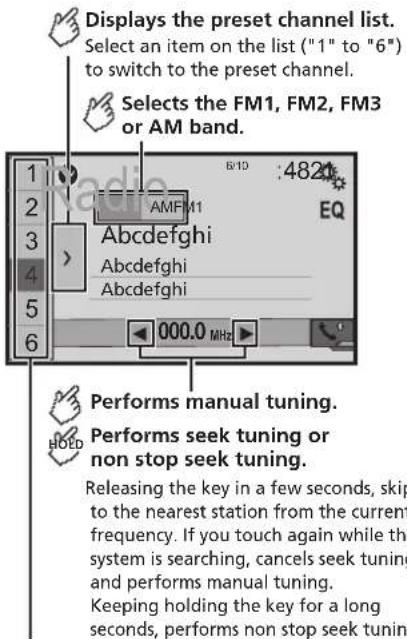
text_image
Displays the preset channel list. Select an item on the list ("1" to "6") to switch to the preset channel. Selects the FM1, FM2, FM3 or AM band. 1 2 3 4 5 6 AMFM1 Abcdefghi Abcdefghi Abcdefghi 000.0 MHz 482 EQ Performs manual tuning. Performs seek tuning or non stop seek tuning. Releasing the key in a few seconds, skip to the nearest station from the current frequency. If you touch again while the system is searching, cancels seek tuning and performs manual tuning. Keeping holding the key for a long seconds, performs non stop seek tuning.
Recalls the preset channel stored to a key from memory. Stores the current broadcast frequency to a key.
By pressing ▶▶▶▶▶▶▶▶▶▶▶▶▶▶▶▶▶▶▶▶▶▶▶▶▶▶▶▶▶▶▶▶▶▶▶▶▶▶▶▶▶▶▶▶▶▶▶▶▶▶▶▶▶▶▶▶▶▶▶▶▶▶▶▶▶▶▶▶▶▶▶▶▶▶▶▶▶▶▶▶▶▶▶▶▶▶▶▶▶▶▶▶▶▶▶▶▶▶▶▶▶>
By pressing and hold ◀◀◀ or ▶▶ release, you can also perform seek tuning.
☐ By keeping pressing and holding ▶◀◀ or ▶▶▶ can perform non stop seek tuning. If you press again, non stop seek tuning is canceled and the preset channel is switched.
Starting procedure
1 Press
2 Touch [Radio].
The "Radio" screen appears.
Storing the strongest broadcast frequencies
The BSM (best stations memory) function automatically stores the six strongest broadcast frequencies under the preset tuning keys "1" to "6".
☐ Storing broadcast frequencies with BSM may replace those you have already saved.
- Previously stored broadcast frequencies may remain stored if the number of frequencies stored has not reached the limit.
1 Touch
2 Touch ☐ to begin a search.
While the message is displayed, the six strongest broadcast frequencies will be stored under the preset tuning keys in order of their signal strength.
■ If you touch [Cancel], the storage process is canceled.
Tuning into strong frequencies
7 You can use this function when "Radio" is selected as the source.
Local seek tuning allows you to only tune into those radio stations with sufficiently strong signals.
1 Display the "System" setting screen.
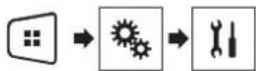
2 Touch [AV Source Settings].
3 Touch [Radio settings].
4 Touch [Local].
5 Touch the item you want to set.
- Off (default):
Turns the seek tuning setting off.
Level1 to Level4:
Sets the level of sensitivity for TM to Level1 to Level4 (for AM Level1 or Level2).
☐ The FM "Level4" (AM "Level2") setting allows reception of only stations with the strongest signals.
Compressed audio files
Displays the artwork when the file with the artwork is being played.
The artwork file type needs to be JPEG, and the file size should be less than 99 KB.
text_image
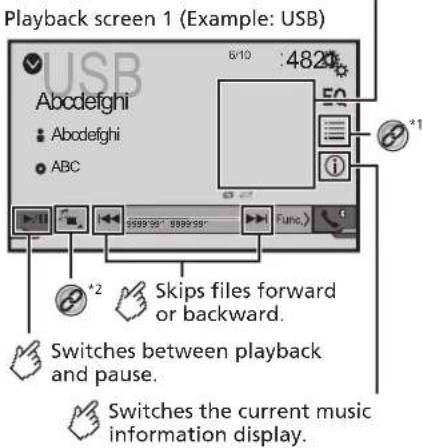
Playback screen 1 (Example: USB) Abcdefghi Abcdefghi ABC 6/10 :4820 50 * *1 *2 Skips files forward or backward. Switches between playback and pause. Switches the current music information display.Plays files in random order.
: Does not play files in random order.
: Plays all files within the repeat range in random order.
Playback screen 2 (Example: USB)
text_image
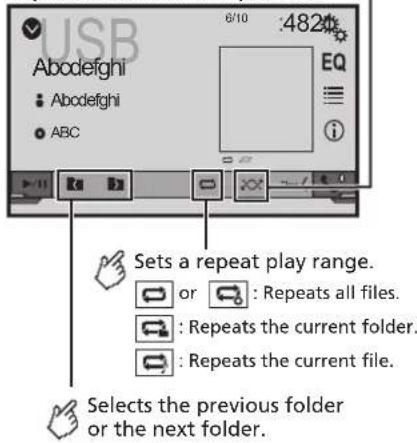
USB Abodefghi • Abodefghi • ABC 6/10 :482# EQ i 11 R3 R2 Set a repeat play range. or : Repeats all files. : Repeats the current folder. : Repeats the current file. Selects the previous folder or the next folder.*1 Selects a file from the list.
Selecting files from the file name list on page 15
Switches the media file type.
Switching the media file type on page 15
By pressing ◀◀◀ or ▶▶ can also skip files forward or backward.
7 By pressing and holding ▶◀◀ or ▶▶▶ can perform fast reverse or fast forward.
You can play compressed audio files stored in a USB storage device.
Media compatibility chart on page 34
Starting procedure
1 Press
2 Plug the USB storage device.
- Plugging and unplugging a USB storage device on page 1
3 Touch [USB].
Play back is performed in order of folder numbers. Folders are skipped if they contain no playable files.
Selecting files from the file name list
You can find files or folders to play back using the file name or folder name list.
1 Touch
2 Touch a file on the list to play back.
- Files are played back in file number order
Switching the media file type
When playing a digital media containing a mixture of various media file types you can switch between media file types to play.
1 Touch
2 Touch the item you want to set.
Music:
Switches the media file type to music (compressed audio).
Video
Switches the media file type to video.
Photo:
Switches the media file type to still image (JPEG or BMP data).
Compressed video files
text_image
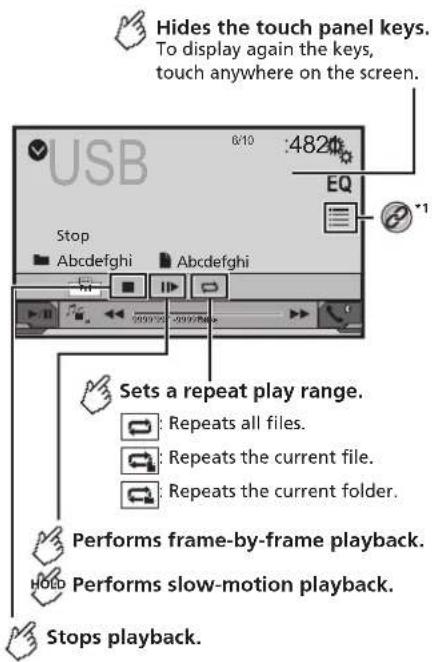
Hides the touch panel keys. To display again the keys, touch anywhere on the screen. Stop Abcdefghi Abcdefghi EQ *1 Sets a repeat play range. : Repeats all files. : Repeats the current file. : Repeats the current folder. Performs frame-by-frame playback. HOLD Performs slow-motion playback. Stops playback.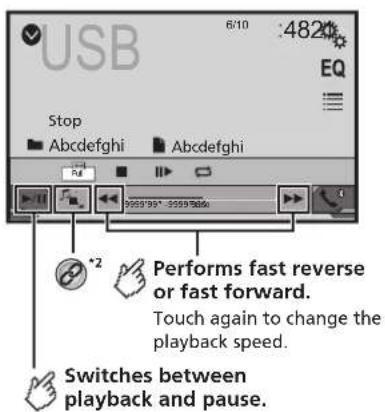
text_image
USB Stop Abcdefghi Abcdefghi *2 Performs fast reverse or fast forward. Touch again to change the playback speed. Switches between playback and pause.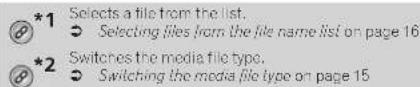
7 By pressing ◀◀◀ or ▶▶▶ can also skip files forward or backward.
By pressing and holding ◀◀◀ or ▶▶ can perform fast reverse or fast forward.
7 Changing the wide screen mode.
Common operations on page 25
You can play compressed video files stored in a USB storage device.
Media compatibility chart on page 34
CAUTION
For safety reasons, video images cannot be viewed while your vehicle is in motion. To view video images, stop in a safe place and apply the parking brake.
Starting procedure
Compressed audio files on page 15
Selecting files from the file name list
You can select files to view using the file name list.
1 Touch
2 Touch a file on the list to play back.
☐ Files are played back in file number order and folders are skipped when they contain no files.
■ Touch the playback sign of the thumbnail to preview the file.
Still image files
text_image
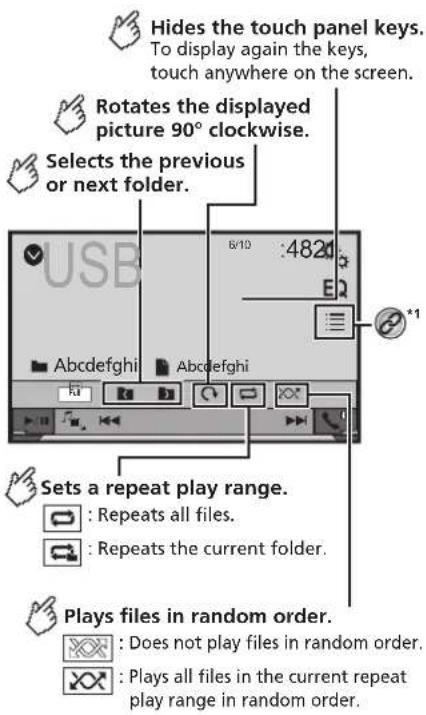
Hides the touch panel keys. To display again the keys, touch anywhere on the screen. Rotates the displayed picture 90° clockwise. Selects the previous or next folder. Sets a repeat play range. : Repeats all files. : Repeats the current folder. Plays files in random order. : Does not play files in random order. : Plays all files in the current repeat play range in random order.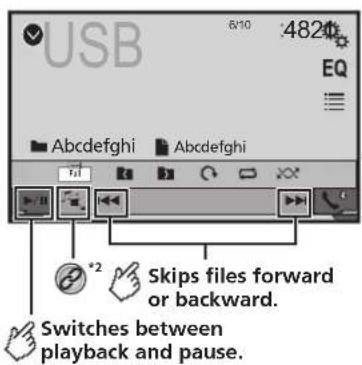
text_image
USB 8/10 482 EQ Abcdefghi Abcdefghi *2 Skips files forward or backward. Switches between playback and pause.
By pressing ◀◀◀ or ▶▶▶ can also skip files forward or backward.
By pressing and holding ▶◀◀ or ▶▶◀ can search 10 files at a time. If the file currently being played is the first or last file in the folder, the search is not performed.
- Changing the wide screen mode.
Common operations on page 25
You can view still images stored in an USB storage device
Media compatibility chart on page 34
Starting procedure
1 Press ■.
2 Plug the USB storage device.
- Plugging and unplugging a USB storage device on page 7
7 Playback is performed in order of folder numbers. Folders are skipped if they contain no playable files.
3 Touch [USB].
The image is displayed on the screen.
Selecting files from the file name list
You can select files to view using the file name list.
1 Touch
2 Touch a file on the list to play back.
☐ Touching a folder on the list shows its contents. You can play a file on the list by touching it.
Switching the media file type
When playing a digital media containing a mixture of various media file types you can switch between media file types to play.
1 Touch
2 Touch the item you want to set.
Music:
Switches the media file type to music (compressed audio).
Video
Switches the media file type to video.
- Photo:
Switches the media file type to still image (JPEG data).
Setting the slideshow interval
JPEG or BMP files can be viewed as a slide show on this product. In this setting, the interval between each image can be set.
This setting is available during playback of the JPEG or BMP files.
1 Display the "Video Setup" screen.

2 Touch [Time Per Photo Slide].
3 Touch the item you want to set.
The following items are available:
"10sec" (default), "5sec", "15sec", "Manual".
iPod
Audio source screen 1
text_image
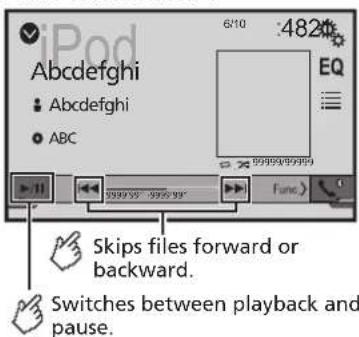
iPod 6/10 :482# ABC Skip files forward or backward. Switches between playback and pause.Sets a shuffle play.
: Plays randomly songs or videos within the selected list.
: Plays album randomly.
Audio source screen 2
text_image
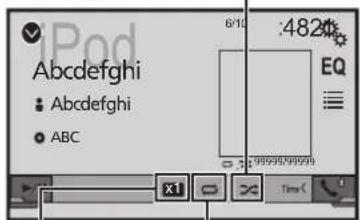
iPod Abcdefghi • Abcdefghi • ABC 6/10 :482# EQ X1 Time:Sets a repeat play range.
: Repeats all in the selected list.
: Repeats the current song or video.
Changes the audiobook speed.
×1 : Normal playback
×2 : Fast playback
×1/2 : Slow-motion playback
Video source screen
text_image
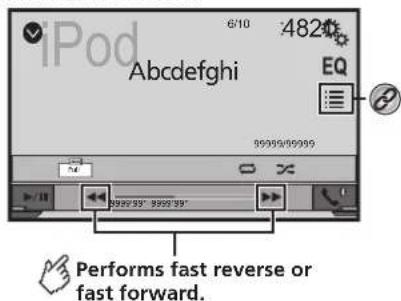
iPod 6/10 482 Abdefghi EQ 99999/99999 Performs fast reverse or fast forward.Selects a track from the list
- Selecting song or video sources from the playlist screen on page 19
By pressing the ◀◀◀ or ▶▶▶bn, you can also skip files forward or backward.
□ By pressing and hold the ◀◀◀ or ▶◀◀, you can also perform fast reverse or fast forward.
□ Changing the wide screen mode
Common operations on page 25
Connecting your iPod
For iPod with a 30-pin connector users
V a USB cable
☐ Depending on your iPod, a USB interface cable for iPod / iPhone (CD-IU201V) (sold separately), is required to connect. iPod audio and/or video sources are enabled if either of the cables is connected.
- iPod / iPhone with 30-pin connector on page 29
For iPod / iPhone with a Lightning connector users
Via USB cable
☐ With a USB interface cable for iPod/iPhone (CD-IU52) (sold separately), iPod audio source is available.
However, functions related to iPod video files are not available.
- iPod / iPhone with Lightning connector on page 29
CAUTION
For safety reasons, video images cannot be viewed while your vehicle is in motion. To view video images, stop in a safe place
iPod
and apply the parking brake.
Starting procedure
1 Connect your iPod.
Connecting your iPod on page 18
The source changes and then playback will start.
If connecting an iPhone or iPod touch, quit applications before.
2 Press
3 Touch [iPod].
Selecting song or video sources from the playlist screen
You can search for the song or video you want to play from the playlist screen.
1 Touch
2 Touch ☐ or ☐ to switch the music or video category list.
3 Touch the category you want to search for.
4 Touch the title of the list that you want to play. If you can not find the desired song or video, try to search again according to the above steps.
5 Start playback of the selected list.
☐ Depending on the generation or version of the iPod, some functions may not be available.
☐ You can play playlists created with the MusicSphere application. The application is available on our website.
☐ Up to 1 000 items can be displayed in the list.
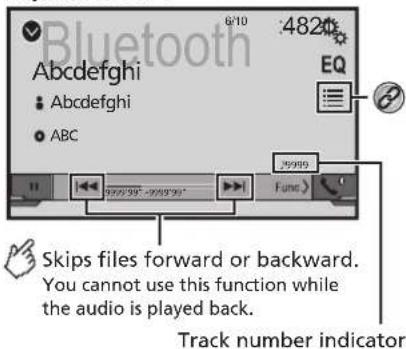
Playback screen 1
text_image
Bluetooth 6/10 482 ABC EQ NBC NBC NBC NBC NBC NBC NBC NBC NBC NBC NBC NBC NBC NBC NBC NBC NBC NBC NBC NBC NBC NBC NBC NBC NBC NBC NBC NBC NBC NBC NBC NBC NBC NBC NBC NBC NBC NBC NBC NBC NBC NBC NBC NBC NBC NBC NBC NBC NBC NBC NBC NBC NBC NBC NBC NBC NBC NBC NBC NBC NBC NBC NBC NBC NBC NBC NBC NBC NBC NBC NBC NBC NBC NBC NBC NBC NBC NBC NBC NBC NBC NBC NBC NBC NBC NBC NBC NBC NBC NBC NBC NBC NBC NBC NBC NBC NBC NBC NBC NBC NIC Track number indicator Skips files forward or backward. You cannot use this function while the audio is played back.
Plays files in random order.
text_image
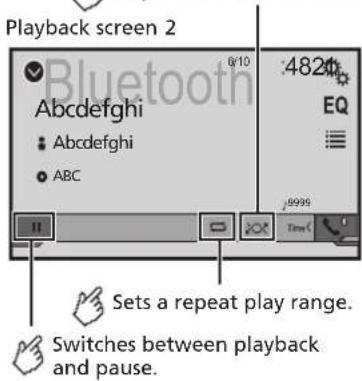
Playback screen 2 Bluetooth 0x10 482 ABC EQ 9999 Sets a repeat play range. Switches between playback and pause.
Selects a file from the list.
- Selecting files from the file name list on page 19
By pressing the ◀◀◀ or ▶▶▶bn, you can also skip files forward or backward.
Bluetooth audio player
By pressing and hold the ◀◀◀ or ▶▶▶▶, you can also perform fast reverse or fast forward.
Before using the Bluetooth audio player, register and connect the device to this product.
Registering your Bluetooth devices on page 10
☐ Depending on the Bluetooth device connected to this product, the available operations with this product may be limited or differ from the descriptions in this manual.
While you are listening to songs on your Bluelcoth device, please refrain from operating the phone function as much as possible. If you try operating, the signal may cause noise for song playback.
☐ When you are talking on the Bluetooth device connected to this product via Bluetooth, it may pause playback.
Starting procedure
1 Display the "System" setting screen.
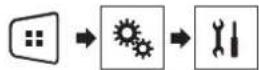
2 Touch [AV Source Settings].
3 Confirm that "Bluetooth Audio" is turned on.
4 Press
5 Touch [Bluetooth Audio].
Selecting files from the file name list
☐ This function may not be available depending on some Bluetooth device.
1 Touch
2 Touch a file or a folder on the list to play back.
AUX source System settings

Hides the touch panel keys.
To display again the keys, touch anywhere on the screen.
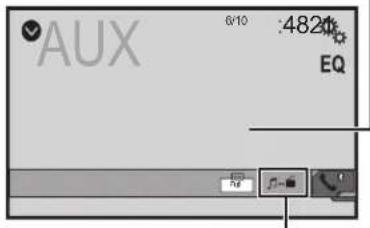
text_image
AUX 6/10 :482Ω EQ
Switches between the screen to operate video files and that to operate music files.
isfely available when there are both audio and video files on the auxiliary equipment.
☐ A Mini-jack AW cable (CD-RM10) (so-d separately) is required for connection.
External video component and the display on page 30
CAUTION
For safety reasons, video images cannot be viewed while your vehicle is in motion. To view video images, stop in a safe place and apply the parking brake.
Starting procedure
You can display the video image output by the device connected to video input.
1 Display the "System" setting screen.
2 Confirm that "AUX Input" is turned on.
3 Press ■.
4 Touch [AUX].
The image is displayed on the screen.
Setting the video signal
When you connect this product to an AUX equipment, select the suitable video signal setting.
You can operate this function only for the video signal input into the AUX input.
1 Display the "Video Setup" screen.

2 Touch [Video Signal Setting].
3 Touch [AUX].
4 Touch the item you want to set.
The following items are available:
Auto (default), PAL, NTSC, PAL-M, PAL-N, SECAM
Displaying the "System" setting screen
1 Press ■.
2 Touch %, and then .Xi
The 'System' setting screen appears.
Activating the Bluetooth audio source
1 Display the "System" setting screen.
- Displaying the "System" setting screen on page 20
2 Touch [AV Source Settings].
3 Touch [Bluetooth Audio] to switch "On" (default) or "Off".
Setting the ever scroll
When "Ever Scroll" is set to "On", the recorded text information scrolls continuously in the display while the vehicle is slopped.
1 Display the "System" setting screen.
- Displaying the "System" setting screen on page 20
2 Touch [Ever Scroll] to switch "On" or "Off" (default).
Setting the rear view camera
A separately sold rear view camera (e.g. ND-BC8) is required for utilizing the rear view camera function. (For details, consult your dealer.)
Rear view camera
This product features a function that automatically switches to the full-screen image of the rear view camera installed on your vehicle, when the shift lever is in the REVERSE (R) position.
Camera for Rear View mode
Rear View can be displayed at all times. Please note that with this setting, the camera image is not resized to fit, and that a portion of what is seen by the camera is not viewable.
CAUTION
Pioneer recommends the use of a camera which outputs mirror reversed images, otherwise the screen image may appear reversed.
System settings
Immediately verify whether the display changes to a rear view camera image when the shift lever is moved to REVERSE (R) from another position.
☐ When the screen changes to full-screen rear view camera image during normal driving, switch to the opposite setting in "Camera Polarity".
☐ If you touch ☑ while the camera image is displayed, the displayed image will turn off temporarily.
Setting rear view camera activation
1 Display the "System" setting screen.
- Displaying the "System" setting screen on page 20
2 Touch [Camera Settings].
3 Touch [Back Camera Input] to switch "On" or "Off" (default).
Setting the polarity of the rear view camera
This function is available when "Back Camera Input" is "On".
Setting rear view camera activation on page 21
1 Display the "System" setting screen.
- Displaying the "System" selling screen on page 20
2 Touch [Camera Settings].
3 Touch [Camera Polarity].
- Battery (default): The polarity of the connected lead is positive.
• Ground: The polarity of the connected lead is negative.
Setting the camera for Rear View mode
To display "Rear View" at all times, "Rear View" needs to be set to "On".
1 Press ■.
2 Touch [Rear View] to switch "On" or "Off" (default).
If no operations are performed for seven seconds on the AV operation screen, the camera view will appear automatically.
7 to set the rear view camera for Rear View mode, set "Back Camera Input" to "On".
Setting rear view camera activation on page 21
Selecting the system language
- If the embedded language and the selected language setting are not the same, text information may not display properly.
- Some characters may not be displayed properly.
1 Display the "System" setting screen. - Displaying the "System" setting screen on page 20
2 Touch [System Language].
3 Touch the language that you want to use.
Setting the beep sound
1 Display the "System" setting screen.
- Displaying the "System" setting screen on page 20
2 Touch [Beep Tone] to switch "On"(default) or "Off".
Adjusting the response positions of the touch panel (touch panel calibration)
If you feel that the touch panel keys on the screen deviate from the actual positions that respond to your touch, adjust the response positions of the touch panel screen.
This setting is available only when you stop your vehicle in a safe place and apply the parking brake.
Do not use sharp pointed tools such as a balloon or mechanical pen, which could damage the screen.
Do not turn off the engine while saving the adjusted position data.
1 Display the "System" setting screen.
- Displaying the "System" setting screen on page 20
2 Touch [Touch Panel Calibration].
3 Touch [Yes].
4 Touch four corners of the screen along the arrows.
5 Press
The adjustment results are saved.
6 Press ■ once again.
Proceed to 16-point adjustment.
7 Gently touch the center of the "+" mark displayed on the screen.
The target indicates the order.
- When you press, the previous adjustment position returns.
- When you press and hold ■, the adjustment is canceled.
8 Press and hold
The adjustment results are saved.
Setting the dimmer
Setting the dimmer trigger
This setting is available only when you stop your vehicle in a safe place and apply the parking brake.
1 Display the "System" setting screen.
- Displaying the "System" setting screen on page 20
2 Touch [Dimmer Settings].
3 Touch [Dimmer Trigger].
4 Touch the item.
- Auto (default):
Switches the dimmer to on or off automatically according to your vehicle's headlight turning on or off.
- Manual:
Switches the dimmer to on or off manually.
Time:
Switches the dimmer to on or off at the time you adjusted.
Setting the dimmer duration in day or night
☐ You can use this function when "Dimmer Trigger" is set to "Manual".
☐ This setting is available only when you stop your vehicle in a safe place and apply the parking brake.
1 Display the "System" setting screen.
- Displaying the "System" setting screen on page 20
System settings
2 Touch [Dimmer Settings].
3 Touch [Day/Night] to switch the following items.
Day (default): Turns the dimmer manually to off.
• Night:
Turns the dimmer manually to on.
Setting the dimmer duration optional
You can adjust the time that the dimmer is turned on or off.
☐ You can use this function when "Dimmer Trigger" is set to "Time".
☐ This selling is available only when you stop your vehicle in a safe place and apply the parking brake.
1 Display the "System" setting screen.
- Displaying the "System" setting screen on page 20
2 Touch [Dimmer Settings].
3 Touch [Dimmer Duration]. The "Duration Setting" screen appears.
4 Touch the time display to activate the adjustment mode.
5 Touch the graph to set the dimmer duration.
- You can also set the dimmer duration touching or ▶ Each touch of ▶ or ▶ moves the cursor backward or forward in the 15 minute width.
- The default setting is 18:00-6:00 (6:00 PM-6:00 AM).
- When the cursors are placed on the same point, the dimmer available time is 0 hours.
- When the cursor for off time setting is placed on the left end and the cursor for on time setting is placed on the right end, the dimmer available time is 0 hours.
- When the cursor for on time setting is placed on the left end and the cursor for off time setting is placed on the right end, the dimmer available time is 24 hours.
■ The time display of the dimmer duration adjusting bar is depending on the clock display setting.
Setting the time and date on page 25
Adjusting the picture
You can adjust the picture for each source and rear view camera.
CAUTION
For safety reasons, you cannot use some of these functions while your vehicle is in motion. To enable these functions, you must stop in a safe place and apply the parking brake. Refer to Important Information for the User (a separate manual).
1 Display the screen you wish to adjust.
2 Display the "System" setting screen.
- Displaying the "System" setting screen on page 20
3 Touch [Picture Adjustment].
4 Touch the item to select the function to be adjusted.
- Brightness:
Adjusts the black intensity. (-24 to +24)
Contrast:
Adjusts the contrast. (-24 to -24)
Color
Adjusts the color saturation. (-24 to +24)
- Hue:
Adjusts the tone of color (which color is emphasized, red or green). (-24 to +24)
- Dimmer: Adjusts the brightness of the display. (+1 to -48)
■ With some pictures, you cannot adjust Hue and Color.
- When you touch [Rear View], the mode changes to the picture adjustment for rear view. By touching [Source], you can return to the picture adjustment for AV source.
- The adjustments of "Brightness", "Contrast" and "Dimmer" are stored separately when your vehicle's headlights are off (daytime) and on (nighttime).
-
"Brightness" and "Contrast" are switched automatically depending on whether the vehicle's headlights are on or off.
-
"Dimmer" can be changed the setting or the time to switch it to on or off.
Setting the dimmer on page 21
■ The setting contents can be memorized separately.
Audio adjustments
Displaying the "Audio" setting screen
1 Press
2 Touch ⚙, and then Ⓞ
The "Audio" setting screen appears
Using fader/balance adjustment
☐ This function is available when "Rear Speaker Output" is set to "Full", and "Preout" is set to "Rear".
1 Display the "Audio" setting screen.
- Displaying the "Audio" setting screen on page 23
2 Touch [Fader/Balance].
3 Touch ▲ or ▼o adjust the front/rear speaker balance.
4 Touch ▶ or □ to adjust the left/right speaker balance.
☐ "Front15" to "Rear15" is displayed as the front/rear speaker balance moves from the front to rear.
☐ "Left15" to "Right15" is displayed as the left/right speaker balance moves from the left to right.
The default setting is "F/R 0 L/R 0".
- You can also set the fader/balance by touching the point on the displayed table.
Using balance adjustment
This function is available when "Rear Speaker Output" and "Precout" are set to "Subwoofer Settings".
1 Display the "Audio" setting screen.
- Displaying the "Audio" setting screen on page 23
2 Touch [Balance].
3 Touch ▶ or ▶ to adjust the left/right speaker balance.
☐ "Left15" to "Right15" is displayed as the left/right speaker balance moves from the left to right.
The default setting is "L/R 0"
- You can also set the balance by touching the point on the displayed table.
Adjusting source levels
SLA (source level adjustment) lets you adjust the volume level of each source to prevent radical changes in volume when switching between sources.
☐ Settings are based on the FM tuner volume level, which remains unchanged.
This function is not available when the FM tuner is selected as the AV source.
1 Compare the FM tuner volume level with the level of the source you want to adjust.
2 Display the "Audio" setting screen.
- Displaying the "Audio" setting screen on page 23
3 Touch [Source Level Adjuster].
4 Touch ▲ or ▼ to adjust the source volume.
If you directly touch the area where the cursor can be moved the SLA setting will be changed to the value of the touched point.
7 '+4' to '-4' is displayed as the source volume is increased or decreased.
The default setting is "0".
Adjusting loudness
This function compensates for deficiencies in the low-frequency and high-frequency ranges at low volume.
This function is not available while you make or receive a call using the hands-free function.
1 Display the "Audio" setting screen.
- Displaying the "Audio" selling screen on page 23
2 Touch [Loudness].
3 Touch the item.
The following items are available:
Off (default), Low, Mid, High.
Using the subwoofer output
This product is equipped with a subwoofer output mechanism, which can be turned on or off.
1 Display the "Audio" setting screen.
- Displaying the "Audio" setting screen on page 23
2 Touch [Subwoofer] to switch "On" (default) or "Off".
Adjusting the subwoofer settings
This function is available only when "Subwoofer" is "On". Using the subwoofer output on page 23
1 Display the "Audio" setting screen.
- Displaying the "Audio" setting screen on page 23
2 Touch [Subwoofer Settings].
3 Touch 🙏 or 📞 turn the subwoofer phase to normal or reverse.
4 Touch ▶ or ▶ adjust the subwoofer level between -24 and 6.
5 Touch ▶ or ▶ adjust the subwoofer frequency.
The following items are available:
80Hz(default), 50Hz, 63Hz, 80Hz, 100Hz, 125Hz.
Switching the rear speaker output
1 Turn the source off.
2 Display the "Audio" setting screen.
- Displaying the "Audio" setting screen on page 23
3 Touch [Rear Speaker Output].
4 Touch to switch "Full" (default) or "Subwoofer".
- When this function is set to "Subwoofer Settings", "Preout" is fixed to "Subwoofer Settings".
Switching the RCA rear output
When "Rear Speaker Output" is set to "Subwoofer Settings", this setting is fixed to "Subwoofer Settings".
1 Display the "Audio" setting screen.
- Displaying the "Audio" setting screen on page 23
2 Touch [Preout] to switch "Subwoofer Settings" (default) or "Rear".
Audio adjustments
Theme menu
Boosting the bass
1 Display the "Audio" setting screen.
- Displaying the "Audio" setting screen on page 23
2 Touch [Bass Booster].
3 Touch to select the bass boost level from 0 to +6.
Setting the high pass filter
1 Display the "Audio" setting screen.
- Displaying the "Audio" setting screen on page 23
2 Touch [High Pass Filter].
3 Touch the item.
The following items are available:
Off(default), 50Hz, 63Hz, 80Hz, 100Hz, 125Hz.
Using the equalizer
Recalling equalizer curves
There are seven stored equalizer curves that you can easily recall at any time. Here is a list of the equalizer curves:
S.Bass is a curve in which only low-pitched sound is boosted.
● Powerful is a curve in which low- and high-pitched sounds are boosted.
● Natural is a curve in which low- and high-pitched sounds are slightly boosted.
● Vocal is a curve in which the midrange, which is the human vocal range, is boosted.
- Flat is a flat curve in which nothing is boosted.
- Custom1 is an adjusted equalizer curve that you create. If you select this curve, the effect is applied to all AV sources
- Custom2 is an adjusted equalizer curve that you create. If you select this curve, the effect is applied to all AV sources.
☐ The default setting is "Powerful"
1 Display the "Audio" setting screen.
- Displaying the "Audio" setting screen on page 23
2 Touch [Graphic EQ]
3 Touch the equalizer you want.
Customizing the equalizer curves
You can adjust the currently selected equalizer curve setting as desired. Adjustments can be made with a 5-band graphic equalizer.
☐ If you make adjustments when a curve "S.Bass", "Powerful" "Natural", "Vocal", or "Flat" is selected, the equalizer curve settings will be changed to "Custom1" mandalorily.
☐ If you make adjustments when the "Custom2" curve is selected for example, the "Custom2" curve will be updated.
- "Custom1" and "Custom2" curves can be created commonly to all sources.
1 Display the "Audio" setting screen.
- Displaying the "Audio" setting screen on page 23
2 Touch [Graphic EQ].
3 Select a curve that you want to use as the basis of customizing.
4 Touch the frequency for which you want to adjust the level.
☐ If you trail a finger across the bars of multiple equalizer bands, the equalizer curve settings will be set to the value of the touched point on each bar.
Selecting the theme color
A theme color can be selected from 3 different colors.
1 Display the "Theme" screen.
2 Touch [Theme].
3 Touch the color you want.
Favorite menu
Registering your favorite menu items in shortcuts allows you to quickly jump to the registered menu screen by a simple touch on the "Favorites" screen.
□ Up to 12 menu items can be registered in the favor to menu.
Creating a shortcut
1 Display the "Settings" screen.

2 Touch the star icon of the menu item that you want to add to the favorite menu. The star icon for the selected menu is filled in.
- To cancel the registration, touch the star icon in the menu column again.
Selecting a shortcut
1 Display the "Favorites" screen.

2 Touch the desired menu item.
Removing a shortcut
1 Display the "Favorites" screen.

2 Touch and hold the favorite menu column you want to remove. The selected menu item is removed from the "Favorites" scre
- You can also remove a shortcut by touching the star icon in the registered menu column.
Common operations
text_image
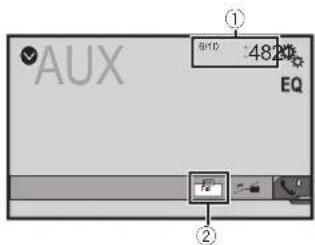
AUX 610 4820 EQ FE ① ②① Clock display
Displays the lime and date selling screen
- Selling the time and date on page 25
② Screen display mode key
Changes the wide screen mode
Changing the wide screen mode on page 25
Setting the time and date
1 Touch the current time on the screen.
2 Touch ▲ or □ to set the correct time and date.
You can operate the following items: Year, month, date, hour, minute.
☐ You can change the time display format to "12hour" (default) or "24hour".
☐ You can change the order of date display format: Day-month year, Month-day-year.
Changing the wide screen mode
You can sell the screen size for the video and JPEG/BMP images.
☐ The default setting is "Full", and for JPEG/BMP images is "Normal".
7 When there are touch panel keys on the screen, images are displayed with the "Full" mode regardless of your setting.
1 Touch the screen display mode key.
The appearance of this key changes according to the current setting.
2 Touch the desired mode.
Full:
A 4:3 picture is enlarged in the horizontal direction only, enabling you to enjoy an image without any omissions.
Zoom
A 4:3 picture is enlarged in the same proportion both vertically and horizontally.
Normal
A 4:3 picture is displayed normally, without changing its proportion.
☐ You cannot operate this function while driving.
☐ Different settings can be stored for each video source.
☐ When a video is viewed in a wide screen mode that does not match its original aspect ratio, it may appear different.
The video image will appear coarser when viewed in 'Zoom' mode.
Other functions Co
Resetting various settings/ Restoring this product to the default settings
You can restore settings or recorded content to the default settings. Various methods are used to clear user data.
Method 1: Remove the vehicle battery
Resets various settings registered to this product.
The settings configured on the "Theme" screen are not reset.
Method 2: Initialize from the "System" menu
Method 3: Press the RESET button
Resetting the microprocessor on page 6
Restoring the default settings
☐ This setting is available only when you stop your vehicle in a safe place and apply the parking brake.
CAUTION
Do not turn off the engine while restoring the settings.
1 Display the "System" setting screen.
2 Touch [Restore Settings].
A message confirming whether to initialize the settings appears.
3 Touch [Restore].
☐ The source is turned off and the Bluetooth connection is disconnected before the process starts.
nection
Precautions
Your new product and this manual
- Do not operate this product, any applications, or the rear view camera option (if purchased) if doing so will divert your attention in any way from the safe operation of your vehicle. Always observe safe driving rules and follow all existing traffic regulations. If you experience difficulty in operating this product or reading the display, park your vehicle in a safe location and apply the parking brake before making the necessary adjustments.
- Do not install this product where it may (i) obstruct the driver's vis on, (ii) impair the performance of any of the vehicle's operating systems of safety features, including airbags, hazard lamp buttons, or (iii) impair the driver's ability to safely operate the vehicle. In some cases, it may not be possible to install this product because of the vehicle type or the shape of the vehicle interior.
● The graphical symbol —— placed on the product means direct current.
Important safeguards
WARNING
Pioneer does not recommend that you install this product yourself. This product is designed for professional installation only. We recommend that only authorized Pioneer service personnel, who have special training and experience in mobile electronics, set up and install this product. NEVER SERVICE THIS PRODUCT YOURSELF. Installing or servicing this product and its connecting cables may expose you to the risk of electric shock or other hazards, and can cause damage to this product that is not covered by warranty.
Precautions before connecting the system
WARNING
Do not take any steps to tamper with or disable the parking brake interlock system which is in place for your protection. Tampering with or disabling the parking brake interlock system could result in serious injury or death.
CAUTION
- Secure all wiring with cable clamps or electrical tape. Do not allow any bare wiring to remain exposed.
- Do not directly connect the yellow lead of this product to the vehicle battery. If the lead is directly connected to the battery, engine vibration may eventually cause the insulation to fail at the point where the wire passes from the passenger compartment into the engine compartment. If the yellow lead's insulation tears as a result of contact with metal parts, short-
circuiting can occur, resulting in considerable danger. - It is extremely dangerous to allow cables to become wound around the steering column or shift lever. Be sure to install this product, its cables, and wiring away in such so that they will not obstruct or hinder driving.
- Make sure that the cables and wires will not interfere with or become caught in any of the vehicle's moving parts, especially the steering wheel, shift lever, parking brake, sliding seat tracks, doors, or any of the vehicle's controls.
- Do not route wires where they will be exposed to high temperatures. If the insulation heats up, wires may become damaged, resulting in a short circuit or malfunction and permanent damage to the product.
- Do not shorten any leads. If you do, the protection circuit (fuse holder, fuse resistor or filter, etc.) may fail to work properly.
- Never feed power to other electronic products by cutting the insulation of the power supply lead of this product and tapping into the lead. The current capacity of the lead will be exceeded, causing overheating.
Before installing this product
- Use this unit with a 12-volt battery and negative grounding only. Failure to do so may result in a fire or malfunction.
- To avoid shorts in the electrical system, be sure to disconnect the (−) battery cable before installation.
To prevent damage
WARNING
- Use speakers over 50 W (output value) and between 4 Ω to 8 Ω (impedance value). Do not use 1 Ω to 3 Ω speakers for this unit.
Connection
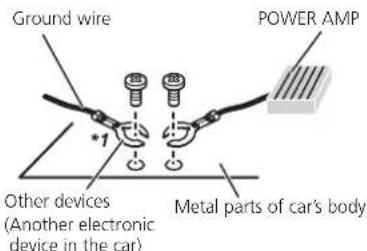
The black cable is ground. When installing this unit or power amp (sold separately), make sure to connect the ground wire first. Ensure that the ground wire is properly connected to metal parts of the car's body. The ground wire of the power amp and the one of this unit or any other device must be connected to the car separately with different screws. If the screw for the ground wire loosens or falls out, it could result in fire generation of smoke or malfunction.
text_image
Ground wire *1 POWER AMP Other devices (Another electronic device in the car) Metal parts of car's body*1 Non supplied for this unit
- When replacing the fuse, be sure to only use a fuse of the rating prescribed on this product.
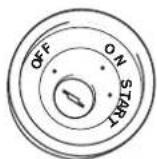
- This product cannot be installed in a vehicle without ACC (accessory) position on the ignition switch.

ACC position No ACC position
- To avoid short-circuiting, cover the disconnected lead with insulating tape. It is especially important to insulate all unused speaker leads, which it left uncovered may cause a short circuit.
- For connecting a power amp or other devices to this product, refer to the manual for the product to be connected.
Notice for the blue/white lead
- When the ignition switch is turned on (ACC ON), a control signal is output through the blue/white lead. Connect to an external power amp's system remote control terminal, the auto-antenna relay control terminal, or the antenna booster power control terminal (max. 300 mA 12 V DC). The control signal is output through the blue/white lead, even if the audio source is switched off.
This product
text_image
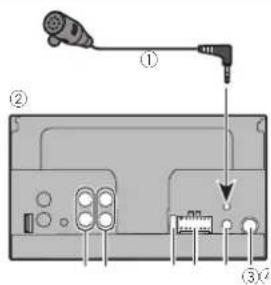
Diagram of an electronic device with labeled ports and connections, including a plug and connector pin① Microphone 3 m (9 ft, 10-1/8 in.)
② This product
③ Antenna jack
④ Wired remote input
Hard-wired remote control adapter can be connected (sold separately).
⑤ Power supply
⑥ Fuse (10 A)
⑦ Front output
⑧ Rear output or subwoofer output
Power cord
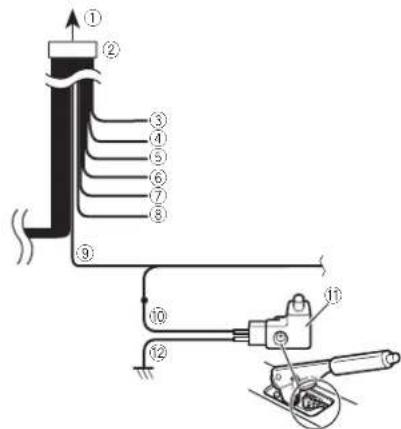
text_image
Technical diagram of a mechanical or electrical device with numbered components and labeled parts① To power supply
② Power cord
③ Yellow
To terminal supplied with power regardless of ignition switch position.
④ Red
To electric terminal controlled by ignition switch (12 V DC) ON/OFF.
⑤ Orange/white
To lighting switch terminal.
⑥ Black (ground)
To vehicle (metal) body.
⑦ Violet/white
Of the two lead wires connected to the back lamp, connect the one in which the voltage changes when the gear shift is in the REVERSE (R) position. This connection enables the unit to sense whether the car is moving forwards or backwards.
③ Blue/white
Connect to system control terminal of the power amp (max. 300 mA 12 V DC).
⑨ Light green
Used to detect the ON/OFF status of the parking brake. This
Connection
lead must be connected to the power supply side of the parking brake switch.
⑩ Power supply side
(1) Parking brake switch
⑫ Ground side
Parking Brake
1 If "Light green" cable is connected to parking brake switch, video image on the display will be controlled by this function.
2 The monitor displays the black screen with warning information to prevent the driver watching video contents during driving.
Speaker leads
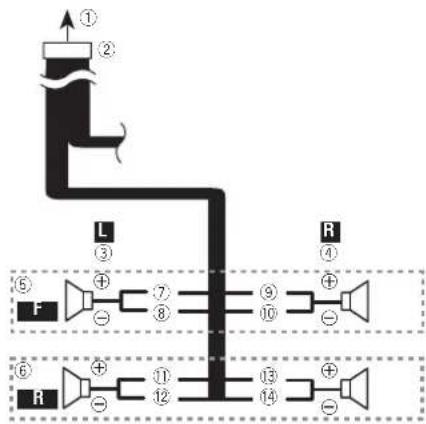
flowchart
graph TD
    A["Port L"] --> B["Port R"]
    B --> C["Port F"]
    C --> D["Port ⑤"]
    D --> E["Port ⑥"]
    E --> F["Port ⑥"]
    F --> G["Port ⑦"]
    G --> H["Port ⑧"]
    H --> I["Port ⑨"]
    I --> J["Port ⑩"]
    J --> K["Port ⑪"]
    K --> L["Port ⑫"]
    L --> M["Port ⑬"]
    M --> N["Port ⑭"]
    N --> O["Port ⑮"]
    O --> P["Port ⑯"]
    P --> Q["Port ⑰"]
    Q --> R["Port ⑱"]
    R --> S["Port ⑲"]
    S --> T["Port ⑳"]
    T --> U["Port ⑴"]
    U --> V["Port ⑤"]
Perform these connections when using a subwoofer without the optional amplifier.
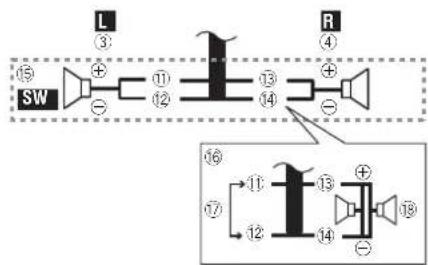
flowchart
graph LR
    SW["SW"] --> L["③"]
    L --> A["⑪"]
    A --> B["⑫"]
    B --> R["④"]
    R --> C["④"]
    C --> D["③"]
    D --> E["②"]
    E --> F["③"]
    F --> G["④"]
    G --> H["③"]
    H --> I["②"]
    I --> J["③"]
    J --> K["④"]
    K --> L["③"]
    L --> L1["③"]
    style SW fill:#f9f,stroke:#333
    style L fill:#ccf,stroke:#333
    style R fill:#cfc,stroke:#333
    style L1 fill:#fcc,stroke:#333
    style L2 fill:#cff,stroke:#333
    style L3 fill:#ffc,stroke:#333
    style L4 fill:#cfc,stroke:#333
    style L5 fill:#fcc,stroke:#333
    style L6 fill:#ffc,stroke:#333
    style L7 fill:#cfc,stroke:#333
    style L8 fill:#fcc,stroke:#333
    style L9 fill:#ffc,stroke:#333
    style L10 fill:#cfc,stroke:#333
    style L11 fill:#fcc,stroke:#333
    style L12 fill:#ffc,stroke:#333
    style L13 fill:#cfc,stroke:#333
    style L14 fill:#fcc,stroke:#333
    style L15 fill:#ffc,stroke:#333
    style L16 fill:#cfc,stroke:#333
    style L17 fill:#fcc,stroke:#333
    style L18 fill:#ffc,stroke:#333
    style L19 fill:#cfc,stroke:#333
    style L20 fill:#fcc,stroke:#333
① To power supply
② Power cord
③ Left
④ Right
⑤ Front speaker
⑥ Rear speaker
⑦ White
⑧ White/black
⑨ Gray
10 Gray/black
① Green
⑫ Green/black
⑬ Violet
14 Violet/black
⑮ Subwoofer (4 Ω)
46 When using a subwoofer of 70 W (2 Ω), be sure to connect the subwoofer to the violet and violet/black leads of this unit. Do not connect anything to the green and green/black leads.
① Not used
16 Subwocier 14 Ω × 2
When a subwoofer is connected to this product instead of a rear speaker, change the rear output selling in the initial setting. The subwoofer output of this product is monaural.
Switching the rear speaker output on page 23
- Synthinking the film speaker (Ampo) on page 20
With a two-speaker system, do not connect anything to the speaker leads that are not connected to speakers.
Power amp (sold separately)
Without internal amp
Important
The speaker leads are not used when this connection is in use.
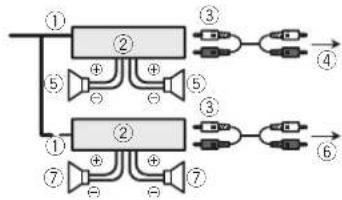
flowchart
graph TD
    A["①"] --> B["②"]
    B --> C["③"]
    B --> D["④"]
    B --> E["⑤"]
    B --> F["⑥"]
    G["①"] --> H["②"]
    H --> I["③"]
    H --> J["④"]
    H --> K["⑤"]
    H --> L["⑥"]
    M["⑦"] --> N["⑦"]
    N --> O["⑦"]
    N --> P["⑦"]
    Q["⊕"] --> R["⊕"]
    S["⊕"] --> T["⊕"]
With internal amp
Important
Front speaker and Rear speaker signals are output from the speaker leads when this connection is in use.
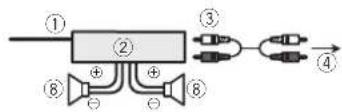
① System remote control
Connect to Blue/white cable
② Power amp (sold separately)
③ Connect with RCA cable (sold separately)
④ To Rear or subwoofer output
Connect a cable according to the preout setting.
⑤ Rear speaker or subwoofer
⑥ To Front output
⑦ Front speaker
⑧ Subwoofer
☐ You can change the RCA output of the subwoofer depending on your subwoofer system.
The subwoofer output of this product is monaural.
Connection
iPod / iPhone
For details on how to connect an external device using a separately sold cable, refer to the manual for the cable.
For details concerning the connection, operations and compatibility of iPhone, refer to Setup for iPod on page 13.
iPod / iPhone with Lightning connector
Connecting via the USB port
The USB interface cable for iPod/iPhone (CD-U52) (sold separately) is required for the connection.
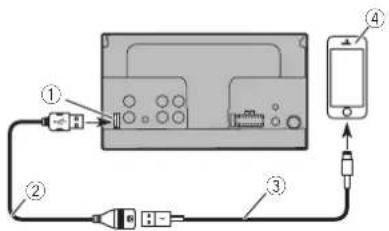
text_image
Diagram showing connections between a device, cable, and smartphone with labeled components① USB port
② USB cable 1.5 m (4 fl. 11 in.)
③ USB interface cable for iPod / iPhone (CD-IL52) (sold separately)
④ iPhone with Lightning connector
iPod / iPhone with 30-pin connector
Connecting via the AUX input
The USB interface cable for iPod / iPhone (CD-U201V) (sold separately) is required for the connection.
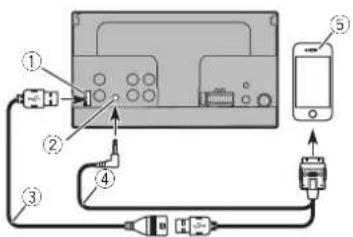
text_image
Diagram showing connections between a device, mobile phone, and cable ports with numbered labels① USB port
② AUX input
③ USB cable 1.5 m (4 fl. 11 in.)
④ USB interface cable for iPod / iPhone (CD-IU201V) (sold separately)
⑤ iPhone with 30 pin connector
Camera
About rear view camera
When you use the rear view camera, the rear view image is automatically switched from the video by moving the shift lever to REVERSE (R). Rear View mode also allows you to check what is behind you while driving.
WARNING
USE INPUT ONLY FOR REVERSE OR MIRROR IMAGE REAR VIEW CAMERA. OTHER USE MAY RESULT IN INJURY OR DAMAGE.
CAUTION
The screen image may appear reversed.
- With the rear view camera you can keep an eye on trailers, or back into a tight parking spot. Do not use for entertainment purposes.
- Objects in rear view may appear closer or more distant than in reality.
- The image area of full-screen images displayed while backing or checking the rear of the vehicle may differ slightly.
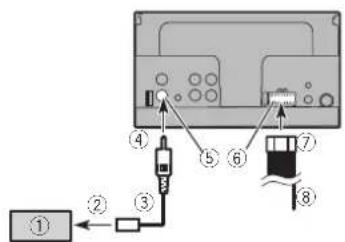
text_image
Diagram showing connection between a device with labeled components and wiring connections① Rear view camera (ND-3CB) (sold separate y)
② To video output
③ RCA cable (supplied with ND-BC8)
④ This product
⑤ Brown (R.C IN)
⑥ Power supply
⑦ Power cord
⑧ Violet/white (REVERSE-GEAR SIGNAL INPUT)
Power cord on page 27
■ Connect only the rear view camera to R.C IN. Do not connect any other equipment.
Some appropriate settings are required to use other view cameras.
Setting the rear view camera on page 20
Connection
External video component and the display
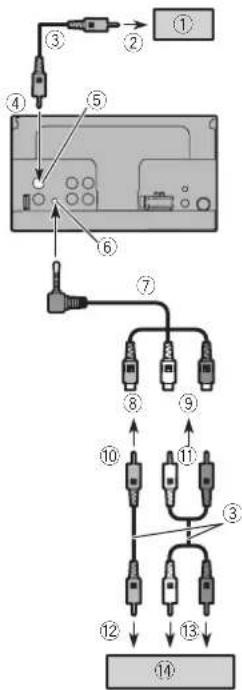
text_image
Diagram showing connected audio equipment ports and connectors with numbered labels① Rear display with RCA input jacks
② To video input
③ RCA cables (sold separately)
④ This
⑤ Yellow (V OUT)
⑥ AUX input
⑦ Mini-jack AV cable (CD-RM10) (sold separately)
⑧ Yellow
⑨ Red, white
10 To Yellow
① To Red white
⑫ To video cutout
13 To audio outputs
⑭ External video component (sold separately)
The appropriate setting is required to use the external video
component.
- AUX source on page 20
WARNING
NEVER install the rear display in a location that enables the driver to watch the video source while driving.
This product's rear video output is for connection of a display to enable passengers in the rear seats to watch the video source.
Installation
Precautions before installation
CAUTION
Never install this product in places where, or in a manner that:
- Could injure the driver or passengers if the vehicle stops suddenly.
- May interfere with the driver's operation of the vehicle, such as on the floor in front of the driver's seat, or close to the steering wheel or shift lever.
To ensure proper installation, be sure to use the supplied parts in the manner specified. If any parts are not supplied with this product, use compatible parts in the manner specified after you have the parts' compatibility checked by your dealer. If parts other than supplied or compatible ones are used, they may damage internal parts of this product or they may work loose and the product may become detached. - Do not install this product where it may (i) obstruct the driver's vision, (ii) impair the performance of any of the vehicle's operating systems or safety features, including airbags, hazard lamp buttons or (iii) impair the driver's ability to safely operate the vehicle.
- Never install this product in front of or next to the place in the dashboard, door, or pillar from which one of your vehicle's airbags would deploy. Please refer to your vehicle's owner's manual for reference to the deployment area of the frontal airbags.
Before installing
- Consult with your nearest dealer if installation requires drilling holes or other modifications of the vehicle.
Before making a final installation of this product, temporarily connect the wiring to confirm that the connections are correct and the system works properly.
Installation notes
- Do not install this product in places subject to high temperatures or humidity, such as:
- Places close to a heater, vent or air conditioner.
- Places exposed to direct sunlight, such as on top of the dashboard.
- Places that may be exposed to rain, such as close to the door or on the vehicle's floor.
• Install this product horizontally on a surface within 0 to 30 degrees tolerance (within 5 degrees to the left or right).
Installation
Improper installation of the unit with the surface tilted more than these tolerances increases the potential for errors in the vehicle's location display, and might otherwise cause reduced display performance.
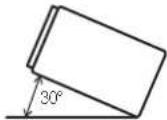
- When installing, to ensure proper real dispersal when using this unit, make sure you leave ample space behind the rear panel and wrap any loose cables so they are not blocking the vents.
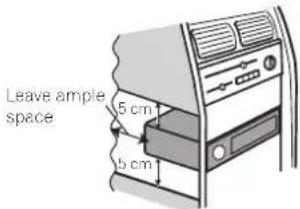
text_image
Leave ample space 5 cm 6 cmInstallation using the screw holes on the side of this product
1 Fastening this product to the factory radio-mounting bracket.
Position this product so that its screw holes are aligned with the screw holes of the bracket, and tighten the screws at three locations on each side.
Use either the truss head screws (5 mm × 9 mm) or flush surface screws (5 mm × 9 mm), depending on the shape of the bracket's screw holes.
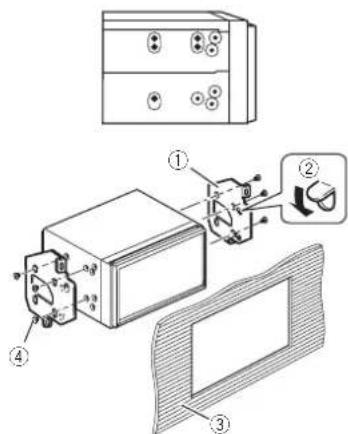
text_image
Technical diagram showing exploded view of a device with labeled components and parts① Factory radio-mounting bracket
② If the pawl interferes with installation, you may bend it down out of the way.
③ Dashboard or console
④ Truss head screw or flush surface screw
Be sure to use the screws supplied with this product.
Installing the microphone
- Install the microphone in a place where its direction and distance from the driver make it easiest to pick up the driver's voice.
- Be sure to turn off (ACC OFF) the product before connecting the microphone.
- Depending on the vehicle model, the microphone cable length may be too short when you mount the microphone on the sun visor. In such cases, install the microphone on the steering column.
Mounting on the sun visor
1 Fit the microphone lead into the groove.
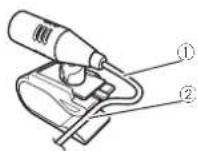
① Microphone lead ② Groove
2 Attach the microphone clip to the sun visor.
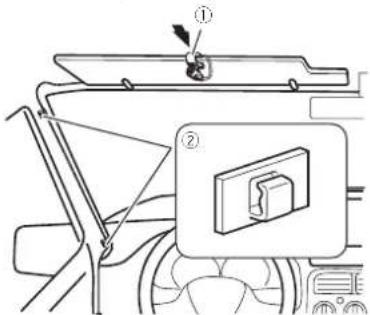
text_image
Diagram showing car seatbelt switch and rear panel with labeled parts, including a close-up inset of the rear panel.① Microphone clip
② Clamps
Use separately sold clamps to secure the lead where necessary inside the vehicle.
Install the microphone on the sun visor when it is in the up position. It cannot recognize the driver's voice if the sun visor is in the down position.
Installation on the steering column
1 Detach the microphone base from the microphone clip by sliding the microphone base while pressing the tab.
Installation
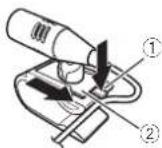
① Tab
② Microphone base
2 Mount the microphone on the steering column.
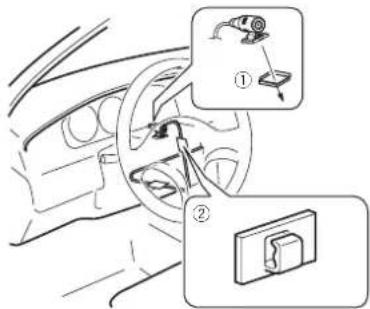
text_image
Diagram showing car interior and dashboard components with numbered parts, likely illustrating a vehicle or system assembly.① Double-sided tape
② Clamos
Use separately sold clamps to secure the lead where necessary inside the vehicle.
3 Keeping it away from the steering wheel.
Adjusting the microphone angle
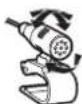
Appendix
Troubleshooting
If you have problems operating this product, refer to this section. The most common problems are listed below, along with likely causes and solutions. If a solution to your problem cannot be found here, contact your dealer or the nearest authorized Pioneer service facility.
Problems with the AV screen
The screen is covered by a caution message and the video cannot be shown.
→ The parking brake lead is not connected or applied.
— Connect the parking brake lead correctly, and apply the parking brake.
→ The parking brake interlock is activated.
— Park your vehicle in a safe place and apply the parking brake.
The audio or video skips.
→ This product is not firmly secured.
Secure this product firmly
No sounds are produced. The volume level will not rise.
→ Cables are not connected correctly.
Connect the cables correctly.
The picture is stretched, with an incorrect aspect ratio.
→ The aspect setting is incorrect for the display.
— Select the appropriate setting for that image.
iPod cannot be operated.
→ The iPod is frozen.
— Reconnect the iPod with the USB Interface cable for iPod/ iPhone.
— Update the iPod software version.
→ An error has occurred.
— Reconnect the iPod with the USB interface cable for iPod / iPhone.
— Park your vehicle in a safe place, and turn off the engine. Turn the ignition key back to off (ACC OFF). Then restart the engine, and turn the power to this product back on.
— Update the iPod software version.
→ Cables are not connected correctly.
Connect the cables correctly.
Problems with the phone screen
Dialing is impossible because the touch panel keys for dialing are inactive.
→ Your phone is out of range for service.
Retry after re-entering the range for service.
→ The connection between the cellular phone and this product cannot be established now.
Perform the connection process.
Problems with the Application screen
A black screen is displayed.
→ While operating an application, the application was ended on the smartphone side.
Press ■ to display the Top menu screen.
→ The smartphone OS may be awaiting screen operation.
Stop the vehicle in a safe place and check the screen on the smartphone.
The screen is displayed, but operation does not work at all.
→ An error has occurred.
Park your vehicle in a safe place, and then turn off the ignition switch (ACC OFF). Subsequently, turn the ignition switch to on (ACC ON) again.
The smartphone was not charged.
→ Charging sloped because the temperature of the smartphone rose due to prolonged use of the smartphone during charging.
Disconnect the smartphone from the cable, and wait until the smartphone cools down.
→ More battery power was consumed than was gained from charging.
This problem may be resolved by slopping any unnecessary services on the smartphone.
Error messages
When problems occur with this product, an error message appears on the display. Refer to the table below to identify the problem, then take the suggested corrective action. If the error persists, record the error message and contact your dealer or your nearest Pioneer service center.
Appendix
Common
AMP Error
→ This product fails to operate or the speaker connection is incorrect; the protective circuit is activated.
— Check the speaker connection. If the message falls to disappear even after the engine is switched off/on, contact your dealer or an authorized Pioneer Service Station for assistance.
Product overheat. System will be shut down automatically in 1 minute. Restart the product by ACC Off/On may fix this problem. If this message keep showing up, it is possible that some problem occurred in the product.
→ The temperature is too high for this product to operate. — Follow the instructions displayed on the screen. If this does not solve the problem, contact your dealer or an authorized Pioneer Station for assistance.
USB storage device
Error-02
→ Communication failed
— Turn the ignition switch OFF and back ON.
— Disconnect the USB storage device.
— Change to a different source. Then, return to the USB storage device.
Unplayable File
→ This type of file cannot be played on this product. — Select a file that can be played.
→ Security for the connected USB storage device is enabled.
— Follow the USB storage device instructions to disable security.
Skipped
→ The connected USB storage device contains DRM protected files.
— The protected files are skipped.
Protect
→ All the files on the connected USB storage device are embedded with DRM.
— Replace the USB storage device.
Incompatible USB
→ The connected USB storage device is not supported by this product.
— Disconnect your device and replace it with a compatible USB storage device.
Check USB
→ The USB connector or USB cable is short-circuited.
— Check that the USB connector or USB cable is not caught in something or damaged.
→ The connected USB storage device consumes more than maximum allowable current.
— Disconnect the USB storage device and do not use it. Turn the ignition switch to OFF, then to ACC or ON and then connect a compliant USB storage device.
Video resolution not supported
→ Files that cannot be played on this product are included in the file.
— Select a file that can be played.
USB was disconnected for device protection. Do not re-insert this USB memory into the unit. Please restart the
unit
→ The USB connector or USB cable is short-circuited.
— Check that the USB connector or USB cable is not caught in something or damaged.
→ The connected USB storage device consumes more than maximum allowable current.
— Disconnect the USB storage device and do not use it. Turn the ignition switch to OFF, then to ACC or ON and then connect a compliant USB storage device.
→ The USB interface cable for iPod / iPhone is short-circuited. — Confirm that the USB interface cable for iPod / iPhone or USB cable is not caught in something or damaged.
Audio Format not supported
→ This type of file is not supported on this product.
— Select a file that can be played.
iPod
Error-02-6X
→ iPod failure.
Disconnect the cable from the iPod. Once the iPod's main menu is displayed, reconnect the iPod and reset it.
Error-02-60
→ The iPod firmware version is old.
— Update the iPod version.
Bluetooth
Error-10
→ The power failed for the Bluetooth module of this product.
— Turn the ignition switch to OFF and then to ON.
If the error message is still displayed after performing the above action, please contact your dealer or an authorized Pioneer Service Station.
Detailed information for play-able media
Compatibility
Common notes about the USB storage device
- Do not leave the USB storage device in any location with high temperatures.
- Depending on the kind of the USB storage device you use, this product may not recognize the storage device or files may not be played back properly.
- The text information of some audio and video files may not be correctly displayed.
- File extensions must be used properly.
- There may be a slight delay when starting playback of files on an USB storage device with complex folder hierarchies.
● Operations may vary depending on the kind of an USB storage device. - It may not be possible to play some music files from USB because of file characteristics, file format, recorded application, playback environment, storage conditions, and so on.
USB storage device compatibility
- For details about USB storage device compatibility with this product, refer to Specifications on page 36.
- Protocol: bulk
- You cannot connect a USB storage device to this product via a USB hub.
- Partitioned USB storage device is not compatible with this product.
- Firmly secure the USB storage device when driving. Do not let the USB storage device fall onto the floor, where it may become jammed under the brake or gas pedal.
- There may be a slight delay when starting playback of audio files encoded with image data.
- Some USB storage devices connected to this product may generate noise on the radio.
- Do not connect anything other than the USB storage device. The sequence of audio files on USB storage device For USB storage device, the sequence is different from that of USB storage device.
Handling guidelines and supplemental information
- This product is not compatible with the Multi Media Card (MMO).
● Copyright protected files cannot be played back.
Appendix
Media compatibility chart
General
Maximum playback time of audio file stored on an USB storage device: 7.5 h (450 minutes)
USB storage device
File system: FAT 6/FAT32
Ver. 2.x of ID3 tag is prioritized when both Ver. 1.x and Ver. 2.x exist.
This product is not compatible with the following: MPSI (MP3 Interactive), mp3 PRO, m3u playlist
USB storage device
File extension: .mp3
Bit rate: 8 kbps to 320 kbps (CBR), VBR
Sampling frequency: 8 kHz to 48 kHz
ID3 tag: ID3 tag Ver. 1.0. 1.1. 2.2. 2.5. 2.4
WMA compatibility
This product is not compatible with the following: Windows Media™ Audio 9 Professional, Lossless. Voice
USB storage device
File extension: wma
Bit rate: 5 kbps to 320 kbps (CBR), VBR
Sampling frequency: 8 kHz to 48 kHz
WAV compatibility
The sampling frequency shown in the display may be rounded.
USB storage device
File extension: way
Format: Linear PCM (LPCM)
Sampling frequency: 16 kHz to 48 kHz
Quantization bits: 8 bits and 16 bits
AAC compatibility
This product plays back AAC files encoded by iTunes.
USB storage device
File extension: m4a
Bit rate: 8 kbps to 320 kbps (CBR)
Sampling frequency: 8 kHz to 48 kHz
Video files compatibility (USB)
Files may not be played back properly depending on the environment in which the file was created or on the contents of the file.
This product may not operate correctly, depending on the application used to encode WMA files.
Depending on the version of Windows Media™ Player used to encode WMA files, album names and other text information may not be correctly displayed.
There may be a slight delay when starting playback of audio files encoded with image data.
This product is not compatible with packet write data transfer.
This product can recognize up to 32 characters, beginning with the first character, including extension for the file and folder name. Depending on the display area, this product may try to display them with a reduced font size. However, the maximum number of the characters that you can display varies according to the width of each character, and of the display area.
☐ Folder selection sequence or other operations may be altered, depending on the encoding or writing software.
.avi
Format: MPFG-4
Compatible video codec: MPEG-4
Compostible audio codec: Linear PCM(LPCM) MP3
Maximum resolution: 720 pixels x 480 pixels
Maximum Frame rate: 30 fps
- Files may not be able to be played back depending on the bit rate.
.mp4
Format: MPEG-4
Compatible video codec: MPFG-4
Compatible audio codec: AAC
Maximum resolution: 720 pixels x 480 pixels
Maximum Frame rate: 30 fps
- Files may not be able to be played back depending on the bit rate.
.mov
Format: MPEG-4
Compatible video codec: MPEG-4
Compatible audio codec: AAC/Linear PCM(LPCM) MP3
Maximum resolution: 720 pixels x 480 pixels
Maximum Frame rate: 30 fps
- Files may not be able to be played back depending on the bit rate.
Example of a hierarchy
This product assigns folder numbers. The user cannot assign folder numbers.
Copyright and trademark notice
Copyright (c) 1987, 1993, 1994
The Regents of the University of California. All rights reserved. Redistribution and use in source and binary forms, with or without modification, are permitted provided that the following conditions are met:
- Redistributions of source code must retain the above copyright notice, this list of conditions and the following disclaimer.
-
Redistributions in binary form must reproduce the above copyright notice, this list of conditions and the following disclaimer in the documentation and/or other materials provided with the distribution.
-
All advertising materials mentioning features or use of this software must display the following acknowledgement: This product includes software developed by the University of California, Berkeley and its contributors.
-
Neither the name of the University nor the names of its contributors may be used to endorse or promote products derived from this software without specific prior written permission. THIS SOFTWARE IS PROVIDED BY THE REGENTS AND CONTRIBUTORS "AS IS" AND ANY EXPRESS OR IMPLIED WARRANTIES, INCLUDING, BUT NOT LIMITED TO, THE IMPLIED WARRANTIES OF MERCHANTABILITY AND FITNESS FOR A PARTICULAR PURPOSE ARE DISCLAIMED. IN NO EVENT SHALL THE REGENTS OR CONTRIBUTORS BE LIABLE FOR ANY DIRECT INDIRECT, INCIDENTAL, SPECIAL, EXEMPLARY, OR CONSEQUENTIAL DAMAGES (INCLUDING, BUT NOT LIMITED TO, PROCUREMENT OF SUBSTITUTE GOODS OR SERVICES; LOSS OF USE, DATA, OR PROFITS, OR BUSINESS INTERRUPTION) HOWEVER CAUSED AND ON ANY THEORY OF LIABILITY WHETHER IN CONTRACT STRICT LIABILITY, OR TORT (INCLUDING NEGLIGENCE OR OTHERWISE) ARISING IN ANY WAY OUT OF THE USE OF THIS SOFTWARE, EVEN IF ADVISED OF THE POSSIBILITY OF SUCH DAMAGE
Appendix
Bluetooth

Bluetooth®
The Bluetooth® word mark and logos are registered trademarks owned by the Bluetooth SIG, Inc. and any use of such marks by PIONEER CORPORATION is under license. Other trademarks and trade names are those of their respective owners.
WMA
Windows Media is either a registered trademark or trademark of Microsoft Corporation in the United States and/or other countries.
This product includes technology owned by Microsoft Corporation and cannot be used or distributed without a license from Microsoft Licensing, Inc.
AAC
AAC is short for Advanced Audio Coding and refers to an audio compression technology standard used with MPFG-2 and MPFG-4. Several applications can be used to encode AAC files, but file formats and extensions differ depending on the application which is used to encode. This unit plays back AAC files encoded by itunes.
Detailed information regarding connected iPod devices
- Pioneer accepts no responsibility for data lost from an iPod, even if that data is lost while using this product. Please back up your iPod data regularly.
- Do not leave the iPod in direct sunlight for extended amounts of time. Extended exposure to direct sunlight can result in iPod malfunction due to the resulting high temperature.
- Do not leave the Pod in any location with high temperatures.
- Firmly secure the iPod when driving. Do not let the iPod
fall onto the floor, where it may become jammed under the brake or gas pedal.
- For details, refer to the iPod manuals.
iPod and iPhone
Made for

"Made for iPod" and "Made for iPhone" mean that an electronic accessory has been designed to connect specifically to iPod or iPhone, respectively, and has been certified by the developer to meet Apple performance standards.
Apple is not responsible for the operation of this device or its compliance with safely and regulatory standards. Please note that the use of this accessory with iPod or iPhone may affect wireless performance.
iPhone, iPod, iPod classic, iPod nano, and iPod touch are trademarks of Apple Inc., registered in the U.S. and other countries.
Lightning
Lightning is a trademark of Apple Inc.
App Store
App Store is a service mark of Apple Inc.
iOS
iOS is a trademark on which Cisco holds the trademark right in the US and certain other countries.
iTunes
iTunes is a trademark of Apple Inc., registered in the U.S. and other countries.
Using app-based connected content
IMPORTANT
Requirements to access app-based connected content services using this product:
- Latest version of the Pioneer compatible connected content application(s) for the smartphone, available from the service provider, downloaded to your smartphone.
- A current account with the content service provider.
- Smartphone Data Plan.
Note: if the Data Plan for your smartphone does not provide for unlimited data usage, additional charges from your carrier may apply for accessing app-based connected content via 3G, EDGE and/or LTE (4G) networks. - Connection to the Internet via 3G, EDGE, LTE (4G) or Wi-Fi network.
- Optional Pioneer adapter cable connecting your iPhone to this product.
Limitations:
- Access to app-based connected content will depend on the availability of cellular and/or Wi-Fi network coverage for the purpose of allowing your smartphone to connect to the Internet.
- Service availability may be geographically limited to the region. Consult the connected content service provider for additional information.
- Ability of this product to access connected content is subject to change without notice and could be affected by any of the following: compatibility issues with future firmware versions of smartphone; compatibility issues with future versions of the connected content application(s) for the smartphone; changes to or discontinuation of the connected Content application(s) or service by its provider.
Notice regarding video viewing
Remember that use of this system for commercial or public viewing purposes may constitute an infringement on the author's rights as protected by the Copyright Law.
Appendix
Notice regarding MP3 file usage
Supply of this product only conveys a license for private, non-commercial use and does not convey a license nor imply any right to use this product in any commercial (i.e., revenue-generating) real-time broadcasting (terrestrial, satellite, cable and/or any other media), broadcasting/streaming via internet, intranets and/or other networks or in other electronic content distribution systems, such as pay-audio or audio-on-demand applications. An independent license for such use is required. For details, please visit http://www.mp3/licensing.com.
Using the LCD screen correctly
Handling the LCD screen
- When the LCD screen is subjected to direct sunlight for a long period of time, it will become very hot, resulting in possible damage to the LCD screen. When not using this product, avoid exposing it to direct sunlight as much as possible.
● The LCD screen should be used within the temperature ranges shown in Specifications on page 36. - Do not use the LCD screen at temperatures higher or lower than the operating temperature range, because the LCD screen may not operate normally and could be damaged.
- The LCD screen is exposed in order to increase its visibility within the vehicle. Please do not press strongly on it as this may damage it.
- Do not push the LCD screen with excessive force as this may scratch it.
- Never touch the LCD screen with anything besides your finger when operating the touch panel functions. The LCD screen can scratch easily.
Liquid crystal display (LCD) screen
- If the LCD screen is near the vent of an air conditioner, make sure that air from the air conditioner is not blowing on it. Heat from the heater may break the LCD screen, and cool air from the cooler may cause moisture to form inside this product, resulting in possible damage.
- Small black dots or white dots (bright dots) may appear on the LCD screen. These are due to the characteristics of the LCD screen and do not indicate a malfunction.
The LCD screen will be difficult to see if it is exposed to direct sunlight.
- When using a cellular phone, keep the antenna of the cellular phone away from the LCD screen to prevent disruption of the video in the form of disturbances such as spots or colored stripes.
Maintaining the LCD screen
- When removing dust from or cleaning the LCD screen, first turn this product off and then wipe the screen with a soft dry cloth.
- When wiping the LCD screen, take care not to scratch the surface. Do not use harsh or abrasive chemical cleaners.
LED (light-emitting diode) backlight
A light emitting diode is used inside the display to illuminate the LCD screen.
- At low temperatures, using the LED backlight may increase image lag and degrade the image quality because of the characteristics of the LCD screen. Image quality will improve with an increase in temperature.
- The product lifetime of the LED backlight is more than 10 000 hours. However, it may decrease if used in high temperatures.
- If the LED backlight reaches the end of its product lifetime, the screen will become dimmer and the image will no longer be visible. In that case, please consult your dealer or the nearest authorized Pioneer Service Station.
Specifications
General
Rated power source....14.4 V DC
(10.8 V to 15.1 V allowable)
Grounding system.... Negative type
Maximum current consumption .... 10.0 A
Dimensions (W × H × D):
D
Chassis 178 mm × 100 mm × 165 mm
(7 in. × 3-7/8 in. × 6-1/2 in.)
Nose 171 mm × 97 mm × 3 mm
(6.3/4 in. × 3-7/8 in. × 1/8 in.)
Weight 1.1 kg (2.4 lbs)
Display
Screen size/aspect ratio 6.2inch wide/16:9 (effective display area: 137.52mm × 77.232mm) (5-5/6in.
× 3in.)
Pixels 1132000 (2400 × 480)
Display method TFT Active matrix driving
Color system.....PAL/NTSC/PAL-M/PAL-N/SECAM compatible
Audio
Maximum power output .... 50 W × 4 ch/4 Ω
• 50 W × 2 ch/4 Ω - 70 W × 1 ch/2 Ω (for subwoofer)
Continuous power output ....22 W × 4 (50 Hz to 15 kHz, 5 % THD, 4Ω LOAD, Both Channels Driven)
Load impedance....4 Ω (4 Ω to 8 Ω [2 Ω for ' ch ] allowable)
Preout output level (max)....2.0 V
Equalizer (5-Band Graphic Equalizer):
Frequency 100 Hz/315 Hz/1.25 kHz/3.15 kHz/8 kHz
Gain ± 12 dB
HPF
Frequency 50 Hz/63 Hz/80 Hz/103 Hz/125 Hz
Slope -12 dB/oct
Subwoofer/LPF:
Frequency 50 Hz/63 Hz/80 Hz/100 Hz/125 Hz
Slope -18 dB/oct
Gain ....+6 dB to -24 dB
Phase ....Normal/Reverse
Bass bcost;
Gain +12 dB to 0 dB
USB
USB standard spec ....USB1.1, USB2.0 Full Speed. USB2.0 High Speed
USB standard spec ....USB 2.0 high speed (For audio files)
Appendix
Max current supply 1.0 A
USB Class MSC (Mass Storage Class)
File system....FAT16, FAT32
MP3 decoding format....MPEG-1 & 2 Audio Layer 3
WMA decoding format .....Ver.7, 7.1, 8, 9 (2 ch audio) (Windows Media Player)
AAC decoding format....MPEG-4 A AC (iTunes encoded only) (Ver. '0.6 and earlier)
WAVE signal format .... Linear PCM: way
Sampling Frequency .....Linear PCM: 16 kHz, 22.05 kHz, 24 kHz, 32 kHz, 44.1 kHz, 48 kHz
JPEG decoding format ......jog, .jog, .joe
Pixel Sampling 4:2:2, 4:2:0
Decode Size.....MAX: 8 192 (H) x 7 680 (W). MIN: 32 (H) x 32 (W)
MPEG4 video decoding format......Simple Profile
Bluetooth
Version Bluetooth 3.0 certified
Output power....+4 dBm Max.
(Power class 2)
Frequency band(s) 2400 MHz to 2483.5 MHz
FM tuner
Frequency range 87.9 MHz to 107.9 MHz
Usable sensitivity .... 12 dBf (1.1 μV/75Ω, mono, S/N: 30 dB)
Signal-to-noise ratio 72 dB (IHF-A network)
AM tuner
Frequency range 530 kHz to 710 kHz (10 kHz)
Usable sensitivity 28 μV (S/N: 20 dB)
Signal-to-noise ratio 62 dB (HF-A network)
CEA2006 Specifications

Power output .... 14W RMS × 4 Channels (4Ω and ≤1% THD+N)
S/N ratio 91dBA (reference: 1 W into 40)
Specifications and design are subject to possible modifica
tions without notice due to improvements.
Table des matières
Specifications....74
Précautions
http://www.pioneerelectronics.com
http://www.pioneerelectronics.ca
text_image
Diagram of a device with numbered components and labeled parts, likely for assembly or labeling.text_image
AUX 6/10 4820 EQ Fail OK

Position ACC Sans position ACC
text_image
Diagram of a device rear panel with labeled components and connection points① Microphone 3 m
Connexion
text_image
Technical diagram showing numbered components of a mechanical or electrical device with labeled parts 1 through 12.text_image
Diagram showing connections between a device, a smartphone, and audio equipment with labeled componentstext_image
Diagram showing connections between a device, switch, and network ports with numbered labelstext_image
Diagram showing device connection with numbered components and labeled parts, likely from an electronics or audio system.text_image
Technical diagram of a device with labeled components and parts, including a zoomed-in view and a screen preview.text_image
Diagram showing car seatbelt mounting mechanism with labeled parts and zoomed-in detail viewtext_image
Diagram showing car interior and dashboard components with numbered parts, including a camera and battery pack assembly.Video resolution not supported
Copyright (c) 1987, 1993, 1994
Phase.....Normale/Inversée
Amplification des graves
Gain 12 dB & 0 dB
Annexe
USB
Version Bluetooth 3.0 cert file
text_image
Diagram of a device with numbered components and labeled parts, likely for assembly or labeling.text_image
AUX 6:10 :482% EQ
text_image
Diagram of a device rear panel with labeled ports and connectors, showing internal components and connection points.text_image
Technical diagram of a mechanical or electrical device with numbered components and labeled partstext_image
Diagram showing connections between a device, cable, and smartphone with labeled componentstext_image
Diagram showing connections between a device, switch, and mobile phone with labeled componentstext_image
Diagram showing cable connection with labeled components from panel 1 to panel 7, including connectors and cable routing.text_image
Technical diagram of a device assembly with labeled components and exploded viewtext_image
Diagram showing car seatbelt mounting mechanism with labeled parts and zoomed-in detail viewtext_image
Diagram showing car interior and dashboard components with numbered parts, likely illustrating a steering or navigation system.Product overheat. System will be shut down automatically in 1 minute. Restart the product by ACC Off/On may fix this problem. If this message keep showing up, it is possible that some problem occurred in the product.
Video resolution not supported
Copyright (c) 1987, 1993, 1994
Register your product at
http://www.pioneerelectronics.com
in Canada
au Canada
en Canadá
http://www.pioneerelectronics.ca
PIONEER CORPORATION
28-8, Honkomagome 2-chome, Bunkyo-ku,
Tokyo 113-0021, Japan
PIONEER ELECTRONICS (USA) INC.
P.O. Box 1540, Long Beach, California 90801-1540, U.S.A.
TEL: (800) 421-1404
PIONEER ELECTRONICS OF CANADA, INC.
340 Ferrier Street, Unit 2, Markham, Ontario L3R 2Z5, Canada
TEL: 1-877-283-5901
TEL: 905-479-4411
PIONEER EUROPE NV
Haven 1087, Keetberglaan 1, B-9120 Melsele, Belgium/Belgique
TEL: (0) 3/570.05.11
PIONEER ELECTRONICS ASIACENTRE PTE. LTD.
2 Jalan Kilang Barat, #07-01, Singapore 159346
TEL: 65-6378-7888
PIONEER ELECTRONICS AUSTRALIA PTY. LTD.
5 Arco Lane, Heatherton, Victoria, 3202 Australia
TEL:(03)9586-6300
PIONEER ELECTRONICS DE MÉXICO S.A. DE C.V.
Blvd. Manuel Ávila Camacho 138, 10 piso
Col.Lomas de Chapultepec, México, D.F. 11000
Tel: 52-55-9178-4270, Fax: 52-55-5202-3714
先锋股份有限公司
台北市內湖區瑞光路407號8樓
電話:886-(0)2-2657-3588
先鋒電子(香港)有限公司
香港九龍長沙灣道909號5樓
電話:852-2848-6488