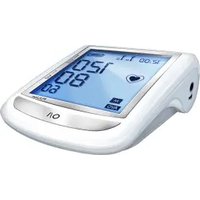
Elite - Sphygmomanometer Medel - Free user manual and instructions
Find the device manual for free Elite Medel in PDF.


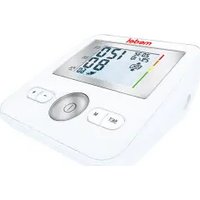
| Product type | Automatic blood pressure monitor for upper arm |
| Brand | Medel |
| Model | Elite |
| Dimensions (L × W × H) | 130 × 172 × 60 mm |
| Weight (without batteries) | 384 g |
| Power supply | 4 AA alkaline batteries 1.5V LR6 or AC adapter 5V/1000mA (not included) |
| Battery life | Approximately 192 measurements (60s per measurement) |
| Measurement method | Oscillometric |
| Pressure measurement range | SYS: 60-230 mmHg, DIA: 40-130 mmHg, pulse: 40-199 beats/min |
| Pressure accuracy | ±3 mmHg |
| Memory | 60 readings with date and time |
| Special functions | Irregular heartbeat detection (I.H.B.), T3 function (average of last 3 measurements), movement indicator |
| Compatible arm circumference | 22-42 cm (universal cuff included) |
| Display | Large backlit LCD screen |
| Classification | Internally powered medical device, applied part type BF, IP21 |
| Operating conditions | Temperature: +5°C to +40°C, humidity 15-91% |
| Storage conditions | Temperature: -20°C to +60°C, humidity <93% |
| Cleaning | Soft slightly damp cloth; do not wash the cuff |
| Spare parts | Universal cuff 22-42 cm (ref. 164.323) |
| Warranty | 5 years |
| Expected service life | 2 years (device), 10,000 cycles (cuff) |
| Package contents | Blood pressure monitor, cuff, 4 AA batteries, instruction manual, storage pouch |
Frequently Asked Questions - Elite Medel
User questions about Elite Medel
0 question about this device. Answer the ones you know or ask your own.
Ask a new question about this device
Download the instructions for your Sphygmomanometer in PDF format for free! Find your manual Elite - Medel and take your electronic device back in hand. On this page are published all the documents necessary for the use of your device. Elite by Medel.
USER MANUAL Elite Medel
natural_image
Three-step diagram showing a hand using a handheld device to adjust internal components (no text or symbols present)Read these instructions for use carefully and keep them for later use, be sure to make them accessible to other users and observe the information they contain.
Dear customer,
Thank you for choosing a product from our range. Our name is synonymous with high-quality, thoroughly tested products for applications in the areas of heat, weight, blood pressure, body temperature, pulse, electrostimulation, beauty, baby and air.
With kind regards,
Your Medel team
Contents
- Included in delivery.... 56
- Signs and symbols.... 56
- Intended use....57
- Warnings and safety notes.... 58
- Device description.... 60
- Initial use 62
- Usage 63
- What if there are problems? 66
-
Maintenance and repairs 68
-
Cleaning and maintenance.... 68
- Accessories and replacement parts....68
- Disposal 69
- Reference to standards 69
- Technical specifications .... 72
- Measurement principle.... 76
- Warranty/service....76
- EMC Guidance 77
1. Included in delivery
Check that the exterior of the cardboard delivery packaging is intact and make sure that all contents are present. Before use, ensure that there is no visible damage to the device or accessories and that all packaging material has been removed. If you have any doubts, do not use the contents and contact your retailer or the specified Customer Service address.
1x blood pressure monitor
1x upper arm cuff (22-42 cm)
1x instructions for use
4x 1.5V AA LR6 batteries
1x storage bag
2. Signs and symbols
The following symbols are used on the device, in these instructions for use, on the packaging and on the type plate for the device:
 | WarningWarning notice indicating a risk of injury or damage to health |
 | ImportantSafety note indicating possible damage to the device/accessory |
 | Product informationNote on important information |
 | Observe the instructionsRead the instructions before starting work and/or operating devices or machines |
 | Isolation of applied parts, type BFGalvanically isolated application part (F stands for “floating”); meets the requirements for leakage currents for type BF |
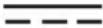 | Direct currentThe device is suitable for use with direct current only |
 | Disposal in accordance with the Waste Electrical and Electronic Equipment EC Directive – WEEE |
 | Do not dispose of batteries containing hazardous substances with household waste |
 | Dispose of packaging in an environmentally friendly manner |
 | Manufacturer |
| EC REP | Authorised Representative in the European Community |
Storage/Transport 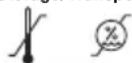 | Permissible storage and transport temperature and humidity |
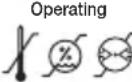 | Permissible operating temperature, humidity and ambient pressure |
| IP21 | Protected against solid foreign objects 12.5 mm in diameter and larger, and against vertically falling drops of water |
 | Serial number |
 | CE labellingThis product satisfies the requirements of the applicable European and national directives |
 | Date of manufacturing |
 | Article number |
3. Intended use
Intended use
The blood pressure monitor is intended for the fully automatic, non-invasive measurement of arterial blood pressure and pulse values on the upper arm.
Target group
It is designed for self-measurement by adults in the home environment and is suitable for users whose upper arm circumference is within the range printed on the cuff.
Indication/clinical benefits
The user can record their blood pressure and pulse values quickly and easily using the device. The recorded values are classified according to internationally applicable guidelines and evaluated graphically. Furthermore, the device can detect any irregular heart beats that occur during measurement and inform the user via a symbol in the display. The device saves the recorded measurements and can also output average values of previous measurements.
The recorded data can provide healthcare service providers with support during the diagnosis and treatment of blood pressure problems, and therefore plays a part in the long-term monitoring of the user's health.
4. Warnings and safety notes

Contraindications
- Do not use the blood pressure monitor on newborns, children or pets.
- People with restricted physical, sensory or mental skills should be supervised by a person responsible for their safety and receive instructions from this person on how to use the device.
- If you have any of the following conditions, it is essential you consult your doctor before using the device: cardiac arrhythmia, circulatory problems, diabetes, pregnancy, pre-eclampsia, hypotension, chills, shaking.
- People with pacemakers or other electrical implants should consult their doctor before using the device.
- The blood pressure monitor must not be used in connection with a high-frequency surgical unit.
- Do not use the cuff on people who have undergone a mastectomy.
- Do not place the cuff over wounds as this may cause further injury.
- Make sure that the cuff is not placed on an arm in which the arteries or veins are undergoing medical treatment, e.g. intravascular access or intravascular therapy, or an arteriovenous (AV) shunt.

General warnings
- The measured values taken by you are for your information only – they are no substitute for a medical examination. Discuss the measured values with your doctor and never make your own medical decisions based on them (e.g. regarding dosages of medicines).
- The device is only intended for the purpose described in these instructions for use. The manufacturer is not liable for damage resulting from improper or incorrect use.
- Using the blood pressure monitor outside your home environment or whilst on the move (e.g. whilst travelling in a car, ambulance or helicopter, or whilst undertaking physical activity such as playing sport) can influence the measurement accuracy and cause incorrect measurements.
- Cardiovascular diseases may lead to incorrect measurements or have a detrimental effect on measurement accuracy.
- Do not use the device at the same time as other medical electrical devices (ME equipment). This could lead to a malfunction of the device and/or an inaccurate measurement.
-
Do not use the device outside of the specified storage and operating conditions. This could lead to incorrect measurements.
-
Only use the cuffs included in delivery or cuffs described in these instructions for use for the device. Using another cuff may lead to measurement inaccuracies.
- Please note that when inflating the cuff, the functions of the limb in question may be impaired.
- Do not perform measurements more frequently than necessary. Due to the restriction of blood flow, some bruising may occur.
- During the blood pressure measurement, the blood circulation must not be stopped for an unnecessarily long time. If the device malfunctions remove the cuff from the arm.
- Place the cuff on your upper arm only. Do not place the cuff on other parts of the body.
- The air line poses a risk of strangulation for small children. Furthermore, included small parts pose a risk of suffocation for small children if swallowed. They should therefore always be supervised.

General precautions
- The blood pressure monitor is made from precision and electronic components. The accuracy of the measurements and service life of the device depend on its careful handling.
-
Protect the device from impacts, humidity, dirt, marked temperature fluctuations and direct sunlight.
-
Ensure the device is at room temperature before measuring. If the measuring device has been stored close to the maximum or minimum storage and transport temperatures and is placed in an environment with a temperature of 20 °C, it is recommended that you wait approx. 2 hours before using the measuring device.
- Do not drop the device.
- Do not use the device in the vicinity of strong electromagnetic fields and keep it away from radio systems or mobile telephones.
- We recommend that the batteries be removed if the device is not to be used for a prolonged period of time.
- Avoid any mechanical restriction, compression or bending of the cuff line.
Measures for handling batteries

- If your skin or eyes come into contact with battery fluid, rinse the affected areas with water and seek medical assistance.
- Choking hazard! Small children may swallow and choke on batteries. Therefore, store batteries out of the reach of small children.
- Risk of explosion! Do not throw batteries into a fire.
- If a battery has leaked, put on protective gloves and clean the battery compartment with a dry cloth.
- Do not disassemble, open or crush the batteries.

- Observe the plus (+) and minus (-) polarity signs.
- Protect the batteries from excessive heat.
- Do not charge or short-circuit batteries.
- If the device is not to be used for a relatively long period, take the batteries out of the battery compartment.
- Use identical or equivalent battery types only.
• Always replace all batteries at the same time. - Do not use rechargeable batteries!

Notes on electromagnetic compatibility
- The device is suitable for use in all environments listed in these instructions for use, including domestic environments.
- The use of the device may be limited in the presence of electromagnetic disturbances. This could result in issues such as error messages or the failure of the display/device.
- Avoid using this device directly next to other devices or stacked on top of other devices, as this could lead to faulty operation. If, however, it is necessary to use the device in the manner stated, this device as well as the other devices must be monitored to ensure they are working properly.
- The use of accessories other than those specified or provided by the manufacturer of this device can lead to an increase in electromagnetic emissions or a decrease in the device's electromagnetic immunity; this can result in faulty operation.
- Failure to comply with the above can impair the performance of the device.
5. Device description
Blood pressure monitor and cuff
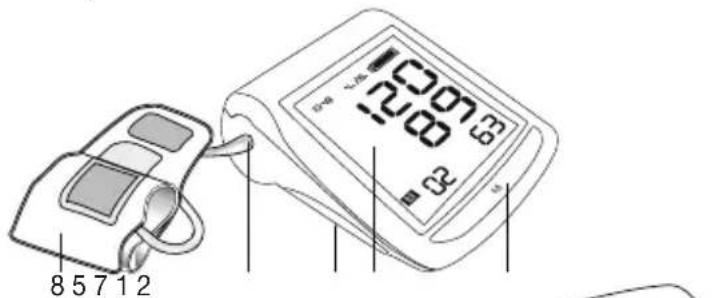
- LCD
- O/I button (Start/Stop)
- Memory button (MEM)
- Average button (T3)
- Air socket
- Micro USB socket for power
- Battery compartment
- Universal Cuff (type BF applied) for 22 - 42 cm arm
POWER:
4 AA ALKALINE Batteries (Rechargeable batteries are no suitable for his device). Adapter (not included) complies with EN 60601-1. Adaptor model not included.
Input: 100-240V\~50/60Hz 0.2A Max Output: 5V 1000mA.
Adaptor model: BLJ06L050100U-V
Please only use the authorized adaptor and USB cable to charge power.
Caution: It is not permitted to connect device to any other type of adaptor other than the approved one.
Display
9 Previous measured data in memory M
10 Average of last 3 readings AVG
11 Measurement in progress ♥
11 Irregular heart beat indicator (I.H.B) ♥
12 Low battery □ Lo
13 Systolic blood pressure in mmHg
14 Diastolic blood pressure in mmHg
15 Pulse per minute
16 Inflation ▲
16 Deflation ▼
17 Time and date
18 Memory display
19 Motion indicator
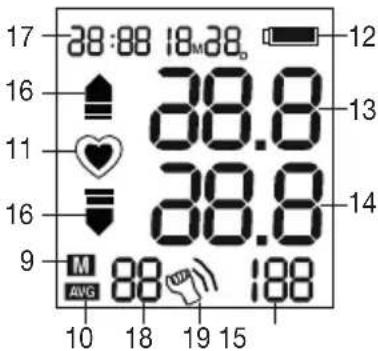
motion may result in an inaccurate measurement
6. Initial use
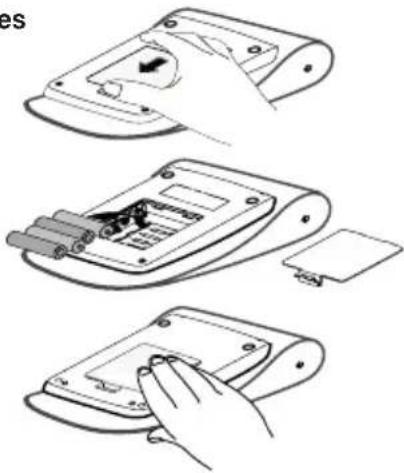
6.1. Inserting the batteries
Insert the batteries.
- Remove the battery cover from the battery compartment.
-
Insert four AA pow- erful batteries into the compartment and ensure each battery is in the proper di- rection.
-
Replace the battery cover.
natural_image
Three-step line drawing of a handheld electronic device with internal components, showing hand placement and assembly (no text or symbols)
CAUTION!
- After the battery warning symbol “” appears, the device is blocked until the batteries have been replaced.
- Please use "AA" long life 1.5 batteries.
- Never leave any low battery into the battery compartment since they may leak and cause damage to the unit.
- If the blood pressure monitor is left unused for long periods, please remove the batteries from the device.
- The typical service life of the new and unused batteries is 192 measurements for the operation time which is 60 s.
6.2 Clock and date adjustment
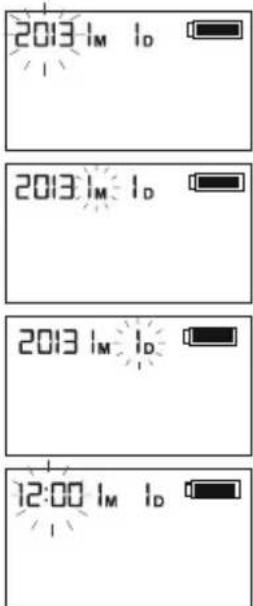
- Once you install the battery or turn off the monitor, it will enter Clock mode, and LCD will display date and time.
- In Clock Mode, press the O/I and MEM buttons simultaneously for 2 seconds and the year value will blink first. Press MEM button to set the year. Keep the MEM button pressed to increase the numbers.
- Press O/I button to confirm and move on to the month
- Repeat the procedure described above to set the day, hour and minutes.
- Once you change the batteries, you should readjust the time and date.
6.3 Connecting tube
Insert the cuff connector into the socket on the left side of the meter.
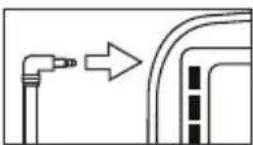
NOTE:
If your arm cuff is broken or not functional, please use a new cuff. If the new arm cuff does not include an air plug, please continue to use the old air plug.
7. Usage
7.1 Before the measurement:
- Relax and avoid eating, smoking as well as all forms of exertion directly before the measurement. All these factors can influence the measurement result.
- Remove any garment that fits closely to your upper arm.
• Measure always on the same arm (normally left) - Attempt to carry out the the measurements regularly at the same time of day, since the blood-pressure changes during the curse of the day.
-
It can cause inaccuracy if the measurements is taken in the following circumstances:
-
Within 1 hour after dinner or drinking;
- Immediate measurement after tea, coffee, smoking;
- Within 20 minutes after taking a bath;
- When talking or moving your fingers;
- In a very cold environment;
When you want to discharge urine.
NOTE: Cuffs that are too narrow or too short result in false measurement values. Selecting the correct cuff is of extraordinary importance. The cuff size is dependent upon the circumference of the arm(measured in the centre). The permissible range is printed on the cuff. If this is not suitable for your use, please contact your dealer.
CAUTION!
- Only use MEDEL original cuffs!
- A loose cuff or a sideways protruding air-pocket causes false measurement values. With repeated measurements, blood accumulates in the respective arm, which can lead to false results.
- Correctly executed blood-pressure measurements should therefore first be repeated after 2-3 minutes pause or after the arm has been held up in order to allow the accumulated blood to flow away.
7.2. Fitting the cuff
- Pass the end of the cuff (with sewn-in rubber stopper) through the metal stirrup so that a loop is formed. The Velcro closer must be facing outwards.(Ignore this step if the cuff has already been prepared.)
- Push the cuff over the left upper arm so that the tube points in the direction of the lower arm.
- Position the cuff on the arm as illustrated in the picture. Make cer-
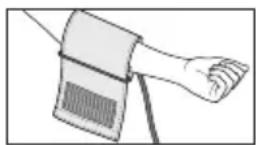
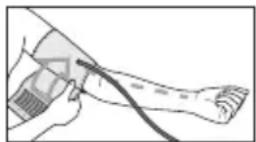
tain that the lower edge of the cuff lies approximately 2 to 3 cm above the elbow and that the rubber tube leaves the cuff on the inner side of the arm)
- Tighten the free end of the cuff and close the cuff with the closer.
ATTENTION!
The mark (ca. 3 cm long bar) must lie exactly over the artery which runs down the inner side of the arm.
- There must be no free space between the arm and the cuff as this would influence the result. Clothing must not restrict the arm. Any piece of clothing which does (e.g. a pullover) must be taken off.
- Secure the cuff with the Velcro closer in such a way that it lies comfortably and is not too tight. Lay the arm on the table (palm upwards) so that the cuff is at the same height as the heart. Make sure that the tube is not kinked.
- Remain seated quietly for two minutes before you begin the measurement.
NOTE:
If is not possible to fit the cuff to the left arm, it can also be placed on the right one. However all measurements should be made using the same arm.
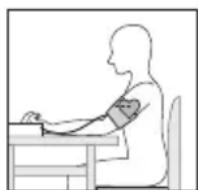
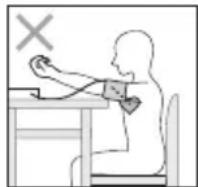
The middle of the cuff should be at the level of the right atrium of the heart.
Before strarting measurement, please sit confortably with legs uncrossed, feet flat on the floor, back and arm supported.
7.3 Measuring procedure
- After the cuff has been appropriately positioned, the measurement can begin Press O/I button. All display symbols appear for 1 second. If the monitor has stored results the LCD will momentarily display the most recent one. If no result has been stored, all the disgits show 0. Then 0 will appear on LCD on the DIA column. The monitor is ready for measurement.
- Then the cuff inflates automatically, the symbol “▲will appear.
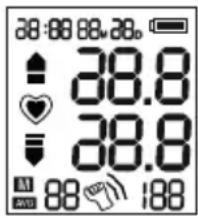
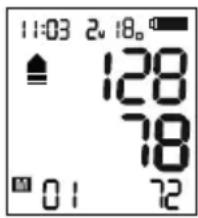
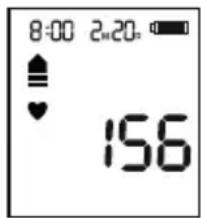
- Once a pulse is detected, the “♥” symbol blinks.
-
Once you reach the correct pressure, inflation stops and the cuff starts to deflate.
-
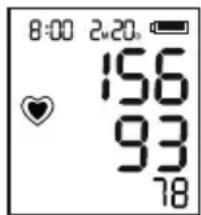
When the measurement is completed, the systolic / diastolic pressure and pulse are shown simultaneously.
-
In case the measurement shows irregular heartbeat (I.H.B.), the "♥" symbol is displayed. In this case the results of the measurement have deviated from a normal situation. Then the measurement needs to be repeated. In the majority of cases, this is not cause for concern. If the symbol "♥" appears regularly (for example several times a week during different daily measurements) it is advisable to discuss it with your medical advisor.
7.4 How to use the memory function
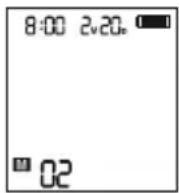
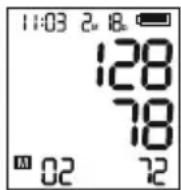
- In clock mode (Off mode), press MEM button. The number of stored data is shown, sudden the latest result will be displayed with date and time.
- Press MEM button repeatedly to review the results measured.
7.5 T3 System: How to see the average of the last 3 measurements (taken within the last 15 minutes)
- Press O/I button and take the first measurement.
- At the end of the first measurement wait at least 5 minutes in a relaxed position.
Then repeat the measurement following step 1 again. -
At the end of the second measurement wait at least 5 minutes in a relaxed position.
Then repeat the measurement following step 1 again. -
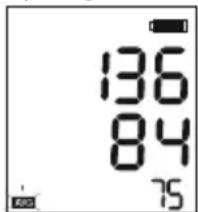
At the end of the third measurement press T3 button to perform the average of the last three measurements taken (the AVG symbol will appear).
NOTE:
The average data using T3 button is shown only if the last 3 measurements have been done within 15 minutes. Otherwise, the data will be shown as 0.
7.6 To delete all values stored in the memory
In Clock mode (Off mode) press MEM button, after the latest data stored will be displayed press again and hold the MEM button
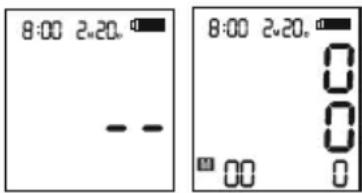
for 3 sec. All results will be deleted. Press the MEM or O/I button to turn off the display.
8. What if there are problems?
Follow the below recommended actions and press O/I button again to start another measurement.
| Error code Possible cause(s) Recommended actions | ||
| E1 Deflation is tnot safe | Re-apply the cuff and try again | |
| E2 The cuff is very tight | ||
| E3 The cuff pressure is excessive Relax for a moment and try again | ||
| E10 The monitor has detected movement during reading | Movement could compromise the reading.Relax for a moment and try again. | |
| E11 | ||
| E20 The reading process cannot detect the heart beat | Movement can compromise the measurement.Relax for a moment and try again .Loosen the clothes on the arm and try again | |
| E21 Inaccurate reading Relax for a moment and try again | ||
| E Exx There is a calibration problem | Repeat the reading. If the problem persists, contact the Service Centre. Refer to the warranty for the contact information and the instructions concerning returns. | |
| Out | Out of measurement range | Relax for a moment. Refasten the cuff and then measure again. If the problem persists,contact your physician. |
8.1 Other possible malfunctions:
| Problem Possible cause(s) Recommended actions | ||
| Only the symbol “☐ Lo” flashes | Batteries are drained. Replace all batteries with new ones. | |
| The blood pressure values displayed are abnormally high or low. | The cuff is not wrapped correctly or not at the level of the heart. | Wrap the cuff correctly and rise your hand so that the cuff is at the same level of your heart. |
| Too much stress is applied on your shoulder or arm. | Relax yourself and make measurement. | |
| You move your arm or arm muscles during measurement. | Remain still and do not move /contract the muscles during measurement. | |
| The (I.H.B.) symbol ”♥” is displayed, but my heart beat rate should be normal. | You move your arm or arm muscles during measurement. | Remain still and do not move /contract the muscles during measurement. |
| The light on the dis-play is dim or not lit | The batteries are flat or not right placed. | Replace the flat batteries with new ones. Insert the batteries correctly. |
9. Maintenance and repairs
For any repair operations, only refer to a technical assistance centre authorized by the Medel International Srl and request original spare parts. Never open the device. There are no user-serviceable parts within. The device requires no lubrication or maintenance. Failure to comply with what expressed above may compromise the safety of MEDEL ELITE.
10. Cleaning and maintenance
- For cleaning only use a soft, lightly moistened cloth.
- Do not use petroleum spirits, thinners or similar solvents.
- Do not wash the cuff.
- Take care to ensure the cuff is not damaged by sharp or pointed objects such as scissors, knives, etc.
- Take the batteries out if the device is not used for a long period.
- In case the device becomes malfunction due to the influence of strong electromagnetic fields, power off the device and repeat the procedure again.
- Disposal of the device (and used batteries) should be carried out according to the national regulations for the disposal of electronic products.
- Cleaning: Dust environment may affect the performance of the unit. Please use the soft cloth to remove the dirt
of the device and cuff before and after use. To obtain the best performance, please follow below instructions:
- Put in a dry place and avoid the sunshine;
- Avoid immersing it in the water. Clean it with a dry cloth in case.
- Avoid shaking and collision.
- Avoid dusty environment and unstable temperature surrounding.
-
Protect if from:
-
water and moisture
- extremes temperature, humidity and altitude
- impact and dropping
- contamination and dust
- direct sunlight
11. Accessories and replacement parts
Accessories and replacement parts are available from the corresponding service address (according to the service address list). Please state the corresponding order number.
| Designation Item number and/or order number | |
| Universal cuff (22-42 cm)(Material: Polyester) | 164.323 |
12. Disposal
i Repairing and disposing of the device
- Do not repair or adjust the device yourself. Proper operation can no longer be guaranteed in this case.
- Do not open the device. Failure to comply will invalidate the warranty.
- Repairs must only be carried out by Customer Services or authorised retailers. Before making a claim, please check the batteries first and replace them if necessary.
- For environmental reasons, do not dispose of the device in household waste at the end of its service life. Dispose of the device at a suitable local collection or recycling point in your country. Dispose of the device in accordance with EC Directive – WEEE (Waste Electrical and Electronic Equipment). If you have any questions, please contact the local authorities responsible for waste disposal.
⚠ Disposing of the batteries
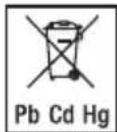
- The empty, completely flat batteries must be disposed of through specially designated collection boxes, recycling points or electronics retailers. You are legally required to dispose of the batteries.
- The codes below are printed on batteries containing harmful substances: Pb = Battery contains lead, Cd = Battery contains cadmium, Hg = Battery contains mercury.
13. Reference to standards
Device standard: Device corresponds to the requirements of the European standard for non-invasive blood-pressure monitor.
EN ISO 81060-1:2012 Non-invasive sphygmomanometers - Part 1: Requirements and test methods for non-automated measurement type
EN 1060-3:1997+A2:2009 Non-invasive blood pressure Part 3: Supplementary requirements for electromechanical blood pressure measuring system
EN 1060-4: Non invasive shygmomanometers - Test procedures to determine the overall system accuracy of automated non-invasive sphygmomanometres.
IEC 60601-1:2005+A1:2012 Medical electrical equipment - Part 1: General requirements for basic safety and essential performance.
NIBP - Requirements
IEC 80601-2-30:2009+A1:2013 Medical electrical equipment - Part 2-30: Particular requirements for the basic sa-
fety and essential performance of automated non-invasive sphygmomanometers
IEC 60601-1-11:2015 Medical electrical equipment - Part 1-11: General requirements for basic safety and essential performance - Collateral standard: Requirements for medical electrical equipment and medical electrical systems used in the home healthcare environment
EC 60601 - 1-2:2014 Medical electrical equipment - Part 1-2: General requirements for basic safety and essential performance - Collateral standard: Electromagnetic compatibility - Requirements and tests.
COMPLIED STANDARDS LIST
| Risk management | EN ISO 14971:2012 / ISO 14971:2007 Medical devices - Application of risk management to medical devices |
| Labeling EN ISO 15223-1:2016 / ISO 15223-1:2016 Medical devices. Symbols to be used with medical device labels, labelling and information to be supplied. Part 1 : General requirements | - |
| User manual EN 1041:2008+A1:2013 Information supplied by the manufacturer of medical devices | |
| General Requirements for Safety EN 60601-1:2006+A1:2013+A12:2014/ IEC60601-1:2005+A1:2012 Medical electrical equipment - Part 1: General requirements for basic safety and essential performanceEN 60601-1-11:2015/ IEC 60601-1-11:2015 Medical electrical equipment - Part 1-11: General requirements for basic safety and essential performance - Collateral standard: Requirements for medical electrical equipment and medical electrical systems used in the home healthcare environment | |
| Electromagnetic compatibility | EN 60601-1-2:2015/ IEC 60601-1-2:2014 Medical electrical equipment - Part 1-2: General requirements for basic safety and essential performance - Collateral standard: Electromagnetic disturbances - Requirements and tests |
| Performance requirements | EN ISO 81060-1:2012 Non-invasive sphygmomanometers - Part 1: Requirements and test methods for non-automated measurement type.IEC 80601-2-30:2013 Medical electrical equipment- Part 2-30: Particular requirements for the basic safety and essential performance of automated non-invasive sphygmomanometers |
| Clinical investigation | ISO 81060-2:2013 Non-invasive sphygmomanometers - Part 2: Clinical validation of automated measurement type |
| Usability EN 60601-1-6:2010+A1:20 | 15/IEC 60601-1-6:2010+A1:2013 Medical electrical equipment- Part 1-6: General requirements for basic safety and essential performance - Collateral standard: UsabilityIEC 62366-1:2015 Medical devices - Part 1: Application of usability engineering to medical devices |
| Software life-cycle processes | EN 62304:2006/AC: 2008 / IEC 62304: 2006+A1:2015 Medical device software - Software life-cycle processes |
| Bio-compatibility | ISO 10993-1:2018 Biological evaluation of medical devices- Part 1: Evaluation and testing within a risk management processISO 10993-5:2009 Biological evaluation of medical devices - Part 5: Tests for in vitro cytotoxicityISO 10993-10:2010 Biological evaluation of medical devices - Part 10: Tests for irritation and skin sensitization |
- Technical specifications
| Display: LCD large digital | backlight display |
| Technology: Oscillometric method | |
| Classification: Internally | powered equipment, with type BF applied part |
| Measurement range: | Rated cuff Pressure : 0 to 299 mmH-g(0Kpa ~39.9Kpa) |
| Measurement Pressure:SYS: 60 mmHg to 230 mmHg(8.0kPA ~30.7kPa)DIA: 40 mmHg to 130 mmHg (5.3kPA ~17.3kPa) | |
| Pulse value: 40 -199 beat/minute | |
| Accuracy: | Pressure : +/- 3 mmHg |
| Heart rate : +/- 5% | |
| Memory: Maximum 60 m | memories (Systolic / Diastolic pressure, Heart beat) |
| Power supply: 4 AA 1.5V | (batteries). AC adaptor powered made: 4V= = =1A (not included). (Please only use the recommended AC adaptor model) |
| Battery life: For approx. | 192 measurements, depending on levels of blood pressure and pump pressure |
| Accessories: Universal | cuff circum. 22 - 42 cm |
| Operationconditions: | Temperature : +5°C to +40°C; |
| Relative Humidity: 15 - 90% (non condensing, but not requiring a water vapour partial pressure greater than 50 HPa). | |
| An atmospheric pressure range of: 700 hPa to 160 hPa | |
| Transport/Storage conditions: | Temperature : -20°C to +60°C ; |
| Relative Humidity : < 93% (non condensing, at a water vapour pressure up to 50 HPa) | |
| Weight of main unit: 384 g (without batteries) | |
| External dimensions: 130 X 172 X 60mm | |
| Applied part: Type BF applied part (cuff) | |
| Protection against electric shock: | Internally powered ME equipment / adaptor class II |
| Potection against harmful ingress of water or particulate matter: | IP21 |
| Mode of operation Continuous operation | |
| Software version | A01 |
NOTE:
Specifications are subject to change without prior notice.
Not intended to be sterilized.
Not for use in an oxygen rich environment.

CAUTION!
- To avoid measurement errors, please avoid the condition of strong electromagnetic field radiated interference signal or electrical fast transient/burst signal.
- This equipment needs to be installed and put into service in accordance with the information provided in the accompanying documents.
- Wireless communications equipment such as wireless home network devices, mobile phones, cordless telephones and their base stations, walkie-talkies can affect this equipment and should be kept at least a distance d away from the equipment. The distance d is calculated by the 800 MHz to 2.5GHz column of Table 6 of IEC 60601-1-2:2014, as appropriate.
- If you have any problems with this device, such as setting up, maintaining or using, please contact with service personnel of MEDEL. Don't open or repair the device by yourself. This device must only be serviced, repaired and opened by individuals at authorized sales centers.
- Please report to MEDEL if any unexpected operation or events occur.
- After drop/shock,etc., that may cause changes in the performance, please contact with service personnel of MEDEL. Don't open or repair the device by yourself. The use of heat and cold producing devices, such as electric heating blankets, heating pads or ice packs, may impair the performance of device and increase the risk of injury to the patient.

CAUTION!
- Keep the device out of the reach of children/pets to avoid inhalation or swallowing of small parts.
- Be careful to strangulation due to cables and hoses, particularly due to excessive length.
- Do not use the device if it is damaged in any way. The continuous use of adamaged unit may cause injury, improper results, or serious danger.
- Please use accessories and detachable parts specified / authorised by manufacturer. Otherwise, it may cause damage to the unit or danger to the user/patients.
- At least 30 min required of equipment to warm from the minimum storage temperature between uses until it is ready for intended use. At least 30 min required for ME equipment to cool from the maximum storage temperature between uses until it is ready for intended use.
-
When not in use, store the device with adapter in a dry room and protect it against extreme moisture, heat, lint, dust and direct sunlight. Never place any heavy objects on the storage case.
-
Do not use solvents to clean this device. Switch off the device and disconnect it from the power supply. The device can be cleaned with a damp cloth. Use lukewarm water and a non-abrasive liquid household cleaner (no abrasive, no alcohol content solution).
- During using, the patient will contact with the cuff. The materials of the cuff have been tested and found to comply with requirements of ISO 10993-5:2009 and ISO 10993-10:2010. It will not cause any potential sensitization or irritation reaction.
- Warning: No servicing/maintenance while the ME equipment is in use.
- The patient is an intended operator. The patient can measure data and change battery under normal circumstances and maintain the device and its accessories according to the user manual.
- Adaptor is specified as a part of ME equipment.
- The plug/adapter plug pins insulates the device from the main supply. Do not position the device in a position where it is difficult to disconnect from the supply mains to safely terminate operation of ME equipment.
-
If the pressure of the cuff reaches 40kPa (300mmHg), the unit will automatically deflate. If the cuff don't deflate when its pressure reaches 40kPa (300mmHg), detach the cuff from the arm and press the O/I button to stop inflation.
-
Before every use, check the device, do not use the device if it is damaged in any way. The continuous use of a damaged unit may cause injury, improper results, or serious danger.
- It is recommended that the performance should be checked every 2 years and after maintenance and repair, by retesting at least the requirements in limits of the error of the cuff pressure indication and air leakage (testing at least at 50mmHg and 200mmHg).
- Warning: No modification of this equipment is allowed.
- Manufacturer will make available on request circuit diagrams, component parts list etc..
- The operator shall not touch output of batteries/adapter and the patient simultaneously.
- The user must check that the equipment does not have visible evidence of damage that may affect patient safety or monitoring capability before use.
- It is intended for adult indoor use only. It is not intended for use with neonatal, pregnant or pre-eclamptic patients.
- Warning: Be careful to regarding the effect of blood flow interference and resulting harmful injury to the patient caused by continuous cuff pressure due to connection tubing kinking; During measurement, please avoid compression or restriction of the connection tubing.
- When using this device, please pay attention to the following situation which may interrupt blood flow and influence blood circulation of the patient, thus cause harmful in-
jury to the patient: connection tubing kinking too frequent and consecutive multiple measurements; the application of the cuff and its pressurization on any arm where intravascular access or therapy, or an arterio-venous (A-V) shunt, is present; inflating the cuff on the side of a mastectomy.
- Warning: Do not apply the cuff over a wound; otherwise it can cause further injury.
- Do not inflate the cuff on the same limb which other monitoring ME equipment is applied around simultaneously, because this could cause temporary loss of function of those simultaneously - used monitoring ME equipment.
- Please check that operation of the device does not result in prolonge impairment of patient blood circulation.
- Do not confuse self-monitoring with self-diagnosis. This unit allows you to monitor your blood pressure. Please start or end medical treatment basing solely on physician's treatment advice. If you are taking medication, consult your physician to determine the most appropriate time for your measurement.
- Never change a prescribed medication without your physician's consent.
- The device cannot be used with HF surgical equipment at the same time.
- The accompanying document shall disclose that the sphygmomanometer was clinically investigated according to the requirements of ISO 81060-2:2013.
- The device is not intended for patient transport outside a healthcare facility.
- The device is not intended for public use.
- The device is not suitable for continuous monitoring during medical emergencies or operations, as when the cuff is inflated for a long time the patient's blood supply to their arm and fingers will be insufficient, causing anesthesia, distending pain and ecchymosed.
- To verify the calibration of the automated sphygmomanometer please contact the manufacturer.
- This device may be used only for the purpose described in this booklet. The manufacturer cannot be held liable for damage caused by incorrect application.
- The device comprises sensitive components and must be treated with caution.
- Observe the storage and operating conditions described in this booklet.
- Do not wash the cuff in a washing machine or dishwasher.
- If Luer lock connectors are used in the construction of tubing, there is a possibility that they might be inadvertently connected to intravascular fluid systems, allowing air to be pumped into a blood vessel.
- The patient is an intended operator.
• Expected service life : 2 years - The service life of the cuff may vary by the frequency of washing, skin condition, and storage state. The typical service life is 10000 times.
15. Measurement principle
This product uses the Oscillometric Measuring method to detect blood pressure.
Before every measurement, the unit establishes a “zero pressure” equivalent to the air pressure. Then it starts inating the arm cuff, meanwhile, the unit detects pressure oscillations generated by beat-to-beat pulsatile, which is used to determine the systolic and diastolic pressure, and also pulse rate. The device also compares the longest and the shortest time intervals of detected pulse waves to mean time interval then calculates standard deviation. The device will display a warning signal with the reading to indicate the detection of irregular heartbeat when the difference of the time intervals is over 25%.
16. Warranty/service
Medel International, via Villapizzone 26 / 20156, Milan (referred to as “Medel”) provides a warranty for this product, subject to the requirements below and to the extent described as follows.
The warranty conditions below shall not affect the seller's statutory warranty obligations which ensue from the sales agreement with the buyer.
The warranty shall apply without prejudice to any mandatory statutory provisions on liability. Medel guarantees the perfect functionality and completeness of this product. The worldwide warranty period is 5 years, commencing from the purchase of the new, unused product from the seller. The warranty only applies to products purchased by the buyer as a consumer and used exclusively for personal purposes in the context of domestic use.
German law shall apply.
During the warranty period, should this product prove to be incomplete or defective in functionality in accordance with the following provisions, Medel shall carry out a repair or a replacement delivery free of charge, in accordance with these warranty conditions
If the buyer wishes to make a warranty claim, they should approach their local retailer in the first instance: see the attached “International Service” list of service addresses.
The buyer will then receive further information about the processing of the warranty claim, e.g. where they can send the product and what documentation is required. A warranty claim shall only be considered if the buyer can provide Medel, or an authorised Medel partner, with
- a copy of the invoice/purchase receipt, and
- the original product.
The following are explicitly excluded from this warranty:
- deterioration due to normal use or consumption of the product;
- accessories supplied with this product which are worn out or used up through proper use (e.g. batteries, rechargeable batteries, cuffs, seals, electrodes, light sources, attachments and nebuliser accessories);
- products that are used, cleaned, stored or maintained improperly and/or contrary to the provisions of the instructions for use, as well as products that have been opened, repaired or modified by the buyer or by a service centre not authorised by Medel;
- damage that arises during transport between manufacturer and customer, or between service centre and customer;
- products purchased as seconds or as used goods;
- consequential damage arising from a fault in this product (however, in this case, claims may exist arising from product liability or other compulsory statutory liability provisions).
Repairs or an exchange in full do not extend the warranty period under any circumstances.
17. EMC Guidance
The ME EQUIPMENT or ME SYSTEM is suitable for home healthcare environments
Warning: don't near active HF surgical equipment and the RF shielded room of an ME system for magnetic resonance imaging, where the intensity of EM disturbances is high.
Warning: use of this equipment adjacent to or stacked with other equipment should be avoided because it could result in improper operation. If such use is necessary, this equipment and the other equipment should be observed to verify that they are operating normally.
Warning: use of accessories, transducers and cables other than those specified or provided by the manufacturer of this equipment could result in increased electromagnetic emissions or decreased electromagnetic immunity of this equipment and result in improper operation."
Warning: portable RF communications equipment (including peripherals such as antenna cables and external antennas) should be used no closer than 30 cm (12 inches) to any part of the equipment, including cables specified by the manufacturer. Otherwise, degradation of the performance of this equipment could result.
Technical description
- All necessary instructions for maintaining BASIC SAFETY and ESSENTIAL PERFORMANCE with regard to electromagnetic disturbances for the excepted service life.
- Guidance and manufacturer's declaration -electromagnetic emissions and Immunity.
Table 1
| Guidance and manufacturer's declaration - electromagnetic emissions | |
| Emission test Compliance | |
| RF Emissionsn CISPR 11 Group 1 | |
| RF Emissionsn CISPR 11 Class [ B ] | |
| Harmonic emissionsIEC 61000-3-2 | Class A |
| Voltage fluctuations / flicker emissionsIEC 61000-3-3 | Comply |
Table 2
| Guidance and manufacturer's declaration - electromagnetic Immunity | ||
| Immunity Test IEC 60601-1-2 Compliance level | ||
| Electrostatic discharge (ESD) IEC 61000-4-2 | ±8 kV contact±2 kV, ±4kV, ±8 kV, ±15 kV air | ±8 kV contact±2 kV, ±4kV, ±8 kV,±15 kV air |
| Electrical fasttransient/burstIEC 61000-4-4 | ±2 kV for power supply lines±1 kV signal input/output 100 kHz repetition frequency | ±2 kV for power supply lines±1 kV signal input/output 100 kHz repetition frequency |
| Surge IEC61000-4-5 ±0.5 kV, ±1 kV | differential mode±0.5 kV, ±1 kV,±2 kV common mode | ±0.5 kV, ±1 kV differential mode±0.5 kV, ±1 kV,±2 kV common mode |
| Voltage dips, short interruptions and voltage variations on power supply input lines IEC 61000-4-11 | % UT; 0,5 cycle. At 0°, 45°, 90°, 135°, 180°,225°, 270° and 315°.0 % UT;1 cycle and 70 % UT; 25/30 cycles; Single phase: at 0°.0 % UT; 250/300 cycle | 0 % UT; 0,5 cycle. At 0°, 45°, 90°, 135°, 180°, 225°, 270° and 315°.0 % UT; 1 cycle and 70 % UT;25/30 cycles; Single phase: at 0°.0 % UT; 250/300 cycle |
| Power frequency magnetic fieldIEC 61000-4-8 | 30 A/m50Hz/60Hz | 30 A/m50Hz/60Hz |
| Conduced RFIEC61000-4-6 | 3 V0,15 MHz - 80 MHz6 V in ISM and amateur radio bands between 0,15 MHz and 80 MHz 80 % AM at 1 kHz | 3 V0,15 MHz - 80 MHz6 V in ISM and amateur radio bands between 0,15 MHz and 80 MHz 80 % AM at 1 kHz |
| Radiated RFIEC61000-4-3 | 10 V/m80 MHz - 2,7 GHz80 % AM at 1 kHz | 10 V/m80 MHz - 2,7 GHz80 % AM at 1 kHz |
| NOTE U_T is the a.c. mains voltage prior to application of the test level. | ||
Table 3
| Guidance and manufacturer's declaration - electromagnetic Immunity | |||||||
| Radiated RF IEC61000-4-3 (Test specifications for ENCLOSURE PORT IMMUNITY to RF wireless communications equipment) | Test Frequency (MHz) | Band (MHz) | Service Modulation Modula | tion (W) | Distance (m) | IMMUNITY TESTLEVEL (V/m) | |
| 385 380-390 | TETRA 400 | Pulse modulation | b) 18Hz | 1.8 0.3 27 | |||
| 450 430-470 | GMRS 460, FRS 460 FM c) ± 5kHz deviation | 1kHz sine | 2 0.3 28 | ||||
| 710 704-787 | LTE Band 13, | 17 Pulse modulation b) 217Hz | 0.2 0.3 9 | ||||
| 745 | |||||||
| 780 | |||||||
| 810 800-960 | GSM 800/900 | TETRA 800, iDEN 820 CDMA 850, LTE Band 5 | Pulse modulation b) 18Hz 2 0.3 28 | ||||
| 870 | |||||||
| 930 | |||||||
| 1720 | 1700-1990 | GSM 1800; CDMA 1900; GSM 1900; DECT; LTE Band 1, 3, 4, 25; UMTS | Pulse modulation b) 217Hz 2 0.3 28 | ||||
| 1845 | |||||||
| 1790 | |||||||
| 2450 | 2400-2570 | Bluetooth, WLAN 802.11 b/g/n, RFID 2450, LTE Band 7 | Pulse modulation 217 Hz | 2 0.3 28 | |||
| 5240 | 5100-5800 | WLAN 802.11 a/n | Pulse modulation 217 Hz | 0.2 | 0.3 | 9 | |
| 5500 | |||||||
| 5785 | |||||||
Subject to errors and changes
FRANÇAIS

Mesures relatives aux piles

natural_image
Three-step line drawing of a handheld electronic device with a hand adjusting its internal components (no text or symbols)ATTENTION!
Description technique
Zone A, No.105, Dongli Road, Torch Development District, Zhongshan, 528437, Guangdong, China

MDSS - Medical Device Safety Service GmbH
Schiffgraben 41, 30175 Hannover- Germany
Distributed by:
Beurer GmbH
Söflinger Str. 218
89077 Ulm, Germany
Made in CHINA


- Read these instructions for use carefully and keep them for later use, be sure to make them accessible to other users and observe the information they contain.
- Dear customer,
- Contents
- Included in delivery
- Signs and symbols
- Intended use
- Intended use
- Target group
- Indication/clinical benefits
- Warnings and safety notes
- Contraindications
- General warnings
- General precautions
- Measures for handling batteries
- Notes on electromagnetic compatibility
- Device description
- Blood pressure monitor and cuff
- POWER:
- Display
- Initial use
- Inserting the batteries
- CAUTION!
- Clock and date adjustment
- Connecting tube
- NOTE:
- Usage
- Before the measurement:
- Fitting the cuff
- ATTENTION!
- Measuring procedure
- How to use the memory function
- T3 System: How to see the average of the last 3 measurements (taken within the last 15 minutes)
- To delete all values stored in the memory
- What if there are problems?
- Maintenance and repairs
- Cleaning and maintenance
- Accessories and replacement parts
- Disposal
- i Repairing and disposing of the device
- ⚠ Disposing of the batteries
- Reference to standards
- Measurement principle
- Warranty/service
- The warranty conditions below shall not affect the seller's statutory warranty obligations which ensue from the sales agreement with the buyer.
- If the buyer wishes to make a warranty claim, they should approach their local retailer in the first instance: see the attached “International Service” list of service addresses.
- EMC Guidance
- Technical description
- FRANÇAIS
- Mesures relatives aux piles
- Description technique
Brand : Medel
Model : Elite
Category : Sphygmomanometer