Sound Live 12 - Audio Mixer MARANTZ - Free user manual and instructions
Find the device manual for free Sound Live 12 MARANTZ in PDF.


| Product Type | Audio Mixing Console |
| Brand | Marantz |
| Model | Sound Live 12 |
| Number of Channels | 12 (4 mono with XLR and 6.35 mm input, 4 stereo pairs with 6.35 mm input) |
| Microphone Inputs | 4 x XLR (channels 1-4) |
| Line Inputs | 8 x 6.35 mm (channels 1-4 and stereo pairs 5/6, 7/8, 9/10, 11/12) |
| Main Outputs (Main Mix) | 2 x XLR, 2 x 6.35 mm |
| Headphone Output | 1 x 6.35 mm stereo |
| Auxiliary Output (Aux Send 1) | 1 x 6.35 mm (monitor) |
| Auxiliary Returns (Aux Rtn) | 2 x 6.35 mm (left and right) |
| 2-Track Inputs/Outputs | Stereo RCA input, stereo RCA output |
| USB Connectivity | 1 USB audio port (type B) for computer, 1 USB power port (type A, 5 V/1 A) |
| Per-Channel EQ | 3-band (high, mid, low) + 75 Hz low-cut filter |
| Graphic Equalizer | Built-in, assignable to Main or Monitor outputs |
| Per-Channel Compressor | Built-in, adjustable |
| Effects Processor | Built-in, 10 effects with 10 variations each (Delay, Delay+Verb, Tremolo, Plate, Chorus, Vocal, Rotary, Small Room, Flange+Verb, Large Hall) |
| Phantom Power | +48 V, switchable (for condenser microphones) |
| Power Supply | Mains 230 V (cable included), replaceable fuse |
| Dimensions (approx.) | 400 x 300 x 100 mm |
| Weight (approx.) | 4 kg |
| Maintenance and Cleaning | Use a dry, soft cloth. Do not use solvents or abrasive products. |
| Safety | Read the provided safety guide. Do not open the device. Entrust any repairs to a qualified technician. |
| Spare Parts and Repairability | Contact a Marantz authorized service center. |
Frequently Asked Questions - Sound Live 12 MARANTZ
User questions about Sound Live 12 MARANTZ
0 question about this device. Answer the ones you know or ask your own.
Ask a new question about this device
Download the instructions for your Audio Mixer in PDF format for free! Find your manual Sound Live 12 - MARANTZ and take your electronic device back in hand. On this page are published all the documents necessary for the use of your device. Sound Live 12 by MARANTZ.
USER MANUAL Sound Live 12 MARANTZ
User Guide (English)
Introduction
Box Contents
Sound Live 12
Power Cable
User Guide
Safety & Warranty Manual
Support
For the latest information about this product (system requirements, compatibility information, etc.) and product registration, visit marantzpro.com.
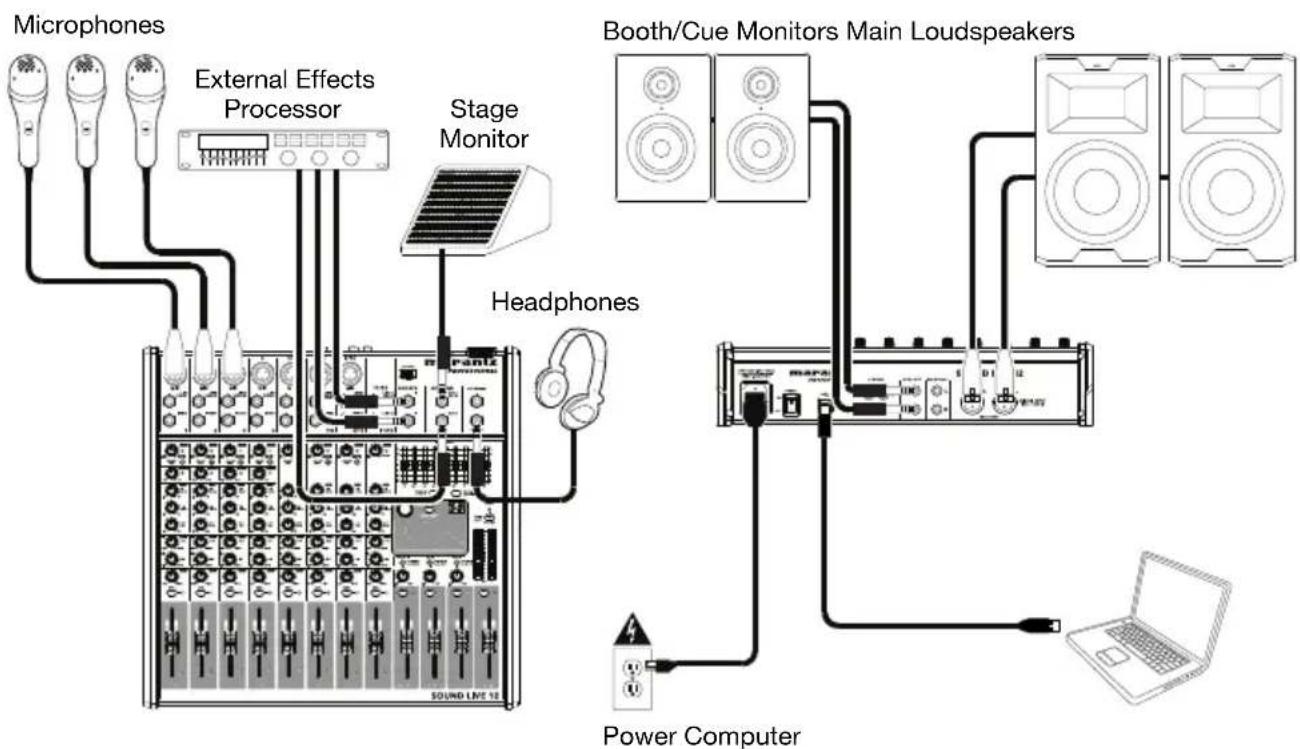
Quick Setup
Items not listed under Introduction > Box Contents are sold separately.
Top Panel View
Rear Panel View
Features
Top Panel
Channels
Note: The channels have essentially the same controls with some minor variations between Channels 1-4, 5/6-9/10, and 11/12. The three different channel types are shown here.
- Mic Input: Connect a microphone or line-level device to these inputs with an XLR cable.
- Line Input: Connect line-level devices to these inputs with 1/4 (6.35mm) cables.
- Insert: Use a standard 1/4" (6.35mm) TRS cable to connect an external processor (such as a compressor, limiter, external EQ unit, etc.) to this jack. The signal will be taken after the channel's gain control and returned before the channel's EQ controls. The tip of the TRS connection is the send, and the ring is the return.
- Gain: Adjusts the channel audio level (pre-fader and pre-EQ gain). Adjust this so that the Signal LED lights up.
- Peak LED: The LED will flash if the signal is clipping. If this happens, decrease the setting of the Gain knob.
- Low Cut Filter: When this button is depressed, that channel's audio will be sent through a 75 Hz low-frequency filter with a slope of 18 dB per octave. This is useful for reducing low-frequency noise when using microphones.
- Compressor: Adjusts the amount of compression on the channel, applied by the mixer's built-in compressor. The LED next to the knob will light up when the compressor is on.
- Hi EQ: Adjusts the high (treble) frequencies of the channel.
- Mid EQ: Adjusts the mid-range frequencies of the channel.
- Low EQ: Adjusts the low (bass) frequencies of the channel.
- Monitor Knob: Adjusts the pre-fader level of the signal sent from that channel to the Monitor Mix, whose level is controlled by the Monitor Fader.



- DFX Knob: Adjusts the post-fader level of the signal sent to the mixer's effects processor, whose level is controlled by the DFX Return Fader (DFX Rtn).
- Channel Pan / Balance: If this knob is labeled Pan, it adjusts the (mono) channel's position in the stereo field. If the knob is labeled Bal, it adjusts the balance between the left and right channels of that stereo signal.
- Channel Mute: Press this button to mute/unmute the channel. The LED next to the button will light up when the channel is muted.
- Channel Fader: Adjusts the audio level on the channel.
- Signal LED (Sig): Indicates that the channel's incoming audio signal is within an optimal range.
Main Controls
- Aux Send: Use 1/4" (6.35mm) TRS cables to connect these outputs to the inputs of an external amplifier or active monitor. Use the Monitor Knob (Mon) on each channel to control the level of the signal sent to Aux Send 1. This is useful for creating a custom monitor mix for onstage musicians.
- Aux Return (Aux Rtn): Connect the outputs of an external device to these inputs with 1/4 (6.35mm) mono cables. If your source is mono, plug it into the left jack and it will be heard on both the left and right sides.
- Aux Return Fader (Aux Rtn): Controls the audio level sent into the Aux Return (Aux Rtn) inputs.
- Graphic Equalizer: When the EQ On/Off switch is on (depressed), you can use these controls to adjust the equalization of the main mix.
- EQ On/Off: Enables or disables the Graphic Equalizer.
- Main Out / Monitor Out: When this button is raised, the Graphic Equalizer will affect the signal sent to the Main Mix Outputs. When this button is depressed, the Graphic Equalizer will affect the signal sent to the Aux 1 (Mon) Output.
- Effect Selector: This knob determines what effect the mixer's internal effects processor will apply to the various channels. Turn the knob to change the effect number, and push the knob to select it. The display next to the DFX Mute button will show the preset number. Each channel can send different levels of audio to the processor by adjusting its DFX Knob. See the Effects section for an explanation of the available effects.
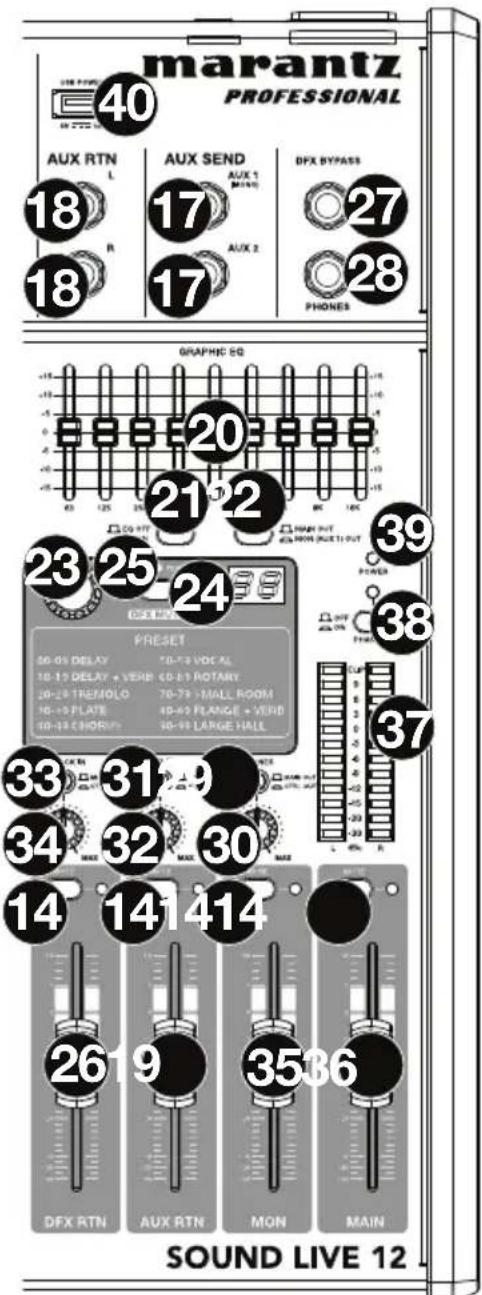
- DFX Mute: Press this button to mute/unmute the effects.
- DFX Peak LED: The LED will flash if the signal is clipping. If this happens, decrease the setting of your source channels' DFX Knobs. When the effects processor is muted, the LED will be solidly lit.
- DFX Return Fader (DFX Rtn): Adjusts the volume of the audio sent from the mixer's effects processor.
- DFX Bypass: You can connect a standard 1/4" (6.35mm) latching-style footswitch (sold separately) to this input and use it to bypass the mixer's internal effects processor (when the footswitch is in its "closed" position).
- Phones Output: Connect 1/4" (6.35mm) stereo headphones to these outputs. The Phones Volume knob controls the volume. The Phones Source button sets what signal is sent to this output.
- Phones Source: When this button is raised, the signal from the Main Mix Outputs will be heard in the Phones Output. When this button is depressed, the signal from the Control Room Outputs (Ctrl Out) will be heard in the Phones Output.
- Phones Volume: Adjusts the volume of Phones Output.
- USB In Source: When this button is raised, the signal sent to the mixer through its USB Port will be sent to the Main Mix Outputs. When this button is depressed, the signal sent to the mixer through its USB Port will be sent to the Control Room Outputs (Ctrl Out).
- USB In Level: Adjusts the level of the signal sent to the mixer through its USB Port.
- 2 Track In Source: When this button is raised, the signal from the 2 Track In will be sent to the Main Mix Outputs. When this button is depressed, the signal from the 2 Track In will be sent to the Control Room Outputs (Ctrl Out).
- 2 Track In Level: Adjusts the level of the 2 Track In.
- Monitor Fader: Adjusts the level of the Aux Send 1 (Mon) output (the Monitor Mix).
- Main Fader: Adjusts the level of the Main Mix Outputs.
- LED Meters: Shows the audio level of the Main Mix Outputs. The Clip LED can light up occasionally, but if it happens too often, reduce the volume of the mix and/or individual channels.
- Phantom Power: Activates/deactivates phantom power. When activated, phantom power supplies +48V to the XLR mic inputs and the LED next to the button will light up. Please note that most dynamic microphones do not require phantom power, while most condenser microphones do. Consult your microphone's documentation to find out whether it needs phantom power.
- Power LED: Illuminates when the mixer is on.
- USB Power Connection: You can use this USB port to connect and power (or charge) a device that requires power from a 5V, 1A USB bus.
Effects
To apply effects, turn the Effects Preset Knob and press it to select one of the available presets. To send a channel's signal to the effects processor, turn up that channel's DFX Knob (Aux 2). Each effect has 10 variations.
| Numbers | Effect | Description |
| 00-09 | Delay | Reproduces the signal after a small period of time. |
| 10-19 | Delay+Verb | Delay effect with room reverb. |
| 20-29 | Tremolo | Rapidly increases and decreases the signal volume at a regular rate. |
| 30-39 | Plate | Simulates bright plate reverb. |
| 40-49 | Chorus | Simulates the full, complex, watery sound of several instruments playing the same thing. |
| 50-59 | Vocal Reverb, simulating a room with a small delay time. | |
| 60-69 | Rotary | Simulates the classic Doppler effect of the spinning horn inside an organ speaker. |
| 70-79 | Small Room | Reverb simulating a bright studio space. |
| 80-89 | Flange+Verb | Applies room reverb plus a classic stereo flanging effect. |
| 90-99 | Large Hall | Reverb simulating a large acoustic space. |
Rear Panel
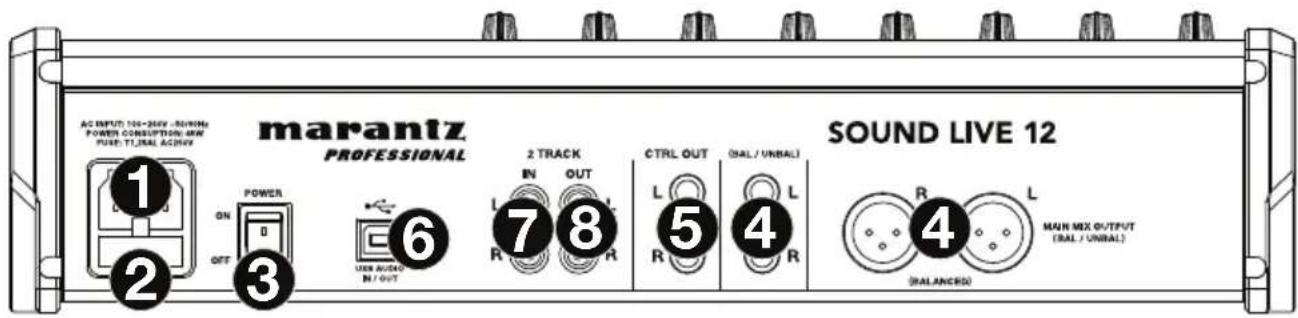
- Power In: Use the included power cable to connect the mixer to a power outlet. While the power is switched off, connect the power cable into the mixer first, then connect the power cable to a power outlet.
- Fuse Cover: If the fuse is broken, use a screwdriver or other tool to lift this tab, and replace the fuse with a fuse with the same rating (printed just above the Power In). Using a fuse with an incorrect rating can damage the unit and/or fuse.
- Power Switch: Powers the mixer on and off. Turn on the mixer only after connecting all of your input devices but before turning on your amplifiers. Turn off amplifiers before you turn off the mixer.
- Main Mix Outputs: Use standard XLR or 1/4" (6.35mm) cables to connect either pair of these outputs to your loudspeakers or amplifier system. Use the Main Fader to control the level of these outputs.
- Control Room Outputs (Ctrl Out): Use standard 1/4" (6.35mm) cables to connect these outputs to your control room (booth) monitors or amplifier system.
-
USB Port: Use a standard USB cable to connect this USB port to a computer. The mixer can send or receive audio to or from your computer through this connection.
-
When sending audio, the main mix will be sent from the mixer to your computer.
-
When receiving audio, it will be sent from your computer to the Main Mix Outputs or Control Room Outputs (Ctrl Out), depending on the position of the mixer's USB In Source button.
-
2-Track Inputs (2 Track In): Connect these inputs to the outputs of an external sound source using a standard stereo RCA cable (sold separately). Use the 2 Track In Source button to send this signal either to the Main Mix Outputs or to the Control Room Outputs (Ctrl Out).
- 2-Track Outputs (2 Track Out): Connect these outputs to the inputs of an external recording device using a standard stereo RCA cable (sold separately).
Assistance technique
Technical Specifications
| Mono Input Channels | Microphone inputs: Electronically balanced, discrete input configuration Frequency response: 20 Hz to 20 kHz, +0.5 dB THD+N: <0.02% at 0 dBu, 1 kHz Gain range: 0 dB to 45 dB (Mic) SNR: 90 dB |
| Line Inputs | Electronically balanced Frequency response: 20 Hz to 20 kHz, +0.5 dB THD+N: <0.03% at 0 dBu, 1 kHz Sensitivity range: -15 dBu to 30 dBu |
| Impedances | Microphone inputs: 51.1 KΩ Channel insert return: 200 KΩ All other inputs: >100 KΩ 2-Track outputs: 10 KΩ All other outputs: 20 KΩ |
| Equalization | High-shelving: ±15 dB @ 12 kHz Mid-bell (mono): ±15 dB @ 2.5 kHz Low-shelving: ±15 dB @ 80 Hz Main EQ: 9 EQ bands (63 Hz, 125 Hz, 250 Hz, 500 Hz, 1 kHz, 2 kHz, 4 kHz, 8 kHz, 16 kHz), ±15 dB |
| DSP (DFX/Effects) | A/D & D/A converters: 24-bit DSP Resolution: 24-bit Effects: 10 DSP effects families with 10 variations available per family Presents: 100 total Controls: Rotary encoder preset selector, DSP mute switch, peak LED indicator |
| Main Mix | Noise (bus noise): -64 dBr (ref: +4 dBu, fader 0 dB, channels muted) -64 dBr (ref: +4 dBu, fader 0 dB, all input channels assigned and set to “unity” gain) Phantom Power: Mic Pin 2/Pin 3 and Pin 1 47±2V |
| Power | Main voltage: USA/Canada: 100-120 VAC ~60 Hz UK/Australia: 240 VAC ~50 Hz Europe: 210-240 VAC ~50 Hz Power consumption: 40 W Fuse: 1.25 A Main connection: Standard IEC receptacle |
| Dimensions (width x depth x height) | 14.1” x 13.6” x 3.1” 358 x 346 x 80 mm |
| Weight | 9.0 lbs. 4.1 kg |
Specifications are subject to change without notice.
Trademarks & Licenses
Marantz is a trademark of D&M Holdings Inc., registered in the U.S. and other countries.
All other product names, company names, trademarks, or trade names are those of their respective owners.
marantzpro.com
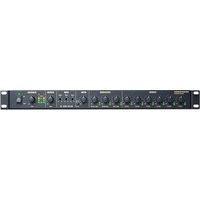
Brand : MARANTZ
Model : Sound Live 12
Category : Audio Mixer