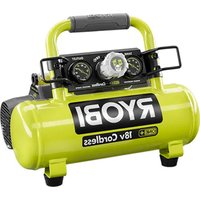
P739 - Stapler RYOBI - Free user manual and instructions
Find the device manual for free P739 RYOBI in PDF.


| Product Type | Portable Air Compressor |
| Brand | RYOBI |
| Model | P739 |
| Tank Capacity | 3.8 L (1 gal) |
| Maximum Pressure | 827.4 kPa (120 psi) |
| Airflow at 276 kPa (40 psi) | 0.02 m³/min (0.75 SCFM) |
| Airflow at 620 kPa (90 psi) | 0.01 m³/min (0.5 SCFM) |
| Motor Type | Brushless, 18 V DC |
| Battery Type | Lithium-ion (Li-ion) |
| Battery Voltage | 18 V |
| Pressure Gauges | 2 pressure gauges, 43.2 mm diameter |
| Safety Valve | Yes, manual reset |
| Automatic Shut-off | Yes, via pressure switch |
| Overload Protection | Resettable internal circuit breaker |
| Applications | Light to medium pneumatic tools, inflation |
| Power Source | 18 V Li-ion battery (not included) |
| Weight | Approx. 6.8 kg (15 lb) |
| Dimensions (L x W x H) | Approx. 35 x 25 x 40 cm |
| Maintenance | Drain tank daily, check safety valve |
| Replacement Parts | Use only genuine RYOBI parts |
| Warranty | 3-year limited |
Frequently Asked Questions - P739 RYOBI
User questions about P739 RYOBI
0 question about this device. Answer the ones you know or ask your own.
Ask a new question about this device
Download the instructions for your Stapler in PDF format for free! Find your manual P739 - RYOBI and take your electronic device back in hand. On this page are published all the documents necessary for the use of your device. P739 by RYOBI.
USER MANUAL P739 RYOBI
General Safety Rules. 3
■ Specific Safety Rules 4-5
Symbols. 6-7
Glossary of Terms. 7
Features. 8
Assembly. 8
Operation. 8-11
■ Maintenance. 11
Troubleshooting. 12
■ Illustrations. 13-14
Parts Ordering/Service......Back Page
WARNING: To reduce the risk of injury, the user must read and understand the operator's manual before using this product.
SAVE THIS MANUAL FOR FUTURE REFERENCE
TABLE DES MATIÈRES
***************
This compressor/pump is not equipped and should not be used to supply breathing quality air. Additional equipment would be necessary to properly filter and purify the air to meet minimal specifications for Grade D breathing as described in Compressed Gas Association Commodity Specification G 7.1 - 1966, OSHA 29 CFR 1910.134. Compressed Gas Association, 4221 Walney Road, Fifth Floor, Chantilly, VA 20151-2923, (703) 788-2700, www.cganet.com. Any such additional equipment has not been examined and no implication of proper use for breathing air is intended or implied.
If this compressor is altered in any way, existing warranties shall be voided. RYOBI and One World Technologies, Inc., disclaim any liabilities whatsoever for any loss, personal injury, or damage.
DISCLAIMER OF WARRANTYES
In the event the compressor is used for the purpose of breathing air application and proper in-line safety and alarm equipment is not simultaneously used, existing warranties shall be voided, and RYOBI disclaims any liabilities whatsoever for any loss, personal injury, or damage.

DANGER:
Read and understand all instructions. Failure to follow all instructions listed below may result in electric shock, fire, and/or serious personal injury.
SAVE THESE INSTRUCTIONS
WORK AREA
- Keep your work area clean and well lit. Cluttered benches and dark areas invite accidents. Floor must not be slippery from wax or dust.
- Do not operate air compressors in explosive atmospheres, such as in the presence of flammable liquids, gases, or dust. Power tools create sparks which may ignite the dust or fumes.
- Keep bystanders, children, and visitors away while operating an air compressor. Distractions can cause you to lose control.
Operate air compressor in an open area at least 18 in. away from any wall or object that could restrict the flow of fresh air to ventilation openings.
ELECTRICAL SAFETY
- Avoid body contact with grounded surfaces such as pipes, radiators, ranges, and refrigerators. There is an increased risk of electric shock if your body is grounded.
- Don't expose air compressors to rain or wet conditions. Water entering an air compressor will increase the risk of electric shock.
Use this product only with batteries and chargers listed in tool/appliance/battery pack/charger correlation supplement 987000-432. Use of other battery packs or chargers may create a risk of injury or fire.
PERSONAL SAFETY
Eye protection which conforms to ANSI specifications and provides protection against flying particles both from the FRONT and SIDE should ALWAYS be worn by the operator and others in the work area when loading, operating, or servicing this product. Eye protection is required to guard against flying fasteners and debris, which could cause severe eye injury.
The employer and/or user must ensure that proper eye protection is worn. We recommend a Wide Vision Safety Mask for use over eyeglasses or standard safety glasses that provide protection against flying particles both from the front and side. Always use eye protection which is marked to comply with ANSI Z87.1.
Additional safety protection will be required in some environments. For example, the working area may include exposure to a noise level which can lead to hearing damage. The employer and user must ensure that any necessary hearing protection is provided and used by the operator and others in the work area. Some environments will require the use of head protection equipment. When required, the employer and user must ensure that head protection marked to comply with ANSI Z89.1 is used.
- Stay alert, watch what you are doing, and use common sense when operating the air compressor. Do not use product while tired or under the influence of drugs, alcohol, or medication. A moment of inattention while operating an air compressor may result in serious personal injury.
- Dress properly. Do not wear loose clothing or jewelry.
Contain long hair. Keep your hair, clothing, and gloves away from moving parts. Loose clothes, jewelry, or long hair can be caught in moving parts.
- Do not overreach. Keep proper footing and balance at all times. Proper footing and balance enables better control of the product in unexpected situations.
Use safety equipment. Always wear eye protection. Dust mask, nonskid safety shoes, hard hat, or hearing protection must be used for appropriate conditions.
- Do not use on a ladder, rooftop, or any inclined, elevated, or unstable support. Stable footing on a solid surface enables better control of the air compressor in unexpected situations.
SERVICE
- When servicing a product, use only identical replacement parts. Follow instructions in the Maintenance section of this manual. Use of unauthorized parts or failure to follow Maintenance instructions may create a risk of injury.
Service must be performed only by qualified repair personnel. Service or maintenance performed by unqualified personnel may result in a risk of injury. - Remove the battery pack, open drain valve to decompress tanks and allow water to drain, and allow air compressor to become cool to the touch before servicing. Turn pressure regulator knob fully counterclockwise after shutting off air compressor.
SPECIFIC SAFETY RULES
- Know your air compressor. Read operator's manual carefully. Learn its applications and limitations, as well as the specific potential hazards related to this product. Following this rule will reduce the risk of electric shock, fire, or serious injury.
- Do not exceed the pressure rating of any component in the system.
- Protect material lines and air lines from damage or puncture. Keep hose away from sharp objects, chemical spills, oil, solvents, and wet floors.
- Check hoses for weak or worn condition before each use, making certain all connections are secure. Do not use if defect is found. Purchase a new hose or notify an authorized service center for examination or repair.
Release all pressures within the system slowly. Dust and debris may be harmful.
Store idle air compressors out of the reach of children and other untrained persons. Air compressors are dangerous in the hands of untrained users. - Maintain air compressors with care. Follow maintenance instructions. Properly maintained products are easier to control.
- Check for misalignment or binding of moving parts, breakage of parts, and any other condition that may affect the product's operation. If damaged, have the air compressor serviced before using. Many accidents are caused by poorly maintained products.
- Keep the exterior of the air compressor dry, clean, and free from oil and grease. Always use a clean cloth when cleaning. Never use brake fluids, gasoline, petroleum-based products, or any strong solvents to clean the unit. Following this rule will reduce the risk of deterioration of the enclosure plastic
- Drain tanks of moisture after each day's use. If unit will not be used for a while, it is best to leave drain valve open until such time as it is to be used. This will allow moisture to completely drain out and help prevent corrosion on the inside of tanks.
■ Risk of Fire or Explosion. When used in conjunction with a dedicated spray system, do not spray flammable liquid in a confined area. Spray area must be well ventilated. Do not smoke while spraying or spray where spark or flame is present. Keep compressors as far from the spraying area as possible, at least 25 feet from the spraying area and all explosive vapors.
■ Risk of Bursting. Do not adjust regulator to result in output pressure greater than marked maximum pressure of attachment. Do not use at pressure greater than 120 psi.
To reduce the risk of electric shock, do not expose to rain. Store indoors.
Inspect tanks yearly for rust, pin holes, or other imperfections that could cause it to become unsafe. Never weld or drill holes in the air tanks.
Make sure the hose is free of obstructions or snags. Entangled or snarled hoses can cause loss of balance or footing and may become damaged.
Use the air compressor only for its intended use. Do not alter or modify the unit from the original design or function.
Always be aware that misuse and improper handling of this product can cause injury to yourself and others.
- Never leave a tool unattended with the air hose attached.
Never point any air tool toward yourself or others.
- Do not operate this air compressor if it does not contain a legible warning label.
- Do not continue to use a tool or hose that leaks air or does not function properly.
Always disconnect the air supply, turn the unit off, and remove the battery pack before making adjustments, servicing a product, or when a product is not in use.
- Do not attempt to pull or carry the air compressor by the hose.
- Your tool may require more air consumption than this air compressor is capable of providing.
Always follow all safety rules recommended by the manufacturer of your air tool, in addition to all safety rules for the air compressor. Following this rule will reduce the risk of serious personal injury.
- Never direct a jet of compressed air toward people or animals. Take care not to blow dust and dirt towards yourself or others. Following this rule will reduce the risk of serious injury.
- Do not use this air compressor to spray chemicals or paint. Your lungs can be damaged by inhaling toxic fumes. A respirator may be necessary in dusty environments.
SPECIFIC SAFETY RULES
Inspect hoses periodically. Replace damaged hoses. Following this rule will reduce the risk of serious personal injury.
- Check damaged parts. Before further use of the air compressor or air tool, a guard or other part that is damaged should be carefully checked to determine that it will operate properly and perform its intended function. Check for alignment of moving parts, binding of moving parts, breakage of parts, mounting, and any other conditions that may affect its operation. A guard or other part that is damaged should be properly repaired or replaced by an authorized service center. Following this rule will reduce the risk of shock, fire, or serious injury.
This equipment incorporates parts, such as snap switches, receptacles, and the like that tend to produce arcs or sparks and, therefore, when located in a garage, it should be in a room or enclosure provided for the purpose, or should be 18 in. or more above the floor.
- Never store a tool with air connected. Storing the tool with air connected can result in unexpected firing and possible serious personal injury.
- Protect your lungs. Wear a face or dust mask if the operation is dusty. Following this rule will reduce the risk of serious personal injury.
- Recharge only with the charger specified by the manufacturer. A charger that is suitable for one type of battery pack may create a risk of fire when used with another battery pack.
Use power tools only with specifically designated battery packs. Use of any other battery packs may create a risk of injury and fire.
- When battery pack is not in use, keep it away from other metal objects, like paper clips, coins, keys, nails, screws or other small metal objects, that can make a connection from one terminal to another. Shorting the battery terminals together may cause burns or a fire.
Under abusive conditions, liquid may be ejected from the battery; avoid contact. If contact accidentally occurs, flush with water. If liquid contacts eyes, additionally seek medical help. Liquid ejected from the battery may cause irritation or burns.
- Battery tools do not have to be plugged into an electrical outlet; therefore, they are always in operating condition. Be aware of possible hazards when not using your battery tool or when changing accessories. Following this rule will reduce the risk of electric shock, fire, or serious personal injury.
- Do not place battery tools or their batteries near fire or heat. This will reduce the risk of explosion and possibly injury.
- Do not crush, drop or damage battery pack. Do not use a battery pack or charger that has been dropped or received a sharp blow. A damaged battery is subject to explosion. Properly dispose of a dropped or damaged battery immediately.
Batteries can explode in the presence of a source of ignition, such as a pilot light. To reduce the risk of serious personal injury, never use any cordless product in the presence of open flame. An exploded battery can propel debris and chemicals. If exposed, flush with water immediately. - Do not charge battery tool in a damp or wet location. Following this rule will reduce the risk of electric shock.
For best results, your battery tool should be charged in a location where the temperature is more than 50°F but less than 100°F . To reduce the risk of serious personal injury, do not store outside or in vehicles.
Under extreme usage or temperature conditions, battery leakage may occur. If liquid comes in contact with your skin, wash immediately with soap and water. If liquid gets into your eyes, flush them with clean water for at least 10 minutes, then seek immediate medical attention. Following this rule will reduce the risk of serious personal injury. - Do not use a battery pack that is damaged or modified. Damaged or modified batteries may exhibit unpredictable behavior resulting in fire, explosion or risk of injury.
- Do not modify or attempt to repair a battery pack that has been damaged.
- Do not expose a battery pack or appliance to fire or excessive temperature. Exposure to fire or temperature above 265°F may cause explosion.
- Follow all charging instructions and do not charge the battery pack or appliance outside of the temperature range specified in the instructions. Charging improperly or at temperatures outside of the specified range may damage the battery and increase the risk of fire.
Have servicing performed by a qualified repair person using only identical replacement parts. This will ensure that the safety of the product is maintained.
Save these instructions. Refer to them frequently and use them to instruct others who may use this product. If you loan someone this product, loan them these instructions also.
SYMBOLS
| The following signal words and meanings are intended to explain the levels of risk associated with this product. SYMBOL SIGNAL MEANING | ||
| DANGER: | Indicates a hazardous situation, which, if not avoided, will result in death or serious injury. | |
| WARNING: | Indicates a hazardous situation, which, if not avoided, could result in death or serious injury. | |
| CAUTION: | Indicates a hazardous situation, that, if not avoided, may result in minor or moderate injury. | |
| NOTICE: | (Without Safety Alert Symbol) Indicates information considered important, but not related to a potential injury (e.g. messages relating to property damage). | |
| Some of the following symbols may be used on this product. Please study them and learn their meaning. Proper interpretation of these symbols will allow you to operate the product better and safer. SYMBOL NAME DESIGNATION/EXPLANATION | ||
| Safety Alert Indicates a potential | personal injury hazard. | |
| Read Operator's Manual | To reduce the risk of injury, user must read and understand operator's manual before using this product. | |
| Eye Protection | Always wear eye protection with side shields marked to comply with ANSI Z87.1. | |
| Wet Conditions Alert Do not expose to rain or use in damp locations. | ||
| Recycle Symbol | This product uses lithium-ion (Li-ion) batteries. Local, state or federal laws may prohibit disposal of batteries in ordinary trash. Consult your local waste authority for information regarding avail-able recycling and/or disposal options. | |
| Risk of Bursting | Do not adjust regulator to result in output pressure greater than marked maximum pressure of attachment. Do not use at pressure greater than 120 PSI. | |
| Risk of Fire or Explosion | Do not spray flammable liquid in a confined area. Spray area must be well ventilated. Do not smoke while spraying or spray where spark or flame is present. Keep compressors as far from the spraying area as possible, at least 25 feet from the spraying area and all explosive vapors. | |
| Hot Surface | To reduce the risk of injury or damage, avoid contact with any hot surface. | |
| Risk to Breathing | Air obtained directly from the air compressor should never be used to supply air for human consumption. | |
SYMBOLS
| Some of the following symbols may be used on this product. Please study them and learn their meaning. Proper interpretation of these symbols will allow you to operate the product better and safer. SYMBOL NAME DESIGNATION/EXPLANATION | ||
| V Volts Voltage | ||
| = | Direct Current Type or a characteristic of current | |
| no | No Load Speed Rotational speed, at no load | |
GLOSSARY OF TERMS
Air Filter
Porous element contained within a metal or plastic housing attached to the compressor cylinder head which removes impurities from the intake air of the compressor.
Air Tank
Cylindrical component which contains the compressed air.
Check Valve
Device that prevents compressed air from flowing back from the air tank to the compressor pump.
Circuit Breaker
Automatically shuts off the compressor if the temperature of the electric motor exceeds a predetermined limit.
Cut-In Pressure
The low pressure at which the motor will automatically restart.
Cut-Off Pressure
The high pressure at which the motor will automatically shut off.
Electric Motor
Device which provides the rotational force necessary to operate the compressor pump.
Auto On/Off Switch
Control which turns the air compressor on or off. The pressure switch will not automatically start and control the compressor unless the manual Auto On/Off switch is in the Auto On position.
NPT (National Pipe Thread)
A seal thread tape must be used to provide a leak-free seal on pipe threaded connections.
Pressure Regulator Knob
Regulates the outgoing pressure from the air outlet to the tool. It is possible to increase or decrease the pressure at the outlet by adjusting this control knob.
Pressure Switch
Automatically controls the on/off cycling of the compressor. It stops the compressor when the cut-off pressure in the tank is reached and starts the compressor when the air pressure drops below the cut-in pressure.
PSI (Pounds Per Square Inch)
Measurement of the pressure exerted by the force of the air. The actual psi is measured by a pressure gauge on the compressor.
Pump
Produces the compressed air with a reciprocating piston contained within the cylinder.
Regulator Pressure Gauge
Displays the current line pressure. Line pressure is adjusted by rotating the pressure regulator knob.
Safety Valve
Prevents air pressure in the air tank from rising over a predetermined limit.
SCFM (Standard Cubic Feet Per Minute) or CFM (Cubic Feet Per Minute)
A unit of measure of air delivery.
Tank Pressure Gauge
Indicates the pressure in the air tank.
FEATURES
PRODUCT SPECIFICATIONS
Air Tank Capacity 1 gal.
Air Pressure 120 psi max.
Air Delivery .Up to .75 SCFM @ 40 psi
Up to .5 SCFM @ 90 psi
Tested per ISO1217
Gauges. 1.7 in. diameter
Motor. 18 V DC
ASSEMBLY

WARNING:
Do not use this product if it is not completely assembled or if any parts appear to be missing or damaged. Use of a product that is not properly and completely assembled or with damaged or missing parts could result in serious personal injury.

WARNING:
Do not attempt to modify this product or create accessories or attachments not recommended for use with this product. Any such alteration or modification is misuse and could result in a hazardous condition leading to possible serious personal injury.
If any parts are damaged or missing, please call 1-800-525-2579 for assistance.
OPERATION

DANGER:
Do not disassemble check valve, tank drain valves or safety relief valve with air in tank - bleed tanks. Failure to depressurize tank could result in explosion and/or serious personal injury.

WARNING:
This equipment incorporates parts, such as snap switches, receptacles, and the like that tend to produce arcs or sparks and, therefore, when located in a garage, it should be in a room or enclosure provided for the purpose, or should be 18 in. or more above the floor.

WARNING:
Do not allow familiarity with products to make you careless. Remember that a careless fraction of a second is sufficient to inflict severe injury.

WARNING:
Do not attach any tools to the open end of the hose until start-up has been completed.

WARNING:
Always wear eye protection with side shields marked to comply with ANSI Z87.1. Failure to do so could result in objects being thrown into your eyes resulting in possible serious injury.

WARNING:
Always remove battery pack from the tool when you are assembling parts, making adjustments, cleaning, or when not in use. Removing battery pack will prevent accidental starting that could cause serious personal injury.

WARNING:
Do not use any attachments or accessories not recommended by the manufacturer of this product. The use of attachments or accessories not recommended can result in serious personal injury.
NOTICE:
Do not use in an environment that is dusty or otherwise contaminated. Using the air compressor in this type of environment may cause damage to the unit.
OPERATION
APPLICATIONS
Air compressors are utilized in a variety of air system applications. Match hoses, connectors, air tools, and accessories to the capabilities of the air compressor.
You may use this product for the purposes listed below:
Operating light- to medium-duty air-powered tools
Operating air accessories such as air nozzles and automotive tire chucks
INSTALLING/REMOVING BATTERY PACK
See Figure 1, page 13.
Make sure the air compressor is turned off.
Insert a fully charged battery pack into the product as shown.
NOTE: For best performance, a 4.0 Ah battery pack is recommended.
Make sure the latches on each side of the battery pack snap into place and the battery pack is secured in the product before beginning operation.
Depress the latches to remove the battery pack.
For complete charging instructions, see the operator's manuals for your battery pack and charger.
CONNECTING/DISCONNECTING AIR HOSE (HOSE NOT PROVIDED)
See Figure 2, page 13.

WARNING:
Never exceed the air tool's pressure rating as recommended by the manufacturer. When using this air compressor as an inflation device, always follow the maximum inflation guidelines stated by the manufacturer of the item being inflated.
Make sure the air compressor is turned off and the battery pack is not installed.
- Rotate pressure regulator knob fully in the counterclockwise direction so that the outlet pressure is at zero (0) psi.
- Attach hose with quick connect air fitting to 1/4 in. quick coupler on air compressor. Make sure to push the hose adaptor end fully into the coupler until the sleeve springs forward to lock it in place.
NOTE: Your air hose can be looped around the hose wrap brackets for storage or any time the air compressor is not in use.
To disconnect an air hose or an air tool:
Confirm that the outlet pressure is at zero (0) psi.
- When disconnecting a hose from 1/4-in. quick coupler, always firmly hold release end of hose.
Pull back on the release sleeve on the 1/4-in. quick coupler.
- With a firm grip, pull out the quick-connect air fitting that is attached to the quick coupler.
BREAK-IN PERIOD
Before first use, install a fully charged 4.0 Ah battery pack, then run the air compressor at zero tank pressure with the drain valve fully open for 30 minutes or until the battery pack is completely discharged, whichever happens first.
TURNING THE AIR COMPRESSOR ON/OFF
See Figure 3, page 14.
Install the battery pack.
- Move the Auto On/Off switch to the AUTO ON (I) position to power the compressor on.
To turn the air compressor off, move the Auto On/Off switch to the OFF (O) position.
NOTE: When the compressor is in the AUTO ON (I) position, the air compressor will automatically turn back on when the designated tank air pressure drops below the preset pressure limit. It will also shut off again when the cut-off pressure is reached.

WARNING:
Never exceed the air tool's pressure rating as recommended by the manufacturer. When using this air compressor as an inflation device, always follow the maximum inflation guidelines stated by the manufacturer of the item being inflated.

WARNING:
Always ensure the switch is in the OFF (O) position and the regulator pressure gauge reads zero before changing air tools or disconnecting the hose from the air outlet. Failure to do so could result in possible serious personal injury.
OPERATION
USING THE AIR COMPRESSOR
See Figure 4, page 14.

WARNING:
Risk of bursting. Do not adjust pressure regulator knob to result in output pressure greater than marked maximum pressure of attachment and/or the item being inflated. Never use at pressure greater than 120 psi. Failure to heed this warning could result in possible serious personal injury.

WARNING:
Air powered tools may require more air consumption than this air compressor is capable of providing. Check the tool manual to avoid damage to the tool or risk of personal injury.
- Ensure that the Auto On/Off switch is in the OFF position and the battery pack is not installed.
- Attach air hose following the instructions in Connecting/ Disconnecting Air Hose (hose not provided).
- Attach 1/4 in. NPT quick-connect air fitting to the accessory or tool you intend to use.
Insert the other end of the quick-connect air fitting to the quick coupler on the open end of hose.
Install the battery pack.
Move the Auto On/Off switch to the Auto On position. - Set the amount of air pressure desired using the pressure regulator knob. Pull the knob out, then turn clockwise to increase or counterclockwise to decrease the air pressure through the hose. When the desired pressure is set, push the knob back in to lock.
NOTE: Always use the minimum amount of pressure necessary for your application. Using a higher pressure than needed will drain air from the tank more rapidly, cause the unit to cycle on more frequently, and reduce battery run time between charges.
Following all safety precautions in this manual and the manufacturer's instructions in the air tool manual, you may now proceed to use your air-powered tool.
NOTE: The air compressor will shut off during an electrical overload. To reset the internal overload switch, turn off the air compressor and allow the unit to cool. Remove and then reinstall the battery packs before resuming operation.
- When finished, always drain the tank, turn the unit off, and remove the battery packs. Never leave the unit on and/or running unattended.
DRAINING THE TANK
See Figures 5 - 6, page 14.
To help prevent tank corrosion and keep moisture out of the air used, the air tank of the compressor should be drained daily.
To drain:
Turn the air compressor off and remove the battery packs.
Pull the ring on the safety valve to release air until tank pressure gauge reads less than 20 psi.
Release the ring.
Turn the drain valves 90° counterclockwise to the ON (open) position.
Tilt tank to drain moisture from tank into a suitable container.
NOTE: Condensate is a polluting material and should be disposed of in compliance with local regulations.
If a drain valve is clogged, release all air pressure, remove and clean valve, then reinstall.

WARNING:
Turn off the air compressor, remove battery packs, and release all air from the tank before servicing. Failure to depressurize tank before attempting to remove valve could cause serious personal injury.
Turn the drain valves 90° clockwise to the OFF (closed) position.

WARNING:
RISK OF BURSTING. All compressed air tanks have a limited lifespan. The lifespan can be affected by a number of factors, including operating conditions of the air compressor, proper maintenance of the tank, and unauthorized repairs and modifications. Since deterioration of the tank can occur internally with no outward signs, the air tank(s) on this compressor MUST be removed from service by the end of the year shown on the data label. Use of the air compressor after this date increases the risk of an air tank rupture, which could result in serious personal injury.
OPERATION
CHECKING THE SAFETY VALVE
See Figure 5, page 14.

DANGER:
Do not attempt to tamper with the safety valve. Anything loosened from this device could fly up and hit you. Failure to heed this warning could result in death or serious personal injury.
The safety valve will automatically release air if the air tank pressure exceeds the cut-out pressure. The valve should be checked before each day of use by pulling the ring by hand.
Install the battery pack.
Turn the air compressor on and allow the tank to fill. The compressor will shut off when the pressure reaches the cut-out pressure.
Turn the air compressor off.
Pull the ring on the safety valve to release air for three to five seconds to allow pressurized air to escape. Release the ring. The safety release valve must reset and hold pressure before all compressed air is exhausted from the tank/pressure vessel.
Any continued loss of air after performing the above steps indicates a problem with the safety valve. Discontinue use and seek service before continued use of the air compressor.

WARNING:
If air leaks after the ring has been released or if the valve is stuck and cannot be actuated by the ring, do not use the air compressor until the safety valve has been replaced. Use of the air compressor in this condition could result in serious personal injury.
MAINTENANCE

WARNING:
Always release all pressure, remove the battery packs, and allow unit to cool to the touch before cleaning or making repairs on the air compressor.

WARNING:
Always wear eye protection with side shields marked to comply with ANSI Z87.1. Failure to do so could result in objects being thrown into your eyes resulting in possible serious injury.

WARNING:
When servicing, use only identical replacement parts. Use of any other parts could create a hazard or cause product damage.
GENERAL MAINTENANCE
Avoid using solvents when cleaning plastic parts. Most plastics are susceptible to damage from various types of commercial solvents and may be damaged by their use. Use clean cloths to remove dirt, dust, oil, grease, etc.

WARNING:
Do not at any time let brake fluids, gasoline, petroleum-based products, penetrating oils, etc., come in contact with plastic parts. Chemicals can damage, weaken or destroy plastic which could result in serious personal injury.
STORING THE AIR COMPRESSOR
Place the Auto On/Off switch in the OFF position.
Remove the battery pack.
- Disconnect air hose and air tool from the product.
Drain air tanks according to instructions.
Thoroughly clean air compressor and any accessories.
Hoses may be stored using the hose wrap brackets on the air compressor.
TROUBLESHOOTING
NOTE: ILLUSTRATIONS START ON PAGE 13 AFTER FRENCH AND SPANISH LANGUAGE SECTIONS.
| PROBLEM POSSIBLE CAUSE SOLUTION | ||
| Compressor will not run Batery is not chargedPressure switch badTank is full of airInternal overload switch is tripped | Recharge battery packTake compressor to service centerCompressor will turn on when tank pressuredrops to cut-in pressureTurn off compressor and allow unit to cool;remove and reinstall battery packs | |
| Motor hums but cannot run or runs slowly | Shorted or open motor windingDefective check valve or unloader | Take compressor to service centerTake compressor to service center |
| Internal overload switch trips repeatedly | Lack of proper ventilation/room temperaturetoo highElectrical overload | Move compressor to well-ventilated areaTurn off unit and allow to cool; remove andreinstall battery packs. |
| Air tank pressure drops when compressor shuts off | Loose connections (fittings, tubing, etc.)Loose drain valve / open drain valveCheck valve leaking | Check all connections with soap and watersolution and tightenTighten drain valve / close drain valveTake compressor to service centerDANGER:Do not disassemble check valve, tank drain valves or safety relief valve with air in tankbleed tank. |
| Excessive moisture in discharge air | Excessive water in air tankHigh humidity | Drain tankMove to area of less humidity; use air line filter |
| Compressor runs continuously | Defective pressure switchExcessive air usage | Take compressor to service centerDecrease air usage; compressor not large enough for tool's requirement |
| Air output lower than normal | Broken inlet valvesConnections leaking | Take compressor to service centerTighten connections |
RÉGLES DE SECURITÉ GÉNÉRALES

AVERTISSEMENT :
NPT - National Pipe Thread
No permitted that you can use the familiarization with your herramientos. No permit to use the familiarization with your herramientos. No permit to use the familiarization with your herramientos. No permit to use the familiarization with your herramientos. No permit to use the familiarization with your herramientos. No permit to use the familiarization with your herramientos. No permit to use the familiarization with your herramientos. No permit to use the familiarization with your herramientos. No permit to use this kind of familiarization. No permit to use this kind of familiarization. No permit to use this kind of familiarization. No permit to use this kind of familiarization. No permit to use this kind of familiarization. No permit to use this kind of familiarization. No permit to use this kind of familiarization. No permit to use this kind of familiarization. No permit to use this kind of familiarization. No permit to use this kind of familiarization. No permit to use this kind of familiarIZATION. No permit to use this kind of familiarization. No permit to use this kind of familiarization. No permit to use this kind of familiarization. No permit to use this kind of familiarization. No permit to use this kind of familiarization. No permit to use this kind of familiarization. No permit to use this kind of familiarization. No permit to use this kind of familiarization. No permit to use this kind of familiarization. No permit to use this kind of familiarizaton. No permit to use this kind of familiarization. No permit to use this kind of familiarization. No permit to use this kind of familiarization. No permit to use this kind of familiarization. No permit to use this kind of familiarization. No permit to use this kind of familiarization. No permit to use this kind of familiarization. No permit to use this kind of familiarization. No permit to use this kind of familiarization. No permit to use this kind of familiaritacion. No permit to use this kind of familiaritacion. No permit to use this kind of familiaritacion. No permit to use this kind of familiaritacion. No permit to use this kind of familiaritacion. No permit to use this kind of familiaritacion. No permit to use this kind of familiaritacion. No permit to use this kind of familiaritacion. No permit to use this kind of familiaritacion. No permit to use this kind of familiaritacion. No permit to use this kind of familiaritacion. No permit to use this kind of familiaritacion. No permit to use this kind of familiaritacion. No permit to use this kind of familiaritacion. No permit to use this kind of familiaritacion. No permit to use this kind of familiaritacion. No permit to use this kind of familiaritacion. No permit to use this kind of familiaritacion. No permit to use this kind of familiaritacion. No permittto use this kind of familiaritacion. No permittto use this kind of familiaritacion No permittto use this kind of familiaritacion No permittto use this kind of familiaritacion No permittto use this kind of familiaritacion No permittto use this kind of familiaritacion No permittto use this kind of familiaritacion No permittto use this kind of familiaritacion No permittto use this kind of familiaritacion No permittto use this kind of familiaritacion No permittno use this kind of familiaritacion No permittno use this kind of familiaritacion No permittno use this kind of familiaritacion No permittno use this kind of familiaritacion No permittno use this kind of familiaritacion No permittno use this kind of familiaritacion No permittno use this kind of familiaritacion No permittno use this kind of familiaritacion No permittno use this kind cfamiliaritatlon No permittno use this kind cfamiliaritatlon No permittno use this kind cfamiliaritatlon No permittno use this kind cfamiliaritatlon No permittno use this kind cfamiliaritatlon No permittno use this kind cfamiliaritatlon No permittno use this kind cfamiliaritatlon No permittno use this kind cfamiliaritatlon No permittno use this kind cfamiliaritatlon No permottno use this kind cfamiliaritatlon No permittno use this kind cfamiliaritatlon No permittno use this kind cfamiliaritatlon No permittno use this kind cfamiliaritatlon No permittno use this kind cfamiliaritatlon No permittno use this kind cfamiliaritatlon No permittno use this kind cfamiliaritatlon No permittno use this kind cfamiliaritatlon No permittno use this kind cfamiliaritatlon No permittno use this knd cfamiliaritatlon No permittno use this knd cfamiliaritatlon No permittno use this knd cfamiliaritatlon No permittno use this knd cfamiliaritatlon No permittno use this knd cfamiliaritatlon No permittno use this knd cfamiliaritatlon No permittno use this knd cfamiliaritatlon No permittno use this knd cfamiliaritatlon No permitt nousekindcfamiliaritatlon No permitt nousekindcfamiliaritatlon No permitt nousekindcfamiliaritatlon No permitt nousekindcfamiliaritatlon No permitt nousekindcfamiliaritatlon No permitt nousekindcfamiliaritatlon No permitt nousekindcfamiliaritatlon No permitt nousekindcfamiliaritatlon No permitt nousekindcfamiliaritatlon

ADVERTENCIA:
To request service, purchase replacement parts,
locate an Authorized Service Center or obtain Customer or Technical Support:
Visit www.ryobitools.com or call 1-800-525-2579
If any parts or accessories are damaged or missing, do not return this product to the store.
Call 1-800-525-2579 for immediate service.
Please obtain your model and serial number from the product data plate.
This product is covered under a 3-year limited Warranty. Proof of purchase is required.
MODEL NUMBER* SERIAL NUMBER
*Model number on product may have additional letters at the end. These letters designate
manufacturing information and should be provided when calling for service.
RYOBI is a trademark of Ryobi Limited and is used pursuant to a license granted by Ryobi Limited.




- TABLE DES MATIÈRES
- DISCLAIMER OF WARRANTYES
- DANGER
- SAVE THESE INSTRUCTIONS
- WORK AREA
- ELECTRICAL SAFETY
- PERSONAL SAFETY
- SERVICE
- SPECIFIC SAFETY RULES
- SYMBOLS
- GLOSSARY OF TERMS
- AIR FILTER
- AIR TANK
- CHECK VALVE
- CIRCUIT BREAKER
- CUT-IN PRESSURE
- CUT-OFF PRESSURE
- ELECTRIC MOTOR
- AUTO ON/OFF SWITCH
- NPT (NATIONAL PIPE THREAD)
- PRESSURE REGULATOR KNOB
- PRESSURE SWITCH
- PSI (POUNDS PER SQUARE INCH)
- PUMP
- REGULATOR PRESSURE GAUGE
- SAFETY VALVE
- SCFM (STANDARD CUBIC FEET PER MINUTE) OR CFM (CUBIC FEET PER MINUTE)
- TANK PRESSURE GAUGE
- FEATURES
- PRODUCT SPECIFICATIONS
- ASSEMBLY
- WARNING
- OPERATION
- NOTICE
- APPLICATIONS
- INSTALLING/REMOVING BATTERY PACK
- CONNECTING/DISCONNECTING AIR HOSE (HOSE NOT PROVIDED)
- BREAK-IN PERIOD
- TURNING THE AIR COMPRESSOR ON/OFF
- USING THE AIR COMPRESSOR
- DRAINING THE TANK
- TO DRAIN
- CHECKING THE SAFETY VALVE
- MAINTENANCE
- GENERAL MAINTENANCE
- STORING THE AIR COMPRESSOR
- TROUBLESHOOTING
- RÉGLES DE SECURITÉ GÉNÉRALES
- AVERTISSEMENT
- NPT - NATIONAL PIPE THREAD
- ADVERTENCIA
Brand : RYOBI
Model : P739
Category : Stapler