
Max Power RY36CSX50A - Saw RYOBI - Free user manual and instructions
Find the device manual for free Max Power RY36CSX50A RYOBI in PDF.


| Product Type | Cordless Chainsaw |
| Brand | RYOBI |
| Model | Max Power RY36CSX50A |
| Power Source | 36V lithium-ion battery (not included) |
| Guide Bar Length | 50 cm |
| Weight (without battery) | 5.5 kg (approx) |
| Oil Tank Capacity | 200 ml |
| Measured Sound Power Level | 102 dB(A) |
| Guaranteed Sound Power Level | 104 dB(A) |
| Intended Use | Cutting wood (branches, trunks, logs) outdoors for domestic use |
| Chain Brake | Yes |
| Chain Catcher | Yes |
| Felling Bumper | Yes |
| Lubrication | Specific chain oil (RYOBI recommended) |
| Routine Maintenance | Daily inspection, chain tension before each use, sharpening if necessary |
| Warranty | 24 months (extension possible upon registration) |
| Storage Temperature | -10 °C to 50 °C |
| Charging Temperature | 10 °C to 38 °C |
| Required Personal Protective Equipment | Helmet, hearing protection, face shield, gloves, leg protectors, safety boots |
| Spare Parts | Guide bar, chain, sprocket, bolts, sprocket cover (manufacturer original recommended) |
Frequently Asked Questions - Max Power RY36CSX50A RYOBI
User questions about Max Power RY36CSX50A RYOBI
0 question about this device. Answer the ones you know or ask your own.
Ask a new question about this device
Download the instructions for your Saw in PDF format for free! Find your manual Max Power RY36CSX50A - RYOBI and take your electronic device back in hand. On this page are published all the documents necessary for the use of your device. Max Power RY36CSX50A by RYOBI.
USER MANUAL Max Power RY36CSX50A RYOBI
natural_image
Exterior view of a RYOBI MAX Power robotic device (no visible text or symbols on body)

EN FR DE ES IT NL PT DA SV FI NO RU PL CS HU RO LV LT ET HR SL SK BG UK TR EL
RY36CSX50A

| Important! | It is essential that you read the instructions in this manual before assembling, operating, and maintaining the product. |
| Attention! | Il est essentiel que vous lisiez les instructions contenues dans ce manuel avant d'assembler, d'entretenir et d'utiliser le produit. |
| Achtung! | Es ist wichtig, dass Sie vor Zusammenbau, Wartung und Benutzung des Produktes die Anweisungen in dieser Anleitung lesen. |
| ¡Atención! | Resulta fundamental que lea este manual de instrucciones antes de realizar el montaje, el mantenimiento y de utilizar este producto |
| Attenzione! | E’ importante leggere le istruzioni contenute nel presente manuale prima di montare il prodotto, svolgere le operazioni di manutenzione sullo stesso e metterlo in funzione. |
| Let op! | Het is van essentieel belang dat u de instructies in deze gebruiksaanwijzing leest voor u het product monteert, onderhoudt en gebruikt. |
| Atenção! | É fundamental que leia as instruções deste manual antes da montagem, manutenção e operação do aparelho. |
| OBS! | Det er vigtigt, at man læser instrukserne i denne brugsanvisning, inden man samler, vedligeholder og betjener produktet. |
| Observera! | Det är viktigt att du läser instruktionerna i manualen före montering, användning och underhåll av produkten. |
| Huomio! | On tärkeää, että luet tämän käsikirjan ohjeet ennen tuotteen kokoamista, huoltoa ja käyttöä. |
| Advarsel! | Det er viktig at du leser instruksjonene i denne manualen før sammensetning, vedlikehold og bruk av produktet |
| Внимание! | Необходимо прочитать инструкции в данном руководстве перед сборкой, обслуживанием и эксплуатацией этого изделия. |
| Uwaga! | Koniecznie należy przeczytać instrukcje zawarte w tym podręczniku przed montażem, obsługą oraz konserwacją produktu. |
| Dûležité upozornění! | Neinstalujte, neprovádějte údržbu ani nepoužívejte tento výrobek dříve, než si přečtete pokyny uvedené v tomto návodu. |
| Figyelem! | Fontos, hogy a termék összeszerelése, karbantartása és használata előtt elolvassa a kézikönyvben található utasításokat. |
| Atenție! | Este esențial să citiți instrucțiunile din acest manual înainte de asamblare, efectuarea întreținerii și opera area produsului. |
| Uzmanību! | Ir svarīgi izlasīt šīs rokasgrāmatas instrukcijas pirms uzstādīšanas, apkopes un preces darbināšanas. |
| Dèmesio! | Prieš surenkant, prižiūrint ir naudojant gaminj, būtina perskaityti šiame vadove pateiktus nurodymus. |
| Tähtis! | Enne masina kokkupanekut, hooldamist ja kasutama hakkamist tuleb käesolevas juhendis esitatud juhised kindlasti läbi lugeda. |
| Upozorenje! | Vrlo je važno da ste prije sklapanja, održavanja i rada s ovim proizvodom pročitali upute u ovom priručniku. |
| Pomembno! | Pomembno je da pred montažo vzdrževanjem in uporabo tega izdelka preberete navodila v tem priročniku. |
| Upzornenie! | Je dôležité, aby ste si pred montážou, údržbou a obsluhou produktu prečitali pokyny v tomto návode. |
| Важно! | Изключително важно е да прочетете инструкциите в настоящото ръководство, преди да преминете към сглобяване, поддръжка или работа с продукта. |
| Важливо! | Дуже важливо, щоб ви прочитали інструкції в цьому керівництві перед складанням, обслуговуванням та експлуатацією цієї машини. |
| Önemli! | Ürünü monte etmeden, kullanmadan ve bakımlı yapmadan önce bu kılavuzdaki talimatları okumanız önemlidir. |
| Прогохή! | Еівαι полú σημαντικό να διαβάσετε τις οδηγίες στο παρόν εγχειρίδιο πριν συναρμολογήσετε, συντηρήσετε ή λειτουργήσετε το προϊόν. |
Subject to technical modification | Sous réserve de modifications techniques | Technische Änderungen vorbehalten | Bajo reserva de modificaciones técnicas | Con riserva di eventuali modifiche tecniche | Technische wijzigingen voorbehouden | Com reserva de modificações técnicas | Med forbehold for tekniske ændringer | Med förbehåll för tekniska ändringar | Tekniset muutokset varataan | Med forbehold om tekniske endringer | могут быть внесены технические изменения | Z zastrzeżeniem modyfikacji technicznych | Změny technických údajů vyhrazeny | A můszaki módosítás jogát fenntartjuk | Sub rezerva modificațiilor tehnice | Paturam tiesības mainīt tehniskos raksturlielumus | Pasiliekant teisę daryti techninius pakeitimus | Tehnilised muudatused võimalikud | Podloæno tehniëkim promjenama | Tehnične spremembe dopuščene | Právo na technické zmeny je vyhradené | Подлежи на технически модификации | Є ob’єктом для технічних змін | Teknik değişikliğe tabidir | техvíków тротпотоїσεων.


EN ORIGINAL INSTRUCTIONS
Safety, performance, and dependability have been given top priority in the design of your cordless chainsaw.
INTENDED USE
The cordless chainsaw is intended for outdoor use only. For safety reasons, the product must be adequately controlled by using a two-handed operation at all times.
The product is designed for cutting branches, trunks, logs, and beams of a diameter determined by the cutting length of the guide bar. It is designed to cut wood only.
The product is to be used in domestic applications only by adults who have received adequate training on the hazards and preventative measures to be taken while using the product. It should not be used for professional tree services.
Do not use the product for any other purpose.
GENERAL PRODUCT SAFETY WARNINGS
⚠ WARNING! Read all safety warnings, instructions, illustrations and specifications provided with this power tool. Failure to follow all instructions listed below may result in electric shock, fi re, and/or serious injury.
Save all warnings and instructions for future reference.
The term "power tool" in the warnings refers to your mains-operated (corded) product or battery-operated (cordless) product.
WORK AREA SAFETY
- Keep work area clean and well lit. Cluttered or dark areas invite accidents.
- Do not operate power tools in explosive atmospheres, such as in the presence of flammable liquids, gases or dust. Power tools create sparks which may ignite the dust or fumes.
- Keep children and bystanders away while operating a power tool. Distractions can cause you to lose control.
ELECTRICAL SAFETY
■ Power tool plugs must match the outlet. Never modify the plug in any way. Do not use any adapter plugs with earthed (grounded) power tools. Unmodified plugs and matching outlets will reduce risk of electric shock.
- Avoid body contact with earthed or grounded surfaces, such as pipes, radiators, ranges and refrigerators. There is an increased risk of electric shock if your body is earthed or grounded.
- Do not expose power tools to rain or wet conditions. Water entering a power tool will increase the risk of electric shock.
- Do not abuse the cord. Never use the cord for carrying, pulling or unplugging the power tool. Keep cord away from heat, oil, sharp edges or moving parts. Damaged or entangled cords increase the risk of electric shock.
- When operating a power tool outdoors, use an extension cord suitable for outdoor use. Use of a cord suitable for outdoor use reduces the risk of electric shock.
If operating a power tool in a damp location is unavoidable, use a residual current device (RCD) protected supply. Use of an RCD reduces the risk of electric shock.
PERSONAL SAFETY
■ Stay alert, watch what you are doing and use common sense when operating a power tool. Do not use a power tool while you are tired or under the influence of drugs, alcohol or medication. A moment of inattention while operating power tools may result in serious personal injury.
■ Use personal protective equipment. Always wear eye protection. Protective equipment such as a dust mask, non-skid safety shoes, hard hat or hearing protection used for appropriate conditions will reduce personal injuries.
■ Prevent unintentional starting. Ensure the switch is in the off-position before connecting to power source and/or battery pack, picking up or carrying the tool. Carrying power tools with your finger on the switch or energising power tools that have the switch on invites accidents.
■ Remove any adjusting key or wrench before turning the power tool on. A wrench or a key left attached to a rotating part of the power tool may result in personal injury.
- Do not overreach. Keep proper footing and balance at all times. This enables better control of the power tool in unexpected situations.
■ Dress properly. Do not wear loose clothing or jewellery. Keep your hair and clothing away from moving parts. Loose clothes, jewellery or long hair can be caught in moving parts.
If devices are provided for the connection of dust extraction and collection facilities, ensure these are connected and properly used. Use of dust collection can reduce dust-related hazards.
- Do not let familiarity gained from frequent use of tools allow you to become complacent and ignore tool safety principles. A careless action can cause severe injury within a fraction of a second.
POWER TOOL USE AND CARE
- Do not force the power tool. Use the correct power tool for your application. The correct power tool will do the job better and safer at the rate for which it was designed.
- Do not use the power tool if the switch does not turn it on and off. Any power tool that cannot be controlled with switch is dangerous and must be repaired.
- Disconnect the plug from the power source and or remove the battery pack, if detachable, from the power tool before making any adjustments, changing accessories, or storing power tools. Such preventive safety measures reduce the risk of starting the power tool accidentally.
■ Store idle power tools out of the reach of children and do not allow persons unfamiliar with the power tool or these instructions to operate the power tool. Power tools are dangerous in the hands of untrained users. - Maintain power tools and accessories. Check for misalignment or binding of moving parts, breakage of parts and any other condition that may affect the power tool's operation. If damaged, have the power tool repaired before use. Many accidents are caused by poorly maintained power tools.
Keep cutting tools sharp and clean. Properly maintained cutting tools with sharp cutting edges are less likely to bind and are easier to control.
■ Use the power tool, accessories and tool bits etc. in accordance with these instructions, taking into account the working conditions and the work to be performed. Use of the power tool for operations different from those intended could result in a hazardous situation.
- Keep handles and grasping surfaces dry, clean and free from oil and grease. Slippery handles and grasping surfaces do not allow for safe handling and control of the tool in unexpected situations.
BATTERY TOOL USE AND CARE
■ Recharge only with the charger specified by the manufacturer. A charger that is suitable for one type of battery pack may create a risk of fire when used with another battery pack.
■ Use power tools only with specifically designated battery packs. Use of any other battery packs may create a risk of injury and fire.
- When battery pack is not in use, keep it away from other metal objects, like paper clips, coins, keys, nails, screws or other small metal objects, that can make a connection from one terminal to another. Shorting the battery terminals together may cause burns or a fire.
■ Under abusive conditions, liquid may be ejected from the battery; avoid contact. If contact accidentally occurs, flush with water. If liquid contacts eyes, additionally seek medical help. Liquid ejected from the battery may cause irritation or burns.
- Do not use a battery pack or tool that is damaged or modified. Damaged or modified batteries may exhibit unpredictable behaviour resulting in fire, explosion or risk of injury.
- Do not expose a battery pack or tool to fire or excessive temperature. Exposure to fire or temperature above 130 °C may cause explosion.
■ Follow all charging instructions and do not charge the battery pack or tool outside the temperature range specified in the instructions. Charging improperly or at temperatures outside the specified range may damage the battery and increase the risk of fire.
SERVICE
■ Have your power tool serviced by a qualified repair person using only identical replacement parts. This will ensure that the safety of the power tool is maintained.
■ Never service damaged battery packs. Service of battery packs should only be performed by the manufacturer or authorized service providers.
GENERAL CHAINSAW SAFETY WARNINGS
- Keep all parts of the body away from the saw chain when the chainsaw is operating. Before you start the chainsaw, make sure the saw chain is not contacting anything. A moment of inattention while operating chainsaws may cause entanglement of your clothing or body with the saw chain.
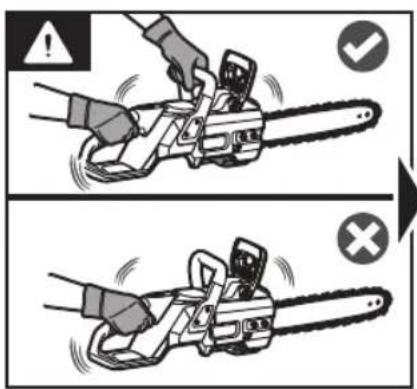
■ Always hold the chainsaw with your right hand on the rear handle and your left hand on the front handle. Holding the chainsaw with a reversed hand configuration increases the risk of personal injury and should never be done.
■ Hold the chainsaw by insulated gripping surfaces only, because the saw chain may contact hidden
wiring. Saw chains contacting a "live" wire may make exposed metal parts of the chainsaw "live" and could give the operator an electric shock.
■ Wear eye protection. Further protective equipment for hearing, head, hands, legs and feet is recommended. Adequate protective equipment will reduce personal injury by flying debris or accidental contact with the saw chain.
■ Do not operate a chainsaw in a tree, on a ladder, from a rooftop, or any unstable support. Operation of a chainsaw in this manner could result in serious personal injury.
■ Always keep proper footing and operate the chainsaw only when standing on fixed, secure and level surface. Slippery or unstable surfaces may cause a loss of balance or control of the chainsaw.
- When cutting a limb that is under tension, be alert for spring back. When the tension in the wood fibres is released, the spring loaded limb may strike the operator and/or throw the chainsaw out of control.
■ Use extreme caution when cutting brush and saplings. The slender material may catch the saw chain and be whipped toward you or pull you off balance.
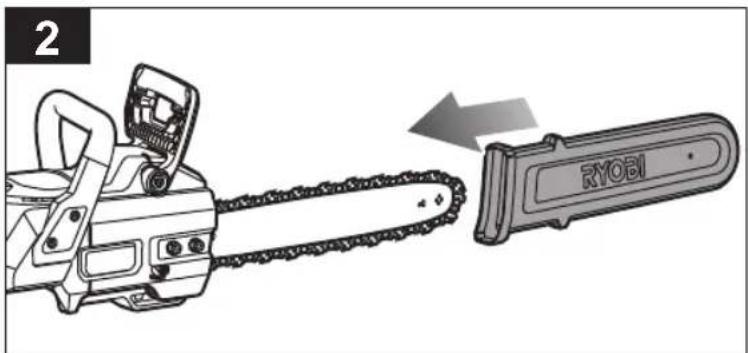
- Carry the chainsaw by the front handle with the chainsaw switched off and away from your body. When transporting or storing the chainsaw, always fit the guide bar cover. Proper handling of the chainsaw will reduce the likelihood of accidental contact with the moving saw chain.
■ Follow instructions for lubricating, chain tensioning and changing the bar and chain. Improperly tensioned or lubricated chain may either break or increase the chance for kickback.
- Cut wood only. Do not use chainsaw for purposes not intended. For example: do not use chainsaw for cutting metal, plastic, masonry or non-wood building materials. Use of the chainsaw for operations different than intended could result in a hazardous situation.
- Do not attempt to fell a tree until you have an understanding of the risks and how to avoid them. Serious injury could occur to the operator or bystanders while felling a tree.
■ Follow all instructions when clearing jammed material, storing or servicing the chainsaw. Make sure the switch is off and the battery pack is removed. Unexpected actuation of the chainsaw while clearing jammed material or servicing may result in serious personal injury.
CAUSES AND OPERATOR PREVENTION OF KICKBACK:
Kickback may occur when the nose or tip of the guide bar touches an object, or when the wood closes in and pinches the saw chain in the cut.
Tip contact in some cases may cause a sudden reverse reaction, kicking the guide bar up and back towards the operator.
Pinching the saw chain along the top of the guide bar may push the guide bar rapidly back towards the operator.
Either of these reactions may cause you to lose control of the saw which could result in serious personal injury. Do not rely exclusively upon the safety devices built into your saw. As a chainsaw user, you should take several steps to keep your cutting jobs free from accident or injury.
Kickback is the result of chainsaw misuse and/or incorrect operating procedures or conditions and can be avoided by taking proper precautions as given below:
■ Maintain a firm grip, with thumbs and fingers encircling the chainsaw handles, with both hands
on the saw and position your body and arm to allow you to resist kickback forces. Kickback forces can be controlled by the operator, if proper precautions are taken. Do not let go of the chainsaw.
- Do not overreach and do not cut above shoulder height. This helps prevent unintended tip contact and enables better control of the chainsaw in unexpected situations.
■ Only use replacement guide bars and saw chains specified by the manufacturer. Incorrect replacement guide bars and saw chains may cause chain breakage and/or kickback. - Follow the manufacturer's sharpening and maintenance instructions for the saw chain. Decreasing the depth gauge height can lead to increased kickback.
ADDITIONAL SAFETY WARNINGS
■ Attend a professionally organised course on the use and maintenance of chainsaws, preventative actions, and first aid. Keep these instructions safe for later use.
■ Chainsaws are potentially dangerous tools. Accidents involving the use of chainsaws often result in loss of limbs or death. Falling branches, toppling trees, rolling logs can all kill. Diseased or rotting timber poses additional hazards. Assess your capability of completing the task safely. If there is any doubt, leave it to a professional tree surgeon.
■ Do not cut vines or small undergrowth (less than 75 mm in diameter).
- It is recommended to practise cutting logs on a saw-horse or cradle when operating the product for the first time.
■ The size of the work area depends on the job being performed and the size of the tree or workpiece involved. For example, felling a tree requires a larger work area than making other cuts, such as bucking cuts. The operator needs to be aware and in control of everything happening in the work area.
- Do not cut with your body in line with the guide bar and chain. If you experience kickback, this position helps prevent the chain from coming into contact with your head or body.
- Do not use a back-and-forward sawing motion. Let the chain do the work. Keep the chain sharp, and do not try to push the chain through the cut.
- Do not put pressure on the saw at the end of the cut. Be ready to take on the weight of the saw as it cuts free from the wood. Failure to do so could result in possible serious personal injury.
- Do not stop the saw in the middle of a cutting operation. Keep the saw running until it is already removed from the cut.
■ To reduce the risk of injury associated with contacting moving parts, always turn off the product, apply the chain brake, remove the battery pack, and make sure that all moving parts have come to a complete stop:
• before cleaning or clearing a blockage
• before leaving the product unattended
- before installing or removing attachments
- before checking, conducting maintenance, or working on the product
Injuries may be caused, or aggravated, by prolonged use of the product. When using the product for prolonged periods, ensure to take regular breaks.
If the product is dropped, suffers heavy impact, or begins to vibrate abnormally, immediately stop the product and inspect for damage or identify the cause of the vibration. Any damage should be properly repaired or replaced by an authorised service centre.
■ Operate the product only in temperatures between 0 °C and 40 °C.
■ Store the product in a location where the ambient temperature is between -10 °C and 50 °C.
PERSONAL PROTECTIVE EQUIPMENT
Good quality personal protective equipment, as used by professionals, helps reduce the risk of injury to the operator. The following items should be used when operating the product:
■ Safety helmet
- should comply with EN 397 and be CE marked
■ Hearing protection
- should comply with EN 352-1 and be CE marked
■ Eye and face protection
- should be CE marked and comply with EN 166 (for safety glasses) or EN 1731 (for mesh visors)
Gloves
- should comply with EN 381-7 and be CE marked
■ Leg protection (chaps)
- should comply with EN 381-5, be CE marked and provide all-round protection
■ Chainsaw safety boots
- should comply with EN ISO 20345:2004 and be marked with a shield depicting a chainsaw to show compliance with EN 381-3. (Occasional users may use steel toe-cap safety boots with protective gaiters, which conform to EN 381-9 if the ground is even and there is little risk of tripping or catching on undergrowth).
■ Chainsaw jackets for upper body protection
- should comply with EN 381-11 and be CE marked
ADDITIONAL BATTERY SAFETY WARNINGS
■ To reduce the risk of fire, personal injury, and product damage due to short circuit, never immerse the tool, battery pack, or charger in fluid or allow fluid to flow inside them. Corrosive or conductive fluids, such as seawater, certain industrial chemicals, and bleach or bleach-containing products, etc., can cause a short circuit.
- Charge the battery pack in a location where the ambient temperature is between 10 °C and 38 °C.
■ Store the battery pack in a location where the ambient temperature is between 0 °C and 20 °C.
INSTRUCTIONS CONCERNING THE PROPER TECHNIQUES FOR BASIC FELLING, LIMBING, AND CROSS-CUTTING
UNDERSTANDING THE FORCES WITHIN THE WOOD
When you understand the directional pressures and stresses inside the wood, you can reduce the pinches or at least expect them during your cutting. Tension in the wood means the fibres are being pulled apart, and if you cut in this area, the kerf or cut tends to open as the saw goes through. If a log is being supported on a saw-horse and the end is hanging unsupported over the end, tension is created on the upper surface due to the weight of the overhanging log stretching the fi bres. Likewise, the underside of the log is
compressed and the fi bres are being pushed together. If a cut is made in this area, the kerf tends to close up during the cut. This cut would pinch the blade.
PUSH AND PULL
The reaction force is always opposite to the direction the chain is moving. The operator must be ready to control the tendency for the product to pull away and push backwards. The product pulls away (forward motion) when cutting on the bottom edge of the bar. The product pushes backwards (towards the operator) when cutting along the top edge.
SAW JAMMED IN THE CUT
Turn off the product, and remove the battery pack. Do not try to force the chain and bar out of the cut as this is likely to break the chain, which may swing back and strike the operator. This situation normally occurs because the wood is incorrectly supported, which forces the cut to close under compression, thereby pinching the blade. If adjusting the support does not release the bar and chain, use wooden wedges or a lever to open the cut and release the saw. Never try to start the chainsaw when the guide bar is already in a cut or kerf.
SKATING/BOUNCING
When the chainsaw fails to dig in during a cut, the guide bar can begin hopping or dangerously skidding along the surface of the log or branch, possibly resulting in the loss of control of the chainsaw. To prevent or reduce skating or bouncing, always use the saw with both hands. Make sure that the saw chain establishes a groove for cutting.
Never cut small, fl exible branches or brushes with your chainsaw. Their size and fl exibility can easily cause the saw to bounce towards you or bind up with enough force to cause a kickback. The best tool for that kind of work is a hand saw, pruning shears, an axe, or other hand tools.
FELLING A TREE
When bucking and felling operations are being performed by two or more persons at the same time, the felling operations should be separated from the bucking operation by a distance of at least twice the height of the tree being felled. Trees should not be felled in a manner that would endanger any person, strike any utility line, or cause any property damage. If the tree does make contact with any utility line, the company should be notified immediately.
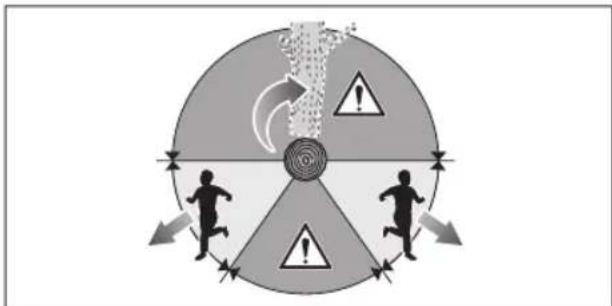
The chainsaw operator should keep on the uphill side of the terrain as the tree is likely to roll or slide downhill after it is felled.
An escape path should be planned and cleared as necessary before cuts are started. The escape path should extend back and diagonally to the rear of the expected line of fall.
flowchart
graph TD
    A["Running Silhouettes"] --> B["Target Circle"]
    B --> C["Warning Symbol: Inverted Triangle with Outward Arrow"]
    C --> D["Warning Symbol: Inverted Triangle with Outward Arrow"]
    D --> E["Warning Symbol: Inverted Triangle with Outward Arrow"]
    E --> F["Warning Symbol: Inverted Triangle with Outward Arrow"]
    F --> G["Warning Symbol: Inverted Triangle with Outward Arrow"]
    G --> H["Warning Symbol: Inverted Triangle with Outward Arrow"]
    H --> I["Warning Symbol: Inverted Triangle with Outward Arrow"]
    I --> J["Warning Symbol: Inverted Triangle with Outward Arrow"]
    J --> K["Warning Symbol: Inverted Triangle with Outward Arrow"]
    K --> L["Warning Symbol: Inverted Triangle with Outward Arrow"]
    L --> M["Warning Symbol: Inverted Triangle with Outward Arrow"]
    M --> N["Warning Symbol: Inverted Triangle with Outward Arrow"]
    N --> O["Warning Symbol: Inverted Triangle with Outward Arrow"]
Before felling starts, consider the natural lean of the tree, the location of larger branches, and the wind direction to judge which way the tree will fall.
Remove dirt, stones, loose bark, nails, staples, and wire from the tree.
Do not attempt to fell trees which are rotten or have been damaged by wind, fire, lightning, etc. This is extremely dangerous and should only be completed by professional tree surgeons.
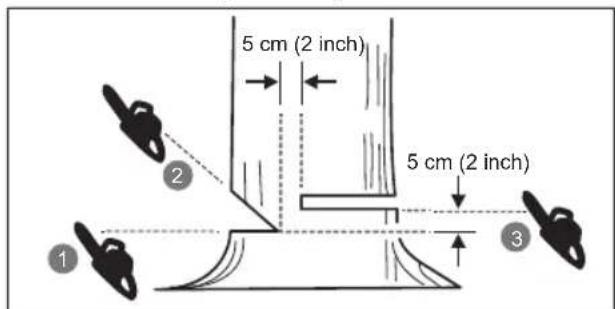
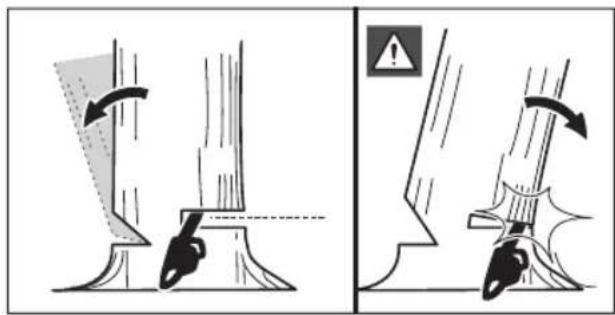
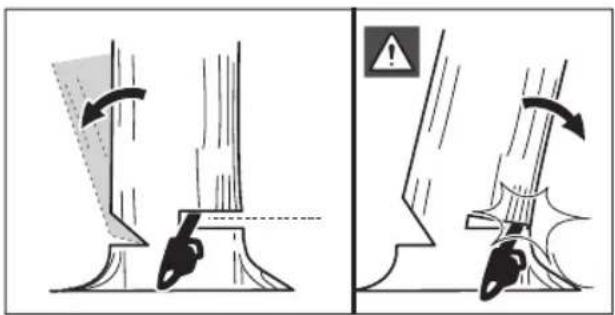
1. Notching undercut
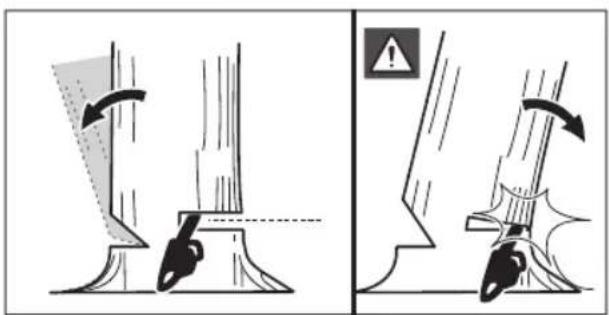
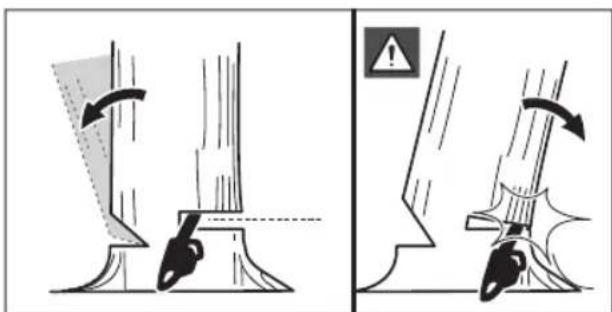
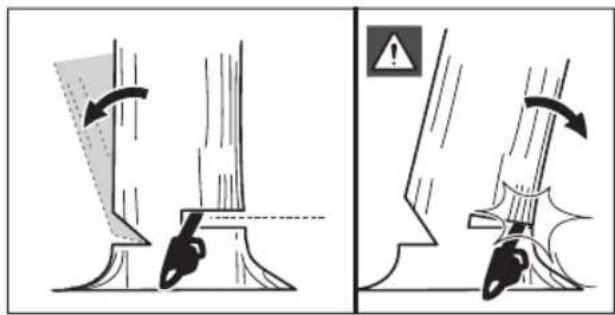
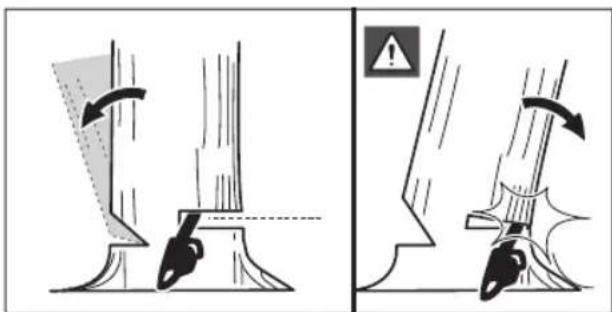
Make the notch 1/3 the diameter of the tree, perpendicular to the direction of the fall. Make the lower horizontal notching cut first. This will help to avoid pinching either the saw chain or the guide bar when the second notch is being made.
2. Felling back cut
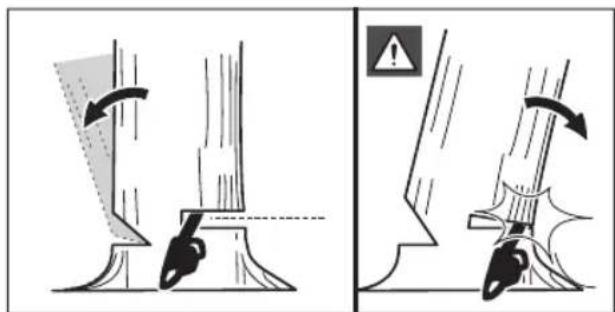
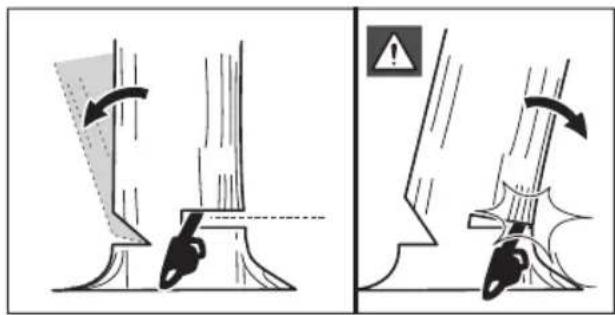
Make the felling back cut at least 50 mm (2 in.) higher than the horizontal notching cut. Keep the felling back cut parallel to the horizontal notching cut. Make the felling back cut so enough wood is left to act as a hinge. The hinge wood keeps the tree from twisting and falling in the wrong direction. Do not cut through the hinge.
As the felling gets close to the hinge, the tree should begin to fall. If there is any chance that the tree may not fall in the desired direction or it may rock back and bind the saw chain, stop cutting before the felling back cut is complete and use wedges of wood, plastic or aluminium to open the cut and drop the tree along the desired line of fall.
When the tree begins to fall, remove the chainsaw from the cut, stop the motor, put the chainsaw down, and use the retreat path planned. Be alert for falling overhead limbs and watch your footing.
natural_image
Two-panel diagram showing mechanical joint states: left panel with directional arrows indicating rotation, right panel with warning symbol (no text or labels)REMOVING BUTTRESS ROOTS
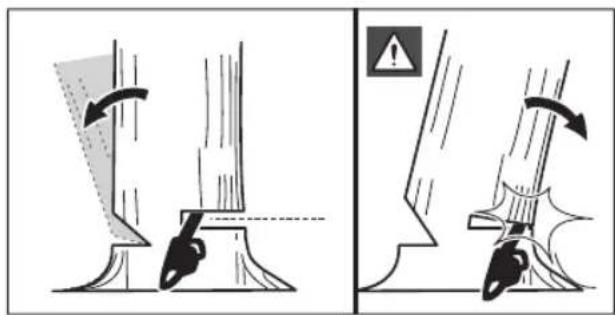
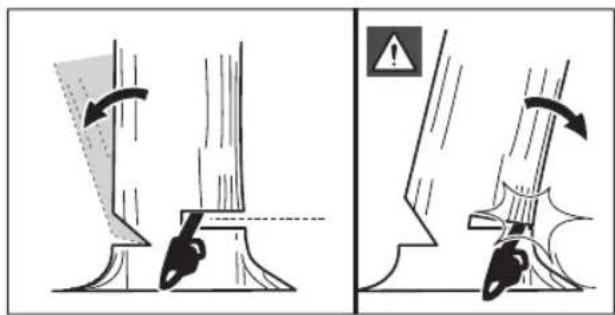
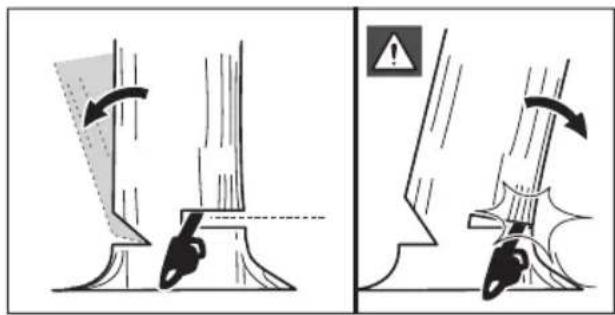
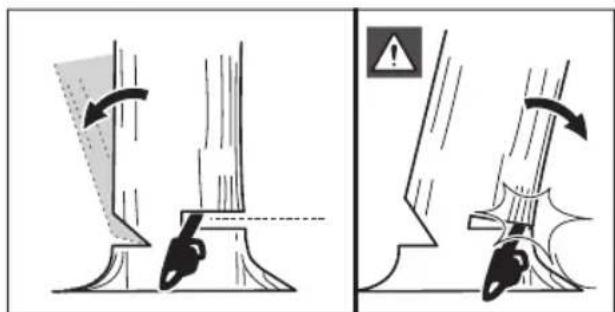
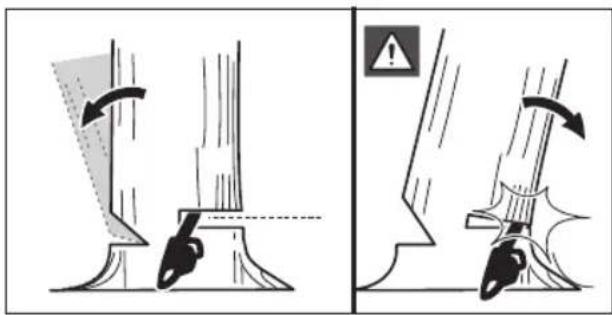
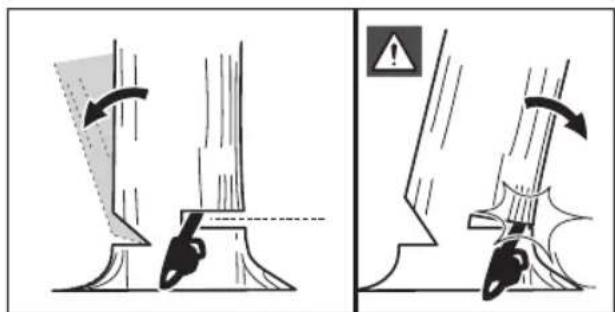
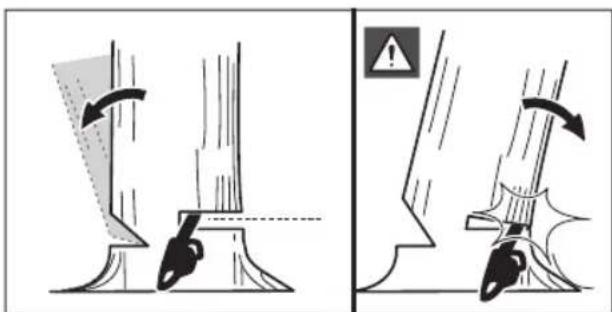
A buttress root is a large root extending from the trunk of the tree above the ground. Remove large buttress roots before felling. Make the horizontal cut into the buttress first, followed by the vertical cut. Remove the resulting loose section from the work area. Follow the correct tree felling procedure after removing the large buttress roots.
BUCKING A LOG
Bucking is cutting a log into lengths. It is important to make sure your footing is firm and your weight is evenly distributed on both feet. When possible, the log should be raised and supported by the use of limbs, logs or chocks. Follow the
simple directions for easy cutting. When the log is supported along its entire length, it is cut from the top (overbuck).
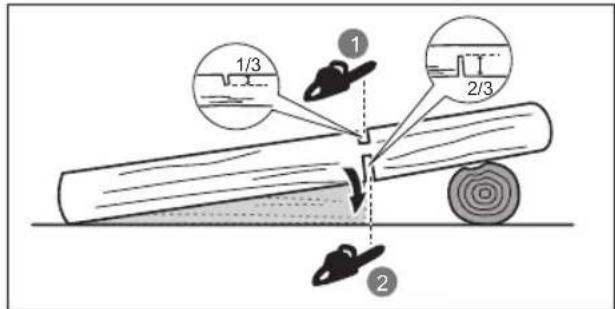
When the log is supported on one end, cut 1/3 the diameter from the underside (underbuck). Then make the fi nished cut by overbucking to meet the fi rst cut.
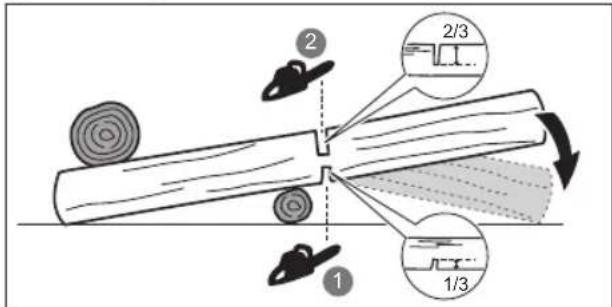
When the log is supported on both ends, cut 1/3 the diameter from the top (overbuck). Then make the finished cut by underbucking the lower 2/3 to meet the first cut.
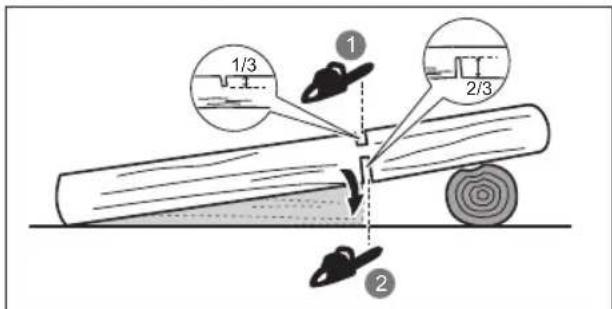
When bucking on a slope always stand on the uphill side of the log. To maintain control when "cutting through", release the cutting pressure near the end of the cut without relaxing your grip on the chainsaw handles. Do not let the chain contact the ground. After completing the cut, wait for the saw chain to stop before you move the chainsaw. Always stop the motor before moving from tree to tree.
LIMBING A TREE
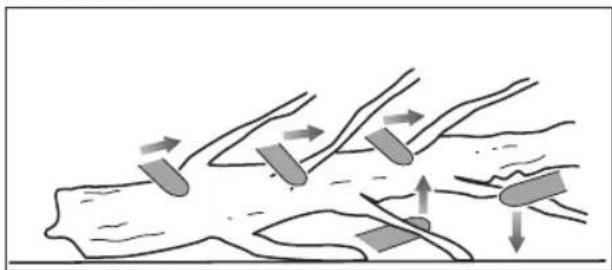
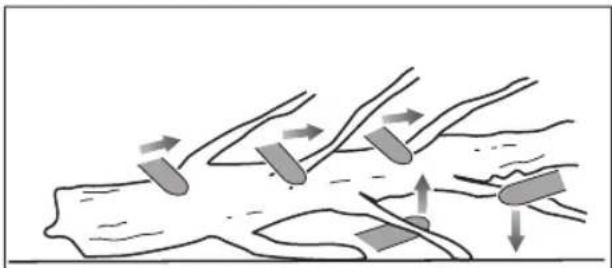
Limbing is removing the branches from a fallen tree. When limbing, leave larger lower limbs to support the log off the ground. Remove the small limbs in one cut. Branches under tension should be cut from the bottom up to avoid binding the chainsaw.
natural_image
Diagram of a biological or geological interaction with directional arrows indicating movement (no text or symbols)SPRINGPOLES
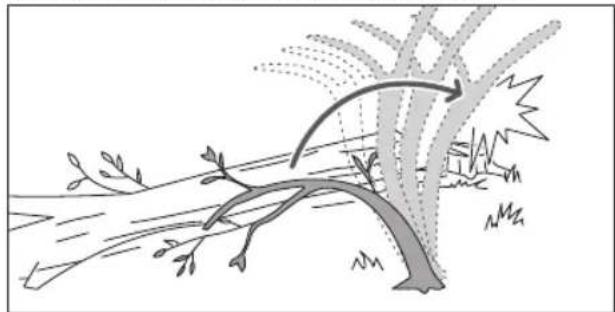
A springpole is any log, branch, rooted stump, or sapling that is bent under tension by other wood so that it springs back if the wood holding it is cut or removed.
On a fallen tree, a rooted stump has a high potential of springing back to the upright position during the bucking cut to separate the log from the stump. Watch out for springpoles—they are dangerous. Do not attempt to cut bent branches or stumps that are under tension unless you are professionally trained and competent to do so.
natural_image
Diagram illustrating tree branches and water flow with arrows indicating movement (no text or labels)⚠ WARNING! Springpoles are dangerous and could strike the operator, causing the operator to lose control of the chainsaw. This could result in a severe or fatal injury to the operator. Cutting spring poles should be done by trained users.
TRANSPORTATION AND STORAGE
■ Turn off the product, remove the battery pack, and allow the product to cool down before storing or transporting.
■ Remove all foreign materials from the product. Store the product in a cool, dry, and well-ventilated place that is inaccessible to children. Keep the product away from corrosive agents, such as garden chemicals and deicing salts. Do not store the product outdoors.
■ Fit the guide bar cover before storing the product of during transportation.
■ For transportation, secure the product against movement or falling to prevent injury to persons or damage to the product.
TRANSPORTING LITHIUM BATTERIES
Transport the battery in accordance with local and national provisions and regulations.
Follow all special requirements on packaging and labelling when transporting batteries by a third party. Ensure that no batteries can come in contact with other batteries or conductive materials while in transport by protecting exposed connectors with insulating, non-conductive caps or tape. Do not transport batteries that are cracked or leaking. Check with the forwarding company for further advice.
MAINTENANCE
■ Use only original manufacturer's replacement parts accessories, and attachments. Failure to do so can cause possible injury, can contribute to poor performance, and may void your warranty.
■ Servicing requires extreme care and knowledge and should be performed only by a qualified service technician. Have the product serviced by an authorised service centre only.
■ You may make adjustments or repairs described in this manual. For other repairs, have the product serviced by an authorised service centre only.
■ Consequences of improper maintenance, removal, or modification of safety devices, may cause the product to not function correctly, increasing the potential for serious injury. Keep the product professionally maintained.
- Sharpening the chain safely is a difficult precision task that should be performed only by experienced skilled professionals. The manufacturer strongly recommends that a worn or dull chain is replaced with a new one, available at your authorised service centre. The part number is available in the product specification table in this manual.
■ Follow the instructions for lubricating and chain tension checking and adjustment.
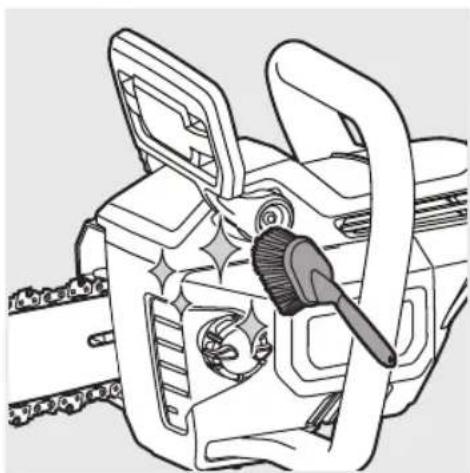
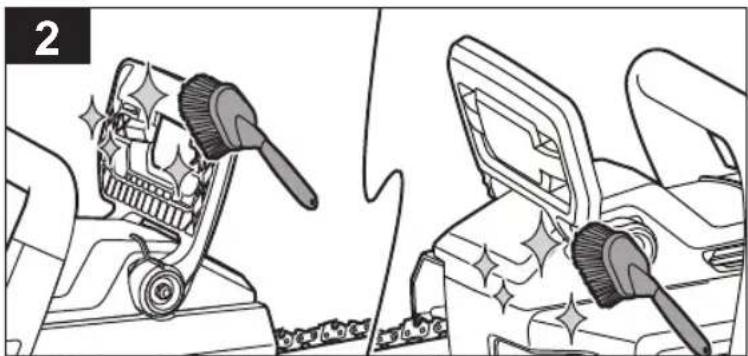
■ After each use, clean the plastic parts with a soft, dry cloth.
- Check all nuts, bolts, and screws at frequent intervals for security to ensure that the product is in safe working condition. Any part that is damaged should be properly repaired or replaced by an authorised service centre.
MAINTENANCE SCHEDULE
Daily check
Bar lubrication Before each use
Chain tension Before each use and frequently
Chain sharpness Before each use (visual check)
For damaged parts Before each use
For loose fasteners Before each use
Chain brake function Before each use
Inspect and clean
Bar Before each use
Complete saw After each use
Chain brake Every 5 hours of operation
KNOW YOUR PRODUCT
See page 211.
- Saw chain
- Guide bar
- Front hand guard / Chain brake
- Front handle
- Rear handle
- Combination wrench
- Chain lubricant cap
- Spiked bumper
- Chain catcher
- Trigger release
- Switch trigger
- Chain lubrication oil
- Bar mounting nuts
- Guide bar cover
- Chain tensioning screw
- Operator's manual
- Battery pack
- Charger
SAFETY DEVICES
Chain brake
Chain brakes are designed to quickly stop the chain from rotating. When the chain brake lever is pushed towards the bar, the chain should stop immediately. A chain brake does not prevent kickback. It only lowers the risk of injury should the chain bar contact the operator's body during a kickback event. The chain brake should be tested before each use for correct operation in both the run and brake positions.
⚠ WARNING! If the chain brake does not stop the chain immediately, or if the chain brake does not stay in the run position without assistance, take the product to an authorised service centre for repair before use.
Chain catcher
The chain catcher prevents the saw chain from being thrown back towards the operator if the saw chain comes loose or breaks.
Guide bars
Generally, guide bars with small radius tips have a somewhat lower potential for kickback. Use a guide bar and matching chain that is just long enough for the job. Longer bars increase the risk of loss of control during sawing. Regularly check the chain tension. When cutting smaller branches (less than the full length of the guide bar) the chain is more likely to be thrown off if the tension is not correct.
Low-kickback saw chain
The low-kickback saw chain helps to reduce the possibility of a kickback event.
The rakers (depth gauges) ahead of each cutter can minimise the force of a kickback reaction by preventing the cutters from digging in too deeply. Use only replacement guide bar and chain combinations that are recommended by the manufacturer.
As saw chains are sharpened, they lose some of the low-kickback qualities, and extra caution is required. For safety, replace saw chains when cutting performance decreases.
Spiked bumper
The integral bumper spike may be used as a pivot when making a cut. It helps to keep the body of the chainsaw steady while cutting. When cutting, push the product forward until the spikes dig into the edge of the wood, then move the rear handle up or down in the direction of the cutting line to help ease the physical strain of cutting.
Over-temperature protection
The battery pack has over-temperature protection, which is designed to protect the battery cells from damage in the event of high temperatures. This feature may cause the battery to stop powering the product until the battery cells cool down. If the battery pack is warm to touch, allow it to cool down before resuming operation. If the product still does not work, connect the battery pack to the charger, which can also indicate over-temperature protection. When the battery cells cool down, the charger begins to charge the battery.
NOTE: High ambient temperatures above 30 °C and high-power tools, such as chainsaws, can cause the battery cells to heat up faster. Monitor the battery pack regularly, and if it is warm to touch, change the battery or allow the battery to cool down.
NOTE: The battery pack LED indicator stops working if the battery protection feature has caused the battery pack to stop powering the product.
SYMBOLS

Safety alert

Read and understand all instructions before operating the product. Follow all warnings and safety instructions.

Wear eye, ear, and head protection.

Wear non-slip, heavy-duty gloves.




Wear non-slip safety footwear when using the product.
Beware of chainsaw kickback and avoid contact with bar tip.
Do not expose the product to rain or damp conditions.
Do not operate the saw using only one hand.
Hold and operate the saw properly with both hands.
Set the chain brake to the RUN position.
Set the chain brake to the BRAKE position.
Guaranteed sound power level
Do not dispose of waste batteries, waste electrical and electronic equipment as unsorted municipal waste. Waste batteries and waste electrical and electronic equipment must be collected separately. Waste batteries, waste accumulators, and light sources have to be removed from the equipment. Check with your local authority or retailer for recycling advice and collection point. According to local regulations, retailers may have an obligation to take back waste batteries and waste electrical and electronic equipment free of charge. Your contribution to the reuse and recycling of waste batteries and waste electrical and electronic equipment helps to reduce the demand of raw materials. Waste batteries, in particular containing lithium, and waste electrical and electronic equipment contain valuable and recyclable materials, which can adversely impact the environment and the human health if not disposed of in an environmentally compatible manner. Delete personal data from waste equipment, if any.
GETTING STARTED
See pages 212-213.
-
Wear Personal Protective Equipment (PPE). Wear full eye protection, ear protection, non-slip heavy-duty gloves, substantial footwear, and protective clothing at all times while operating the product. Do not operate the product when barefoot or wearing open sandals.
-
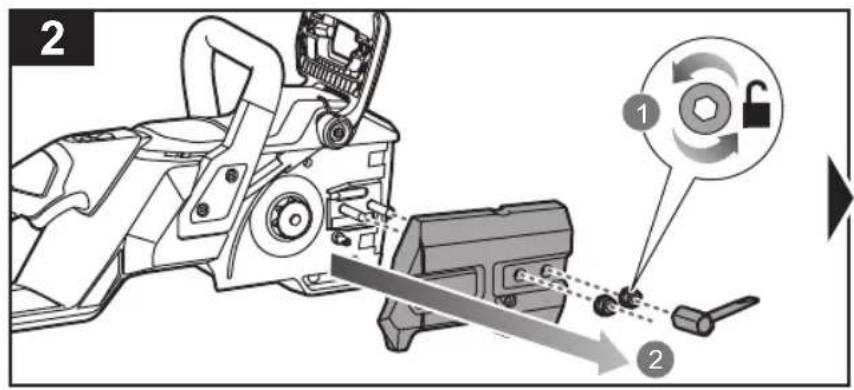
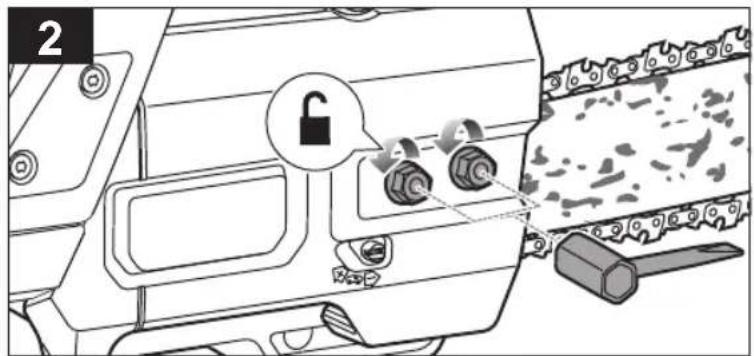
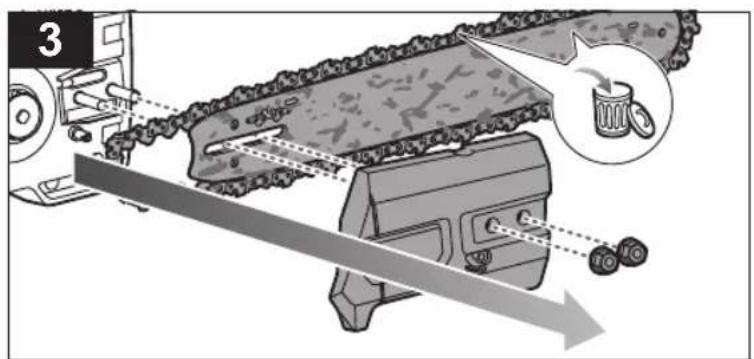
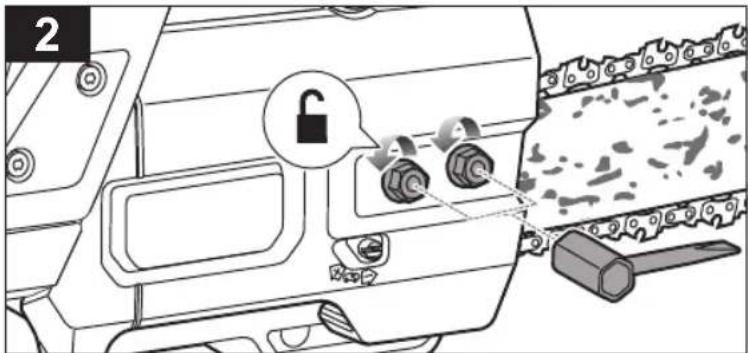
Loosen the bar mounting nuts. Remove the nuts and sprocket cover.
-
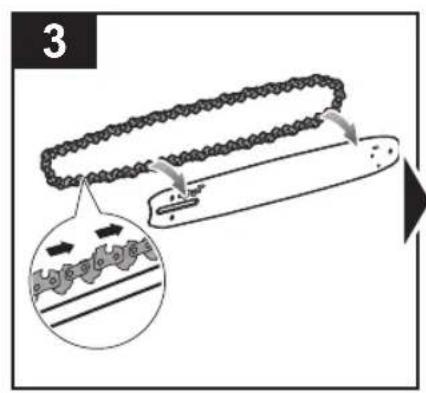
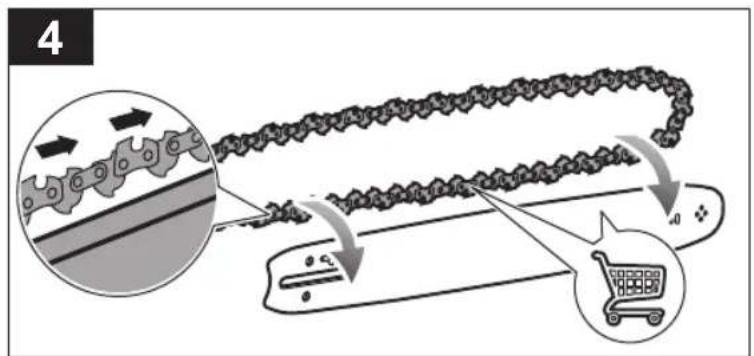
Place the chain drive links into the bar groove. Position the chain so that there is a loop at the back of the bar. The saw chain should face in the direction of chain rotation. If the chain faces backwards, turn the loop over.
-
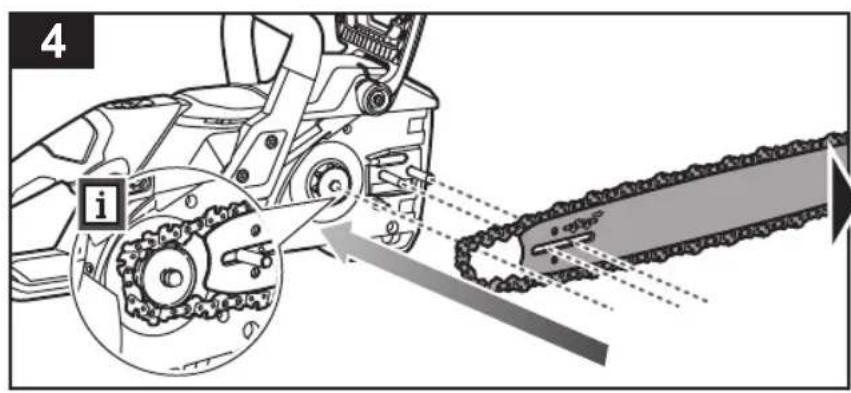
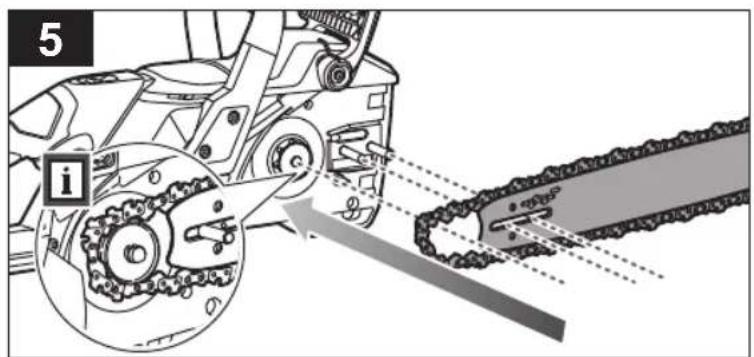
Hold the chain in position on the bar, and place the loop around the drive sprocket. Lower the bar so that the bolts go through the slot in the bar.
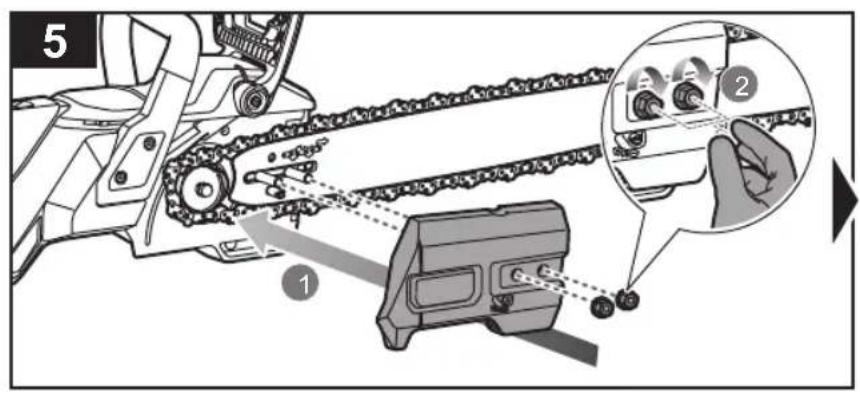
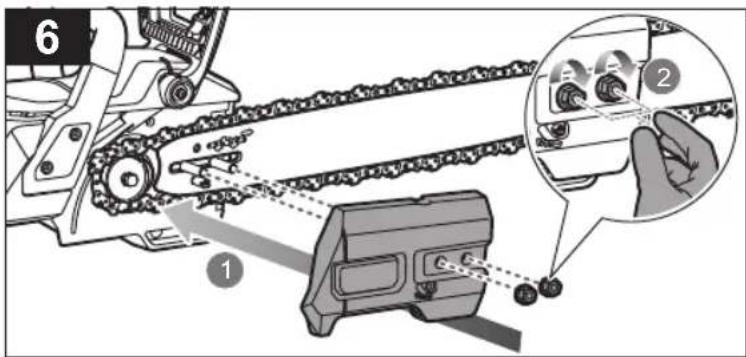
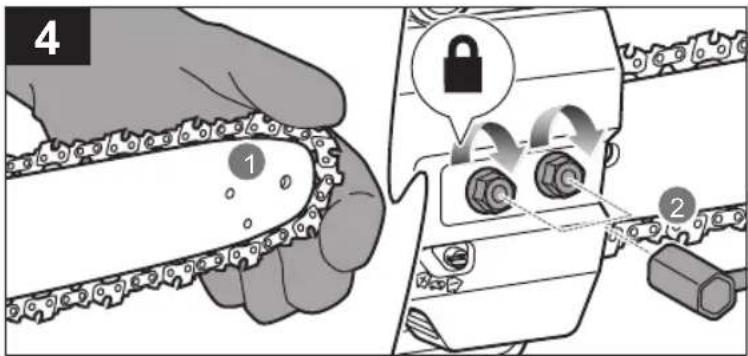
Reinstall the sprocket cover. Install and hand-tighten the bar mounting nuts. The guide bar must be free to move for chain tension adjustment.
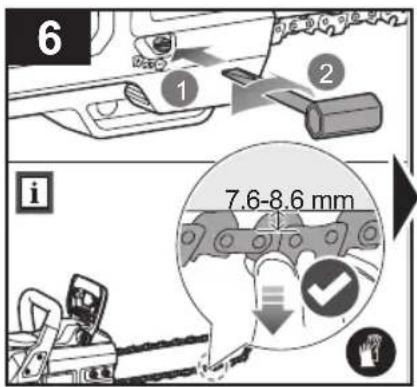
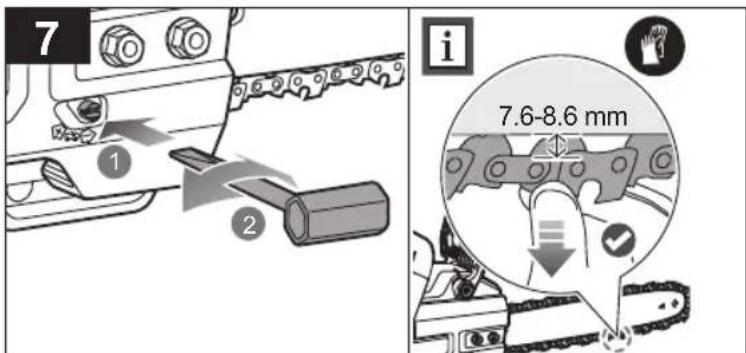
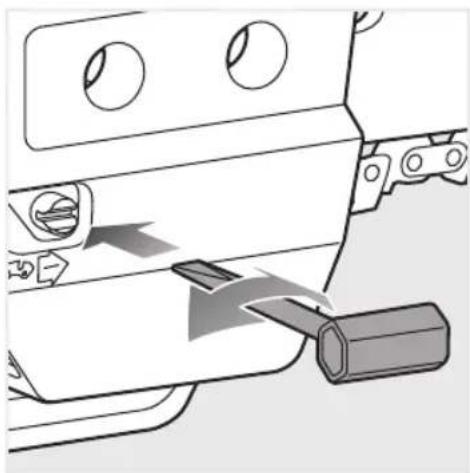
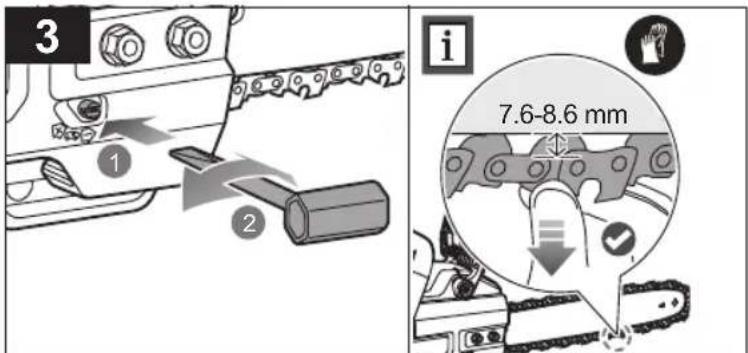
- Adjust the chain tension. Turn the chain tensioning screw using the combination wrench. Frequently check the chain tension while adjusting.
-To increase the chain tension, turn the chain tensioning screw clockwise.
-To reduce the chain tension, turn the chain tensioning screw counterclockwise.
NOTE: The chain tension is correct when the gap between the cutter in the chain and the bar is between 7.6 and 8.6 mm. Pull the chain in the middle of the lower side of the bar downwards (away from the bar), and measure the distance between the bar and the chain cutters.
NOTE: The temperature of the chain increases during normal operation, causing the chain to stretch. Check the chain tension frequently and adjust as required. A chain that is tensioned while warm may be too tight upon cooling. Make sure that the chain tension is correctly adjusted as specified in these instructions.
-
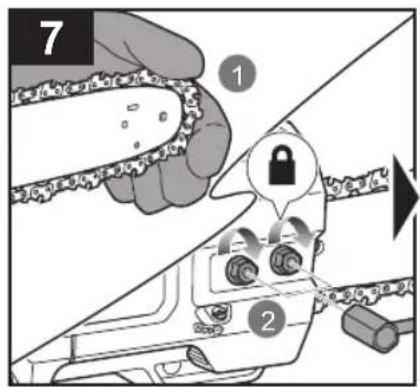
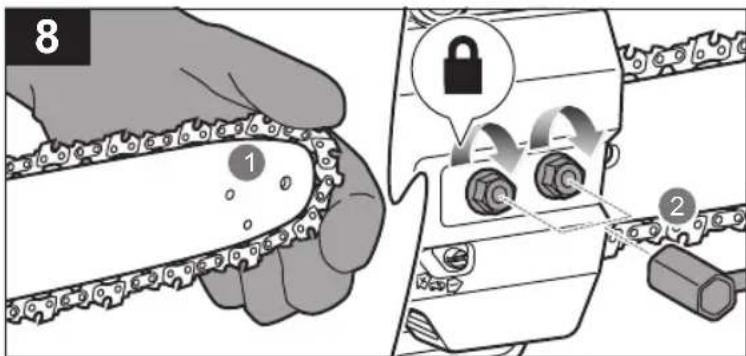
Hold up the tip of the guide bar, and securely tighten the bar mounting nuts.
-
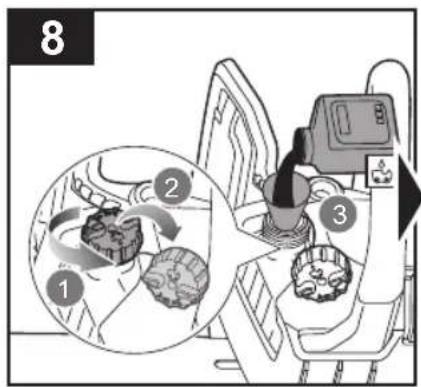
Add chain lubricating oil.
Use only RYOBI chainsaw lubricating oil from an authorised service centre.
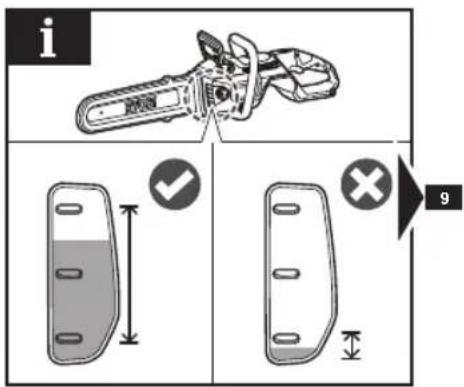
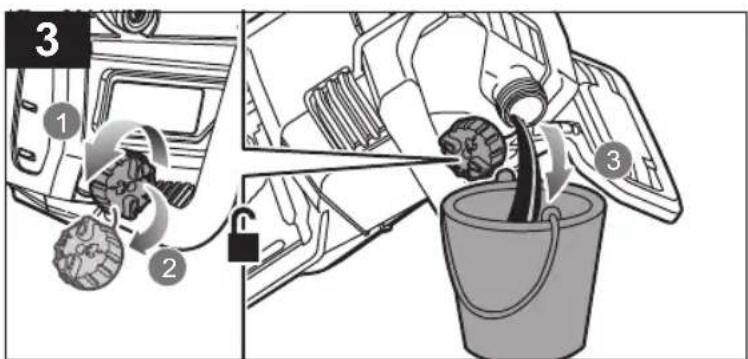
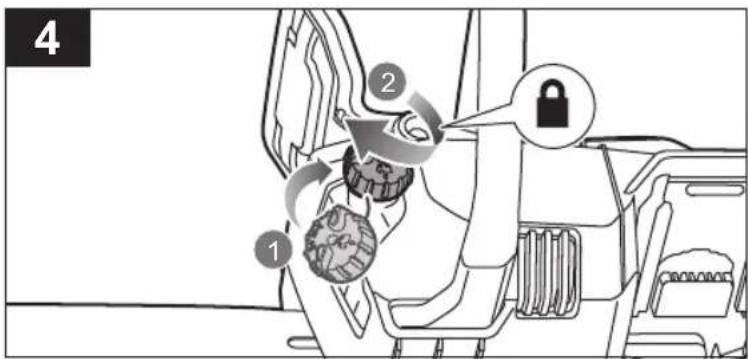
Clear the surface around the oil cap to prevent contamination. Remove the cap from the oil tank. Pour the oil into the oil tank, and monitor the oil level gauge. Ensure that no dirt enters the oil tank while filling. Close the oil tank, and tighten the cap. Wipe off any spillage.
NOTE: Never work without chain lubricant. If the saw chain is running without lubricant, the guide bar and the saw chain can be damaged. Before and while using the chainsaw, check the oil level in the oil level gauge.
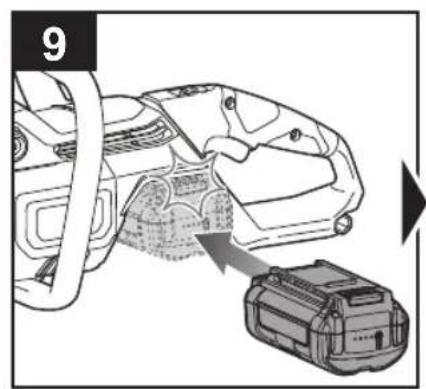
- Install the battery pack.
Align the raised ribs on the battery pack with the grooves in the product's battery port. Insert the battery pack into the product. Make sure that the latch of the battery pack snaps in place and that the battery pack is fully seated and securely attached before beginning operation.
⚠ WARNING! Always hold the product with the right hand on the rear handle and the left hand on the front handle.
WARNING! Grip both handles with the thumbs and fingers encircling the handles. Ensure that the left hand is holding the front handle so that the thumb is underneath.
- Start the product.
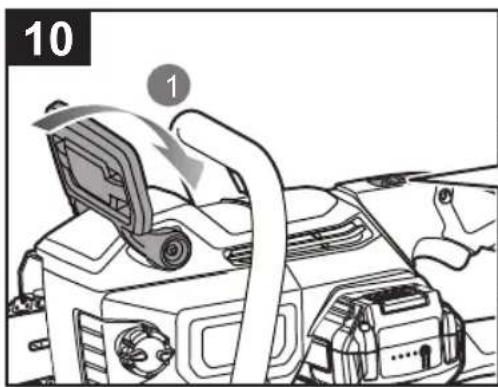
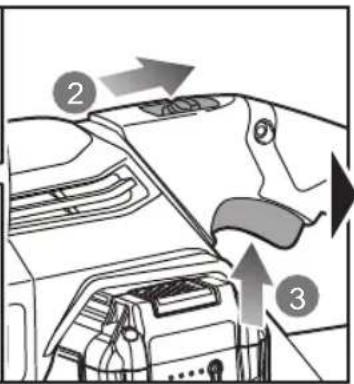
Set the chain brake into the run position by grasping the top of the chain brake lever and pulling towards the front handle until you hear a click. Pull the trigger release. Press the switch trigger.
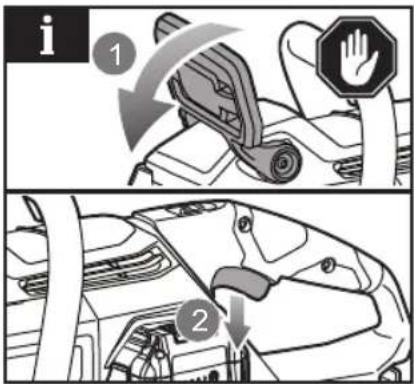
NOTE: To stop the product, engage the chain brake by rotating the left hand around the front handle. Allow the back of the hand to push the chain brake lever towards the bar while the chain is rotating rapidly. Release the switch trigger.
FR TRADUCTION DE LA NOTICE ORIGINALE
flowchart
graph TD
    A["Start"] --> B{Decision}
    B -->|Yes| C["Action: Arrow to Circle"]
    B -->|No| D["Action: Arrow to Circle"]
    C --> E["Warning: An exclamation mark"]
    D --> F["Warning: An exclamation mark"]
natural_image
Two-panel diagram showing mechanical or structural changes: one with a curved arrow indicating rotation, the other with a warning sign (no text or symbols)COUPE DES RACINES DE CONTREFORT
natural_image
Diagram of a biological or geological interaction with directional arrows indicating movement (no text or symbols)TIGES RESSORTS
natural_image
Diagram illustrating tree growth with arrows indicating movement, no text or symbols presentVERSTEHEN SIE DIE KRÄFTE IN DEM HOLZ

natural_image
Two-panel diagram showing mechanical joint states: left panel with arrow indicating rotation, right panel with warning symbol (no text or labels)WURZELANSÄTZE ENTFERNEN
natural_image
Diagram showing fluid flow around a pipe with directional arrows indicating movement (no text or labels)FEDERSTÖCKE
natural_image
Diagram illustrating a tree with wind patterns and soil layers, no text or symbols presentMACHEN SIE SICH MIT IHREM PRODUKT VERTRAUT
Siehe Seite 211.
natural_image
Two-panel diagram showing mechanical assembly steps with arrows indicating motion, no text or symbols present.natural_image
Diagram showing fluid flow around a pipe with directional arrows indicating movement (no text or labels)BARRAS ELÁSTICAS
natural_image
Diagram illustrating tree branches and water flow with arrows indicating movement (no text or labels)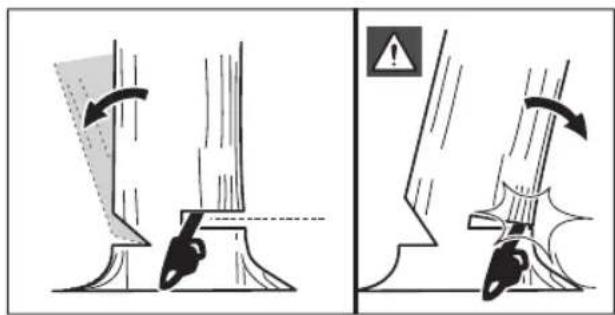
natural_image
Two-panel diagram showing mechanical joint states before and after press, with no visible text or symbols.natural_image
Diagram showing fluid flow around a pipe with directional arrows indicating movement (no text or labels)POLI A MOLLA
natural_image
Diagram illustrating tree branches and water flow with arrows indicating direction (no text or labels)ALGEMENE PRODUCTVEILIGHEIDSWAARSCHUWINGEN
EXTRA VEILIGHEIDSWAARSCHUWINGEN ACCU
natural_image
Two-panel diagram showing mechanical joint states: left panel with directional arrows indicating rotation, right panel with warning symbol (no text or labels)natural_image
Diagram of a biological or geological interaction with directional arrows indicating movement (no text or symbols)VEERSTOK
natural_image
Diagram illustrating tree branches and wind patterns with arrows indicating direction (no text or labels)flowchart
graph TD
    A["Start"] --> B{Decision}
    B -->|Yes| C["Action: Arrow to Circle"]
    B -->|No| D["Action: Red Arrow to Circle"]
    C --> E["Warning: An exclamation mark"]
    D --> F["Warning: An exclamation mark"]
natural_image
Two-panel diagram showing mechanical joint states before and after press, with no visible text or symbols.natural_image
Diagram showing fluid flow around a pipe with directional arrows indicating movement (no text or labels)GALHOS
natural_image
Diagram illustrating a tree with wind patterns and soil layers, showing erosion and growth (no text or labels)SAV HAR SAT SIG FAST I SAVERILLEN.
flowchart
graph TD
    A["Start"] --> B{Target}
    B --> C["Incident"]
    B --> D["Running"]
    C --> E["Warning Symbol"]
    D --> F["Warning Symbol"]
    E --> G["Arrow Right"]
    F --> H["Arrow Left"]
    G --> I["Circle with Tail"]
    H --> I
    I --> J["End"]
natural_image
Two-panel diagram showing a mechanical or structural change under compression, with arrows indicating direction and a warning symbol (no text or labels present)FJERNING AF BRAETR∅DDER
Når stammen er understøttet i begge ender, saver man 1/3 diameter fra oversiden af stammen. Man afslutter derefter snittet ved at save de nederste 2/3 nedefra op til det første snit.
natural_image
Diagram showing fluid flow around a pipe with directional arrows indicating movement (no text or labels)FJEDERSTÄNGER
natural_image
Diagram illustrating tree branches and erosion patterns with arrows indicating flow direction (no text or labels)SÄGEN HAR FASTNAT I KAPET
natural_image
Two-panel diagram showing mechanical joint states before and after installation, with no visible text or symbols.AVLÄGSNA ROTBEN
natural_image
Diagram showing fluid flow around a pipe with directional arrows indicating movement (no text or labels)FJÄDERSTÄNGER
natural_image
Diagram illustrating tree branches and erosion with arrows indicating flow direction (no text or labels)TRANSPORT OCH FÖRVARING
flowchart
graph TD
    A["Running Person"] --> B{Warning}
    B --> C["Accident"]
    C --> D["Warning"]
    D --> E["Accident"]
    E --> F["Warning"]
    F --> G["Warning"]
    G --> H["Warning"]
    H --> I["Warning"]
    I --> J["Warning"]
    J --> K["Warning"]
    K --> L["Warning"]
    L --> M["Warning"]
    M --> N["Warning"]
    N --> O["Warning"]
    O --> P["Warning"]
    P --> Q["Warning"]
    Q --> R["Warning"]
    R --> S["Warning"]
    S --> T["Warning"]
    T --> U["Warning"]
    U --> V["Warning"]
    V --> W["Warning"]
    W --> X["Warning"]
    X --> Y["Warning"]
    Y --> Z["Warning"]
natural_image
Two-panel diagram showing mechanical joint states: left panel with arrow indicating rotation, right panel with warning symbol (no text or labels)ULKONEVIEN JUURIEN POISTAMINEN
natural_image
Diagram showing fluid flow around a pipe with directional arrows indicating movement (no text or labels)KIREYDET
natural_image
Diagram illustrating tree growth with arrows indicating movement, no text or symbols presentSAG KJ∅RT FAST I KUTTET.
natural_image
Two-panel diagram showing mechanical joint states: left panel with directional arrows indicating movement, right panel with warning symbol (no text or labels)FJERNE STÖTTERÖTTER
natural_image
Diagram of a biological or geological structure with directional arrows indicating movement or flow (no text or symbols present)FJÆRSTENGER
natural_image
Diagram illustrating tree growth with arrows indicating movement, no text or symbols presentKJENN PRODUKTET DITT
Se side 211.
natural_image
Two-panel diagram showing mechanical joint states: left panel with directional arrows indicating rotation, right panel with warning symbol (no text or labels)natural_image
Diagram of a hand holding a tool with directional arrows indicating movement or force (no text or symbols present)ПРУЖИНЯЩИЕ ДЕРЕВЬЯ
natural_image
Diagram illustrating tree growth with arrows indicating movement, no text or symbols presentflowchart
graph TD
    A["Running Silhouettes"] --> B["Central Target"]
    B --> C["Warning Symbol: Inverted Triangle with Outward Arrow"]
    C --> D["Warning Symbol: Inverted Triangle with Outward Arrow"]
    D --> E["Warning Symbol: Inverted Triangle with Outward Arrow"]
    E --> F["Warning Symbol: Inverted Triangle with Outward Arrow"]
    F --> G["Warning Symbol: Inverted Triangle with Outward Arrow"]
    G --> H["Warning Symbol: Inverted Triangle with Outward Arrow"]
    H --> I["Warning Symbol: Inverted Triangle with Outward Arrow"]
    I --> J["Warning Symbol: Inverted Triangle with Outward Arrow"]
    J --> K["Warning Symbol: Inverted Triangle with Outward Arrow"]
    K --> L["Warning Symbol: Inverted Triangle with Outward Arrow"]
    L --> M["Warning Symbol: Inverted Triangle with Outward Arrow"]
    M --> N["Warning Symbol: Inverted Triangle with Outward Arrow"]
    N --> O["Warning Symbol: Inverted Triangle with Outward Arrow"]
natural_image
Two-panel diagram showing a mechanical or structural change under compression, with no visible text or symbols.USUNIĘCIE KORZENI BOCZNYCH
natural_image
Diagram showing fluid flow around a pipe with directional arrows indicating movement (no text or labels)NAPREŻONE GALEZIE
natural_image
Diagram illustrating a tree with wind patterns and ground vegetation, showing no text or symbols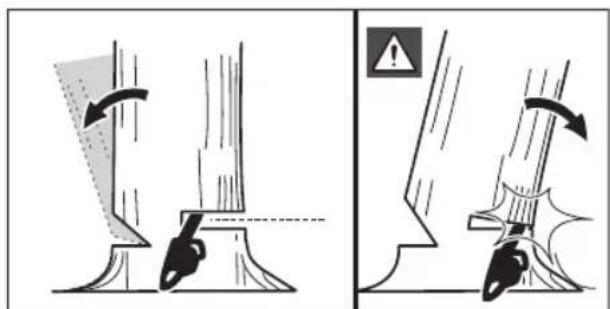
natural_image
Two-panel diagram showing mechanical assembly steps: left panel shows a curved component with rotation arrow, right panel shows a bent tool with warning symbol (no text or labels)natural_image
Diagram of a biological or geological structure with directional arrows indicating movement or flow (no text or symbols present)ODPRUŽENÉ VĚTVĚ
natural_image
Diagram illustrating tree growth with arrows indicating movement, no text or symbols present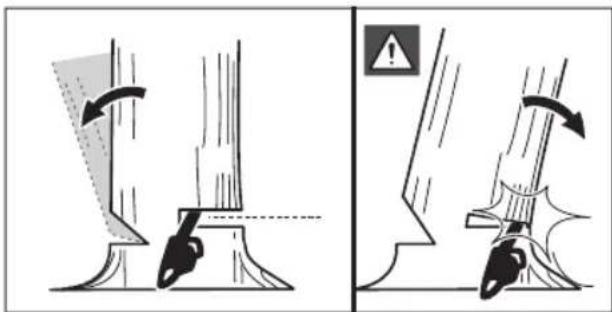
natural_image
Two-panel diagram showing mechanical joint states before and after installation, with no visible text or symbols.natural_image
Diagram showing fluid flow around a pipe with directional arrows indicating movement (no text or labels)ÁGRÉSZEK
natural_image
Diagram illustrating tree branches and water flow with arrows indicating direction (no text or labels)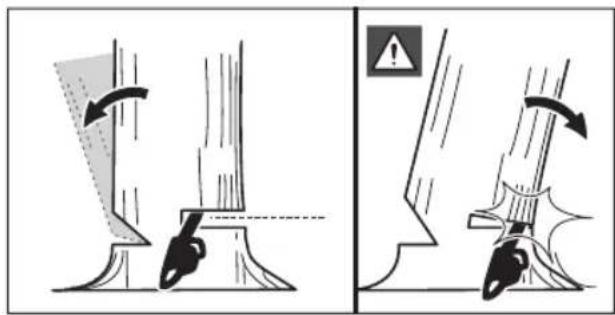
natural_image
Two-panel diagram showing mechanical assembly steps: left panel shows a cutting tool with rotation arrow, right panel shows a press or clamping mechanism with warning symbol (no text or labels)TĂIEREA RĂDĂCINILOR DE CONTRAFORT
natural_image
Diagram showing fluid flow around a pipe with directional arrows indicating movement (no text or labels)TIJE DE SUSPENSIE DE AMORTIZARE
natural_image
Diagram illustrating tree branches and erosion patterns (no text or labels)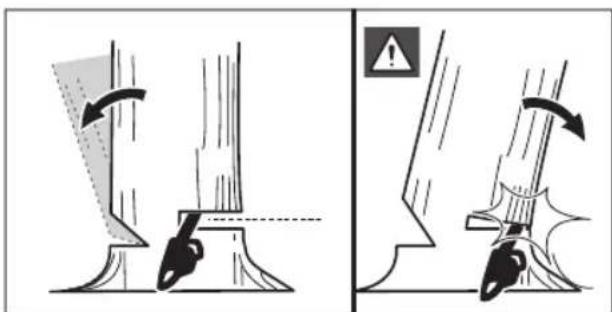
natural_image
Two-panel diagram showing mechanical joint states before and after installation, with no visible text or symbols.BALSTA SAKNU APZAGEŠANA
natural_image
Diagram of fluid flow around a pipe with directional arrows indicating movement (no text or labels)ATSPERİGI KRÜMI
natural_image
Diagram illustrating tree branches and erosion with arrows indicating flow direction (no text or labels)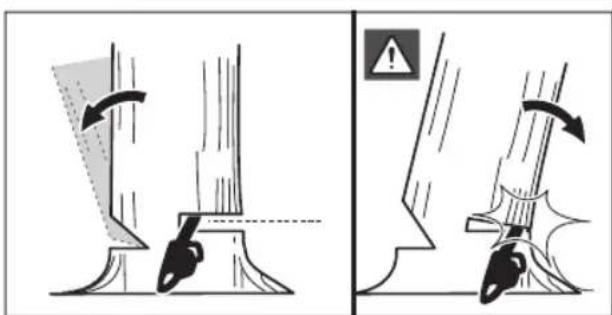
natural_image
Two-panel diagram showing mechanical joint states before and after installation, with no visible text or symbols.ATRAMOS ŠAKNU PJOVIMAS
natural_image
Diagram of fluid flow around a pipe with directional arrows indicating movement (no text or labels)JTEMPIMO JĖGŲ VEIKIAMI PJOVINIAI
natural_image
Diagram illustrating a tree with wind patterns and soil layers, showing erosion and growth (no text or symbols)SUSIPAŽINKITE SU JRENGINIU
Žr. 211 psl.
SEADME ÜLDISED OHUTUSJUHISED
MOOTORSAE ÜLDISED OHUTUSJUHISED
natural_image
Two-panel diagram showing mechanical joint states: left panel with arrow indicating rotation, right panel with warning symbol (no text or labels)PEAJUURTE EEMALDAMINE
natural_image
Diagram showing fluid flow around a pipe with directional arrows indicating movement (no text or labels)TAGASILÖÖGIOKSAD
natural_image
Diagram illustrating tree branches and water flow with arrows indicating direction (no text or labels)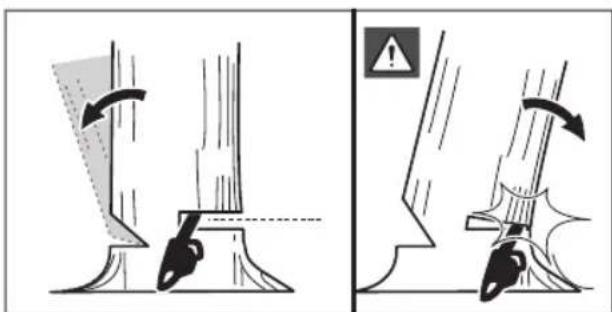
natural_image
Two-panel diagram showing mechanical joint states before and after installation, with no visible text or symbols.REZANJE POTPORNOG KORIJENJA
Potporno korijenje je veliko korijenje koje viri iz stabla drveta iznad zemlje. Odrežite velike korjene prije nego što počnete s obaranjem. Prvo načinite vodoravni usjek u potoprnom korijenu, a zatim okomiti. Oslobodite tako izrezani dio iz zone rada. Nastavite s obaranjem nakon što ste uklonitli potporno korijenje.
REZANJE TRUPCA NA ODREĐENU DULJINU
Trupci se režu na određene duljine. Vrlo je važno da ste sigurni da je vaše uporište čvrsto i da je vaša težina jednako raspoređena na oba stopala. Kada je to moguće, trupac bi trebalo podignuti i poduprijeti granama, trupcima ili klinovima. Za lakše rezanje slijedite jednostavne upute: Kada je trupac podložen uzduž cijele duljine, reže se s gornje strane (preko trupca).
Kada je trupac podložen s jednog kraja, reže se 1/3 promjera od donje strane (ispod trupca). Potom izvršite završni rez preko trupca kako biste susreli prvi rez.
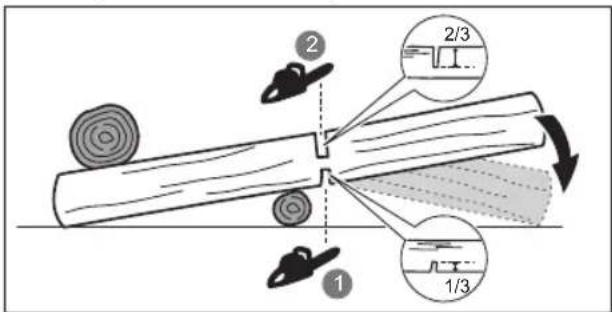
Kada je trupac podložen s oba kraja, reže se 1/3 promjera od gornje strane (ispod trupca). Potom izvršite završni rez s donje strane manje 2/3 kako biste susreli prvi rez.
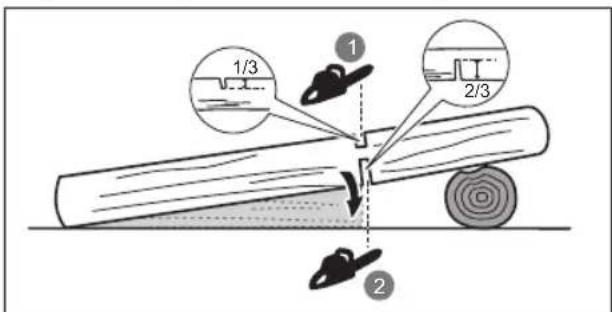
Kada režete trupac na kosini, uvijek stanite na gornju stranu trupca. Kako biste sačuvali kontrolu prilikom „potpunog presijecanja”, smanjite pritisak tijekom rezanja pri kraju reza ne smanjujući čvrstoću hvata na rukohvatima lančane pile. Ne dozvolite da lanac dodiruje zemlju. Nakon dovršetka reza pričekajte da se zaustavi lanac pile prije nego maknete pilu. Prije prebacivanja sa stabla na stablo uvijek zaustavite pilu.
OBREZIVANJE STABLA
Obrezivanje je uklanjanje grana s palog stabla. Prilikom obrezivanja ostavite velike niže grane da podupiru trupac sa zemlje. Uklonite male grane u jednom rezu. Grane koje su zategnute treba rezati odozdo prema gore kako bi se izbjeglo zahvaćanje lanca pile.
natural_image
Diagram of a biological or geological structure with directional arrows indicating movement or flow (no text or symbols present)NAPETE GRANE
Savijeno šiblje je grana, panj bez korjena ili grm koji je savijen zbog nekog drugog komada drveta, tako da se naglo otpušta kad odrežemo ili uklonimo komad tog drveta koji ga drži.
natural_image
Diagram illustrating tree branches and erosion with arrows indicating flow direction (no text or labels)⚠ UPOZORENJE! Savijeno šiblje je opasno je jer vas može udariti i možete izgubiti kontrolu nad motornom pilom. Što može dovesti do teških ili smrtonosnih ozljeda. Rezanje savijenog šiblja moraju obavljati obučeni korisnici.
PRIJEVOZ I SKLADIŠTENJE
DODATNA VARNOSTNA OPOZORILA
natural_image
Two-panel diagram showing mechanical assembly steps: left panel shows a cutting tool with rotation arrow, right panel shows a press or clamping mechanism with warning symbol (no text or labels)ODSTRANJEVANJE OPORNIH KORENIN
natural_image
Diagram of a medical procedure showing fluid flow and movement with arrows indicating direction (no text or labels)VZMETNE PALICE
Odskočno deblo je vsako deblo, veja, ukoreninjen štor ali mlado drevesce, ki je upognjeno pod pritiskom zaradi drugega lesa, tako da odskoči nazaj, će odžagamo ali odstranimo les, ki ga zadržuje.
natural_image
Diagram illustrating tree branches and erosion with arrows indicating flow direction (no text or labels)OSOBNÉ OCHRANNÉ POMÓCKY
natural_image
Two-panel diagram showing mechanical assembly steps: left panel shows a cutting tool with rotation arrow, right panel shows a press or clamping mechanism with warning symbol (no text or labels)ODSTRAŇOVANIE KOREŇOVÝCH NÁBEHOV
natural_image
Diagram showing fluid flow around a pipe with directional arrows indicating movement (no text or labels)NAPNUTÉ KONÁRE
natural_image
Diagram illustrating a tree with wind patterns and leaves, showing erosion and growth (no text or labels)OBOZNÁMTE SA S VAŠÍM PRODUKTOM
Pozrite stranu 211.
- Pílová ret'az
- Vodiaca lišta
- Predný chránič ruky/brzda reťaze
- Predná rukovät
- Zadná rukovät
- Kombinovaný klúč
- Uzáver olejovej nádrže
- TImiaci klin
- Zachytávač reťaze
- Západka plynovej páčky
- Vypínač
- Olej na mazanie ret'aze
- Matice na montáž lišty
- Kryt vodiacej lišty
- Skrutka na nastavenie napnutia ret'aze
- Návod na obsluhu
- Batéria
- Nabíjačka
BEZPEČNOSTNÉ ZARIADENIA
Brzda ret'aze
natural_image
Two-panel diagram showing mechanical assembly steps with arrows indicating motion, no text or symbols present.ИЗРЯЗВАНЕ НА ДЕБЕЛИ КОРЕНИ
natural_image
Diagram of a biological or geological structure with directional arrows indicating movement or flow (no text or symbols present)ПРУЖИННИ ПРЪТИ
natural_image
Diagram illustrating tree branches and erosion patterns with arrows indicating flow direction (no text or labels)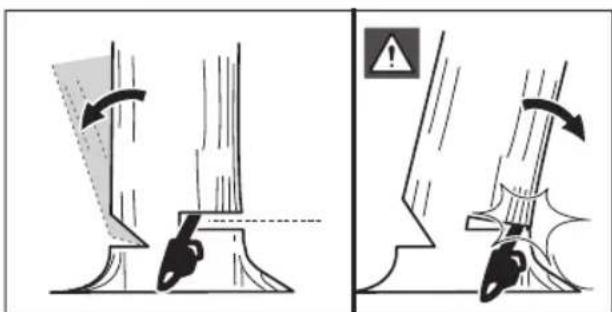
natural_image
Two-panel diagram showing mechanical joint states before and after installation, with no visible text or symbols.natural_image
Diagram showing fluid flow around a pipe with directional arrows indicating movement (no text or labels)ПРУЖНІ ШТАНГИ
natural_image
Diagram illustrating tree growth with arrows indicating movement, no text or symbols present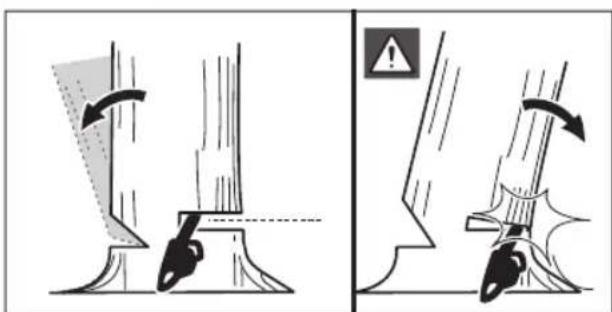
natural_image
Two-panel diagram showing mechanical joint states before and after installation, with no visible text or symbols.YAN KÖKLERIN ÇIKARILMASI
natural_image
Diagram showing fluid flow around a pipe with directional arrows indicating movement (no text or labels)YAYLI DIREKLER
natural_image
Diagram illustrating tree branches and water flow with arrows indicating direction (no text or labels)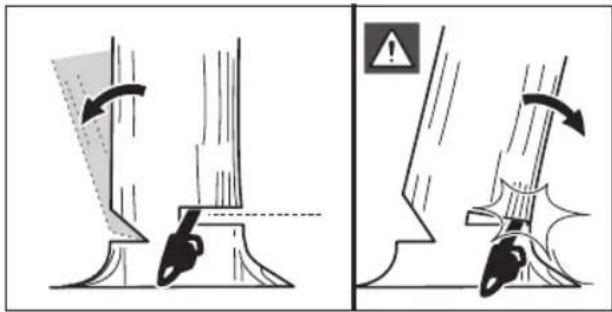
natural_image
Two-panel diagram showing mechanical components with arrows indicating motion, one with a shaded area and the other with a warning symbol (no text or labels)natural_image
Diagram showing fluid flow around a pipe with directional arrows indicating movement (no text or labels)TENTΩΜΕΝΑ ΣΤΕΛΕΧΗ
natural_image
Diagram illustrating tree growth with arrows indicating movement, no text or symbols present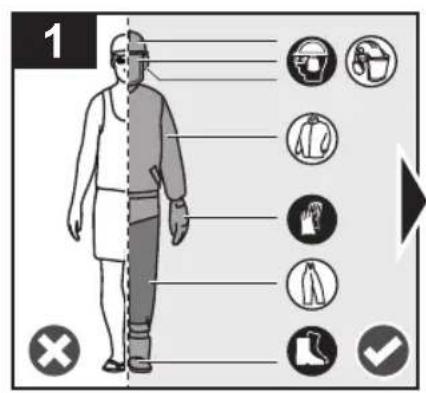
natural_image
Diagram of a car interior showing structural components and a close-up of a vehicle's internal structure (no text or symbols)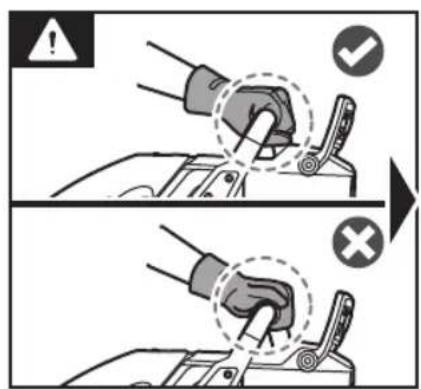
5
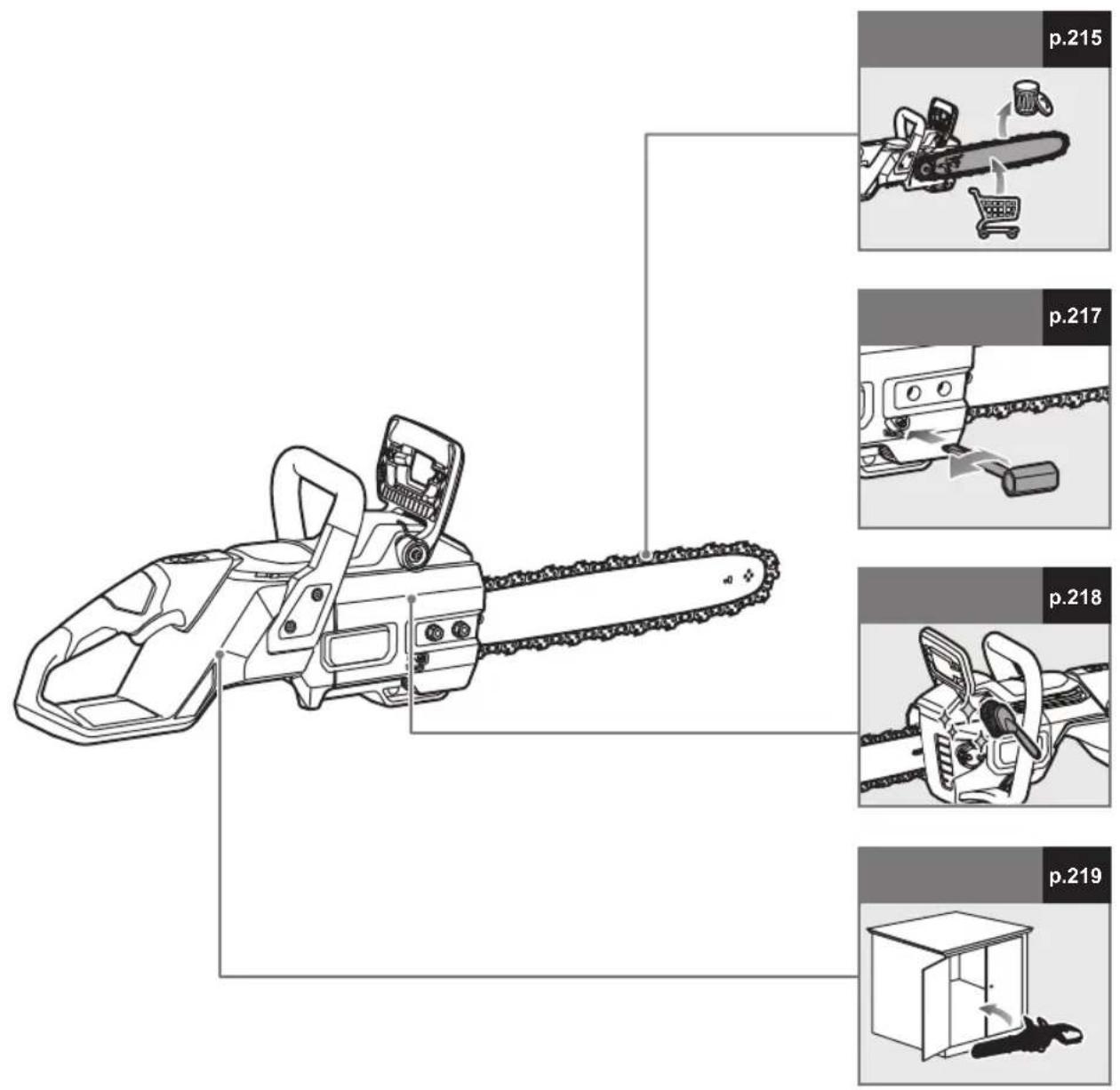
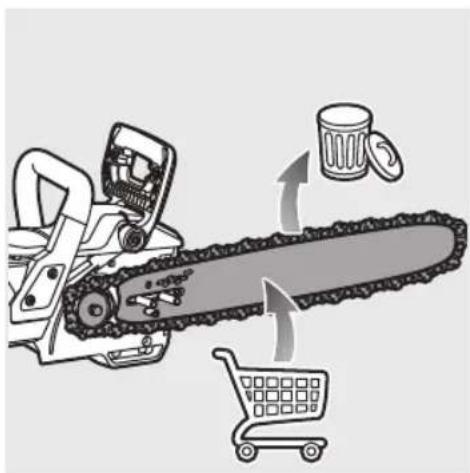
natural_image
Diagram of a chain-linking machine with a shopping cart and recycling bin (no text or symbols)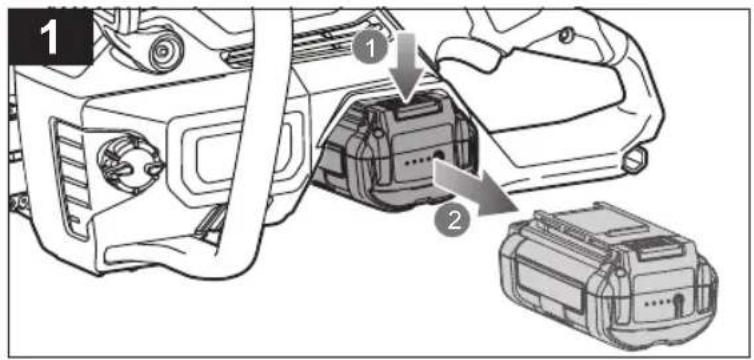
natural_image
Diagram of a car door handle with a tool inserted, showing no text or symbols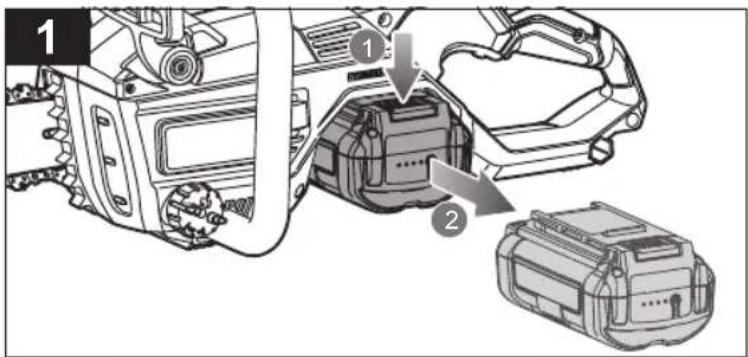
natural_image
Line drawing of a car interior showing a brush applying material to the dashboard (no text or symbols)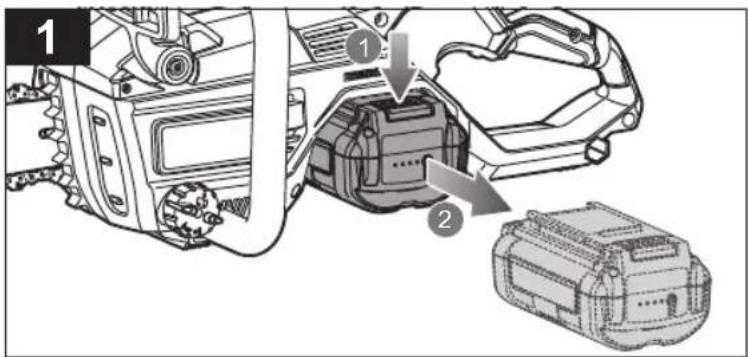
natural_image
Line drawing of a car interior showing two handrails with brushes and a seatbelt, no text or symbols present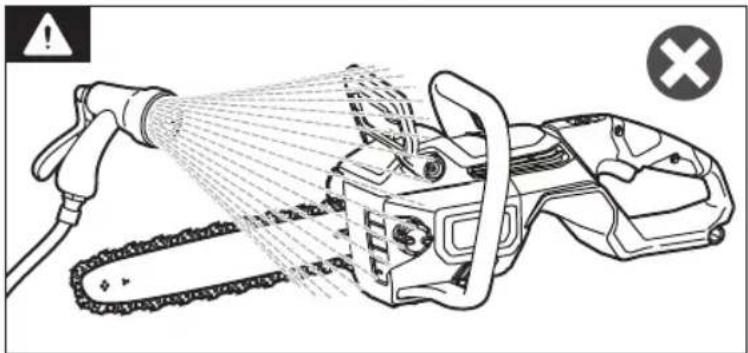
natural_image
Illustration of a chainsaw with spray gun emitting powder, no text or symbols present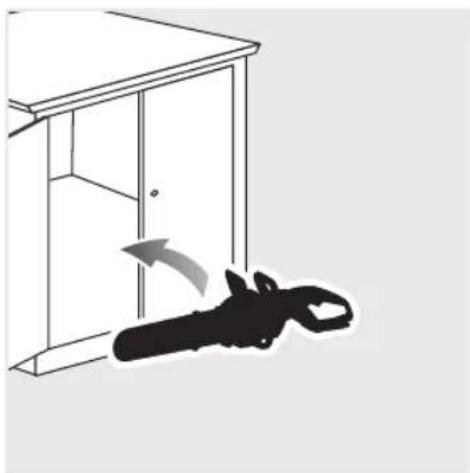
natural_image
Simple line drawing of a hand holding a small object inside a cabinet (no text or symbols)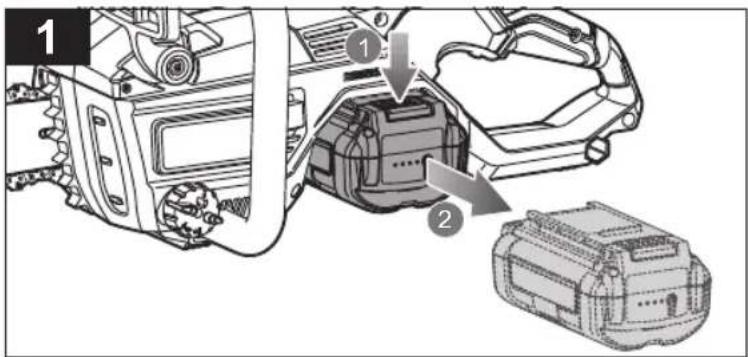
natural_image
Simple line drawing of a cabinet with an arrow indicating direction and a silhouette of a dog emerging from the door (no text or symbols)English Français Deutsch Español Italiano Nederlands Português
| Product specifications | Caractéristiques produit | Produkt-Spezifikationen | Caracteristicas del producto | Caratteristiche del prodotto | Productgegevens Caracteristicas do aparelho |
| Cordless chainsaw | Tronçonneuse sans fil | Akku-Kettensäge | Motosierra inalámbrica | Motosega senza filo | Snoerloze kettingzaag |
| Model | Modèle | Modell | Modelo | Modello | Modelo |
| Rated voltage | Tension nominale | Nennspannung | Tensión nominal | Voltaggio nominale | Toegekende spanning |
| No-load speed | Vitesse à vide | Leerlaufdrehzahl | Velocidad sin carga | Velocità senza carico | Snelheid zonder lading |
| Guide bar length | Longueur du guide-chaîne | Länge der Führungsschiene | Longitud de la barra guía | Lunghezza barra di guida | Zwaardlengte Comprimento da lämina-guía |
| Usable cutting length | Longueur de coupe utile | Anwendbare Schnittlänge | Largo de corte | Lunghezza di taglio disponibile | Bruikbare zaaglengte |
| Chain stop | Arrêt de chaîne | Kettenstop | Parada de la cadena | Arresto catena | Kettingstop |
| Chain length | Longueur de la chaîne | Kettenlänge | Longitud de la cadena | Lunghezza catena | Kettinglengte |
| Chain pitch | Gouge de la chaîne | Kettenteilung | Paso de la cadena | Passo catena | Kettingsteek |
| Chain gauge | Pas de la chaîne | Kettenstärke | Calibre de la cadena | Sezione catena | Tanddiepte |
| Drive links quantity Nombre de maillons d'entraînement | Anzahl der Antriebsglieder | Cantidad de eslabones del accionamiento | Quantità maglie guida | Aantal aandrijfschakels | |
| Chain oil tank capacity Contenance du réservoir d'huile de chaîne | Kettenöltankkapazität | Capacidad del depósito de aceite de la cadena | Capacità serbatoio olio catena | Kettingolietankcapaciteit | |
| Weight (without battery pack, guide bar, chain, and oil) | Poids (sans la batterie, la barre de guidage, la chaîne et l'huile) | Gewicht (ohne Akkupack, Führungsschiene, Kette und Öl) | Peso (sin batería, barra de guía, cadena ni aceite) | Peso (senza pacco batteria, barra guida, catena e olio) | Gewicht (zonder accu, geleidestang, ketting en olie) |
| Vibration level (in accordance with IEC 62841-1 and IEC 62841-4-1) | Niveau de vibration (selon IEC 62841-1; IEC 62841-4-1) | Vibrationsgrad (gemäß IEC 62841-1; IEC 62841-4-1) | Nivel de vibración (de acuerdo con IEC 62841-1; IEC 62841-4-1) | Livello vibrazioni (in accordo con la direttiva IEC 62841-1; IEC 62841-4-1) | Trillingsniveau (in overeenstemming met IEC 62841-1; IEC 62841-4-1) |
| Front handle | Poignée avant | Vorderer Handgriff | Mango delantero | Manico anteriore | Voorste handvat |
| Rear handle | Poignée arrière | Hinterer Handgriff | Mango trasero | Manico posteriore | Achterste handvat |
| Uncertainty of measurement | Incertitude de la mesure | Unsicherheit der Messung | Incertidumbre de medición | Incertezza delle misurazioni | Onzekerheid bij meting |
| Noise emission level (in accordance with IEC 62841-1 and IEC 62841-4-1) | Niveau d'émission sonore (selon IEC 62841-1; IEC 62841-4-1) | Schallenergiepegel (gemäß IEC 62841-1; IEC 62841-4-1) | Nivel de emisión de ruido (de acuerdo con IEC 62841-1; IEC 62841-4-1) | Livello di emissione rumore (in accordo con la direttiva IEC 62841-1; IEC 62841-4-1) | Geluidsemissieniveau (in overeenstemming met IEC 62841-1; IEC 62841-4-1) |
| A-weighted sound pressure level at the operator's position | Niveau de pression sonore pondéré A au niveau de l'opérateur | A-bewerteter Schalldruckpegel an der Position des Anwenders | Nivel de presión sonora ponderado A en la posición del operario | Livello di pressione sonora pesato A alla posizione dell'operatore | A-gewogen geluidsdrukniveau op de plaats van de bediener |
| Uncertainty of measurement | Incertitude de la mesure | Unsicherheit der Messung | Incertidumbre de medición | Incertezza delle misurazioni | Onzekerheid bij meting |
| A-weighted sound power level | Niveau de puissance sonore pondéré A | A-bewerteter Schallleistungspegel | Nivel de potencia acústica ponderada en A | Livello di potenza sonora pesato A | A-gewogen geluidsniveau |
| Uncertainty of measurement | Incertitude de la mesure | Unsicherheit der Messung | Incertidumbre de medición | Incertezza delle misurazioni | Onzekerheid bij meting |
| Compatible battery packs | Blocs des batterie compatibles | Kompatible Akkupacks Paquetes de batería compatibles | Gruppo batterie compatibili | Compatibele accupacks | Baterias compatíveis |
| Compatible chargers | Chargeurs compatibles | Kompatible Ladegeräte | Cargador compatible | Caricatore compatibile | Compatibele oplader |


Dansk Svenska Suomi Norsk Русский Polski
| Produktspecifikationer | Produktspecifikationer | Tuotteen teknisettiedot | Produktpesifikasjoner | Характеристикиизделия | Parametry techniczne | |
| Ledningsfri kædesav | Sladdlös motorsåg | Langaton moottorisaha | Kabelfri motorsag | Беспроводная цепнаяпила | Bezprzewodowa piłałańcuchowa | |
| Model | Modell | Malli | Modell | Модель | Model | RY36CSX50A |
| Mærkespænding | Spänning | Nimellisjännite | Nominell spenning | Номинальноенапряжение | Napięcie znamionowe 36 V d.c. | |
| Tomgangshastighed Hastighet utanbelastning | Nopeus ilman kuormaa | Tomgangshastighet | Холостая скорость | Prędkość obrotowa bezobciążenia | 18,5 m/s | |
| Sværdets længde | Klingans längd | Terälevyn pituus | Sagsverdlengde | Длина пильной шины | Długość prowadnicy | 508 mm |
| Anvendelig skærerlængde | Användbarsågningslängd | Leikkuupituus | Brukbar kuttelengde | Используемаярежущая длина | Użyteczna długośćciecía | 480 mm (19 in.) |
| Kædestop | Kedjestopp | Ketjun pysähtyminen | Kjedestopp | Останов цепи | Ogranicznik łańcucha | < 2 s |
| Kædelængde | Kedjelängd | Ketjun pituus | Kjedelengde | Длина цепи | Długość łańcucha | 508 mm (20 in.) |
| Kædestigning | Kedjedelning | Ketjun jako | Inndeling av kjede | Зубья пильной цепи | Przecinak kształtowyłańcucha | 3/8 in. |
| Max. tilladeligt kædeslør | Kedjetjocklek | Ketjun paksuus | Kjedestørrelse | Шаг пильной цепи | Skok łańcucha | 0,050 in. |
| Antal drivled | Mängden drivlänkar | Vetolenkkien määrä | Drivlinkmengde | Количество звеньев | Liczba ogniw napędu | 70 |
| Kædeolietank-kapacitet | Kapacitet föroljøbehållaren | Ketjun öljysáiliontilavuus | Kjeldeolje tankkapasitet | Емкость масляногобака пилы | Pojemność zbiomikaoleju łańcuchowego | 200 mL |
| Vægt (udenbatteripakke, sværd,kæde og olie) | Vikt (utan batteripaket,sågsvärd, kedjaoch olja) | Paino (ilmanakkupakkausta,terälaippaa, ketjuaja öliyä) | Vekt (uten batteripakke,føringsstang, kjedeog olje) | Вес (безаккумуляторногоблока, направляющейшины, цепи и масла) | Masa (bezakumulatora,prowadnicy, łańcuchai oleju) | 4,2 kg |
| Vibrationsniveau (iht.IEC 62841-1; IEC62841-4-1) | Vibrationsnivå (enligtIEC 62841-1; IEC62841-4-1) | Tärinätaso (standardinIEC 62841-1; IEC62841-4-1 mukaisesti) | Vibrasjonsnivå (iht.IEC 62841-1; IEC62841-4-1) | Уровень вибрации(в соответствии сIEC 62841-1; IEC62841-4-1) | Poziom wibracji(zgodnie z normąIEC 62841-1; IEC62841-4-1) | |
| Forhåntag | Främre handtag | Etukädensija | Fremre håndtak | Передняя ручка | Przedni uchwyt | 5,3 m/s2 |
| Baghåntag | Bakre handtag | Takakädensija | Bakre håndtak | Задняя ручка | Tylny uchwyt | 5,2 m/s2 |
| Målingsusikkerhed | Osäkerhet för mätt | Mittausten epätarkkuus | Usikkerhet ved måling | Погрешностьизмерения | Niepewność pomiaru | 1,5 m/s2 |
| Støjemissionsniveau(iht. IEC 62841-1; IEC62841-4-1) | Bullerutsläppsnivå(enligt IEC 62841-1;IEC 62841-4-1) | Melutaso (standardinIEC 62841-1; IEC62841-4-1 mukaisesti) | Støyutslipsnivå (iht.IEC 62841-1; IEC62841-4-1) | Уровень шума (всоответствии сIEC 62841-1; IEC62841-4-1) | Poziom emisji hałasu(zgodnie z normąIEC 62841-1; IEC62841-4-1) | |
| A-vægtetlydtryksniveau vedoperatørens position | A-viktad ljudtrycksnivåvid operatörsplats | A-painotettukäyttajään kohdistuvaäänenpainetaso | A-vektet lydtrykk vedoperatorposisjon | Амплитудно-вавешенный уровеньзвукового давленияна рабочем местеоператора | Poziom ważonegociśnienia akustycznegow pozycji operatora | 95,5 dB(A) |
| Målingsusikkerhed | Osäkerhet för mätt | Mittausten epätarkkuus | Usikkerhet ved måling | Погрешностьизмерения | Niepewność pomiaru | 3,0 dB |
| A-vægtetlydeffektniveau | A-vägd ljudeffektsnivå | A-painotettu äänenteho | A-vektet lydeffektnivå | УровеньА-взвешеннойзвуковой мощности | A-ważony poziom mocyakustycznej | 103,5 dB(A) |
| Målingsusikkerhed | Osäkerhet för mätt | Mittausten epätarkkuus | Usikkerhet ved måling | Погрешностьизмерения | Niepewność pomiaru | 3,0 dB |
| Kompatible batterier | Kompatibla batteripaket | Yhteensopivat akut | Kompatiblebatteripakker | Совместимаяаккумуляторная батарея | Pasujace akumulatory | BPL36.., RY36B.. |
| Kompatibel oplader | Kompatibel laddare | Yhteensopiva laturi | Kompatibel lader | Совместимоезарядное устройство | Zgodna ładowarka | BCL36.., RY36C.. |
| Čeština | Magyar | Română | Latviski | Lietuviškai | Eesti | Hrvatski |
| Technické údaje produktu | Termék muszaki adatai | Specificatiile produsului | Produkta specifikacijas | Gaminio technines savybes | Toote tehnilised andmed | Specifikacije proizvoda |
| Akumulátorová řetězová pila | Akkumulátoros láncfūrész | Fierästrâu electric cu lanț, cu accumulator | Akumulatoru kēdes zāgis | Akumuliatorinis grandininis pjūklas | Juhtmeta mootorsaag Bežična motorna pila | |
| Model Tipus Model Model | elis Modelis Mulel Model | |||||
| Jmenovité napětí | Névleges feszültség | Tensiunea nominală | Nominālais spriegums | Nominali įtampa | Nimipinge | Nazivni napon |
| Rychlost naprázdno | Üresjáratí fordulatszám | Vítezá fărā sarciná | Tukšgaitas ātrums | Greitis be apkrovimo | Tühikäigukiirus | Brzina bez opterećenja |
| Délka vodící lišty | Láncvezető hossza | Lungime a barei de ghidare | Sliedes garums | Kreipiamosios juostos ilgis | Juhtlati pikkus Duljina vodilice | lanca |
| Vyuzitelná řezaci délka | Hasznos vágáshossz Lungime de tāiere utilizabilă | Imantojamais griešanas garums | Naudojamas pjovimo ilgis | Kasutatav lõike pikkus | Korisna duljina vodilice | |
| Zastavení řetězu | Láncleállás | Oprire lanț | Kēdes apstāšanās | Grandinės stabdiklis | Keti seiskumine | Hvatač lanca |
| Délka řetězu | Lánc hossza | Lungimea lanțului | Kēdes garums | Grandinės ilgis | Ketta pikkus | Duljina lanca |
| Článek řetězu | Fog osztás | Lamele lanțului | Kēdes asmeniši | Pjovimo grandinės dantukas | Keti samm Zubac lanca | |
| Roztoč řetězu | Fogak közötti távolság | Pasul lanțului | Kēdes parameters | Pjovimo grandinės žingsnis | Keti rööbe. | Korak lanca |
| Počet hnacích článkú řetězu | Vágófogak mennyisége | Numár zale de legátură | Piedziņas posmu skaits | Varomujų grandžių kiekis | Veolūlide hulk Količina pogonskih članaka | |
| Kapacita olejové nádrže pro řetěz | Láncolaj tartályának térfogata | Capacitate rezervor ulei de lanț | Kēdes elļas tvertnes tilpums | Grandinės alyvos bakelio tūris | Õlipaagi maht | Kapacitet spremnika ulja za lanac |
| Hmotnost (bez baterií, vodici lišty, řetězu a oleje) | Tõmeg (akku, vezetôrůd, lánc és olaj nélkūl) | Greutate (fărā accumulator, ghidaj, lanț și ulei) | Svars (bez akumulatoru bloka, kēdes sliedes, kēdes un elļas) | Svoris (be akumuliatoriaus, kreipiamosios juostos, grandinės ir alyvos) | Kaal (ilma aku, juhtplaadi, keti ja Ōlita) | Težina (bez baterijskog sklopa, mača, lanca i ulja) |
| Úroveň vibrací (v souladu s IEC 62841-1; IEC 62841-4-1) | Vibraciós szint (az IEC 62841-1; IEC 62841-4-1 szerint) | Nivel de vibratie (In conformitate cu IEC 62841-1; IEC 62841-4-1) | Vibracijas līmenis (saskaņa ar IEC 62841-1; IEC 62841-4-1) | Vibracijos lygis (pagal IEC 62841-1; IEC 62841-4-1 standartą) | Vibratsioonitase (vastavalt standardile IEC 62841-1; IEC 62841-4-1) | Razina vibracija (u skladu s IEC 62841-1; IEC 62841-4-1) |
| Prední rukojet | Elülso fogantyú | Māner anterior | Priekšejais rokturis | Priekine rankena | Eesmine käepide | Prednja rucka |
| Zadní rukojet | Hàtsó fogantyú | Mānerul principal | Alzmugurejais rokturis | Galine rankena | Tagumine käepide | Stražnja rucica |
| Nejistota měření | Mérès bizonytalansága | Nesiguranța māsurătorii | Mērijuma nenoteiktība | Matavimo paklaida | Mõõtmismääramatus | Neodređenost mjerenja |
| Hladina emise hluku (v souladu s IEC 62841-1; IEC 62841-4-1) | Hangkibocsátási szint (az IEC 62841-1; IEC 62841-4-1 szerint) | Nivel emisie zgomot (In conformitate cu IEC 62841-1; IEC 62841-4-1) | Trokšņu emisijas līmenis (saskaņa ar IEC 62841-1; IEC 62841-4-1) | Skleidžiamo triukšmo lygis (pagal IEC 62841-1; IEC 62841-4-1 standartą) | Helivõimsuse tase (vastavalt standardile IEC 62841-1; IEC 62841-4-1) | Razina emisija buke (u skladu s IEC 62841-1; IEC 62841-4-1) |
| Hladina akustického tlaku vážená funkcí A v poloze obsluhy | A-sülyozott hangnyomásszint a kezelő helyén | Valoare A nivel presikune zgomot la pozilja operatorului | A–novērtōjuma skaņas spiediena līmenis operatora darba vietā | A dažninės charakteristikos garso slėgio lygis operatoriaus vietoje | A-kaalutud helirōhu tase operaatori töökohal | A-ponderirana razina zvučnog tlaka u položaju operatera |
| Nejistota měření | Mérès bizonytalansága | Nesiguranța māsurătorii | Mērijuma nenoteiktība | Matavimo paklaida | Mõõtmismääramatus | Neodređenost mjerenja |
| Hladina akustického výkonu vážená funkcí A | A-sülyozott hangleljesítményszint | Nivel de putere acustică ponderată A | A-līmeņa skaņas jaudas līmenis | A-svertinis akustinis lygis | A-kaalutud helivõimsuse tase | Ponderirana razina zvučne snage |
| Nejistota měření | Mérès bizonytalansága | Nesiguranța māsurătorii | Mērijuma nenoteiktība | Matavimo paklaida | Mõõtmismääramatus | Neodređenost mjerenja |
| Kompatibilní akumulátery | Kompatibilis akkumulátorok | Acumulatori compatibili | Savietojami akumulatoru komplekti | Suderinami baterijos paketai | Ühilduvad akupaketid | Kompatibilna pakiranja baterija |
| Kompatibilní nabíječka | Kompatibilis töltő | Íncárcător compatibil | Saderīgs lādētājs | Suderinamas jkroviklis | Ühilduv laadija | Kompatibilni punjači |


The declared vibration total values and the declared noise emission values given in this instruction manual have been measured in accordance with a standardised test and may be used to compare one tool with another. They may be used for a preliminary assessment of exposure.
The declared vibration and noise emission values represent the main applications of the tool. However, if the tool is used for different applications, used with different accessories, or poorly maintained, the vibration and noise emission may differ. These conditions may significantly increase the exposure levels over the total working period. An estimation of the level of exposure to vibration and noise should take into account the times when the tool is turned off or when it is running idle. These conditions may significantly reduce the exposure level over the total working period.
Identify additional safety measures to protect the operator from the effects of vibration and noise, such as maintaining the tool and the accessories, keeping the hands warm (in case of vibration), and organising work patterns.
FR
⚠ AVERTISSEMENT
EN RYOBI WARRANTY APPLICATION CONDITIONS
In addition to any statutory rights resulting from the purchase, this product is covered by a warranty as stated below.
- The warranty period is 24 months for consumers and commences on the date the product was purchased. This date has to be documented by an invoice or other proof of purchase. The product is designed and dedicated to consumer and private use only. So there is no warranty provided in case of professional or commercial use. This warranty applies only on new products.
- There is a possibility to extend for a part of the range of power tools (AC/DC) the warranty period over the period described above using the registration on the www.ryobitools.eu website. The eligibility of products for extended warranty is clearly displayed in stores and / or on packaging and is contained within the product documentation. The end user is required to register his/her newly-acquired products online within 30 days from the date of purchase. The end user may register for the extended warranty in his/her country of residence if listed on the online registration form where this option is valid. Furthermore, end users must give their consent to the storage of their personal data that is required to be entered online. They must also accept the terms and conditions. The registration confirmation receipt, which is sent out by e-mail, and the original invoice showing the date of purchase will serve as proof of the extended warranty.
- The warranty covers all defects of the product during the warranty period due to faults in workmanship or material at the purchase date. The warranty is limited to repair and/or replacement and does not include any other obligations including but not limited to incidental or consequential damages. The warranty is not valid if the product has been misused, used contrary to the instruction manual, or has been incorrectly connected to a power supply. This warranty does not apply to:
– any damage to the product that is the result of improper or lack of maintenance
– any product that has been altered or modified
– any product where original identification (trade mark, serial number) markings have been defaced, altered or removed
– any damage caused by non-observance of the instruction manual
– any product not displaying the CE approval mark on the rating plate
– any product that has been attempted to be repaired by a non-authorised warranty service centre or without prior authorisation by Techtronic Industries
– any product connected to improper power supply (amps, voltage, frequency)
– any damage caused by external influences (water, chemical, physical, shocks) or foreign substances
– normal wear and tear spare parts
– inappropriate use, overloading of the tool
– use of non-approved accessories or parts
– Power tool accessories provided with the tool or purchased separately, including but not limited to screw driver bits, drill bits, abrasive discs, sand paper and blades, lateral guide, etc.
- Components (parts and accessories) subject to natural wear and tear, including but not limited to service & maintenance kits, carbon brushes, bearings, chuck, SDS drill bit attachment or reception, power cord, auxiliary handle, transport carry case, sanding plate, dust bag, dust exhaust tube, felt washers, impact wrench pins & springs, etc.
- In some countries your local RYOBI dealer undertakes to send the product to the RYOBI service organisation. When sending a product to a RYOBI service station, the product should be safely packed without any dangerous contents such as petrol, marked with sender's address and accompanied by a short description of the fault.
- A repair / replacement under this warranty is free of charge. It does not constitute an extension or a new start of the warranty period. Exchanged parts or products become our property. In some countries delivery charges or postage will have to be paid by the sender. Your statutory rights arising from the purchase of the product remain unaffected
- This warranty is valid in the European Community, Switzerland, Iceland, Norway, Liechtenstein, Turkey, Russia, and the United Kingdom. Outside these areas, please contact your authorised RYOBI dealer to determine if another warranty applies.
AUTHORISED SERVICE CENTRE
Any request or issue with the product can be addressed to your local authorised service centres (visit www.ryobitools.eu) or directly to: Techtronic Industries GmbH, Max Eyth Straße 10, 71364 Winnenden, Germany. Please state the serial number and product type printed on the label.
FR RYOBI CONDITIONS D'APPLICATION DE LA GARANTIE
EN EC DECLARATION OF CONFORMITY
Cordless chainsaw
Brand: RYOBI | Manufacturer ^1 | Model number ^2 | Serial number range ^3
We declare as the manufacturer under our sole responsibility that the product mentioned below fulfills all the relevant provisions of the following European Directives, European Regulations and harmonised standards ^1
Measured sound power level.... 102.0 dB(A)
Guaranteed sound power level.... 104 dB(A)
Conformity assessment method to Annex V Directive 2000/14/EC amended by 2005/88/EC.
Notified body ^5
Certificate number ^©
Authorised to compile the technical file:7
FR DÉCLARATION CE DE CONFORMITÉ
Max-Eyth-Straße 10, 71364 Winnenden, Germany
^2 RY36CSX50A
^3 48690101000001 - 48690101999999
^4 2006/42/EC, 2014/30/EU, 2000/14/EC, 2005/88/EC, 2011/65/EU, EN 62841-1:2015+A11:2022, EN 62841-4-1:2020, EN IEC 55014-1:2021, EN IEC 55014-2:2021
^5 No. 0197 – TÜV Rheinland LGA Products GmbH Tillystraße 2 D - 90431 Nürnberg, Germany
^6 BM 50604316 0001
Todd Chipner
Senior Vice President, Quality – Asia
Max-Eyth-Straße 10, 71364 Winnenden, Germany
GB-DECLARATION OF CONFORMITY
Manufacturer: Techtronic Industries GmbH
Max-Eyth-Straße 10, 71364 Winnenden, Germany
We declare as the manufacturer under our sole responsibility that the product mentioned below
Cordless chainsaw
Brand: RYOBI
Model number: RY36CSX50A
Serial number range: 48690101000001 - 48690101999999
fulfills all the relevant provisions of the following Regulations: S.I. 2008/1597 (as amended), S.I. 2016/1091 (as amended), S.I. 2012/3032 (as amended), S.I. 2001/1701 (as amended) and that the following designated standards have been used:
EN 62841-1:2015+A11:2022, EN 62841-4-1:2020, BS EN IEC 55014-1:2021,
BS EN IEC 55014-2:2021, BS EN IEC 63000:2018
Measured sound power level: 102.0 dB(A)
Guaranteed sound power level: 104 dB(A)
Conformity assessment method to S.I. 2001/1701 Schedule 8 (as amended)
Notified body:
No. 0197 – TÜV Rheinland LGA Products GmbH
Tillystraße 2 D - 90431 Nürnberg, Germany
Certificate number:
BM 50604316 0001
Todd Chipner
Senior Vice President, Quality – Asia
Authorised to compile the technical file:
Techtronic Industries (UK) Ltd
Parkway
Marlow Bucks SL7 1YL
UK


EN RYOBI is a trade mark of Ryobi Limited, and is used under license.
natural_image
Three vertical panels with diagonal striped patterns, no text or symbols present
Techtronic Industries GmbH
Max-Eyth-Straße 10,
71364 Winnenden, Germany
Techtronic Industries (UK) Ltd
Parkway
Marlow Bucks SL7 1YL
UK
961087625-03