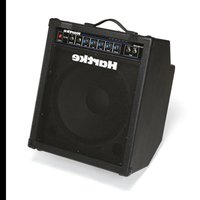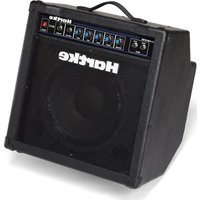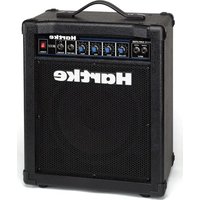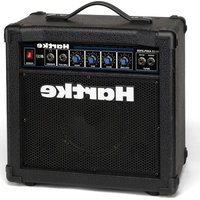
B150 - Audio Amplifier Hartke - Free user manual and instructions
Find the device manual for free B150 Hartke in PDF.


| Product Type | Bass Guitar Combo Amplifier |
| Brand | Hartke |
| Model | B150 |
| Output Power | 15 Watts RMS |
| Speaker | 152mm (6-inch) Woofer, 8 Ohms |
| Inputs | 1 Passive Input (6.35mm Jack), 1 Active Input (6.35mm Jack, 10 dB attenuation) |
| Outputs | Line Out, Headphone Jack (Stereo 6.35mm), Speaker Output, Effects Loop (Preamp Out / Amp In) |
| Equalization | 3-band: Low (100 Hz ±15 dB), Mid (830 Hz ±15 dB), High (5 kHz ±15 dB) |
| Headphone Output Level | 200 mW into 600 Ohms |
| Power Supply | Mains via IEC power cord with grounding |
| Fuse | 3AG Fast-acting (USA/Japan) or 50T Time-lag (UK/Europe), appropriate rating |
| Approximate Dimensions | 300 x 250 x 250 mm |
| Approximate Weight | 6 kg |
| Color | Black |
| Special Features | Headphone jack disables speaker |
| Safety | Mandatory grounding, do not expose to moisture |
| Maintenance | Clean with a damp cloth, do not block ventilation |
| Warranty | Warranty card included, contact dealer for repairs |
Frequently Asked Questions - B150 Hartke
User questions about B150 Hartke
0 question about this device. Answer the ones you know or ask your own.
Ask a new question about this device
Download the instructions for your Audio Amplifier in PDF format for free! Find your manual B150 - Hartke and take your electronic device back in hand. On this page are published all the documents necessary for the use of your device. B150 by Hartke.
USER MANUAL B150 Hartke
DO NOT EXPOSE THIS EQUIPMENT TO RAIN OR MOISTURE
AVIS
RISQUE DE CHOC ELECTRONIQUE NE PAS OUVRIR
CAUTION
FOR CONTINUED PROTECTION AGAINST RISK OF FIRE, REPLACE ONLY WITH SAME TYPE FUSE
ATTENTION
UTILISER UN FUSIBLE DE RECHANGE DE MÊME TYPE
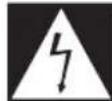
CAUTION
RISK OF ELECTRIC SHOCK DO NOT OPEN

WARNING: To reduce the risk of fire or electric shock, do not expose this unit to rain or moisture. To reduce the hazard of electrical shock, do not remove cover or back. No user serviceable parts inside. Please refer all servicing to qualified personnel. The lightning flash with an arrowhead symbol within an equilateral triangle, is intended to alert the user to the presence of uninsulated "dangerous voltage" within the products enclosure that may be of sufficient magnitude to constitute a risk of electric shock to persons. The exclamation point within an equilateral triangle is intended to alert the user to the presence of important operating and maintenance (servicing) instructions in the literature accompanying the product.
Important Safety Instructions
- Please read all instructions before operating the unit.
- Keep these instructions for future reference.
- Please heed all safety warnings.
- Follow manufacturers instructions.
- Do not use this unit near water or moisture.
- Clean only with a damp cloth.
- Do not block any of the ventilation openings. Install in accordance with the manufacturers instructions.
-
Do not install near any heat sources such as radiators, heat registers, stoves, or other apparatus (including amplifiers) that produce heat.
-
Do not defeat the safety purpose of the polarized or grounding-type plug. A polarized plug has two blades with one wider than the other. A grounding type plug has two blades and a third grounding prong. The wide blade or third prong is provided for your safety. When the provided plug does not fit your outlet, consult an electrician for replacement of the obsolete outlet.
-
Protect the power cord from being walked on and pinched particularly at plugs, convenience receptacles and at the point at which they exit from the unit.
-
Unplug this unit during lightning storms or when unused for long periods of time.
-
Refer all servicing to qualified personnel. Servicing is required when the unit has been damaged in any way, such as power supply cord or plug damage, or if liquid has been spilled or objects have fallen into the unit, the unit has been exposed to rain or moisture, does not operate normally, or has been dropped.
Hartke B Series....3
Combo Bass Amplifier Features....3
Guided Tour - Front Panel 4
Setting Up and Using Your Hartke 7
B Series Combo Bass Amplifier 7
Using Equalization and Shape....9
Specifications....47
FRANÇAIS
Introduction....11
Printed April 2006 v 5.0
www.hartke.com
Phone: 1-800-3-SAMSON (1-800-372-6766)
Fax: 516-364-3888
^A K-TEAM
P R O D I
Introduction
We know you don't like reading owners manuals, but you've just purchased one of the finest bass amplifiers around, and we want to tell you about it! So, before you plug in and start popping and slapping, we'd like to suggest you take just a few moments to scan these pages. We'll make it as painless as possible, we promise—and who knows, you might just pick up a tip or two.
The B Series is a powerful combo amplifier which includes a matched 8-ohm bass speaker in a specially designed cabinet. It's the perfect system for use in small venues such as club dates and for home recording studios. Plus, its dedicated headphone output makes it an awesome practice amp!
There are five different models in the B Series, and this manual covers them all. The B150 is the baby of the family; it's got a 15-watt amp and an 6" speaker. Next up is the B200, which has a 20-watt amp and an 8" speaker. Then the B300, at 30-watts with a 10" speaker. Jumping to twice the power, the B600 pumps 60 watts into a 12" speaker. The B900 delivers a full 90 watts of bone-rattling power into a 15" speaker. Whichever of these models you've purchased, you're assured of that great Hartke sound and robust construction.
In these pages, you'll find a detailed description of the many features of your B Series Combo Bass Amplifier, as well as a guided tour through its front and rear panels, step-by-step instructions for setting up and using the amp, additional information about equalization and a unique Shape control (provided in the B600 and B900 models), plus full specifications. You'll also find a warranty card enclosed—please don't forget to fill it out and mail it so that you can receive online technical support and so we can send you updated information about this and other Hartke and Samson products in the future. Also, be sure to check out our website (http://www.samsontech.com) for complete information about our full product line.
SPECIAL NOTE: Should your Hartke B Series Combo Bass Amplifier ever require servicing, a Return Authorization (RA) number is necessary. Without this number, the unit will not be accepted. If purchased in the United States, please call Samson at 1-800-372-6766 for a Return Authorization number prior to shipping. Please retain the original packing materials and, if possible, return the unit in its original carton and packing materials. If purchased outside the United States, please contact your local distributor for warranty information.
Hartke B Series
Combo Bass Amplifier Features
The Hartke B Series offers all the newest concepts in state-of-the-art bass amplification at an extremely affordable price. Here are some of its main features:
- Bipolar circuit design ensures that every nuance of your bass performance is reproduced faithfully.
- Dual inputs that accommodate a broad range of input levels, so that you can use the B Series with pretty much any kind of bass, from passive models to those with active circuitry. It is almost impossible to overload the input of a B Series bass amplifier!
- Three bands of high-quality equalization, allowing you to create a broad range of tonal colors for your bass instrument.
- Line-level effects loop send (Preamp Out) and return (Amp In) jacks that allow you to connect to professional outboard effects processors.
- The B600 and B900 models feature Hartke's original Kickback bass speaker enclosure design, allowing the amplifier to be placed flat on the floor or in a tilt-back position for increased high-end clarity and directionality.
- A separate headphone output which automatically disconnects the speaker output, allowing use as a high-quality practice amp.
- A unique front-panel line-level output for interfacing with PA systems or recording mixing consoles.
- Included is a matched Hartke 8-ohm speaker mounted in a specially designed cabinet for clean, crisp sound.
- In the B600 and B900 models, a unique contour filtering system called "Shape" which activates a multi-band equalization curve specially designed to enhance the sound of the electric bass. The front panel Shape control enables you to continuously sweep a filter through various frequency areas in order to customize the effect of the curve to the specific tonal characteristics of your particular bass instrument.
- A steel grill helps protect the speaker from bumps and bruises when you are transporting your amplifier.
- Removable power cord supplied with the correct plug for your geographic area.
- Rugged construction makes the B Series eminently road-worthy.
Guided Tour - Front Panel
text_image
1 2 3 4 5 6 7 8 9 BASS AMPLIFIER Hartke PASSIVE ACTIVE VOLUME SHAPE BAS MID HIGH LINE OUT PHONES B900 POWER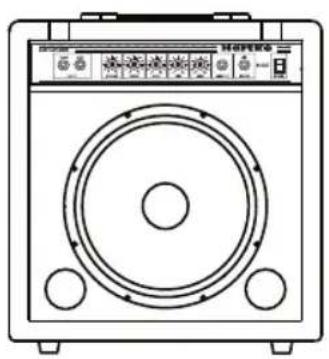
natural_image
Front view of a portable audio amplifier with speaker grille and control buttons (no text or symbols visible)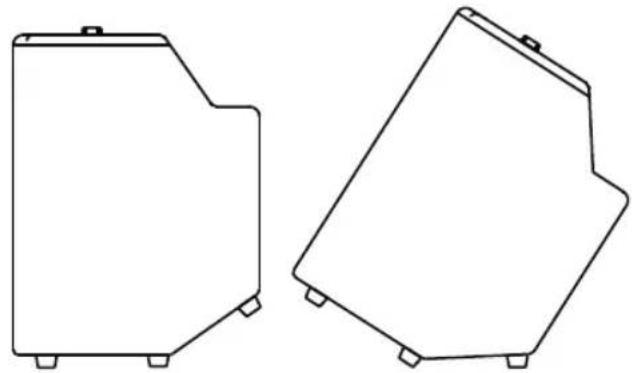
natural_image
Two technical line drawings of a mechanical component with mounting holes (no text or symbols)B600 and B900 Kickback Enclosure
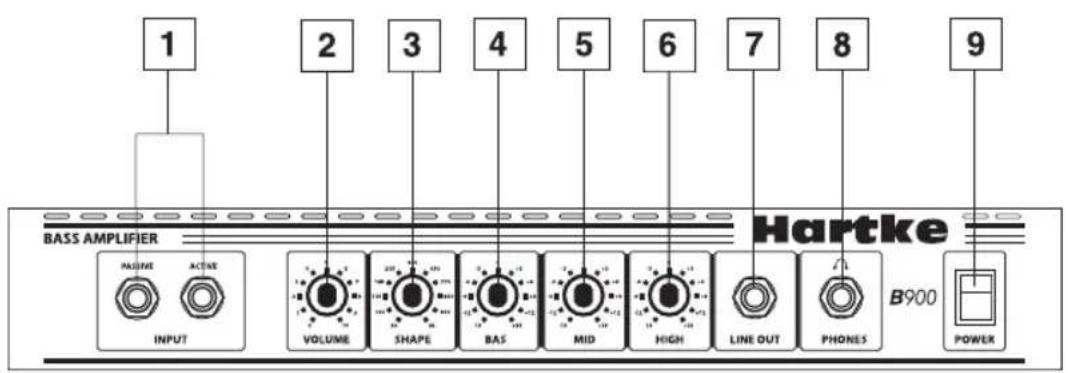
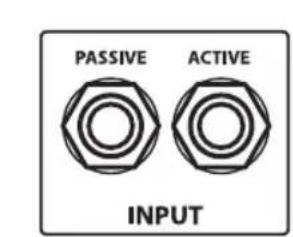
- Inputs - Connect your bass guitar to one of these standard 1/4" unbalanced jacks. If your bass has passive electronics (that is, if it has no battery), connect it to PASSIVE INPUT, which is designed to handle low-level signals. If your bass has active electronics (that is, if it has a battery), connect it to ACTIVE INPUT, which employs a 10 dB pad and is designed to handle hotter bass pickup signals.
- Volume control - This is the overall volume control. For best signal-to-noise ratio, keep the output of your bass at or near maximum and adjust the B Series Volume to the desired level.
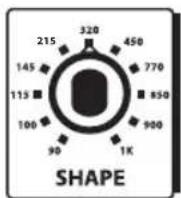
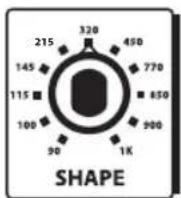
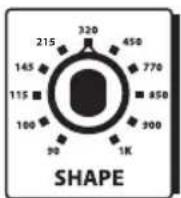
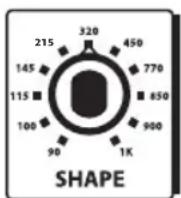
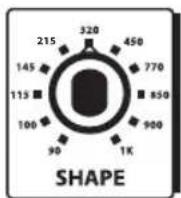
- Shape control (B600 and B900 only) - This control applies a specialized 20 dB notch filter to the specified frequency area so that you can customize the effect of the Shape curve to best complement your particular bass instrument. Moving the Shape control clockwise causes the notch filter to be applied to higher frequencies while moving it counterclockwise causes it to be applied to lower frequencies. At the fully clockwise position, the filter is applied to the 1 kHz frequency area; this will act to attenuate mid-range frequencies and give your bass a deep, low tone. At the fully counterclockwise position, the filter is applied to the 90 Hz frequency area; this will act to attenuate low frequencies and give your bass a biting, trebly sound. For more information, see the "Using Equalization and Shape" section on page 8 in this manual.
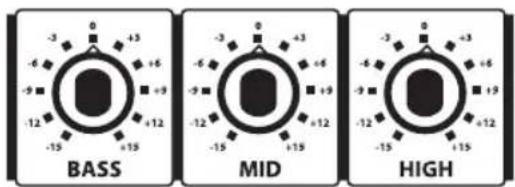
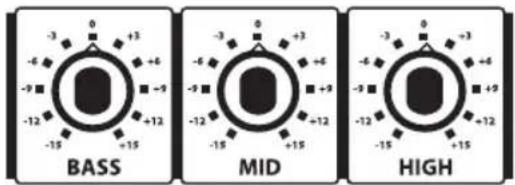
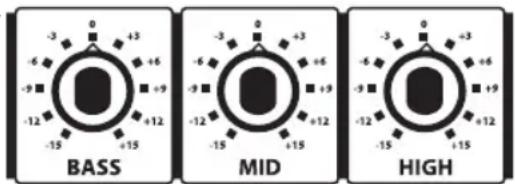
- Bass EQ control - This control provides approximately 15 dB of cut or boost at 100 Hz, with a peak (bell) curve. When the knob is at the 12 o'clock ("0") position, there is no boost or attenua
Guided Tour - Front Panel
tion (that is, flat response). As it is turned clockwise from the "0" position, the frequency area is boosted; as it is turned counterclockwise from the "0" position, the frequency area is attenuated. For more information, see the "Using Equalization and Shape" section on page 8 in this manual.
- Mid EQ control - This control provides approximately 15 dB of cut or boost at 830 Hz, with a peak (bell) curve. When the knob is at the 12 o'clock ("0") position, there is no boost or attenuation (that is, flat response). As it is turned clockwise from the "0" position, the frequency area is boosted; as it is turned counterclockwise from the "0" position, the frequency area is attenuated. For more information, see the "Using Equalization and Shape" section on page 8 in this manual.
- High EQ control - This shelving control provides approximately 15 dB of cut or boost at 5 kHz. When the knob is at the 12 o'clock ("0") position, there is no boost or attenuation (that is, flat response). As it is turned clockwise from the "0" position, the frequency area is boosted; as it is turned counterclockwise from the "0" position, the frequency area is attenuated. For more information, see the "Using Equalization and Shape" section on page 8 in this manual.
- Line Out - This standard unbalanced 1/4" jack provides a line-level post-EQ and post-Volume (and, in the B600 and B900 models, post-Shape) output signal from the B Series. You'll usually use this to connect the B Series signal to a line-level input when interfacing with PA systems or recording mixing consoles. The signal from this output is the same as that from the Preamp Out on the rear panel (see #3 on page 5).
- Headphones jack - Connect any standard stereo headphone (600 ohms or less) to this standard 1/4" stereo jack. When a plug is inserted into the headphone jack, the speaker output is disconnected, allowing you to use your B Series as a practice amplifier. The level of the signal sent to the headphones is determined by the setting of the Volume knob—at the point where a connected speaker would clip, the headphones will clip.
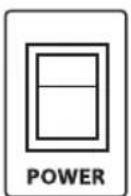
WARNING: Because even the smallest B Series amplifier is capable of generating extremely high headphone signal levels, always start with the Volume knob at minimum and then slowly turn it up. In particular, a clicking sound is an indication of distortion and possible damage to the headphones (and/or your hearing!); don't let things get to that point! - Power switch - Use this to power the B Series on or off. When powered on, an LED inside this switch is lit.
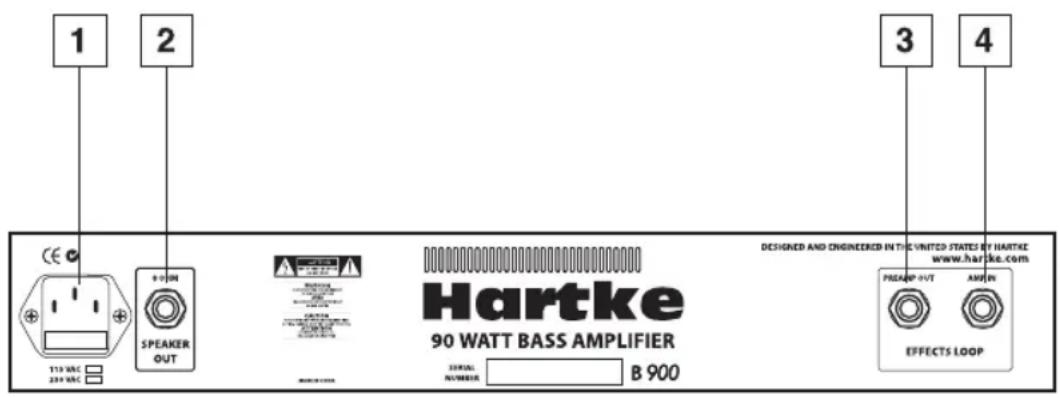
Guided Tour - Rear Panel
text_image
1 2 3 4 173 WBC 239 WBC SPEAKER OUT Hartke 90 WATT BASS AMPLIFIER SERIAL NUMBER B 900 DESIGNED AND ENGINEERED IN THE UNITED STATES BY HARTKE WWW.hartke.com PREAMP-OUT AMPIN EFFECTS LOOP- AC Inlet - Attach the grounded AC power cord here to connect your B Series amplifier to mains power. This cord comes supplied with the appropriate plug for your geographic area.
CAUTION: Do not use an adapter to defeat the third grounding pin on this plug or severe electric shock may result!
The fuse holder comes from the factory with the appropriately rated fuse for your model. If you need to change this fuse for any reason, replace it with one that has the same exact rating.
- Speaker Output – The SPEAKER OUTPUT jack is used to connect the internal speaker to the amplifier. Your B Series amplifier has been designed to match the internal speaker, so we recommend that you do not connect an external bass speaker to your amplifier. If you do, be sure to match the power rating of your amplifier to the connected speaker. In some cases, under powering a high power speaker can damage the connected amplifier. DO NOT connect any speaker with any impedance rating that is lower than 8 Ohms. Doing so may void your warranty.
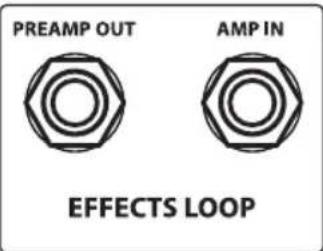
- Preamp Out (Effects Loop Send)- Use this 1/4" unbalanced jack to send signal to a professional outboard effects processor.* Output level is approximately 0 dB to +4 dB and is post-EQ and post-Shape but unaffected by the setting of the Volume control. The signal from this output is the same as that from the Line Out on the front panel (see #7 on page 4).
- Amp In (Effects Loop Return)- Use this 1/4" unbalanced jack to return signal from a professional outboard effects processor.*
Setting Up and Using Your Hartke B Series Combo Bass Amplifier
Setting up your Hartke Systems B Series Combo Bass Amplifier is a simple procedure which takes only a few minutes:
- Remove all packing materials (save them in case of need for future service) and decide where the amplifier is to be physically placed. To avoid potential overheating problems, make sure that the rear panel is unobstructed and that there is good ventilation around the entire unit.
- Connect the 3-pin AC plug into any grounded AC socket. Don't turn the B Series on just yet, though.
text_image
PASSIVE ACTIVE INPUT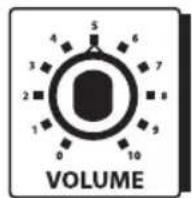
- Use a standard music instrument cable to connect your bass to one of the Input jacks on the front panel. If your bass has passive electronics (that is, if it has no battery), connect it to Passive Input which is designed to handle low-voltage signals. If your bass has active electronics (that is, if it has a battery), connect it to Active Input, which has a 10 dB pad and is designed to handle hotter bass pickup signals.
- On the front panel of the B Series, turn the Volume control to its minimum (fully counterclockwise) position, set all three EQ controls to their "0" (12 o'clock) position, and, if you are using a B600 or B900, set the Shape control to its 12 o'clock position.
- Press the front panel Power switch in order to turn on your B Series amp; the LED in the switch will light up.
- Set the output of your bass to maximum and then, while playing, slowly turn the B Series Volume control up until the desired level is achieved. It's nearly impossible to overload the B Series amplifier, so if you hear distortion even at low Volume settings, check for a faulty cable (if it's good, simply back off the output of your bass).
- If you are using a B600 or B900, turn the Shape knob both clockwise and counterclockwise to hear the effect of the Shape curve and filter on the sound of your bass. Leave the Shape knob at the point where it best complements your particular instrument and playing style.
- Adjust the three equalization controls to taste (when you get a great setting that complements your instrument and playing style, it's a good idea to write it down for future use).
text_image
-3 -6 -9 -12 -15 +3 +6 +9 +12 BASS -3 -6 -9 -12 -15 +3 +6 +9 +12 MID -3 -6 -9 -12 -15 +3 +6 +9 +12 HIGH- Test the headphone output by turning the Volume control to its minimum (fully counter-
Setting Up and Using Your Hartke B Series Combo Bass Amplifier
clockwise) position and then connect a standard stereo headphone to the front-panel Headphones jack. While playing your bass, slowly turn the Volume control up—you should hear sound from the headphones and none from the connected speaker. We recommend the use of large size headphones (those with large transducers) for optimum bass reproduction.
- If you need to connect the B Series to a PA system or a recording mixing console, connect a cable between the front-panel Line Out output and a line-level input on the mixer. (See #7 on page 4 in this manual for more information on the use of the B Series Line Out).
- If you're using a professional external signal processor that has line-level inputs and outputs, turn your B Series amp off momentarily and then connect a standard audio cable between the rear panel Preamp Out jack and your effects processor input and another standard audio cable between the Amp In jack and your effects processor output (if required, multiple effects processors can be daisy-chained together, output to input). Then turn the B Series amp back on and play your bass while adjusting the controls of your effects processor(s). For best results, set both the input and output gain of all connected effects processor(s) to 0 dB (unity gain), so that there is no increase or decrease in level whether the effects are switched in or out.

text_image
PREAMP OUT AMP IN EFFECTS LOOPIf you encounter difficulty with any aspect of setting up or using your Hartke B Series Bass Combo Amplifier, you can call
Samson Technical Support (1-800-372-6766) between 9 AM and 5 PM EST, or contact your local distributor.
Using Equalization and Shape
The Hartke Systems B Series Bass Amplifier gives you enormous control over shaping the sound of your bass, using a process called equalization. To understand how this works, it's important to know that every naturally occurring sound consists of a broad range of pitches, or frequencies, combined together in a unique way. This blend is what gives every sound its distinctive tonal color. The B Series EQ controls allow you to alter a sound by boosting or attenuating specific frequency areas—they operate much like the bass and treble controls on your hi-fi amp, but with much greater precision.
text_image
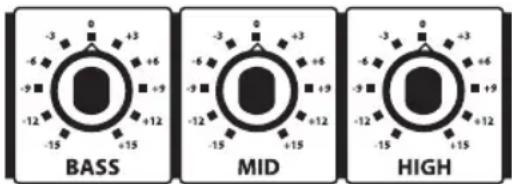
-3 -6 -9 -12 -15 +3 +6 +9 +12 BASS -3 -6 -9 -12 -15 +3 +6 +9 +12 MID -3 -6 -9 -12 -15 +3 +6 +9 +12 HIGHThe B Series offers three bands of equalization. Each EQ knob (labeled Bass, Mid, and High, respectively) affects a different frequency area (100 Hz, 830 Hz, and 5 kHz, respectively) and provides approximately 15 dB of boost and attenuation. We carefully selected these frequency areas because they have maximum impact on bass signals. For example, the Low (100 Hz) control affects the very lowest audible frequencies (in fact, most humans cannot hear below 20 Hz), while the High (5 kHz) control affects the "twang" of a bass string.
When an EQ knob is in its center detented position ("0"), it is having no effect. When it is moved right of center, the particular frequency area is being boosted; when it is moved left of center, the frequency area is being attenuated. Turning all EQ controls up the same amount will have virtually the same effect as simply turning up the Volume; conversely, turning them all down the same amount will have virtually the same effect as turning down the Volume. Both approaches are pointless (after all, that's why we gave you a Volume control!)
In many instances, the best way to deal with equalization is to think in terms of which frequency areas you need to attenuate, as opposed to which ones you need to boost. Be aware that boosting a frequency area also has the effect of boosting the overall signal; specifically, too much Low EQ boost can actually cause overload distortion or even harm the connected speaker.
In addition, the B600 and B900 models provide a unique Shape control which employs a notch filter to remove specific frequency areas. At the same time, it overlays a special equalization curve that is designed to improve the sound of electric bass instruments. This curve provides boost at certain frequency areas and attenuation at other frequency areas. As the Shape knob is turned clockwise, the notch filter is imposed on higher frequency areas; as it is turned counterclockwise, the filter is imposed on lower frequency areas. At the fully clockwise position, the filter is applied to the 1 kHz frequency area, making for a deep, rich tone; at the fully counterclockwise position, the filter is applied to the 90 Hz frequency area, making for a bright, twangy tone.
The specific EQ (and/or Shape) you will apply to your bass signal is very much dependent upon your particular instrument and personal taste and playing style. However, here are a few general suggestions:
Using Equalization and Shape
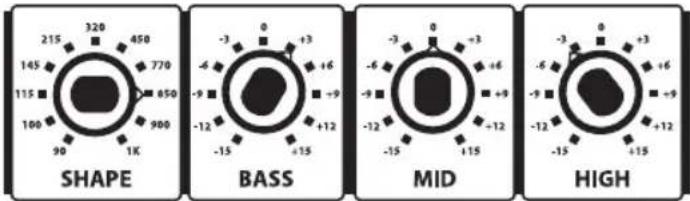
- For that super-deep reggae or Motown sound, boost the Low EQ slightly while attenuating the High EQ. If you're using a B600 or B900, set the Shape control to approximately 850 Hz.
- To remove boxiness and make your instrument sound more "hi-fi," try attenuating the Mid EQ control. If you're using a B600 or B900, set the Shape control to approximately 320 Hz.
text_image
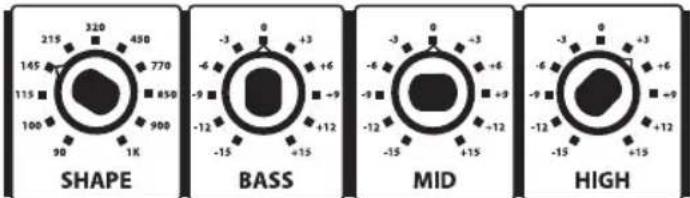
SHAPE BASS MID HIGH- For a twangy, cutting sound, try boosting the High EQ. (putting new roundwound strings on your bass will help a lot also!). If you're using a B600 or B900, set the Shape control to approximately 145 Hz.
- Whenever you get a really good EQ (and/or Shape) setting for a particular instrument or song, write it down (you'd be amazed how easy it is to forget these things!).
As you experiment with the EQ and Shape controls of the B Series, don't forget that your bass
text_image
SHAPE BASS MID HIGHalso provides significant EQ control in the form of its pickup and tonal settings—this can be particularly effective in instruments that have active circuitry.
Introduction
text_image
PASSIVE ACTIVE INPUT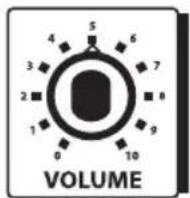
text_image
-3 -6 -9 -12 -15 BASS -3 -6 -9 -12 -15 MID -3 -6 -9 -12 -15 +3 +6 +9 +12 +15 +12 +15 HIGHnatural_image
Line drawing of a portable audio amplifier with speaker grille and buttons (no text or symbols)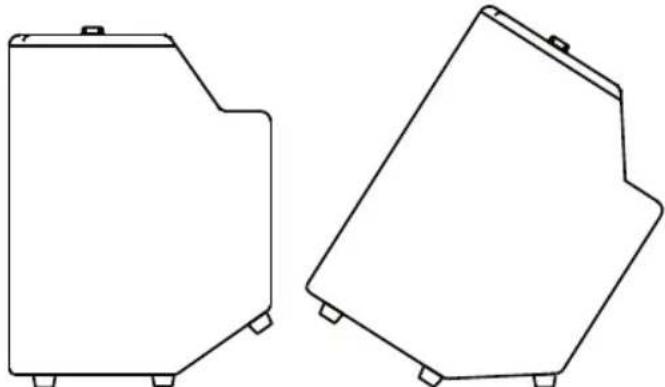
natural_image
Two technical line drawings of a mechanical component with mounting holes (no text or symbols)text_image
PASSIVE ACTIVE INPUT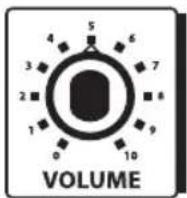
natural_image
Front view of a portable audio amplifier with speaker grille and control buttons (no text or symbols visible)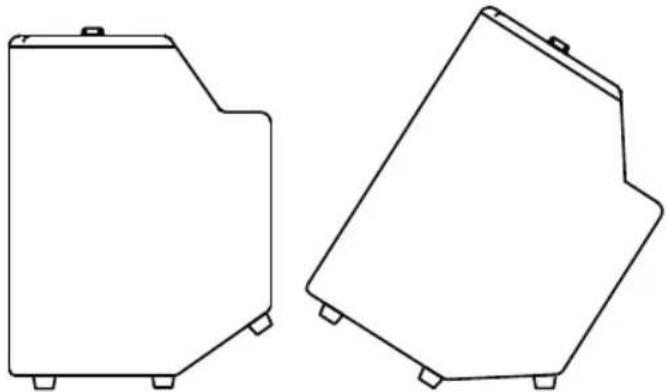
natural_image
Two technical line drawings of a mechanical component with mounting holes (no text or symbols)text_image
PASSIVE ACTIVE INPUT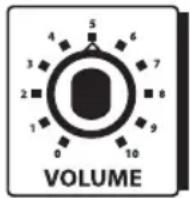

text_image
-3 -6 -9 -12 -15 +3 +6 +9 +12 BASS -3 -6 -9 -12 -15 +3 +6 +9 +12 MID -3 -6 -9 -12 -15 +3 +6 +9 +12 HIGHnatural_image
Front view of a portable audio amplifier with speaker grille and control buttons (no text or symbols visible)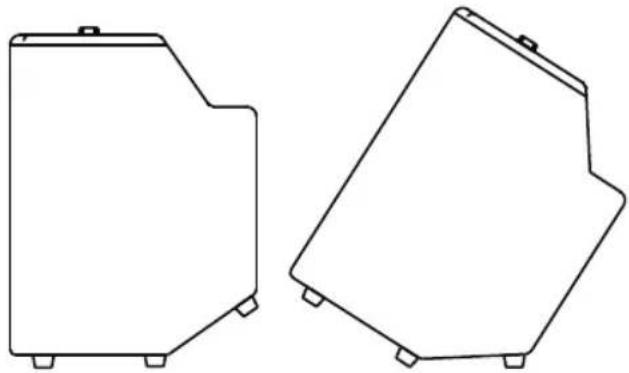
natural_image
Two technical line drawings of a mechanical component with mounting holes (no text or symbols)B600 e B900 - cabinet 'Kickback'
text_image
PASSIVE ACTIVE INPUT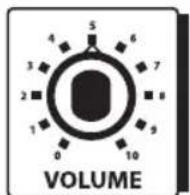
1. Rated Output Power (@ 1 kHz, 4 ohm, 5% THD)
B150 15 Wrms
B200 20 Wrms
B300 30 Wrms
B600 60 Wrms
B900 90 Wrms
2. Rated Input Level (@ 1 kHz)
Input 1 -20 dBu
Input 2 -10 dBu
3. Total Harmonic Distortion (@ 1 dB below rated output, 1 kHz typical)
B150 0.1%
B200 0.1%
B300 0.1%
B600 0.05%
B900 0.07%
4. Signal To Noise Ratio (re: 1 Wrms @ 1 kHz)
B150 67 dB
B200 67 dB
B300 66 dB
B600 65 dB
B900 70 dB
5. Dynamic Range (re: Rated output @ 1 kHz)
B150 80 dB
B200 80 dB
B300 75 dB
B600 80 dB
B900 90 dB
6. Signal Gain
Input 1 to Line Out / Preamp Out +30 dB (B200), +30 dB (B200), +30 dB (B300)
$$ + 3 0 \mathrm{dB} (\mathrm{B} 3 0 0), + 3 0 \mathrm{dB} (\mathrm{B} 9 0 0 $$
Input 1 to Speaker Out +46 dB (B150), +48 dB (B200), +55 dB (B300)
+57 dB (B300), +61 dB (B900)
Input 2 to Line Out / Preamp Out +20 dB (B150),+20 dB (B200),+20 dB (B300)
+20 dB (B300), +20 dB (B900)
Input 2 to Speaker Out +36 dB (B150), +38 dB (B200), +45 dB (B300)
+47 dB (B300), +51 dB (B900)
7. Equalizer
Low (100 Hz) ±15 dB
Mid (830 Hz) ±15 dB
High (5 kHz) ±15 dB
8. Headphone Output
200 mW (typical) @ 600 ohms
9. Fuse Type 3AG fast-acting (US & Japan), 50T time delay (UK & European)
10. Fuse Rating
US & Japan
0.5A (B200), 1.0A (B300), 2.0A (B300), 3.0A (B900)
UK & European T250M (B200), T500M (B300), T1M (B300), T1.6M (B900), T?M
B150 15 W efficace
B200 20 W efficace
B300 30 W efficace
B600 60 W efficace
B900 90 W efficace
+57 dB (B300), +61 dB (B900)
Entre entrée Input 2 et sortie Line Out / Preamp Out +20 dB (B150), +20 dB (B200), +20 dB (B300) +20 dB (B300), +20 dB (B900)
+57 dB (B300), +61 dB (B900)
+57 dB (B300), +61 dB (B900)
Input 2 a Line Out / Preamp Out +20 dB (B150),+20 dB (B200),+20 dB (B300)
+20 dB (B300), +20 dB (B900)
Input 2 a Speaker Out +36 dB (B150),+38 dB (B200),+45 dB (B300)
+47 dB (B300), +51 dB (B900)
7. Ecualizador
Graves (100 Hz) ±15 dB
Medios (830 Hz) ±15 dB
4. Rapporto Segnale/Rumore (rif: 1 Wrms @ 1 kHz)
B150 67 dB
B200 67 dB
B300 66 dB
B600 65 dB
B900 70 dB
5. Dynamic Range (rif: uscita @ 1 kHz)
B150 80 dB
B200 80 dB
B300 75 dB
B600 80 dB
B900 90 dB
+57 dB (B300), +61 dB (B900)
Da Input 2 a Line Out / Preamp Out +20 dB (B150), +20 dB (B200), +20 dB (B300)
+20 dB (B300), +20 dB (B900)
Da Input 2 a Speaker Out +36 dB (B150),+38 dB (B200),+45 dB (B300)
+47 dB (B300), +51 dB (B900)
7. Equalizzatore
Low (100 Hz) ±15 dB
Mid (830 Hz) ±15 dB
High (5 kHz) ±15 dB