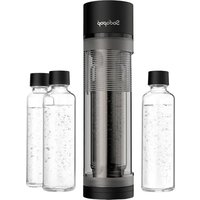
Logan - Soda maker Sodapop - Free user manual and instructions
Find the device manual for free Logan Sodapop in PDF.


User questions about Logan Sodapop
0 question about this device. Answer the ones you know or ask your own.
Ask a new question about this device
Download the instructions for your Soda maker in PDF format for free! Find your manual Logan - Sodapop and take your electronic device back in hand. On this page are published all the documents necessary for the use of your device. Logan by Sodapop.
USER MANUAL Logan Sodapop
natural_image
Microscopic view of bubbles and particles dispersed in a field (no text or symbols)Inhaltsverzeichnis
text_image
Exploded diagram of a gas collection device with labeled components including spray bottles, condenser, and filter.natural_image
Two views of a mechanical component with red arrows indicating directional movement (no text or symbols)natural_image
Illustration of a hand inserting a black cylindrical device into a black housing (no text or symbols visible)natural_image
Close-up of a black industrial device with a red curved arrow indicating rotation or motion (no text or symbols visible)Inbetriebnahme
natural_image
Illustration of a hand inserting a cylindrical device into a container (no text or symbols visible)natural_image
Illustration of a hand spraying water onto a faucet with a snowflake nearby (no text or symbols)natural_image
Two-step illustration showing a hand inserting a blue liquid into a black digital device (no text or symbols present)natural_image
Close-up of a black cylindrical object with a red arrow indicating rotation, next to a hand holding a small object (no text or symbols visible)Sprudel herstellen
natural_image
Two-step illustration showing a hand holding a blue liquid in a container, with red arrows indicating direction (no text or symbols)natural_image
Illustration of a hand cleaning a yellow spray bottle with a black cap and a small droplet nearby (no text or symbols)2.2
natural_image
Two transparent plastic bottles and a checkmark inside a box (no text or symbols)natural_image
Two empty glass bottles with standard caps, no text or symbols visible2
Tipp
A = ca. 112 mm B = ca. 188 mm C = ca. 426 mm

ca. 2 kg

ca. 10 - 40 °C
Let's get bubbling and get your water fizzy! Just keep reading and I'll show you how – it's really easy. You and me are going to bring your water to life.
natural_image
Abstract illustration of bubbles and droplets on a white background (no text or symbols)Contents
| Safety information.... | Page | 4 - 7 |
| Appliance overview / scope of delivery.... | Page | 8 |
| Initial start-up.... | Page | 9 - 10 |
| Preparing sparkling water.... | Page | 11 |
| Maintenance and cleaning.... | Page | 12 |
| Exchanging CO2 cylinders and bottles.... | Page | 13 |
| Frequently asked questions.... | Page | 14 |
| Specifications / Service / Disposal information.... | Page | 15 |
Symbols and warning information

CAUTION! Risk of injury!
Prior to use, inspect the carbon dioxide cylinder and valve for dents, punctures or other damage. Defective cylinders must not be used. In these cases, please contact our customer service team (see p. 15).

Safety information:
Must be observed when handling CO_2 cylinders containing carbon dioxide

Hazard no. 20 – ERICard no. 2-51 – UN 1014: The CO _2 cylinders are pressurised vessels categorised as UN no. 1013, carbon dioxide. ADR class 2, classification code 2A. It is assumed
that the containers are refillable and the capacity is >0.5 l
- Contains gas under pressure
- Heating the container will cause pressure to rise and risk of explosion and immediate release of expanding vapour cloud creating a pressure wave
- Cool down the cylinder, store in a well-ventilated area. Store upright. Store away from flammable gases and other combustible materials
Safety information
Before using the soda maker, read the instructions for use thoroughly. Failure to observe them could result in danger. Keep this manual in a safe place. If you pass this appliance on to another owner, include the manual with it.
This appliance is intended only for carbonating clean drinking water. Water containing additives such as syrup or effervescent tablets, and other beverages and liquids must not be carbonated.
The soda maker is intended for domestic use only. The manufacturer accepts no liability for any consequences arising from commercial use, use other than for the intended purpose or failure to follow the instructions in this manual.
General warnings
Improper handling of the appliance can lead to injuries. In the event of apparent malfunction of the appliance, stop using the appliance and contact our customer service team.
- Only use the appliance in the upright position on a stable, level surface
• To ensure the appliance is stable and does not tip over, only use the appliance with the feet folded out. To do so, loosen the
fixture on the bottom of the appliance and rotate the feet outwards by 90 degrees (see p. 9)
- Keep the appliance away from heat, avoid direct sunlight and do not place the appliance on hot surfaces (e.g. ovens)
- Only carbonate clean drinking water
- Only use genuine Sodapop Logan bottles
- Do not carbonate empty bottles
- Add syrup only after carbonating your water
Improper handling poses a threat to children and persons with limited physical, sensory or mental abilities (for example, partially disabled people or older people with limited physical and mental abilities) or to those without experience and knowledge (such as older children). This product may be used by children aged from 8 years and above and persons with limited physical, sensory or mental abilities or by those without experience and knowledge, provided that they are supervised or have been instructed in the safe use of the product and have understood the associated dangers. Children under the age of 8 must not be allowed to operate or play with the appliance. Cleaning and
Safety information (continued)
user maintenance must not be carried out by children unless they are supervised. Do not allow children to play with the packaging film. They could become entangled in it while playing and suffocate.
Warnings regarding the use of CO₂ cylinders
We recommend that only CO2 cylinders from Sodapop are used. In any case, use only tested CO2 cylinders in accordance with DIN EN ISO 7866 that are identical in construction:
- Thread M18x1.5
- PH250 bar max. filling pressure
- 425 g filling weight
-
π
-
Never remove CO_2 cylinders during the carbonation process
- Do not make any modifications to CO_2 cylinders
- Do not damage or burn CO_2 cylinders, avoid falls and violent impacts
- Do not throw CO_2 cylinders
- Never transport the appliance with the CO_2 cylinder inserted
- Store CO_2 cylinders upright, in cool, well-ventilated places
- Only have CO_2 cylinders refilled and maintained by an authorised specialist company
Risk of frostbite!
The carbon dioxide cylinder can become extremely cold after use and when carbon dioxide escapes rapidly as the result of damage. In the event that the CO_2 cylinder ices up, avoid all physical contact with the cylinder. First allow the CO_2 cylinder to come up to room temperature before replacing it.
Risk of suffocation due to carbon dioxide
CO 2 can escape from damaged or deformed CO 2 cylinders. In a concentrated form, this can lead to suffocation. Do not use the cylinder and contact the service hotline on page 15.
If you feel dizzy or unwell, carefully ventilate the room where the CO₂ cylinder is located. Consult a doctor if necessary.
Risk of explosion due to CO_2 cylinders
The CO _2 cylinder is under pressure and can explode if warmed up. Keep the cylinder away from heat sources over 50 °C, direct sunlight, flammable gases and other combustible substances. Only store upright in cool, well-ventilated places.
Safety information (continued)
Usage and warning instructions for glass bottles
The glass bottles supplied are intended only for the Sodapop Logan soda maker. Do not use bottles from a different manufacturer and do not use any other bottles in general.
Observe the permissible capacity of the glass bottle: for carbonation fill with clean water up to the rated capacity and insert into the appliance correctly.
Risk of injury! Inspect the glass bottle for damage before each use. Do not continue to use damaged glass bottles, instead dispose of it and replace with a new one (see page 13 for more information).
Previous damage (e.g. hairline cracks, minor internal damage and flaws) can result in the glass bottle exploding when under pressure during carbonation.
- Do not continue to use bottles that have fallen to the floor or that have been subjected to other impacts
- Do not expose bottles to extreme temperature fluctuations in excess of 45 °C
- Do not pour hot water into a cold bottle
- Do not store bottles in temperatures below 4 °C (freezer, freezer compartment)
- Do not use bottles with a damaged fixture
The safety door on the sparkling water maker is intended to protect against injuries in the event that a water bottle explodes. The soda maker can only be used when the safety door is closed.
The glass bottles supplied are dishwasher safe.
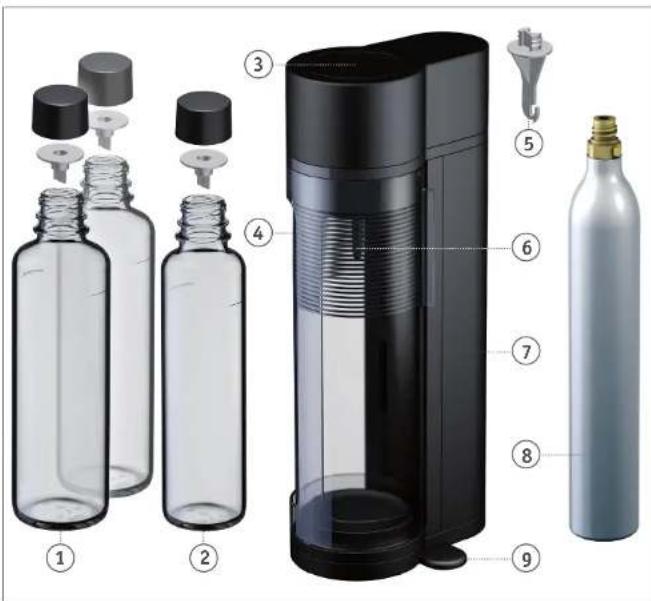
Appliance overview / scope of delivery
text_image
Exploded diagram of a gas collection device with labeled components including liquid bottles, spray bottle, and digital scanner.- 2 x Glass bottle, 850 ml / 29.92 fl oz (nominal capacity) and seal
- Glass bottle, 600 ml / 21.12 fl oz (nominal capacity) and seal
- Carbonating button
- Safety door
- Valve protection
- CO _2 lance
- Rear panel
8.CO,cylinder - Folding feet

INFO!
All parts shown here and the original instruction manual are included in the delivery. Before using the appliance for the first time, please check the delivery for completeness.
Initial start-up

CAUTION!
Risk of injury!
Prior to use, inspect the CO₂ cylinder and valve for dents, punctures or other damage. Defective cylinders must not be used. In such cases, please contact our customer service team.
Place the appliance on a level, dry surface. Do not position in direct sunlight and keep away from heat sources such as ovens and naked flames.
Inspect the glass bottle for cracks, minor internal damage and flaws before each use.
1 Unpack the appliance and accessories, clean bottles with lukewarm water, washing-up liquid and a bottle brush and leave to dry. Wipe the appliance with a soft, damp cloth and washing-up liquid.
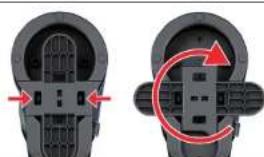
2 For optimal stability, loosen the fixture underneath the appliance (see arrows), rotate the feet out by 90 degrees and click the fixture into place.
2
natural_image
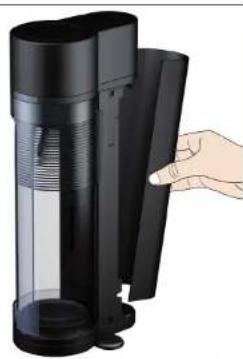
Two views of a mechanical component with red arrows indicating directional movement (no text or symbols)3 Insert CO₂ cylinder: Hold the middle of the rear panel and pull backwards to remove.
3
natural_image
Illustration of a black handheld air purifier with a hand adjusting its lid (no text or symbols visible)4 Before inserting the CO₂ cylinder for the first time, unscrew the valve protection.
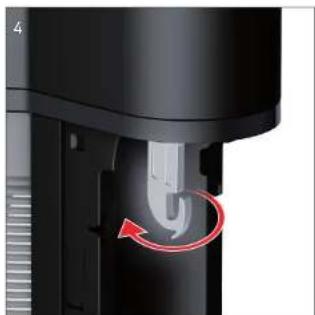
natural_image
Close-up of a black industrial device with a red circular arrow indicating rotation or adjustment (no text or symbols visible)Initial start-up
5 Remove the protective film from the CO_2 cylinder and twist off the cap. Insert the CO_2 cylinder straight into the recess, push upwards and screw (only by hand) into the fixture in anti-clockwise direction. Push the rear panel back into the back of the appliance until it clicks into place. Make sure that it is positioned correctly.
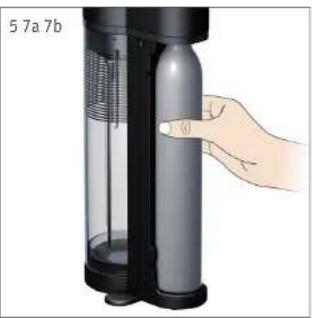
natural_image
Illustration of a hand inserting a cylindrical device into a transparent chamber (no text or symbols visible)6 Fill the bottle with clean drinking water up to the rated capacity. Cold tap water or chilled water from the refrigerator is ideal, since it best absorbs the carbon dioxide.
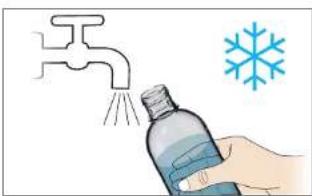
natural_image
Illustration of a hand spraying water with a faucet and a snowflake symbol (no text or labels)7 Swing open the safety door to the left. Ensure that the CO2 lance is titled forward and locked in place. Push the bottle filled up to the mark completely upwards over the CO2 lance. Then push the bottle backwards towards the carbonator until it is aligned vertically. Briefly pull on the bottle to check.
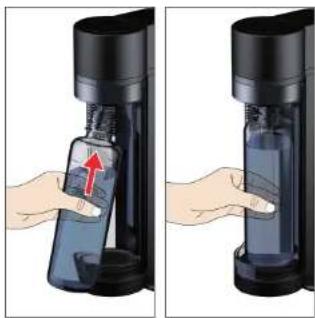
natural_image
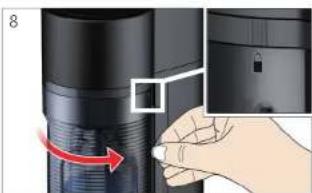
Two-step illustration showing a hand inserting a liquid into a digital device (no text or symbols present)8 Close the safety door fully (up to the lock symbol, you will hear the door click into place.) The appliance is not functional while the door is open.
natural_image
Close-up of a black cylindrical object with a red arrow indicating rotation, next to a hand holding a small object (no text or symbols visible)Preparing sparkling water
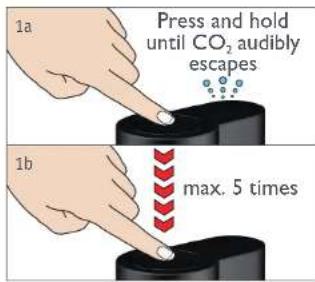
1 Press the carbonating button all the way down and hold until CO_2 audibly escapes (Fig. 1a), then release. Carbon dioxide is added to the water. Depending on how fizzy you would like the water to be, it is recommended to perform the carbonation process a maximum of five times. (Fig. 1b).
text_image
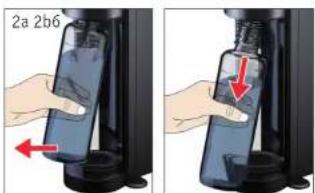
Press and hold until CO₂ audibly escapes max. 5 times2 Remove the bottle containing carbonated water. To do so, open the safety door anti-clockwise.
Caution: when you do this, you will hear residual pressure escaping. Tilt the bottle towards you (Fig. 2a), then pull it downwards at an angle and remove (Fig. 2b).
text_image
2a 2b63 Only at this point can you refine the water by adding syrup. After adding the syrup, gently shake or roll the bottle to ensure that the syrup is evenly distributed. CAUTION! Use only food-safe additives and flavourings that are suitable for mixing with drinking water.
4 Open the screw cap carefully to drink the sparkling water – the liquid is under pressure and can bubble up a lot when first opened. If this happens, close the bottle again and only then unscrew the cap completely. Pour the sparkling water into a glass and enjoy.
5 Store opened sparkling water in the closed bottle in the refrigerator at approx. 6 °C.

NOTE!
The amount of carbon dioxide is sufficient for light carbonation (1x press) for approx. 60 litres of sparkling water.
Maintenance and cleaning
1 Cleaning the appliance
Wipe the appliance with a soft, damp cloth with washing-up liquid and wipe dry. Never put the appliance in the dishwasher and do not use abrasive or corrosive cleaning agents.
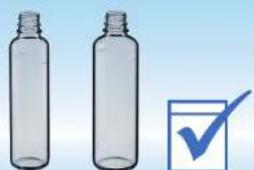
2.2 Clean in the dishwasher
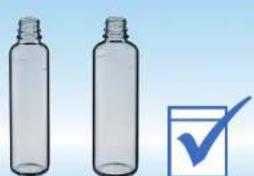
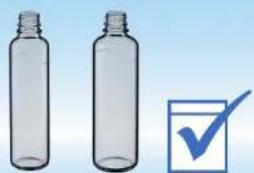
Only the supplied Sodapop glass bottles are suitable for cleaning in the dishwasher strictly observe the graphic below (Fig. 2.2).
Twist off the cap, carefully place the bottle upside-down in the dishwasher so that it cannot fall over and handle glass bottles in the same way as fragile glass.
2 Cleaning bottles
The bottles should be cleaned each time they are emptied of sparkling water.
2.1 Manual cleaning
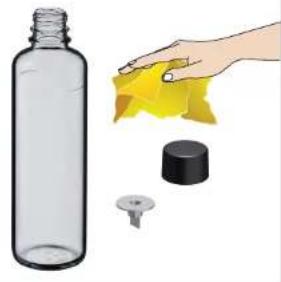
Only clean bottles and caps with domestic washing-up liquid in warm water. When doing this, remove the rubber seal from the cap, clean it and then re-insert (Fig. 2.1).
Use a soft bottle brush to clean the insides. After cleaning, rinse the bottles with warm water and allow to dry upside-down on a drying rack.
2.1
natural_image
Illustration of a hand cleaning a yellow substance from a plastic bottle, with a black container and a small droplet nearby (no text or symbols)2.2
natural_image
Two transparent plastic bottles and a checkmark inside a box (no text or symbols)Sodapop glass bottles dishwasher safe

SAFETY NOTE!
Risk of damage!
Only use water, washing-up liquid and a damp cloth to clean the appliance and bottles. Do not use scouring agents or aggressive cleaning agents.

CAUTION:
Store bottles filled with sparkling water at max. 4–6 °C in a
refrigerator. Do not store bottles in the freezer, do not freeze water in the bottles and do not fill with hot water.
Exchanging CO₂ cylinders and bottles
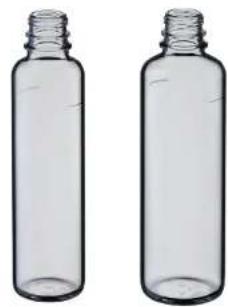
1 Replacing the bottles
Immediately dispose of damaged glass bottles (hairline cracks, flaws). Do not use any bottles other than genuine Sodapop Logan bottles under any circumstances.
Replacement bottles are available from your Sodapop dealer. Alternatively, you can order new bottles from the Sodapop online shop at www.sodapop.com
2 Replacing the CO₂ cylinder
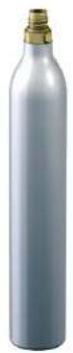
Only exchange the empty CO₂ cylinder for a full one or have it refilled by an authorised specialist dealer. Just pay the price of the gas content.
Alternatively, you can order new CO₂ cylinders from the Sodapop online shop at www.sodapop.com
1
natural_image
Two empty glass bottles with standard caps, no text or symbols visible2


CAUTION:
Sodapop syrups in a wide variety of flavours are available from the Sodapop online shop at www.sodapop.com. Try them out for yourself and discover your new favourite syrup for fresh Sodapop sparkling water.

Always store CO₂ cylinders in a cool, well-ventilated place.
Never expose to direct sunlight. Always store well away from heat sources, flammable gases and other combustible substances.
Frequently asked questions
The appliance doesn't produce any bubbles or makes very few
- It is possible that the carbonating button hasn't been pressed down far enough. Press the carbonating button down as far as possible and hold it in this position until the acoustic signal sounds. Only then release the button.
- Check that the CO _2 cylinder is positioned correctly. It may not be screwed in correctly.
- The CO_2 cylinder may be empty and must be replaced with a full cylinder.
- The glass bottle was not filled to the rated fill line. Make sure that the bottles are filled up to the rated fill line before adding bubbles.
- Always only use very cold, fresh water. Cold water is significantly better at absorbing the carbon dioxide.
Carbon dioxide is leaking after a new cylinder has been inserted
The CO_2 cylinder must be screwed anti-clockwise into the cylinder fixture by hand. Carbon dioxide will still escape:
- If there are possible leaks between the cylinder fixture and the cylinder valve. If necessary, screw the cylinder into the fixture more tightly.
- If the rubber seal has shifted when screwing it in. Remove the cylinder again and check if there is a rubber seal in the cylinder fixture. If it has shifted, simply place it back into the correct position in the centre of the fixture and screw in the cylinder again. If the seal is missing, do not use the CO₂ cylinder under any circumstances. If this happens, contact Sodapop customer services.
The bottle overflows during the carbonation process
- Check whether the bottle has been filled above the rated fill line. If necessary, pour away excess water.
- Only press the carbonating button until the acoustic signal sounds, then release it. Do not continue to hold it down.
Carbon dioxide continues to escape after carbonation
The carbon dioxide cylinder may have a leak.
CAUTION: Risk of choking and suffocation!
Do not remove the CO_2 cylinder under any circumstances - risk of frostbite!
Leave the soda maker undisturbed. Ventilate the room well and breath in fresh air. Consult a doctor if you begin to feel unwell. Leave the room, allow the carbon dioxide to escape with an open window and allow the cylinder to come back up to room temperature before replacing it with an intact, full one.
Specifications / Service
Model LOGAN (TYPE 1083)
| A = approx.112 mm / 4.41 inB = approx.188 mm / 7.41 inC = approx.426 mm / 16.78 in | |
| approx. 2 kg / 4.41 lb | |
| approx. 10 - 40 °C | |
| DIN EN ISO 7866 that are identical in construction:- Thread M18x1.5- PH250 barmax. filling pressure- 425 g filling weight- π |

INFO
We recommend that you re- tain the original packaging
so that you can return your appliance to an authorised customer service if it ever needs repair.
No guarantee is provided for any damage caused by transport in unsuitable packaging.
If you have any questions or suggestions, please use the contact form on our website or call us.

www.sodapop.com
Contact:
Xmodus Systems GmbH
Reiherstraße 2
35708 Haiger
Germany

Service-Hotline
+49 800 4000 244 from Germany
+43 800 4000 24 from Austria
+41 800 4000 24 from Switzerland
or the Service Portal at

service@sodapop.com
Disposal information
The packaging is recyclable. Ask the department responsible in your local council offices for further information about recycling.

The appliance contains valuable materials which can be recycled and reused. For this reason, contact your local waste management recycling centre for correct disposal.
Je suis Logan!
natural_image
Abstract illustration of bubbles and droplets on a white background (no text or symbols)Table des matières
natural_image
Two views of a mechanical component with red arrows indicating directional movement (no text or symbols)natural_image
Illustration of a hand inserting a black cylindrical device into a transparent chamber (no text or symbols visible)natural_image
Close-up of a black industrial device with a red curved arrow indicating rotation or movement (no text or symbols visible)Mise en service
natural_image
Hand inserting a cylindrical device into a gas cylinder (no text or symbols visible)natural_image
Illustration of a hand spraying water with a faucet and a snowflake symbol (no text or labels)natural_image
Close-up of a black cylindrical object with a red arrow indicating rotation, next to a hand holding a small object (no text or symbols visible)natural_image
Illustration of a hand cleaning a bottle with a yellow cloth, a black lid, and a small pin (no text or symbols)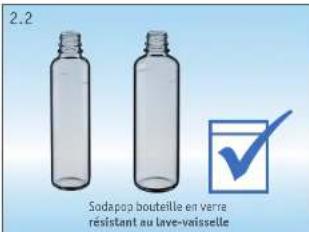
natural_image
Two empty glass bottles with standard caps, no text or symbols visible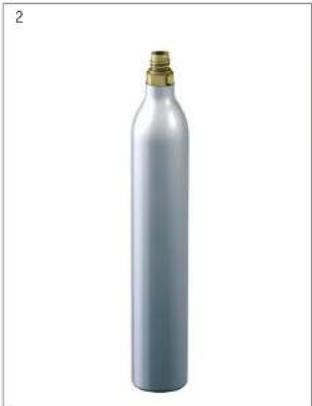
natural_image
Exterior view of a metallic cylindrical gas cylinder with a gold cap (no text or symbols visible)Conseil
natural_image
Abstract illustration of bubbles and droplets on a white background (no text or symbols)Indice
text_image
Exploded diagram of a gas collection device with numbered components for identificationnatural_image
Two views of a car head showing internal components with red arrows indicating motion or movement (no text or symbols)natural_image
Illustration of a black handheld vacuum cleaner with a hand adjusting its lid (no text or symbols visible)natural_image
Close-up of a black industrial device with a red circular arrow indicating rotation or adjustment (no text or symbols visible)Messa in funzione
natural_image
Illustration of a hand inserting a cylindrical device into a container (no text or symbols visible)natural_image
Illustration of a hand spraying water with a faucet and a snowflake symbol (no text or labels)natural_image
Two-step illustration showing a hand inserting a bottle into a digital device (no text or symbols present)natural_image
Close-up of a black cylindrical object with a red arrow indicating rotation, next to a hand holding a white object (no text or symbols visible)Gasatura
natural_image
Illustration of a hand cleaning a plastic bottle with a yellow cloth, a black lid, and a small pin (no text or symbols)2.2
natural_image
Two transparent plastic bottles and a checkmark inside a container (no text or symbols)natural_image
Two empty transparent glass bottles with standard caps, no text or symbols visible2

Consiglio
A = ca. 112 mm B = ca. 188 mm C = ca. 426 mm
ca. 2 kg
ca. 10 - 40 °C