F7PBW24S1-L - Wine cellar Fulgor Milano - Free user manual and instructions
Find the device manual for free F7PBW24S1-L Fulgor Milano in PDF.


User questions about F7PBW24S1-L Fulgor Milano
0 question about this device. Answer the ones you know or ask your own.
Ask a new question about this device
Download the instructions for your Wine cellar in PDF format for free! Find your manual F7PBW24S1-L - Fulgor Milano and take your electronic device back in hand. On this page are published all the documents necessary for the use of your device. F7PBW24S1-L by Fulgor Milano.
USER MANUAL F7PBW24S1-L Fulgor Milano
natural_image
Three black bottle silhouettes arranged horizontally on a white background (no text or symbols)F7PBW24S1 - R
F7PBW24S1 - L
F7IBW24O1 - R
F7IBW24O1 - L
COMBI WINE CELLAR
CAVE À VINS CONBINEÉ
COMBINADO ENFRIADOR
DE BOTELLAS DE VINO
EN
USER MANUAL
FR
MODE D'EMPLOI
ES
MANUAL DE USUARIO
1 IMPORTANT DIRECTIONS OF SAFETY AND THE ENVIRONMENT 6
1.1 For your safety....6
1.2 Important information when using the appliance....7
1.3 Caring for the environment 8
1.4 Cleaning, sanitization and maintenance.... 8
2 INSTALLATION 9
2.2 Connection to the electrical power supply....?
2.3 Refrigerant 9
3 BEFORE STARTING 10
3.2 Manufacturer's Liability 11
3.3 Technical support.... 11
3.4 Model / serial identification.... 12
3.5 Main components.... 11
3.5 Main components.... 14
2.6 Electronic control.... 12
3.8 Electric control 16
3.7 Main control panel 16
4 APPLIANCE ON / OFF AND TEMPERATURE ADJUSTMENT 17
4.2 How to adjust the temperature for different requirements
4.2 How to adjust the temperature for different requirements and information. 17
4.3 Messages and alarms.... 20
4.4 Wine Cellar temperatures.... 21
5 FUNCTIONS AND SETTINGS 21
5.1 Functions 21
5.2 Settings 26
6 INTERNAL LAYOUT 32
.1 Internal layout (positioning, adjustment, removal) 32
7 ACTIVATION AND USE OF THE ICE MAKER 32
7.1 Use of the FreshZone compartment 32
8 LIGHTING 33
3.1 Lighting 53
9 CONSERVATION OF WINES 33
9.1 General directions.... 34
9.2 Conservation strategies.... 22
9.2 Conservation temperature.... 35
8.3 Time of conservation.... 35
9.4 Consumption temperature 36
9.5 Position of bottles 37
10 CARE AND CLEANING 37
10.1 Care and cleaning 37
10.2 Cleaning of the ventilation grille, filter and condenser 38
10.3 Internal cleaning 39
11 TROUBLESHOOTING GUIDE 40
11.1 Troubleshooting guide 40
1.2 Messages appearing of the display....41
SAFETY INSTRUCTIONS

This is the safety alert symbol. This symbol alerts you to potential hazards that can kill or hurt you and others. All safety messages will follow the safety alert symbol and either the word "DANGER" or "WARNING." These words mean:

WARNING
You can be killed or seriously injured if you don't follow instructions. You can be killed or seriously injured if you don't immediately follow instructions.

DANGER
All safety messages will tell you what the potential hazard is, tell you how to reduce the chance of injury, and tell you what can happen if the instructions are not followed.
SAVE THESE INSTRUCTIONS!

WARNING IMPORTANT SAFETY INSTRUCTIONS
This manual contains operational instructions for the users of the appliance. Keep this manual in an easily accessible place for future reference. Improper installation, adjustment, alteration, service or maintenance can cause property damage, injury, or death.
Read the installation, operating, and maintenance instructions thoroughly before installing or servicing this equipment.
To reduce risk of fire, electric shock, or injury to persons when using your appliance, follow basic precautions, including the following:
Children should be supervised to ensure that they do not play with the appliance. This appliance is not intended for use by persons (including children) with reduced physical, sensory or lack of experience and knowledge unless they have been given supervision or instruction concerning use of the appliance by a person responsible for their safety.
- This appliance is designed to refrigerate beverages and foods and is intended for domestic use.
This appliance is intended to be used in household and similar applications such as: staff kitchen areas in shops, offices, and other working environments; farm houses and by clients in hotels, motels, and other residential-type environments; bed and breakfast-type environments; and catering and similar non-retail applications.
Do NOT use an extension cord or adapter
Plug into a grounded 3 prong outlet.
Do not remove ground prong.

WARNING
In the event of a power failure, do not attempt to operate this appliance.

WARNING
Keep the appliance area free and clear from combustibles or flammable materials and vapors.

WARNING
Keep ventilation openings, in the appliance enclosure or in the built-in structure, clear of obstruction. Do not obstruct the air intake or exhaust openings of the appliance.

WARNING
Do not store explosive substances such as aerosol cans with a flammable propellant in this appliance.

WARNING
Do not use electrical appliances inside the food storage compartments of the appliance.
IMPORTANT SAFETY INSTRUCTIONS FOR PROPER DISPOSAL OF YOUR OLD REFRIGERATOR

WARNING
Suffocation Hazard
Remove doors or lid from your old appliance.
Failure to do so can result in death or brain damage.

WARNING Risk of child entrapment.
Before you throw away your old refrigerator or freezer:
Remove the doors, the drawers, and power cord.
Leave the shelves in place so that children may not easily climb inside.
IMPORTANT: Child entrapment and suffocation are not problems of the past. Junked or abandoned refrigerators are still dangerous, even if they will sit for "just a few days." If you are getting rid of your old refrigerator, please follow these instructions to help prevent accidents.
Important information to know about disposal of refrigerants:
Dispose of refrigerator in accordance with federal and local regulations. Refrigerants must be evacuated by a licensed. EPA-certified refrigerant technician in accordance with established procedures.
IMPORTANT SAFETY INSTRUCTIONS FOR MAINTENANCE AND CARE

DANGER
Risk of fire or explosion due to puncture of refrigerant tubing; follow handling instructions carefully. Flammable refrigerant used.

WARNING
To be repaired only by trained service personnel.
Use only manufacturer-authorized service parts. Do not use replacement parts that have not been recommended by the manufacturer (e.g., parts made at home using a 3D printer). If power supply cord is damaged, it must be replaced by the manufacturer, its service agent, or a similarly qualified person in order to avoid a hazard. Any repair equipment used must be designed for flammable refrigerants. Follow all manufacturer repair instructions. Use nonflammable cleaner.

WARNING
Do not puncture refrigerant tubing, do not damage the refrigerant circuit.

WARNING
Do not use mechanical devices or other means to accelerate the defrosting process, other than those recommended by the manufacturer.
TIP OVER HAZARD
WARNING
Installed; to avoid a hazard due to instability of the appliance, it must be fixed in accordance with the instructions (see instruction manual provided).
Keep doors taped closed until refrigerator is completely installed especially when unattended.
Use two or more people to move and install refrigerator.
Failure to do so can result in death or serious injury.
1. IMPORTANT INSTRUCTIONS FOR SAFETY AND THE ENVIRONMENT
1.1 For your safety
If this appliance is replacing an existing appliance which must be removed or disposed of, make sure that it does not become a dangerous trap for children by cutting its power supply cable and rendering it impossible to close the door. Use the same caution at the end of the lifespan of the new appliance.
The appliance is not designed to operate with external timers or with remote-control systems.
This appliance is designed to refrigerate beverages and foods and is intended for domestic use.
This appliance is for refrigeration and conservation of fresh and frozen foods in the home. Every other use is considered inappropriate.
The appliance must be installed by following the instructions in the Installation Guide, particular care should be taken not to obstruct the vent openings of the appliance and of the built-in units.
The appliance features a concentrated lighting system with LED lamps. Do not stare into these lamps when they are on to avoid possible eyesight damage.
This warning is also contained on the label attached to the inside of the refrigerator door.
When the freezer is functioning do not touch the inner metal surfaces with wet or damp hands, since skin may stick to the very cold surfaces.
Do not use any type of electrical equipment inside of the food conservation compartments.
When positioning the shelves, do not place fingers in the shelf slide guides.
Never attempt to extinguish a flame/fire with water: turn off the appliance and cover the flame with a fireproof blanket.
Do not position containers of flammable liquids near the appliance.
Completely switch off the appliance and unplug the power supply cable during cleaning operations. If the plug is not easily reached, it is a good idea to turn off the breaker or remove the fuse that controls the socket that the appliance is connected to.
The packaging parts can be dangerous for children: do not allow children to play with the plastic bags, plastic film or Styrofoam.
Any repairs must be performed by a qualified Fulgor Milano Service technician.
This appliance is not intended for use by persons (including children) with reduced physical, sensory or lack of experience and knowledge unless they have been given supervision or instruction concerning use of the appliance by a person
responsible for their safety. Children should be supervised to ensure that they do not play with the appliance.
Do not damage the appliance refrigerant circuit pipes.
Do not store explosive substances such as aerosol cans with a flammable propellant in this appliance.
If the power cord of this appliance is damaged,
it must be replaced by the manufacturer, customer service or a similarly qualified person. Improper installations and repairs may put the user at considerable risk.
Repairs may be performed by the manufacturer, customer service or a similarly qualified person only.
Plug into a grounded 3 prong outlet.
Do not remove ground prong
Do not use an adapter
Do not use an extension cord.
Disconnect power to all units before servicing.
Children should be supervised to ensure that they do not play with the appliance.
Do not modify this appliance.
Do not insert pointed metal objects (cutlery or utensils) into the slots in the appliance.
Do not touch (especially with wet hands) frozen products put them in your mouth directly.
Do not store inflammable, explosive or volatile substances.
Do not keep explosive substances, such as spray
bottles with flammable propellants in the appliance. > Bottles containing strong alcoholic drinks must be tightly closed and stored vertically.
Organic compounds, acids and essential oils can corrode the seals and plastic surfaces if
left in contact with them for extended periods.
Turn off the appliance and unplug it from the mains before cleaning or maintenance.
Do not pull the cable to unplug the appliance.
1.2 Important information when using the appliance
Cleaning and maintenance that should be performed by the user must not be carried out by unsupervised children.
Never use electrical appliances inside the appliance (e.g. heater, electric ice maker, etc.). Explosion hazard!
Never defrost or clean the appliance with a steam cleaner! The steam may penetrate electrical parts and cause a short-circuit. Risk of electric shock!
Do not use pointed and sharp-edged implements to remove frost or layers of ice. You could damage the refrigerant tubes. Leaking refrigerant may cause eye injuries or ignite.
- Take care that no objects are stuck in the doors. - Do not stand on or lean heavily against base of appliance, drawers or doors, etc.
Before cleaning the appliance, pull out the power cord plug or switch off the breaker. Do not pull out the power cord plug by tugging on the power cord.
Store high-percentage alcohol tightly closed and standing up.
Keep plastic parts and the door seal free of oil and grease. Otherwise, parts and door seal will become porous.
Never cover or block the ventilation openings for the appliance.
According to current regulations, children between 3 and 8 years of age can take or load food from the appliance, but it is highly discouraged to allow children under 8 years of age to perform these operations and in general to use the appliance.
Keep children under the age of eight at a safe distance unless they are constantly supervised and make sure that they do not play with the appliance.
Do not use mechanical, electrical, chemical devices other than those recommended by the manufacturer to speed up the defrosting process.
Do not damage the cooling circuit (if it can be accessed).
In the event of damage to the cooling circuit, avoid the use of open flames and ventilate the area properly.
Do not use the appliance or parts of it in ways other than those specified in this manual.
Opening the door for long periods can cause the temperature in the appliance compartments to rise considerably.
Clean surfaces that may come into contact with food and accessible drainage systems regularly.
Store raw meat and fish in suitable containers in the refrigerator, so that it does not come into contact with other food or drip on it.
If the appliance is left empty for long periods of time, switch it off, thaw it, clean it, dry it and leave the door open to prevent the development of mould inside.
Never rest sharp metal objects such as knives, forks, spoons and lids on the appliance during use.
Do not use abrasive or corrosive detergents le.g. scouring powders, stain removers and metallic spongesl on glass parts.
Do not sit on the appliance.
- Do not sit or lean on the door or any open drawers. - Do not pry on the door or handle to move the appliance.
Do not use electrical appliances (e.g. hair dryers) or sprays for defrosting, the plastic parts could be damaged.
Do not use the appliance to cool rooms for any reason.
Always unplug the appliance in the event of a fault or when performing cleaning or maintenance.
Do not keep liquids in tins or glass containers in the freezer.
- Do not place heavy objects on the top of the appliance.

Warning
To avoid contamination of food, please respect the following instructions:

Opening the door for long periods can cause a significant increase of the temperature
in the compartments of the appliance. > Clean regularly surfaces that can come in contact with food and accessible drainage systems.
Store raw meat and fish in suitable containers in the refrigerator, so that it is not in contact with or drip onto other food.
1. IMPORTANT DIRECTIONS FOR SAFETY AND THE ENVIRONMENT
2. INSTALLATION
Symbols used in the Guide:

Note
Recommendations for correct use of the appliance

Important
Directions for avoiding appliance damage

Warning
Indications for avoiding injury to people
1.3 Caring for the environment


Pay special attention to correct disposal procedure for all the packaging materials.
The appliance must not be disposed of with urban waste. Contact local waste disposal centres for on how to dispose of recyclable waste.
Prior to disposal, cut the power supply cord and make it impossible to close the door.
During disposal, avoid damage to the refrigeration circuit.
The appliance does not contain hazardous substances for the atmospheric ozone layer, neither in the refrigeration circuit nor in the insulation.
1.4 Cleaning, sanitization and maintenance
Any work on the appliance must be carried out by a qualified technician or the After-sales Service.

Warning
To avoid contamination of food, please respect the following instructions:
Opening the door for long periods can cause a significant increase of the temperature in the compartments of the appliance. > Clean regularly surfaces that can come in contact with food and accessible drainage systems.
If the refrigerating appliance is left empty for long periods, switch off, defrost, clean, dry, and leave the door open to prevent mould developing within the appliance.
2.1 Installation
Make sure that installation is performed correctly, adhering to all of the instructions in the specific installation guide provided with the appliance.
The appliance must be connected to ground in compliance with electrical system safety standards. > Position the appliance with the aid of a second person.
Never use the open door to lever the appliance into place when fitting.
Avoid exerting too much pressure on the door when open.
The appliance must not be installed near heat sources. If this is not possible, suitable insulation must be used.
The appliance must not be exposed to direct sunlight.
Do not use the appliance outdoors.
installation and servicing should be carried out by qualified personnel in accordance with current standards.
Have the electrical supply installed by authorised technical personnel.
For avoiding dangers, if the power supply cable is damaged, contact technical support immediately and they will replace it, so as to prevent any risk.
Always use any necessary/ required personal protective equipment (PPE) before performing any work on the appliance (installation, maintenance, positioning or movement).
▶ Before performing any operation on the appliance, switch off the power supply.
Do not try to repair the appliance yourself or without the assistance of a qualified technician.
CAUTION: while positioning the appliance, make sure that the power supply cable is not caught or damaged.
To prevent instability of the appliance, install and secure it correctly as indicated in the instructions provided in this manual.
2.2 Connection to the electrical power supply
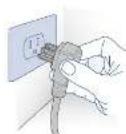
The appliance operates at 115 V AC, 60 Hz and is equipped with a power supply cord with a 3-prong grounded plug, which must be connected to a dedicated 3-prong (15 Amp) grounding-type wall receptacle.

Important
Do not use extension cords and/or adapters for connection.

Warning
If energy is supplied through an alternative energy power source (solar, geothermal, etc...) or if home automation systems are installed, it may cause malfunctions with this appliance's electronics in which case connecting it to an isolation transformer is recommended.
2.3 Refrigerant
The refrigerant isobutane (R600a) is contained within the refrigerant circuit of the appliance, a natural gas with a high level of environmental compatibility, which is nevertheless flammable.
During transportation and installation of the appliance, be certain that none of the components of the refrigerant circuit become damaged.
- If the refrigerant circuit should become damaged: - avoid open flames and sources of ignition;
- thoroughly ventilate the room in which the appliance is situated.

Caution:
risk of fire / flammable materials.

Important
Carry out transportation, installation and/or cleaning with extra care so that no damage occurs to the refrigeration circuit.
3.1 Know your appliance
Congratulations for having purchased your new Fulgor Milano: from now on you can use our innovative conservation system, which will allow you to keep all of your food and wine in the best way possible.
This manual will answer most of your questions about the product's features. Should you require further information, please
call us 1-855-4FULGOR (1-855-438-5467)
visit fulgor-milano.com/us/en/assistance

Important
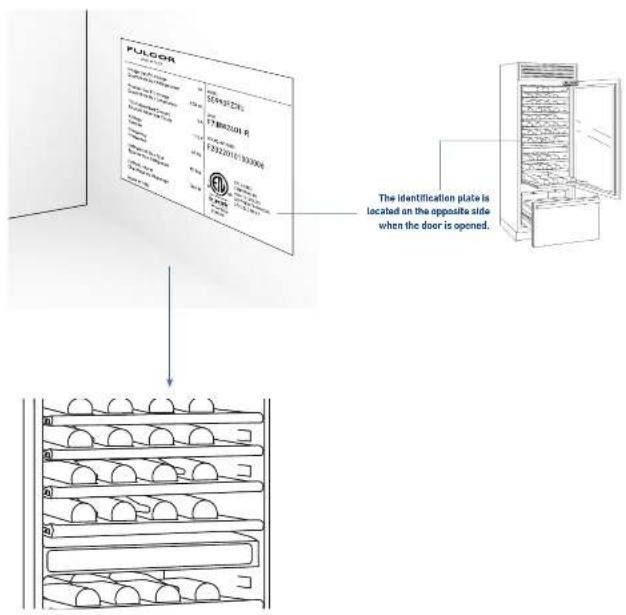
Before calling, write down the model and serial numbers which are available in the manuals package and on the rating plate located inside the appliance, opposite the hinge side.
3.2 Manufacturer's liability
The manufacturer declines all liability for damage to persons or property caused by:
use of the appliance other than that specified;
failure to comply with the instructions in the user manual;
tampering with any part of the appliance;
use of non-original spare parts.
3.3 Technical support
In the event of failure of the appliance, contact the technical support and have the repair carried out by qualified personnel only.
Make sure you have the model and serial number available on the identification plate.
Use original spare parts only.
Do not try to repair the appliance yourself or without the assistance of a qualified technician: this affects safety and may void the warranty.
3.4 Model / serial identification
The model / serial identification shows the technical data, the serial number and the model. The product plate must never be removed.
text_image
PULGOR 12.000 12.000 12.000 12.000 12.000 12.000 12.000 12.000 12.000 12.000 12.000 12.000 12.000 12.000 12.000 F7B3201-8 F7B3201-8 F7B3201-8 F7B3201-8 F7B3201-8 F7B3201-8 F7B3201-8 F7B3201-8 F7B3201-8 F7B3201-8 F7B3201-6 F7B3201-6 F7B3201-6 F7B3201-6 F7B3201-6 F7B3201-6 F7B3201-6 F7B3201-6 F7B3201-6 F7B3201-6 F7B3201-5 F7B3201-5 F7B3201-5 F7B3201-5 F7B3201-5 F7B3201-5 F7B3201-5 F7B3201-5 F7B3201-5 F7B3201-5 F7B3201-4 F7B3201-4 F7B3201-4 F7B3201-4 F7B3201-4 F7B3201-4 F7B3201-4 F7B3201-4 F7B3201-4 F7B3201-4 F7B3201-3 F7B3201-3 F7B3201-3 F7B3201-3 F7B3201-3 F7B3201-3 F7B3201-3 F7B3201-3 F7B3201-3 F7B3201-3 F7B3201-2 F7B3201-2 F7B3201-2 F7B3201-2 F7B3201-2 F7B3201-2 F7B3201-2 F7B3201-2 F7B3201-2 F7B3201-2 F7B3201-1 F7B3201-1 F7B3201-1 F7B3201-1 F7B3201-1 F7B3201-1 F7B3201-1 F7B3201-1 F7B3201-1 F7B3201-1 F7B3201-9 F7B3201-9 F7B3201-9 F7B3201-9 F7B3201-9 F7B3201-9 F7B3201-9 The Identification Plate is located on the opposite side when the door is opened.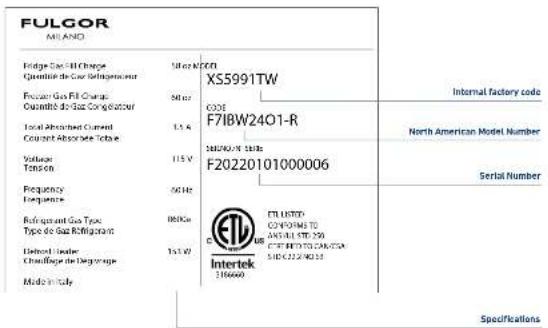
text_image
FULGOR MILAND Fridge Gas Fill Charge Quantile de Curr Beringenauer Fraguar Gas Fill Charge Quantile de Gas Conglasser Total Precinct Current Constant Absolute Value Voltage Tension Frequency Frequency Refrigerant Gas Type Type de Gas Refrigerant Indoor Heater Chardage de Dyeing-Energy Mode in Italy 100 gm 90 gm 1.5 L 115 V 50 Hz 800 gm 15 L/V XS5991TW CODE F7IBW24O1-R SIN6N01W SEEDS F20220101000006 ET LISTED CONFORM TO JNSL11 STD 350 CIF REYTO CANADORA SHD 222 NO252 Intertek 2166600 Internal factory code North American Model Number Serial Number SpecificationsClimate Class: SN/T
SN (Subnormal from +50°F to +90°F Ifrom +10°C to +32°C)
N (Normal) from +61°F to +90°F (from +16°C to +32°C)
ST (Subtropical) from +64°F to +100°F (from +18°C to +38°C)
T (Tropical) from +64°F to +109°F (from +18°C to +43°C)
3.5 Main components
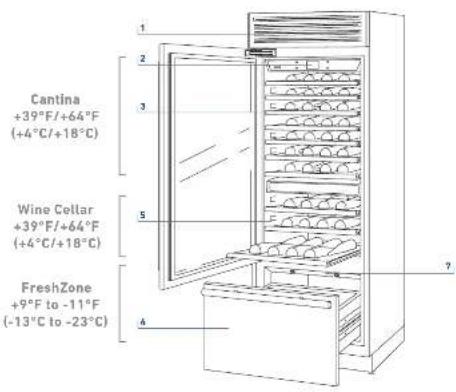
text_image
Cantina +39°F/+64°F (+4°C/+18°C) Wine Cellar +39°F/+64°F (+4°C/+18°C) FreshZone +9°F to -11°F (-13°C to -23°C)1 Ventilation grille.
2 Interactive control panel.
3 Cantina Compartment.
4 Sliding bottle shelves, mounted on wheels for easy extraction.
5 Wine Cellar
Compartment.
6 Freezer, Fresh or Fridge convertible compartment (FreshZone functionality).
7 LED illuminations for the freezer compartment bottom drawer.
3.6 Electronic Control
The innovative electronic control system maintains constant temperature on the three compartments and visualizes it on the control panel display. It also allows user interaction making it possible to personalize settings of the various functions and to receive audible and/or visual messages from the appliance.
3.7 Main control panel

text_image
FULGOR MILANO FULGOR MILANO
Turning On / Turning Off:
Touch the icon for turning on or off the unit.

Home
Touch the icon home for going back to the main display screen.

Alarm
Touch the icon to view the messages and to deactivate the buzzer.

Back
Touch the arrow icon for going back to the previous display screen.
4.1 Switching on and off
First time starting the unit
Touch the button @The display shows the following launch screens:
1) Logo.
2) Initial test (last 3 minutes).
3) The display shows the main screen with the temperature measured from the appliance inside the compartments. Automatically the unit starts to cool down until reaching the set temperatures.
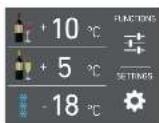
4) Home screen (*)
- cantina compartment +6°F (-8°C) - wine cellar compartment +41°F (-5°C) - FreshZone compartment +0°F (-18°C)
(*) The home screen varies depending on the mode(s); the FreshZone compartment is set in the freezer mode +0°F (-18°C). For changing this setting lock up the function 5. When the appliance is first switched on it is recommended to wait at least 12 hours without opening the doors and before placing any food inside the unit. During startup alarms are muted.
Shutdown.
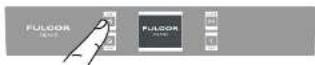
1) Touch the icon Ⓤ for 3 seconds.
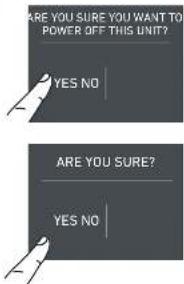
text_image
ARE YOU SURE YOU WANT TO POWER OFF THIS UNIT? YES NO ARE YOU SURE? YES NO2) Touch YES to switch off.
3) Confirm shutdown by touching the YES.

When the fridge is off there is no stand-by indicators that the fridge is plugged to a socket.
Switching off Cantina and Wine Cellar compartment.
The cartina compartment and the wine cellar compartment, can be shutdown individually whereas the FreshZone drawer can't be turned off unless through the complete shutdown of the unit
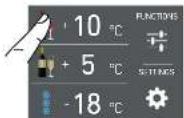
1) Home screen.
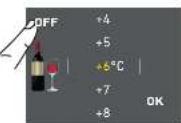
2) Touch OFF.
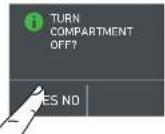
3) Touch YES to turn the compartment off.
4. APPLIANCE ON / OFF AND TEMPERATURE ADJUSTMENT
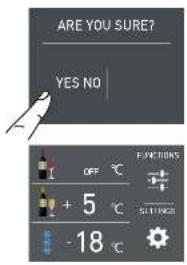
text_image
ARE YOU SURE? YES NO OFF °C + 5 °C -18 °C4) Touch YES to confirm deactivation.
5) On the home screen appears the icon ▶ OFF, which indicates that the cantine compartment is off.
For turning off the wine cellar compartment follow the same directions.
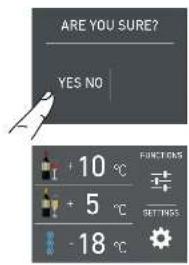
text_image
ARE YOU SURE? YES NO + 10 °C + 5 °C - 18 °C FUNCTIONS SET INSIGHTS4) Touch YES to confirm reactivation.
5) Return to Home automatically.
The same procedure is required if you want to restart the wine cellar compartment
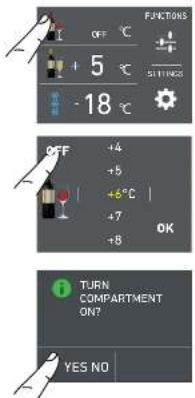
Restart the compartments.
In the case you wish to turn on again the wine compartments.
text_image
FUNCTIONS OFF °C +5 °C -18 °C OFF +4 +5 +6°C +7 +8 OK TURN COMPARTMENT ON? YES NO1) Home screen. For example for turning back on the cantina compartment, touch 📄.
2) Touch OFF.
3) Touch YES.
Switching off for long periods
During long absence periods it is recommended to switch off the appliance following the previous instructions and then disconnect the electrical plug or the breaker controlling the socket. Completely empty the appliance, clean and dry it and leave the doors and drawers partially open to prevent unpleasant odors.

Each time the appliance is switched on it goes through a self-diagnosis procedure lasting three minutes before completely starting up. If only one of the wine compartments is switched off, that compartment's fan will continue to operate to prevent the formation of unpleasant odours and mould.
4.2 How to adjust the temperature for different requirements
Each model has been carefully tested before leaving the factory and is adjusted in such a way to ensure high performance and low consumption. Usually, it is not necessary to modify the factory settings.
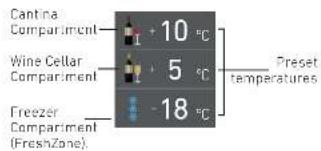
How it looks to the home screen in the various models:
text_image
Cantina Compartment + 10 °C Wine Cellar Compartment + 5 °C Freezer Compartment (FreshZone) - 18 °C Preset temperaturesModify the temperatures compartment
Example:
how to modify the Cantina Compartment temperature.
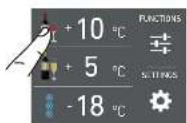
1) Home screen. Touch icon of cantina compartment.
2) Scroll up/down to select the desired temperature.
Cantine Compartment from +39°F to +64°F (from +4°C to +18°C).
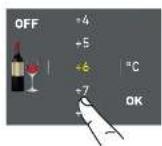
3) Touch OK to confirm the desidered temperature.
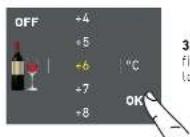
The same procedure is required to set the temperature in the Wine cellar Compartment (from +39°F to +64°F (from +4°C to +18°C) and in the FreshZone bottom drawer
from +9°F to -11°F (from -13°C to -23°C).

The temperature shown can vary slightly in respect to the set temperature following frequent openings of the doors or insertion of room temperature items or large quantities of goods.
6 to 12 hours may be necessary for goods to reach the selected temperature.
Padlock icon.
The padlock icon shows up when the temperatures are set.
The padlock open/close shows that is or isn't possible to modify the compartment's temperatures anymore.


Usually an open gray padlock can be seen; in that case you can scroll up or down with a finger on the display, select the desired temperature and press OK for confirming.
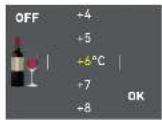
Whereas a white closed padlock can be seen if the user has activated some functions (described in the paragraph 5.1) that modify the settings of the respective compartment, therefore the user in that situation will not be able to change the temperature of the compartments.
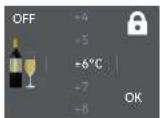
If the icon function is touched and a specific function is set (for example holiday, shopping trimode, ect...), the white padlock will be seen closed and it won't be possible to change the temperature of the compartments as long as the function won't be completed or if it is manually deactivated.
4.3 Messages and alarms
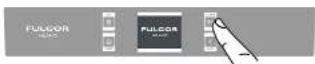
An integrated control system will give information through bright textual messages you can see on the display.
The audible signal that goes along with some of the messages can be turned off by touching the alarm icon 📄 on the main control panel. You can find the list of the messages at the end of this manual.
4.4 Wine Cellar temperatures
For a better conservation the red wines need a relatively warmer temperature.
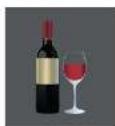
Red Wine.
from +50°F to +64°F (from +10°C to +18°C)
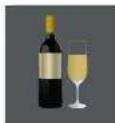
White Wine.
from +39°F to +48°F (from +4°C to +9°C).
For example if a temperature higher than +48°F (+9°C) is set, the display will change the icon from white wine to red wine.
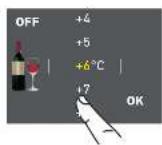
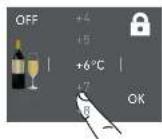
INFORMATION FOR USING THE DISPLAY.
It is possible to personalize the operation of your Fulgor Milano unit in order to adapt it to the different ways you might want to use it.
5.1 Functions.
After touching the functions icon on the home screen the following icons will be shown with the following available functions.

1) Vacation.
2) Shopping FreshZone.

3) Rapid Bottle Cooler.

4) Humidity Control.

5) Light 12h
1) Vacation Mode
This function (recommended in case of prolonged absences since it allows considerable energy savings) brings the wine compartment temperature to +57°F (+14°C).
It is possible to program the duration, or it can be manually deactivated upon re-entry after a period of absence. This function remains active even if during the period of absence there is a prolonged interruption of electrical power.
It is possible to program a period from 1 to 90 days.
2) Shopping Mode: FreshZone
This function should be activated at least 24 hours before inserting room temperature items into the freezer, or several hours before placing into the freezer previously frozen items which have been subject to a slight temperature rise.
This function automatically deactivates when the programmed time period expires. It is possible to program timed activation of the function. If interrupted by a prolonged interruption of the electrical power, this mode will not resume automatically.
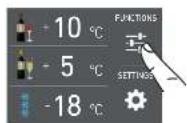
A) Home screen. Touch FUNCTIONS.
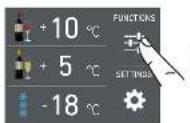
A) Home screen. Touch the icon function.
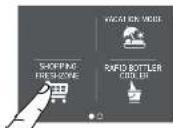
B) Touch the icon Shopping FreshZone.
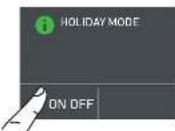
C) Touch ON to activate the function.
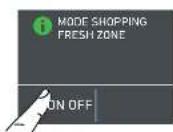
C) Touch the button On to activate the function.
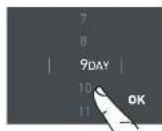
D) Scroll up / down to set the desired time (in days) and then touch OK.
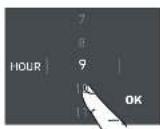
D) Scroll up / down to set the desired time (in hours) and then pres ok.
It is possible to program a period from 1 to 24 hours.
3) Rapid Bottle Cooler
This function can be activated when it is necessary to cool off beverages quickly, by placing them inside the freezer compartment.
It is possible to select a duration of 1 to 45 minutes. A sound signal will indicated when the timer has expired.
After removing the beverages, deactivate the sound signal by pressing the Alarm button
4) Humidity Control.
This function enables to set the humidity of the cantina and wine cellar compartments. The default setting is set to "Medium".
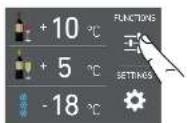
A) Home screen. Touch FUNCTIONS.

A) Home screen. Touch FUNCTIONS.
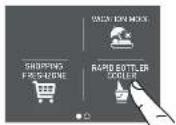
B) Touch RAPID BOTTLE COOLER.
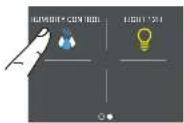
B) Scroll right twice and touch HUMIDITY CONTROL.
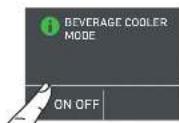
C) Touch ON to activate the function.
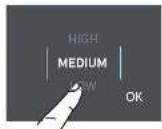
C) Scroll until setting the desired humidity and press OK.
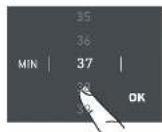
D) Scroll up or down, for setting the desired time range (in minutes) and touch OK.
5) Interior light for 12 h.
This function enables to set the timing of the interior light and it stays on 12 hours when the wine cellar door is closed, in order to see the inner part illuminated through the glass.
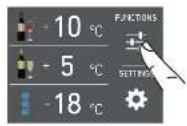
A) Home screen. Touch FUNCTIONS.
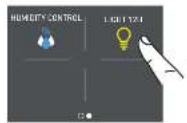
B) Touch the Light 12h icon
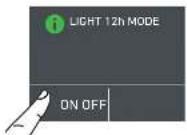
C) Touch ON if you want to activate Light 12h Mode.
5.2 Settings
It is possible to personalize the settings of your Fulgor Milano fridge for adapting it to the different ways you might want to use it.

1) Date

2) Time

3) Fahrenheit and Celsius degrees.

4) Language

5) FreshZone.

6) Sabbath Mode (optional).

7) Reset.

8) Demo Mode.

9) Maintenance.

10) Service.

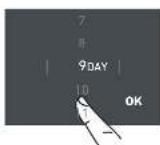
1) Date
The display will show the date in the format (day:month:year). By touching the display you can modify the set-
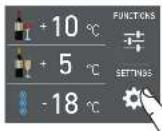
A) Home screen. Touch SETTINGS.
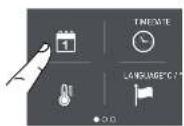
B) Touch DATE.
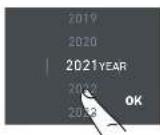
C) Scroll up or down until selecting the desired year and then touch OK.

D) Scroll up or down until selecting the desired month and press OK.
2) Time
The display shows the hours and minutes in the format hn:mm. This function selects the display at 12 or 24 h.
3) Set °F/°C
This function permits visualizing the temperature in Fahrenheit or Centigrade degrees. Normally, the appliance is set for visualization in Fahrenheit degrees.
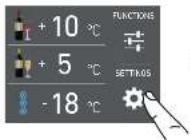
A) Home screen, Touch SETTINGS.
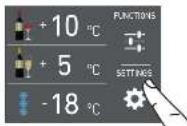
A) Home screen. Touch SETTINGS.
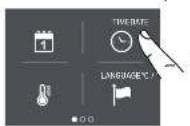
B) Touch TIME.
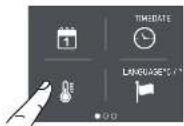
B) Touch the icon °C/°F.
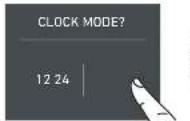
C) Touch in which way you want to see the time: 12 or 24 hours.
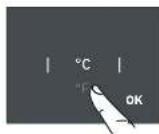
c) Scroll up / down to select either Fahrenheit or centigrade degrees and touch OK
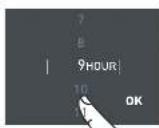
D) Scroll up / down to set the hours and then press OK.
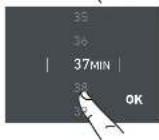
E) Scroll up / down to set the minutes and then press OK.
4) Language
To set the language of the fridge, simply touch the settings button on the display.
5) FreshZone
The freezer compartment can, if desired, be converted to a fridge or a FreshZone.
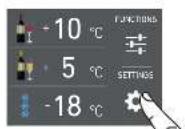
A) Home screen. Touch SETTINGS.
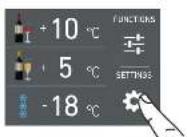
A) Home screen. Touch SETTINGS
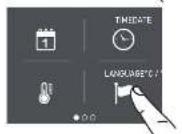
B) Touch LANGUAGE.
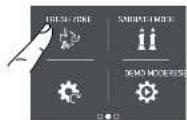
B) Scroll twice right and touch FRESH ZONE.

C) Scroll up / down to select the desired language and press OK.
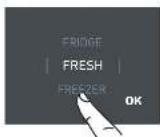
C) Scroll up / down and select one of the three functions
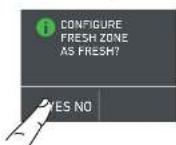
D) Touch YES to confirm the desired function.
6) Sabbath Mode (Optional)
The function makes it possible to comply to certain religious observances requiring that the operation of the appliance is not affected by the opening or closing of the doors (the thermostatic control, the inner lighting and the ice maker are deactivated).
7) Reset
It gives the possibility to restore the base settings that were set in the factory, cancelling all the changes that have been made from there onward.
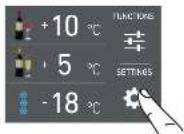
A) Home screen. Touch SETTINGS.
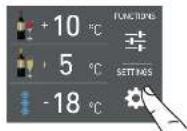
A) Home screen. Touch SETTINGS.
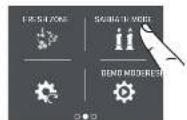
B) Scroll right twice and touch SABBATH MODE.
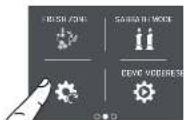
B) Scroll right twice and touch RESET.
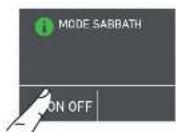
c) Touch the CN button to activate the function.
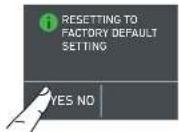
C) Touch YES.
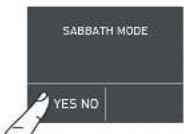
D) Touch YES to activate the function.
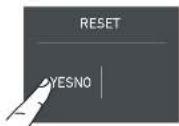
D) Confirm your choice by touching YES.
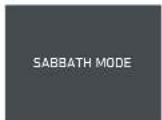
E) The fridge will work accordingly to this configuration.
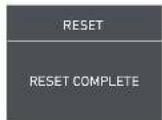
E) The reset has been performed. The fridge's factory settings have been restored.
Note: Sabbath mode automatically expires after 72 hours. To deactivate prior to this, touch the display to wake it up and choose the OFF option.

Important
If you restore the base settings("reset"), it is necessary to set again the choice of the functioning of the FreshZone drawer that has been made, in case they were set before as fridge or fresco.
8) Demo Mode
It is possible to simulate the functioning of the fridge, for showroom display or for tradeshows.
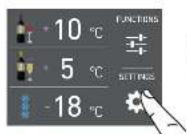
A) Home screen. Touch SETTINGS.
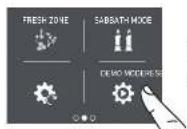
B) Scroll right twice and touch DEMO MODE.
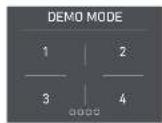
C) Insert the password for the activation.
Default password 1 2 3 4
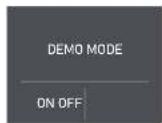
D) Select either ON or OFF.
9) Maintenance
This appliance requires, for a correct operation, the cleaning of the ventilation grille and the condenser. The default setting of the unit is "Warning disabled". If enabled, the appliance will issue a reminder once per year to clean the grille and condenser, it is possible to disable the warning signal and see the time left before the next cleaning that has to be done.
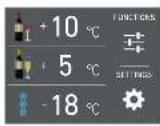
A) Home screen. Touch SETTINGS.
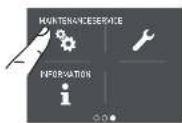
B) Scroll to the right three times and touch MAINTENANCE.
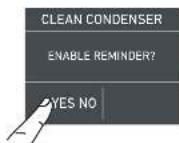
C) To enable it, touch the Yes icon.
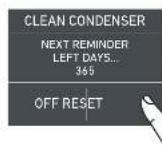
D) Here you can see the current days remaining in the countdown where you can choose to RESET the counter or disable the reminder by touching OFF.
If you want to disable the reminder, at step D touch Off, then touch Yes as below.
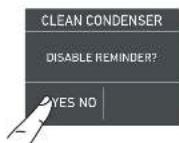
E) To disable the warning, touch YES.
11) Info System
The function Info System shows the data of the products for example the software's code, serial number and the factory's codes of the fridge.
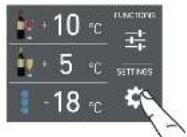
A) Home screen. Touch SETTINGS.
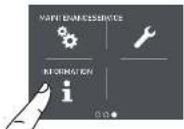
B) Touch INFORMATION.
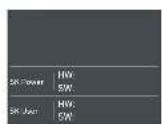
c) Here are shown the data of the Fulgor Milano unit.
10) Service
The service function is reserved for the Fulgor Milano service technicians.
6.1 Internal Layout (positioning, adjustment, removal)
Wine shelf
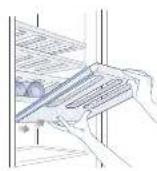
The shelves can be easily removed for cleaning. Remove the bottles, completely extract the shelf, tilt it upward until the wheels are free of their seat and extract it.
FreshZone drawer
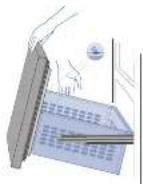
Fixed to the slide guides with two thumbscrews > to remove the drawer, unscrew the thumbscrews and remove the drawer by pulling up slightly at the front as you pull forward.
to remove the inner FreshZone drawer unscrew its two thumbscrews and pull up slightly as you pull forward.
7.1 Use of the FreshZone compartment
The FreshZone compartment, used in conjunction with the Wine Cellar and Cantina compartment, allows great flexibility in the use of the appliance. Some possible uses:
Freezer mode
Liquors, such as vodka, gin, tequila, schnapps, limoncello and the glasses to serve them Rapid cooling of beverages, by activating the bottle cooler function Storage of large amounts of ice.
Refrigerator mode
As expansion of the Wine Cellar or of the Cantina For refrigeration of beer and soft drinks For storage of cold dishes and snacks.
Fresh mode
For conservation of ham. salmon gourmet preparations
Note: although Fresh mode can also be used to keep beer very cold do not place non-alcoholic beverages in this compartment when configured as a Fresh or Freezer zone as containers may burst as liquids expand when they freeze. Liquids with alcohol have a lower freezing threshold.
8.1 Lighting
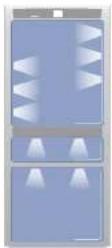
To provide optimum interior lighting, LED strips illuminate the refrigerator compartment from the top and sets of LED lights directly illuminate different areas of the wine compartments and the freezer drawer.
In case of malfunction and/or failure of the lighting system, you should contact an authorized Fulgor Milano Service Agent.

Once activated, the light of the top compartment will automatically shut off after 6 hours.
9.1 General directions
As is known, wine can be stored for long periods of time if this is done under the following conditions:
- Suitable temperature without appreciable variations over time - Controlled level of humidity - Protection from light - Absence of noise and vibrations - Absence of odours - Bottle xept horizontal
All of these conditions are fully met in the Fulgor Milang Wine Cellar
9.2 Conservation temperature
The space offered by the Wine Cellar and Cantina compartments, which can be expanded as necessary by using the FreshZone compartment as a wine cellar, allows conservation of your best wines at three different temperatures.
The three compartments are initially set to the following temperatures:
Canline Compartment +50°F (+12°C) - adjustable from +39°F to -64°F (from +4°C to +18°C) Wine Cellar Compartment +50°F (+10°C) - adjustable from +39°F to -64°F (from +4°C to +18°C) Fresh/Zone drawer +10°F (-18°C) adjustable from 15°F to 8°F (from -15°C to -22°C) (freezer model)
To transform the FreshZone compartment into a wine cellar space, you must access the Menu, set it as a refrigerator compartment, and adjust it to a temperature between from +39°F to +46°F (From +4°C to -8°C).
All the temperatures can be modified according to the characteristics of the wines and personal preferences. However, you should attempt to keep the temperature as constant as possible over time. Rapid and large scale temperature variations can in fact cause dilation of the liquid and early aging of the wine.
9. CONSERVATION OF WINES
You should also avoid very low temperatures which may lead to the formation of deposits and damage the aesthetic qualities of the wine.
All the compartments offer optimal conditions and take into account all these needs. It should however be noted that the Cantina Compartment, in particular, is thermostically controlled in a very precise manner and ensures the utmost care and attention over time of your most prized bottles. When the Cantina Compartment is set below +50°F (+10°C) the Wine Cellar must not be set beyond +54°F (+12°C).
Model with Cantina and Wine Cellar
| Cantina |
| Wine Cellar |
| FreshZone |
9.3 Time of conservation
Improvement of wine over time and its duration usually depends on the character of the variety and its type. The following chart shows the best period of conservation and aging for various types in ideal conservation conditions offered by your appliance.
However, you should always follow the instructions of the winemaker, especially for fine wines.
TYPE OF WINE CONSERVATION TEMPERATURE TIME OF CONSERVATION
| New wines (Vin Nouveau) | from +54°F to +57°F (from +12°C to +14°C) | 6 months |
| Sweet sparkling wines | from +46°F to +50°F (from +8°C to +10°C) | 1 year |
| Rosé | from +50°F to +57°F (from +10°C to +14°C) | 1 year |
| Semi sparkling wines | from +50°F to +54°F (from +10°C to +12°C) | 1-2 year |
| Normal white wines | from +50°F to +57°F (from +10°C to +14°C) | 1-2 year |
| Light red wines | from +54°F to +57°F (from +12°C to +14°C) | 2 year |
| Dry sparkling wines | from +46°F to +50°F (from +8°C to +10°C) | 2 year |
| Classic sparkling wines | from +46°F to +50°F (from +8°C to +10°C) | 3-4 year |
| Barrique and Vigorous white | from +46°F to +54°F (from +8°C to +12°C) | 3-5 year |
| Normal red wines | from +57°F to +61°F (from +14°C to +16°C) | 3-5 year |
| Barrique and Vigorous red wines | from +57°F to +64°F (from +14°C to +18°C) | 7-10 year |
| Straw wines or Liquorous wines | from +61°F to +64°F (from +16°C to +18°C) | 10-15 year |
9.4 Consumption temperature
As a general rule, while wines should be served at a temperature between +50°F and +54°F (+10°C and +12°C) and red wines between +54°F and -57°F (+12°C and +14°C).
Some wines may however be best enjoyed at higher or lower temperatures.
You should also keep in mind that, during the summer, wine is generally enjoyed at lower temperatures than during the winter.
You should also consider the following:
White wines
White wines are normally not served at high temperatures, since they are generally more acidic than red wines and not very lannic. Therefore they are more enjoyable at low temperatures.
It is preferable to serve these wines between +50°F and +57°F (+10°C and +14°C). Young, fresh and aromatic wines can also be served at +50°F (+10°C), while less aromatic ones are served at +54°F (+12°C).
Temperatures between +54°F and +57°F (+12°C and +14°C) are for soft, mature white wines that have been aged for some years in the bottle.
Higher temperatures would favour the exallation of the sweet character of the wine, at the expense of the acidity and flavour, which are considered pleasant and desirable characteristics of this type of wine.
Rosé
Rose wine is served at the same temperature as white wines. It should be noted that these wines may include a certain amount of tannin and may therefore be preferable at higher temperatures. Therefore, they are served between -50^ F and +54^ F ( +10^ C and +12^ C), if young and fresh, and between -54^ F and +57^ F ( -12^ C and +14^ C) if robust and mature.
Due to the special processing they undergo, new vintage wines contain a low tannin content and are therefore more enjoyable if served between +54°F and +57°F (+12°C and +14°C).
Red wines
Since they contain more lannin and are less acidic, red wines are normally served at higher temperatures.
Younger wines with less tannin are normally served between +57°F and +61°F (+14°C and +16°C). while more full-bodied ones that are more tannic may be served at up to +64°F (+18°C). Some wines that have aged for years in the bottle, still full-bodies and tannic, may be served at +64°F (-18°C) or even +68°F (+20°C).
Young red wines with little tarrin and slightly structured may be enjoyable at lower temperatures, between +54°F and +57°F (+12°C and +14°C).
Sparkling wines
It is difficult to provide instructions to cover the wide variety of sparkling wines in available.
As a general rule, sweeter and more aromatic sparkling wines should be served at lower temperatures, down to +46°F (+8°C), whereas more tannic sparkling wines may be served at higher temperatures, up to +57°F (+14°C).
Dry sparkling wines are usually served between +46°F and +50°F (+8°C and +10°C).
"Classic" sparkling wines are normally served at these temperatures, which may be as high as +54^ (+12^) for sparkling wines that have been aged for some time.
It is however advisable, especially for finer wines, to follow the suggestions and recommendations of the winemaker on the bottle.
These types of wines can be served at temperatures between +61°F and +64°F (+16°C and +18°C), depending on personal tastes, to attenuate the sweet taste of straw wines, it can also be served at +50°F (+10°C).
9.5 Position of bottles
The sliding shelves are made of fine wood and contoured so as to hold bottles of the most classical traditional shape or of the most modern design.
Whether your collection holds fine bouteilles or petit bouteilles, they will be right at home in the Fulgor Milano Wine Cellar.
Also Magnum bouleilles can be stored, provided you remove the shelf just above the one that will hold them.
10.1 Care and Cleaning
To clean the parts made of steel use a microfiber cloth and the sponge provided in the kit with the appliance. Always use the cloth and sponge in the direction of the steel's satin finish.
Every now and then, to polish the steel, wipe with a slightly damp microfiber cloth.
You should use special care to keep the ventilation openings in the appliance or in the cabinet that houses it free of obstructions.

Warning
After a prolonged interruption of electrical power, once the electrical power is reactivated, an audible signal will indicate if the temperature has raised above normal levels. In addition to this the display will show for one minute the highest temperature detected inside the compartments, to allow the user to decide how to better use the food items. After one minute the display will resume normal operation, while the Alarm button will continue to blink.
Press the Alarm button ⚙to display the highest recorded temperatures.

Note
Scrupulously follow the detailed directions that can be found in the provided kit and never use abrasive or metallic products which could scratch and damage the satin finishing on the appliance permanently. Before performing any sort of cleaning, disconnect the appliance from the electrical power supply.
Make sure you do not damage the refrigerant circuit in any way.

Warning
The use of chlorine-based detergents or similar that contains it should be avoided (bleach, hypochlorite, etc).
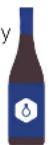
Burgundy
BOTTLE
Bordeaux
BOTTLE
10.2 Cleaning of the ventilation grille, filter and condenser
The unit requires, for a correct operation, the cleaning of the ventilation grille and condenser.
The recurring cleaning every 12 months is reminded by a message on the display. It is possible to disable the signal and see the time left before the next cleaning has to be done.
Behind the frontal ventilation grille there is the condenser.
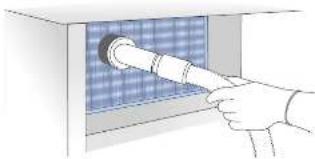
To clean it use a vacuum cleaner with a soft brush attachment at maximum power, sweeping it along in the direction of the vents. Incase of significant dust build up, the lower ventilation grille can be removed to allow a more accurate cleaning of the condenser.
On the maintenance settings, after the installation of the unit and after it has been turned on, you can set the condenser cleaning warning.
In the case the warning sign will be enabled, there will be a signal every 12 months, that tells that is time to clean the condenser.
After cleaning it, touch the reset con in order to reactivate the warning signal in 12 months.
In the case you do not want the warning cleaning signal of the condenser anymore, touch the off icon.
For knowing how to use the maintenance display, see page 30.
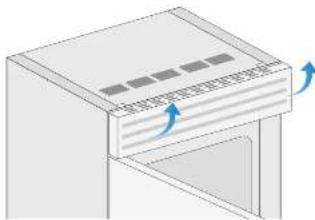
Upper condenser.
For cleaning the condenser follow the instructions:
Lifting up the hinged grille.
natural_image
Diagram of a cabinet or rack with directional arrows indicating movement or force (no text or symbols present)Clean it thoroughly from any dust build up as shown in the picture, taking care not to damage it.
natural_image
Illustration of a hand inserting a plug into a blue-patterned vent (no text or symbols)Warning
The edges of the condenser are extremely thin and can be sharp, therefore use adequate protection for the hands and arms when cleaning the condenser.
10.3 Internal cleaning
Clean the internal and removable parts by washing them with a solution of lukewarm water and a small amount of dishwashing detergent.
Rinse and dry right away.
Do not use mechanical devices or other methods to speed up defrosting.

Warning
Do not use water on the electrical parts. lights and control panel.

Warning
The use of chlorine-based detergents or similar that contains it should be avoided (bleach, hypochlorite, etc).

Note
Do not bring cold glass parts into contact with boiling water.
Do not wash any parts of the refrigerator in a dishwashing machine since this could damage or irreparably deform the parts.
11.1 Troubleshooting guide
If you notice malfunctions in your appliance, use this guide before calling Service. This guide may help you resolve the problem yourself or could provide important information to ensure rapid and effective service.
Malfunction message
A malfunction is usually indicated on the display. Problems that cannot be resolved by the user are signalled through a malfunction code.
The appliance does not work
Is the appliance connected to the electrical power supply?
Does electrical power arrive at the electrical socket?
Is the Unit power activated? Is the condenser clean?
The internal temperatures are higher than
normal
Does the display show a malfunction code?
Is the temperature adjusted correctly?
Is the condenser clean?
Were the doors or drawers open for a long period of time?
Were large quantities of food recently inserted?
The compressor runs for a long time period
Bear in mind that during a very hot weather and with very high temperatures in the room it is normal that the compressor remains in operation for prolonged periods of time.
Were the doors or drawers open for a long period of time?
Were large quantities of food recently inserted? Is the condenser clean?
Check that the doors are closed and that the food or containers do not obstruct the perfect closure of the door.
Is Shopping mode enables?
If you hear strange noises
It is normal to hear noise from the fans or compressors during the defrost phase.
Noise could be louder depending on the position of the appliance and the surrounding environment.
Condensation forms both inside and out
If the climate is very humid, the formation of condensation is normal. Opening the door or drawers for prolonged periods of time can contribute to the formation of condensation. In any case, make sure that the doors are always perfectly closed and the gasket is making a good seal.
The Cooler or Freezer has frost or ice
Did you leave the doors open for a long period of time?
Do the doors close perfectly?
If the doors do not close perfectly, contact your installer.
Unpleasant odours inside the appliance
Clean the appliance completely as indicated in this manual.
Hermetically cover all the food. Do not conserve food for prolonged periods of time.
The doors are difficult to open
The appliance was designed to permit hermetic closure.
When the door is closed, a vacuum situation can occur: in this case it is necessary to wait a few seconds until the pressure balances before opening the door.
11.2 Malfunction indications appearing on the display
Display message Malfunction description
| Power Failure | Prolonged interruption of electrical powerThe appliance starts up again automatically and indicates the highest recorded temperatures. |
| Door open | Door openthis message appears few minutes from the door opening |
| Drawer open | Drawer openthis message appears few minutes from the drawer opening |
| Cellar too warm | Cellar (Wine Cellar) compartment too warmSee the troubleshooting guide |
| Cellar too cold | Cellar (Wine Cellar) compartment too coldWait 12 hours. If the problem persists, contact Customer Care |
| Cantina too warm | Cantina compartment too warmSee the troubleshooting guide |
| Cantina too cold | Cantina compartment too warmWait 12 hours. If the problem persists, contact Customer Care |
| Cooler too warm | FreshZone compartment (cooler model) too warmSee the troubleshooting guide |
| Cooler too cold | FreshZone compartment (cooler mode) too coldWait 12 hours. If the problem persists, contact Customer Care |
| Freezer too warm | FreshZone compartment (freezer model) too warmSee the troubleshooting guide |
| Freezer too cold | FreshZone compartment (freezer model) too coldWait 12 hours. If the problem persists, contact Customer Care |
| Error Code... | Functional problemscall Customer Care who may help you to save the problem or put you in contact with the nearest Service Agent |
| Check condenser | Check CondenserEvery 12 months the display shows the message "Check Card", clean the condenser and follow the instructions for resetting or disabling the timer. |
In case of anomalies, touch the button Alarm ⏻ and the display will show the corresponding message with its error number code.
The message will be shown for 3 seconds, then it will go back to the home screen.
For holding the message on the screen, press on the display, the button info (1). The message will be on the screen for 30 seconds, then it will go back to the home screen.
In the case there is more than one error message, the display will show in timed sequence the different messages.
SOMMAIRE
1 INDICATIONS IMPORTANTES CONCERNANT LA SÉCURITÉ 4
7.3 + bank interest (the Deutsche
10 ENTRETIEN ET NETTOYAGE 35
Make sure that installation is performed correctly, adhering to all of the instructions in the specific installation guide provided with the appliance.
3.3 Assistance technique

2) Shopping FreshZone.
Compartiment Wine Cellar
natural_image
Diagram of a cabinet or storage unit with directional arrows indicating movement (no text or symbols)natural_image
Illustration of a hand inserting a cylindrical component into a blue-patterned panel inside a container (no text or symbols)Avertissement
Message "Call Service"
text_image
Bodega +39°/+64°F +4°/+18°C Wine Cellar +39°/+64°F +4°/+18°C FreshZone +9° a -11°F -13° a -23°Ctext_image
FULGOR MLANG FULGOR MLAVO
2) Shopping FreshZone
natural_image
Diagram of a cabinet or rack with directional arrows indicating movement or force (no text or symbols present)natural_image
Illustration of a hand inserting a plug into a blue-patterned vent (no text or symbols)