
KUV100 (2022) - Car Mahindra - Free user manual and instructions
Find the device manual for free KUV100 (2022) Mahindra in PDF.


User questions about KUV100 (2022) Mahindra
0 question about this device. Answer the ones you know or ask your own.
Ask a new question about this device
Download the instructions for your Car in PDF format for free! Find your manual KUV100 (2022) - Mahindra and take your electronic device back in hand. On this page are published all the documents necessary for the use of your device. KUV100 (2022) by Mahindra.
USER MANUAL KUV100 (2022) Mahindra
CONDITIONS DE GARANTIE 25
PROGRAMME D'ENTRETIEN 25
EN CAS D'URGENCE -26
CONCESSIONNAIRES BRC 35
COUPONS D'ENTRETIEN 36
PROBLÈMES ET SOLUTIONS -40
ESPANOL
INTRODUCCIÓN -27
COMPONENTES DEL EQUIPO DE GAS -27
MODO DE EMPLEO 29
NOTICIAS ÚTILES 31
CUMPLIMIENTOS Y VENTAJAS 32
CONDICIONES DE GARANTÍA 33
natural_image
Technical line drawing of a mechanical pulley or wheel component (no text or symbols)natural_image
Isometric line drawing of a device casing with internal components (no text or symbols)natural_image
Isometric line drawing of a rectangular device with three internal compartments and labeled ports (B, G, R), no text or symbols present.We congratulate you on installing a “BRC Gas Equipment” system that, we are sure, will meet your expectations and will assure many years of pleasant driving respecting the environment. M.T.M. Srl, situated in Cherasco (CN - Italy) and owner of the BRC Gas Equipment trademark, has been producing LPG and CNG conversion systems for petrol vehicles for nearly 30 years, and it holds now a worldwide leadership in this field. The range of products necessary for converting any kind of vehicle includes tanks, reducers, LPG and CNG valves, mixers, ECUs and specific electronic components, all complying with the European (E67-01, R110) or national laws in force and with the CE directives about polluting emissions (Euroll, EuroIV and EuroV) and electromagnetic compatibility. Every product is the result of long-years research, experi- mentations and development, completely carry out inside the company; among the most important products, we want to remember the LPG or CNG sequential injection systems in gaseous phase of “Sequent” family. CAD-CAM systems are used to design and develop every single component. Production departments are characterised by a high automation and recourse to N/C machines. The Quality Department manages the production process, assuring the full observance of UNI EN ISO 9001:2000 and ISO TS 16949:2009 regulations. BRC Gas Equipment cooperates with the most important European and extra-European car-builders, and it’s member of some of the big- gest international associations playing a vital role in research and development of new solutions related to use and standardisation of components for LPG and CNG con- version in the automotive field.
M. T. M. Srl thanks you for taking the wise decision to use LPG or CNG as fuel for your car, and to choose one of the several "BRC Gas Equipment" authorised workshops, being BRC synonym of Quality, Saving, Safety and cutting-edge Technology.
Please read carefully this booklet before driving your car, it contains all information related to the gas system installed on your vehicle and some important warnings we ask you to follow to enjoy longer travels with the lowest expenses, the highest working safety and the most comfortable driving.
Have a nice journey with BRC Gas Equipment.
Gas system components
Information about equipment dislocation, characteristics and instructions for use is merely indicative. Before picking up your vehicle, please ask your BRC instal- ler for more information. M.T.M. SrI reserves the right to modify the following chapters without notice. Pictures shown in this booklet are purely illustrative and they do not necessarily correspond to what installed on vehicle.
LPG TANK/CNG CYLINDERS
It is the biggest and heaviest additional element, and it's installed in the rear side of the vehicle, strongly fixed to the car body.
- Ipg: there are two kinds of tanks: cylindrical, housed in a part of the luggage compartment, or ring-shaped, housed in the spare wheel compartment. In both cases, it's made of heat-treated HT steel and is tested up to 30 bar pressures, that's to say over the normal working pressure ranging from 2 to 15 bar. Every tank is submitted to the hard tests provided for the Land Transports Department. Moreover, in order to preserve tank and to increase safety, the law orders the 80% filling limitation, limitation automatically managed by the multivalve.
- cng: the seamless single-piece cylinders are tested at a pressure more than twice the working one. CNG cylinders amply conform to the stringent international laws about crash-testing and flash point standards.
TANK VALVE/CYLINDER
- lpg: situated on the tank, multivalve manages many functions, such as: refuelling, filling limitation, level indication, LPG taking with interception solenoid valve, safety valve and excess flow. It is equipped with a manual tap allowing its closing.
- cng: every single CNG cylinder is equipped with a special valve performing different functions. First of all, it allows the cylinder closing, separating its contents from the rest of the equipment. Cylinder valve also carries out a breather function, in case of accidental overpressures. As a good rule, it's better to turn off the tap situated on the cylinders before starting any operation or in case of accident.
REFUELLING POINT
- Ipg: refuelling point, equipped with a non-return valve, is outside the vehicle, in a protected and hidden position, on the rear bumper or near the petrol filler insi- de the fuel little door. In the former case, to refuelling the car, you have to simply unscrew the cap and connect the gun, while in the latter one it may be neces- sary to screw the suitable gun adapter.
- cng: it is a normal non-return valve having refuelling function, and it's normally situated in the engine compartment. You can recognize it thanks to a red protection cap or to a black screw cap. As a good rule, it's better to check the refuelling point cap closing, to avoid possible impurities might compromise its right working.
SOLENOID VALVE
Housed in the engine compartment, it's the device that allows the automatic opening and closing of the gas flow from the tank to the engine. It can be provided with a filter for impurities that ought to be periodically replaced. It carries out several safety functions, such as gas flow closing in case of engine accidental swit- ching off, even with key contact switched on.
REDUCER
It is an important device situated in the engine compartment. Traditional system reducers need periodic overhauling and adjustment not always necessary on reducers of the gaseous injection systems.
- Ipg: LPG reducers-vaporizers allow reducing pressure to the working values, and provide the heat exchange necessary for the complete LPG evaporation.
- cng: CNG reducers allow reducing pressure to the optimal working values. CNG is in gaseous state, so it doesn't need to be vaporized.
GASEOUS PHASE FILTER (injection systems)
It has the important task of retaining any gas impurity, preserving in this way the injectors working. In the LPG systems, it's situated downstream the reducer- vaporizer, and in the CNG ones, at the reducer inlet.
RAIL AND INJECTORS (injection systems)
We called "Rail" the element on which gas injectors are housed. It allows the uniform distribution of gas fuel to all injectors.
Injector is an electromechanical injector to all intents and purposes, with the task of supplying dosed gas fuel quantity in pressure, and inject it in the intake manifold.
A pressure and temperature sensor, situated on the Rail or near it, provides to the ECU all information necessary for managing flow and for automatic petrol-gas and gas-petrol changeover.
ACTUATOR/MIXER (traditional systems)
They are electromechanical devices that automatically control the gas flow to be sent to the engine, according to the information coming from the vehicle and the lambda oxygen sensor, and elaborated by the ECU. In the carburettor vehicles there isn't this actuator, and the mixer directly manages the gas adjustment.
ECU
It is the brain of the whole system and allows performing different kinds of operations, in accordance with the equipment installed: from the simple changeover
to some sophisticated carburation controls, from the diagnosis to the emission control, and so on. All ECUs are equipped with "Safety-Car" function that closes solenoid valves in case of engine accidental switching off, even with key contact being on, in order to prevent any possible gas leakage.
CHANGEOVER SWITCH
Situated in a comfortable position inside the passenger compartment, it allows choosing vehicle powering: gas or petrol.
Instructions
REFUELLING FOR INJECTION AND CARBURETTOR VEHICLES
- Ipg: refuelling point, equipped with a non-return valve, necessary for LPG refuelling, is generally situated in the vehicle rear side. To refuel, it is necessary to unscrew the plastic protection cap (if existing) and connect the refuelling gun.
- cng: refuelling point, equipped with a non-return valve, necessary for CNG refuelling, is generally situated in the vehicle front side (engine compartment). To recharge CNG cylinders, it is necessary to remove the quick coupling protection on which the refuelling gun will be inserted. As soon as the refuelling flow stops, the non-return valve automatically come back in its closing position, obstructing so the body central hole and allowing the gun disconnection without any consi- derable gas leakage.
NOTE: Please also consult "CNG Cylinders Test" in the chapter "Useful references".
DIRECTIONS TO FOLLOW DURING THE REFUELLING
You are recommended to follow directions and precautions suggested at the filling stations. During the refuelling, it is necessary to follow some simple safety norms:
- LPG-CNG: switch the engine off,
- LPG-CNG: turn all board lights and radio equipment off,
- CNG: get out of your car and go to the suitable station areas. Authorised personnel generally carry out refuelling operation.
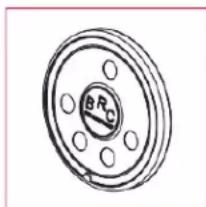
natural_image
Technical line drawing of a mechanical pulley or wheel component (no text or symbols)STARTING UP AND CHANGEOVER FOR INJECTION VEHICLES CONVERTED WITH "SEQUENT" SYSTEMS
Vehicles converted with injection systems in gaseous phase of Sequent family are equipped with a push-button changeover switch with acoustic indicator (Buzzer), on which a gas level indicator is integrated, consisting of 4 green LEDs.
Changeover called "One-Touch" is a one-position switch. Fuel change (gas or petrol) is recognised every time the push-button is pressed. ECU recognises and records the fuel state (gas or petrol) when you switch off the vehicle in order to repropose the same state at the next switching on.
A) PETROL MODE: The red round LED turned on informs user of this state; gas level information disappears, that's to say that the four green level LEDs are turned off.
B) GAS MODE: In this state, vehicle starts in petrol mode. Red round LED is on, and gas level LEDs are on in a number depending on the tank gas level. Vehicle changes automatically over to gas mode when program changeover settings are reached. The round LED, by becoming first orange and then green, informs user that changeover has been done.
C) GAS-PETROL AUTOMATIC CHANGEOVER: Sequent systems are able to recognize when it's not possible to supply the engine correctly, because of the end of gas or of the gas supply low pressure. In this situation, with switch in gas position, vehicle automatically changes over from gas to petrol (in this case vehicle can work in petrol mode for short periods).
System can automatically come back to gas mode if it recognizes the possibility to supply engine correctly. Otherwise, if system realises it cannot supply engine with gas anymore, it informs user by means of a repetitive buzzing and of the switch red LED turned on. Buzzer can be switched off by putting the switch in petrol position. Now, it's necessary to refuel to obtain again the vehicle normal gas working. Gas-petrol changeover strategy can be also adopted, in some special conditions and for a few seconds, in order to optimise vehicle working.
D) ERROR INDICATION: In case of possible gas system working anomalies, systems informs user by turning on the two blinking green level LEDs in the middle, and by the round orange LED blinking too. In this situation, changeover switch doesn't work anymore, and ECU records the fuel mode you had before the error indi- cation. If vehicle was in gas mode, the mode remains the same (idem for petrol mode).
If ECU recorded the gas mode, but meanwhile the fuel ends, passage to the petrol mode will be automatic and without any acoustic indication.
STARTING UP AND CHANGEOVER FOR INJECTION VEHICLES
Changeover switch has three positions allowing the gas working with starting up in petrol mode and automatic changeover, and the petrol and gas working mode. The first position is the one recommended for the vehicle right working.
A) PETROL-GAS AUTOMATIC CHANGEOVER MODE: With changeover switch in its central position, vehicle starts up in petrol mode, then automati-cally changes over to gas. Changeover happens during deceleration or acceleration (according to the installer's set up), after exceeding a programmed rpm threshold and after a programmed rpm decrease, or after a deceleration.
While engine is running in petrol mode the LED on the changeover switch turns red, and it becomes green when engine is running in gas mode. B) PETROL MODE: With changeover switch turned to the left (or to the petrol pump symbol), LED on the changeover switch turns red, injec-tors are working, gas solenoid valves are closed and gas flow control system is off. Vehicle regularly works in petrol mode, as if there was no gas system installed on it. C) GAS MODE: With changeover switch turned to the right (or to the BRC trademark), LED on the changeover switch turns green and engine only runs in gas mode. Anyway, system changes over to petrol in case of starting failure or accidental switching off.
Working with changeover switch in gas position has to be considered as an emergency solution, to be used only in case of petrol system bad working, and being careful to never leave petrol tank completely empty. It is possible to run only in gas mode or only in petrol mode, if depending on fuel availability.
STARTING UP AND CHANGEOVER FOR CARBURETTOR VEHICLES: A) PETROL MODE: With changeover switch in petrol position, the petrol solenoid valve is fed by petrol and, at the same time, the LED situa- ted on the switch itself turns red. B) GAS MODE: With changeover switch in gas position, gas solenoid valves get excited for some seconds and, at the same time, the LED situated on the switch itself turns green. The aim is to automatically provide the "starter" in order to favour starting up. If you start up before starter is over, gas solenoid valves are still supplied, otherwise, their supply is interrupted, and reactivates as soon as the engine is started up. C) PETROL-GAS CHANGEOVER: ECU changes over from petrol to gas with no flooding risks, following the described procedures. With the changeover switch in central position, all solenoid valves close at the same time. After the carburettor emptying (perceivable with a slight power loss), it's enough to put changeover switch in gas position (function not available for all models).
D) GAS-PETROL CHANGEOVER: To change over, it's enough put changeover switch in petrol position. Stopping switch in its central position, carburettor is filled (per- ceivable with a slight power loss). After the carburettor filling, it will be enough to put changeover switch in its petrol position, closing in this way gas solenoid valves (function not available for all models).
LEVEL INDICATOR FOR INJECTION AND CARBURETTOR VEHICLES
Changeover switch also works as level indicator thanks to its LEDs. Normally, changeover switch has 4 green LEDs showing gas quantity inside the tank (4 LEDs=4/4, 3 LEDs=3/4, 2 LEDs=2/4, 1 LEDs=1/4). Fuel reserve indication is given by the first green LED blinking.
NOTE: We suggest to always use the partial odometer in order to control vehicle autonomy. In some changeover switches, a suitable red LED indicates the fuel reserve.
WARNING: Avoid that LPG or petrol tank and CNG cylinders be completely empty. It's necessary to always keep a petrol quantity corresponding to 1/4 or 1/2 of the tank and periodically refill it.
WARNING: Vehicles with On Board Computer: on some vehicles, during the gas mode, information about autonomy and consumptions given by the on board computer and by the petrol level indicator must not be considered.
You can have the real petrol level only when you start the vehicle up. After the changeover to gas, you could perceive a petrol level decrease, proportionally to the kilome- tres made. After switching the vehicle off, and only after some minutes since the vehicle starting, you can try again to detect the real petrol level.
WARNING: A strategy can be activated with some systems, in order to allow short periods of petrol working not indicated by the changeover switch. Please check with your installer if this strategy has been enabled.
Useful references
LPG TANK OVERHAULING
In Italy LPG tank must be replaced 10 years after its final test. Please check the laws in force in your Country about this matter.
CNG CYLINDERS TEST
In Italy at the moment of the installation, vehicle is equipped with a plastic tag coloured in blue light-green showing important data about cylinders installed on the vehicle. Please check the procedure provided for your Country.
VEHICLE PERIODICAL OVERHAULING
In Italy every car, after its fourth year of life, must be submitted to overhauling. Please check the laws in force in your Country about this matter.
ITALIAN DISTRIBUTION NETWORK
Dealers' network amounts today to more than 2000 LPG stations and roughly 600 CNG stations, and it is growing a lot. For any further information, we suggest to consult our BRC Road Atlas of Italy.
EUROPEAN DISTRIBUTION NETWORK
Dealers' network amounts today to more than 14.000 LPG stations in 26 Countries and roughly 1.700 CNG stations in 25 Countries.
PARKING
In Italy CNG vehicles are not submitted to restrictions concerning the underground parking while LPG vehicles can only park in the outside floors and in the first underground floor of garages. Please check the laws in force in your Country about this matter.
REFUELLING ADAPTER
Before moving to a foreign country, we suggest to check if your refuelling point is the suitable one for the country where you are going to. You can obtain this kind of information from your installer, or from the BRC dealer you can find on our website www.brc.it.
EQUIPMENT DISASSEMBLY
Eventual disassembly must be carried out by a BRC authorised workshop. Please check if a new test is necessary in your Country after this operation.
GAS QUALITY
The fuel for auto-traction called CNG is a gas mixture that can show some differences according to the geographical zone and to other uncontrollable factors, depending on distribution network manager or supplier. Methane is the main component of Natural Gas, with a quantity between the 84% and the 99.5%. The presence of many gases reduces calorific value of CNG for auto-traction, and, consequently, vehicle performances and autonomy. Also using LPG the autonomy of the vehicle changes a lot because it depends on driving and maintenance conditions, but also on gas composition, which can change from season to season, but from filling to filling too. LPG is in fact a gas composition (Butane and Propane) mixed in a not standard way. Only using LPG complying with the European regulation "EN589" assures the right working of BRC gas equipment.
Performances (powers, speed, pick-up and consumptions) are slightly lower if compared to the petrol mode, both in LPG and in CNG mode.
CONSUMPTION
LPG consumption shows roughly a 20% increase in comparison with petrol one, but the general feature of this information (percentage comes from the average between high- and low-powered vehicles) makes a specific analysis of any single case necessary.
Fulfilments and grants
Main workshops can test your equipment and carry out necessary dossiers directly in its own seat. Please be careful with fulfill any grant or regulation neces- sary. At the moment of the installation, verify the existence of possible grants for ecologic fuels sector and for LPG or CNG vehicles running in town centres or during traffic restrictions.
Guarantee conditions
The system good working guarantee, relating to its correct installation, adjustments and maintenance is issued and charged to the installer's workshop, to whom you can address to for any further information. M.T.M. Srl issues the good working guarantee of every single product bearing the BRC trademark, in accordance with norms and general guarantee conditions in force at the moment of installation.
Maintenance schedule
A regular maintenance is essential to keep gas system in safety and low costs conditions. Besides the traditional care for your vehicle and controls indicated in the manufacturer's "Use and Maintenance" booklet, that any workshop can easily carry out, your LPG or CNG equipment ought to be submitted to maintenance
by the "BRC Gas Equipment" authorised workshop that installed it.
Preventive maintenance of gas system components has a vital importance for its good right working. Products' ageing is a gradual process but, by doing some simple scheduled maintenance checks, you could keep low costs and high safety on your vehicle.
The following paragraphs will explain when gas system components ought to be submitted to maintenance and what kind of operations must be carried out during each car service, see page 36.
FREE CAR SERVICE COUPON
"BRC Gas Equipment" authorised workshop that installed your LPG or CNG system must execute the free car service. It must be made after the first 1.000-1.500 km covered in gas mode, and it allows taking advantage of some operations without any charges. If you had your car serviced by a workshop different from the installer's one, some costs of labour may be charged.
SCHEDULED MAINTENANCE
BRC chargeable scheduled maintenance is based on car service coupons to be carried out 10.000, 20.000 km after the installation, and then, every 20.000 km in order to always assure the vehicle and gas system right working. For doing car service, you need to go to your installer and ask for the stamp application on the suitable coupon. These operations will assure the equipment right working and the Guarantee validity.
NOTE: Costs of labour for BRC components replacement will be charged to the customer, even if covered by builder's guarantee, if replacement operations will be carried out by a workshop different from the installer's one.
In an emergency
Today's LPG and CNG systems mean safety. Stringent laws assure components perfect construction and, during their test, pipes and fittings tightness are controlled. "BRC Gas Equipment" gives special importance to tests and checks of components. During its assembly, dimension and integrity of every single piece is verified. Tightness, inner pressures, solenoid valves tightness and coil working are checked after the assembly. So, product used for realizing this system is synonym for technology, quality and safety. If, unfortunately, vehicle is involved in an accident, before going to the authorised workshop, it's better to change over to petrol. Safety solenoid valves of the gas system will close automatically. Moreover, multivalve on LPG tank and valves on CNG cylinders have some manual taps that allow stopping the gas going out from tanks or cylinders. Call the area BRC dealer and ask him for the closest BRC authorised workshop, that will assist you in accordance with its work organisation.
Introduction
A wide distribution network assures the presence of BRC Gas Equipment wherever LPG and CNG fuels are diffused. Before moving to a foreign country, please consult our website http://www.brc.it/getconc.aspx?lang=en and search for the BRC dealers to contact for any assistance or information about gas in the country of destination.
BRC DANS LE MONDE
Problems and solutions
| PROBLEMA POSSIBILI CAUSE SOLUZIONI | ||
| • Changeover switch does not show gas level | • Changeover switch is in petrol position (level LEDs are off)• Problems in communication between changeover switch and level sensor on tank | • Change over to gas and verify the level display• Contact a BRC authorized workshop |
| • Changeover switch does not show gas level | • 5A fuse cut off • Changeover switch out of order• Changeover switch harness cut off | • Contact a BRC authorized workshop |
| • Vehicle stalls while changing over to gas | • 15A fuse cut off • Relay broken or actuators relay cable disconnected | • Contact a BRC authorized workshop |
| • Vehicle changes over to petrol mode during tip-in (see page 17 - GAS QUALITY paragraph) | • Absence or poor quality of gas into the tank• Possible gas pipes narrowinga • Possible gas system filters choking• Gas system harness cut off• Possible problems on gas ECU | • Fill up the tank• Contact a BRC authorized workshop |
| • The 4 changeover switch LEDs blink together | • Refine gas level calibration set up• Possible problems on multivalve level sensor • Possible problems on level gauge• Wrong gas refuelling, limit of 80% has been passed (overfuelling) | • Contact a BRC authorized workshop |
| • Vehicle works wrongly at idle in gas mode | • Possible problems on injectors/mapping | • Contact a BRC authorized workshop |
| • Vehicle does not switch on or works wrongly in petrol mode | • Absence of petrol into the tank• Possible problems on petrol injectors• Possible problems on petrol system• Possible problems on gas ECU | • Fill up the tank• Contact a workshop• Contact a BRC authorized workshop |
| • Smell of gas into the passenger compartment | • Lack of gas (valve or tank) | • Contact a BRC authorized workshop |
| • Problems with gas refuelling operation • Full tank | • Possible problems on multivalve or refuelling point | • Contact a BRC authorized workshop• Consume some gas and try again |
| • Wrong indication of gas level into the tank (see page 16) | • Refine gas level calibration set up• Possible problems on multivalve level sensor | • Contact a BRC authorized workshop• Warning: put the car on a plane surface to obtain the right gas level indication |
| • Excessive consumption of gas • Warning: LPG | • Consumption shows a 20% increase in comparison with petrol one.A bigger percentage is possible, also depending everyone's driving style.• Map too rich | • Contact a BRC authorized workshop on |
WARNING! ANY INTERVENTION ON GAS INSTALLATION MUST BE CARRIED OUT BY BRC AUTHORIZED AND TRAINED PERSONNEL ONLY.