IBC800 - Battery charger Pro-User - Free user manual and instructions
Find the device manual for free IBC800 Pro-User in PDF.


User questions about IBC800 Pro-User
0 question about this device. Answer the ones you know or ask your own.
Ask a new question about this device
Download the instructions for your Battery charger in PDF format for free! Find your manual IBC800 - Pro-User and take your electronic device back in hand. On this page are published all the documents necessary for the use of your device. IBC800 by Pro-User.
USER MANUAL IBC800 Pro-User
text_image
PM25 Battery Charge I35E




IP20



INTELLIGENT 6V & 12V BATTERY CHARGER
SUITABLE FOR 12.8V LITHIUM IRON PHOSPHATE BATTERIES (LIFEPO4) BETWEEN 2AH-15AH CAPACITY AND 6/12V LEAD ACID FLOODED, GEL, MAINTENANCE-FREE, AGM BATTERIES BETWEEN 1.2-26 AH CAPACITY

INTELLIGENTES 6V & 12V BATTERIELADEGERÄT
GEEIGNET FÜR 12,8V LITHIUM IRON PHOSPHAT BATTERIEN (LIFEPO4) MIT EINER KAPAZITÄT ZWISCHEN 2AH-15AH UND 6V & 12V BLEI-SÄURE-BATTERIEN, GEL-, WARTUNGSFREI-, AGM-BATTERIEN MIT EINER KAPAZITÄT VON 1.2-26 AH

INTELIGENTE 6V & 12V ACCULADER
GESCHIKT VOOR 12,8V LITHIUM IRON PHOSPHATE (LIFEPO4) ACCU'S MET EEN CAPACITEIT TUSSEN 2AH-15AH EN 6V & 12V LOODZUURACCU'S, GEL, AGM ACCU'S MET EEN CAPACITEIT TUSSEN 1.2-26 AH

CHARGEUR DE BATTERIE INTELLIGENT 6V & 12V
CONVIENT AUX BATTERIES 12,8V LITHIUM IRON PHOSPHATE (LIFEPO4) AVEC UNE CAPACITÉ ENTRE 2AH-15AH & AUX BATTERIES PLOMB EN 6V ET 12V, GEL, AGM, , SANS ENTRETIEN (SM/MF), D'UNE CAPACITÉ DE 1,2-26 AH

The IBC800 Intelligent Battery Chargers are advanced battery chargers manufactured for Pro-User Europe GmbH that will increase your battery's performance and prolong its life.
We have taken numerous measures in quality control to ensure that your product arrives in top condition, and will perform to your satisfaction.
Please carefully read and follow the safety and operating instructions. Not following these instructions may result in a serious accident, including damaged property, serious or even fatal injuries. If the device is passed on to another person, this manual must also be handed over with it.
IMPORTANT SAFETY INSTRUCTIONS

CAUTION: Please read this instruction manual carefully before installing and starting up the device. Do not operate the device unless you have fully read and understood all the provided information. If you are not confident working with 6V/12V DC voltage or are unsure of what you are doing, consider to seek for professional help e.g. a car garage or your vehicle's manufacturer. Failure to observe these instructions may cause an electrical shock, fatal or serious injury, material damage or impair the function of the device.
Read your vehicle's owner's manual!
Some vehicle manufacturers may have special requirements before charging the vehicle's battery. (e.g. fuses that have to be removed or certain security demands).
Pro-User accepts no liability for direct or indirect damage caused by faulty connections, a usage of damaged or altered products, a usage for purposes other than described and especially caused by failure to follow these instructions.

NEVER CONNECT to unsuitable batteries (e.g. NiCd-batteries). Do not charge batteries that are known to be broken. The battery charger is not designed as a jump starter. Not following these instructions could cause serious personal injury or material damage.

This unit has safeguards against overheating, reverse-polarity and short-circuit. Despite this, it is highly recommended not to touch or connect the red to the black clamp or to connect the charging cables in reverse polarity. This could cause dangerous sparks and electric arcing. Only connect and disconnect the battery, when the mains supply is disconnected.

For indoor use only: Do not use the unit close to open fire. Do not operate the unit in explosive atmospheres, such as in the presence of flammable liquids, gases or dust. Please stop using the device, if the unit is getting very hot, is smoking or is showing any abnormal behaviour.

The battery charger is not intended for use in electric vehicles
Pro-User Europe GmbH is not liable for any direct or indirect damages or injuries caused by the use of the device, especially caused by failure to follow these instructions.
Type of Batteries
This charger is intended to be used only on 12.8V Lithium batteries and 6V & 12V Lead Acid Batteries, e.g. Lead Acid Flooded, Gel, Maintenance-Free, AGM Batteries. Do not try to charge unsupported types of batteries like NiCd or non-rechargeable batteries. Follow the recommendations of your battery's manufacturer.
Storage
When not in use, store the battery charger in a dry environment. Store the battery charger in a safe place out of the reach of children.
Gases
When the battery is being charged, you may notice bubbling in the fluid caused by the release of gas. As the gas is flammable, avoid naked flames, glowing or electrostatically charged material and sparks in the vicinity of the battery. Always provide adequate ventilation. Because of this risk of explosive gas, only connect and disconnect the battery leads when the mains supply is disconnected.
Maintenance
The unit is maintenance-free. If necessary, clean the unit with care using a dry cloth. Don't try to open the body casing. There are no user-serviceable parts inside. Damage due to improper use, modifications or attempted repairs lead to the exclusion of liability and the loss of warranty. Do not lengthen or shorten the cables. The mains supply cord and the charging cables of this device cannot be replaced. If they are damaged, the appliance must be discarded.
General
- Electrical devices are not toys. Keep the product away from children.
- Only use the product as intended and for purposes described in the manual.
- After opening the package, examine all parts for visible damage. If you have found any damage, please contact the company you purchased this unit from.
- Always disconnect the power supply (including the connection to the battery) when working on the device.
- Use only approved accessories (especially all cables) or parts fully consistent with the requirements. The installer is responsible for ensuring that the correct cable and fuse sizes are used.
- The surface temperature can reach up to 65^ C. Power-off and stop using the device immediately, if the unit is smoking or is showing any abnormal behaviour.
- This appliance is not intended for use by persons (including children) with reduced physical, sensory or mental capabilities, or lack of experience and knowledge, unless they are supervised or have been instructed on how to use the appliance by a person responsible for their safety. Children should be supervised to ensure that they do not play with the appliance.
- Installing the device, maintenance and repair work may only be carried out by qualified personnel who are familiar with the risks involved, the relevant regulations and with the guidelines and safety precautions to be applied.
- Do not disassemble the device - the internal circuitry contains hazardous voltages. Attempting to service the unit yourself may result in electric shock or fire and will void the unit warranty.
- Always keep metal objects or other materials that can short circuit the terminals of the battery or the device securely away. A resulting spark or short-circuit may not only damage the device, but also cause an explosion and potentially produce a current high enough to weld a ring or the like to metal. Remove personal metal items such as rings, bracelets, necklaces, and watches when working on the device or the battery.
- Operate the device only, if all cables and the housing are undamaged and all connections are tight and clean. Loose or dirty connections could result in overheating, electrical sparks and fire.
- Ensure the device is standing firmly. The device must be set up and fastened in such a way that it cannot tip over or fall down.
Environment
- Only use the product in environments from 0^ 40^ .
- Do not operate the product in damp, wet or dusty environments: Never expose the device to rain or snow. Doing so may result in damage to the device or other equipment installed in the system or result in electric shock or fire. Do not operate the unit in explosive atmospheres, such as in the presence of flammable liquids, gases or dust. Do not put batteries, or anything that should be protected from sparks around the device. Doing so may result in fire or explosion.
- To avoid heat accumulation, do not cover the device. To prevent overheating, ensure that air inlets and ventilation is not obstructed. Do not expose the device to a heat source (such as direct sunlight or heating). Avoid additional heating of the device in this way.
Electrical Cables
- If cables have to be fed through metal holes or other walls with sharp edges, use ducts or cable bushings to prevent damage.
- Do not lay cables which are loose or bent next to electrically conductive material (metal).
- Do not pull on the cables.
- Avoid to lay 230 V mains cable and 6V/12/24V DC cables in the same duct.
- Prevent all cables from being stepped on, tripped over, or being damaged by e.g. sharp edges or hot surfaces.
Precautions When Charging Batteries
- Batteries can store large amounts of energy and improper handling can be dangerous. NEVER CONNECT to a battery with an unsuited voltage or other unsuitable or damaged batteries
- Keep children away from batteries and acid.
- Disconnect the supply before making or breaking the connections to the battery.
- Never try to charge a damaged battery.
- Do not exceed the recommended maximum recharge rate of your battery.
- Never smoke or allow a spark or flame in vicinity of battery or engine.
- Never use the charger when it has received a hard blow, been dropped, or otherwise been damaged. Also check all cables prior to use. Take it to a qualified professional for inspection and repair.
- To avoid heat accumulation, do not cover the charger.
- Never charge a frozen battery. If battery fluid (electrolyte) becomes frozen, bring the battery to a warm area to allow the battery to thaw before you begin charging.
- Place the charger as far away from the battery as is allowed by the length of the charging cables. Do not place the charger directly on top of the battery or vice versa or on a surface constructed from combustible material.
- When your vehicle's battery is fully charged, always remove the charging cables before starting the vehicle.
- Although it is usually possible without causing problems to charge the battery when installed, we recommend to remove the battery from the car before charging. When charging the battery while installed in the car, Pro-User Europe GmbH cannot take any responsibility for harm to your car electronic or the car itself.
- Avoid getting electrolyte on your skin or clothes. It is acidic and can cause burns. If battery acid contacts skin or clothing, wash immediately with water. Baking soda neutralizes lead acid battery electrolyte. If electrolyte gets into your eyes, immediately flood your eyes with running cold water for at least 20 minutes and get medical attention immediately. Gloves and eye protection is therefore highly recommended.
- Do not touch the battery clamps together when the charger is on.
- Always keep metal objects or other materials that can short circuit battery terminals securely away from the batteries. The resulting spark or short-circuit may cause an explosion and can produce a current high enough to weld a ring or the like to metal. Remove personal metal items such as rings, bracelets, necklaces, and watches when working with starter batteries.
- Prevent the power cord and charging cables from being stepped on, tripped over, or being damaged by e.g. sharp edges or hot surfaces.
- Never pull out the plug by the cord when unplugging the charger. Pulling on the cord may cause damage to the cord or the plug. Only use an extension cord if absolutely necessary: If an extension cord must be used, make sure that it is of sufficient size for the supply of current over the required distance and in good condition.
- Observe technical instructions of the seller or the manufacturer of your battery
- Read your car's owner's manual. Some vehicle manufacturers may have special requirements before charging or discharging the vehicle's battery (e.g. fuses that have to be removed or certain security demands).
PACKAGING MATERIALS
To avoid danger of suffocation, do not let children play with foils or other packaging materials. Remove all protective coverings before putting the device in operation.
SCOPE OF DELIVERY
• Pro-User IBC800
• 40 cm charging cable with crocodile clamps
- Operating manual
TECHNICAL DESCRIPTION
text_image
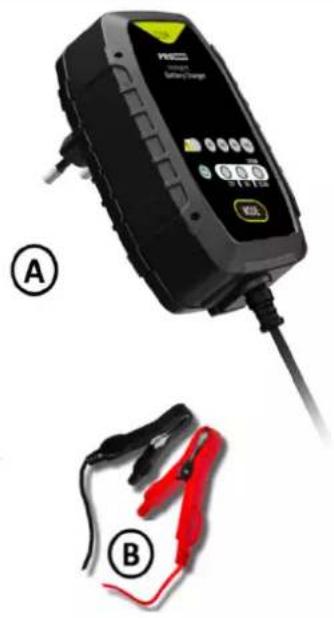
GPS Battery Charge VOL (A) (B)Item Description
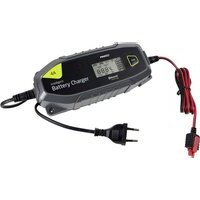
A Battery charger IBC800
B Charging cables (red (+ positive) and black (- negative) crocodile clips
OPERATION
Please Read Carefully Before Using The Device
This system is intended to be used only with 6V & 12V Lead Acid Batteries, Gel, Maintenance Free, AGM and 12.8V 4-cells LiFePO4. This charger is suitable to charge:
- 6 V batteries with a capacity of 1.2 - 26 Ah
• 12 V batteries with a capacity of 1.2 - 26 Ah
• 12.8V 4-cells LiFePO4 Lithium batteries with a capacity of 2 - 15 Ah
Preparing The Battery
It is recommended to disconnect the battery from the car if possible. This will avoid possible damage to the alternator, your car's electronic system and damage to the bodywork from possible spillage. If you remove the battery from the vehicle, always remove the grounded terminal from the battery at first. To avoid sparks, make sure all accessories of the vehicle are turned off. A marine (boat) battery must be removed and charged on shore. (To charge on-board requires special devices designed for marine use).
Follow your battery manufacturer's precautions and preparatory measures, such as removing or not removing cell caps while charging. Make sure the charging rate is not over your battery manufacturer's suggestion.
For permanently sealed batteries, it is not necessary to carry out the following checks. Don't try to open a sealed or maintenance-free battery.
Firstly remove the caps from each cell and check that the level of the liquid is sufficient in each cell. If it is below the recommended level, top up with de-ionized or distilled water.

ATTENTION: Under no circumstances should tap water be used. The cell caps should not be replaced until charging is complete. This allows any gases formed during charging to escape. It is inevitable that some minor escape of acid will occur during charging.
Connecting The Charging Cables
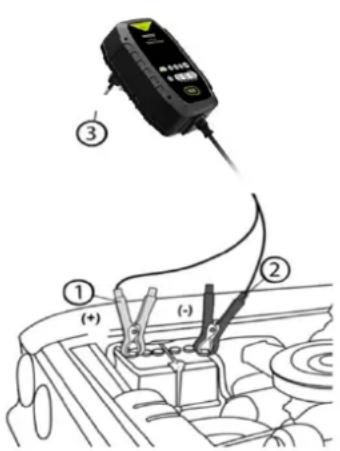
Connect the clamps to the battery in the following order:
text_image
Diagram showing a diagnostic tool interacting with a car engine, labeled with parts ①, ②, and ③.- Connect the positive charging lead (RED) to the positive terminal post of the battery (marked +).
- Connect the negative charging lead (BLACK) to the negative post of the battery (marked -) or to the Chassis of the car. Please do not connect to fuel lineso or carburettor which are not supposed to be connected.
It is important to ensure that all connections are making good contact with their respective terminal posts.
- Now you can connect the charger to the mains supply and start charging by selecting the proper charging mode as explained below.
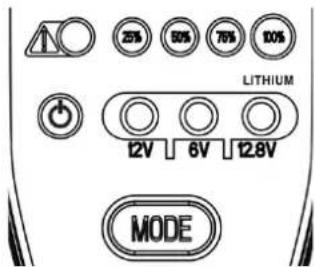
Charging Modes. The IBC800 has three (3) modes. The Lithium charge mode require the mode button to be pressed and held for three (3) seconds to enter the enhanced mode. This "Enhanced" modes require your full attention before selecting. Do not operate the charger until you confirm the appropriate charge mode for your battery. Below is a brief description:
| 12V NORMFor charging 12-volt Flooded, Gel, Maintenance-Free batteries. | ||
| 14.5V | 0.8A | 1.2-26Ah Batteries |
| 6V NORMFor charging 6-volt Flooded, Gel, Maintenance-Free batteries.When selected, the LED will illuminate. | ||
| 7.3V | 0.8A | 1.2-26Ah Batteries |
| 12.8V LITHIUMPress & Hold ModeFor charging 12.8-volt lithium iron phosphate batteries. Whenselected, the LED will illuminate. | ||
| 14.5V | 0.8A | 2Ah-15Ah Batteries |
Charging
Your Pro-User IBC charger can easily be configured to charge many different types of batteries. The following recommendations should, however, only be seen as guidelines. When in doubt, always consult the battery manufacturer for further instructions.
Note: Depending on the condition of the battery, the charger adapts the charging currents to ensure optimum charging of the battery. Only during the main charging phase, the battery is charged with the maximum charging current. Shortly before the maximum charging capacity has been reached the charging current is reduced. This ensures a gentle and best possible charging up to the battery's maximum capacity.
The battery charger must be connected to the battery according to the instructions above.
Starting the charging process:
- Once you have established that the battery clamps or eyelets have been correctly connected, you can start the charging process. To do so, insert the charger plug into the AC socket.
- The charger will start in Standby mode, indicated by the STAND BY LED.
- Press the mode button to select the appropriate charge mode (press and hold for three seconds to enter an enhanced charge mode) for the voltage and chemistry of your battery. The selected charge mode LED will illuminate.
LED DISPLAY
text_image
25% 50% 70% 100% LITHIUM 12V 6V 12.8V MODEThe state-of-charge (SOC) LED display has four (4) SOC indicators.
| LED | Explanation |
| 25% Red LED | The LED will flash when the battery is less than 25% charged. When the battery is 25% charged, the LED will be solid. |
| 50% Orange LED | The LED will flash when the battery is less 50% charged. When the battery is 50% charged, the LED will be solid. |
| 75% Yellow LED | The LED will flash when the battery is less 75% charged. When the battery is 75% charged, the LED will be solid. |
| 100% Green LED | The LED will flash when the battery is less than 100% charged. When the battery is 100% charged, the LED will be solid. |
Stopping the Charging Process
Charging can be stopped at any time by disconnecting the supply cord.
After Charging

WARNING! Disconnect the supply before making or breaking the connections to the battery. As the released gas is flammable, avoid naked flames, glowing or electrostatically charged material and sparks in the vicinity of the battery. Always provide adequate ventilation. Because of this risk of explosive gas, only connect and disconnect the battery leads when the mains supply is disconnected.
- Unplug charger from the mains supply
- Disconnect the negative charging lead (BLACK) from the negative post of the battery (marked -) or mass.
- Disconnect the positive charging lead (RED) from the positive terminal post of the battery (marked +).
- Clean and store battery charger.
If the charged battery is maintainable, wait some time until the bubbling stops. Inspect the liquid in each cell again and top up carefully with de-ionized or distilled water if necessary. Now replace the caps. Any surplus fluid around the cell tops should be wiped off carefully as it may be acidic. Avoid getting electrolyte on your skin or clothes. Use eye protection. Wash your hands carefully.
TROUBLESHOOTING

WARNING! Do not open or disassemble the device. Attempting to service the unit yourself may cause the risk of electrical shock or fire. Please follow the safety instructions when working on the device.
In a few cases, the charging process will finish very quickly, but the battery is not fully charged or does not deliver the desired voltage or power. The reason for this case could be that the battery is broken and needs to be replaced. If the device doesn't work at all, an internal fuse might be blown. This happens always for a reason. Do not try to replace internal fuses yourself. The device has to be checked by the manufacturer or by an authorized service.
ERROR DIAGNOSTICS
Error conditions are indicated in the LED display.
| Error | Reason/Solution | |
| Solid Red LED | Standard Charging Mode | The battery is not accepting a charge. Change charge mode to Recovery Mode. |
| Recovery Mode | The battery cannot be recovered. | |
| Flashing Yellow LED | Battery capacity may be too high for the selected mode. Verify the battery capacity and charge mode. If battery capacity is in range, change charge mode to Recovery Mode. | |
| Solid Yellow LED | Battery voltage is too high or too low for the selected mode. Verify the battery voltage and charge mode. | |
| Flashing Red LED | Reverse polarity. Reverse the battery connections. | |
BATTERY MAINTENANCE AND CARE
It is essential to keep your battery regularly charged throughout the year, especially during the winter months. Low temperature reduces the effectiveness of your car battery and your motor oil is thicker. Engines are more difficult to start and the heater, windscreen wipers and lights are all draining power. It is at this time that batteries have to be at peak power. If your battery is not regularly maintained and kept fully charged, it can cause problems and a possible breakdown.
Listed are some helpful hints on how to keep your battery healthy in conjunction with your battery charger:
Detecting faulty cells with a hygrometer (not possible with Lithium, sealed or maintenance-free batteries)
Starter-batteries are usually made of several cells, with a nominal voltage of 2V per cell. If one of the cells is defective, the whole battery deteriorates. If, after several hours of charging, your battery is still flat, you should test the battery cells.
Using a hydrometer, which can be purchased from most motor accessory stores, you can check the specific gravity of the electrolyte in each cell. Take hydrometer readings from each cell in the battery. Put the fluid back into the cell after testing, taking care not to spill the fluid. If one reading is lower than the others, this could indicate a faulty cell. If necessary, get an auto-electrician to check your battery. In some cases a battery can be revived, but one faulty cell is enough to ruin your battery.
Care
Sometimes the battery may appear flat, but the reason could simply be dirty or loose connections on your battery terminals. It is important to maintain the leads on a regular basis. Clean all contacts and grease them using terminal grease. Make sure that all connections are tight.
It is essential to keep the electrolyte level above the plates, note that you should not overfill it, as the electrolyte is strongly acidic. When topping up, do not use tap water. Always use distilled or de-ionized water. If necessary have it checked by your garage.
TECHNICAL SPECIFICATIONS
| Model | IBC800 |
| Suitable Batteries | |
| Suitable Battery Voltages | 6V & 12V & 12.8V |
| Suitable Battery-Types and Battery's Capacities | This system is intended to be used only with 6V & 12V Lead Acid Batteries, Gel, Maintenance Free, AGM and 12.8V 4-cells LiFePO4. This charger is suitable to charge:• 6 V batteries with a capacity of 1.2 - 26 Ah• 12 V batteries with a capacity of 1.2 - 26 Ah• 12.8V 4-cells LiFePO4 Lithium batteries with a capacity of 2 - 15 Ah |
| Electrical Values | |
| AC Input | 220-240V AC, ~ 50Hz, 300mA |
| Output Current | 0.8A (max) |
| Charging Voltage | Lead acid: 7.3V/ 14.4V DCLiFePO4; 12.8V/4 cells |
| Other | |
| Protection class | IP20 |
| Electrical Safeguards | Protection against: Short circuit protection, Overload protection, Wrong polarity protection, Reverse battery protection, Safety timer protection |
| Operating ambient temperature | 0°C ~ 40°C |
| Ambient Storage Temperature | -30 °C to 60 °C |
| Electrical Values | |
| AC Input | 220-240V AC, ~ 50Hz, 300mA |
| Output Current | 0.8A (max) |
| Charging Voltage | Lead acid: 7.3V/ 14.4V DCLiFePO4; 12.8V/4 cells |
| Other | |
| Protection class | IP20 |
| Electrical Safeguards | Protection against: Short circuit protection, Overload protection, Wrong polarity protection, Reverse battery protection, Safety timer protection |
| Operating ambient temperature | 0^ 40^ |
| Ambient Storage Temperature | -30^ to 60^ |
This model may be operated in EU countries.

text_image
Collection of logos and symbols including open book, CE, recycling symbol, TUV SOD logo, IP20 icon, RoHS 2011/65/EU checkmark, and T1A battery.ENVIRONMENTAL PROTECTION

The product is classed as Electrical or Electronic Equipment and should not be disposed of with other household or commercial waste at the end of its working life. Please recycle where facilities exist. Ask your local authority or retailer for recycling advice.
WARRANTY
Pro-User warrants this product for a period of 6 months from the date of purchase to the original purchaser. Warranty is not transferable. Warranty covers defect against workmanship and materials only. To obtain warranty service, please return the unit to the place of purchase or authorized Pro-User dealer together with your proof of purchase. The warranty is void if the product has been damaged or not used as described in this manual. Warranty is void if a non-authorized repair has been performed. Pro-User makes no other warranty expressed or implied. Pro-User is only responsible for repair or replacement (at Pro-Users' Discretion) of the defective product and is not responsible for any consequential damage or inconvenience caused by the defect.
EINLEITUNG
text_image
Diagram showing a diagnostic tool interacting with an automotive engine, labeled with parts ① to ③ and (+/-) indicators.text_image
25% 50% 76% 10% LITHIUM 12V 6V 12.8V MODEtext_image
GPSD PAGS PAGS (a) (b)text_image
Diagram showing a diagnostic device with labeled parts and connection points, including (+) and (-) indicators.text_image
Diagram showing a diagnostic tool interacting with an automotive engine, labeled with parts ① to ③ and (+/-) indicators.1.
text_image
WACC Battery Charge WACC (A) (B)Parte Descripción
text_image
Diagram showing a diagnostic tool with labeled parts and a schematic of the engine compartment with (+) and (-) indicators.text_image
25% 50% 76% 100% LITHIUM 12V 6V 12.8V MODEEU – Declaration of Conformity
We herewith confirm that the appliance as detailed below complies with the mentioned directives.
Artikelbezeichnung:
Article description:
4A Battery Charger with Bluetooth functionality
Artikelnummer:
Article number:
18171 18172
Typenbezeichnung:
Type:
IBC4000 IBC4000B
Firmenanschrift:
Company address:
Pro-User Europe GmbH, Seestrasse 19, 83253 Rimsting, Germany
Governing EU-directives / directives CE concernées:

Electromagnetic compatibility (EMC)
2014/30/EU

Low voltage directive
2014/35/EU

- Funkanlagen und
Radio and Telecommunication Terminal Equipment
R&TTE 1999/5/EC

- RoHS-Richtlinie
RoHS Directive
2011/65/EU (method EN62321)
harmonized EN-Standards
The article complies with the standards as mentioned below which are necessary to obtain the CE-symbol:
Zu 1.
EN55014-1: 2006+A1:2009+A2:2011
EN55014-2:2015
EN61000-3-2:2014
EN61000-3-3:2013
Zu 2.
EN60335-1:2012+A11:2014
EN60335-2-29:2004+A2:2010
EN62233:2008 (EMF)
Signature & Company Stamp