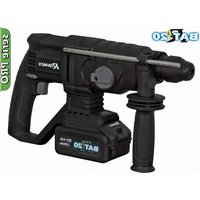
PRBAT20/PERFPRO - Drill RIBIMEX - Free user manual and instructions
Find the device manual for free PRBAT20/PERFPRO RIBIMEX in PDF.



| Product type | Rotary hammer / cordless impact drill |
| Brand | RIBIMEX |
| Model | PRBAT20/PERFPRO |
| Rated voltage | 20 V (Li-ion) |
| Battery capacity | 4.0 Ah |
| Charging time | Approximately 2 hours |
| Chuck type | SDS (SDS-plus) |
| Variable speed | Yes, by trigger pressure |
| Reversible rotation direction | Yes |
| Functions | Drilling, hammer drilling, screwing/unscrewing |
| Drilling capacity (max.) | 16 mm in concrete (approximately) |
| Included accessories | 4 drill bits (8, 10, 12, 16 mm), 1 flat chisel, 1 pointed chisel, battery, charger, auxiliary handle, depth stop, manual |
| Weight (approximate) | 2.5 kg (with battery) |
| Dimensions (approx.) | 300 x 200 x 100 mm |
| Auxiliary handle | Yes, adjustable (right/left) |
| Depth stop | Yes, adjustable |
| Safety equipment | Safety glasses, dust mask, hearing protection recommended |
| Maintenance | Clean with a soft dry cloth; do not use solvents or immerse in water |
| Warranty | 2 years (tool); 6 months for battery |
| After-sales service | RIBIMEX, 56 Route de Paris, 77340 Pontault-Combault, France; sav@ribimex.fr |
Frequently Asked Questions - PRBAT20/PERFPRO RIBIMEX
User questions about PRBAT20/PERFPRO RIBIMEX
0 question about this device. Answer the ones you know or ask your own.
Ask a new question about this device
Download the instructions for your Drill in PDF format for free! Find your manual PRBAT20/PERFPRO - RIBIMEX and take your electronic device back in hand. On this page are published all the documents necessary for the use of your device. PRBAT20/PERFPRO by RIBIMEX.
USER MANUAL PRBAT20/PERFPRO RIBIMEX

PRBAT20/PERFPRO/620419
FR
PERFORATEURABATTERIE20V
User and maintenance manual
Original instructions
IT
TRAPANO A PERCUSSIONA BATTERIA 20V
Carefully read this instruction manual before operating this appliance.
Incorrect operation may cause injury and/or damages.
Please keep this manual for future reference.
Note: Non-contractual information and photos, which may be changed without prior notice.
Actual product may differ from illustrative photos.
Subject to technical changes and improvements.

ATTENZIONE:
EN-Original instructions
I. Parts List
II. Characteristics
III. Safety instructions
IV. Getting Started
V. Operation
VI. Maintenance and Storage
I. PARTS LIST
See Fig. 1
II. CHARACTERISTICS See Table 1
III. SAFETY INSTRUCTIONS
WARNING Read all safety warnings and all instructions.
Failure to follow the warnings and instructions may result in electric shock, fire and/or serious injury.
Save all warnings and instructions for future reference.
The term "power tool" in the warnings refers to your mains-operated (corded) power tool or battery-operated (cordless) power tool.
Symbols (Explanation of symbols appearing on the tool, if applicable).
| Do not expose to weather conditions (ex.: storm, rain, snow ...) or moisture. Do not use in damp or wet areas. | |
| Do not expose product to extreme temperatures (too hot or too cold environment). Protect from over exposure to direct sunlight. | |
| Caution! Risk of injury and/or damage and/or deterioration of product in case of noncompliance to safety requirements. | |
| Read the instructions manual. | |
| Wear protective equipment: face mask, ear and goggles protection. | |
| Wear protective gloves and boots. | |
| Keep all your body parts away from moving parts (e.g. chuck, bits) | |
| Keep persons (esp. children) and animals away from product and working area. | |
| Warning: Electrical hazard. Presence of electric current. Disconnect product from its power source / remove the battery before maintenance, cleaning or any intervention on product; or when you do not use product. Disconnect battery charger power cable if cable or extension cord is damaged or cut during operation. Unplug adaptor by pulling the plug. Do not pull the cable. | |
| Do not dispose of this product with household rubbish. Disposition of this product in the nearest recycle centre. Please contact your local authority or local recycle centre for further information for its safe disposal. | |
| Battery packs/batteries should be collected, recycled or disposed of in an environmental-friendly manner. Battery packs/batteries contain substances that can pollute the environment. Do not dispose of battery packs/batteries into household waste. Return exhausted batteries to your local collection or nearest recycling point. Please contact your local authority or local recycle centre for further information for its safe disposal. | |
| Explosion hazard! Protect batteries against heat and fire. Do not throw into fire. Do not burn. | |
| Protect the environment: do not throw batteries into water. Do not throw into the environment. | |
| Max 45°C | Maximum ambient temperature: 45°C Always charge the battery pack in ambient environment between +10°C to +40°C. |
(A) General power tool safety warnings
1) Work area safety
a) Keep work area clean and well lit. Cluttered or dark areas invite accidents.
b) Do not operate power tools in explosive atmospheres, such as in the presence of flammable liquids, gases or dust. Power tools create sparks which may ignite the dust or fumes.
c) Keep children and bystanders away while operating a power tool. Distractions can cause you to lose control.
Do not let persons, especially children, not involved in the work use the tool, touch the tool and keep them away from the work area.
Keep the product away from children or from their environment. Never allow children to operate the tool. Children should be supervised to ensure that they do not play with the tool.
2) Electrical safety
a) Power tool plugs must match the outlet. Never modify the plug in any way. Do not use any adapter plugs with earthed (grounded) power tools. Unmodified plugs and matching outlets will reduce risk of electric shock.
b) Avoid body contact with earthed or grounded surfaces, such as pipes, radiators, ranges and refrigerators. There is an increased risk of electric shock if your body is earthed or grounded.
c) Do not expose power tools to rain or wet conditions. Water entering a power tool will increase the risk of electric shock.
d) Do not abuse the cord. Never use the cord for carrying, pulling or unplugging the power tool. Keep cord away from heat, oil, sharp edges or moving parts. Damaged or entangled cords increase the risk of electric shock.
e) When operating a power tool outdoors, use an extension cord suitable for outdoor use. Use of a cord suitable for outdoor use reduces the risk of electric shock.
f) If operating a power tool in a damp location is unavoidable, use a residual current device (RCD) protected supply. Use of an RCD reduces the risk of electric shock.
3) Personal safety
a) Stay alert, watch what you are doing and use common sense when operating a power tool. Do not use a power tool while you are tired or under the influence of drugs, alcohol or medication. A moment of inattention while operating power tools may result in serious personal injury.
b) Use personal protective equipment. Always wear eye protection. Protective equipment such as dust mask, non-skid safety shoes, hard hat, or hearing protection used for appropriate conditions will reduce personal injuries.
c) Prevent unintentional starting. Ensure the switch is in the off-position before connecting to power source and/or battery pack, picking up or carrying the tool. Carrying power tools with your finger on the switch or energising power tools that have the switch on invites accidents.
d) Remove any adjusting key or wrench before turning the power tool on. A wrench or a key left attached to a rotating part of the power tool may result in personal injury.
c) Do not overreach. Keep proper footing and balance at all times. This enables better control of the power tool in unexpected situations.
f) Dress properly. Do not wear loose clothing or jewellery. Keep your hair, clothing and gloves
away from moving parts. Loose clothes, jewellery or long hair can be caught in moving parts. g) If devices are provided for the connection of dust extraction and collection facilities, ensure these are connected and properly used. Use of dust collection device can reduce dust-related hazards.
4) Power tool use and care
a) Do not force the power tool. Use the correct power tool for your application. The correct power tool will do the job better and safer at the rated speed for which it was designed.
b) Do not use the power tool if the switch does not turn it on and off. Any power tool that cannot be controlled with the switch is dangerous and must be repaired.
c) Disconnect the plug from the power source and/or the battery pack from the power tool before making any adjustments, changing accessories, or storing power tools. Such preventive safety measures reduce the risk of starting the power tool accidentally.
d) Store idle power tools out of the reach of children and do not allow persons unfamiliar with the power tool or these instructions to operate the power tool. Power tools are dangerous in the hands of untrained users.
e) Maintain power tools. Check for misalignment or binding of moving parts, breakage of parts and any other condition that may affect the power tool's operation. If damaged, have the power tool repaired before use. Many accidents are caused by poorly maintained power tools.
f) Keep cutting tools sharp and clean. Properly maintained cutting tools with sharp cutting edges are less likely to bind and are easier to control.
g) Use the power tool, accessories and tool bits etc. in accordance with these instructions, taking into account the working conditions and the work to be performed. Use of the power tool for operations different from those intended could result in a hazardous situation.
5) Service
a) Have your power tool serviced by a qualified repair person using only identical replacement parts. This will ensure that the safety of the power tool is maintained.
6) Battery tool use and care
a) Recharge only with the charger specified by the manufacturer. A charger that is suitable for one type of battery pack may create a risk of fire when used with another battery pack.
b) Use power tools only with specifically designated battery packs. Use of any other battery packs may create a risk of injury and fire.
c) When battery pack is not in use, keep it away from other metal objects, like paper clips, coins, keys, nails, screws or other small metal objects, that can make a connection from one terminal to another. Shorting the battery terminals together may cause burns or a fire.
d) Under abusive conditions of use, liquid may be ejected from the battery; avoid contact. If contact accidentally occurs, flush with water. If liquid contacts eyes, additionally seek medical help. Liquid ejected from the battery may cause irritation or burns.
e) Ensure that the switch is in the OFF position before inserting the battery. Inserting the battery into power tools with the switch on invites trouble. Injury hazard.
(B) Additional safety rules for drills
a) Recommendation for the operator to wear hearing protection. Wear ear protectors. Exposure to noise can cause hearing loss.
b) Use auxiliary handles (if supplied with the tool). Loss of control can cause injuries.
c) Hold power tool by insulated gripping surfaces when performing an operation where the accessory or the screw may contact hidden wiring. Cutting accessory contacting a "live" wire may make exposed metal parts of the power tool "live" and shock the operator.
d) Hold the power tool with a firm grip with both hands (if possible) and keep a good balance.
The tool is best guided with both hands. If bit gets locked, a strong torque reaction may occur when screwing in or loosening screws. Keep the grip dry, clean and free from oil and grease.
e) Use appropriate detectors to determine if utility lines are hidden in the work area or call the local utility company for assistance. Contact with electric lines can lead to fire and electric shock.
Damaging a gas line can lead to explosion. Penetrating a water line causes property damage or electric shock.
f) Secure the workpiece. Never hold the workpiece in your hand or across your legs or against your body. A workpiece clamped with clamping devices or in a vice is held more secure than by hand. An unstable workpiece can cause loss of control of the tool and/or injury.
g) Position yourself so as to avoid being caught between the tool or auxiliary handle (if supplied) or bit and workpiece. Should the bit become jammed in the workpiece, the reaction torque of the tool could crush your body.
h) Do not use dull or damaged bits and/or accessories. Dull or damaged bits/accessories have a greater tendency to get jammed in the workpiece, or to break, or to be ejected.
Check that the insert tools used are compatible with the chuck system and that they are secured in the chuck correctly. Ensure fastener and attachment will withstand the level of torque generated by the tool. Excessive torque may overstress, strip or damage the fastener/attachment and possibly lead to personal injury.
i) When installing a bit/accessory in the chuck, insert the bit/accessory well inside the chuck. If the bit / accessory is not inserted properly, the grip of the chuck over the bit / accessory is greatly reduced likely to increase the risk of loss of control. After inserting the bit, pull on it, so as to ensure that it is properly locked.
j) Never grasp the tool (the chuck or the accessory) while in motion and never place your hands too close to the spinning chuck or accessory. Avoid touching rotating parts. Switch on the power tool only after bringing it into position at the workpiece. Touching rotating parts, especially rotating inserts, may lead to injury. Injury hazard.
k) Always wait until the chuck and accessory have come to a complete stop before placing it down. The accessory can jam and lead to loss of control over the power tool.
1) Some materials may contain chemicals that can be toxic. Avoid inhalation of dust and any contact with the skin.
Dust from materials, such as paint containing lead, some wood species, concrete / masonry / stone containing silica, and minerals as well as metal, may be harmful. Contact with or inhalation of the dust may cause allergic reactions and/or respiratory or other diseases to the operator or bystanders.
Certain kinds of dust are classified as carcinogenic such as oak and beech dust, especially in conjunction with additives for wood conditioning (chromate, wood preservative).
Material containing asbestos must only be treated by specialists.
When indicated wear a respirator appropriate for the type of dust generated.
Ensure that the workplace is well ventilated.
Follow national requirements for the materials you want to work with.
m)-
n) If the bit becomes bound or jammed in the workpiece, immediately stop the tool by releasing the trigger switch, then reverse the rotation direction and slowly squeeze on the trigger switch to release and remove the bit. Be ready for strong reaction torque likely to cause a
kickback.
o) Avoid touching the drill bit just after use, as it may be hot. Similarly, when removing the bit/accessory from the tool, wear protective gloves to grasp it. Accessories (bits) may become hot after prolonged use. Avoid contact with skin. Burn hazard
(C) Safety information about the charger and the battery-pack
Before using the charger and the battery, read all the instructions and cautionary markings on charger, battery pack and tool.
1) Charger
a) Do not attempt to open or disassemble the charger. If the charger has been dropped or is damaged in any way, stop using it and do not attempt to repair it. Return the charger for repair to an authorized service center or a qualified person, to avoid any danger to the user; or discard it according to local laws.
b) Protect the charger against any heat source (e.g. direct sunlight exposure, fire, heater...).
To prevent any damage to the charger.
c) Do not expose the charger to water, moisture and cold. Electric shock hazard.
d) If the power cord or the plug becomes damaged, stop suing the charger until it has been repaired by a qualified person. If the supply cord is damaged, it must be replaced by the manufacturer or its authorized service center, in order to avoid a hazard. Electric shock hazard.
e) Only use the charger provided with the tool, or a same type or same model charger to charge the battery. The use of other types of charger increases the risk of electric shock, personal injury and damage.
f) Never attempt to recharge non-rechargeable batteries. Batteries may explode
g) Only use the charge at ambient temperatures between +10°C and +40°C . Store charger in a dry location protected from cold where temperature would not exceed +40°C . To prevent any damage to the charger.
h) The charger is intended for indoor use only. Place charger on solid, flat non-flammable surface and away from any flammable materials when re-charging the battery pack.
Do not recharge the battery pack in a wet or humid environment. The charger and battery pack may heat during charging process.
2) Battery
a) Do not attempt to open the battery. If the battery is damaged in any way, stop using it and do not attempt to recharge it. Short-circuit or electric shock or explosion hazard. Discard it according to local laws.
b) Protect the battery pack against any heat source (e.g. direct sunlight exposure, fire, heater...). To prevent any damage or explosion hazard.
c) Do not expose the battery pack to water, moisture and cold. To prevent any damage.
d) In case of damage and improper use of the battery, vapours may be released. Ensure proper ventilation and provide for fresh air to the work area. The vapours can irritate the respiratory system.
e) Only use the battery pack provided with the tool. The use of other types of batteries may increase the risk of electric shock, personal injury and damage.
f) Use only original batteries or recommended by the manufacturer with the voltage matching your tool, as listed on the nameplate. When using other batteries (e.g. reconditioned batteries or other brands), there is risk of explosion causing injury or property damage.
g) Charge battery pack only at ambient temperatures between +10°C and +40°C . Store the battery in a dry location protected from cold where temperature would not exceed +40°C . To prevent any damage to the battery.
h) Do not store or carry a battery in a pocket, toolbox or any other place where it may come into
contact with metal objects. The battery pack terminals may be short-circuited causing damage to the battery or burns or a fire. Make sure that no conductive material touches the terminals.
(D) Special warnings when using the product
- Become familiar with the controls and the proper use of the tool.
- Keep children and bystanders away
Do not let bystanders touch the tool or its power cable or the extension cord.
All bystanders (esp. children) should be kept away from tool and work area.
Keep the product away from children or from their environment. Never allow children to operate the tool. Children should be supervised to ensure that they do not play with the tool.
- Only well-instructed adults should operate the product. This product is not intended for use by persons (including children) with reduced physical, sensory or mental capabilities, or lack of experience and knowledge, unless they have been given supervision or instruction concerning use of the product by a person responsible for their safety.
- Within the working area, the person using the machine is responsible for any damage or injury sustained by third parties or their property which has been caused by the machine. Watch your working area and do not allow third persons or animals to be around.
- Do not use the tool in wet or damp conditions, areas. Keep work area free from tipping hazards.
- Never change the rotation direction of the chuck while the tool is still running. Ensure that the chuck has come to a complete stop before changing rotation direction.
- Never put down the tool unless the tool is switched off and the chuck has come to a complete stop.
- Keep hands and other body parts well away from the workpiece while tool is in use.
Keep hands well away from the underside of the workpiece during use. Do not use your hands to remove any dust, chips or other waste while the tool is in use. Do not touch the bit right after operation, as it may be hot and cause burns.
- When using tool for screwing/unscrewing, place the bit on the bolt head only when power tool is switched off.
- Residual risks
Even when the tool is used as prescribed it is not possible to eliminate all residual risk factors. The following hazards may arise in connection with the tool's construction and design:
a. Damage to lungs if an effective dust mask is not worn.
b. Damage to hearing if effective hearing protection is not worn.
c. Health defects resulting from vibration emission if the power tool is being used over longer periods of time or not adequately managed and properly maintained.
10.1. Noise level

Wear hearing protection while operating the power tool.
The measured values have been measured in accordance with a standard test method.
The measured values are mentioned in the characteristics table.
10.2. Vibrations level
The declared vibration total value has been measured in accordance with a standard test method and may be used for comparing one tool with another.
The declared vibration total value may also be used in a preliminary assessment of exposure.
Warning! The vibration emission during actual use of the power tool can differ from the declared total value depending on the ways in which the tool is used.
There is the need to identify safety measures to protect the operator that are based on an estimation of exposure in the actual conditions of use (taking account of all parts of the operating cycle such as the times when the tool is switched off and when it is running idle in addition to the trigger time).
10.3-Electromagnetic field
WARNING! This machine produces an electromagnetic field during operation. This field may under some circumstances interfere with active or passive medical implants. To reduce the risk of serious or
fatal injury, we recommend persons with medical implants to consult their physician and the medical implant manufacturer before operating this machine.
11. Remarks:
The safety precautions and instructions given in this manual are unable to cover in detail all the conditions and situations that may arise.
The operator and/or user must use common sense and caution when operating the product especially for any matters that are not referred in the above
12. Warning
The use of any accessory or attachment, other than those recommended in this instruction manual, may present a risk of injury to persons or animals and may cause damages.
13. Have your tool repaired by a qualified person
Repairs should only be carried out by qualified persons using original spare parts, otherwise it may result in considerable danger to the user.
ATTENTION! The machine's operation generates a certain level of noise. National or local regulations regarding noise nuisance may restrict the use of the machine to certain hours. Check with your local authority.
IV. GETTING STARTED

Before any intervention on product, ensure that switch is set on the "OFF" position, remove the battery and unplug the charger from its power source.
4.1- Unpacking
- Remove product from its packaging.
- Check that tool and accessories are not damage.
Content: - 1pc rotary hammer
- 1pc Li-ion battery 20V 4.0A
- 1pc quick charger
- 1pc flat chisel + 1pc point chisel
- 4pcs SDS drill 8/10/12/16
- 1pc depth scale
- 1pc auxiliary handle
-1 instructions manual
4.2-Assembly
The tool requires minor assembly prior to first time use.
Ensure to remove the battery before proceeding with any intervention.
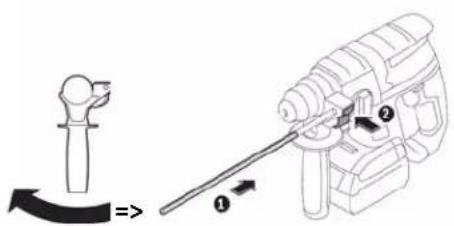
4.2.1-Auxiliary handle assembly (8)
To fit the auxiliary handle (8), unscrew the handle to open the clamping ring.
Pull open the clamping ring until it can pass over the chuck and set onto the drill body.
Re-screw the handle firmly.
Note1: you can assemble the auxiliary handle as desired: either on the right or on the left.
Note2: Only use the tool with the auxiliary handle assembled.
4.2.2-Depth gauge assembly
Unscrew the auxiliary handle.
① Insert the depth gauge through the opening located on the upper part of the auxiliary handle.
② Re-screw the handle.
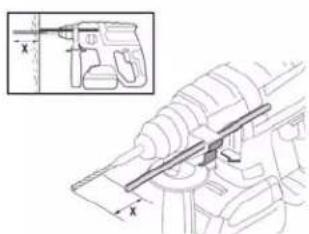
4.2.3- Depth gauge adjustment
To adjust the depth gauge to the required working depth, proceed as follows:
Measure back from the drill tip and move the depth stop back to the required measured depth.
The end of the depth stop will come into contact with the work surface when the required depth of hole is reached.

4.3-Battery & Charger
Note: The battery is supplied partially charged. To ensure proper running of the tool, completely charge the battery in the provided charger before first time use.
Tips to ensure optimal battery life
-
Do not to drop, hit, or damage the battery.
-
Recharge the battery before it is completely drained.
When you notice that the tool performance is decreasing, recharge the battery accordingly.
-
Never charge a fully charged battery. Overloading reduces its life.
-
If the battery is hot, allow it to cool down before proceeding with charging.
-
When the product is not used, it is recommended to charge the battery every 3 months.
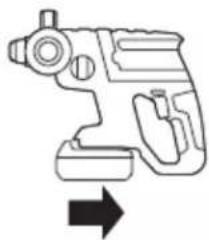
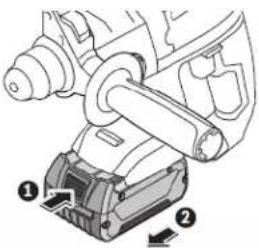
Inserting and removing the battery
a) To insert the battery: slide the battery into the handle bottom part.
Make sure that the battery is securely locked.
b) To remove the battery: press the release button and pull battery out of the handle bottom.
[a]
[b]
Charging the battery
-
Place charger on a flat and dry surface within 1m of a wall socket.
-
Remove battery from tool.
-
Insert battery into charger.
-
Plug battery charger into wall socket (power source). (Only use with provided charger).
-
Charge battery battery 20V 4.0Ah for approx. 2 hours.
-
After charging, remove battery from charger and insert it on tool.
-
Then disconnect charger from mains and store it adequately.
Note: Maintain the charger and the battery at a temperature between +10°C and +40°C .
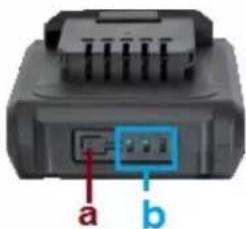
LEDs on battery
The LEDs on the battery (b) indicate the charging level of the battery.
Press on button [a], the LEDs battery level will light up:
3 LEDs on = the battery is fully charged (full capacity).
2 LEDs on = the battery is half charged (medium capacity).
1 LED on = the battery capacity is low and needs to be charged.
0 LED on = the battery is depleted.
LEDs on battery charger
The two LEDs on the charger will indicate the charging status:
The red LED lighted on means the charger is powered and the battery is charging.
The green LED lighted on means the battery is fully charged.

4.4- Switch On/Off
To operate product: press on trigger switch (4).
To stop product: release the trigger switch (4).
Note: the switch cannot be activated wen the selector (3) is set in middle position.
Note: a light pressure on the ON/OFF trigger switch (4) results in low speed, allowing drilling to begin in a smooth, controlled manner.
Further pressure on the switch results in an increase in speed. The rotational speed to be used depends upon the material being worked upon.

4.5- Changing to Forward or Reverse mode (Fig.1)
To change the rotation, press on the Forward/Reverse selector (3).
Note: do not abruptly change rotating direction when machine is operating.
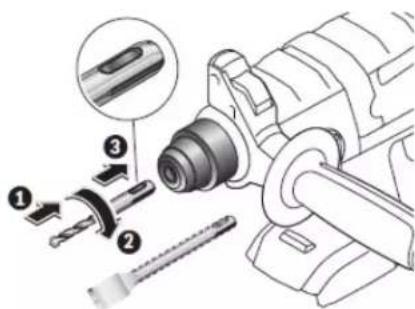
4.6- Inserting and removing an accessory
Ensure to remove the battery before proceeding with any intervention.
4.6.1- Inserting an accessory
Note1: Use only a clean work tool. Before insertion into the chuck, lubricate the shaft of the accessory lightly with machine grease.
Note2: the word accessory used in this paragraph refers to the bits, chisels and keyless chuck
- Pull locking sleeve backwards and hold it.
- Insert the accessory into the chuck as inside as possible, and then release locking sleeve.
- Ensure that accessory is securely locked in by firmly pulling on it.
4.6.2- Removing an accessory
- To remove the accessory, pull locking sleeve backwards and hold it.
- Remove the accessory and release locking sleeve.
- Clean the accessory and rub it over with a small amount of machine grease
4.7- Selector Drill, Drill/Hammer and Hammer
Place the selector on desired position:

: Drill position

: Drill / Hammer position

: Hammer position

V. OPERATION
5.1- Intended use
- The product is intended for domestic use (indoor or under shelter).
- The product is intended for drilling, light chiselling and forward/reverse screwing (within tool own specifications).
- Do not use tool for any other use outside the scope of this manual.
- Any other use different from that indicated in these instructions may cause damage to the tool and present a danger to the user.
- DO NOT use nor mount on the tool accessories that are not recommended by the manufacturer.
- The product is not intended for artisanal, commercial, professional and/or industrial use.
- Do not use for applications not covered in this manual.
- The manufacturer or seller cannot be held responsible for incorrect or non-compliant use of machine.
5.2-Operation
Note: Before first use, charge the battery.
- Ensure that battery is fully charged.
- Wear appropriate protective equipment.
- Insert compatible bit or accessory in the chuck.
- Prepare material for work
- Secure material if necessary.
Do not use your own weight or body to hold material.
- Firmly hold tool to avoid kickbacks. Always maintain a balanced and secure position.
- Place bit on workpiece. Do not make sudden movements.
- Press on the trigger switch (4) to start operation.
Note: never touch or grasp the chuck or bit during operation. - Once work is finished, stop product by releasing the switch (4).
Note: do not put down product until chuck has completely stopped rotating.
Tips: Apply progressive load, excessive pressure overloads the motor unnecessarily, and can cause damage.
CAUTION! Material Damage! Excess pressure can cause material damage.
WARNING! Do not become careless in assuming your knowledge of the tool.
DO not be filled (over repeated use) with a sense of ease and familiarity with the tool, neglecting strict compliance to the safety instructions given with the tool.
Improper us of the tool or failure to comply with the provided safety instructions in this manual can cause severe injury.
Remember that a split second of negligence is enough to cause serious damage.
Stay alert for your surroundings and especially for any danger that you may not hear while using the tool.
VI. MAINTENANCE AND STORAGE

Before any intervention on product, ensure that switch is set on the "OFF" position, remove the battery and unplug the charger from its power source.
Reminder: Make sure to maintain the machine in good working condition, carry out regular maintenance of the machine after each use and before storage. Any breach or default of adequate maintenance reduces the life of the machine and increases the risk of breakdowns and accidents.
To preserve the security system throughout the life of the machine, it is important to perform maintenance and proper cleaning, DO NOT use non-compliant replacement parts and do NOT dismantle yourself the machine or change the security features.
6.1-Cleaning
a) Clean the plastic parts with a soft and clean cloth.
Do not use aggressive cleansing agents (solvents, abrasive cleansers) or an abrasive sponge or any sharp objects.
- Do not use any caustic chemicals to clean the plastics parts.
- Never put or immerse the product in water or any liquid, and ensure that water does not penetrate the tool or the charger.
Never splash with water or clean with high pressure hose.
b) Clean chuck with a soft dry brush.
c) Clean ventilation holes with soft dry brush.
6.2-Storage
- Activate the safety lock (forward / reverse switch in the middle position) before storing or transporting the power tool
- Clean tool before storage.
- Keep product, user manual and accessories in the original packaging.
- It is recommended to store the product in a clean, dry location, protected from frost, and keep it out of children's reach (e.g. lock it up).
- Do not store product in temperatures lower than 0°C (32°F)
- Do not place or store any object on top of the product.
6.3- Disposal
- Battery: do not throw with household rubbish or into fire or in the environment. Dispose of used battery in provided collecting centres.
- Tool and charger: do not dispose with household garbage. Do not throw into the environment.
Dispos of the product in a collection centre for waste of electrical and electronic equipment, or a waste drop-off centre; or seek advice from your local municipality.
- Proceed with disposal of the tool, accessories and packaging according to local regulations regarding the protection of the environment.
6.4- Information about the guarantee
The product is guaranteed in accordance with the legislation of the country of sale.
The guarantee starts from the date of purchase (subject to proof of purchase, ie. Sales receipt with purchase date)
The guarantee only covers defects in materials or workmanship.
Repairs (under the guarantee) can only be performed by an authorized service center.
When making a claim under the guarantee, the original sales receipt (with purchase date) must be submitted.
The guarantee does not apply in the following:
- Normal wear and tear (on the product itself or wear parts).
- Incorrect use, eg overloading of the device, use of non-approved accessories
- Abuse or damage to the product, and damage caused by external factors.
- Damage caused by non-compliance with the instructions and guidelines of the manual, e.g. connection to the wrong power source or non-compliance with instructions for assembly or installation.
- Partially or totally disassembled device.
- Partially or fully modified device with parts not recommended by the manufacturer
Special provisions:
A 6 month guarantee is given for rechargeable batteries.
In case of dispute or litigation concerning the product or guarantee, the Melun Commercial Court has exclusive jurisdiction.
Our warranty conditions are available from our STAV department [*] and on our website.
Should you have any repair requests under the warranty, please contact your retailer or our STAV [ ]
who will inform you on the procedure.
Should you have any parts and/or accessories request, you can contact our STAV [*] to ask for the product exploded view by indicating our reference and the serial number or batch number appearing on the nameplate.
[*] STAV = Technical and After-Sales Service department
STAV contact details: Ribimex, 56 Route de Paris, F-77340 Pontault-Combault.
Tel: 08 92 35 05 77 (0,34€/min; only in France); email: sav@ribimex.fr
Internet Website: www.ribimex.com
6.5- Special condition for battery transport
The lithium-ion batteries contained in the tool are subject to the dangerous goods requirements.
When preparing the tool to be shipped, it is mandatory to consult a specialist in hazardous materials.
Also observe any national / local regulations which is likely to be more detailed.
Tape terminals or mask them and pack the battery so that it does not move in the package.



- FR
- PERFORATEURABATTERIE20V
- IT
- TRAPANO A PERCUSSIONA BATTERIA 20V
- ATTENZIONE
- GENERAL POWER TOOL SAFETY WARNINGS
- WORK AREA SAFETY
- ELECTRICAL SAFETY
- PERSONAL SAFETY
- POWER TOOL USE AND CARE
- SERVICE
- BATTERY TOOL USE AND CARE
- ADDITIONAL SAFETY RULES FOR DRILLS
- SAFETY INFORMATION ABOUT THE CHARGER AND THE BATTERY-PACK
- CHARGER
- BATTERY
- SPECIAL WARNINGS WHEN USING THE PRODUCT
- WEAR HEARING PROTECTION WHILE OPERATING THE POWER TOOL
- REMARKS
- WARNING
- HAVE YOUR TOOL REPAIRED BY A QUALIFIED PERSON
- GETTING STARTED
- 4.1- UNPACKING
- 4.2-ASSEMBLY
- 4.2.1-AUXILIARY HANDLE ASSEMBLY (8)
- 4.2.2-DEPTH GAUGE ASSEMBLY
- 4.2.3- DEPTH GAUGE ADJUSTMENT
- 4.3-BATTERY & CHARGER
- TIPS TO ENSURE OPTIMAL BATTERY LIFE
- INSERTING AND REMOVING THE BATTERY
- CHARGING THE BATTERY
- LEDS ON BATTERY
- LEDS ON BATTERY CHARGER
- 4.4- SWITCH ON/OFF
- 4.5- CHANGING TO FORWARD OR REVERSE MODE (FIG.1)
- 4.6- INSERTING AND REMOVING AN ACCESSORY
- 4.6.1- INSERTING AN ACCESSORY
- 4.6.2- REMOVING AN ACCESSORY
- 4.7- SELECTOR DRILL, DRILL/HAMMER AND HAMMER
- OPERATION
- 5.1- INTENDED USE
- 5.2-OPERATION
- MAINTENANCE AND STORAGE
- BEFORE ANY INTERVENTION ON PRODUCT, ENSURE THAT SWITCH IS SET ON THE "OFF" POSITION, REMOVE THE BATTERY AND UNPLUG THE CHARGER FROM ITS POWER SOURCE
- 6.1-CLEANING
- 6.2-STORAGE
- 6.3- DISPOSAL
- 6.4- INFORMATION ABOUT THE GUARANTEE
- SPECIAL PROVISIONS
- 6.5- SPECIAL CONDITION FOR BATTERY TRANSPORT
Brand : RIBIMEX
Model : PRBAT20/PERFPRO
Category : Drill