
E212C - Saw Fuxtec - Free user manual and instructions
Find the device manual for free E212C Fuxtec in PDF.



| Type de produit | Cordless Battery Chainsaw |
| Marque | Fuxtec |
| Modèle | E212C |
| Tension nominale | 40 V |
| Type d'accumulateur compatible | EP 20 (2.0 Ah), EP 40 (4.0 Ah), EP 60 (6.0 Ah) |
| Vitesse de coupe de la chaîne (à vide) | 10 m/s |
| Longueur du guide-scie | 310 mm (12") |
| Nombre de maillons de chaîne | 45 |
| Capacité du réservoir d'huile | 160 ml |
| Poids (sans accumulateur, guide-scie et chaîne) | 4.5 kg |
| Poids de l'accumulateur EP 20 | 0.9 kg |
| Poids de l'accumulateur EP 40 | 1.3 kg |
| Poids de l'accumulateur EP 60 | 1.7 kg |
| Niveau de pression acoustique (LpA) | 89 dB(A) |
| Niveau de puissance acoustique (LwA) | 103 dB(A) |
| Valeur totale des vibrations (ah) | 3.5 m/s² |
| Dispositifs de sécurité | Chain brake, hand guard, anti-lock lever |
| Lubrification | Biodegradable chain oil (RAL-UZ48) |
| Guide-scie de rechange | Ref. 120SDEA041 (310 mm) |
| Chaîne de rechange | Ref. 91PJ045X or 91PX045X (45 links) |
| Maintenance | Chain tensioning, sharpening, cleaning of oil groove |
| Utilisation prévue | Sawing and felling trees in the private domain |
| Garantie | 24 months from date of purchase |
Frequently Asked Questions - E212C Fuxtec
User questions about E212C Fuxtec
0 question about this device. Answer the ones you know or ask your own.
Ask a new question about this device
Download the instructions for your Saw in PDF format for free! Find your manual E212C - Fuxtec and take your electronic device back in hand. On this page are published all the documents necessary for the use of your device. E212C by Fuxtec.
USER MANUAL E212C Fuxtec
natural_image
Fuxtec motorcycle with glowing effect on black background (no text or symbols on body)natural_image
Mechanical assembly diagram showing a wheel and gear mechanism (no text or symbols)natural_image
Diagram showing a mechanical gear or chain drive with an inset close-up of the blade and a magnified view of the blade (no text or symbols present)natural_image
Mechanical assembly diagram showing a chain track and gear mechanism (no text or symbols)natural_image
Mechanical assembly diagram showing a chain drive mechanism with no visible text or symbolsnatural_image
Mechanical assembly diagram showing a rotating component with arrows indicating motion (no text or labels)i HINWEIS
natural_image
Interior view of a car dashboard with a mounted electronic device (no visible text or symbols)natural_image
Diagram of a chain-linking gear with a lock and padlock icon (no text or symbols)natural_image
Illustration of a chainsaw with a key inserted, showing mechanical components and a lock symbol (no text or labels)natural_image
Line drawing of a chain-linking gear with a lock and padlock attached (no text or symbols)natural_image
Technical line drawing of a mechanical device with no visible text or symbolsGerät ausschalten
natural_image
Technical line drawing of a mechanical device with internal components and a directional arrow (no text or symbols)natural_image
Illustration of hands operating a chain-linking power tool (no text or symbols visible)natural_image
Diagram showing a chain with circular patterns and directional arrows, no text or symbols presentnatural_image
Diagram of a chain drive with a gear-like mesh and directional arrows indicating motion (no text or symbols)Symbols used in this manual 41
Symbols on the power tool....41
For your safety 42
Safety instructions for Chain Saws 45
Noise and vibration 49
Technical specifications....51
Overview....52
Instructions for use ....53
Basic working technique 64
Disposal Information 71
Guarantee....72
C E-declaration of conformity....73
Symbols used in this manual

WARNING!
Denotes impending danger.
Non-observance of this warning may result in death or extremely severe injuries.

CAUTION!
Denotes a potentially dangerous situation. Non-observance of this warning may result in injury or damage to property.

NOTE
Denotes application tips and essential information.
Symbols on the power tool

General safety warning!

Before switching on the power tool, read the operating manual!
Wear safety goggles.

Wear ear protection.

Wear head protection

Protect the device from rain, and do not leave it outdoors in the rain!

Disposal information

The guaranteed sound power level is 103 dB.
Direct current (DC)

Chain speed (no load)
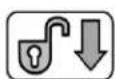
Loosen the chain brake
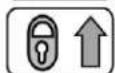
Activate the chain brake
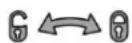
Lock/Unlock the chain cover
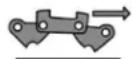
Prescribed running direction of the saw chain
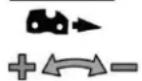
Increase/Reduce the Chain Tension
For your safety

WARNING!
Before using the garden tool, read and follow:
– these operating instructions,
– the user instructions of associated/ supplied accessories (charger, battery),
– the currently valid site rules and regulations for preventing accidents.
User
This garden tool is not intended for use by persons (including children) with reduced physical, sensory or mental capabilities or lack of experience and knowledge unless they have been given supervision or instruction concerning the use of the machine by a person responsible for their safety. Never allow children or people unfamiliar with these instructions to use the garden tool. Supervise children. That will ensure that children do not play with the device.
Intended use
This garden tool is
– intended for sawing wood and felling trees in the private sector exclusively,
– not suitable for sawing plastic, masonry or building materials which are not made of wood,
- not suitable for work above shoulder height
– to use according to this operating manual's descriptions and safety instructions.
Any other use is not as intended. Improper use is not covered by the warranty, and the manufacturer will reject any liability. The user is liable for all injuries to third parties and damage to their property. Operate the device only in the technical condition stipulated and delivered by the manufacturer. Operate the device only in the technical condition specified and provided by the manufacturer. Arbitrary changes to the device will exclude the manufacturer from any liability for resulting injury and/or damage.
General Power Tool Safety Warnings
WARNING!
Read all safety warnings and all instructions. Failure to follow the warnings and instructions may result in electric shock, fire and/or severe injury. Save all warnings and instructions for future reference.
The term "power tool" in all of the warnings refers to your mains-operated (corded) power tool or battery-operated (cordless) power tool.
Work area safety
- Keep the work area clean and well-lit. Cluttered and dark areas invite accidents.
- Do not operate power tools in explosive atmospheres, such as in flammable liquids, gases or dust. Power tools create sparks which may ignite the dust or fumes.
- Keep children and bystanders away while operating a power tool. Distractions can cause you to lose control.
Electrical safety
- Power tool plugs must match the outlet. Never modify the plug in any way. Do not use any adapter plugs with earthed (grounded) power tools. Unmodified plugs and matching outlets will reduce the risk of electric shock.
- Avoid body contact with earthed or grounded surfaces, such as pipes, radiators, ranges and refrigerators. There is an increased risk of electric shock if your body is earthed or grounded.
- Do not expose power tools to rain or wet conditions. Water entering a power tool will increase the risk of electric shock.
- Do not abuse the cord. Never use the cord for carrying, pulling or unplugging the power tool. Keep the cord away from heat, oil, sharp edges and moving parts. Damaged or entangled cords increase the risk of electric shock.
- When operating a power tool outdoors, use an extension cord suitable for outdoor use. Using a cord suitable for outdoor use reduces the risk of electric shock.
- If operating a power tool in a damp location is unavoidable, use a residual current device (RCD) protected supply. The use of an RCD reduces the risk of electric shock.
Personal safety
- Stay alert, watch what you are doing and use common sense when operating a power tool. Do not use a power tool while you are tired or under the influence of drugs, alcohol or medication. A moment of inattention while operating power tools may result in serious personal injury.
- Use personal protective equipment. Protective equipment such as dust masks, non-skid safety shoes, hard hats, and hearing protection for appropriate conditions will reduce personal injuries. Always wear eye protection.
- Prevent unintentional starting. Ensure the switch is off-position before connecting to a power source and/or battery pack, picking up or carrying the tool. Carrying power tools with your finger on the switch or energising power tools with the switch on invites accidents.
- Remove any adjusting key or wrench before turning the power tool on. A wrench or a key left attached to a rotating part of the power tool may result in personal injury.
- Do not overreach. Keep proper footing and balance at all times. That enables better control of the power tool in unexpected situations.
- Dress properly. Do not wear loose clothing or jewellery. Keep your hair, clothing and gloves away from moving parts. Loose clothes, jewellery or long hair, can be caught in moving parts.
- If devices are provided for connecting dust extraction and collection facilities, ensure these are connected and properly used. The use of dust collection can reduce dust-related hazards.
Power tool use and care
- Do not force the power tool. Use the correct power tool for your application. The right power tool will do the job better and safer at the rate for which it was designed.
- Do not use the power tool if the switch does not turn on and off. Any power tool that cannot be controlled with the switch is dangerous and must be repaired.
- Disconnect the plug from the power source and/or the battery pack from the power tool before making any adjustments, changing accessories, or storing power tools. Such preventive safety measures reduce the risk of starting the power tool accidentally.
-
Store idle power tools out of the reach of children and do not allow persons unfamiliar with the power tool or these instructions to operate the power tool. Power tools are dangerous in the hands of untrained users.
-
Maintain power tools. Poorly maintained power tools cause many accidents. Check for misalignment or binding of moving parts, breakage of parts and any other condition that may affect the power tool's operation. If damaged, have the power tool repaired before use?
- Keep cutting tools sharp and clean. Properly maintained cutting tools with sharp edges are less likely to bind and are easier to control.
- Use the power tool, accessories and tool bits etc., by these instructions, taking into account the working conditions and the work to be performed. Using the power tool for operations different from those intended could result in a hazardous situation.
Battery tool use and care
- Recharge only with the charger specified by the manufacturer. A charger suitable for one type of battery pack may create a risk of fire when used with another.
- Use power tools only with specifically designated battery packs. Using other battery packs may create a risk of injury and fire.
- When the battery pack is not in use, keep it away from other metal objects, like paper clips, coins, keys, nails, screws or other small metal objects, that can connect one terminal. Shorting the battery terminals together may cause burns or a fire.
- Under abusive conditions, liquid may be ejected from the battery; avoid contact. If contact accidentally occurs, flush with water. Liquid ejected from the battery may cause irritation or burns. If liquid contacts the eyes, additionally seek medical help.
Service
- Have your power tool serviced by a qualified repair person using only identical replacement parts. That will ensure that the safety of the power tool is maintained.
Safety instructions for Chain Saws
- When the saw is running, keep all body parts away from the saw chain. Before starting the saw, ensure that the saw chain touches nothing. When working with a chain saw, a moment of inattention may result in clothing or body parts being caught by the chain saw.
-
Always hold the chain saw with your right hand on the rear handle and your left hand on the front handle. Having the chain saw in reverse working position increases the risk of injuries and must be avoided.
-
Hold the electric power tool by the insulated handle surfaces, as the saw chain may contact hidden wiring. If the saw chain comes into contact with a live line, metallic parts of the device may become energised and cause an electric shock.
- Wear goggles and hearing protection. Additional head, hands, legs and feet protective equipment is recommended. Suitable protective clothing reduces the risk of injury from flying splinters and accidentally touching the saw chain.
- Do not work with the chain saw in a tree. When operating the chain saw in a tree, there is a risk of injury.
- Always ensure you have a firm footing and use the chain saw only when standing on solid, safe and level ground. Slippery ground or unsteady footing, such as on a ladder, may cause you to lose your balance or lose control of the chain saw.
- When cutting a branch under tension, expect it to spring back. When the tension in the wood fibres is released, the branch under tension may strike the operator and/or cause him to lose control of the chain saw.
- Be particularly careful when cutting undergrowth and young trees. Thin material may become caught in the saw chain and strike you or cause you to lose your balance.
- Carry the chain saw, switched off, by the front handle, ensuring that the chain saw is turned away from your body. Handle the chain saw carefully to reduce the likelihood of inadvertently touching the running saw chain. Always pull on the protective cover when transporting or storing the chainsaw. Follow the instructions for lubrication, tensioning the chain and changing the accessories. An improperly tensioned or lubricated chain may either snap or increase the risk of a kickback.
- Keep the handles dry, clean and free of oil and grease. Greasy and oily handles are slippery and will cause a loss of control.
- Saw wood only. Please do not use the chain saw for work that is not designed. Example: Do not use the chain saw for sawing plastic, masonry or building materials not made of wood. If the chain saw is not used as intended, this may result in hazardous situations.
Causes of and avoiding a kickback
A kickback can occur when the tip of the guide rail touches an object or the wood bends, and the saw chain becomes jammed in the cut. If the rail tip touches an object, this may occasionally cause an unexpected reaction
directed backwards, throwing the guide rail upwards and in the direction of the operator. If the saw chain jams on the upper edge of the guide rail, the rail may quickly recoil in the operator's direction.
These reactions may cause loss of control of the saw and potentially severe injuries. Do not rely solely on the safety devices integrated into the chainsaw. As a chain saw user, you should take various measures to work without the risk of accidents and injuries. A kickback occurs when the electric power tool is used incorrectly or erroneously. A kickback can be prevented by taking appropriate precautions, as described below:
- Holds the saw firmly with both hands, ensuring that your thumbs and fingers clasp the handles on the chain saw. Move your body and arms to a position where they can withstand the kickback forces. If appropriate measures are taken, the operator can control the kickback forces. Never release the chain saw.
- Avoid an abnormal body posture and do not saw above shoulder height. That will prevent you from unintentionally touching the rail tip and enable better control of the chain saw in unexpected situations.
- Use only replacement rails and saw chains stipulated by the manufacturer. Incorrect replacement rails and saw chains might cause the chain to snap and/or a kickback.
- Follow the manufacturer's instructions for sharpening and servicing the saw chain. If the depth limiter is too low, a greater tendency for a kickback occurs.
Additional safety instructions
- Before using the power tool, familiarise yourself thoroughly with the sawing technique of chain saws. Information can be found in the specialist literature. We recommend attending suitable training courses.
- This device is not designed to be used by persons (including children) who have limited physical, sensory or mental abilities or have inadequate experience and/or knowledge of the device unless they are supervised by a person responsible for their safety or they have been instructed by the person how to use the device. Children should be supervised to ensure that they do not play with the device.
- Switch the device off and remove the battery under the following conditions:
- if the device is left unattended;
- before checking, cleaning or performing other work on the device;
- if the device starts vibrating excessively.
- While sawing, ensure that no persons (particularly children) or animals are in the working area. Ensure that children do not play with the device.
- Check the terrain on which the device will be used and remove any stones and pieces of wire the chain could pick up the saw to avoid endangering people or wearing out the device.
- Ensure the saw chain does not touch the ground or other objects.
- When interrupting work, never leave the device unattended and keep it in a safe place.
• Always switch the chain saw off before transporting it to other workplaces. - Ensure that all guards and handles are fitted before using the device. Never attempt to switch on an incompletely assembled device or one with unauthorised modifications.
- Operate the device only in the technical condition stipulated and delivered by the manufacturer. Unauthorised changes to the device exclude the manufacturer's liability for any resulting damage and/or injury.
- Spare parts must conform to the requirements specified by the manufacturer. Therefore use original spare parts only or spare parts authorised by the manufacturer. Please follow the supplied installation instructions when replacing parts and remove the battery beforehand.
- Have repairs done exclusively by a qualified technician or a service centre.
Safety instructions for the battery charger
- Keep the battery charger away from rain or moisture. Water penetration in the battery charger increases the risk of an electric shock.
- Keep the battery charger clean. Contamination can lead to the danger of an electric shock.
- Before each use, check the battery charger, cable and plug. If the supply cord is damaged, it must be replaced by the manufacturer, its service agent or similarly qualified persons to avoid a hazard. Damaged battery chargers, cables and plugs increase the risk of an electric shock.
- Do not place any objects on the battery charger, and do not place the battery charger on soft surfaces. There is a risk of fire.
-
Always check that the mains voltage matches the voltage indicated on the rating plate of the battery charger.
-
Never use the charger if the cable, plug or external influences have damaged the device. Take the charger to the nearest service centre.
- Never open the battery charger. If the battery charger is defective, take it to a service centre.
Safety instructions for Li-ion batteries
- Do not open the battery. There is a risk of a short-circuit.
- Protect the battery from heat, e.g., continuous exposure to sunlight, fire, water and humidity. There is a risk of explosion.
- In case of damage and improper battery use, vapours may be emitted. The vapours can irritate the respiratory system. Ventilate the area and seek medical help in case of complaints.
- Under abusive conditions, liquid may be ejected from the battery; avoid contact. If contact accidentally occurs, flush with water. Liquid ejected from the battery may cause irritation or burns. If liquid contacts the eyes, additionally seek medical help.
- Use only original batteries with the voltage indicated on the rating plate of your electric power tool. If other batteries are used, e.g. imitations, reconditioned batteries or third-party products, there is a risk of injuries and damage caused by exploding batteries.
- The battery voltage must match the battery charging voltage of the battery charger. Otherwise, there is a risk of fire and explosion.
- Recharge only with the charger specified by the manufacturer. A charger suitable for one type of battery pack may create a risk of fire when used with another battery pack.
- Pointed objects, such as nails or screw- drivers, or external forces may damage the battery. That may cause an internal short-circuit and the battery to burn, smoke, explode or overheat.
Noise and vibration
i NOTE
Values for the A-weighted sound pressure level and the total vibration values can be found in the "Technical specifications" table.
CAUTION!
The indicated measurements refer to new power tools. Daily use causes the noise and vibration values to change.
i NOTE
The vibration emission level given in this information sheet has been measured by a standardised test given in EN 60745 and may be used to compare one tool with another. It may be used for a preliminary assessment of exposure. The declared vibration emission level represents the main applications of the tool. However, the vibration emission may differ if the tool is used for different applications, with different accessories or poorly maintained. This may significantly increase the exposure level over the total working period.
However, if the tool is used for different applications, with other accessories or poorly maintained, the vibration emission may differ. This may significantly decrease the exposure level over the total working period. Identify additional safety measures to protect the operator from the effects of vibration, such as maintaining the tool and the accessories, keeping the hands warm, and organising work patterns.
CAUTION!
Wear ear protection at a sound pressure above 85 dB(A).
Technical specifications
| Appliance | Chain saw | ||||
| Type | E212C | E214C | E216C | ||
| Nominal voltage | V= | 40 | |||
| Battery type | EP 20 | Ah | 2.0 | ||
| EP 40 | Ah | 4.0 | |||
| EP 60 | Ah | 6.0 | |||
| Chain speed (no load) | m/s | 10 | |||
| Saw rail length | mm | 310 | 360 | 410 | |
| Amount of drive links | 45 | 52 | 57 | ||
| Oil tank volume | ml | 160 | |||
| Weight according to "EPTA Procedure 01/2003" (without battery, saw rail and saw chain) | kg | 4.5 | |||
| Weight battery | EP 20 | kg | 0.9 | ||
| EP 40 | kg | 1.3 | |||
| EP 60 | kg | 1.7 | |||
| A-weighted sound pressure level according to ISO 22868, EN 3744: | |||||
| Sound pressure level LpA | dB(A) | 89 | |||
| Sound power level LwA | dB(A) | 103 | |||
| Uncertainty K | dB | 3 | |||
| Total vibration value according to ISO 22867: | |||||
| Emission value ah | m/s^2 | 3.5 | |||
| Uncertainty K | m/s^2 | 1.5 | |||
Overview
Different chain saws are described in these instructions. The illustrated chain saw may differ in detail from the one you purchased.
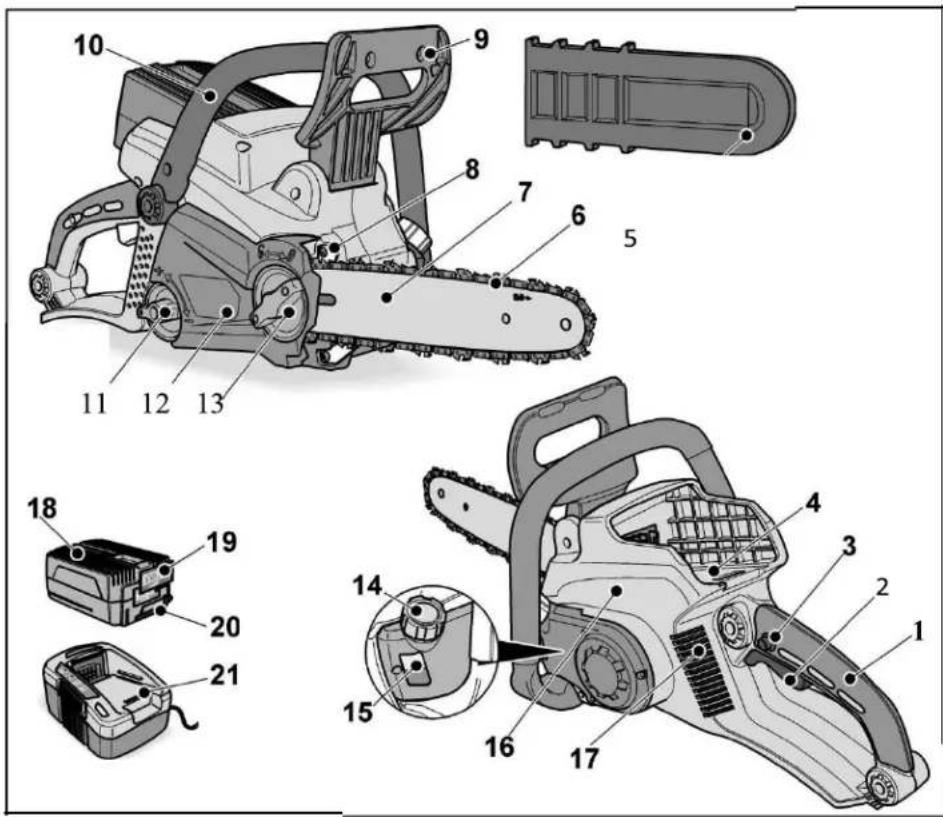
1 Rear handle
2 On/Off button
3 Switch interlock
4 Insertion slot for battery
5 Protection hood
6 Saw chain
7 Saw rail
8 Spiked bumper
9 Hand guard/chain brake
10 Handlebar
11 Chain tensioning wheel
12 Chain cover
13 Handwheel
14 Oil tank cover
15 Oil tank with oil level indicator
16 Housing
17 Ventilation openings
18 Battery*
EP20 (2,0 Ah), EP40 (4,0 Ah), EP60 (6,0 Ah)
19 Release button for battery
20 LED state of charge indicator
21 Battery charger *
* Optional. Depending on the delivery scope.
Instructions for use
WARNING!
Switch the device off and remove the battery under the following conditions:
- if the device is left unattended;
– before checking, cleaning or performing other work on the device; - if the device starts vibrating excessively.
Before initial operation
Unpack the garden tool and accessories and ensure no parts are missing or damaged.
i NOTE
The batteries (optional - depending on delivery scope) are not fully charged on delivery. Before initial operation, charge the batteries fully. See the user manual of the battery charger. Adjustments before using delete this line
Assembling
Attaching saw rail and saw chain
WARNING!
- The teeth on the saw chain are very sharp! Wear protective gloves when per-forming any work on the chain. Risk of injury!
-
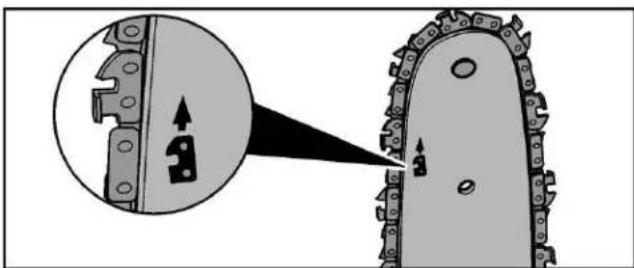
An incorrectly attached saw chain will cause the power tool to cut in an uncontrolled manner! When attaching the chain, observe the specified running direction!
-
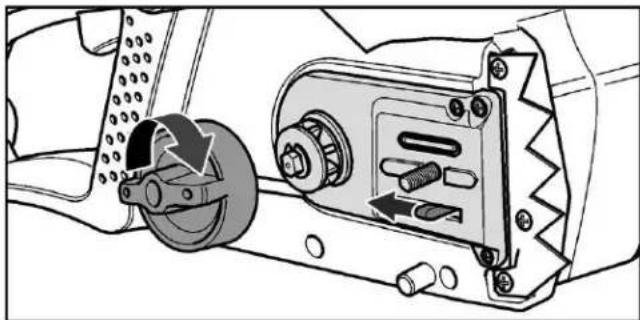
Place the chain saw on any suitable flat surface.
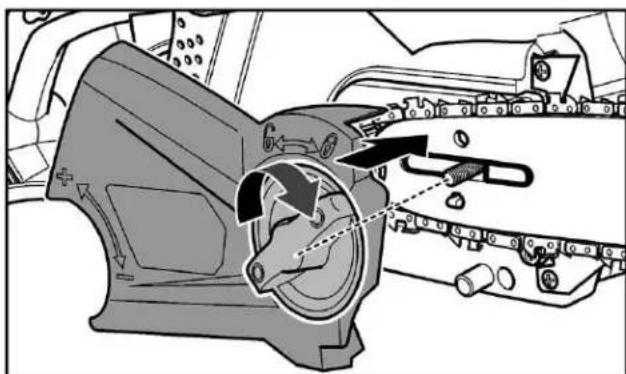
- Detach the handwheel (1.) and remove the chain cover (2.).
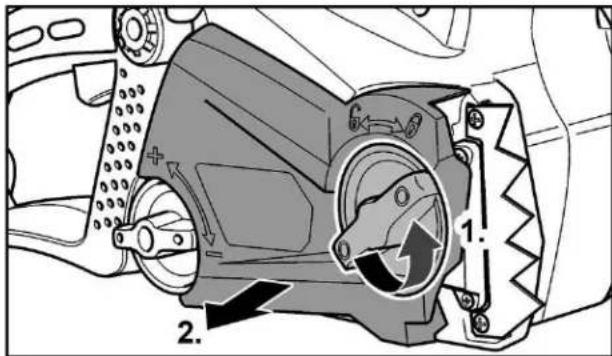
- Turn the chain tensioning wheel clockwise to push the saw rail as far as possible onto the chain wheel.
natural_image
Mechanical assembly diagram showing a gear and motor components (no text or labels)- Place the saw chain around the saw rail, starting on the upper part of the rail. Slide the chain in the slot around the saw rail. When attaching the chain, ensure that it is in the correct running direction.
When attaching the chain, ensure that it is in the correct running direction
natural_image
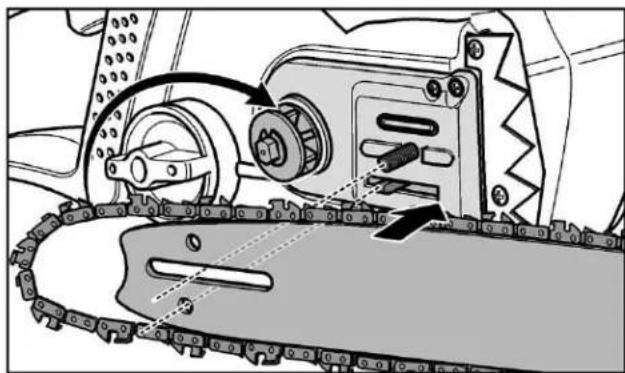
Diagram showing a gear meshing process with an inset close-up of the main gear (no text or symbols present)- Place the elongated hole of the saw rail on the stud bolt a and the guide bolt b on the chain saw.
- Place the saw chain around the chain wheel.
natural_image
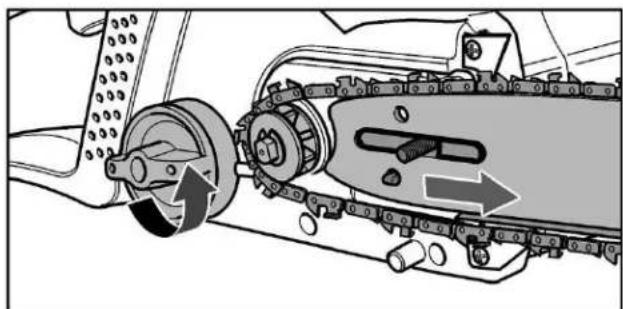
Mechanical assembly diagram showing a chain link and gear mechanism (no text or symbols)- Tighten the chain tensioning wheel anti-clockwise to tension the chain. The saw chain must not sag, but it should be possible to pull it 2-4 millimetres off the saw rail in the middle of the saw rail.
natural_image
Mechanical assembly diagram showing a chain drive mechanism with pulleys and gears (no text or symbols)- Turn the saw chain by hand to check that it runs perfectly. It must slide freely in the rail.
- Attach the chain guard. Tighten the handwheel to attach the rail and the cover.
natural_image
Mechanical assembly diagram showing a motor and gear mechanism with no visible text or symbolsNOTE
Check and re-adjust the tension of a new chain after working for a few minutes. Switch the motor off, remove the battery and actuate the chain brake.
Pour in chain oil
CAUTION!
- Fill the device only with an environmentally compatible quality chain and bar lubricant (according to RAL-UZ48).
- Do not use waste oil. Renewed contact with waste oil can cause skin cancer. Waste oil is environmentally harmful. Waste oil does not have the necessary lubricating properties and is unsuitable for chain lubrication.
- An oil other than the one recommended may damage the rail, the chain and the lubricating system.
- Ensure that dirt does not get into the oil tank.
– Avoid spilling oil. Always wipe up any spilt oil.
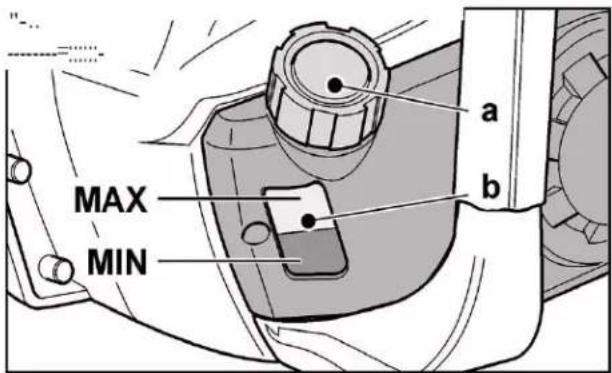
- Unscrew the oil tank cap (a).
- Carefully pour in the chain lubricating oil until it reaches the upper mark on the oil level indicator (b).Tank volume: max. 160 ml
- Tighten the oil tank cap (a) by hand.
Inserting/replacing the battery
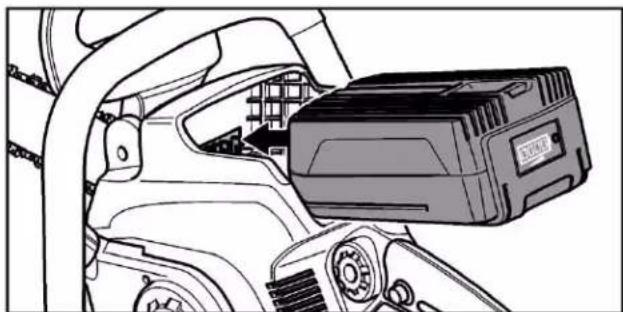
- Charging the battery as described in the user manual of the charger.
- Press the charged battery into the power tool until it clicks into place.
natural_image
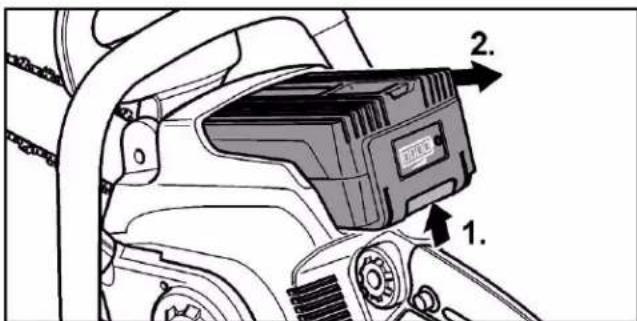
Technical line drawing of a car interior showing dashboard and engine compartment with a mounted device (no text or symbols visible)•To remove, press the release button (1.) and pull out the battery (2.).

CAUTION!
Protect the battery contacts when the battery is not being used. Loose metal parts may short-circuit the contacts - Explosion and fire hazard!
Chain brake

WARNING!
Before using the chain saw, always check that the brake is in perfect working order. Otherwise, please do not use the chain saw and have it repaired by a qualified technician or a service centre. The chain saw features a safety chain brake which stops the chain within a fraction of a second in the event of a kickback. If a kickback occurs, the chain brake is automatically actuated by touching the hand guard with your left hand.
Therefore always hold the chain saw firmly with both hands.
Manually activating the chain brake
- Tilt the hand guard towards the saw rail tip
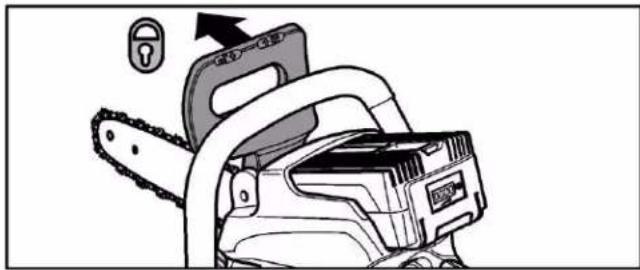
natural_image
Diagram of a chain-linking gear with a lock and padlock, showing mechanical components without any text or symbols.Loosening the chain brake
- Pull the hand guard towards the handlebar.
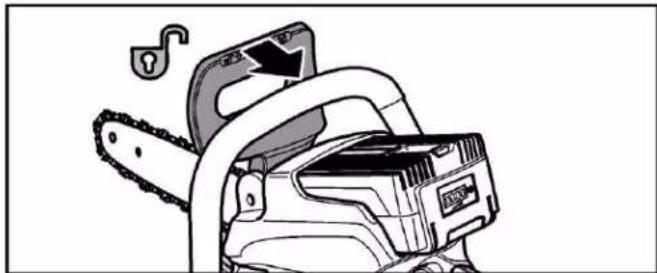
natural_image
Illustration of a chain-linking gear with a lock icon above (no text or symbols)Checking the chain brake
- Place the chain saw on a secure surface.
- Loosen the chain brake.
- Hold the chain saw with both hands.
- Switch the chain saw on. The saw chain runs.
- Tilt the hand guard towards the saw rail tip.
The chain must stop immediately! Otherwise, do not use the chain saw and have it repaired by a qualified technician or a service centre.
• After work, regularly remove sawdust and saw waste from the visible mechanisms of the chain brake.
Lubricating the chain

CAUTION!
The device may be operated with adequate chain lubricating oil only. Inadequate lubrication will reduce the service life of the power tool.
- Check the amount of oil on the oil level indicator.
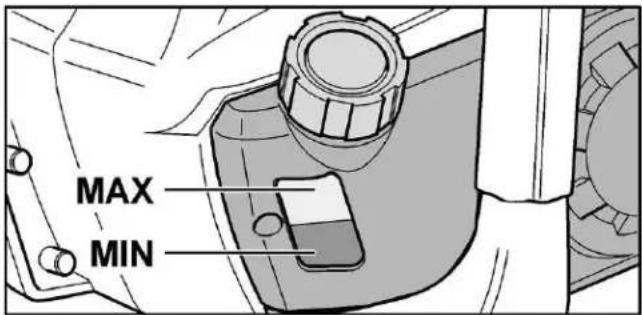
Topping up the chain oil
!
- Fill the device only with an environmentally compatible quality chain and bar lubricant (according to RAL-UZ48).
- Do not use waste oil. Renewed contact with waste oil can cause skin cancer. Waste oil is environmentally harmful. Waste oil does not have the necessary lubricating properties and is unsuitable for chain lubrication.
- An oil other than the one recommended
- Ensure that dirt does not get into the oil tank.
- Avoid spilling oil. Always wipe up any spilt oil.
- Check on the transparent oil level indicator (b) whether there is still adequate chain oil for lubrication may damage the rail, the chain and the lubricating system.
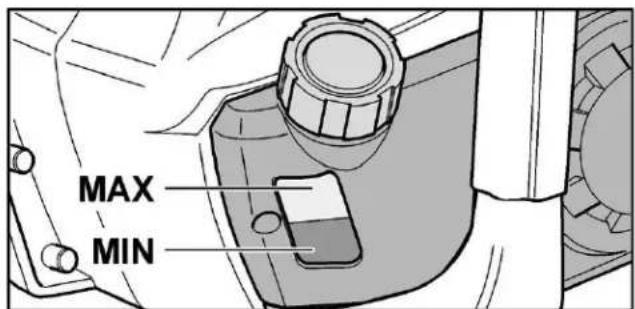
- Unscrew the oil tank cap (a). Before opening, clean the tank cap and inlet nozzle if required.
- Carefully pour in the chain lubricating oil until it reaches the upper mark on the oil level indicator (b).
- Tighten the oil tank cap (a) by hand.
- Check the chain oil level even during operation and top up with chain oil if required.
Checking the chain lubrication
- Start the device (see section "Switching on/ off the power tool").
- Hold the running saw chain for some time approx. 15 ~cm above a suitable surface. If there is adequate chain lubrication, the oil which is ejected by the saw chain will form a light trail.
Switching on/off the power tool
Switching on
WARNING!
Ensure that the saw chain has not yet been positioned for cutting and is not touching any other objects. Risk of injury!
- Hold the chain saw firmly with both hands and ensure that there are no people (particularly children) or animals in the immediate vicinity.
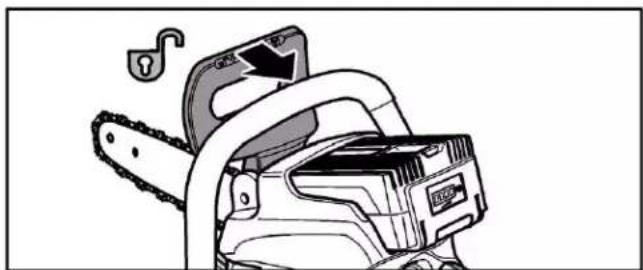
- Ensure that the chain brake is released before starting the chain saw. To do this, pull the hand guard back towards the handlebar.
natural_image
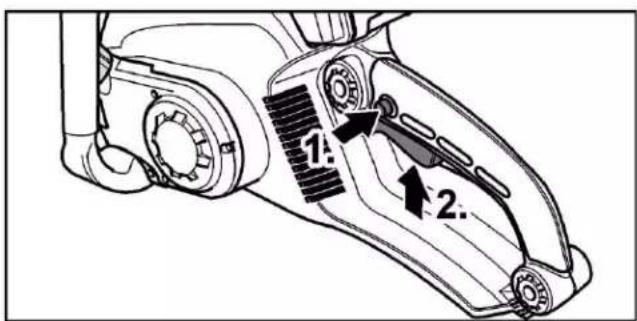
Line drawing of a chain-linking machine with chains and a lock icon (no text or symbols)- Press the release button and hold down (1.).
- Press the rear On/Off switch (2.). The saw chain runs.
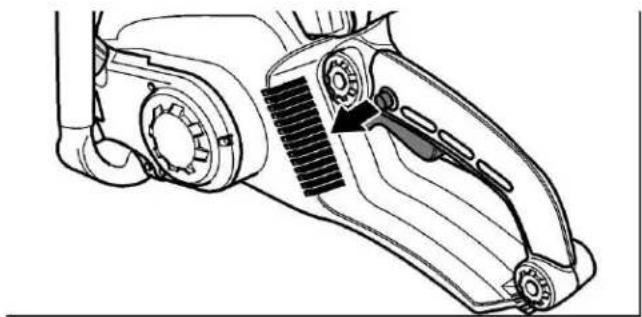
- rerelease the release button.
natural_image
Technical line drawing of a mechanical device with gear and adjustment knob (no text or symbols)Switching off
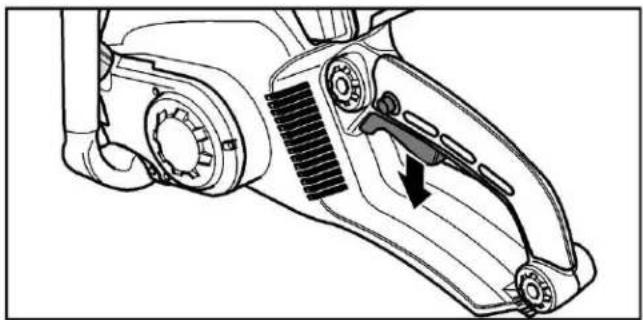
- Release the On/Off switch.
natural_image
Technical line drawing of a mechanical component with internal parts and directional arrow (no text or symbols)Battery state of charge
- Press the button on the battery to check the state of charge at the state of charge
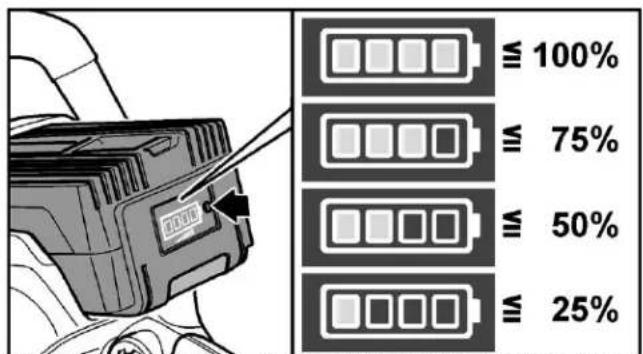
The indicator goes out after 5 seconds. If one of the LEDs flashes, the battery must be recharged. If none of the LEDs lights up after the button is pressed, the battery is faulty and must be replaced.
Using the device
WARNING!
Before using the power tool, familiarise
yourself thoroughly with the sawing technique of chainsaws (see section "Basic working technique"). Risk of injury!
Never allow children to operate the chain saw. Allow no person to use this chain saw who has not read this user manual or received adequate instructions for safe and proper use.
We recommend attending suitable training courses. The information listed here is only additional!
Before each use
- Check that all parts of the power tool are present, firmly attached and undamaged.
- Check that the chain tension is correct.
- Check that the chain brake functions.
- Check the chain lubrication.
- Check that there are no leaks.
Correct posture
Risk of injury!
- Never work on the unstable ground!
– Never work above shoulder height! - Never work while standing on a ladder!
- Do not bend too far forwards when working!
- Use the power tool only when the weather conditions and terrain are favourable!
- Stand with both legs firmly on the ground.
- Beware of obstructions in the working area.
- When working, always hold the power tool with both hands!
- Hold the power tool:
– with the left hand on the hand grip.
– with the right hand on the handle.
– in a balanced position with your feet firmly on the ground.
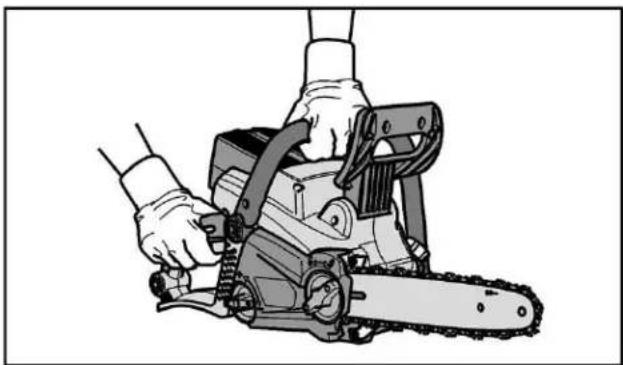
natural_image
Illustration of hands operating a chain-linking machine (no text or symbols visible)That is how to use the saw correctly!
- Look over the working area and remove any obstructions.
- Before starting work, check the safety of the power tool (see "Before each use").
- Pick up the power tool in both hands as specified.
- Switch the chain saw on before starting the cut.
- Apply uniform pressure to the device, however, not excessive force.
- If possible, place the device's tree claw on the branch to be sawn.
After use
Risk of injury!
Always switch the motor off before you put the power tool down! When the On/Off switch is released, the saw chain continues running briefly.
- Stop the engine.
- Wait until all rotating parts have come to a standstill.
- Remove the battery.
- Place the sheath on the cutting mechanism.
- Activate chain brake.
- Leave the power tool to cool down.
Basic working technique

Risk of injury!
This section deals with the basic working technique when handling the power tool.
The information given here does not replace a specialist's extensive training and experience.
Avoid any work for which you are not adequately qualified! Imprudent handling of the power tool may result in extremely serious to fatal injuries!
Sawing technique
Pull stroke sawing
With this technique, the underside of the saw rail saws from top to bottom
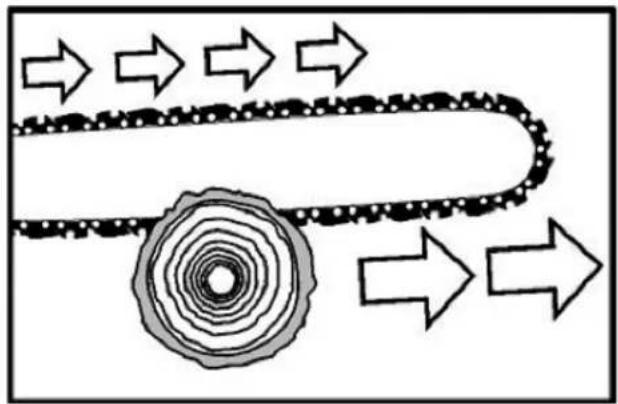
natural_image
Diagram showing a chain with circular patterns and directional arrows, no text or symbols presentThe saw chain pushes the power tool forwards away from the user. The power tool's front edge forms a support that absorbs the forces that occur when sawing on the tree trunk.
In pull stroke sawing, the user has much more control over the power tool and can better avoid kickbacks. Therefore this sawing technique should be used preferably.
Push stroke sawing
With this technique, the upper side of the saw rail saws from bottom to top.
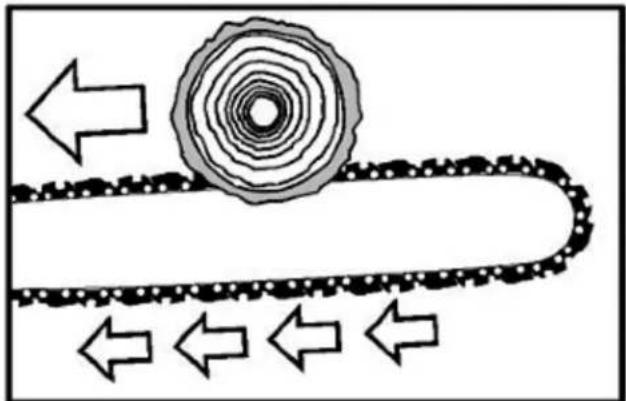
natural_image
Diagram of a chain drive with a gear-like structure and directional arrows indicating motion (no text or symbols)The saw chain pushes the power tool backwards towards the user.

WARNING!
If the saw rail jams, the power tool may be thrown back towards the user with great force. If the user does not use his physical strength to compensate for the force of the saw chain pushing backwards, there is a risk that only the tip of the saw rail will contact the wood and cause a kickback. Risk of death or highly severe injuries!
Felling a tree

Risk of Injury!
Felling and limbing work may be performed by trained persons only! There is a risk of life-threatening injuries! Before starting felling work, ensure that:
– there are no unauthorised persons and no animals within the fall area (A) of the tree;
– there is an obstacle-free escape route for all those involved. People withdraw (B) at an angle opposite the direction of fall;
– the area around the trunk is free of obstacles (risk of tripping!);
- the next workplace is at least two and a half tree lengths away. Before felling the tree, check the direction in which the tree will fall and ensure that there are neither objects nor persons or animals within a distance of 2 12 tree lengths.
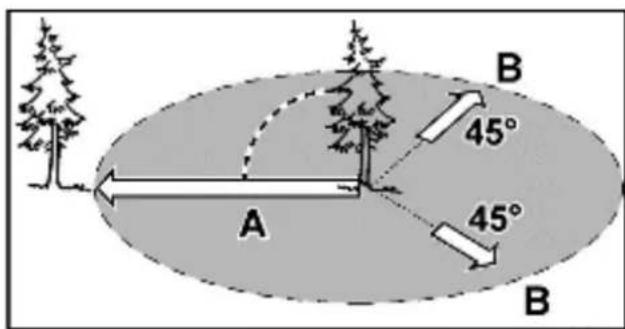
A tree is felled in two stages:
- Notch the trunk by approx. One-third of its diameter is on the side of the direction of the fall (1.).
- On the opposite side, make the felling cut (2.), which must be slightly higher than the notch (approx. 3-5 cm).
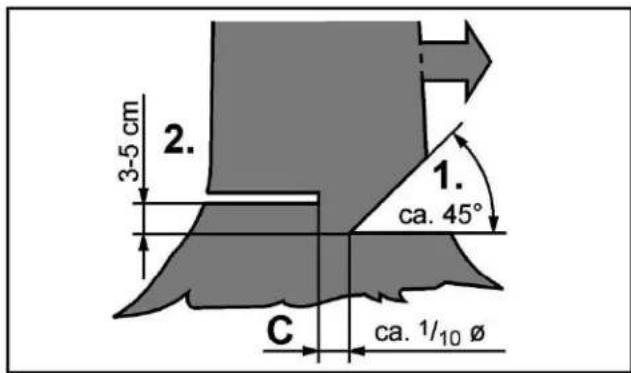
Risk of injury!
Never saw the tree trunk all the way through. The area (C) is used as a "hinge" and provides a defined direction of fall. When felling, stand only at the side of the tree to be felled! There is a risk of life- threatening injuries!
Trunks lying flat on the ground
- Cut halfway into the trunk, then turn around and saw through from the opposite side.
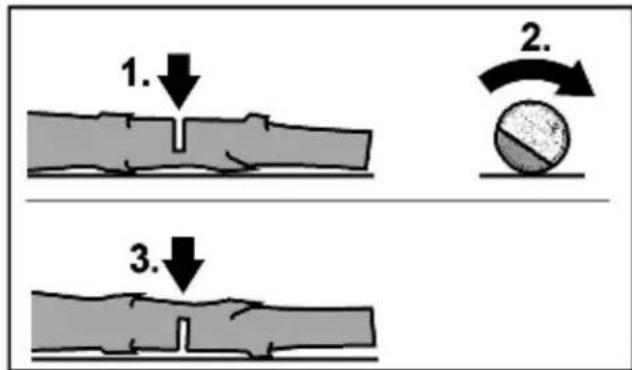
⚠️ Damage to power tool!
Ensure the saw rail does not touch the ground when sawing through the trunk!
Supported trunks
We recommend supporting trunks, which are to be sawn through on sawhorses. If this is not possible, the trunk should be raised and supported with the aid of the supporting branches or via support blocks.
- In area A, first cut approx. one-third of the trunk diameter from top to bottom,
then complete the cut from bottom to top.
- In area B, first cut approx. one-third of the trunk diameter from bottom to top, then cut through from the top.
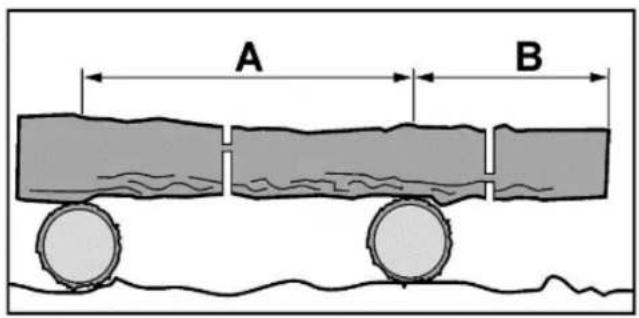

Risk of injury!
Do not saw trunks which are under tension! Splintering wood or a jammed saw rail may result in severe injuries!
Removing branches
• Always work on the side opposite the branch in question.
- Start at the bottom of the trunk and work upwards.
- 10-15 cm from the base of the branch saw upwards into the branch 1/3 of the branch diameter (1.).
- A little further up the branch, saw through the branch from top to bottom (2.).
- Make a cut close to the trunk (3.). Cut top to bottom.
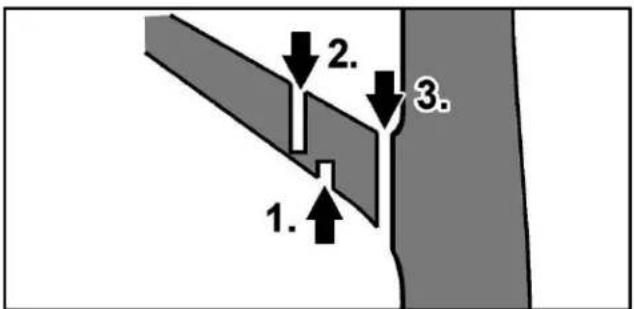
- When limbing trunks lying flat on the ground, first always saw off the branches pointing upwards. Do not cut through supporting branches until the trunk has been shortened.

Risk of injury!
Branches supported or under tension may wedge the saw chain in the wood!
Maintenance and care

WARNING!
Before performing any work on the garden tool, remove the battery.
Risk of injury by the sharp cutters! Wear protective gloves.

n the interest of your safety!
Perform only the maintenance work described here yourself. All other work, in particular motor maintenance and repairs, must be performed by a trained specialist. Improper work may damage the power tool and also result in injuries. Has the power tool been inspected once a year at a service centre?
Overview of cleaning and maintenance
After using the power tool
- Clean the device.
Regularly, depending on the application conditions
- Tension the saw chain.
- Clean the oil guide groove in the saw rail.
- Regrind saw chain.
- Check saw chain oil level. Top up if required.
Cleaning

WARNING!
Do not use water or liquid detergents.

CAUTION!
Clean the device after every use. Failure to clean the device can damage the materials and cause malfunctions.
- Clean the device with a damp cloth and a soft brush.
- Remove the chain cover, and then use a soft brush to remove debris from the saw rail, saw chain, chain wheel and chain cover.
- Keep the ventilation slits clean and dust-free.
Servicing
Tensioning the saw chain
The saw chain must not sag, but it should be possible to pull it 2-4 millimetres off the saw rail in the middle of the saw rail.
- Unscrew the handwheel anti-clockwise until the saw rail can be moved by hand.
- Turn the chain tensioning wheel on anti-clockwise to tension the chain.
- Turn the saw chain by hand to check that it runs perfectly. It must slide freely in the rail.
- Tighten the handwheel to attach the rail and the cover.
NOTE
Check and re-adjust the tension of a new chain after working for a few minutes.
Switch the motor off, remove the battery and actuate the chain brake.
Cleaning oil guide groove in the saw rail
- Remove the saw rail.
- Remove dirt from the oil guide groove using a suitable tool. Use a plastic spatula, not a steel tool!
• Re-attach the saw rail.
Regrinding saw chain
Special tools are required to sharpen the saw chain and guarantee that the blades of the chain are sharpened at the correct angle and to the correct depth. We recommend having the saw chain reground by a specialist.
Spare parts
| Saw rail | Saw chain | |
| 310mm (12") | 120SDEA041 | 91PJ045X91PX045X |
| 360mm (14") | 140SDEA041 | 91PJ052X91PX052X |
| 410mm (16") | 160SDEA041 | 91PJ057X91PX057X |
Storage
- Store the device in a dry, frost-free place (10-25 °C).
- Store the battery and the device separately.
- Charge the battery before storing the device in winter.
- For a prolonged period of non-use, drain the chain lubricating oil out of the power tool.
- Place the sheath on the cutting mechanism.
- Keep the device, particularly its plastic components, away from brake fluids, petrol, petroleum products, penetrating oil, etc. They contain chemical substances which may damage, attack or destroy the plastic components of the device.
- Fertilisers and other garden chemicals contain substances which may have a highly corrosive effect on the metal parts of the device. Therefore do not store your device near these substances.
Repairs
Check the device for damage. Repairs may be carried out by an authorised customer service centre only.
Disposal Informaion

WARNING!
Render redundant garden tools unusable:
- mains operated tool by removing the power cord,
– battery-operated tool by removing the battery.

EU countries only:
Do not throw electric power tools into the household waste! By the European Directive 2012/19/EC on Waste Electrical and Electronic Equipment and transposition into national law, used electric power tools must be collected separately and recycled in an environmentally friendly manner.

Recycling raw materials instead of waste disposal.
Devices, accessories and packaging should be recycled in an environmentally friendly manner. Plastic parts are identified for recycling according to material type.

WARNING!
Do not throw accumulators/batteries into the household waste, fire or water. Do not open disused batteries. Accumulators/batteries should be collected, recycled or disposed of in an environmentally friendly manner.
EU countries only:
By Directive 2006/66/EC, defective or used batteries must be recycled.

NOTE
Please ask your dealer about disposal options!
Guarantee
This product has been manufactured to the highest quality standards. When a new product is purchased, a 24-month manufacturer's warranty is guaranteed, which comes into force on the date the product was purchased. The guarantee covers only defects attributed to a material and/or production fault and non-performance of warranted characteristics. When claiming the guarantee, enclose the original sales receipt with the purchase date. Repairs under warranty may be carried out only by workshops or service centres authorised by the manufacturer. A claim may be made under the guarantee only if the power tool has been used as intended.
This warranty is invalid where defects are caused by or result from:
– misuse, abuse or neglect;
– commercial use (industry, craft, rental)
– repairs attempted by unauthorized repair centres
– damage caused by external effects, foreign objects, substances or accidents.
C E-declaration of conformity
We declare that the product described in Technical Data
E212C E214C E216C
- Producer: Fuxtec GmbH
KappstraBe 69
71083 Herrenberg/ Germany
- Conforms with the
following directives: Machinery Directive 2006/42/EC
Outdoor Directive 2000/14/EC
EMC Directive 2014/30/EU
- In accordance to the
following applicable harmonized
standards: EN 60745-1:2010
EN 60745-2-13:2010
EN 55014-1:2011
EN 55014-2:2008
The conformity assessment procedure verifies the conformity with the Machinery Directive according to Directive 2006/42/EC.
The conformity assessment procedure verifies the conformity with the Noise Emission of Outdoor Equipment Directive according to Annex V and Directive 2000/14/EC.
-
Measured sound power level: 99,9 dB(A)
-
Guaranteed sound power
level: 103 dB(A)
EP20 (2,0 Ah), EP40 (4,0 Ah), EP60 (6,0 Ah)
natural_image
Mechanical assembly diagram showing a wheel and gear mechanism (no text or symbols)natural_image
Diagram of a chain drive mechanism showing gear and blade assembly (no text or symbols)natural_image
Mechanical assembly diagram showing a chain link mechanism with no visible text or symbolsnatural_image
Mechanical assembly diagram showing a chain drive mechanism with pulleys and gears (no text or symbols)natural_image
Mechanical assembly diagram showing a rotating component and chain connection (no text or symbols)i NOTE
natural_image
Diagram of a vehicle interior showing a car's front wheel, dashboard, and internal components (no text or symbols)natural_image
Diagram of a chain-link robotic device with a lock icon and gear mechanism (no text or symbols)natural_image
Illustration of a chainsaw with a gear handle and chainmail (no text or symbols)Controllo del freno catena
natural_image
Technical illustration of a chain-linking tool with a lock and padlock (no text or symbols)natural_image
Technical line drawing of a mechanical device with gear and adjustment knob (no text or symbols)Spegnimento
natural_image
Technical line drawing of a mechanical device with internal components and a directional arrow (no text or symbols)natural_image
Illustration of hands operating a chain-linking machine (no text or symbols visible)natural_image
Diagram of a chain with circular patterns and directional arrows, no text or symbols presentnatural_image
Diagram of a chain with a gear-like structure and directional arrows indicating motion (no text or symbols)18 Accumulateur *(EP20 (2,0 Ah), EP40 (4,0 Ah), EP60 (6,0 Ah))
natural_image
Mechanical assembly diagram showing a wheel and gear mechanism (no text or symbols)natural_image
Diagram showing a mechanical chain with gear and mesh components, including an inset close-up of a gear mechanism (no text or symbols)natural_image
Mechanical assembly diagram showing a chain track with gear and pulley components (no text or symbols)natural_image
Mechanical assembly diagram showing a chain drive mechanism with no visible text or symbolsnatural_image
Mechanical assembly diagram showing gear meshing and rotational motion (no text or labels)i REMARQUE
natural_image
Diagram of a car interior showing a vehicle's seatbelt with a mounted device (no text or symbols visible)PRUDENCE!
natural_image
Diagram of a chain-linking tool with a lock icon and gear mechanism (no text or symbols)natural_image
Illustration of a chainsaw with a gear and lock, showing mechanical components without any text or symbols.natural_image
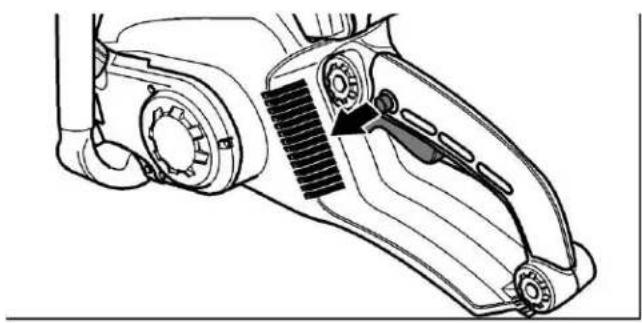
Technical illustration of a chain saw with a lock and padlock (no text or symbols)- Relâchez le cran anti-enclenchement.
natural_image
Technical line drawing of a mechanical device with gear and adjustment lever (no text or symbols)Éteindre
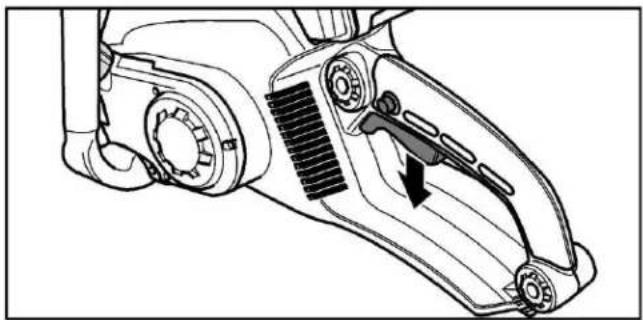
- Release the On/Off switch.
natural_image
Technical line drawing of a mechanical device with internal components and directional arrow (no text or symbols)natural_image
Illustration of hands operating a chain-linking machine (no text or symbols visible)natural_image
Diagram of a chain with circular patterns and directional arrows, no text or symbols presentnatural_image
Diagram of a chain drive with gear and pulley, showing motion arrows (no text or symbols)- Conforme aux directives
natural_image
Mechanical assembly diagram showing a gear shift mechanism with no visible text or symbolsnatural_image
Diagram showing a mechanical chain cutting process with an inset magnified view of the cut edge (no text or symbols)natural_image
Mechanical assembly diagram showing a chain track with gear and pulley components (no text or symbols)natural_image
Mechanical assembly diagram showing a chain drive mechanism with pulleys and gears (no text or symbols)natural_image
Mechanical assembly diagram showing gear meshing and gear alignment (no text or labels)i NOTAS
natural_image
Interior view of a vehicle dashboard with a mounted electronic device (no visible text or symbols)!ATENCIÓN!
natural_image
Technical illustration of a chain saw with a lock and gear mechanism (no text or symbols)natural_image
Line drawing of a chain-linking machine with chains and a key (no text or symbols)natural_image
Technical illustration of a chain-linking tool with a lock and padlock (no text or symbols)natural_image
Technical line drawing of a mechanical device with gear and adjustment lever (no text or symbols)Apagado
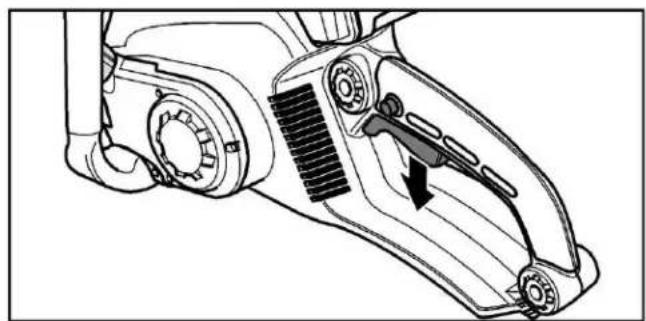
- Suelte el interruptor de on/off.
natural_image
Technical line drawing of a mechanical device with internal components and a directional arrow (no text or symbols)natural_image
Illustration of hands operating a chain-linking machine (no text or symbols visible)natural_image
Diagram showing a chain with circular patterns and directional arrows, no text or symbols presentnatural_image
Diagram of a chain drive with a gear-like mesh and directional arrows indicating motion (no text or symbols)



- i HINWEIS
- Gerät ausschalten
- Symbols used in this manual
- WARNING!
- CAUTION!
- NOTE
- Symbols on the power tool
- For your safety
- User
- Intended use
- General Power Tool Safety Warnings
- Work area safety
- Electrical safety
- Personal safety
- Power tool use and care
- Battery tool use and care
- Service
- Safety instructions for Chain Saws
- Causes of and avoiding a kickback
- Additional safety instructions
- Safety instructions for the battery charger
- Safety instructions for Li-ion batteries
- Noise and vibration
- i NOTE
- Overview
- Instructions for use
- Before initial operation
- Assembling
- Attaching saw rail and saw chain
- Pour in chain oil
- Inserting/replacing the battery
- Chain brake
- Manually activating the chain brake
- Loosening the chain brake
- Checking the chain brake
- Lubricating the chain
- Topping up the chain oil
- !
- Checking the chain lubrication
- Switching on/off the power tool
- Switching on
- Switching off
- Battery state of charge
- Using the device
- Before each use
- Correct posture
- Risk of injury!
- That is how to use the saw correctly!
- After use
- Basic working technique
- Sawing technique
- Pull stroke sawing
- Push stroke sawing
- Felling a tree
- Trunks lying flat on the ground
- ⚠️ Damage to power tool!
- Supported trunks
- Removing branches
- Maintenance and care
- n the interest of your safety!
- Overview of cleaning and maintenance
- After using the power tool
- Regularly, depending on the application conditions
- Cleaning
- Servicing
- Tensioning the saw chain
- Cleaning oil guide groove in the saw rail
- Regrinding saw chain
- Storage
- Repairs
- Disposal Informaion
- EU countries only:
- Recycling raw materials instead of waste disposal.
- Guarantee
- C E-declaration of conformity
- E212C E214C E216C
- Controllo del freno catena
- Spegnimento
- i REMARQUE
- PRUDENCE!
- Éteindre
- i NOTAS
- !ATENCIÓN!
- Apagado
Brand : Fuxtec
Model : E212C
Category : Saw