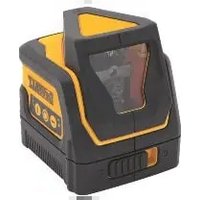
DW0811 - Laser level DEWALT - Free user manual and instructions
Find the device manual for free DW0811 DEWALT in PDF.



| Product Type | Self-leveling cross-line laser level |
| Model | DW0811 (LR/LG variants) |
| Brand | DeWALT |
| Power Source | 4 AA batteries (1.5 V) or 12 V MAX* Li-Ion rechargeable battery pack |
| Light Source | Laser diodes (red for LR, green for LG) |
| Wavelength | 620-690 nm (red) or 510-530 nm (green) |
| Laser Class | Class 2 (≤1.50 mW per beam) |
| Range (without detector) | Up to 20 m (red) or 35 m (green) |
| Range (with detector) | Up to 50 m |
| Accuracy (level and plumb) | ± 3 mm per 10 m (± 1/8 in per 33 ft) |
| Self-leveling range | ± 4° |
| Operating temperature | -10 °C to 50 °C (14 °F to 122 °F) |
| Storage temperature | -20 °C to 60 °C (-5 °F to 140 °F) |
| Protection rating | IP65 (water and dust resistant) |
| Mounting thread | 1/4 in - 20 and 5/8 in - 11 |
| Main functions | Horizontal and vertical (lateral) beam, magnetic pivoting bracket, battery charge indicator |
| Maintenance and cleaning | Clean with a soft, dry cloth. Do not use solvents. |
| Safety | Class 2 laser: do not stare directly into the beam. Use personal protective equipment. |
| Spare parts and repairability | Repairs by authorized DeWalt service centers. Disassembly voids warranty. |
| Warranty | See www.DEWALT.com for details. |
Frequently Asked Questions - DW0811 DEWALT
User questions about DW0811 DEWALT
0 question about this device. Answer the ones you know or ask your own.
Ask a new question about this device
Download the instructions for your Laser level in PDF format for free! Find your manual DW0811 - DEWALT and take your electronic device back in hand. On this page are published all the documents necessary for the use of your device. DW0811 by DEWALT.
USER MANUAL DW0811 DEWALT
DW089LR, DW089LG 3 x 360° Line Laser DW0811LR, DW0811LG 2 x 360° Line Laser
| E |
| ES |
| F |
| PT |
www.DEWALT.com
Please read these instructions before operating the product.

Figures
A
B


©
D
E
Figures

①
②

③

L


Figures
M


N
①
2
③

E Contents
- Laser Information
- User Safety
- Battery Safety
- Powering the Laser
- Operating Tips
- Turning the Laser ON
- Checking Laser Accuracy
• Using the Laser - Troubleshooting
- Accessories
• Service and Repairs
• Warranty - Specifications
Laser Information
The DW089LR/DW089LG 3-Beam 360° Line Laser and the DW0811LR/DW0811LG 2-Beam 360° Line Laser are Class 2 laser products. The lasers are self-leveling laser tools that can be used for horizontal (level) and vertical (plumb) alignment projects.
Each product complies with 21 CFR 1040.10 and 1040.11 except for deviations pursuant to laser notice No. 50, dated June 24, 2007.
Conforms to UL STDS 61010-1 & 2595
Certified to CSA STD C22.2 No. 61010-1
Supplier's Declaration of Conformity
47 CFR § 2.1077 Compliance Information
Unique Identifier: DW089LR, DW089LG, DW0811LR, DW0811LG
Responsible Party – U.S. Contact Information
DEWALT
701 East Joppa Road
Towson, Maryland 21286
www.DEWALT.com
FCC Compliance Statement
This equipment has been tested and found to comply with the limits for a Class B digital device, pursuant to Part 15 of the FCC Rules. These limits are designed to provide reasonable protection against harmful interference in a residential installation. This equipment generates, uses and can radiate radio frequency energy and, if not installed and used in accordance with the instructions, may cause harmful interference to radio communications. However, there is no guarantee that interference will not occur in a particular installation. If this equipment does cause harmful interference to radio and television reception, which can be determined by turning the equipment off and on, the user is encouraged to try to correct the interference by one or more of the following measures:
- Reorient or relocate the receiving antenna.
- Increase the separation between the equipment and receiver.
- Connect the equipment into an outlet on a circuit different from that to which the receiver is connected.
- Consult the dealer or an experienced radio/TV technician for help.
ISED Compliance Statement
This device contains license-exempt transmitter(s)/receiver(s) that comply with Innovation, Science, and Economic Development Canada's license-exempt RSS(s). Operation is subject to the following two conditions:
- This device may not cause interference.
- This device must accept any interference, including interference that may cause undesired operation of the device.
User Safety
Safety Guidelines
The definitions below describe the level of severity for each signal word. Please read the manual and pay attention to these symbols.

DANGER: Indicates an imminently hazardous situation which, if not avoided, will result in death or serious injury.

WARNING: Indicates a potentially hazardous situation which, if not avoided, could result in death or serious injury.

CAUTION: Indicates a potentially hazardous situation which, if not avoided, may result in minor or moderate injury.
NOTICE: Indicates a practice not related to personal injury which, if not avoided, may result in property damage.
If you have any questions or comments about this or any DeWALT tool, call 1-800-4-DEWALT (1-800-433-9258) or go to www.DEWALT.com.

WARNING:
Never modify the tool or any part of it. Damage to the laser or personal injury could result.

WARNING:
Read and understand all instructions.
Failure to follow the warnings and instructions may result in electric shock, fire and/or serious injury.
SAVE THESE INSTRUCTIONS

WARNING:
Laser Radiation Exposure. Do not disassemble or modify the laser level. There are no user serviceable parts inside. Serious eye injury could result.

WARNING:
Hazardous Radiation. Use of controls or adjustments or performance of procedures other than those specified herein may result in hazardous radiation exposure.
The label on your laser may include the following symbols.
| Symbol Meaning | |
| V Volts | |
| mW Milliwatts | |
| Laser Warning | |
| nm Wavelength in nanometers | |
| 2 Class 2 Laser | |
Warning Labels
For your convenience and safety, the following labels are on your laser.


WARNING: To reduce the risk of injury, user must read instruction manual.

WARNING: LASER RADIATION. DO NOT STARE INTO BEAM. Class 2 Laser Product.
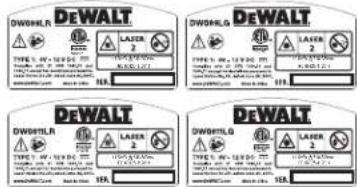
- If the equipment is used in a manner not specified by the manufacturer, the protection provided by the equipment may be impaired.

E
Do not operate the laser in explosive atmospheres, such as in the presence of fl ammable liquids, gases, or dust. This tool may create sparks which may ignite the dust or fumes.
- Store an idle laser out of reach of children and other untrained persons. Lasers are dangerous in the hands of untrained users.
- Tool service MUST be performed by qualified repair personnel. Service or maintenance performed by unqualified personnel may result in injury. To locate your nearest DEWALT service center go to www.DEWALT.com.
- Do not use optical tools such as a telescope or transit to view the laser beam. Serious eye injury could result.
- Do not place the laser in a position which may cause anyone to intentionally or unintentionally stare into the laser beam. Serious eye injury could result.
- Do not position the laser near a refl ective surface which may refl ect the laser beam toward anyone's eyes. Serious eye injury could result.
- Turn the laser off when it is not in use. Leaving the laser on increases the risk of staring into the laser beam.
- Do not modify the laser in any way. Modifying the tool may result in hazardous laser radiation exposure.
- Do not operate the laser around children or allow children to operate the laser. Serious eye injury may result.
- Do not remove or deface warning labels. If labels are removed, the user or others may inadvertently expose themselves to radiation.
- Position the laser securely on a level surface. If the laser falls, damage to the laser or serious injury could result.
Personal Safety
- Stay alert, watch what you are doing, and use common sense when operating the laser. Do not use the laser when you are tired or under the influence of drugs, alcohol, or medication. A moment of inattention while operating the laser may result in serious personal injury.
- Use personal protective equipment. Always wear eye protection. Depending on the work conditions, wearing protective equipment such as a dust mask, non-skid safety shoes, hard hat, and hearing protection will reduce personal injury.
Tool Use and Care
- Do not use the laser if the Power/Transport Lock switch does not turn the laser on or off. Any tool that cannot be controlled with the switch is dangerous and must be repaired.
- Follow instructions in the Maintenance section of this manual. Use of unauthorized parts or failure to follow Maintenance instructions may create a risk of electric shock or injury.
Battery Safety

WARNING:
Batteries can explode, or leak, and can cause injury or fire. To reduce this risk:
- Carefully follow all instructions and warnings on the battery label and package, and the accompanying Battery Safety manual.
- Always insert batteries correctly with regard to polarity + and -, as marked on the battery and the equipment.
- Do not short battery terminals.
- Do not charge disposable batteries.
-
Do not mix old and new batteries. Replace all batteries at the same time with new batteries of the same brand and type.
-
Remove dead batteries immediately and dispose of per local codes.
- Do not dispose of batteries in fire.
- Keep batteries out of reach of children.
- Remove batteries when the device is not in use.
- Use only the charger specified for your rechargeable battery pack.
- Disconnect the battery pack from the laser before making any adjustments, changing accessories, or storing the laser. Such preventative safety measures reduce the risk of starting the laser accidentally.
- When the battery pack is not in use, keep it away from other metal objects, like paper clips, coins, keys, nails, screws, or other small metal objects that can make a connection from one terminal to another. Shorting the battery terminals together may cause bums or a fire.
- Use the laser only with specifically designated battery packs. Use of other battery packs may create a risk of injury and fire.
- Under abusive conditions, liquid may be ejected from the battery; avoid contact. If contact accidentally occurs, flush with water. If liquid contacts eyes, additionally seek medical help. Liquid ejected from the battery may cause irritation or burns.
- Do not use a battery pack or laser that is damaged or modified. Damaged or modified batteries may exhibit unpredictable behavior resulting in fire, explosion, or risk of injury.
- Do not expose a battery pack or laser to fire or excessive temperature. Exposure to fire or temperature above 265°F (130°C) may cause an explosion.
- Follow all the charging instructions and do not charge the battery pack outside of the temperature range specified in the instructions. Charging improperly or at temperatures outside of the specified range may damage the battery and increase the risk of fire.
Powering the Laser
This laser can be powered by either of these battery packs:
- A DEWALT 12V MAX* Li-ion Battery Pack (DCB120, DCB122, DCB123, DCB125, or DCB127). *Maximum initial battery voltage (measured without a workload) is 12 volts. Nominal voltage is 10.8.
- A DEWALT AA Starter Pack with 4 new high-quality name brand AA batteries. Note: The AA Starter Pack is only recommended for use with the red laser (DW089LR or DW0811LR).
Use of any other batteries may create a risk of fire.
Charging the Li-ion Battery
- If the DEWALT 12V MAX* Li-ion battery pack is attached to the laser, remove it.
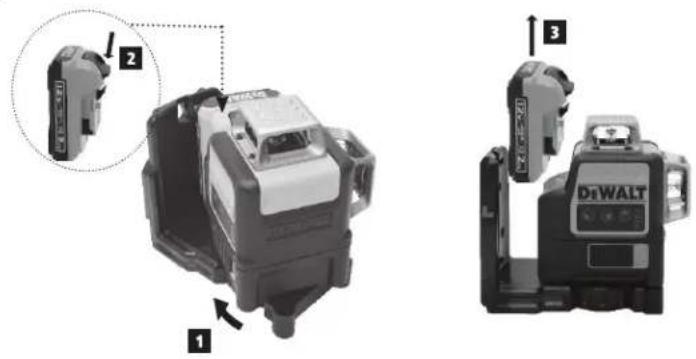
- Rotate the laser so it is easier to access the battery pack (Figure ①).
- While pressing down on the release button on the battery pack (Figure © ②), pull the battery pack up to unlock it from the laser.
- Pull the battery pack the rest of the way up and out of the laser (Figure © 3).
- Plug the charger cord into an electrical outlet.
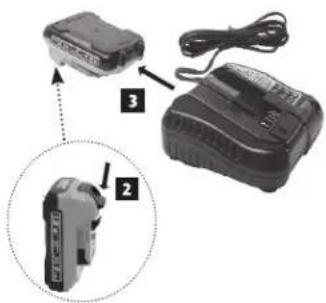
- Slide the battery pack into the charger until it snaps in place (Figure ⑧①). On the charger, the left indicator light will flash to let you know the battery is being charged.
- After the battery is fully-charged (the indicator light on the charger no longer flashes), press and hold the release button on the battery pack (Figure B ②) and slide the pack out of the charger (Figure B ③).
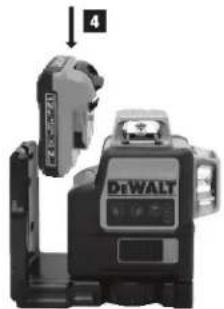
- Slide the battery pack down in the laser until it snaps in place (Figure B 4).
E
Installing New AA Batteries

CAUTION:
The AA Starter Pack is designed specifically for use with DEWALT 12V compatible laser products and cannot be used with any other tools. Do not attempt to modify the product.
-
If the AA Starter Pack is attached to the laser, remove it.
-
Rotate the laser so it is easier to access the Starter Pack (Figure © 1).
- While pressing down on the release button on the Starter Pack (Figure ②), pull the Starter Pack up to unlock it from the laser).
-
Pull the Starter Pack the rest of the way up and out of the laser (Figure ③).
-
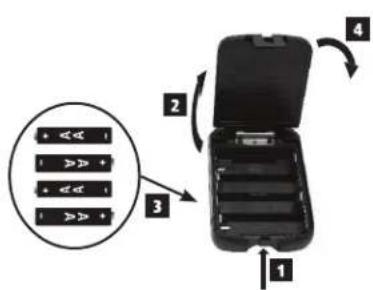
On the AA Starter Pack, lift up the latch to open the battery compartment cover (Figure ① and ②).
-
Insert four new, high-quality, name brand AA batteries, making sure to position the - and + ends of each battery as noted inside the battery compartment (Figure A ③).
-
Push the battery compartment cover down until it snaps in place (Figure A ④).
-
Slide the Starter Pack down in the laser until it snaps in place (Figure A 5).
Viewing the Battery Meter
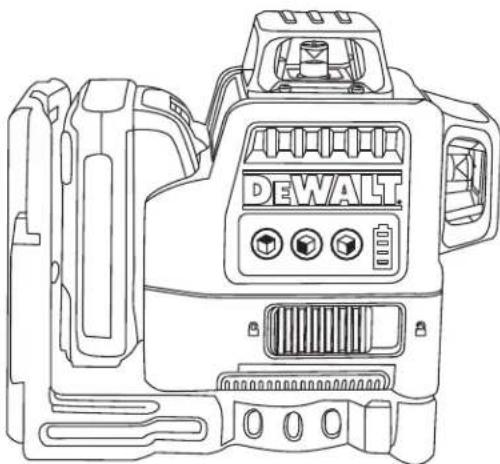
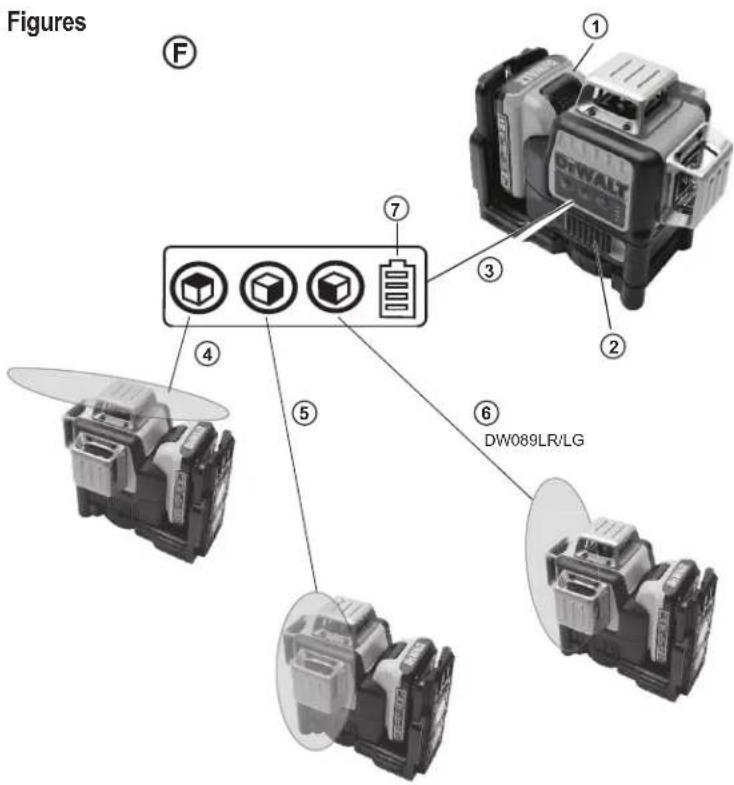
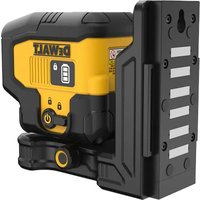
When the laser is ON, the battery meter on the keypad (Figure ⑦) indicates how much power remains. Each of the four LEDs on the battery meter represents 25% of the power.
- The bottom LED will illuminate and flash when the battery level is low (below 12.5%). The laser may continue to operate for a short time while the battery power continues to drain, but the beam(s) will quickly dim.
• After fresh batteries are installed in the AA Starter Pack, or the 12V MAX Li-ion battery is charged, and the laser is turned ON again, the laser beam(s) will return to full brightness and the battery indicator level will indicate full capacity.
- If all 4 LEDs on the battery meter remain ON, this indicates that the laser is not fully powered OFF. When the laser is not in use, make sure the Power/Transport Lock switch is placed to the LEFT to the Locked/OFF position (Figure ⑤②).
Operating Tips
• To extend battery life per charge, turn the laser off when it is not in use.
• To ensure the accuracy of your work, check the laser calibration often. Refer to Checking Laser Accuracy.
- Before attempting to use the laser, make sure it is positioned securely, on a smooth, fl at stable surface that is level in both directions.
- To increase beam visibility, use a Laser Target Card (Figure D) and/or wear Laser Enhancement Glass es (Figure E) to help find the beam.

CAUTION:
To reduce the risk of serious injury, never stare directly into the laser beam with or without these glasses. Refer to Accessories for important information.
• Always mark the center of the beam created by the laser.
- Extreme temperature changes can cause movement or shifting of building structures, metal tripods, equipment, etc., which can effect accuracy. Check your accuracy often while working.
- If the laser has been dropped, check to make sure your laser is still calibrated. Refer to Checking Laser Accuracy.
Turning the Laser On
Place the laser on a fl at level surface. Slide the Power/Transport Lock switch ⑤② to the right to unlock/turn ON the laser.
Each laser line is powered on by pressing its button on the keypad (Figure ⑤ ③). Pressing the button again turns the laser line off. The laser lines can be powered one at a time or all at the same time.
| Laser Buttons | ||
| DW089LR/LG | Horizontal laser line(Figure F 4) | |
| Side vertical laser line(Figure F 5) | ||
| Front vertical laser line(Figure F 6) | ||
| DW0811LR/LG Horizontal laser line(Figure F 4) | ||
| Side vertical laser line(Figure F 5) | ||
When the laser is not in use, slide the Power/Transport Lock switch to the left in the OFF/Locked position. If the Power/Transport Lock switch is not placed in the lock position, all 4 LEDs will continuously flash on the Battery Meter.
Checking Laser Accuracy
The laser tools are sealed and calibrated at the factory. It is recommended that you perform an accuracy check prior to using the laser for the first time (in case the laser was exposed to extreme temperatures) and then regularly to ensure the accuracy of your work. When performing any of the accuracy checks listed in this manual, follow these guidelines:
- Use the largest area/distance possible, closest to the operating distance. The greater the area/distance, the easier to measure the accuracy of the laser.
- Place the laser on a smooth, flat, stable surface that is level in both directions.
• Mark the center of the laser beam.
Horizontal Beam - Scan Direction
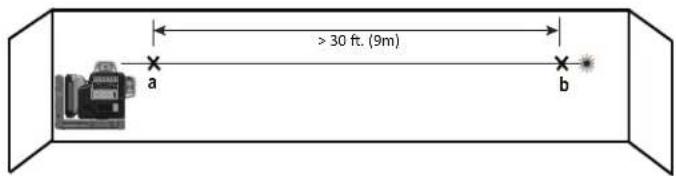
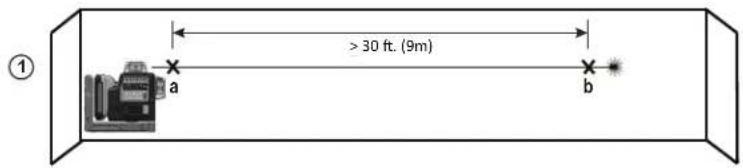
Checking the horizontal scan calibration of the laser requires two walls 30' (9m) apart. It is important to conduct a calibration check using a distance no shorter than the distance of the applications for which the tool will be used.
- Place the laser against the end of the wall on a smooth, flat, stable surface that is level in both directions (Figure ①).
- Move the Power/Transport Lock switch to the right to turn the laser ON.
- Press ⚙ to turn on the horizontal beam.
- At least 30' (9m) apart along the laser beam, mark a and b.
- Turn the laser 180°.
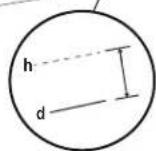
- Adjust the height of the laser so the center of the beam is aligned with ⓐ (Figure ①②).
- Directly above or below, mark ⊙ along the laser beam (Figure ①③).
- Measure the vertical distance between ⓑ and Ⓒ.
- If your measurement is greater than the Allowable Distance Between and for the corresponding Distance Between Walls in the following table, the laser must be serviced at an authorized service center.
| Distance Between Walls | Allowable Distance Between b and c |
| 30' (9m) 1/4" (6.0mm) | |
| 40' (12m) 5/16" (8.0mm) | |
| 50' (15m) 13/32" (10.0mm) | |
F Horizontal Beam - Pitch Direction
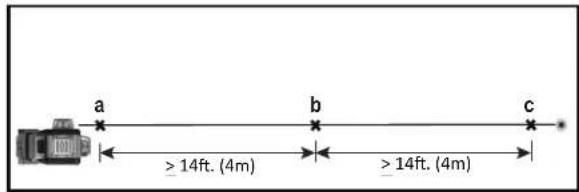
Checking the horizontal pitch calibration of the laser requires a single wall at least 30' (9m) long. It is important to conduct a calibration check using a distance no shorter than the distance of the applications for which the tool will be used.
- Place the laser against the end of the wall on a smooth, flat, stable surface that is level in both directions (Figure ①).
- Move the Power/Transport Lock switch to the right to turn the laser ON.
- Press Ⓤ to turn on the horizontal beam.
- At least 30' (9m) apart along the laser beam, mark a and b.
- Move the laser to the opposite end of the wall (Figure ①②).
- Position the laser toward the first end of the same wall and parallel to the adjacent wall.
- Adjust the height of the laser so the center of the beam is aligned with ⑥.
- Directly above or below, mark ⊙ along the laser beam (Figure ①③).
- Measure the distance between ⓐ and Ⓒ.
- If your measurement is greater than the Allowable Distance Between and for the corresponding Distance Between Walls in the following table, the laser must be serviced at an authorized service center.
| Distance Between Walls | Allowable Distance Between a and c |
| 30' (9m) 1/4" (6.0mm) | |
| 40' (12m) 5/16" (8.0mm) | |
| 50' (15m) 13/32" (10.0mm) | |
Vertical Beam (DW089)
Checking the vertical (plumb) calibration of the laser can be most accurately done when there is a substantial amount of vertical height available, ideally 30° (9m), with one person on the floor positioning the laser and another person near a ceiling to mark the position of the beam. It is important to conduct a calibration check using a distance no shorter than the distance of the applications for which the tool will be used.
- Place the laser on a smooth, flat, stable surface that is level in both directions (Figure M ①).
- Move the Power/Transport Lock switch to the right to turn the laser ON.
- Press ⑤ and ⑥ turn on both vertical beams.
- Mark two short lines where the beams cross a, b and also on the ceiling c, d. Always mark the center of the beam's thickness (Figure M 2).
- Pick up and rotate the laser 180°, and position it so the beams line up with the marked lines on the level surface (e, f) (Figure M 3).
- Mark two short lines where the beams cross on the ceiling g, h.
- Measure the distance between each set of marked lines on the ceiling (c, g and d, h). If the measurement is greater than the values shown below, the laser must be serviced at an authorized service center.
| Ceiling Height | Allowable Distance Between Marks |
| 8' (2.5m) 1/16" | (1.5mm) |
| 10' (3m) 3/32" | (2.0mm) |
| 14' (4m) 1/8" | (2.5mm) |
| 20' (6m) 5/32" | (4mm) |
| 30' (9m) 1/4' | (6mm) |
90° Accuracy Between Vertical Beams (DW089)
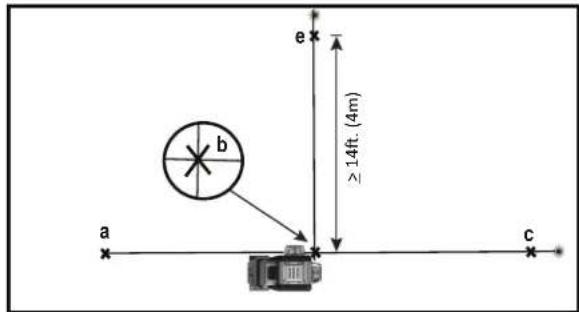
Checking 90° accuracy requires an open floor area at least 33' x 18' (10m x 5m). Refer to Figure N for the position of the laser at each step and for the location of the marks made at each step. Always mark the center of the beam's thickness.
- Place the laser on a smooth, flat, stable surface that is level in both directions.
- Move the Power/Transport Lock switch to the right to turn the laser ON.
- Press Ⓐ to turn on the side vertical beam.
- Mark the center of the beam at three locations (a, b, c) on the floor along the side laser line. Mark b should be at the midpoint of the laser line (Figure N 1).
- Pick up and move the laser to ⓑ.
- Press Ⓞ to turn on the front vertical beam too (Figure N 2).
- Position the front vertical beam so it crosses precisely at ⓑ, with the side beam aligned with Ⓔ (Figure N 2).
B. Mark a location ⓔ along the front vertical beam at least 14' (4m) away from the unit (Figure N②). - Rotate the laser 90° so the side vertical beam now passes through ⓑ and Ⓔ (Figure N 3).
-
Directly above or below ⓐ, mark ⏱ along the front vertical beam.
-
Measure the distance between a and f . If the measurement is greater than the values shown below, the laser must be serviced at an authorized service center.
| Distance froma to b | Allowable Distance Between a and f |
| 14' (4m) 5/32" | (3.5mm) |
| 17' (5m) 3/16" | (4.5mm) |
| 20' (6m) 7/32" | (5.5mm) |
| 23' (7m) 1/4" | (6mm) |
Using the Laser
Leveling the Laser
As long as the laser is properly calibrated, the laser is self-leveling. Each laser is calibrated at the factory to find level as long as it is positioned on a flat surface within average ±4° of level. No manual adjustments are required.
If the laser has been tilted so much that it cannot self-level ( >4° ), the laser beam will fl ash. There are two fl ashing sequences associated with the out of level condition.
- Between 4° and 10° the beams flash with a constant blink cycle
- At angles greater than 10° the beams flash with a three blink cycle.
When the beams flash THE LASER IS NOT LEVEL (OR PLUMB) AND SHOULD NOT BE USED FOR DETERMINING OR MARKING LEVEL OR PLUMB. Try repositioning the laser on a more level surface.
E Using the Pivot Bracket
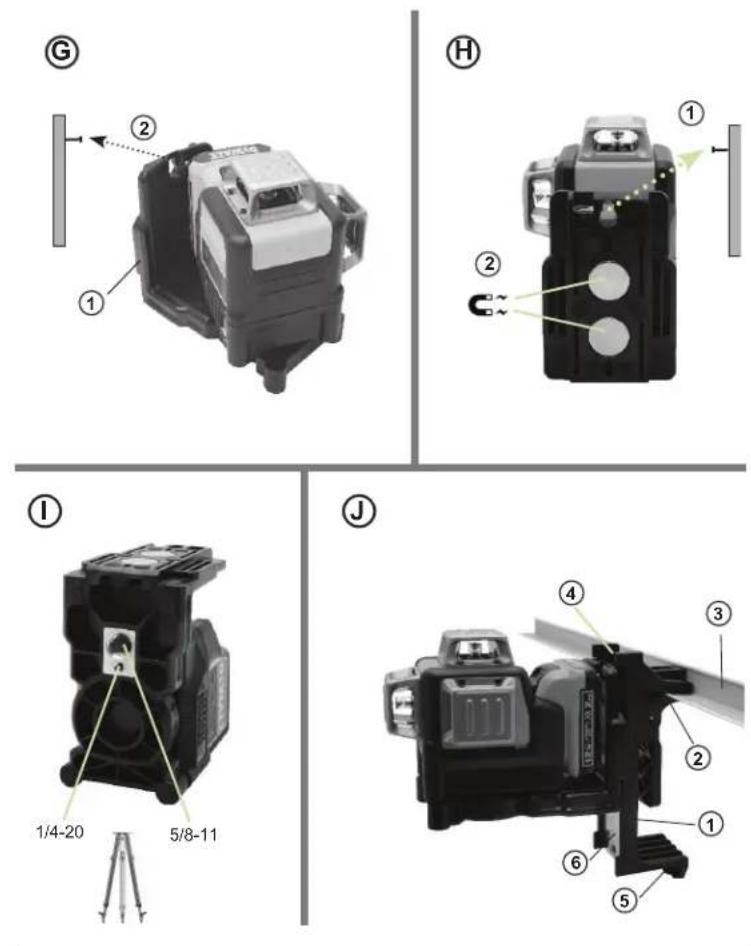
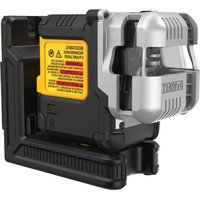
The laser has a magnetic pivot bracket (Figure ⑤ ①) permanently attached to the unit.

WARNING:
Position the laser and/or wall mount on a stable surface. Serious personal injury or damage to the laser may result if the laser falls.
- The bracket has magnets (Figure ①②) which allow the unit to be mounted to most upright surfaces made of steel or iron. Common examples of suitable surfaces include steel framing studs, steel door frames, and structural steel beams.
- The bracket has a keyhole slot (Figure ⑤② or ⑥①) so it can be hung from a nail or screw on any kind of surface.
Maintenance
- To maintain the accuracy of your work, check the laser often to make sure it is properly calibrated. See Field Calibration Check.
- Calibration checks and other maintenance repairs may be performed by DEWALT service centers.
- When not in use, store the laser in the kit box provided. Do not store your laser at temperatures below -5°F (-20°C) or above 140°F (60°C).
- Do not store your laser in the kit box if the laser is wet. The laser should be dried first with a soft dry cloth prior to storage.
Cleaning
Exterior plastic parts may be cleaned with a damp cloth. Although these parts are solvent resistant, NEVER use solvents. Use a soft, dry cloth to remove moisture from the tool before storage.
Troubleshooting
The Laser Does Not Turn On
- Make sure AA batteries (when used) are installed correctly according to + and – on the inside of the battery door.
- Make sure the batteries or rechargeable pack are in proper working condition. If in doubt, try installing new batteries.
- Make sure that the battery contacts are clean and free of rust or corrosion. Be sure to keep the laser level dry and use only new, high-quality, name brand batteries to reduce the chance of battery leakage.
- If the laser unit is heated above 120°F (50°C), the unit will not turn on. If the laser has been stored in extremely hot temperatures, allow it to cool. The laser level will not be damaged by pressing the on/off button before cooling to its proper operating temperature.
The Laser Beams Flash
The lasers are designed to self-level up to an average of 4° in all directions. If the laser is tilted so much that the internal mechanism cannot level itself, the laser beams will fl ash indicating that the tilt range has been exceeded. THE FLASHING BEAMS CREATED BY THE LASER ARE NOT LEVEL OR PLUMB AND SHOULD NOT BE USED FOR DETERMINING OR MARKING LEVEL OR PLUMB. Try repositioning the laser on a more level surface.
The Laser Beams Will Not Stop Moving
The laser is a precision instrument. Therefore, if it is not positioned on a stable (and motionless) surface, the laser will continue to try to fi nd level. If the beam will not stop moving, try placing the laser on a more stable surface. Also, try to make sure that the surface is relatively flat, so that the laser is stable.
The Battery Meter LEDs Flash
When all 4 LEDs continuously flash on the Battery Meter this indicates that the unit has not been fully powered off using the Power/Transport Lock switch (Figure F②). The Power/Transport Lock switch should always be placed in the LOCKED/OFF position when the laser is not in use.
Accessories
The laser is equipped with both 1/4 - 20 and 5/8 - 11 female threads (I) on the bottom of the unit (Figure ①). This thread is to accommodate current or future DeWalt accessories. Only use DeWalt accessories specified for use with this product. Follow the directions included with the accessory.

WARNING:
Since accessories, other than those offered by DeWalt, have not been tested with this product, use of such accessories with this tool could be hazardous. To reduce the risk of injury, only DeWalt recommended accessories should be used with this product.
If you need any assistance in locating any accessory, please contact your nearest DeWALT service center or go to www.DEWALT.com.
Target Card
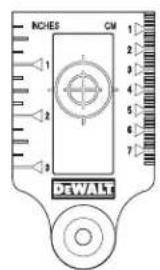
Some laser kits include a Laser Target Card (Figure ①) to aid in locating and marking the laser beam. The target card enhances the visibility of the laser beam as the beam crosses over the card. The card is marked with standard and metric scales. The laser beam passes through the red plastic and reflects off of the reflective tape on the reverse side. The magnet at the top of the card is designed to hold the target card to ceiling track or steel studs to determine plumb and level positions. For best performance when using the Target Card, the DrWALT logo should be facing you.
Laser Enhancement Glasses
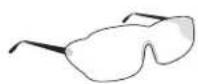
Some laser kits include Laser En hancement Glasses (Figure E). These glasses improve the visibility of the laser beam under bright light conditions or over long distances when the laser is used for interior applications. These glasses are not required to operate the laser.

CAUTION:
These glasses are not ANSI approved safety glasses and should not be used while operating other tools. These glasses do not keep the laser beam from entering your eyes.

CAUTION:
To reduce the risk of serious injury, never stare directly into the laser beam with or without these glasses.
Ceiling Mount
The laser ceiling mount (Figure ①①), if included, offers more mounting options for the laser. The ceiling mount has a clamp (Figure ②②) at one end which can be fixed to a wall angle for acoustic ceiling installation (Figure ③③). At each end of the ceiling mount is a screw hole (Figure ④④ and ⑤⑤), allowing the ceiling mount to be attached to any surface with a nail or screw.
Once the ceiling mount is secured, its steel plate provides a surface to which the magnetic pivot bracket (Figure ①⑥) can be attached. The position of the laser can then be fine-tuned by sliding the magnetic pivot bracket up or down on the wall mount.
E
Service and Repairs
NOTE: Disassembling the laser level(s) will void all warranties on the product.
To assure product SAFETY and RELIABILITY, repairs, maintenance and adjustment should be performed by authorized service centers. Service or maintenance performed by unqualified personnel may result in a risk of injury. To locate your nearest DeWalt service center call 1-800-4-DEWALT (1-800-433-9258) or go to www.DEWALT.com.
Warranty
Go to www.DEWALT.com for the latest warranty information.
Specifications
E
| DW089LR & DW0811LR DW089LG & DW0811LG | ||
| Light Source Laser diodes | ||
| Laser Wavelength 620 – 690nm visible | 510 – 530nm visible | |
| Laser Power ≤1.50mW (each beam) CLASS 2 LASER PRODUCT | ||
| Working Range 20m (±65') | 50m with detector | 35m (±115')50m with detector |
| Accuracy (Plumb) ±1/8" per 33' (±3mm per 10m) | ||
| Accuracy (Level) ±1/8" per 33' (±8mm per 10m) | ||
| Battery Low 1 x LED Flashing on Battery meter | ||
| Unit Not Powered Off With Pendulum Lock Switch | 4 x LED Flashing on Battery meter | |
| Flashing Laser Beams Tilt range | exceeded/unit is not level | |
| Power Source 4 AA (1.5V) batteries (6V DC) or 12V D | eWALT Battery Pack | |
| Operating Temperature 14°F to 122°F (-10°C to 50°C) | ||
| Storage Temperature -5°F to 140°F (-20°C to 60°C) | ||
| Humidity | Maximum relative humidity 80% for temperatures up to 88°F (31°C), decreasing linearly to 50% relative humidity at 104°F (40°C) | |
| Environmental | Water & Dust Resistant to IP65 | |
Contenido
ES
Towson, Maryland 21286
www.DEWALT.com
Towson, Maryland 21286
www.DEWALT.com
Towson, Maryland 21286
www.DEWALT.com
| Distância entre as Paredes | Distância Permitida entre b e c |
| 30' (9 m) 1/4" (6,0 mm) | |
| 40' (12 m) 5/16" (8,0 mm) | |
| 50' (15 m) 13/32" (10,0 mm) | |
| Distância entre as Paredes | Distância Permitida entre a e c |
| 30' (9 m) 1/4" (6,0 mm) | |
| 40' (12 m) 5/16" (8,0 mm) | |
| 50' (15 m) 13/32" (10,0 mm) | |
Feixe Vertical (DW089)
Towson, Maryland 21286
N821367 February 2020


- E CONTENTS
- LASER INFORMATION
- SUPPLIER'S DECLARATION OF CONFORMITY
- 47 CFR § 2.1077 COMPLIANCE INFORMATION
- FCC COMPLIANCE STATEMENT
- ISED COMPLIANCE STATEMENT
- USER SAFETY
- SAFETY GUIDELINES
- WARNING
- SAVE THESE INSTRUCTIONS
- WARNING LABELS
- E
- PERSONAL SAFETY
- TOOL USE AND CARE
- BATTERY SAFETY
- POWERING THE LASER
- CHARGING THE LI-ION BATTERY
- INSTALLING NEW AA BATTERIES
- CAUTION
- VIEWING THE BATTERY METER
- OPERATING TIPS
- TURNING THE LASER ON
- CHECKING LASER ACCURACY
- HORIZONTAL BEAM - SCAN DIRECTION
- F HORIZONTAL BEAM - PITCH DIRECTION
- VERTICAL BEAM (DW089)
- 90° ACCURACY BETWEEN VERTICAL BEAMS (DW089)
- USING THE LASER
- LEVELING THE LASER
- E USING THE PIVOT BRACKET
- MAINTENANCE
- CLEANING
- TROUBLESHOOTING
- THE LASER DOES NOT TURN ON
- THE LASER BEAMS FLASH
- THE LASER BEAMS WILL NOT STOP MOVING
- THE BATTERY METER LEDS FLASH
- ACCESSORIES
- TARGET CARD
- LASER ENHANCEMENT GLASSES
- CEILING MOUNT
- SERVICE AND REPAIRS
- WARRANTY
- SPECIFICATIONS
- CONTENIDO
- ES
- FEIXE VERTICAL (DW089)
Brand : DEWALT
Model : DW0811
Category : Laser level