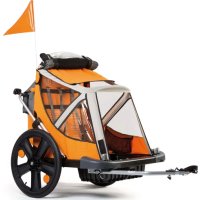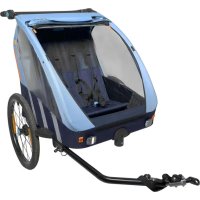
B-Travel - Bike trailer Bellelli - Free user manual and instructions
Find the device manual for free B-Travel Bellelli in PDF.


User questions about B-Travel Bellelli
0 question about this device. Answer the ones you know or ask your own.
Ask a new question about this device
Download the instructions for your Bike trailer in PDF format for free! Find your manual B-Travel - Bellelli and take your electronic device back in hand. On this page are published all the documents necessary for the use of your device. B-Travel by Bellelli.
USER MANUAL B-Travel Bellelli
natural_image
Person riding a bicycle with a two-wheeled vehicle in a park setting, no visible text or symbols on the bike or background.[Unreadable]
2
b
p
Hollwill
belairn

[Non-Text]

1
natural_image
Product photo of a smart car with orange frame, black wheels, and small accessories (no visible text or symbols)2
4
5
7
IMPORTANTE
Read the instructions carefully before using the trailer.
Follow the instructions for use very closely.
Improper installation or misuse of the trailer can put a child's safety at serious risk.
Keep these instructions in a safe place for future reference.
WARNING
- Do not tamper with or modify the trailer or the device that connects it to the bicycle.
- Do not use the trailer if any part of the trailer and/or bicycle is broken or missing. Contact the retailer if you require any spare parts for the trailer.
- The bicycle's manoeuvrability is affected when the trailer is attached to it, particularly in terms of balance, steering and braking. Braking distance is increased with a trailer attached.
- Replace the trailer if it is involved in an accident, even if there is no visible damage.
- Do not transport goods in the cabin when it is occupied by a child.
- Do not install child seats in the cabin.
- Never leave a bicycle parked with a child unattended in the trailer.
• Always respect the traffic laws of the country where you are using the trailer. Make sure that the trailer meets the legal requirements for use on the road, paying particular attention to its lights (tail lights and reflectors).
GENERAL INFORMATION
- It is possible to transport one or two children who are able to sit alone and unassisted for extended periods (ages approximately 9 months to 6 years old).
• Maximum transportable weight: 35 kg (77 lbs).
• Maximum weight of each child: 16 kg (35 lbs). Do not use with children whose weight exceeds this value. -
Maximum transportable weight in the back pocket: 3 kg (6.5 lbs).
-
Maximum total weight (trailer + passengers + cargo in the cabin and/or in the back pocket): 50 kg (100 lbs in the US and Canada).
- Use with bicycles with 26 "or 28" wheels that can tow a load of at least 50 kg (100 lbs in the US and Canada); refer to your bicycle's manual or the retailer.
- Do not use with children whose height, when seated in the cabin, exceeds the limit line shown on the backrest.
- Do not transport animals.
- Do not attach the trailer to motorcycles, scooters or motor bikes.
- Do not carry other children on the bicycle in the front or rear child seats.
- Do not place additional loads on the bar that connects the trailer to the bicycle.
- Do not transport loads that protrude from the cabin or from the back pocket.
• The cyclist must be at least 16 years old. - It is recommended that rear-view mirrors be installed on the bicycle.
- Have children wear an approved helmet of the appropriate size. (Note: In some countries, it is compulsory to wear a helmet; refer to the traffic laws of the country where you are using the trailer).
- Keep the front netting closed while moving.
- In the event of an emergency, breakage or puncture, push the trailer to a safe stopping area away from the road before carrying out any repairs.
- Check the trailer and bicycle regularly. See the section Periodic Checks.
- It is advisable to have the bicycle checked with a qualified mechanic before attaching the trailer.
- It is advisable to practice with an empty trailer on a road that isn't busy before using it in traffic.
GETTING STARTED
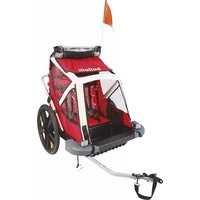
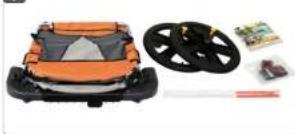
Do not assemble and attach the trailer while there is a child in the cabin. Identify all of the components before assembly (fig. 1).
- Trailer.
- Wheels.
- Reflectors and battery-operated light.
- Instruction manual.
- Visibility flag.
How to open the structure
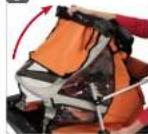
Open the structure by pulling back the upper curved section of the frame (fig.2).
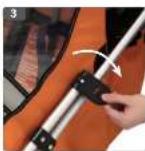
Rotate the locking devices to fix the structure into place (fig. 3). The locking device is properly closed when the metal pin pops out. Repeat this procedure on the other side of the trailer.
How to fit the wheels
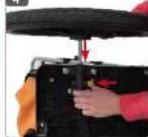
Remove the protective covers from the wheel axles Press the yellow button on the wheel support located under the base and insert the wheel axle (fig. 4).
Warning: Check that the yellow button has clicked into place once the axle has been inserted. If it has not, the wheel axle has not been inserted correctly and the procedure must be repeated.
Repeat the same procedure with the other wheel.
How to fit the accessories
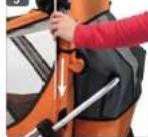
Assemble the visibility flag and insert it into the slot on the road side of the backrest (fig. 5).
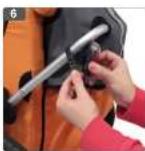
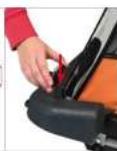
Attach the red light to the back of the trailer, road side (fig 6).
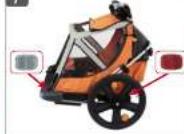
Attach the white reflectors to the front of the trailer; attach the red reflectors to the back of the trailer (fig. 7).
How to open the bicycle connection bar
Remove the safety pin.
Rotate the bar forward (fig. 8).
Insert the safety pin in the front hole (fig. 9).
Close the safety pin (fig. 10).
How to attach the coupling device to the bicycle
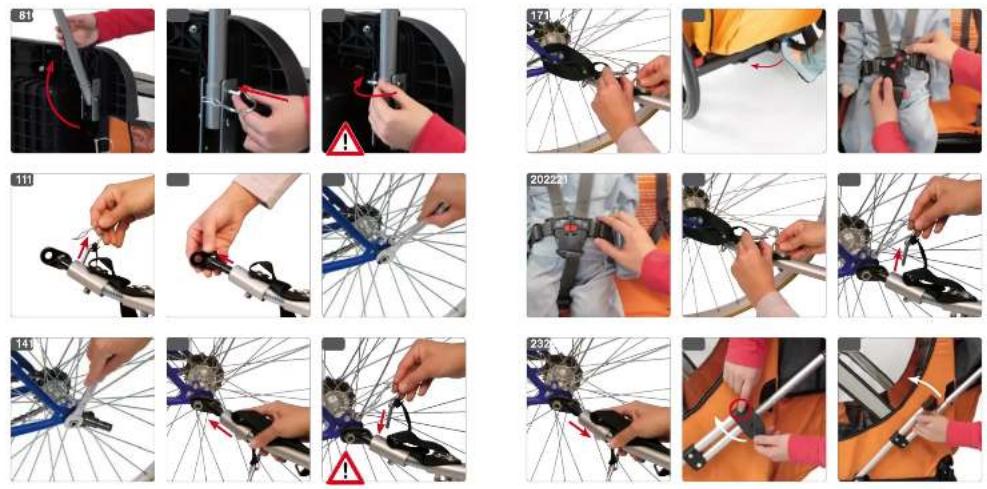
Make sure the bicycle is in a stable, secure position. Pull the safety pin out (fig. 11) and remove the coupling device from the bar that connects the trailer to the bicycle (fig. 12).
Unscrew the hub from the bicycle's rear wheel (fig. 13). Place the coupling device on the wheel hub of the bicycle.
Screw the hub onto the wheel of the bicycle (fig. 14).
How to attach the trailer to the bicycle
Remove the safety pin.
Insert the connection bar into the coupling device (fig. 15).
Insert the safety pin (fig. 16).
Close the safety pin.
Attach the supplementary safety strap to the frame of the bicycle (fig. 17).
Warning: Check that the safety pin is closed properly.
Warning: Do not use the trailer unless the supplementary safety strap is attached.
Warning: The supplementary safety strap must be very taut. Loose straps can catch the spokes of the wheel and may damage the wheel or cause an accident.
Warning: Make sure that the attached items do not affect the panniers on the bicycle, rack, or anything else.
Warning: Check all fastening devices regularly (frame, connection bar, bicycle coupling device): they may become loose with use.
FINAL CHECK
Push the bicycle along for a few metres, free of any load:
- check that no moving parts touch the trailer or its coupling system;
- check that there are no protruding parts near the wheel;
- check that the brakes and pedals are still working properly;
- check that the safety belts in the trailer do not come into contact with the wheels or other moving parts of the trailer;
- check that the front cover of the trailer does not come into contact with the wheels or other moving parts of the trailer.
PARKING BRAKE
To engage the parking break, move the lever to the Stop position (fig. 18).
To disengage, move the lever to the Go position
USE OF THE TRAILER
Warning: Always set the parking brake before letting children on and off or loading and unloading items.
Have children sit inside the cabin.
Buckle their safety belts (fig. 19).
Adjust the belt loops so that they fit snugly around the child's body (fig. 20).
Warning: Always fasten children's safety belts before moving.
CONDUCT ON THE ROAD
Always obey the traffic laws of the country in which you are using the trailer.
The bicycle's manoeuvrability may be affected when the trailer is attached to it, particularly in terms of balance, steering and braking.
Reduce your speed when riding down a slope. Braking distance is increased when a trailer is attached.
Take curves with particular caution; do not make sharp turns, especially when there are obstacles (curbs, posts) that can hinder the movement of the trailer.
Maintain a speed appropriate to traffic and road conditions. It is recommended to not exceed 25 km/h (15mph) on straight paved roads and 10 km/h (15 mph) on curved, wet, or uneven roads.
Tell children not to rock inside the cabin in order to avoid sudden shifts of weight which may cause problems with stability.
Avoid potholes, puddles and other obstacles.
Travel at reduced speeds; slow down when going downhill and when approaching turns.
Avoid sharp movements.
Brake gradually.
Do not use the trailer on icy roads or in adverse weather conditions.
Do not leave a child unattended in the trailer.
Do not leave the trailer sitting out in the sun; the cabin's interior, its plastic parts and its metal parts may overheat.
Make frequent stops during long trips to allow children to move about freely.
Children, in the cabin, are more susceptible to extreme temperatures than adults. During the winter or in cold weather, make sure that children are sufficiently covered and do not suffer from the cold when at rest. During the summer or in hot weather, make sure that children are sufficiently ventilated and hydrated.
How to detach the trailer from the bicycle
Warning: Do not detach the trailer while there is a child in the cabin.
Remove the supplementary safety belt from the bike frame (fig. 21).
Remove the safety pin (fig. 22).
Remove the connection bar from the coupling device (fig. 23).
How to close the trailer
Push the metal pin in and turn the safety latch out (fig. 24).
Repeat this procedure on the other side.
Close the structure again, applying moderate forward pressure to the two safety latches simultaneously (fig. 25).
REGULAR CHECKS
Check the trailer and bicycle regularly.
Frequent checks:
- Check the tyre pressure and condition of the tyres on the trailer and the bicycle. They must be inflated and in good condition;
- Check that the brakes on the bicycle are working properly;
- Check that the trailer's rear light and the bicycle's lights are working properly;
- Check that the reflectors are clean.
Regular checks:
- Check the fasteners and joints on the frame, the connection bar and the system for attachment to the bicycle;
- Check the trailer wheel attachment system;
- Check the fabric: Make sure that there are no tears or damaged areas;
- Check the flag and its pole.
MAINTENANCE
Wash the trailer with soap and water. Do not use harsh chemicals.
Inflate the tyres according to the recommended pressure provided on the side of each tyre.
The rear light requires two AAA 1.5 V batteries.
GUARANTEE
The terms of the guarantee can be viewed online at www.bellelli.com.