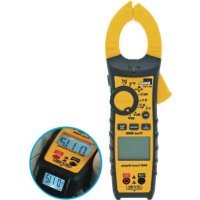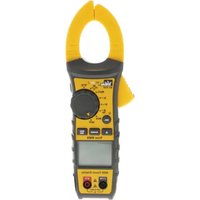
61-737 - Measuring equipment IDEAL - Free user manual and instructions
Find the device manual for free 61-737 IDEAL in PDF.


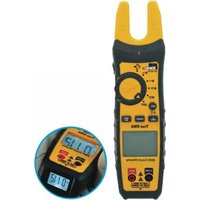
| Product Type | TRMS Digital Clamp Meter |
| Brand | IDEAL |
| Model | 61-737 |
| Category | Measuring Equipment |
| Dimensions (L x W x H) | 242 x 71 x 46 mm |
| Jaw Opening | 35 mm |
| Weight | 0.36 kg |
| Power Supply | 3 AAA batteries 1.5 V |
| Battery Life | Approx. 100 hours |
| Display | 4000-count LCD with backlight |
| Main Functions | AC Current (400 A), AC/DC Voltage (600 V), Resistance, Continuity, Capacitance, Diode, Frequency, Temperature (°C/°F), Non-Contact Voltage Detection (NCV) |
| Safety Category | CAT III 600 V |
| Protection | Double insulation, overload 600 V RMS / 400 A AC |
| Special Functions | MAX/MIN, Data Hold (HOLD), Relative Mode (Δ), Manual/Auto Range Selection, Disableable Auto Power Off (APO) |
| AC Current Measurement | 40.00 A and 400.0 A |
| AC/DC Voltage Measurement | 400.0 mV to 600 V |
| Resistance Measurement | 400.0 Ω to 40.00 MΩ |
| Capacitance Measurement | 400.0 nF to 4.000 mF |
| Frequency Measurement | 10 Hz to 9.999 kHz |
| Temperature | -40 to 1000 °C / -40 to 1832 °F (type K thermocouple included) |
| NCV Detection | Yes, from 40 V to 600 V AC |
| Maintenance and Cleaning | Clean with a damp cloth and mild detergent. Do not use solvents. Ensure the device is dry before use. |
| Spare Parts | TL-757 test lead set (included), type K thermocouple, AAA batteries |
| Repairability | No user-serviceable parts. Contact IDEAL customer service. |
| Warranty | 2 years (limited) |
| Standards | IEC 61010-1, CAT III 600 V, pollution degree 2 |
Frequently Asked Questions - 61-737 IDEAL
User questions about 61-737 IDEAL
0 question about this device. Answer the ones you know or ask your own.
Ask a new question about this device
Download the instructions for your Measuring equipment in PDF format for free! Find your manual 61-737 - IDEAL and take your electronic device back in hand. On this page are published all the documents necessary for the use of your device. 61-737 by IDEAL.
USER MANUAL 61-737 IDEAL
IDEAL® Test and Measurement
61-737 400-Amp AC Clamp Meter Operation and Safety Manual
Identification and description of operating controls and functions 8-9
Operating Features....10-11
Using Test Leads....12
Meter Operation....13-17
Non-Contact Voltage Testing 13
Measuring Current....14
Measuring Voltage....14
Measuring Continuity 15
Measuring Resistance....15
Measuring Capacitance 16
Measuring Diodes 16
Measuring Frequency 17
Measuring Temperature 17
Functions Operation Table 18-19
Functions Indication Table 20-21
Electrical Specifications 22-23
Environmental Specifications....24
Mechanical Specifications ....24
EMC / EMI 24
FCC 25
Safety 25
Maintenance and Service 26-27
Introduction
The IDEAL 61-737 Clamp Meter is an auto ranging true root mean square (T) digital clamp meter that measures AC current (amps) via the clamp head, measured voltage, frequency, resistance, continuity, capacitance, diode via test-leads and measures temperature via a K-Type thermocouple, and detects the presence of voltage between 40V to 600V via a non-contact sensor in the right tip of the C
Arc Flash and Shock Hazard, Proper PPE Required. Follow all safety procedure, wear proper PPE in accordance to NFPA 70E. Read and fully understand the instruction manual prior to using this product. Failure to comply can result in serious injury or death.
Contacting IDEAL INDUSTRIES, INC.
To contact IDEAL INDUSTRIES, INC., call one of the following telephone 1
IDEAL Industries USA Customer Service
• Phone Number: 800-435-0705
- Email: contactus@idealindustries.com
IDEAL Industries Canada Customer Service
• Phone Number: 905-683-3400
- Email: ideal_Canada@idealindustries.com
IDEAL Industries EMEA
• Phone Number: +44 (0)1925 444 446
- Email: eur.sales@idealindustries.com
IDEAL Industries Australia
• Phone Number: +61 3 9562 0175
- Email: InfoAUS@idealindustries.com
Or visit the IDEAL Electrical Website at www.idealind.com
To register your product, find manuals, watch videos, simply scan this QR co
Safety Information
Warning - Identifies conditions and actions that could result in or serious injury if the hazard is realized.

Caution - Identifies conditions and actions that could result in meter dam- equipment under test damage or data loss if the hazard is realized.

WARNING
Arc Flash and Shock Hazard, Proper PPE Required. Follow all safety procedures, wear proper PPE in accordance to NFPA 70E and follow the guidelines below and the instructions in this manual when operating the meter. Failure to comply can result in serious injury or death.
- Choking Hazard, Small Parts. Keep Away from Children. Sharp Objects Hazard, This is not a toy. It is not for use or play by children. Keep Away from Children. Failure to do so can result in serious injury.
- Only experienced or technically competent consumers should use this equipment.
- When in doubt, call an experienced electrician to make any and all necessary repairs or installations. At all times, perform any necessary work on a de-energized circuit that has had its circuit breaker turned off and has been locked out.
- Use the Meter only as specified in this manual or protection provided by the Meter can be compromised.
- Before using or connecting the Meter, visually inspect it to ensure the cases are not cracked and the back case is securely in place. Do not use if the Meter appears damaged.
- Before using the test leads, inspect carefully for damaged insulation, exposed metal or cracked probes. Check test leads for continuity. Do not use leads if they appear damaged.
- Use only approved test leads. Do not use improvised connections that could present a safety hazard.
- Never measure ac current while the test leads are inserted into the input jacks.
- When using the probes, keep fingers behind the finger guards on the probes.
- Connect the common test lead before connecting the live test lead. When disconnecting test leads, disconnect the live test lead first.
- This Meter is intended for use by qualified electricians. Follow NFPA 70E Standards for Electrical Safety in the Workplace when using this Meter.
- Do not use without the batteries correctly in place and the battery door closed and secured.
- Do not use Meter if it operates incorrectly as protection may be compromised.
- When in doubt, have the Meter serviced.
- When servicing the Meter, use only specified replacement parts.

WARNING
Arc Flash and Shock Hazard, Proper PPE Required. Follow all safety procedures, wear proper PPE in accordance to NFPA 70E and follow the guidelines below and the instructions in this manual when operating the meter. Failure to comply can result in serious injury or death.
- Have the Meter serviced only by qualified service personnel.
- Do not use the Meter around explosive gas, dust, or vapor, or during electrical storms, or in wet environments.
- When measuring, keep fingers behind the Tactile Barrier. See "The Meter" on pg. 8 and 9.
- Do not apply more than the rated voltage, as marked on the Meter, between the terminals or between any terminal and earth ground.
- To avoid false readings that can lead to electrical shock and injury, replace the batteries as soon as the low battery indicator ( ) appears.
- Remove the test leads from the circuit prior to removing the battery door.
• Voltages exceeding 30VAC RMS or 60VDC pose a shock hazard so use caution. - Always ensure that test leads are secured so that they cannot be accidentally snagged or tripped over.
- Do not work alone so that assistance can be rendered in an emergency.
- Use extreme caution when working around bare conductors or bus bars. Contact with the conductor could result in electric shock.
- Adhere to local and national safety codes. Individual protective equipment must be used to prevent shock and arc blast injury where hazardous live conductors are exposed.
- Disconnect circuit power and discharge all high-voltage capacitors before you measure resistance, continuity, or capacitance.
- Do not measure current in circuits carrying more than 600V or 400A with the Meter law
- Never operate the Meter with the back cover removed or the case open.
• Cancer and Reproductive Harm - www.P65Warnings.ca.gov

CAUTION
Meter damage, equipment under test damage or data loss can occur if the following guidelines are not adhered to.
- Use the proper terminals, function, and range for the measurement application.
- Clean the case and accessories with a damp cloth and mild detergents only. Do not use abrasives or solvents. Make sure the meter is completely dry before use.
Symbols & Descriptions
| SYMBOL DESCRIPTION | |
 | Arc Flash and Shock Hazard |
 | Shock Hazard |
 | Warning or Caution |
 | Choking Hazard |
 | AC (Alternating Current) |
 | DC (Direct Current) |
 | Low Battery Indicator |
 | Earth Ground |
| 400 A Maximum Current Specification | |
| CAT III | IEC Measurement Category IIICAT III has protection against transients in equipment in fixed-equipment installations such as distribution panels feeders, and short branch circuits. Also included are lighting systems in larger buildings. |
| NCV | Non-Contact Voltage Sensing |
| NCV | Non-Contact Voltage Sensing Point |
| A | Amperage AC |
| Hz | Frequency measured via the clamp head |
| V | Voltage AC or DC |
| Hz% | Frequency displayed as % measured with AC Voltage |
| [###] | Ohms |
| [###] | Continuity |
 | Capacitance |
 | Diode |
| (027T) | |
| (14776) | |
| (3252) | |
| (487X) | |
| [###] | Delta (Relative) |
 | Double Insulation |
 | Do not dispose of this product as unsorted municipal waste. It must be properly disposed of in accordance with local regulations. Please see www.epa.gov or www.erecycle.org for additional information. |
 | Conforms to applicable North American Safety Standards |
 | Conforms to applicable Australian Safety Standards |
 | Conforms to European Directives |
NOTE: The Measurement Category (CAT) and voltage rating of any combination of test probe, test probe accessory, current clamp accessory, and the Meter is the LOWEST rating of any individual component.
Operation
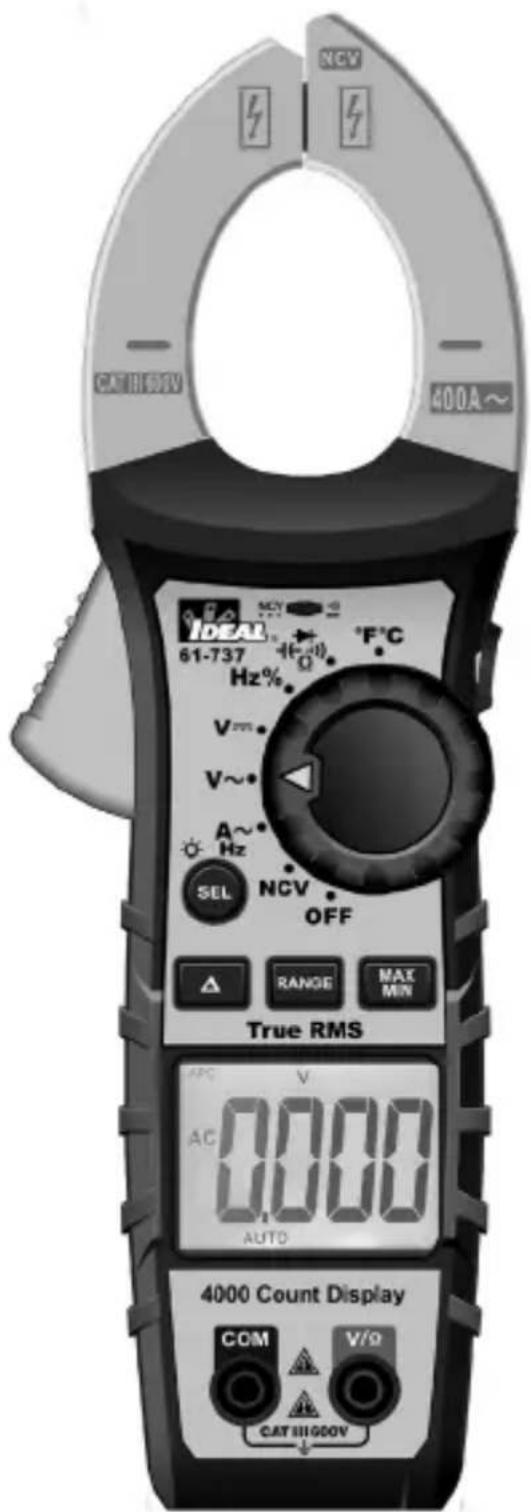
Identification and Description of Operating Controls and Functions for the 61-737 400A AC:
- Tapered Jaws with Hook Tip
- Data Hold
- Function Dial
- Max/Min
- LCD Display
- Volts and Resistance (V-Ω) Input Terminal
- COM Input Terminal
- Ergonomic Grip
- Range Button
- Relative Button
- Select / Backlight Button
- Lever
- NCV/Continuity/High Voltage Indicator
- Tactile Barrier
- NCV Sensing Point
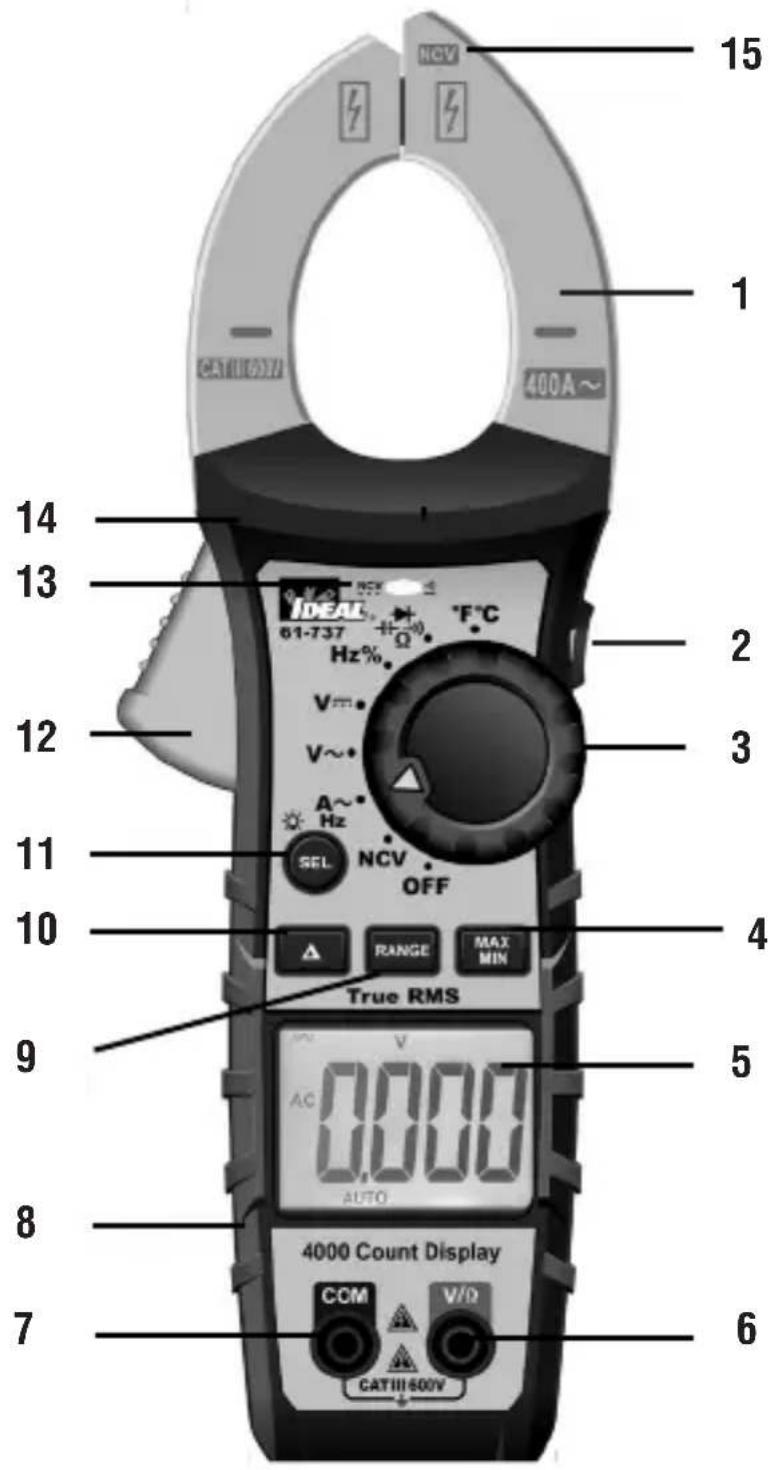
Operating Features
High Voltage Warning (HI-V)
The meter LED remains RED and the beep lasts for 1 second and then goes silent when voltages in excess of 30V are measured.
NOTE: This feature does not work in the Ohm, capacitor, continuity or clamp modes.
Data Hold Feature
Press the Hold button on the side of the meter to toggle in and out of the data hold mode. "HOLD" appears in the upper left of the meter display when data hold is active. Use the data hold feature to lock a measurement reading on the display. Press the Hold button again to unlock the display and obtain a real-time reading.
MAX/MIN Feature
The MAX/MIN records the maximum and minimum measured value. Press the MAX/MIN button to activate this feature and to toggle between MAX, and MIN readings. The unit will continually capture MAX and MIN values over time. Depressing the MAX/MIN button for >2 sec. exits the MAX/MIN mode.
Relative Mode
Press the “△” button to enter the Relative mode. The “△” symbol is displayed, and the value on the display is stored as a reference value. In the Relative mode, the value shown on the display is always the difference between the stored reference value and the present reading. Press the “△” button again to exit the Relative mode.
Auto Power Off (APO) Feature Disable
The meter automatically powers itself down after about 30 minutes of no use. Press any button, and the meter will wake up and display the last reading taken before power down. To Disable APO, press and hold the SEL button while turning the dial to any desired function. When APO is defeated, the “APO” will be removed from the display. Turning the meter off and back on will restore the APO default.
Backlight
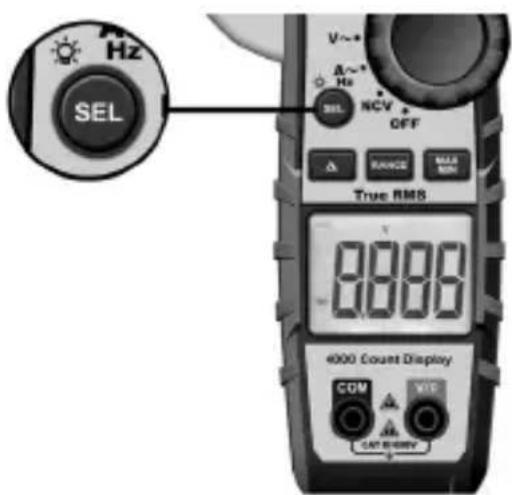
Backlight is selectable to be on in all functions.
Press and hold the SEL button on the meter for more than 2 seconds to turn the backlight on and off. The white backlight will remain lit for about 5 minutes before they automatically turn off to conserve battery power. Or turn the lights off by pressing and holding the button for more than 2 seconds again.
Using Test Leads
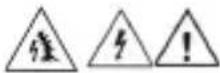
WARNING: Arc Flash and Shock Hazard, Proper PPE Required.
Follow all safety procedures, wear proper PPE in accordance to NFPA 70E and follow the guidelines below and the instructions in this manual when operating the meter with TL-757 Test Leads or equivalent. Test Leads must be rated for the electrical environment the meter is being used in and have a voltage rating of at least the voltage of the circuit to be measured. Failure to comply can result in serious injury or death.

Choking Hazard, Small Parts. Keep Away from Children. Sharp Objects Hazard, This is not a toy. It is not for use or play by children. Keep Away from Children. Failure to do so can result in serious injury.
Protective Cap Guard Ring

CAT III 1000V, CAT IV 600V (with cap on)

WARNING:
- Use only approved test leads. Do not use improvised connections that could present a safety hazard.
- Never measure AC or DC current while the test leads are inserted into the input jacks.
- Prior to using the test leads, inspect them carefully for damaged insulation, exposed metal or bent probes. Check test leads for continuity. Do not use leads if they appear damaged.
- When using the probes, keep fingers behind the finger guards on the probes.
- Connect the common test lead before connecting the live test lead. When disconnecting test leads, disconnect the live test lead first.
- Always ensure that test leads are secured so that they cannot be accidentally snagged or tripped over.
This meter is intended for use with the IDEAL TL-757 lead set (provided with this product) or equivalent. The lead set must comply with requirements for Overvoltage and Measurement Categories CAT IV 600V CAT III 1000V CAT II 1000V.
Meter Operation
Non-Contact Voltage Sensing
natural_image
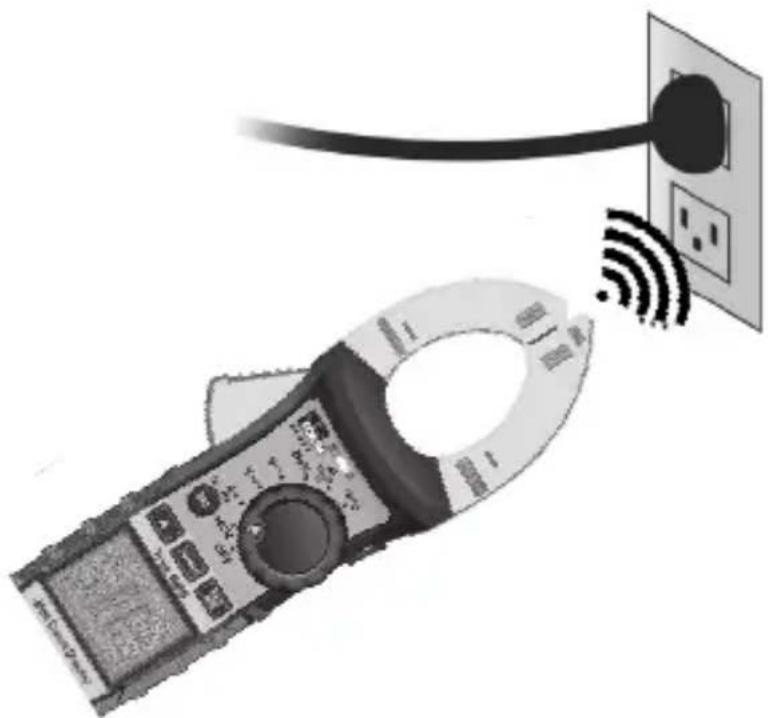
Illustration of a handheld device connected to an electrical outlet with signal waves (no text or symbols)First, rotate the function key to the NCV position. Place the jaw tip marked with NCV close to an AC outlet (or any AC conductor such as light switches or power cords) and scan back and forth across the outlet. Red indicator LED flashes at a frequency of 3Hz, and the buzzer beeps at a frequency of 3Hz simultaneously if live voltage is greater than 40VAC (50\~60Hz) is detected. To differentiate between hot and neutral in an outlet, place the NCV tab directly next to each slot in the outlet. The tone (buzzer) will sound over the slot that is energized and not on the neutral slot. Either test lead can also be used to differentiate between the hot and neutral. Plug the red or black test lead into the V input jack on the meter. With the function switch in the NCV position, insert the probe end of just one probe into the slots on the outlet. The meter will beep and the Red LED will flash when a hot conductor is contacted.
NOTES:
While the NCV is a helpful function, it is ALWAYS RECOMMENDED that the operator verify that any electrical conductor is completely de-energized and that no voltage is present by measuring for voltage AND CONFIRMING THAT NO VOLTAGE IS PRESENT and that all applicable PPE and lock out tag out procedures be followed before attempting any work on ANY electrical distribution system.
Voltages with frequencies higher than 60Hz or electrostatic charges may also be detected by the NCV sensing antenna.
Measuring AC ( ) Current (Amps)

Note: When measuring current, align conductor with dash marks on jaws.
Measuring AC ( ) or DC ( ·s ) Voltage
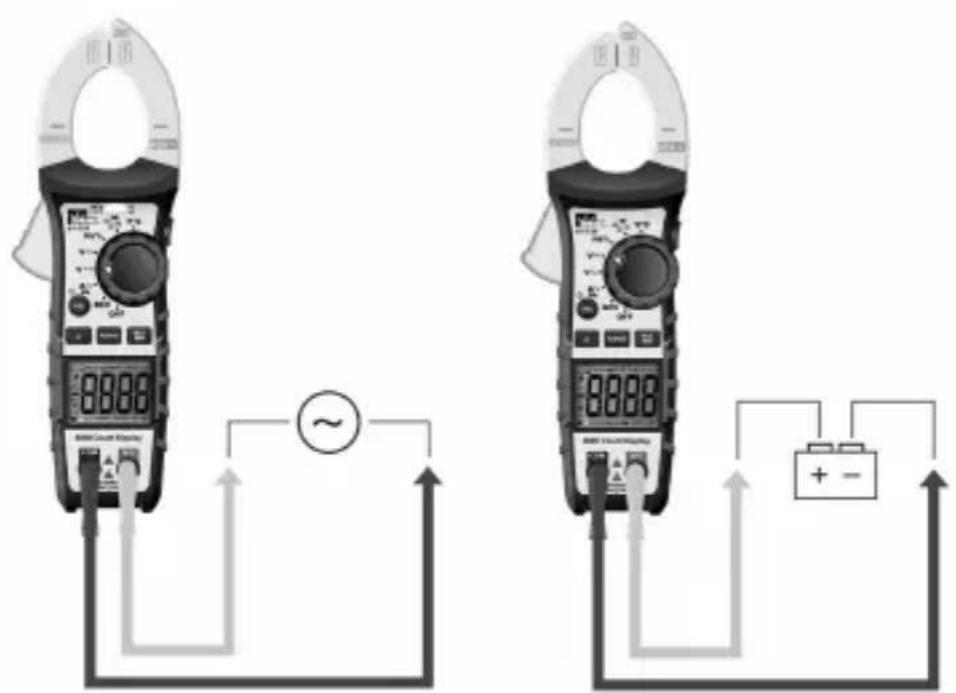
Note: When measuring AC voltage, Ghost or stray voltages (caused by induced voltages coupling from one parallel conductor to the next as found when measuring one conductor in multiple conductor circuits) may cause an incorrect value. Selecting the Low impedance position (LoZ) on the dial, (see inset above) while measuring voltage with the 61-757 will defeat the influence of Ghost or Stray voltage.
Verifying Continuity ( )
- Verify the circuit is de-energized.
- The meter will sense the level of resistance and a beep if the resistance is less than 10 Ω to confirm that continuity is present.
- Red LED will illuminate and resistance value will be displayed.
- The default setting is Continuity.
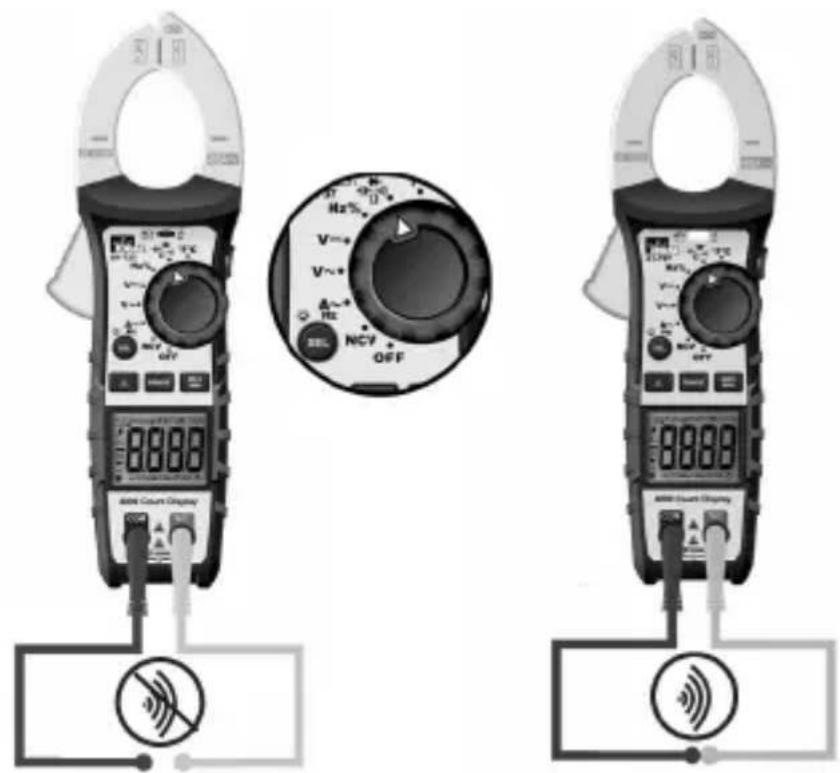
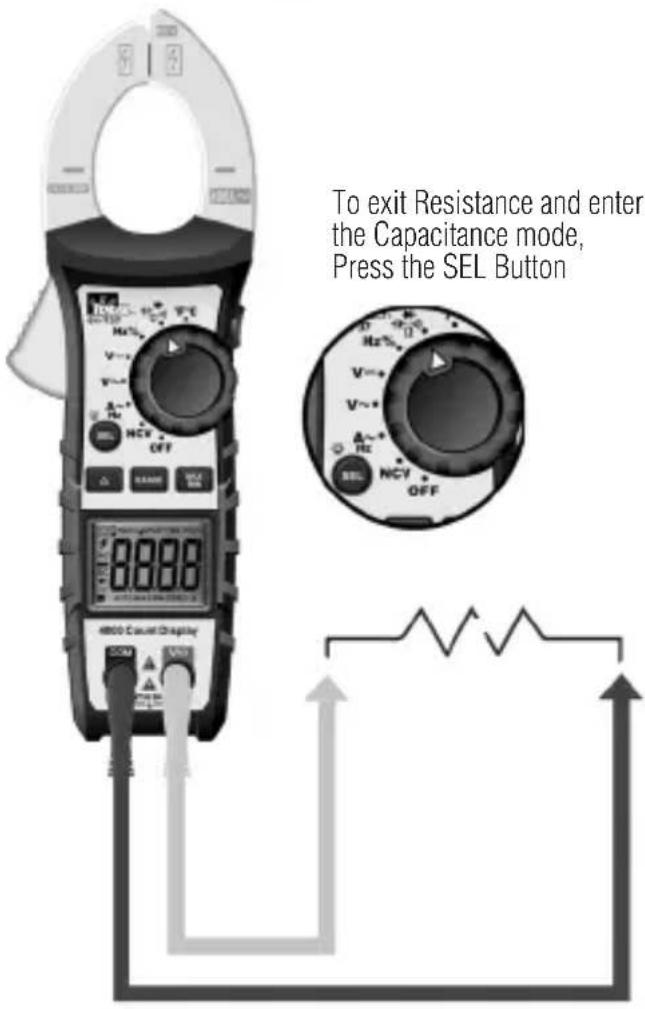
Measuring Resistance (Ohms / Ω)
Verify the circuit is de-energized to obtain accurate measurements.
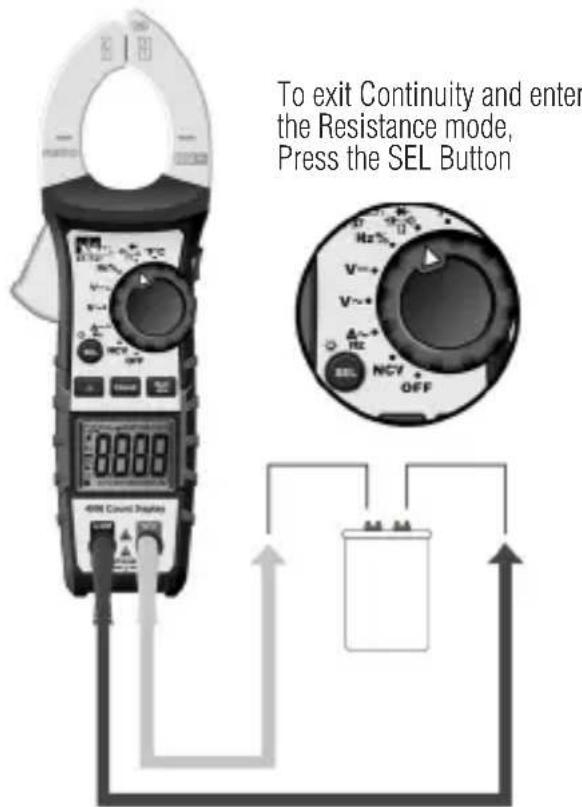
Measuring Capacitance ( ± )
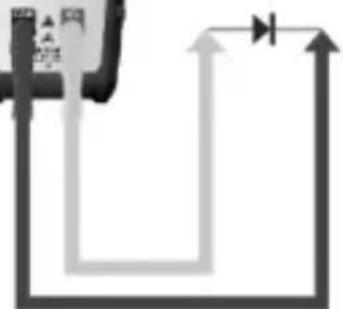
Measuring Diodes (→+)
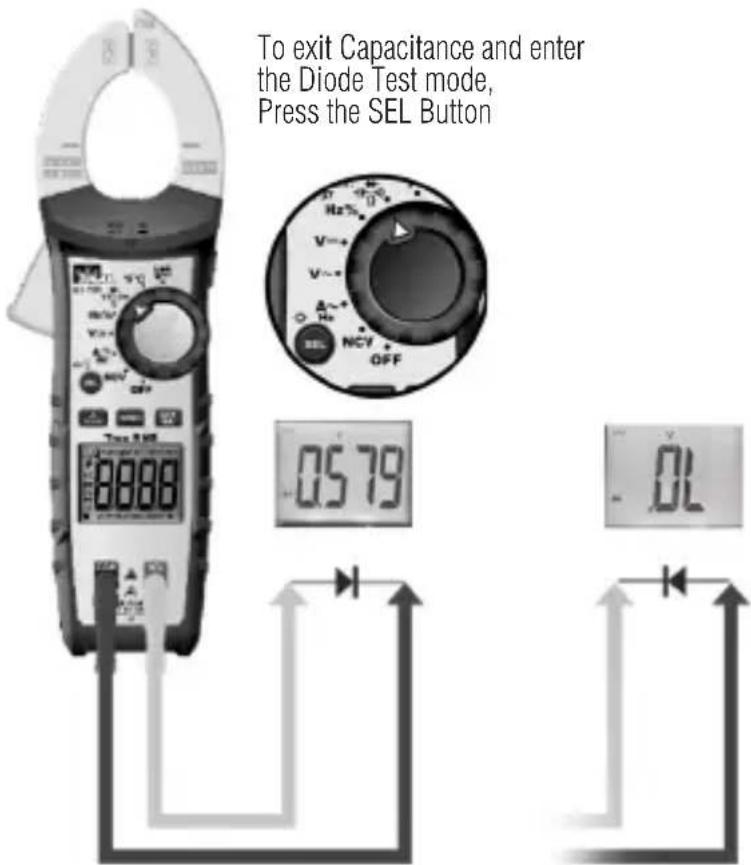
Measuring Frequency ( Hz )
Hz using Current
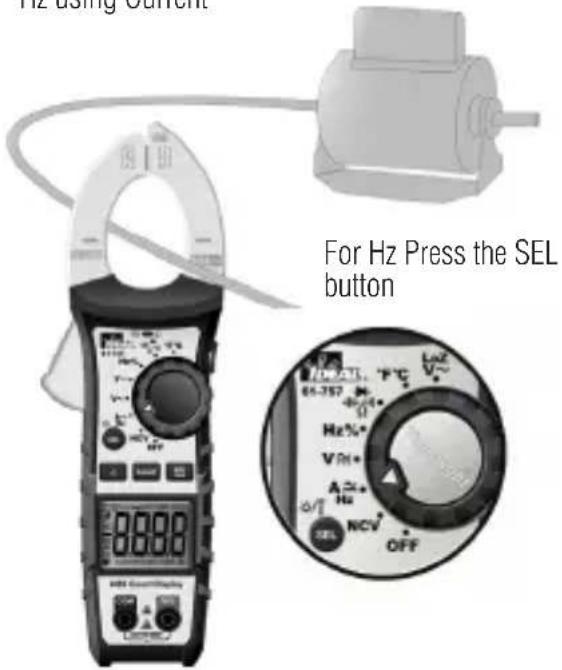
Current must be greater than 4 Amps AC.
Hz using Voltage
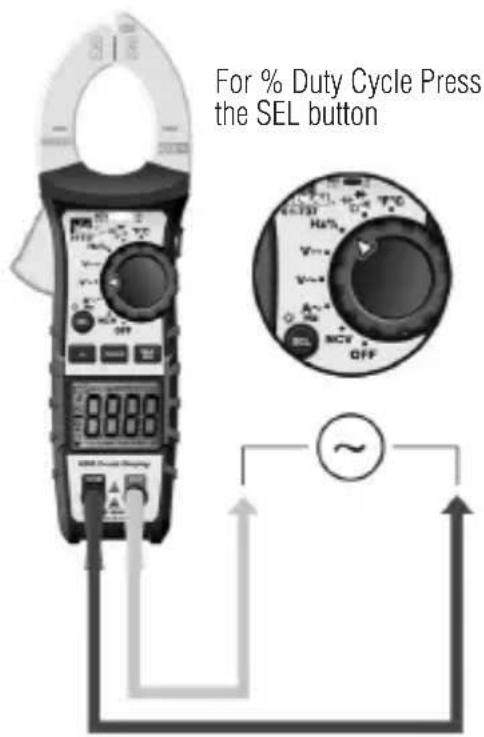
Measuring Temperature (°F °C)
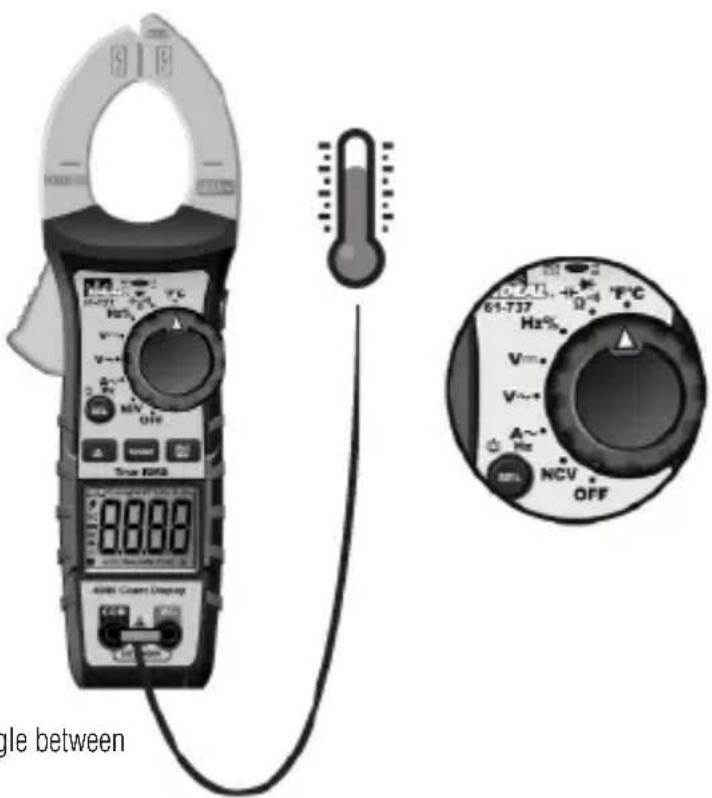
Press SEL to toggle between F and C
Functions Operation Table
| Button Response Default Function | ||
| HOLD | HOLD: All Functions (Except NCV) | Normal Measurement |
| SEL / ⚫/¶ | ACA / Hz ACA | |
| ACV/DCV NA | ||
| Hz/% Hz | ||
| ···//— —/—————————————————————————— | Continuity | |
| °F/°C °F | ||
| RANGE ACV, DCV, ACA, Ω | Auto range (LCD display “AUTO”) | |
| MAX/MIN ACV, DCV, ACA, Ω, °F/°C Normal Measurement | ||
| △ | △: ACV, DCV, ACA, CAP, Ω, °F/°C | Normal Measurement |
| Non-Contact Voltage Indication | ||
| OperationNote: Long Press: >2 seconds Short Press: < 2 seconds | ||
cularly enter or exit the data hold mode, LCD will display “”  | ||
| 1) Short press: Circularly select the appropriate test function.2) When in HOLD, RANGE, MAX/MIN, REL / function, Short press the SEL key will exit current function and go into the relative select function.3) Long press: Circularly turn on or off the backlight, default is off, Applicable to all measuring settings. The backlight will turn off automatically 5 minutes after they are activated. Long press SEL button again to turn on the backlight. | ||
| 1) Short press the RANGE key to enter manual range mode (LCD will not display “AUTO”), and the current range, press again to enter cyclical selection range. Long press: exits manual range and enters Auto range. Switching measurement setting or restarting the unit returns the unit to the default setting.2) In HOLD, MAX/MIN, REL function, Short press the RANGE key to exit the current function and enter the relative range function. | ||
| 1) Short press: enter “MAX/MIN” statistics mode, continuously updates the data, and you can circularly view the maximum value→ minimum value→ maximum value. Long press: exits statistical mode and returns to the normal working mode. After pressing the REL, and then short pressing MAX/MIN, the unit will show the MAX/MIN after deducting the initial offset value.2) When HOLD function is in use, MAX/MIN is invalid.3) After entering the statistical mode, exit the automatic range at the same time and enter into the current range, the APO will be disabled; exit the MAX/MIN function to restore the automatic range and automatic shutdown.4) In the statistical mode, a short press of the HOLD key will stop refreshing the statistical data. At the same time, a short press of the MAX/MIN key can review the stored data of MAX/MIN, a short press of the HOLD key exits HOLD to continue refreshing the statistical data. | ||
| 1) Short press: Circularly enter or exit REL function (when entering REL function, LCD will display “△” symbol)2) Entering the REL function, exits auto range and enters into the current range.3) Entering the REL measurement mode does not change the actual measurable range of the current range4) When HOLD or MAX/MIN is in use, REL function is invalid. | ||
| Displays “EF” – Electromagnetic Field | ||
Functions Indication Table
| Function Description | |
| Auto Range Auto | detects and displays most pertinent range for measured value. |
| LCD Total of two | LCDs (front and bottom). Bottom LCD displays same numbers as front display for all functions, displays a “-” symbol for all negative readings, displays “AC” for alternating current or “DC” for direct current and displays “Amps” for current measurement. |
| LCD Backlight White backlight for both front and bottom display. | |
| High Voltage Alarm | 1) Effective setting: ACV / DCV.2) In ACV/DCV, voltage measurement value: ACV/DCV ≥30V, LCD displays high voltage alarm lightning symbol“ ” Simultaneously the NCV LED is on and beeping lasts for 1 second and then goes silent during measurement.3) In voltage measure, the voltage data is out of range and LCD displays “OL”, and high voltage alarm lightning symbol“ ” Simultaneously the NCV LED is on and beeping lasts for 1 second and then goes silent during measurement. |
| Regular Prompt 1) | When turning the dial switch to any setting position except OFF, the buzzer will beep one time and NCV LED flashes one time.2) When the button selection is valid, the buzzer will beep one time; When the button is invalid, the buzzer will beep twice3) About 1 minute before the automatic shutdown, the buzzer will beep 5 times continuously, and 1 long beep before the unit shuts down.4) When the automatic shutdown function is cancelled, the buzzer will beep 5 times when it reaches the APO time setting. |
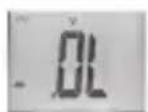
| Over Range Indication | LCD displays “OL” when over range is encountered. |
| Function Description | |
| Low Battery Indication | When the battery voltage < 3.6±0.2V, the low battery indication is displayed on the screen and the meter still works normally. When the battery voltage drops to less than 3.1±0.2V, “bAtt” is displayed for 5 seconds then shuts off. When the battery voltage is less than 2.3V, the meter is unreliable. Battery life varies by battery brand This ensures accurate readings. |
| APO No actions of the rotary dial or button presses for 30 minutes will be automatically cause the unit to shut down and enter the low-power state. Turning the meter off and then on will reset the meter to the default shutdown function, the LCD displays the “APO” symbol. | |
| Restore APO All the buttons can wake up the unit or rotate the dial switch to OFF setting and then turn on the unit to wake it up. | |
| Disable Auto Power Off Function | Pressing the “Select” key while turning on the unit at the same time, will cancel auto shutdown function. Buzzer will beep 5 times and the LCD will not display the “APO” symbol. |
Electrical Specifications
| Function Range Resolution Accuracy | |||
| AC Voltage (V) | 4.000V 0.001V | ±(a%+b) | |
| 400.0V 0.1V | |||
| 600V 1V ±(1.5%+5) | |||
| AC Current (A) | 40.00A 0.01A ±(2.0%+9) | ||
| 400.0A 0.1A ±(2.0%+5) | |||
| Frequency (ACA Hz) | 99.99Hz 0.01Hz | ±(0.1%+5) | |
| 999.9Hz 0.1Hz | |||
| DC Voltage (V) | 400.0mV 0.1mV ±(1.0%+8) | ||
| 4.000V 0.001V | ±(1.0%+5)4.000V 0.01V | ||
| 400.0V 0.1V | |||
| 600V 1V ±(1.5%+5) | |||
| Resistance (Ω) | 400.0Ω 0.1Ω | ±(1.5%+5) | |
| 4.000kΩ 0.001kΩ | |||
| 40.00kΩ 0.01kΩ | |||
| 400.0kΩ 0.1kΩ | |||
| 4.000MΩ 0.001MΩ | |||
| 40.00MΩ 0.01MΩ ±(2.0%+5) | |||
-
Overload Protection: 600VRMS and 400 AAC
-
Accuracy a is % of reading and b is LSD (Least Significant Digit).
-
AC crest factor 2.5 at 4000 counts, And non-sinusoidal wave according to wave factor calculated as follows:
a) Add 3% when crest factor is 1\~2
b) Add 5% when crest factor is 2\~2.5
| Function Range Resolution Accuracy | |||
Continuity 0.1 Ω  | ≤10Ω : Buzzer beeps and red indicator LED illuminates continuously | ||
| ≥70Ω : No buzzer beep | |||
| Diode 0.001V |  | Silicon PN joint with forward voltage about 0.5V to 0.8V | |
| Capacitance (F) | 400.0nF 0.1nF | ±(4.0%+8) | |
| 4.000uF 0.001uF | |||
| 40.00uF 0.01uF | |||
| 400.0uF 0.1uF | |||
| 4.000mF 0.001mF ±(5.0%+9) | |||
| Frequency (Hz/%) | 10Hz to 9.999kHz | 0.001Hz to 0.001kHz | ±(0.1%+5) |
| Duty Cycle (Hz/%) | 0.1% to 99.9% | 0.1% ±2.0% | |
| Temp. °F | -40 to 1832°F | 1°F | ±(2.0%+6) @ -40 to 32°F ±(2.0%+6) @33 to 1832°F |
| Temp. °C | -40 to 1000°C | 1°C | ±(2.0%+3) @ -40 to 0°C ±(2.0%+3) @1 to 1000°C |
| NCV | 40-600V AC | ≥40V/(50 to 60Hz), with direct wire contact, red indicator LED flashes at a frequency of 3Hz, and the buzzer beeps at a frequency of 3Hz | |
Environmental Specifications
| Operating Temperature: | 32°F to 86°F (0°C to 30°C) (80%RH)86°F to 104°F (30°C to 40°C) (75%RH)104°F to 122°F (40°C to 50°C) (45%RH) |
| Operating Altitude: | < 6562 ft (< 2000 m) |
| Storage Temperature: | 14°F to 140°F (-10°C to 60°C) (<80%RH) |
Intended for indoor use
Mechanical Specifications
| Dimensions (L x W x H) 9.5 in. x 2.8 in. x 1.8 in.(242 mm. x 71 mm. x 46 mm.) |
| Jaw Opening Dimensions |
| 1.4 in. (35 mm.) |
| Weight |
| 0.79 LBS (0.36 KG) |
| Display: |
| LCD |
| Display Count: 61-737 |
| 4000 |
| Power Source: |
| 3 x 1.5V AAA |
| Battery Life: |
| 100 Hours Typical |
EMC/EMI
CISPR 22 3rd Edition. Class B Limits.
EN 55032
CISPR 32
CISPR 11
FCC 15.107 with reference to Section 15.109 (g).
ICES-003
EN 61326-2-2 Sec 6.4.2.101
USA (FCC)
47 CFR 15 subpart B. This product is considered an exempt device per clause 15.103.
Safety
Complies with the following:
IEC 61010-1, Edition 3 (2010-06) +AMD1 (2016-12)
ANSI/UL/IEC EN 61010-1, Edition 3 (2015-07-15)
IEC 61010-2-032 (2019-06)
IEC 61010-2-033 (2019-06)
Overvoltage CAT III 600V, Not intended for use in a CAT IV.
Any voltages exceeding the defined maximum voltage measurement categories described above are outside the normal use of the equipment and protection cannot be guaranteed.
Pollution Degree Class 2
Maintenance and Service
Equipment Maintenance and Service
Meter Inspection
Do not use if meter appears damaged. Visually inspect the meter to ensure case and jaws are not cracked.
Test Lead Inspection
Inspect and replace test leads if insulation is damaged, metal is exposed, or probes are cracked. Pay particular attention to the insulation surrounding the connectors.
Thermocouple Inspection
Inspect the thermocouple for signs of wear or breakage. Replace if necessary to guarantee accuracy of readings.
Battery Inspection/Replacement
Inspect the battery compartment monthly for any signs of degradation. Low battery voltages will cause inaccuracies in readings. Remove the batteries for storage or if the meter will not be used for longer than one month. Battery leakage will compromise the safety of the meter and cause irreparable damage to internal components.
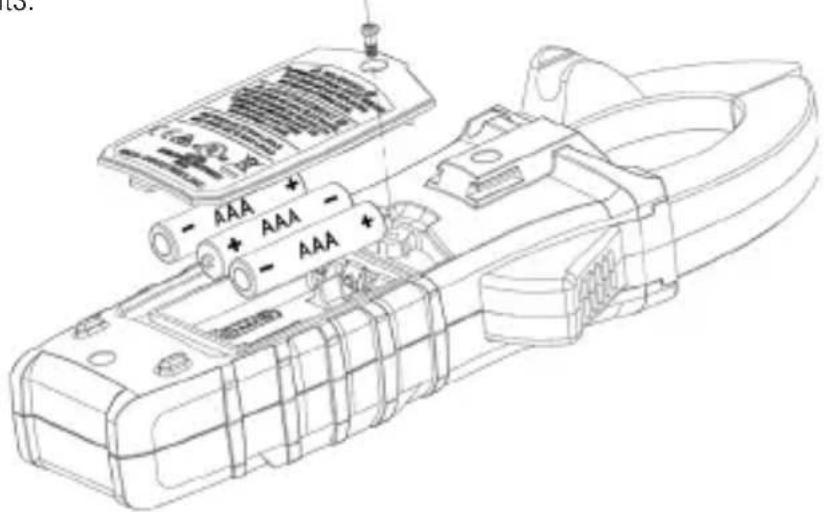
Shock Hazard. Remove the test leads from the circuit prior to removing the battery cover. Failure to comply can result in serious injury or death.
Maintenance and Storage
Switch off and disconnect the meter completely before carrying out any maintenance. Clean the case with a damp cloth and mild detergent. Do not use abrasives or solvents. Keep away from liquids and ensure the meter is completely dry before use.
Service and Replacement Parts
This unit has no user-servicable parts.
This clamp meter has no fuse.
Disposal of Waste, Electrical & Electronic Equipment

In order to preserve, protect and improve the quality of the environment, protect human health and utilize natural resources prudently and rationally, the user should return unserviceable product to relevant facilities in accordance with statutory regulations. The crossed-out wheeled bin indicates the product needs to be disposed separately and not as municipal waste.
Do not dispose of this product as unsorted municipal waste. It must be properly disposed of in accordance with local regulations. Please see www.epa.gov or www.erecycle.org for additional information.
Disposal of Used Batteries/Accumulators
The user is legally obliged to return used batteries and accumulators. Disposing used batteries in household waste is prohibited! Batteries/accumulators containing hazardous substances are marked with the crossed-out wheeled bin. The symbol indicates that the product is forbidden to be disposed via domestic refuse. The chemical symbols for the respective hazardous substances are Cd = Cadmium, Hg = Mercury, Pb = Lead.
You can return used batteries/accumulators free of charge to any collecting point of your local authority, our stores, or where batteries/accumulators are sold. Consequently, you must comply with your legal obligations and contribute to environmental protection.
TWO YEAR LIMITED WARRANTY
This tester is warranted to the original purchaser against defects in material and workmanship for a period of two (2) years from date of purchase. With proof of purchase from an authorized IDEAL distributor, a defective tester will be repaired or replaced with the same product or a functionally equivalent product, at the option of IDEAL INDUSTRIES, INC. during the warranty period, subject to verification of the defect or malfunction. Warranty does not cover consumables such as fuses, batteries, and excludes defects caused by leakage from batteries, abuse, mishandling, dropping, ordinary wear and tear, misuse, neglect, unauthorized repair, improper use, alterations, accidents or any causes beyond IDEAL's reasonable control. Consequential or incidental damages are not recoverable under this warranty. Some states do not allow the exclusion or limitation of incidental or consequential damages, so the above limitation or exclusion may not apply to you. This LIMITED WARRANTY gives you specific legal rights, which vary from state to state. This warranty constitutes the sole and exclusive remedy of the purchaser and the exclusive liability of IDEAL, and is in lieu of any and all other warranties, and expressly disclaims all other warranties, implied, or statutory as to merchantability, fitness for purpose sold, description, quality productiveness, or any other matter. No agent, distributor or other supplier has the authority to modify or amend this warranty or make other representations or warranties other than those contained in this warranty without express written authorization from IDEAL. For warranty service, call IDEAL customer service at 1-800-435-0705.
Made in China.
IDEAL INDUSTRIES, INC. Syracuse, IL 60178, U.S.A. 800-435-0705 waw.idealind.com ND 9012-1
natural_image
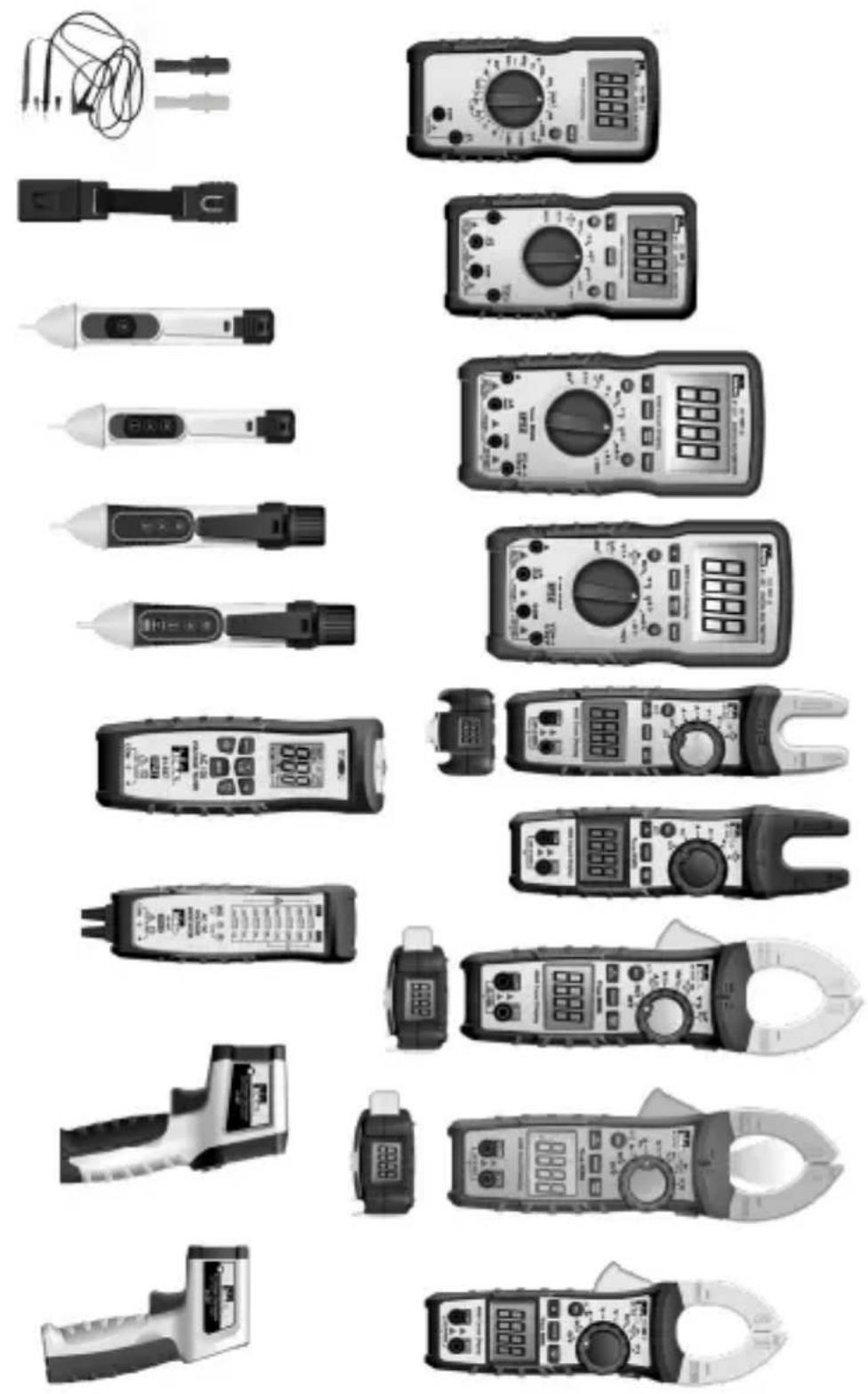
Collection of various digital and analog multimeters displayed in a grid layout (no visible text or labels)Scan the barcode on the right to see the new IDEAL T&M Product Line


SCAN ME
Advertencias....32-33
Precauciones....33
Símbolos....34-35
Operación ....36-51
IDEAL Industries Australia
natural_image
Illustration of a handheld device connected to an electrical outlet with signal waves (no text or symbols)Functions Indication Table


ADVERTENCIA
natural_image
Collection of various digital multimeters and probes displayed in a grid layout (no visible text or labels)IDEAL Industries Australia

SCAN ME
natural_image
Illustration of a handheld device connected to an electrical outlet with signal waves (no text or symbols)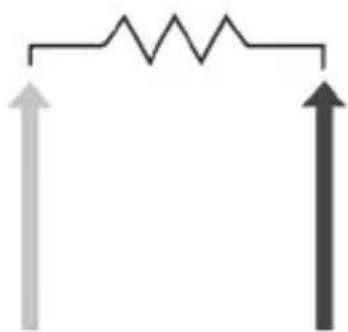
natural_image
Simple diagram showing a zigzag line above two upward-pointing arrows, no text or symbols present.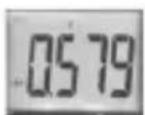
natural_image
Pure diagram of a pipe system with arrows indicating flow direction (no text or symbols)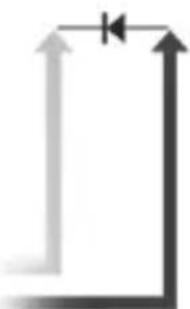
natural_image
Simple diagram with two vertical arrows pointing upward, one with a double arrow and the other with an arrowhead (no text or symbols)natural_image
3D rendering of a cylindrical mechanical component with a rectangular top and side shaft (no text or symbols)CISPR 22 3rd Edition. Class B Limits.
EN 55032
CISPR 32
CISPR 11