SIW 11TES - Heat pump DIMPLEX - Free user manual and instructions
Find the device manual for free SIW 11TES DIMPLEX in PDF.



| Product type | Glycol water-to-water heat pump for indoor installation, compact with integrated domestic hot water tank |
| Brand | Dimplex |
| Model | SIW 11TES |
| Dimensions (H x W x D) | 1994 x 590 x 710 mm |
| Weight (transport unit) | 287 kg (including packaging) / 445 kg (filled) |
| Power supply | Power: 3~/N/PE 400 V (50 Hz), C20A; control: 1~/N/PE 230 V (50 Hz), C13A |
| Heating flow temperature range | 20 to 62 °C |
| Heat source temperature range (glycol water) | -5 to 25 °C |
| Refrigerant | R410A, 1.9 kg, GWP 2088, CO₂ equivalent 4 t |
| Domestic hot water tank | Volume 170 L, nominal capacity 156 L, max pressure 6 bar, enameled steel according to DIN 4753 |
| Nominal heating power (Prated) | 10 kW |
| COP (B0/W35) | 5.0 |
| Sound power level (indoor) | 43 dB(A) |
| Maximum test pressure | 4.0 bar (heating and glycol water side) |
| Maximum permissible tilt during transport | 45° |
| Heating side maintenance | Cleaning with 5% phosphoric acid or 5% formic acid at room temperature |
| Heat source side maintenance | Cleaning of the dirt collector strainer (mounted on the glycol water inlet) |
| Repairability | Removable heat pump module, removable housing panels, intervention by authorized service center |
| Integrated safety devices | High and low pressure pressostat, hot gas thermostat, flow switch, motor protection, temperature limiter |
| Additional warranty | Under conditions, upon commissioning by a service center approved by the manufacturer |
Frequently Asked Questions - SIW 11TES DIMPLEX
User questions about SIW 11TES DIMPLEX
0 question about this device. Answer the ones you know or ask your own.
Ask a new question about this device
Download the instructions for your Heat pump in PDF format for free! Find your manual SIW 11TES - DIMPLEX and take your electronic device back in hand. On this page are published all the documents necessary for the use of your device. SIW 11TES by DIMPLEX.
USER MANUAL SIW 11TES DIMPLEX
natural_image
Line drawing of a rectangular industrial cabinet or enclosure with mounting holes and a small internal component (no text or symbols)Installation and Operating Instruction
Brine-to-Water Heat Pump for Indoor Installation
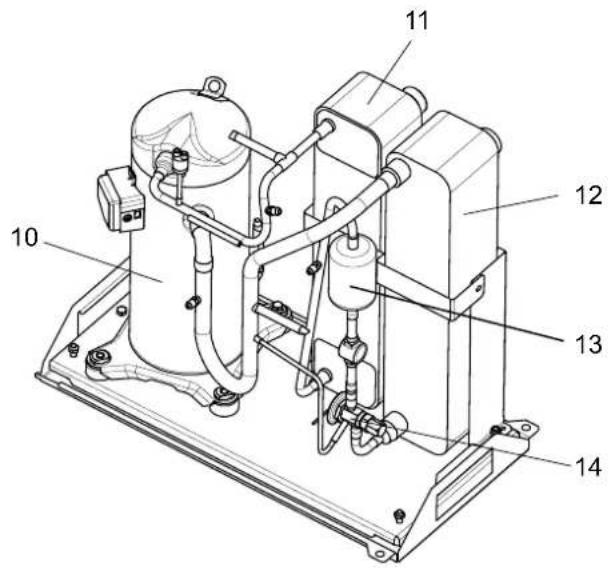
10) Verdichter
11) Verflüssiger
12) Verdampfer
13) Filtertrockner
1) Entlüftung
natural_image
Pure mechanical assembly diagram showing a shaft connected to multiple valve ports (no text or symbols)natural_image
Front view of a modern electronic device with a screen and control knob (no visible text or symbols)5 Transport
5.1 Allgemein
natural_image
Technical line drawing of a rectangular industrial cabinet with labeled components (no text or symbols beyond basic labels)natural_image
Technical line drawing of an industrial air conditioning unit with internal components and mounting base (no text or labels)ACHTUNG!
Glen Dimplex Thermal Solutions
Garantieurkunde GDTS
Glen Dimplex Thermal Solutions
natural_image
Empty white rectangle with black border (no text or symbols)Table of contents
1 Please read immediately....EN-2
1.1 Important information......EN-2
1.2 Intended use......EN-2
1.3 Legal regulations and directives....EN-2
1.4 Energy-efficient use of the heat pump......EN-2
2 Intended use of the heat pump ......EN-3
2.1 Intended purpose......EN-3
2.2 Operating principle......EN-3
3 Basic device......EN-3
3.1 General......EN-3
3.2 Brine-to-water hydraulic module....EN-4
3.3 Heat pump module.....EN-4
4 Accessories......EN-5
4.1 Brine circuit manifold....EN-5
4.2 Brine controller.....EN-5
4.3 Remote control....EN-5
4.4 Building management technology......EN-5
4.5 Smart RTC....EN-5
5 Transport......EN-6
5.1 General......EN-6
5.2 Removing the casing panels....EN-6
5.3 Removing the heat pump module....EN-7
6 Installation....EN-8
6.1 General Information......EN-8
6.2 Acoustic Emissions......EN-8
7 Installation....EN-8
7.1 General......EN-8
7.2 Connection on heating side....EN-8
7.3 Heat source connection....EN-9
7.4 Domestic hot water connection....EN-9
7.5 Temperature sensor....EN-10
7.6 Electrical connection....EN-10
8 Commissioning......EN-12
8.1 General......EN-12
8.2 Preparation......EN-12
8.3 Start-up procedure......EN-12
9 Cleaning / maintenance ...... EN-13
9.1 Maintenance....EN-13
9.2 Cleaning the heating system ......EN-13
9.3 Cleaning the heat source system......EN-13
10 Faults / troubleshooting......EN-13
11 Decommissioning / disposal......EN-13
12 Device information ...... EN-14
13 Product information as per Regulation (EU) No 813/2013, Annex II, Table 2......EN-16
1 Please read immediately
1.1 Important information
ATTENTION!
When operating or maintaining a heat pump, the legal requirements of the country where the heat pump is operated apply. Depending on the refrigerant quantity, the heat pump must be inspected for leaks at regular intervals by a certified technician, and these inspections must be recorded.
ATTENTION!
If the heat pump or circulating pumps are controlled externally, an flow rate switch is required to prevent the compressor from being switched on when there is no volume flow.
ATTENTION!
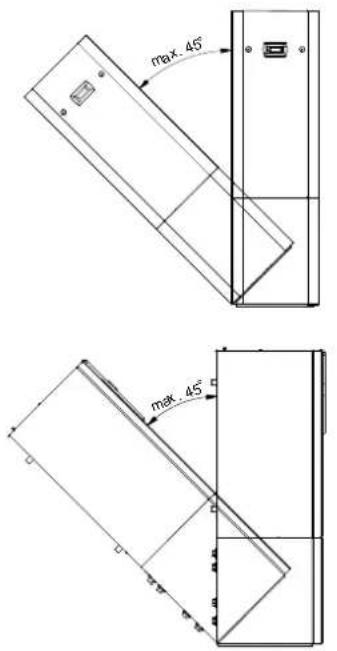
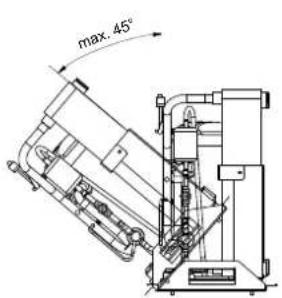
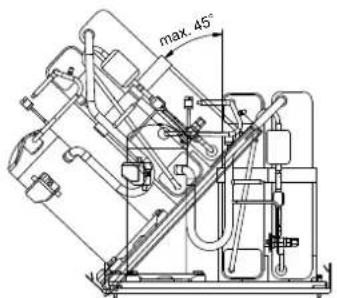
In installed and dismantled state, the heat pump module may only be tilted by a maximum of 45^ (in each direction Cap. 5.3 on pag. 7).
ATTENTION!
Before start-up, the transport fastening must be removed.
ATTENTION!
Flush the heating system prior to connecting the heat pump.
ATTENTION!
The maximum test pressure in the heating circuit and the brine circuit is 4.0 bar. This value must not be exceeded.
ATTENTION!
With fully demineralized water, it is important to ensure that the minimum permissible pH value of 7.5 (minimum permissible value for copper) is complied with. Failure to comply with this value can result in the heat pump being destroyed.
ATTENTION!
The brine solution must contain at least a 25 % concentration of a monoethylene glycol or propylene glycol-based antifreeze, which must be mixed before filling.
ATTENTION!
A suitable de-aerator (micro bubble air separator) must be installed in the heat source circuit by the customer.
ATTENTION!
The heat pump must be started up in accordance with the installation and operating instructions of the heat pump manager.
ATTENTION!
The supplied dirt trap must be inserted in the heat source inlet of the heat pump to protect the evaporator against the ingress of impurities.
ATTENTION!
Work on the heat pump must only be performed by authorised and qualified after-sales service technicians!
ATTENTION!
Disconnect all electrical circuits from the power source prior to opening the device.
1.2 Intended use
This device is only intended for use as specified by the manufacturer. Any other use beyond that intended by the manufacturer is prohibited. This requires the user to abide by the relevant project planning documents. Please refrain from tampering with or altering the device.
1.3 Legal regulations and directives
This heat pump is designed for use in a domestic environment according to Article 1, Paragraph 2 k) of EU directive 2006/42/EC (machinery directive) and is thus subject to the ments of EU directive 2014/35/EU (low-voltage directive). It is thus also intended for use by non-professionals for heating shops, offices, hotels and other similar working environments, agricultural establishments and hotels, guesthouses and other residential buildings.
This heat pump conforms to all relevant DIN/VDE regulations and EU directives. Refer to the EC Declaration of Conformity in the appendix for details.
The heat pump must be connected to the power supply in compliance with all relevant VDE, EN and IEC standards. Any further connection requirements stipulated by local utility companies must also be observed.
The heat pump is to be connected to the heat source system and the heating system in accordance with all applicable regulations.
This unit can be used by children aged 8 and over and by persons with limited physical, sensory or mental aptitude or lack of experience and/or knowledge, providing they are supervised or have been instructed in the safe use of the unit and understand the associated potential dangers.
Children must not play with the device. Cleaning and user maintenance must not be carried out by children without supervision
ATTENTION!
When operating or maintaining a heat pump, the legal requirements of the country where the heat pump is operated apply. Depending on the refrigerant quantity, the heat pump must be inspected for leaks at regular intervals by a certified technician, and these inspections must be recorded.
More information can be found in the accompanying log book.
1.4 Energy-efficient use of the heat pump
By operating this heat pump you are helping to protect our environment. Both the heating system and the heat source must be properly designed and dimensioned to ensure efficient operation. It is particularly important to keep water flow temperatures as low as possible. All connected energy consumers should therefore be suitable for low flow temperatures. Raising the heating water temperature by 1 K corresponds to an increase in energy consumption of approx. 2.5 %. Low-temperature heating systems with flow temperatures between 30 °C and 50 °C are particularly well-suited for energy-efficient operation.
The domestic hot water temperature should not exceed 45 °C when the heat pump is in operation. This will save you significant amounts of energy.
2 Intended use of the heat pump
2.1 Intended purpose
The high-efficiency compact brine-to-water heat pump with built-in domestic hot water cylinder is intended only for heating water and process water. It can be used in new or existing heating systems. The mixture of water and frost protection (brine) acts as a heat transfer medium in the heat source system. Ground probes, ground heat collectors or similar systems can be used as heat source systems.
2.2 Operating principle
The heat generated by the sun, wind and rain is stored in the ground. This heat stored in the ground is collected at a low temperature by the brine circulating in the ground heat collector, the borehole heat exchanger or a similar system. A circulating pump then conveys the "heated" brine to the evaporator of the heat pump. There the heat is given off to the refrigerant in the refrigerating cycle. This cools the brine so that it can once again absorb thermal energy in the brine circuit.
The refrigerant is drawn in by the electrically driven compressor, compressed and "pumped" to a higher temperature level. The electrical power needed to run the compressor is not lost in this process. Most of it is absorbed by the refrigerant.
The refrigerant subsequently passes through the liquifier where it transfers its thermal energy to the heating water. Depending on the set operating point, the heating water is thus heated up to a max. of 62 °C.
3 Basic device
3.1 General
The basic device consists of a ready-for-use heat pump for indoor installation in a compact design with built-in domestic hot water cylinder.
All components required for the operation of the heat pump are located on the switch box with heat pump manager. An outside temperature sensor including fixing accessories and a dirt trap are supplied with the heat pump. The supply for the load current and the control voltage must be installed by the customer.
The customer must provide both the heat source system and the brine circuit manifold.
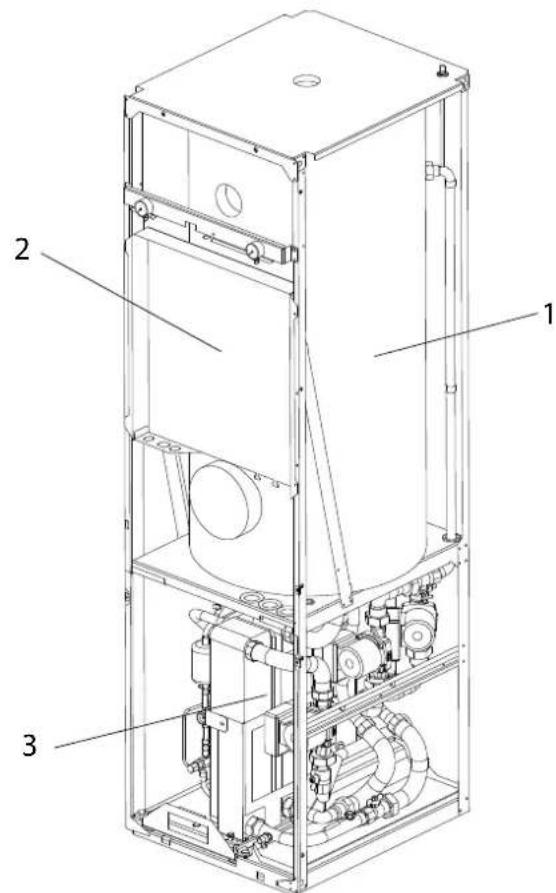
1) Brine-to-water hydraulic module
2) Switch box with heat pump manager
3) Heat pump module
3.2 Brine-to-water hydraulic module
The brine-to-water hydraulic module contains the components of the heating and brine circuit required for connecting the heat pump.
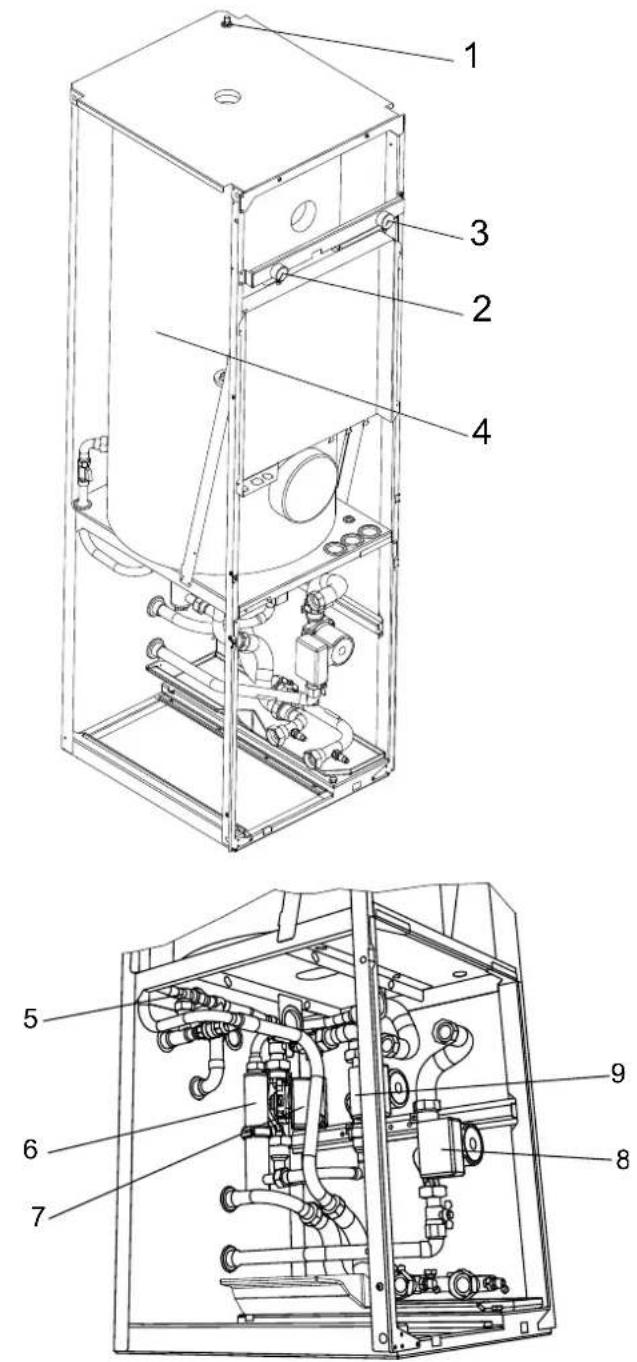
1) De-aeration
2) Heating pressure gauge
3) Brine pressure gauge
4) Domestic hot water cylinders
5) Overflow valve
6) Pipe heater
7) Heat circulating pump
8) Brine circulating pump
9) Domestic hot water circulating pump
3.3 Heat pump module
The refrigeration circuit is "hermetically sealed" and contains the fluorinated refrigerant R410A included in the Kyoto protocol. Information on the GWP value and CO_2 equivalent of the refrigerant can be found in the chapter Device information. The refrigerant is CFC-free, non-ozone depleting and non-combustible.
The heat pump module switch box contains all components required for operating the refrigeration circuit.
4.1 Brine circuit manifold
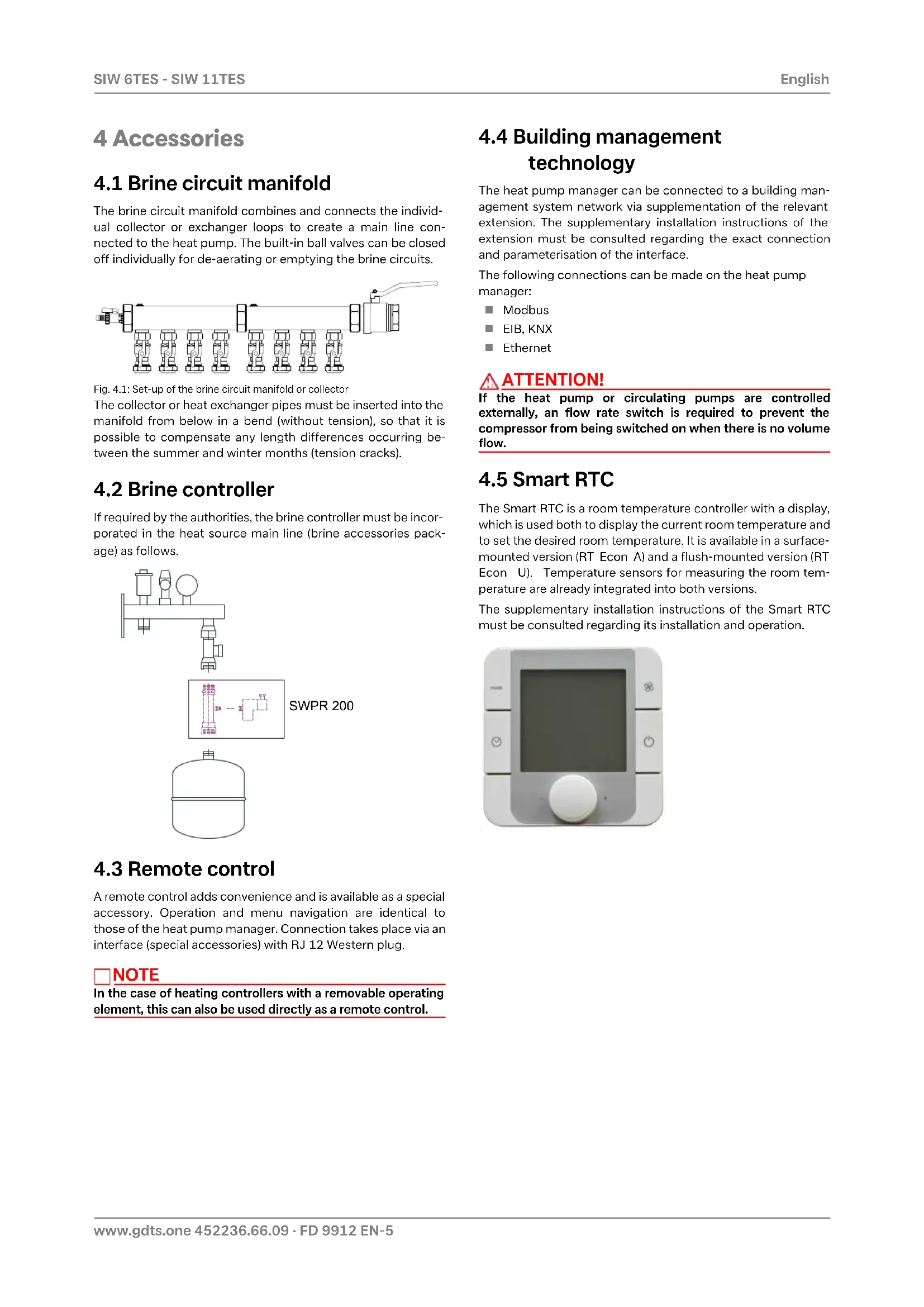
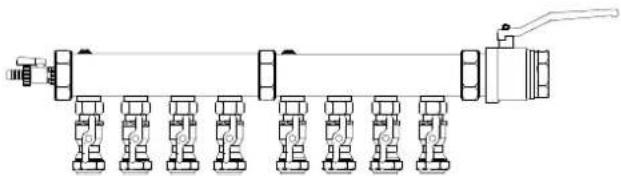
The brine circuit manifold combines and connects the individual collector or exchanger loops to create a main line connected to the heat pump. The built-in ball valves can be closed off individually for de-aerating or emptying the brine circuits.
natural_image
Pure mechanical assembly diagram showing a shaft connected to a conveyor belt with multiple rollers (no text or symbols)Fig. 4.1: Set-up of the brine circuit manifold or collector The collector or heat exchanger pipes must be inserted into the manifold from below in a bend (without tension), so that it is possible to compensate any length differences occurring between the summer and winter months (tension cracks).
4.2 Brine controller
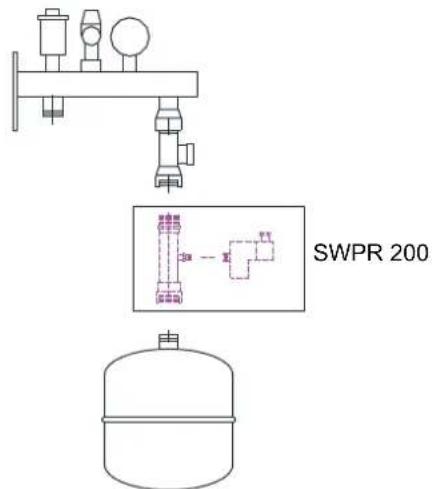
If required by the authorities, the brine controller must be incorporated in the heat source main line (brine accessories package) as follows.
4.3 Remote control
A remote control adds convenience and is available as a special accessory. Operation and menu navigation are identical to those of the heat pump manager. Connection takes place via an interface (special accessories) with RJ 12 Western plug.
NOTE
In the case of heating controllers with a removable operating element, this can also be used directly as a remote control.
4.4 Building management technology
The heat pump manager can be connected to a building management system network via supplementation of the relevant extension. The supplementary installation instructions of the extension must be consulted regarding the exact connection and parameterisation of the interface.
The following connections can be made on the heat pump manager:
Modbus
EIB, KNX
Ethernet
ATTENTION!
If the heat pump or circulating pumps are controlled externally, an flow rate switch is required to prevent the compressor from being switched on when there is no volume flow.
4.5 Smart RTC
The Smart RTC is a room temperature controller with a display, which is used both to display the current room temperature and to set the desired room temperature. It is available in a surface-mounted version (RT Econ A) and a flush-mounted version (RT Econ U). Temperature sensors for measuring the room temperature are already integrated into both versions.
The supplementary installation instructions of the Smart RTC must be consulted regarding its installation and operation.

natural_image
Digital display device with control buttons and a central screen (no visible text or symbols)5 Transport
5.1 General
A lift truck is suited for transporting the unit on a level surface. Carrying straps may be used if the heat pump needs to be transported on an uneven surface or carried up or down stairs. These straps can be passed directly underneath the pallet.
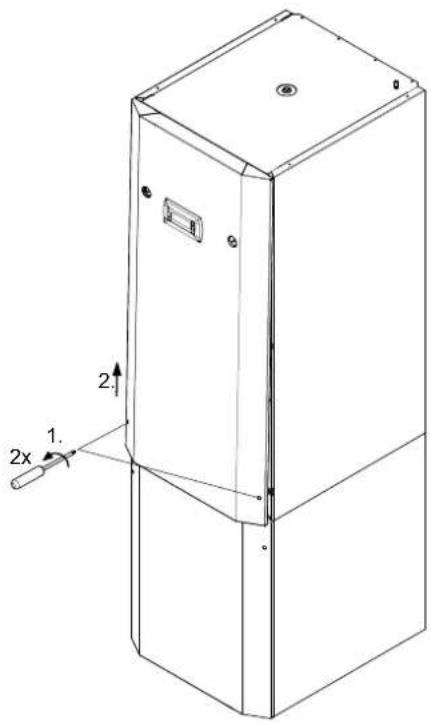
natural_image
Technical line drawing of a rectangular industrial cabinet with labeled components (no text or symbols beyond basic labels)Fig. 5.2: open front plate top
ATTENTION!
In installed and dismantled state, the heat pump module may only be tilted by a maximum of 45^ (in each direction) (see Cap. 5.3 on pag. 7).
5.2 Removing the casing panels
All panelling can be removed to allow accessing the inside of the device.
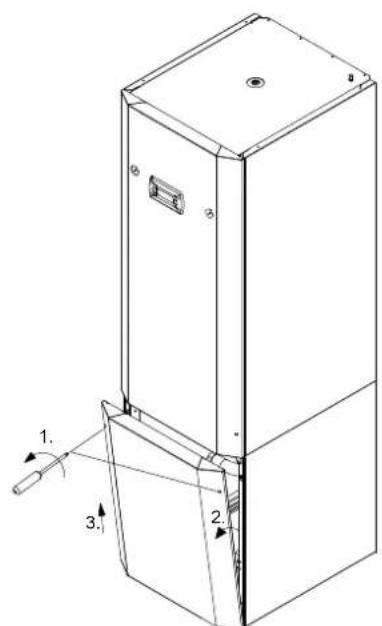
Fig. 5.1: open front plate bottom
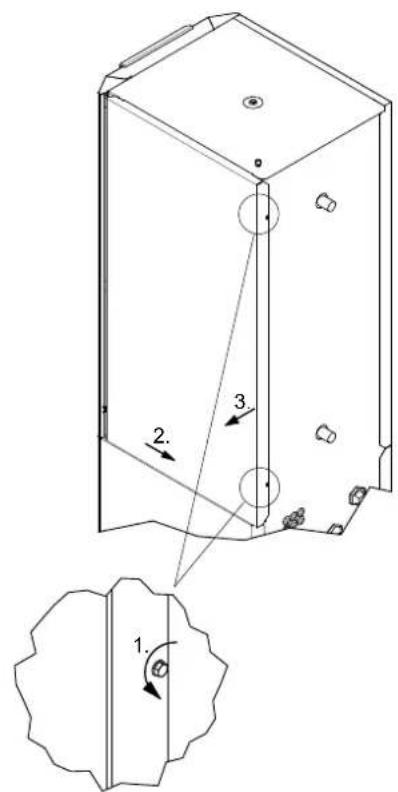
Fig. 5.3: open side plates
5.3 Removing the heat pump module
Removing the heat pump module enables to heat pump to be transported easily in a horizontal position and the heat pump module to be transported separately.
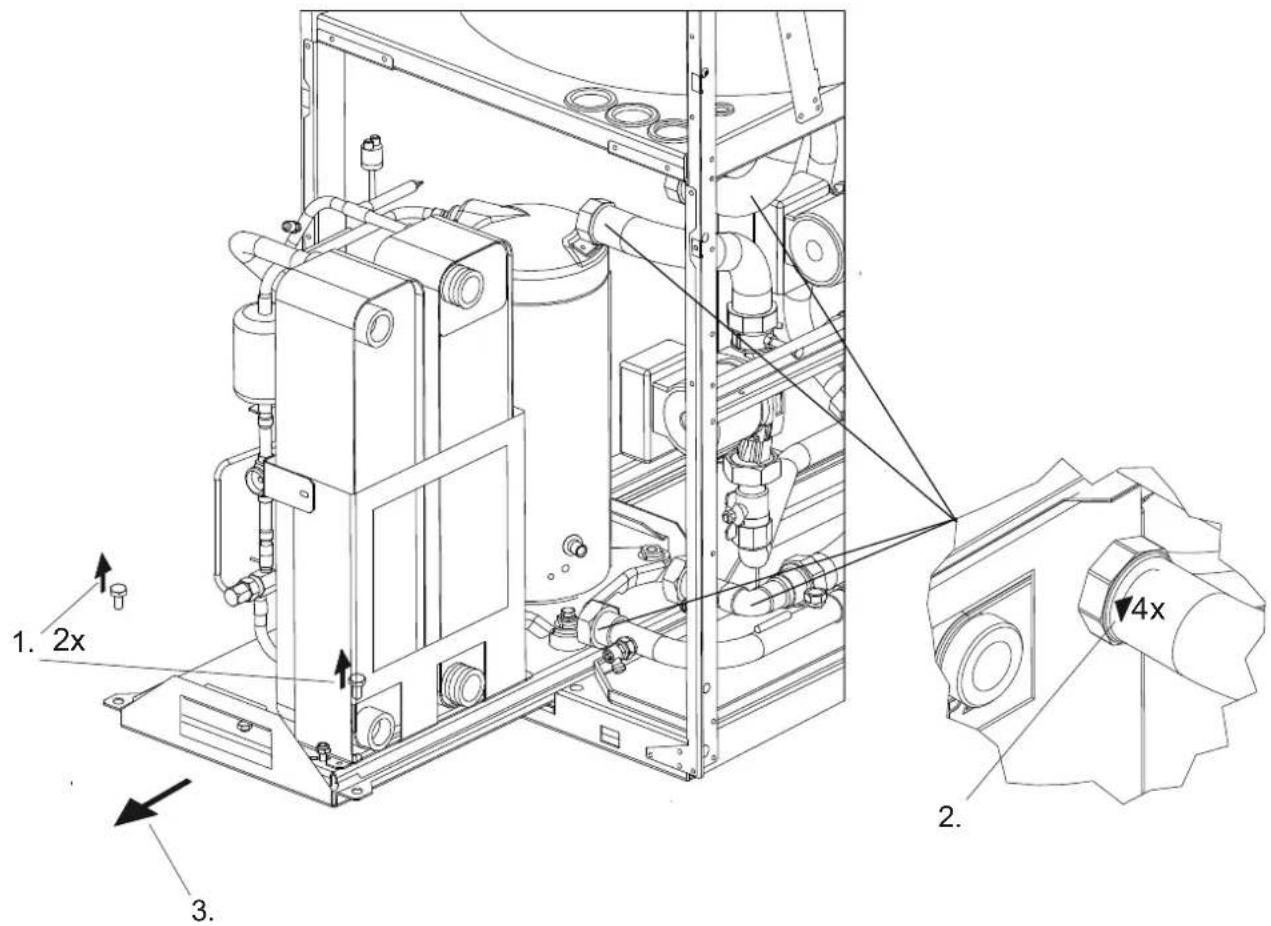
natural_image
Technical line drawing of an industrial equipment unit with pipes, valves, and a base plate (no text or labels)ATTENTION!
In installed and dismantled state, the heat pump module may only be tilted by a maximum of 45^ (in each direction).
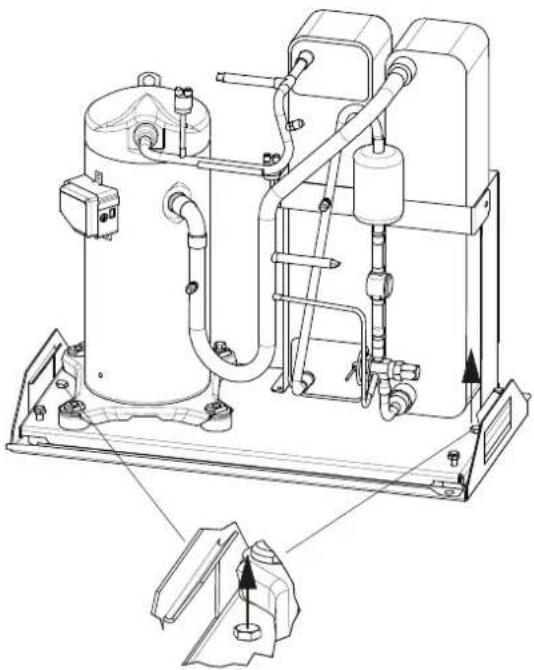
After transportation, the transport fastening on the heat pump module is to be removed from both sides.
ATTENTION!
Before start-up, the transport fastening must be removed.
6 Installat
6.1 General Information
The compact brine-to-water heat pump must be installed in a frost-free, dry room on an even, smooth and horizontal surface. The entire base of the frame should lie directly on the floor to ensure an adequate soundproof seal. The surface must have sufficient load bearing capacity for the weight of the heat pump and the domestic hot water quantity. If supporting feet are used, the heat pump must be installed horizontally. In this case, the specified sound level can be up to 3 dB(A) higher, and additional sound insulation measures may be necessary.
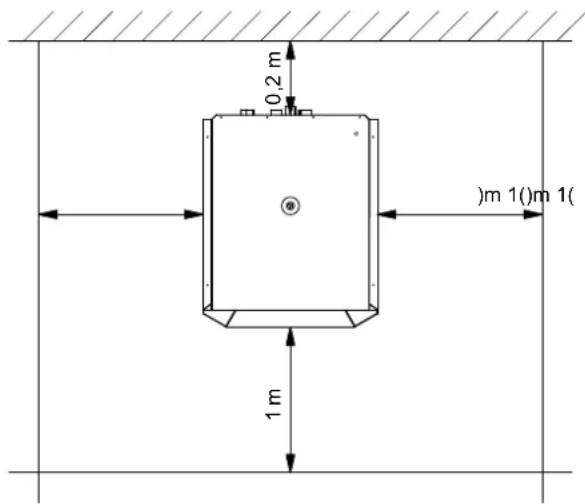
The heat pump must be installed so that maintenance work can be carried out without hindrance. This can be ensured by maintaining a clearance of approx. 1 m in front of and, where necessary, at the sides of the heat pump. If the heat pump is accessed from the front (e.g. installed in a recess etc.), the heat pump module can be removed for after-sales service (see Chapter 5).
Neither frost nor temperatures higher than 35 °C must occur in the installation location at any time of the year.
6.2 Acoustic Emissions
The heat pump operates silently due to efficient sound insulation. Internal insulation measures should be carried out to prevent vibrations from being transmitted to the foundation or to the heating system.
7 Installat
7.1 General
The following connections need to be established on the heat pump:
■ Flow and return of the brine (heat source system)
■ Flow and return of the heating system
■ Domestic hot water outlet
Cold water inlet
■ Voltage supply
■ Temperature sensor
i7.2 Connection on heating side
ATTENTION!
Flush the heating system prior to connecting the heat pump.
Before connecting the heating water system to the heat pump, the heating system must be flushed to remove any impurities, residue from sealants, etc. Any accumulation of deposits in the liquefier may cause the heat pump to completely break down.
Once the heat pump has been connected to the heating system, it must be filled, de-aerated and pressure-tested.
ATTENTION!
The maximum test pressure in the heating circuit and the brine circuit is 4.0 bar.
This value must not be exceeded.
The following points must be observed when filling the system:
■ Untreated filling water and make-up water must be of drinking water quality.
(colourless, clear, free of sediments)
■ Filling water and make-up water must be pre-filtered (max. pore size 5 m).
Scale formation in domestic hot water heating systems cannot be avoided, but in systems with flow temperatures below 60 °C, the problem can be disregarded. With high-temperature heat pumps and in particular with bivalent systems in the higher performance range (heat pump + boiler combination), flow temperatures of 60 °C and more can be achieved. The following standard values should therefore be adhered to with regard to the filling and make-up water according to VDI 2035, sheet 1: The total hardness values can be found in the table.
| Total heat output in kW | Total alkaline earths in mol/m ^3 and/or mmol/l | Specific system volume (VDI 2035) in l/kW | ||
| < 20 | ≥ 20 < 50 | ≥ 50 | ||
| Total hardness in °dH | ||||
| < 50 | ≤ 2,0 | ≤ 16,8 | ≤ 11,2 | < 0,11 ^1 |
| 50 - 200 | ≤ 2,0 | ≤ 11,2 | ≤ 8,4 | |
| 200 - 600 | ≤ 1,5 | ≤ 8,4 | < 0,11 ^1 | |
| > 600 | < 0,02 | < 0,11 ^1 | ||
- This value lies outside the permissible value for heat exchangers in heat pumps.
Fig. 7.1: Guideline values for filling and make-up water in accordance with VDI 2035
For systems with an above-average specific system volume of 50 l/kW, VDI 2035 recommends using fully demineralized water and a pH stabiliser to minimize the risk of corrosion in the heat pump and the heating system.
ATTENTION!
With fully demineralized water, it is important to ensure that the minimum permissible pH value of 7.5 (minimum permissible value for copper) is complied with. Failure to comply with this value can result in the heat pump being destroyed.
Minimum heating water flow
The minimum heating water flow through the heat pump must be assured in all operating states of the heating system.
This can be achieved using a heating circuit which is continuously open, e.g. in a reference room which is regulated using a room temperature controller (available as a special accessory).
(see integration diagram Cap. 4.1 on pag. XIV)
NOTE
System faults may result if this is not observed.
The frost protection function of the heat pump manager is active whenever the heat pump manager and the heat circulating pumps are ready for operation. The system must be drained if the heat pump is taken out of service or in the event of a power failure. If heat pump systems are implemented in buildings where a power failure cannot be detected (holiday homes etc.), the heating circuit should be operated with suitable frost protection.
The domestic hot water volume should be checked by the heating system technician. An additional expansion vessel and a safety valve must be installed by the customer (according to DIN 4751, Part 1). The tables listed in the manufacturers' catalogues simplify dimensioning the system on the basis of the water content.
7.3 Heat source connection
The following procedure must be observed when making the connection:
Connect the brine pipe to the heat pump flow and return.
An additional expansion vessel and a safety valve must be installed by the customer (according to DIN 4751, Part 1).
The hydraulic integration diagram must be adhered to.
The dirt trap included in the scope of supply must be inserted in the brine inlet of the heat pump by the customer.
The brine liquid must be produced prior to charging the system. The liquid must have a brine concentration of at least 25 % to ensure frost protection down to -14 °C.
Only monoethylene glycol or propylene glycol-based antifreeze may be used.
The heat source system must be de-aerated and checked for leaks.
ATTENTION!
The brine solution must contain at least a 25% concentration of a monoethylene glycol or propylene glycol-based antifreeze, which must be mixed before filling.
ATTENTION!
A suitable de-aerator (micro bubble air separator) must be installed in the heat source circuit by the customer.
7.4 Domestic hot water connection
7.4.1 General
Installation and commissioning must be performed by an authorised specialist company. The entire system, including all factory-assembled components, should be inspected to ensure that everything is working properly and that there is no leakage. The enamelled steel complying in accordance with DIN 4753 is suitable for normal drinking water.
The following materials can be used in the consumer's domestic hot water system:
Copper
Stainless steel
Brass
Plastic
Depending on the materials used in the domestic hot water system (customer installation), material incompatibility may lead to corrosion damage. This especially applies to zinc-plated materials and materials containing aluminium. If there is a risk of water contamination during operation, it may be necessary to install a filter.
The maximum permissible operating overpressure indicated on the type plate must not be exceeded. It may be necessary to mount a pressure reducer.
NOTE
To compensate for pressure fluctuations or water shocks in the cold water network and to prevent unnecessary pressure loss, a closed expansion vessel with flow fitting must be mounted.
7.4.2 Commissioning
Ensure that the water supply is turned on and the cylinder is filled before start-up.
The domestic hot water cylinder must be equipped with a certified, spring-loaded membrane safety valve by the customer. A shut-off device must not be installed between the cylinder and the safety valve. The operational reliability of the valve must be checked at regular intervals. We recommend having an annual service inspection carried out by a qualified specialist company.
7.5 Temperature sensor
The following temperature sensors are already installed or must be installed additionally:
■ External temperature sensor (R1) supplied (NTC-2)
■ Return temperature heating circuit (R2) installed (NTC-10)
■ Return temperature primary circuit (R24) installed (NTC-10)
■ Flow temperature heating circuit (R9) installed (NTC-10)
■ Return temperature primary circuit (R6) installed (NTC-10)
■ Domestic hot water temperature (R3) installed (NTC-10)
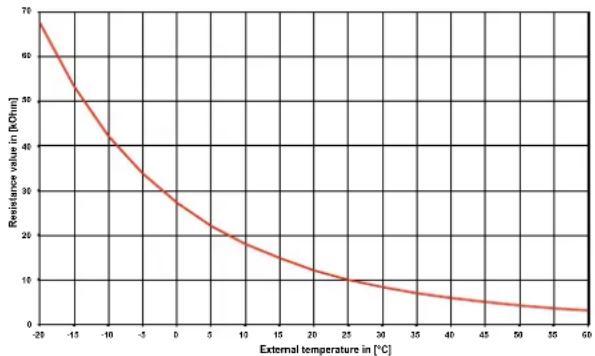
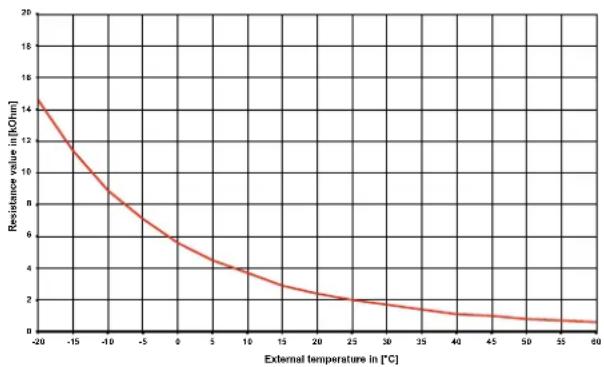
7.5.1 Sensor characteristic curves
The temperature sensors to be connected to the heat pump manager must correspond to the sensor characteristic curve illustrated in Fig.7.2 on pag. 10. The only exception is the external temperature sensor included in the scope of supply of the heat pump (see Fig.7.3 on pag. 10)
line
| External temperature in [°C] | Resistance value in [kOhm] | | ---------------------------- | -------------------------- | | -20 | 70 | | -15 | 55 | | -10 | 45 | | -5 | 35 | | 0 | 28 | | 5 | 22 | | 10 | 18 | | 15 | 15 | | 20 | 12 | | 25 | 10 | | 30 | 8 | | 35 | 6 | | 40 | 5 | | 45 | 4 | | 50 | 3 | | 55 | 2 | | 60 | 1 |Fig. 7.2: Sensor characteristic curve NTC-10
line
| External temperature in [°C] | Resistance value in [kOhm] | |---|---| | -20 | 14.5 | | -15 | 11.8 | | -10 | 9.2 | | -5 | 7.3 | | 0 | 5.8 | | 5 | 4.6 | | 10 | 3.9 | | 15 | 3.2 | | 20 | 2.7 | | 25 | 2.3 | | 30 | 2.0 | | 35 | 1.8 | | 40 | 1.6 | | 45 | 1.4 | | 50 | 1.2 | | 55 | 1.1 | | 60 | 1.0 |Fig. 7.3: Sensor characteristic curve NTC-2 according to DIN 44574 Outdoor temperature sensor
7.5.2 Mounting the external temperature sensor
The temperature sensor must be mounted in such a way that all weather conditions are taken into consideration and the measured value is not falsified.
■ Mount on the external wall on the north or north-west side where possible
- Do not install in a “sheltered position” (e.g. in a wall niche or under a balcony)
■ Not in the vicinity of windows, doors, exhaust air vents, external lighting or heat pumps
■ Not to be exposed to direct sunlight at any time of year
| Dimensioning parameter sensor lead | |
| Conductor material | Cu |
| Cable-length | 50 m |
| Ambient temperature | 35 °C |
| Laying system | B2 (DIN VDE 0298-4 / IEC 60364-5-52) |
| External diameter | 4-8 mm |
7.6 Electrical connection
7.6.1 General
All electrical connection work must be carried out by a trained electrician or a specialist for the specified tasks in accordance with the
■ installation and operating instructions,
■ country-specific installation regulations (e.g. VDE 0100),
■ technical connection conditions of the energy suppliers and supply grid operators (e.g. TAB) and
■ local conditions.
To ensure that the frost protection function of the heat pump works properly, the heat pump manager must remain connected to the power supply and the flow must be maintained through the heat pump at all times.
The switching contacts of the output relay are interference-suppressed. Therefore, depending on the internal resistance of the measuring instrument, a voltage can also be measured when the contacts are open. However, this will be much lower than the line voltage.
Extra-low voltage is connected to controller terminals N1-J1 to N1-J11; N1-J19; N1-J20; N1-J23; N1-J24 and the terminal strips X3. If, due to a wiring error, the line voltage is mistakenly connected to these terminals, the heat pump manager will be destroyed.
7.6.2 Electrical Installation
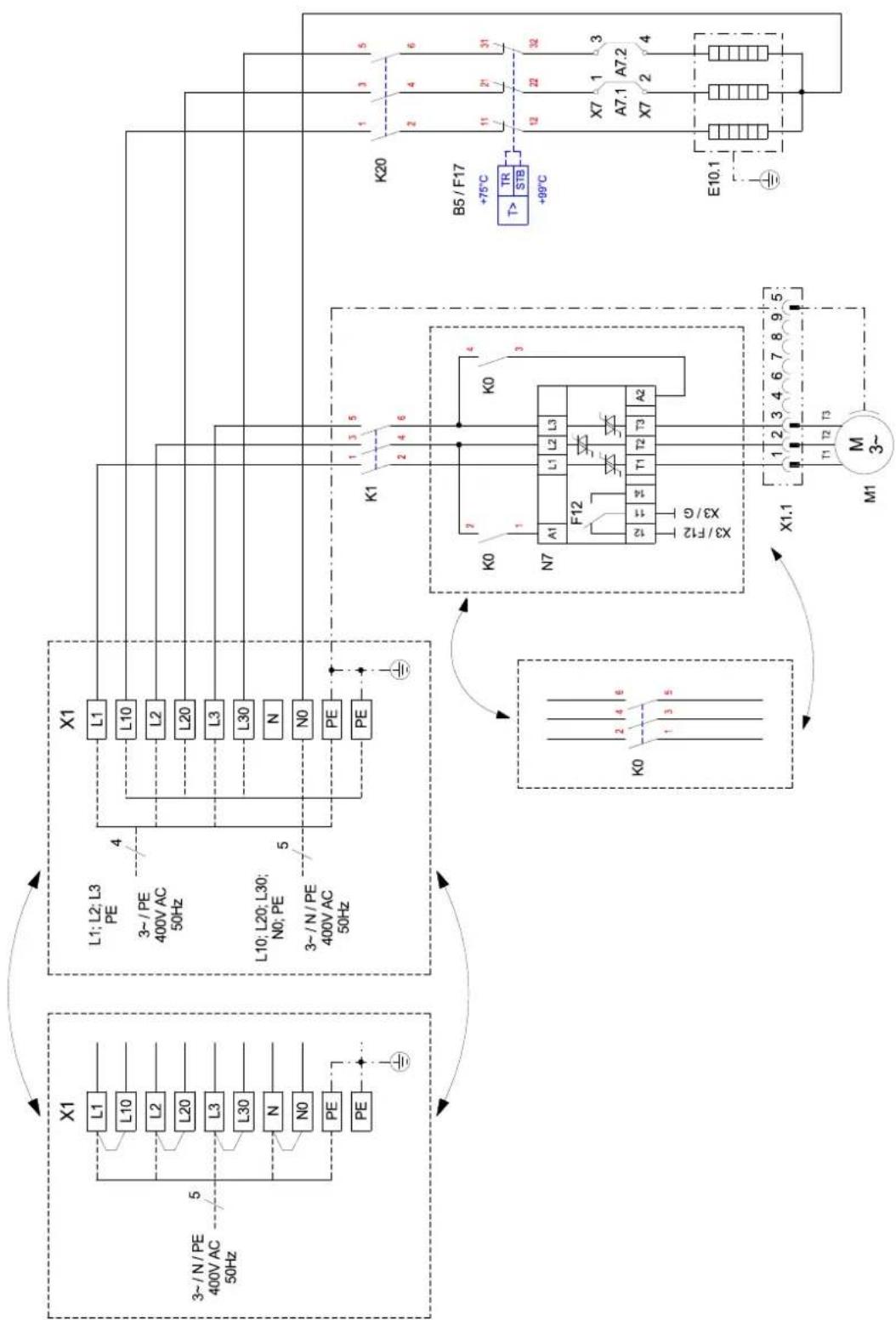
1) The five-core electrical supply cable for the output section of the heat pump is fed from the heat pump meter via the utility company blocking contactor (if required) into the heat pump.
The mains cable is connected at the heat pump switch box using terminals X1: L1/L2/L3/N/PE.
The enclosed mini-grip bag contains four links that have to be connected to terminal X1 (L1-L10, L2-L20, L30-L3, N-N0) as shown in the circuit diagram (see appendix). There is no need for these links if two separate five-core supply cables are used (see appendix).
An all-pole disconnecting device with a contact gap of at least 3 mm (e.g. utility company blocking contactor or power contactor) as well as an all-pole circuit breaker with common tripping for all external conductors must be installed in the power supply (tripping current and characteristic in compliance with the device information).
ATTENTION!
Only applies to the SIW 6TES:
Ensure the rotary field is clockwise when connecting the mains cables (if the rotary field is not clockwise, the heat pump will not work properly, is very loud and may cause damage to the compressor).
Only applies to the SIW 8TES and SIW 11TES:
Ensure that there is a clockwise rotating field: With incorrect wiring the starting of the heat pump is prevented. A corresponding warning is indicated on the display of the heat pump manager (adjust wiring).
2) The three-core electric supply cable for the heat pump manager (heating controller N1) is fed into the heat pump. Connection of the control line to the switch box of the heat pump via terminals X2: L/N/PE.
Details on the power consumption of the heat pump are listed on both the product information sheet and the type plate.
The (L/N/PE \~230 V, 50 Hz) supply cable for the heat pump manager must have a constant voltage. For this reason, it should be tapped upstream from the utility blocking contactor or be connected to the household current, as important protection functions could otherwise be lost during a utility block.
3) The utility blocking contactor (K22) with 3 main contacts (1/3/5 // 2/4/6) and an auxiliary contact (NO contact 13/14) should be dimensioned according to the heat pump output and must be supplied by the customer.
The NO contact of the utility blocking contactor (13/14) is looped from terminal strip X3/G to terminal X3/A1.
CAUTION! Extra-low voltage! The contactor is installed in the electrical distribution system. Mains cables for the installed heaters must be laid and secured in accordance with the valid standards and regulations.
4) All installed electric cables must have permanent wiring.
5) The external sensor (R1) is connected to terminals X3/GND (ground) and X3/R1.
7.6.3 Connecting an electronically regulated circulating pump
Electronically regulated circulating pumps have high starting currents, which may shorten the service life of the heat pump manager. A coupling relay is therefore installed or must be installed between the output of the heat pump manager and the electronically regulated circulating pump. This is not necessary if the maximum permissible operating current of the heat pump manager of 2 A and the maximum permissible starting current of the heat pump manager of 12 A are not exceeded by the electronically regulated circulating pump or a relevant approval has been issued by the pump manufacturer.
ATTENTION!
It is not permitted to connect more than one electronically regulated circulating pump via a relay output.
8 Commissioning
8.1 General
To ensure that start-up is performed correctly, it should only be carried out by an after-sales service technician authorised by the manufacturer. These measures can also include an additional warranty under certain conditions (see Warranty).
8.2 Preparation
The following items must be checked prior to start-up:
All of the heat pump connections must be installed as described in chapter 7.
- The heat source system and the heating circuit must have been filled and checked.
- Dirt traps and breathers must be inserted in the brine inlet of the heat pump.
All valves that could impair proper flow in the brine and heating circuits must be open.
The heat pump manager must have been parametered for the relevant hydraulics in accordance with its operating instructions.
8.3 Start-up procedure
The heat pump is started up via the heat pump manager.
ATTENTION!
The heat pump must be started up in accordance with the installation and operating instructions of the heat pump manager.
The overflow valve must be adjusted to the requirements of the respective heating system. Incorrect adjustment can lead to faulty operation and increased energy consumption. We recommend carrying out the following procedure to set the overflow valve correctly:
Close all of the heating circuits that may also be closed during operation so that the most unfavourable operating state - with respect to the water flow - is achieved. This normally means the heating circuits of the rooms on the south and west sides of the building. At least one heating circuit must remain open (e.g. bathroom).
The overflow valve should be opened far enough to produce the maximum temperature spread between the heat flow and heat return flow listed in the following table for the current heat source temperature. The temperature spread should be measured as close as possible to the heat pump. The heating element of mono energy systems should be disconnected during start-up.
| Heat source temperature | Max. temperature spread between heating flow and return flow | |
| of to | ||
| -5 °C 0 °C | 10 K | |
| 1 °C 5 °C | 11 K | |
| 6 °C | 9 °C 12 K | |
| 10 °C | 14 °C | 13 K |
| 15 °C | 20 °C | 14 K |
| 21 °C | 25 °C | 15 K |
9 Cleaning / maintenance
9.1 Maintenance
To prevent faults due to sediment in the heat exchangers, care must be taken to ensure that no impurities can enter either the heat source system or the heating system. In the event that operating malfunctions due to contamination occur nevertheless, the system should be cleaned as described below.
9.2 Cleaning the heating system
The ingress of oxygen into the heating water circuit may result in the formation of oxidation products (rust), particularly if steel components are used. These enter the heating system via the valves, the circulating pumps and/or plastic pipes. It is therefore essential - in particular with respect to the piping of underfloor heating systems - that only diffusion-proof materials are used.
NOTE
We recommend the installation of a suitable corrosion protection system to prevent the formation of deposits (e.g. rust) in the condenser of the heat pump. We recommend equipping diffusion-open heating systems with an electrophysical anti-corrosion system (e.g. ELYSATOR system).
Residue from lubricants and sealants may also contaminate the heating water.
In the event of severe contamination leading to a reduction in the performance of the liquefier in the heat pump, the system must be cleaned by a heating technician.
Based on current knowledge, we recommend carrying out the cleaning with a 5 % phosphor acid or, if more frequent cleaning is required, with a 5 % formic acid.
In both cases, the cleaning fluid should be at room ture. We recommend flushing the heat exchanger in the direction opposite to the normal flow direction.
To prevent acidic cleaning agents from entering the heating system circuit, we recommend connecting the flushing device directly to the flow and return of the liquifier. It is then important that the system be thoroughly flushed using appropriate neutralising agents to prevent any damage from being caused by cleaning agent residue remaining in the system.
Acids must be used with care and the regulations of the employers' liability insurance associations must be adhered to.
The manufacturer's instructions regarding cleaning agent must be complied with at all times.
9.3 Cleaning the heat source system
ATTENTION!
The supplied dirt trap must be inserted in the heat source inlet of the heat pump to protect the evaporator against the ingress of impurities.
The filter sieve of the dirt trap should be cleaned one day after start-up. Further checks must be set according to the level of dirt. If no more signs of contamination are evident, the filter can be removed to reduce pressure drops.
10 Faults / troubleshooting
This heat pump is a quality product and is designed for trouble-free operation. In the event that a fault should occur, it will be indicated on the heat pump manager display. In this case, consult the "Faults and troubleshooting" page in the operating instructions of the heat pump manager.
If you cannot correct the fault yourself, please contact your after-sales service technician.
ATTENTION!
Work on the heat pump must only be authorised and qualified after-sales service technicians!
ATTENTION!
Disconnect all electrical circuits from the power source prior to opening the device.
11 Decommissioning / disposal
Before removing the heat pump, disconnect it from the power source and close all valves. The heat pump must be installed by trained personnel. Observe all environmental requirements regarding the recovery, recycling and disposal of materials and components in accordance with all applicable standards. Particular attention should be paid to the proper disposal of refrigerants and refrigerant oils.
12 Device information
| 1 Type and order code | SIW 6TES SIW 8TES SIW 11TES | |||
| 2 Design | ||||
| Heat source Brine Brine Brine | ||||
| 2.1 Model Compact Compact Compact | ||||
| 2.2 Contr. Integrated Integrated Integrated | ||||
| 2.3 Thermal energy meter | Integrated | Integrated | ||
| 2.4 Installation location | Indoors | Indoors | ||
| 2.5 Performance levels | 1 | 1 | ||
| 3 Operating limits | ||||
| 3.1 Heating water flow | °C | 20 to 62 ± 2 | 20 to 62 ± 2 | |
| 3.2 Brine (heat source) | °C | -5 to 25 | -5 to 25 | |
| 3.3 Antifreeze | Monoethylene glycol | Monoethylene glycol | ||
| 3.4 Minimum brine concentration (-13 °C freezing temperature) | 25% | 25% | ||
| 4 Flow / sound | ||||
| 4.1 Heating water flow / free compression | ||||
| Nominal flow in accordance with EN 14511 | at B0 / W35...30 | m3/h / Pa | 1,0 / 68000 | 1,4 / 52000 |
| at B0 / W45...40 | m3/h / Pa | 1,0 / 68000 | 1,3 / 52500 | |
| at B0 / W55...47 | m3/h / Pa | 0,6 / 73000 | 0,8 / 72000 | |
| Minimum heating water flow | m3/h / Pa | 0,6 / 73000 | 0,8 / 72000 | |
| 4.2 Brine flow rate / free compression | ||||
| Nominal flow in accordance with EN 14511 | at B0 / W35...30 | m3/h / Pa | 1,5 / 54000 | 2,1 / 37500 |
| at B0 / W45...40 | m3/h / Pa | 1,3 / 59000 | 1,7 / 48000 | |
| at B0 / W55...47 | m3/h / Pa | 1,3 / 59000 | 1,5 / 57000 | |
| Minimum brine flow rate | m3/h / Pa | 1,3 / 59000 | 1,5 / 57000 | |
| 4.3 Sound power level according to EN 12102 | dB(A) | 42 | 42 | |
| 4.4 Sound pressure level at a distance of 1m1 | dB(A) | 30 | 30 | |
| 5 Dimensions, connections and weight | ||||
| 5.1 Device dimensions2 | H x W x D mm | 1994 × 590 x 710 | 1994 × 590 x 710 | |
| 5.2 Weight of the transportable unit(s) incl. Packaging/filled | kg | 265 / 422 | 280 / 438 | |
| 5.3 Device connections for heating system | Inches | Thread 11⁄4" external | Thread 11⁄4" external | |
| 5.4 Device connections for heat source | Inches | Thread 11⁄4" external | Thread 11⁄4" external | |
| 5.5 Refrigerant; total filling weight | type/kg | R410A/1,2 | R410A/1,6 | |
| 5.6 GWP value / CO2equivalent | --- / t | 2088 / 3 | 2088 / 3 | |
| 5.7 Refrigeration circuit hermetically sealed | yes | yes | ||
| 5.8 Lubricant; total filling quantity | type/litres | Polyolester (POE)/0.7 | Polyolester (POE)/1.2 | |
| 5.9 Volume of heating water in device | Litres | 2,8 | 3,2 | |
| 5.10 Volume of heat transfer medium in device | Litres | 2,9 | 3,4 | |
| 6 Electrical connection | ||||
| 6.1 Supply voltage / fuse protection (combined infeed HP and HG2) | 3-/N/PE 400 V(50 Hz) / C16A | 3-/N/PE 400 V(50 Hz) / C16A | ||
| 6.2 Fuse protection for separate infeed: HP / HG2 | C10A / B10A | C10A / B10A | ||
| 6.3 Control voltage / fuse protection | 1-/N/PE 230 V(50 Hz) / C13A | 1-/N/PE 230 V(50 Hz) / C13A | ||
| 6.4 Degree of protection according to EN 60 529 | IP 21 | IP 21 | ||
| 6.5 Starting current with soft starter | A | 28 (without SS) | 17 | |
| 6.6 Nominal power consumption B0 / W35 / max. power consumption ^3 kW | 1,26 / 2,7 1,61 / 3,3 2,12 / 4,3 | |||
| 6.7 Nominal current at B0 / W35 / cos φ A / -- | 2,3 / 0,8 2,9 / 0,8 3,9 / 0,8 | |||
| 6.8 Power consumption of compressor protection (per compressor)W | -- | -- | -- | |
| 6.9 Power consumption of heat circulating pump W Max. 70 Max. 70 Max. 70 | ||||
| 6.10 Power consumption brine circulating pump W | Max. 87 | Max. 87 | Max. 87 | |
| 6.11 Electrical pipe heater (2nd heat generator) kW | 2.4 or 6^4 | 2.4 or 6^4 | 2.4 or 6^4 | |
| 7 Complies with the European safety regulations | 5 | 5 | 5 | |
| 8 Additional model features | ||||
| 8.1 Water in device is protected against freezing ^6 | Yes | Yes | Yes | |
| 8.2 Max. operating overpressure (heat source/heat sink) bar | 3,0 | 3,0 | 3,0 | |
| 9 Domestic hot water cylinders | ||||
| Material | Enamelled steel complying with DIN 4753 | Enamelled steel complying with DIN 4753 | Enamelled steel complying with DIN 4753 | |
| 9.1 cylinder volume | in litres | 170 | 170 | 170 |
| 9.2 nominal volumen | in litres | 156 | 156 | 156 |
| 9.3 Max. operating pressure | bar | 6 | 6 | 6 |
| 9.4 Heat exchanger area | m ^2 | 2,1 | 2,1 | 2,1 |
| 9.5 Heat loss at 50°C cylinder temperature 20°C room temperature | kW/h24h | 0,69 | 0,69 | 0,69 |
| 9.6 Draw-off rate (without re-heating) ^7 | Litres | 213 | 213 | 213 |
| 10 Heat output / COP ^3 | EN 14511 | EN 14511 | EN 14511 | |
| at B-5 / W45 kW / --- | 4,9 / 3,2 | 6,4 / 3,3 | 8,7 / 3,3 | |
| at B0 / W55 kW / --- | 5,4 / 2,9 | 7,1 / 2,9 | 9,5 / 2,9 | |
| at B0 / W45 kW / --- | 5,6 / 3,6 | 7,3 / 3,7 | 9,9 / 3,8 | |
| at B0 / W35 kW / --- | 5,9 / 4,7 | 7,8 / 4,8 | 10,5 / 5,0 | |
- The specified sound pressure level corresponds to the operating noise of the heat pump in heating operation with a flow temperature of 35 °C.
The specified sound pressure level represents the free sound area level. The measured value can deviate by up to 16 dB(A), depending on the installation location.
-
Please note that additional space is required for pipe connections, operation and maintenance.
-
These data indicate the size and capacity of the system according to EN 14511. For an analysis of the economic and energy efficiency of the system, the bivalence point and regulation should be taken into consideration. These specifications can only be achieved with clean heat exchangers. Information on maintenance, commissioning and operation can be found in the respective sections of the installation and operating instructions. The specified values have the following meaning, e.g. B0 / W35: Heat source temperature 0 °C and heating water flow temperature 35 °C.
-
Condition as received 6kW.
-
See CE declaration of conformity
-
The heat circulating pump and the heat pump manager must always be ready for operation.
-
Mixed water withdrawal temperature 38 °C and cylinder temperature 45 °C.
13 Product information as per
Regulation (EU) No 813/
2013, Annex II, Table 2
| Information requirements for heat pump space heaters and heat pump combination heaters | ||||||
| Model | SIW 6TES | |||||
| Air-to-water heat pump | no | |||||
| Water-to-water heat pump | no | |||||
| Brine-to-water heat pump | yes | |||||
| Low-temperature heat pump | no | |||||
| Equipped with a supplementary heater | yes | |||||
| Heat pump combination heater | yes | |||||
| Parameters shall be declared for medium-temperature application, except for low-temperature heat pumps. For low- temperature heat pumps, parameters shall be declared for low-temperature application. | ||||||
| Parameters shall be declared for average climate conditions: | ||||||
| Item Symbol Value Unit Item Symbol Value | Unit | |||||
| Rated heat output (*) | Prated | 5 | kW | Seasonal space heating energy efficiency | ηs | 130 % |
| Declared capacity for heating foer part load at indoor temperature 20°C and outdoor temperature Tj | Declared coefficient of performance or primary energy ratio for part load at indoor temperature 20 °C and outdoor temperature Tj | |||||
| Tj = -7°C | Pdh | 5,4 kW | Tj = -7°C | COPd | 2,98 - | |
| Tj = +2°C | Pdh | 5,6 kW | Tj = +2°C | COPd | 3,50 - | |
| Tj = +7°C | Pdh | 5,7 kW | Tj = +7°C | COPd | 3,89 - | |
| Tj = +12°C | Pdh | 5,8 kW | Tj = +12°C | COPd | 4,38 - | |
| Tj = bivalent temperature | Pdh | 5,4 kW | Tj = bivalent temperature | COPd | 2,85 - | |
| Tj = operation limit temperature | Pdh | 5,4 kW | Tj = operation limit temperature | COPd | 2,85 - | |
| For air-to-water heat pumps | For air-to-water heat pumps: | |||||
| Tj = -15°C (if TOL < -20°C) | Pdh | -- kW T | = -15°C (if TOL < -20°C) | COPd | -- - | |
| Bivalent temperature | Tbiv | -10 | °C | For air-to-water heat pumps:Operation limit temperature | TOL | -10 °C |
| Cycling interval capacity for heating | Pcych | - | kW Cycling interval efficiency | COPcyc | - - | |
| Degradation co-efficient (**) | Cdh | 0,90 | - | Heating water operating limit temperature | WTOL | 62 °C |
| Power consumption in modes other than active mode | Supplementary heater | |||||
| Off mode | POFF | 0,015 | kW Rated | heat output (*) | Psup | 0 kW |
| Thermostat-off mode | PTO | 0,020 | kW | Type of energy input | eletrical | |
| Standby mode | PSB | 0,015 | kW | |||
| Crankcase heater mode | PCK | 0,000 | kW | |||
| Other items | ||||||
| Capacity control | fixed | For air-to-water heat pumps: Rated air flow rate, outdoors | - | - m3/h | ||
| Sound power level, indoors/outdoors | LWA | 42/- | dB | For water-/brine-to-water heat pumps: Rated brine or water flow rate, outdoor heat exchanger | - | 1,1 m3/h |
| Emissions of nitrogen oxides | NOx | - | mg/kWh | |||
| For heat pump combination heater: | ||||||
| Declared load profile | L | Water heating energy efficiency | ηwh | 102 % | ||
| Daily electricity consumption | Qelec | 4,80 | kWh | Daily fuel consumption | Qfuel | - kWh |
| Contact details | Glen Dimplex Deutschland GmbH, Am Goldenen Feld 18, 95326 Kulmbach | |||||
| (*) For heat pump space heaters and heat pump combination heaters, the rated output Prated is equal to the design load for heating Pdesignh, and the rated heat output of a supplementary capacity for heating sup(Tj). | ||||||
| (**) If Cdh is not determined by measurement nthen the default degradation is Cdh = 0,9(-) not applicable | ||||||
| Model SIW 8TES | ||||||
| Air-to-water heat pump no | ||||||
| Water-to-water heat pump no | ||||||
| Brine-to-water heat pump yes | ||||||
| Low-temperature heat pump no | ||||||
| Equipped with a supplementary heater yes | ||||||
| Heat pump combination heater yes | ||||||
| Parameters shall be declared for medium-temperature application, except for low-temperature heat pumps. For low- temperature heat pumps, parameters shall be declared for low-temperature application. | ||||||
| Parameters shall be declared for average climate conditions: | ||||||
| Item Symbol Value Unit Item Symbol Value Unit | ||||||
| Rated heat output (*) Prated 8 kW | Seasonal space heating energy efficiency ηs 145 % | |||||
| Declared capacity for heating foer part load at indoor temperature 20°C and outdoor temperature Tj | Declared coefficient of performance or primary energy ratio for part load at indoor temperature 20 °C and outdoor temperature Tj | |||||
| Tj = -7°C Pdh 8,0 kW Tj = -7°C COPd 3,39 - | ||||||
| Tj = +2°C Pdh 7,9 kW Tj = +2°C COPd 3,85 - | ||||||
| Tj = +7°C Pdh 7,9 kW Tj = +7°C COPd 4,22 - | ||||||
| Tj = +12°C Pdh 7,8 kW Tj = +12°C COPd 4,67 - | ||||||
| Tj = bivalent temperature Pdh 8,0 kW Tj = bivalent temperature COPd 3,28 - | ||||||
| Tj = operation limit temperature Pdh 8,0 kW Tj = operation limit temperature COPd 3,28 - | ||||||
| For air-to-water heat pumps | For air-to-water heat pumps: | |||||
| Tj = -15°C (if TOL < -20°C) Pdh --kW Tj = -15°C (if TOL < -20°C) COPd -- - | ||||||
| Bivalent temperature Tblv -10 °C For air-to-water heat pumps: TOL -10 °C | ||||||
| Cycling interval capacity for heating Pcych - kW Cycling interval efficiency COPcyc - - | ||||||
| Degradation co-efficient (**) Cdh 0,90 - Heating water operating limit temperature WTOL 62 °C | ||||||
| Power consumption in modes other than active mode | Supplementary heater | |||||
| Off mode POFF 0,015 kW Rated heat output (*) Psup 0 kW | ||||||
| Thermostat-off mode PTO 0,020 kW Type of energy input eletrical | ||||||
| Standby mode PSB 0,015 kW | ||||||
| Crankcase heater mode PCK 0,000 kW | ||||||
| Other items | ||||||
| Capacity control fixed | For air-to-water heat pumps: Rated air flow rate, outdoors - - m³/h | |||||
| Sound power level, indoors/outdoors LWA 42/- dB For water-/brine-to-water heat pumps: Rated brine or water flow rate, outdoor heat exchanger - 1,5 m³/h | ||||||
| Emissions of nitrogen oxides NOx - mg/kWh | ||||||
| For heat pump combination heater: | ||||||
| Declared load profile L | Water heating energy efficiency ηwh 98 % | |||||
| Daily electricity consumption Qelec 4,96 kWh Daily fuel consumption Qfuel - kWh | ||||||
| Contact details Glen Dimplex Deutschland GmbH, Am Goldenen Feld 18, 95326 Kulmbach | ||||||
| (*) For heat pump space heaters and heat pump combination heaters, the rated output Prated is equal to the design load for heating Pdesignh, and the rated heat output of a supplementary capacity for heating sup(Tj). | ||||||
| (**) If Cdh is not determined by measurement nthen the default degradation is Cdh = 0,9 (-) not applicable | ||||||
| Model SIW 11TES | ||||||
| Air-to-water heat pump no | ||||||
| Water-to-water heat pump no | ||||||
| Brine-to-water heat pump yes | ||||||
| Low-temperature heat pump no | ||||||
| Equipped with a supplementary heater yes | ||||||
| Heat pump combination heater yes | ||||||
| Parameters shall be declared for medium-temperature application, except for low-temperature heat pumps. For low- temperature heat pumps, parameters shall be declared for low-temperature application. | ||||||
| Parameters shall be declared for average climate conditions: | ||||||
| Item Symbol Value Unit Item Symbol Value Unit | ||||||
| Rated heat output (*) Prated 10 kW | Seasonal space heating energy efficiency ηs 142 % | |||||
| Declared capacity for heating foer part load at indoor temperature 20°C and outdoor temperature Tj | Declared coefficient of performance or primary energy ratio for part load at indoor temperature 20 °C and outdoor temperature Tj | |||||
| Tj = -7°C Pdh 9,9 kW Tj = -7°C COPd 3,19 - | ||||||
| Tj = +2°C Pdh 10,2 kW Tj = +2°C COPd 3,74 - | ||||||
| Tj = +7°C Pdh 10,4 kW Tj = +7°C COPd 4,16 - | ||||||
| Tj = +12°C Pdh 10,5 kW Tj = +12°C COPd 4,67 - | ||||||
| Tj = bivalent temperature Pdh 9,8 kW Tj = bivalent temperature COPd 3,06 - | ||||||
| Tj = operation limit temperature Pdh 9,8 kW Tj = operation limit temperature COPd 3,06 - | ||||||
| For air-to-water heat pumps | For air-to-water heat pumps: | |||||
| Tj = -15°C (if TOL < -20°C) Pdh --kW Tj = -15°C (if TOL < -20°C) COPd -- - | ||||||
| Bivalent temperature Tbiv -10 °C For air-to-water heat pumps: TOL -10 °C | ||||||
| Cycling interval capacity for heating Pcych - kW Cycling interval efficiency COPcyc - - | ||||||
| Degradation co-efficient (**) Cdh 0,90 - Heating water operating limit temperature WTOL 62 °C | ||||||
| Power consumption in modes other than active mode | Supplementary heater | |||||
| Off mode POFF 0,015 kW Rated heat output (*) Psup 0 kW | ||||||
| Thermostat-off mode PTO 0,020 kW Type of energy input eletrical | ||||||
| Standby mode PSB 0,015 kW | ||||||
| Crankcase heater mode PCK 0,000 kW | ||||||
| Other items | For air-to-water heat pumps: Rated air flow rate, outdoors - m3/h | |||||
| Capacity control fixed | ||||||
| Sound power level, indoors/outdoors LWA 43/- dB For water-/brine-to-water heat pumps: Rated brine or water flow rate, outdoor heat exchanger - 2,2 m3/h | ||||||
| Emissions of nitrogen oxides NOx - mg/kWh | ||||||
| For heat pump combination heater: | ||||||
| Declared load profile L | Water heating energy efficiency ηwh 94 % | |||||
| Daily electricity consumption Qelec 5,18 kWh Daily fuel consumption Qfuel - kWh | ||||||
| Contact details Glen Dimplex Deutschland GmbH, Am Goldenen Feld 18, 95326 Kulmbach | ||||||
| (*) For heat pump space heaters and heat pump combination heaters, the rated output Prated is equal to the design load for heating Pdesignh, and the rated heat output of a supplementary capacity for heating sup(Tj). | ||||||
| (**) If Cdh is not determined by measurement nthen the default degradation is Cdh = 0,9 (-) not applicable | ||||||
Table des matières
11 Mise hors service/Élimination.... FR-13
10) Compresseur
11) Condenseur
12) Évaporateur
13) Sèche-filtre
14) Détendeur
4 Accessoires
natural_image
Technical line drawing of a mechanical assembly with multiple valve-like components (no text or symbols)natural_image
Front view of a white electronic device with a screen and control knob (no visible text or symbols)5 Transport
5.1 Généralités
natural_image
Technical line drawing of an industrial air conditioning unit with cooling fans and piping (no text or labels)ATTENTION!
line
| Soleeintrittstemperatur in [°C] | Brine inlet temperature in [°C] | Power consumption in [kW] | | -------------------------------- | --------------------------------- | -------------------------- | | 0 | 0 | 2.5 | | 5 | 0 | 2.5 | | 10 | 0 | 2.5 | | 15 | 0 | 2.5 | | 20 | 0 | 2.5 | | 25 | 0 | 2.5 | | 30 | 0 | 2.5 | | 35 | 0 | 2.5 | | 40 | 0 | 2.5 | | 45 | 0 | 2.5 | | 50 | 0 | 2.5 | | 55 | 0 | 2.5 | | 60 | 0 | 2.5 | | 65 | 0 | 2.5 | | 70 | 0 | 2.5 | | 75 | 0 | 2.5 | | 80 | 0 | 2.5 | | 85 | 0 | 2.5 | | 90 | 0 | 2.5 | | 95 | 0 | 2.5 | | 100 | 0 | 2.5 | | 105 | 0 | 2.5 | | 110 | 0 | 2.5 | | 115 | 0 | 2.5 | | 120 | 0 | 2.5 | | 125 | 0 | 2.5 | | 130 | 0 | 2.5 | | 135 | 0 | 2.5 | | 140 | 0 | 2.5 | | 145 | 0 | 2.5 | | 150 | 0 | 2.5 | | 155 | 0 | 2.5 | | 160 | 0 | 2.5 | | 165 | 0 | 2.5 | | 170 | 0 | 2.5 | | 175 | 0 | 2.5 | | 180 | 0 | 2.5 | | 185 | 0 | 2.5 | | 190 | 0 | 2.5 | | 195 | 0 | 2.5 | | 200 | 0 | 2.5 | | 205 | 0 | 2.5 | | 210 | 0 | 2.5 | | 215 | 0 | 2.5 | | 220 | 0 | 2.5 | | 225 | 0 | 2.5 | | 230 | 0 | 2.5 | | 235 | 0 | 2.5 | | 240 | 0 | 2.5 | | 245 | 0 | 2.5 | | 250 | 0 | 2.5 | | 255 | 0 | 2.5 | | 260 | 0 | 2.5 | | 265 | 0 | 2.5 | | 270 | 0 | 2.5 | | 275 | 0 | 2.5 | | 280 | 0 | 2.5 | | 285 | 0 | 2.5 | | 290 | 0 | 2.5 | | 295 | 0 | 2.5 | | 300 | 0 | 2.5 | | 305 | 0 | 2.5 | | 310 | 0 | 2.5 | | 315 | 0 | 2.5 | | 320 | 0 | 2.5 | | 325 | 0 | 2.5 | | 330 | 0 | 2.5 | | 335 | 0 | 2.5 | | 340 | 0 | 2.5 | | 345 | 0 | 2.5 | | 350 | 0 | 2.5 | | Note: The actual values for each line are not provided in the code image, so they are calculated based on the formula used in the plot.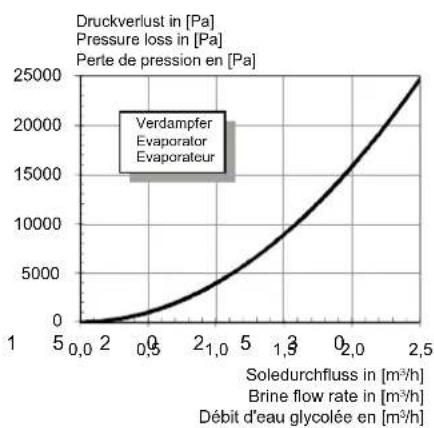
line
| Soledurchfluss in [m³/h] | Pressure loss in [Pa] | | ------------------------ | --------------------- | | 0.0 | 0 | | 0.5 | ~1000 | | 1.0 | ~5000 | | 1.5 | ~10000 | | 2.0 | ~15000 | | 2.5 | ~25000 |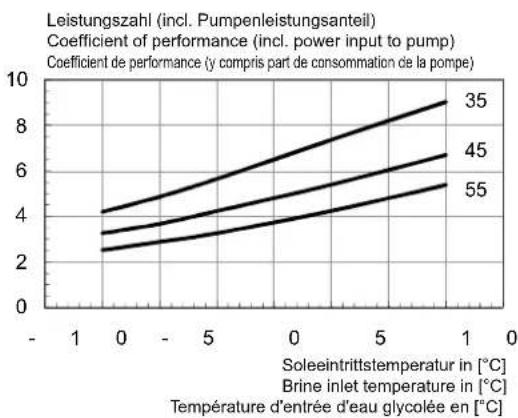
line
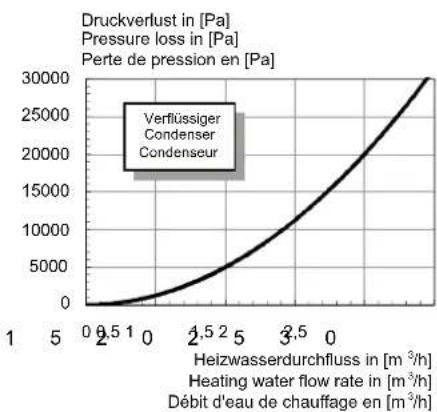
| Heizwasserdurchfluss [m³/h] | Pressure loss in [Pa] | | --------------------------- | --------------------- | | 0.5 | 0 | | 1 | 0 | | 2.5 | 5000 | | 3.5 | 15000 | | 0 | 30000 |2.3 Kennlinien / Characteristic Curves / Courbes caractéristiques SIW 11TES
line
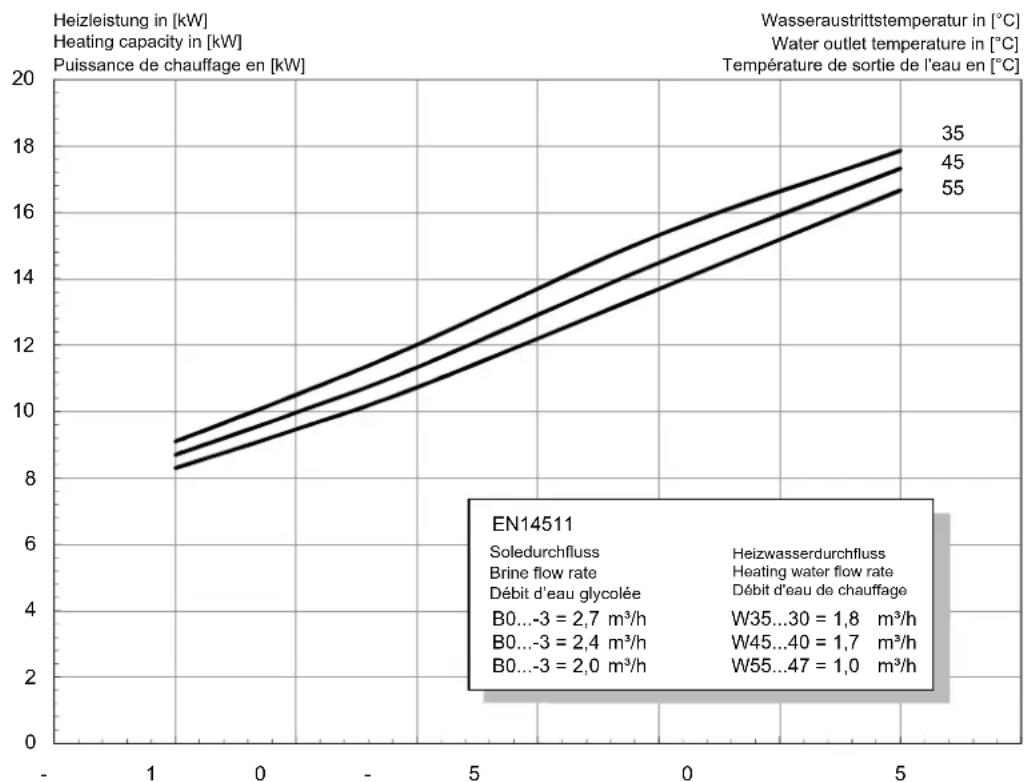
| B0...3 m³/h | Heizleistung [kW] | Water outlet temperature [°C] | Heat flow rate [m³/h] | | ---------- | ----------------- | ----------------------------- | --------------------- | | 2.7 | ~9.0 | 35 | 1.8 | | 2.4 | ~10.0 | 45 | 1.7 | | 2.0 | ~11.0 | 55 | 1.0 |line
| Brine inlet temperature in [°C] | Power consumption in [kW] | | -------------------------------- | -------------------------- | | 0 | 2.0 | | 5 | 2.5 | | 10 | 2.7 | | 15 | 2.8 | | 20 | 2.9 | | 25 | 3.0 | | 30 | 3.1 |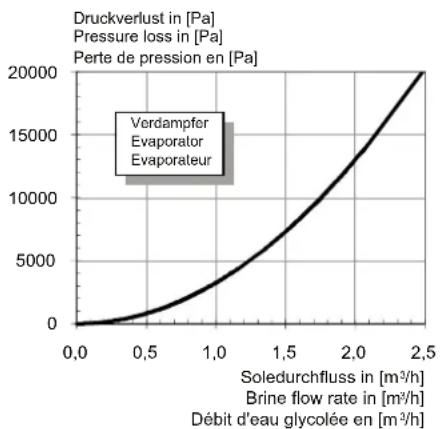
line
| Soledurchfluss in [m³/h] | Brine flow rate in [m³/h] | Pressure loss in [Pa] | | ------------------------ | ------------------------- | --------------------- | | 0.0 | 0 | 0 | | 0.5 | 1000 | ~1000 | | 1.0 | 3000 | ~3000 | | 1.5 | 6000 | ~6000 | | 2.0 | 10000 | ~10000 | | 2.5 | 15000 | ~15000 |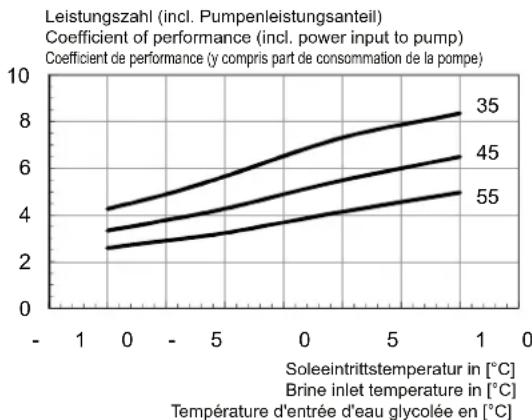
line
| Soleeintrittstemperatur in [°C] | Brine inlet temperature in [°C] | Leistungszahl (incl. Pumpenleistungsanteil) | | ------------------------------- | --------------------------------- | ------------------------------------------ | | 0 | 0 | 2.5 | | 0 | 5 | 3.5 | | 0 | 10 | 4.5 | | 5 | 0 | 3.0 | | 5 | 5 | 4.0 | | 5 | 10 | 5.0 | | 10 | 0 | 4.5 | | 10 | 5 | 6.0 | | 10 | 10 | 7.5 |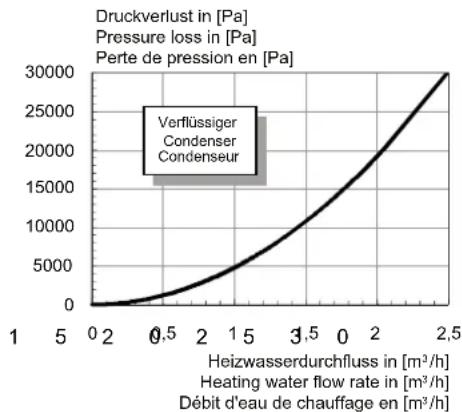
line
| Heizwasserdurchfluss in [m³/h] | Pressure loss in [Pa] | | ------------------------------ | --------------------- | | 0.2 | 0 | | 0.5 | ~1000 | | 1.5 | ~5000 | | 3.5 | ~15000 | | 2.5 | ~30000 |2.4 Einsatzgrenzendiagramm / Operating limits diagram / Diagramme des seuils d'utilisation
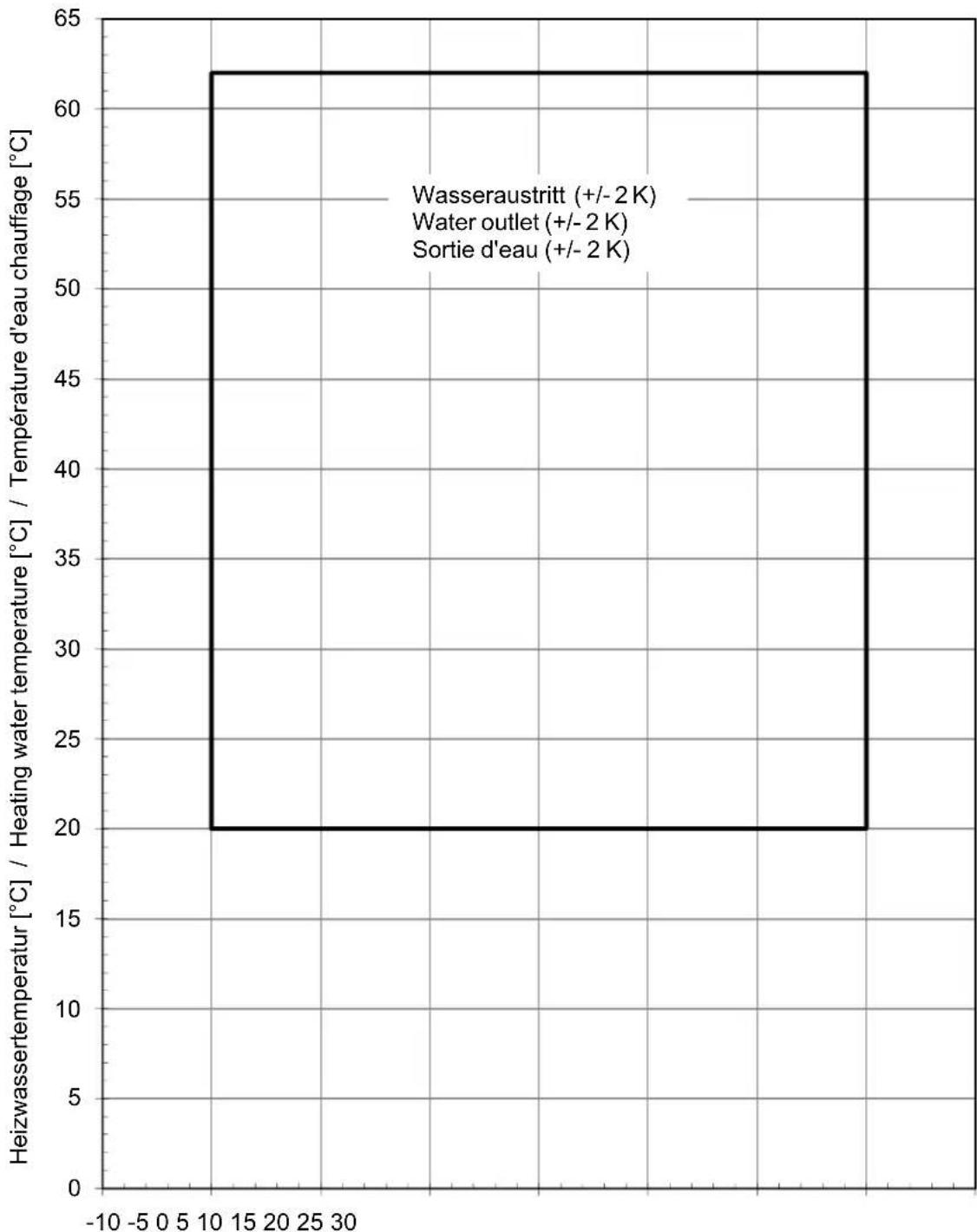
line
| Measurement Type | Temperature (°C) / Heating water temperature | | ---------------- | -------------------------------------------- | | Wasseraustritt | 62 | | Water outlet | 62 | | Sortie d'eau | 62 |Wärmequelleneintrittstemperatur [°C] Heat source inlet temperature [°C] Température d'entrée de la source de chaleur [°C]
3.3 Last / Load / Charge
flowchart
graph TD
    subgraph Power Circuit
        X1["3-/N/PE 400V AC 50Hz"] --> X2["L1; L2; L3 PE"]
        X2 --> X3["L10; L20; L30; N0; PE"]
        X3 --> X4["L30; N; N0; PE"]
        X4 --> X5["L30; L20; L30; N0; PE"]
        X5 --> X6["L30; L20; L30; N0; PE"]
        X6 --> X7["L30; L20; L30; N0; PE"]
        X7 --> X8["L30; L20; L30; N0; PE"]
        X8 --> X9["L30; L20; L30; N0; PE"]
        X9 --> X10["L30; L20; L30; N0; PE"]
        X10 --> X11["L30; L20; L30; N0; PE"]
        X11 --> X12["L30; L20; L30; N0; PE"]
        X12 --> X13["L30; L20; L30; N0; PE"]
        X13 --> X14["L30; L20; L30; N0; PE"]
        X14 --> X15["L30; L20; L30; N0; PE"]
        X15 --> X16["L30; L20; L30; N0; PE"]
        X16 --> X17["L30; L20; L30; N0; PE"]
        X17 --> X18["L30; L20; L30; N0; PE"]
        X18 --> X19["L30; L20; L30; N0; PE"]
        X19 --> X20["L30; L20; L30; N0; PE"]
        X20 --> X21["L30; L20; L30; N0; PE"]
        X21 --> X22["L30; L20; L30; N0; PE"]
        X22 --> X23["L30; L20; L30; N0; PE"]
        X23 --> X24["L30; L20; L30; N0; PE"]
        X24 --> X25["L30; L20; L30; N0; PE"]
        X25 --> X26["L30; L20; L30; N0; PE"]
        X26 --> X27["L30; L20; L30; N0; PE"]
        X27 --> X28["L30; L20; L30; N0; PE"]
        X28 --> X29["L30; L20; L30; N0; PE"]
        X29 --> X30["L30; L20; L30; N0; PE"]
        X30 --> X31["L30; L20; L30; N0; PE"]
        X31 --> X32["L30; L20; L30; N0; PE"]
        X32 --> X33["L30; L20; L30; N0; PE"]
        X33 --> X34["L30; L20; L30; N0; PE"]
        X34 --> X35["L30; L20; L30; N0; PE"]
        X35 --> X36["L30; L20; L30; N0; PE"]
        X36 --> X37["L30; L20; L30; N0; PE"]
        X37 --> X38["L30; L20; L30; N0; PE"]
        X38 --> X39["L30; L20; L30; N0; PE"]
        X39 --> X40["L30; L20; L30; N0; PE"]
        X40 --> X41["L30; L20; L30; N0; PE"]
        X41 --> X42["L30; L20; L30; N0; PE"]
        X42 --> X43["L30; L20; L30; N0: PE"]
        X43 --> X44["L30: PE"]
        X44 --> X45["L30: PE"]
        X45 --> X46["L30: PE"]
        X46 --> X47["L30: PE"]
        X47 --> X48["L30: PE"]
        X48 --> X49["L30: PE"]
        X49 --> X50["L31: PE"]
        X51["L1: PE 4.5/PE 5.5/PE 5.5/PE 5.5/PE 5.5/PE 5.5/PE 5.5/PE 5.5/PE 5.5/PE 5.5/PE 5.5/PE 5.5/PE 5.5/PE 5.5/PE 5.5/PE 5.5/PE 5.5/PE 5.5/PC"]
    end
    subgraph Power Circuit
        K1["+75°C"] --> K2["+99°C"] --> K7["TR STB"] --> B5["F17 +75°C"] --> E1["+99°C"] --> M["+75°C"] --> M1["+99°C"] --> M["+75°C"] --> M["+99°C"] --> M["+75°C"] --> M["+99°C"] --> M["+75°C"] --> M["+99°C"] --> M["+75°C"] --> M["+99°C"] --> M["+75°C"] --> M["+99°C"] --> M["+75°C"] --> M["+99°C"] --> M["+75°C"] --> M[+9<nl>
    end
flowchart
graph TD
    subgraph Power Source
        X2["PE"] --> A1["A1"]
        X2 --> A2["A2"]
        X2 --> A3["A3"]
        X2 --> A4["A4"]
        X2 --> A5["A5"]
        X2 --> A6["A6"]
        X2 --> A7["A7"]
        X2 --> A8["A8"]
        X2 --> A9["A9"]
        X2 --> A10["A10"]
        X2 --> A11["A11"]
        X2 --> A12["A12"]
        X2 --> A13["A13"]
        X2 --> A14["A14"]
        X2 --> A15["A15"]
        X2 --> A16["A16"]
        X2 --> A17["A17"]
        X2 --> A18["A18"]
    end

    subgraph Control Circuit
        KM11["KM11"] --> K0["K0"]
        KM11 --> K1["K1"]
        KM11 --> KM20["K20"]
        KM11 --> KM13["KM13"]
        KM13 --> KM18["KM18"]
        KM18 --> KM11
        KM11 --> KM13
        KM13 --> M1["M1"]
        M1 --> M2["M2"]
        M2 --> M3["M3"]
        M3 --> M4["M4"]
        M4 --> M5["M5"]
    end

    subgraph Control Bus
        KM11 --> N["NN"]
        KM13 --> P["PWM"]
        KM18 --> U["U C-10V"]
        KM13 --> R["BR"]
        KM18 --> S["BR"]
        KM13 --> T["PR"]
        KM18 --> U
    end

    subgraph Control Circuit
        M16["M16"] --> M21["M21"]
        M22["M22"] --> M3
        M3 --> M4
        M4 --> M5
    end

    subgraph Control Bus
        J1["J1"] --> G["G"]
        J24["V+Wm GND +WRES"] --> VU["U1 U2 U3 GND +VDC"]
        J3["J3"] --> VG["V4 GND U5 GND"]
        J4["J4"] --> VG
        J5["J5"] --> IDI["ID1 ID2 ID3 ID4 ID5 ID6 ID7 ID8 IDC1"]
    end

    subgraph Control Circuit
        J6["J6"] --> U6["U6 U7 U8 GND"]
        J7["J7"] --> ID9["ID9 ID10 ID11 ID12 IDC9"]
        J8["J8"] --> IDI["IDI ID3 HDC I3 HDC I4 HDC"]

    end

    subgraph Control Bus
        R7["R7"] --> R9["R9"]
    end

    subgraph Control Circuit
        B3["B3"] --> T["T-T"]
        B4["B4"] --> T["T-T"]
        A1["K22"] --> A2["A2"]
        K23["K23"] --> K23
    end

    subgraph Control Bus
        F10.1["F10.1"] --> V["X3/G"]
    end

    subgraph Control Circuit
        R24["R24"] --> R6["R6"]
    end

    subgraph Control Bus
        B2["B2"] --> Pc["Pc"]
        F10.2["F10.2"] --> N20.1["N20.1"]
        K0["K0"] --> I3["I3"]
        X13["X13"] --> F5["F5"]
        X13 --> Pp["Pp"]

    end

    subgraph Control Circuit
        N["NEA 230V AC 50Hz"] --> X2
    end

    subgraph Control Bus
        T["NEA 230V AC 50Hz"] --> X2
    end

    subgraph Control Circuit
        T["NEA 230V AC 50Hz"] --> X2
    end

    subgraph Control Bus
        T["NEA 230V AC 50Hz"] --> X2
    end

    subgraph Control Circuit
        T["NEA 230V AC 50Hz"] --> X2
    end

    subgraph Control Bus
        T["NEA 230V AC 50 Hz"] --> X2
    end

    subgraph Control Circuit
        T["NEA 230V AC 50 Hz"] --> X2
    end

    subgraph Control Bus
        T["NEA 230V AC 50 Hz"] --> X2
    end

    subgraph Control Circuit
        T["NEA 230V AC 50 Hz"] --> X2
    end

    subgraph Control Bus
        T["NEA 230V AC 50 Hz"] --> X2
    end

    subgraph Control ICs
        K0["K0"] --> A1["A1"]
        K1["K1"] --> A2["A2"]
        K20["K20"] --> A3["A3"]
        K20KLMKLMKLMKLMKLMKLMKLMKLMKLMKLMKLMKLMKLMKLMKLMKLMKLMKLMKLMKLMKLMKLMKLMKLMKLMKLMKLMKLMKLMKLMKLMKLMKLMKLMKLMKLMKLMKLMKLMKLMKLMKLMKLMKLMKLMKLMKLMKLMKLMKLMKVMH
    end

    subgraph Control ICs
        KM11["KM11"] --> N["NN"]
        KM13["KM13"] --> P["PWM"]
        KM18["KM18"] --> U["PWM"]
        KM13 --> R["BR"]
        KM18 --> S["BR"]
        KM18 --> T["PR"]
        KM18 --> U
    end

    subgraph Control ICs
        M1["M1"] --> N["NN"]
        M13["M13"] --> P["PWM"]
        M8["M8"] --> U["PWM"]
        M8 --> T["PR"]
        M8 --> U
    end

    subgraph Control ICs
        M2["M2"] --> N["NN"]
        M2["C"] --> O["PbPbOaOaOaOaOaOaOaOaOaOaOaOaOaOaOaOaOaOaOaOaOaOaOaOaOaOaOaOaOaOaOaOaOaOaOaOaOaOaOaOaOaOaOaOaOaOaOaOaOaOaOac<br>    end<br><br>    subgraph Control ICs<br>        M6[M6"] --> N["NN"]
        M6["C"] --> O["PbPbOaOaOaOaOaOaOaOaOaOaOaOaOaOaOaOaOaOaOaOaOaOaOaOaOaOaOaOaOaOaOaOaOaOaOaOaOaOaOaOaOaOac<br>    end<br><br>    subgraph Control ICs<br>        M9[M9"] --> N["NN"]
        M9["C"] --> O["PbPbOaOaOaOaOaOaOaOaOaOaOaOaOaOaOaOaOaOaOaOaOaOac<br>    end<br><br>    subgraph Control ICs<br>        M7[M7"] --> N["NN"]
        M7["C"] --> O["PbPbOaOaOaOaOaOaOaOaOaOaOaOaOaOac<br>    end<br><br>    subgraph Control ICs<br>        M5[M5"] --> N["NN"]
        M5["C"] --> O["PbPbOaOaOaOaOaOaOaOaOaOaOaOac<br>    end<br><br>    subgraph Control ICs<br>        M4[M4"] --> N["NN"]
        M4["C"] --> O["PbPbOaOaOaOaOaOaOaOaOaOac<br>    end<br><br>    subgraph Control ICs<br>        M3[M3"] --> N["NN"]
        M3["C"] --> O["PbPbOaOaOaOaOaSvSvSvSvSvSvSvSvSvSvSvSvSvSvSvSvSvSvSvSvSvSvSvSvSvSvSvSvSvSvSvSvSvSvSvSvSvSvSvSvSvSvSvSvSvSvSvSvSvSvSs<br>    end<br><br>    subgraph Control ICs<br>        M6[M6"] --> N["NN"]
        M6["C"] --> O["PbPbOeAoBdGND"]
        M8["M8"] --> U["PbPbOeAoBdGND"]
        M8 --> T["PbPbOeAoBdGND"]
    end
Extra-low voltage is supplied to plug-in terminals N1-J1 to J11, J23 to J26 and the terminal strip X3. Higher voltage must not be supplied here under any circumstances.
ATTENTION!
- Installation and Operating Instruction
- Transport
- Allgemein
- ACHTUNG!
- Glen Dimplex Thermal Solutions
- Table of contents
- Please read immediately....EN-2
- Intended use of the heat pump ......EN-3
- Basic device......EN-3
- Accessories......EN-5
- Transport......EN-6
- Installation....EN-8
- Installation....EN-8
- Commissioning......EN-12
- Cleaning / maintenance ...... EN-13
- Faults / troubleshooting......EN-13
- Decommissioning / disposal......EN-13
- Device information ...... EN-14
- Product information as per Regulation (EU) No 813/2013, Annex II, Table 2......EN-16
- Please read immediately
- Important information
- ATTENTION!
- Intended use
- Legal regulations and directives
- Energy-efficient use of the heat pump
- Intended use of the heat pump
- Intended purpose
- Operating principle
- Basic device
- General
- Brine-to-water hydraulic module
- Heat pump module
- Brine circuit manifold
- Brine controller
- Remote control
- NOTE
- Building management technology
- Smart RTC
- General
- Removing the casing panels
- Removing the heat pump module
- Installat
- General Information
- Acoustic Emissions
- Installat
- General
- i7.2 Connection on heating side
- Minimum heating water flow
- System faults may result if this is not observed.
- Heat source connection
- Domestic hot water connection
- General
- Commissioning
- Temperature sensor
- Sensor characteristic curves
- Mounting the external temperature sensor
- Electrical connection
- General
- Electrical Installation
- Connecting an electronically regulated circulating pump
- Commissioning
- General
- Preparation
- Start-up procedure
- Cleaning / maintenance
- Maintenance
- Cleaning the heating system
- Cleaning the heat source system
- Faults / troubleshooting
- Decommissioning / disposal
- Product information as per
- Regulation (EU) No 813/
- 2013, Annex II, Table 2
- Table des matières
- Mise hors service/Élimination.... FR-13
- Accessoires
- Généralités
- Kennlinien / Characteristic Curves / Courbes caractéristiques SIW 11TES
- Einsatzgrenzendiagramm / Operating limits diagram / Diagramme des seuils d'utilisation
Brand : DIMPLEX
Model : SIW 11TES
Category : Heat pump