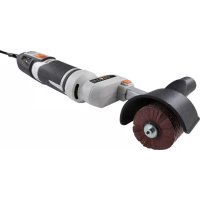
Maxx Roll BTSR001 - Electric sander Batavia - Free user manual and instructions
Find the device manual for free Maxx Roll BTSR001 Batavia in PDF.


| Product Type | Multi-function Electric Sander |
| Brand | Batavia |
| Model | Maxx Roll BTSR001 |
| Supply Voltage | 230 - 240 V~, 50 Hz |
| Power | 300 W |
| No-load Speed | 1600 - 3300 min⁻¹ |
| Protection Class | II (double insulation) |
| Main Functions | Sanding, brushing, polishing |
| Supplied Accessories | Abrasive belt sleeve holder, abrasive belt grit 80, flap roller 60 mm grit 80, flap roller 10 mm grit 80, dust cover, Allen key |
| Vacuum Cleaner Connection | Yes, via the dust cover |
| Speed Variator | Yes, 6 positions |
| Sound Pressure Level (LpA) | 75.4 dB(A) (uncertainty 3 dB(A)) |
| Sound Power Level (LwA) | 86.4 dB(A) (uncertainty 3 dB(A)) |
| Vibrations (sanding) | 2.124 m/s² |
| Vibrations (polishing) | 2.540 m/s² |
| Vibrations (brushing) | 2.181 m/s² |
| Safety Devices | Spindle lock button, double insulation, dust cover |
| Maintenance and Cleaning | Clean ventilation openings with a brush or compressed air; never immerse in water |
| Spare Parts and Repairability | Repair by a qualified technician; use identical replacement parts |
| Warranty | 2 years |
Frequently Asked Questions - Maxx Roll BTSR001 Batavia
User questions about Maxx Roll BTSR001 Batavia
0 question about this device. Answer the ones you know or ask your own.
Ask a new question about this device
Download the instructions for your Electric sander in PDF format for free! Find your manual Maxx Roll BTSR001 - Batavia and take your electronic device back in hand. On this page are published all the documents necessary for the use of your device. Maxx Roll BTSR001 by Batavia.
USER MANUAL Maxx Roll BTSR001 Batavia
Operating instructions
Gebruiksaanwijzing
Mode d'emploi
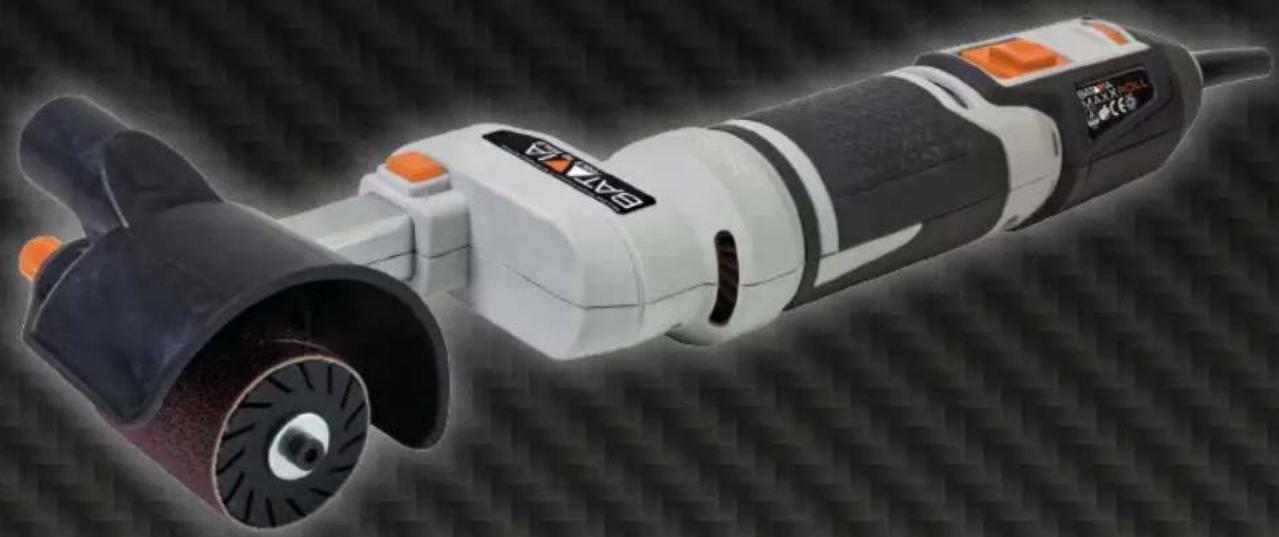
Modelnr. BT-SR001
Art.Nr. 7062243
MAXXROLL
300 W


BATVIA
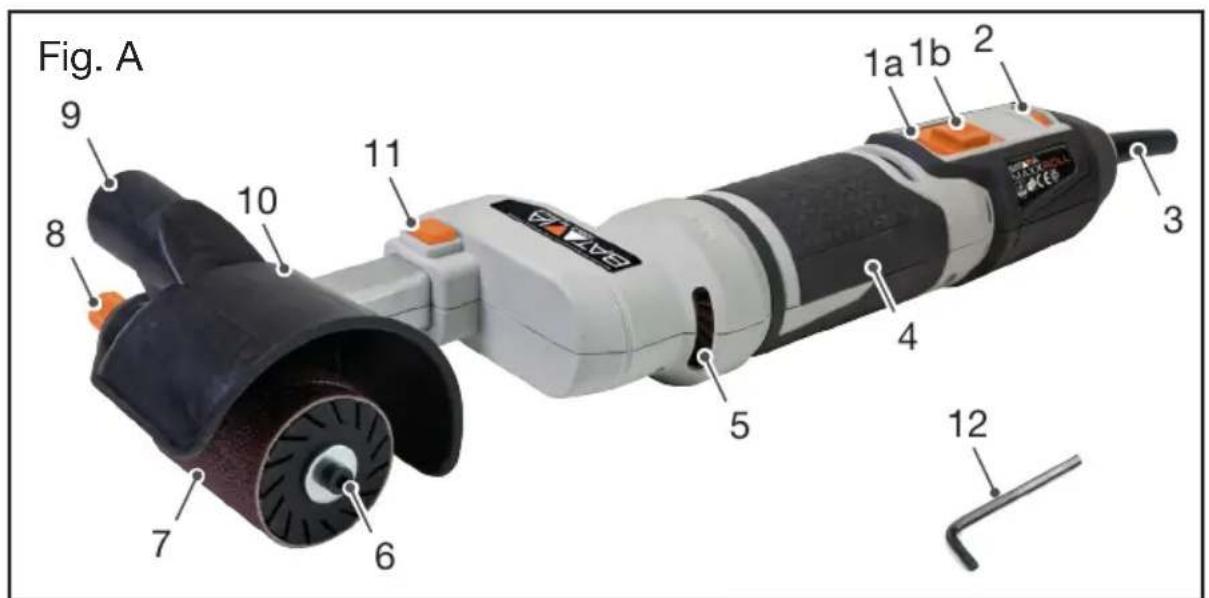
ÜBERSICHT
- (a+b) ON/Off switch
- Speed control button
- Power cord
- Handle
- Vents
- Hex. socket screw
- Accessory
- Screw dust hood
- Vacuum cleaner connection
- Dust extraction hood
- Shaft lock button
- Allen Key
- Drive shaft
APERCU
Safety instructions 15
Before the first use 20
Intended use 20
Assembly 20
Dust extraction 20
Switching ON and OFF 21
Speed control 21
Choice of accessory 21
Sanding 22
Maintenance and cleaning 22
Technical data 22
TABLE DES MATIÈRES
Instruction manuals provide valuable hints for using your new device. They enable you to use all functions, and they help you avoid misunderstandings and prevent damage. Please take the time to read this manual carefully and keep it for future reference. Intended for household and similar purposes.
EXPLANATION OF THE SYMBOLS
WARNING - To reduce the risk of injury during operation, read the instructions.

Denotes risk of personal injury, loss of life or damage to the tool in case of non-observation of the instructions in this manual.
Risk of electric shock.

Immediately remove the mains plug from the mains if the mains cable becomes damaged and during cleaning and maintenance.


Always wear hearing protection. The effects of noise can cause hearing loss.

Wear a dust mask. When working with wood and other materials, harmful dust may be generated. Work with asbestos containing materials is not permitted!

Wear safety glasses. When working with electric power tools, sparks, splinters, chips and dust particles may be generated and these can cause loss of sight.

Electric power tool, protection class II. This sign symbolises that this unit corresponds to Protection Class II. This means that the unit is equipped with either reinforced or double insulation between the mains circuit and output voltage or metal housing respectively.

Variable speed control.

CE stands for "Conformité Européenne", which means "In accordance with EU Regulations".
With the CE marking, the manufacturer confirms that this Electric tool complies with the applicable European directives.

luntary test seal „Safety Tested"

Do not dispose of electric power tools with domestic refuse.
GENERAL POWER TOOL SAFETY WARNINGS

WARNING! Read all safety warnings and all instructions.
Failure to follow the warnings and instructions may result in electric shock, fire and/or serious injury.
Save all warnings and instructions for future reference.
The term "power tool" in the warnings refers to your mainsoperated (corded) power tool or battery-operated (cordless) power tool.
1. Work area safety
2. Electrical safety
a. Keep work area clean and well lit. Cluttered and dark areas invite accidents.
b. Do not operate power tools in explosive atmospheres, such as in the presence of flammable liquids, gases or dust. Power tools create sparks which may ignite the dust of fumes.
c. Keep children and bystanders away while operating a power tool. Distractions can cause you to lose control.
a. Power tool plugs must match the outlet. Never modify the plug in any way. Do not use any adapter plugs which earthed (grounded) power tools. Unmodified plugs and matching outlets will reduce risk of electric shock.
b. Avoid body contact with earthed or grounded surfaces such as pipes, radiators, ranges and refrigerators. There is an increased risk of electric shock if your body is earthed or grounded.
c. Do not expose power tools to rain or wet conditions. Water entering a power tool will increase the risk of electric shock.
English
d. Do not abuse the cord. Never use the cord for carrying, pulling or unplugging the power tool. Keep cord away from heat, oil, sharp edges or moving parts. Damaged or entangled cords increase the risk of electric shock.
e. When operating a power tool outdoors, use an extension cord suitable for outdoor use. Use of a cord suitable for outdoor use reduces the risk of electric shock.
f. If operating a power tool in a damp location is unavoidable, use a residual current device (RCD) protected supply. Use of an RCD reduces the risk of electric shock.
3. Personal safety
a. Stay alert, watch what you are doing and use common sense when operating a power tool. Do not use a power tool while you are tired or under the influence of drugs, alcohol or medication. A moment of inattention while operating power tools may result in serious personal injury.
b. Use personal protective equipment. Always wear eye protection. Protective equipment such as dust mask, non-skid safety shoes, hard hat, or hearing protection used for appropriate conditions will reduce personal injuries.
c. Prevent unintentional starting. Ensure the switch is in the off-position before connecting to power source and/or battery pack, picking up or carrying the tool. Carrying power tools with your finger on the switch or energising power tools that have the switch on invites accidents.
d. Remove any adjusting key or wrench before turning the power tool on. A wrench or a key left attached to a rotating part of the power tool may result in personal injury.
e. Do not overreach. Keep proper footing and balance at all times. This enables better control of the power tool in unexpected situations.
f. Dress properly. Do not wear loose clothing or jewellery. Keep your hair, clothing and gloves away from moving
parts. Loose clothes, jewellery or long hair can be caught in moving parts.
g. If devices are provided for the connection of dust extraction and collection facilities, ensure these are connected and properly used. Use of dust collection can reduce dust-related hazards.
4. Power tool use and care
a. Do not force the power tool. Use the correct power tool for your application. The correct power tool will do the job better and safer at the rate for which it was designed.
b. Do not use the power tool if the switch does not turn it on and off. Any power tool that cannot be controlled with the switch is dangerous and must be repaired.
c. Disconnect the plug from the power source and/or the battery pack from the power tool before making any adjustments, changing accessories, or storing power tools. Such preventive safety measures reduce the risk of starting the power tool accidentally.
d. Store idle power tools out of the reach of children and do not allow persons unfamiliar with the power tool or these instructions to operate the power tool. Power tools are dangerous in the hands of untrained users.
e. Maintain power tools. Check for misalignment or binding of moving parts, breakage of parts and any other condition that may affect the power tools operation. If damaged, have the power tool repaired before use. Many accidents are caused by poorly maintained power tools.
f. Keep cutting tools sharp and clean. Properly maintained cutting tools with sharp cutting edges are less likely to bind and are easier to control.
g. Use the power tool, accessories and tool bits etc. in accordance with these instructions, taking into account the working conditions and the work to be performed. Use of the power tool for operations different from intended could result in a hazardous situation.
5. Service
a. Have your power tool serviced by a qualified repair person using only identical replacement parts. This will ensure that the safety of the power tool is maintained.
SAFETY INSTRUCTIONS FOR ALL OPERATIONS
SafetyWarningsCommon for Sanding, WireBrushingorPolishingOperations:
a. This power tool is intended to function as a sander, wire brush or polisher. Read all safety warnings, instructions, illustrations and specifications provided with this power tool. Failure to follow all instructions listed below may result in electric shock, fire and/or serious injury.
b. Operations such as grinding or cutting-off are not recommended to be performed with this power tool. Operations for which the power tool was not designed may create a hazard and cause personal injury.
c. Do not use accessories which are not specifically designed and recommended by the tool manufacturer. Just because the accessory can be attached to your power tool, it does not assure safe operation.
d. The rated speed of the accessory must be at least equal to the maximum speed marked on the power tool. Accessories running faster than their rated speed can break and fly apart.
e. The outside diameter and the thickness of your accessory must be within the capacity rating of your power tool. Incorrectly sized accessories cannot be adequately guarded or controlled.
f. The arbour size of wheels, flanges, backing pads or any other accessory must properly fit the spindle of the power tool. Accessories with arbour holes that do not match the mounting hardware of the power tool will run out of balance, vibrate excessively and may cause loss of control.
g. Do not use a damaged accessory. Before each use inspect the accessory such as abrasive wheels for chips and cracks, backing pad for cracks, tear or excess wear, wire brush for loose or cracked wires. If power tool or accessory is dropped, inspect for damage or install an undamaged accessory. After inspecting and installing an accessory, position yourself and bystanders away from the plane of the rotating accessory and run the power tool at maximum no-load speed for one minute. Damaged accessories will normally break apart during this test time.
h. Wear personal protective equipment. Depending on application, use face shield, safety goggles or safety glasses. As appropriate, wear dust mask, hearing protectors, gloves and workshop apron capable of stopping small abrasive or workpiece fragments. The eye protection must be capable of stopping flying debris generated by various operations. The dust mask or respirator must be capable of filtrating particles generated by your operation. Prolonged exposure to high intensity noise may cause hearing loss.
i. Keep bystanders a safe distance away from work area. Anyone entering the work area must wear personal protective equipment. Fragments of workpiece or of a broken accessory may fly away and cause injury beyond immediate area of operation.
j. Hold power tool by insulated gripping surfaces only, when performing an operation where the cutting accessory may contact hidden wiring or its own cord. Cutting accessory contacting a "live" wire may make exposed metal parts of the power tool "live" and shock the operator.
k. Position the cord clear of the spinning accessory. If you lose control, the cord may be cut or snagged and your hand or arm may be pulled into the spinning accessory.

English
I. Never lay the power tool down until the accessory has come to a complete stop. The spinning accessory may grab the surface and pull the power tool out of your control.
m. Do not run the power tool while carrying it at your side. Accidental contact with the spinning accessory could snag your clothing, pulling the accessory into your body.
n. Regularly clean the power tool's air vents. The motor's fan will draw the dust inside the housing and excessive accumulation of powdered metal may cause electrical hazards.
o. Do not operate the power tool near flammable materials. Sparks could ignite these materials.
p. Do not use accessories that require liquid coolants. Using water or other liquid coolants may result in electrocution or shock.
FURTHER SAFETY INSTRUCTIONS FOR ALL OPERATIONS
Kickback and RelatedWarnings
Kickback is a sudden reaction to a pinched or snagged rotating wheel, backing pad, brush or any other accessory. Pinching or snagging causes rapid stalling of the rotating accessory which in turn causes the uncontrolled power tool to be forced in the direction opposite of the accessory's rotation at the point of the binding.
For example, if an abrasive wheel is snagged or pinched by the workpiece, the edge of the wheel that is entering into the pinch point can dig into the surface of the material causing the wheel to climb out or kick out. The wheel may either jump toward or away from the operator, depending on direction of the wheel's movement at the point of pinching. Abrasive wheels may also break under these conditions.
Kickback is the result of power tool misuse and/or incorrect operating procedures or conditions and can be avoided by taking proper precautions as given below.
a. Maintain a firm grip on the power tool and position your body and arm to allow you to resist kickback forces.
Always use auxiliary handle, if provided, for maximum control over kickback or torque reaction during start-up. The operator can control torque reactions or kickback forces, if proper precautions are taken.
b. Never place your hand near the rotating accessory. Accessory may kickback over your hand.
c. Do not position your body in the area where power tool will move if kickback occurs. Kickback will propel the tool in direction opposite to the wheel's movement at the point of snagging.
d. Use special care when working corners, sharp edges etc. Avoid bouncing and snagging the accessory. Corners, sharp edges or bouncing have a tendency to snag the rotating accessory and cause loss of control or kickback.
e. Do not attach a saw chain woodcarving blade or toothed saw blade. Such blades create frequent kickback and loss of control.
ADDITIONAL SAFETY INSTRUCTIONS FOR SANDING OPERATIONS
SafetyWarnings Specific for Sanding Operations:
a. Do not use excessively oversized sanding disc paper. Follow manufacturers recommendations, when selecting sanding paper. Larger sanding paper extending beyond the sanding pad presents a laceration hazard and may cause snagging, tearing of the disc or kickback.
ADDITIONAL SAFETY INSTRUCTIONS FOR POLISHING OPERATIONS
SafetyWarnings Specific forPolishing Operations:
a. Do not allow any loose portion of the polishing bonnet or its attachment strings to spin freely. Tuck away or trim any loose attachment strings. Loose and spinning attachment strings can entangle your fingers or snag on the workpiece.
ADDITIONAL SAFETY INSTRUCTIONS FOR WIRE BRUSHING OPERATIONS
SafetyWarnings Specific for Wire Brushing Operations:
a. Be aware that wire bristles are thrown by the brush even during ordinary operation. Do not overstress the wires by applying excessive load to the brush. The wire bristles can easily penetrate light clothing and/or skin.
b. If the use of a guard is recommended for wire brushing, do not allow any interference of the wire wheel or brush with the guard. Wire wheel or brush may expand in diameter due to work load and centrifugal forces.
SAFETY INSTRUCTIONS FOR SANDERS

When using electric tools, basic safety precautions should always be followed to reduce the risk of fire, electric shock and personal injury.
Read all these instructions before attempting to operate this product and save these instructions.
Before using the appliance
Check the following:
Make sure the voltage corresponds to the type label on the unit.
- Persons with limited physical, sensorial or mental abilities are not allowed to use the unit, unless they are supervised for their safety by a qualified person.
- The sander may not be used in damp environment. Attention: The sander is not designed for wet sanding.
- Secure the work pieces to avoid slipping.
Always lay down the sander before the moving parts have come to complete stop.
- Always attach the dust bag or a vacuum cleaner to the dust extraction flange while working with the sander. Make sure that the integrated dust extraction system is functioning.
- The dust forming during operation may be hazardous to your health, combustible or explosive. Take the necessary precautions as:

Always wear hearing protection.
Wear a dust mask.
- Attention: Please note that poisonous dust may be formed e.g. when sanding paint, which contains lead, while processing some kinds of wood or metal. Always use a dust extraction device and a dust mask.
- Only use extension cables which are approved for outdoor operation.
In the case of a malfunction please do not attempt to repair the machine yourself. Contact the customer support department or have it repaired by a professional.
ELECTRICAL SAFETY
When using electric machines always observe the safety regulations applicable in your country to reduce the risk of fire, electric shock and personal injury. Read the following safety instructions and also the enclosed safety instructions.

Always check that the power supply corresponds to the voltage on the rating plate.

Class II machine - Double insulation - You don't need any earthed plug.
Replacing cables or plugs
If the power cord is damaged, it must be replaced by the manufacturer or its service agent or a similarly qualified person, in order to avoid a hazard.
Immediately throw away old cables or plugs when they have been replaced by new ones. It is dangerous to insert the plug of a loose cable in the wall outlet.
Using extension cables
Only use an approved extension cable suitable for the power input of the machine. The minimum conductor size is 1.5mm^2 .When using a cable reel always unwind the reel completely Inadequate extension cords can be dangerous. If an extension cord is used, it shall be suitable for outdoor use, and the connection has to be kept dry and off the ground. It is recommended that this is accomplished by
English
means of a cord reel which keeps the socket at least 60~mm above the ground.
BEFORE THE FIRST USE
Remove the device and accessories from the packaging. Keep packaging materials away from small children. There is danger of suffocation!
CONTENTS
1 MaxxRoll
1 Rubber shank for sanding sleeves.
1 Sanding sleeve grain 80
1 Flap wheel 60 mm, grain 80
1 Flap wheel 10mm grain 80
1 Dust extraction hood
1 User Manual
INTENDED USE
The sander is designed for sanding, wire brushing and polishing wood, plastic, stone, composites, paints/varnishes, putty, and similar materials.
Materials containing asbestos can not be handled with the sander. The sander should only be used for dry grinding.
The tool is to be used only for its prescribed purpose. Any other use is deemed to be a case of misuse.
ASSEMBLY
Whenever you want to work on electric tools, you must first unplug them from the power socket.
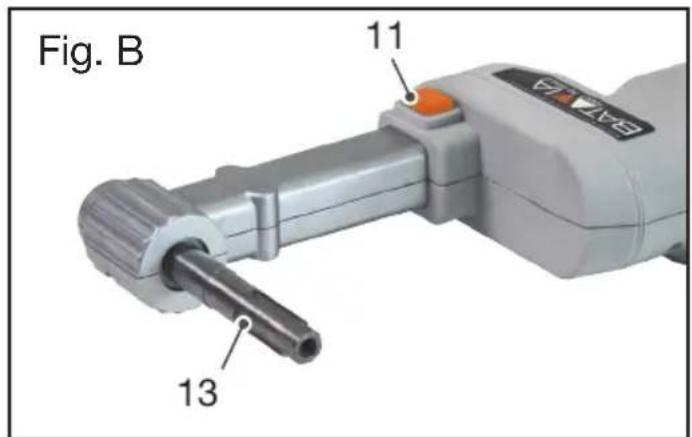
Inserting/Replacing Accessories (Fig. B):
- Lock the drive shaft by pressing the shaft lock button (11);
- Loosen the hex. socket screw (6) using the Allen Key (12);
- Place the desired accessory onto the drive shaft (13) of the machine;
- Tighten the hex. socket screw.
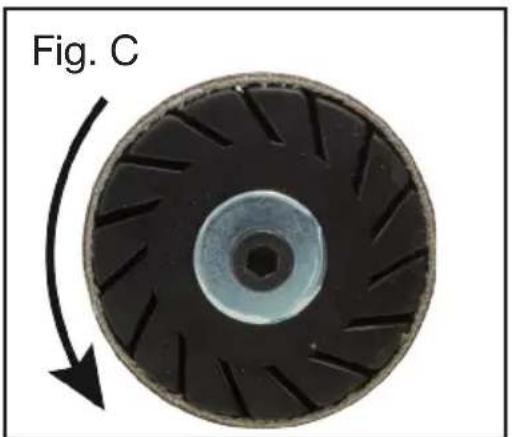
Inserting/Replacing the Sanding Sleeve (Fig. C):
When working with sanding sleeves, the rubber shank for sanding sleeves needs to be mounted first, as described in the section "Inserting/Replacing Accessories".
- Lock the drive shaft by pressing the shaft lock button (11);
- Place the desired sanding sleeve onto the shank for sanding sleeves.
Due to the special shape of the shank for sanding sleeves, the sanding sleeve is easily inserted and removed from the shank.
Prior to putting the sanding sleeve in place: turn the sanding sleeve counter-clockwise and at the same time push it onto the shank.
Prior to removing the sanding sleeve: turn the sanding sleeve counter-clockwise and at the same time pull it off the shank.
All other kinds of accessories can be placed directly onto the drive shaft, making the Maxx-Roll ready for use.
DUST EXTRACTION
Always use the dust extraction hood and connect it to a vacuum cleaner, because dust represents a health hazard.
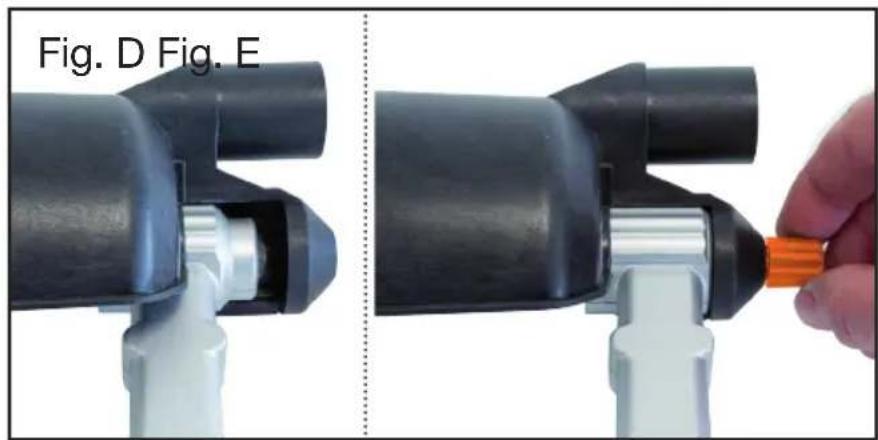
Assembly of the Dust extraction hood (Fig. D):
There is only 1 way to assemble the dust extraction hood. Pay attention to the cut-out.
- Place the dust extraction hood above the drive shaft (13);
- Push the dust extraction hood onto the drive shaft;
- Screw the dust extraction hood down, using the screw that was provided (8).
The dust extraction hood can now be moved into different positions, in order to get it into the ideal working position. This keeps dust or possible sparks away from the user.
Avoid dust accumulation in the work space. Dust is easily inflammable.
Dust from materials such as lead-based paint, certain kinds of wood, minerals and metal, can be hazardous to your health. Touching or inhaling dust can lead to allergic reactions and/ or diseases of the respiratory tract of the user or persons in the vicinity.
Certain kinds of dust, for example, from oak and birch wood are considered carcinogenic, especially in combination with additives used for the treatment of wood (chromate and wood
preservatives). Materials containing asbestos may only be processed by experts.
- If possible, make use of the most appropriate dust extraction for the material.
- Ensure for good ventilation of the work space.
- Usage of a breathing mask, filter class P2, is advised.
Respect the regulations of your country regarding the materials to be processed.
SWITCHING ON AND OFF
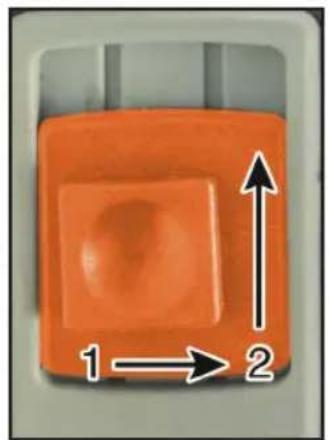
- To switch the machine on, push the ON/OFF button (1b) to the right and simultaneously push button (1a) forward. (Fig. E)
- To switch the machine off, push the ON/OFF button (1) backwards.
SPEED CONTROL
The desired speed can be set with the speed control button (2). The appropriate speed depends on the material that will be sanded and the sanding paper used and needs to be determined through testing.
Attention: When using the machine continuously, do not run it on the lowest speed. This could cause overheating of the motor.
The figures in the table below are advised values:
1-2 Low speed
3-4 Medium speed
5-6 High speed
CHOICE OF ACCESSORY
Select the accessory according to the shape of the surface and the material to be processed. Adjust the grain to the desired level of sanding.
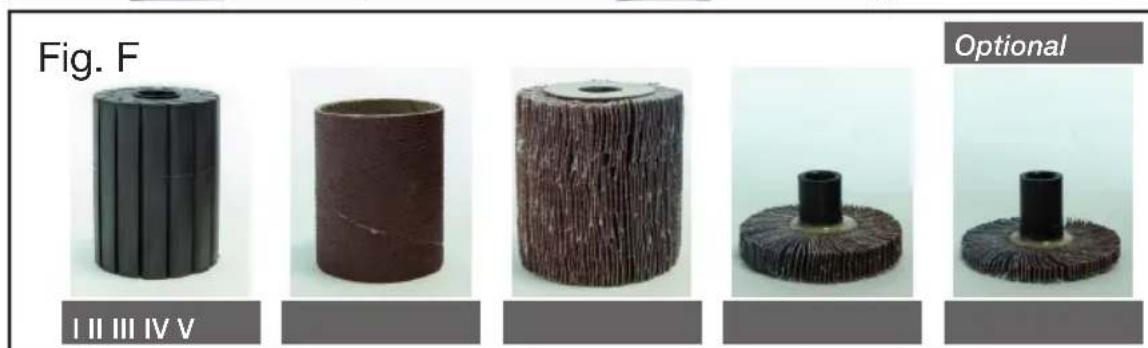
Accessories (Fig. F):
Rubber shank for sanding sleeves (I):
Purpose: Usage of sanding sleeves.
Sanding sleeve (II):
Material: wood, paint layers, plastics, metals.
Purpose: Sanding down of even surfaces, such as window frames, doors, table, etc.
Flap wheel 60 mm (III):
Material: wood, paint layers, plastics, metals.
Purpose: Sanding down of large, uneven, surfaces; sanding down of curvy objects.
Flap wheel 10 mm (IV):
Material: wood, paint layers, plastics, metals.
Purpose: Sanding down of narrow gaps; sand- ing down of curvy objects.
Flap wheel 5 mm (V):
Optional.
Material: wood, paint layers, plastics, metals.
Purpose: Sanding down of narrow gaps; sanding down of small curvy objects.
Rubber shank for sanding sleeves, conical (VI):
Optional.
Purpose: usage of conical sanding sleeves.
Conical sanding sleeve (VII):
Optional.
Material: wood, paint layers, plastics, metals.
Purpose: sanding down of surfaces with small gaps.
Flexible sanding wheel 60 mm (VIII):
Optional.
Material: wood, paint layers, plastics, metals.
Purpose: Sanding down of objects with different shapes and round edges, such as bannisters, parapets, table legs, etc.
Flexible sanding wheel 12 mm (IX):
Optional.
Material: wood, paint layers, plastics, metals.
Purpose: Sanding down of objects with different shapes and round edges, such as bannisters, parapets, table legs, etc.
Steel brush (X):
Optional.
Material: Metal.
Purpose: For the removal of rust and persistent dirt.
Polishing brush (XI):
Optional.
Material: Metals, stainless steel, plastics, aluminium.
Purpose: cleaning, polishing of surfaces.
English
Check the accessories prior to use. The accessories must be perfectly mounted and be able to rotate freely. Let the machine run without any load for at least 1 minute. Do not use damaged, non-circular or vibrating accessories. Damaged accessories can rupture and cause injuries.
SANDING
While sanding, always make sure to hold the machine firmly with both hands and ensure that you are standing firmly on the ground. It is more secure to control the machine with two hands.
- Apply only little pressure when sanding. Applying too much pressure can result in uneven sanding.
- Choose the appropriate grain, depending on the state of the surface and the material. Do not sand down for too long on the same spot.
- Use finer sanding paper for the second round of sanding, until you have reached the desired level of smoothness.
MAINTENANCE AND CLEANING
- To reduce the risk of injury, always disconnect the main power plug before cleaning the device.
- Clean your device with a damp cloth.
- For stubborn dirt, you can moisten the cloth with a mild detergent or soft soap. Other cleaning products often contain chemicals that can damage the plastic parts of the device.
Make sure that air vents always remain clean and open. - Make sure that no liquids get into the machine and never immerse the device in liquid.
- Repairs, inspections of the machine interior, adjustments, and the replacement of carbon brushes should only be performed by a qualified electrician. Only identical replacement parts should be used! For more information, please contact customer service.
-
Disconnect the main power plug prior to performing any maintenance work!
-
Always keep the ventilation openings (8) open and clean. After each use, remove the dirt and dust with a paintbrush or with compressed air from the ventilation openings.
- Never clean the sander with water or other liquids.
- If an increased brush sparking occurs, it is a sign that the carbon brushes must be replaced. Have the carbon brushes replaced by a professional.
TECHNICAL DATA
Voltage: 230 - 240 V~50 Hz
Power: 300 W
Rated speed: 1600 - 3300 min-1
Sound pressure level L_pA : 75.40 dB(A)
Uncertainty K: 3 dB(A)
Sound power level L_wA : 86.40 dB(A)
Uncertainty K: 3 dB(A)
Hand-arm vibration
Sanding mode a_h,DS .. 2.124 m/s<2.5 m/s Polishing mode aP 2.540 m/s Wire brushing mode a a_h,WB .2.181m/s<2.5 m/s Uncertainty K: 1.5 m/s

Residual risks
Even when the power tool is used as prescribed it is not possible to
eliminate all residual risk factors. The following hazards may arise in connection with the power tool's construction and design:
- Damage to lungs if an effective dust mask is not worn.
- Damage to hearing if effective hearing protection is not worn.
- Damages to health resulting from vibration emission if the power tool is being used over longer period of time or not adequately managed and properly maintained.
WARNING! This power tool produces an electromagnetic field during operation. This field may under some circumstances interfere with active or passive medical implants. To reduce the risk of serious or fatal injury, we recommend persons with medical implants to consult their physician and the medical implant manufacturer before operating this machine.

Wear hearing protection while operating the power tool.
The declared vibration total value has been measured in accordance with a standard test method and may be used for comparing one tool with another.
The declared vibration total value may also be used in a preliminary assessment of exposure.
Warning
The vibration emission during actual use of the power tool can differ from the declared total value depending on the ways in which the tool is used.
There is the need to identify safety measures to protect the operator that are based on an estimation of exposure in the actual conditions of use (taking account of all parts of the operating cycle such as the times when the tool is switched off and when it is running idle in addition to the trigger time).
DISPOSAL AND RECYCLING

Do not dispose of electric power tools with domestic refuse.
The electric power tool is shipped in packaging to reduce transport damage. This packaging is a raw material and as such can either be reused or can be fed back into the raw material cycle. The electric power tool and its accessories are made from various materials such as metals and plastics. Take defective components to a special refuse collection point. Ask about these at your specialist shop or local council.
The product and the user manual may be subject to changes. Technical data may be changed without prior notice.
EC-DECLARATION OF CONFORMITY
We, the Batavia GmbH, Weth. Buitenhuisstraße 2a, NL-7951 SM Staphorst, declare by our own responsibility that the product Maxx-Roll, Model BT-SR001, Item-No 7062243, is according to the basic requirements, which are defined in the European Directives Electromagnetic Compatibility 2004/108/EC (EMC), 2006/42/EC (Machinery) and their amendments. For the evaluation of conformity, the following harmonized standards were consulted:
EN 60745-1; EN 60745-2-3; EN 55014-1; EN 55014-2; EN 61000-3-2; EN 61000-3-3
Staphorst, 04 August 2015
Technical documentation kept by:
Meino Seinen, QA Representative
Batavia GmbH, Weth. Buitenhuisstraat 2a, 7951 SM Staphorst, Netherlands
François
CHER CLIENT
Even when the power tool is used as prescribed it is not possible to
eliminate all residual risk factors. The following hazards may arise in connection with the power tool's construction and design:
CE-DECLARATION DE CONFORMITE
AANVULLENDE VEILIGHEIDSWAARSCHUWINGEN VOOR SCHUREN
This product has got a 2 year warranty
Dear Client, if for any reason this product is not working, please ensure you contact our Client Service Centre. Ensure you have your original receipt of purchase. This warranty covers all defects in workmanship or materials in this Batavia product for a two year period from the date of purchase. The warranty does not cover any malfunction, or defect resulting from misuse, neglect, alteration, or repair.
Other European countries | Customer Services Monday till Friday from 8 am until 4 pm