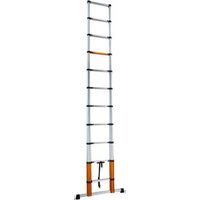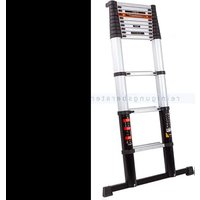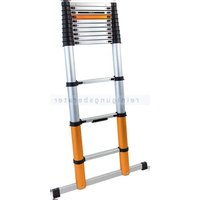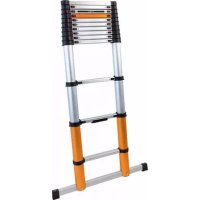
BTTL002 - Ladder Batavia - Free user manual and instructions
Find the device manual for free BTTL002 Batavia in PDF.


| Brand | Batavia |
| Model | BTTL002 |
| Product type | Telescopic ladder |
| Unfolded length | 388 cm |
| Folded length | 120 cm |
| Number of rungs | 13 |
| Width of rungs | 32 cm |
| Maximum permissible load | 150 kg |
| Net weight | 13 kg |
| Material | Aluminum (estimated) |
| Certification | TÜV/GS |
| Intended use | Short-duration light work |
| Recommended tilt angle | 75° (ratio 1:4) |
| Number of simultaneous users | 1 |
| Maintenance | Clean after each use, avoid dirt |
| Storage | In a dry, dust-free place, folded and strapped |
| Warranty | 2 years |
| Customer service | service@batavia.eu |
Frequently Asked Questions - BTTL002 Batavia
User questions about BTTL002 Batavia
0 question about this device. Answer the ones you know or ask your own.
Ask a new question about this device
Download the instructions for your Ladder in PDF format for free! Find your manual BTTL002 - Batavia and take your electronic device back in hand. On this page are published all the documents necessary for the use of your device. BTTL002 by Batavia.
USER MANUAL BTTL002 Batavia
Operating instructions
Gebruiksaanwijzing
Mode d'emploi

natural_image
Vertical ladder structure with black and white panels, no visible text or symbolsModelnr BT-TL001
Art.Nr. 7061176
Teleskopleiter
Telescopic Ladder
Telecoopladder
Bringing the ladder in position and putting up the ladder 9
Use instructions 9
Maintenance and care 10
Causes of accidents 10
Technical specifications 11
Inhoudsopgave
natural_image
Close-up of hands using a metal ladder to lift a white roller, with a black strap and blue shoes visible (no text or symbols)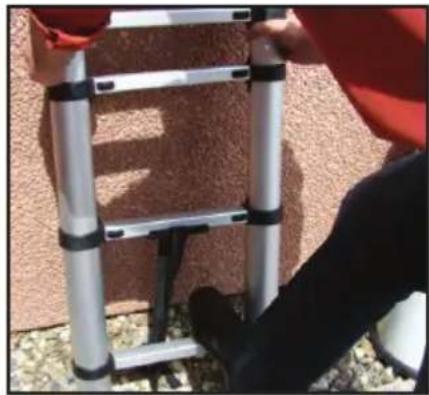
natural_image
Person climbing a metal ladder outdoors, wearing red jacket and black pants (no visible text or symbols)natural_image
Hand holding a metal ladder with red upward arrows indicating motion or force (no text or symbols)natural_image
Person in red jacket handling a metal frame with red arrows, against a textured wall background (no text or symbols visible)Read and understand the user manual before using the telescopic ladder. Keep this manual in a safe place and pass it
on if you pass on the telescopic ladder.
Do not use the telescopic ladder under the influence of pharmaceuticals, drugs, alcohol, etc. or if you feel unwell. Only use the telescopic ladder for easy jobs and for a short period of time. Do not spend long periods without regular breaks on the telescopic ladder. Fatigue and loss of balance are accident hazards.

Check before and after every use the proper functioning and state of all components of the telescopic ladder.
Never use the telescopic ladder if it is damaged. Ensure safe use.
Ensure that children cannot play on the telescopic ladder.
Keep the telescopic ladder away from children and supervised persons.

Remove dirt on the telescopic ladder, such as wet paint, oil or snow before use. Do not use the telescopic ladder on slippery ground, such as ice, wet floor, shiny or dirty surfaces, soft or sloping ground, etc. Always take additional safety measures to prevent


slipping and to ensure stability. Avoid using the telescopic ladder in the rain, because dirt and water in the tubing of the ladder stringers can lead to malfunctions. Do not use the telescopic ladder in bad weather, e.g. strong wind. Place the telescopic ladder on a stable, level and immovable surface.


Do not lean the telescopic ladder against an unstable surface. Always lean the telescopic
ladder against a level and solid surface to ensure the stability of the telescopic ladder. Take additional safety measures, if necessary.

Always hold tight and ensure safe footing when climbing up or down the telescopic ladder. Watch the telescopic ladder when climbing up or down. Never climb up or down with the back against the telescopic ladder, always face the ladder.


The telescopic ladder is only to be used by one person at a time.
When working on the telescopic ladder, hold on to it with one hand or lean against it, if possible. Take additional safety measures if this is not possible.
Place the telescopic ladder only on its feet and not on the rungs. Do not use the telescopic ladder upside down.
When putting up the telescopic ladder ensure that pedestrians, vehicles, etc. cannot collide with the telescopic ladder. Ensue that no doors or windows are in the working area, which can unexpectedly be opened. Close all doors and windows within the working area, except the emergency exits, if possible.

Never exceed the permissible load capacity of the telescopic ladder. The telescopic ladder has a permissible load capacity of max. 150 kg.
Always stand with both feet on one rung.

Put up the telescopic ladder in an inclination angle of 1:4, which corresponds to a support angle on the ground of approx. 75 degrees.
Wear sturdy shoes to prevent slipping, stumbling, etc.
Do not change the position of the telescopic ladder while you are standing on it.
Do not use the telescopic ladder carelessly (e.g. climbing two rungs at a time, sliding down the ladder stringers, jumping off the ladder, etc.)
Ensure that the plastic end caps are always attached to the telescopic ladder. Do not use the ladder without plastic end caps. They prevent dirt, dust, etc. from entering the telescopic tubing and causing damages.
Do not use the top three rungs to climb or to stand on.
Avoid impacts, since damages can affect the sliding mechanism.
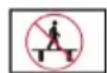
Do not use the telescopic ladder horizontally, for instance to bridge precipices or as a storage shelf, saw horse, etc.

Ensure that the telescopic ladder is suitable for the respective job. Ensure, when using the telescopic ladder to climb on roofs, that the top rung protrudes at least 1m above working height.

Avoid leaving an unsecured ladder at the top. Wrong ladder selection (e.g. too short telescopic ladder, unsuitable use, etc.) can cause accidents.
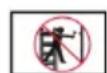
Objects, work equipment, etc., which must be transported while climbing up the telescopic ladder, should not be heavy and easy to handle. Avoid excessive lateral loads, such as carrying up heavy loads or drilling sideways in solid materials.
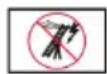
Determine all hazards from electric equipment in the proximity of the work area, e.g. cables or other accessible electric equipment. Do not use conducting telescopic ladders for unavoidable electric jobs. Do not put up the telescopic ladder in the immediate vicinity of live electric equipment (e.g. high-voltage overhead power lines).
Transport the telescopic ladder always in its retracted position. Ensure that the telescopic ladder is properly positioned and fixed on the roof or truck to avoid transport damage.
Fix the rungs with the webbing when storing the telescopic ladder to secure against accidental opening. Do not use the top rung when hanging the telescopic ladder up for storage. Always store the telescopic ladder in a dry and clean place.
Before using the ladder
- Check the ladder visually for damages and safe use at the start of each working day, when the ladder is used;
- Commercial users are to check the ladder regularly;
- Ensure that the ladder is suitable for the respective job;
- Carry out a risk assessment considering the legal requirements in the country of use before using a ladder for work.
Bringing the ladder in position and putting up the ladder
- Secure all locking mechanisms before use, if installed.
Use Instructions
Never use a damaged telescopic ladder.
Extending the telescopic ladder – extending only some rungs –
- Place the telescopic ladder on solid and level ground.
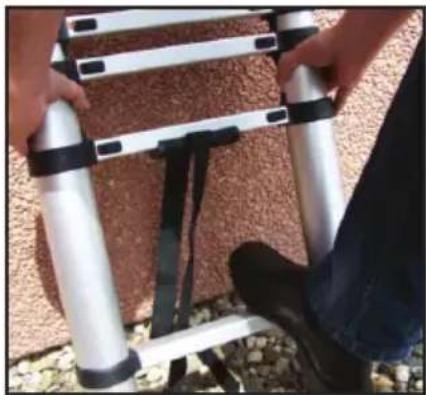
- Stabilize the telescopic ladder with one foot on the lowest rung and extend the telescopic ladder bottom-up to the desired length if only some rungs are needed and the ladder is not extended to its full length.
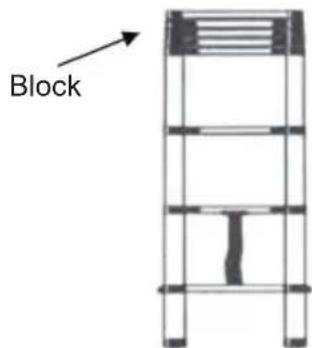
The block is always at the top if the telescopic ladder is not extended to its full length.
natural_image
Close-up of hands assembling a white and black metal ladder-like structure on gravel ground (no text or symbols visible)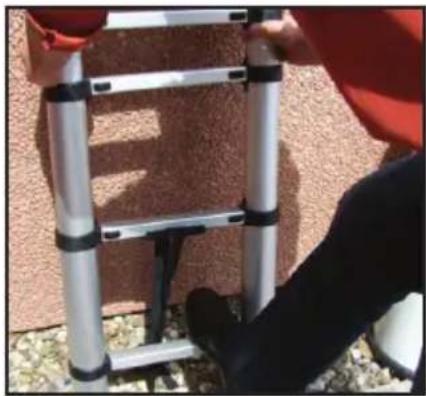
natural_image
Person climbing a metal ladder outdoors, no visible text or symbolsThe block is always at the top if the telescopic ladder is not extended to its full length.
text_image
BlockExtending the telescopic ladder – extend to its full length –
- Place the telescopic ladder on solid and level ground.
- Stabilize the telescopic ladder with one foot on the lowest rung and start extending the telescopic ladder at the top rung to fully extend it. Extend one rung at a time until all rungs are extended and the total length is obtained.
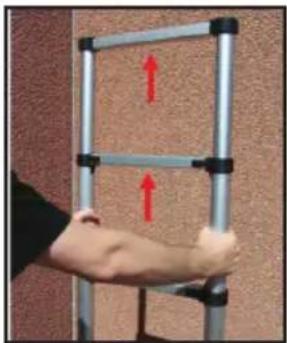
natural_image
Hand using a metal ladder to lift a wall-mounted object, with red arrows indicating upward motion (no text or symbols visible)Please note that, while extending the telescopic ladder beginning with the top rung, the ladder is not locked and retracts if not all rungs are extended.
Retract telescopic ladder
Always take great care when retracting the telescopic ladder.
- Place the telescopic ladder on solid and level ground.
- Press the unlocking buttons towards the centre to retract the telescopic ladder, as shown in the illustration.
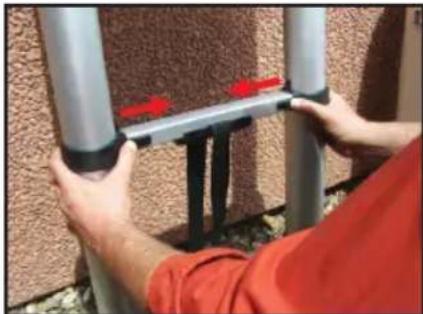
natural_image
Person installing or adjusting a wall-mounted device with red arrows indicating motion (no text or symbols visible)Start retracting the telescopic ladder at the highest rung you can reach, if the telescopic ladder was extended to its full length.
You can retract the remaining telescopic ladder either a rung at a time or press the next to last unlocking buttons (on the second rung from the bottom). This retracts all remaining rungs.
With the 2.5cm safety distance between rungs pinching your fingers is virtually impossible.
However, ensure that your Arms and fingers are in line with the unlocking buttons (dotted line), when retracting the ladder.
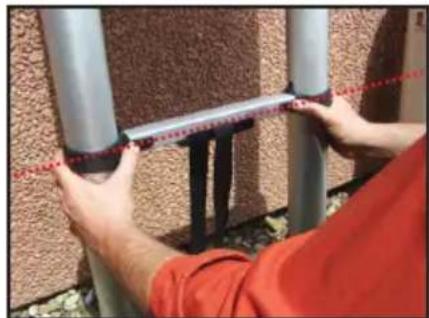
natural_image
Person measuring a wall-mounted object with red measurement tape (no text or symbols visible)Maintenance and care
- Always keep the telescopic ladder clean. Remove dirt, abrasive dust, paint, glue, etc. after every use, before retracting the telescopic ladder. Dirt can affect the proper functioning. Always wipe the rungs clean.
- Clean the telescopic ladder with a broom or a cloth. Thoroughly dry the rungs if the telescopic ladder gets wet.
• To prevent surface damage always protect the plastic end caps from dirt and abrasive dust, etc. - Leave repair and maintenance work to competent staff.
Causes of accidents
The following list of hazards shows common risks when working with ladders and does not claim to be complete. Observe the following instructions as a foundation for safe work.
a) Loss of stability:
1) Improper ladder placement (wrong angle for extension ladders or not complete opening of stepladders).
2) Bottom part slipping away from the wall.
3) Sideways slipping, tipping and overturning (for instance by leaning outwards or unstable contact surface).
4) Poor condition of the ladder (e.g. missing anti-slip feet).
5) Jumping from an unsecured ladder.
6) Dirty floor, unstable ground, not absolutely level ground, slippery ground.
7) Adverse weather conditions, such as strong wind.
8) Collisions with the ladder, e.g. vehicles or doors.
9) Wrong type of ladder, e.g. too short or unsuitable ladder.
b) Wrong handling:
1) Bringing the ladder to the work position.
2) Putting up and disassembling the ladder.
3) Carrying objects on the ladder.
c) Slipping and falling off the ladder:
1) Unsuitable shoes.
2) Dirty rungs.
3) Unsafe behaviour, e.g. climbing two rungs at a time, sliding down the ladder.
d) Ladder failure:
1) Ladder condition, e.g. damaged rungs, wear and tear.
2) Overloading the ladder.
e) Electric hazards:
1) Working on live wires, e.g. during electric troubleshooting.
2) Placing the ladder too close to live components, e.g. power cables at the ceiling.
3) Damaging electric components with the ladder, e.g. covers or insulation.
4) Wrong ladder selection for electrical job.
Technical specifications
Extended length: 388 cm
Retracted length: 120 cm
Number of rungs: 13 rungs
Width of rungs: 32 cm
Load capacity: 150 kg
Net weight: 13 kg
Safety distance between rungs: 2.5 cm
Approval marks: TÜV/GS
Batavia GmbH
Blankenstein 180
7943 PE Meppel - The Netherlands
natural_image
Person using a white bench press on outdoor equipment (no text or symbols visible)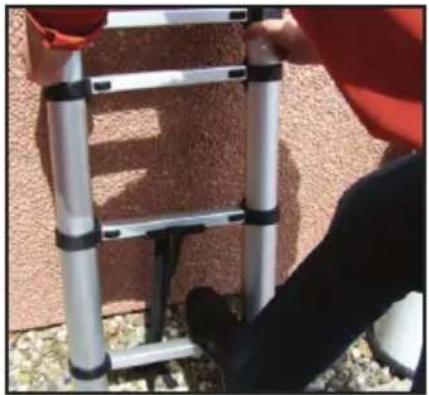
natural_image
Person climbing a metal ladder outdoors, no visible text or symbolsnatural_image
Hand holding a metal ladder with red upward arrows indicating motion or force (no text or symbols)natural_image
Person in red shirt holding a metal frame with red arrows, against a textured wall background (no text or symbols visible)natural_image
Person in red shirt measuring a wall-mounted object with measurement tape (no visible text or symbols)natural_image
Person using a white and black bench press on a gravel surface (no text or symbols visible)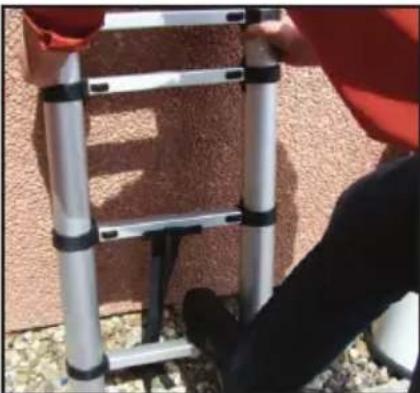
natural_image
Person climbing a metal ladder outdoors, no visible text or symbolsnatural_image
Hand holding a metal ladder with red upward arrows indicating motion or force (no text or symbols)natural_image
Person in red jacket handling a metal support frame with red buttons, against a textured wall background (no text or symbols visible)natural_image
Person measuring a wall-mounted object with red measurement tape (no text or symbols visible)This product has got a 2 year warranty
Dear Client, if for any reason this product is not working, please ensure you contact our
Client Service Centre. Ensure you have your original receipt of purchase. This warranty covers all defects in workmanship or materials in this Batavia product for a two year period from the date of purchase. The warranty does not cover any malfunction, or defect resulting from misuse, neglect, alteration, or repair.
Other European countries | Customer Services
Monday till Friday from 8 am until 4 pm
Overige landen Europa | Klantenservice