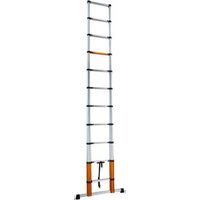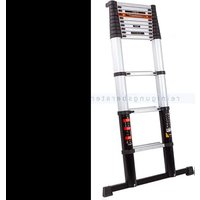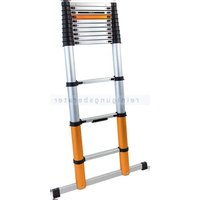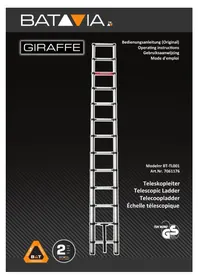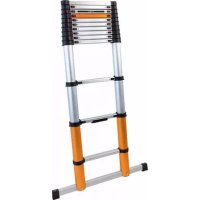
Giraffe Air 3.91 - Ladder Batavia - Free user manual and instructions
Find the device manual for free Giraffe Air 3.91 Batavia in PDF.



User questions about Giraffe Air 3.91 Batavia
0 question about this device. Answer the ones you know or ask your own.
Ask a new question about this device
Download the instructions for your Ladder in PDF format for free! Find your manual Giraffe Air 3.91 - Batavia and take your electronic device back in hand. On this page are published all the documents necessary for the use of your device. Giraffe Air 3.91 by Batavia.
USER MANUAL Giraffe Air 3.91 Batavia
Pack contents/product parts
- Unlock key (locking device), 22 ×
- Support foot
- Non-slip cap (support foot), 2 ×
- Strap
- Rung, 12 ×
- Beam, 2 ×
- Protective cap (rung), 26 ×
- Upper block (with ladders not extended to the maximum length)
- Hexagon bolt with nut, 2 ×
Pack contents/product parts 3
General information 18
Reading and storing the user manual 18
Explanation of symbols 18
Safety 19
Proper use 19
Safety instructions 20
Checking the ladder and pack
contents 23
Mounting the support foot 23
Using the ladder 24
Locking device 24
Extending the ladder 25
Retracting the ladder 25
Cleaning and maintenance 26
Transport and storage 26
Causes of accidents 26
Technical data 28
Disposal 28
Disposing of the packaging 28
Disposing of the ladder 28
Inhoud
Overzicht 2
Safety instructions 43
General information Reading and storing the user manual

This user manual accompanies this aluminium telescopic ladder 3.91 m
(hereinafter referred to as "ladder"). It contains important information about safety and use.
Before using the ladder, read the user manual carefully. This particularly applies to the safety instructions. Failure to heed this user manual may result in severe injury or damage to the ladder.
The user manual is based on the standards and rules in force in the European Union. When abroad, you must also observe country-specific guidelines and laws.
Store the user manual for future use. If you pass the ladder on to third parties, please be absolutely sure to include this user manual.
Explanation of symbols
The following symbols and signal words are used in this user manual, on the ladder or on the packaging.

WARNING!
This signal symbol/word designates a hazard with moderate degree of risk which may lead to death or severe injury if not avoided.

CAUTION!
This signal symbol/word designates a hazard with low risk that, if not avoided, may result in minor or moderate injury.
NOTICE!
This signal word warns against potential damages to property.

This symbol provides you with additional useful information regarding handling
or use.


TÜV Rheinland confirms that the telescopic ladder meets
the relevant requirements of a safe product.

Read and understand the user manual before using the ladder.
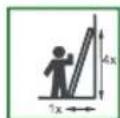
During deployment bear in mind the necessary inclination angle. The
inclination angle/propping angle of the ladder must amount to approx. 75^ (ratio 1:4).
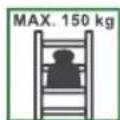
Observe the maximum load capacity of 150kg

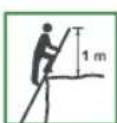
Bear in mind that the ladder overhang over the
contact point must amount to at least 1m
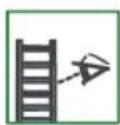
Always conduct a sight check of the ladder before using the ladder.
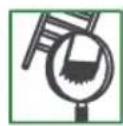
Always check the feet of the ladder before using the ladder.
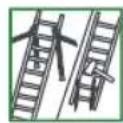
Secure the top and bottom ends of the ladder.

The maximum number of users permitted on the ladder is 1. Make sure that
only one person is on the ladder at a time.
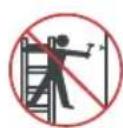
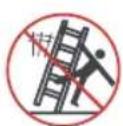
Avoid leaning out sideways.
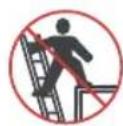
Climbing sideways off the ladder is not permitted.

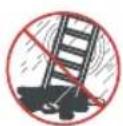
Make sure that the floor at the installation site is
not contaminated.
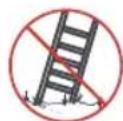
Only set up the ladder on solid ground.
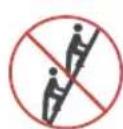
Only one person is permitted on each climbable side of
the ladder.
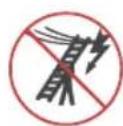
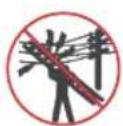
When transporting the ladder, pay attention to risks
posed by power lines.
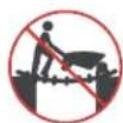
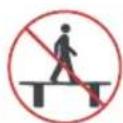
Do not use the ladder to bridge distances.
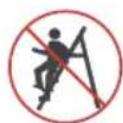
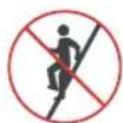
Always face the ladder while climbing up and
down it.
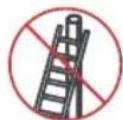
Make sure that you lean the top end of the ladder correctly.
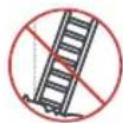
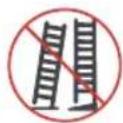
Always set up the ladder on level ground.

When using the ladder observe the correct set-up direction.
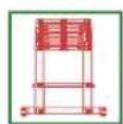
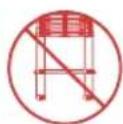
The ladder may only be used in combination with
the stabiliser on the feet (support foot).
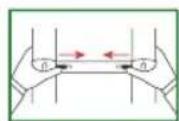
While retracting the ladder, hands must be situated on the outside beams and must not, during any point of the retracting process, be
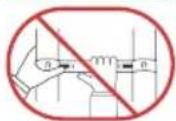
placed on the rungs.
Safety
Proper use
The ladder is designed exclusively for use as a climbing aid and has a maximum load capacity of 150kg . It is only intended for private use
English
and is not suitable for commercial purposes.
The ladder is designed exclusively as a leaning ladder, which means it must be leaned against a contact point with an inclination angle of approx. 1:4.
Only use the ladder as described in this user manual. Any other use is deemed improper and may result in damage to property or even personal injury. The ladder is not a children's toy.
The manufacturer or vendor accepts no liability for damage caused by improper or incorrect use.
Safety instructions

WARNING!
Danger of serious injury!
Incorrect use or incorrect handling of the ladder incurs risks that can lead to serious injury or even death.
- Only use the ladder if you are in good health. Certain health circumstances, use of medication as well as alcohol and drug abuse can lead to an increased danger to your safety when using the ladder.
- Make sure when transporting the ladders on a roof rack or in a commercial vehicle that the ladders are fastened/secured in an
appropriate way in order to avoid damage to property and people.
- After delivery and before first use, check the condition of the ladder and that all parts are functional.
- Carry out a sight check of the ladder for damage and safe use at the beginning of every workday in which the ladder must be used.
- Make sure that the ladder is suitable for the intended use.
- Do not use the ladder if it is damaged.
- Remove all contaminates from the ladder, e.g. wet paint, dirt, oil or snow, before using the ladder.
- Before using a ladder while working, you should perform a risk assessment that accounts for the legal regulations of the country where it is used.
- The ladder must be installed in the correct set up position, e.g. correct propping angle for leaning ladders (inclination angle approx. 1:4), rungs and treads level.
- Locking devices, if fitted, must be completely secure before use.
- The ladder must be set up on a flat, level base that does not move.
- A leaning ladder should be leaned against a level, solid sur
face and secured before you use it, e.g. by securing the leaning ladder or by using a suitable installation to ensure structural stability.
- The ladder must never be placed in a new position from above.
- Once the ladder is positioned, attention must be paid to any risk of collision, e.g. with pedestrians, vehicles or doors. If possible, lock all doors and windows in the work area, but not emergency exits.
- Check the surroundings for sources of danger, such as exposed high-voltage overhead power lines or other exposed electrical equipment, before you set up the ladder and climb on it.
- Always set up the ladder on its feet and not on the rungs or steps.
- Do not set up the ladder on slippery surfaces (e.g. ice, glossy surfaces or clearly contaminated solid surfaces), unless through additional measures the ladder is prevented from slipping or that the contaminated areas are sufficiently clean.
-
Never exceed the payload of the ladder. The maximum load-bearing capacity of the ladder is 150 kg.
-
Do not lean too far out from the ladder when you are standing on it. You should always stand firmly with both feet on the same step and keep the centre of your body (belly button) between the beams.
- Under no circumstances climb off the ladder at great height without an additional safeguard. Secure the ladder or use a suitable mechanism for securing the stability.
- Do not stand on the top three rungs of the ladder.
- Only use the ladder for simple tasks that do not take much time to complete.
- Do not use the ladder to perform work under electrical voltage. The ladder is made of conductive material.
- Do not use the ladder outdoors during adverse weather conditions, e.g. strong wind or storm.
- Ensure that children do not play with the ladder. Do not leave the ladder unsupervised when it is set up.
- Keep children away from the ladder.
If possible, lock all doors and windows in the work area, but not emergency exits.
English
- Always climb up and down the ladder with your face to the ladder.
- If you climb up or down the ladder, always hold on with both hands.
- Do not use the ladder to bridge distances or as a bridge.
- Wear suitably sturdy shoes when you climb onto the ladder.
- Avoid working on the ladder with a one-sided load, e.g. drilling sideways through solid materials (e.g. bricks or concrete).
- Do not remain too long on the ladder without regular pauses (tiredness is a danger). Climb off of the ladder immediately if you feel tired.
- Leaning ladders for reaching elevated heights should be pushed at least 1 m past the contact point.
- Do not climb higher than the last metre of the leaning ladder.
- Carry only light, manageable items when you are on the ladder.
- Always hold on with one hand when working on the ladder or, if this is not possible, take additional security precautions.
Before use, ensure that the locking devices of the ladder function and that all extended sections are properly locked before you
climb onto the ladder. Only use the ladder if it functions properly.
- Make sure that there are no lines or pipes, unsecured windows and doors or buttresses nearby before you climb onto the ladder.
- Do not use the ladder if one or more non-slip caps for the support foot are missing or are visibly damaged.
- Set up the ladder so that it is always freely accessible.
- Climb onto the ladder one rung at a time and do not skip multiple rungs.
- Do not slide down the beams.
- If necessary, take additional measures to secure the stability of the ladder, e.g. by lashing the ladder to a secure anchor.
If you are working at elevated heights, take extra steps to further secure the ladder.
- Only transport the ladder when it is fully retracted and when it is secured with the strap.
- Do not move the ladder if there is a person on it.
- Do not place any tools or other objects on the rungs and do not hang anything on the ladder.
- Do not pull too forcefully on objects and do not exert intense pressure on objects if you are on the ladder. This could cause the ladder to tip over.
- Always wear tightly fitting clothing when you climb onto the ladder. Loose-fitting clothing could get caught and cause you to fall off the ladder.
- Do not extend the ladder in a makeshift manner and do not modify its shape and function in any manner.
- The ladder must never be placed in a new position from above.
Checking the ladder and pack contents
WARNING!
Risk of injury!
If you use a damaged ladder or employ the ladder incorrectly, there is a large risk of injury.
- After delivery and before first use, check the condition of the ladder and that all parts are functional.
WARNING!
Danger of suffocation!
If children play with the packaging wrapper, they could catch themselves in it and suffocate.
- Do not let children play with the packaging wrapper.
NOTICE!
Risk of damage!
The ladder can be damaged if you cautiously open the packaging
with a sharp knife or another pointed object.
-
Proceed carefully when opening.
-
Take the ladder out of the packaging.
- Check to make sure that the delivery is complete (see fig. A).
- Check whether the ladder or the individual parts exhibit damages. If this is the case, do not use the ladder. Contact the manufacturer at the service address specified on the warranty card.
Mounting the support foot
CAUTION!
Injury to persons and damage to property!
The ladder can fall over during the assembly of the support foot. In the process, it can lead to damage to property or injury to persons.
- Take care during the assembly of the support foot that the ladder does not fall over.
-
If necessary, get assistance from a second person for assembly.
-
Place the support foot ② on the ground (see fig. H).
- Put the beams ⑥ on the support foot in such a way that the mounting holes of the beams and support foot align.
- Put the hexagon bolts through the mounting holes.
- Fasten the bolts with the nuts.
Using the ladder

WARNING!
Danger of serious injury!
If you use the ladder improperly, you could hurt yourself and other persons.
- Only step onto the ladder if you:
have set it up properly, in a suitable location and in accordance with the instructions,
are wearing sturdy shoes,
have carefully read and understood all the information in the chapter "Safety". - Ensure that the locking devices of the ladder function and that all extended sections are properly locked before you climb onto the ladder.
- Do not leave children alone and unsupervised when the ladder is set up.
- Do not stand on the top three rungs of the ladder.
- Make sure that the ladder is properly secured when moving it.
- Only climb onto the ladder if you have set it up using the correct leaning angle of 75^ (inclination angle 1:4).

CAUTION!
Crushing hazard!
When extending or retracting the ladder, you can catch or jam your
fingers if you proceed without caution.
Take care when extending or retracting the ladder.
- When retracting the ladder ensure that your fingers, hands and arms are at the height of the actuated unlock keys.
Locking device
With the aid of the locking devices on the rungs 5, the individual ladder sections are locked when you extend the ladder.
-
Always check that all sections are correctly locked before climbing the ladder:
-
The locking device of a section is locked if the red section next to both unlock keys ① of a rung is not visible (see fig. B). If you apply pressure to the corresponding rung, it cannot be pushed down.
- The locking device of a section is not locked if the red section next to one or both unlock keys ① of a rung is visible (see fig. C). If you apply pressure to the corresponding rung, it can be pushed down.
- Keep in mind that when you extend the ladder from the top down, the individual sections will only lock when you have
extended the ladder to its full length.
Extending the ladder Extending the ladder by a few rungs

If you do not extend the ladder to its full length, the blocks of the remaining
rungs that are not extended must be located at the top end of the ladder.
- Set up the ladder on a solid and level ground.
- Stabilise the ladder by placing a foot on the support foot ②.
- Extend the ladder from the bottom up, rung by rung until the desired length is reached (see fig. D).
With the aid of the locking device, each section is automatically locked as soon as the corresponding rung has extended to its maximum.
4. Make sure that each and every ladder section is locked before you climb onto the ladder (see section "Locking device").
Extending the ladder to its total length
- Set up the ladder on a solid and level ground.
-
Stabilise the ladder by placing a foot on the support foot ②.
-
Extend the ladder from the top down, rung by rung until the total length is reached (see fig. E and F).
Keep in mind that the locking devices of the ladder only lock when you have extended the ladder to its total length.
- Make sure that each and every ladder section is locked before you climb onto the ladder (see section "Locking device").
Retracting the ladder

If you activate the lowest unlock keys (on the second rung from below), all rungs
of the above ladder section are automatically unlocked and retracted. If you begin with one of the upper rungs, this only unlocks the rungs above it and the rungs below must be unlocked separately.
- Make sure that the ladder stands on a solid and level ground.
- When retracting the ladder ensure that your fingers, hands and arms are at the height of the actuated unlock keys.
- Push both unlock keys of a rung towards the centre so that the red area below becomes visible. The locking device unlocks and the remainder of the ladder above the rung is retracted.
Cleaning and maintenance

WARNING!
Risk of injury!
There is a risk of injury with incorrect handling. If rungs or beams are contaminated, you can easily slip or fall off the ladder and injure yourself.
- Keep the ladder clean. Remove contaminants, such as, e.g. dirt, paint residues etc., after each use and before retracting the ladder.
- Always wipe the rungs off.
- Leave repair and maintenance work to be carried out exclusively by experts.
NOTICE!
Risk of damage!
Improper cleaning can lead to damage.
- Do not use any aggressive cleaners, brushes with metal or nylon bristles or sharp or metallic cleaning utensils such as knives, hard scrapers and the like. They could damage the surfaces.
- Keep the protective caps and the non-slip caps of the support foot free from dirt, abrasive grit and so forth. This could damage the surface.
-
Clean the ladder with a brush or a cloth.
-
Dry the ladder, and in particular the rungs, thoroughly after cleaning.
- Under no circumstances carry out maintenance and repairs to the ladder by yourself. Contact the manufacturer or a specialist workshop at the service address specified on the warranty card. Liability and warranty claims are waived in the event of repairs performed by the user or incorrect handling.
Transport and storage
- Retract the ladder completely after every use and secure it with the aid of the strap 4 in order to prevent it from extending by accident.
- Store the ladder in a dry area.
- Store the ladder out of the reach of children.
- Ensure that children do not handle the ladder unsupervised.
Causes of accidents
The following partial listing of risks tells of typical hazards and examples for frequent causes of accidents when using a ladder. In order to avoid accidents, take into consideration the mentioned risks in the handling of the ladder as a basis for safe work.
a) Loss of stability
1) incorrect positioning of the ladder (e.g. incorrect propping angle of leaning ladders or incomplete opening of step ladders);
2) sliding away of the lower end of the ladder outwards, e.g. away from the wall on which the ladder is leaning;
3) slipping off the ladder sideways, falling to the side and tipping of the upper tread (e.g. by leaning out too far or an insufficient grip on the uppermost top step);
4) poor condition of the ladder (missing or damaged rubber caps on the support foot);
5) climbing off of an unsecured ladder at height;
6) unsuitable ground at the installation site of the ladder (e.g. unstable, soft ground, sloping, slippery surfaces or contaminated solid surfaces);
7) unfavourable weather conditions (e.g. wind);
8) collision with a ladder, e.g. by vehicles or doors;
9) incorrect choice of ladder (e.g. ladder too short, unsuitable use).
b) Improper handling
1) setting up the ladder in its position of usage;
2) assembly and disassembly of the ladder;
3) carrying items whilst climbing the ladder.
c) Slips, stumbles and falls
1) unsuitable footwear;
2) contaminated rungs;
3) careless behaviour of user (e.g. taking two steps at a time, sliding down the beams).
d) Failure of the ladder construction
1) poor condition of the ladder (e.g. damaged beams, wear and tear);
2) overloading of the ladder.
e) Electrical hazards
1) unavoidable work under voltage (e.g. fault tracing);
2) setting up the ladder in direct proximity of electrical equipment under voltage (e.g. high voltage overhead cables);
3) damage of electrical equipment by ladders (e.g. coverings or protective insulation);
4) incorrect choice of ladder type for electrical work.
Technical data
Model: BT-TL009
Maximum permissible load: 150kg
Maximum length: 3.91 m
Inclination angle: 65^ - 75^
Weight: 14.5kg
Maximum permissible
number of users: 1
Article number: 7062759
Disposal
Disposing of the packaging

Dispose of the packaging by sorting into single type materials.
Dispose of cardboard and carton as waste paper and foils via the recyclable material collection service.
Disposing of the ladder
Dispose of the ladder in accordance with the applicable laws and regulations for your country.
Type Approved
Safety
Regular Production
Significance
www.zuv.com 1419042351
TÜV Rheinland bevestigt dat de telescopische ladder
Maximale length: 3,91 m
Hellingshoek: 65^ - 75^
This product has got a 2 year warranty
Dear Client, if for any reason this product is not working, please ensure you contact our Client Service Centre. Ensure you have your original receipt of purchase. This warranty covers all defects in workmanship or materials in this Batavia product for a two year period from the date of purchase. The warranty does not cover any malfunction, or defect resulting from misuse, neglect, alteration, or repair.
Other European countries - Customer Services /