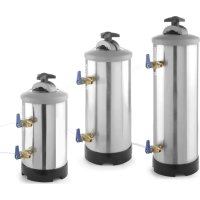
231210 - Water Softener Hendi - Free user manual and instructions
Find the device manual for free 231210 Hendi in PDF.


| Product Type | Water Softener |
| Model | 231210 |
| Brand | Hendi |
| Height | 400 mm |
| Weight | 7.5 kg |
| Resin Volume | 5.6 litres |
| Salt per Regeneration | 1 kg |
| Nominal Flow Rate (at 4 bar) | 1000 l/h |
| Supply Pressure | 0.1 - 0.8 MPa (1 - 8 bar) |
| Ambient Temperature | 4°C - 35°C |
| Maximum Inlet Hardness | 90°f (900 ppm CaCO3) |
| Water Connections | 3/8"G or 3/4"G |
| Regeneration Frequency | According to hardness and consumption (see table) |
| Resin Lifespan | Approximately 5 to 7 years |
| Materials | Stainless steel and polymers |
| Intended Use | Softening of drinking water for domestic or technological use |
| Regeneration Type | Manual by depressurization, cleaning and rinsing |
| Cleaning and Maintenance | Clean lid and bottle after regeneration; avoid corrosion |
| Safety | Do not use without supervision by unqualified persons; do not repair yourself |
| Spare Parts | Resins, seals, hoses |
Frequently Asked Questions - 231210 Hendi
User questions about 231210 Hendi
0 question about this device. Answer the ones you know or ask your own.
Ask a new question about this device
Download the instructions for your Water Softener in PDF format for free! Find your manual 231210 - Hendi and take your electronic device back in hand. On this page are published all the documents necessary for the use of your device. 231210 by Hendi.
USER MANUAL 231210 Hendi
WATER SOFTENER ZMIĘKCZACZ DO WODY
231210, 231227, 231234
natural_image
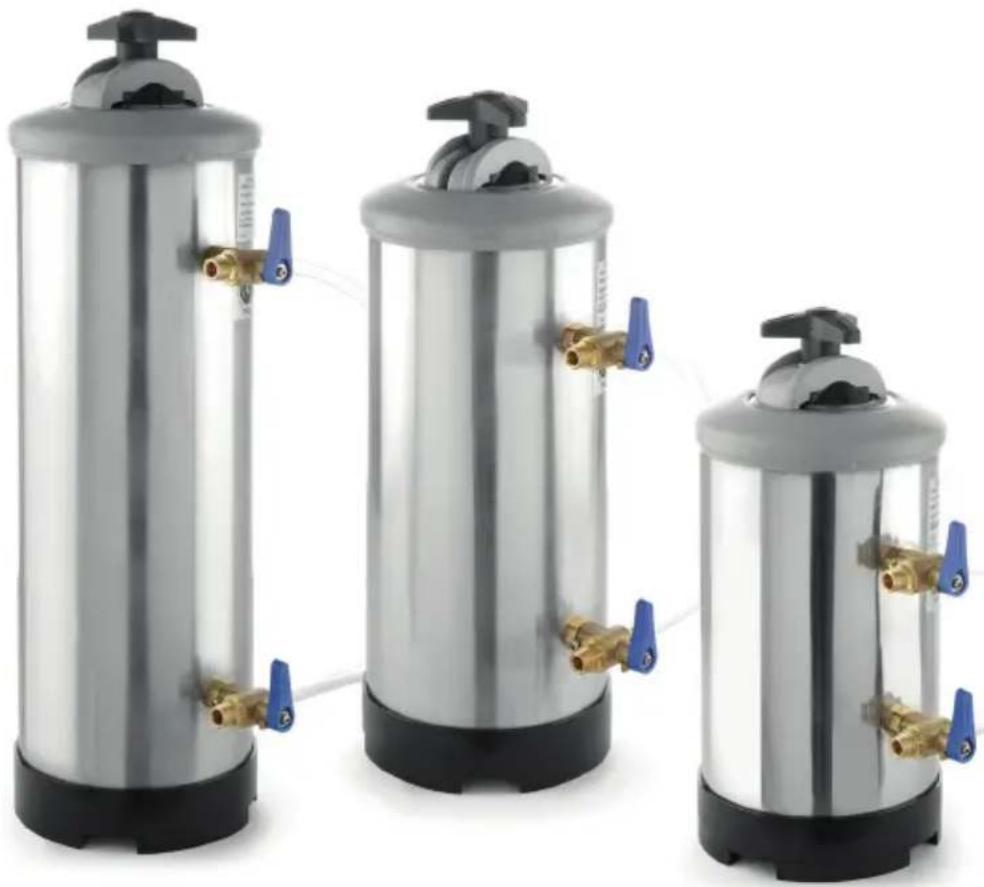
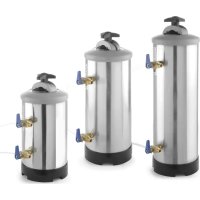
Three stainless steel cylindrical water heaters with blue valve fittings, arranged in descending size (no text or symbols visible)User manual | Gebrauchsanweisung | Instrukcja obstugi | Mode d'emploi Istruzioni per l'utente | Руководство по эксплуатации |
You should read this user manual carefully before using the appliance.
1. INTRODUCTION AND GENERAL INFORMATION
1.1 1.1 OBJECTIVE OF THE MANUAL
1.2 KEEPING THE MANUAL
1.3 EQUIPMENT IDENTIFICATION
1.4 DECLARATION OF COMPLIANCE
1.5 HYGIENIC SAFETY NORMS AND ICIM TESTING
1.6 RECOMMENDATIONS AND WARNINGS
2. ABOUT THE EQUIPMENT
2.1 HOW DOES IT WORK?
2.2 EQUIPMENT DESCRIPTION
2.3 THE PACKAGING CONTAINS
2.4 TECHNICAL FEATURES
2.5 CHARACTERISTICS OF FEED WATER
2.6 EQUIPMENT PERFORMANCE BASED ON WATER HARDNESS
3. INSTALLATION
3.1 PACKAGING
3.2 CHOOSING THE PLACE OF INSTALLATION
3.3 CONNECTION TO THE WATER SYSTEM
3.4 CONNECTION TO THE DRAIN SYSTEM
4. ACTIVATION AND INSTRUCTIONS FOR THE REGENERATION
4.1 RINSING THE RESINS
4.2 PERIODIC REGENERATION
5. MAINTENANCE FOR THE INSTALLER
5.1 CHANGING THE RESINS
5.2 RESIN PRESERVATION AND ACTIVATION AFTER A LONG PERIOD OF INACTIVITY
6. IMPROPER USE OF THE EQUIPMENT
7. EQUIPMENT DISPOSAL
F INDEX
1. INTRODUCTION ET INFORMATIONS GÉNÉRALES
1.1 OBJECTIF DU LIVRET
1.2 CONSERVATION DU LIVRET
1.3 IDENTIFICATION DE L'APPAREIL
1.4 DÉCLARATION DE CONFORMATION
1.5 NORMES ICIM DE SÉCURITÉ SANITAIRE ET EXPÉRIMENTALE
1.6 CONSEILS UTILES ET AVERTISSEMENTS
2. CONNAÎTRE L'APPAREIL
2.1 COMMENT FONCTIONNE-T-IL?
2.2 DESCRIPTION DE L'APPAREIL
2.3 L'EMBALLAGE CONTIENT
2.4 CARACTÉRISTIQUES TECHNIQUES
2.5 CARACTÉRISTIQUES DE L'EAU D'ALIMENTATION
2.6 PERFORMANCE DE L'ADOUCISSEUR SELON LA DURETÉ DE L'EAU
3. INSTALLATION
3.1 EMBALLAGE
3.2 CHOISIR LE LIEU D'INSTALLATION
3.3 RACCORDEMENT AU RÉSEAU HYDRIQUE
3.4 RACCORDEMENT AU RÉSEAU D'ÉVACUATION
4. MISE EN MARCHE ET INSTRUCTIONS POUR LA RÉGÉNÉRATION
4.1 RINÇAGE DES RÉSINES
4.2 RÉGÉNÉRATION PÉRIODIQUE
5. MANUTENTION POUR L'INSTALLATEUR
5.1 CHANGER LES RÉSINES
5.2 CONSERVATION DES RÉSINES ET MISE EN MARCHE APRÈS UNE PÉRIODE D'INACTIVITÉ
6. UTILISATION INCORRECTE DE L'APPAREIL
7. ÉLIMINATION DE L'APPAREIL
- WSTEP I UWAGI OGÓLNE
1.2 PRŻECHOWYWANIE INSTRUKCJI OBSŁUGI
1.3 IDENTYFIKACJA PRODUKTU
1.4 DEKLARACJA ZGODNOŚCI
1.5 NORMY BEZPIECZEŃSTWA HIGIENICZNEGO I BADAWCZEGO ICIM
FIG. 1
RISCIACQUO E MESSA IN FUNZIONE
RINSING AND ACTIVATION
RINÇAGE ET MISE EN MARCHE
SPÜLEN UND INBETRIEBNAHME
ENJUAGE Y PUESTA EN FUNCIONAMIENTO
ПРОМЫВКА И ФУНКЦИОНИРАВАНИЕ
РŁUKANIE I URUCHOMIENIE
natural_image
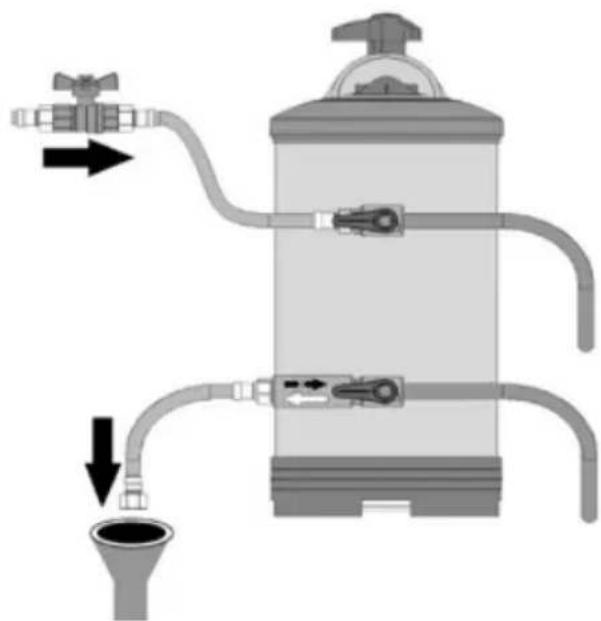
Diagram of a vertical pressure vessel with inlet/outlet valves and flow paths, showing fluid flow direction (no text or labels)FIG. 2
LEGENDA (fig. 1):
A ENTRATA ACQUA
B USCITA ACQUA
C RUBINETTO ENTRATA ACQUA
D RUBINETTO USCITA ACQUA
E TUBO SCARICO PRESSIONE
F TUBO RIGENERAZIONE
G TAPPO BOMBOLA
I VALVOLA DI RITEGNO
L ETICHETTA
M RUBINETTO GENERALE
N POZZETTO DI SCARICO
LEGEND (fig. 1):
A WATER INLET PIPE
B WATER OUTLET PIPE
C WATER INLET TAP
D WATER OUTLET TAP
E DEPRESSURIZATION PIPE
F REGENERATION PIPE
G TANK LID
I CHECK VALVE
L LABEL
M STANDARD TAP
N FLOOR SINK
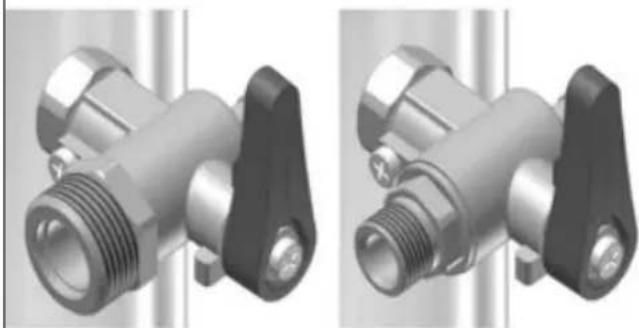
3/4" G 3/8" G
natural_image
Two identical 3D renderings of a metallic valve fitting with threaded ports and black connectors (no text or symbols visible)FIG. 3
FASE DI LAVORO
SERVICE MODE
MODALITÉ DE TRAVAIL
BETRIEB
FASE DE TRABAJO
ФАЗА РАБОТЫ
TRYB PRACY
natural_image
Diagram of a cylindrical mechanical device with internal components and directional arrows indicating flow or movement (no text or symbols)PULIZIA
CLEANING
NETTOYAGE
SPÜLUNG
LIMPIEZA
ФАЗА РЕГЕНЕРАЦИИ
CZYSZCZENIE
FASE DI RISCIACQUO
RINSING MODE
MODALITÉ DE RINÇAGE
REGENERATION
natural_image
Illustration showing a hand cleaning a circular object with a faucet and a water dispenser (no text or symbols)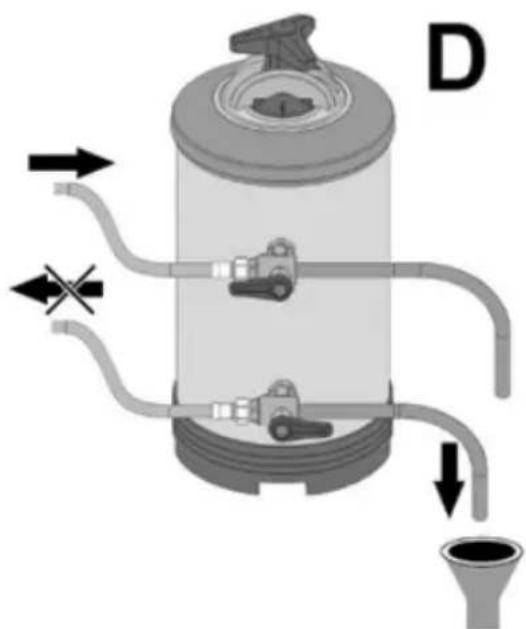
natural_image
Diagram of a cylindrical device with internal components and fluid flow arrows, no text or symbols presentFIG.4
AVVERTENZE PER L'UTENTE
- This equipment must not be used by children or by people with physical, mental or sensory impairments, or by people lacking experience, unless they be supervised by someone responsible for their safety, or they received instructions regarding the correct and safe way to use the equipment and were warned of the risks.
- Never try to repair the equipment by yourself: you may cause damage. Ask your seller for assistance.
- Never touch or use the water softener with wet or damp hands or feet, or barefoot.
1. INTRODUCTION AND GENERAL INFORMATION
1.1 OBJECTIVE OF THE MANUAL
This instruction manual is addressed to qualified personnel who must have knowledge of the health and safety norms of the place of installation.
The objective of this manual is to give useful information and warnings, both to the installer and the user, regarding:
HOW TO STORAGE AND KEEP THE EQUIPMENT BEFORE USE:
- Place and room conditions
- Expiry date
FOR THE INSTALLER
• Precautions for hygienic safety
• Equipment description and characteristics
- Place and mode of installation
- Activation
- Procedures to follow after a period of inactivity of the equipment
• Equipment disposal
- Solutions to some problems
FOR THE USER
- Instructions for the periodic rinsing of the resins
- Instructions for the care and cleaning of the equipment
- Health and hygiene warnings concerning the water produced by the equipment
The manual also gives you the guidelines to avoid an improper use of the equipment and it specifies the installer and the user's responsibilities, therefore we suggest reading through this manual before installing or using the water softener. If the dispositions are not followed, the manufacturer will decline responsibility for any damage caused to people, things or animals, and will consider the guarantee null and void.
1.2 KEEPING THE MANUAL
This manual is an integral part of the product. It must be kept with care by the user and it must accompany the equipment, even in case of a propriety transfer.
1.3 EQUIPMENT IDENTIFICATION
The equipment is identified by the numbers written in bold on the bottom left side of the label (fig. 1, L) on the softener's tank, on the package and on the back of this manual.
1.4 DECLARATION OF COMPLIANCE
This product complies with the Community Regulations and national laws applicable at the moment of its entrance on the market.
The declaration of compliance signed by the manufacturer is available on request and online.
1.5 HYGIENIC SAFETY NORMS AND ICIM TESTING
This equipment has been tested by the ICIM Institute of Italian Certificated for the Mechanic, licensed credited labora-tory, certificated to the compliance with:
- Reg. n.1935/2004/CE products and components contact with elements according to the dispositions MOCA.
• D.M. n.174/2004 products and components utilised in contact with feed water.
It is NECESSARY to use original replacements for repairs and maintenance, to guarantee hygienic safety.
To preserve hygienic safety, we commend removing the equipment from the package only at the moment of installation.
1.6 RECOMMENDATIONS AND WARNINGS
FOR THE STORAGE:
• Storage the water softener in a dry place
- The temperature in the storage must be between 0 - 35 °C
• We recommend using the equipment within 24 months
FOR THE INSTALLER
We suggest installing the equipment after carefully reading the instruction manual. Should complications arise, we suggest asking your seller for assistance. The seller's information is written on the last page of this manual.
FOR THE USER
- Never try to repair the equipment by yourself: you may cause damage. Ask your seller for assistance.
- For manual regeneration and regular salt refillings, read the "ACTIVATION AND INSTRUCTIONS FOR REGENERATION".
- Cleaning the water softener is part of the user's duties.
The manufacturers are not responsible for any damage or harm that may derive by not following these precautions.
2. ABOUT THE EQUIPMENT
2.1 HOW DOES IT WORK?
The cationic resins in the softener's tank transform calcium carbonate in sodium carbonate, which is water-soluble at the working temperatures of both coffee makers and ice makers machines.
The transfer of sodium ions between the resins and water is imperative to soften drinking water, but this process tends to decline in proportion to the flow rate and the consumption of water. For this reason, it is necessary to regenerate the exhausted resins by making water and salt flow through them, therefore returning them to their active state.
The resins gradually lose their cationic function, and consequently their efficiency, with each regeneration. We recommend replacing them after seven years of use.
2.2 EQUIPMENT DESCRIPTION (fig. 1)
The main components of the water softener are:
- 1 tank containing the resins for water softening
• 2 three-way taps (fig. 1, C-D) - 1 tank lid (fig. 1, G)
2.3 THE PACKAGING CONTAINS
• 1 complete water softener
• 1 instruction manual
• 2 drain pipes (fig. 1, E-F)
2.4 TECHNICAL FEATURES
Pressure of feed water: 0,1 ÷ 0,8 MPa (1 ÷ 8 bar)
Nominal flow rate at 4 bar: ..... 1000 l/h
Room temperature: 4°C - 35°C
Joints for the connection to the water system: 3/8"G; 3/4"G (fig. 3)
2.5 CHARACTERISTICS OF FEED WATER
Feed water must be:
- Drinkable and clean (SDI 1)
• Temperature must be between 6° and 25°C - Hardness must be below 900 ppm CaCO_3 (90°f)
2.6 EQUIPMENT PERFORMANCE BASED ON WATER HARDNESS
lation to preserve their hygienic safety. It is forbidden to use components that are not suitable for drinking water contact, or components which hygienic safety was compromised, as they could corrupt the quality of treated water and the equipment itself.
Connect the water inlet (fig. 1, A) and outlet (fig.1, B) to the connection joints (fig.3) of the water softener, tightening them safely.
| MODEL | h [mm] | WEIGHT [kg] | RESIN [l] | SALT/RIG. [kg] | LITRES OF WATER SOFTENED, BASED ON HARDNESS | ||||
| 20°f11°d200 ppm CaCO_3 | 30°f16°d300 ppm CaCO_3 | 40°f22°400 ppm CaCO_3 | 50°f d500 ppm CaCO_3 | 60°f28°d600 ppm CaCO_3 | |||||
| 231210 | 400 | 7,5 | 5,6 | 1 | 1680 | 1120 | 840 | 672 | 560 |
| 231227 | 500 | 9,5 | 8,4 | 1,5 | 2520 | 1680 | 1260 | 1008 | 840 |
| 231234 | 600 | 12 | 11,2 | 2 | 3360 | 2240 | 1680 | 1344 | 1120 |
3. INSTALLATION
3.1 PACKAGING
- Before the installation, check that the equipment was not damaged by the transport and does not show any anomaly. If in doubt, ask your seller, whose information is written on the back of this manual.
- Don't throw the package away for some time, being careful to keep any dangerous or small parts of the package away from children.
3.2 CHOOSING THE PLACE OF INSTALLATION
- Ensure that any other water treatment machine is not present upline of the place of installation.
- Ensure that feed water comes from a drinking water pipe. We recommend checking the chemical and physical parameters of the drinking water as well as its hardness before installation.
• Install the equipment near a floor sink, to dispose of the waste water produced by the regeneration. - Install the equipment in a dry place that can be easily accessible to maintain, regenerate and clean the equipment. Do not install the equipment in dirty and unhygienic places, or in any place difficult to clean.
- Ensure that room temperature in the place of installation is between 4°C and 35°C.
- Keep away from corrosive or acid products.
- Do not install in places where electric safety norms or personal safety norms are openly disregarded.
- Hydric pressure must not be under 0.1 Mpa (1 bar) or over 0.8 Mpa (8 bar). (We recommend at least 3 or 4 bar)
- If hydric pressure is over 8 bar, it is necessary to install a pressure adaptor.
- Salt packages or boxes must not be kept in humid places or in direct contact with the floor: keep it, for example, on a wooden pallet.
3.3 CONNECTION TO THE WATER SYSTEM (fig.1)
The connection of the equipment to the water system must be done according to all applicable norms, following the instructions of the manufacturer and qualified personnel.
During the installation use pipes, hoses, valves and components which comply with the applicable Italian norm on hygienic safety, the Ministerial Decree 174/2004. They must be kept in their sealed package until the moment of instal-
Ensure that:
- The water inlet and outlet pipes (fig. 1, A and B) comply with the norms on drinking water pipes.
- The water inlet pipe (fig 1, A) has an internal diameter of at least 7 mm.
- A standard tap (fig. 1, M) must be installed by the user between the water system and the water softener, to ensure that water flow can be interrupted in case of necessity.
- Install on the water outlet a check valve (fig. 1, I) (DVGW, DIN 1988 T2) to protect the water softener from a reverse flow of hot water that could cause damage.
- Install a tap to take a sample of the outlet water, to test its hardness.
All pipes must be free, not crushed or constricted.
3.4 CONNECTION TO THE DRAIN SYSTEM
Waste water resulting from the regeneration is funnelled into the floor sink by the flexible pipe (fig.1, F) included in the package.
Warning: keep the drain pipe suspended over and not immersed in the water of the sink (fig. 1, N).
At the end of the installation, before opening the water inlet and outlet taps (fig. 1, C-D), rinse the resins as explained in the chapter “Activation and instructions for the regeneration”.
4. ACTIVATION AND INSTRUCTIONS FOR THE REGENERATION
4.1 RINSING THE RESINS (fig. 2)
Put the water outlet pipe in the floor sink.
Turn the tap levers on the left and open the standard tap to let the water in.
Let the water flow until it is clear, then close the standard tap (fig.1, M) and connect the water outlet pipe to the machine of your choice.
4.2 PERIODIC REGENERATION (fig. 4)
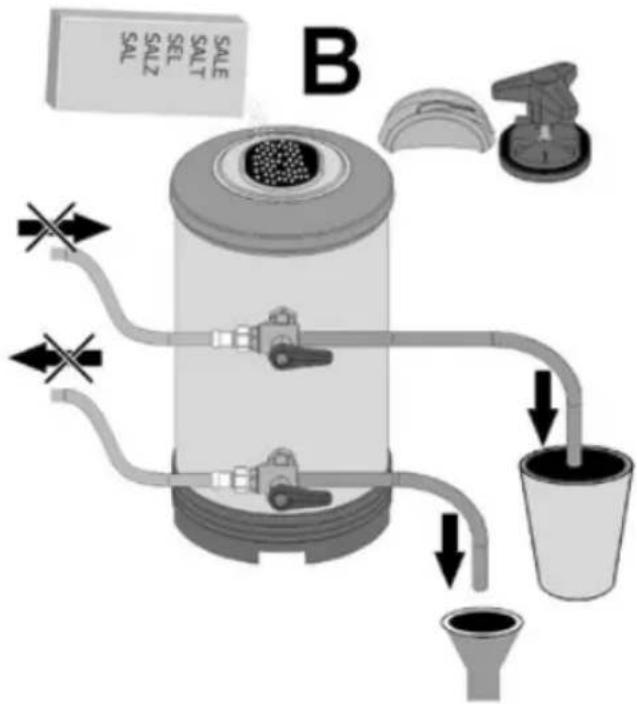
- Position B (DEPRESSURIZATION MODE)
1) Put the depressurization pipe in a bucket (fig. 1, E and fig. 4, position B)
2) Turn the tap levers on the right and wait until depressurization.
3) Remove the lid (fig. 1, G) and add the required quantity of
salt according to the model (see the table at paragraph 2.6)
- Position C (CLEANING)
Clean the lid and the seal (fig. 4, C) from any salt residue.
Clean the upper part of the water softener from any salt residue and clean the tank and under the cover of the weld joint of any leaked salt water.
The manufacturer does not take responsibility for the corrosion of the tank caused by the failure to follow these instructions.
4) Put the lid back on and tighten it.
- Position D (RINSING MODE)
5) Turn the water inlet tap lever (fig. 1, C) on the left
6) Let the salt water come out from the drain pipe until the water is fresh (around 40 minutes)
- Position A (SERVICE MODE)
7) Put the water softener back in service mode by turning the water outlet tap lever back on the left (fig.1, D)
WARNING: during the regeneration, the machine connected to the water softener does not receive drinking water.
5. MAINTENANCE FOR THE INSTALLER:
5.1 CHANGING THE RESINS
The resins' softening capacity ends after 5-7 years. This period can change based on the characteristic of the feed water and the quantity of softened water.
After this period of time, the user needs to decide if it is enough to change the resins or if it is better to change the water softener itself.
To change the resins it is necessary to disconnect the water softener and bring it to an appropriate place.
To disconnect the water softener:
1) Close the main water inlet tap (fig. 1, M)
2) Put the depressurization pipe in a bucket (fig. 1, E and fig. 4, Position B).
3) Turn the tap levers on the right, as in fig. 4, Position B.
4) Wait a few seconds until depressurization.
5) When water stops coming out of the depressurization pipe (fig. 1, E) it is possible to unscrew the inlet and outlet pipes (fig. 1, A and B) from the joints (fig. 3).
6) Open the lid (fig. 1, G) and change the resins. Clean the interior of the tank before inserting the new resins.
Do not throw the exhausted resins in the sewers.
The resins are not biodegradable and must be considered a non-hazardous waste (EU code CER 190905).
After changing the resins, clean the lid seal and the upper part of the softener from any resin residue.
7) Close the lid (fig. 1, G) and bring the softener back to its installation place.
8) Connect the water inlet and outlet pipes to the joints (fig. 3) and tighten them.
9) Rinse the resins as explained in paragraph 4.1.
5.2 RESIN PRESERVATION AND ACTIVATION AFTER A LONG PERIOD OF INACTIVITY
If the water softener is not to be used for more than 30 days, it is necessary to do a double regeneration first and then leave the water softener with the lid (fig. 1, G) closed.
We suggest avoiding a period of inactivity longer than 12 months. It is forbidden to reactivate the system after this period of inactivity.
If the period of inactivity is shorter than 12 months, it is necessary to rinse the resins and do a manual regeneration (paragraph 4.1 and 4.2) before reactivating the equipment.
6. IMPROPER USE OF THE EQUIPMENT
This equipment has been created to soften drinking water for domestic and technological use. The equipment must not be used for any other purpose and it must not be modified or tampered with in any way.
Any other use than the one specified in this manual is improper and therefore dangerous.
The manufacturer cannot be considered responsible for any damage caused by improper, mistaken or illogical use of the equipment.
- It is forbidden to feed the equipment with any liquid other than drinking water.
- It is forbidden to introduce in the tank any products other than salt (NaCl)
7. EQUIPMENT DISPOSAL
Any waste must be disposed of according to the applicable norms.
The water softener was built with non-hazardous materials like polymers and stainless steel, and they must be disposed of according to the applicable norms.
Do not throw the resins in the sewer.
The resins are not biodegradable. They are classified as non-hazardous waste, and must be disposed of accordingly (EU code CER 190905).
AVERTISSEMENTS POUR L'UTILISATEUR
1.1 OBJECTIF DU MANUEL
3.3 RACCORDEMENT AU RÉSEAU HYDRIQUE (fig.1)
1. WSTEP I UWAGI OGÓLNE
1.1 PRZEZNACZENIE INSTRUKCJI OBSŁUGI
This equipment is a water softener for domestic use, to be connected exclusively with the water system.
The following values refer to a test on 2540 litres, with domestic drinking water and 1 cycle of manual regeneration, in compliance with ICIM internal regulations on testing.
The parameters comply with the values indicated by the Italian norms on the subject, the Legislative decree n.31, February 2, 2001, and following transpositions.
| ParametroParametersParamètresParameterParámetroПараметрыParametry | Riferimento normativo(D.lgs. 2 febbraio 2001, n. 31 e successivi recepimenti)Prescriptive values according to Legisla-tive decree n.31, February 2, 2001, and following transpositionsValeurs normatifs selon la loi italienneDécret Législatif du 2 février 2001, n.31, et transpositions suivantesRechtssetzender Hinweis(D.lgs. 2. Februar 2001, n. 31 und folgende Maßnahme)Referencia normativa(Ley de 2 de Febrero 2001, n. 31 y siguientes reconocimientos)Нормативная ссылка (Зак. Акт от 02.02.2001,н.31 с посл. дополн.)Norma(wg rozporządzenia Rep. Włoskiej z dn. 2 lutego 2001, n. 31 i dalsze zmiany) | Acqua domestica potabile di provaDomestic drinking water for testingEau domestique potable d'essaisTest HaustrinkwasserAgua doméstica potable de pruebaДомашняя питьевая вода для пробыWartości dla wody pitnej poddanej testom przed uzdatnieniem | Acqua domestica potabile di prova trattataDomestic drinking water for testing, treatedEau domestique potable d'essais traitéeBearbeitetes Test HaustrinkwasserAgua doméstica potable tratadaОбработанная домашняя питьевая вода для пробыWartości dla wody pitnej uzdatnionej |
| DurezzaHardness | 15 - 50 °f(valori consigliati - recommended values) | Min. 17,70 - Max. 18,80 | Min. 0,10- Max. 0,20 |
| ConduttivitàConductivity | 2500 μScm-1 a 20°C Media | 400 Media 415 | |
| TorbiditàTurbidity | Accettabile e senza anomale variazioniAcceptable and lacking anomalous variations | Max. 1 NTU Max. 1 NTU | |
| AmmonioAmmonium | 0,50 mg/L Non rilevato | Non rilevatoNot detected Not detected | |
| CalcioCalcium | 100 mg/L(consigliato - recommended) | Min. 47,69- Max. 48,32 mg/L | Min. 0,29 - Max. 0,56 mg/L |
| MagnesioMagnesium | 50 mg/L(consigliato - recommended) | Min. 14,11 -Max. 14,35 mg/L | Min. 0,07 - Max. 0,09 mg/L |
| SodioSodium | 200 mg/L | Min. 3,27 - Max. 3,36 mg/L | Min. 90,04 - Max. 93.30 mg/L |
| FerroIron | 200 μg/L | Min. 2,32 - Max. 4,19 μg/L | Min. 6,08 - Max. 6,97 μg/L |
| Escherichia Coli | 0 UFC/ 100 ml Non rilevato Non rilevatoNot detected Not detected | ||
| PseudomonasAeruginosa | 0 UFC/ 250 ml Non rilevato Non rilevatoNot detected Not detected |
The drinking water-contact materials of the water softener comply with the parameters requested by the Italian laws (D.M. 6 aprile 2004, n.174).
WARNING: this equipment needs periodic maintenance to guarantee the treated drinking water requirements and to maintain the features declared by the manufacturer.
THE EQUIPMENT MUST BE USED FOLLOWING THE RULES IN THE MANUAL
| DATA INSTALLAZIONE • INSTALLATION DATEINSTALLATIONSDATUM • DATE INSTALLATIONFECHA INSTALLACIÓN • DATA УСТАНОВКИ • DATA INSTALACJI | ||
| DATA RIGENERAZIONE • REGENERATION DATES • REGENERIERUNGSDATUMDATE RÉGÉNÉRATION • FECHAS REGENERACIÓN • DATA РЕГЕНЕРАЦИИ • DATA REGENERACJI | ||
Etichetta - Label - Étiquette - Etikette - Etiqueta - Этикетка - Etykieta
Data - Date - Date - Datum
Fecha - Data - Data
line
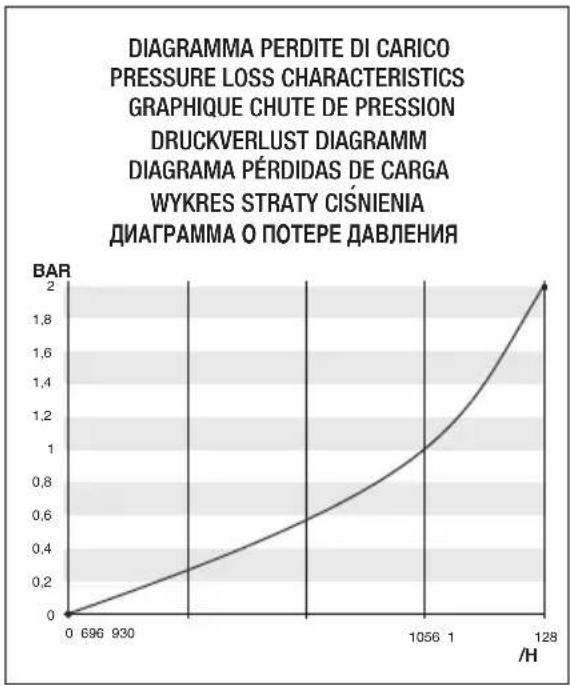
DIAGRAMMA PERDITE DI CARICO PRESSURE LOSS CHARACTERISTICS GRAPHIQUE CHUTE DE PRESSION DRUCKVERLUST DIAGRAMM DIAGRAMA PÉRDIDAS DE CARGA WYKRES STRATY CIŚNIENIA DIAGRAMMA O POTERE DABLEHNA | /H | BAR | |---|---| | 0 | 0 | | 696 | 0 | | 930 | 0.2 | | 1056 | 1.0 | | 1 | 1.4 | | 128 | 2.0 |Timbro del Venditore/Installatore - Seller/Installer's stamp Cachet du vendeur / installateur - Verkäufer/Installateur Stempel Sello del vendedor / Instalador - Печать Продавца / Установщика Pieczęć sprzedawcy / instalatora
Hendi B.V.
Steenoven 21
3911 TX Rhenen, The Netherlands
Tel: +31 (0)317 681 040
Email: info@hendi.eu
Hendi Polska Sp. z o.o.
ul. Magazynowa 5
62-023 Gądki, Poland
Tel: +48 61 6587000
Email: info@hendi.pl
Hendi Food Service Equipment GmbH
Central Barn, Hornby Road
Lancaster, LA2 9JX, United Kingdom
Tel: +44 [0]333 0143200
Email: sales@hendi.co.uk
Hendi Food Service Equipment Romania Srl
PKS Hendi South East Europe SA
5 Metsovou Str.
18346 Moschato, Athens, Greece
Tel: +30 210 4839700
Email: office.greece@hendi.eu
Hendi HK Ltd.
1208, 12/F Exchange Tower
33 Wang Chiu Road, Kowloon Bay, Hong Kong
Tel: +852 2154 2618
Email: info-hk@hendi.eu
Find Hendi on internet:
www.hendi.eu
www.facebook.com/HendiFoodServiceEquipment
www.linkedin.com/company/hendi-food-service-equipment-b.v.
www.youtube.com/HendiEquipment
- Variations et fautes d'impression réservés.
- Errori di cambiamenti, di stampa e di impaginazione riservati.
- Изменения, печати и верстки ошибки защищены.


- WATER SOFTENER ZMIĘKCZACZ DO WODY
- INTRODUCTION AND GENERAL INFORMATION
- ABOUT THE EQUIPMENT
- INSTALLATION
- ACTIVATION AND INSTRUCTIONS FOR THE REGENERATION
- MAINTENANCE FOR THE INSTALLER
- IMPROPER USE OF THE EQUIPMENT
- EQUIPMENT DISPOSAL
- F INDEX
- INTRODUCTION ET INFORMATIONS GÉNÉRALES
- CONNAÎTRE L'APPAREIL
- MISE EN MARCHE ET INSTRUCTIONS POUR LA RÉGÉNÉRATION
- MANUTENTION POUR L'INSTALLATEUR
- UTILISATION INCORRECTE DE L'APPAREIL
- ÉLIMINATION DE L'APPAREIL
- LEGENDA (fig. 1):
- LEGEND (fig. 1):
- AVVERTENZE PER L'UTENTE
- OBJECTIVE OF THE MANUAL
- HOW TO STORAGE AND KEEP THE EQUIPMENT BEFORE USE:
- FOR THE INSTALLER
- FOR THE USER
- KEEPING THE MANUAL
- EQUIPMENT IDENTIFICATION
- DECLARATION OF COMPLIANCE
- HYGIENIC SAFETY NORMS AND ICIM TESTING
- RECOMMENDATIONS AND WARNINGS
- FOR THE STORAGE:
- HOW DOES IT WORK?
- EQUIPMENT DESCRIPTION (fig. 1)
- THE PACKAGING CONTAINS
- TECHNICAL FEATURES
- CHARACTERISTICS OF FEED WATER
- EQUIPMENT PERFORMANCE BASED ON WATER HARDNESS
- PACKAGING
- CHOOSING THE PLACE OF INSTALLATION
- CONNECTION TO THE WATER SYSTEM (fig.1)
- CONNECTION TO THE DRAIN SYSTEM
- RINSING THE RESINS (fig. 2)
- PERIODIC REGENERATION (fig. 4)
- - Position B (DEPRESSURIZATION MODE)
- - Position C (CLEANING)
- The manufacturer does not take responsibility for the corrosion of the tank caused by the failure to follow these instructions.
- MAINTENANCE FOR THE INSTALLER:
- CHANGING THE RESINS
- RESIN PRESERVATION AND ACTIVATION AFTER A LONG PERIOD OF INACTIVITY
- AVERTISSEMENTS POUR L'UTILISATEUR
- OBJECTIF DU MANUEL
- RACCORDEMENT AU RÉSEAU HYDRIQUE (fig.1)
- WSTEP I UWAGI OGÓLNE
- PRZEZNACZENIE INSTRUKCJI OBSŁUGI
- Hendi B.V.
- Hendi Polska Sp. z o.o.
- Hendi Food Service Equipment GmbH
- Hendi Food Service Equipment Romania Srl
- PKS Hendi South East Europe SA
- Hendi HK Ltd.
- Find Hendi on internet:
Brand : Hendi
Model : 231210
Category : Water Softener