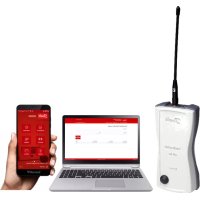
SonoRead 868 - Measuring equipment DANFOSS - Free user manual and instructions
Find the device manual for free SonoRead 868 DANFOSS in PDF.


User questions about SonoRead 868 DANFOSS
0 question about this device. Answer the ones you know or ask your own.
Ask a new question about this device
Download the instructions for your Measuring equipment in PDF format for free! Find your manual SonoRead 868 - DANFOSS and take your electronic device back in hand. On this page are published all the documents necessary for the use of your device. SonoRead 868 by DANFOSS.
USER MANUAL SonoRead 868 DANFOSS
User Manual SonoRead 868 Wireless Radio Receiver for meter reading
Table of Contents
English version ....5
1 Introduction....5
2 Important Considerations ....5
3 Items Supplied and Packaging 6
4 Operating Principle 7
5 Overview....8
6 Establishing a Bluetooth Connection ....10
7 External Serial Interface .... 11
8 Troubleshooting....12
9 Care and Maintenance....13
10 Disposal....13
11 Specifications....13
Table des matières
Version Française ....15
User Manual SonoRead 868 Wireless Radio Receiver for meter reading
1 Introduction
The SonoRead 868 is a portable radio receiver for wireless M-Bus resource meters (currently capable of handling Mode T1, T2, C1). SonoRead 868 is equipped with a Bluetooth interface. A rechargeable lithium ion battery assures operating times up to 20 hours with one charge.
The SonoRead 868 is usually used in conjunction with a smartphone or tablet for mobile reading of radio consumption meters (heat, water, electricity, gas and others).
Due to its watertight enclosure (IP64) and its mechanical rugged construction (EN 60721 class 7M3) it can be used in harsh environments without additional protection.
Additionally, the SonoRead 868 is equipped with a serial interface to connect e.g. optical meter configuration devices.

2 Important Considerations
- The specific purpose of the SonoRead 868 is the mobile reception of M-Bus Mode T1, T2 and C1 consumption meter radio telegrams and the transmission to a smartphone or tablet via Bluetooth interface.
• The SonoRead 868 may only be operated by trained personnel. - The SonoRead 868 is only to be used in environments in conformity with its protection rating (IP64) and operating temperature range (-5°C to +55°C).
- The integrated rechargeable lithium ion battery may not be charged at temperatures below 0°C or above +45°C (battery charging only at 0°C to +45°C)
- Only the accompanying charging device may be used to charge the SonoRead 868. Do not operate the charging device without the proper wall plug adapter. The charging device may only be used in dry and weather-protected environments.
- Do not use force to insert the round battery charger plug. Turn it until it you can gently push it into the SonoRead 868 connector. Do not screw it too tight.
- Charge the SonoRead 868 completely before using it the first time.
- The SonoRead 868 is not a calibrated measuring device. The transmitted meter counts and consumptions are of informative character only.
- If a fault occurs, do not try to repair the unit yourself. Attempts to do so will void the warranty. Refer all servicing to your supplier.
- Do not open the case of the device. Do especially not remove, open or short circuit the lithium ion battery inside the device.
3 Items Supplied and Packaging
Please ensure that the package contents are complete. These are as follows:
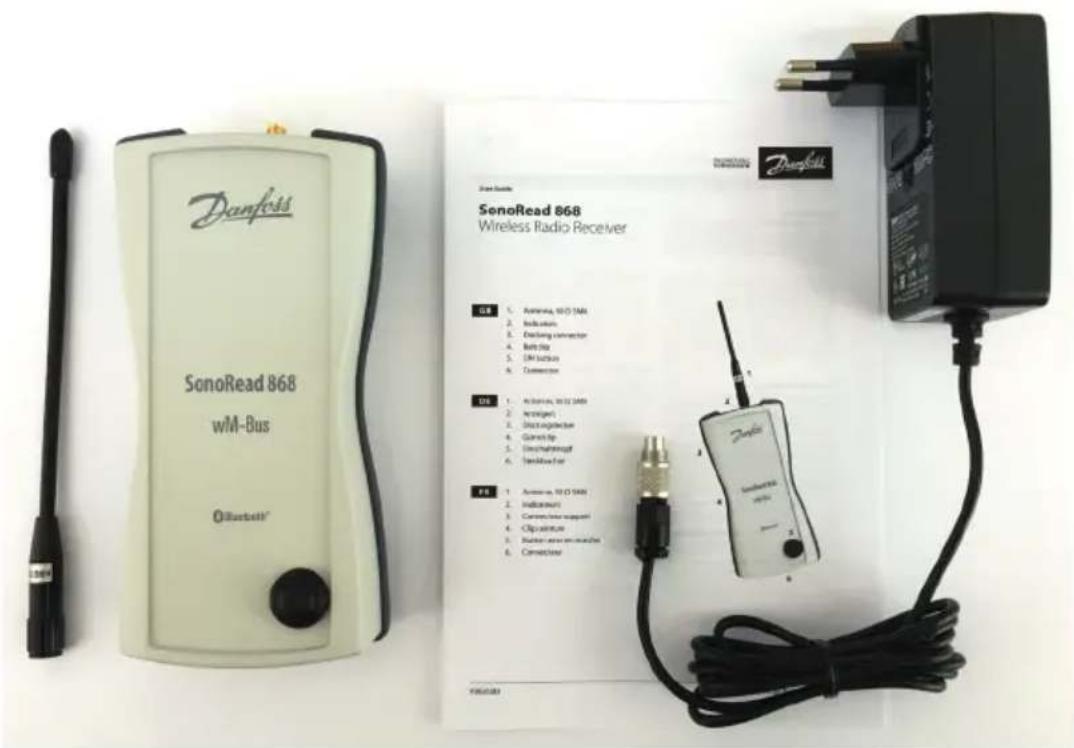
- SonoRead 868
- Antenna
• Wall plug battery charger - Short manual
The packaging can be reused or recycled. Please dispose properly of any packaging material no longer required. If you notice any transport damage during unpacking, please contact your supplier immediately.

To avoid risk of suffocation, keep packaging film away from children!
4 Operating Principle
The SonoRead 868 is a radio receiver for wireless M-Bus consumption meters (electricity, gas, water, heat and others). The received radio telegrams of the consumption meters are stored into an internal memory and are immediately transmitted to a smartphone or tablet using its Bluetooth interface, if a Bluetooth connection is established. If there is no Bluetooth connection the SonoRead 868 collects all radio telegrams (up to 2000) and transmits them at once as soon as the Bluetooth connection is reestablished.
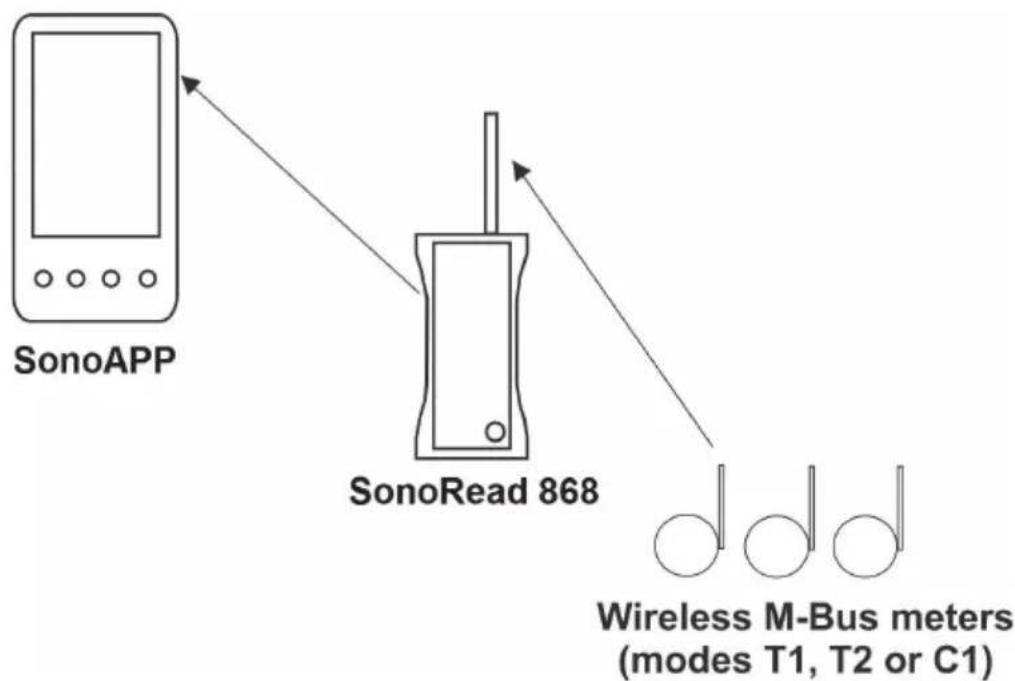
flowchart
graph TD
    A["SonoAPP"] --> B["SonoRead 868"]
    B --> C["Wireless M-Bus meters (modes T1, T2 or C1)"]
Due to its built-in rechargeable lithium ion battery the SonoRead 868 has got an autonomy of approximately 20 hours (while not using the external serial interface). Recharging takes about 4 to 5 hours depending on the charge state of the battery.
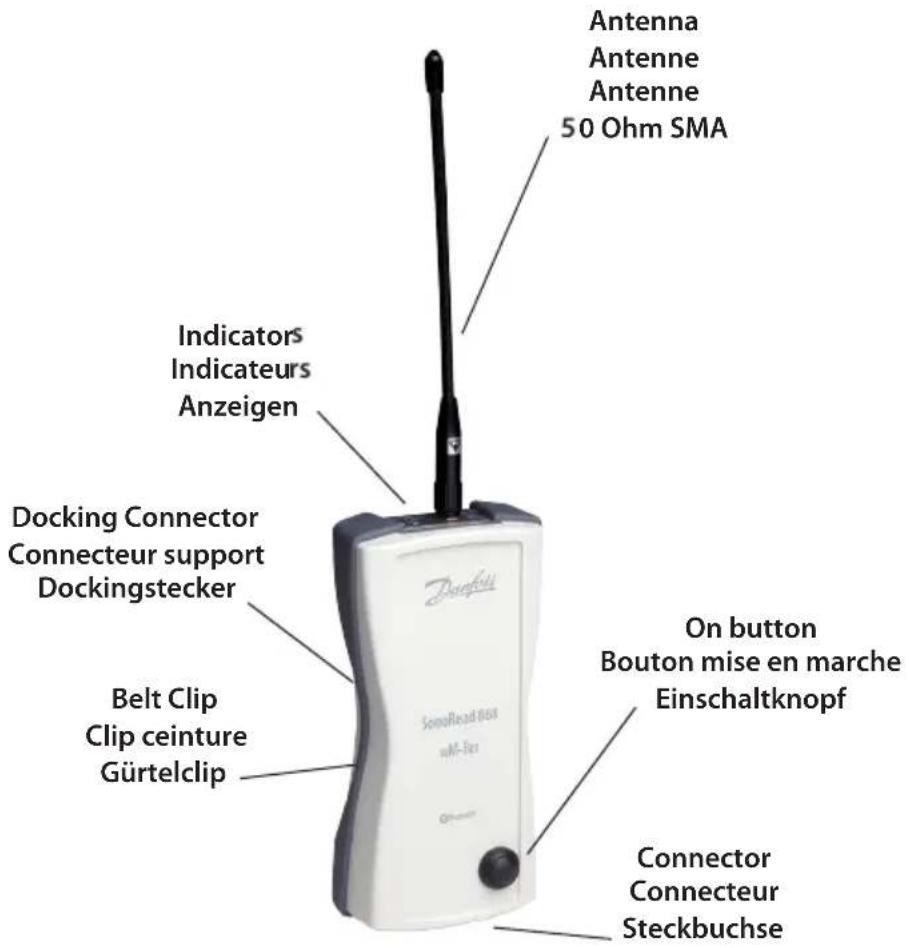
The antenna interface is a standard 50 Ohm SMA connector which can be connected to any suitable antenna.
5 Overview
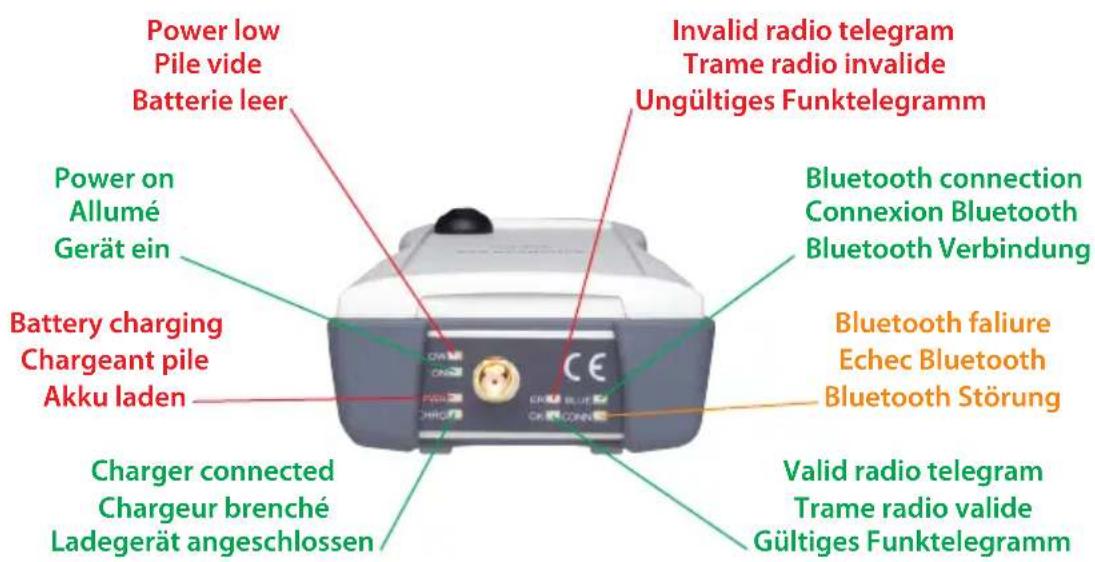
User Manual SonoRead 868 Wireless Radio Receiver for meter reading
| Antenna: Screw the antenna gently and without force onto the SMA antenna connector of the device. It is possible to use other 868 MHz, 50 Ohm, SMA antennas like car roof mount-ed antennas. However, there is no guaranty that other antennas might work as well or work at all. The warranty is void if you are using other antennas, active antennas or pre-amplifiers on the SonoRead 868 antenna connector. Pay especially attention not to cause any static electric discharge on the antenna connector of the SonoRead 868. | |
| On Button: | Press this button to switch the device on. The power on LED will light up in green. After approximately 5 seconds the internal self-test has finished and the device is ready to receive radio telegrams.The device switches itself off, automatically, if there has not been a Bluetooth connec-tion for more than 10 minutes.By pressing the on button for more than 5 seconds, you may switch off the device manually. |
| Connector: The battery charger connector is placed at the bottom side of the device.Additionally, this connector contains the external serial interface. Therefore, it is not possible to connect the battery charger and a serial interface device at the same time. | |
| Power on LED:. Power low LED: | Device is on (ON)Low power warning (LOW)The ON LED lights up in green if the device is switched on. If the battery power is low, the red LOW LED lights up, also. In this case, the user should immediately connect the battery charger. Approximately 4 minutes after the power low warning, the device is switching itself off. |
| Charger connected LED: Battery charging LED: | Charger is connected (CHRG)Battery is charging (PWR)The CHRG LED lights up in green if the battery charger is connected to the device. If the device is charged the PWR LED stays on red. If the red PWR LED is switched off the battery of the device is full. Due to the low self discharge rate of the lithium ion battery it is not necessary to keep the battery charger connected. |
| Radio telegram LED: | Valid radio telegram (OK)Invalid radio telegram (ER)The OK LED lights up if a valid radio telegram has been received. The ER LED lights up if an invalid (corrupt) radio telegram has been received. |
| NOTE: If the ER LED and the LOW LED are flashing in red rapidly, the internal self-test of the device has failed. Switch the device off and on again to see if the error persists. If this is the case, you should turn it in for repair. | |
| Bluetooth LED: (Flashing) Bluetooth connection (BLUE)Bluetooth error (permanent on, not flashing, CONN)The amber LED lights up some seconds after the device has been switched on. If there is a permanent error in the Bluetooth module, the amber LED stays on permanently. In this case, switch the device off and on again. If a Bluetooth connection is established the green LED flashes. | |
6 Establishing a Bluetooth Connection
After the power-on of the device you should wait approximately 5 seconds before trying to establish a Bluetooth connection. This period of time is necessary for starting up all the modules in the SonoRead 868.
Afterwards, you should go to the Bluetooth configuration page of your smartphone or tablet and perform a device search. This process differs from device to device, so please check also the manual or online help of your smartphone or tablet.
To verify if the correct SonoRead 868 device is found you can compare the found Bluetooth name with the name / serial number on the back of the device (e.g. MBWBLUE 87384327).
If you are asked for an authorization code / PIN, enter four times zero: 0000.
7 External Serial Interface
The SonoRead 868 is equipped with a simple external serial interface (TX / RX and power supply, only). This external serial interface may be used to connect e.g. optical or other meter configuration devices. The maximum power output is limited to 35mA (5.4 V).
Exterior view on the connector pins
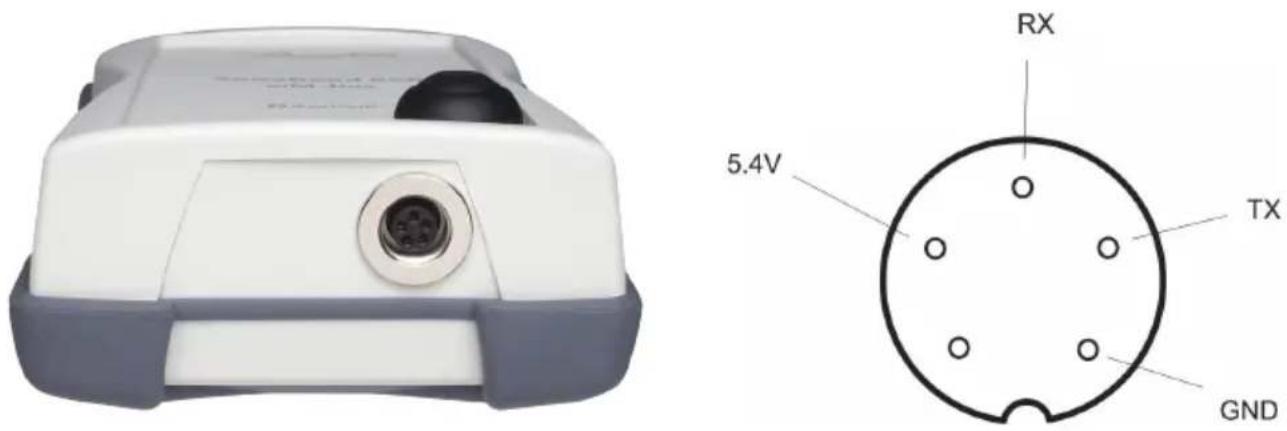
| TX: SonoRead 868 -> external device 0=+5.4V; 1=-5.4 V | |
| RX: external device -> SonoRead 868 0=+3.0 V ...+15.0V; 1=-3.0V...-15.0V | |
| Power: +5.4 V / 35 mA max. | |
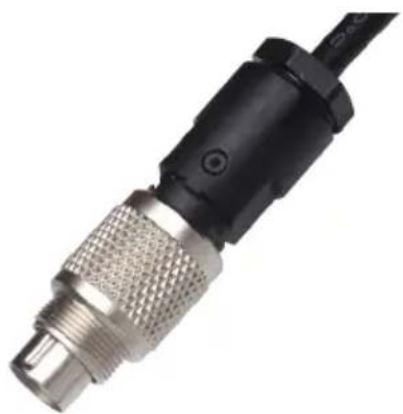
The corresponding counterpart to the SonoRead 868 connector is:
natural_image
Close-up of a metallic audio connector with threaded shaft and black plastic head (no visible text or symbols)BINDER - 99-0413-00-05 connector (5-way)
8 Troubleshooting
Should the SonoRead 868 not work as described in this document, please check the list of possible error causes below for a solution:
After pressing the On button there is no LED lit up.
- Charge the device for at least 4 hours.
- If the error persists, turn the device in for repair.
After having dropped the SonoRead 868 device to the ground it is no longer possible to switch it on (there is no LED lit up after pressing the On button).
- Connect the charger for approximately 15 seconds. Try to switch on the device again.
• If the error persists turn the device in for repair.
After connecting the battery charger the CHRG LED is not lit up.
- Check if the plug of the battery charger is correctly placed onto the SonoRead 868 connector.
- Check if the battery charger wall plug is connected to mains power supply.
• If the error persists turn the device in for repair.
It is not possible to establish a Bluetooth connection.
- Check if the SonoRead 868 is still switched on.
- Check if the SonoRead 868 was found during the Bluetooth device search and repeat it, if necessary.
- Switch the SonoRead 868 off (by holding the On button down for more than 5 seconds), wait 60 seconds and switch it on again. Retry the Bluetooth search then. Note, that it is not possible to switch off the device manually if a Bluetooth connection is established (Bluetooth LED lights up in amber).
- Switch off and restart your smartphone or tablet.
- Try another smartphone or tablet for establishing the Bluetooth connection.
• If the error persists turn the device in for repair.
The battery operating time is much shorter than specified.
- If you are using the serial interface intensively with an external device consuming a lot of power, the battery operating time is shorter than specified. This depends on the power consumption of the external device and on how long the external device is switched on.
- Lithium ion batteries are degrading with time and charging cycles. Usually, after one year or 300 charging cycles the capacity should be still at 80% of the initial capacity. However, if the battery operating time becomes too short after several years, it is possible to replace the lithium ion battery. Do not attempt to replace the battery by yourself but turn the device in.
The ER LED and the LOW LED are flashing in red rapidly.
- The internal self-test has failed. Switch the SonoRead 868 off (by holding the On button down for more than 5 seconds). Charge the device for at least 4 hours. Switch the device on and try again.
• If the error persists turn the device in for repair.
9 Care and Maintenance
- Clean the device only with a soft cloth, moistened with mild soapy water.
- Never use strong detergents or hard brushes.
- Disconnect the battery charger if the battery is full. The lithium ion battery does not need to be constantly connected to the battery charger for keeping its charge.
10 Disposal
The SonoRead 868 must not be disposed together with the domestic waste. All users are obliged to hand in all electrical or electronic devices, regardless of whether or not they contain toxic substances, to ensure a disposal in environmentally acceptable manner.
Therefore, return the device at the end of its lifetime to the manufacturer (address on page 36).
11 Specifications
| Name: SonoRead 868 | |
| Application: Radio receiver with Bluetooth interface | |
| Place of operation: Non-weather protected portable applications | |
| Protection rating: IP64 | |
| Receiver frequency: 868 MHz | |
| Receiving range: depending on environment up to 400 m (outdoor) or up to 30 m (indoor) | |
| Receiver memory: 2000 radio telegrams | |
| Power supply: 3.7 volt lithium ion rechargeable battery | |
| Autonomy: 20 hours (without using the serial interface) | |
| Battery life time expectancy: | >300 charging cycles |
| Battery Charger: | Input: 100 V to 240 V AC50 to 60 Hz1.0 A max.Output: 5 V DC3.0 A max.The charging device may only be used in dry and weather-protected environments. |
| Operating conditions: | -5°C to +55°C (not during battery charging)0°C to +45°C (during battery charging)10% to 95% humidity |
| Storage conditions: | -20°C to +45°C (less than 3 months)-20°C to +25°C (less than 1 year)for keeping at least 80% of the battery capacity |
| Dimensions: | approximately 160 x 180 x 40 mm (without antenna)length of antenna approximately 180 mm |
| Weight: | 300 g |
| Interface: | Bluetooth 2.1 Class 2 (10 m) |
User Manual SonoRead 868 Wireless Radio Receiver for meter reading
| Radio parameters receiver:Frequency:Bandwidth:Frequency deviation:Chiprate:Coding: | 868.95 MHz200 kHz50 kHzT1/C1: 100,000 Chip/s, S1: 32,768 Chip/sT1: 3 of 6 code, C1: none, S1: Manchester |
| Radio parameters transmitter:Frequency:Frequency deviation:Chiprate:Coding: | 868.3 MHz50 kHz (adjustable to 28.8 kHz)32,768 Chip/s (adjustable 25,000 - 40,000 Chip/s)Manchester |
| Approved directives / norms: | RED Directive 2014/53/EURadio Equipment DirectiveRoHS Directive 2011/65/EU Restriction of Hazardous substancesEN 301 489-1V2.1.1EN 302 208-1V3.1.1EN 50581:2012EN 60721-3-2 class 2M2 / class 2K2EN 60721-3-7 class 7M3 / class 7K2 / class 7Z14 / IP64WEEE Directive 2012/19/EU (WEEE Reg. nr.: DE 27123794) |
flowchart
graph TD
    A["SonoAPP"] --> B["SonoRead 868"]
    B --> C["Wireless M-Bus meters (modes T1, T2 or C1)"]
User Manual SonoRead 868 Wireless Radio Receiver for meter reading
natural_image
Front view of a medical or laboratory device with a central connector and metallic handle (no visible text or symbols)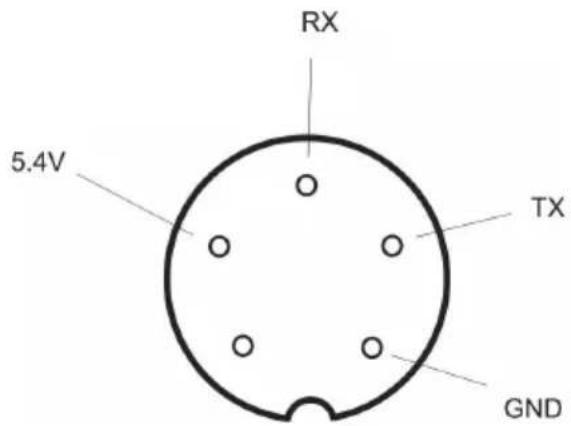
| TX: SonoRead 868 -> appareil externe 0=+5.4V; 1=-5.4 V | |
| RX: appareil externe -> SonoRead 868 0=+3.0 V ...+15.0V; 1=-3.0V...-15.0V | |
| Alimentation: +5.4V / 35 mA max. | |
natural_image
Close-up of a metallic audio connector with threaded shaft and black body (no visible text or symbols)User Manual SonoRead 868 Wireless Radio Receiver for meter reading
| Paramètres radio récepteur: Fréquence: Bande de fréquence: Déviation de fréquence: Chiprate: Codage: | 868.95 MHz200 kHz50 kHzT1/C1: 100,000 Chip/s, S1: 32,768 Chip/sT1: 3 of 6 code, C1: rien, S1: Manchester |
| Paramètres radio transmetteur: Fréquence: Déviation de fréquence: Chiprate: Codage: | 868.3 MHz50 kHz (réglable à 28.8 kHz)32,768 Chip/s (réglable 25,000 - 40,000 Chip/s)Manchester |
| Conformité aux directives / normes: | RED Directive 2014/53/EU Radio Equipment DirectiveRoHS Directive 2011/65/EU Restriction of Hazardous substancesEN 301 489-1V2.1.1EN 302 208-1V3.1.1EN 50581:2012EN 60721-3-2 class 2M2 / class 2K2EN 60721-3-7 class 7M3 / class 7K2 / class 7Z14 / IP64WEEE Directive 2012/19/EU (WEEE Reg. nr.: DE 27123794) |
flowchart
graph TD
    A["SonoAPP"] --> B["SonoRead 868"]
    B --> C["Wireless M-Bus meters (modes T1, T2 or C1)"]
User Manual SonoRead 868 Wireless Radio Receiver for meter reading
natural_image
Front view of a white and gray electronic device with a central connector (no visible text or symbols)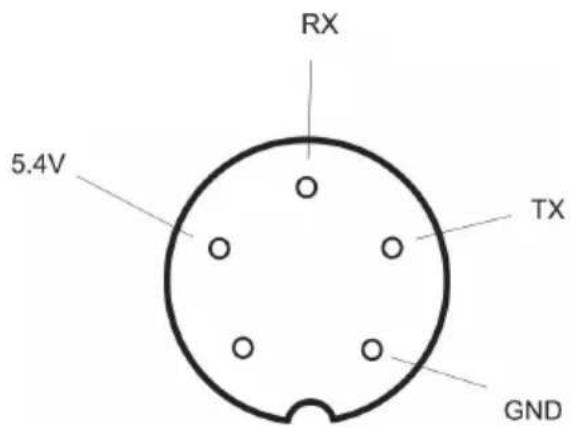
| TX: SonoRead 868 -> Externes Gerät 0=+5.4V; 1=-5.4 V | |
| RX: Externes Gerät -> SonoRead 868 0=+3.0 V ...+15.0V; 1=-3.0V...-15.0V | |
| Versorgung: +5.4V / 35 mA max. | |
natural_image
Close-up of a metallic audio connector with threaded shaft and black plastic head (no visible text or symbols)BINDER - 99-0413-00-05 Steckverbinder (5-Pol)
User Manual SonoRead 868 Wireless Radio Receiver for meter reading
| Funkparameter Empfänger: | |
| Frequenz: | 868,95 MHz (434,475 MHz) |
| Bandbreite: | 200 kHz |
| Frequenzhub: | 50 kHz |
| Chiprate: | T1/C1: 100.000 Chip/s, S1: 32.768 Chip/s |
| Kodierung: | T1: 3 aus 6 Code, C1: keine, S1: Manchester |
| Funkparameter Sender: | |
| Frequenz: | 868.3 MHz |
| Frequenzhub: | 50 kHz (einstellbar auf 28.8 kHz) |
| Chiprate: | 32.768 Chip/s (einstellbar 25.000 - 40.000 Chip/s) |
| Kodierung: | Manchester |
| Erfüllte Richtlinien / Normen: RED | Directive 2014/53/EU Radio Equipment DirectiveRoHS Directive 2011/65/EU Restriction of Hazardous substancesEN 301 489-1V2.1.1EN 302 208-1V3.1.1EN 50581:2012EN 60721-3-2 class 2M2 / class 2K2EN 60721-3-7 class 7M3 / class 7K2 / class 7Z14 / IP64WEEE Directive 2012/19/EU (WEEE Reg. nr.: DE 27123794) |
User Manual SonoRead 868 Wireless Radio Receiver for meter reading
Danfoss A/S
Energy Meters • Ulvehavevej 61 • DK-7100 Vejle • Denmark
Phone: +45 7488 8500 · Fax: +45 7488 8501
heating@danfoss.com • www.heating.danfoss.com
Danfoss can accept no responsibility for possible errors in catalogues, brochures and other printed material. Danfoss reserves the right to alter its products without notice. This also applies to products already on order provided that such alterations can be made without subsequential changes being necessary in specifications already agreed.
All trademarks in this material are property of the respective companies. Danfoss and the Danfoss logotype are trademarks of Danfoss A/S. All rights reserved.