USER MANUAL KD-X320BT JVC
MANUEL D'INSTRUCTIONS
JVCKENWOOD Corporation
Please read all instructions carefully before operation to obtain the best possible performance from the unit.
Information on Disposal of Old Electrical and Electronic Equipment and Batteries (applicable for countries that have adopted separate waste collection systems)
Products and batteries with the symbol (crossed-out wheeled bin) cannot be disposed as household waste.
Old electrical and electronic equipment and batteries should be recycled at a facility capable of handling these items and their waste byproducts.
Contact your local authority for details in locating a recycle facility nearest to you. Proper recycling and waste disposal will help conserve resources whilst preventing detrimental effects on our health and the environment.
Notice: The sign "Pb" below the symbol for batteries indicates that this battery contains lead.
Declaration of Conformity with regard to the R&TTE Directive 1999/5/EC Declaration of Conformity with regard to the EMC Directive 2004/108/EC Declaration of Conformity with regard to the RoHS Directive 2011/65/EU Manufacturer:
JVC KENWOOD Corporation
3-12, Moriya-cho, Kanagawa-ku, Yokohama-shi, Kanagawa, 221-0022, Japan
EU Representative's:
JVC Technical Services Europe GmbH
Konrad-Adenauer-Allee 1-11, D-61118 Bad Vilbel, Germany
Hereby, JVC KENWOOD declares that this unit KD-X320BT is in compliance with the essential requirements and other relevant provisions of Directive 1999/5/EC.
Français
HactoTJMM,JVcKEBUYdEcknapuyet,TO TTO cyptroTBvKOx-320BTO COOTBCTBYET Heo6XoDMbIM Tre6obAHmI aDpyHM BaXbHM oNoJeKHeM dIeKTeMbI 1999/5/EC.
YkpaHa
LMM, JVC KENWOOD EknapyE, 0u cie Bnip6 "KD-X320BT" BiINNOBIAe CYTTEBM BMNORMA ta IHMN BiINNOBIMHNpyKtAM DInpeKTNB1 1999/5/EC.
CONTENTS
| BEFORE USE | 2 |
| BASICS | 3 |
| GETTING STARTED | 4 |
| USB / iPod / ANDROID | 5 |
| RADIO | 7 |
| AUX | 8 |
| BLUETOOTH® | 9 |
| AUDIO SETTINGS | 14 |
| DISPLAY SETTINGS | 16 |
| MORE INFORMATION | 17 |
| TROUBLESHOOTING | 19 |
| SPECIFICATIONS | 21 |
| INSTALLATION / CONNECTION | 22 |
BEFORE USE
Warning
Do not operate any function that takes your attention away from safe driving.
Caution
Volume setting:
- Adjust the volume so that you can hear sounds outside the car to prevent accidents.
- Lower the volume before playing digital sources to avoid damaging the speakers by the sudden increase of the output level.
General:
- Avoid using the external device if it might hinder safe driving.
- Make sure all important data has been backed up. We shall bear no responsibility for any loss of recorded data.
- Never put or leave any metallic objects (such as coins or metal tools) inside the unit, to prevent a short circuit.
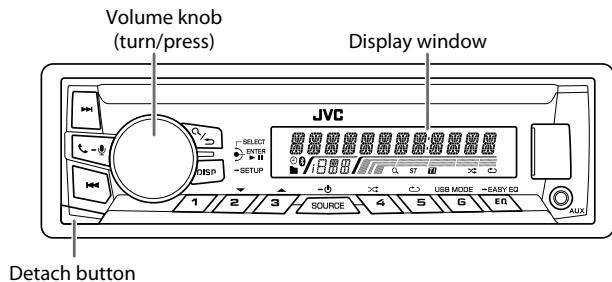
- USB rating is indicated on the main unit. To view, detach the faceplate. ( 3)
How to read this manual
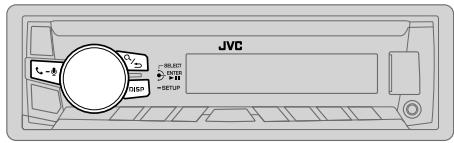
- Operations are explained mainly using buttons on the faceplate.
- English language is used for the display explanation in this manual.
- [XX] indicates the selected items.
- ( XX) indicates references are available on the stated page.
Maintenance
Cleaning the unit: Wipe off dirt on the faceplate with a dry silicone or soft cloth.
Cleaning the connector: Detach the faceplate and clean the connector gently with a cotton swab, being careful not to damage the connector.
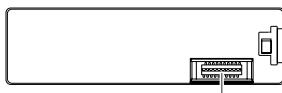
Connector (on the reverse side of the faceplate)
Faceplate
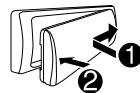
Attach
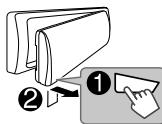
Detach
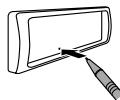
How to reset
Your preset adjustments will also be erased.
| To | On the faceplate |
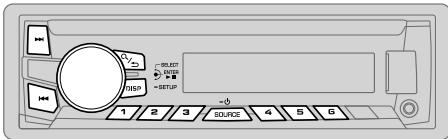
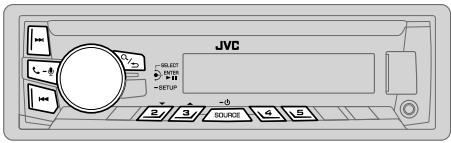
| Turn on the power | Press SOURCE-⊙.
• Press and hold to turn off the power. |
| Adjust the volume | Turn the volume knob. |
| Press the volume knob to mute the sound or pause playback.
• Press again to cancel. |
| Select a source | • Press SOURCE-⊙ repeatedly.
• Press SOURCE-⊙, then turn the volume knob within 2 seconds. |
| Change the display information | Press DISP-SETUP repeatedly. (↔ 18) |
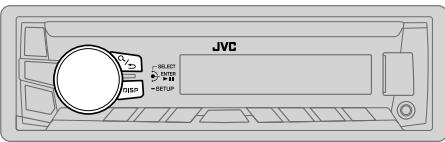

Cancel the demonstration
1 Press and hold DISP-SETUP.
2 Turn the volume knob to select [DEMO], then press the knob.
3 Turn the volume knob to select [DEMO OFF], then press the knob.
4 Press DISP-SETUP to exit.

Set the clock
1 Press and hold DISP-SETUP.
2 Turn the volume knob to select [CLOCK], then press the knob.
3 Turn the volume knob to select [CLOCK SET], then press the knob.
4 Turn the volume knob to make the settings, then press the knob. Day Hour Minute
5 Turn the volume knob to select [24H/ 12H], then press the knob.
6 Turn the volume knob to select [12 HOUR] or [24 HOUR], then press the knob.
7 Press DISP-SETUP to exit.
To return to the previous setting item, press / .

Set the basic settings
1 Press and hold DISP-SETUP.
2 Turn the volume knob to make a selection (see the following table), then press the knob.
3 Repeat step 2 until the desired item is selected or activated.
4 Press DISP-SETUP to exit.
To return to the previous setting item, press / .
Default: XX
| SETTINGS |
| BEEP | ON: Activates the keypress tone. ; OFF: Deactivates. |
| SRC SELECT |
| AM* | ON: Enables AM in source selection. ; OFF: Disables. |
| AUX* | ON: Enables AUX in source selection. ; OFF: Disables. |
| F/W UPDATE |
| SYSTEM / BLUETOOTH |
| F/W xxxx | YES: Starts upgrading the firmware. ; NO: Cancels (upgrading is not activated).For details on how to update the firmware, see:<http://www.jvc.net/cs/car/>. |
| CLOCK |
| CLOCK SYNC | AUTO: The clock time is automatically set using the Clock Time (CT) data in FM Radio Data System signal. ; OFF: Cancels. |
| CLOCK DISP | ON: The clock time is shown on the display even when the unit is turned off. ; OFF: Cancels. |
| ENGLISH | Selected language is use as the display language for menu and Tag information (folder name, file name, song title, artist name, album name) if applicable.By default, the menu language is: ENGLISH |
| PYCKM | if applicable. |
- Not displayed when the corresponding source is selected.
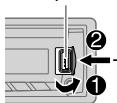
Start playback
The source changes automatically and playback starts.
USB input terminal
USB
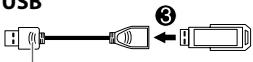
USB 2.0 cable*1 (commercially available)
iPod/iPhone
(Accessory of the iPod/ iPhone)*1
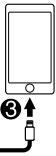
ANDROID*2
Micro USB 2.0 cable*1 (commercially available)
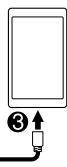
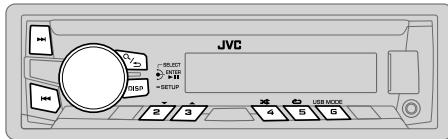
| To | On the faceplate |
| Reverse / Fast-forward*3 | Press and hold ↓/▶. |
| Select a file | Press ↓/▶. |
| Select a folder*4 | Press 3 ▲/2 ▼. |
| Repeat play*5 | Press 5 ▶ repeatedly. |
| TRACK RPT/ RPT OFF | : JVC Playlist Creator (JPC) / JVC Music Control (JMC) file (→18) |
| TRACK RPT/ FOLDER RPT/ RPT OFF | : MP3/WMA/AAC/WAV/FLAC file |
| ONE RPT/ ALL RPT/ RPT OFF | : iPod or ANDROID |
| Random play*5 | Press 4 ▶ repeatedly. |
| FOLDER RND/ ALL RND/ RND OFF | : MP3/WMA/AAC/WAV/FLAC file or JPC / JMC file |
| SONG RND/ ALL RND/ RND OFF | : iPod or ANDROID |
1 Do not leave the cable inside the car when not using.
2 When connecting an Android device, "Press [VIEW] to install JVC MUSIC PLAY APP" is shown. Follow the instructions to install the application. You can also install the latest version of JVC MUSIC PLAY application on your Android device before connecting. (→ 18)
3 For ANDROID: Applicable only when [AUTO MODE] is selected. (→ 6)
4 Only for MP3/WMA/AAC/WAV/FLAC files. This does not work for iPod/Android.
*5 For iPod/Android: Applicable only when [HEAD MODE]/[AUTO MODE] is selected. (→ 6)
| To | On the faceplate |
| Select control mode | While in iPod source, press 6 USB MODE repeatedly.
HEAD MODE: Control from the unit.
IPHONE MODE: Control from the iPod/iPhone. However, you can still play/pause or file skip from the unit.
While inAndroid source, press 6 USB MODE repeatedly.
AUTO MODE: Control from the unit (using JVC MUSIC PLAY application).
AUDIO MODE: Control other media player applications from the Android device (without using JVC MUSIC PLAY application). However, you can still play/pause or file skip from the unit. |
| Select music drive | Press 6 USB MODE repeatedly.
The stored songs in the following start playback.
• Selected internal or external memory of a smartphone (Mass Storage Class).
• Selected drive of a multiple drives device. |
Change the playback speed of the Audiobook
While listening to the iPod and [HEAD MODE] is selected ( Select control mode)...
1 Press and hold DISP-SETUP.
2 Turn the volume knob to select [IPOD], then press the knob.
3 Press the volume knob to select [AUDIOBOOKS].
4 Turn the volume knob to make a selection, then press the knob. 0.5 × SPEED / 1 × SPEED / 2 × SPEED: Select the desired playback speed of the Audiobooks sound file in your iPod/iPhone. (Default: Depends on your iPod/iPhone setting.)
5 Press DISP-SETUP to exit.
To return to the previous setting item, press Q .
Select a file from a folder/list
1 Press /
2 Turn the volume knob to select a folder/list, then press the knob.
3 Turn the volume knob to select a file, then press the knob.
Quick Search
If you have many files, you can search through them quickly. For MP3/WMA/AAC/WAV/FLAC or JPC / JMC file: Turn the volume knob quickly.
For iPod:
You can search for a file according to the first character. Press 3 ▲/2 ▼ or turn the volume knob quickly to select the desired character (A to Z/0 to 9/Others).
- Select "OTHERS" if the first character is other than A to Z, 0 to 9.
To return to the previous setting item, press Q /
To cancel, press and hold Q/
- For iPod, applicable only when [HEAD MODE] is selected. (→ Select control mode)
- For ANDROID, applicable only when [AUTO MODE] is selected.
(→ Select control mode)
"ST" lights up when receiving an FM stereo broadcast with sufficient signal strength.
Search for a station
1 Press SOURCE- repeatedly to select FM or AM.
2 Press / to search for a station automatically. (or)
Press and hold / until "M" flashes, then press repeatedly to search for a station manually.
Settings in memory
You can store up to 18 stations for FM and 6 stations for AM.

Store a station
While listening to a station....
Press and hold one of the number buttons (1 to 6). (or)
1 Press and hold the volume knob until "PRESET MODE" flashes.
2 Turn the volume knob to select a preset number, then press the knob.
The preset number flashes and "MEMORY" appears.

Select a stored station
Press one of the number buttons (1 to 6). (or)
1 Press / 一
2 Turn the volume knob to select a preset number, then press the knob to confirm.
Other settings
1 Press and hold DISP-SETUP.
2 Turn the volume knob to select [TUNER], then press the knob.
3 Turn the volume knob to make a selection (see the following table), then press the knob.
4 Repeat step 3 until the desired item is selected/activated or follow the instructions stated on the selected item.
5 Press DISP-SETUP to exit.
To return to the previous setting item, press / .
Default: XX
| RADIO TIMER | Turns on the radio at a specific time regardless of the current source.
1 ONCE/DAILY/ WEEKLY/OFF: Select how often the timer will be turned on.
2 FM/ AM: Select the source.
3 01 to 18 (for FM)/ 01 to 06 (for AM): Select the preset station.
4 Set the activation day*1 and time.
“⊕” lights up when complete.
Radio Timer will not activate for the following cases.
• The unit is turned off.
• [OFF] is selected for [AM] in [SRC SELECT] after Radio Timer for AM is selected. (→4) |
| SSM | SSM 01 – 06 / SSM 07 – 12 / SSM 13 – 18: Automatically resets up to 18 stations for FM. “SSM” stops flashing when the first 6 stations are stored.
Select SSM 07 – 12 / SSM 13 – 18 to store the following 12 stations. |
*1 Selectable only when [ONCE] or [WEEKLY] is selected in step 1.
Default: XX
| LOCAL SEEK*2 | ON: Searches only stations with good reception. ; OFF: Cancels.
• Settings made are applicable only to the selected source/station. Once you change the source/station, you need to make the settings again. |
| IF BAND | AUTO: Increases the tuner selectivity to reduce interference noises from adjacent FM stations. (Stereo effect may be lost.) ; WIDE: Subjects to interference noises from adjacent FM stations, but sound quality will not be degraded and the stereo effect will remain. |
| MONO | ON: Improves the FM reception, but the stereo effect will be lost. ; OFF: Cancels. |
| NEWS-STBY*2 | ON: The unit will temporarily switch to News Programme if available. ; OFF: Cancels. |
| REGIONAL*2 | ON: Switches to another station only in the specific region using the “AF” control. ; OFF: Cancels. |
| AF SET*2 | ON: Automatically searches for another station broadcasting the same program in the same Radio Data System network with better reception when the current reception is poor. ; OFF: Cancels. |
| TI SET*2 | ON: Allows the unit to temporarily switch to Traffic Information if available (“TI” lights up). ; OFF: Cancels. |
| PTY SEARCH*2 | Select a PTY code (see below).
If there is a station broadcasting a program of the same PTY code as you have selected, that station is tuned in. |
PTY code: NEWS, AFFAIRS, INFO, SPORT, EDUCATE, DRAMA, CULTURE, SCIENCE, VARIOUS, POP M (music), ROCK M (music), EASY M (music), LIGHT M (music), CLASSICS, OTHER M (music), WEATHER, FINANCE, CHILDREN, SOCIAL, RELIGION, PHONE IN, TRAVEL, LEISURE, JAZZ, COUNTRY, NATION M (music), OLDIES, FOLK M (music), DOCUMENT
*2 Only for FM source.
Use a portable audio player
1 Connect a portable audio player (commercially available).
3.5 mm stereo mini plug with "L" shaped connector (commercially available)
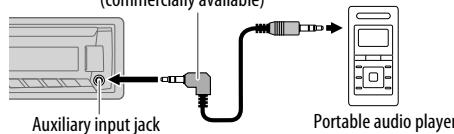
2 Select [ON] for [AUX] in [SRC SELECT]. ( 4)
3 Press SOURCE- repeatedly to select AUX.
4 Turn on the portable audio player and start playback.

Use a 3-core plug head stereo mini plug for optimum audio output.
BLUETOOTH - Connection
Supported Bluetooth profiles
- Hands-Free Profile (HFP)
- Serial Port Profile (SPP)
- Phonebook Access Profile (PBAP)
- Advanced Audio Distribution Profile (A2DP)
- Audio/Video Remote Control Profile (AVRCP)
Supported Bluetooth codecs
- Sub Band Codec (SBC)
- Advanced Audio Coding (AAC)
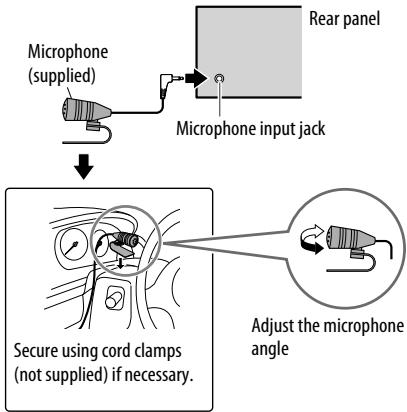
Connect the microphone
Pair a Bluetooth device
When connecting a Bluetooth device to the unit for the first time, perform pairing between the unit and the device.
1 Press SOURCE- to turn on the unit.
2 Search and select "JVC UNIT" on the Bluetooth device.
"BT PAIRING" flashes on the display.
- For some Bluetooth devices, you may need to enter the Personal Identification Number (PIN) code immediately after searching.
- Refer also to the manual supplied with your Bluetooth device.
3 Perform (A) or (B) depending on what scrolls on the display.
For some Bluetooth devices, pairing sequence may vary from the steps described below.
(A) "[Device Name]" "XXXXXX" "VOL - YES" "BACK - NO"
"XXXXXXXX" is a 6-digit passkey randomly generated during each pairing.
1 Ensure that the passkey which appears on the unit and Bluetooth device is the same.
Press the volume knob to confirm the passkey.
3 Operate the Bluetooth device to confirm the passkey.
(B) "[Device Name]" "VOL - YES" "BACK - NO"
Press the volume knob to start pairing.
2. If "PAIRING" "PIN 0000" scrolls on the display, enter the PIN code "0000" into the Bluetooth device.
You can change to a desired PIN code before pairing. ( 13)
- If only "PAIRING" appears, operate the Bluetooth device to confirm pairing.
"PAIRING COMPLETED" appears when pairing is completed and "8" will light up when the Bluetooth connection is established.
- Up to five devices can be registered (paired) in total.
- Only one Bluetooth device can be connected at any time.
- This unit supports Secure Simple Pairing (SSP).
- Some Bluetooth devices may not automatically connect to the unit after pairing. Connect the device to the unit manually. Refer to the instruction manual of the Bluetooth device for more information.
- Once the pairing is completed, the Bluetooth device will remain registered in the unit even if you reset the unit. To delete the paired device, 13, [DELETE PAIR].
- When you connect iPhone/ iPod touch/ Android device to the USB input terminal, pairing request (via Bluetooth) is automatically activated. Press the volume knob to pair once you have confirmed the device name.
Automatic pairing request is activated only if:
- Bluetooth function of the connected devcie is turned on.
[AUTO CNNT] is set to [ON]. ( 13)
- JVC MUSIC PLAY application is installed on the Android device.
BLUETOOTH - Mobile phone
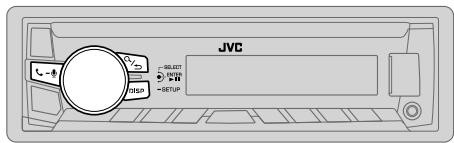
Receive a call
When there is an incoming call:
- All the buttons flash.
- The unit answers the call automatically if [AUTO ANSWER] is set to a selected time. ( 11)
During a call:
- If you turn off the unit or detach the faceplate, the Bluetooth connection is disconnected.
| To | On the faceplate |
| Answer a call | Press or the volume knob. |
| Reject a call | Press and hold or the volume knob. |
| End a call | Press and hold or the volume knob. |
| Adjust the phone volume [00] to [50] (Default: [15]*) | Turn the volume knob during a call.
·This adjustment will not affect the volume of the other sources. |
| Switch between hands-free and private talk modes | Press the volume knob during a call.
·Operations may vary according to the connected Bluetooth mobile phone. |
- Not applicable for iPhone. During a call, the unit synchronizes the phone volume on the iPhone to the unit.
Improve the voice quality
While talking on the phone....
1 Press and hold DISP-SETUP.
2 Turn the volume knob to make a selection (see the following table), then press the knob.
3 Repeat step 2 until the desired item is selected or activated.
4 Press DISP-SETUP to exit.
To return to the previous setting item, press Q/
Default: XX
| MIC LEVEL | -10 — +10 (—4): The sensitivity of the microphone increases as the number increased. |
| NOISE RDCT | -5 — +5 (0): Adjust the noise reduction level until the least noise is being heard during a phone conversation. |
| ECHO CANCEL | -5 — +5 (0): Adjust the echo cancellation delay time until the least echo is being heard during a phone conversation. |
Make the settings for receiving a call
1 Press to enter Bluetooth mode.
2 Turn the volume knob to make a selection (see the following table), then press the knob.
3 Repeat step 2 until the desired item is selected or activated.
To return to the previous setting item, press Q/
Default: XX
SETTINGS
AUTO ANSWER
01 SEC 30 SEC: The unit answers incoming call automatically in the selected time (in seconds).; OFF: Cancels.
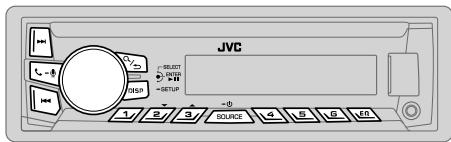
Make a call
You can make a call from the call history, phonebook, or dialing the number. Call by voice is also possible if your mobile phone has the feature.
1 Press to enter Bluetooth mode.
2 Turn the volume knob to make a selection (see the following table), then press the knob.
3 Repeat step 2 until the desired item is selected/activated or follow the instructions stated on the selected item.
To return to the previous setting item, press / .
| RECENT CALL | 1 Press the volume knob to select a name or a phone number.
·“>” indicates call received, “<” indicates call made, “M” indicates call missed.
·“NO HISTORY” appears if there is no recorded call history or call number.
2 Press the volume knob to call. |
| PHONEBOOK | 1 Press 3▲/2▼ to select the desired letter (A to Z, 0 to 9, and OTHERS).
·“OTHERS” appears if the first character is other than A to Z, 0 to 9.
2 Turn the volume knob to select a name, then press the knob.
3 Turn the volume knob to select a phone number, then press the knob to call.
·If the phone supports PBAP, the phonebook of the connected phone is automatically transferred to the unit when pairing.
·This unit can display only non-accent letters. (Accent letters such as “U” is shown as “U”). |
| DIAL NUMBER | 1 Turn the volume knob to select a number (0 to 9) or character (×, #, +).
2 Press ↓← / ▷→ to move the entry position.
Repeat steps 1 and 2 until you finish entering the phone number.
3 Press the volume knob to call. |
| VOICE | Speak the name of the contact you want to call or the voice command to control the phone functions. (⇒ Make a call using voice recognition) |
Make a call using voice recognition
1 Press and hold to activate the connected phone.
2 Speak the name of the contact you want to call or the voice command to control the phone functions.
- Supported Voice Recognition features vary for each phone. Refer to the instruction manual of the connected phone for details.
- This unit also supports the intelligent personal assistant function of iPhone.
1 Press to enter Bluetooth mode.
2 Turn the volume knob to select [RECENT CALL], then press the knob.
3 Turn the volume knob to select a contact.
4 Press and hold / to enter delete mode.
5 Turn the volume knob to select [DELETE] or [DELETE ALL], then press the knob.
DELETE: Selected name or phone number in step 3 is deleted.
DELETE ALL: All names or phone numbers in [RECENT CALL] in step 2 is deleted.
6 Turn the volume knob to select [YES], then press the knob.
To return to the previous setting item, press / .
- Not applicable for mobile phone that supports PBAP.
Settings in memory
You can store up to 6 contacts into the number buttons (1 to 6).
1 Press to enter Bluetooth mode.
2 Turn the volume knob to select [RECENT CALL], [PHONEBOOK], or [DIAL NUMBER], then press the knob.
3 Turn the volume knob to select a contact or enter a phone number. If a contact is selected, press the volume knob to show the phone number.
4 Press and hold one of the number buttons (1 to 6). "MEMORY P(selected preset number)" appears when the contact is stored.
To erase a contact from the preset memory, select [DIAL NUMBER] in step 2 and store a blank number.
Make a call from memory
1 Press to enter Bluetooth mode.
2 Press one of the number buttons (1 to 6).
3 Press the volume knob to call. "NO PRESET" appears if there is no contacts stored.
Bluetooth mode settings
1 Press and hold DISP-SETUP.
2 Turn the volume knob to select [BLUET00TH], then press the knob.
3 Turn the volume knob to make a selection ( 13) , then press the knob.
4 Repeat step 3 until the desired item is selected/activated or follow the instructions stated on the selected item.
5 Press DISP-SETUP to exit.
To return to the previous setting item, press Q .
Default: XX
| PHONE*1 | Selects the phone or audio device to connect or disconnect.
“*” appears in front of the device name when connected. |
| AUDIO*1 |
| APPLICATION*1 | Shows the connected phone name using the JVC Smart Music Control*2 app. “*” appears in front of the device name when connected. |
| DELETE PAIR | 1 Turn the volume knob to select a device to delete, then press the knob.
2 Turn the volume knob to select [YES] or [NO], then press the knob. |
| SET PINCODE (0000) | Changes the PIN code (up to 6 digits).
1 Turn the volume knob to select a number.
2 Press !←/▶→to move the entry position.
Repeat steps 1 and 2 until you finish entering the PIN code.
3 Press the volume knob to confirm. |
| AUTO CNT | ON: The unit automatically reconnect when the last connected Bluetooth device is within range.; OFF: Cancels. |
| AUTO PAIR | ON: The unit automatically pair supported Bluetooth device (iPhone/ iPod touch/Android device) when it is connected through USB input terminal. Depending on the operating system of the connected device, this function may not work.; OFF: Cancels. |
| INITIALIZE | YES: Initialized all the Bluetooth settings (including stored pairing, phonebook, and etc.); NO: Cancels. |
| INFORMATION | MY BT NAME: Displays the unit name (JVC UNIT).;
MY ADDRESS: Shows address of this unit. |
1 You can only connect another Bluetooth device by disconnecting the connected Bluetooth device first. "×" disappears when disconnected.
2 JVC Smart Music Control is designed to view JVC car receiver status and perform simple control operations on Android smart phones. For JVC Smart Music Control operations, visit JVC website: http://www.jvc.net/cs/car/.
Bluetooth compatibility check mode
You can check the connectivity of the supported profile between the Bluetooth device and the unit.
- Make sure there is no Bluetooth device paired.
1 Press and hold
"BLUETOOTH" "CHECK MODE" appears. "SEARCH NOW USING PHONE" "PIN IS 0000" scrolls on the display.
2 Search and select "JVC UNIT" on the Bluetooth device within 3 minutes.
3 Perform (A), (B) or (C) depending on what appears on the display.
(A) "PAIRING" "XXXXXX" (6-digit passkey): Ensure that the same passkey appears on the unit and Bluetooth device, then operate the Bluetooth device to confirm the passkey.
(B) "PAIRING" "PIN IS 0000": Enter "0000" on the Bluetooth device.
(C) "PAIRING": Operate the Bluetooth device to confirm pairing.
After pairing is successful, "PAIRING OK" "[Device Name]" appears and Bluetooth compatibility check starts.
If "CONNECT NOW USING PHONE" appears, operate the Bluetooth device to allow phonebook access to continue.
The connectivity result flashes on the display.
"PAIRING OK" and/or "H.FREE OK"1 and/or "A STREAM OK"2 and/or "PBAP OK"*3: Compatible
1 Compatible with Hands-Free Profile (HFP)
2 Compatible with Advanced Audio Distribution Profile (A2DP)
*3 Compatible with Phonebook Access profile (PBAP)
After 30 seconds, "PAIRING DELETED" appears to indicate that pairing has been deleted, and the unit exits check mode.
- To cancel, press and hold SOURCE- to turn off the power, then turn on the power again.
BLUETOOTH—Audio
Audio player via Bluetooth
1 Press SOURCE- repeatedly to select BT AUDIO.
2 Operate the Bluetooth audio player to start playback.
| To | On the faceplate |
| Playback / pause | Press Q/→. |
| Select group or folder | Press 3 ▲/2 ▼. |
| Reverse /
Forward skip | Press ↓/▶L. |
| Reverse / Fast-forward | Press and hold ↓/▶L. |
| Repeat play | Press 5 ⊙ repeatedly.
TRACK RPT, ALL RPT, RPT OFF |
| Random play | Press 4 ×× repeatedly.
GROUP RND, ALL RND, RND OFF |
Operations and display indications may differ according to their availability on the connected device.
AUDIO SETTINGS
| To | On the faceplate |
| Select a preset equalizer | Press EQ-EASY EQ repeatedly. |
| Press EQ-EASY EQ, then turn the volume knob within 2 seconds.Preset equalizer: FLAT (default), HARD ROCK, JAZZ, POP,R&B, TALK, USER1, USER2, VOCAL BOOST, BASS BOOST,CLASSICAL, DANCE |
| Store your own sound settings | 1 Press and hold EQ-EASY EQ.2 Turn the volume knob to select [EASY EQ], then press the knob.3 Turn the volume knob to select [USER1] or [USER2], then press the knob.4 Turn the volume knob to make a selection, then press the knob.For settings, refer to step 2 of [EASY EQ]. (→ 15)• To return to the previous setting item, press Q/→.• To exit, press EQ-EASY EQ. |
Other settings
1 Press and hold DISP-SETUP.
2 Turn the volume knob to make a selection ( 15) , then press the knob.
3 Repeat step 2 until the desired item is selected/activated or follow the instructions stated on the selected item.
4 Press DISP-SETUP to exit.
To return to the previous setting item, press .
Default: XX
| EQ SETTING |
| EQ PRESET | FLAT / HARD ROCK / JAZZ / POP / R&B / TALK / USER1 / USER2 / VOCAL BOOST / BASS BOOST / CLASSICAL / DANCE: Selects a preset equalizer. |
| EASY EQ | 1 USER1/ USER2: Select a preset name. |
| 2 Adjust your own sound settings. |
| SUB.W SP*1*2: 00 to +06 (Default: 03) |
| SUB.W*1*3: -08 to +08 00 |
| BASS LVL: -06 to +06 00 |
| MID LVL: -06 to +06 00 |
| TRE LVL: -06 to +06 00) |
| PRO EQ | 1 USER1/ USER2: Select a preset name. |
| 2 BASS / MIDDLE / TREBLE: Select a sound tone. |
| 3 Adjust the sound elements of the selected sound tone. |
| BASS Frequency: 60/80/100/200 HZ (Default: 80 Hz) |
| Level: -06 to +06 00 |
| Q: Q1.0/Q1.25/Q1.5/Q2.0 01.0) |
| MIDDLE Frequency: 0.5/1.0/1.5/2.5 KHZ (Default: 1.0 KHZ) |
| Level: -06 to +06 00 |
| Q: Q0.75/Q1.0/Q1.25 01.25) |
| TREBLE Frequency: 10.0/12.5/15.0/17.5 KHZ (Default: 10.0 KHZ) |
| Level: -06 to +06 00 |
| Q: Q FIX 0 FIX) |
| AUDIO |
| BASS BOOST | +01 / +02: Selects your preferred bass boost level. ; OFF: Cancels. |
| LOUD | 01 / 02: Boosts low or high frequencies to produce a well-balanced sound at low volume. ; OFF: Cancels. |
| SUB.W LEVEL*1 | SPK-OUT*2 00 to +06 (+03): Adjusts the output level of the subwoofer connected via speaker lead. (⇒ 16) |
| PRE-OUT*3 -08 to +08 (00): Adjusts the output level of the subwoofer connected to the lineout terminals (REAR/ SW) through an external amplifier. (⇒ 16) |
| SUB.W*3 | ON / OFF: Turns on or off the subwoofer output. |
| SUB.W LPF*1 | THROUGH: All signals are sent to the subwoofer. ; LOW 55HZ / MID 85HZ / HIGH 120HZ: Audio signals with frequencies lower than 55 Hz/ 85 Hz/ 120 Hz are sent to the subwoofer. |
| SUB.W PHASE*1 | REVERSE (180°)/ NORMAL (0°): Selects the phase of the subwoofer output to be in line with the speaker output for optimum performance. (Selectable only if a setting other than [THROUGH] is selected for [SUB.W LPF].) |
| FADER | R06 — F06 (00): Adjusts the front and rear speaker output balance. |
| BALANCE*4 | L06 — R06 (00): Adjusts the left and right speaker output balance. |
| VOL ADJUST | -05 — +05 (00): Presets the volume adjustment level of each source (compared to the FM volume level). Before adjustment, select the source you want to adjust. ("VOL ADJ FIX" appears if FM is selected.) |
1 Displayed only when [SUB.W] is set to [ON].
2 Displayed only when [SPK/PRE OUT] is set to [SUB.W/SUB.W]. (→ 16)
3 Displayed only when [SPK/PRE OUT] is set to [REAR/SUB.W] or [SUB.W/SUB.W]. (→ 16)
4 This adjustment will not affect the subwoofer output.
AUDIO SETTINGS
| AMP GAIN | LOW POWER: Limits the maximum volume level to 30. (Select if the maximum power of each speaker is less than 50 W to prevent damaging the speakers.); HIGH POWER:The maximum volume level is 50. |
| D.T.exp(Digital Track Expander) | ON: Creates realistic sound by compensating the high-frequency components and restoring the rise-time of the waveform that are lost in audio data compression.; OFF: Cancels. |
| SPK/PRE OUT | Selects the appropriate setting to get the desired output. (See the following table.) |
SPK/PRE OUT
Connection via lineage terminals ( 23)
| Setting | Lineout terminal |
| FRONT | REAR/SW |
| REAR/REAR | Front speakers output | Rear speakers output |
| REAR/SUB.W | Front speakers output | Subwoofer output |
| SUB.W/SUB.W | Front speakers output | Subwoofer output |
Connection via speaker leads ( 23)
| Setting | Rear speaker lead |
| L (left) | R (right) |
| REAR/REAR | Rear speakers output | Rear speakers output |
| REAR/SUB.W | Rear speakers output | Rear speakers output |
| SUB.W/SUB.W | Subwoofer output | (Mute) |
If [SUB.W/SUB.W] is selected:
- [HIGH 120HZ] is selected in [SUB.W LPF] and [THROUGH] is not available.
-R01] is selected in [FADER] and selectable range is [R06] to [00]
DISPLAY SETTINGS
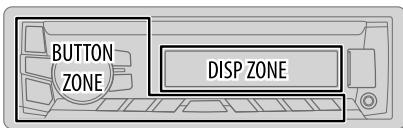
1 Press and hold DISP-SETUP.
2 Turn the volume knob to make a selection (see the following table), then press the knob.
3 Repeat step 2 until the desired item is selected/activated or follow the instructions stated on the selected item.
4 Press DISP-SETUP to exit.
To return to the previous setting item, press .
Default: XX
| DISPLAY |
| DIMMER | Selects the display and button illumination adjusted in the [BRIGHTNESS] setting.
OFF: Selects the day adjustments. ; ON: Selects the night adjustments. ;
DIMMER TIME: Adjusts the dimmer on and off time.
Turn the volume knob to adjust the [ON] time, then press the knob.
Turn the volume knob to adjust the [OFF] time, then press the knob.
(Default: [ON]: 18:00 or 6:00 PM
[OFF]: 6:00 or 6:00 AM)
AUTO: Changes between the day and night adjustments when you turn off or on the car headlights. *1 |
*1 The illumination control wire connection is required. (→23)
DISPLAY SETTINGS
BRIGHTNESS Sets the button, display and USB input terminal brightness for day and night separately.
1 DAY/NIGHT:Select day or night.
2 Select a zone for setting. ( 16)
3 Set the brightness level (00 to 31).
(Default: BUTTON ZONE: DAY: 25; NIGHT: 09
DISP ZONE: DAY: 31; NIGHT: 12)
SCROLL*2 ONCE: Scrolls the display information once. ; AUTO: Repeats scrolling at 5-second intervals. ; OFF: Cancels.
*2 Some characters or symbols will not be shown correctly (or will be blanked).
Playable files
- Playable audio file: MP3 (.mp3), WMA (.wma), AAC (.m4a), WAV (.wav), FLAC (.flac)
- Playable USB device file system: FAT12, FAT16, FAT32
Even when audio files comply with the standards listed above, playback may be impossible depending on the types or conditions of media or device.
About USB devices
- This unit can play MP3/WMA/AAC/WAV/FLAC files stored on a USB mass storage class device.
- You cannot connect a USB device via a USB hub.
-
Connecting a cable whose total length is longer than 5m may result in abnormal playback.
The maximum number of characters for:
-
Folder names: 64 characters
- File names: 64 characters
- MP3 Tag: 64 characters
WMA Tag: 64 characters
AAC Tag: 64 characters
WAV Tag: 64 characters
-
FLAC Tag: 64 characters
-
This unit can recognize a total of 20 480 files, 999 folders (999 files per folder including folder without unsupported files), and of 8 hierarchies.
- This unit cannot recognize a USB device whose rating is other than 5V and exceeds 1 A.
About iPod/iPhone
Made for
- iPod touch (2nd, 3rd, 4th, and 5th generation)
- iPod classic
- iPod nano (3rd, 4th, 5th, 6th, and 7th generation)
- iPhone 3G, 3GS, 4, 4S, 5, 5S, 5C
- It is not possible to browse video files on the "Videos" menu in [HEAD MODE].
- The song order displayed on the selection menu of this unit may differ from that of the iPod/ iPhone.
- If some operations are not performed correctly or as intended, visit: http://www.jvc.net/cs/car/.
About Android device
- This unit supports Android OS 4.1 and above.
- Some Android devices (with OS 4.1 and above) may not fully support Android Open Accessory (AOA) 2.0.
- If the Android device supports both mass storage class device and AOA 2.0, this unit always playback via AOA 2.0 as priority.
- For more information and the latest compatible list, see: http://www.jvc.net/cs/car/.
About Bluetooth
- Depending on the Bluetooth version of the device, some Bluetooth devices may not be able to connect to this unit.
- This unit may not work with some Bluetooth devices.
- Signal conditions vary, depending on the surroundings.
- For more information about Bluetooth, visit the following JVC website: http://www.jvc.net/cs/car/.
About JVC Playlist Creator and JVC Music Control
- This unit supports the PC application JVC Playlist Creator and Android™ application JVC Music Control.
- When you play audio file with song data added using the JVC Playlist Creator or JVC Music Control, you can search for audio file by Genres, Artists, Albums, Playlists, and Songs.
- JVC Playlist Creator and JVC Music Control are available from the following web site: http://www.jvc.net/cs/car/.
Available Cyrillic letters

Available characters
Display indications
| A | B | B | F | Д | Е | Ж | З | И | Й | К | Л | М | Н | О | Р |
| I | E | B | F | E | W | 3 | Ia | Ia | H | Ia | Ia | H | I | Ia | P |
| C | T | Y | Ф | X | Ч | Ч | Ш | Ч | b | b | b | э | Ю | Я | E |
| C | T | Y | Ф | X | Ч | Ll | Ul | Ul | I | I | I | I | I | I | E |
Press DISP-SETUP repeatedly.
| FM or AM | Station name (PS)*1 → Frequency → Program type (PTY)*1*2 → Title*1*2 → Day/Clock → (back to the beginning) *1 For FM Radio Data System stations only. *2 If unavailable, "NO PTY" / "NO TEXT" appears. |
| USB | Playing time → Day/Clock → Album title/Artist*3 → Track title*3 → Folder/file name → (back to the beginning) *3 If not recorded, "NO NAME" appears. |
| USB-IPOD | Playing time → Day/Clock → Album title/Artist*4 → Track title*4 → (back to the beginning) |
| USB-ANDROID | *4 If not recorded, "NO NAME" appears. |
| AUX | AUX ←→ Day/Clock |
| BT AUDIO | Playing time → Day/Clock → Album title/Artist*5 → Track title*5 → (back to the beginning) *5 If not recorded, "UNKNOWN" appears. |
TROUBLESHOOTING
| Symptom | Remedy |
| General | Sound cannot be heard. | ·Adjust the volume to the optimum level.
·Check the cords and connections. |
| "MISWIRING CHECK WIRING THEN PWR ON" appears. | Turn the power off, then check to be sure the terminals of the speaker wires are insulated properly. Turn the power on again. |
| "PROTECTING SEND SERVICE" appears. | Send the unit to the nearest service center. |
| Source cannot be selected. | Check the [SRC SELECT] setting. (⇒ 4) |
| Radio | ·Radio reception is poor.
·Static noise while listening to the radio. | ·Connect the antenna firmly.
·Pull the antenna out all the way. |
| USB / iPod | Playback order is not as intended. | The playback order is determined by the file name (USB). |
| Elapsed playing time is not correct. | This depends on the recording process earlier. |
| "Not SUPPORT" appears and file skips. | Check whether the file is a playable format. (⇒ 17) |
| "READING" keeps flashing. | ·Do not use too many hierarchical levels and folders.
·Reattach the USB device. |
| "CANNOT PLAY" flashes and/ or connected device cannot be detected. | ·Check whether the connected device is compatible with this unit and ensure the files are in supported formats. (⇒ 17)
·Reattach the device. |
| The iPod/iPhone does not turn on or does not work. | ·Check the connection between this unit and iPod/iPhone.
·Detach and reset the iPod/iPhone using hard reset. |
| Correct characters are not displayed. | This unit can only display uppercase letters, numbers, and a limited number of symbols. Uppercase Cyrillic letters can also be displayed if [РУСКИN] is selected. (⇒ 4) |
| Symptom | Remedy |
| ANDROID | ·Sound cannot be heard during playback.
·Sound output only from the Android device. | ·Reconnect the Android device.
·If in [AUDIO MODE], launch any media player application on the Android device and start playback.
·If in [AUDIO MODE], relaunch the current media player application or use another media player application.
·Restart the Android device.
·If this does not solve the problem, the connected Android device is unable to route the audio signal to unit. (⇒ 18) |
| Cannot playback at [AUTO MODE]. | ·Make sure JVC MUSIC PLAY APP is installed on the Android device. (⇒ 5)
·Reconnect the Android device and select the appropriate control mode. (⇒ 6)
·If this does not solve the problem, the connected Android device does not support [AUTO MODE]. (⇒ 18) |
| “NO DEVICE” or “READING” keeps flashing. | ·Switch off the developer options on the Android device.
·Reconnect the Android device.
·If this does not solve the problem, the connected Android device does not support [AUTO MODE]. (⇒ 18) |
| Playback is intermittent or sound skips. | Turn off the power saving mode on the Android device. |
| “CANNOT PLAY” | ·Make sure Android device contains playable audio files.
·Reconnect the Android device.
·Restart the Android device. |
| Bluetooth® | No Bluetooth device is detected. | · Search from the Bluetooth device again.
· Reset the unit. (→3) |
| Pairing cannot be made. | · Make sure you have entered the same PIN code to both the unit and Bluetooth device.
· Delete pairing information from both the unit and the Bluetooth device, then perform pairing again. (→9) |
| Echo or noise occurs. | · Adjust the microphone unit's position. (→9)
· Check the [ECHO CANCEL] setting. (→10) |
| Phone sound quality is poor. | · Reduce the distance between the unit and the Bluetooth device.
· Move the car to a place where you can get a better signal reception. |
| Sound is being interrupted or skipped during playback of a Bluetooth audio player. | · Reduce the distance between the unit and the Bluetooth audio player.
· Turn off, then turn on the unit and try to connect again.
· Other Bluetooth devices might be trying to connect to the unit. |
| The connected Bluetooth audio player cannot be controlled. | · Check whether the connected Bluetooth audio player supports Audio/Video Remote Control Profile (AVRCP). (Refer to the instructions of your audio player.)
· Disconnect and connect the Bluetooth player again. |
| “PAIRING FULL” | The number of registered devices has reached its limit. Retry after deleting an unnecessary device. (→13, DELETE PAIR) |
| “PLEASE WAIT” | The unit is preparing to use the Bluetooth function. If the message does not disappear, turn off and turn on the unit, then connect the device again. |
If you still have troubles, reset the unit. ( 3)
| Symptom | Remedy |
| Bluetooth® | “BT DEVICE NOT FOUND” | The unit failed to search for the registered Bluetooth devices during [AUTO CNTCT]. Turn on Bluetooth from your device and connect manually. (→ 13) |
| “NOT SUPPORT” | The connected phone does not support Voice Recognition feature. |
| “ERROR” | Try the operation again. If “ERROR” appears again, check if the device supports the function you have tried. |
| “H/W ERROR” | Reset the unit and try the operation again. If “H/W ERROR” appears again, consult your nearest service center. |
| “BT ERROR PLS UPDATE” | Update the Bluetooth firmware. (→ 4) |
SPECIFICATIONS
| Tuner | FM Frequency Range | 87.5 MHz — 108.0 MHz (50 kHz step) |
| Usable Sensitivity (S/N = 26 dB) | 0.71 μV/75 Ω |
| Quieting Sensitivity (DIN S/N = 46 dB) | 2.0 μV/75 Ω |
| Frequency Response (±3 dB) | 30 Hz — 15 kHz |
| Signal-to-Noise Ratio (MONO) | 64 dB |
| Stereo Separation (1 kHz) | 40 dB |
| AM | Frequency Range | MW | 531 kHz — 1 611 kHz (9 kHz step) |
| LW | 153 kHz — 279 kHz (9 kHz step) |
| Usable Sensitivity (S/N = 20 dB) | MW | 28.2 μV |
| LW | 50 μV |
| USB | USB Standard | USB 1.1, USB 2.0 (Full speed) |
| Compatible Devices | Mass storage class |
| File System | FAT12/ 16/ 32 |
| Maximum Supply Current | DC 5 V — — 1 A |
| D/A Converter | 24 Bit |
| Frequency Response (±1 dB) | 20 Hz — 20 kHz |
| Signal-to-Noise Ratio (1 kHz) | 105 dB |
| Dynamic Range | 88 dB |
| Channel Separation | 90 dB |
| MP3 Decode | Compliant with MPEG-1/2 Audio Layer-3 |
| WMA Decode | Compliant with Windows Media Audio |
| AAC Decode | AAC-LC“.m4a” files |
| WAV Decode | RIFF waveform Audio Format (Linear PCM only) |
| FLAC Decode | FLAC files |
| Auxiliary | Frequency Response (±3 dB) | 20 Hz — 20 kHz |
| Input Maximum Voltage | 1 000 mV |
| Input Impedance | 30 kΩ |
| Bluetooth | Version | Bluetooth Ver.2.1+EDR/ Bluetooth 3.0 |
| Frequency Range | 2.402 GHz — 2.480 GHz |
| Output Power | +4 dBm (MAX), 0 dBm (AVE) Power Class 2 |
| Maximum Communication Range | Line of sight approx. 10 m (32.8 ft) |
| Pairing | SSP (Secure Simple Pairing) |
| Profile | HFP1.6 (Hands-Free Profile)
A2DP (Advanced Audio Distribution Profile)
AVRCP1.4 (Audio/Video Remote Control Profile)
PBAP (Phonebook Access Profile)
SPP (Serial Port Profile) |
| Audio | Maximum Output Power | 50 W × 4 or
50 W × 2 + 50 W × 1 (Subwoofer = 4 Ω) |
| Full Bandwidth Power
(at less than 1 % THD) | 22 W × 4 |
| Speaker Impedance | 4 Ω — 8 Ω |
| Preout Level/Load (USB) | 2 500 mV/10 kΩ |
| Preout Impedance | ≤ 600 Ω |
| General | Operating Voltage
(10.5 V — 16 V allowable) | 14.4 V |
| Maximum Current Consumption | 10 A |
| Operating Temperature Range | 0°C to +40°C |
| Installation Size (W × H × D) | 182 mm × 53 mm × 108 mm |
| Weight | 0.60 kg |
Warning
- The unit can only be used with a 12 V DC power supply, negative ground.
- Disconnect the battery's negative terminal before wiring and mounting.
- Do not connect Battery wire (yellow) and Ignition wire (red) to the car chassis or Ground wire (black) to prevent a short circuit.
- Insulate unconnected wires with vinyl tape to prevent a short circuit.
- Be sure to ground this unit to the car's chassis again after installation.
Caution
- For safety's sake, leave wiring and mounting to professionals. Consult the car audio dealer.
- Install this unit in the console of your vehicle. Do not touch the metal parts of this unit during and shortly after use of the unit. Metal parts such as the heat sink and enclosure become hot.
- Do not connect the wires of speakers to the car chassis or Ground wire (black), or connect them in parallel.
- Connect speakers with a maximum power of more than 50W . If the maximum power of the speakers is lower than 50W , change the [AMP GAIN] setting to avoid damaging the speakers. ( 16)
- Mount the unit at an angle of less than 30^ .
- If your vehicle wiring harness does not have the ignition terminal, connect Ignition wire (red) to the terminal on the vehicle's fuse box which provides 12 V DC power supply and is turned on and off by the ignition key.
- Keep all cables away from heat dissipate metal parts.
- After the unit is installed, check whether the brake lamps, blinkers, wipers, etc. on the car are working properly.
- If the fuse blows, first make sure the wires are not touching car's chassis, then replace the old fuse with one that has the same rating.
Basic procedure
1 Remove the key from the ignition switch, then disconnect the terminal of the car battery.
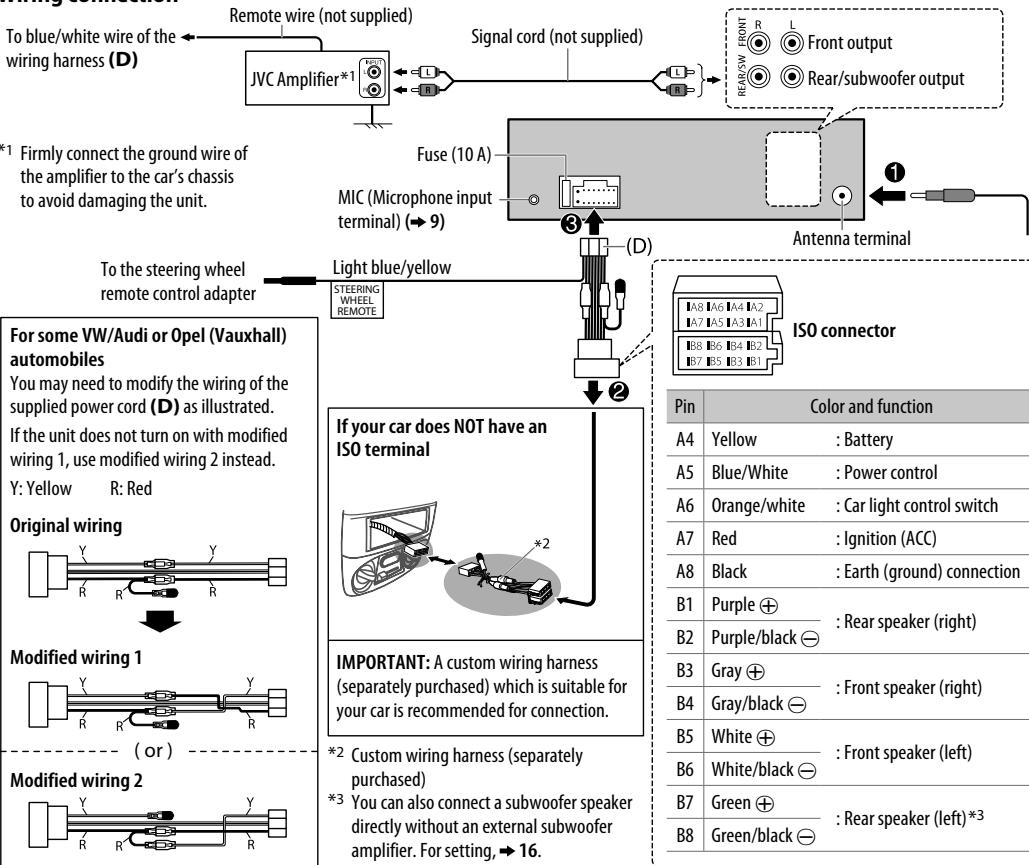
2 Connect the wires properly. See Wiring connection. (→ 23)
3 Install the unit to your car. See Installing the unit (in-dash mounting).
4 Connect the terminal of the car battery.
5 Reset the unit. ( 3)
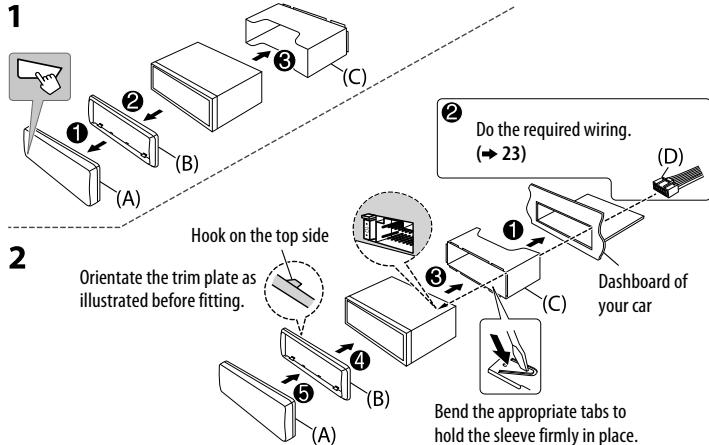
Installing the unit (in-dash mounting)
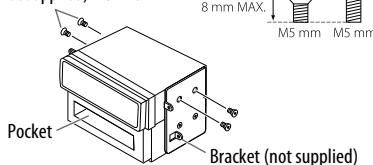
When installing without the mounting sleeve
Use only the specified screws. Using wrong screws might damage the unit.
Flat or round head screws (not supplied) M5× 8mm
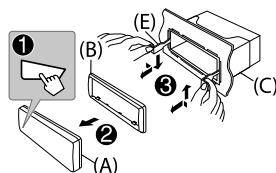
How to remove the unit
Wiring connection
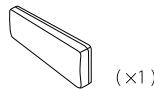
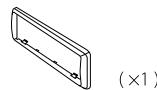
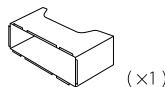
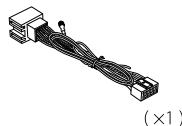
Part list for installation
(A) Faceplate
(B) Trim plate
(C) Mounting sleeve
(D) Wiring harness
(E) Extraction key
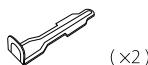
TABLE DES MATIERES
| AVANT L'UTILISATION | 2 |
| FONCTIONNEMENT DE BASE | 3 |
| PRISE EN MAIN | 4 |
| USB / iPod / ANDROID | 5 |
| RADIO | 7 |
| AUX | 8 |
| BLUETOOTH® | 9 |
| RéGLAGES AUDIO | 14 |
| RéGLAGES D'AFFICHAGE | 16 |
| PLUS D'INFORMATIONS | 17 |
| GUIDE DE DÉPANNAGE | 19 |
| SPECIFICATIONS | 21 |
| INSTALLATION / RACCORDEMENT | 22 |
AVANT L'UTILISATION
Avertissement
BLUETOOTH—Telephone portable
Copyright (C) 2000,2001,2002,2003,2004,2005,2006,2007,2008,2009 Josh Coalson Redistribution and use in source and binary forms, with or without modification, are permitted provided that the following conditions are met:
- Redistributions of source code must retain the above copyright notice, this list of conditions and the following disclaimer.
- Redistributions in binary form must reproduce the above copyright notice, this list of conditions and the following disclaimer in the documentation and/or other materials provided with the distribution.
- Neither the name of the Xiph.org Foundation nor the names of its contributors may be used to endorse or promote products derived from this software without specific prior written permission.
THIS SOFTWARE IS PROVIDED BY THE COPYRIGHT HOLDERS AND ONTRIButors "AS IS" AND ANY EXPRESS OR IMPLIED WARRANTY, INCLUDING, BUT NOT LIMITED TO, THE IMPLIED WARRANTYES OF MERCHANTABILITY AND FITNESS FOR A PARTICULAR PURPOSE ARE DISCLAIMED. IN NO EVENT SHALL THE FOUNDATION OR COLNTRIBUTORS BE LIABLE FOR ANY DIRECT, INDIRECT, INCIDENTAL, SPECIAL, EXEMPLARY, OR CONSEQUENTIAL DAMAGES (INCLUDING, BUT NOT LIMITED TO, PROCEDURE OF SUBSTITUTE GOODS OR SERVICES; LOSS OF USE, DATA, OR PROFITS; OR BUSINESS INTERUPTION) HOWEVER CAUSED AND ON ANY THEORY OF LIABILITY, WHETHER IN CONTRACT, STRICT LIABILITY, OR TORT (INCLUDING NEGLIGENCE OR OTHERWISE) ASING IN ANY WAY OUT OF THE USE OF THIS SOFTWARE, EVEN IF ADVISED OF THE POSSIBILITY OF SUCH DAMAGE.
- Microsoft and Windows Media are either registered trademarks or trademarks of Microsoft Corporation in the United States and/or other countries.
- "Made for iPod," and "Made for iPhone" mean that an electronic accessory has been designed to connect specifically to iPod, or iPhone, respectively, and has been certified by the developer to meet Apple performance standards. Apple is not responsible for the operation of this device or its compliance with safety and regulatory standards. Please note that the use of this accessory with iPod or iPhone may affect wireless performance.
- iPhone, iPod, iPod classic, iPod nano, and iPod touch are trademarks of Apple Inc., registered in the U.S. and other countries.
Lightning is a trademark of Apple Inc.
Android is trademark of Google Inc.
- The Bluetooth® word mark and logos are registered trademarks owned by Bluetooth SIG, Inc. and any use of such marks by JVC KENWOOD Corporation is under license. Other trademarks and trade names are those of their respective owners.


